
Benbrook City Zoning Code
CHAPTER 17
98 - LANDSCAPE AND BUFFER REQUIREMENTS
17.98.010 - Purpose.
The purpose of the landscaping and buffer requirements is to provide for the orderly and aesthetic development of the city. It is the intent of these requirements to:
A.
Provide a balance between the need for landscape treatments and the need for commercial growth in the city.
B.
Protect and enhance the community's environmental, economic, and aesthetic resources while promoting quality investment and enhancing community appearance.
C.
Promote a flexible attitude of enforcement sufficient to meet the spirit and intent of these requirements.
D.
Promote mutually beneficial improvements by utilizing incentives rather than penalties.
E.
To aid in stabilizing the environmental balance by contributing to the processes of air purification, oxygen regeneration, groundwater recharge, stormwater runoff retardation and erosion control.
F.
Provide for the separation and buffering of incongruous uses and intensity of activities and provide for the visual softening of building masses.
G.
Reduce glare from paved surfaces, dust nuisances and the impact of noise.
H.
Protect and promote the value of residential and commercial properties within the city.
I.
Promote a positive image for the attraction of new business enterprises within the city.
J.
Encourage the protection of healthy trees and vegetation and promote the natural ecological, environmental and aesthetic qualities of the city.
(Ord. No. 1344, § 1, 10-18-2012; Ord. No. 1398, § 10, 8-18-2016)
17.98.020 - Bufferyards and landscaping requirements.
A.
The requirements of this chapter shall apply to all new and additional residential and nonresidential construction.
B.
For the purposes of this chapter, the following zoning districts will apply:
1.
Residential
a.
Residential estate (RE)
b.
One family district (A)
c.
One family district (B)
d.
One family reduced district (BR)
2.
Multi-family
a.
Multiple family restricted district (CR)
b.
Multiple family district (C)
c.
Multiple family district (D)
d.
Mixed use district (MU)
3.
Nonresidential - all other zoning districts
C.
Buildings in existence on the effective date of this ordinance shall be considered legally nonconforming. Any new construction which exceeds two thousand five hundred square feet, or more than a thirty percent expansion of an existing building, shall be required to meet the requirements herein. Pad site developments or ground lease developments shall be required to provide landscaping in accordance with the interior landscaping requirements of Section 17.98.040 below. Bufferyard and landscaping requirements include required bufferyards, interior landscaping, parking lot landscaping and tree canopy requirements.
(Ord. No. 1344, § 1, 10-18-2012; Ord. No. 1398, § 10, 8-18-2016)
17.98.030 - Bufferyards.
Bufferyards shall be required in accordance with this section to separate different land uses from each other, to eliminate or minimize potential nuisances such as dirt, litter, noise, glare of lights, signs, and unsightly buildings or parking areas, or to provide spacing to reduce adverse impacts of noise, odor or danger from fire or explosions. Both the amount of land and the type and amount of planting and specified structures for each bufferyard are designed to lessen nuisances between adjacent incompatible land uses or between a land use and a public road.
A.
Location. Bufferyards shall be located within and along the outer perimeter of the developing lot or boundary line. Bufferyards may overlap drainage and/or utility easements; however, plantings should not impede the flow of water within a drainage easement. Bufferyards shall not be located on any portion of an existing or dedicated public street or right-of-way.
B.
Bufferyard Requirements.
1.
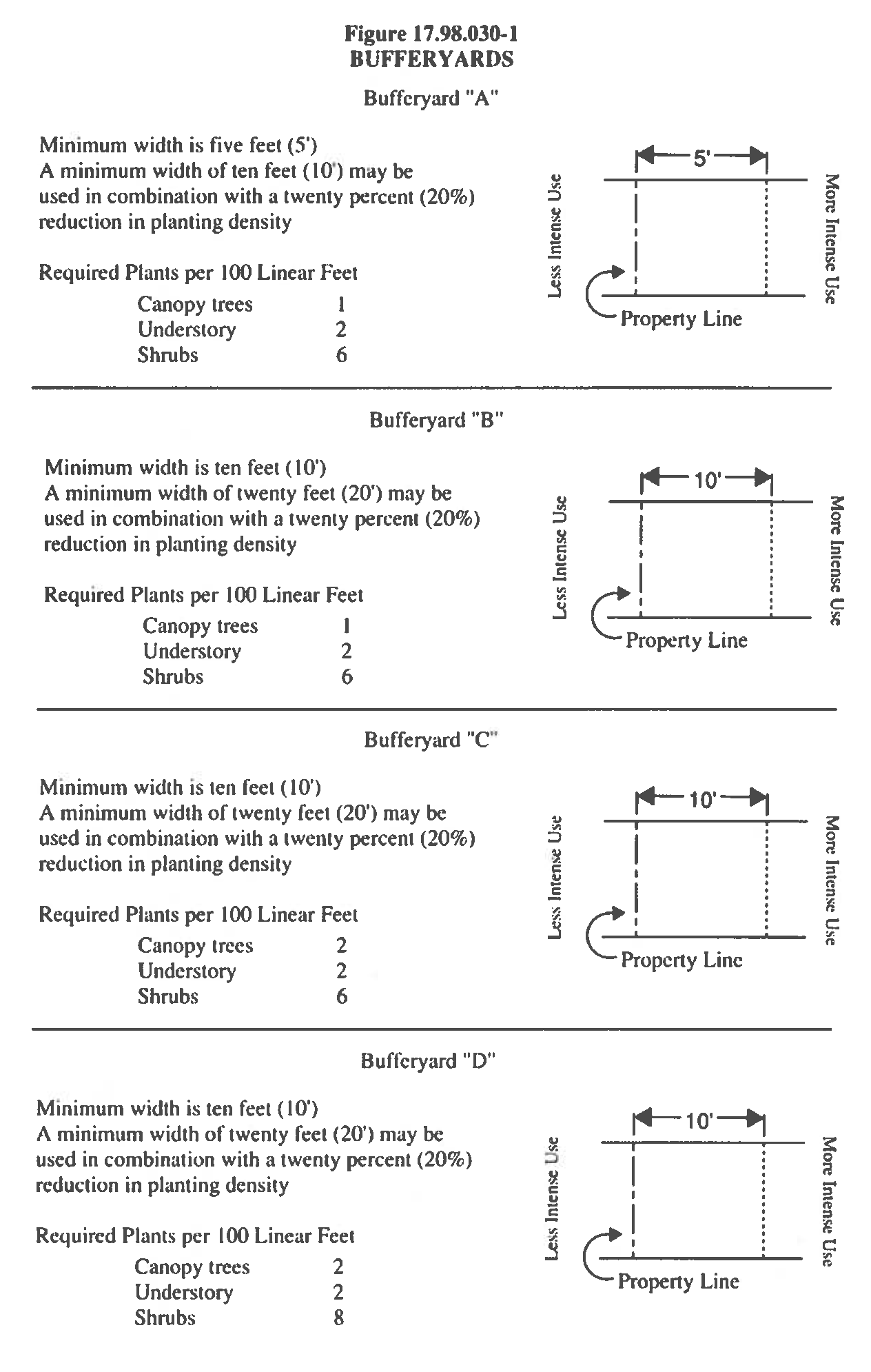
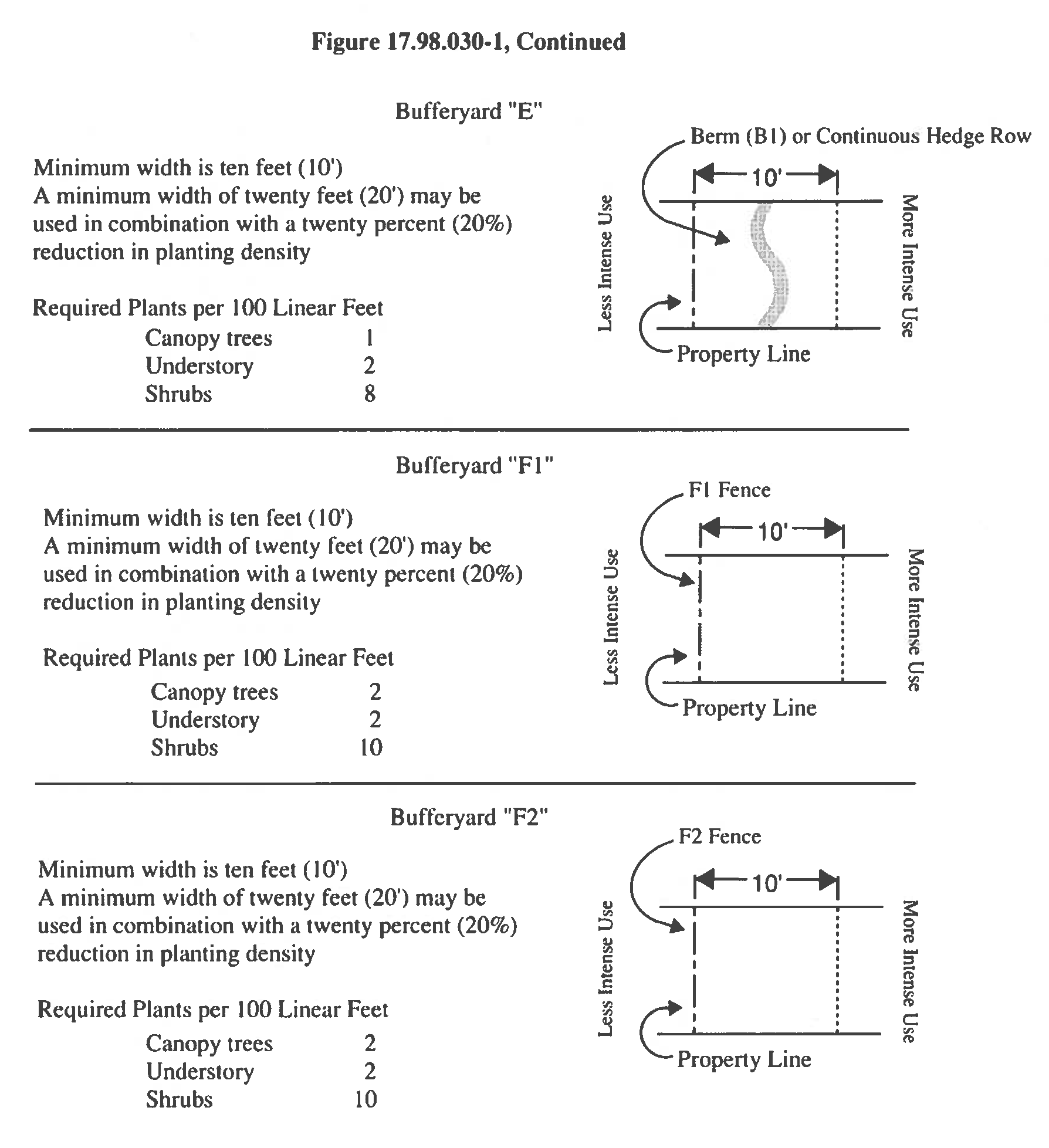
Tables 17.98.030 - A and 17.98.030 - B determine the type of bufferyard required between two adjacent parcels or a parcel and a roadway. The letter designations contained in the tables refer to the different bufferyards described in Figure 17.98.030-1, Illustration of Bufferyards, in this Chapter. The following is a summary of the bufferyards:
Table 17.98.030 - A
SUMMARY OF BUFFERYARDS
Plant material shall be credited to meet only one bufferyard (i.e. plants on corners do not satisfy two bufferyards).
2.
Existing Plant Credits: Existing trees which are within fifty feet of the property line and have a minimum of fifty percent of the drip line within a landscaped area shall be granted credits toward reducing the required plantings for canopy trees or understory trees as follows:
Table 17.98.030 - B
SUMMARY OF REDUCTIONS
Existing trees between 1-1/2" dbh and 6" dbh that are within the bufferyard may be granted credits on a one-for-one basis.
TABLE 17.98.030 - C
BUFFERYARDS ADJACENT TO OTHER LAND USES
* No bufferyard required.
1. Permitted Uses in "CF" Community Facilities District, as described in Chapter 17.24.022, and city parks and golf courses are exempt from buffer fence requirements.
2. Conditional Uses in "CF" Community Facilities District, as described in Chapter 17.24.024, are subject to buffer wall requirements in accordance with the conditional use permit.
3. Bufferyards required adjacent to single family residential districts in accordance to Chapter 17.75.
4. In unified commercial developments, interior bufferyards may be altered with approval of the Planning and Zoning Commission.
TABLE 17.98.030 - D
BUFFERYARDS REQUIRED ADJACENT TO STREETSb
* No bufferyard required
Notes:
a. An F2 screening fence and a five-foot bufferyard is required when the rear yards and/or side yards of a residential subdivision abut a frontage road, arterial, collector or local street. The screening wall and landscaping shall be located in a ten-foot screening wall and landscape easement with the wall located to the back of the easement between the landscaping and the residential lots. A minimum of seven and a half feet is required for landscaping.
b. The canopy tree requirement may be reduced on a one-for-one basis if street trees have been provided in accordance with Section 16.28.050 of the Benbrook Municipal Code (Subdivisions).
3.
Requirements for Plant Materials: Plant materials shall conform to Section 17.98.070 below. All bufferyards, unless grass or ground cover is already established, shall be seeded with grass or planted with ground cover so as to assure coverage within three years.
C.
Required Structures.
1.
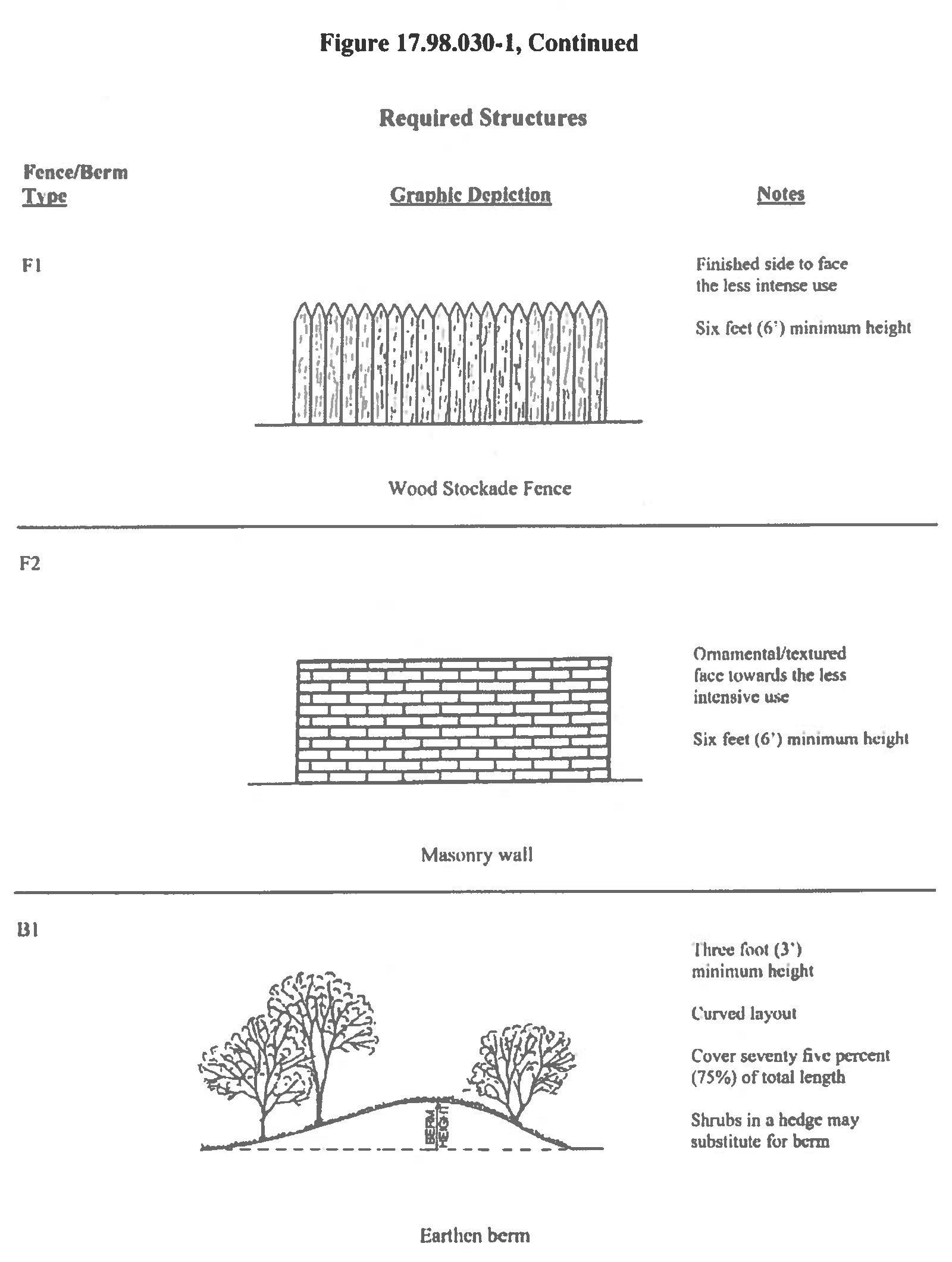
Walls and Fences: Whenever a wall and/or fence is required within a bufferyard, it shall be six feet in height and constructed in accordance with specifications set forth in the City's Design Standards and Criteria. A "F1" fence may be wood stockade; a "F2" wall and/or fence shall be of masonry construction. A "finished" side of a wall or fence shall face the residential or less intense land use side.
2.
Berms/Hedge: Whenever a berm is required in a bufferyard, it shall be a minimum of three feet in height and constructed in accordance with the specifications set forth in the city's design standards and criteria. Berms shall have side slopes no steeper than 2:1. When possible, all berms shall be curvilinear, rather than straight. Berms are not required to be continuous and are preferred to be broken periodically, but must cover a minimum of seventy-five percent of the length of the property line to be buffered. A hedge of plants obtaining a mature height greater than three feet may be substituted for a berm. When planting, this hedge shall be a minimum of two feet in height and planted no further than thirty inches on center. The hedge or berm shall not be permitted in the visibility triangle and/or public open space easement.
D.
Uses of Bufferyards: A bufferyard may be used for passive recreation, such as pedestrian, bike or equestrian trails, provided that (a) no plant material is eliminated, (b) the total width of the bufferyard is maintained, and (c) all other requirements of this section are met. Bufferyards may not be used for playfields, stables, swimming pools, tennis courts, accessory buildings, parking facilities or trash dumpster locations.
(Ord. No. 1344, § 1, 10-18-2012; Ord. No. 1361, § 2, 2-16-2014; Ord. No. 1393, § 27, 1-21-2016; Ord. No. 1398, § 10, 8-18-2016; Ord. No. 1487, § 20, 2-16-2023)
17.98.040 - Interior landscaping requirements.
A.
Interior Landscaping Requirements: The amount of landscape area required on the interior of the lot (excluding bufferyards) shall be based on the square footage of the building footprint of the proposed buildings.
For single story anchor tenants having more than twenty thousand square feet of floor area, the building square footage shall be the front width of the building multiplied by a depth of sixty feet.
The required landscape area for the zoning districts listed belowshall be ten percent of the floor area.
1.
Planting Requirements: The following plants shall be required within the interior landscape areas:
a.
One canopy tree per six hundred square feet.
b.
One understory tree per three hundred square feet.
c.
One shrub per one hundred twenty square feet.
d.
Ground cover—Ten percent of required area.
2.
Location requirements: A minimum of seventy-five percent of all required plant materials within the interior landscape area shall be in the front or along either side of the building between the building and the interior edge of the required bufferyards.
3.
Enhanced Pavement Credits: For every one square foot of enhanced pavement area, the required interior landscape area may be reduced by one-half square foot. The maximum credit given for enhanced pavement shall be ten percent of the required interior landscape area.
4.
Right-of-way Landscaping Credits: The required interior landscape area may be reduced by a maximum of ten percent when the applicant chooses to establish, irrigate and maintain turfgrass within the parkway along the front of their property. The percent credit given will be prorated based on the portion of the parkway irrigated (i.e. fifty percent parkway irrigated provides five percent credit).
B.
Residential Lots: Each residential lot shall have a minimum of one canopy tree within the required front yard.
Zoning Districts: SD, RE, A, B, BR, CR, C.
(Ord. No. 1344, § 1, 10-18-2012; Ord. No. 1398, § 10, 8-18-2016)
17.98.050 - Parking lot landscaping requirements.
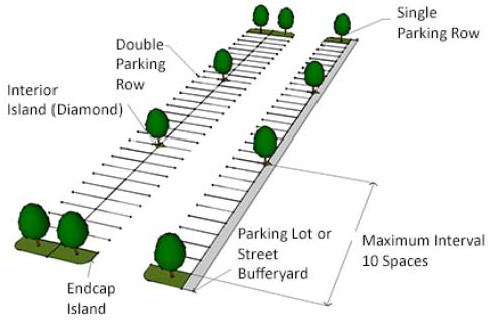
Interior planter islands shall be provided in parking areas on the basis of twenty square feet of landscape area for each parking space provided (approximately one island per ten spaces.) Each row of parking spaces shall provide the required landscape area. The building official may modify the island requirement for each row in situations where it would be beneficial to combine islands into a larger island. Planter islands shall have a minimum width of eight feet back to back, if curbed, or nine feet edge to edge if no curb is provided. Parking lot landscaping does not count toward the total required interior landscape area. See Figure 17.98.050 - A.
Figure 17.98.050 - A
PARKING LOT LANDSCAPING
Endcap Islands:
A.
All rows of spaces shall terminate in a curbed landscaped island. Each island shall conform to the specifications described for interior islands above. End islands are provided to define parking lot circulation, provide sight distance at the intersection of drive aisles and places for trees.
B.
Existing Trees: The building official may approve variations to the planter island requirements to preserve existing trees in interior parking areas. For existing trees, the minimum width of the planter island shall be as follows:
C.
Each endcap island shall have one hundred sixty square feet in area with nine feet in width back-of-curb to back-of-curb for a single row parking layout or three hundred twenty square feet in area with nine feet in width back-of-curb to back-of-curb for a double row parking layout. A minimum three-inch caliper canopy tree is required in each endcap island per parking row. A double parking row will require two trees in the endcap island.
Interior Islands:
A.
Interior islands may be a parking space or a diamond-shaped planter.
B.
A landscape island must be provided for every ten parking spaces.
C.
Each parking island must be a minimum of one hundred sixty square feet in area and nine feet in width back-of-curb to back-of-curb except where a diamond shaped interior island is proposed. A minimum three-inch caliper canopy tree is required in each.
D.
Interior island (with diamond-shaped planters) has a minimum of twenty-five square foot interior area (exclusive of perimeter curbing) with minimum interior dimensions of five feet by five feet. The minimum exterior area (including perimeter curbing) is thirty-six square feet. Parking lot trees shall be planted to align with the ends of parking lot stripes (between cars) and away from light standards, in order to create adequate shade canopies, and avoid damage to tree trunks.
E.
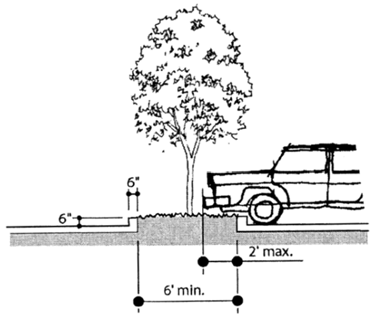
Diamond-shaped planters shall be a minimum of six feet in width with a six inch height and six inch width curb. A two feet clearance between the inside of the curb and the circumference trunk of the tree is required to avoid damage to the tree trunks. See Figure 17.98.050 - B.
F.
Interior islands may be consolidated or intervals may be expanded to preserve existing trees.
G.
Existing Trees: The building official may approve variations to the planter island requirements to preserve existing trees in interior parking areas. For existing trees, the minimum width of the planter island shall be as follows:
Figure 17.98.050 - B
DIAMOND-SHAPED PLANTER CURB REQUIREMENTS
Parking adjacent to street bufferyard or other parking lot:
When a parking aisle is immediately adjacent to the street bufferyard such that the parking is generally perpendicular (not parallel) to the required bufferyard, a berm will be required. If shall be a minimum of three feet in height and constructed in accordance with the specification set forth in the city's design standards and criteria. Berms shall have side slopes no steeper than 2:1. Berms must cover a minimum of seventy-five percent of the length of the property line to be buffered.
(Ord. No. 1344, § 1, 10-18-2012; Ord. No. 1398, § 10, 8-18-2016)
17.98.060 - Landscape and tree canopy requirements.
The following requirements shall apply to all developments within city limits:
A.
The minimum percentages of landscape and tree canopy requirements are listed in Table 17.98.060-A entitled Landscape and Tree Canopy Requirements. Landscaping that is preserved from natural conditions, or is provided to meet the bufferyard, parking lot, or interior landscaping requirement may be counted toward meeting the minimum coverage requirements in this subsection.
B.
The following may count towards meeting the landscape and tree canopy requirements:
1.
Undisturbed vegetative areas, natural areas, or native landscape areas.
2.
Landscaping in the adjacent public right-of-way.
3.
Plazas and pedestrian circulation areas if constructed with pervious material.
4.
Landscaping in the parking lot.
5.
Landscaping in bufferyards.
6.
Interior plantings.
C.
Landscape Areas: Landscape area is the portion of a site which is not defined as "lot coverage" and meets the definition in Chapter 17.08 of this title.
D.
Tree Canopy: Tree canopy is measured by computing the area that the mature canopy will encompass based on the tree list contained in Table 17.98.060-B. The mature canopies shall be estimated for existing trees on site. Any tree not on the tree list shall be estimated by use of standard landscaping references.
E.
Artificial Lot Line: An artificial lot is intended to provide administrative relief for large sites that will achieve planting areas that exceed substantially more than twenty percent of gross platted lot area after development is completed. The use of artificial lots is limited by the following:
1.
If the platted property is over two acres in size, the applicant may request permission to create an "artificial lot" to satisfy the requirements of this subsection.
2.
The planning director may approve the creation of an artificial lot only if the spirit and intent of this chapter will not be violated. If approved by the director, artificial lot lines shall be indicated on the proposed landscape plan and shall contain, at minimum, the total amount of impervious surface coverage, plus twenty percent of the area inside the artificial lot reserved for required planting area.
3.
The area within the artificial lot lines shall provide trees and landscaping in compliance with the requirement of this section, and may not extend beyond the property boundaries of a single platted lot.
4.
The artificial lot lines must be delineated on plans approved by the director prior to the issuance of a building permit. The area outside the artificial lot shall be maintained as planting area with live vegetation determined by the applicant. No trees located outside the artificial lot lines may be used for tree credits.
5.
The artificial lot lines shall include areas that are adjacent to a public right-of-way or are necessary to accomplish buffering of adjacent properties.
Table 17.98.060-A
MINIMUM LANDSCAPE AND TREE CANOPY REQUIREMENTS
Table 17.98.060-B
STANDARD TREE CHARACTERISTICS
(Ord. No. 1344, § 1, 10-18-2012; Ord. No. 1398, § 10, 8-18-2016; Ord. No. 1487, § 19, 2-16-2023)
17.98.070 - Plant materials.
A.
Quality Standard: All plant material shall be of No. 1 grade, free from plant disease, of typical growth for the species, have a healthy, normal root system, rounded branching pattern, and shall conform to the code of standards set forth in the current edition of the American Standard for Nursery Stock.
B.
Recommended Plants: A list of recommended plants within each plant material type is included in Table 17.98.070. Plants designated as native and/or adapted are recommended. Plants designated with an "I" require irrigation. The applicant may propose plants other than those listed if the plant is appropriate for the intended use or the applicant maintains a plant care program sufficient to properly care for the proposed plant material.
Plant materials shall be appropriate for the region and local soil conditions and shall be planted in accordance with good horticultural practice. Plants selected should require only low maintenance and should be temperature and drought tolerant. The applicant is encouraged to refer to the Texas Smartscape website (www.txsmartscape.com) for additional information on native and adapted species.
C.
Size Requirements When Planted: All plants shall equal or exceed the following measurements when planted. Plants larger than specified may be used, but use of such plants shall not decrease the size requirements of other proposed plants.
1.
Tree measurement: Canopy and understory trees with single trunks shall be measured by caliper size one foot above the ground line. Multi-trunk trees shall be measured by the height of the tree.
2.
Minimum sizes: The minimum plant size when planted shall be as follows:
The planning director or building official may approve smaller size shrubs based on unusual growing circumstances and/or on a specific design which reflects the overall intent of this section.
_____
TABLE 17.98.070
RECOMMENDED PLANTS
The city reserves the right to approve plants and planting through an appointed horticulturist, landscape architect, or other persons so qualified.
N = Native,
A = Adapted
I = Requires irrigation
LW = Low water demand
(Ord. No. 1344, § 1, 10-18-2012; Ord. No. 1356, § 9, 10-17-2013; Ord. No. 1398, § 10, 8-18-2016)
17.98.080 - Landscape/irrigation plan requirements.
A.
Qualification to Prepare Plans: Landscape plans shall be prepared by a registered landscape architect, landscape designer or landscape contractor knowledgeable in plant materials and landscape design. Irrigation plans shall be prepared by a licensed irrigator or landscape architect, and may be submitted after the landscape plan is in approvable form. Irrigation permits are required from the Benbrook Water Authority (BWA) and owner must conform to all BWA regulations.
B.
Landscape Plan Requirements: The following items shall be provided on the required landscape plan:
1.
Sheet size twenty-four-inch by thirty-six-inch, or as approved;
2.
Acceptable scale: 1″ = 10′, 1″ = 20′, 1″ = 40′, or as approved;
3.
North arrow, graphic and written scale;
4.
Appropriate title (i.e. "Landscape Plan");
5.
Title block, including street address, legal description, and date of preparation;
6.
Name and address of owner;
7.
Name, address and telephone number of person preparing plan;
8.
Property line shown with dimensions;
9.
Existing utilities (water, sewer, storm drain, gas, electric, cable TV, etc.);
10.
Width and type of bufferyards labeled on all sides;
11.
Location, size and species of all existing trees six-inch dbh or greater which are to be preserved;
12.
Location, quantity, size and species of all proposed plant materials;
13.
Maintenance note (see Section 17.98.080);
14.
Label type of any enhanced pavement proposed;
15.
Visibility triangles shown;
16.
Seal and dated signature of landscape architect (if applicable);
17.
Plant list; and
18.
Any berms delineated with one-foot contours.
C.
Irrigation Requirements: The city encourages water conservation through the use of native and/or adapted plant materials. Landscaping using plants in Table 17.98.070 designated as having low water demand (LW) do not require permanent irrigation. Temporary irrigation may be necessary during the initial period of plant establishment. Landscapes using non-native species or a mixture of native and non-native species require an irrigation system to maintain plant viability. The planning director has the ultimate authority to determine whether an irrigation system is required or not. The city encourages the use of irrigation systems with rain sensors and drip irrigation to promote efficient use of water.
D.
Irrigation Plan Requirements: The following items shall be provided on the required irrigation plan:
1.
Sheet size twenty-four inch by thirty-six inch, or as approved;
2.
Acceptable scale: 1″ = 10′, 1″ = 20′, 1″ = 40′, or as approved;
3.
North arrow, graphic and written scale;
4.
Appropriate title (i.e. "Irrigation Plan");
5.
Title block including street address, legal description, and date of preparation;
6.
Name and address of owner;
7.
Name, address and telephone number of person preparing plan;
8.
Property line with dimensions;
9.
Location of all existing trees six-inch dbh or larger which are to be saved in accordance with the tree survey;
10.
All pipes labeled as to size;
11.
All sprinkler heads labeled as to type (key is acceptable);
12.
Backflow prevention device labeled with type and size;
13.
Location of water meter and connection to water service;
14.
Any existing utilities (water, sewer, storm drain, gas, electric, cable TV, etc.);
15.
Note indicating that installation must be inspected by the Benbrook Water Authority (Telephone Number 817-249-1250);
16.
Maintenance note indicated; and
17.
Seal and dated signature of professional who prepared plan.
(Ord. No. 1344, § 1, 10-18-2012; Ord. No. 1356, § 9, 10-17-2013; Ord. No. 1398, § 10, 8-18-2016)
17.98.090 - Maintenance.
A.
General: The owner, tenant and the agent, if any, shall be jointly and severably responsible for the maintenance of all landscaping and irrigation. All required landscaping shall be maintained in a neat and orderly manner at all times. This shall include mowing, edging, pruning, fertilizing, watering, weeding, and other such activities common to the maintenance of landscaping. Landscaped areas shall be kept free of trash, litter, weeds and other such material or plants not a part of the landscaping. All plant materials shall be maintained in a healthy and growing condition as is appropriate for the season of the year. All irrigation heads or lines that are broken and flow water shall be replaced or repaired immediately to prevent the waste of water.
B.
Plant Replacement: The owner shall be responsible for replacing all plant materials required by the zoning ordinance and subdivision ordinance (landscape bufferyards, interior landscape area, parking area, and street trees) which shows dead branching over seventy-five percent or more of the normal branching pattern and repair irrigation system. Plant materials which die shall be replaced with plant material of similar variety and similar initial size. The owner shall make such necessary replacements within thirty days of notification by the city.
(Ord. No. 1398, § 10, 8-18-2016)

