
Big Flats City Zoning Code
CHAPTER 17
04 - INTRODUCTORY PROVISIONS AND DEFINITIONS
17.04.010 - Short title.
This title shall be known as the "Zoning Law of the Town of Big Flats, N.Y." and may also be referenced as "BFZL".
(LL No. 1, 2021, § 1)
17.04.020 - Authority.
Pursuant to the Municipal Home Rule Law of the Consolidated Laws of New York State, the Town of Big Flats Town Board in the County of Chemung, State of New York, resolves, enacts, and publishes the following provisions.
(LL No. 1, 2021, § 1)
17.04.030 - Precedence of more restrictive standards.
The provisions of this chapter are in addition to the provisions set forth in other town laws or regulations, as well as any other lawfully adopted rules, regulations, or ordinances, including but not limited to those of Chemung County, the State of New York, or the United States. Wherever the requirements of this chapter are at variance with the requirements of other lawfully adopted rules, regulations, or ordinances, the more restrictive or that imposing the higher standards shall govern.
(LL No. 1, 2021, § 1)
17.04.040 - Purpose.
The zoning requirements and districts set forth and the districts identified upon the zoning map of the town are made to promote public health, safety, and general welfare of the community; and specifically:
A.
To encourage the most appropriate use of land in the community in order to conserve and protect the value of property;
B.
To eliminate the sprawl of development and provide for more adequate and suitably located commercial facilities and consequently eliminate road-side hazards and add to community attractiveness;
C.
To create a suitable system of open spaces and recreation areas, and to protect and enhance existing wooded areas, scenic areas, farmlands, and waterways;
D.
To protect groundwater resources which serve as public and private sources of water supply;
E.
To regulate development densities in order to assure access to light and circulation of air, to facilitate the prevention and fighting of fires, to prevent undue concentration of population, to lessen congestion on roads, to provide efficient municipal utility services, and to accommodate solar energy systems and equipment and access to sunlight necessary thereto;
F.
To improve transportation facilities and traffic circulation, and to provide adequate off-road parking and loading facilities;
G.
To assure privacy for residents and freedom from public nuisances and things harmful to the health, safety, and general welfare of the community;
H.
To protect the community against unsightly, obtrusive, and nuisance land uses and operations;
I.
To enhance the aesthetic aspects throughout the entire town and maintain its natural beauty; and
J.
To provide an opportunity for occupancy of housing or uses of land to all people regardless of race, creed, sex, color, national origin, age, disability, or marital status.
This title has been made with reasonable consideration for the character of each district and a district's suitability for particular uses, and with a view to conserving and protecting the value of the property, to encourage the most appropriate uses of the land throughout the town.
These purposes are achieved through this title by regulating and restricting the height, number of stories, and size of buildings and other structures; restricting the density of population; regulating the size of yards and other open spaces; regulating and restricting the location and use of a building structure and lot for trade, industry, residential or other purposes; creating districts for such purposes and establishing their boundaries; continuing a zoning board of appeals to determine and vary the application of various provisions of this title in harmony with its general purposes and intent and in accordance with specific rules in this chapter contained; and providing for the enforcement of this title.
(LL No. 1, 2021, § 1)
17.04.050 - Interpretation, separability, and conflict.
A.
The following rules of construction of language shall apply to the text of this title.
1.
Words used in the present tense include the future tense.
2.
Words used in the singular include the plural, and words used in the plural include the singular.
3.
Words used in the masculine form shall also include the feminine.
4.
The word "person" includes an individual, partnership, association, firm, or corporation.
5.
The word "shall" is mandatory; the words "may" or "should" are permissive.
6.
The words "used" or "occupied" as applied to any lot or building shall be construed to include the words "intended, arranged or designed to be used or occupied".
7.
A building or structure includes any part thereof.
8.
The phrases, "to erect," "to construct", and "to build" each has the same meaning and includes to excavate for a building and to relocate a building by moving it from one location to another.
9.
Other words not defined above or in Section 17.04.060 shall be as defined in the New York State Uniform Fire Prevention and Building Code or as used in their common meaning.
10.
The term "NYS" means New York State.
B.
If any section, subsection, paragraph, subdivision, sentence, clause, or provision of this title shall be held invalid, such invalidity shall apply only to the section, subsection, paragraph, subdivision, sentence, clause, or provision adjudicated invalid, and the remainder of this title shall remain valid and in full force and effect.
C.
This title shall be interpreted in such a way wherever possible so that the meaning of the words, phrases and subsections in this title shall make them consistent, valid, and legal in effect.
D.
Whenever the requirements of this title are at variance with the requirements of other lawfully adopted laws, rules, requirement, or ordinances of the town, the one of these with the most restrictive provisions or those imposing the higher requirement shall govern.
E.
Any reference in this title to other laws, rules or regulation shall be interpreted to include any future amendments to those laws, rules, or regulation.
F.
Unconstitutionality and illegality. If any clause, sentence, paragraph, word, section, or part of this title shall be adjudged by any court of competent jurisdiction to be unconstitutional, illegal, or invalid, such judgment shall not affect, impair, or invalidate any paragraph, word, section, or part thereof not directly involved in the controversy in which such judgment shall have been rendered.
(LL No. 1, 2021, § 1)
17.04.060 - Definitions.
The following words or phrases as used in this title are defined as follows:
Adverse visual impact means the negative effect of a regulated activity on the visual quality of a landscape.
Aesthetic impact means any occurrence which creates a detrimental effect on the perceived beauty of a place or structure. Mere visibility, even startling visibility of a project proposal, should not be a threshold for decision-making. Instead, a project, by virtue of its visibility, must clearly interfere with or reduce the public's enjoyment and/or appreciation of the appearance of an inventoried resource (e.g. cooling tower plume blocks a view from a state park overlook).
Agri-business means, for sale, gain, or commercial purpose as a principal use, the: (a) processing of agricultural products from agricultural plant and agricultural animal uses into modified forms of such agricultural products; and/or (b) packaging of such modified agricultural product; and/or (c) storage of agricultural plant products in silos, grain elevators, or similar structures that are not part of an agricultural plant use. Examples of such modified agricultural projects are foodstuff, fertilizer, and fuels. The term agri-business does not include factory farm, feedlot, kennel, and/or slaughterhouse.
Agricultural activity means activity including grazing and watering livestock, irrigating crops, harvesting crops, using land for growing agricultural products, and cutting timber for sale, but shall not include the operation of a dude ranch or similar operation, or the construction of new structures associated with agricultural activities.
Agricultural animal means the: (a) raising and gathering of agricultural animal products for sale, gain, or commercial purpose as a principal use; (b) incidental storage of feed for agriculture animal products raised on the same lot with such storage; and (c) the place of sale of those agricultural animal products raised on the same lot with such place of sale. As used in this definition, agricultural animal products consist of livestock, poultry, dairy cows, fur-bearing animals, and bees, for sale, gain or commercial purposes. The term agricultural animal does not include agri-business, commercial stable, factory farm, feedlot, kennel, and slaughterhouse.
Agricultural plant means the: (a) raising and harvesting of agricultural plant products for sale, gain, or commercial purpose as a principal use; and (b) storage and/or place of sale of those agricultural plant products raised on the same lot with such storage and/or place of sale and additionally of agricultural plant products raised on another lot devoted to agricultural plant use. As used in this definition, agricultural plant products consist of whole plants and plant parts but excluding cut tree wood. Examples of whole plants are vegetable-bearing plants, fruit-bearing plants, herb-bearing plants, flowering plants, bushes, and trees. Example of plant parts are: vegetables, fruits, herbs, cut flowers, cut twigs, cut evergreen trees, and tree sap. As used in this definition, whole plants exclude invasive and rampant plants described in Section 17.36.200.
Airport means any lot designed to be used and/or operated either publicly or privately by any person for the landing and taking off of aircraft, including all necessary taxiways, aircraft storage and tie-down areas, hangars and other necessary buildings.
Alteration means any change, rearrangement, modification, addition or enlargement to a building, structure, use, or lot other than repairs.
Alternative dwelling park means a contiguous parcel of land under single ownership on which two or more manufactured homes or homes of any other styles of construction having less than one thousand two hundred (1,200) square feet and/or having any one overall exterior dimension of less than twenty (20) feet are located.
Antenna means a structure greater than twelve (12) feet in height being a device: (a) mounted on a supporting structure or on a vehicle continuously maintained at a location for a period of more than one week; and (b) used for receiving or transmitting electro-magnetic signals for telephone, television, radio and/or other communication devices from and/or to orbiting space satellites and/or ground communications systems.
Antenna array means a collective assembly of antennae.
Antenna, co-location. Co-location antenna means the construction or installation of an antenna on an existing tower or on a lot containing an existing wireless telecommunications facility use.
Antique or craft shop means a retail storefront that primarily deals in the on-site sale of antiques or hand-made crafts. A site or facility housing three or more antique or craft vendors shall not be considered an antique or craft shop. Additionally, a facility that primarily deals in the sale of antiques or crafts through internet or catalog sales shall not be considered an antique or craft shop.
Applicant means a property owner or agent of a property owner who has filed an application for a land development activity.
Art center means a facility that is able to encompass a variety of art forms. Stage theaters, small scale motion picture theaters, art galleries, museums, and educational facilities may be included as part of an art center.
Art gallery means a facility for the exhibition of art, characterized by the ownership of a collection. As part of standard use activities, limited sales of exhibited art shall be allowed.
Aquifer means an area consisting of saturated, permeable geologic material capable of yielding water to wells and springs.
Assisted living facility means a facility with a principal use of assisted living care as defined and regulated by New York State. (See also convalescent home and nursing home).
Attic means that space of building which is between the top of the uppermost floor construction and the underside of the roof. (See story).
Auction facility means a lot or structure dedicated to periodic auction of goods and/or services.
Auction facility, farm means an auction facility dedicated to periodic auction of livestock, such as horses, sheep, lambs, goats, and/or cattle and/or farm implements, such as tractors threshers, or dairy equipment.
Authorized board or body means the town board or other board designated by the legislative body to review and act on development and subdivision review.
Auto salvage yard. See salvage yard.
Backdrop means the distant part of a landscape located from four miles to infinity from the viewer.
Bakery means a small scale facility where the baking and serving of goods primarily takes place on-premise. Large-scale wholesale bakery facilities shall not be construed as a bakery.
Bank means a financial institution licensed by the government whose primary activities include borrowing or lending money. For the intent of this document, a credit union shall be defined as a bank.
Bar means a business establishment licensed by NYS to serve alcoholic beverages and which establishment is designed primarily for the consumption of such alcoholic beverages on the lot. Food or entertainment may be provided on the lot as a secondary use.
Barrier means a structure and/or plant materials that obstruct visual and/or noise impact on use from another use and which is located in a buffer yard. A barrier is not considered a fence for the purposes of the regulations set forth in Section 17.36.060.
Basement means any space of a building which is partly below finished grade but having more than one-half of its height measured from floor to ceiling above average finished grade. (See cellar).
Bed and breakfast means a building consisting of a one-unit dwelling in which at least one, but not more than four, sleeping rooms are provided as a primary use by the resident-owner for compensation from and for the accommodation of transient guests with no more than two meals served daily and the entire service included in one stated price.
Billboard. See sign, off-lot.
Boarding house means a building, other than a hotel/motel or bed and breakfast, containing a general kitchen and a general dining room, in which at least three, but no more than six, sleeping rooms are offered for rent, with or without meals to nontransient guests. A lodging house, or rooming house shall be deemed a boarding house.
Body modification facility means a business that performs permanent or semi-permanent deliberate modification of the human body for nonmedical reasons in a nonsurgical setting. Examples of body modification include but are not limited to: tattooing, branding, piercing (excluding piercing of the ear), or other forms of body modification that are not of a religious or cultural nature.
Buffer means an area of land forming a physical separation between two uses and consisting of the required setback and any buffer yard.
Buffer yard means an area of a buffer lying between a lot line or transition yard and the required setback that is landscaped in accordance with Section 17.36.200 and having the same width as the required setback.
Building means any structure, either temporary or permanent, having walls and a roof, designed for the shelter of any person, animal, or property, and occupying more than one hundred forty-four (144) square feet of area.
Building area means the total of areas taken on a horizontal plane at the main grade level of the principal building and all accessory buildings including open or enclosed porches, attached carport or garage but exclusive of terraces, and uncovered steps. Such horizontal area of each building is the area within and circumscribed by the exterior faces of the outer walls and/or architectural elements of the building.
Building, accessory means an accessory structure that is a building.
Building group means a group of two or more principal buildings and any accessory buildings occupying a lot in one ownership and having any yard in common.
Building height. See structure height.
Building, principal means a building where the principal uses of the lot are conducted and situated.
Building, semi-detached means a building attached by a party wall to another building normally of the same type on the same or a separate lot.
Bulk means a term to describe the size, volume, area, and shape of a structure and the physical relationship of their exterior walls or their location to lot lines, other buildings and structures, or other walls of the same building; and of all open spaces required in connection with a structure, or lot.
Bulk storage means materials stored in large quantities which are dispensed in smaller units for use or consumption as regulated in Chapter 17.24.
Campground means a public or privately owned facility consisting of campsites offered for rent on a nightly, weekly, monthly, or seasonal basis, as well as common amenities intended to serve campground patrons. Such amenities may include restaurants, conference facilities, restrooms, recreation areas, small-scale convenience marts, and assembly areas. Campsites may or may not feature access to publicly or privately maintained utilities such as sewer, water, or electric service. Campgrounds shall not be confused with alternative dwelling parks.
Campground, high-amenity means a campground that may provide multiple utility hook ups and other services such as camp stores, outdoor games and other facilities. High-amenity campground may allow stays of greater than two weeks. High-amenity campgrounds are considered a high-impact recreational use.
Campground, primitive means a facility that meets the campground definition but has limited amenities, does not provide sewer or water hook ups, generally lacks buildings, and does not allow stays longer than two weeks. Primitive campgrounds may provide restrooms and electricity. Primitive campgrounds are considered a low-impact recreational use.
Car wash means a building, lot, or portions thereof where vehicles are washed either by the patron or others using machinery and mechanical devices specifically designed for this purpose.
Catering means the on or off-site business of providing and distributing of foodstuffs for private gatherings.
Catering facility means a fixed location where catering events occur. Such locations may include kitchens, seating areas, and/or conference facilities.
Cellar means that space of a building that is considered non-habitable and is partly or entirely below average finished grade, which has more than half its height, measured from the floor to ceiling, below the average established curb level or finished grade of the ground adjoining the building. (See basement).
Cemetery means the land that is set apart or used for the internment of the dead or in which human bodies have been buried. A cemetery may include facilities for storing ashes of human remains that have been cremated or the internment of the dead in sealed crypts or compartments but may not include a structure for the cremation of human remains.
Channel means a natural or artificial watercourse with a definite bed and banks that conducts continuously or periodically flowing water.
Church. See place of worship.
Clearing means any activity that removes the vegetative surface cover.
Clear vision zone means a volumetric zone at an intersection, of any combination of roads, drives, internal drives and driveways permitting a visual line of sight and defined by a geometric sector of certain radius in a base plane in feet above finished grade and by a zone height extending a certain number of feet above the base plane.
Club, membership means an organization catering exclusively to members and their guests, and lot and/or building for social, educational, service, recreational or athletic purposes, which are not conducted primarily for financial gain, providing there are no vending stands, merchandising, or commercial activities except as when limited to the use of the membership or guests for the club purposes.
Club, rod and gun means a membership club where the primary purpose is related to outdoor sportsman activities. Such facilities may include shooting ranges, hunting, and fishing areas, limited lodging facilities for member use, and other recreation and social facilities similar to those of other membership clubs.
Cluster residential development (CRD) means a subdivision plat or plats, for the residential use, approved pursuant to Chapter 17.28, in which the applicable physical and dimensional requirements may be modified to provide an alternative permitted method for the layout, configuration and design of lots, buildings and structures, roads, utility lines, and other infrastructure, parks, and landscaping in order to preserve the natural and scenic qualities of open lands.
Code enforcement officer (CEO) means an official designated by the town board for the purpose of enforcing codes, laws, ordinances, rules, regulations, and conditions set by resolution of the town board, planning board, or zoning board of appeals.
Co-locator means a company, person, or entity that owns or operates a co-location antenna.
Color means the property of reflecting light of a particular wavelength that enables the eye to differentiate otherwise indistinguishable objects. A hue (red, green, blue, yellow, etc.) as contrasted with a value (black, white, or gray).
Commercial vehicle means any vehicle with a net vehicle weight of five tons or more and/or more than four axles, or trailer longer than eighteen (18) feet or any vehicle registered and licensed as a commercial vehicle per the state which it is used or designed to be used for the commercial transportation of persons, goods, wares, or merchandise.
Composition means the arrangement of the component parts of a landscape. Component parts are objects or activities usually described in terms of color, texture, line, form, dominance, and scale.
Condominium means a building or building group, in which residential dwelling units, commercial, or industrial units are owned individually with common areas and facilities owned jointly by all the owners of individual space within the building or building group. Condominiums are regulated under the Condominium Act (Article 9B of Real Property Law, or most recent or applicable law).
Conference center means a center where meetings or conferences are conducted. A conference center may be part of a hotel/motel, may operate as a stand-alone facility, or may be operated in conjunction with a catering facility.
Constrained land includes wetlands (including a one hundred (100) foot buffer around such wetland), watercourses, floodways, one hundred (100) year floodplains, lands within the Ridgeline Overlay Districts (Chapter 17.24), and slopes over twenty-five (25) percent, which are two thousand (2,000) square feet or more of contiguous sloped area.
Consulted agencies means each government agency having decision-making authority applicable to a proposed development and private consultant designated by such governmental agency.
Contrast means the diversity or distinction of adjacent parts. Effect of striking differences in color, form, line, or texture of a landscape. Comparing the component parts of a landscape in terms of form, line, color, texture, dominance, or scale.
Convalescent home means a building used for accommodation and care of persons receiving nonskilled, long or short-term care, meeting the New York State Department of Social Services (NYSDSS) definition of a proprietary facility. (See also nursing home).
Convenience mart means a retail use that combines no less than two and no more than three uses on a single lot, with at a minimum, the sale of motor vehicle fuel and accessory substances, as well as the sale of groceries taking place on the property. Fast food restaurants may be permitted as a use for convenience mart if the total floor space dedicated to the fast food restaurant (including seating) is no greater than ten (10) percent of the total floor area of the convenience mart and no drive through window is provided. For a single lot that is greater than three acres, the planning board may permit one or a combination of the following if it determines there is adequate and safe traffic flow, circulation, and parking—a fourth use, a drive thru window and/or fast food floor area to be increased up to a maximum of forty (40) percent of the total floor area. All uses must be permitted in the zoning district in which the lot is located.
Cottage industry means a business conducted as an accessory use, which is clearly incidental to or secondary to a residential use of a dwelling unit and which: (a) does not change the character of the residential use; (b) is carried out wholly within the enclosed walls of the dwelling unit and/or an accessory structure located on the same lot as the dwelling unit; and (c) is operated by a resident of the dwelling unit; and with up to three employees who do not reside in the dwelling unit.
Coverage means that lot area or percentage of lot area covered by buildings, including accessory structures, and all other impervious surfaces.
Crematorium means a structure used for the purposes of the cremation of human remains.
Cumulative effects mean the impact on the environment, which results from the incremental impact of the activity when added to other past, present, and reasonably foreseeable future activities regardless of what entity undertakes such other actions. Cumulative effects can result from individually minor, but collectively significant activities taking place over a period of time.
Day care center means a place, person, association, corporation, institution, or agency which provides day care for children as defined and licensed by NYSDSS pursuant to the NYS Social Services Law and related rules and regulations. The name, description, or form of the entity which operates a day care center shall not affect its status as a day care center.
The term day care center shall not refer to care provided in:
1.
A day camp as defined in the State Sanitary Code (10 NYCRR Chapter I);
2.
An after-school program operated by a private school or religious organization; or
3.
A facility operated by a public school district or providing day services under an operating certificate issued by the department of mental health.
Day care of adults shall be as defined and licensed by the NYSDSS pursuant to the NYS Social Services Law and related rules and regulations.
Day care, family home means day care provided as an accessory use in the care givers' residence in accordance with NYSDSS rules and regulations.
Dedication means the deliberate appropriation of property by its owner for general public use.
Density means the minimum lot area per permitted principal use. (See bulk and density control schedule).
Design engineer or professional means an engineer, architect, landscape architect, designer, or surveyor licensed to practice in the State of New York.
Developer means any entity or person undertaking proposed land development activities.
Development means any man-made changes to improved or unimproved real estate, including, but not limited to, the construction or reconstruction of buildings, structures and/or impervious surfaces, the construction of tanks or other storage facilities, pumps, pumping stations, waste treatment or disposal facilities, and/or the excavation, dredging, filling, mining, or grading for purposes of development.
Direct effects mean those effects caused by the activity and occur at the same time and place. Direct effects are a subset of cumulative effects.
Director of planning means an official designated by the town board for the purpose of providing professional opinion to the town board, planning board or zoning board of appeals. This official also shall serve the town as a zoning enforcement officer.
District means a portion of the land area of the town: (a) mapped on the town zoning map pursuant to Section 17.08.020 and designated as a use district with specified permitted uses pursuant to Sections 17.08.040 and 17.12.010; (b) established as a planned multiple residential district (PMRD) pursuant to Chapter 17.20; (c) established as a planned unit development (PUD) pursuant to Chapter 17.21 or (d) established as an overlay district pursuant to Chapter 17.24.
Distribution center means a facility that stores inventory and ships finished good orders to customers for a specific geographic area. Such a facility may accept customer returns, but no direct retail or wholesale sales are done from this location.
Double frontage lot means a lot which fronts upon two streets which do not intersect at the boundaries of the lot. Also known as a through lot.
Drive means an improved way that provides or is designed to provide vehicular access between a road and a parking area and/or an internal drive.
Drive, internal means an improved way that provides or is designed to provide vehicular access between a drive and one or more uses on the same lot.
Drive-through use means an accessory use for a business use that provides service to a person in a motor vehicle alongside a service window, booth, receptacle, or other like arrangement on the exterior of a principal or accessory structure for the business use.
Driveway means an improved way on a lot containing a one-unit dwelling and/or two-unit dwelling and providing or designed to provide vehicular access between the residential use and a road and/or drive or internal drive.
Dry cleaning facility means a location where the cleaning of clothing or fabrics with chemical solvents takes place. Facility may include a location where patrons drop off and pick-up clothing to be dry cleaned.
Dump. See solid waste disposal facility.
Duration means the period of time in which an effect on a resource may exist or remain detectable.
Dwelling, accessory unit means a second dwelling unit accessory to a one-unit dwelling, included as part of the initial construction of a one-unit dwelling or subsequently added thereto for use as a complete, independent living facility with provisions within the accessory apartment for cooking, eating, sanitation, and sleeping. An accessory dwelling unit may also be located in a separate accessory structure on the same lot as the main dwelling, such as a detached garage, provided that such structure is clearly an accessory to the main dwelling unit rather than the accessory dwelling unit. An accessory dwelling unit may be used as a short-term rental within the permitted districts.
Dwelling, multi-unit means a building consisting of three or more dwelling units.
Dwelling, one-unit means a building consisting of one dwelling unit that is:
1.
Detached having two side yards; or
2.
Semi-detached having only one side yard and one common party wall.
Dwelling, two-unit means a building consisting of two dwelling units.
Dwelling, seasonal shall be a dwelling unit consisting of one or more rooms, connected together, with provisions for living, cooking, sanitary and sleeping facilities exceeding one hundred forty-four (144) square feet to be used for non-permanent place of residence. Maximum time period for continued residency shall not exceed six months.
Dwelling unit means one or more rooms, connected together, with provision for living, cooking, sanitary, and sleeping facilities arranged for the use of one family or household. This shall include a manufactured home, house trailer, or factory manufactured home provided they meet the requirements of this title and the NYS Uniform Fire Prevention and Building Code. It shall not include a hotel/motel or a boarding house.
Easement means a recorded right-of-way or right of use held by a person or entity from an owner of a lot.
Equipment storage area, nonresidential means any space, inside or outside of a structure, used for the storage or keeping of equipment and/or the associated materials and machinery for construction, excavating, landscaping, or associated commercial vehicles, or associated transportation trailers, or parts thereof, whether they are in operable or inoperable condition, which are in active or inactive use. Outside storage areas must have applicable screening to avoid visual impacts and must be maintained accordance with applicable property maintenance requirements. This definition shall exclude equipment, material, machinery, and vehicles associated with an active agricultural animal use, active agricultural plant use, or active timber harvesting operation.
Equipment storage area, residential means any space, inside a structure, used for the storage or keeping of equipment and/or the associated materials and machinery for use for the maintenance and upkeep of a residential use. No commercial vehicles or associated equipment shall be permitted to be stored in a residential equipment storage area. This definition shall exclude equipment, material, machinery, and vehicles associated with an active agricultural animal use, active agricultural plant use, or active timber harvesting operation.
Erosion control manual means the most recent version of the "New York Standards and Specifications for Erosion and Sediment Control" manual, commonly known as the "Blue Book."
Existing uses means the current appearance and use of the landscape, considering previous human alterations.
Factory farm means a feedlot confirming more than three hundred (300) agricultural animals.
Family means a household consisting of a single housekeeping unit occupied by one or more persons. (See the NYS Uniform Fire Prevention and Building Code).
Farm market means a temporary and/or permanent structure, operated on a seasonal or year-round basis, that allows for agricultural producers to retail agricultural plant products and agriculture-related items directly to consumer and enhance income through value-added products, services, and activities.
Feedlot means a lot on which agricultural animals have been, are or will be stabled or confined and fed or maintained within a ground surface area not more than twenty-five (25) times the ground surface area occupied by the agricultural animals for further growth thereof for a total of forty-five (45) days or more in any twelve (12) month period, and the animal confinements areas do not sustain crops, vegetation, forage growth, or post harvest residues in the normal growing season. Two or more feedlots under a common ownership shall be treated as a single feedlot if the lots on which they are located adjoin each other, or if they use a common area or system for the disposal of wastes.
Fence means a vertical structure, constructed of wood, masonry, stone, wire, metal, or any other manufactured material or combination of materials, erected to meet setback or buffer yard requirements.
Finished grade means the elevation at which the finished surface of the surrounding lot intersects the walls or supports of a building or structure. If the line of intersection is not reasonably horizontal, the finished grade, in computing height of a building and structure, shall be the mean elevation of all finished grade elevations around the periphery of the building.
Fitness center means a public or privately owned facility which houses equipment for the purpose of physical exercise. Such facilities may include gymnasiums, workout facilities, swimming pools, ball courts, outdoor exercise areas, personal service facilities, or small scale restaurant facilities. A health club or a gymnasium shall be considered a fitness center.
Flea market means a lot or parcel with outdoor stalls, booths, or selling spaces used for the display or sale of used or new goods, wares, merchandise, antiques, collectibles and arts and crafts.
Floor area means the aggregate sum of the gross horizontal area of the floor or several floors of the building or building group. The floor area of a building or building group shall include:
1.
Basement space;
2.
Elevator shafts and stairwells at each floor;
3.
Floor space for mechanical equipment, with structural headroom of seven feet six inches or more;
4.
Penthouses;
5.
Attic space (whether or not a floor has actually been laid) providing structural headroom of seven feet six inches or more for at least fifty (50) percent of the area;
6.
Interior balconies and mezzanines;
7.
Enclosed porch or attached garage;
8.
Accessory use, exclusive of space for parking lots.
However, the floor area of a building shall not include:
1.
Cellar space, except that cellar space used for retail shall be included for the purposes of calculating requirements for accessory off-road parking spaces and accessory off-road loading berths;
2.
Elevator and stair bulkheads, accessory water tanks, and cooling towers;
3.
Floor space used for mechanical equipment, with structural headroom of less than seven feet six inches;
4.
Attic space, whether or not a floor has actually been laid, providing structural headroom of less than seven feet six inches for fifty (50) percent of the area;
5.
Uncovered steps and/or exterior fire escapes;
6.
Terraces, breeze ways, open porches, and outside balconies and open spaces;
7.
Accessory off-road parking spaces;
8.
Accessory off-road loading berths.
Food truck means a motorized vehicle, registered by the state department of motor vehicles and able to be operated on the public roadway in which food for human consumption is sold or dispensed. Such vehicle may be self-propelled or towed by another registered vehicle. Food trucks shall be compliant with applicable public health and safety regulations. Location of food truck must allow for safe parking and adequate space for patron safety.
Footprint, building means the perimeter of a structure or series of structures at ground level as depicted on a scaled drawing.
Form means the structure, mass or shape of a landscape or an object. Landscape form is often defined by the edges or outlines of landforms, rock forms, vegetation patterns, waterforms, or the enclosed spaces created by these attributes.
Fuel storage terminal means a fuel storage and distribution facility where motor fuel is supplied by pipeline or marine vessel and from which motor fuel may be removed at the rack.
Funeral service means a business that provides burial and funeral related services for the deceased and their families. These services may include a prepared wake and funeral. The provision of a chapel for the funeral service may be included on site.
Grading means excavation or fill of material, including the resulting conditions thereof.
Gross floor area means the sum of the gross horizontal areas of several floors of a building measured from the exterior faces of the exterior walls or from the centerline of walls separating two buildings. Gross floor area does not include basements when at least one-half the floor-to-ceiling height is below grade. Gross floor area does not include accessory parking, attic space having a floor-to-ceiling height less than seven feet, exterior balconies, uncovered steps, or inner courts.
Health care clinic means a place where medical, dental, vision, nutrition, physical therapy, chiropractic, and other similar health care services are furnished to persons on an out-patient basis by three or more physicians or professional health care providers who have common offices in a building which may also offer laboratory/testing facilities, medical, or surgical procedures, and similar health care services.
Heliport means any lot or other facility used or designed to be used, either publicly or privately, by any person for the landing and taking off of helicopters, including all necessary taxiways, aircraft storage and tie-down areas, hangars, and other necessary buildings.
Hobby farm means any use accessory to the principal use involving the raising or gathering of farm animals for any purpose.
1.
As used in this definition, farm animals consist of horses, cows, llamas, donkeys, mules, goats, sheep, chickens (see D), roosters, ducks, geese, turkeys, poultry, livestock of any kind, etc. All farm animals shall be maintained on property by fencing consistent with Section 17.36.060, or other applicable methods to ensure owner is able to maintain animals on the individual property. Inability to keep farm animals on the owner's parcel will result in the code enforcement officer taking appropriate measures as outlined in this code.
2.
Any animal other than those commonly considered to be domestic pets such as dogs, cats, parakeets, house rabbits, aquatic and similar animals whose primary residence is inside the house located on such parcel which the principal use of said parcel is residential shall be considered noxious and offensive uses of property, and as such constitute a nuisance.
3.
The term farm animals do not include bee keeping (in compliance with Article 15 of the NYS Agriculture and Markets Law), agri-business, agricultural animal, agricultural plant, commercial stable, private stable, factory farm, feedlot, kennel, and slaughterhouse.
4.
Hens and chickens shall be permitted as follows:
a.
Chicken coops shall be a minimum of ten (10) feet from any property line, shall not be located in any front yard, and shall be located at least one hundred (100) feet from any well. Chickens shall not be allowed to roam freely in any front yard or beyond the property line and shall be confined to a coop at night.
b.
No chickens shall be raised, harbored, or gathered on any lot smaller than six thousand (6,000) square feet.
c.
Not more than four hens and/or chickens located on lots less than fifteen thousand (15,000) square feet not located within a RU (rural) or C (conservation) zone.
d.
Not more than six hens and/or chickens located on lots less than one acre not located within a RU (rural) or C (conservation) zone
e.
All chicken litter and manure and any material conducive to the breeding of flies, or which would create any offensive odor, that is removed from the chicken run or coop, shall be placed in sealed compost bins, air-tight containers, or air-tight bags until entirely removed from the premises or turned under the soil surface as fertilizer.
f.
No parcel shall improperly harbor, raise, or gather chickens/by-product in a manner which may cause or found to have caused disease, odors, aquifer contamination, etc., or deemed to be a nuisance.
Home occupation means an occupation or profession conducted as an accessory use, clearly incidental and secondary to the residential use of a dwelling unit and which does not change the character of the dwelling unit, and which is carried on wholly within the enclosed walls of the dwelling unit by only a resident of the dwelling unit.
Hospital means an institution for the care and treatment of sick and injured, equipped with technical facilities, medical, nursing, and other professional and technical personnel necessary for diagnosis and treatment of persons suffering from sickness or injury who may require bed care. (See the NYS Public Health Law).
Hotel/motel means one or several buildings, or any part thereof, which contains living and sleeping accommodations for transient occupancy, which may have a common exterior entrance or entrances, and which may or may not include dining and/or meeting facilities. Individual rooms may or may not have small scale kitchen facilities. This term shall not include a short term rental, bed and breakfast or boarding house, or dwelling unit.
Ice cream parlor means a location where the primary product is ice cream and items derived from ice cream or similar dairy products. The ice cream sold at such a facility shall typically be intended for immediate consumption, although limited sale of packaged ice cream and frozen dairy goods are allowed. An outdoor ice cream stand shall be considered an ice cream parlor.
Impervious cover means those surfaces, improvements, and structures that cannot effectively infiltrate rainfall, snow melt and water (e.g. building rooftops, pavement, sidewalks, driveways, etc.).
Improvements means constructed or installed facilities, other than buildings including but not limited to: drives or internal drives, utilities, parking areas, roads, the entire stormwater management system and components, domestic and fire protection, water supply, and public sewer, except those portions thereof that are the responsibility of the town water district, town sewer district, county department of public works, and county sewer district no. 1, and other similar facilities needed to support the principal or accessory use.
Incineration service means an on or off-site service providing for the disposal of waste materials via combustion.
Indirect effects mean those effects caused by the activity or use attributed to the activity and are later in time or farther removed in distance but are still reasonably foreseeable. Indirect effects are a subset of cumulative effects.
Industrial stormwater permit means a state pollutant discharge elimination system permit issued to a commercial industry or group of industries which regulates the pollutant levels associated with industrial stormwater discharges or specifies on-site pollution control strategies.
Industrial use means any activity conducted in connection with the manufacture, assembly, disassembly, fabrication, painting, coating, resource recovery, storage, or processing of materials or products.
Infiltration means the process of percolating stormwater into the subsoil.
Inn. See hotel/motel.
Jurisdictional wetland means an area that is inundated or saturated by surface water or groundwater at a frequency and duration sufficient to support a prevalence of vegetation typically adapted for life in saturated soil conditions, commonly known as hydrophytic vegetation as defined by the state department of environmental conservation and/or Army Corp of Engineers.
Kennel and domestic animal daycare means any lot or structure used or maintained for the caring for, boarding, breeding, sale, letting for hire, or the commercial training of dogs, cats and/or other domestic animals kept as pets, which may include on-site outdoor exercise space.
Land development activity means construction activity including clearing, grading, excavating, soil disturbance or placement of fill that results in land disturbance of equal to or greater than one acre, or activities disturbing less than one acre of total land area that is part of a larger common plan of development or sale, even though multiple separate and distinct land development activities may take place at different times on different schedules.
Landform means one of the attributes or features that make up the Earth's surface, such as a plain, hill/mountain, ridgeline, or valley.
Landowner means the legal or beneficial owner of land, including those holding the right to purchase or lease the land, or any other person holding proprietary rights in the land.
Landscape means an area composed of interacting ecosystems that are repeated because of geology, landform, soils, climate, biota, and human influences throughout that area.
Landscape character or landscape composition means particular attributes, qualities, and traits of a landscape that give it an image and make it identifiable or unique. Landscape compatibility means the elements of color, form, line, and texture that typically determine landscape character.
Large tree means a live deciduous tree that is a minimum of eight inches diameter breast height (dbh).
Lawn and garden equipment sales means the use of a lot or structure or any part thereof for the display, sale, lease and/or repair of equipment and/or new or used vehicles not licensed for use on a public road and for the display and sale of materials, each of which is designed and intended for: (a) establishing and maintaining a lawn and/or garden; and/or (b) residential small scale snow removal.
Library means any facility in which literary and artistic materials, such as books, periodicals, newspapers, pamphlets, prints, or audio-visual materials, are kept for reading, reference, or lending. Such a facility may be a stand-alone use or in conjunction with a school, museum, or cultural facility.
Line means anything that is arranged in a row or sequence. In landscapes ridges, skylines, structures, changes in vegetation, or individual trees and branches may be perceived as a line.
Line-of-sight profile. A profile is a graphic depiction of the depressions and elevations one would encounter walking along a straight path between two selected locations. A straight line depicting the path of light received by the eye of an imaginary viewer standing on the path and looking towards a predetermined spot along that path constitutes a line-of-sight. The locations along the path where the viewer stands and looks are the control points of the line-of-sight profile.
Loading berth means a dedicated area for the receipt or distribution of materials or merchandise by motor vehicles, including space for standing, loading, and unloading.
Lot means a measured unit of contiguous land, whether improved or unimproved, having fixed boundaries and designated on a plat or survey devoted to a specific use or occupied by a building or a building group, united by a common interest, use or ownership.
Lot area means the total area within the lot lines excluding any area within a right-of-way and any area within twenty-five (25) feet of the centerline of a private road.
Lot, corner means a lot situated at the junction of and adjacent to two or more intersecting roads when the interior angle or intersection does not exceed one hundred thirty-five (135) degrees.
Lot, coverage. See coverage.
Lot depth means the mean distance from the front lot line to rear lot line.
Lot line means the lines bounding a lot.
Lot line, front means a lot line, which is coincident with the right-of-way boundary line of a road, other than a private road, or which is measured twenty-five (25) feet from the centerline of a private road.
Lot, through means a lot, which faces on two roads at opposite ends of the lot and which is not a corner lot.
Lot width means the width of a lot measured along the front yard setback.
Maintenance agreement means a legally recorded document that acts as a property deed restriction, and which provides for long-term maintenance of stormwater management practices.
Mall means an individual building or group of buildings under common management that is/are greater than twenty-five thousand (25,000) square feet in total size containing a combination of three or more separate retail uses or an individual building or group of buildings under common management that is/are greater than one hundred thousand (100,000) square feet in total size containing a combination of three or more separate office or industrial uses.
Manufactured home means a structure, transportable in one or more sections and while being transported is eight body feet or more in width or forty (40) body feet or more in length or, when installed on a lot, is at least three hundred twenty (320) square feet, and which is built on a permanent chassis and designed to be used as a dwelling with or without a permanent foundation when connected to the required utilities, and includes the plumbing, heating, air conditioning and electrical systems contained therein. The term shall include any structure which meets the size requirements herein set forth, and for which the manufacturer has filed the certification required by the United States Department of Housing and Urban Development (HUD) and which structure complies with the National Manufactured Home Construction and Safety Standards. A manufactured home should not be confused with a travel trailer which is towed by a motor vehicle and which can be operated independently of utility connections and is limited in width while being transported to eight body feet, in length to thirty-two (32) body feet and is designed to be used principally as a temporary dwelling and does not require a HUD seal. A manufactured home shall include a double wide manufactured home. A manufactured home is identified as such by the existence of the seal required by HUD. A manufactured home should not be confused with a modular home.
Manufactured home park. See alternative dwelling park.
Medical clinic. See health care clinic.
Mini-storage facility means a building or building group designed and constructed with individual partitions or compartments for the storage of property. This definition shall not include a wholesale storage, warehouse/distribution center, truck terminals, and/or other transfer facilities for goods, wares, or merchandise.
Mitigation means any action taken or not taken to avoid, minimize, rectify, reduce, or eliminate actual or potential adverse environmental impact, including adverse visual impact.
Mixed-use building means a building that contains two or more allowable principal use types in a multi-story building. For example, a building with at least one floor devoted to allowed nonresidential uses and at least one devoted to allowed residential uses would be considered a mixed-use building.
Modular home means a dwelling unit constructed off-site, consisting of one or more segments, and designed to be affixed to and supported by a foundation, as part of the real estate, and the one or more segments having each horizontal overall exterior dimension of at least twenty (20) feet.
Monopole means a freestanding tower consisting of a single pole designed to support an antenna.
Museum means a building, place, or institution primarily devoted to the acquisition, conservation, study, exhibition, and educational interpretation of objects having scientific, historical, or artistic value. Such facilities may include limited retail, restaurant, catering, or conference facilities to serve museum patrons.
New York State licensed professional means a professional, licensed by the State of New York under Article 145 of the New York State Education Law. This includes but is not limited to engineer, architect, and interior designer.
Native species means a species that was not introduced and historically, or currently, occurs in a given ecosystem.
Nature center means a type of museum or visitors center designed to educate people about nature and the environment. Classrooms, trails, habitat areas, and conference facilities may be a part of a nature center. Additionally, lodging and camping areas for users of the nature center may be available.
Night club means a place of entertainment whose principal use is provision of music and space for dancing by patrons on a lot, regardless of whether alcoholic beverage, food, or other entertainment are provided as accessory use.
Nonpoint source pollution means pollution from any source other than from any discernible, confined, and discrete conveyances, and shall include, but not be limited to, pollutants from agricultural, silvicultural, mining, construction, subsurface disposal, and urban runoff sources.
Notice of compliance means a notice issued by a code enforcement officer upon completion of construction, alteration, or change in occupancy classification pursuant to the NYS Uniform Fire Prevention and Building Code (latest edition) of a building and/or lot. The notice shall acknowledge satisfactory compliance with the requirements of this law, any conditions of approval attached to such use by an authorized board of the town, and any adjustments thereto granted by the zoning board of appeals. The notice is a permit to use the structure and/or lot in accordance with the approval.
Nursery school/pre-kindergarten means a private school organized for the purpose of educating three or more children less than seven years of age for less than three hours per day (although two sessions may be held daily) and shall be registered and certified by the NYS Education Department. (See also day care center).
Nursing home means a facility with a principal use of nursing care as defined and regulated by New York State.
Office, general business means a business, office, or agency providing service to the general public or other offices and agencies, such as insurance brokers, real estate agents, computer programming, consulting organizations, or similar service businesses.
Office, professional means an office principally occupied by a professional licensed by the state such as a lawyer, engineer, architect, accountant, physician, chiropractor, therapist, dentist, or similar occupation.
Outdoor lighting means outdoor electrically powered illuminating device, lamps, light, or reflective surface used or designed to be used for illumination of a structure, sign, improvement and/or lot.
Parcel. See lot.
Parking area means an area for the parking, display, and/or storage of motor vehicles.
Parking lot, commercial means any lot or structure where the principal use is a parking area.
Paving means a smooth, hard, dense pervious, semi pervious or impervious surface, which is durable and well-drained under normal use and weather conditions. For purpose of a public/dedicated road or street, see Chapter 12.04 of this code.
Permanent impact means the potential long-term effects on the characteristics, or functions and values of the resource that result from a regulated activity.
Phasing means clearing a parcel of land in distinct pieces or parts, with the stabilization of each piece completed before the clearing of the next.
Permit, building means a permit issued by the code enforcement officer in conformance with this title, the New York State Uniform Fire Prevention and Building Code (latest edition) and/or any other building code requirements adopted by the town.
Personal service establishment means a non-retail use providing service related to an individuals' care and upkeep needs, such as a manicurist, pedicurist, massage, yoga, barber shop and/or beauty parlor, and the upkeep of personal attire, such as tailor, seamstress, or shoe repair. This definition shall not include facilities used for appliance, vehicle, small engine repair or similar use, nor shall it include a body modification facility.
Place of worship means a building or lot used predominantly for public worship by members or representatives of a spiritual and/or religious sect, group, or organization as recognized by state statute and any other use must be de minimis.
Planned unit development (PUD) means an independent, freestanding zoning district, wherein the zoning regulations need not be uniform for each class or type of land use, but where the use of land shall be in accordance with a preliminary planned unit development plan approved by the town board.
Plant nursery. See agricultural plant.
Plaza means an individual building or building group under common management that is/are less than twenty-five thousand (25,000) square feet in total size containing a combination of three or more separate retail uses; or an individual building or building group under common management that is/are less than one hundred thousand (100,000) square feet in total size containing a combination of three or more separate office or industrial uses.
Pollutant of concern means sediment or a water quality measurement that addresses sediment (such as total suspended solids, turbidity, or siltation) and any other pollutant that has been identified as a cause of impairment of any water body that will receive a discharge from the development activity.
Practicable means available and feasible considering cost, existing technology, and logistics based on the overall purpose of the activity.
Project means land development activity.
Reasonably foreseeable future activities means that the activity will proceed or there is a high probability that the activity will proceed, i.e. valid permits have been granted for projects in the vicinity of the proposed project; projects are constructed or under construction, or applications for permits to construct projects in the vicinity of the proposed project are currently under consideration.
Recharge means the replenishment of underground water reserves.
Recreation, high-impact means indoor or outdoor recreation that requires one or more permanent structures and has a high impact on the character and environment of the site. This includes but is not limited to stadiums, amusement parks, batting cages, swimming pools, tennis courts, high-amenity campgrounds, alpine ski resorts, racetracks, miniature golf, go kart tracks, bowling centers, roller skating facilities, zoos, and similar recreational or gaming facilities. It also includes club houses or other buildings that support recreational uses that are predominantly low-impact recreation, such as nature centers, paintball, and golf courses.
Recreation, low-impact means recreation that does not require permanent buildings or structures, retains natural surfaces, and will have little to no impact on the character of the environment of the site. This includes but is not limited to sports fields, trails, primitive campgrounds, picnic areas, playgrounds, open pavilions, boat launches, driving ranges, and temporary recreational activities that do not require permanent structures (such as traveling carnivals). It can include those portions of golf courses, nature centers, paintball fields, and other outdoor recreation facilities that do not contain buildings, except for small structures that are necessary appurtenances of the recreational use, such as restrooms or small storage sheds.
Recreational vehicle (RV) means a motorized vehicle or trailer that can be registered by the state department of motor vehicles, which is designed to be primarily used for temporary living or sleeping purposes while traveling and which is customarily standing on wheels or removable rigid supports.
Research facility means a business facility where the primary focus is on product advancement and innovation. Such facilities may be on stand-alone lots or a part of an office or business park.
Resource means the individual protected natural resource specific to the activity proposed in an application.
Restaurant, fast food. A fast-food restaurant describes an establishment where food and/or beverages are sold in a form ready for consumption by design, packaging, and sales techniques; significant revenue is derived from food sales where a large percentage of consumption takes place off-lot. At such a restaurant, patrons are served at a counter and a drive through window is commonly present.
Restaurant, standard. A standard restaurant describes any full-service establishment whose principal use is the on-site preparation and sale of food for consumption by patrons at such a restaurant, patrons are served by a wait staff. Such an establishment may or may not sell alcoholic beverages.
Retail means a business or commercial use or activity involving primarily the sale or exchange of goods, wares and merchandise or stock-in-trade to the public which may include some fabrication on-site of goods or merchandise that are sold on the lot containing such use or activity.
Retail, small scale means a structure with no more than two distinct business uses that is no greater than ten thousand (10,000) square feet in size.
Right-of-way means property under public control, ownership, or easement, by deed or by operation of law, and used or intended to be used for travel by persons and/or vehicles.
Road means an existing public or private way which has been improved to afford vehicular access to a lot.
Road, local means a road designed primarily to provide vehicular access only to a lot which abuts it.
Road, marginal access means a local road that is parallel and adjacent to a primary road, that is connected to the primary road by another short local road.
Road, primary means a state, county, or town road which serves or is designed to serve heavy flows of vehicular traffic and which is used primarily as a route for vehicular traffic between communities and/or other heavy traffic areas.
Road, private means an improved way that is used or designed to be used to provide access to lots which abut it, that is built to town specifications, and remains in the ownership of and is maintained by the developer or development association and is not dedicated to the town.
Road, secondary means a town road which serves or is designed to serve as a vehicular traffic way within a neighborhood or as a feeder to a primary road.
Road, town means a road that is controlled, maintained, and owned by the town by deed or by operation of law.
Roadside stand means a direct marketing operation without a permanent structure, only offering outdoor shopping. Such an operation is seasonal in nature and features on-site and locally produced agricultural plant products. Roadside stand shall operate as an accessory use to the principal use of the lot(s).
Salvage yard means a lot with or without a building used or occupied for the storage, sale, or salvage of junk material, including processing, such as sorting, baling, packing, disassembly, exchange, purchase and/or sale of materials, and including scrap metals or other scrap, used, or salvaged building materials, or the dismantling or demolition of automobiles or other vehicles, tires, machinery, or parts thereof. This term shall not include the storage, uses or salvage of agricultural machinery in agricultural plant, agricultural animal, agri-business, and feedlot uses.
Scale contrast means the degree to which an activity or object dominates or intrudes into a landscape or confined setting.
Scenic resource means public natural resources or public lands visited by the general public, in part for the use, observation, enjoyment, and appreciation of natural or cultural visual qualities. The attributes, characteristics, and features of the landscape of a scenic resource provide varying responses from and varying degrees of benefits to, humans.
School, private means an elementary or secondary school facility operated by a person, firm, corporation, or organization (other than a public school district), giving academic instruction in the ten (10) common learning areas of arithmetic, reading, spelling, writing, the English language, geography, history, civics, hygiene and physical training, registered and/or certified under the requirement of the Commissioner of the state department of education or chartered by the Regents of the University of the State of New York.
Sediment control means measures that prevent eroded sediment from leaving the site.
Sensitive areas mean cold water fisheries, shellfish beds, swimming beaches, groundwater recharge and aquifer areas, water supply reservoirs, habitats for threatened, endangered or special concern species.
Setback means a line generally parallel to a lot line and spaced equidistant therefrom by a distance specified in Section 17.16.020 or a line generally parallel to an edge of a drive or internal drive and spaced equidistant therefrom by a distance specified in Chapter 17.20.
Short-term rental means the rental of rooms or an accessory dwelling unit to unrelated persons or transient guest who come and go over short periods of time and the owner/resident shall have permanent occupancy of the dwelling unit. The resident/owner occupancy shall be considered the principal use and the short-term rental shall be an accessory use. The period of rental shall be less than one month.
Sign means any letter, number, mark, symbol, figure, picture, exemplary device and/or banner (each and/or all hereafter referred to as "symbol") used or designed to be used to express, advertise, or display an idea, instruction, product, commodity, business, service and/or entertainment. The term includes any structural or surface area where the symbol is displayed or attached.
Sign area means the area within the fewest and shortest straight lines that can be drawn around the outside perimeter of a sign including all decorations and lights but excluding the supports if they are not used for advertising purposes. Each separate face of a sign shall be counted as part of the sign area, except that any neon tube, string of lights, or similar device shall be considered as a two-dimension structure and deemed to have minimum width dimension of six inches.
Sign, identification means a sign containing the name of and/or directing attention to a particular business, profession, or other principal use on a lot, as well as any and all accessory use(s) that exist on a lot. A "for sale" sign or "lease" sign relating to the lot on which it is displayed shall be deemed an identification sign when a building and/or lot is unoccupied or vacant and offered for sale or lease.
Sign, off-lot means a sign which directs attention to, advertises or expresses an idea, product, business activity, service, or entertainment which is not conducted, sold, or offered upon the lot where such sign is located.
Sign, temporary means a sign displayed for a limited period of time. Such signs are typically constructed of, but not limited to light materials and whose duration is limited by its construction functionality.
Significant wildlife habitat (SWH) means the habitat frequented by endangered and threatened species.
Site plan means a map, plan, and supporting information required pursuant to Chapter 17.32 for uses specified in Section 17.12.010.
Situation means the position of the activity or object within the landscape.
Slaughterhouse means a lot on which or a building in which agricultural animals are slaughtered for sale, gain, or commercial purpose.
Solar collector means a device or structure, or combination of devices or structures, including supports, which transform direct solar energy into thermal, chemical, or electrical energy, and that contribute to a structure's on-site energy supply.
Solar collector, detached means a solar collector physically detached from the structure for which solar energy is to be supplied.
Solar energy system means a complete design or assembly consisting of a solar collector, an energy storage facility (where used) and components for the distribution of transformed energy provided that the system is independent of any conventional energy system. Passive solar energy systems may be included in this definition.
Solid waste disposal facility means any facility as defined, permitted and regulated by New York State Department of Environmental Conservation (NYSDEC).
Spatial dominance means the degree to which an activity or object dominates the landscape; is prominently situated within the landscape; or dominates landform, waterform, or sky backdrop.
SPDES general permit for construction activities GP-0-20-001 (or latest permit) means a permit under the state pollutant discharge elimination system (SPDES) issued to developers of construction activities to regulate disturbance of one or more acres of land.
SPDES general permit for stormwater discharges from municipal separate stormwater sewer systems (MS4) GP-0-20-001 (or latest permit) means a permit under the state pollutant discharge elimination system (SPDES) issued to municipalities to regulate discharges from municipal separate storm sewers (MS4) for compliance with EPA established water quality standards and/or to specify stormwater control standards.
Specialized repair means a building or lot used primarily for the indoor repair of highly technical specialized equipment, such as: electronic equipment, electrical systems, computer systems and circuits and other similar operation and support systems. This definition does not include a principal or accessory use that involve mechanical and body repair, painting or refinishing of motor vehicles, small engines, appliances, or similar products.
Stable, commercial means any lot or structure used or maintained for the boarding, breeding, sale, training, riding, or driving of horses, mules, or donkeys for compensation or incidental to the operation of any club, association, or similar organization.
Stable, private means an accessory structure to a residential use in which horses, mules or donkeys are kept for private accessory use and not for remuneration.
Stabilization means the use of practices that prevent exposed soil from eroding.
Steep slope means any geographic area of the town having natural topography with slopes of a ratio of fifteen (15) percent, one and one-half feet rise in ten (10) feet horizontal distance, or greater.
Stop work order means an order issued which requires that all construction activity on a site be stopped.
Storage facility means a building or building group designed and constructed for the common, long-term, and/or seasonal interior storage of individual or business property. This definition does not include a warehouse/distribution center, truck terminal or other transfer facility for goods, wares, or merchandise.
Stormwater means rainwater, surface runoff, snowmelt, and drainage.
Stormwater hotspot means a land use or activity that generates higher concentrations of hydrocarbons, trace metals or toxicants than are found in typical stormwater runoff, based on monitoring studies.
Stormwater management means the use of structural or nonstructural practices that are designed to reduce stormwater runoff and mitigate its adverse impacts on property, natural resources, and the environment.
Stormwater management facility means one or a series of stormwater management practices installed, stabilized, and operating for the purpose of controlling stormwater runoff.
Stormwater management officer means an employee or officer designated by the town to accept and review stormwater pollution prevention plans, forward the plans to the town planning board and inspect stormwater management practices.
Stormwater management practices (SMPs) means measures, either structural or nonstructural, that are determined to be the most effective, practical means of preventing flood damage and preventing or reducing point source or nonpoint source pollution inputs to stormwater runoff and water bodies.
Stormwater pollution prevention plan (SWPPP) means a plan for controlling stormwater runoff and pollutants from a site during and after construction activities.
Stormwater runoff means flow on the surface of the ground, resulting from precipitation.
Story means a portion of a building which is between one floor and the next higher floor level or roof.
Structure means a static construction of building materials, composed of one or more parts, including but not limited to a building, heating-ventilating-air conditioning (HVAC) system, stadium, platform, tower, antenna, shed, display stand, storage bin, sign, fence, reviewing stand and gasoline/fuel pump.
Structure, accessory means a structure detached from, on the same lot with and subordinate to a principal structure, used for purposes customarily incidental to those of the principal structure. Accessory structure includes, but is not limited to, portable, removable, or permanent enclosure, shade structure, carport, garage, and storage shed.
Structure height means the vertical distance measured from the mean finished grade to the highest point of a roof or otherwise to the top of a structure.
Structured parking means parking spaces provided within the footprint area of a structure, such as a building, including rooftop, at-grade, or below grade spaces.
Structure, principal means a structure where the principal uses of a lot are conducted. Such structure includes any open or enclosed porch, carport, garage, or similar structure attached to such structure.
Surface waters of the State of New York means lakes, bays, sounds, ponds, impounding reservoirs, springs, wells, rivers, streams, creeks, estuaries, marshes, inlets, canals, the Atlantic Ocean within the territorial seas of the State of New York and all other bodies of surface water, natural or artificial, inland or coastal, fresh or salt, public or private (except those private waters that do not combine or effect a junction with natural surface or underground waters), which are wholly or partially within or bordering the state or within its jurisdiction. Storm sewers and waste treatment systems, including treatment ponds or lagoons which also meet the criteria of this definition are not waters of the state. This exclusion applies only to manmade bodies of water which neither were originally in waters of the state (such as a disposal area in wetlands) nor resulted from impoundment of waters of the state.
Temporary means a type of period of time allowed by law or determined to be appropriate for the facts and circumstances relating to a condition or situation under consideration for permit or approval by the code enforcement officer or an authorized board of the town.
Temporary impacts mean the potential short-term effects on the characteristics, or functions and values of the resource that result from a regulated activity or the periodic use of a structure. Temporary effects are also those potential effects that can be overcome or avoided through implementation methods during an activity or restoration of the resource following completion of an activity.
Texture means the grain of a landscape or repetitive pattern of tiny forms. Visual texture can range from smooth to coarse.
Theater, drive in means a seasonal outdoor facility devoted to the showing of motion pictures.
Theater, motion picture means an enclosed building or part of a building primarily devoted to showing motion pictures.
Theater, stage means a facility that is primarily utilized for dramatic musical or live performances and which may include dinner theaters. A stage theater may be operated as a stand-alone use or as part of an art center, cultural facility, school, or museum.
Tiny homes mean a dwelling unit that is four hundred (400) square feet or less in floor area excluding lofts and shall be compliant with New York State Building Code (latest edition).
Tower means a structure other than a building vertically projecting up from ground upon which it is positioned and designed to support an antenna or other structure that is not a building.
Town center area means the area defined by the town center, town center residential, and town center 2 zoning districts.
Townhouse means a building consisting of three or more attached one-unit dwellings each having separate entrances and common vertical party walls. (See also building, semi-detached).
Traditional uses mean the dominant cultural uses of the resource that have occurred in the recent, rather than historical, past.
Transient guest means any person who shares a dwelling unit on a nonpermanent basis for not more than thirty (30) days. (See the New York State Sanitary Code).
Transition yard means an area of land forming a physical separation between a district boundary and a yard setback or buffer yard.
Travel trailer. See recreational vehicle.
Truck terminal means a building or lot, part of a building or lot, used for the short-term storage, transfer and/or transit of goods, wares and merchandise for the owner or others by truck or rail transport.
Use means an activity on a lot.
Use, accessory means a use which is controlled by the person exercising a principal use, incidental to and customarily associated with the principal use and located on the same lot as the principal use.
Use, adult means a public or private business or establishment or any part thereof, which excludes persons under eighteen (18) years of age, and which has as a significant or substantial portion of its stock-in-trade, or derives a significant or substantial portions of its revenues or devotes a significant or substantial portion of its interior business or advertising to the sale, rental and/or display of materials, products, entertainment, or services which are of a sexually explicit nature.
Use, extractive means the removal and sale of any soil, gravel, or earth product from a property. Grading in preparation for site construction under approved plans, where earth material is moved on-site or removed off-site incidental to construction activities, shall not be deemed an extractive use.
Use, nonconforming means the use of structure or lot, legally existing at the time of enactment of this title, which does not conform to the zoning requirements of the district in which it is situated.
Use, principal means a main or primary use of a lot or structure.
Vehicle detailing facility means a business that performs an extremely thorough cleaning and polishing of an automobile, both inside and out, to produce a show-quality level of detail above and beyond that provided by a car wash.
Vehicle filling station means a lot, including any structure thereon or any part thereof, that is used primarily for the sale of fuel, oil, and other petroleum products for motor vehicles on-site, and may include accessory uses for the sale of motor vehicle accessories, facilities for lubricating, washing, and motor vehicle repair, but shall not include auto body work, welding, or painting.
Vehicle maintenance facility means a lot or structure containing three or more of the following uses: vehicle filling station, vehicle repair, vehicle detailing, auto parts sales, car wash, and/or vehicle rental.
Vehicle rental means a lot and/or a structure or any part thereof used for the rental and for the display for rental of only passenger automobiles (including minivans, sport utility vehicles, moving vans/trucks or other vehicles not requiring a commercial driver's license (CDL) to operate).
Vehicle repair means a lot including any structure thereon or any part thereof, that may have as a principal use a vehicle filling station, and may also include welding, painting, and vehicular body and/or engine work and the accessory sale of related vehicle parts, maintenance products, and accessories. A salvage yard is not to be considered as meeting this definition.
Vehicle sales and/or repair, heavy equipment means a lot and/or structure or any part thereof used for the display, sale, lease, or repair of new or used tractor trailers, heavy construction equipment, and large-scale agricultural equipment.
Vehicle sales and/or repair, specialized means a lot and/or structure of any part thereof used for the display, sale, lease, or repair of new or used recreational vehicles (RV), boats, jet-skis, motorcycles, ATV/UTV or other motorized vehicles not defined under vehicle sales/lease or vehicle sales and lease, heavy equipment.
Vehicle sales/lease means a lot and/or a structure or any part thereof used for the sale and/or lease, and for the display for sale and/or lease, of new or used automobiles (including minivans and sport utility vehicles), trucks (five tons GVW or less) or trailers (eighteen (18) feet in length or less), motorcycles, recreational vehicles, snowmobiles, boats, and light industrial vehicles.
Veterinary hospital means a lot and/or structure thereon or any part thereof used for the treatment and/or examination of animals' illness including facilities for boarding animals receiving examination or treatment. This definition is deemed to include animal hospital or clinic.
Viewshed means the geographic area as viewed from a scenic resource, which includes the proposed activity. The viewshed may include the total visible activity area from a single observer position or the total visible activity area from multiple observers' positions. A map that shows the geographic area from which a proposed action may be seen is a viewshed.
Visual assessments mean a variety of analytical techniques that employ viewsheds, and/or line-of-sight profiles, and descriptions of aesthetic resources, to determine the impact of development upon aesthetic resources; and potential mitigation strategies to avoid, eliminate or reduce impacts on those resources.
Visual elements mean the landscape components that make up the overall visual character of a landscape.
Visual impact means what occurs when the mitigating effects of perspective do not reduce the visibility of an object to insignificant levels. Beauty plays no role in this concept. A visual impact may also be considered in the context of contrast. For instance, all other things being equal, a blue object.
Visual quality means the essential attributes of the landscape that when viewed elicit overall benefits to individuals and, therefore, to society in general. The quality of the resource and the significance of the resource are usually but not always, correlated.
Warehouse/distribution center means a lot and/or structure thereon or any part thereof used for short term or temporary storage of goods, wares, and/or merchandise, whether for the owner of the warehouse/distribution center or for others, prior to shipment thereof to a wholesale and/or retail business, whether it is in public or private ownership, or to a not-for-profit organization.
Warehouse/distribution center, small scale means a lot and/or structure thereon or any part thereof used for short term or temporary storage of goods, wares, and/or merchandise, whether for the owner of the warehouse/distribution center or for others, prior to shipment thereof to a wholesale and/or retail business, whether it is in public or private ownership, or to a not-for-profit organization and not exceeding ten thousand (10,000) square feet of floor area dedicated to the use.
Watercourse means a permanent or intermittent stream or other body of water, either natural or manmade, which gathers or carries surface water.
Waterform means one of the attributes or features that make up the earth's surface, such as a pond, lake, stream, river, waterfall, estuary, or ocean.
Waterway means a channel that directs surface runoff to a watercourse or to the public storm drain.
Wholesale business means a business or establishment which is engaged in selling primarily to retailers or jobbers rather than directly to the public.
Wireless telecommunication means any personal wireless service as defined in the Federal Telecommunications Act of 1996 which includes Federal Communication Commission (FCC) licensed commercial wireless telecommunication services, including cellular, personal communication services (PCS), specialized mobile radio (SMR), enhanced specialized mobile radio (ESMR), paging and similar services.
Wireless telecommunication facility (WTF) means an unstaffed facility for transmission and/or reception of wireless telecommunication and comprising an antenna or antenna array plus connection cables on a tower or support structure to achieve necessary elevation for such transmission and/or reception and associated operating equipment.
WOSS means wetlands of special significance.
Yard, front means an open area bounded by:
1.
A front lot line;
2.
A front yard setback; and
3.
Either:
a.
Two side lot lines; or
b.
A side lot line and another front lot line; or
c.
Two other front lot lines. (See Figure 1).
Yard, rear means an open area bounded by:
1.
A rear lot line;
2.
A rear yard setback related to the rear lot line; and
3.
Two side yard setbacks. (See Figure 1).
Yard, side means an open area bounded by:
1.
A side lot line;
2.
A side yard setback related to the side lot line;
3.
A front yard setback; and
4.
Either:
a.
Rear lot line; or
b.
Another side lot line; or
c.
Another front yard setback.
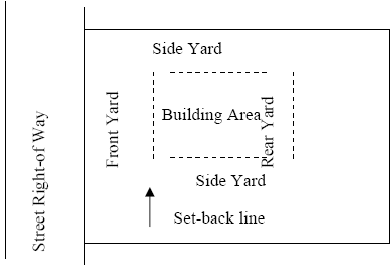
Figure 1:
Rendering of Setback Dimensions
(LL No. 2, 2023; LL No. 1, 2021, § 1)
17.04.070 - Application of requirements.
No building or lot shall hereafter be used or occupied, and no building or structure or part thereof shall be erected, constructed, altered, or reconstructed unless in conformity with the requirement in this chapter specified for the district in which it is located, except as hereinafter provided.
(LL No. 1, 2021, § 1)
17.04.080 - General requirements.
A.
No structure shall hereafter be erected, constructed, altered, or reconstructed except in conformance with the requirements and procedures of this title.
B.
No part of a required yard or other open space around any structure required for the purpose of complying with the provisions of this title shall be included as part of a yard or other open space required for another structure.
C.
No lot shall be reduced in size so that its area or any of its dimensions or open spaces would be smaller than required by this title.
D.
No structure or lot shall be used for any uses other than those uses permitted for the district as set forth in Section 17.12.010 or 17.21.030 where applicable.
E.
This title shall be interpreted and applied so that it provides the minimum requirements for the promotion of the public health, safety, and general welfare.
F.
A use not specifically permitted shall be deemed to be prohibited.
G.
Regardless of any other provisions of this title, any use that is noxious or offensive and constitutes a public nuisance by reason of emission of odor, dust, noise, vibration, smoke, gas, fumes, or radiation or which presents a hazard to public health or safety is prohibited.
H.
Approval of a use under this title shall not abrogate an applicant's responsibility to obtain all other required local, county, state, or federal permits or approvals as appropriate.
(LL No. 1, 2021, § 1)

