
Big Flats City Zoning Code
CHAPTER 17
36 - DEVELOPMENT REQUIREMENTS GENERALLY
17.36.010 - Intent.
The intent of this chapter and Chapters 17.40 through 17.52 is to establish requirements for all development to assure compliance with this title and the town comprehensive plan.
(LL No. 1, 2021, § 1)
17.36.020 - General requirement.
Every development shall comply with the applicable provisions of this chapter and Chapters 17.40 through 17.52.
(LL No. 1, 2021, § 1)
17.36.030 - Lot requirements.
A.
A lot shall be sized and arranged to not create any degree of nonconformance with this title.
B.
Lot Access.
1.
A lot shall not have direct access with a road.
2.
Where a watercourse separates a buildable area of a lot from a road with which the lot has vehicle access, installation of a bridge or other structure, spanning the watercourse, shall be subject to the same design criteria and review as all other stormwater drainage facilities in a development.
(LL No. 1, 2021, § 1)
17.36.040 - Road arrangement and access design requirements.
A.
Intent. It is the intent of this section to assure that all development provides for safe and adequate access to a lot proposed for development. This intent is furthered by requiring that all development that proposes to contain a new town road, private road, and/or internal drive be designed to:
1.
Provide for:
a.
Convenient traffic access and circulation;
b.
Traffic control and safety;
c.
Pedestrian and bicycle access, circulation, and safety;
d.
Access for fire fighting, snow removal, and street maintenance equipment;
e.
Stormwater drainage;
f.
Utility location; and
2.
Arranged to:
a.
Separate through traffic from neighborhood traffic insofar as practical;
b.
Be coordinated to compose a connected system;
c.
Be laid out to provide suitable future road connections with adjoining lots; and
d.
Conform to the requirements of the Americans with Disabilities Act (ADA).
B.
Road and Drive Requirements.
1.
A development proposal, subject to site plan review as provided in Chapter 17.32, shall show and detail all design features for a town road, private road, and/or internal drive sufficient to document compliance with the intent of this section and Chapter 12.04 of this code.
2.
A traffic study or analysis may be required to support design considerations and/or to validate the mitigation of any traffic impacts associated with a development.
(LL No. 1, 2021, § 1)
17.36.050 - Drive, internal drive, and driveway requirements.
A.
Intent. It is the intent of this section to assure that all development provides for safe and adequate access to a lot proposed for development. This intent is furthered by requiring that all development that proposes to contain a new internal drive and/or driveway be designed to comply with the requirements of a highway work permit for all work conducted in a right-of-way.
B.
General Requirement.
1.
A development plan shall show and detail design features for an internal drive and/or driveway sufficient to document compliance with the intent of this section and the standard for internal drive and driveway construction in the town.
2.
A plan for an internal drive and/or driveway prepared by a design engineer may be required to fully support design considerations and/or to validate the mitigation of any traffic impacts associated with a development.
(LL No. 1, 2021, § 1)
17.36.060 - Fence requirements.
A.
General Requirement. Grading of a site for the purpose of raising the elevation of a fence contrary to this section is prohibited, except as shown in an approved site plan.
B.
A fence on a lot shall comply with the following requirements:
1.
Height Restrictions.
a.
RU, R1, R2, C, TC, and TCR districts:
i.
Maximum height of four feet above finished grade shall be permitted for a fence located in a front yard. A fence located in a front yard, near a right-of-way, shall be established and maintained in accordance with the provisions of Section 17.36.070.
ii.
Maximum height of eight feet above finished grade shall be permitted for a fence located not within a front yard.
b.
ABD, BN, BN2, BNR, TC2, BR, CL and I districts:
i.
The height and location of a fence shall be approved in a site plan.
ii.
A site plan is not required for a fence located on a lot containing an existing residential use listed in Section 17.12.010; provided, that the existing residential use is continued, and the fence construction complies with the requirements of this section.
2.
A fence shall be constructed entirely within the boundaries of a lot.
(LL No. 1, 2021, § 1)
17.36.070 - Clear vision zone requirements.
A.
Intent. It is the intent of this section to assure that all development provides for safe and adequate access to and from a lot proposed for development. This intent is furthered by requiring that all development that proposes to contain a new road, drive, internal drive, or driveway be designed to provide a clear vision zone.
B.
General Requirement.
1.
A development plan shall show and detail design features for a drive, internal drive, and driveway sufficient to document compliance the intent of this section and the standard for clear vision zone in the town.
2.
A plan for a road, drive, internal drive, or driveway prepared by a design engineer may be required to fully support design considerations and/or to validate the mitigation of any traffic impacts associated with a development.
(LL No. 1, 2021, § 1)
17.36.080 - Valley wall development requirements.
A.
Steep Slope Requirements. The topography of the town includes many steep slopes that benefit the community by providing scenic views, aquifer recharge areas, wooded areas, and substantial protection against flooding and erosion. If these areas are not carefully protected, the benefits of these areas will be irreparably lost, and extensive erosion and flooding is likely to occur. Road construction, building site development, and other construction activity proposed for these areas require special design consideration to prevent erosion, minimize stormwater runoff, and preserve large trees, natural terrain, and scenic views.
B.
General Requirements.
1.
Each development proposal shall, show, in a plan, all site work, cut and fill, erosion, and drainage control measures and any proposed road, drive, internal drive, and/or driveway cross-subsections. The detail of the plan shall be sufficient to determine if steep slopes exist on the proposed development site and the extent which such steep slopes affect the proposed site work. The preparation of these plans by a design engineer may be required.
2.
Constructing or grading development sites to be level, otherwise known as padding, shall be permitted only when it can be clearly demonstrated, by exhibits presented in a site plan that the final treatment of the site meets the requirements of this subsection.
C.
Design Requirements. Design principles and criteria used in the review of a site plan application shall include, but is not limited to, the following:
1.
Landscaping of areas around a structure making such areas compatible with the natural terrain;
2.
Shaping, grouping, and placement of manmade structures to complement the natural landscape;
3.
Arrangement of structures so they complement one another to promote visual interest;
4.
Shaping of essential grades to conform to the existing contours and prohibit the appearance of successive padding, terracing, or other similar form of grading for a building site in steep slope areas;
5.
Encouragement of split-level development sites;
6.
Use of one-way roads when consistent with traffic safety, circulation needs, and natural topography. This guideline may allow for smaller road right-of-way, less cut-and-fill within a given area, and a road network consistent with the natural terrain. A road shall be parallel with the hillside wherever possible and may require variable width of right-of-way. This shall not only provide the most economical routing, but also minimize the amount of grading required.
D.
Slopes Greater than Twenty-Five (25) Percent. A slope greater than twenty-five (25) percent (2.5 feet of vertical rise in a ten (10) feet horizontal distance) shall not be developed except as approved in a site plan. When an application is received by the code enforcement officer for a development that proposes to affect, in any way, a slope greater than twenty-five (25) percent, the application shall be referred to the planning board as a site plan application under Chapter 17.32.
(LL No. 1, 2021, § 1)
17.36.090 - Stormwater management and erosion control requirements.
A.
Intent. It is the intent of this section to assure that all development provides for adequate protection against the impacts associated with stormwater and that development does not create added stormwater runoff from a development site. This intent is furthered by requiring that all development plans include provisions for stormwater management and that such plans comply with the standard for stormwater management in the town indicated in Chapter 17.37.
B.
General Requirement.
1.
A development plan shall show and detail design features for a stormwater management system sufficient to document compliance the intent of this section and the standard for stormwater management in the town.
2.
A plan for a stormwater management system prepared by a design engineer may be required to fully support design considerations and/or to validate the mitigation of any stormwater impacts associated with a development.
C.
Special Site Plan Requirement. When an application for building permit, highway work permit, variance and/or special permit, includes a lot where, in the determination of the stormwater officer, a significant impact associated with stormwater management and/or erosion is likely to occur as a result of a development the application shall be referred to the planning board as a site plan application under Chapter 17.32.
D.
Stormwater Pollution Prevention Plan. A stormwater pollution prevention plan consistent with the requirements of this chapter (the town stormwater management and erosion and sediment control law (Chapter 17.37 of this code)) shall be required. The SWPPP shall meet performance and design criteria and standards set forth in Title 17. The approved preliminary subdivision plat or site plan shall be consistent with the provisions of this chapter (the town stormwater management and erosion and sediment control law).
(LL No. 1, 2021, § 1)
17.36.100 - Open space requirements.
A.
For an alternative dwelling park, PMRD, PUD, or multi-unit dwelling development.
1.
Consistent with the town comprehensive plan, open space may be required for an alternative dwelling park, PMRD, any PUD that includes a residential component, or multi-unit dwelling development. Land for open space or other recreational purposes may not be required until the planning board has made a finding that a proper case exists for requiring that open space be suitably located for recreational purposes within the town and if such a case exists the site plan shall show open space suitably located therein unless there are no suitable open space of adequate size. Such findings shall include an evaluation of the present and anticipated future needs for recreational facilities in the town based on projected population growth to which the particular subdivision plat will contribute. The required open space shall meet the following minimum requirements:
a.
Such land shall be either held in private or corporate ownership, maintained in by an established organization.
b.
The location of such land on a lot shall be determined with the following considerations:
i.
Maximizing the safety of residents walking or bicycling between such facilities and their homes;
ii.
Providing for safe traffic circulation and parking at the open space site;
iii.
Minimizing the interaction between traffic to and from the principal use of the lot and the traffic to and from the open space site(s) on the lot;
iv.
The suitability of the open space site and its location for the intended recreational purpose.
2.
A preliminary subdivision plat or site plan shall include the following minimum details regarding open space:
a.
A dimensional drawing showing boundaries of the open space, its size in square feet, the location, and a description of any equipment to be installed or buildings to be constructed in the open space;
b.
A maintenance plan for the area;
c.
A detailed description of future ownership, insofar if such is possible, of the land for the open space;
d.
The details of the plan shall show how the entire area is to be graded, drained, and landscaped to make it a useful and attractive feature of the development.
B.
Open Space in All Development Areas.
1.
On a lot proposed for a development that requires a subdivision approval or site plan in accordance with Section 17.12.010 that are determined to be of importance to the community based on their environmental setting, scenic view, historical, or archeological significance may be set aside and not be developed as a condition of subdivision or site plan approval. Such a determination shall depend upon the magnitude and character of the development and the potential that the environmental setting, scenic view, historical, or archeological site would be irreparably lost if not preserved.
2.
Lands proposed for open space purposes shall be either held in private or corporate ownership and maintained by an established organization. The ownership of such land shall be determined in consideration of the following:
a.
The severity of the constraints and the impact these constraints have on the potential for further development of a lot;
b.
The importance of the land area to the town and the persons using the development;
c.
The lands scenic quality, potential for wildlife habitat, and the potential for protecting adjacent properties from any potential adverse impact that may result from development of the area of an open space;
d.
The likelihood that residents in the development and/or the town would utilize and/or benefit from the set aside of such land.
3.
When it is determined by the planning board that open space is required, a detailed plan shall be provided with a preliminary subdivision plat or site plan for the open space and at minimum include:
a.
A dimensional drawing showing boundaries of the open space;
b.
A maintenance plan for the open space area;
c.
A detailed description of future ownership of the land, insofar as such is possible;
d.
A description of any improvements planned for the land.
(LL No. 1, 2021, § 1)
17.36.110 - Utility requirements.
A.
Electric, Telephone, and Cable. With the exception of individual service to one-unit and two-unit dwellings, the telephone and television cable, electric and gas lines or similar utility services shall be installed underground unless full documentation supporting other methods as the most feasible approach is provided to and accepted by the planning board in an approved subdivision or site plan.
B.
Water Supply and Sewage Disposal. The installation of and specifications for public water and sewer lines shall comply with the rules, regulations, and requirements of the town water district, county sewer district, county health department, state department of environmental conservation and/or state department of health.
(LL No. 1, 2021, § 1)
17.36.120 - Damaged and unsafe building or structure requirements.
A.
General Requirements.
1.
The owner of a structure or building that has been damaged by fire, flood, or other cause shall notify the code enforcement officer (CEO) of the damage within seventy-two (72) hours of when the damage occurred. Any damaged building or structure shall be made safe and secure in accordance with the state uniform fire prevention and building code.
2.
The use of fire as a method for razing a damaged or unsafe structure or building is prohibited unless specifically authorized by the state department of environmental conservation, county emergency management office, the fire chief for the jurisdictional fire district, and the town code enforcement officer (CEO).
B.
Repair, Replacement and/or Razing.
1.
The owner of a building or structure which has been damaged by fire, flood, or other cause to an extent of more than fifty (50) percent of its replacement value shall comply with the following requirements:
a.
Arrange for the damaged building or structure to be evaluated by a design engineer and/or the CEO.
b.
Shall apply for a building permit for the work recommended by the design engineer and/or CEO and which may include repair, reconstruction or razing of the damaged building or structure. The owner shall perform such work within one hundred eighty (180) days of the date of an order to remedy from the CEO.
2.
The owner of a building or structure which has been damaged by fire, flood, or other cause to an extent of less than fifty (50) percent of its replacement value shall apply for a building permit for the work required to either repair, reconstruct or raze the damaged building or structure and perform such work within two hundred seventy (270) days of the date the damage occurred.
(LL No. 1, 2021, § 1)
17.36.130 - Industrial use requirements.
A.
General Requirements. No industrial use shall be permitted, established, maintained, or conducted which is likely to cause or have:
1.
Fumes, gases, dusts, particulate, odors, or any other atmospheric pollutant beyond the boundaries of the lot whereon an industrial use is located;
2.
Excessive smoke or similar atmospheric pollutant beyond the boundaries of a lot on which the industrial use is located. Excessive smoke shall be determined according to the Ringelmann's Scale for Grading the Density of Smoke, published by the U.S. Bureau of Mines. When the shade or appearance of such smoke is darker than No. 2 on the Ringelmann Smoke Chart, it is then excessive;
3.
Noise levels greater than seventy (70) decibels (dB) measured at a boundary of a lot occupied by an industrial use;
4.
A discharge of any industrial effluent into any watercourse, open ditch, or on a land surface unless specifically permitted under the authority of the state department of environmental conservation;
5.
A discharge of any industrial effluent into a public sanitary sewer system except in accordance with the rules of and under the control of public health authorities or the public body controlling such sewer system;
6.
Open storage or stocking of any waste materials;
7.
Glare or light levels in excess of the requirements set in Section 17.36.240;
8.
Vibration perceptible beyond the lot lines whereon such industrial use is conducted;
9.
Any other nuisance, activity, or action that may be harmful to a person or property.
B.
Buffer, Barrier, and Landscape Requirements.
1.
Buffer and barrier shall be provided in accordance with Section 17.36.200.
2.
All portions of the lot proposed for industrial development and not occupied by structure, parking area, drive, internal drive, pedestrian ways, or storage shall be landscaped with lawn, trees, shrubs, or other plant material in accordance with Section 17.36.200.
C.
Other Industrial Use Activity.
1.
Outdoor Storage. Materials, supplies, or products shall not be stored in a front yard and such storage located in the side or rear yard shall be screened in conformance with Section 17.36.200.
2.
Off-Road Loading and Unloading Berths. Off-road loading and unloading berths shall be provided in accordance with Section 17.48.020 and the following minimum requirements:
a.
An off-road loading and unloading berth located on or along a drive shall be located a minimum of one hundred (100) feet from a road.
b.
The handling of all freight shall occur either on those sides of a building which do not face a road or be suitably landscaped and screened in accordance with Section 17.36.200.
3.
Accessory Use. Accessory uses shall conform to the minimum requirements set forth in Chapter 17.40 and as prescribed in an approved site plan.
D.
Design Requirement. A site plan for an industrial use shall include design elements that includes sufficient documentation to determine compliance with the requirements of this section and all other applicable sections of this title.
E.
Access. Access to a lot containing an industrial use shall:
1.
Be designed by a design engineer;
2.
Be designed not to route traffic directly through a R1, R2, or TCR district on other than a primary road;
3.
Be designed to access a road other than a town road located within a R1, R2, or TCR district; and
4.
Have a design based on a traffic study that includes provisions for access for all vehicles expected or intended to use the site.
(LL No. 1, 2021, § 1)
17.36.150 - Wind energy conversion systems (windmill) requirements.
The intent of this section is to regulate the placement of and access to wind for an energy conversion system and to protect the health and safety of individuals on adjacent lots.
A.
General Requirements. A site plan approval and building permit are required for the construction of a wind energy conversion system.
B.
Dimensional Requirements.
1.
The total height for a vertical axis rotor installation of a wind energy conversion system is the tower height plus one-half the rotor diameter, and for a horizontal rotor installation of a wind energy conversion system is the distance from the base at finished grade to the top of the unit.
2.
A wind energy conversion system setback shall be a distance that is the greater of either the total height of the wind energy conversion system or the required setback.
3.
A maximum allowable total height for a wind energy conversion system shall be one hundred five (105) feet unless otherwise restricted or prohibited by federal, state, or local laws, rules, or regulations.
4.
Minimum allowable height above finished grade at the lowest point of the arc of a rotor blade shall be fifteen (15) feet.
C.
Safety Requirements. All wind energy conversion systems shall be designed, installed, and maintained in accordance with the following:
1.
The foundation and supports for a wind energy conversion system shall be as designed by a design engineer.
2.
At least one sign shall be posted at the base of the wind energy conversion system warning of high voltage.
3.
Tower climbing ladders, stairs or similar devices shall be no lower than twelve (12) feet from the ground.
4.
All wind energy conversion system(s) shall be installed with braking systems approved by the manufacturer.
D.
Sound Control Requirements. The maximum level of sound created by the wind energy conversion system as measured at the lot line shall be no greater than fifty-five (55) decibels (dB).
E.
Design Requirements.
1.
All electric transmission lines serving the installation shall be installed underground.
2.
No wind energy conversion system with guy wire support shall be permitted.
(LL No. 1, 2021, § 1)
17.36.160 - Home occupation requirements.
A.
Restrictions. The following uses shall not be permitted as a home occupation:
1.
A business which has a primary function of wholesale or retail sale of goods or articles produced off-site on a lot;
2.
Any form of motor vehicle repair including vehicle body work;
3.
Motor vehicle sales or lease;
4.
Any small engine or appliance repair;
5.
A veterinary hospital;
6.
A bar and/or restaurant;
7.
Any use or activity defined as a cottage industry under Section 17.36.170 of this title; and
8.
Any use that, under the provisions of the state uniform fire prevention and building code is not permitted based on the type of construction or a use prohibited based on any other federal, state, or local law, rule, or regulation.
B.
General Requirements. A home occupation use shall comply with the following minimum requirements:
1.
No more than two home occupations shall be conducted as an accessory use to a dwelling unit.
2.
In a dwelling unit the lesser of either twenty-five (25) percent of the total floor area or five hundred (500) square feet, may be used for or dedicated to the use(s).
3.
The use(s) shall be conducted within the enclosed walls of dwelling unit.
4.
There shall be no external evidence of such use(s) except for a sign installed in accordance with Chapter 17.52. No stock, merchandise, packaging, equipment or displays related to the use shall be visible from outside the dwelling unit.
5.
Except for articles produced on the premises, no stock in trade shall be displayed or sold on the premises.
6.
The dwelling unit in which the use is located shall not be altered or extended in a manner not customary or typical to a residential building to accommodate the use.
7.
The use shall not result in or cause vehicular traffic volumes of greater than four cars per hour or otherwise create a nuisance to abutting lots.
8.
There shall be no sharing, letting, or subletting of space, for use by non-residents in the conduct of their profession, trade, or business.
9.
No additional parking facilities shall be required to be constructed to accommodate the use(s).
10.
The use shall not change the residential character of the adjoining lots.
(LL No. 1, 2021, § 1)
17.36.170 - Cottage industry requirements.
A.
Restrictions. The following uses shall not be permitted as a cottage industry use:
1.
A business which has a primary function of wholesale or retail sale of goods or articles on a lot except as provided in subsection (B) of this section;
2.
Any form of motor vehicle repair including vehicle body work;
3.
Motor vehicle sales or lease;
4.
Veterinary hospital;
5.
Bar and/or restaurant;
6.
Any use that, under the provisions of the state uniform fire prevention and building code is not permitted based on the type of construction or a use prohibited based on any other federal, state, or local law, rule, or regulation.
B.
General Requirements. A cottage industry use may be permitted when an approved site plan documents compliance with the following minimum requirements:
1.
No more than one cottage industry use may be permitted on a residential premise.
2.
In a dwelling unit, the lesser of thirty (30) percent of the total floor area or seven hundred fifty (750) square feet is to be used for or dedicated to the use.
3.
No more than one thousand five hundred (1,500) square feet of an accessory structure is used for or dedicated to the use.
4.
The use is to be conducted within the enclosed walls of the dwelling unit and/or accessory structure.
5.
There is no external evidence of such use except for a sign installed in accordance with Chapter 17.52. No stock, merchandise, packaging, equipment, or displays related to the use is visible from outside the and/ dwelling unit or accessory structure.
6.
A dwelling unit in which the use is located is not altered or extended in a manner not customary to or typical of a residential building in order to accommodate the use. Construction and/or modification of an accessory structure to accommodate the use is permitted.
7.
The use shall not result in or cause vehicular traffic volumes of greater than six cars per hour or otherwise create a nuisance to abutting properties.
8.
A maximum of ten (10) percent of any area devoted to or used for the use may be for display, and/or wholesale and retail sales.
9.
There shall be no sharing, letting, or subletting of space, for use by others in the conduct of their profession, trade, or business.
10.
The use shall remain compliant with all conditions of site plan approval.
(LL No. 1, 2021, § 1)
17.36.180 - Wireless telecommunication facility (WTF) requirements.
A.
Intent. The town has received and anticipates receiving additional applications for WTF that will include the construction of antennas and towers. It is the intent of the town to establish an orderly process for managing the accommodation of the communication needs of the residents and businesses consistent with applicable federal and state regulations, while protecting the health safety and general welfare of the residents of the town by:
1.
Facilitating the provision of wireless telecommunication and other communication services to the residents and businesses of the town, while simultaneously preserving the character, appearance, and aesthetic resources of the town;
2.
Minimizing the adverse visual effects of wireless telecommunication towers and facilities through development of site and approval criteria;
3.
Protecting the scenic, historic, environmental, natural, and manmade resources of the town;
4.
Preserving property values of the town;
5.
Minimizing the undue proliferation and height of wireless telecommunication towers throughout the town;
6.
Avoiding potential harm to adjacent persons and properties from tower failure, noise, falling objects, and attractive nuisance through the establishment of site standards; and
7.
Encouraging shared use of existing and approved towers in order to reduce the number of towers needed to serve the community where reasonably possible, so as to minimize and mitigate the adverse visual impacts of towers and their facilities.
B.
These regulations are intended to be consistent with the Telecommunications Act of 1996 in that:
1.
They do not prohibit, or have the effect of prohibiting, the provision of personal wireless services;
2.
They are not intended to be used to reasonably discriminate among providers of functionally equivalent services;
3.
They do not regulate personal wireless services on the basis of the environmental effects of radio frequency emissions to the extent that the regulated services and facilities comply with the FCC's regulations concerning emissions.
C.
Approval Procedures.
1.
Site Plan Approval. As specified in Chapter 17.12 of this code, all WTF shall require site plan approval in accordance with the procedures and requirements of Chapter 17.32 of this title.
2.
Additional Submittal Requirements. In addition to the standard submittal requirement for a site plan as specified in Chapter 17.32, an application for a WTF shall include the following documentation, except that the planning board may waive the submittal of certain of the following documentation in the instance of an antenna that is to be located on an existing structure or tower:
a.
Necessity of Service. A documentary demonstration supported by standard engineering practices, signed by a licensed NYS professional engineer with expertise in WTF, that the proposed WTF is necessary to provide service to locations that cannot be served by an existing WTF within or outside the town, and/or by alternate technologies, such as repeaters.
b.
A copy of the FCC license for the applicant's service in the proposed area.
c.
A five-year build-out plan for the proposed site and other sites within the town adjacent municipalities, clearly demonstrating the applicant's plans for other structures, proposed application and building dates.
d.
Structural Integrity Certification. A certification by a state licensed professional engineer that the supporting structure will meet the state building code wind load requirements for the proposed facility and any additional users identified in the co-location antenna certification.
e.
Co-Location Antenna Certification. A documentary demonstration by standard engineering practices, signed by a licensed state professional engineer, that the tower would accommodate co-locators. Such data shall identify the maximum number of co-locators, or alternative co-location antenna strategies, which could be supported on the tower.
f.
Visual Impact Assessment. The applicant shall provide a documentary visual impact assessment, including a photo simulation, that supports with clear and convincing evidence that the visual, aesthetic, and community character intrusion impacts have been minimized to the greatest extent possible.
g.
Bulk and Density Documentation. The applicant shall provide clear and convincing documentary evidence that the proposed structure height of the antenna or tower is the minimum necessary to provide licensed communications to the locations in the town that the applicant is unable to serve with an existing facility or with a structure with a lower structure height.
h.
Emission Certification. A report signed by state licensed professional engineer with expertise in WTF and/or a health physicist with expertise in radio frequency emissions, that the proposed maximum equipment output at the proposed site will comply with all emission standards adopted by the FCC, such certification may be required to be updated periodically.
i.
Non-Interference Certification. A certification and supporting evidence signed by NYS licensed professional engineer with expertise in WTF that the proposed WTF will not cause interference with existing communication devices.
D.
Standards for WTF. A new or the alteration of an existing WTF shall meet the following minimum standards:
1.
Minimum lot area shall be as specified in Chapter 17.16.
2.
An antenna or a tower for a WTF shall have a setback, from all property lines, from above ground power lines and/or from other structures not used in support of the WTF, the greater of: (a) either the required setback set forth in Chapter 17.16; or (b) no less than the maximum distance from the center of the monopole antenna to the perimeter of the fall zone of the antenna or tower, as certified by a state licensed professional engineer. Fall zone shall be measures from the base to the top of the tower.
3.
A WTF shall be located no nearer than five hundred (500) feet to a dwelling unit, day care center, place of worship, school, or a road or drive used by the public.
4.
Structure Height Limits. The structure height of any antenna or tower shall be the minimum required to establish and maintain adequate service as supported by the documentation submitted in the site plan review and approval application. In no instance shall the tower exceed a structure height that is the lesser of either one hundred twenty (120) feet or a maximum of fifty (50) feet above any immediately adjacent tree line.
5.
A WTF shall be a monopole, unless otherwise authorized by the planning board for good cause as shown in the submittal documentation.
6.
Signal lights shall be prohibited unless required by the FCC or Federal Aviation Administration.
7.
A WTF shall be sited to have the minimum adverse visual impact on the surrounding areas and roads. WTF and towers shall be designed and constructed of materials that are harmonious with natural setting.
8.
The maximum area to be cleared for a WTF shall be no more than fifty (50) feet in extent from the footprint of the WTF and its accessory structure. Only the very minimum amount of vegetative clearing shall be permitted to accommodate construction.
9.
All equipment and accessory structures shall be sited to minimize adverse visual impact on the surrounding areas and roads. The planning board may require that these facilities be located completely or partially underground.
10.
All equipment not located within a building shall be designed and/or treated with materials to blend with the surrounding natural setting.
11.
Signs shall be prohibited unless required by the planning board or an applicable regulation or law.
12.
Co-location antenna arrangements are required of all new WTF unless substantial documentation shows that:
a.
The applicant has provided clear and compelling evidence in accordance with subsection 17.36.180(B);
b.
Co-location cannot achieve the minimum reasonable technical needs of the proposed facility;
c.
The inability to secure permission of owner of existing site and/or facility at a reasonable cost to allow additional installation; and/or
d.
Structural and other engineering limitations, absent reasonable refurbishment, are demonstrated.
13.
The applicant shall document additional capacity for future shared use of the tower and shall certify that such additional capacity shall be available for future applicants providing wireless telecommunication services, subject to good faith negotiations.
14.
The clustering of antennas or towers on the same lot shall be considered if co-location antennas cannot be arranged.
15.
Each WTF shall be protected against unauthorized access. Security fencing shall be required. The planning board shall determine the area extent of fencing required based on the site plan application submittal. All security fencing shall be a minimum of twelve (12) feet in height.
E.
Discontinued Use. An antenna or tower not operated for the provision of wireless telecommunication services for a continuous period of twelve (12) months or more may be deemed abandoned. Upon receipt of notice of determination from the town, the operator shall remove the antenna or tower within ninety (90) days of the date of such notice of determination.
F.
Exempt Facilities. Provided compliance with Section 17.36.181 is maintained by the property owner, the following transmitting and/or receiving WTF's are exempt from regulation by this section of this code:
1.
Amateur radio and satellite facilities provided that such facilities are operated by a licensed amateur;
2.
Civil, emergency, and other facilities under the control of or operated by a government agency; or
3.
Home satellite facilities where installed on residential premises solely for the use by the residents of that premises and not offered for service to off-premises locations.
(LL No. 1, 2021, § 1)
17.36.181 - Accessory antenna.
A.
Residential Antennas. Antennas for transmitting and/or receiving telecommunication that are listed in subsection 17.36.180(F) as exempt from the provisions of Section 17.36.180 and that are constructed or installed on a lot with a residential principal use and are used as an accessory use to an existing residential use, shall be constructed and maintained as follows:
1.
That the antenna or any supporting structure, such as a tower, is constructed or installed behind the front of the principal building on the lot and to not encroach on any portion of any required side, front or rear yard.
2.
A freestanding antenna or any part thereof including the supporting structure for such antenna shall not exceed forty (40) feet in height.
3.
An antenna attached to any portion or part of a building including a chimney, shall not extend above the roof line to lesser of either: (a) the structure height as permitted by Section 17.16.020 for the district and use applicable to the lot or (b) no more than five feet above the highest point of the roof of the principal building on the lot.
4.
Any guy wire supports for an antenna that are within eight feet to the ground, a walkway or any habitable space of a building shall be clearly marked to the extent as to make the guy wires visible to pedestrians.
B.
Commercial Antennas. Antennas for transmitting and/or receiving telecommunication that are listed in subsection 17.36.180(F) as exempt from the provisions of Section 17.36.180 and that are constructed or installed on a lot with a general, business, or industrial principal use and are used as an accessory use to an existing general, business, or industrial use, shall require approval pursuant to Chapter 17.32 of this title and as a minimum be constructed and maintained as follow:
1.
That the antenna or any supporting structure such as a tower, is constructed or installed behind the front of the principal building on the lot and to not encroach on any portion of any required side, front, or rear yard.
2.
A free-standing antenna or any part thereof including the supporting structure for such antenna, shall not exceed forty (40) feet in height.
3.
A free-standing antenna or tower, including any guy supports, constructed, or installed at ground level shall be enclosed in a fenced area of such area and height as permitted in an approved site plan.
4.
An antenna attached to any portion or part of a building including a chimney, shall not extend above the roof line to lesser of either: (a) the structure height as permitted by Section 17.16.020 for the district and use applicable to the lot; or (b) no more than eight feet above the highest point of the roof of the principal building on the lot.
5.
Any guy wire supports for an antenna that are within eight feet to the ground, a walkway or any habitable space of a building shall be clearly marked to the extent as to make the guy wires visible to pedestrians.
(LL No. 1, 2021, § 1)
17.36.190 - Vehicle filling station, vehicle repair, vehicle sales or lease and heavy equipment vehicle sales and/or repair, vehicle maintenance facility and/or convenience mart.
A.
Dimensional Requirements.
1.
Minimum Lot Size.
a.
Minimum lot size for vehicle filling station, vehicle repair, vehicle sales or lease and heavy equipment vehicle sales and/or repair vehicle maintenance facility and/or convenience mart uses shall be the greater of either one acre or the minimum lot area requirement prescribed in Section 17.16.020.
b.
In those instances where a vehicle filling station, vehicle repair, vehicle sales or lease and heavy equipment vehicle sales and/or repair, vehicle maintenance facility and/or convenience mart uses is proposed as part of a mall or plaza, there shall be dedicated for such use a minimum lot area of one acre.
c.
In addition to any required lot area and/or setback, a developer may be required to provide any additional space necessary, as determined by an approved site plan, to mitigate any potential impact on surrounding lots or uses.
2.
The minimum lot width shall be the greater of two hundred (200) feet or the minimum lot width prescribed in Section 17.16.020.
3.
Fuel dispensing devices shall not be located within the front, rear and/or side yard setbacks including all required buffers and/or barriers as defined by the underlying zoning district and as defined in this chapter.
B.
General Requirements.
1.
Automobile parts, including tires, frames, hubcaps, motors, and dismantled or unregistered motor vehicles; are to be stored within a structure or otherwise screened from view from any adjoining lot or road. Accessory products that are offered for sale may be placed outside during normal business hours provided such items are stored or displayed in a rack.
2.
All repair work shall be performed within a building. Vehicles waiting to be serviced or stored on the lot shall not be parked or stored in any required buffer and/or transition yard. Wrecked vehicles being held for insurance adjustment or other legal purpose shall be stored behind the rear wall of the building and/or screened from view from an adjoining lot or road.
3.
Parking.
a.
No vehicle shall be parked, stored, or left standing within fifteen (15) feet of a road right-of-way.
b.
Parking area requirements shall be as set forth in Section 17.48.010. Such parking areas shall not conflict with the traffic pattern to and from any fuel pump. In addition to any required parking, a developer may be required to provide any additional parking areas necessary, by an approved site plan, to mitigate any potential impact on a surrounding lot or use.
c.
Where parking areas abut a residential use as set forth in Section 17.12.010 or a residential district boundary, they shall be screened from such use or district and include a barrier that shall:
i.
Be composed of densely planted plant material no less than ten (10) feet in depth, eight feet in height from finished grade;
ii.
Include an opaque fence;
iii.
Be of materials consistent with the character of adjacent residential lots;
iv.
Be maintained in perpetuity or to a time when the adjoining residential use no longer exists.
4.
No vehicles offered for rent or sale shall be placed, stored, or parked within fifteen (15) feet of a road right-of-way.
5.
All storage and display areas shall be provided with a hard, dust-free surface and shall be adequately drained.
6.
All outdoor lighting shall conform with Section 17.36.240.
7.
No twenty-four (24) hour operation use shall be permitted within two hundred fifty (250) feet of an existing residential use and/or residential district boundary.
8.
Fuel, oil, and other materials which are environmentally hazardous shall be stored, controlled, and disposed of in accordance with the rules and regulations of the state department of environmental conservation.
(LL No. 1, 2021, § 1)
17.36.200 - Transition yard, buffer yard, landscaping, and barrier requirements.
A.
Intent. The preservation and promotion of nature is a desirable and important means of protecting the public health, safety, and welfare and that a healthy environment indicates a healthy community, which is consistent with the town comprehensive plan. The use of buffers and transition yards is a method of preserving and enhancing nature while providing citizens an assurance of protection from negative intrusions such as visual and noise impacts from uses on adjoining developments. More specifically, this section is intended to provide requirements that will ensure greater compatibility between different characters of land uses by requiring a transition yard between residential and non-residential districts and a screen or buffer between the uses in order to minimize the harmful impact of noise, dust and other debris, motor vehicle headlight glare or other artificial light intrusion and other objectionable activities or impacts conducted on or created by an adjoining or nearby use. This section will provide consideration of those physical and visual elements of a development or use and to require treatment of the land with landscaping using plant materials and/or manmade features. Such plant materials and/or manmade features are to be arranged to enhance the appearance, to screen or effectively separate different types of uses, and to eliminate or minimize impacts on adjoining uses.
B.
Application of Transition Yards and Buffer Yards.
1.
When a district other than a R1, R2, or TCR district abuts a R1, R2, or TCR district, a transition yard shall be provided. (See Figure 4).
2.
The buffer yard provisions of this section shall apply to all uses requiring site plan approval or as a mitigation for impacts associated with a development in any districts in the town. (See Figures 4 and 5).
3.
When provisions of this section require transition and buffer yards such yards shall be in addition to any setback required in the district. (See Figures 4 and 5)
C.
Transition Yard Requirements. (See Figures 4 and 5).
1.
Minimum Requirements. Where a R1, R2, or TCR district abuts any other district without an intervening road, a minimum side or rear yard setback in the other district that is measured from a lot line coincident with the boundary of the abutting district shall be increased more than the minimum yard setback specified in Section 17.16.020 for the other district by a transition yard which will have a depth equal to the number of feet as follows:
2.
Where a R1, R2, RU, or TCR district abuts any other district along the centerline of a road, a transition yard shall be required in the other district that is a depth measured from a front lot line coincident with the right-of-way of the road which shall be a minimum of twenty-five (25) feet more than the minimum front yard setback specified in Section 17.16.020 for the other district.
3.
A transition yard shall be treated as a buffer yard for purposes of determining landscaping and barrier requirements as provided in subsections E and F of this section.
4.
No principal structure, principal use, accessory structure, or accessory use shall be located within any required transition yard.
5.
No drive shall be located within a required transition yard if there is an adjoining lot in common ownership on which such drive may be located without being in a transition yard. Otherwise, a drive or parking space as an accessory use may be located within the required transition yard only as approved in a site plan.
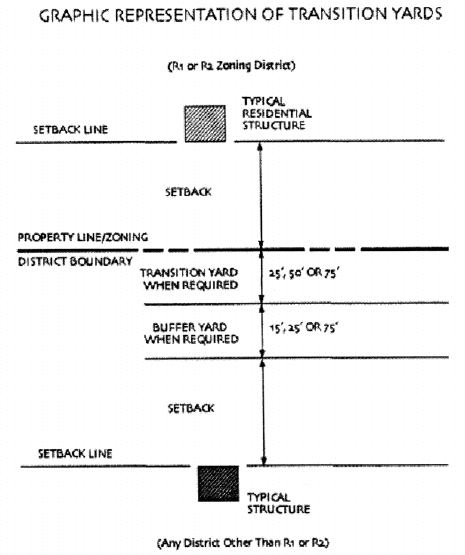
Figure 4: Transition Yards
D.
Buffer Yard Requirements. (See Figure D-1).
1.
Where a lot is proposed to contain a use listed in the use categories set forth in Section 17.08.040 and abuts a lot containing an existing or approved use, a minimum buffer yard shall be provided, for the proposed use, as follows:
Buffer Yard Type Description. (See Figures 4 and 5 for graphic representation).
1.
The buffer yard shall be the minimum yard requirements (setbacks) for the proposed principal use and structures as prescribed in Section 17.16.020.
2.
The buffer yard shall be the total of the minimum yard requirements (setbacks) for the proposed principal use and structures as prescribed in Section 17.16.020 plus a buffer yard of fifteen (15) feet and such buffer yard shall be landscaped in accordance with subsection E of this section.
3.
The buffer yard shall be the minimum yard requirements (setbacks) for the proposed principal use and structures as prescribed in Section 17.16.020 plus a buffer yard twenty-five (25) feet and such buffer yard shall be landscaped in accordance with subsection E of this section.
4.
The buffer yard shall be the minimum yard requirements (setbacks) for the proposed principal use and structures as prescribed in Section 17.16.020 plus a buffer yard of seventy-five (75) feet and such buffer yard shall be landscaped in accordance with subsection E of this section.
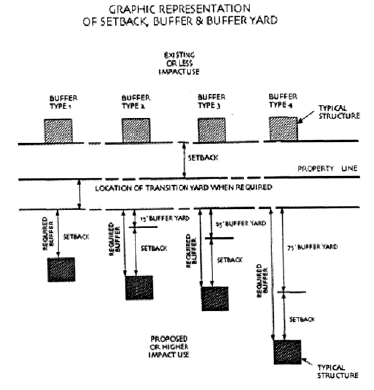
Figure 5: Buffer Yard
2.
No principal structure, principal use, accessory structure, or accessory use shall be located within any required buffer yard.
3.
A drive and parking spaces shall not be located within a required buffer yard.
4.
The buffer yard shall be provided with landscaping as required in an approved site plan and the requirements set forth in subsection E of this section.
5.
A buffer yard shall be shown on drawings required in an application for site plan approval.
6.
A buffer yard required to mitigate an impact associated with a development shall be designed by a design professional and constructed in accordance with said design.
7.
The requirements of Section 17.36.070 shall be considered in the design of any buffer yard.
8.
The owner and all future owners shall maintain a required buffer yard in perpetuity. If a buffer yard is not maintained, the town reserves the right to take actions in accordance with Section 17.32.190.
E.
Landscaping Requirements.
1.
Where a buffer yard is required by this section, the buffer yard shall be provided with a landscape type as specified in the following table:
Landscaping Type Description. (See Figure 6 for graphic representation of landscape density).
1.
Buffers may be landscaped with plantings of choice. No landscape plan is required.
2.
Planting shall include shrubbery and/or small trees that at maturity will be a minimum of six feet or a height that will provide intervening vegetation to the full height of the proposed use structure as viewed from an eye level elevation of five feet six inches at any point on the abutting use setback line.
3.
Planting shall include hedges, shrubbery, and/or small trees that at maturity will be a minimum of eight feet or a height that will provide intervening vegetation to the full height of the proposed use structure as viewed from an eye level elevation of five feet six inches at any point on the abutting use setback line.
4.
Planting shall include hedges, shrubbery and/or small trees that at maturity will be a minimum of ten (10) feet or a height that will provide intervening vegetation to the full height of the proposed use structure as viewed from an eye level elevation of five feet six inches at any point on the abutting use setback line and/or the second story of a residential use.
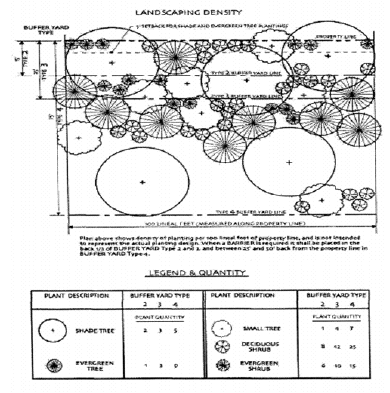
Figure 6: Landscape Density
*Note: See subsection F3 of this section for plant type and minimum planted size.
2.
Landscape Plan.
a.
Whenever landscaping is required pursuant to this section and a site plan approval is required, a landscape plan shall be submitted to the planning board.
b.
In those instances where a landscape plan is required to be submitted to the planning board, the landscape plan shall be prepared and stamped by a state licensed landscape architect, authorized to practice landscape architecture in accordance with state law and shall be designed in accordance with the requirements of this section.
c.
A variety of plants may be substituted for plantings required under this section; however, the performance of the substitute vegetation shall be equal to that of those approved in any site plan and as follows:
i.
Evergreen trees may be substituted for shade trees or small trees without limitations.
ii.
Evergreen shrubs may be substituted for deciduous shrubs without limitation.
d.
The size and character of all plantings shall be in accordance with the provisions of the American Standard for Nursery Stock, (ASNS) latest edition (currently November 6, 1996), which is adopted by reference in this chapter.
e.
Plantings adjacent to roads or within parking areas shall be those recommended in the handbook Urban Trees Site Assessment Selection for Stress Tolerance Planting, published by Urban Horticulture Institute, Cornell University.
f.
Invasive or Rampant Plants. The use of invasive or rampant plants is prohibited. Examples of such plants include, but are not limited to: purple loosestrife, oriental bittersweet, kudzu, exotic wisterias, such as Chinese and Japanese wisteria, mile-a-minute weed, Russian olive, multi-flora rose, white poplar, and black locust.
3.
Plant Requirements. Plant branching, root size, and proportions at time of planting shall be as described in the ASNS standards according to the specified plant size. Minimum required planted size shall be as follows:
* Callery Pear (Pyrus calleryana) shall be sized as per shade tree, type 1 and 2.
** Japanese Yew (Taxus cuspidata) shall be sized as per CE, type 3.
Table notes:
•
Bare root stock may be allowed as a portion of the required planting upon review of planting plan and determination that the landscaping meets the intent of this section.
•
Dwarf plants, vines, and ground covers may be used as part of an overall planting plan but will not be counted as part of the buffer yard planting requirements.
4.
Landscaping Minimum Requirements. The following minimum requirements shall apply to the preservation, installation, and maintenance of all landscaping required by this section:
a.
All disturbed soil areas of the site shall be replanted or re-seeded in accordance with the approved plan.
b.
All plantings will be done at an appropriate time of the year in accordance with the standards and policies of the Chemung County Soil and Water Conservation District (CCSWCD). No planting will be allowed if the ground is frozen and shall be completed in accordance with generally accepted horticultural practices for the town's geographic area.
c.
Shade or evergreen trees shall not be planted closer than five feet to a property line.
d.
Plantings required by this section shall fit with the character of the surroundings and be composed of native, naturalized and disease resistant species capable of survival without extraordinary measures and be cold hardy in accordance with USDA plant hardiness zone 5.
e.
The owner and future owners shall be responsible for the maintenance, repair and replacement of all landscaping required under this section in perpetuity and the area shall be kept free of refuse and debris. If the required landscaping is not maintained, the town reserves the right to take actions in accordance with Section 17.32.190.
5.
Credit for Existing Vegetation. To the greatest extent possible, existing site vegetation shall be saved during construction and thereafter. Existing site vegetation may be used to meet some or all of the requirements of subsection E of this section provided that the existing site vegetation provides or exceeds the minimum level of protection afforded by the requirements of this section. If applicable, the planning board may consider credit for preservation of qualifying existing site vegetation on a one-to-one basis with the landscaping requirements of this section. New plantings where existing vegetation is used as part of the required landscaping shall be compatible with the existing landscape in character and type.
6.
Alternative Designs. For good cause shown, the developer may submit alternative designs as part of a landscape plan provided the alternative design meets or exceeds the minimum requirements of this section and that such alternative design is accepted and approved by the planning board.
F.
Barrier Requirements.
1.
When a specific impact is identified that cannot be practically mitigated under the landscaping requirements of this section, as determined by the planning board, a barrier may be required that meets or exceeds the following requirements:
Barrier Description.
1.
The barrier shall comply with the requirements of Section 17.36.070 and shall provide protection against impacts associated with a development to a minimum height above finished grade of six feet as measured at the common property line between the existing and proposed use.
2.
The barrier shall comply with the requirements of Section 17.36.070 and shall provide protection against impacts associated with a development to a minimum height above finished grade of eight feet as measured at the common property line between the existing and proposed use.
3.
The barrier shall comply with the requirements of Section 17.36.070 and shall provide protection against impacts associated with a development to a minimum height above finished grade of ten (10) feet as measured at the common property line between the existing and proposed use.
4.
The barrier shall comply with the requirements of Section 17.36.070 and shall provide protection against impacts associated with a development to a minimum height above finished grade of twelve (12) feet as measured at the common property line between the existing and proposed use.
[5.]
The barrier shall be provided for in the buffer yard or transition yard.
[6.]
When a barrier is required, the barrier shall be illustrated on the drawings required in an application for site plan approval.
[7.]
A barrier shall be designed to provide the degree of continuous protection to a use commensurate with the specific adverse impact associated with a development.
[8.]
A barrier shall be designed by a design engineer such as a landscape architect and constructed in accordance with the design.
[9.]
The requirements of Section 17.36.070 shall be considered in the design of any barrier.
[10.]
The owner and future owners shall maintain a required barrier in perpetuity. If a barrier is not maintained in accordance with this section, the town reserves the right to take actions as described in Section 17.32.190.
(LL No. 1, 2021, § 1)
17.36.210 - Fast food restaurant requirements.
A.
Intent. A fast food restaurant use has operational characteristics that may include a significantly higher number of customers per day than those of surrounding uses. This use is likely to also have an accessory drive-through use. These characteristics have the potential for creating serious traffic conflicts, hazards to pedestrians, and congestion at peak hours. It is the intent of this section to provide reasonable controls to avoid, to the greatest extent possible the consequences of this congestion and traffic hazard.
B.
Dimensional Requirements.
1.
Minimum Lot Size.
a.
Minimum lot size for all uses shall be as defined in the bulk density requirement, Section 17.16.020.
b.
In those instances where a use regulated in this chapter is proposed as part of a mall or plaza and is located on an outparcel from the primary mall or plaza lot, there shall be dedicated for such use an area of the lot equal to one acre.
c.
To mitigate impacts on adjoining lots and/or road infrastructure, additional lot area, setbacks and/or right-of-way reserve strips may be required in an approved site plan.
2.
Minimum Lot Width. The greater of one hundred (100) feet or the minimum lot width established in the bulk density requirement for the applicable district, Section 17.16.020.
C.
Access and parking.
1.
Access shall be designed by a design engineer in accordance with Sections 17.36.050 and 17.36.070.
2.
Parking.
a.
The number of parking spaces shall be as specified in Section 17.48.010.
b.
Parking areas or parking lots shall be designed to provide for pedestrian safety. To the greatest extent possible, pedestrian access to the principal structure shall not cross primary circulation lanes.
c.
Whenever possible, fast food restaurants shall work with adjoining properties to provide shared parking and access for the fast food restaurant and the adjoining properties.
D.
Buffer, Landscaping and Barrier Requirements.
1.
Buffers, landscaping and barriers shall be provided in accordance with Section 17.36.200.
2.
Additional barrier shall be provided for areas used for parking, dumpsters, utilities, and accessory structures from an adjoining, road, or lot.
(LL No. 1, 2021, § 1)
17.36.220 - Drive-through use requirements.
A.
Intent. A drive-through use has many points of traffic conflict and the potential for creating congestion on roads, drives and internal drives. This section prescribes requirements to ameliorate such congestion and traffic conflicts.
B.
General Vehicular Traffic Requirements.
1.
A principal or accessory use which contains a drive-through use shall provide a drive or internal drive dedicated to the drive-through use and which complies with the requirements of Sections 17.36.050 and 17.36.070 as well as the following minimum requirements:
a.
A drive or internal drive for a drive-through use shall be distinctly marked and shall be separate from other internal traffic circulation drive lanes and pedestrian ways.
b.
Drive or internal drive for a drive-through use shall not cross any principal pedestrian access to the principal building.
2.
All uses shall maintain a minimum distance of forty (40) feet from the service window to a public right-of-way.
C.
Vehicular Traffic Stacking or Queuing Requirements. A drive-through use, for the following specific principal or accessory uses shall provide the following minimum vehicular traffic queuing or stacking distances:
1.
For a fast food restaurant, the minimum distance shall be one hundred forty (140) feet between start of lane to service window.
2.
For a bank and other business not using order stations the minimum distance shall be sixty (60) feet from start of lane to service window.
D.
Multiple Drive-Through Vehicular Traffic Lanes. The planning board may allow lesser distances than those specified in subsection C of this section for businesses with multiple drive-through lanes when substantial documentation supporting such reduction is provided in an approved site plan.
(LL No. 1, 2021, § 1)
17.36.230 - Adult use requirements.
A.
Intent. This section recognizes that adult uses, by their very nature, have serious objectionable operational characteristics and deleterious effects on adjacent neighborhoods and businesses. The objectionable characteristics of these uses are heightened by their concentration and by being located inappropriately in proximity to residential neighborhoods, schools, parks, and other areas frequently used by the town's youth. The special purpose of this section is to regulate the creation, opening, commencement and/or operation of any adult use, as defined in this chapter, in order to achieve the following:
1.
To preserve the character and the quality of life in the neighborhoods and business areas of the town;
2.
To control such documented harmful and adverse secondary effects of the adult uses on the surrounding areas which include decreased property values, attraction of transients, parking and traffic problems, increased crime, loss of business for surrounding businesses, and deterioration of neighborhoods;
3.
To keep such uses out of areas where youth routinely assemble;
4.
To maintain the general welfare and safety for the town's residents.
B.
Adult Uses. An adult use includes, but is not limited to, the following:
1.
A business or establishment, or any part thereof, which excludes persons under eighteen (18) years of age and which has as a significant or substantial portion of its stock-in-trade, or derives a significant or substantial portion of its revenues or devotes a significant or substantial portion of its interior business or advertising to the sale, rental and/or display of the following:
a.
Books, magazines, periodicals, or other printed materials; photographs, films, motion pictures, video cassettes or video reproductions, digital reproductions, slides, compact discs, computer software, or other visual representations which depict or display human sexual activity or human sexual anatomical areas, or
b.
Instruments, devices, or paraphernalia which are designed for use or marketed primarily for stimulation of human genital organs or for sexual gratification.
A business or establishment has a significant or substantial portion of its use in adult uses when twenty (20) percent or more of its stock-in-trade is devoted to adult uses, or it derives twenty (20) percent or more of its revenues from adult uses or it devotes twenty (20) percent or more of its interior display or advertising to the sale, rental and/or display of adult uses;
2.
A night club, bar, nonalcoholic or "juice" bar, restaurant or similar establishment which excludes persons under eighteen (18) years of age and which features:
a.
Persons who appear nude or in a state of semi-nudity,
b.
Live performances which are characterized by the display or exposure of human genitalia, buttocks, or breasts, or
c.
Films, motion picture, video cassettes or video reproductions, digital reproductions, slides, compact disks, computer software, or other visual representations which depict or display human sexual activity or human sexual anatomical areas;
3.
A hotel, motel, or similar establishment which provides patrons with closed-circuit television transmissions, films, motion pictures, video cassettes, slides, or other photographic or digital reproductions which are characterized by the depiction or description of sexual activities or contact with sexual, anatomical areas of human beings and has a sign visible from the public right-of-way which advertises the availability of this adult type of photographic reproductions; or offers sleeping rooms for rent on a regular basis for a period of time which is less than ten (10) hours.
C.
Criteria for Approval of Special Permit. An adult use shall only be permitted subject to the following requirements:
1.
Located in an I or CL district.
2.
Spaced at least one thousand (1,000) feet from another adult use.
3.
Spaced not less than five hundred (500) feet from the boundary of any R1, R2, RU, TC, TC2, TCR, or BNR district.
4.
Spaced not less than five hundred (500) feet from any of the following:
a.
School;
b.
Place of worship;
c.
Park or playground;
d.
School bus stop; or
e.
Existing residential dwelling unit;
5.
Not conducted in any manner that permits the observation of the adult use or a picture or representation of the adult use from any road, drive, internal drive, driveway and/or pedestrian way, or from any adjoining lot.
6.
Complies with all other applicable provisions of this and other applicable laws.
(LL No. 1, 2021, § 1)
17.36.240 - Outdoor lighting requirements.
A.
Intent. It is the intent of this section to require that outdoor lighting conserves energy, provide security and utility and not adversely impact the night-time environment. Proposed outdoor lighting plans shall to the maximum degree possible show that they do not adversely impact the rural character of the community or cause excessive glare to traffic or pedestrians.
B.
General Requirement.
1.
A development plan shall show and detail design features for outdoor lighting sufficient to document compliance the intent of this section and the standard for outdoor lighting in the town.
2.
A plan for outdoor lighting prepared by a design engineer may be required to fully support design considerations and/or to validate the mitigation of any lighting impacts associated with a development.
C.
Special Site Plan Requirement. When an application for building permit, variance and/or special permit, includes a lot where, in the determination of the code enforcement officer, a significant impact associated with outdoor lighting is likely to occur as a result of a development, the application shall be referred to the planning board as a site plan application under Chapter 17.32.
D.
Restrictions. Except for in an approved site plan, the following types of lighting are prohibited as outdoor lighting:
1.
Mercury vapor lights;
2.
Any light source created by a laser or any similar high intensity light is prohibited for outdoor lighting;
3.
Searchlights or ground-based, upward-projecting spotlights.
E.
Performance Standards for Outdoor Lighting. Appropriately regulated and properly installed outdoor lighting will contribute to the safety and welfare of the residents of the town. This section is intended to assist property owners in their efforts to provide a safe and secure environment, control energy costs and keep unnecessary direct light from shining onto abutting properties or streets. It is also intended to reduce the problems of glare, minimize light trespass, and help reduce the energy and financial costs of outdoor lighting by establishing regulations which limit the area that certain kinds of outdoor lighting fixtures can illuminate and by limiting the total allowable illumination of lots located in the town. In order to assure that walkways, parking lots, and other outdoor areas accessible to the general public are safely illuminated at night, the following minimum standards for outdoor lighting levels shall be adhered to. These outdoor lighting levels are the minimum levels that are generally considered adequate for the designated areas. Individual site lighting requirements can vary considerably, however, and property owners are ultimately responsible for ensuring that adequate illumination of outdoor areas is provided.
1.
Minimum Required Outdoor Lighting Levels for Development Subject to Site Plan Approval or Special Use Permit.
2.
No artificial lighting shall shine directly upon any neighboring property or be so established that it shall shine directly upon any neighboring property or shall shine directly on or into any room or rooms, porches or patios of any neighboring structure or property as to be a nuisance. Nor shall any artificial lighting be maintained or operated from any structure or land in such a way as to be a nuisance to neighboring properties or impair vision through inordinate glare or to create a hazard to neighboring properties or as to interfere with the reasonable quiet, enjoyment, use, or comfort of the occupants of the neighboring properties.
3.
Exterior lighting facing neighboring property shall be hooded or shielded so that it does not produce an objectionable or inordinate glare on the neighboring property.
4.
Exterior lighting shall be controlled in both height and intensity and shall be in conformance with the requirements established herein. The light level measured at a lot line shall not exceed 0.2 foot-candles unless adjacent property is under common ownership or part of a larger common development plan as typically found in a mall, plaza, or business center. All outdoor light sources mounted on poles or buildings or trees to illuminate driveways, sidewalks, walkways, parking lots, or other outdoor areas shall use fully shielded light fixtures. For purposes of this section, a "full cutoff light fixture" is one in which no more than two and one-half percent of the total output is emitted at ninety (90) degrees from the vertical pole or building wall on which it is mounted. All such fixtures shall be installed or shielded so that part of the light bulb or light source is not visible beyond the property boundaries.
5.
Any lights used to illuminate the exterior of a multiple unit dwelling, dormitory or other group residence, or an alternative dwelling park, or a commercial, industrial, or other nonresidential or nonagricultural space or parcel, including buildings, signs and other structures, parking and pedestrian areas and landscaping, shall be designed and installed such that:
a.
Any exterior lighting unit with a lamp or lamps rated at a total of more than one thousand eight hundred (1,800) lumens, and any flood or spot exterior lighting unit with a lamp or lamps rated at a total of more than nine hundred (900) lumens, shall not emit any direct light above a horizontal plane through the lowest direct light-emitting part of the exterior lighting unit;
b.
Any exterior lighting unit with a lamp or lamps rated at a total of more than one thousand eight hundred (1,800) lumens, and any flood or spot exterior lighting unit with a lamp or lamps rated at a total of more than nine hundred (900) lumens, shall be mounted at a height equal to or less than the value 3 + (D/3), where D is the distance in feet to the nearest property boundary;
c.
The maximum height of the exterior lighting unit may not exceed twenty-five (25) feet. The planning board may allow for an increase in maximum height where the proposed increase in height will have no negative impact on adjacent parcels and will meet the maximum/minimum foot-candle levels and/or allow for an overall reduction in the amount of outdoor lighting fixtures.
6.
Exceptions to the above shall be: Any exterior lighting unit with a lamp or lamps rated at a total of one thousand eight hundred (1,800) lumens or less, and any flood or spot exterior lighting unit with a lamp or lamps rated at nine hundred (900) lumens or less, may be used without restriction as to light distribution or mounting height, except that if any spot or flood exterior lighting unit rated nine hundred (900) lumens or less is aimed, directed, or focused such as to cause direct light from the exterior lighting unit to be directed toward residential buildings on adjacent or nearby land, or to create glare perceptible to persons operating motor vehicles on public ways, the exterior lighting unit shall be redirected or its light output controlled as necessary to eliminate such conditions.
(LL No. 1, 2021, § 1)
17.36.250 - Outdoor recreational use requirements.
A.
Intent. The intent of this section is to control and regulate the impacts associated with an outdoor recreational use to assure minimum adverse impact on surrounding uses. Outdoor recreational use includes outdoor activities classified as recreation, high-impact or recreation, low-impact. These facilities may be of a commercial or of a public nature, such as a town or county park.
B.
General Requirements.
1.
Outdoor lighting shall comply with Section 17.36.240.
2.
An outdoor recreational use located within five hundred (500) feet of a lot line for any existing residential use shall schedule all events to end prior to 11:00 p.m.
3.
The use of an outdoor public address (PA) system shall comply with Section 17.36.260.
4.
Where such use abuts an existing residential use and is designed or intended to be operated or open for business any time after 9:00 p.m., a buffer, in accordance with Section 17.36.200, equal to the requirements for an industrial use shall be provided on the lot with such use.
C.
Sanitary Requirements.
1.
An outdoor recreational use shall provide for adequate and safe public rest room and/or toilet facilities in accordance with the requirements of the state department of health and the state uniform fire prevention and building code.
2.
When temporary and/or portable restrooms are to be used to comply with this subsection, no less than four shall be provided.
(LL No. 1, 2021, § 1)
17.36.260 - Sound control requirements.
A.
Intent. This section is intended to establish sound level requirements sufficient to permit the enjoyment and use of adjoining lots without the adverse impacts associated with unnecessary or unusually high levels of sound. The sound levels requirements established in this section are considered to be minimum requirements and more restrictive requirements may be imposed to mitigate any measurable adverse sound impact associated with a development.
B.
General Requirements.
1.
Unless specifically authorized in an approved site plan a use on a lot shall not produce a sound level that exceeds an average of seventy (70) decibels (dB) over any twenty (20) minute period from 8:00 a.m. to 10:00 p.m. and of sixty-five (65) decibels (dB) at all other times and measured at a lot line of the lot.
2.
A sound level deemed by a public health authority to be a danger to the public at large in the vicinity of a use creating such sound shall be prohibited.
3.
All construction equipment in use on a construction site shall be equipped with mufflers and used in such a manner as to control the creation of excessive noise.
4.
An outdoor sound system located in either a R1, R2, TC, TC2, TCR, or BNR district or in another district within one thousand (1,000) feet of a R1, R2, TC, TC2, TCR, or BNR district boundary shall not be operated at any time after 11:00 p.m. or earlier than 8:00 a.m. local time.
C.
Exceptions.
1.
Sound levels of construction activities for a development pursuant to an approved site plan or building permit may exceed the limits established in subsection (B)(1) of this section provided such sound does not occur in any of the following circumstances:
a.
After ten o'clock p.m.;
b.
After construction activity has been completed;
c.
After a certificate of compliance or occupancy for the development has been issued; or
d.
In violation of subsection (B)(2) of this section.
2.
Specific sound levels in excess of the requirements of subsection B of this section may be approved in a site plan.
3.
A governmental use is not restricted by the requirements of this section.
(LL No. 1, 2021, § 1)
17.36.280 - Commercial parking lot or structure requirements.
A.
Density Requirements.
1.
Minimum lot size: two acres.
2.
Minimum lot width: three hundred (300) lineal feet.
B.
Access Requirements. Access shall be provided in accordance with Section 17.36.050 and such access shall comply with Section 17.36.070.
C.
Prohibited Activity. The following activities or conditions are prohibited at a commercial parking lot or structure:
1.
Storage or parking of unlicensed or unregistered motor vehicles;
2.
Storage or overnight parking of commercial vehicles;
3.
Retail use, auction, or flea market;
4.
Drive in theater;
5.
Overnight or long-term camping or occupancy.
(LL No. 1, 2021, § 1)
17.36.290 - Flea market requirements.
A.
Density Requirements.
1.
Minimum lot size: ten (10) acres.
2.
Minimum lot width: five hundred (500) feet.
B.
Buffer, landscaping and barrier requirements shall be per Section 17.36.200.
C.
Parking requirements shall comply with Section 17.48.010.
D.
Outdoor Sound or Public Address System Requirements. Unless specifically approved with a special use permit, an outdoor sound or public address system is not permitted for a flea market.
E.
Sanitary Facility Requirements.
1.
A flea market shall provide for adequate and safe public rest room and/or toilet facilities in accordance with the requirements of the state department of health and the state uniform fire prevention and building code.
2.
When temporary and/or portable restrooms are to be used to comply with this subsection, no less than four shall be provided.
F.
Other Requirements.
1.
With the exception of a permitted sign and/or required rest room facilities, there shall be no permanent or temporary accessory structure without approval of a site plan by the planning board.
2.
All tables, stands and/or other display equipment and all vehicles shall be removed from the lot at any time that the flea market is not open to the public for any period of time greater than seventy-two (72) hours.
3.
No overnight camping or permanent occupancy shall be permitted unless specifically authorized with a special use permit.
(LL No. 1, 2021, § 1)
17.36.300 - Airport and heliport requirements.
A.
Density and Runway Location Requirements.
1.
A minimum lot size of twenty-five (25) acres is required for a privately owned airport and/or heliport.
2.
To the greatest extent possible a runway shall be aligned and located so that the flight path as measured for distance of one thousand (1,000) feet from the end of the runway does not align directly over any existing residence or other occupied building other than those used in support of the airport or heliport use.
B.
Buffer, Landscaping and Barrier Requirements.
1.
Landscaping Requirements.
a.
The entire lot, except for area covered by a structure, interior drive, or surfaced as a parking area and/or other ancillary use, shall be seeded or planted with ground covers and suitable landscaping in accordance with an overall landscaping plan approved as part of an approved site plan or special use permit.
b.
All landscaping shall be maintained by the owner or future owners in perpetuity.
2.
Buffer Requirements.
a.
Buffer, landscaping and barrier in accordance with Section 17.36.200 and any conditions of an approved site plan or special use permit shall be maintained by the developer in perpetuity.
b.
A minimum buffer of one hundred (100) feet in width shall be maintained on the lot of the airport or heliport use and the lot line of an adjoining lot containing residential use.
c.
No structure or parking area shall be permitted within a buffer.
3.
Barrier Requirements. Any material incidental to the airport or heliport use including trash, boxes, aircraft parts and other materials stored outside a building shall be:
a.
Screened from view from any adjoining lot or road by a barrier in accordance with Section 17.36.200 and at least eight feet in height as measured from finished grade; and
b.
Located in accordance with a design approved in a site plan or special use permit.
C.
Maintenance Facility Requirements. All aircraft repair and/or maintenance, with the exception of fueling, shall be conducted inside of a principal or accessory structure unless otherwise prohibited by local, state or federal law, rule or regulation.
D.
Fuel or Tank Farm Requirements. Fuel or tank farm shall be located to comply with all applicable local, state, or federal law, rule, or regulation.
E.
Operating Hour Requirement. Standard operations of aircraft shall be limited to between the hours 5:00 a.m. and 10:00 p.m.
(LL No. 1, 2021, § 1)
17.36.310 - Rod and gun club requirements.
A.
Density Requirements.
1.
Minimum lot size: per planning board discretion
2.
Minimum lot width: per planning board discretion
B.
Buffer, landscaping, and barrier requirements shall be in accordance with Section 17.36.200.
C.
Parking requirements shall be in accordance with Section 17.48.010.
D.
Noise Control Requirement. Noise levels generated by such use shall be no greater than fifty-five (55) dB as measured at the boundaries of the lot occupied by such use creating noise.
E.
Sanitary Facility Requirement.
1.
A rod and gun club shall provide adequate and safe public rest room and/or toilet facilities in accordance with the requirements of the state department of health and the state uniform fire prevention and building code.
2.
When temporary and/or portable restrooms are to be used to comply with this subsection, no less than two shall be provided.
(LL No. 1, 2021, § 1)
17.36.320 - Equipment storage area.
A.
Intent. It is the intent of this section to establish requirements to assure that equipment storage areas as an accessory use to a residential, business, general, or industrial use are developed so as to minimize any foreseeable negative impacts on the neighborhood where they are located. Such an area may prove to deteriorate the quality of the neighborhood through the development of visual blight, unwarranted property taxes produced by unkempt property, and negative impacts to the aesthetic resources. It is the intent of this section to, wherever possible; prevent such a use from creating a negative impact on the character of the neighborhood, aesthetic resources, and/or property values.
B.
General Requirements.
1.
Where a lot contains, or is proposed to contain, a use listed in the use categories set forth in Section 17.12.010 and wishes to use any space of the parcel as an accessory equipment storage area, shall abide to the requirements set forth in this section.
2.
All equipment to be stored in such an area shall be screened either with a privacy fence, constructed in accordance with Section 17.36.060, or type 3 landscaping, as defined in Section 17.36.200, unless the existing landscaping can be shown to provide adequate visual screening.
3.
Parking. In accordance with Section 17.48.010, off-road parking area(s) on the same parcel as a residential use shall be restricted to noncommercial vehicles only.
4.
As defined herein equipment storage areas in residential districts that exist at the time of the enactment of the local law shall be removed or brought into compliance within three years of the effective date of such local law.
5.
Such storage area is restricted to the side and/or rear of the principal structure on a parcel of land.
C.
General Requirements Associated with a Residential Use.
1.
Such space, if less than a total of one hundred twenty (120) square feet, outside of a structure, if contiguous and/or in aggregate on a parcel of land, would not be considered an equipment storage area, unless otherwise stated.
2.
Storage of equipment and machinery shall not exceed ten (10) feet in height and shall be maintained in a safe and secure condition and location.
D.
General Requirements Associated with a Non-Residential Use.
1.
Such space, if less than one percent of the lot area, outside of a structure, if contiguous and/or in aggregate on a parcel of land, would not be considered an equipment storage area, unless otherwise stated.
2.
Storage of equipment and machinery shall not exceed twenty (20) feet in height and shall be maintained in a safe and secure condition and location.
(LL No. 1, 2021, § 1)
17.36.330 - Drive-in theater requirements.
A.
Allowed Accessory Uses. The following shall be allowed as accessory uses for a drive in theater:
1.
Standard or fast food restaurant.
2.
Ice cream parlor.
3.
Recreation, low-impact or high-impact.
B.
Size. The minimum size requirement for a drive-in theater shall be:
1.
For a single screen theater, ten (10) acres.
2.
For each additional screen, five acres.
C.
Setbacks. The minimum setbacks for a drive-in theater shall be:
1.
Front: one hundred (100) feet.
2.
Side: fifty (50) feet.
3.
Rear: fifty (50) feet.
(LL No. 1, 2021, § 1)
17.36.340 - Town center area requirements.
A.
Intent. It is the intent of this section to promote development patterns in the town center area, that are of a high-density, high-intensity, mixed-use nature.
B.
Use Districts.
1.
The regulations described in this section are applicable to the following zoning districts:
a.
TC, town center;
b.
TC2, town center 2; and
c.
TCR, town center residential.
2.
Additionally, these requirements, at the discretion of the planning board, may be applied to any planned unit development in the town, as defined in Chapter 17.21 and for any mixed-use project within the business regional zoning district.
C.
Purpose. The purposes of the regulations in this section are to:
1.
Provide flexibility in development standards for reuse or new re-development of vacant or underutilized lots within the town center area that will protect the character of the hamlet;
2.
Provide compatibility with residential and nonresidential existing character using architectural and design elements of scale, color, and form guidelines and standards;
3.
Promote development of a compact, pedestrian-oriented town center area consisting of a high-intensity employment center, vibrant and dynamic mixed-use areas, and residential living environments that provide a broad range of housing types for an array of housing needs;
4.
Promote a diverse mix of residential, business, commercial, office, institutional, educational, cultural and entertainment activities for workers, visitors, and residents;
5.
Promote infill development and more efficient redevelopment of existing properties within the town center area.
6.
Encourage pedestrian-oriented development within walking distance of transit opportunities at densities and intensities that will help to support transit usage where it is achievable;
7.
Promote the health and well-being of residents, employees, and visitors by encouraging physical activity, alternative transportation, and greater social interaction;
8.
Create a place that represents a unique, attractive, and memorable destination for residents, employees, and visitors;
9.
Utilize buildings and landscaping to create meaningful public spaces; and
10.
Enhance the community's character through the promotion of high-quality urban design.
D.
Lot Coverage and Lot Widths.
1.
All residential development in the town center area is subject to the standards for lot coverage as provided in Section 17.16.020.
2.
All other allowed uses, existing development, and proposed development are subject to the following standards for lot coverage:
a.
The area covered by impervious surfaces (i.e. area covered by buildings and pavement) shall be minimized to the greatest extent practicable; best practices for surface water management shall be required pursuant to the town stormwater management guidelines (Chapter 17.37 of this title).
3.
Lot widths should create a relatively symmetrical street cross section that reinforces the public space of the street as a simple, unified public space.
E.
Building Height. All development is subject to the following maximum building height standards:
1.
All building heights for proposed new buildings shall be consistent with the prevailing building heights of contiguous lots and properties so as to not create a disparate and disproportionate mix of heights. For example, if both properties on each side of the lot contain one-story buildings, it would not be disparate to create a two-story building; however, it would be disproportionately out of character of the neighboring properties to create a three-story structure. Or, if the adjacent properties were two-story, it would not be out of character to create a three-story building or one-story building.
2.
New structures shall be no more than three stories.
3.
In the TC district, within five hundred (500) feet of the intersection of Main and Canal Streets, new construction is encouraged to have a minimum of two-story façade height. Such second story frontage must contain habitable space of at least thirty (30) feet deep, measured from the front of the building to the back. Other portions, which compose the rear of the building, structures further than fifty (50) feet from the public road, or portions that are otherwise not visible from the main road are exempt. The intent of this provision is to create a stronger and more traditional public street wall within the traditional hamlet area.
a.
If a development is found to be in compliance with this subdivision, the requirements of the bulk and density control may be reduced by no more than fifty (50) percent.
F.
Frontage Buildout.
1.
To reinforce the street edge, new development shall align the front of construction with the front of neighboring buildings that are also close to the front setback line.
2.
The front façade should be kept parallel to the street.
3.
Landscaping should be used to reinforce the façade frontage line in areas where there are gaps between buildings.
4.
Additions and renovations to existing structures should attempt to increase the building frontage prominence whenever possible.
5.
Corner lots should try to place as much building mass near the intersection as possible to help anchor the lot and take advantage of the high visibility.
a.
The creation of a public space on the corner, such as a pocket park, sculptural element, or water feature such as a fountain shall be encouraged.
b.
Vehicle intensive uses, such as gas stations, drive thru facilities, or vehicle maintenance facility shall locate the primary building at the front of the site to focus visual attention on the architecture of the structure itself while using it to shield vehicle areas and accessory buildings in the rear.
6.
The primary building entry should be placed at the front of the building (facing the front lot line) and be clearly identifiable from the street.
a.
To allow the main entry area to still be visible from a side or rear parking lot, a secondary entry may be provided which is more readily accessible to patrons from the rear or side if desires, provided it is clearly not the primary means of entry. Alternately, an entry or "entry element" such as a porch, gate, ramp, or covered walkway, etc. may be used along the front or corner of the building so that it is visible in the front, but also visible when approaching from the side or rear parking areas.
b.
If the planning board determines that it is not feasible or desirable to place the main building entry directly on the front façade, attempts should be made to ensure that it is still readily visible and faces the main road or internal street as much as possible.
G.
Setbacks.
1.
All development in the town center area is subject to the following setback standards:
a.
No minimum front yard setback is required in the town center area.
b.
The maximum front yard setback may not exceed the average front yard depth of the nearest two lots on either side of the subject lot.
c.
If one or more of the lots required to be included in the averaging calculation are vacant, such vacant lots will be deemed to have a yard depth of zero feet.
d.
Lots fronting a different street than the subject lot or separated from the subject lot by a street or alley may not be used in computing the average.
e.
When the subject lot is a corner lot, the average setback will be computed based on the two adjacent lots that front on the same street as the subject lot.
f.
When the subject lot abuts a corner lot fronting on the same street, the average setback will be computed based on the abutting corner lot and the nearest two lots that front on the same street as the subject lot. Calculating setbacks shall be conducted by using the example provided below:
g.
The minimum rear setback must be zero to thirty (30) percent of the lot depth.
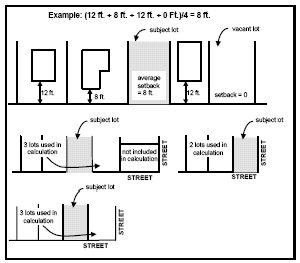
Figure 7: Average Setback
2.
The following exceptions to the maximum front and side yard setbacks apply:
a.
A portion of the building may be set back from the maximum setback line in order to provide an articulated facade or accommodate a building entrance feature, if the total area of the space created does not exceed one square foot for every linear foot of building frontage, as shown in Figure 7.
b.
A building may be set back farther than the maximum setback in order to accommodate an outdoor eating area. In order to preserve the continuity of the street wall, the building may be set back no more than twelve (12) feet from the front property line or at least forty (40) percent of the building facade must be located at the maximum setback line. The total square footage of an outdoor eating area that is located between a public sidewalk and the building facade may not exceed twelve (12) times the building's street frontage in linear feet.
c.
Exceptions to Minimum Side Yard Setbacks.
i.
Side Yard Setbacks in TCR. Provision for zero lot-line one-unit dwellings will be made, provided that a reciprocal access easement is recorded for both lots and townhouses or other attached dwellings, and provided that all dwellings have pedestrian access to the rear yard through means other than the principal structure.
H.
Off-Street Parking. All development in the town center area is subject to the following parking standards:
1.
One off-street parking space must be provided for each dwelling unit.
2.
Off-street parking for non-residential uses must be provided at a minimum ratio of one space per each one thousand (1,000) square feet of gross floor area, or two parking spaces, whichever is greater
3.
All off-street parking spaces must be located to the rear of the principal building or otherwise screened so as to not be visible from public right-of-way or residential zoning districts.
I.
Indoor/Outdoor Operations. All permitted uses in the town center area must be conducted within buildings unless otherwise expressly authorized. This requirement does not apply to off-street parking or loading areas, automated teller machines, or outdoor seating areas, alone or in connection with restaurants.
J.
Doors and Entrances.
1.
Buildings must have a primary entrance door facing a public sidewalk or a front yard if a public sidewalk does not exist. Entrances at building corners may be used to satisfy this requirement.
2.
Building entrances may include doors to individual shops or businesses, lobby entrances, entrances to pedestrian-oriented plazas, or courtyard entrances to a cluster of shops or businesses.
K.
Vehicle and Driveway Access.
1.
No curb cuts are allowed to cross sidewalks that disrupt pedestrian movements and pose safety threats.
2.
Curb cuts will provide pedestrian primary access, clear zones, and circulation.
L.
Landscaping Requirements.
1.
Parking Area Landscaping and Screening. All parking and loading areas fronting public streets or sidewalks, and all parking and loading areas abutting residential districts or uses shall provide:
a.
A landscaped area at least five feet wide along the public street or sidewalk.
b.
Screening at least three feet in height and not less than fifty (50) percent opaque.
c.
One tree for each twenty-five (25) linear feet of parking lot frontage.
2.
Parking Area Interior Landscaping. The corners of parking lots, "islands," and all other areas not used for parking or vehicular circulation shall be landscaped. Vegetation can include turf grass, native grasses or other perennial flowering plants, vines, shrubs, or trees. Such spaces may include architectural features such as benches, kiosks, or bicycle parking.
3.
In parking lots, an additional landscaped area of at least three hundred (300) square feet shall be provided for each twenty-five (25) spaces or fraction thereof, containing one canopy tree. The remainder shall be covered with turf grass, native grasses, or other perennial flowering plants, vines, or shrubs.
4.
Installation and Maintenance of Landscaping Materials.
a.
All landscape materials shall be installed to current industry standards.
b.
Maintenance and replacement of landscape materials shall be the responsibility of the property owner and all future owners. Landscape maintenance should incorporate environmentally sound management practices, including the use of water- and energy-efficient irrigation systems such as drip irrigation, and pruning primarily for plant health and public safety, as well as the replacing of dead materials annually.
5.
Materials. All plant materials must meet the minimum standards set by the American National Standards Institute in ANSI Z60.1 American Standard for Nursery Stock. Landscape species shall be indigenous or proven adaptable to the climate but shall not be invasive species. Plant materials shall comply with the following standards:
a.
Landscape materials shall be tolerant of specific site conditions, including but not limited to heat, cold, drought, and salt.
b.
Existing healthy plant material may be utilized to satisfy landscaping requirements, provided it meets the minimum plant size specified above.
c.
Landscape materials that are used for screening shall be of a size that allows growth to the desired height and opacity within two years.
M.
Pedestrian Circulation.
1.
Convenient pedestrian circulation systems that minimize pedestrian-motor vehicle conflicts shall be provided continuously throughout the town center area. Where feasible, any existing pedestrian routes through the site shall be preserved and enhanced. All public streets, except for alleys, shall be bordered by sidewalks on both sides of the street, in accordance with the specifications below:
a.
Sidewalks in the TCR District. Clear and well-lighted sidewalks, three to five feet in width, depending on projected pedestrian traffic, shall connect all dwelling entrances to the adjacent public sidewalk.
b.
Sidewalks in the TC and TC2 Districts. Clear and well-lighted walkways shall connect building entrances to the adjacent public sidewalk and to associated parking areas. Such walkways shall be a minimum of five feet in width and comply to all ADA standards.
2.
Development subject to site plan approval or special use permit shall post a bond, as determined by the town board, for the completion of sidewalks and shall set aside appropriate real property for a public easement for such sidewalk.
(LL No. 1, 2021, § 1)
17.36.341 - Solar siting.
A.
Intent. It is in the public interest to provide for and encourage renewable energy systems and a sustainable quality of life, the purpose of this chapter is to facilitate the development and operation of renewable energy systems based on sunlight. Solar energy systems are appropriate in all zoning districts when measures are taken, as provided in this section, to minimize adverse impacts on neighboring properties and protect the public health, safety, and welfare. Solar farms should complement the municipality and its residents' way of life and not be solely a method to replace otherwise viably or future use of property in the town, for example, tillable farmland, tree removal, impact upon future development in the area due to utility requirements for operation of the solar farm with commercially viable premises, as well as quality of life issues. This legislation is not intended to override agricultural exemptions that are currently in place.
B.
Definitions. As used in this chapter, the following terms shall have the meanings indicated, unless the context or subject matter requires otherwise.
Building-integrated photovoltaic (BIPV) systems means a solar energy system that consists of integrating photovoltaic modules into the building structure, such as the roof or the facade and which does not alter the relief of the roof.
Collective solar means solar installations owned collectively through subdivision homeowner associations, college student groups, "adopt-a-solar-panel" programs, or other similar arrangements.
Flush mounted solar panel means a photovoltaic panel or tile that is installed flush to the surface of a roof or wall of a principal and/or accessory structure and which cannot be angled or raised.
Freestanding or ground-mounted solar collector system means a solar collector system that is directly installed in the ground and is not attached or affixed to an existing structure. Pole mounted solar energy systems shall be considered freestanding or ground-mounted solar energy systems for purposes of this section.
Glare means the effect produced by light with intensity sufficient to cause annoyance, discomfort, or loss in visual performance and visibility.
Major solar collection system or solar farm means energy generation facility or area of land principally used to convert solar energy to electricity, whether by photovoltaics, concentrating solar thermal devices or various experimental solar technologies, with the primary purpose of wholesale or retail sales of electricity, but also may be for on-site use. Solar farm facilities consist of one or more freestanding ground- or roof-mounted solar collector devices, solar-related equipment and other accessory structures and buildings, including light reflectors, concentrators, and head exchangers, substations, electrical infrastructure, transmission lines and other appurtenant structures and facilities.
Minor solar collection system means a solar photovoltaic cell, panel or array, or solar hot air or water collector device, which relies upon solar radiation as an energy source for collection, inversion, storage, and distribution of solar energy for electricity generation or transfer of stored heat, secondary to the use of the premises for other lawful purposes with the total surface area of all solar collectors on the lot not to exceed three thousand (3,000) square feet.
Net-metering means a billing arrangement that allows solar customers to get credit for excess electricity that they generate and deliver back to the grid so that they only pay for their net electricity usage at the end of the month.
Photovoltaic (PV) systems mean a solar energy system that produces electricity by the use of semiconductor devices, called photovoltaic cells that generate electricity whenever light strikes them.
Qualified solar installer means a person who has skills and knowledge related to the construction and operation of solar electrical equipment and installations and has received safety training on the hazards involved. Persons who are on the list of eligible photovoltaic installers maintained by the New York State Energy Research and Development authority (NYSERDA), or who are certified as a solar installer by the North American Board Certified Energy Practitioners (NABCEP), shall be deemed to be qualified solar installers for the purposes of this definition.
Rooftop or building mounted solar collector system means a solar collector system in which solar panels are mounted on top of the structure of a roof either as a flush-mounted system or as modules fixed to frames which can be tilted toward the south at an optimal angle.
Setback means the distance from a front lot line, side lot line or rear lot line of a parcel within which a free standing or ground mounted solar energy system is installed.
Solar access means space open to the sun and clear of overhangs or shade including the orientation of streets and lots to the sun so as to permit the use of active and/or passive solar energy systems on individual properties.
Solar collector means a solar photovoltaic cell, panel, or array, or solar hot air or water collector device, which relies upon solar radiation as an energy source for the generation of electricity or transfer of stored heat.
Solar easement means an easement recorded pursuant to NY Real Property Law § 335-b, the purpose of which is to secure the right to receive sunlight across real property of another for continued access to sunlight necessary to operate a solar collector.
Solar energy equipment/system means solar collectors, controls, energy storage devices, heat pumps, heat exchangers, and other materials, hardware, or equipment necessary to the process by which solar radiation is collected, converted into another form of energy, stored, protected from unnecessary dissipation and distributed. Solar systems include solar thermal, photovoltaic, and concentrated solar.
Solar array means a group of multiple solar modules with purpose of harvesting solar energy.
Solar panel means a device for the direct conversion of solar energy into electricity.
Solar storage battery means a device that stores energy from the sun and makes it available in an electrical form.
C.
Applicability.
1.
The requirements of this section shall apply to all solar energy system and equipment installations modified or installed after the effective date of this section.
2.
Solar energy system installations for which a valid building permit has been issued or, if no building permit is presently required, for which installation has commenced before the effective date of this section shall not be required to meet the requirements of this section.
3.
All solar energy systems shall be designed, erected, and installed in accordance with all applicable codes, regulations and industry standards as referenced in the state building code and this code.
4.
Solar collectors, unless part of a major solar collector system or solar farm, shall be permitted only to provide power for use by owners, lessees, tenants, residents, or other occupants of the premises on which they are erected, but nothing contained in this provision shall be construed to prohibit "collective solar" installations or the sale of excess power through a "net billing" or "net-metering" arrangement in accordance with New York Public Service Law § 66-j or similar state or federal statute.
5.
Nothing contained within this section shall preclude the town from operating or leasing any solar energy system on town-owned properties or assets, subject to the provisions contained within this section.
D.
Minor Solar Collection Systems.
1.
Rooftop and Building-Mounted Minor Solar Collector Systems. Rooftop and building mounted solar collectors are permitted in all zoning districts in the town subject to the following conditions:
a.
Building permits shall be required for installation of all rooftop and building-mounted solar collectors.
b.
Rooftop and building-mounted solar collectors shall not exceed the maximum allowed height of the principal use in any zoning district.
c.
With the exception of solar panels, all equipment associated with roof mounted collector systems, including but not limited to controls, energy storage devices, heat pumps, exchangers, or other materials, hardware or equipment necessary for the process by which solar radiation is converted into another form of energy shall be screened from street view and shall not be located within the front yard.
2.
Building-Integrated Photovoltaic (BIPV) Systems. BIPV systems are permitted in all zoning districts and shall be shown on the plans submitted for the building permit application for the building containing the system.
3.
Free Standing and Ground Mounted Minor Solar Collector Systems. Free standing or ground mounted minor solar collector systems are permitted as accessory structures in all zoning districts of the town, subject to the following requirements:
a.
The ground mounted and freestanding minor solar collector systems shall meet the accessory building setback and location requirements per subsection 17.40.020(C).
b.
Building permits are required for the installation of all ground-mounted and free standing minor solar collector systems.
c.
The height of the ground mounted and freestanding solar collector systems and any mounts shall not exceed sixteen (16) feet in any zone, when oriented at maximum tilt.
d.
The total surface area of all minor solar collector systems on the lot shall not exceed three thousand (3,000) square feet and, when combined with all other buildings and structures, including accessory structure, on the lot, shall not exceed the maximum lot coverage per Section 17.16.020 of the zone in which they are located.
e.
Ground mounted and freestanding minor solar collector systems and other facilities shall be surfaced, designed, and sited so as not to reflect glare onto adjacent properties and roadways.
f.
Ground mounted and freestanding minor solar collector systems shall be screened when possible and practicable from adjoining lots and street rights-of-way through the use of architectural features, earth berms, landscaping, fencing or other screening which will harmonize with the character of the property and surrounding area. Any transition yard, buffer yard, landscaping, and barrier requirements per Section 17.36.200 shall be adhered to when applicable. The proposed screening shall not interfere with normal operation of the solar collectors.
g.
The area of the ground mounted and freestanding solar collectors and/or equipment pads shall be included in calculating whether the lot meets maximum permitted impervious coverage requirements as defined in Section 17.16.020 for the applicable zoning district.
h.
The installation of ground mounted and freestanding minor solar collectors on any non-residential use shall be considered a development and shall comply with the site plan approval process and applicable sections of Title 17.
E.
Major Solar Collection Systems or Solar Farms. Major solar collection systems or solar farms shall be permitted under site plan approval and upon grant of a special use permit by the town board in the RU, BN2, BNR, BR, I, and C districts, subject to the following supplementary regulations:
1.
Height and Setback Restrictions.
a.
The maximum height for freestanding solar panels located on the ground or attached to a framework located on the ground shall no exceed sixteen (16) feet in height above ground at maximum tilt angle.
b.
The minimum setback from front property line shall be fifty (50) feet and side and rear property lines shall be fifty (50) feet unless a residential structure is within three hundred (300) feet of the property line or cannot be built and be compliant with underlying zoning district setbacks and then the side and rear setback shall be extended to one hundred (100) feet. If the setback requirement of the underlining zoning district for general or business use is greater than that setback distance shall apply. Any transition yard, buffer yard, landscaping, and barrier requirements per Section 17.36.200 shall be adhered to when applicable.
c.
The minimum setback from a residential structure to solar collectors shall be two hundred (200) feet. As part of the special use permit process the town board upon good cause reduce the setback from the residential structure.
d.
The maximum permitted impervious coverage requirements shall be as defined in Section 17.16.020 the applicable zoning district. The panel areas shall not be included in calculating whether the lot meets the maximum permitted impervious coverage if the panels are post mounted. Any access roads, equipment pads, or other impervious surface shall be included in calculating whether the lot meets maximum permitted impervious coverage requirements.
2.
Design Restrictions.
a.
Major solar collection systems and solar farms shall be enclosed by a chain link or fixed knot deer perimeter fence to restrict unauthorized access at a minimum height of seven feet.
b.
A sign not to exceed sixteen (16) square feet shall be displayed on or near the main access point and shall list the facility name, owner, and phone number for emergency personnel purposes.
c.
Ground mounted, and freestanding solar collector systems shall be screened from adjoining lots and street rights-of-way through the use of architectural features, earth berms, landscaping, fencing or other screening which will harmonize with the character of the property and surrounding area. Any transition yard, buffer yard, landscaping, and barrier requirements per Section 17.36.200 shall be adhered to when applicable. The proposed screening shall not interfere with normal operation of the solar collectors.
d.
All panels and equipment shall be surfaced, designed, and sited so as not to reflect glare onto adjacent properties and roadways.
e.
On-site power lines shall, to the maximum extent practicable, be placed underground.
f.
Removal of trees and other existing vegetation should be minimized to the best extent possible.
g.
Driveways and access roads within the lot shall be a gravel or crushed stone surface and shall be designed to minimize the extent of roadways constructed, disturbance and soil compaction.
h.
All major solar collection systems or solar farms shall be considered Type 1 actions as it relates to SEQRA.
i.
All major solar collection systems or solar farms that disturb over one acre shall submit a stormwater pollution prevention plan (SWPPP) in accordance with the Chapter 17.37 and the SPDES general permit for stormwater discharges from construction activity, latest version (general permit).
j.
All major solar collection systems or solar farms shall provide a construction access plan and decompaction/stabilization plan to prevent excessive compaction due to construction activities and to ensure site is properly decompacted and stabilized per the terms of the approved SWPPP and the general permit. Construction access plan must be approved by the town prior to the applicant advancing past the phase I construction as referenced in the major solar collection system construction requirements section below.
k.
The following shall be conditions of approval for all special use permits issued for major solar collection facilities:
i.
No major solar collection facility or solar farm shall be energized or allowed to generate power to the electric transmission line until a certificate of occupancy has been obtained from the town code department.
ii.
The town shall receive thirty (30) days' notification prior to the applicant and/or contractor requesting final electrical inspection from the approved third party electrical inspector.
iii.
Applicant and contractor(s) shall adhere to construction conditions requirements outlined in the following sections.
iv.
Any violation of subsection 17.36.341(E) that are not corrected by the applicant and/or contractor in a timely and responsive manner shall warrant the town board to revoke the special use permit, issue a stop work order, and the applicant and/or contractor shall face fines and penalties as outlined in this chapter and/or Section 15.04,150, whichever is more stringent.
v.
Bi-weekly construction site meetings shall be required by all parties to ensure compliance with the construction requirements for major solar collection systems outlined in subsection 17.36.341(E)(3). Applicant shall provide to the town and other involved parties a summary report of the bi-weekly meetings along with remediation actions to address any noncompliant corrective measures within forty-eight (48) hours of the site meeting.
vi.
The construction requirements outlined in subsection 17.36.341(E)(3) shall be strictly adhered to for all major solar collection systems or solar farms. Any deviation from the construction sequence outlined below will result in fines, penalties and legal actions as referenced in Section 17.36.341 of the town zoning code. Written approval by the town board is required for the applicant to deviate from the construction requirements outlined in the code.
vii.
If any work is commenced outside the authorized phase of construction, the town code enforcement officer shall immediately issue a stop work order. Persons receiving the stop work order shall be required to halt all development and construction activities. The stop work order shall be in effect until the town confirms that construction activities being performed in compliance with the construction requirements in subsection 17.36.341(E).
viii.
In addition to or as an alternative to any penalty provided herein, or by law, any person who violates the construction requirements of subsection 17.36.341(E) or proceeds with construction activities in subsequent phases without approval from the town shall be guilty of a violation punishable by a fine of at [least] five hundred dollars ($500.00) and not exceeding one thousand dollars ($1,000.00) per day or imprisonment for a period not to exceed fifteen (15) days, or both.
3.
Major Solar Collection System Construction Requirements.
a.
For each of the construction phases noted below, the town code enforcement officer shall review and inspect the work completed and shall provide written authorization to proceed to the next phase. No work shall be performed on the next phase until such authorization has been obtained. A construction phase compliance checklist will be provided to the applicant as part of the site plan approval and a condition of site plan approval shall be that the compliance checklist must be kept on site and no phase shall continue without documented authorization from the code enforcement officer permitting the applicant and/or contractor(s) to advance to the next phase.
b.
To obtain inspections, the applicant shall notify the town code enforcement officer at least forty-eight (48) hours in advance of the desired construction phase inspection.
c.
Construction sequencing:
i.
Pre-Construction Kick Off Meeting. Prior to the start of any mobilization, staging, ground disturbance or any other construction activities a pre-construction kick-off meeting shall be scheduled and held. The following items shall be received and approved by the town before the pre-construction kick-off meeting can be held:
(A)
Final site plan approval from the planning board and special use permit from the town board has been obtained and all conditions necessary to start construction have been met with all appropriate documentation necessary to demonstrate compliance having been submitted, reviewed and approved by the town.
(B)
Final stormwater pollution prevention plan (SWPPP) has been received by the town and stamped "approved" by the town planning and code department.
(C)
A performance guarantee to be provided by the original applicant named on the site plan and special use permit applications. Applicant to provide a performance bond, cash escrow, or irrevocable letter of credit from an appropriate financial or surety institution which guarantees satisfactory completion of the project and names the town as the beneficiary. The security shall be in the amount of fifteen (15) percent of the total construction cost of the project which shall be provided in a certified cost estimate prepared by a professional engineer in the state. The performance guarantee shall remain in force until the surety is released from liability by the town as outlined in the sequence below. Any change of ownership and/or operation to the original applicant shall require a new performance guarantee. The town must be notified of any change of ownership within thirty (30) days of such change.
(D)
A stormwater inspection fee to be provided by the original applicant named on the site plan and special use permit applications. Applicant to provide a fee in the amount of five thousand dollars ($5,000.00) that will be placed in cash escrow. All inspections and meetings completed by town staff will be paid out of that escrow amount. At any point that amount is depleted, the applicant may be required to post additional cash escrow.
(E)
Kick-off meeting. After all of the items noted above have been completed applicant may schedule an on-site kick-off meeting and shall invite the following minimum attendees: engineer-of-record that prepared SWPPP, applicant (submitting site plan/special use permit application), EPC company (if applicable), general contractor, site contractor, and representative from the town. During the pre-construction kick-off meeting, the construction requirements outlined in this section along with the compliance checklist; SWPPP requirements including critical elements such as erosion and sediment control and stormwater management measures; decompaction and stabilization; and construction access plan shall be reviewed with all parties.
ii.
Phase I Construction. Construction during this phase shall include all work to be completed as noted below and work shall be completed in an acceptable manner. At a minimum, the following construction activities shall be completed prior to the installation of the racking system and panels.
(A)
All perimeter controls shall be installed, maintained and functioning.
(B)
All land clearing has been completed and all earthwork has been completed.
(C)
Temporary and/or permanent best management practices for erosion and sediment control and runoff management have been installed (per the approved SWPPP).
(D)
Underground utility conduits have been installed.
(E)
Concrete equipment pad has been poured (equipment may or may not be installed at this stage).
(F)
Equipment posts have been staked out and/or drilled.
(G)
Applicant or contractor to update access plan if needed to limit construction traffic to select areas to be accessed at this stage of construction. Access plan shall be approved and being followed prior to advancing to the next phase of construction.
(H)
Applicant or contractor to decompact and stabilize, per requirements of the SWPPP and general permit, latest revision, areas as noted on the access plan not scheduled to receive heavy and/or frequent construction traffic necessary to complete the remainder of construction. Access plan shall be communicated to all subcontractors and measures shall be put in place (i.e. construction fencing) to ensure construction traffic is kept off these areas to avoid compaction.
(I)
Town code enforcement officer must sign off on the decompaction and/or stabilization work that has been completed per the terms of the SWPPP and general permit, latest revision.
(J)
Upon approval by the town code enforcement officer for this phase of construction, the applicant that posted the performance guarantee may submit a written request to release twenty-five (25) of said guarantee.
(K)
Upon approval of the access plan and successful completion of decompaction and stabilization per the SWPPP and general permit, the applicant or contractor may proceed to the installation of racking system, panels, wiring and equipment installation.
(L)
Weekly inspection reports must document that access plan is being following and heavy construction equipment is not compacting areas that have been decompacted and stabilized.
iii.
Phase II Construction. At this phase all remaining work is completed in order to request electrical inspections. Prior to final electrical inspection the following items shall be completed by the applicant or contractor:
(A)
The town shall receive thirty (30) days' notification prior to the applicant and/or contractor requesting final electrical inspection from the approved third party electrical inspector. If the town does not receive notification and final inspection is completed without notification to the town, the special use permit shall be immediately revoked and the applicant shall face fines and penalties as outlined in this chapter or and as in Section 15.04.140, whichever is more stringent.
(B)
All work shall be completed per the approved plans and/or deviations have been approved by the engineer-of-record and the town.
(C)
SWPPP final stabilization measures are in place and/or close to final stabilization.
(D)
Operation and maintenance plan and agreement have been executed and proof of recording has been obtained.
(E)
All landscaping and/or buffering has been installed unless seasonal restrictions prevent installation from occurring at this time. If landscaping and/or buffering is not installed, the applicant shall provide a financial security for such improvements to ensure that these items will be installed next planting season.
(F)
Upon approval by the town code enforcement officer for this phase of construction, the applicant that posted the performance guarantee may submit a written request to release twenty-five (25) percent of said guarantee.
iv.
Project Closeout. Upon satisfactorily meeting the items noted below, the town shall issue the final certificate of occupancy and sign the notice of termination. At this phase all work has been completed including the following:
(A)
The site has achieved eighty (80) percent stabilization and all landscaping and/or buffer has been installed.
(B)
All punch list or deficient items have been satisfactorily addressed.
(C)
An as-built plan and certification letter prepared by the professional engineer of record licensed in the state stating that the site has been constructed in conformance with the approved site plan, special use permit and conditions, and the approved SWPPP and any deviations from the approved plans have been noted and approved by the engineer.
(D)
Upon project closeout the remaining portion of the performance guarantee and inspection escrow shall be released.
(E)
Town to perform post-construction three-year inspections and applicant to perform inspections and maintain per O&M agreement and plan.
4.
Decommissioning.
a.
Solar farms and solar power plants which have not been in active and continuous service for a period of six months shall be removed at the owners or operator's expense. Town may request from the owner or operator proof of service if it appears the site appears to be inactive or out of service.
b.
The site shall be restored to as natural a condition as possible within three months of the removal. Failure to do so will result in the loss of the applicable performance bond and payment. A time extension may be requested by the owner in the event that weather or other circumstances prevent the site from being restored within the three-month time period.
c.
A valid performance and payment bond assigned to the town for major solar collection system. The applicant must provide an estimated cost of decommissioning and the salvage value of all equipment to establish the amount. The performance guarantee may be of the following types:
i.
A surety or performance bond that renews automatically. A bond certificate must be submitted to the town each year verifying the bond has been properly renewed.
ii.
A no-contents irrevocable bank letter of credit from a banking corporation licensed to do business in the state.
d.
The full amount of the bond or letter of credit must remain in full force and effect until the major solar collection system is decommissioned and any necessary site restoration is completed.
e.
All applications for a solar farm shall be accompanied by a decommissioning plan to be implemented upon abandonment and/or in conjunction with removal of the facility. If the applicant begins but does not complete construction of the project within eighteen (18) months after receiving final site plan approval, this may be deemed abandonment of the project and require implementation of the decommissioning plan to the extent applicable.
f.
Any change of ownership and/or operation shall require a new application and new bond. The town must be notified of any change of ownership within thirty (30) days of such change. If this does not occur the town board may exercise full authority to utilize the bond or letter of credit and decommission the site.
F.
Safety.
1.
All solar collector installations must be performed by a qualified solar installer. Documentation of being a qualified solar installer must be provided as part of the building permit application.
2.
Prior to operation, electrical connections must be inspected by a town approved third-party electrical inspection person or agency. Any connection to the public utility grid must be inspected by the appropriate public utility.
3.
Solar energy systems shall be maintained in good working order. Maintenance shall include, but not be limited to, mowing, painting, structural repairs, and integrity of security measures. Site access shall be maintained to a level acceptable to the code enforcement officer and emergency personnel. The owner or operator shall be responsible for the cost of maintaining the solar farm and any access road(s), unless accepted as a public right-of-way.
4.
Rooftop and building-mounted solar collectors shall meet all applicable state fire and building code standards.
5.
Upon request, the owner or operator shall cooperate with local emergency services in developing an emergency response plan. All means of shutting down the solar farm facility shall be clearly marked. The owner or operator shall identify a responsible person for public inquiries throughout the life of the installation.
6.
If solar storage batteries are included as part of the solar collector system, they must be placed in a secure container or enclosure meeting the requirements of all applicable building code standards when in use and when no longer used shall be disposed of in accordance with the laws and regulations of the town and other applicable laws and regulations.
7.
All installations must adhere to the provisions of all applicable state fire and building codes, and any other applicable local, state, and federal codes and/or standards.
8.
Where this section differs or conflicts with other laws, rules, and regulations, unless the right to do so is preempted or prohibited by the county, state of federal government, the more restrictive or protective of the town and the public safety shall apply.
(LL No. 1, 2024; LL No. 1, 2021, § 1)
17.36.342 - Cannabis-related businesses.
A.
Intent. It is the intent and purpose of this section to provide regulations regarding cannabis-related businesses occurring within the limits of the town. Such facilities shall comply with all regulations provided in the Marihuana Regulation and Taxation Act (MRTA)(S.854-A/A.1248-A), Chapter 7-A, Cannabis Law (410 ILCS 705/1-1) and the regulations provided in this chapter. In the event that the MRTA is amended, the more restrictive of the state or town regulations (as established in this chapter) shall apply.
B.
Violation. Any person, firm, partnership, association, corporation, company, entity, or organization of any kind and any principle or agent thereof found guilty violating any provisions of this local law, and the owner or any entity that owns or hold an interest in any premises on which a violation is committed shall be subject to penalties outlined in this code.
C.
Definitions. As used in this chapter, the following terms shall have the meanings indicated, unless the context or subject matter requires otherwise.
Act means Marihuana Regulation and Taxation Act, Chapter 92 of the Laws of 2021.
Board means the New York State Cannabis Board established pursuant to the Act.
Cannabinoid hemp means any hemp and any product processed or derived from hemp, that is used for human consumption provided that when such product is packaged or offered for retail sale to a consumer, it shall not have a concentration of more than three-tenths of a percent delta-9 tetrahydrocannabinol.
Cannabis means all parts of the plant of the genus Cannabis, whether growing or not; the seeds thereof, the resin extracted from any part of the plant' and every compound, manufacture, salt, derivative, mixture, or preparation of the plant, its seeds or resin. It does not include the mature stalks of the plant, fiber produced from the stalks, oil or cake made from the seeds of the plant, any other compound, manufacture, salt, derivative, mixture, or preparation of the mature stalks (except the resin extracted therefrom), fiber, oil, or cake, or the sterilized seed of the plant which is incapable of germination. It does not include hemp, cannabinoid hemp or hemp extract as defined by the Act or any drug products approved by the federal Food and Drug Administration.
Community facility means a facility that may include, but not be limited to, a facility that provides day care to children; a public park; a playground; a public swimming pool, a library; a school; a community center; or a center or facility where the primary purpose of which is to provide recreational opportunities or services to children or adolescents.
Eligible applicant means an applicant that satisfies all the required elements of the adult-use retail dispensary, Part 116.
License means a license issued pursuant to the adult-use retail dispensary, Part 116 and is conditioned on all requirements and prohibitions being met.
Licensee means a person who has been granted a license to engage in the retail sale of cannabis products under Part 116 of the adult-use retail dispensary license program.
Office of cannabis management (OCM) is an independent entity providing a comprehensive regulatory framework governing the cultivation, processing, manufacturing, distribution, transportation and sale of cannabis in the state, including medical, adult-use, and cannabinoid hemp.
Part 116 means the section of Chapter II of Subtitle B of Title 9 of the Official Compilation of Codes, Rules and Regulations of the State of New York, current amendment which establishes the regulations for obtaining an adult-use retail dispensary.
D.
Types of Licenses. New York State intends to issue twelve (12) different cannabis-related business type licenses that permit activities ranging for cultivation to retail and delivery. The town zoning ordinance classes the different business types as either industrial or commercial.
1.
Industrial cannabis-related businesses include all operators obtaining a cultivation, distribution, processing and/or storage licenses from the state. Industrial cannabis-related business shall only be permitted in the rural (RU), airport business development (ABD), and industrial (I) zoning districts through site plan and special use permit pursuant to Chapter 17.32 and Chapter 17.33 as well as all other applicable provisions of this chapter and any and all chapters of this code.
a.
All industrial cannabis-related businesses shall adhere to the industrial use requirements outlined in Section 17.36.130 and all other applicable sections of this code.
2.
Commercial cannabis-related business includes all operators obtaining an adult-use retail dispensary, delivery service and/or nursery license. Commercial cannabis-related business also includes on-site consumption facilities that sell directly to the consumer for consumptions on the premises. Commercial cannabis-related businesses shall only be permitted in the business regional (BR) zoning district through site plan and special use permit pursuant to Chapter 17.32 and Chapter 17.33 as well as all other applicable provisions of this chapter and any and all chapters of this code.
a.
All regulations for commercial cannabis-related businesses shall contained in this section shall only become valid once the town through local law has elected to opt in to the licensing and establishment of adult use cannabis retail dispensaries and/or on-site cannabis consumption sites with the office of cannabis management (OCM). Until said time, no commercial cannabis-related businesses including adult use cannabis retail dispensaries and on-site cannabis consumptions sites shall be permitted to operate in the town.
b.
No cannabis products shall be sold, gifted, processed, manufactured, and/or distributed unless the operators have obtained the necessary licenses to operate from the office of cannabis management.
i.
Proof of licensed premises from the state office of cannabis management shall be required by the applicant as a condition of site plan and special use permit review and approval.
ii.
Any store that attempt to gift or give away cannabis products shall be prohibited within the town. Operation of any such establishment within the town is declared a public nuisance and shall be abated pursuant to the authority established by this code.
E.
Supplemental Regulations for Cannabis-Related Businesses.
1.
All facilities operated by a registered organization, including any manufacturing facility and dispensing facility, shall have a security system and security plan in place to prevent and detect diversion, theft, or loss of cannabis related products. Such security system and plan shall meet the license requirements and any other safety and security requirements as outlined by the OCM;
2.
All applications shall be in compliance with Part 116;
3.
Any commercial cannabis-related business shall maintain minimum ownership and control requirements set forth in Part 116 and proof of compliance with said requirements shall be provided to the town on an annual basis.
4.
All commercial cannabis-related businesses shall only acquire cannabis products from entities authorized to distribute cannabis products in the state;
5.
Commercial cannabis-related business shall not be located with one thousand (1,000) feet of the lot line of any park, playground, library, religion institution or other community facility and two thousand five hundred (2,500) feet of the lot line of any school.
6.
Commercial cannabis-related business shall be prohibited in all residential districts or within a three-hundred-foot radius of any property in a residential district or that is used for residential purposes.
7.
No more than one commercial cannabis-related business shall be located on any lot or within one-half mile of any other commercial cannabis-related business.
8.
On a lot where a commercial cannabis-related business is operating, the lot shall have no other uses on site unless located within a plaza or mall that has multiple shops on a single lot.
9.
Cannabis products shall not be sold to individuals under twenty-one (21) years of age and no one under the age of twenty-one (21) shall be permitted to enter the licensed facility. Applicant shall provide documentation during the site plan application to show what measures will be implemented to ensure no one under the age of twenty-one (21) is permitted to enter the licensed facility.
10.
No commercial cannabis related business shall be located within pre-existing nonconforming buildings.
11.
No outdoor seating areas or areas of on-site consumption shall be permitted at an adult-use cannabis retail dispensary.
12.
Any buildings in which a commercial cannabis-related business operates shall ensure that the sales and products being sold are not visible from offsite or from a public right-of-way. Applicants are encouraged to minimize opaque facades and/or use other measures to screen the retail areas in order to maintain attractive street frontages.
13.
Hours of operation. Commercial cannabis-related business shall only sell cannabis products, including through delivery, during their hours of operation of which may include the following hours and days:
a.
Monday through Saturday: 9:00 a.m.—10:00 p.m.
b.
Sunday: 12:00 p.m.—6:00 p.m.
c.
Closed: Easter, Thanksgiving Day, Christmas Day, New Year's Day.
d.
Customers may place orders, such as through an online website or application, or accepting payment for those orders outside of the licensee's hours of operation but does prohibit licensees from providing the customer with any cannabis products they have ordered (including through delivery) until the licensee's hours of operation begin.
14.
Any drive-thru services or sales shall be compliant with Section 17.36.220.
15.
Parking. Commercial cannabis-related businesses shall meet the off-road parking and loading requirements for retail stores outline in Chapter 17.48.
16.
Inspections. Police officers and code enforcement officer may inspect the premises and records of licensed operators as allowed by law.
17.
Upon surrender of an commercial cannabis-related business license, or cessation of operations, licensee shall notify the town in writing at least thirty (30) days prior to the date the licensee anticipates ceasing operations and licensee shall meet the requirements of Part 116 in the event of any suspension, revocation, and/or surrendering of license.
18.
Site plan and special use permit application requirements for all cannabis-related businesses.
a.
Copy of license application submitted to the OCM.
b.
Detailed floor plans, including square footage of spaces.
c.
All signage proposed including location and size of photos along with photo simulations to show proposed signage from various viewpoints of the site.
d.
Traffic impact study and traffic control plan with estimate trips per hour including opening day, weekends and the first six months of operation.
e.
Odor control plan.
f.
Engineer's report showing plans for operation, water use, waste disposal, light pollution, transportation/delivery, energy efficient and security.

