
Big Flats City Zoning Code
CHAPTER 17
16 - BULK AND DENSITY CONTROL REQUIREMENTS
17.16.010 - Intent.
This chapter is established in the interest of promoting public health, safety, and welfare by providing open space for: the access of light and air circulation, preventing conflagration, facilitating firefighting, meeting current and future septic disposal needs, protecting water supplies and environmentally sensitive areas, providing no congested traffic movements, and protecting views.
(LL No. 1, 2021, § 1)
17.16.020 - Bulk and density control schedule.
The bulk and density control schedule of required conditions is shown for each individual district as follows:
A.
Rural (RU) Zoning District.
1.
Bulk and Density Control Schedule.
B.
Residential Moderate Density (R1) Zoning District.
1.
Bulk and Density Control Schedule.
2.
For existing lots meeting the requirements of 17.28.080(A), see Section 17.28 (Cluster Residential Subdivisions).
C.
Residential High Density (R2) Zoning District.
1.
Bulk and Density Control Schedule.
D.
Town Center (TC) Zoning District.
1.
Bulk and Density Control Schedule.
2.
For mixed use projects, see note 5.
E.
Town Center 2 (TC2) Zoning District.
1.
Bulk and Density Control Schedule.
2.
For mixed use projects, see note 5.
F.
Town Center Residential (TCR) Zoning District.
1.
Bulk and Density Control Schedule.
G.
Business Neighborhood (BN) Zoning District.
1.
Bulk and Density Control Schedule.
2.
For mixed use projects, see note 5.
H.
Business Neighborhood 2 (BN2) Zoning District.
1.
Bulk and Density Control Schedule.
I.
Business Non-Retail (BNR) Zoning District.
1.
Bulk and Density Control Schedule.
J.
Business Regional (BR) Zoning District.
1.
Bulk and Density Control Schedule.
2.
For mixed use projects, see note 5.
K.
Airport Business Development (ABD) Zoning District.
1.
Bulk and Density Control Schedule.
* Upon approval from FAA building height may be permitted to be up to 60 feet or 4 stories.
L.
Commercial Light Industrial (CL) Zoning District.
1.
Bulk and Density Control Schedule.
M.
Industrial (I) Zoning District.
1.
Bulk and Density Control Schedule.
N.
Conservation (C) Zoning District.
1.
Bulk and Density Control Schedule.
O.
Reserved.
P.
Notes Applicable to the Density or Bulk Control Schedule.
1.
Overall exterior dimension means overall exterior lineal length and width of a structure.
2.
The county health department may require new development using on-lot sewage disposal systems to have larger than the minimum lot sizes stated in this chapter.
3.
Owners of property in the rural zoning district as of the date of passage of this ordinance shall retain the right to a one time subdivision of their property into no more than two total parcels to provide a homestead property for a family member, as defined by the state division of housing and community renewal. The newly created parcel shall be no smaller in size than the minimum lot size allowed in the R1 zoning district for properties without public sewer or water service.
4.
Multi-unit Dwelling. The requirements for each multi-unit dwelling and the lot for the multi-unit dwellings within the BN and BR zoning districts shall be as established by the planning board in the site plan review and approval process, but shall comply with the following special requirements:
a.
Maximum lot coverage: sixty (60) percent;
b.
Minimum lot area:
i.
BN District: thirty thousand (30,000) square feet plus two thousand five hundred (2,500) square feet for each dwelling unit.
1.
Requires approval from the county department of health.
ii.
BR district: eighty-five thousand (85,000) square feet.
iii.
Front yard: twenty (20) feet.
iv.
Side yard: ten (10) feet.
v.
Rear yard: twenty-five (25) feet.
c.
Reserved.
d.
Maximum building height: forty-two (42) feet and three stories;
e.
Minimum habitable dwelling area:
5.
For mixed use projects greater than one story in height, where there is a conflict in lot dimensions, the less restrictive dimension shall be used.
(LL No. 1, 2021, § 1)
17.16.030 - Yard requirements.
Except as provided in this chapter, no structure shall be erected or altered, or lots used, except in accordance with the requirements set forth in this chapter and the bulk and density control schedule. No principal building shall be erected or altered in a setback.
A.
Special Requirement Relating to Front Yard.
1.
No part of any lot that has two or more front yards shall be deemed to be a rear yard.
2.
On any lot with more than one front yard, all yards, other than front yard, shall be deemed to be a side yard.
3.
The minimum front yard setback on an undeveloped lot may be reduced under the following conditions:
a.
Lots adjoining the two sides of the undeveloped lot have principal buildings located within less than the minimum front yard setback established for the district;
b.
The lot width of the undeveloped lot is two hundred fifty (250) feet or less; and
c.
The reduced front yard setback on the undeveloped lot shall be no less than a distance equal to the average distance between the front lot line and the building line on the adjoining lots.
B.
Special Requirement Relating to Inside Yard.
1.
A structure having semi-detached, townhouse, or multi-unit dwelling shall meet side yard setback only at the end of the structure facing the side yard.
2.
Where the side wall of a building is not parallel to the side lot line or the side lot line is broken or otherwise irregular, the side yard may be varied. In such case, the average width of the side yard shall not be less than the otherwise required minimum width; provided, however, that such yard shall not be narrower at any one point than one-half the otherwise required minimum width setback.
(LL No. 1, 2021, § 1)
17.16.040 - Projection into yard.
Only the following shall be permitted to project into a minimum yard setback:
A.
Awnings and canopies may project a maximum of six feet.
B.
Cornices, eaves, passive solar devices, other such architectural features, and roof-mounted antenna may project a maximum of two feet.
C.
Exterior uncovered and unenclosed handicap access facilities may project up to the lot line if required to meet the access requirements of Americans with Disabilities Act (ADA).
D.
Except as provided in Chapters 17.36 through 17.52, unroofed and unenclosed paved surfaces may project up to the lot line.
(LL No. 1, 2021, § 1)
17.16.050 - Compliance with density.
A.
No subdivision of a lot shall create a lot that is not in compliance with any provision of the bulk and density control schedule.
B.
There shall be no more than one principal structure containing any dwelling unit on a lot except as may be approved under site plan review and approval.
(LL No. 1, 2021, § 1)
17.16.060 - Distance between principal structures on same lot.
Where there are two or more principal structures on a lot in any district, the space between such structures shall be at least equal to the structure height of the taller structure.
(LL No. 1, 2021, § 1)
17.16.070 - Through lot.
In the case of a lot running through from one road to another road, the front of such lot shall for the purposes of this title, be considered that frontage upon which the majority of the buildings in the same block front, but in case there has been no clearly defined frontage established, the owner may, when applying for a building permit, specify on the permit application which lot line shall be considered the front lot line. The rear portion of such a lot shall, however, be a front yard for the purposes of determining required setback and locations of permitted structure and use.
(LL No. 1, 2021, § 1)
17.16.080 - Transition yard requirements.
A.
Where a R1, R2, or TCR district abuts any other district without an intervening road, a minimum side or rear yard setback in the other district that is measured from a lot line coincident with the boundary of the abutting district shall be increased more than the minimum yard setback specified in Section 17.16.020 for the other district by the number of feet as follows: (except where the TCR abuts the TC and TC2)
(LL No. 1, 2021, § 1)
17.16.090 - Special requirements relating to yards in RU district.
A.
Notwithstanding any other provision of the BFZL, other than subsections (B) and (C) of this section, agricultural plant use, except structures thereof other than fences and/or plant-supporting structures, may extend to any and all lot lines of the lot on which the agricultural plants are raised.
B.
No agricultural plant use shall be within:
1.
Ground surface distance of one hundred (100) feet from any watercourse, spring, existing well on a lot abutting the lot containing the agricultural plant use, or other surface water body used to provide potable water, and
2.
The required buffer and transition yard, as set forth in Section 17.36.200, along the lot line of the agricultural plant use that is coincident with a R1, R2, TCR, PUD, or PMRD district boundary line.
C.
No business uses other than agricultural plant, agricultural animal, and commercial stable shall be within five hundred (500) feet of a boundary line of a R1, R2, or PMRD district.
(LL No. 1, 2021, § 1)
17.16.100 - Special requirements relating to yards in the town center area.
A.
In the TC, TC2, and TCR zoning districts, no minimum front or side setback is required.
B.
The maximum front and side setback may not exceed the average front or side yard of the nearest two lots on either side of the subject lot.
C.
If one or more of the lots required to be included in the averaging calculation are vacant, such vacant lots will be deemed to have a yard depth of zero feet.
D.
Lots fronting a different street than the subject lot or separated from the subject lot by a street or alley may not be used in computing the average.
E.
When the subject lot is a corner lot, the average setback will be computed on the basis of the two adjacent lots that front on the same street as the subject lot.
F.
When the subject lot abuts a corner lot fronting on the same street, the average setback will be computed on the basis of the abutting corner lot and the nearest two lots that front on the same street as the subject lot. Calculating setbacks shall be conducted by using the example provided in Figure 2:
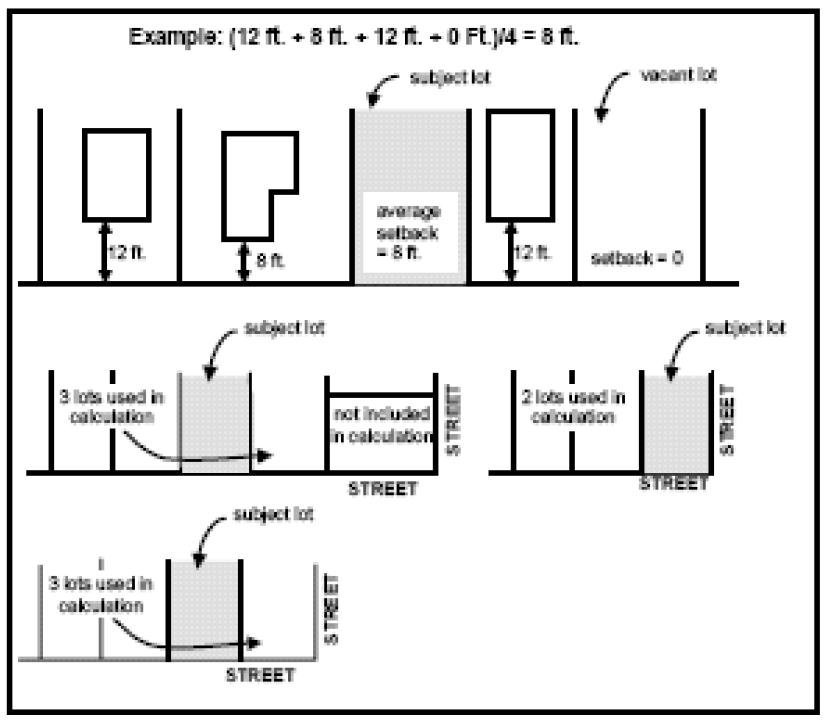
Figure 2: Average Setback
G.
Exceptions to the standards provided in Figure 2 are:
1.
A portion of the building may be set back from the maximum setback line in order to provide an articulated facade or accommodate a building entrance feature, provided that the total area of the space created must not exceed one square foot for every linear foot of building frontage.
2.
A building may be set back farther than the maximum setback in order to accommodate an outdoor eating area. In order to preserve the continuity of the street wall, the building may be set back no more than twelve (12) feet from the front or street side property line or at least forty (40) percent of the building facade must be located at the maximum setback/line. The total area of an outdoor eating area that is located between a public sidewalk and the building facade may not exceed twelve (12) times the building's street frontage in linear feet.
3.
The minimum rear setback must be zero to thirty (30) percent of the lot depth.
4.
No side setback is required in the TC and TC2 districts, except when a property abuts a residential-zoned property outside of the town center area, in which case the minimum side yard setback required in the TC or TC2 district must be the same as required for a residential use on the abutting residential-zoned lot in accordance with Section 17.16.020, bulk and density control schedule.
(LL No. 1, 2021, § 1)

