
Black Mountain City Zoning Code
CHAPTER 3
- SUBDIVISIONS
3.1.1 - Purpose and applicability.
A.
The purpose of these regulations is to guide the subdivision and development of land for residential, commercial, and industrial purposes in such a manner as to implement the comprehensive plan and to:
1.
Promote orderly and harmonious growth;
2.
Establish safe development practices without danger to health, flood, erosion, excessive noise, air pollution, or other menace;
3.
Facilitate fire protection;
4.
Ensure proper provisions for drainage, water supply, sewerage, and other appropriate utility services;
5.
Provide a safe, convenient and functional system for vehicular and non-motorized transportation, including transit services;
6.
Arrange buildings, lots, blocks, and streets shall so as to afford adequate stormwater management and flood prevention;
7.
Protect and enhance native vegetation; and to
8.
Develop with sensitivity to the topography and natural beauty of the land.
B.
The requirements of this chapter apply to all types of subdivisions of land, except:
1.
Combination or recombination of portions of previously subdivided land and recorded lots where the total number of lots is not increased and the resultant lots are equal to or exceed the town's subdivision regulation standards.
2.
Land division into parcels of ten acres or greater where no right-of-way dedication is involved.
3.
Public acquisition for transportation corridors such as purchase of land for roadway widening or the establishment of rights-of-way.
4.
Single ownership tract division where the entire area of the land to be divided is no greater than two acres and is being divided into not more than three lots, where no street right-of-way dedication is involved, and where the resultant lots are equal to or exceed the town's subdivision regulation standards.
5.
Division of land pursuant to an order of a court of the general court of justice.
6.
The division of land pursuant to the terms of a probated will or in accordance with intestate succession under Chapter 29 of the North Carolina General Statutes.
7.
Division of land for cemetery lots or burial plots.
8.
Division of land to change boundary lines between adjoining property owners where no new right-of-way dedication is involved and changes in lot size and setbacks do not create a nonconformity with the land use code.
9.
Division of land as part of a special use permit. Special use permits are issued by the board of adjustment and governed by an approved master plan in accordance with the regulations provided in chapter 7. In such cases, the special use permit and master plan as approved by the board of adjustment shall be considered as an approved preliminary plat. Special use permits shall otherwise comply with all other town regulations and shall provide such covenants or other legal provisions which will insure conformity to, and achievement of, the plan.
10.
Division of land for the purpose of habitat preservation, protection of ridge tops, surface waters, wetland or other natural features, for the protection of an archeological site, or for the purposes of creating a stormwater management facility, without meeting subdivision standards for lot size, access, or road frontage if the following conditions are met:
a.
Maintenance responsibility is established with a recognized land trust, the town or other responsible entity;
b.
The tract is placed in conservation in perpetuity; and
c.
The town may retain access for the purpose of public safety protection.
3.2.1 - Conformance with adopted plans.
Subdivision plats shall conform to the adopted plans of the town. For subdivisions in traditional neighborhood development (TND) zoning districts or as part of special use permits (SUP), the plat shall conform to the approved master plan.
3.2.2 - No subdivision without approval.
A.
No real property, including property declared under the NC Condominium Act (G.S. 47C-1 et seq.), lying within the town's jurisdiction shall be subdivided except in conformance with applicable provisions of this chapter.
B.
No land disturbing or construction activity with the exception of utility testing, engineering testing and surveying to be carried out in conjunction with the subdivision of land shall be commenced until the preliminary plat or plan is approved by the town planning board or the town subdivision administrator as appropriate.
C.
The register of deeds shall not file or record a plat of a subdivision subject to this article that has not been approved in accordance with these provisions. The clerk of superior court shall not order or direct the recording of a plat if the recording would conflict with this chapter.
D.
No street shall be accepted and maintained by the town nor shall any street lighting, water or sewer be extended to or connected with any subdivision of land, nor shall any permit be issued by an administrative agent or department of the town for the construction of any building or other improvement requiring a permit, upon any land concerning which a plat is required to be approved unless and until the requirements set forth in this article and the Town of Black Mountain Standards and Details Manual have been complied with and the same has been approved by the town council.
3.3.1 - Minor subdivision.
A.
A minor subdivision is defined as the division of a tract or parcel of land where:
1.
No new public streets or roads are proposed (except for private driveway easements with each driveway serving no more than three lots);
2.
No part of the tract or parcel to be divided has been divided under this section in the previous ten years; and
3.
No more than four lots will result from the division.
B.
The resultant lots shall conform with all requirements of this land use code.
C.
The minor subdivision process shall be used only where the subdivision includes all contiguous land under the ownership of the applicant and where the resultant lots will not constitute a new phase of an existing development.
D.
The minor subdivision process is not intended to permit the avoidance of improvements, infrastructure or other standards imposed for major subdivisions. Therefore, when an application for minor subdivision approval is made by an applicant who has previously obtained minor subdivision approval for an adjacent parcel of land in the previous two years, the application shall be treated as an application for, and conform to the requirements of, a major subdivision as set forth below.
E.
The following procedures shall be followed for minor subdivisions. The numbers in the boxes below correspond with a detailed description of each step of the process on the following:
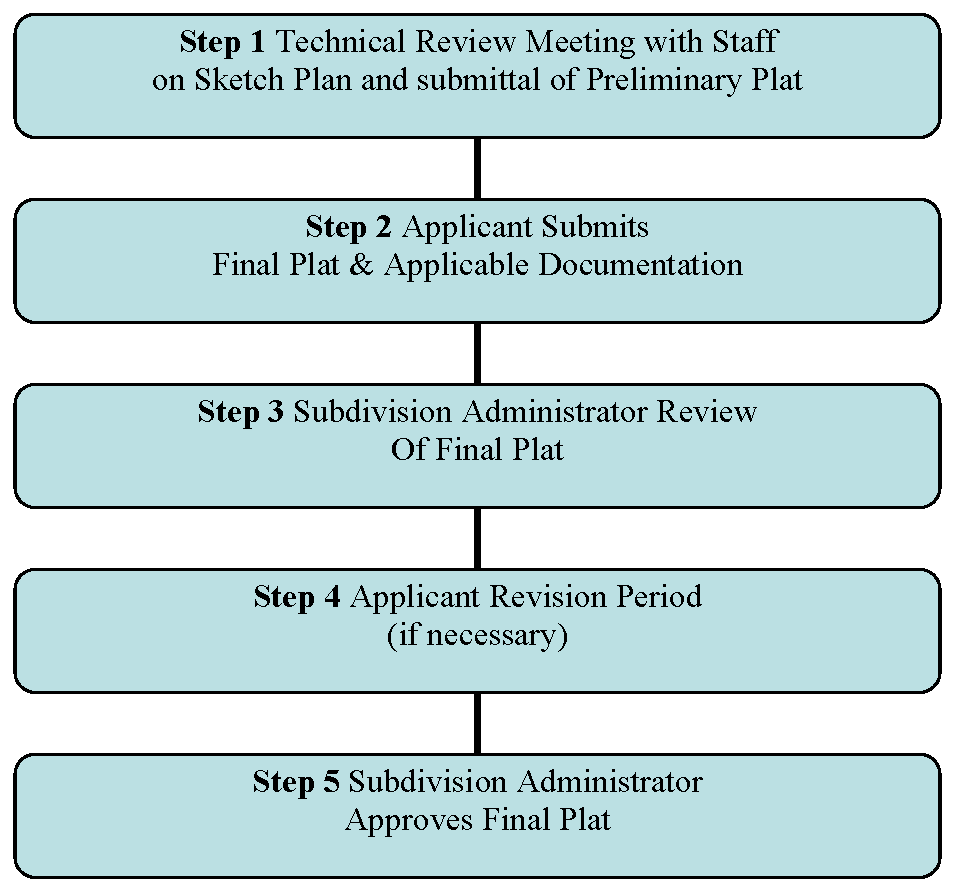
Step 1. Pre-application meeting
A.
The applicant shall schedule a pre-application meeting with the subdivision administrator. The applicant shall bring a preliminary plat of the proposed development to the meeting that meets the requirements set forth in the land use code.
B.
The subdivision administrator shall review the preliminary plat for compliance with this land use code and shall inform the applicant of any deficiencies. Additional information concerning the proposed subdivision may be required at the request of the subdivision administrator.
C.
One copy of the preliminary plat shall be retained as a part of the record of the subdivision administrator with one copy being returned to the subdivider or his authorized agent along with comments made by the subdivision administrator concerning the plat as generated during the review. No improvements shall be made until the preliminary plat is filed with the subdivision administrator.
Step 2. Applicant submits final plat
The subdivider shall submit the final plat in accordance with the requirements of section 3.4.
Step 3. Review of final plat by subdivision administrator
The subdivision administrator shall review the final plat in accordance with the requirements of this code.
Step 4. Applicant revision period (if necessary)
If the proposed plat is not approved, the applicant may revise the plat in accordance with the comments provided by the subdivision administrator and may resubmit the plat for approval.
Step 5. Subdivision administrator approval of final plat
A.
The subdivision administrator shall approve or disapprove the plat within 15 days of submission.
B.
The subdivider shall bring a recorded copy to the subdivision administrator for the file. No permits shall be issued for individual lots until a recorded copy is provided.
(Ord. No. O-21-11, 8-9-2021)
3.3.3 - Major subdivision.
Any subdivision of land, other than an exempt subdivision or minor subdivision, is a major subdivision subject to review and approval as provided below.
The numbers in the boxes below correspond with a detailed description of each step of the process on the following:
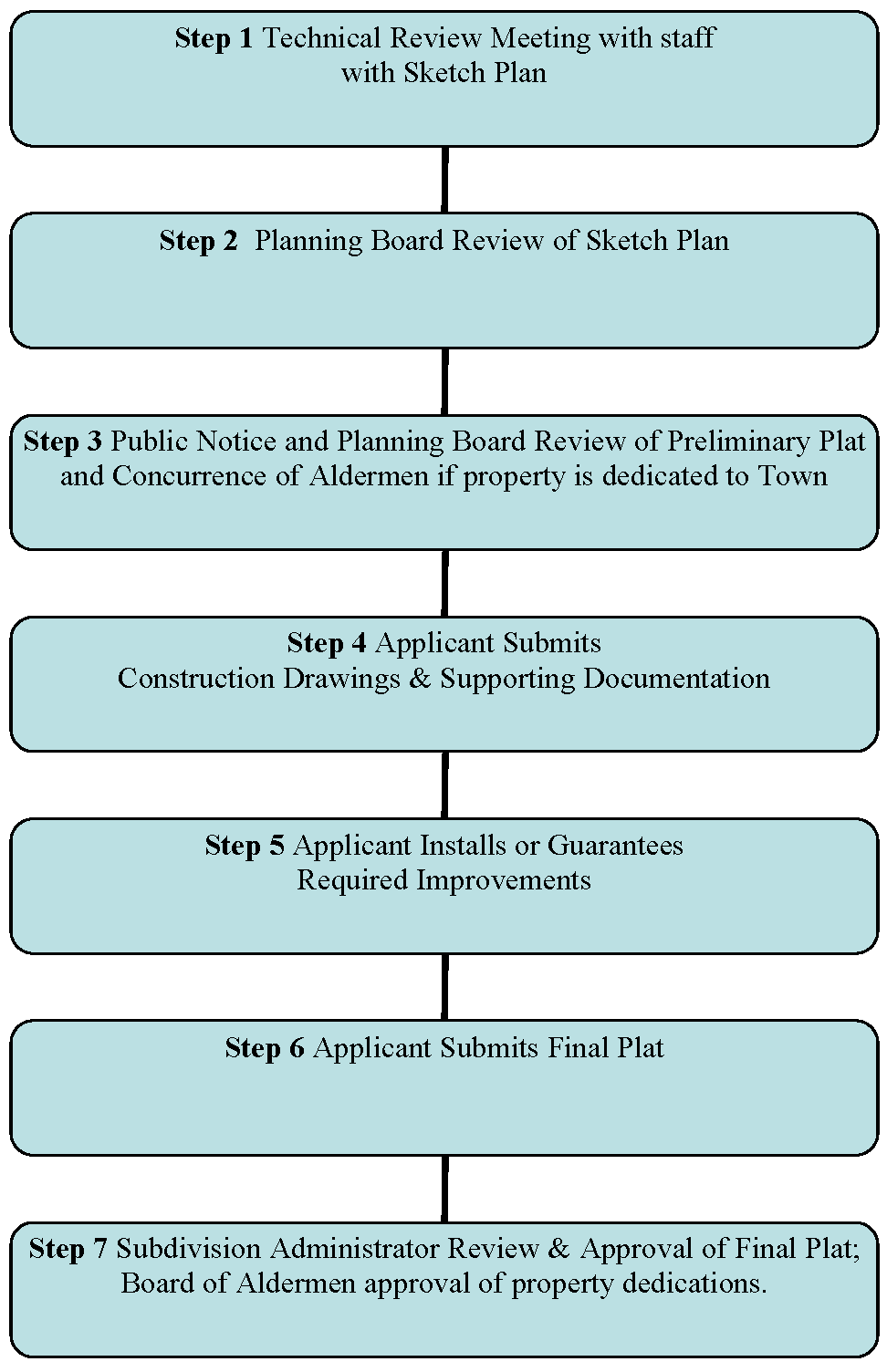
Step 1: Pre-application meeting with sketch plan
A.
The applicant shall schedule a pre-application meeting with the subdivision administrator. The applicant shall bring a sketch plan of the proposed development to the meeting that meets the requirements set forth in section 1.4.6.
B.
The subdivision administrator shall review the sketch plan with the applicant for compliance with this land use code. The public works director, fire marshal, local NCDOT district representative, Metropolitan Sewerage District representative, or other agency representative may be included in the technical review of the sketch plan. The subdivision administrator shall advise the applicant of the regulations pertaining to the proposed subdivision and the procedures to be followed in the preparation and submission of the preliminary and final plats.
C.
One copy of the sketch plan shall be retained as a part of the record of the subdivision administrator with one copy being returned to the subdivider or his authorized agent along with comments made by the subdivision administrator concerning the proposed plat.
Step 2: Planning board review of sketch plan
A.
The sketch plan shall be forwarded to the planning board for input and comment. The planning board shall review the sketch plan for general compliance with the requirements of this chapter and any other applicable regulations, and set a date, usually the following regularly scheduled planning board meeting, for the applicant to return to the planning board with a preliminary plat.
B.
Comments generated from the staff technical review and planning board comments of the sketch plan will be submitted in writing to the applicant.
Step 3: Planning board review and approval of preliminary plat
A.
The applicant shall submit preliminary plat to the subdivision administrator who shall place the item on the agenda of the next regularly scheduled planning board meeting along with his or her recommendation as to whether the preliminary plat should be approved.
B.
Notice shall be given as provided in section 1.5.4.F.
C.
Before the planning board reviews the preliminary plat, the following agencies shall be given an opportunity to make recommendations concerning the proposed subdivision plat:
1.
The district highway engineer as to the any proposed state streets, state highways, and related drainage systems;
2.
The county health director, public works director, MSD representative, and representatives of any other local public utility, as appropriate, as to proposed water or sewerage systems;
3.
The fire marshal; and
4.
The stormwater and floodplain administrator(s).
D.
The planning board shall review the plat for conformity with the requirements of this land use code and shall either approve, approve with modifications, or deny the application for approval of the preliminary plat.
Step 4: Applicant submits construction drawings and supporting documentation
Following preliminary plat approval, the applicant shall submit engineer sealed construction drawings and supporting documentation for each individual phase or phases of development. The public works director, building inspector and fire marshal shall review and approve the construction drawings for all public roads, private roads and water infrastructure. If the preliminary plat was approved with modifications by the planning board, the applicant shall also submit a revised plat reflecting such changes.
Step 5: Infrastructure/improvements installed or guaranteed
A.
Following approval by the public works director, building inspector and fire marshal, the subdivider may proceed with the installation of or arrangement for required improvements in accordance with the approved preliminary plat and the requirements of this ordinance.
B.
Prior to approval of a final plat, the subdivider shall have installed the improvements specified in this ordinance or guaranteed their installation.
C.
Following the completion of the improvements and infrastructure, the subdivider shall provide as-built construction drawings to the public works director and the fire marshal.
Step 6: Applicant submits final plat
A.
The applicant shall submit a final plat to the subdivision administrator that meets the requirements of section 3.4.
B.
The applicant shall submit the final plat within two years after the planning board's approval of the preliminary plat; otherwise, such prior approval of the preliminary plat shall become null and void. In that event, final plat approval shall not be granted unless and until the applicant resubmits the preliminary plat for approval by the planning board.
C.
If required, evidence of formation of a legally constituted homeowner's association and any maintenance agreements with the homeowner's association shall be submitted to the planning department with the final plat.
Step 7: Subdivision administrator review and approval of final plat
A.
The subdivision administrator shall:
1.
Review the final plat for compliance with the approved preliminary plat;
2.
Ensure that the final plat meets the requirements of section 3.4;
3.
Verify that all required infrastructure improvements have been completed or that a financial guarantee has been provided as set forth in section 3.5.7.
B.
The subdivision administrator shall approve, disapprove, or approve subject to minor modifications within 15 days of submission of the plat.
C.
The applicant shall file the plat for recording in the Office of the Register of Deeds for Buncombe County within 90 days from the date of approval and shall bring a recorded copy to the planning and development department for filing with the town clerk. No permits shall be issued for individual lots until a recorded copy is provided.
3.4.1 - Sketch plans.
The subdivider shall submit to the planning director or his/her designee seven copies of a sketch plan on 11″ × 17″ or smaller paper of the proposed subdivision containing the following information at a minimum:
1.
The name of the subdivision, the proposed use and the name, address, and phone number of the owner.
2.
A vicinity map showing the location of the subdivision in relation to neighboring tracts, subdivisions, roads, or nearby buildings and their zoning and uses.
3.
The boundaries of the tract.
4.
Total acreage of the tract and the portion of the tract to be subdivided.
5.
Location of significant natural features such as water courses, ponds, rock outcroppings or forest.
6.
Topography at five-foot intervals and the location of existing drainages or swales.
7.
Location of flood hazard areas from FIRM map.
8.
Location of existing or proposed utilities.
9.
Existing street and lot layout and dimensions, including rights-of-way.
10.
Proposed new lot layout and dimensions and any rights-of-way or driveways to be built. Road specifications are indicated in the Town of Black Mountain Standards and Details Manual.
11.
Designated open space, greenway or park space that is a minimum of five percent of the total land area of the original tract. Designation of easements to the town for parks and greenways according to the town's pedestrian plan, greenway master plan or recreation and parks plan can qualify for the dedicated open space requirement but must be approved by the town council and planning board in consultation with the planning director and the recreation and parks directors.
12.
Sidewalks or greenways which serve all occupiable lots and of equal or greater linear feet than the total linear footage of the subdivision road. Linear greenway easements may count toward the five-percent open space requirement.
13.
A statement from the town water department and/or MSD that adequate water and sewer service may be provided to the lot(s). If the subdivider intends to use on-site septic, then a statement from the Buncombe County Health Department must be included that indicates that the created lots have septic or are appropriate for septic systems.
3.4.2 - Preliminary and final plat submittal requirements.
A.
For minor subdivisions, the applicant shall submit one 18″ × 24″ or larger preliminary plat and one 11″ × 17″ or smaller copy of the preliminary plat along with a completed checklist to the subdivision administrator in both hard copy and digital format;
B.
For major subdivisions, the applicant shall submit eight 18″ × 24″ or larger plats along with a completed checklist to the planning and development department in both hard copy and digital format;
C.
All final plats shall be prepared by a registered land surveyor currently licensed and registered in the state by the state board of registration for professional engineers and land surveyors. The final plat shall conform to the provisions for plats, subdivisions, and mapping requirements set forth in North Carolina General Statutes and in the Manual of Practice for Land Surveying in North Carolina, and Buncombe County. One original and two copies of the final plat shall be submitted.
3.4.3 - Permanent reference points.
Prior to the approval of the final plat, permanent reference points shall have been placed in accordance with G.S. 47-30, as amended.
3.4.4 - Specifications for preliminary and final plats.
Preliminary and final plats shall depict or contain the information indicated in the following table. An "X" indicates that information is required. Preliminary and final plats shall be clearly and legibly drawn at a scale of not less than 100 feet to one inch and on sheets acceptable to the register of deeds.
3.4.5 - Certificates for preliminary and final plats.
A.
Certificates and statements for preliminary plats.
1.
Certificate of survey and accuracy.
2.
Certificate of approval for preliminary plat
3.
Private water/sewer statement.
The Buncombe County Health Department has expressed no opinion as to the suitability of private septic systems or water systems on this property. Each lot is subject to individual inspection and approval of septic systems.
B.
Certificates and statements for final plats:
1.
Certificate of survey and accuracy
2.
Certificate of ownership and dedication.
3.
Professional engineer certification for subdivisions, streets, and improvements.
City___________ Date________
Subdivision or Project Name ________
Phase (if applicable)___________
Entrance from
_____
(US or NC Route, SR# and Road Name)
A final inspection of the streets, storm drainage, sanitary sewer, and water systems for the above referenced subdivision or project has been performed by ___________. I have reviewed the inspection data and have determined that the streets have been constructed in accordance with the design drawings approved by the North Carolina Department of Transportation (or the Town of Black Mountain Public Works Director) on ________ (date) and all subsequent revisions. My observations and testing indicate the subgrade, base, and pavement have been constructed in accordance with the guidelines established by NCDOT Standard Specifications for Roads and Structures (or Town Specifications), as verified by test results.
4.
Certification of guarantee of improvements.
I hereby certify that a security bond has been posted with the Town in accordance with Section 3.5.9 of the land use code to insure completion of required improvements in case of default.
5.
Certificate of approval for recording.
I hereby certify that the final subdivision plat shown hereon has been found to comply with the Subdivision Regulations of the Town of Black Mountain, North Carolina and that this plat has been approved by the Subdivision Administrator for recording in the office of the County Register of Deeds.
6.
Review officer certificate.
I, (name of Review Officer), Review officer of Buncombe County, certify that the map or plat to which this certification is affixed meets all statutory requirements for recording.
7.
Other notes for deed requirements based on approvals.
These may include but are not limited to, location of structural stormwater BMPs, and/or conditions required as part of a conditional use or special use permit.
3.5.1 - Lots.
A.
All lots must conform to the minimum lot size, setback and density requirements of the district within which the subdivision is, or will be, located, unless the subdivision is designed as a conservation subdivision plan, in which case only density requirements shall apply.
B.
For subdivisions in traditional neighborhood development (TND), institutional campus development (ICD) zoning districts, or projects developed pursuant to a special use permit, the lot lay-out shall conform to the approved master plan.
C.
Street right-of-way, setback requirements from North Carolina surface water streams as designated on USGS topography maps, sidewalks and other publicly dedicated areas shall not be included in the calculation of lot size. The location of structures and their setbacks shall be indicated on the preliminary plat. Qualified conservation subdivision plans shall meet district density requirements, but have flexibility in all other lot requirements as long as the proposed subdivision meets the site capacity analysis.
D.
Duplexes on a single lot and zero lot line dwellings are allowed within all districts, except heavy industrial (HI-0), provided that requirements are met for minimum lot size for single-family use including density and perimeter setbacks of the district in which they are located. A duplex meeting all the requirements for a single-family lot shall be counted as one residential density unit or RUA for the designated density of the zoning district in which the duplex is located.
E.
Duplexes may be subdivided as a two-unit townhome or condominium for the purpose of separate ownership of the two individual units as long as:
1.
All fire and building codes are met at the time of the subdivision or division of the structure into a duplex.
2.
Two off-street parking spaces are provided for each unit.
3.
Required setbacks for the district are maintained on the perimeter of both lots on all sides except where the units adjoin.
4.
Common areas and maintenance requirements, such as that for driveways, open space and stormwater management areas are enumerated as part of the subdivision, or provided under common ownership in a townhome or condominium plan.
5.
Triplexes or other multi-dwelling units of three or more units must follow guidelines of applicable special use category or multi-family requirements.
3.5.2 - Streets.
A.
Unless a lot is set aside for conservation in perpetuity, all lots shall have access to a street and all proposed streets shall be installed or financially guaranteed prior to final plat approval. Access roads for both major and minor subdivisions shall traverse a surveyed right-of-way centerline showing calls and distances and its beginning and ending points in relation to adjoining properties.
B.
All streets, driveways, and rights-of-way therefore shall be designed and constructed according to the requirements set out in the Town of Black Mountain standards and Details Manua.
C.
Any access serving more than three lots shall be considered a road. Roads providing access to more than four lots must be constructed to requirements as indicated in the Town of Black Mountain Standards and Details Manual and may be dedicated to the town upon a written street dedication request.
D.
Any access serving more than three lots shall be considered a road. Roads may be dedicated to the town upon approval of a written street dedication request.
E.
Reserved.
F.
The fire marshal and public works director may authorize a variance up to 20 percent (up to eight feet variation on right-of-way, and up to four-foot variation on total travel surface), based on topography, landscape context, traffic and public safety needs.
G.
The town may accept streets for ownership and maintenance one year after the completion date of the final road surfacing. Application for street acceptance must be made in writing approved by the public works director and fire marshal.
H.
Final plans for major subdivisions shall include a statement by a licensed professional engineer that all roads are in compliance with the Town of Black Mountain Standards and Details Manual.
I.
In a conservation subdivision, rights-of-way that cannot meet the road standards as indicated in the Town of Black Mountain Standards and Details Manual without compromising performance goals of the conservation subdivision requirements (see 7.5.4) and which access more than three lots must meet the approval of the public services director and fire marshal for the purpose of waste collection, snow removal and maintenance, as well as emergency vehicle access.
J.
No base course shall be placed on muck, pipe clay, organic matter or other unsuitable matter, and a minimum compaction rate of subgrade prior to paving shall be as indicated in the Town of Black Mountain Standards and Details Manual.
K.
Traffic impact studies may be required for subdivision roads connecting to the town or NCDOT system per section 3.5.8 of this code or NCDOT guidelines.
L.
Where curbs are provided on streets or where curbs and sidewalks are constructed within a subdivision, any construction shall be in full compliance with the provisions of G.S. 163-44.14 which sets forth standards for providing curb ramps or curb cuts for handicapped persons.
M.
Pre-existing roads which do not meet these standards may be incorporated into a subdivision only upon approval of the fire marshal and public works director. Where pre-existing roads do not have a designated right-of-way, right-of-way shall be established to cover at least the maintenance area of the roadway (back of ditch to back of ditch).
N.
If an existing street serving the proposed development does not meet minimum town street standards, the developer shall make the necessary improvements to bring the street up to town standards or shall make a payment to the town to cover the cost of such improvements.
3.5.3 - Utilities.
A.
The preliminary subdivision plat must be accompanied by satisfactory evidence as to the proposed method and system of water supply and sanitary sewage collection and disposal. The town requires connection to existing public water and sewer lines if any such lines are located within 300 feet of the property boundary, unless topography does not allow such connection or requisite easements cannot be obtained. The installation of all said systems except wells or septic tanks serving only one connection shall be required prior to final plat approval unless financially guaranteed.
B.
Well or septic systems owned and operated by a public or private entity must be approved by the Buncombe County Health Department or other applicable state agency.
C.
Water, sewer and other utility easements shall be designated on preliminary and final plats.
D.
All utilities serving new major subdivisions must be placed underground.
3.5.4 - Entryways to subdivisions.
A.
Signage and landscaping may be incorporated into entrances to subdivisions in accordance with landscaping and signage requirements of the land use code. In residential zoning districts, signage shall have a monument style base.
B.
Entrance signage to a major subdivision may be illuminated in accordance with the town's lighting ordinance.
C.
Gates and/or structures that serve to stop traffic such as a staffed gatehouse or guard station, are not permitted.
3.5.5 - Pedestrian circulation (major subdivisions only).
A.
All major subdivisions shall have a plan for internal pedestrian circulation as well as points of connectivity with exterior transportation corridors.
B.
Major subdivisions, other than conservation subdivisions, shall provide a network of sidewalk or greenway trails to serve all lots. The total length of these facilities shall be equal or greater than the total of linear feet of new roadway as measured at the centerline. As part of preliminary plat review, the planning board may require that the applicant:
1.
Place a portion of the required linear footage of sidewalk or greenway outside of the subdivision within the public right-of-way where there is opportunity to improve connectivity to the subdivision being developed (such as to link the subdivisions' sidewalk to an existing bus stop, park, sidewalk or greenway) in exchange for equal reduction in linear footage within the subdivision interior.
2.
Pay the financial equivalent to the town in order to develop sidewalks on arterial or collector roads that serve that subdivision, or
3.
Develop a greenway trail of equivalent cost through the property in order to implement the town's greenway master plan and instead of sidewalks or in combination with required sidewalks.
C.
Whenever practicable, the construction of a sidewalk shall be on a line parallel with the edge of the public right-of-way of a street, highway or road, and the edge of a sidewalk will be a minimum of two feet from said roadway's edge of pavement or its curb/gutter. This separation area shall be planted with grass, trees, or other plants consistent with the yards in the subdivision or shall be incorporated into the stormwater plan for the development.
D.
Sidewalks shall be a minimum of five feet in width within subdivisions, or a minimum of six feet in width on adjacent arterial roads or NCDOT roadways. Paved trails or greenways shall be a minimum of six feet in width, with ten feet in width being preferred. Trail width may vary to minimize trail impacts on natural features or trees, or to transition to a connection with another trail or sidewalk. Decorative elements such as brick pavers or stamped concrete may be incorporated as long as they do not pose a hazard for users. Sidewalk or trail surface and construction must be approved by the town's public works director prior to dedication to the town.
E.
Sidewalks shall be constructed of not less than 4,000 P.S.I. concrete and shall be five feet wide, four inches thick, constructed on an adequately graded base, except that where the sidewalk crosses a driveway it shall be six inches thick. The surface of the sidewalk shall be steel trowel and light broom finished and cured with an acceptable curing compound. Tooled joints shall be provided at intervals of not less than five feet and expansion joints at intervals of not less than 30 feet. The sidewalk shall have a maximum lateral slope of one-fourth-inch per foot.
3.5.6 - Open space requirements (major subdivisions only).
A.
All major subdivisions must dedicate the equivalent of 15 percent of the total land area of the original parcel or combination of parcels used in the subdivision as dedicated, common open space.
B.
Designation of easements to the town for parks or greenways according to the town's pedestrian plan, greenway master plan or recreation and parks plan may qualify for the dedicated open space requirements but must be approved by the planning board.
C.
Land designated as open space on a final plat shall be dedicated to a neighborhood association or other entity, or shall be considered to be offered for dedication to the town. The town may accept control of the open space through:
1.
Express action by the town council;
2.
Approval of the final plat with areas specifically dedicated to the Town of Black Mountain for the purpose of open space, park and/or greenway development as accepted by the town council; or
3.
Conveyance of fee simple marketable title (unencumbered financially and environmentally) to the property to the town at the time of final plat recordation, subject to approval by the town council.
4.
Until such time as the dedication has been accepted, land so offered may be used for open space purposes and be maintained by the underlying or abutting property owner or similarly by an owners' association. Land so offered for dedication shall not be used for any purpose inconsistent with the proposed public use.
D.
The town council may, prior to approving the final plat or otherwise accepting dedication of land, request review by the recreation and parks commission before making their determination. Dedications should meet the following criteria:
1.
Unity. Dedicated area shall form a single parcel of land, except where the town council determines that two or more parcels or a linear easement across multiple parcels would be in the best interest of the public given the type and distribution of space needed to serve the development. In such cases, the council may require that such parcels be connected by a dedicated strip of land or access easement be at least 20 feet in width.
2.
Usability. At least on-half of the total land dedicated shall be located outside of areas of special flood hazard, alluvial soils, lakes or other water bodies, and at least 75 percent of the total land dedicated shall be located outside of wetlands. Land dedicated only for greenways need not follow the requirements of this subsection.
3.
Shape. Dedicated land shall be sufficiently shaped and proportional to be usable for proposed recreational facilities and activities, such as greenways, athletic fields, playground area, tennis courts, swimming pools, etc.
4.
Access. Public access to dedicated land shall be provided by adjoining street frontage or by a dedicated public easement which connects the dedicated land to a public street or right-of-way, or from adjacent property, as determined by the town council.
5.
Greenway dedications shall be a minimum of 15 feet in width.
(Ord. No. O-21-04, 6-14-2021)
3.5.7 - Improvement guarantees.
A.
Installation and dedication of all improvements shall be made prior to final plat approval unless financially guaranteed.
B.
The town may enter into an agreement with the subdivider whereby the subdivider shall agree to complete all required improvements as specified on the approved preliminary plat, for that portion of the subdivision to be shown on the final plat, within a reasonable time to be determined in said agreement. To secure this agreement, the subdivider shall provide a guarantee not exceeding 1.25 times (or 125 percent of) the entire cost of the improvements in the form of a performance bond, cash or equivalent security, or a letter of credit.
1.
Surety performance bond(s) shall be obtained from a surety bonding company authorized to do business in North Carolina. The bond(s) shall be payable to the Town of Black Mountain and shall be in an amount equal to 1.25 times the entire cost, as estimated by an engineer of installing all required improvements as specified on the approved preliminary plat for that portion of the subdivision to be shown on the final plat. The duration of the performance guarantee shall initially be one year, unless the developer determines that the scope of work for the required improvements necessitates a longer duration. In the case of a bonded obligation, the completion date shall be set one year from the date the bond is issued, unless the developer determines that the scope of work for the required improvements necessitates a longer duration. A developer shall demonstrate reasonable, good-faith progress toward completion of the required improvements that are secured by the performance guarantee or any extension. If the performance guarantee is likely to expire prior to completion of the required improvements, the performance guarantee shall be extended, or a new performance guarantee issued, for an additional period. An extension shall only be for the duration necessary to complete the required improvements.
2.
Cash or equivalent security. The subdivider shall deposit cash or other instrument readily convertible into cash at face value, either with the town or in escrow with a financial institution designated as an official depository of the town. The amount of the deposit shall be equal to 1.25 times the cost, as estimated by, an engineer of installing all required improvements as specified on the approved preliminary plat for that portion of the subdivision to be shown on the final plat. The subdivider shall file with the town an agreement between the financial institution and himself guaranteeing that:
a.
An escrow account shall be held in trust until released by the acting subdivision administrator and may not be used or pledged by the subdivider in any other matter during the term of the escrow; and
b.
In the case of a failure on the part of the subdivider to complete improvements, the financial institution shall, upon notification and submission by the town board to the institution of the amount needed to complete improvements, either pay to the town the funds needed to complete the improvements, up to the full balance of the escrow account, or deliver to the town any other instruments fully endorsed or otherwise made payable in full to the town.
3.
Letter of credit. A satisfactory, irrevocable letter of credit as approved by the town attorney and deposited with the town clerk shall be submitted, containing the following information:
a.
Indication that the Town of Black Mountain is the sole beneficiary;
b.
The amount (of the letter of credit) as approved;
c.
Account number and/or credit number that drafts may be drawn on;
d.
List of improvements that shall be built that the letter is guaranteeing;
e.
Terms in which the town may make drafts on the account;
f.
Expiration date of the letter.
C.
Upon default, meaning failure on the part of the subdivider to complete the required improvements in a timely manner as spelled out in the agreement, then the surety, or the financial institution holding the escrow account shall, if requested by the town, pay all or any portion of the bond or escrow fund to the Town of Black Mountain up to the amount needed to complete the improvements based on the estimate. Upon payment, the town board, in its discretion, may expend such portion of said funds as it deems necessary to complete all or any portion of the required improvements. The town shall return to the surety or escrow account any funds not spent in completing the improvements.
D.
The town council may release a portion of any security posted as the improvements are completed and recommended for approval by the subdivision administrator. At such time as the town council approves all improvements placed in the subdivision, all security posted shall be immediately released.
3.5.8 - Traffic impact analysis.
A.
Purpose. The purpose of this section is to ensure that applicants for new development and redevelopment consider and mitigate the impact of the development on the existing and/or proposed roadway system. While the town acknowledges responsibility to build and maintain a public transportation system, the project applicants may need to assist in improving transportation facilities in order to maintain the existing level of service by accommodating additional traffic generated by the development. These transportation facilities involve pedestrian, non-motorized vehicular traffic and motorized vehicular traffic.
B.
Applicability. Traffic impact analysis is required. All proposals for new construction, additions and/or expansions to existing structures, and/or changes of use located on town roads, which will result in trips equal or greater to 798 daily trips, using the trip generation rates from the most recent edition of the Trip General Manual published by the Institute of Transportation Engineers.
C.
Improvements required. The planning director or his/her designee will review submitted traffic impact analysis, and will finalize the improvements required. In those cases where the Town of Black Mountain requires certain improvements to be constructed in order to accommodate additional traffic generated by the proposed developments, the improvements shall be approved by the town council and shall be funded and/or constructed by the project developer in accordance with the standards and direction provided by the Town of Black Mountain. The improvements shall be in place or under construction prior to issuance of any certificate of occupancy or certificate of completion required for any phase or portion of the project.
3.6.1 - Rights-of-way and easements.
A.
The approval and recordation of a final plat constitutes an offering to the town and the public of the right-of-way of each public street, alley, greenway or utility or drainage easement shown on such plat.
B.
The approval and recordation of a plat does not constitute acceptance of the right-of-way or easement or responsibility for its maintenance by the town, unless the town requires it as part of the development approval, or accepts any such offer of dedication by resolution of the town council at the time of final plat approval, by a separate, express action at a later time, or by actually exercising control over and maintaining such facilities.
C.
Rights-of-way which are intended to remain private or which are not accepted by the town at the time of approval of the final plat, must be subject to a road maintenance agreement.
3.6.2 - Dedication and closures of rights-of-way or land to the town.
A.
Property owners or other parties of interest may petition for the closure of a right-of-way offering through the planning department. The planning board, planning department, or other government or utility agency may also request the closure of a right-of-way. Rights-of-way closures shall follow these procedures:
1.
A right-of-way closure petition is filed with the planning department. Owners of property abutting the right-of-way or portion of the right-of-way requested for closure must sign the petition and pay a fee as established by the town council. If all owners of the abutting properties do not sign the petition, notice to abutting property owners shall be given as required by G.S. 160A-299. If the request is generated from town staff or a board or commission, the fee shall not apply.
2.
The planning director or his/her designee will prepare a staff report that includes a map that shows the length of the right-of-way from terminus to terminus, an inventory of uses within the right-of-way (if any utilities, etc.), information on possible future uses from any of the town's adopted plans, and comments from the fire department and place the issue on the next planning board agenda, if the petition is filed two weeks before the date of the next meeting, or otherwise at the next meeting.
3.
Notice of the request and pursuant review by the planning board shall be sent to all abutting property owners, and the notice may be sent to owners of property adjoining any portion or all of the street affected by a partial right-of-way closure, at the discretion of the planning board or staff.
4.
The planning board will review the request and make recommendation to the town council to accept the petition for closure, to accept the right-of-way into town control or maintenance, to close any additional area of right-of-way in addition to the petition, or to not accept the petition and leave the right-of-way as an offering.
5.
The planning board shall consider any or all of the following criteria in making their recommendation for closure of a right-of-way:
(a)
Right-of-way identified is not part of adopted town plans.
(b)
Right-of-way is not necessary for current or future utilities.
(c)
Right-of-way in its current condition poses a hazard to public health, safety or welfare.
(d)
Right-of-way is along a drainage that is part of a stormwater management plan.
(e)
Right-of-way provides a current or future corridor for a greenway, alley, or roadway that would meet a specific transportation need.
(f)
Abutting property owners have signed the petition in favor of the closure.
(g)
The planning board shall have 35 days from the date of the first regular meeting of the planning board held after receipt of the request within which to submit a recommendation to the town council. If the planning board fails to act within the required 30-day period, it shall be deemed to support and recommend the requested closure and the petition shall proceed to the town council.
The planning board may also amend the scope or length of the right-of-way closure petition as a complimentary petition to the town council.
6.
Planning board recommendation is forwarded to town council who shall establish a date for a public hearing by adopting a resolution of intent to close. The town attorney shall prepare a description of the right-of-way in question for use in setting the public hearing.
7.
Staff shall place the resolution of intent stating the date of the public hearing in a newspaper of general circulation within the Town of Black Mountain once a week for four successive calendar weeks. Staff shall prominently post the area for closure at two locations with a visible sign indicating the scope of the petition, the date for the public hearing and the phone number of the staff person to contact for information. Staff shall also provide notice by first class mail to all abutting property owners, and may, at the discretion and direction of the town council, mail such notice to all owners of property adjoining any portion or all of the street affected by a partial right-of-way closure. Notice shall also be posted to the town website indicating the date and time of the hearing.
8.
Town council holds the public hearing and accepts or rejects the petition for closure.
3.6.3 - Dedication of streets, right-of-way or land to the town.
A.
Improvements within rights-of-way, open space or easements, such as utility lines, street paving, drainage facilities or stormwater BMPs, sidewalks or trails may be accepted for maintenance by the town upon approval by the town council.
B.
The town council shall not accept as a public street, any street extension, new street or part thereof until preliminary plans have been approved by the planning director, public works director, and fire marshal, and unless the street or part thereof has met the following requirements:
1.
A street dedication petition signed by all owners of property over which the street or right-of-way passes is filed with the planning department.
2.
The road meets all requirements as indicated in the Town of Black Mountain Standards and Details Manual.
3.
Where necessary, property owners must be willing to purchase approved culverts to install under new constructed driveways.
4.
The road must be approved by the public works director and the fire marshal upon inspection.
5.
The planning department shall forward the street dedication request to the town council for approval.

