
Bladen County Unincorporated
City Zoning Code
City Zoning Code
ARTICLE 10
ZONING DISTRICTS: OFF-STREET PARKING AND LOADING, SIGNS, LANDSCAPING AND BUFFERING, OUTDOOR LIGHTS
10.1 - GENERAL REQUIREMENTS
10.1.1.
Off-Street Parking Required. At the time of the erection of any building, or at the time any principal building is enlarged or increased in capacity by adding dwelling units, guestrooms, seats, or floor area, or before conversion from one type of use or occupancy to another, permanent off-street parking space shall be provided in the amount specified by this Section. Such parking space may be provided in a parking garage or property guarded open space.
10.1.2.
Certification of Minimum Parking Requirements. Each application for a Zoning Permit (except for dwellings) shall include information as to the location and dimensions of off-street parking and the means of ingress and egress to such space. This information shall be in sufficient detail to enable the Zoning Officer to determine whether the requirements of this Article are met.
10.1.3.
Combination of Required Parking Space. The required parking space for any number of separate uses may be combined in one (1) lot, but the required space assigned to the one (1) use may not be assigned to another use, with one exception. One-half (½) of the parking space required for churches whose peak attendance will be at night or on Sundays may be assigned to a use which will be closed at night and on Sundays or in shopping centers where uses may have different peak hours.
10.1.4.
Remote Parking Space. If the off-street parking space required by this Ordinance cannot be reasonably provided on the same lot on which the principal use is located, such space may be provided on any land within reasonable distance of the main entrance to such principal use, provided such land is in the same ownership as the principal use and in the same zoning district. Said land shall be used for no other purposes so long as no other adequate provisions of parking space meeting the requirements of this Ordinance have been made for the principal use. In such cases, the applicant for a permit for the principal use shall submit with his application for a Zoning Permit or a Certificate of Occupancy an instrument duly executed and acknowledged, which subjects said land to parking use in connection with the principal use for which it is made available. Such instrument shall become a permanent record and be attached to the Zoning Permit or Certificate of Occupancy application. In the event such land is ever used for other than off-street parking space for the principal use to which it is encumbered and no other off-street parking space meeting the terms of this Ordinance is provided for the principal use, the Certificate of Occupancy or Zoning Permit for such principal use shall become void.
10.1.5.
Requirements for Parking Lots. Where parking lots for more than five (5) cars are permitted or required, the following provisions shall be complied with in addition to the requirements below:
(a)
The lot may be used only for parking and not for any type of loading, sales, dead storage, repair work, dismantling or servicing, but shall not preclude convention exhibits or parking of rental vehicles.
(b)
All entrances, exits, barricades at sidewalks, and drainage plans shall be approved and constructed before occupancy.
(c)
A strip of land five (5) feet wide adjoining any street line or any lot zoned for residential uses shall be preserved as open space, guarded with wheel bumpers and planted in grass and/or shrubs or trees.
(d)
Any parking lot of more than five (5) cars which is adjacent, along the side or rear property lines, to property used or zoned for residential uses, shall be provided with screening
(e)
Only one (1) entrance and one (1) exit sign no larger than two (2) square feet prescribing parking regulations may be erected at each entrance or exit.
10.1.6.
Manufactured Home Parking and Storing. It shall be unlawful to park or otherwise store for any purpose whatsoever any mobile home or trailer within any zoning district except as follows:
(a)
At a safe, lawful, and non-obstructive location on a street, alley highway, or other public place, providing that the trailer or mobile home shall not be parked overnight;
(b)
Within a mobile home park, provided, however, the mobile home shall either have a North Carolina or HUD Label of Compliance permanently attached thereto; and
(c)
On any other lot or plot provided that trailers shall be stored in a garage or carport or in the rear or side yard.
(d)
Junk or Dilapidated Mobile Home/Manufactured Home Storage or repair yards must obtain a special use permit.
10.1.7.
Vehicle Storage.
(a)
Residential District. Only vehicles intended for personal use shall be parked or stored on any property zoned R—Residential. No storage of commercial inventory whatsoever shall be permitted and no inoperative or unlicensed vehicles shall be permitted to be parked or stored longer than (14) fourteen days. Commercial trucks or vans driven home by employees or owners must be parked in the side or rear yard.
(b)
Residential Agricultural District. Storage of Junk, inoperable or unlicensed vehicles must comply with the following:
(1)
One junk, inoperable, or unlicensed vehicle will be allowed on any owner occupied lot if located in the side or rear yard.
(2)
Any owner occupied lot may store up to three junk, inoperable, or unlicensed vehicles if they are completely concealed from public view by:
a.
A tarp(s) and placed in the rear yard of the subject property,
b.
A canvas car cover and placed in the rear yard of the subject property, or
c.
Located in the rear yard surrounded by vegetative growth and screened from public view.
(3)
A property owner with more than three (four or more) junk, inoperable, or unlicensed vehicles must obtain a special use permit for a junkyard to continue to store the vehicles on their property.
(c)
Public and Conservation, Commercial and Industrial Districts. Customer and employee parking is permitted along with the parking and storing of governmental or commercial vehicles, in any public and conservation, commercial, or industrial district. Inoperative vehicles shall only be permitted to be parked or stored while undergoing repairs at a commercial garage or automobile service station or if stored in an approved junk or wrecking yard. ("Four or more junk, inoperable, or unlicensed vehicles constitute a junk yard).
10.1.8.
Minimum Parking Requirements. The number of off-street spaces required by this Article shall be provided on the same lot with the principal use except as provided in Section 4 and the required number of off-street parking spaces specified for each use shall be considered as the absolute minimum. In addition, a developer shall evaluate his own needs to determine if they are greater than the minimum specified by this Ordinance. For purposes of this Ordinance, an off-street parking space shall be no less than one hundred sixty (160) square feet in area, plus adequate ingress and egress provided for each off-street parking space.
Table 10-1
Minimum Parking Requirements
10.1.9
Design Standards for Off-Street Parking. All off-street areas required by this Article shall conform with the following Design Standards:
(a)
All parking spaces shall have minimum dimensions of nine (9) feet in width and eighteen (18) feet in length. All access or backup aisles shall conform to the following minimum dimensions:
Table 10-2
Parking Space Dimensional Requirements
(b)
The use of streets, sidewalks, alleys or other public rights-of-way for parking or maneuvering to and from off-street parking spaces is prohibited, except where such maneuvering is necessary in the use of driveways for access to and from single-family and two family dwellings. All off-street parking areas shall be so arranged that ingress and egress is by forward motion of the vehicle.
(c)
Parking area edges shall be protected by suitable curbing, wheel guards, or other means to prevent vehicular encroachment on a public right-of-way or on adjacent property, and to protect the public right-of-way and adjoining properties from the damaging effects from surface drainage from parking lots.
(d)
Where parking or loading areas are provided adjacent to the public street, ingress and egress thereto shall be made only through driveways not exceeding twenty-five (25) feet in width at the curb line of said street, except where the Zoning Officer finds that a greater width is necessary to accommodate the vehicles customarily using the driveway.
(e)
Where two (2) or more driveways are located on the same lot, other than a mobile home park, the minimum distance between such drives shall be thirty (30) feet or one third (⅓) of the lot frontage, whichever is greater; however, this provision shall not apply to any commercial or industrial planned development. Driveway locations in such developments shall be approved by the North Carolina Department of Transportation.
(f)
Businesses adjacent to, or integrated in, a shopping center or cluster of commercial facilities shall use the common access with other business establishments in the center.
(g)
No driveway shall be located closer than twenty-five (25) feet to any street intersection.
(h)
Any lighting of parking areas shall be shielded so as to cast no light upon adjacent properties and streets.
(i)
All applicable ADA (American Disabilities Act) standards shall apply.
10.1.10.
Off-Street Loading Purpose and General Requirements.
(a)
Off-street loading requirements are established in order to ensure the proper and uniform development of loading areas throughout the County, to relieve traffic congestion in the streets and to minimize any detrimental effects of off-street loading areas on adjacent properties.
(b)
Each application for a Zoning Permit or Certificate of Occupancy shall include plans and other information of sufficient detail to enable the Zoning Administrator to determine whether or not the requirements of this Article have been met. Plans for off-street loading areas shall include information as to:
(1)
The location and dimensions of driveway entrances, access aisles and loading spaces.
(2)
The provisions for vehicular and pedestrian circulation.
(3)
The location of sidewalks and curbs.
(c)
The Zoning Permit or Certificate of Occupancy for the construction or use of any building, structure or land where off-street loading space is required shall be withheld by the Zoning Officer until the provisions of this Section have been met. If at any time such compliance ceases, any Certificate of Occupancy which shall have been issued for the use of the property shall immediately become void and of no effect.
10.1.11.
Design Standards for Off-Street Loading Space. The off-street loading space required by this Article shall be provided for standing, loading, and unloading operations either inside or outside a building, on the same lot with the use served, and shall conform to the following standards:
(a)
For uses containing a gross floor area of less than 20,000 square feet, each off-street loading space shall have minimum dimensions of fifteen (15) feet in width and thirty (30) feet in length.
(b)
For uses containing a gross floor area of 20,000 square feet or more, each off-street loading space shall be fifteen (15) feet in width and forty-five (45) feet in length as a minimum.
(c)
All off-street loading spaces shall have a minimum vertical clearance of fifteen (15) feet.
(d)
Access aisles or apron spaces shall be of sufficient width to allow for proper backing and/or turning movements.
(e)
Required off-street loading areas including drives and access aisles shall be paved with an all-weather hard surface material.
(f)
Loading spaces and access ways shall be located in such a way that no truck or service vehicle using such areas shall block or interfere with the free, normal movement of other vehicles on a service drive or on any off-street parking area, public street, aisle or pedestrian way used for general circulation. In addition, the off-street loading facilities shall be designed and constructed so that all maneuvering of vehicles for loading and unloading purposes shall take place entirely within the property lines of the premises.
(g)
Loading area edges shall be protected by suitable curbing to prevent encroachment on a public right-of-way or on adjacent property, and to protect the public right-of-way and adjoining properties from the damaging effects of surface drainage from off-street loading areas.
(h)
Any lighting of loading areas shall be shielded so as to cast no light upon adjacent properties and streets.
(i)
Any off-street loading areas and access ways adjacent, along the side or rear property lines, to property used or zoned for residential purposes, shall be provided with screening meeting the standards described in Part 3: Screening and Buffering.
10.1.12.
Minimum Off-Street Loading Requirements. Off-street loading shall be provided and maintained as specified in the following:
(a)
Uses which normally handle large quantities of goods, including, but not limited to, industrial plants, wholesale establishments, storage warehouses, freight terminals, hospitals or sanitariums, and retail sales establishments shall provide off-street loading facilities in the following amounts:
Table 10-3
Off-Street Loading
(b)
Uses which do not handle large quantities of goods, including, but not limited to, office buildings, restaurants, funeral homes, hotels, motels, apartment buildings, and places of public assembly, shall provide off-street loading facilities in the following amounts:
Table 10-4
Off-Street Loading
10.3 - PURPOSE OF SIGN REGULATIONS
It is the purpose of this section to permit signs of a commercial, industrial, and residential nature and to regulate the size and placement of signs, which are visible from any public way. These regulations shall apply to all districts. No exterior sign may be erected, painted, repainted, posted, placed, replaced or hung in any district, except in compliance with these regulations. These regulations are intended to establish standards which recognize the rights of all citizens to protection under the First Amendment to the US Constitution while also supporting public safety and the natural attractiveness of the area.
10.4 - GENERAL SIGN REGULATIONS
10.4.1.
Permit Required. With the exception of those signs specifically authorized in Section 10.5. below, no sign may be erected without a permit from the Administrative Officer.
10.4.2.
Permit Application. Application for permits shall be submitted on forms obtainable at the Office of the Zoning Officer. Each application shall be accompanied by plan, which shall:
(a)
Indicate the proposed site by identifying the property by ownership, location and use;
(b)
Show the location of the sign on the lot in relation to property lines and building, zoning district boundaries, right-of-way lines, and existing signs; and
(c)
Show size, character, complete structural specifications and methods of anchoring and support.
If conditions warrant, the Zoning Officer may require such additional information as will enable him to determine if such sign is to be erected in conformance with this Ordinance.
10.4.3.
Structural Requirements. Structural Requirements for signs shall be those requirements found in the North Carolina State Building Code.
10.4.4.
Sign Area Computation. Sign area shall be computed by the smallest square, triangle, rectangle, circle or combination thereof which will encompass the entire sign, including lattice work, wall work, frame or supports incidental to its decoration. In computing the area, only one (1) side of a double face sign structure shall be considered.
10.4.5.
Fees.
(a)
No permit shall be issued until the exact dimensions and area of the sign have been filed with the Zoning Officer and the fees posted in the Planning office are paid accordingly.
(b)
Exempt from this fee requirement shall be those signs specified in Section 10.5. below.
10.4.6.
Maintenance. All signs, together with all their supports and braces, shall be kept in a state of good repair and in a neat and clean condition. No sign shall be continued which becomes, in the opinion of the Zoning Officer, structurally unsafe and endangers the safety of the public or property. The Zoning Officer may order the removal of any sign that is not maintained in accordance with the provisions of this section. Such removal shall be at the expense of the owner or lessee and shall occur within ten days after written notification thereof by the Zoning Officer. If such order is not complied with in thirty (30) days, the Zoning Officer shall remove such at the expense of the owner or lessee thereof.
10.4.7.
Location Restrictions.
(a)
No sign shall be permitted on any public right-to-way except as specifically authorized herein.
(b)
No sign shall be attached to or painted on any telephone pole, telegraph pole, power pole, or other man-made object not intended to support a sign, nor on any tree, rock or other natural object except as specifically authorized herein.
(c)
Sign shall not obstruct any window, door, fire escape, stairway, ladder, or opening intended to provide light, air, ingress or egress for any building, structure, or lot.
10.4.8.
Setback and Height Requirements.
(a)
Except as otherwise provided herein, signs are required to observe the same yard setback and height regulations as the principal structures or buildings.
(b)
If the lot on which a ground sign is to be located is zoned other than residential, but is immediately adjacent to a lot zoned for residential use, then a distance of at least fifty (50) feet shall intervene between the closest part of such sign and the adjacent lot line of the property in the residential district. Provided further, that all out-door advertising signs shall conform to Section 10.5.
10.4.9.
Nonconforming Signs. No nonconforming sign erected before the adoption of this Ordinance shall be moved or replaced, without complying with the provisions of this Ordinance. All signs existing on the effective date of this article which do not conform to the requirements set forth herein shall be removed or brought into compliance within thirty-six months (36) from the effective date of this Ordinance. However, an existing nonconforming business or industry shall, after the three-year period, be allowed one sign not exceeding 12 square feet on a side or a total of twenty square feet, which sign shall be affixed to the building and have only non-flashing illumination.
10.5 - SIGNS NOT REQUIRING A PERMIT FROM THE ZONING OFFICER
The signs listed below shall not require a permit from the Zoning Officer. However, all signs using electrical wiring and connection shall have an electrical permit.
10.5.1.
Direction/Informational Signs. Directional and information signs, erected and maintained by public agencies and governmental bodies.
10.5.2.
Public/Quasi-Public Name Signs. Quasi-public signs, not to exceed four (4) square feet in area. Such signs shall only be used for the purpose of stating or calling attention to:
(a)
The name of location of the city, hospital, community center, public or private school, church, synagogue, or other place of worship;
(b)
The name of a place of meeting or an official or civil body such as the Chamber of Commerce, service club, or fraternal organization.
(c)
An event of public interest such as public hearing, rezoning, announcement, general election, church or public meeting; local or county fair; and other similar community activities and campaigns;
(d)
Soil conservation, 4-H and similar projects; and zoning and subdivision jurisdiction boundaries.
10.5.3.
Professional and Home Occupations Signs.
(a)
One sign per lot not to exceed two (2) square feet attached to the principal structure.
(b)
One sign per lot not to exceed two (2) square feet located at least ten (10) feet from the street line and side property lines. Where side yards are required, no such sign shall be permitted in the required side yards.
(c)
No such signs shall be illuminated in the residential district.
10.5.4.
Temporary Subdivision Sign. Subdivision development signs, not over sixty-four (64) square feet in area which direct attention to the opening of a new subdivision may be erected on the site of such new subdivision. Only indirect illumination with white light will be permitted, such sign shall be removed when seventy-five (75) percent of the Subdivision is sold.
10.5.5.
Bulletin Board. One bulletin board for each school or other public building and for each church, synagogue or place of worship, provided that it be located on the same premises and shall not exceed fifty (50) square feet, such bulletin board may be free standing or attached. In residential districts, illumination of bulletin boards shall be white, non-flashing lights.
10.5.6.
Temporary Signs.
(a)
Real Estate. One (1) temporary real estate sign not exceeding four (4) square feet in area may be placed on a property that is for sale, lease, rent, or barter; however, when the property on which said sign is placed fronts on more than one (1) street, one (1) sign shall be allowed on each street frontage. Such signs shall not be illuminated.
(b)
Other Temporary Advertising Signs. Temporary advertising signs shall be permitted providing that such signs shall not exceed six (6) square feet in area in residential districts and shall be spaced no closer than 100 feet apart.
(c)
Temporary Construction Sign. One (1) temporary construction sign may be erected on the site during the period of construction or reconstruction to announce the name of the owner and/or developer, the name of the structure and its use or occupants to be, contractor, subcontractor, architect, and engineer; however, when the property on which said sign is placed fronts on more than one (1) street, one (1) sign shall be allowed on each street frontage. Such signs shall be removed when the building has been approved for occupancy by the Zoning Officer. Maximum size of construction signs in the residential zone shall be twenty-four (24) square feet; in all other zones, seventy-two (72) square feet.
10.5.7.
Setback Requirements for Signs Not Requiring a Building Permit. Signs which do not require a permit from the Zoning Officer shall be set back at least ten (10) feet any public right-of-way line or property line and shall be setback at least twenty-five (25) feet from any road intersection. No illumination is permitted.
10.6 - PERMANENT SIGNS FOR SUBDIVISIONS
10.6.1.
Districts Where Allowed: RA district as a Use with Conditions.
10.6.2.
One permanent subdivision sign per major entrance is permitted. Exception: if a subdivision name sign is incorporated into gateposts, brick walls, or similar structures making the entrance, the name may appear on both sides of the entrance as a substitute for other subdivision identification signs.
10.6.3.
Total area per entrance is sixty-four (64) square feet.
10.6.4.
Signs shall be placed on private property no closer than ten (10) feet to any property line.
10.6.5.
Illumination is restricted to white indirect lighting.
10.6.6.
Content of sign is limited to the name of the subdivision.
10.7 - BUSINESS AND INDUSTRIAL SIGNS
10.7.1.
Districts Where Allowed: Commercial and Industrial Districts.
10.7.2.
Business and industrial signs shall be permitted on the premises in districts in which the principal use is permitted subject to the following limitations:
(a)
They shall not project more than 1 foot from any building wall or canopy.
(b)
If suspended from a canopy, the sign must be at least eight (8) feet above the sidewalk level.
(c)
Non-illuminated signs shall have a total surface area in square feet per establishment no greater than two (2) times the street frontage of the lot, in feet, but in no case shall the total for all signs be greater than 100 square feet.
(d)
Illuminated signs shall have a total sign surface area in square feet per establishment, no greater than two (2) times the street frontage of the lot, in feet, but in no case shall the total for signs be greater than 50 square feet. Display lighting shall be shielded so as to prevent a direct view of the light source form a residence in a residential district. No intermittent lighting effect may be utilized.
(e)
Freestanding signs shall be located not less than 12 feet from the street lot line or behind the setback line, whichever is greater. No freestanding sign shall be located in a required side yard or within 10 feet of the side property line.
(f)
One freestanding shopping center identification sign is permitted per shopping center. The maximum area per sign is 200 square feet for centers having up to 15 businesses and 300 square feet for centers having more than 15 businesses.
(g)
One manufactured home park sign is permitted per major entrance to a manufactured home park. Area of each sign shall not be more than one-half square foot per manufactured home space, but not to exceed fifty (50) square feet. Setback shall be at least 10 feet from the front property line; illumination is restricted to indirect white lighting.
10.8 - OUTDOOR ADVERTISING SIGNS (OFF-PREMISES BILLBOARDS)
10.8.1.
Districts Where Allowed: RA district as a Use with Conditions.
10.8.2.
Defined: Outdoor Advertising, Off-Premises. The use of land consisting of a sign erected and maintained for the purpose of (i) displaying, advertising, identifying, or directing attention to business products, operations, or services sold or offered at a site other than the site where the sign is erected or (ii) promoting an attraction, activity, idea, opinion, or other noncommercial messaging that is unrelated to the site where the sign is erected. A sign meeting this definition is commonly known as a billboard, where space is commonly made available or rented to advertisers to display their messages to the traveling public. For the purposes of this section, the term "off-premises outdoor advertising" includes off-premises outdoor advertising visible from the main-traveled way of any road.
State Law reference— G.S. 160D-912(a)
10.8.3.
General Requirements.
(a)
No outdoor advertising sign may exceed 600 square feet in area and fifty (50) feet in height.
(b)
Attached signs, side by side signs and two sign structures facing in the same direction shall be prohibited.
(c)
Rooftop billboard signs are prohibited.
(d)
No part of any outdoor advertising sign shall be located within 800 feet of another outdoor advertising sign.
(e)
The backs of all outdoor advertising sign shall be painted in a neutral color to blend with the surrounding area and to prevent the reflection of car lights and sunlight.
(f)
No part of any outdoor advertising sign shall be located within 300 feet of any residential structure.
(g)
No sign shall be affixed to trees without the written permission of the property owner.
(h)
Allowed along designated state routes (highways) only.
(i)
An NCDOT Outdoor Advertising Permit shall be required.
State Law reference— G.S. 160D-912(b)
10.8.4.
Nonconforming Off-Premises Advertising Signs.
(a)
Removal of Nonconforming Off-Premises Outdoor Advertising Signs. Bladen County may require the removal of an off-premises outdoor advertising sign that is nonconforming under a local ordinance and may regulate the use of off-premises outdoor advertising within its planning and development regulation jurisdiction in accordance with the applicable provisions of this Ordinance and subject to G.S. 136-131.1 and 136-131.2.
State Law reference— G.S. 160D-912(b)
(b)
Written Notice of Intent Required. Bladen County shall give written notice of its intent to require removal of off-premises outdoor advertising by sending a letter by certified mail to the last known address of the owner of the outdoor advertising and the owner of the property on which the outdoor advertising is located.
State Law reference— G.S. 160D-912(c)
(c)
Bladen County may not enact or amend an ordinance of general applicability to require the removal of any nonconforming, lawfully erected off-premises outdoor advertising sign without the payment of monetary compensation to the owners of the off-premises outdoor advertising, except as provided below. The payment of monetary compensation is not required if:
(1)
Bladen County and the owner of the nonconforming off-premises outdoor advertising enter into a relocation agreement pursuant to subsection (f) of this section.
(2)
Bladen County and the owner of the nonconforming off-premises outdoor advertising enter into an agreement pursuant to subsection (k) of this section.
(3)
The off-premises outdoor advertising is determined to be a public nuisance or detrimental to the health or safety of the populace.
(4)
The removal is required for opening, widening, extending or improving streets or sidewalks, or for establishing, extending, enlarging, or improving any of the public enterprises listed in G.S. 160A-311, and the local government allows the off-premises outdoor advertising to be relocated to a comparable location.
(5)
The off-premises outdoor advertising is subject to removal pursuant to statutes, ordinances, or regulations generally applicable to the demolition or removal of damaged structures. This subsection shall be construed subject to and without any reduction in the rights afforded owners of outdoor advertising signs along interstate and federal aid primary highways in this State as provided in G.S. chapter 136, article 13.
State Law reference— G.S. 160D-912(d)
(d)
Monetary compensation is the fair market value of the off-premises outdoor advertising in place immediately prior to its removal and without consideration of the effect of the ordinance or any diminution in value caused by the ordinance requiring its removal. Monetary compensation shall be determined based on:
(1)
The factors listed in G.S. 105-317.1(a); and
(2)
The listed property tax value of the property and any documents regarding value submitted to the taxing authority.
State Law reference— G.S. Chapter 160D-912(e)
(e)
If the parties are unable to reach an agreement under subsection (e) above of this section on monetary compensation to be paid by Bladen County to the owner of the nonconforming off-premises outdoor advertising sign for its removal, and Bladen County elects to proceed with the removal of the sign, Bladen County may bring an action in superior court for a determination of the monetary compensation to be paid. In determining monetary compensation, the court shall consider the factors set forth in subsection (e) above of this section. Upon payment of monetary compensation for the sign, Bladen County shall own the sign.
State Law reference— G.S. Chapter 160D-912(f)
(f)
In lieu of paying monetary compensation, Bladen County may enter into an agreement with the owner of a nonconforming off-premises outdoor advertising sign to relocate and reconstruct the sign. The agreement shall include the following:
(1)
Provision for relocation of the sign to a site reasonably comparable to or better than the existing location. In determining whether a location is comparable or better, the following factors shall be taken into consideration:
a.
The size and format of the sign.
b.
The characteristics of the proposed relocation site, including visibility, traffic count, area demographics, zoning, and any uncompensated differential in the sign owner's cost to lease the replacement site.
c.
The timing of the relocation.
(2)
Provision for payment by Bladen County of the reasonable costs of relocating and reconstructing the sign including:
a.
The actual cost of removing the sign.
b.
The actual cost of any necessary repairs to the real property for damages caused in the removal of the sign.
c.
The actual cost of installing the sign at the new location.
d.
An amount of money equivalent to the income received from the lease of the sign for a period of up to 30 days if income is lost during the relocation of the sign.
State Law reference— G.S. 160D-912(g)
(g)
For the purposes of relocating and reconstructing a nonconforming off-premises outdoor advertising sign pursuant to subsection (g) of this section, Bladen County consistent with the welfare and safety of the community as a whole, may adopt a resolution or adopt or modify its ordinances to provide for the issuance of a permit or other approval, including conditions as appropriate, or to provide for dimensional, spacing, setback, or use variances as it deems appropriate.
State Law reference— G.S. 160D-912(h)
(h)
If Bladen County has offered to enter into an agreement to relocate a nonconforming off-premises outdoor advertising sign pursuant to subsection (g) of this section, and within 120 days after the initial notice by Bladen County the parties have not been able to agree that the site or sites offered by Bladen County for relocation of the sign are reasonably comparable to or better than the existing site, the parties shall enter into binding arbitration to resolve their disagreements. Unless a different method of arbitration is agreed upon by the parties, the arbitration shall be conducted by a panel of three arbitrators. Each party shall select one arbitrator and the two arbitrators chosen by the parties shall select the third member of the panel. The American Arbitration Association rules shall apply to the arbitration unless the parties agree otherwise.
State Law reference— G.S. 160D-912(i)
(i)
If the arbitration results in a determination that the site or sites offered by Bladen County for relocation of the nonconforming sign are not comparable to or better than the existing site, and Bladen County elects to proceed with the removal of the sign, the parties shall determine the monetary compensation under subsection (e) of this section to be paid to the owner of the sign. If the parties are unable to reach an agreement regarding monetary compensation within 30 days of the receipt of the arbitrators' determination, and Bladen County elects to proceed with the removal of the sign, then Bladen County may bring an action in superior court for a determination of the monetary compensation to be paid by Bladen County to the owner for the removal of the sign. In determining monetary compensation, the court shall consider the factors set forth in subsection (e) of this section. Upon payment of monetary compensation for the sign, Bladen County shall own the sign.
State Law reference— G.S. 160D-912(j)
(j)
Notwithstanding the provisions of this section, Bladen County and an off-premises outdoor advertising sign owner may enter into a voluntary agreement allowing for the removal of the sign after a set period of time in lieu of monetary compensation. Bladen County may adopt an ordinance or resolution providing for a relocation, reconstruction, or removal agreement.
State Law reference— G.S. 160D-912(k)
(k)
Bladen County has up to three years from the effective date of an ordinance enacted under this section to pay monetary compensation to the owner of the off-premises outdoor advertising provided the affected property remains in place until the compensation is paid.
State Law reference— G.S. 160D-912(l)
(l)
This section does not apply to any ordinance in effect on July 1, 2004. Bladen County may amend an ordinance in effect on July 1, 2004 to extend application of the ordinance to off-premises outdoor advertising located in territory acquired by annexation or located in the extraterritorial jurisdiction of the County. Bladen County may repeal or amend an ordinance in effect on July 1, 2004 so long as the amendment to the existing ordinance does not reduce the period of amortization in effect on the effective date of this section.
State Law reference— G.S. 160D-912(m)
(m)
The provisions of this section shall not be used to interpret, construe, alter or otherwise modify the exercise of the power of eminent domain by an entity pursuant to G.S. chapter 40A or G.S. chapter 136.
State Law reference— G.S. 160D-912(n)
(n)
Nothing in this section shall limit Bladen County authority to use amortization as a means of phasing out nonconforming uses other than off-premises outdoor advertising.
State Law reference— G.S. 160D-912(o)
10.9 - SIGNS ON COUNTY PROPERTY
10.9.1.
Posting of Signs Required. The county manager is hereby ordered to post appropriate signage on each park, building or portion of a building now or hereafter owned, leased as lessee, operated, occupied, managed or controlled by the county, as well as the appurtenant premises to such buildings, indicating that concealed handguns are prohibited therein.
10.9.2.
Location of Signs. Said signs shall be visibly posted on the exterior of each entrance by which the general public can access the building, appurtenant premises, or park. The county manager shall exercise discretion in determining the necessity and appropriate location for other signs posted on the interior of the building, appurtenant premises, or park.
10.11 - PURPOSE of Buffering and Screening
The purpose of this Article is to establish minimum landscaping and screening requirements that provide (i) a visual buffer between parking and loading areas and public streets, (ii) a visual buffer between parking and loading areas and adjoining residential land uses, (iii) screening of solid waste collection dumpsters, and (iv) screening between certain incompatible land uses.
10.12 - BUFFER REQUIREMENTS FOR PERENNIAL WATERS
10.12.1.
A minimum of thirty-five (35) foot vegetative buffer is required for development activities along all perennial waters indicated on the most recent versions of U.S.G.S. 1:24,000 (7.5 minute) scale topographic maps or as determined by local government studies. Desirable artificial stream bank or shoreline stabilization is permitted.
10.12.2.
No new development is allowed in the buffer except for water dependent structures and public projects such as road crossings and greenways where no practical alternative exists. These activities should minimize built-upon surface area, direct runoff away from the surface waters and maximize the utilization of storm water Best Management Practices.
10.13 - PARKING AND LOADING AREA LANDSCAPING
10.13.1.
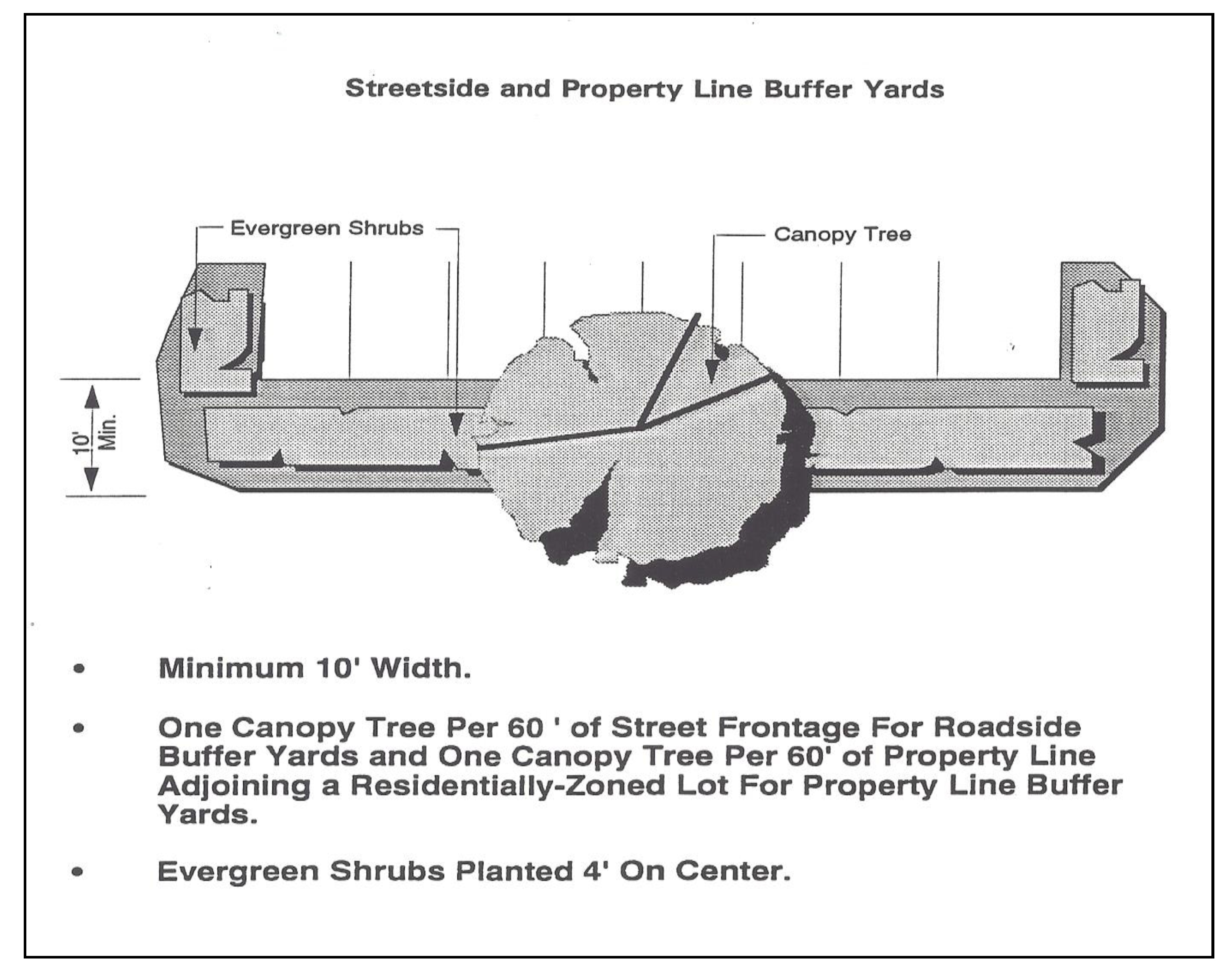
Street Side Buffer Yard Requirements. (See Figure 10-1)
(a)
All parking lots containing ten or more parking spaces shall include a minimum 10-foot perpetually maintained natural or planted buffer yard to screen the parking lot from all adjoining public street rights-of-way (where such parking lot is not screened visually by an intervening building).
(b)
The required streetside buffer yard shall contain at least one canopy tree for each sixty linear feet of street frontage and each tree shall be a minimum of 8 feet in height and shall have a minimum caliper of 2 inches (measured six inches above grade) at the time of planting. Each tree shall be a species which can be expected to attain a minimum height of 40 feet and have a crown width of 30 feet or greater at maturity. No tree shall be planted within 20 feet of the edge of a driveway at its intersection with the street right-of-way.
(c)
The required buffer yard shall also contain evergreen shrubs, planted four feet on center, which are of a species which can be expected to reach a minimum height of 36 inches and a minimum spread of 30 inches within 3 years of planting.
(d)
All portions of the streetside buffer yard not planted with trees or shrubs or covered by a wall or other barrier shall be planted with grass, ground cover, or natural mulch of a minimum depth of 3 inches.
10.13.2.
Property Line Buffer Yard Requirements. (See Figure 10-1)
(a)
Any parking lot and loading area (i) which contains ten or more parking spaces, (ii) which is located on a commercially-, industrially-, institutionally-used lot, and (iii) which abuts a residentially zoned lot shall include a minimum 10-foot perpetually maintained natural or planted buffer yard along all adjoining property lines that do not coincide with street rights-of-way.
(b)
The required property line buffer yard shall comply with the planting standards set out in Section 10.13.2(a). above for streetside buffer yards except that there shall be one canopy tree for each 60 LF of property line adjoining a residentially zoned lot rather than for each 60 LF of street frontage.
Figure 10-1
Planting Requirements for Buffer Yards
10.14 - SCREENING OF DUMPSTERS
Solid waste collection dumpsters which are (i) located on sites used for multi-family residential, townhouse, condominium, commercial, institutional, or industrial purposes and (ii) abutting a residence, residentially zoned lot, or street right-of-way shall be screened from the view of adjoining residences, residentially zoned lots, or street rights-of-way. Such screening may consist of natural vegetation, fences, walls, or berms and shall be installed, located, or constructed so as to create an effective screen.
10.15 - SCREENING OF ADJOINING INCOMPATIBLE LAND USES
10.15.1.
Multi-family Residential Uses. (see Figure 10-2) Whenever four or more multi-family residential, townhouse, or condominium dwelling units are proposed to be located directly abutting property which is used for single-family residential purposes or which is zoned for single-family residential use, the multi-family, townhouse, or condominium use shall provide screening in accordance with the following standards:
(a)
A minimum 15-foot perpetually maintained natural or planted buffer yard shall be provided along all property lines directly abutting a single-family used or zoned lot.
(b)
The buffer yard shall contain 2 canopy trees and 3 understory tress per 100 linear feet of buffer yard. Canopy trees shall be a minimum of 8 feet in height and 2 inches in caliper (measured 6 inches above grade) when planted. When mature, a canopy tree should be at least 40 feet high and have a crown width of 30 feet or greater. Understory trees shall be a minimum of 4 feet high and 1 inch in caliper (measured 6 inches above grade) when planted.
(c)
The buffer yard shall also contain 17 shrubs per 100 linear feet of buffer yard. All shrubs shall be of a species which can be expected to reach a minimum height of 36 inches and a minimum spread of 30 inches within 3 years of planting.
(d)
All portions of the buffer yard not planted with trees or shrubs or covered by a wall or other barrier shall be planted with grass, ground cover, or natural mulch of a minimum depth of 3 inches.
10.15.2.
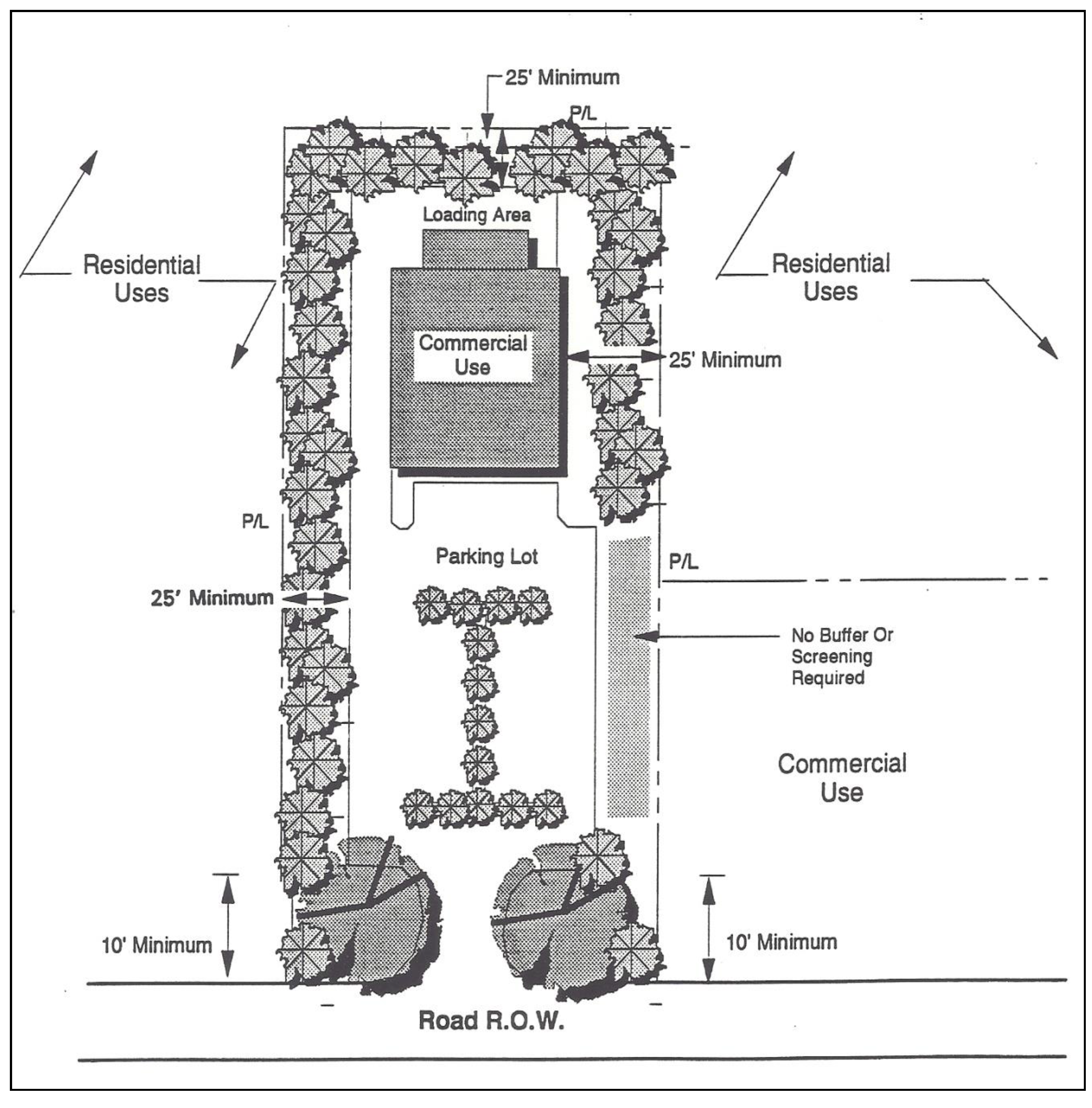
Industrial and Commercial (Business) Uses. (see Figure 10-2) Whenever an industrial or commercial (business) use is proposed to be located so that the principal building, accessory building(s), outdoor use areas, or parking and loading areas are within 100 feet of a lot which is used for residential purposes or which is zoned for residential use, the industrial or commercial use shall provide screening in accordance with the following standards:
(a)
A minimum 25-foot perpetually maintained natural or planted buffer yard shall be provided along all property lines directly abutting a residentially used or zoned lot.
(b)
The buffer yard shall contain 3 canopy trees and 5 understory trees per 100 linear feet of buffer yard. Canopy trees shall be a minimum of 8 feet in height and 2 inches in caliper (measured 6 inches above grade) when planted. When mature, a canopy tree should be at least 40 feet high and have a crown width of 30 feet or greater. Understory trees shall be a minimum of 4 feet high and 1 inch in caliper (measured 6 inches above grade) when planted.
(c)
The buffer yard shall also contain 25 shrubs per 100 linear feet of buffer yard. All shrubs shall be of a species which can be expected to reach a minimum height of 36 inches and a minimum spread of 30 inches within 3 years of planting.
(d)
All portions of the buffer yard not planted with trees or shrubs or covered by a wall or other barrier shall be planted with grass, groundcover, or natural mulch of a minimum depth of 3 inches.
Figure 10-2
Example of the Application of Buffers and Screens
10.16 - FENCES, WALLS AND SCREENS
10.16.1.
A fence, wall, or screen for the purposes of privacy and/or security may be located in any required yard provided:
(a)
The activities of the principal use may not extend into a front yard that is screened by a solid fence, wall, or shrubbery screen (e.g., a restaurant shall not enclose the front yard with a solid fence for the purpose of providing customers a lounge, a bar or an eating area).
(b)
No open wire fence of a type that could inflict injury from casual contact (such as barbed wire fence) is permitted below a height of six (6) feet in any district. Other types of open wire fencing (such as hurricane and chain link fencing) may be erected in any yard.
(c)
The height of a fence, wall, or screen shall be measured from the average undisturbed grade of the adjacent property.
(d)
Within residential zoning districts, the following fence, wall, and screen height limits shall apply:
(1)
Within front yards, the height for fences, walls, or screens shall be limited to four (4) feet except that the board of adjustment shall hear and decide requests for variances to allow height up to six (6) feet within front yards adjacent to thoroughfares. The variance request application shall include information on the factors set forth below, other requirements of this section and chapter, and any other information pertinent to granting the variance.
a.
The fence, wall or screen shall be set back a minimum of one-half (½) the distance of the required front yard setback for the district or fifteen (15) feet, whichever is greater;
b.
At least fifty (50) percent of the area of the fence, wall, or screen above four (4) feet shall be open along the entire length such that clear vision is possible from one side to the other; and
c.
Additional conditions may be specified to maintain safe access, ingress, and egress to and from the subject and surrounding properties.
(2)
Within any side or rear yard, the maximum height for any fence shall be eight (8) feet.
(3)
Fence height limits shall not apply to electric/gas substations, water/sewer treatment plants or facilities, municipal water storage facilities, waste treatment facilities, or government facilities.
(4)
Fence height limits shall not apply to chain link fences surrounding tennis courts or ball field backstops. Fences for private tennis courts shall be within the required setbacks for accessory uses in that zoning district.
(5)
In all zoning districts, chain link, woven wire, and electric and barbed wire fences shall be prohibited in front yards, except on bona fide farms, electric and gas substations, and government facilities. Fences and walls of exposed concrete block, tires, junk or other discarded materials shall be prohibited.
(6)
A fence, wall, or screen shall not impede access by emergency services to the subject and surrounding properties.
(7)
A fence, wall, or screen shall be installed with the finished side facing adjoining properties and rights-of-way.
(8)
A fence, wall, or screen shall be maintained in a sturdy upright position free from any broken or missing parts, slats or boards. Finishes shall be maintained in good condition.
10.17 - LINE OF SIGHT
10.17.1.
In order to maintain an acceptable and safe line of sight for motor vehicle drivers, no parking spaces, fences, walls, posts, lights, shrubs, trees or other type of obstructions not specifically exempted shall be permitted in the space between thirty (30) inches and above ground level and ten (10) feet above ground level within a triangular sight distance.
10.17.2.
The required triangular sight distance for any street intersections with thoroughfares shall be provided in compliance with the American Association of State Highway and Transportation Officials sight distance standards for roadway of similar classifications, intersections signalization/signage, and rated speeds.
10.18 - ALTERNATIVE SCREENING METHODS
10.18.1.
When screening is required by this Article or by other provisions of this Ordinance and the site design, topography, unique relationships to other properties, lot configuration, spatial separation, natural vegetation, or other special considerations exist relative to the proposed development, the applicant may submit a specific plan for screening to the Zoning Administrator. This plan must demonstrate how the purposes and standards of this Ordinance will be met by measures other than those listed in Sections 10.13 through 10.17 If approved by the Zoning Administrator, the alternative screening plan may be utilized to meet the requirements of this Ordinance.
10.18.2.
A combination of natural vegetation, fences, walls and berms may be utilized to achieve the screening requirements of Sections 10.13 through 10.17. provided that the following standards are met:
(a)
Walls (a minimum of 5 feet in height and constructed of masonry, stone or pressure treated lumber) or an opaque fence (a minimum of 5 feet in height) may be used to reduce the widths of the buffer yards by 10 feet.
(b)
Understory trees may be substituted for canopy trees if, in the opinion of the Zoning Inspector upon conferring with the electrical utility provider, a conflict exists with overhead utility lines.
(c)
Wall planters shall be constructed of masonry, stone or pressure treated lumber and shall have a minimum height of 30 inches. The minimum height of shrubs in wall planters shall be 6 inches. The effective planting area of the wall planter shall be 4 feet in width (7 feet if the wall planter contains trees).
(d)
Any berm utilized for screening purposes shall have a minimum height of 3 feet, a minimum crown width of 3 feet, and a side slope no greater than 3:1.
10.19 - USE OF EXISTING SCREENING
When a lot is to be developed so that screening is required and that lot abuts an existing hedge, fence or other screening material on the adjoining lot, then that existing screen may be used to satisfy the requirements of this Ordinance. The existing screen must meet the minimum standards for screening established by this Ordinance and it must be protected from damage by pedestrians or motor vehicles. However, the burden to provide the necessary screening remains with the use to be screened and is a continuing obligation that runs with the land so long as the original use continues in operation. Consequently, should the screening on the adjoining lot be removed, the use required to be screened shall, at that time, provide screening in accordance with the requirements of this Ordinance.
10.29 - GUARANTEE IN LIEU OF IMMEDIATE INSTALLATION
It is recognized that land development occurs continuously and that vegetation used in landscaping or screening should be planted at certain times of the year to ensure the best chance of survival. In order to ensure compliance with this Ordinance and reduce the potential expense of replacing landscaping or screening materials which were installed in an untimely or improper fashion, the developer may provide an adequately secured performance bond or other security to ensure that all of the requirements of this Article will be fulfilled.
10.31 - PURPOSE
Sufficient outdoor lighting at night increases safety, enhances the County's night time character, and helps provide security. New lighting technologies have produced lights that are extremely powerful, and these types of lights may be improperly installed so that they create problems of excessive glare, light trespass, and higher energy use. Appropriately regulated, and properly installed, outdoor lighting will contribute to the safety and welfare of the residents of the County.
10.32 - Definitions.
As found in Article 2 of this Ordinance, the following definitions are used in this section:
Direct Light. Light emitted directly from the lamp, off of the reflector or reflector diffuser, or through the refractor or diffuser lens, of a luminaire.
Fixture. The assembly that houses the lamp or lamps and can include all or some of the following parts: a housing, a mounting bracket or pole socket, a lamp holder, a ballast, a reflector or mirror, and/or a refractor or lens.
Flood or Spot Light. Any light fixture or lamp that incorporates a reflector or a refractor to concentrate the light output into a directed beam in a particular direction.
Fully-Shielded Lights. Outdoor light fixtures shielded or constructed so that no light rays are emitted by the installed fixture at angles above the horizontal plane as certified by a photometric test report.
Glare. Light emitting from a luminaire with an intensity great enough to reduce a viewer's ability to see, and in extreme cases causing momentary blindness.
Grandfathered Luminaires. Luminaires not conforming to this code that were in place at the time this code was voted into effect. When an ordinance "grandfathers" a luminaire, it means that such already-existing outdoor lighting does not need to be changed unless a specified period is specified for adherence to the code.
Height of Luminaire. The height of a luminaire shall be the vertical distance from the ground directly below the centerline of the luminaire to the lowest direct-light-emitting part of the luminaire.
Indirect Light. Direct light that has been reflected or has scattered off of other surfaces.
Lamp. The component of a luminaire that produces the actual light.
Light Trespass. The shining of light produced by a luminaire beyond the boundaries of the property on which it is located.
Lumen. A unit of luminous flux. One foot-candle is one lumen per square foot. For the purposes of this Ordinance, the lumen-output values shall be the initial lumen output ratings of a lamp.
Luminaire. This is a complete lighting system, and includes a lamp or lamps and a fixture.
Outdoor Lighting. The night-time illumination of an outside area or object by any man-made device located outdoors that produces light by any means.
Temporary Outdoor Lighting. The specific illumination of an outside area of object by any man-made device located outdoors that produces light by any means for a period of less than 7 days, with at least 180 days passing before being used again.
10.33 - OUTDOOR ADVERTISING SIGNS
10.33.1.
Top Mounted Fixtures Required. Lighting fixtures used to illuminate an outdoor advertising sign shall be mounted on the top of the sign structure. All such fixtures shall comply with the shielding requirements of Section 10.32.1. Bottom-mounted outdoor advertising-sign lighting shall not be used.
10.33.2.
Outdoor advertising signs of the type constructed of translucent materials and wholly illuminated from within do not require shielding. Dark backgrounds with light lettering or symbols are preferred, to minimize detrimental effects. Unless conforming to the above dark background preference, total lamp wattage per property shall be less than 41 watts.
10.33.3.
Prohibitions. Electrical illumination of outdoor advertising off-site signs between the hours of 11:00 p.m. and sunrise is prohibited.
10.34 - RECREATIONAL FACILITIES
10.34.1.
Any light source permitted by this Ordinance may be used for lighting of outdoor recreational facilities (public or private), such as, but not limited to, football fields, soccer fields, baseball fields, softball fields, tennis courts, or show areas, provided all of the following conditions are met:
10.34.2.
All fixtures used for event lighting shall be fully shielded or be designed or provided with sharp cut-off capability, so as to minimize up-light, spill-light, and glare.
10.34.3.
All events shall be scheduled so as to complete all activity before or as near to 10:30 p.m. as practical, but under no circumstances shall any illumination of the playing field, court, or track be permitted after 11:00 p.m. except to conclude a scheduled event that was in progress before 11:00 p.m. and circumstances prevented concluding before 11:00 p.m.

