
Bladen County Unincorporated
City Zoning Code
City Zoning Code
ARTICLE 9
ZONING DISTRICTS: OTHER DESIGN STANDARDS
9.1 - PURPOSE
It is the purpose of this Ordinance, including the following dimensional and other design standards, to promote the public health, safety, and general welfare of the residents of Bladen County.
9.2 - STANDARDS APPLICABLE TO ALL DISTRICTS
9.2.1.
Minimum Lot Area.
(a)
The minimum lot sizes set forth in this Article are permissible only if and to the extent that adequate water and sewer facilities are or can be made available to serve the lots. Where public water and sewer services are not available, a greater lot area may be required. The designation of "C" (use with conditions) or "S" (Special Use Permit required) will indicate this as may be required.
(b)
Deviations from the applicable lot size requirements of this Article may be made under special circumstances, for nonconforming lots in accordance with Article 18.
9.2.2.
Minimum Lot Width.
(a)
The lot width shall be measured along a straight line connecting the points at which a line that demarcates the required setback from the street intersects with side property lines.
(b)
No lot created after the effective date of this Ordinance that is less than the recommended width shall be entitled to a variance from any building setback requirement.
(c)
Deviations from the applicable lot width requirements of this Section may be made for nonconforming lots in accordance with Article 18.
(d)
Minimum lot width requirements for individual units in a condominium or townhouse project are waived. However, the development parcel must adhere to the minimum lot width requirements of the zoning district in which it is located.
9.2.3.
Building Height.
(a)
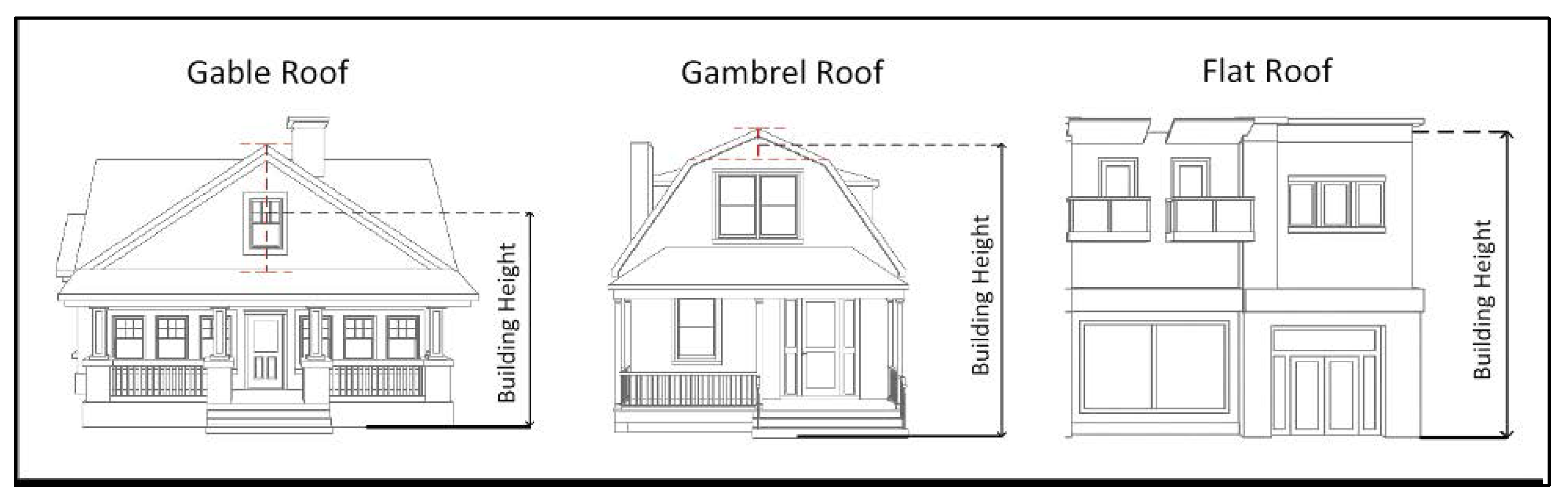
The vertical distance measured from the average elevation of the proposed finished grade at the front of the structure to one of the following (see Figure 9.1: Building Height Measurement):
(1)
The midpoint between eave and ridgeline on a simple sloped roof (e.g., gable or hip roof) or curved roof (e.g., barrel roof);
(2)
Where there are multiple roof planes (e.g., gambrel or mansard roof), the highest midpoint on a sloped or curved roof surface or the highest flat roof plane, whichever is highest; or
(3)
The highest roof plane on a flat roof (not including any parapet wall). Appurtenances usually required to be placed above the roof level and not intended for human occupancy (e.g., antennas, chimneys, solar panels) shall not count toward the building height.
Figure 9.1: Building Height Measurement
9.2.4.
Lot Access Requirements.
(a)
Subject to the remaining provisions of this Section, every lot or parcel to be built upon shall abut a public or private street or a private easement and no structure shall be built upon a lot which does not abut a public or private street or a private easement.
(b)
Every lot or parcel shall have a driveway access that meets or exceeds the requirements of the NCDOT. A driveway with two-way operations shall have a minimum 20 foot and a maximum of 36-foot width. A driveway with one-way operation shall have a minimum 12 foot and a maximum 24-foot width. Policy on Street and Driveway Access to North Carolina Highways, July 2003.
(c)
Lot access requirements for individual units in condominium and townhouse projects are waived. However, the individual units shall have right of access through common areas containing private streets and/or private drives.
9.2.5.
Building Setback Requirements.
(a)
Setback distances shall be measured from the street right-of-way line, street centerline, or property line to a point on the lot that is the nearest extension of any part of the building that is substantially a part of a building itself and not a mere appendage to it nor a building part allowed to encroach into a setback.
(b)
Building setbacks from approved private streets shall be measured from the private street right-of-way, private street easement, or the boundary line of the common area reserved for the private street.
(c)
Setbacks for flag lots and lots served by access easements shall comply with the requirements of the district in which they are located.
(d)
Where fifty percent or more of the lots in a recorded subdivision on the same side of the block as the lot in question are developed with less than the required street setbacks, the average setback of the two principal buildings nearest that lot shall be observed as the required minimum setback.
(e)
Deviations from the applicable setback requirements of this Section may be made for nonconforming lots.
9.2.6.
Dimensional Requirements for Accessory Buildings, Structures and Uses.
(a)
Only one accessory structure/building shall be permitted on lots less than twenty thousand (20,000) square feet. Larger lots are allowed an extra accessory building/structure for each additional thirty thousand (30,000) square feet provided that such accessory buildings/structures are a minimum of thirty (30) feet apart from any other principal or secondary building/structures.
(b)
Minimum Setbacks for Accessory Buildings, Structures and Uses are:
(1)
Minimum side setback: 10 feet.
(2)
Minimum rear setback: 10 feet.
(3)
Minimum setback from principal structure: 10 feet.
(4)
Maximum building height shall not exceed 20 feet. from mean roof height.
(c)
Accessory buildings not exceeding 50 square feet. and used exclusively to house well and pump equipment may be permitted in front, side or rear yards, provided such accessory buildings are at least five (5) feet from any property lines and do not encroach into any required easements or other site angles.
(d)
An accessory building may be located on another contiguous or non-contiguous lot from the principal use with which it is associated, only to the extent that the principal use itself would also be permitted on such lot.
(e)
Residential use of an accessory structure is only permitted for one accessory structure per principal structure and is only allowed in the RA district.
(f)
Accessory structures shall not be used for commercial purposes unless properly permitted.
(g)
Accessory Structures and Uses in Residential Districts. In all residential zoning districts, accessory structures and uses must be placed in back of or on the side of the principal structure on the lot and must meet the setback requirements for the applicable zoning district.
(h)
Lot Coverage. Accessory structures to a residential use shall not have a ground floor area which exceeds 50 percent of the ground floor area of the principal building.
(i)
Expansion of Nonconforming Use Not Permitted. If a property is nonconforming under the zoning ordinance, then the addition of an accessory use or structure must not violate and restriction concerning the expansion or change involving the nonconforming features of the site.
9.2.7.
Encroachments in Setbacks.
(a)
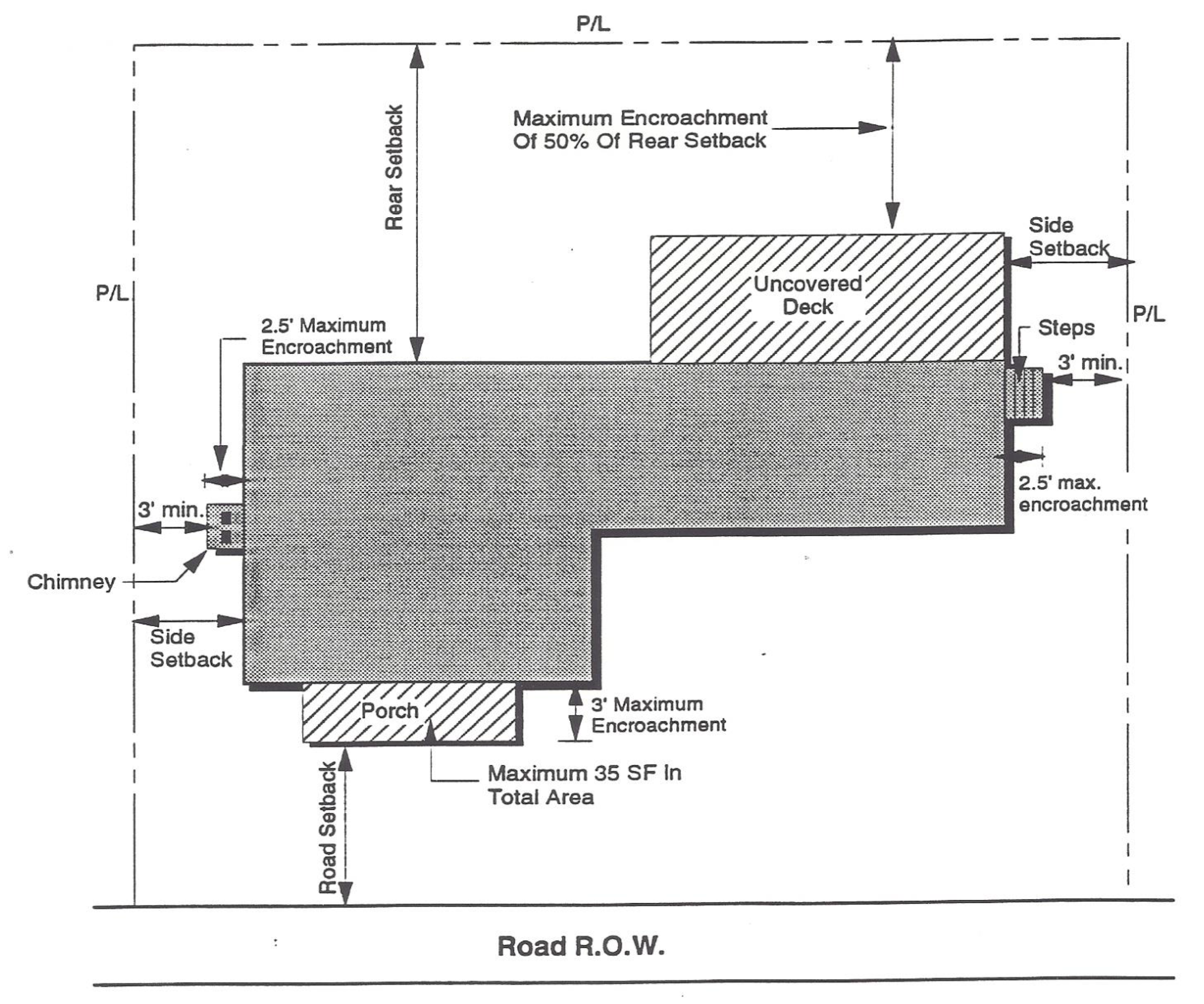
The following encroachments, examples depicted in Figure 9-2 are permitted in required setbacks provided there is no interference with any sight area:
(1)
Landscaping features, including, but not limited to, ornamental pools, planting boxes, sculptures, arbors, trellises, and birdbaths;
(2)
At grade patios, play equipment or outdoor furniture, ornamental entry columns and gates, flag poles, lamp posts, address posts, HVAC equipment, mailboxes, outdoor fire places, public utility wires and poles, pumps or wells, and fences or retaining walls; and
(3)
Handicapped ramps.
Figure 9-2: Encroachments Permitted in Setbacks
9.2.8.
Visibility at Intersections. No building, structure, wall, fence, shrub or tree shall be erected, maintained, or planted on any lot which will allow an obstruction in the horizontal or vertical sight distance area.
9.2.9.
Principal Building Per Lot. No more than one principal building shall be permitted on a buildable lot or parcel in RA, R, C and CON districts.

