
Blissfield City Zoning Code
ARTICLE II
CONSTRUCTION OF LANGUAGE AND DEFINITIONS
216.200 - Construction of language.
Sec. 2.00. The following rules of construction apply to the text of this Ordinance.
1.
The particular shall control the general.
2.
In the case of any difference of meaning or implication between the text of this Ordinance and any caption or illustration, the text shall control.
3.
The word "shall" is always mandatory and not discretionary. The word "may" is permissive.
4.
Words used in the present tense shall include the future; the words used in the singular number shall include the plural, and the plural the singular, unless the context clearly indicates the contrary.
5.
A "building" or structure includes any part thereof.
6.
The phrase "used for" includes "arranged for", "designed for", "intended for", "maintained for", or "occupied for".
7.
The word "person" includes an individual, a corporation, a partnership, an incorporated association, or any other similar entity.
8.
Unless the context clearly indicates the contrary, where a regulation involves two or more items, conditions, provisions, or events connected by the conjunction "and", "or", "either/or", the conjunction shall be interpreted as follows:
(a)
"And" indicates that all the connected items, conditions, provisions or events shall apply.
(b)
"Or" indicates that all the connected items, conditions, provisions or events may apply singly or in any combination.
(c)
"Either/or" indicates that all the connected items, conditions, provisions or events shall apply singly but not in combination.
9.
Terms not herein defined shall have the meaning customarily assigned to them.
(Amended: 9-28-09)
216.201 - Definitions.
Sec. 2.01. For the purpose of enforcing the provisions of this Ordinance, certain terms and words used herein are defined as follows:
Accessory Building: A supplementary building or a portion of a main building, the use of which is incidental to that of the main building and which is located on the same lot as the main building, but such use shall not include any building used for dwelling, lodging, or sleeping quarters for human beings.
Adult Entertainment Facilities:
1.
Adult bookstore: means an establishment that has, as a substantial or significant portion of its stock in trade, sexual paraphernalia, books, periodicals, magazines, newspapers, pamphlets, pictures, photographs, motion picture films, and/or videotapes which are distinguished or characterized by their emphasis on matter depicting, describing or relating to nudity, sadomasochistic abuse or sexual conduct.
2.
Adult motion picture theater: means an establishment, whether in a completely enclosed building or not, that offers, for an admission fee, membership fee, or other valuable consideration, the viewing during more than 25 percent of its operating hours of motion picture films, pictures or photographs which are distinguished or characterized by their emphasis on nudity, sadomasochistic abuse, or sexual conduct.
3.
Adult theater: means an enclosed building or any portion of a building which is used for presenting material distinguished or characterized by an emphasis on matter depicting, describing, or relating to sexual conduct, nudity, or sadomasochistic abuse by any means of display, including, without limitation, by motion picture, mechanical amusement devices, television, including videotape or closed circuit, or live performance for observation by patrons therein.
4.
Adult Personal Service Business: A business whose activities include a person, while partially nude, providing personal service for another person on an individual basis in a closed room. It includes, but is not limited to, the following activities and services: modeling studios, photographic studios, wrestling studios, individual theatrical performances, body painting studios and massage studios.
5.
Adult Cabaret: An establishment which features topless dancers, and/or bottomless dancers, partially nude or seminude dancers, go-go dancers, exotic dancers, strippers, male or female impersonators or similar entertainers, or topless and/or bottomless and/or partially nude or seminude waitpersons or employees or any other form of nude or partially nude or seminude service or entertainment.
6.
Nudity: means uncovered or less than opaquely covered postpubertal human male or female genitals, pubic areas or buttocks.
7.
Sadomasochistic abuse: means flagellation or torture by or upon a human.
8.
Sexual conduct: means any of the following actual or simulated acts of:
a.
Human sexual intercourse, homosexual or heterosexual;
b.
Human or animal masturbation;
c.
Bestiality;
d.
Fellatio;
e.
Cunnilingus;
f.
Human excretory functions;
g.
Sodomy; or
h.
Fondling or erotic touching of human genitals, pubic region, buttocks or breasts.
Alley: A public way which affords only a secondary means of access to abutting property and not intended for general traffic circulation.
Alterations: Any change in the location or use of a building, or any change or modification in the supporting members of a building such as bearing walls, columns, beams, hoists, girders and similar components, or any occupancy, the consummated act of which may also be referred to herein as "altered" or "reconstructed".
Appeal: An entreaty or demand for hearing or review of facts and/or actions in connection with the public enforcement of this Ordinance.
Architectural Features: Architectural features of a building shall include cornices, eaves, gutters, belt courses, sills, lintels, bay windows, chimneys and decorative ornaments.
Automobile Wash Establishment: A building or portion thereof, the primary purpose of which is that of washing vehicles.
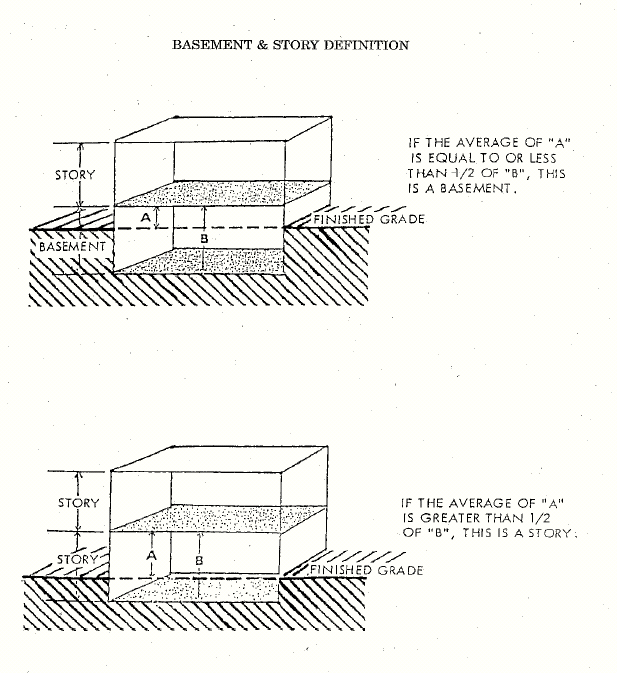
Basement: That portion of a building wholly or partly below grade, but so constructed that the vertical distance from the average grade to the basement floor is greater than the vertical distance from the average grade to the basement ceiling. A basement shall not be included as a story for height measurement. (See illustration entitled "Basement and Story Definition").
Bed and Breakfast: A residence that offers transient sleeping accommodations for rent and provides a breakfast meal to the tenant at no additional charge.
Bedroom: A room in a dwelling unit used for or intended to be used for sleeping purposes by human beings.
Block: The property abutting one side of a street and lying between the two nearest intersecting streets, crossing or terminating; or between the nearest such street and railroad right-of-way; un-subdivided acreage, lake, river or live stream; or between any of the foregoing and any other barrier to the continuity of development.
Boarding House: A dwelling where meals, or lodging and meals, are provided for compensation to three or more persons by prearrangement for definite periods of not less than one week. A boarding house is to be distinguished as other than a motel, hotel, convalescent home or nursing home.
Board of Appeals: The term "board of appeals" shall mean the Village of Blissfield, Lenawee County, State of Michigan, Zoning Board of Appeals.
Building: A structure erected on-site, a mobile home structure, a pre-manufactured or pre-cut structure, above or below ground, designed primarily for the shelter, support or enclosure of persons, animals or property of any kind.
Building, Main or Principal: A building in which is conducted the principal use of the lot upon which it is situated.
Building and/or Zoning Compliance Permits: The written authority issued by the Zoning Administrator of the Village permitting the construction, removal, moving, alteration, or use of a building in conformity with the provisions of this Ordinance.
Carport: Any roofed structure or shelter or portion of a building (open on two or more sides) which may or may not be attached to a dwelling, other than an attached or detached garage, used for the purpose of storing motor vehicles.
Child Care Organization: A governmental or nongovernmental organization having as its principal function receiving minor children for care, maintenance, training and supervision. Such organization shall be defined as follows:
1.
Child Care or Day Care Center: A facility, other than a private residence, receiving one or more preschool or school age children for care for periods of less than twenty-four (24) hours a day and where the parents, guardians, family member or court appointed fiduciary or care giver is not immediately available to the child. Child care center or day care center includes a facility that provides care for not less than two (2) consecutive weeks, regardless of the number of hours of care per day. The facility is generally described as a child care center, day care center, day nursery, nursery school, parent cooperative preschool, play group, before or after school program, or drop in center. Child care center or day care center does not include any of the following:
A.
Sunday school, a vacation bible school, or a religious instructional class that is conducted by a religious organization where children are attending for not more than three (3) hours per day for an indefinite period or for not more than eight (8) hours per day for a period not to exceed four (4) weeks during a twelve month period.
B.
A facility operated by a religious organization where children are in the religious organizations care for not more than three (3) hours while persons responsible for the children are attending religious services.
C.
A program that is primarily supervised, school-age, child focused training in a specific subject including, but not limited to, dancing, drama, music or religion. This exclusion applies only to the time a child is involved in supervised, school-age, child-focused training.
D.
A program that is primarily an incident of group athletic or social activities for school-age children sponsored by or under the supervision of an organized club or hobby group, including, but not limited to, youth clubs, scouting and school-age recreational or supplementary education programs. This exclusion applies only to the time the school-age child is engaged in the group athletic or social activities and if the school-age child can come and go at will.
2.
Private Home: A private residence in which the licensee or registrant permanently resides as a member of the household, which residency is not contingent upon caring for children or employment by a licensed or approved child placing agency. Private home includes a full-time foster family home, a full-time foster family group home, a group child care home, or a family child care home as follows:
A.
Foster Family Home: A private home in which one (1) but not more than four (4) minor children who are not related to an adult member of the household by blood, marriage or adoption, are given care and supervision for twenty-four hours a day for four (4) or more days a week for two (2) or more consecutive weeks unattended by a parent or legal guardian.
B.
Foster Family Group Home: A private home in which more than four (4) but less than seven (7) minor children who are not related to an adult member of the household by blood, marriage or adoption, are given care and supervision for twenty-four hours a day for four (4) or more days a week for two (2) or more consecutive weeks unattended by a parent or legal guardian.
C.
Family Child Care Home: A private home in which one (1) but fewer than seven (7) minor children are received for care and supervision for periods of less than twenty-four hours a day, unattended by a parent or legal guardian except children related to an adult member of the family by blood, marriage or adoption. Family Child Care Home includes a home that gives care to all unrelated minor children for more than four (4) weeks during a calendar year.
D.
Group Child Care Home: A private home in which more than six (6) but not more than twelve (12) minor children are given care and supervision for periods of less than twenty-four hours a day, unattended by a parent or legal guardian except children related to an adult member of the family by blood, marriage or adoption but including a home that gives care to all unrelated minor children for more than four (4) weeks during a calendar year.
3.
Adult Foster Care: A facility for the care of adults over eighteen (18) years of age, as licensed and regulated under the Adult Foster Care Facility Licensing Act, as amended, and the associated rules promulgated by the State of Michigan. Such organizations shall be defined as follows:
A.
Adult Foster Care Family Home: A private residence with capacity to receive not more than six (6) adults who shall be provided foster care for five (5) or more days a week and for two (2) or more consecutive weeks.
B.
Adult Foster Care Group Home (small): Means an adult foster care facility with capacity for not more than twelve (12) adults who are provided foster care.
C.
Adult Foster Care Group Home (large): Means an adult foster care facility with capacity for at least thirteen (13) but not more than twenty (20) adults who are provided foster care.
Clinic: A building or a group of buildings where human patients are admitted, but not lodged overnight, for examination and treatment by more than one professional, such as a physician, dentist, or the like.
Commercial Use: A commercial use relates to the use of property in connection with the purchase, sale, barter, display, or exchange of goods, wares, merchandise or personal services or the maintenance of offices or recreational or amusement enterprises.
Commission: This term, and the term "Planning Commission" shall mean the Village of Blissfield Planning Commission.
Convalescent or Nursing Home: A convalescent home or nursing home is a home for the care of children or the aged or the infirm, or a place of rest for those suffering serious bodily disorders, wherein three or more persons are cared for. Said home shall also conform to, and qualify for license under the applicable State laws (even though State law may provide for different regulations).
Deck: An exterior floor system supported on at least two opposite sides by an adjoining structure and/or posts, piers, or other independent supports.
Drive-in Restaurant: A drive-in restaurant is any establishment whose principal business is the sale of foods, frozen desserts, or beverages to the customer in a ready-to-consume state, and whose design, method of operation, or any portion of whose business includes one or both of the following characteristics:
(a)
Foods, frozen desserts, or beverages are served directly to the customer in a motor vehicle either by a car-hop or by other means which eliminates the need for the customer to exit the motor vehicle.
(b)
The consumption of foods, frozen desserts, or beverages within a motor vehicle parked upon the premises or at other facilities on the premises outside the restaurant building, is allowed, encouraged, or permitted.
Drive-through: An establishment so developed that some portion of its retail or service character is dependent upon providing a driveway approach and a staging area specifically designed for motor vehicles so as to serve patrons while in their motor vehicles rather than within a building or structure, for carry-out and consumption or use after the vehicle is removed from the premises.
Dwelling, Single Family: A building containing not more than one (1) dwelling unit designed for residential use, complying with the following standards:
(a)
It complies with the minimum square footage requirements of the Village of Blissfield Building Code and the Village of Blissfield Zoning Ordinance for the zone in which it is located.
(b)
It has a minimum width across the front, side and rear elevation of 20 feet and complies in all respects with the Village of Blissfield Building Code, including minimum heights for habitable rooms. Where a dwelling is required by law to comply with any federal or state standards or regulations for construction are different than those imposed by the Village of Blissfield Building Code, then and in that event such federal or state standard or regulation shall apply.
(c)
It is firmly attached to a permanent foundation constructed on the site in accordance with the Village of Blissfield Building Code and shall have a wall of the same perimeter dimensions of the dwelling and constructed of such materials and type as required in the applicable building code for single-family dwellings. In the event that the dwelling is a manufactured home, as defined herein, such dwelling shall be installed pursuant to the manufacturer's setup instructions and shall be secured to the premises by an anchoring system or devise complying with the rules and regulations of the Michigan Mobile Home Commission and shall have a perimeter wall as required above.
(d)
In the event that a dwelling is a manufactured home as defined herein, each mobile home shall be installed with the wheels removed. Additionally, no dwelling shall have any exposed towing mechanism, undercarriage or chassis.
(e)
The dwelling is connected to a public sewer and water supply.
(f)
The dwelling contains a storage capability area in a basement located under the dwelling, in an attic area, in closet areas, or in a separate structure of standard construction similar to or of better quality than the principal dwelling, which storage area shall be equal to ten percent of the square footage of the dwelling or 100 square feet, whichever shall be less.
(g)
The dwelling is compatible in design and appearance with other residences in the vicinity, with either a roof over-hang of not less than six inches on all sides, or alternatively with window sills or roof drainage systems concentrating roof drainage at collection points along the sides of the dwelling; has not less than two exterior doors with the second one being in either the rear or side of the dwelling; and contains steps connected to said exterior door areas or to porches connected to said door areas where a difference in elevation requires the same.
The compatibility of design and appearance shall be determined in the first instance by the Village Zoning Administrator upon review of the plans submitted for a particular dwelling subject to appeal by an aggrieved party to the Blissfield Planning Commission within a period of 15 days from the receipt of notice of said Zoning Administrator's decisions. An aggrieved party to the Blissfield Planning Commission decision within a period of 15 days from the receipt of notice of said Blissfield Planning Commission decision may appeal said decision to the Blissfield Village Council. Any determination of compatibility shall be based upon the standards set forth in this definition of "dwelling" as well as the character, design and appearance of one or more residential dwellings located outside of manufactured home parks within 2,000 feet of the subject dwelling where such area is developed with dwellings to the extent of not less than 20 percent of the lots situated within said area; or, where said area is not so developed, by the character, design and appearance of one or more residential dwellings located outside of manufactured home parks throughout the Village. The foregoing shall not be construed to prohibit innovative design concepts involving such matters as solar energy, view, unique land contour, or relief from the common or standard designed home.
(h)
The dwelling contains no additions or rooms or other areas which are not constructed with similar quality workmanship as the original structure, including permanent attachment to the principal structure and construction of a foundation as required herein.
(i)
The dwelling complies with all pertinent building and fire codes. In the case of a manufactured home, all construction and all plumbing, electrical apparatus and insulation within and connected to said manufactured home shall be of a type and quality conforming to the "Mobile Home Construction and Safety Standards" as promulgated by the United States Department of Housing and Urban Development, being 24 CFR 3280, and as from time to time such standards may be amended. Additionally, all dwellings shall meet or exceed all applicable roof snow load and strength requirements.
(j)
The foregoing standards shall not apply to a manufactured home located in a licensed manufactured home park except to the extent required by state or federal law or otherwise specifically required in the ordinance of the Village pertaining to such parks.
(k)
All construction required herein shall be commenced only after a building permit has been obtained in accordance with the applicable Village building code provisions and requirements.
Dwelling, Two-Family: A building containing not more than two separate dwelling units designed for residential use and conforming in all other respects to the standards set forth in this Ordinance.
Dwelling, Multiple-Family: A building containing three or more dwelling units designed for residential use and conforming in all other respects to the standards set forth in this Ordinance.
Efficiency Unit: An efficiency unit is a dwelling unit consisting of one or more rooms exclusive of hallways or closets directly off the principal room providing not less than 400 square feet of floor area.
Essential Services: The erection, construction, alteration or maintenance by public utilities or public authorities, or underground or overhead gas, electrical, steam or water transmission or distribution systems, collection, communication, supply or disposal systems, including poles, wires, drains, sewers, pipes, conduits, cables, towers, fire alarm boxes, police call boxes, traffic signals, hydrant or other similar equipment and accessories in connection therewith, not including buildings, as shall be reasonably necessary for the furnishing of adequate services by public utilities, or public authorities, or for the public health, safety or general welfare (not including buildings other than are primarily enclosures or shelters of the above essential service equipment). Same shall be permitted as authorized by law and other ordinances, the intent being to exempt such erection from the application of this Ordinance.
Family: Family shall mean one or more persons related by blood or marriage occupying a dwelling unit and living as single, nonprofit housekeeping unit.
A collective number of individuals living in one house and under one head, whose relationship is of a permanent and distinct domestic character, and cooking as a single housekeeping unit. This definition shall not include any society, club, fraternity, sorority, association, lodge, combine, federation, group, coterie, or organization, which is not a recognized religious order, nor include a group of individuals whose association is temporary and resort-seasonal in character or nature.
100-Year Floodplain: The evaluation of which determines the height to which uses will be regulated or to the elevation to be flood proofed.
Floodway: The channel of the river and those portions of the adjoining lands which are reasonably required to carry and discharge the regulatory flood.
Floor Area:
(a)
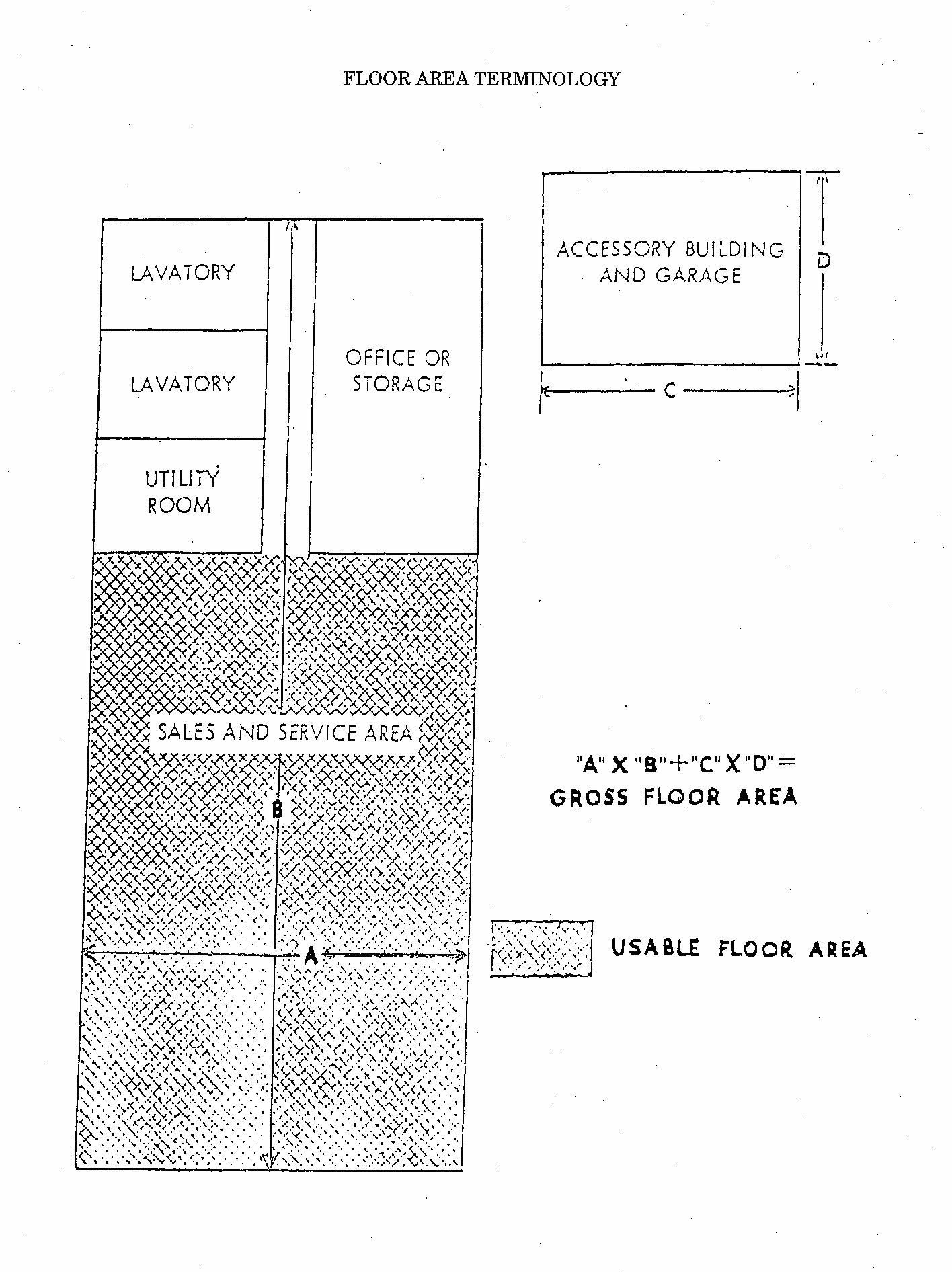
Floor Area, Gross: The sum of the gross horizontal areas of the several floors of the building measured from the exterior faces of the exterior walls or from the center line of walls separating two buildings. The "floor area" of a building which is what this normally is referred to as, shall include the basement floor area when more than one-half of the basement height is above the established curb level or finished lot grade, whichever is higher (see Basement definition). Any space devoted to off-street parking or loading shall not be included in "floor area". Areas of basements, utility rooms, breezeways, unfinished attics, porches (enclosed or unenclosed) or attached garages are not included.
(b)
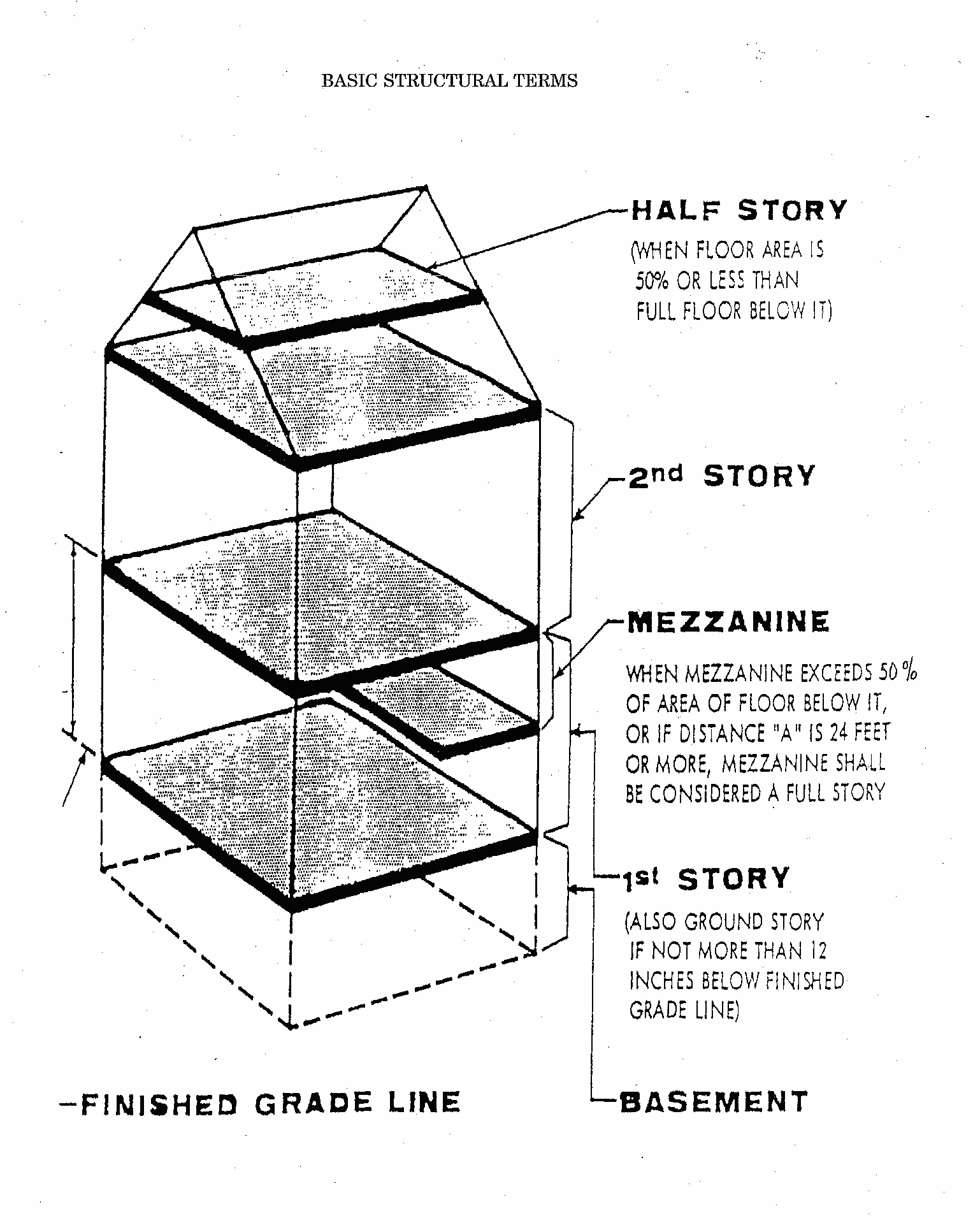
Floor Area, Useable: The measurement of useable floor area shall include that portion of the floor area, measured from the interior face of the exterior walls, used for or intended to be used for services to the public or customers, patrons, clients, or patients; including areas occupied by fixtures or equipment used for display or sale of goods or merchandise, but not including areas used or intended to be used for storage of merchandise, utility or mechanical equipment rooms, or sanitary facilities. In the case of the half story, the useable floor area shall be considered to be only that portion having a clear height above it of four feet or more. (See illustrations entitled "Basic Structural Terms" and "Floor Area Terminology").
Garage, Private: A space or structure suitable for the storage of motor vehicles having no public shop or service in connection therewith, for the use solely of the owner or occupant of the principal building on a lot, or of his family or domestic employee.
Grade: The building grade shall, in the case of fairly level ground conditions, be the level of the ground adjacent to the walls. For substantially un-level ground conditions, the grade shall be the average elevation of the ground adjacent to the walls.
Group Day Care Home: A private dwelling or residence in which up to 12 minor children are given care and supervision for periods of less than 24 hours a day.
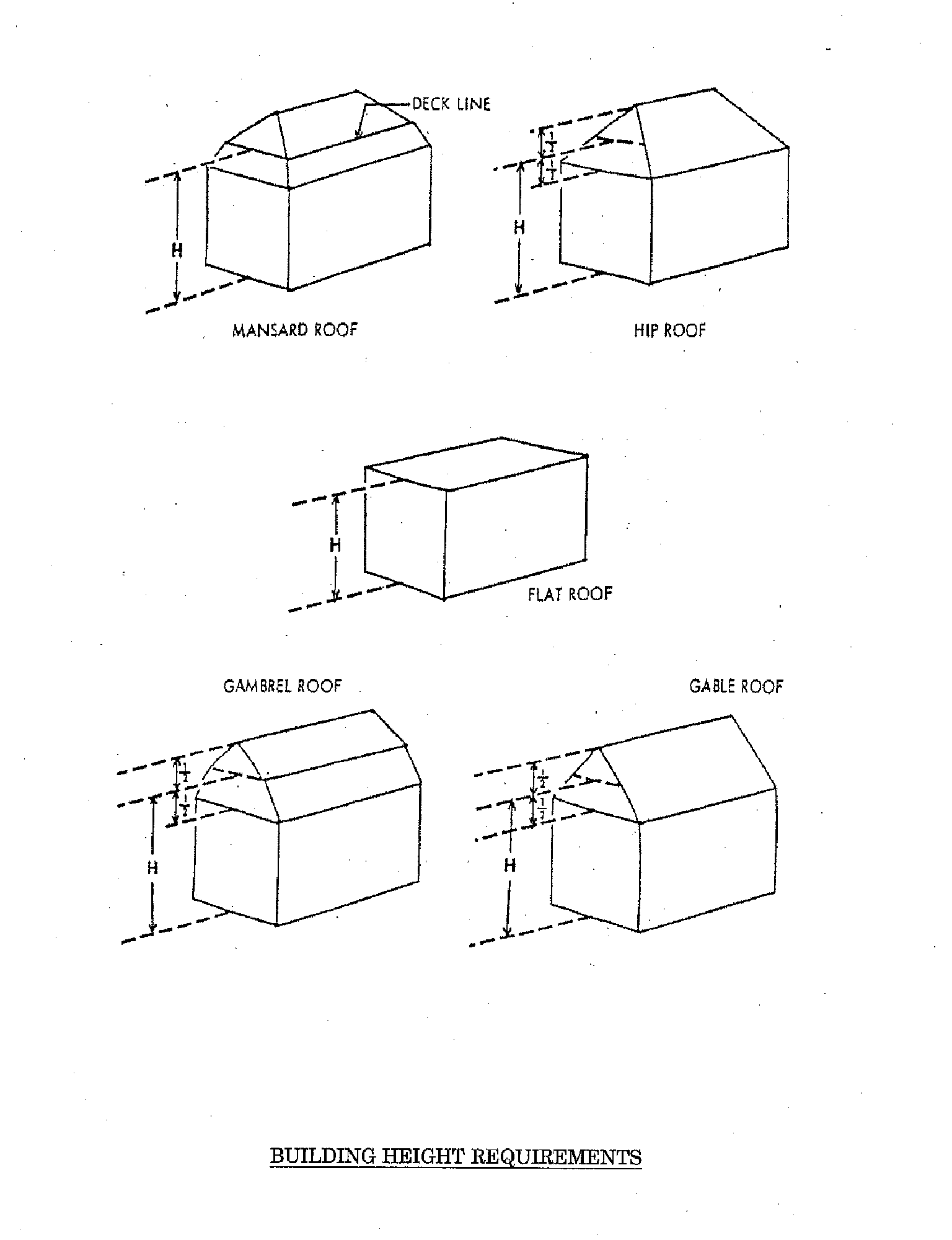
Height, Building: The vertical distance measured from the grade of the building to the highest point of the roof for flat roofs; to the deck line for mansard roofs; and to the mean height level (between eaves and ridges) for gable, hip and gambrel roofs. Where a building is located upon a terrace, the height may be measured from the average ground level of the terrace at the building wall. (See illustration entitled "Building Height Requirements".)
Home Occupation: An accessory use of a dwelling unit for gainful employment which is conducted entirely within a dwelling and which is clearly incidental and secondary to the residential use of the lot, does not change the character of the dwelling, and meets all applicable provisions of the Ordinance.
Hospital: A building structure or institution in which sick or injured persons, primarily in-patients, are given medical or surgical treatment and operating under license by the Health Department of the State of Michigan.
Housing for Elderly: Housing designed or intended to accommodate persons aged 65 or older.
Hotel: A building occupied as a more or less temporary abiding place for individuals, who are lodged with or without meals in rooms occupied singly for hire, in which provision is not made for cooking on any individual plan and in which there are more than ten sleeping rooms.
Kennel: Any lot or premises on which three or more dogs or cats are kept either permanently or temporarily commercially boarded. All kennels shall comply with all applicable Village, County, and State regulations.
Loading Space: An off-street space on the same lot with a building or group of buildings, for temporary parking of a commercial vehicle while loading or unloading merchandise or materials.
Lot: A lot is a piece or parcel of land occupied or intended to be occupied by a building and any accessory buildings or by any other use or activity permitted thereon and including the open spaces and yards required under this Ordinance, and having its frontage upon a public street or road either dedicated to the public or designated on a recorded subdivision.
(a)
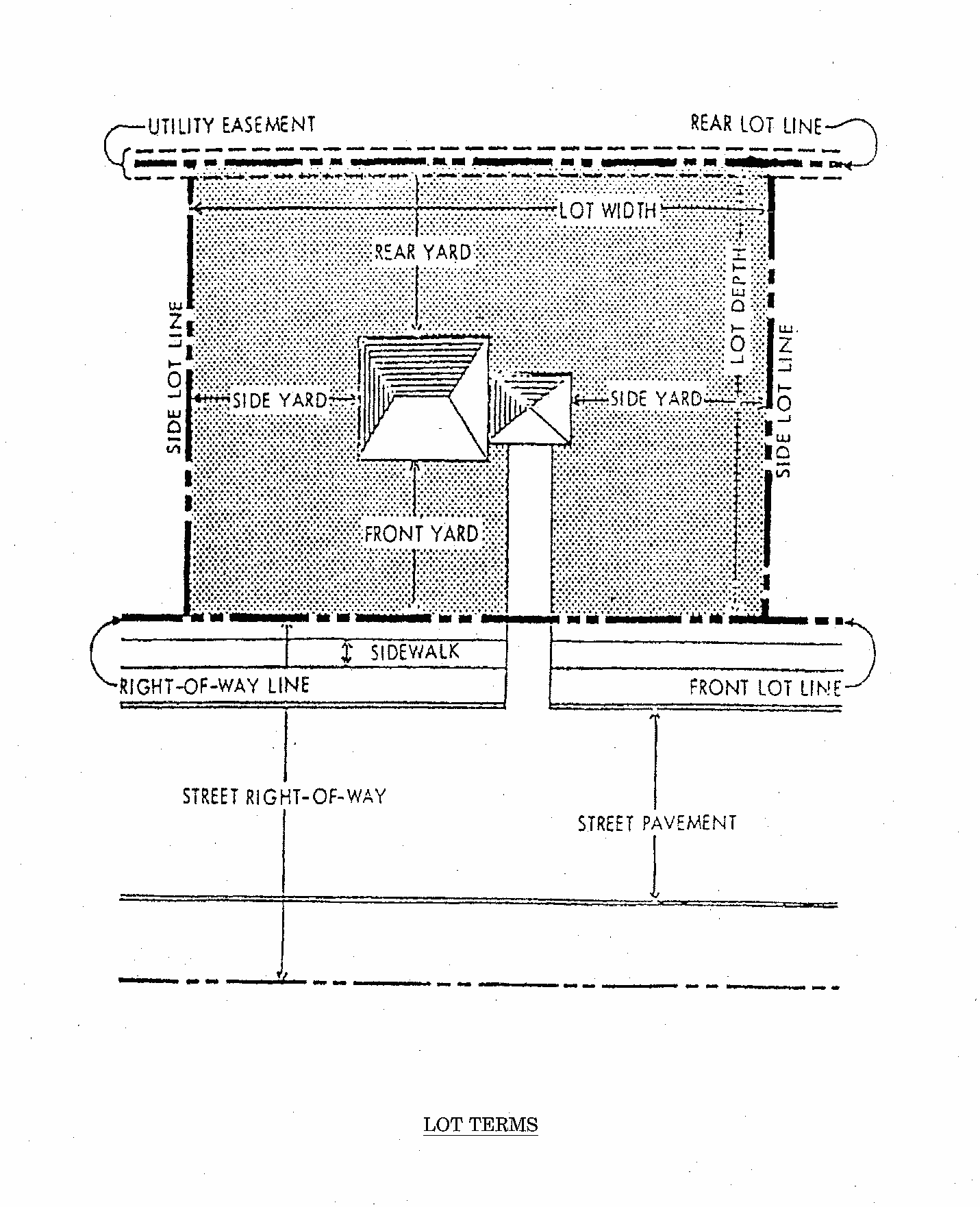
Lot Depth: The depth of a lot is the mean horizontal distance from the center of the front street line to the center of the rear lot line.
(b)
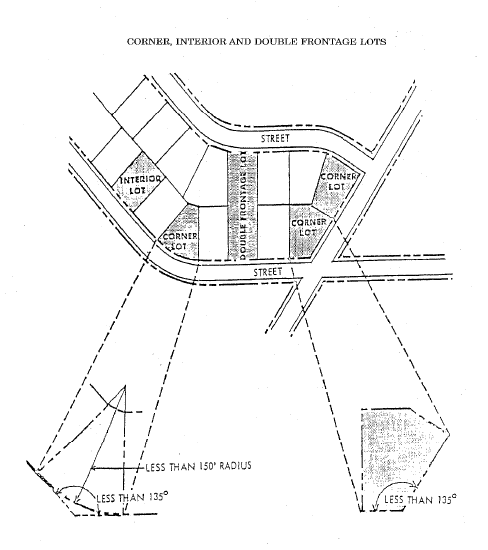
Lot, Double Frontage: A lot other than a corner lot having frontage on two more or less parallel streets. In the case of a row of double frontage lots, one street will be designated as the front street for all lots in the plat and in the request for a zoning compliance permit. If there are existing buildings in the same block fronting on one or both of the streets, the required minimum front yard setback shall be observed on those streets where buildings presently front.
(c)
Lot, Interior: An interior lot is a lot other than a corner lot with only one lot line fronting on a street.
(d)
Lot, Width: The horizontal distance between the side lot lines, measured at the two points where the building line, or setback line, intersects the side lot lines.
Lot Lines: Any line dividing one lot from another or from the right-of-way and thus constitute property lines bounding a lot.
(a)
Lot Line, Front: In the case of an interior lot abutting on one public or private street, the front lot line shall mean the line separating the lot from such street right-of-way. In the case of a corner or double frontage lot, the front lot line shall be that line separating said lot from that street which is designated as the front street in the plat and/or in the request for a zoning compliance permit.
(b)
Lot Line, Rear: The rear lot line is that boundary which is opposite and most distant from the front lot line. In the case of a lot pointed at the rear, the rear lot line shall be that assumed line parallel to the front lot line not less than ten feet long lying farthest from the front lot line and wholly within the lot. In any case, when this definition does not apply, the Village Planning Commission shall designate the rear lot line.
(c)
Lot Line, Side: Any lot boundary line not a front lot line or a rear lot line. A side lot line separating a lot from a street is a side street lot line. A side lot line separating a lot from another lot or lots is an interior lot line.
Lot of Record: A lot of record is a lot the dimension and configuration of which are shown on a map recorded in the office of the Register of Deeds for Lenawee County, or a lot or parcel described by metes and bounds, the accuracy of which is attested by a Professional Engineer or Land Surveyor (so registered and licensed in the State of Michigan) and likewise so recorded on a file with the County.
Lot Corner: A lot where the interior angle of two adjacent sides at the intersection of two streets is less than 135 degrees. A lot abutting upon a curved street or streets shall be considered a corner lot for the purposes of this Ordinance if the arc is of less radius than 150 feet and the tangents to the curve, at the two points where the lot lines meet the curve or the straight street line extended, form an interior angle of less than 135 degrees. (See illustration entitled "Corner, Interior and Double Frontage Lots".)
Major Automobile Service and Repair Station: Buildings and premises for the primary purpose of engine rebuilding, rebuilding or conditioning of motor vehicles, collision services such as body, frame and fender repair, painting, and similar activities.
Minor Automobile Service and Repair Station: Buildings and premises for the primary purpose of retail sales of gasoline, oil, grease, batteries, tires and other operational fluids and accessories for automobiles, and the installation of such items, and for other minor automobile repair not to include auto refinishing, body work or painting, dismantling of vehicles for the purpose of reuse or resale of parts, or storage of automobiles other than those in for immediate repair. Retail sales may include convenience store merchandise sold primarily to patrons purchasing fuel or services.
Manufactured Home: A structure, transportable in one or more sections, which is built on a chassis and/or a structural frame, and designed to be used as a detached single-family dwelling unit with or without permanent foundation, when connected to the required utilities, and includes the plumbing, heating, air-conditioning, and electrical systems contained in the structure. Manufactured home does include mobile home, but does not include a recreational vehicle.
Manufactured homes which do not conform to the standards of this Ordinance shall not be used for dwelling purposes within the Village unless located within a manufactured home park or a manufactured home plat zoned for such uses, or unless used for temporary residence purposes as hereinafter provided.
Manufactured Home Park: A parcel or tract of land under the control of a person upon which three or more manufactured homes are located on a continual non-recreational basis and which is offered to the public for that purpose regardless of whether a charge is made therefore, together with any building, structure, enclosure, street, equipment, or facility used or intended for a temporary trailer park.
Mini Storage (warehouse) Facilities: A building or group of buildings in a controlled access or fenced area that contains individual compartmentalized and controlled access stalls or lockers for the storage of customer's goods or wares which are generally not used on a daily basis.
Motels-Motor Courts: A building or a group of buildings in which overnight lodging is provided and offered to the public for compensation and catering primarily to the public traveling by motor vehicles.
Motor Home: A motorized vehicular unit primarily designed for travel and/or recreational usage, which may contain facilities for overnight lodging. This term does not apply to mobile homes.
Nonconforming Lot of Record (Substandard Lot): A lot lawfully existing prior to the effective date of this Ordinance, or a subsequent amendment thereto, and which fails to meet the area and/or dimensional requirements of the zoning district in which it is located. This definition includes and expands upon any definition of a non-conforming lot of record, and/or substandard lot as may be provided by relevant law.
Nonconforming Structure: A building or structure (or portion thereof) lawfully existing at the time of adoption of this Ordinance or a subsequent amendment thereto, that does not conform to the provisions of this Ordinance relative to height, bulk, area, placement or yards for the zoning district in which it is located.
Nonconforming Use: A use of a building or structure or of a parcel or tract of land, lawfully existing at the time of adoption of this Ordinance or subsequent amendment thereto, that does not conform to the provisions of the Ordinance. This definition includes and expands upon any definition of a nonconforming use as may be provided by relevant law.
Nonconforming Use or Structure-Class A: A nonconforming use or structure which has been designated to be allowed to be perpetuated and improved under the provisions of this ordinance.
Nonconforming Use or Structure-Class B: A nonconforming use or structure which has been designated to be allowed to be perpetuated within the restricted provisions of this ordinance.
Off-Street Parking Lot: A facility providing vehicular parking spaces along with adequate drives and aisles. Adequate maneuvering space shall be provided which allows unrestricted access and egress.
Outlot: A lot or parcel of land dedicated to public or private uses other than a dwelling site.
Open Air Business Uses: Open air business uses shall include the following business uses:
(a)
Retail sale of trees, shrubbery, plants, flowers, seed, topsoil, humus, fertilizer, trellises, lawn furniture, playground equipment, and other home garden supplies and equipment.
(b)
Retail sale of fruit and vegetables.
(c)
Tennis courts, archery courts, shuffleboard, horseshoe courts, miniature golf, golf driving range, children's amusement park and/or similar recreation uses.
(d)
Bicycle, utility truck or trailer, motor vehicle, boats or home equipment sale; rental or repair services.
(e)
Outdoor display and sale of garages, swimming pools, motor homes, mobile homes, snowmobiles, farm implements, and similar products.
Parking Space: An area for each automobile or motor vehicle, such space being exclusive of necessary drives, aisles, entrances or exits, and being fully accessible for the storage or parking of self-propelled vehicles.
Passenger Vehicle: A vehicle designed to carry 10 or less for transportation of persons.
Planned Residential Development: An optional means of development allowing a mixture of types of residential units, i.e. single-family, two-family and multiple family, in conformance to a comprehensive physical plan.
Porch, Enclosed: A covered entrance to a building or structure which is totally enclosed, and projects out from the main wall of said building or structure and has a separate roof or an integral roof with the principal building or structure to which it is attached.
Porch, Open: A covered entrance to a building or structure which is unenclosed except for columns supporting the porch roof, and projects out from the main wall of said building or structure and has a separate roof or an integral roof with the principal building or structure to which it is attached.
Public or Private Park: A parcel of land for use as a recreation area, play area, picnic area, or nature area, without commercial trade.
Public Authority: Any person, firm, corporation, municipal department or board duly authorized to furnish and furnishing under municipal or state regulation to the public; transportation, water, gas, electric, telephone, steam, telegraph, or sewage disposal.
Recreational Equipment: Any travel trailers, campers, folding tent trailer, utility trailer, boat, boat trailer, personal water craft and personal water craft trailer, float and raft, including transportation equipment and off-road vehicles, manufactured motorized home, manufactured motor bus, all designed to be used as a temporary dwelling for travel, recreation and vacation use or periodically and occasional recreation and vacation use.
Setback: The minimum horizontal distance required to exist between the line of the building, which shall be defined as that portion of the structure which extends closest to the respective lot lines and setback lines (see illustration "lot terms").
Site Plan: A plan showing all salient features of a proposed development, so that it may be evaluated in order to determine whether it meets the provisions of this Ordinance. A site plan contains more comprehensive and detailed information about improvements proposed on the site than does a plot plan because of the more complex nature of land uses required to receive site plan approval, such as business, industrial, and multiple family developments.
Story: That portion of a building, other than a mezzanine, included between the surface of any floor and the floor next above it, or if there is no floor above it, then the space between the floor and the ceiling next above it.
(a)
Mezzanine: A "Mezzanine" floor may be used in this definition of a full story when it covers more than 50 percent of the area of the story underneath said mezzanine, or, if the vertical distance from the floor next below it to the floor next above it is 24 feet or more.
(b)
Basement: For the purpose of this Ordinance, a basement shall be counted as a story if over 50 percent of its height is above the level from which the height of the building is measured, or if it is used for business purposes, or if it is used for dwelling purposes by other than a janitor or domestic servants employed in the same building, including the family of the same.
(c)
Half: A half story is that part of a building between a pitched roof and the uppermost full story, said part having a floor area which does not exceed one-half the floor area of said full story, provided the area contains at least 200 square feet with a clear height of at least seven feet and six inches.
Street: The public thoroughfare which affords traffic circulation and principal means of access to abutting property, including avenue, place, way, drive, lane, boulevard, highway, road, and other thoroughfare, except an alley.
Structure: Anything constructed or erected, the use of which requires location on the ground or attachment to something having location on the ground.
Swimming Pool: The term "Swimming Pool" shall mean any structure, container, or man-made pond located whether above or below grade, designed to hold water to a depth greater than 24 inches intended for swimming or bathing.
Construction specifications submitted for approval of a building permit shall be in conformance with accepted standards and requirements of the U.S. Soil Conservation Service, State Health Department, or other appropriate engineering guidelines.
Temporary Building: Any building/structure not attached to a foundation, used for a period of time in conjunction with an ongoing building/construction/renovation/repair project.
Use: The purpose of which land or premises of a building thereon is designed, arranged, intended, or for which it is occupied, maintained, let, or leased.
(a)
Accessory: A use naturally and normally incidental to, subordinate to, and devoted exclusively to the main use of the premises.
Utility Room: A utility room is a room in a dwelling, not located in the basement, the use of which is primarily for storage or for housing a heating unit, or for laundry purposes.
Variance: A variance is a modification of the literal provisions of the Zoning Ordinance which is granted when strict enforcement would cause undue practical difficulty owing to circumstances unique to the individual property on which the variance is granted.
Wind Energy System: A wind energy system which converts wind energy into electricity through the use of a wind turbine generator and includes the turbine, blades, and tower as well as related electrical equipment.
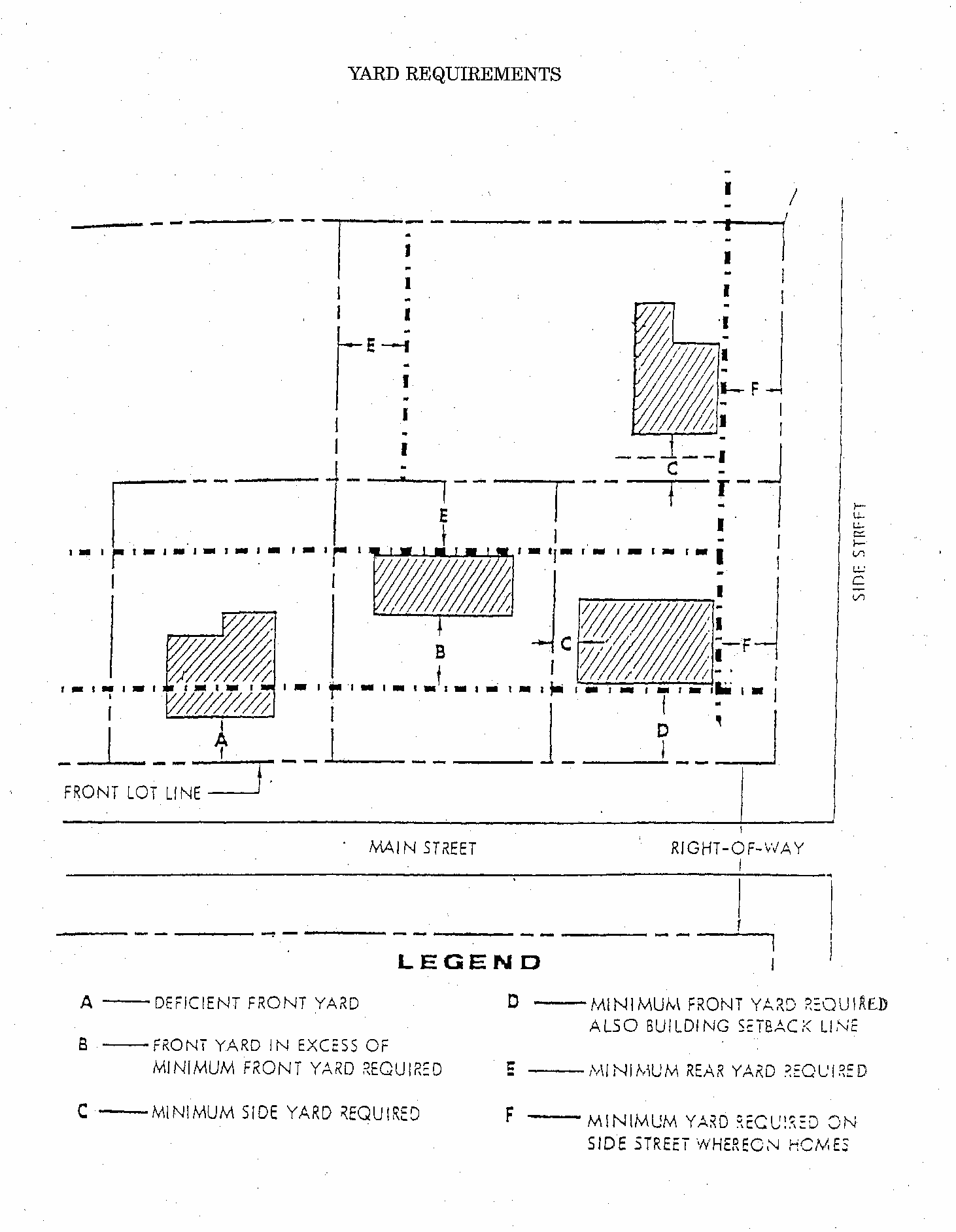
Yard, Required Side-Rear-Front: An open space of prescribed width or depth, adjacent to a lot or property line, on the same land with a building or group of buildings, which open space lies in the area between the building or group of buildings and the nearest lot line and is unoccupied and unobstructed from the ground upward, except as otherwise provided herein. This regulation shall not exclude eaves provided that an eight foot height clearance is provided above the adjacent ground level. (See illustration entitled "Yard Requirements".)
(a)
Front: An open space extending the full width of a lot and of a depth measured horizontally at right angles to the front property line, lot line, or right-of-way.
(b)
Rear: An open space extending the full width of a lot and of a depth measured horizontally at right angles to the rear property line, lot line, or right-of-way, except as otherwise provided in this Ordinance.
(c)
Side: An open space extending on each side of the lot from the required front yard to the required rear yard, and of a width measured horizontally at right angles to the respective side property line, lot line, or right-of-way.
Zoning Administrator: This term shall refer to the Zoning Administrator of the Village of Blissfield, or his or her authorized representative.
(Amended: 2-26-01; 4-22-02; 11-25-02; 9-28-09)

