
Boonville City Zoning Code
PART 7
- ACCESSORY USES AND BUILDINGS
Section 7.1.- Terms Relating to Accessory Buildings and Uses are Defined.
(a)
Accessory use means a use subordinate to and incidental to the primary actual use of the main building or to the primary actual use of the premises.
(b)
Accessory building is a part of the main building, or a separate building, located on the same lot with the main building, devoted to an accessory use.
(c)
A private garage is an accessory building housing vehicles owned and used by occupants of the main building. Where vehicles are used or housed by persons other than occupants, the building is a storage garage. Neither a private garage nor a storage garage may house more than one commercial vehicle.
(d)
A home occupation is an accessory use; it is an activity carried on only by a resident member of a family meeting these conditions: Only one non-illuminated sign no larger than two square feet in an area is used, which sign is attached to the building; nothing is done to make the building or premises appear in any way as anything but a dwelling; only one person is employed from outside the resident family; mechanical equipment used does not constitute a nuisance.
(e)
A sign is any outdoor advertising that is a structure or that is attached to, placed or painted on a building or that is leaned against the structure or displayed on any part of a premises. Detached sign (ground pole sign) is any sign supported by uprights or braces in or upon the ground surface.
(f)
An antenna dish or disk is an accessory component; it is any circular or similar dish shaped receiving antenna used for receiving television signals from a satellite.
(Ord. No. 2746, § 1, 8-5-85; Ord. No. 2766, § 2, 2-3-86; Ord. No. 3437, § 1, 9-15-97)
Section 7.2. - The following Accessory Uses are Permitted.
(a)
In the R-A, R-1 and R-2 Districts:
Private garages.
Home occupations.
Vegetable and flower gardens.
Tennis courts, swimming pools, garden houses, pergolas, ornamental gates, barbecue
ovens, fireplaces and similar uses customarily accessory to residential uses.
Keeping of small animals commonly housed in a dwelling but not on a commercial basis or on a scale reasonably objectionable to adjacent property owners; provided, however, that this shall not affect farms of more than three acres where animals are housed in structures located more than 50 feet from property lines.
Storage of wood, lumber and other materials where the land occupied by such storage is confined to one location with a maximum area of 100 square feet.
Antenna dish or disk.
(b)
In the R-3 Districts there may also be:
Storage garages.
Antenna dish or disk.
(c)
In the C-1 Districts there may also be:
Parking lots.
A use of not to exceed 40 per cent of the floor area for incidental storage or light
industrial activity.
Antenna dish or disk.
(d)
In the C-2 and M-1 Districts there may be any accessory use.
(e)
Temporary buildings for construction purposes are permitted in any district as accessory buildings during the course of construction.
(f)
Accessory buildings may not be used for dwelling purposes.
(g)
In the RGD-1 District there may also be parking lots, antenna dish or disk and other accessories as approved in the site plan.
(Ord. No. 2766, § 3, 2-3-86; Ord. No. 3295, § 8, 3-4-96)
Section 7.3. - The following regulations regarding signs shall be observed.
(a)
Churches, public and semipublic buildings, hospital and institutions in R Districts may have one bulletin board not more than 50 square feet in area.
(b)
Only those signs permitted in (a), temporary signs not more than ten square feet in area pertaining to lease or sale of premises and nameplates when nonilluminated and not greater in area than two square feet are allowed in an R District; provided that a nameplate of four square feet is allowed in an R-3 District.
(c)
Ground pole signs. Each establishment may be allowed one on-premises ground pole sign, provided a minimum of 50 feet of street frontage is available. Establishments may be allowed an additional on-premises ground pole sign, provided both signs are located a minimum of 120 feet from one another along the street frontage of the tract of land. Establishments in M-1 Districts may be allowed a third pole sign, provided all signs are located a minimum of 120 feet from one another along the street frontage of the tract of land.
No part of the ground pole sign structure or its advertising content shall be placed or extend into any street, street right-of-way or private property other than the property owned by the establishment.
Surface area of the sign shall be in proportion to the setback of the sign from the center of the traveled portion, including parking area of the nearest public roadway.
In the C-1 and M-1 Districts, four square feet in sign surface area shall be allowed per foot of setback distance (Area = 4 × setback distance). In the C-2 District, two square feet in sign surface shall be allowed per foot of setback distance (Area = 2 × setback distance). The height of such sign shall be in proportion to the setback of the sign from the center of the traveled portion, including parking area of the nearest roadway. In the C-1, C-2 and M-1 Districts for every foot setback from the center of the traveled portion, including parking area of the nearest public roadway, one foot in sign height shall be allowed. Height = 1 × setback distance with a maximum height of 60 feet being allowed height being measured from the ground to the top of the sign. The height of the advertising content shall be at least seven feet above the ground.
(d)
A detached sign may be permitted on land immediately adjacent to and along the right-of-way of federal interstate freeways of the United States highways, excluding designated business routes, provided that such detached signs shall be a minimum height of 60 feet and a maximum size of 800 square feet, provided that no point on such signs shall be farther than 1,320 feet back from the right-of-way of said federal interstate freeways and United States highways, provided that no detached sign along such freeways or highways shall be erected closer than 200 feet from an existing residential structure, and provided that such detached signs shall be erected so as to be viewed from said federal interstate freeways and United States highways. There will be a limitation under this subparagraph of one sign per business location, however, this limitation should not be construed to limit other signs allowed under subparagraphs of this section.
(Ord. No. 2747, § 1, 8-5-85; Ord. No. 2785, § 1, 6-5-86; Ord. No. 2938, § 1, 9-5-89; Ord. No. 2944, § 1, 11-6-89)
Section 7.3-1. - Purpose and scope.
The purpose of this section is to regulate all exterior signs erected or installed, after the effective date of this ordinance so as to protect the property values as well as the character of the various zoning districts in the city, to protect health, safety and morals and to promote the public welfare. It is the intention of this article to regulate the design, construction, location and maintenance of all signs, both for appearance and safety and to provide for the removal of unsafe and unsightly and unlawful signs.
(Ord. No. 3313, § 1(Exh. A), 5-20-96)
Section 7.3-2. - Definitions.
Advertising sign: Any sign that advertises, promotes or gives information on products, events, or businesses not conducted within the premises or location upon which the sign is located.
Applicant: Any individual, corporation, association, firm, partnership and the like, singular or plural.
Approved combustible material: Wood, or materials not more combustible than wood, and approved combustible plastics.
Approved combustible plastics: Those plastics which, when tested in accordance with American Society for Testing Materials standard methods for test for flammability of plastics over 0.050 inch in thickness (D635-44), burn no faster than two and five tenths inches per minute in sheets of 0.060 inch thickness.
Area: The entire area within a continuous perimeter, enclosing the extreme limits of sign display, including any frame or border. Curved, spherical, or any other shaped sign face shall be computed on the basis of actual surface area. The computation for signs composed of individual letters, numerals, or other devices shall be the sum of the area of the smallest rectangle or other geometric figure encompassing each of said letter or devices. The calculation for a double-faced sign shall be the area of one face only. Double-faced signs shall be so constructed that the perimeter of both faces coincide and are parallel and not more than 24 inches apart.
Attention-attracting devices: Any flasher, blinker, animation, banner, clock or other object designed or intended to attract the attention of the public to an establishment or sign.
Awning: A shelter projecting from and supported by the exterior wall of a building constructed of nonrigid materials on a supporting framework.
Billboards: Same as advertising sign.
Building sign: Any sign attached to or projecting from a building, at a 90 degree angle, and is made an integral part of the building.
Changeable copy sign: Any panel which is characterized by changeable copy illuminated or unilluminated regardless of method of attachment. Changeable copy signs shall be permitted in accordance with the requirements for the same type primary sign.
Code enforcement officer: The city inspector, or his agent, of the City of Boonville is charged with the administration and enforcement of the sign ordinance.
Combination sign: Any sign which combines the characteristics of two or more types of signs. Combination signs shall conform to all requirements for all types of signs comprising the combination sign.
Detached sign type "A": Any free-standing sign which has a clearance of less than ten feet.
Detached sign type "B": Any free-standing sign which has a clearance of ten or more feet.
Detached sign type "C": A monument type identification sign which rises from the ground, is either illuminated or unilluminated, and generally has no clearance under it.
Electrical sign: Any sign which has characters, letters, figures, designs, faces, backgrounds of outlines illuminated by incandescent, neon or fluorescent lamps or luminous parts of the sign proper, these light sources being either external or internal, or any sign which uses electrical/mechanical equipment or devices in its operation.
Erect: To build, construct, attach, hand, place, suspend, or affix and shall also include the painting of signs on the exterior of a building or structure.
Facade: The front or main face of any building or structure on which the street or frontage road which has been established as a permanent address as listed in the city directory.
Free-standing sign: Any sign supported by uprights, braces, poles or other vertical members in or upon the ground and not attached to a building.
Highway signs: Same as advertising signs.
Identification sign: A sign giving the name and address of a building, business, development or establishment. Such signs may be wholly or partly devoted to a readily recognized symbol.
Illuminated sign:
(a)
Semi-illuminated sign. Any sign which is uniformly illuminated internally over its entire area, including the area of the sign, by use of electricity or other artificial light.
(b)
Indirectly illuminated sign. Any sign which is partially or completely illuminated at any time by an external light source which is so shielded as to not be visible at eye level.
(c)
Fully illuminated sign. Any sign which is illuminated by an external or internal light source which is visible.
Letter display: Individual letters mounted on a facade or parapet wall.
Location: A lot, premise, building, wall, property, or any place whatsoever, upon which a sign is located.
Mansard roof: A roof which appears to be a part of the facade (wall), usually constructed for appearance only.
Marquee or canopy: A covering structure projecting from and attached to a building, or self supporting.
Nonilluminated sign: Any sign which is lighted by natural sunlight only.
Painted wall sign: A sign which is painted directly on a building or structure. Painted wall signs will be permitted subject to the same restrictions as wall signs.
Permanent sign: A sign constructed to remain indefinitely.
Portable sign: A sign which is not permanently affixed to one location and has the capability of being moved from one site to the next without disassembly.
Roof level: Where the eaves of the roof connect to the top of the wall, except where a mansard roof is used. Mansard roof level shall be the uppermost elevation of the roof.
Roof line: That part of the roof or parapet which covers the major area of the building.
Roof sign: A sign any part of which extends above the high point of a roof or parapet wall of a building and which is wholly or partially supported by the building.
Sign: The term sign shall mean and include every sign, name, number, identification, description, announcement, declaration, demonstration, device, display, flag banner, pennant, illustration, beacon, light, or insignia and structure supporting any of the same, affixed directly or indirectly to or upon any building or outdoor structure, or erected or maintained upon a piece of land and which directs attention to an object, product, service, place, activity, person, institution, organization or business.
Structure: The supports, uprights, bracing and framework for the sign, including foundations where applicable.
Subdivision amenity sign: A sign directing traffic to amenities such as a clubhouse or swimming pool within the subdivision.
Subdivision entrance marker: A sign identifying the subdivision, located at one or more of the subdivision entrances.
Temporary sign: A sign of noncombustible or combustible materials, with or without a frame, which is usually attached to the outside of a building on a wall or store front, fence, tree, utility pole, or temporary structure, for a limited period of time; or a sign which is not permanently attached to the ground, building or other load-bearing structure. Temporary signs are intended to be displayed for a short period of time not to exceed 30 days.
Wall sign: A sign attached to or erected against an exterior wall of a building or structure, which projects not more than 12 inches from a wall and presents only one face of advertising copy to the public.
(Ord. No. 3313, § 1(Exh. A), 5-20-96)
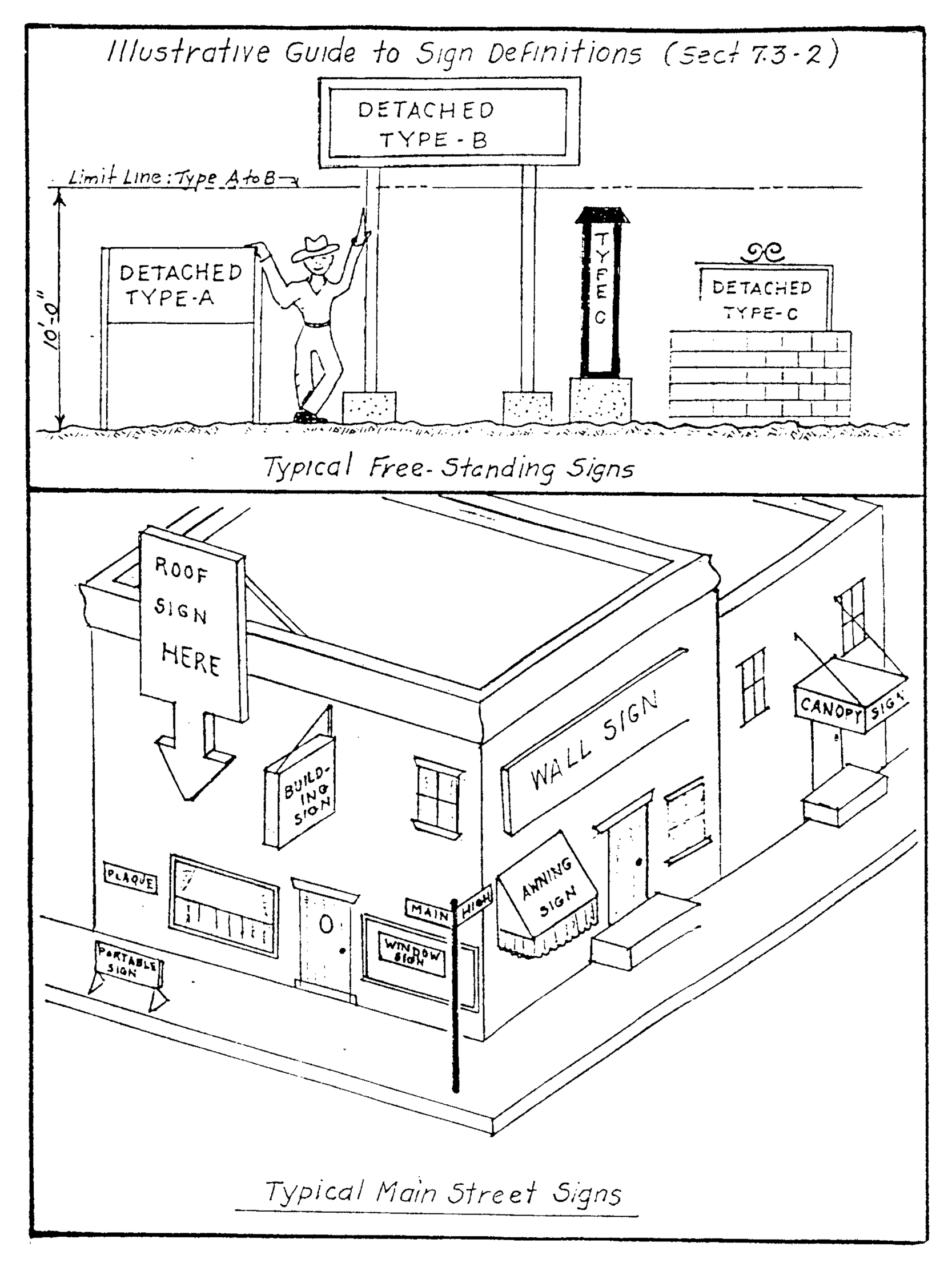
Section 7.3-3. - Responsibility for violation.
The applicant, the owner of the sign, the owner of the land or structure, and the person in charge of erecting the sign or structure are all subject to the provisions of this article and therefore subject to the penalty hereinafter provided.
(Ord. No. 3313, § 1(Exh. A), 5-20-96)
Section 7.3-4. - Penalty for violation.
Any applicant, person, firm, corporation or other entity violating the provisions of this chapter shall be guilty of a misdemeanor and upon conviction thereof shall be subject to a fine of not less than $25.00 nor more than $100.00. Each day such violation is committed or permitted to continue shall constitute a separate offense and shall be punishable as such hereunder.
(Ord. No. 3313, § 1(Exh. A), 5-20-96)
Section 7.3-11. - Permit required.
Except as otherwise provided in this chapter, no sign shall hereafter be erected, construed, or altered except as provided by this chapter, and until a permit for same has been issued by the building inspector.
(Ord. No. 3313, § 1(Exh. A), 5-20-96)
Section 7.3-12. - Application for sign permit.
Application for permits shall be made on forms as provided by the City of Boonville. The permit application shall be signed by the applicant and when the applicant is any person other than the owner of the property, the permit application shall also be signed by the owner of the property, or his agent or lessee and shall contain the location of the sign structure, the name and address of the sign owner and of the sign erector, drawings showing the design, dimensions and locations of the sign and such other pertinent information as the building inspector may require to ensure compliance with this ordinance. For all permanent Detached Type B, building, roof or marquee signs, the drawings of sign, and its system of support shall be certified by an engineer registered in the State of Missouri.
All illuminated signs shall bear the Underwriters Laboratories label or be built to comply with Underwriters requirements. If, upon application, it shall appear that the proposed structure is in compliance with all the requirements of this article, the building code and all other laws and ordinances of the City of Boonville, the building inspector shall then issue the permit. If the work authorized under the permit has not been completed within 120 days after date of issuance, the permit shall become null and void. A permit may be renewed by the building inspector and no additional fee shall be collected for the renewal. In the event the building inspector denies the application, the reasons for denial shall be forwarded to the applicant in written form, and signed by the building inspector.
(Ord. No. 3313, § 1(Exh. A), 5-20-96)
Section 7.3-13. - Permit fees.
Every applicant, before being granted a permit hereunder, shall pay a building permit fee to the City of Boonville, Missouri. Any changes made to the sign other than maintenance, shall require a new building permit. The fee shall be based on the area of one face of the sign as expressed in square feet at a fee rate of $35.00 up to 50 square feet and $0.10 thereafter. The minimum permit fee for any sign shall be $35.00. The area of the sign shall be calculated from the geometry of the extreme limits of one face as defined in section 7.3-2.
(Ord. No. 3313, § 1(Exh. A), 5-20-96)
Section 7.3-14. - Exemptions.
A permit will not be required for the following listed signs. These exemptions, however, shall apply only to the requirement of the permit and shall not be construed as relieving the owner of the sign from the responsibility for its erection, maintenance, appearance, and removal.
(1)
Construction project signs:
(a)
Maximum size 32 square feet per face.
(b)
One per street frontage.
(c)
To be removed at completion of construction.
(d)
To be located on premises.
(2)
Commercial and industrial structure "for sale" or "for rent" signs:
(a)
Maximum size 32 square feet per face.
(b)
One per street frontage.
(c)
To be removed within ten days after sale or letting.
(d)
To be located on premises.
(3)
Residential, commercial and industrial acreage "for sale" or "for rent" signs.
(a)
Maximum size 32 square feet per face.
(b)
One per street frontage.
(c)
To be removed within ten days after sale or letting.
(d)
To be located on premises.
(4)
Residential structure "for sale" or "for rent" signs.
(a)
Maximum size six square feet per face.
(b)
One per street frontage.
(c)
To be removed within ten days after sale or letting.
(d)
To be located on premises, except providing that no more than three direction signs on three different lots off premises shall be allowed.
(5)
Political signs:
(a)
Maximum size six square feet in face area in residential districts:
(b)
Maximum size 32 square feet in face area in commercial and industrial areas.
(c)
Shall be placed back of the property line on private property.
(d)
It shall be the responsibility of the property owner to have these signs removed not later than seven days after the election or event and they shall not be erected earlier than 60 days prior to the election or event to which they pertain.
(e)
There shall be no political signs on any public utility pole.
(6)
Traffic or other municipal signs or informational signs: Legal notice, railroad crossing signs, danger, warning and such temporary, emergency or nonadvertising signs necessary for traffic control or as may be approved by the city council.
(7)
Memorial signs or tablets: Names of buildings, and date of erection when cut into any masonry surface or when constructed of bronze or other metal.
(8)
Temporary signs inside buildings: Inside windows, or painted on windows or on glass portions or doors of buildings for the advertisement of a particular item, event, or sale.
(9)
Temporary signs: For public, charitable, religious, or fraternal organizations including banners and cloth signs:
(a)
Maximum size 32 square feet per face.
(b)
One per street frontage.
(c)
To be located on premises or off premises.
(d)
To be placed no sooner than 45 days prior to the event and to be removed within ten days following the event.
(10)
Occupational signs or other signs: Denoting only the name and profession of an occupant in a commercial building, public institutional building, or a residence and not exceeding two square feet in area.
(11)
Flags, emblems, or insignia of any governmental body, decorative displays: For holidays, or public demonstrations, which do not contain advertising and are not used as such.
(12)
Church or school signs: One illuminated or nonilluminated sign per church or school, on church or school premises, indicating activities and services therein provided and not exceeding 32 square feet per side.
(13)
Residential development signs: Residential developments shall be permitted two detached signs type "C", identifying the name of the development only for each entrance of the development. Such sign shall not exceed 32 square feet in area. Said sign shall be maintained on private property, no closer than ten feet to the property line.
(14)
Small direction type signs: Small signs, not exceeding three square feet in area, displayed on private property for the convenience of the public, including signs to identify entrance and exit drives, parking areas, one-way drives, restrooms, freight entrances, and other similar signs.
(15)
Scoreboards: Scoreboards in athletic stadiums.
(16)
Incidental sign: A small sign, emblem, or decal, placed within the establishment, informing the public of goods, facilities, or services available on the premises, e.g., a credit card sign or a sign indicating hours of business.
(17)
Plaques: Plaques or signs denoting historical landmarks or points of interest as may be recommended BHPAC.
(Ord. No. 3313, § 1(Exh. A), 5-20-96; Ord. No. 3933, § 1, 6-7-04)
Section 7.3-15. - Revocation of permits.
The building inspector is hereby authorized and empowered to revoke any permit issued by him upon failure of the holder thereof to comply with the provisions of this subpart or any amendment hereto.
(Ord. No. 3313, § 1(Exh. A), 5-20-96)
Section 7.3-21. - Signs allowed.
The following sign standards by zoning districts shall apply in the City of Boonville. The districts are as defined by the zoning ordinance and official zoning map. Historic areas and landmarks are as designated by BHPAC. Only signs as described herein and as may be described under section 7.3-14 shall be permitted.
(a)
Churches, public and semipublic buildings, hospitals and institutions in R Districts may have one bulletin board not more than 32 square feet in area.
(b)
Only those signs permitted in (a), temporary signs not more than six square feet in area pertaining to lease or sale of premises and nameplates when nonilluminated and not greater in area than four square feet are allowed in an R District.
(c)
Detached signs. Each establishment may be allowed one on-premises sign, provided a minimum of 50 feet of street frontage is available. Establishments may be allowed an additional on-premises detached sign, provided both signs are located a minimum of 120 feet from one another along the street frontage of the tract of land. Establishments in M-1 Districts may be allowed a third detached sign, provided all signs are located a minimum of 120 feet from one another along the street frontage of the tract of land.
No part of the detached sign structure or its advertising content shall be placed or extend into any street, street right-of-way or private property other than the property owned by the establishment.
Surface area of the sign shall be in proportion to the setback of the sign from the center of the traveled portion, including parking area of the nearest public roadway.
In the C-2 and M-1 Districts, four square feet in sign surface area shall be allowed per foot of setback distance (Area = 4 × setback distance). In the C-1 District, two square feet in sign surface shall be allowed per foot of setback distance (Area = 2 × setback distance). The height of such sign shall be in proportion to the setback of the sign from the center of the traveled portion, including the parking area of the nearest roadway. In the C-1, C-2 and M-1 Districts for every foot setback from the center of the traveled portion, including parking area of the nearest public roadway, one foot in sign height shall be allowed. Height = 1 × setback distance with a maximum height of 60 feet being allowed, height being measured from the ground to the top of the sign. The height of the advertising content shall be at least seven feet above the ground.
(d)
A detached sign may be permitted on land immediately adjacent to and along the right-of-way of federal interstate freeways and United States highways, excluding designated business routes, provided that such detached signs shall be a maximum height of 60 feet and a maximum size of 800 square feet, provided that no point on such signs shall be farther than 1,320 feet back from the right-of-way of said federal interstate freeways and United States highways, provided that no detached sign along such freeways or highways shall be erected closer than 200 feet from an existing residential structure, and provided that such detached signs shall be erected so as to be viewed from said federal interstate freeways and United States highways. There will be a limitation under this subparagraph of one sign per business location; however, this limitation should not be construed to limit other signs allowed under subparagraphs of this section.
All signs within the limits of the City of Boonville which are adjacent to federal and state highways will be subject to the pertinent regulations of the governing jurisdiction. In addition, signs in the glide path of Boonville Municipal Airport will be subject to regulations of the F.A.A.
(Ord. No. 3313, § 1(Exh. A), 5-20-96)
Section 7.3-22. - Billboard or advertising signs.
(1)
Advertising signs shall be permitted only along interstate highways and highways in Missouri's primary highway system; however, only in areas zoned C-1, C-2 or M-1.
(2)
In no case shall advertising signs be erected at a spacing which is closer than 500 feet apart, per roadway side, and all advertising signs must comply with the Missouri Highway Department's setback and other regulations.
(Ord. No. 3313, § 1(Exh. A), 5-20-96)
Section 7.3-23. - Nonconforming existing signs.
Signs that were erected before the adoption of this chapter may continue to exist and be maintained in a safe manner; however, such nonconforming signs may not be replaced, expanded, enlarged, or modified to denote the change in the type of business or a change in ownership or substantially improved other than in compliance with these regulations.
(Ord. No. 3313, § 1(Exh. A), 5-20-96)
Section 7.3-24. - Variances.
In obtaining a sign permit, the applicant may apply to the Planning and Zoning Commission for a variance from the specific requirements of this Code. A variance may be granted by the Planning and Zoning Commission, where the literal application of the code would create a particular hardship for the sign user and the following criteria are met:
(a)
The granting of the requested variance would not be materially detrimental to the property owners in the vicinity.
(b)
The hardship caused to the sign user under a literal interpretation of the code is due to conditions unique to that property, does not apply generally to other properties in the city, and is not based solely upon economic hardship.
(c)
The granting of the variance would not be contrary to the general objectives of this Code.
In granting a variance, the Planning and Zoning Commission may attach additional requirements necessary to carry out the spirit and purpose of this subpart in the public interest.
(Ord. No. 3313, § 1(Exh. A), 5-20-96)
Section 7.3-25. - Prohibited signs.
The following signs are prohibited [in all districts] and shall be removed in accordance with section 7.3-35, "Removal".
(1)
Signs containing any indecent, obscene, or immoral matter, as determined by the Planning and Zoning Commission.
(2)
Signs which are located on any public right-of-way, except that traffic or other nonadvertising signs as provided in paragraph 6, section 7.3-14, "Exemptions", shall be allowed rights-of-way.
(3)
Signs illuminated to an intensity to cause glare or brightness to a degree that could constitute a hazard or nuisance. Revolving, flashing, intermittently lighted or changing color signs shall be a minimum of five-second intervals. Beacons or similarly constructed signs shall not be allowed.
(4)
Illuminated signs erected within 150 feet of a residential district, unless lighting is shielded from view.
(5)
Signs which are of a size, location, movement, content, coloring or manner of illumination which may be confused with or construed as a traffic-control device or which hide from view any traffic, street signal or signal or which obstruct the view in any direction at a street or road intersection.
(6)
Signs which advertise an activity, business or service that is no longer conducted or advertises a product that is no longer produced shall be removed as provided for in section 7.3-35, "Removal", except where the owner or lessor of a premise is seeking a new tenant, such signs may remain in place for not more than 60 days from date of vacancy.
(7)
Any detached type B sign within 150 feet of a residentially zoned area or within 150 feet of an historic district.
(Ord. No. 3313, § 1(Exh. A), 5-20-96; Ord. No. 3838, § 1, 12-17-01)
Sections 7.3-26—7.3-30. - Reserved.
Note: These sections reserved for the new gaming zone (RGD-1).
Section 7.3-31. - Engineering design and materials.
A.
Design loads. The following provisions shall apply to design loads.
1.
Wind. The effect of special local wind pressures shall be thoroughly considered in the design; but the wind load shall not be assumed less than 30 pounds per square foot (psf) of net exposed area.
2.
Earthquake. Signs adequately designed to withstanding wind pressures shall generally be considered capable of withstanding earthquake shocks, and related forces as provided in Sections 718.0 and 719.0 of the BOCA Basic Building Code.
B.
Construction. All signs, including their supporting structure, foundation and methods of attachment, shall be designed and constructed in conformity to the provisions for materials, loads and stresses of Articles 7 and 8 of the BOCA Basic Building Code and the requirements of this ordinance.
1.
All permanent signs, sign structures, and nonstructural trim shall be constructed of approved combustible or noncombustible materials.
2.
Signs along all streets and boundaries shall not interfere with line of sight within 20 feet of the point of intersection of pavement of:
(a)
A vehicular accessway or driveway and a street.
(b)
A vehicular accessway or driveway and a sidewalk.
(c)
Two or more vehicular accessways or driveways.
No sign which obstructs sight lines at elevations between two feet and eight feet above roadways shall be located on any corner lot within the triangular area formed by the intersection of the roadway center lines, connecting them at points 70 feet from their point of intersection for roads of collector category or less and 120 feet for aerials.
3.
Obstruction of egress, openings, ventilation. A sign shall not be erected, constructed or maintained so as to obstruct any fire escape, window, door, or other opening; or so as to prevent free passage from one part of the roof to any other part thereof. A sign shall not be attached in any form, shape or manner to a fire escape, or shall not be so placed as to interfere with an opening which is required for legal ventilation. (Reference Articles 5 and 6 of BOCA Code)
4.
Letters, figures, characters or representations in cutout or irregular form which are maintained in conjunction with, attached to or superimposed upon any sign shall be safely and securely built or attached to the sign structure.
5.
Illuminated signs. Illuminated signs produced in quantity (other than signs custom-built for specific locations) shall be constructed in accordance with the "Standards for Electric Signs (U.L.48) of Underwriters Laboratories, Inc." and bear the label of the Underwriters Laboratories, Inc.
6.
Electrical signs. All electrical signs, either temporary or permanent, shall be connected to permanent electrical service installed according to the requirements of the National Electrical Code, 1990 Edition. All wiring for newly constructed detached signs shall be underground, unless this is determined to be prohibited by the Building Inspector.
(Ord. No. 3313, § 1(Exh. A), 5-20-96)
Section 7.3-32. - Inspection.
As soon as a sign has been erected, the permittee shall notify the Building Inspector, who shall inspect such sign and approve the same if it is in compliance with the provisions of this ordinance. Footing inspections may be required by the Building Inspector for all signs having footings.
Building Inspector may from time to time as he deems necessary, inspect all signs or other structures regulated by this chapter, for the purpose of ascertaining whether they are secure or whether they are in need of removal or repair. If the sign does not comply with the provisions of this subpart, the Building Inspector shall notify the applicant in writing of such noncompliance and give the applicant 30 days, or less if the Building Inspector determines a hazardous situation exists, to comply. All signs may be reinspected at the discretion of the Building Inspector.
(Ord. No. 3313, § 1(Exh. A), 5-20-96)
Section 7.3-33. - Maintenance.
Every sign or other advertising structure, together with all its supports or braces shall be kept in good repair. The sign location shall be free of rubbish and weeds. All structural members and all copy areas are to be kept painted and clean so as to prevent deterioration, oxidations, rust, paint fading, paint peeling or other unsightly conditions. After 30 days' notice in writing, the building inspector may order the removal of any sign that is not maintained in accordance with the provisions of this section.
(Ord. No. 3313, § 1(Exh. A), 5-20-96)
Section 7.3-34. - Abandoned signs.
Any sign, now or hereafter existing which no longer advertises a bona fide business conducted, or a product sold, shall be removed by the owner, agent or lessee having the beneficial use of the building, structure or land upon which such sign may be found. If the owner, agent or lessee fails to remove the sign, the building inspector shall remove it in accordance with section 7.3-35, "Removal". These removal provisions shall not apply where a succeeding owner, agent or lessee conducts the same type of business, or advertises a current product and agrees to maintain the signs as provided in this article, makes application for permit and pays the fee, as provided for section 7.3-13.
(Ord. No. 3313, § 1(Exh. A), 5-20-96)
Section 7.3-35. - Removal.
The Building Inspector shall order the removal of any sign erected in violation of this chapter, or any existing sign which has been abandoned, or where lack of maintenance has created a hazard to the public safety. Thirty days' notice, in writing, shall be given to the owner of such sign, or of the building, structure or premises on which the sign is located, to remove the sign or to bring it into compliance with this article. Upon failure to remove the sign or comply with this notice, the Building Inspector shall cause the removal of the sign. Any costs of removal incurred by the Building Inspector shall be assessed to the owner of the property on which sign is located and may be collected in the manner of ordinary debt or in the manner of taxes and such charge shall be a lien on the property. The Building Inspector shall refuse to pay costs so assessed. The Building Inspector may cause any sign which is an immediate peril to persons or property to be removed summarily without notice.
(Ord. No. 3313, § 1(Exh. A), 5-20-96)
Section 7.4. - Accessory buildings shall be located in accordance with the following rules.
(a)
Accessory buildings and garage apartments may be located in a rear yard but may not occupy more than 30 per cent of a rear yard.
(b)
Any accessory building closer than ten feet to a main building shall be considered as part of the main building and shall be provided with the side and rear yards required for the main building.
(c)
An accessory building more than ten feet from a main building may be erected within two feet of a side or rear lot line but must be located at least 60 feet from the front street line.
(d)
Where a garage is entered from an alley, it must be kept ten feet from the alley line.
(e)
On corner lots, the minimum buildable width of 28 feet for main buildings is reduced to 22 feet for accessory buildings.
Section 7.5. - Fences shall be located in accordance with the following rules.
(a)
No fence more than 30 per cent solid and no fence or planting more than three feet high may be located within 30 feet of a street intersection.
(b)
Except as provided in (a), fences less than four feet high may be located on any part of a lot.
(c)
Except as provided in (a), fences less than seven feet high may be erected on any part of a lot that is as far back or further back from the street than the main building.
Section 7.6. - Antenna dish or disk in R-A, R-1, R-2, R-3, C-1 and C-2 areas shall be located in accordance with the following rules.
(a)
No antenna dish or disk exceeding 24 inches in diameter may be located in the front yard or a side yard and can be located no closer than ten feet to the rear or side property lines.
(b)
The maximum number of antenna dishes or disks per residential lot is one.
(c)
The maximum diameter of antenna dish or disk is 13 feet in residential district.
(d)
All antenna dishes or disks in R-A, R-1, R-2 and R-3 areas over four feet in diameter shall be mounted at grade level, and no antenna dish in the preceding zones shall be mounted on a tower or other form of structural support.
(e)
This ordinance shall operate prospectively; it shall have no effect as to antenna dishes or disks presently located in the City of Boonville.
(Ord. No. 2766, § 1, 2-3-86; Ord. No. 3218, § 1, 2-20-95)
Section 7.7. - Telecommunications towers.
(a)
Purposes:
(1)
The general purpose of this section is to regulate the placement, construction and modification of telecommunications towers, support structures, and antennae in order to protect the health, safety and welfare of the public, while at the same time not unreasonably interfering with the development of the competitive wireless telecommunications marketplace in Boonville. Specifically, this Section is intended:
a.
To provide for the appropriate location and development of telecommunications facilities and systems to serve the citizens and businesses of the City of Boonville.
b.
To minimize adverse visual impacts of communications antennae and support structure through the careful design, siting, landscape screening and innovative camouflaging techniques;
c.
To maximize the use of existing and new support structures so as to minimize the need to construct new or additional facilities;
d.
To promote and encourage shared use of towers and antennae support structures as a primary option rather than construction of additional single-use towers;
e.
To ensure that any new telecommunications tower or structure is located in an area compatible with the neighborhood or surrounding community to the extent possible; and that hazards to the safety of the public and to adjacent property are eliminated or minimized.
f.
To ensure that regulation of telecommunications towers and structures does not have the effect of prohibiting the provision of personal wireless services, and does not unreasonably discriminate among functionally equivalent providers of such service.
g.
To eliminate the uncontrolled proliferation of towers in the City of Boonville which could diminish property values and spoil the aesthetic value of the city.
(b)
Legislative findings.
(1)
On February 9, 1996, Congress enacted the federal Telecommunications Act of 1996 P.L. No. 104-458. The purpose of the Act included deregulation of the telecommunications industry and providing a more competitive environment for wired and wireless telecommunication services in the United States.
(2)
The Telecommunications Act of 1996 preserves the authority of the City to regulate the placement, construction, and modification of towers and antennae support structures and to protect the health, safety and welfare of the public.
(3)
The City has been granted the authority to enact legislation to regulate the construction, placements, and operation of Telecommunications towers and antennae pursuant to its zoning powers established in Chapter 89 RSMo. And additionally pursuant to its general and specific police powers established by statute authorizing the regulations herein to protect the public health, safety and welfare.
(4)
The Federal Communications Commission (FCC) has exclusive jurisdiction over (1) regulation of the environmental effects of radio frequency emissions from telecommunications facilities, and (2) the regulation of radio signal interference among users of the radio frequency spectrum.
(5)
Consistent with the Telecommunications Act of 1996, the regulations of this section will not have the effect of prohibiting the provision of personal wireless services, and do not unreasonably discriminate among functionally equivalent providers of such service. The regulations also impose reasonable restrictions to protect the public safety and welfare and ensure opportunities for placement of antennae with prompt approval by the city. The section does not attempt to regulate in areas within the exclusive jurisdiction of the FCC.
(c)
Applicability.
(1)
All towers, antennae support structures and telecommunications facilities, any portion of which are located within the City of Boonville, are subject to this section. All towers within the City of Boonville, Missouri, at the time of passage of this section shall be registered with the City Administrator within 60 days from the effective date hereof together, with the height, width and location thereof. Failure to register an existing tower shall raise a presumption that said tower, was not a legal nonconforming use on the date of passage of this section.
(2)
Any current legal use being made of an existing tower or antennae support structure on the effective date of this section (herein "Non-conforming structures") shall be allowed to continue, even if in conflict with the terms of this section. Any tower site that has received City approval in the form of either a conditional use permit or building permit, but has not yet been constructed or located, shall be considered a Non-conforming structure so long as such approval is current and not expired.
(d)
Definitions.
(1)
As used in this section, the following terms shall have the meanings and usages indicated: The word "shall" is always mandatory and not merely directory. The word "may" is directory and discretionary and not mandatory.
Act means the Federal Communications Act of 1934 as amended by the Telecommunications Act of 1996 and as may, from time to time, be amended.
Alternative tower structure. This shall mean manmade trees, clock towers, bell steeples, grain silos, light poles and similar alternative design structures which camouflage or conceal the presence of antennae or communication towers, also commonly referred to as "stealth towers."
Antenna means any device that transmits and/or receives radio waves for voice, data or video communications purposes including, but not limit to, television, AM/FM radio, microwave, cellular telephone and similar forms of communications. The term shall exclude satellite earth station antennae less than two meters in diameter (mounted within 12 feet of the ground or building-mounted) and any receive-only home television antennae.
AGL means average ground level. Average ground level shall be determined by the average elevation of the natural ground level within a radius of 50 feet from the center location of measurement.
Applicant means any person that applies for a permit for a tower pursuant to this section.
Application means the process by which an applicant submits a request and indicates a desire to be granted a permit to construct, own or operate a tower within the City of Boonville. An application includes all written documentation, verbal statements and representations, in whatever form or forum, made by an applicant to the City concerning such a request.
Cabinet means a structure for the protection and security of communications equipment associated with one or more antennae where direct access to equipment is provided from the exterior and that has a horizontal dimensions that do not exceed four feet by six feet and vertical height that does not exceed six feet.
Camouflaged structure means a monopole in which the pole is hidden from view.
City means the City of Boonville, a municipal corporation, in the State of Missouri, acting by and through its City Administrator or his/her designee.
Code means the City of Boonville, Missouri, Code of General Ordinances.
Communications or telecommunications means the transmission, between or among points as specified by the user, or information of the user's choosing, without change in the form or content of the information as sent or received, by wire, radio, optical cable, electronic impulses, or other similar means. As used in this definition, "information" means knowledge or intelligence represented by any form of writing, signs, signals, pictures, sounds, or any other symbols.
Council means the Boonville, Missouri City Council.
Engineer means any engineer licensed by the State of Missouri.
FAA means the Federal Aviation Administration.
FCC means the Federal Communications Commission and any legally appointed, designated or elected agent or successor.
Guyed tower means a tower that is supported, in whole or in part, by guy wires and ground anchors.
Height means the vertical distance measured from AGL of the base of the structure to the highest point of the tower including attached antennae or other attachments.
Modification means any addition, alteration, deletion, or change, including the addition or replacement of antennae, or any change to a structure requiring a building permit or other governmental approval.
Monopole means a self supporting tower consisting of a single pole.
Owner/Operator means any person, as defined herein, who is permitted under this section to build, operate or maintain a tower in the City of Boonville.
Person means any natural person, firm, partnership, association, corporation, company, or other legal entity, private or public, whether for profit or not-for-profit.
Planning and Zoning Commission means the City of Boonville Planning and Zoning Commission.
Shelter means a building for the protection and security of communications equipment associated with one or more antennae and where access to equipment is gained from the interior of the building. Human occupancy for office or other uses or the storage of other materials and equipment not in direct support of the connected antennae is prohibited.
Telecommunications facilities mean any cables, wires, lines, wave guides, antennae and any other equipment or facilities associated with the transmission or reception of telecommunications as authorized by the FCC which a person seeks to locate or has installed upon a tower or antennae support structure. However, the term telecommunications facilities shall not include:
1.
Any satellite earth station antenna two meters in diameter or less which is located in an area zoned industrial or commercial;
2.
Any satellite earth station one meter or less in diameter, regardless of zoning category;
3.
Any satellite earth station in excess of two meter in diameter which is utilized for the reception of broadcast television, video or radio signals and which is an ancillary use to a structure on the holder of the broadcast license's premises.
Tower. A self-supporting lattice, guyed or monopole structure constructed from grade which supports telecommunications facilities. The term "tower" shall not include amateur radio operators' equipment, as licensed by the FCC. The term "tower" does not include utility poles which are utilized for the support of electrical, telephone, cable television, or other similar cables and wires, are located on public rights-of-way or easements for that purpose and are a part of a system of such poles throughout the City of Boonville, Missouri.
(e)
General requirements. The requirements sets forth in this section shall be applicable to all towers, antennae and other support structures installed, built or modified after the effective date of this section to the full extent permitted by law.
(1)
Zoning compliance: The construction of towers is prohibited in the following zoning districts: R-1, R-2, R-3 and those portions of C-1 and C-2 which lie in an area one block east of Main Street to one block west of Main Street and from Water Street south to Ashley Road. This prohibition may be waived for City, County, State, Federal or other political subdivision buildings lying within the above area.
(2)
Compliance with building codes and safety standards: Designed to ensure the structural integrity of antenna support structures, the applicant shall see that it is constructed and maintained in compliance with all standards contained in applicable state and local building codes and the applicable standards published by Electronics Industries Association. In addition to any other approvals required by this section, no antenna, tower, or support structure shall be erected prior to issuance of a building permit.
(3)
Regulatory compliance. All antennae and support structures shall meet or exceed current standards and regulations of the FAA, FCC and any other state or federal agency with the authority to regulate communications antennae and support structures. Should such standards or regulations be amended, then the owner/operator shall bring such devices and structure into compliance with the revised standards or regulation within the time period mandated by the controlling agency. No approval for any placement, construction or modification of any antenna or structure permitted by this section shall be granted for any applicant having an uncured violation of this section or any other governmental regulatory requirement related to such antenna or structures within the City.
(4)
Security: All antennae and support structures shall be protected from unauthorized access by appropriate security measures. A description of proposed security measures shall be provided as part of any application to install, build or modify antennae or support structures. Additional measures may be required as a condition of the issuance of a building permit or administrative permit as deemed necessary by the City Administrator or Planning and Zoning Commission in the case of a conditional use permit.
(5)
Lighting. Antennae and support structures shall not be lighted unless required by the FAA or other state or federal agency with authority to regulate, in which case a description of the required lighting scheme will be made a part of the application to install, build or modify the antenna or support structure. Equipment cabinets and shelters may have lighting only as approved by the City Administrator on the approved site development plan.
(6)
Advertising. Unless a disguised antenna support structure in the form of an otherwise lawfully permitted pylon sign, the placement of advertising on structures regulated by this section is prohibited.
(f)
Design criteria and siting requirements.
(1)
Towers shall maintain a galvanized steel finish or, subject to the requirement of the FAA or any applicable state or federal agency, be painted a neutral color consistent with the natural or built environment of the site.
(2)
Equipment shelters or cabinets shall have an exterior finish compatible with the natural or built environment of the site and shall also comply with any design guidelines as may be applicable to the particular zoning district in which the facility is located.
(3)
Towers shall not exceed the height limitation of 150 feet or the height limitation of any airport overlay zone as may be adopted by the city.
(4)
Antennae attached to a building or disguised antenna support structure shall be of a color identical to or closely compatible with the surface to which they are mounted.
(5)
All towers shall be set back from all yard lines at least one foot for each foot of height unless an easement is given by the adjoining property owner. Set back requirements for towers shall be measured from the base of the tower to the property line of the parcel on which it is located.
(6)
Ground anchors of all guyed towers, if permitted, shall be located on the same parcel as the tower and meet the setbacks of the applicable zoning district unless an easement is given by the adjoining property owner.
(7)
All towers shall be separated from all residential units by a minimum distance of 300 feet as measured from the center of the tower to the closest point of the residential unit. (Residential units include modular and mobile homes used for living purposes).
(8)
Fences with lockable gates must be constructed around or upon parcels containing towers or telecommunication facilities. Fencing shall be of such a size and style as to protect these facilities from trespass or unauthorized use of the property.
(9)
Any new tower in excess of 60 feet above AGL shall be constructed to twice the capacity of its primary use in order that secondary users might lease the balance of the tower capacity. The design of the tower compound shall maximize use of building materials, colors, textures, screening and landscaping that effectively blend the tower facilities within the surrounding natural setting and built environment.
(10)
Vehicle storage on any tower site is prohibited. Outdoor storage is prohibited except to the extent that the stored materials are used in the normal course of business and the stock is regularly rotated. Any outdoor storage shall be within the fenced confine of the tower and the stock must not encompass more than five per cent of the fenced area. On site parking for periodic service and maintenance is approved and should be provided.
(11)
All towers including their foundations and supports must be designed and certified by an engineer to be structurally sound and, at minimum, in conformance with the city's building code, any applicable state and federal laws, and other standards outlined in the Code. A building permit must be obtained before construction may begin.
(g)
Shared use.
(1)
Prior to the issuance of any permit to alter or modify any tower existing on the effective date of this section, the applicant shall provide to the city a written and notarized agreement committing to make said tower available for use by others subject to reasonable technical limitations and reasonable financial terms. The willful and knowing failure of a tower applicant to agree to shared use or to negotiate in good faith with potential users shall be cause for the withholding of future permits to the same applicant to install, build or modify antennae or towers within the city.
(2)
Prior to the issuance of any permit to install, build or modify any tower, the tower applicant shall furnish the City Administrator an inventory of all of that applicant's towers in or within one-half mile of the city limits of Boonville. The inventory shall include the tower's reference name or number, the street location, latitude and longitude, structure type, height, type and mounting height of existing antennae and an assessment of available ground space for the placement of additional equipment shelters.
(3)
Any new tower approved at a height of 60 feet or higher (above AGL) shall be designed and constructed to accommodate additional users. (Ref. 7.7(f)(9)). A written agreement committing to shared use as required by Section 7.7(g)(1) shall be submitted by the tower applicant. The willful and knowing failure of the applicant for a tower built for shared use to negotiate in good faith with potential users shall be cause for the withholding of future permits to the same applicant to install, build or modify antennae or towers within the City.
(4)
Any permittee whose tower heights in excess of 60 feet (above AGL) which is constructed after the effective date of this section and which has been built in accordance with setbacks and special conditions granted to towers with shared use capabilities under this article, and which contains additional capacity for installation or shared use of telecommunications facilities as demonstrated at the time the application for construction was granted, shall agree to allow another person to install or share telecommunications facilities on such a tower subject to reasonable terms and conditions negotiated between the parties including the suitability of the proposed tenant, the credit record and technical abilities of the proposed tenant. For the purpose of shared use of antennae, a legal non-conforming tower may be used. However, in no event shall a permittee be required to allow shared use of facilities if to do so would result in technical interference with the delivery of permittee's service. Failure to permit shared use on a tower which has been built in accordance with setbacks and special conditions permitted for towers designed for shared use may result in any enforcement action, as permitted in Section 7.7(i) or 7.7(p) following a hearing as permitted in Section 7.7(i) hereof.
(5)
Any person seeking shared use of a tower subject to this provision shall, after filing an application, negotiate with the owner/operator for such use. The owner/operator may on a legitimate and reasonable business basis choose between multiple requests for shared use on the same tower or structure, and may reject any request where legitimate technical obstacles cannot be reasonable overcome or where the person requesting shared use will not agree to reasonable financial terms. Any person believing that the owner/operator has breached its duty to negotiate in good faith for shared use shall immediately notify the owner/operator and the City Administrator in writing. The City Administrator may reject the application upon a finding that shared use has been improperly denied. A notice of breach of duty shall explain the precise basis for the claim and shall be accompanied by payment of an administrative review fee of $500.00 to the city to offset the cost of review. After the owner/operator's receipt of the notice, the owner/operator shall have ten calendar days to provide a written submission to the City Administrator responding to the alleged violation of the shared use requirement. If deemed necessary by the City Administrator, he/she may engage, at the cost of the person alleging the violation, a neutral, qualified technical consultant to provide an opinion on feasibility or costs of the shared use request.
(h)
Uses allowed without a permit.
(1)
The attachment of additional or replacement of antennae or shelters to any tower existing on the effective date of this section or subsequently approved in accordance with these regulations, provided that additional equipment shelters or cabinets are located within the existing tower compound area.
(2)
The mounting of antennae on any existing building or structure such as a water tower, provided that the presence of the antennae is concealed by architectural elements or satisfactorily camouflaged by painting them a color identical to the surface to which they are attached.
(3)
The installation of antennae or the construction of a tower or support structure on buildings or land owned by the City, following the approval of a lease agreement by the Council.
(i)
Authorization by administrative permit.
(1)
The placement as follows of antennae and towers are permitted in designated zoning districts only by administrative permit approved by the Planning and Zoning Commission and issued by the City Building Inspector.
a.
The attachment of additional or replacement antennae or shelters to any tower existing on the effective date of this section or subsequently approved in accordance with these regulations, but only when such addition or replacement requires the enlargement of the existing tower compound area as long as all other requirements of this section and the underlying zoning district are met.
b.
The one-time replacement of any tower existing on the effective date of this section or subsequently approved in accordance with these regulations so long as the purpose of the replacement is to accommodate shared use of the site or to eliminate a safety hazard. The new tower shall be of the same type as the original except that a guyed or self-supporting (lattice) tower may be replaced by a monopole. If the guyed or lattice tower to be replaced is 180 feet or less in height, it shall only be replaced with a monopole. The height of the new tower may exceed that of the original by not more than 20 feet. Subsequent replacements shall require the approval of a conditional use permit.
c.
Towers erected and maintained for a period not to exceed 30 days for the purpose of replacing an existing tower, testing an existing or proposed network, or special events requiring mobile towers.
(2)
Application procedures and requirements.
a.
Applications for administrative permit shall be made on the appropriate forms, to the City Administrator, accompanied by a fee of $200.00 with the following submittals:
b.
A detailed site plan, based on a closed boundary survey of the host parcel, shall be submitted indicating all existing and proposed improvements including buildings, drives, walkway, parking areas and other structures, public rights-of-way, the zoning categories of the subject and adjoining properties, the location of and distance to off-site residential structures, required setbacks, required buffer and landscape areas, hydrologic features, and the coordinates and heights above AGL of the existing or proposed tower.
c.
For antennae mounted on existing structures, a report by an engineer certified in the State of Missouri qualifying the integrity of the structure and its ability to support the antennae and any associated equipment.
d.
Diagrams showing the line of sight from the nearest public right-of-way and the antennae.
e.
A list of equipment and contents of equipment cabinets and/or storage buildings.
f.
A report describing the structure's ability to support shared uses.
g.
Any applicant for a new communication tower shall place a bond or other security with the City prior to any final approval for the purpose of removing any tower as required herein, and to compensate the City for performing proper maintenance of such tower to insure such towers do not become unsafe or otherwise fail to comply with the requirements of this Chapter. The bond or security shall be in the form approved by the City Administrator, and in the amount of $50,000.00, or such other amount as determined by the City Administrator to satisfy the requirements hereof with regard to the specific tower to which it would apply.
(3)
a.
The application shall be review by the City Building Inspector and Planning and Zoning Commission to determine compliance with the above standards and transmit the application for review and comment by other departments and public agencies as may be affected by the proposed facility.
b.
The City Administrator shall issue a decision on the permit within 45 days of the date of application or the application shall be deemed approved. The City Administrator may deny the application or approve the application as submitted or with such modifications as are, in his/her judgement, reasonably necessary to protect the safety or general welfare of the city citizens consistent with the purposes of this section. The City Administrator may consider the purposes of this section and the factors established herein for granting a conditional use permit as well as any other considerations consistent with this section. A decision to deny an application shall be made in writing, and state the specific reasons for the denial.
c.
Appeals. Any applicant who is denied a tower application, or who is determined by the City Administrator to be in violation of this section shall have the right to appeal the decision before the Planning and Zoning Commission. At the request of the applicant, an informal hearing shall be set on the agenda at the next regular Planning and Zoning Commission meeting following the denial of an application, or the determination of a violation and shall consider, in addition to a determination of whether or not a violation exists or the application was improperly denied, the question of the technical or economic feasibility of compliance with this section. In the event the Planning and Zoning Commission finds that an existing tower was constructed in accordance with setback and other provisions relating to towers designed for shared use, and said tower is not made available for shared use as indicated at the time of application, the Planning and Zoning Commission may suspend or revoke the permit. Final decisions of the Planning and Zoning Commission shall be subject to judicial review pursuant to Chapter 536, RSMo.
(j)
Conditional use permit required.
(1)
All proposals to install, build or modify an antenna or support structure not permitted by sections 7.7(h) or 7.7(i) above, shall require the approval of a conditional use permit following a duly advertised public hearing by the Planning and Zoning Commission.
a.
Applications for conditional use permits shall be filed and processed subject to and in the manner as established in Appendix "C" of the General Code of Ordinances. A decision by the Planning and Zoning Commission shall be accompanied by substantial evidence supporting the decision which shall be made a part of the written record of the meeting at which a final decision on the application is rendered. Evidence may be submitted with the application or thereafter or presented during the public hearing by the applicant or others.
(2)
Additional minimum requirements. No conditional use permit shall be issued unless the applicant has clearly demonstrated by substantive evidence that placement of an antenna or structure pursuant to Subsection 7.7(h) (Permitted Uses) or Subsection 7.7(i) (Administrative Permits) of this section is not technologically or economically feasible. The Planning and Zoning Commission may consider current or emerging industry standards and practices, among other information, in determining feasibility.
(3)
Findings required. In addition to the determinations or limitations specified herein for the consideration of conditional use permits, the Planning and Zoning Commission shall also base its decision upon, and shall make findings as to, the existence of the following conditions:
a.
No existing towers, structures or buildings within the necessary geographic area for the applicant's tower meet the applicant's necessary engineering requirements considering: (1) height; (2) structural strength; (3) resulting signal interference; (4) feasibility of retrofitting; (5) feasibility of redesigning the applicant's tower network; or (6) other limiting conditions that render existing towers, structures or buildings within the applicant's required geographic area unsuitable.
b.
That the design of the tower or structure, including the antenna, shelter and ground layout maximally reduces visual degradation and otherwise complies with provisions and intent of this section. New towers shall be of a monopole design, unless it is shown that an alternative design would equally or better satisfy this provision.
c.
That the proposal minimizes the number and/or size of towers or structures that will be required in the area.
d.
That the applicant has not previously failed to take advantage of reasonably available shared use opportunities or procedures provided by this section or otherwise.
(4)
If any one, but not more than one, of the first four determinations is not satisfied, approval may be granted only on finding of unique circumstances otherwise necessitating approval to satisfy the purposes of this section.
(5)
Additional Limitations. No tower shall be approved at a height exceeding 150 feet AGL unless the applicant clearly demonstrates that such height is required for the proper function of the applicant's system or that of a public safety communications system of a governmental entity sharing the tower. Such showing must also be supported by the opinion of a telecommunications consultant hired by the city at the expense of the applicant. The opinion of the consultant shall include a statement that no available alternatives exist to exceeding the height limit or the reason why such alternatives are not viable.
(k)
Permit compliance.
(1)
Inspections. By applying for a permit to install, build or modify an antenna or support structure, an applicant grants the city authority to enter onto its property to inspect the tower for the purpose of determining whether it complies with the applicable state law and all other construction standards provided by the code, federal and state law. The city reserves the right to conduct such inspection at any time.
(2)
Annual filing requirement. An applicant or owner/operator shall certify in writing that its tower is structurally sound and conforms to the requirements of the applicable state law and all other construction standards set forth by the City Code, federal and state law every year by filing by January 1st of every year following the date of the grant of its permit a sworn statement by the owner/operator or his representative to that effect. All applicants with permits or owner/operators of towers in existence on the effective date of this Ordinance shall submit a statement not later than 60 days from the effective date and by January 1st of every year thereafter that said tower is free from hazards and that the tower does not pose an imminent threat to the surrounding area or pubic health and safety. Together with this statement, every applicant or owner shall provide a certificate of liability insurance for no less than $300,000.00 coverage for injury to persons or property as a result of any tower failure or malfunction or defect. All applicants or owner/operators shall list the city as a party who must be notified should this insurance be cancelled or discontinued for any reason 30 days before the expiration of coverage.
(3)
Discontinuance of use. In the event the permitted use of a tower is discontinued by the applicant or owner/operator, written notice shall be provided to the City Administrator of applicant's or owner/operator's intent to discontinue use and the date when the use shall be discontinued.
(4)
Permit renewal fee. On or by January 1st of every year following the granting of an initial tower permit for a new or existing tower, each applicant or owner/operator shall submit an annual permit fee of $50.00, unless the applicant or owner/operator maintains a valid business license in the City of Boonville for the current year and year prior. In no event shall a permit be revoked or considered expired for failure to pay the annual renewal fee unless the applicant or owner/operator has received at least 30 days notice of the proposed action.
(l)
Revocation of permit.
(1)
The City may at any time revoke a tower permit for failure to comply with the provisions of this section. To properly revoke a tower permit, the City must comply with procedures set forth below:
a.
The City Administrator shall provide the applicant or owner/operator with a written notice of a cause for revocation and the intent to revoke and shall allow applicant 60 days subsequent to receipt of the notice in which to correct the violation or to provide adequate assurance of performance in compliance with this section. Together with the notice required herein, the city administrator shall provide the applicant or owner/operator with written findings of fact which are the basis of the revocation.
b.
The City shall provide the applicant or owner/operator with the right to a public hearing before the Council, which public hearing shall follow the 60-day notice required in Subsection 7.7(l)(1)a. All interested parties shall be allowed an opportunity to be heard at the public hearing and present evidence.
c.
After the public hearing, the Council shall, within 30 days after the public hearing date, issue a written order setting forth its findings of fact and conclusion of law forming the basis for its decision.
d.
Upon written determination by the Council to revoke a permit, the applicant or owner/operator may appeal the decision to a court of competent jurisdiction pursuant to Chapter 536 R.S.Mo.
e.
Upon satisfactory correction by applicant or owner/operator of the violation upon which said notice was given as determined in the Director's sole discretion, the initial notice shall become void.
f.
Upon applicant's or owner/operator's failure to correct a violation as found by the Council, the City Administrator or his/her designee may issue an order to disconnect utilities to said tower to any utility company providing same. Said order shall not be issued prior to 30 days from the date of the council's written determination. Said order shall be served upon the chief executive officer thereof, together with the applicant or owner/operator at the last know address, and have attached to it the findings of the Council.
(m)
Transfer of permit.
(1)
A tower permit may not be sold, transferred, leased or assigned to any other person.
(2)
Should a tower be sold, transferred, leased or assigned, the new owner, lessee or assignee shall apply for a new tower permit.
(3)
Notwithstanding the previous provisions of Subsection 7.7(m), a tower existing on the date of passage of this section shall not lose it grandfathered status.
(n)
Abandonment of tower.
(1)
In the event the use of any tower has been discontinued for a period of 1 year, or in the event that an applicant or owner/operator has taken no action within 180 days after the revocation of a tower permit pursuant to Subsection 7.7(l) such tower shall be deemed abandoned.
(2)
The City shall provide the tower owner three months notice and an opportunity to be heard before the Council before initiating such action. After such notice has been provided, the City shall have the authority to initiate proceedings to either acquire the tower and any appurtenances attached thereto at the then fair market value, to approve the sale of the tower to a third party or in the alternative, order the demolition of the tower and all appurtenances.
(3)
The City shall provide the tower owner with the right to a public hearing before the Council, which public hearing shall follow the three-month notice required in Subsection 7.7(n)(2). All interested parties shall be allowed an opportunity to be heard at the public hearing.
(4)
After a public hearing is held pursuant to Subsection 7.7(n)(3), the Planning and Zoning Commission may order the forfeiture to the City or demolition of the tower at the tower or property owner's expense. The Commission's final decision shall be subject to judicial review pursuant to Chapter 536, R.S.Mo.
(5)
Shall the tower owner, for any reason, fail to respond to an order of abatement or demolition, then the City may exercise it's rights under the terms and conditions of the owner's bond which was provided as per Subsection 7.7(i)(2).g or Chapter 13 of the Code.
(o)
Commercial operation of unlawful tower or antenna.
(1)
Notwithstanding any right that may exist for a governmental entity to operate or construct a tower or structure, it shall be unlawful for any person to erect or operate for any private commercial purpose any new antenna, tower or disguised support structure in violation of any provision of this section regardless of whether such antenna or structure is located on land owned by a governmental entity.
(p)
Penalty.
(1)
Any person violating this section shall be subject to a fine of not more than $500.00 or 90 days in jail or both, as provided under Section 1-9 of the Code. Each day the violation continues shall constitute a separate offense.
(q)
Miscellaneous.
(1)
Severability. In any section, subsection, sentence, clause, phrase or portion of this section is for any reason held invalid or unconstitutional by any court of competent jurisdiction, such portion shall be deemed a separate, distinct and independent provision and such holding shall not affect the validity of the remaining portions hereof.
(2)
Repeal of laws in conflict. This section supersedes all ordinances or parts of ordinances adopted prior hereto which are in conflict herewith, to the extent of such conflict.
(3)
Dangerous structures. Should the city have to take action under the Code provisions to remove a dangerous structure or abate a nuisance or health hazard, then a lien may be assessed in the same manner as for a building that is demolished or for the abatement of a nuisance, as set forth in Chapter 13 of the Code.
(Ord. No. 3734, § 1, 1-2-01)

