
Bourbonnais City Zoning Code
ARTICLE X
- ZONING DISTRICT STANDARDS
Sec. 36-10-1. - Residence districts.
(a)
Purpose. The residence districts set forth herein are established in order to protect public health and promote public safety, convenience, comfort, morals, prosperity and welfare. These general goals include, among others, the following:
(1)
To protect residential areas against fire, explosion, noxious fumes, offensive odors, noise, smoke, vibrations, dust, heat, glare and other objectionable factors;
(2)
To protect residential areas to the extent possible and appropriate in each area against unduly heavy motor vehicle traffic, especially through traffic, and to alleviate congestion by promoting off-street parking;
(3)
To protect residential areas against undue congestion of public streets and other public facilities by controlling the density of population through regulation of the bulk of buildings and structures;
(4)
To protect and promote the public health and comfort by providing for ample light and air to buildings and the windows thereof;
(5)
To promote public comfort and welfare by providing for usable open space on the same zoning lot with residential development;
(6)
To provide sufficient space in appropriate locations to meet the probable need for future residential expansion and to meet the need for necessary and desirable services in the vicinity of residences, in a manner that does not adversely impact those residential areas.
(7)
To promote the best use and development of residential land in accordance with a comprehensive land use plan, to promote stability of residential development, and protect the character and desirable development, and to protect the value of land and improvements and so strengthen the economic base of the village.
(b)
Permitted obstructions. The following obstructions shall be permitted in residence districts when located between the "building setback line" and the "property boundary line":
(1)
Terraces;
(2)
Awnings and canopies (except in R-6 district);
(3)
Chimneys, not projecting more than two feet;
(4)
Steps not over four feet in height;
(5)
Arbors and trellises;
(6)
Fences or walls (rear or side yards only and as regulated per article VII of this chapter);
(7)
Breezeways and open porches (rear yards only and except in R-6 district);
(8)
Driveways.
(c)
R-1 one-family residence district.
(1)
Purpose. The R-1 district encompasses the predominant areas of single-family housing in the village. It is established to accommodate larger lot, detached residential uses. Its intent is to preserve existing lower-density neighborhoods, and to ensure that new development is compatible with existing land uses, development patterns, and design character. The R-1 district also is intended to accommodate community facilities (like schools and parks) that, when properly located, enhance the village and residents' quality of life.
(2)
Permitted uses. Permitted uses in the R-1 district shall be as listed in the Zoning District Use Table (36-10-6).
(3)
Special uses. Special uses in the R-1 district shall be as listed in the Zoning District Use Table (36-10-6).
(4)
Parking requirements. R-1 district parking requirements shall be as listed article VIII of this chapter.
(5)
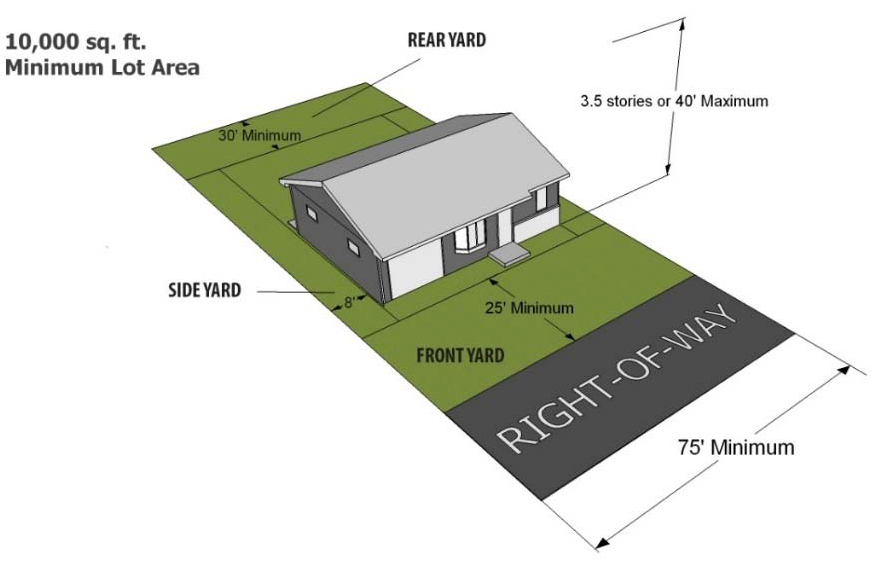
Bulk space and yard regulations. Bulk regulations in the R-1 district including regulations regarding lot area, lot width, yard areas, lot coverage, and building height shall be as listed in Table 10-1 and Figure 10-1.
(6)
Accessory structures. Accessory structures standards shall be as defined in article VII of this chapter.
Table 10-1
R-1 One-Family Residence District Standards
R-1 One-Family Residence District Bulk Regulations Illustration: Figure 10-1
(7)
Additional standards.
a.
Religious institution bulk standards. Within the R-1 district; "religious institutions" will have:
1.
A minimum lot requirement of 15,000 square feet,
2.
A minimum lot width at the front yard setback line of 80 feet,
3.
A maximum height for towers or steeples of 100 feet,
4.
A maximum height for the main structure of 70 feet.
5.
A side yard setback of not less than ten feet on each side of the main structure and a combined total of side yards not less than 25 feet shall be maintained on lots on which a religious institution is constructed or an addition to an existing religious institution is constructed.
b.
Lots and parcels not meeting size and width standards.
1.
When two or more parcels of land, each of which lacks adequate "lot area" or "lot width" to qualify for a permitted use under the requirements of the R-1 district, are contiguous and held in common ownership, they shall be used as one "zoning lot" for such use.
2.
Any single "lot" of land within the R-1 district that does not meet the requirements for minimum lot area and lot width at the time of the effective date of this chapter may be utilized for a permitted use, provided that the lot area and each yard setback are not less than 75 percent of the minimum required dimension.
c.
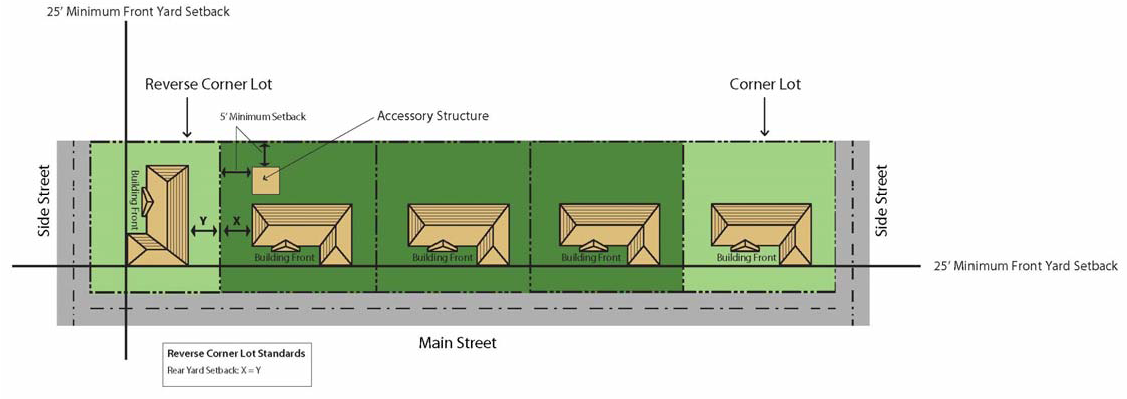
Corner lot standards. Corner lots will have a minimum front yard setback of 25 feet when the "building frontage" faces that yard. See Figure 10-2.
d.
Reverse corner lot standards. In the case of a "reverse corner lot": See Figure 10-2
1.
There shall be a setback from the "side street" of not less than 25 feet.
2.
No accessory building lot shall project beyond the front yard required of the adjacent lot to the rear.
3.
The rear yard setback shall not be less than the side yard setback requirement of the "adjacent" property or eight feet, whichever is greater.
e.
Standards for lots adjacent to reverse corner lots. No accessory structure on a lot adjacent to a "reverse corner lot" shall be located nearer than five feet to the side lot line adjacent to said lot, nor closer than five feet to the rear lot line.
Figure 10-2: Corner Lot and Reverse Corner Lot. R-1 Example
(d)
R-2 one-family residence district.
(1)
Purpose. The R-2 district is established to accommodate Single-Family residential uses on moderately sized lots. Its intent is to create and preserve Single-Family detached residential areas, which are commonly adjacent to and have similar overall character as R-1 zoned neighborhoods. New development in this district will be compatible with existing land uses, development patterns, and design character. The R-2 district also is intended to accommodate community facilities (like schools and parks) that, when properly located, enhance the Village and residents' quality of life.
(2)
Permitted uses. Permitted uses in the R-2 district shall be as listed in the Zoning District Use Table (36-10-6).
(3)
Special uses. Special uses in the R-2 district shall be as listed in the Zoning District Use Table (36-10-6).
(4)
Parking requirements. R-2 District parking requirements shall be as listed in article VIII of this chapter.
(5)
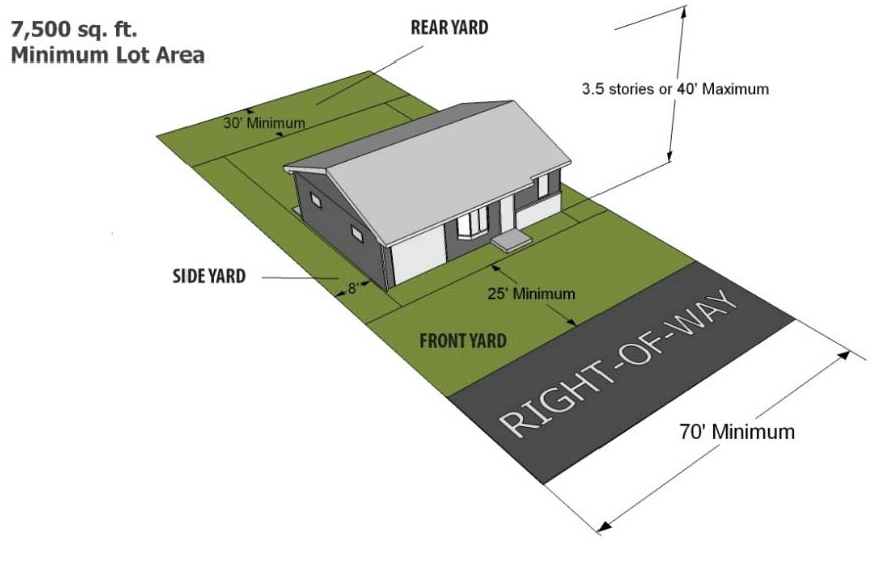
Bulk space and yard regulations. Bulk regulations in the R-2 district including regulations regarding lot area, lot width, yard areas, lot coverage, and building height shall be as listed in Table 10-2 and Figure 10-3.
(6)
Accessory structures. Accessory structures standards shall be as defined in article VII of this chapter.
Table 10-2
R-2 One-Family Residence District
R-2 One-Family Residence District Bulk Regulations Illustration: Figure 10-3
(7)
Additional standards.
a.
Religious institution bulk standards. Within the R-2 district; "religious institutions" will have:
1.
A minimum lot requirement of 15,000 square feet,
2.
A minimum lot width at the front yard setback line of 80 feet,
3.
Maximum height for towers or steeples of 100 feet,
4.
A maximum height for the main structure of 70 feet.
5.
A side yard setback of not less than ten feet on each side of the main structure and a combined total of side yards not less than 25 feet shall be maintained on lots on which a religious institution is constructed or an addition to an existing religious institution is constructed.
b.
Lots and parcels not meeting size and width standards.
1.
When two or more parcels of land, each of which lacks adequate "lot area" or "lot width" to qualify for a permitted use under the requirements of the R-2 district, are contiguous and held in common ownership, they shall be used as "one zoning" lot for such use.
2.
Any single "lot" of land within the R-2 district that does not meet the requirements for minimum lot area and lot width at the time of the effective date of this chapter may be utilized for a permitted use, provided that the lot area and each yard setback are not less than 75 percent of the minimum required dimension.
c.
Corner lot standards. Corner lots will have a minimum front yard setback of 25 feet when the "building frontage" faces that yard. See Figure 10-2.
d.
Reverse corner lot standards. In the case of a "reverse corner lot": See Figure 10-2
1.
There shall be a setback from the "side street" of not less than 25 feet.
2.
No accessory building lot shall project beyond the front yard required of the adjacent lot to the rear.
3.
The rear yard setback shall not be less than the side yard setback requirement of the "adjacent" property or eight feet, whichever is greater.
e.
Standards for lots adjacent to reverse corner lots. No accessory structure on a lot adjacent to a "reverse corner lot" shall be located nearer than 5' to the side lot line adjacent to said lot, nor closer than 5' to the rear lot line.
(e)
R-3 single-family estate residence district.
(1)
Purpose. The R-3 district is established to accommodate single-family residential uses on smaller sized lots than districts, and create and preserve single-family detached residential areas. New development in this district will be compatible with existing land uses, development patterns, and design character.
(2)
Permitted uses. Permitted uses in the R-3 district shall be as listed in the Zoning District Use Table (36-10-6).
(3)
Special uses. Special uses in the R-3 district shall be as listed in the Zoning District Use Table (36-10-6).
(4)
Parking requirements. R-3 district parking requirements shall be as listed article VIII of this chapter.
(5)
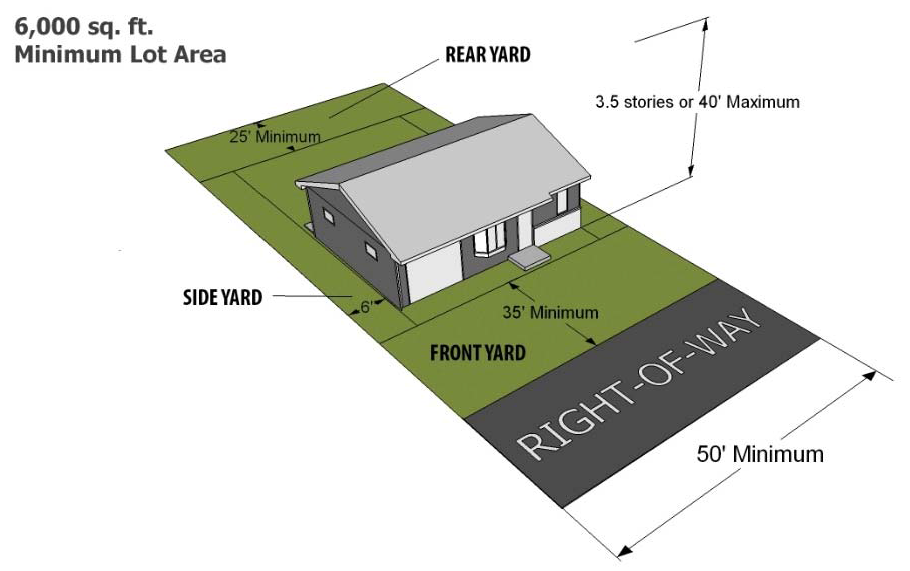
Bulk space and yard regulations. Bulk regulations in the R-3 district including regulations regarding lot area, lot width, yard areas, lot coverage, and building height shall be as listed in Table 10-3 and Figure 10-4.
(6)
Accessory structures. Accessory structures standards shall be as defined in Article VII of this chapter.
Table 10-3
R-3 Single-Family Estate Residence District
R-3 Single-Family Residence District Bulk Regulations Illustration: Figure 10-4
(7)
Additional standards.
a.
Corner lot standards. Corner lots will have a minimum front yard setback of 40 feet when the "building frontage" faces that yard. See Figure 10-2.
b.
Reverse corner lot standards. In the case of a "reverse corner lot": See Figure 10-2
1.
There shall be a setback from the "side street" of not less than 40 feet.
2.
The rear yard shall not be less than the side yard setback of the adjacent property or 25 feet, whichever is greater.
c.
Standards for lots adjacent to reverse corner lots. No accessory building on a lot adjacent to a "reverse corner lot" shall be located nearer than ten feet to the side lot line adjacent to said lot, nor closer than ten feet to the rear lot line.
(f)
R-4 two-family residence district.
(1)
Purpose. The R-4 district is established to accommodate two-family and limited single-family residential uses and to provide a variety of family-oriented housing in the village. The R-4 is typically located adjacent to single-family zoned neighborhoods, and R-4 development shall be designed to be well integrated into the overall character and transportation system of nearby residential areas.
(2)
Permitted uses. Permitted uses in the R-4 district shall be as listed in the Zoning District Use Table (36-10-6).
(3)
Special uses. Special uses in the R-4 district shall be as listed in the Zoning District Use Table (36-10-6).
(4)
Parking requirements. R-4 district parking requirements shall be as listed article VIII of this chapter.
(5)
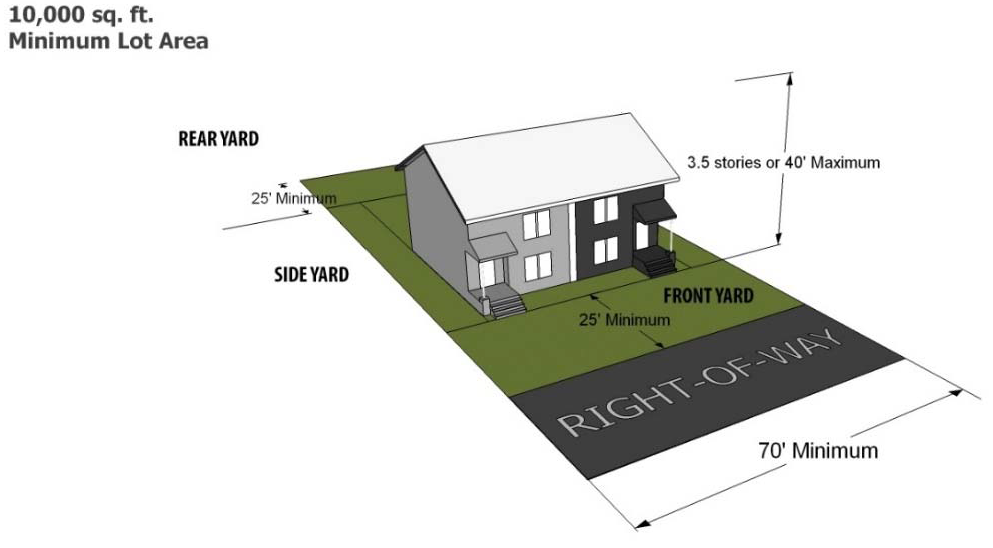
Bulk space and yard regulations. Bulk regulations in the R-4 district including regulations regarding lot area, lot width, yard areas, lot coverage, and building height shall be as listed in Table 10-4 and Figure 10-5.
(6)
Accessory structures. Accessory structures standards shall be as defined in article VII of this chapter.
Table 10-4
R-4 Two-Family Residence District
R-4 Two-Family Residence District Bulk Regulations Illustrations: Figure 10-5
(7)
Additional standards.
a.
Lots and parcels not meeting size and width standards.
1.
When two or more parcels of land, each of which lacks adequate "lot area" or "lot width" to qualify for a permitted use under the requirements of the R-4 district, are contiguous and held in common ownership, they shall be used as "one zoning" lot for such use.
2.
Any single "lot" of land within the R-4 district that does not meet the requirements for minimum lot area and lot width at the time of the effective date of this chapter may be utilized for a permitted use, provided that the lot area and each yard setback are not less than 75 percent of the minimum required dimension.
3.
Every two-family dwelling lot that has less width than required, and was recorded under separate ownership from adjoining lots prior to the adoption of the ordinance, may be occupied by a two-family dwelling. However, in no case shall the lot area per dwelling unit be less than 3,000 square feet.
b.
Corner lot standards. Corner lots will have a minimum front yard setback of 25 feet when the "building frontage" faces that yard. See Figure 10-2.
c.
Reverse corner lot standards. In the case of a "reverse corner lot": See Figure 10-2
1.
There shall be a setback from the "side street" of not less than 25 feet.
2.
The rear yard shall not be less than the side yard setback of the adjacent property or 8 feet, whichever is greater.
d.
Standards for lots adjacent to reverse corner lots. No accessory building on a lot adjacent to a "reverse corner lot" shall be located nearer than five feet to the side lot line adjacent to said lot, nor closer than five feet to the rear lot line.
e.
Converted dwelling. An existing one-family dwelling located on a lot of less area than required in this section may be converted to a two-family dwelling without increasing the lot size, provided that the building is not enlarged beyond its present outside dimensions and that all other regulations of this chapter are complied with. Additions may be made to a building being converted only when lot size and yard requirements of this section are complied with for such additions.
(g)
R-5 multiple-family residence district.
(1)
Purpose. The R-5 district is established to provide for multiple-family dwelling development, and to provide a range of housing options in the village. These districts typically are located closer to arterial or collector roads to facilitate easy access to the transportation system. These districts also may be adjacent to single- or two-family zoned neighborhoods. R-5 development shall be designed to be well integrated into the overall character and transportation system of nearby residential areas and the community in general.
(2)
Permitted uses. Permitted uses in the R-5 district shall be as listed in the Zoning District Use Table (36-10-6).
(3)
Special uses. Special uses in the R-5 District shall be as listed in the Zoning District Use Table (36-10-6).
(4)
Parking requirements. R-5 district parking requirements shall be as listed Article VIII of this chapter.
(5)
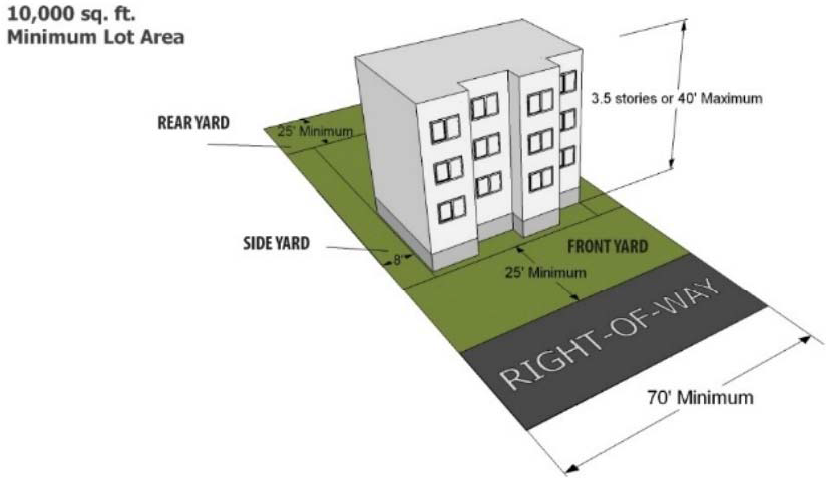
Bulk Space and Yard Regulations. Bulk regulations in the R-5 district including regulations regarding lot area, lot width, yard areas, lot coverage, and building height shall be as listed in Table 10-5 and Figure 10-6.
(6)
Accessory structures. Accessory structures standards shall be as defined in article VII of this chapter.
Table 10-5
R-5 Multiple-Family Residence District
R-5 Multiple-Family Residence District Bulk Regulations Illustration: Figure 10-6 Additional Standards
(7)
Additional standards.
a.
Side yards of multiple-family dwellings and apartments.
1.
On interior lots there shall be a side yard on each side of a main building of not less than eight feet on each side for all multiple-family dwellings and apartments of not more than two stories in height.
2.
For each additional story added above the two stories, the side yard on each side of the main building shall be increased by two feet in width.
b.
Lot coverage. A minimum 20 percent of the lot shall be preserved as "green space."
c.
Accessory buildings. No accessory building on a reverse corner lot shall project beyond the front yard line required on the key lot in the rear, nor be located nearer than five feet to the side lot line of such key lot.
d.
Exterior materials. All multi-family buildings hereinafter constructed or structurally altered shall have not less than 50 percent brick, stone or exposed aggregate or a combination of same on all exterior walls of the building.
(h)
R-6 mobile home park residence district.
(1)
Purpose. The R-6 district is established to provide for an alternative living style and dwelling type to conventional single-family housing. The purpose of this district is to provide a grouping of home sites within the setting of a residential subdivision for manufactured housing units, which is designed in a unified manner so as to establish a neighborhood character for the development.
(2)
Permitted uses. Permitted uses in the R-6 district are listed in the Zoning District Use Table (36-10-6).
(3)
Special uses. Special uses in the R-6 District shall be as listed in the Zoning District Use Table (36-10-6).
(4)
Parking requirements. R-6 district parking requirements shall be as listed article VIII of this chapter.
(5)
Bulk space and yard regulations. Bulk regulations in the R-6 District including regulations regarding lot area, lot width, yard areas, lot coverage, and building height shall be as listed in Table 10-6.
(6)
Accessory structures. Accessory structures standards shall be as defined in article VII of this chapter.
Table 10-6
R-6 Mobile Home Park Residence District
All Other Permitted and Special Uses
(7)
Additional standards.
a.
Landscape buffer. A 25-foot landscaped buffer yard is required around the perimeter of all newly developed mobile home parks. This buffer yard shall be in addition to any other setback or yard area requirement and must be approved by the planning and zoning commission.
b.
Landscape screening. Landscape screening by trees or compact hedge of at least 75 percent opacity shall be provided along all property lines of the mobile home park.
c.
Minimum separation. A minimum separation of ten feet shall be maintained between a mobile home and any other structure.
d.
Access. Every mobile home lot shall have access to and abut a private driveway. The driveway shall have an unobstructed access to a public thoroughfare.
e.
Street and driveways. All streets and driveways, in every mobile home park shall be paved with a minimum width of 24 feet.
f.
Common open space. Common open space equal to 250 square feet per home shall be provided at common locations within the park.
g.
Designated operator. Every mobile home park shall have a designated operator for the park. The operator shall provide the zoning administrator with their name, office hours, office mailing address, and emergency contact persons and numbers.
h.
Maintenance. It shall be the duty of the mobile home park operator to secure the maintenance of the park and ensure that the park meets all applicable state or local laws, ordinances or regulations.
i.
Incidental retail sales. Incidental retail sales of mobile homes may be permitted in a mobile home park provided no mobile home models are located on the site of the mobile home park.
j.
One for one replacement. For the purposes of this title, the one to one replacement of a mobile home with another mobile home shall be permitted unless otherwise prohibited by village ordinance.
k.
Signs. A map, directory or sign shall be erected at each entrance to the mobile home park, which identifies the exact location of each mobile home and mobile home site. (Additional sign standards shall be as defined in article 36-9 of this chapter.)
l.
Accessory buildings. Accessory buildings, structures and uses, such as laundry facilities and storage areas, shall be for the sole use of the residents of the mobile home park. Offices shall be used only in the management and operation of the mobile home park. (Additional accessory structures standards shall be as defined in article VII of this chapter.)
(i)
R-7 single-family estate residence district.
(1)
Purpose. The R-3 district is established to accommodate large lot single-family estate living in the village. This district is intended to establish low density enclaves and is most appropriate for subdivision development generally located near fringe areas of the village. Due to the low-density character of the district, it is expected to contain primarily residential uses.
(2)
Permitted uses. Permitted uses in the R-3 district shall be as listed in the Zoning District Use Table (36-10-6).
(3)
Special uses. Special uses in the R-3 district shall be as listed in the Zoning District Use Table (36-10-6).
(4)
Parking requirements. R-3 district parking requirements shall be as listed Article VIII of this chapter.
(5)
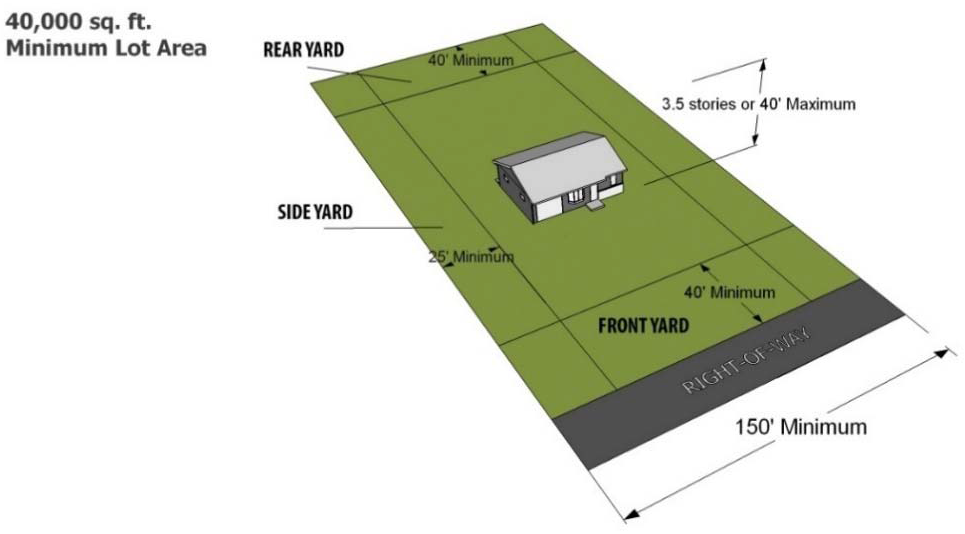
Bulk space and yard regulations. Bulk regulations in the R-3 district including regulations regarding lot area, lot width, yard areas, lot coverage, and building height shall be as listed in Table 10-3 and Figure 10-4.
(6)
Structures. Accessory structures standards shall be as defined in article VII of this chapter.
Table 10-7
R-3 Single-Family Estate Residence District
R-7 Single-Family Estate Residence District Bulk Regulations Illustration: Figure 10-7
(7)
Additional standards.
a.
Corner lot standards: Corner lots will have a minimum front yard setback of 40 feet when the "building frontage" faces that yard. See Figure 10-2.
b.
Reverse corner lot standards. In the case of a "reverse corner lot": See Figure 10-2.
1.
There shall be a setback from the "side street" of not less than 40 feet.
2.
The rear yard shall not be less than the side yard setback of the adjacent property or 25 feet, whichever is greater.
c.
Standards for lots adjacent to reverse corner lots. No accessory building on a lot adjacent to a "reverse corner lot" shall be located nearer than ten feet to the side lot line adjacent to said lot, nor closer than ten feet to the rear lot line.
(j)
Banquet facilities with catering staff special use permits R-1 and R-7 requirements.
(1)
Purpose and intent. This section's purpose and intent is to allow a property owner to utilize their property for banquet facilities with catering staff (NAIC Code 722320) within the R-1 and R-7 districts. Implementing the regulations and standards within this section will ensure that wedding/event facilities in the R-1 and R-7 districts will be conducted in an orderly manner that will not result in an impact or negative change to the residential character of the surrounding community. Based on the parcel size and proximity to existing improvements, the standards below will be placed on properties authorized to hold banquet facilities with catering staff (NAIC Code 722320) within the R-1 and R-7 districts.
(2)
Banquet facilities with catering staff (NAIC Code 722320) may be allowed on properties of five acres or greater in the R-1 and R-7 districts subject to the approval of a special use permit according to chapter 36-14-6 (Special Use Permit) of the village's Municipal Code, in compliance with, but not limited to, the following standards:
a.
Parking. Adequate on-site parking facilities, pedestrian and vehicular circulation, and vehicular ingress and egress shall be provided in compliance with chapter 36, article 8 (Off-Street Parking and Loading Standards) of the village's Municipal Code.
b.
Sanitary facilities. The zoning administrator shall determine the appropriate quantity and location for sanitary facilities. All facilities shall be located on-site and shall comply with accessibility requirements and the requirements of the Kankakee County Health Department.
c.
Security. Provision for security and safety measures shall be provided, if applicable. Current contact information shall always be maintained on file with the village.
d.
Signs. Shall be provided in compliance with chapter 36, article 9 (Signs) of the village's Municipal Code.
(3)
Site-specific development standards.
a.
Days and hours of operation. The site may be used for a maximum of two events per week unless otherwise modified by the permit approval. No more than four events may occur on sequential dates. All events shall begin after 10:00 a.m. and be completed by 12:00 a.m.
b.
Noise levels and monitoring. Noise levels generated from events shall be subject to the following criteria:
1.
Noise levels for events shall not exceed the village's noise standards during set up or as part of the event.
2.
Any noise-generating activities shall not start before 10:00 a.m. and be terminated at 11:00 p.m.
c.
Accessory structures.
1.
If an accessory structure is provided as part of the project approval, ancillary structures shall be permanent construction, fully enclosed or enclosable on four sides, and have a roof. Accessory structures shall be complementary in terms of size, scale, and materials used on the primary structure on the site.
2.
Accessory structures shall be subject to the setbacks for accessory structures contained in chapter 36, article 7 (Accessory Use and Structures) of the village's Municipal Code, except that structures cannot exceed 40 feet in height and be no larger than 10,000 square feet unless approved in the special use permit.
d.
On-site parking requirements.
1.
All on-site parking areas do not need to be paved; however, they must be stabilized to minimize any off-site dust impacts and for compliance. The zoning administrator shall review the site plan as a special use permit condition.
2.
Adequate parking must be provided based on the maximum occupancy of the site. Occupancy will be determined based on the seating capacity of the events.
3.
If buses or limousines are offered for off-site transport, adequate drop-off and pick-up locations must be provided on-site.
e.
Location requirements. Any parcel where a facility is proposed shall have access to a paved and maintained public street.
f.
Solid waste collection and disposal. On-site waste collection shall be located not to create any off-site noise, odors, or nuisances. Solid waste shall be removed from the site within 48 hours of any event.
g.
Sanitary facilities. Any potable sanitary facilities shall not be located any closer than 25 feet from an adjacent property with residential use. Sanitary waste shall be removed from the site within 48 hours of any event.
(Ord. No. 19-2142, § 2, 4-15-19; Ord. No. 23-2409, § 3, 9-5-23)
Sec. 36-10-2. - Business districts.
(a)
Purpose. The business districts set forth herein are established to protect the public health, to promote public safety, comfort, convenience, and the general welfare, and to protect the economic base of the village and the value of property. These general purposes include, among others, the following specific objectives:
(1)
To promote the most desirable use of land in accordance with a well-considered plan so that adequate space is provided in appropriate locations for the various types of business uses, thereby protecting and strengthening the economic base of the village.
(2)
To place in separate district from residential areas those businesses that may create noise, odors, hazards, unsightliness, or which may generate excessive traffic.
(3)
To require that structures and business operations adjacent to residential uses are located so as to minimize potential impact on those residential uses.
(4)
To encourage the grouping in appropriate locations of compatible business uses that will tend to draw trade that is mutually interchangeable and so promote public convenience and business prosperity and contribute to the alleviation of traffic congestion.
(5)
To provide for the establishment of off-street parking facilities, permitted and required, so as to alleviate traffic congestion and promote shopping convenience and business prosperity.
(b)
B-1 central commercial business district.
(1)
Purpose. The B-1 district is established to provide for the day to day shopping, service and dining needs of those in the village and beyond. Businesses selling larger, consumer goods are also appropriate in this district. Located in the core of the village, the district is intended to provide safe and easy access to a range of goods and services. New development should be designed to complement existing uses as regards the transportation, site characteristics and overall community character. Where the district is located adjacent to a residential zoning district, care shall be taken to mitigate potential negative impacts on residents.
(2)
Permitted uses. Permitted uses in the B-1 district are listed in the Zoning District Use Table (36-10-6)
(3)
Special uses. Special uses in the B-1 district shall be as listed in the Zoning District Use Table (36-10-6).
(4)
Parking requirements. B-1 district parking requirements shall be as listed Article VIII of this chapter.
(5)
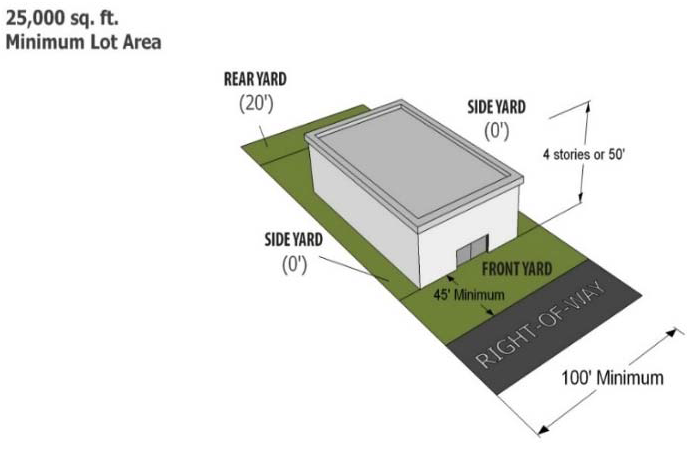
Bulk space and yard regulations. Bulk regulations in the B-1 District include regulations regarding lot area, lot width, yard areas, lot coverage, and building height shall be as listed in Table 10-7 and Figure 10-7.
(6)
Accessory structures. Accessory structures standards shall be as defined in article VII of this chapter.
Table 10-7
B-1 Central Commercial Business District
B-1 Central Commercial Business District Bulk Regulations Illustration: Figure 10-7
(7)
Additional standards.
a.
Height standards. Parapet walls, chimneys, cooling towers, elevator bulkheads, stacks, and necessary mechanical appurtenances may be erected over and above the maximum height of 50 feet, provided they are constructed in accordance with all other ordinances of the village.
b.
Transitional yard standards.
1.
Front yard setback. When a B-1 property is "adjacent" to a residentially zoned property, and both front on the same street between two intersecting streets, the front yard setback of the adjacent residential zoning district shall apply to the B-1 property.
2.
Side yard setback. When a B-1 corner lot abuts a residentially zoned property (or an alley separating the B-1 property from a residence district) a side yard setback shall be provided equal to one-half the front yard required in the adjacent residence district. In no case more shall the required side yard be greater than ten feet. The setback shall also apply if the business buildings front the intersecting street, commonly referred to as the "side street."
3.
Side yard screening. Where the side yard of a business lot abuts a residentially zoned property, a 100 percent screen fence or year-round landscape buffer a minimum of six feet high shall be provided on the business lot.
4.
Rear yard setback. When the rear property line of a B-1 property "abuts" to a residentially zoned property, the rear yard setback of the adjacent residential zoning district shall apply as the rear yard setback for the B-1 property.
5.
Rear yard screening. Where the rear yard of a business lot abuts a residentially zoned property, a 100 percent screen fence or year-round landscape buffer a minimum of six feet high shall be provided on the business lot.
(c)
B-2 corridor commercial business district.
(1)
Purpose. The B-2 district, designed to be consistent with the B-1 district, also is established to provide for the day to day shopping, service and dining needs of those in the village and beyond. Businesses selling larger, consumer goods are also appropriate in this district. New development should be designed to complement existing uses as regards the transportation, site characteristics and overall community character. Where the district is located adjacent to a residential zoning district, care shall be taken to mitigate potential negative impacts on residents.
(2)
Permitted uses. Permitted uses in the B-2 district are listed in the Zoning District Use Table (36-10-6).
(3)
Special uses. Special uses in the B-2 district shall be as listed in the Zoning District Use Table (36-10-6).
(4)
Parking requirements. B-2 district parking requirements shall be as listed article VIII of this chapter.
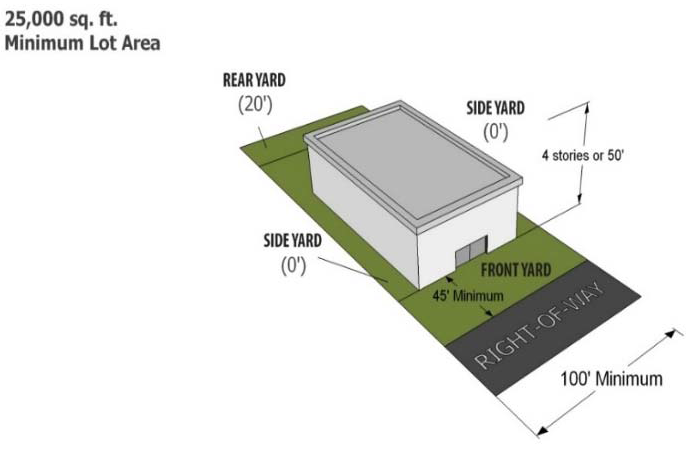
(5)
Bulk space and yard regulations. Bulk regulations in the B-2 District include regulations regarding lot area, lot width, yard areas, lot coverage, and building height shall be as listed in Table 10-8 and Figure 10-8.
(6)
Accessory structures. Accessory structures standards shall be as defined in article VII of this chapter.
Table 10-8
B-2 Corridor Commercial Business District
B-2 Corridor Commercial Business District Bulk Regulations Illustration: Figure 10-8
(7)
Additional standards.
a.
Height standards. Parapet walls, chimneys, cooling towers, elevator bulkheads, stacks, and necessary mechanical appurtenances may be erected over and above the maximum height of 50 feet, provided they are constructed in accordance with all other ordinances of the village.
b.
Transitional yard standards.
1.
Front yard setback. When a B-2 property is "adjacent" to a residentially zoned property, and both front on the same street between two intersecting streets, the front yard setback of the adjacent residential zoning district shall apply to the B-2 property.
2.
Side yard setback. When a B-2 corner lot abuts a residentially zoned property (or an alley separating the B-2 property from a residence district) a side yard setback shall be provided equal to one-half the front yard required in the adjacent residence district. In no case more shall the required side yard be greater than ten feet. The setback shall also apply if the business buildings front the intersecting street, commonly referred to as the "side street."
3.
Side yard screening. Where the side yard of a business lot abuts a residentially zoned property, a 100 percent screen fence or year-round landscape buffer a minimum of six feet high shall be provided on the business lot.
4.
Rear yard setback. When the rear property line of a B-2 property "abuts" to a residentially zoned property, the rear yard setback of the adjacent residential zoning district shall apply as the rear yard setback for the B-2 property.
5.
Rear yard screening. Where the side yard of a business lot abuts a residentially zoned property, a 100 percent screen fence or year-round landscape buffer a minimum of six feet high shall be provided on the business lot.
(d)
U-1 university district.
(1)
Purpose. The university district is intended as a zoning designation applied to an area that includes a college or university and related ancillary uses held under single ownership, affiliated ownership or leasehold where controlled by the university. The university district is further designed to allow and encourage the flexible, yet orderly development of such an area by emphasizing regulations that buffer and limit the cross effects of the district and adjacent land uses and consider the institution's master planning.
(2)
Permitted uses. Permitted uses in the U-1 district are listed in the Zoning District Use Table (36-10-6).
(3)
Special uses. Special uses in the U-1 District shall be as listed in the Zoning District Use Table (36-10-6).
(4)
Parking requirements. U-1 District parking requirements shall be as listed article VIII of this chapter.
(5)
Bulk space and yard regulations.
a.
Uses other than single and two-family dwellings. Minimum yards required in the U-1 university district shall be as depicted on the approval of a master plan as set forth in section 36-10-2(d)(7)a. If there is no master plan or the master plan fails to provide for a yard area requirement, then the minimum standards shown in Table 10-9 shall apply.
b.
Single- and two-family dwellings. All height and bulk regulations for one and two-family dwellings in the U-1 District shall be as required in the R-2 one-family residence district and shown in Tables 10-2.
(6)
Accessory structures. The accessory uses in the U-1 university district shall be located within a building or a structure containing a permitted or special use. Such accessory uses shall be primarily for the service and convenience of the students and employees of the college or university.
Table 10-9
U-1 University District
(7)
Additional standards.
a.
Master plan. The location of buildings and structures, and establishment of uses shall be in general conformance with a master land use plan, as prepared by the university, and approved by the Bourbonnais Planning and Zoning Commission. The master land use plan shall designate existing and proposed buildings, structures and land uses, roadways, pedestrian walkways, and other means of access. A college or university may construct, relocate or enlarge said buildings, structures and land uses, provided that said work is consistent with the master plan as approved by the Bourbonnais Planning and Zoning Commission, is consistent with the village's applicable development regulations, all necessary permits have been obtained, and said construction, relocation or enlargement is in keeping with all requirements of this district. The master plan may be amended from time to time, but any and all such amendments shall require the approval of the Bourbonnais Planning and Zoning Commission. Parapet walls, chimneys, cooling towers, elevator bulkheads, stacks, and necessary mechanical appurtenances may be erected over and above the maximum height of 50 feet, provided they are constructed in accordance with all other ordinances of the village.
b.
Signage. Signage in the University District shall be regulated by Code section 36-9.
c.
Height. The existing communications/radio tower and the existing smoke stack owned by Olivet Nazarene University (as shown on the master plan) are allowed exceptions to the maximum height in Table 10-9.
d.
Transitional yard standards.
1.
Side yard. Where a side lot line coincides with a side or rear lot lines in an adjacent residential district, a yard shall be provided along such lot line. Said yard shall be twice the dimensions of the minimum side or rear yard required for the residential district.
2.
Rear yard. Where a rear lot line coincides with a side or rear lot line in an adjacent residential district, a yard shall be provided along such rear lot line. Such yard shall be twice the dimension of the minimum side or rear yard required for the residential district.
e.
Development standards.
1.
General provisions.
i.
All business, servicing, processing and the like shall be conducted and take place within completely enclosed buildings, excepting parking lots and, motor vehicle storage.
ii.
For the purpose of this district, more than one principal building shall be allowed on one lot.
iii.
Signs: Signs erected on the property, structure or buildings adjacent to a public street shall be compliant with Code section 36-9.
2.
Compliance with building codes. All buildings within the university district shall be constructed to conform to the applicable standards and specifications of the village.
3.
Streets and walks. All public streets and walkways within dedicated rights-of-way or easements shall be constructed in full compliance with the applicable Village standards for streets and walkways.
4.
Public utilities. All utilities shall be located underground as required in the village subdivision ordinance.
5.
Street lights. All street lights located within dedicated rights-of-way or easements shall be in full compliance with the applicable village standards for streetlights.
6.
Landscaping. Any area on any individual lot within the U-1 university district not used for construction or vehicular purposes shall be adequately and attractively landscaped. The landscape design may incorporate native plant materials and existing side amenities or new forms and vistas may be introduced by the use of plant materials, earth sculptures and/or structures.
7.
Parking lot screening and landscaping. All open off-street parking areas for six or more cars shall be effectively screened by a wall, solid fence or densely planted compact hedge along any side which adjoins or is directly across a street or alley from a property in a residential district or an institutional property. Such wall, fence or hedge shall maintain a solid to open ratio of not less than 95 percent when measured six feet above grade. In all off-street parking facilities, open to the sky, having a paved area greater than 500 square feet, a minimum of ten percent of such area shall be landscaped to create visual relief. This landscaping shall be required in addition to any other landscaping required under this section and such landscaping shall be established to break (soften) the expanse of paving.
8.
Storage screening. The exterior storage of materials and inventory, where permitted, shall be effectively screened from view from any district boundary line and right-of-way. Screening may consist of live or decorative plantings, or fencing.
(Ord. No. 19-2142, § 2, 4-15-19)
Sec. 36-10-3. - Manufacturing districts,
(a)
Purpose. The manufacturing districts set forth herein are established to protect public health, safety, comfort, convenience and the general welfare and to protect the economic base of the village, as well as the value of real estate, by regulating manufacturing developments in appropriate locations. These general objectives include, among others, the following specific objectives:
(1)
To protect established residential areas and the health of families living therein by restricting those nearby manufacturing activities which may create offensive noise, vibration, smoke, dust, odors, heat, glare, fire hazards and other objectionable influences to appropriate areas.
(2)
To provide adequate space in appropriate locations for most types of manufacturing and related activities so that the economic structure of the village may be strengthened and that employment opportunities may be found in the interest of public prosperity and welfare.
(3)
To provide space for manufacturing activities in locations accessible to rail and highways, so that the movement of raw materials, finished products and employees can be carried on efficiently and with a minimum danger to public life and property.
(4)
To establish proper standards of performance which will restrict obnoxious manufacturing activities, while at the same time encourage and permit the manufacturing activities which have adopted facilities for the processing of finished products without adversely affecting the health, happiness, safety, convenience and welfare of the people living and working in nearby areas.
(5)
To protect manufacturing districts from incompatible uses of land by prohibiting the use of such space for new residential development, thereby preserving the land for a more appropriate use in accordance with the plans for village improvement and development.
(6)
To promote the most desirable use of land in accordance with a well-considered plan of land use for all of the village, to conserve the use of property, to promote stability of manufacturing activities and related development and to protect the character and established development in each area of the community, to enhance and stabilize the value of land and to protect the tax base of the village.
(b)
M-1 limited manufacturing district.
(1)
Purpose. The purpose of the M-1 limited manufacturing district is to provide for less intensive fabrication and assembly-type manufacturing and limited industrial uses, as well as warehousing, storage, office, and research and development facilities. Standards of the M-1 district are intended to mitigate any potential off-site impact to residential uses.
(2)
Permitted uses. Permitted uses in the M-1 district are listed in the Zoning District Use Table (36-10-6).
(3)
Special uses. Special uses in the M-1 district shall be as listed in the Zoning District Use Table (36-10-6).
(4)
Parking requirements. M-1 district parking requirements shall be as listed article VIII of this chapter.
(5)
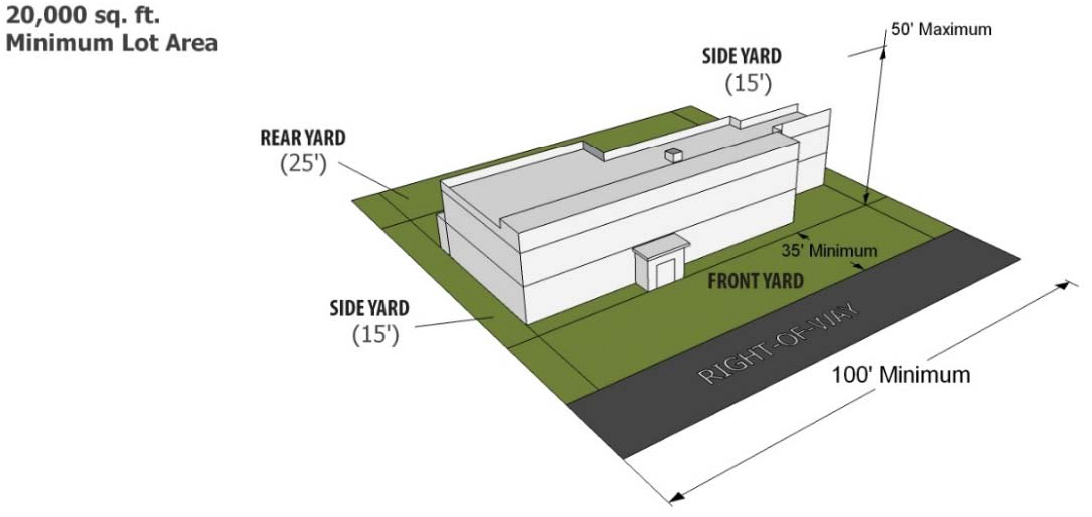
Bulk space and yard regulations. Bulk regulations in the M-1 District include regulations regarding lot area, lot width, yard areas, lot coverage, and building height shall be as listed in Table 10-10 and Figure 10-9.
(6)
Accessory structures. Accessory structures standards shall be as defined in article VII of this chapter.
Table 10-10
M-1 Limited Manufacturing District
M-1 Manufacturing District, Limited Bulk Regulations Illustration: Figure 10-9
(7)
Additional standards.
a.
Height standards.
1.
Additional height for utilities and appurtenances. Parapet walls, chimneys, cooling towers, elevator bulkheads, stacks and necessary mechanical appurtenances may be erected over and above the maximum height, provided they are constructed in accordance with all other ordinances of the village.
2.
Additional height for principal uses. Additional height above the permitted 50-foot limit may be allowed as a special use, in accordance with the special use processes of the village.
b.
Use of site.
1.
Outdoor storage. No outdoor storage of any kind is allowed in this district.
2.
Operations. All operations shall be conducted in an enclosed building.
3.
Impervious coverage. The maximum amount of impervious coverage including buildings, parking areas, loading areas and access drives shall not exceed 80 percent of the site.
c.
Transitional yard standards. Where a lot in the M-1 district is adjacent to a residence district, the following additional regulations shall apply:
1.
Side yard setback.
i.
There shall be a minimum side yard of 25 feet along residential lots.
ii.
The parking of private automobiles is permitted within the side yard areas, but not closer than five feet to any lot zoned for residential use.
2.
Rear yard setback.
i.
There shall be a rear yard of not less than 30 feet.
ii.
No storage of materials or equipment, or the parking of automobiles shall take place within the ten feet closest to any residential lot.
3.
Screening and buffering. Lots in the M-1 district that are adjacent to a residential district, and not separated by a street or other public right-of-way, shall provide a 100 percent solid (so as to prohibit light through it) landscaped barrier or privacy wood fence extending from ground level to a height of at least six feet shall be constructed and maintained along the property line adjacent to any residentially zoned property.
(c)
M-2 general manufacturing district.
(1)
Purpose. The purpose of the M-2 general manufacturing District is to provide locations for somewhat more intensive general manufacturing, fabrication and assembly-type uses than may be typically located in the M-1 district. These are uses that may be more obnoxious or objectionable industrial uses and should be located to minimize impact on other activities.
(2)
Permitted uses. Permitted uses in the M-2 district are listed in the Zoning District Use Table (36-10-6).
(3)
Special uses. Special uses in the M-2 district shall be as listed in the Zoning District Use Table (36-10-6).
(4)
Parking requirements. M-2 district parking requirements shall be as listed article VIII of this chapter.
(5)
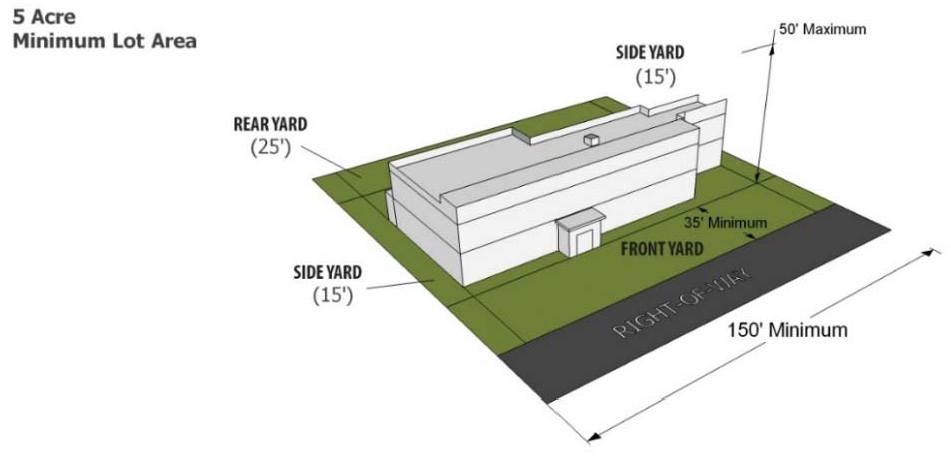
Bulk space and yard regulations. Bulk regulations in the M-2 district include regulations regarding lot area, lot width, yard areas, lot coverage, and building height shall be as listed in Table 10-11 and Figure 10-10.
(6)
Accessory structures. Accessory structures standards shall be as defined in article VII of this chapter.
Table 10-11
M-2 General Manufacturing District
M-2 Manufacturing District, General Bulk Regulations Illustration: Figure 10-10
(7)
Additional standards.
a.
Height standards.
1.
Additional height for utilities and appurtenances. Parapet walls, chimneys, cooling towers, elevator bulkheads, stacks and necessary mechanical appurtenances may be erected over and above the maximum height, provided they are constructed in accordance with all other ordinances of the village.
2.
Additional height for principal uses. Additional height above the permitted 50-foot limit may be allowed as a special use, in accordance with the special use processes of the village
b.
Use of site.
1.
Outdoor storage. Within 200 feet of a residential zoning district, all storage shall be in completely enclosed buildings or structures. Storage located elsewhere in this district may be open to the sky but shall be screened.
2.
Impervious coverage. The maximum amount of impervious coverage including buildings, parking areas, loading areas and access drives shall not exceed 80 percent of the site.
c.
Transitional yard standards. Where a lot in the M-2 district is adjacent to another district, the following additional regulations shall apply:
1.
Side yard setback.
i.
There shall be a minimum side yard of 25 feet along lots in other districts.
ii.
The parking of private automobiles is permitted within the side yard areas, but not closer than five feet to any lot zoned for another district.
2.
Rear yard setback.
i.
There shall be a rear yard of not less than 30 feet.
ii.
No storage of materials or equipment, or the parking of automobiles shall take place within the ten feet closest to any residential lot.
3.
Front yards. Where the frontage on one side of a street between two intersecting streets is located partially in an M-2 district and partially in some other use district, the front yard requirements of the other use district shall apply to the M-2 district.
i.
Screening and buffering. Lots in the M-2 district that are adjacent to a residential district, and not separated by a street or other public right-of-way, shall provide a 100 percent solid (so as to prohibit light through it) landscaped barrier or privacy wood fence extending from ground level to a height of at least six feet shall be constructed and maintained along the property line adjacent to any residentially zoned property.
(d)
Institutional district.
(1)
Purpose. The institutional zoning district is intended to accommodate the development and redevelopment of public and semi-public facilities such as: Governmental administration buildings; fire, police and rescue services; utilities; public and private educational institutions.
(2)
Permitted uses. Permitted uses in the (I) district are listed in the Zoning District Use Table (36-10-6).
(3)
Special uses. Special uses in the (I) district shall be as listed in the Zoning District Use Table (36-10-6).
(4)
Parking requirements. (I) District parking requirements shall be as listed article VIII of this chapter.
(5)
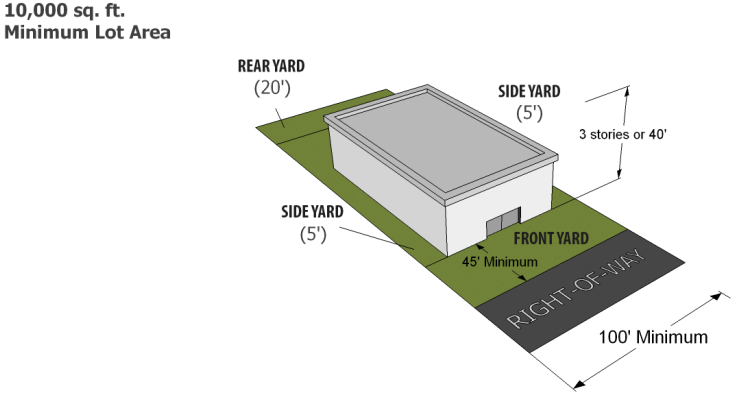
Bulk space and yard regulations. Bulk regulations in the (I) District include regulations regarding lot area, lot width, yard areas, lot coverage, and building height shall be as listed in Table 10-12 and Figure 10-11.
(6)
Accessory structures. Accessory structures standards shall be as defined in article VII of this chapter.
Table 10-12
(I) Institutional District
Institutional District Bulk Regulations Illustration: Figure 10-11
(7)
Additional standards.
a.
Height standards. Parapet walls, chimneys, cooling towers, elevator bulkheads, stacks, and necessary mechanical appurtenances may be erected over and above the maximum height of 50 feet, provided they are constructed in accordance with all other ordinances of the village.
b.
Transitional yard standards.
1.
Front yard setback. When an (I) property is "adjacent" to a residentially zoned property, and both front on the same street between two intersecting streets, the front yard setback of the adjacent residential zoning district shall apply to the (I) property.
2.
Side yard setback. When an (I) corner lot abuts a residentially zoned property (or an alley separating the (I) property from a residence district) a side yard setback shall be provided equal to one-half the front yard required in the adjacent residence district. In no case more shall the required side yard be greater than ten feet. The setback shall also apply if the institutional buildings front the intersecting street, commonly referred to as the "side street."
3.
Side yard screening. Where the side yard of a institutional lot abuts a residentially zoned property, a 100 percent screen fence or year-round landscape buffer a minimum of six feet high shall be provided on the institutional lot.
4.
Rear yard setback. When the rear property line of a (I) property "abuts" to a residentially zoned property, the rear yard setback of the adjacent residential zoning district shall apply as the rear yard setback for the institutional property.
5.
Rear yard screening. Where the side yard of a business lot abuts a residentially zoned property, a 100 percent screen fence or year-round landscape buffer a minimum of six feet high shall be provided on the institutional lot.
c.
Business operations. All permitted and special uses in the (I) district zoning shall be wholly conducted within a permanent, enclosed building, with the exception of storage of equipment or materials accessory to the primary use, which shall be screened from adjacent residential uses.
(Ord. No. 19-2142, § 2, 4-15-19)
Sec. 36-10-4. - I-57 interchange overlay district.
(a)
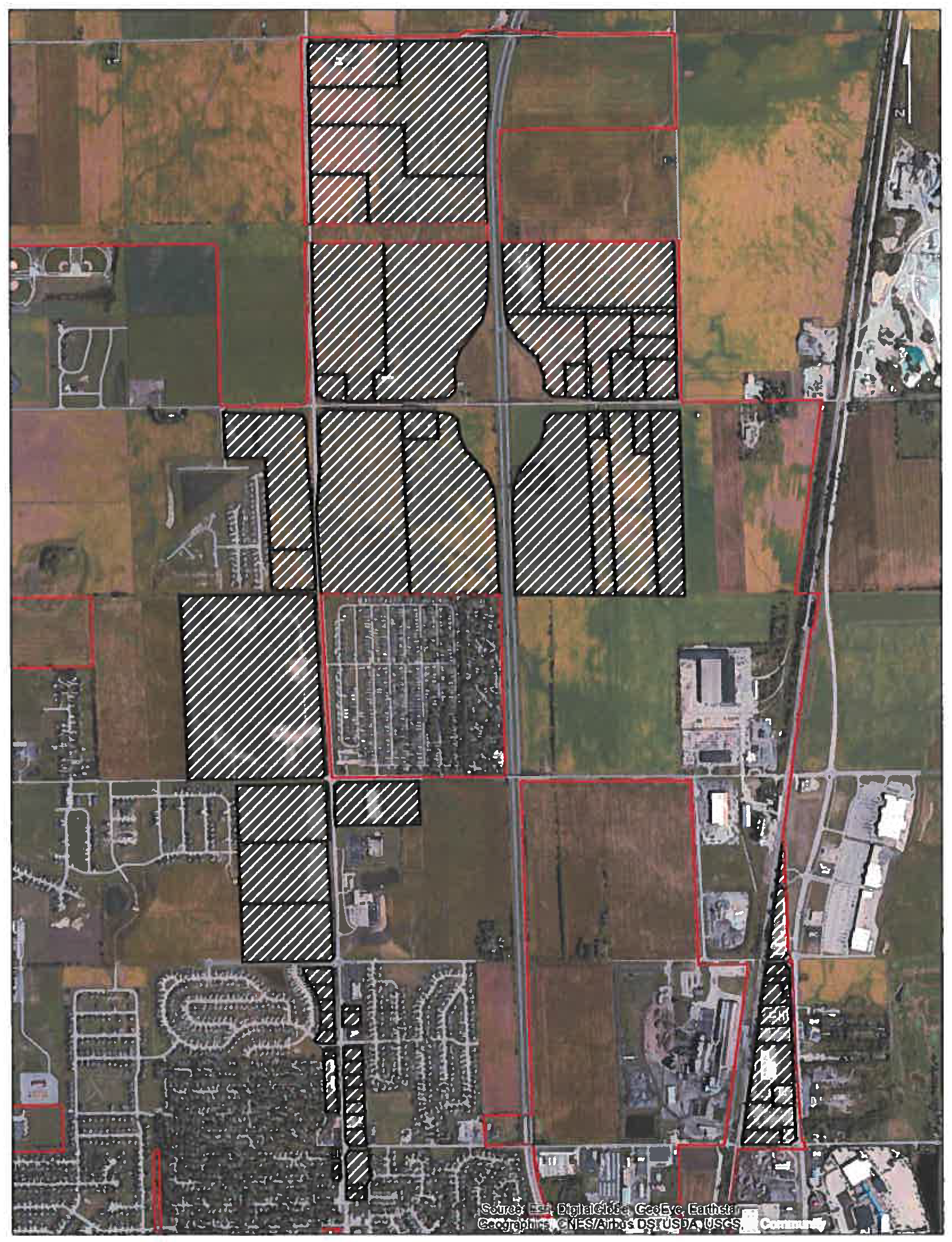
Purpose. The I-57 overlay district establishes the expected character of development near the I-57 interchange. This will be an area of significance regarding the village's appearance, character, and tax base. In many ways this will be the front door to Bourbonnais from the rest of the region, and specific design guidelines will support and quality appearance for the area. Such guidelines will be applied in a manner that allows for the creativity of designers and personalization of individual developments and is intended to provide a consistently high quality character that will be beneficial to all property users and the Village as a whole.
(b)
District boundary. The boundaries of the I-57 interchange overlay district are shown on Figure 10-12.
(c)
Permitted uses.
(1)
Permitted uses within the I-57 overlay district south of 5500 N and west of Route 45 shall be in keeping with the underlying zoning district.
(2)
Permitted uses within the I-57 overlay district north of 5500 N and east Route 45 shall include those uses permitted in the B-1, B-2, and M-1, zoning districts.
(3)
Permitted uses within the I-57 overlay district north of 5500 N and east Interstate 57 shall include uses permitted in the M-2 zoning districts.
(d)
Special uses.
(1)
Special uses within the I-57 overlay district south of 5500 N and west of Route 45 shall be in keeping with the underlying zoning district.
(2)
Special uses within the I-57 overlay district north of 5500 N and east Route 45 shall include those special uses in the B-1, B-2, M-1, and M-2 Zoning Districts.
(3)
Special uses within the I-57 overlay district north of 5500 N and east Interstate 57 shall include special uses in the M-2 zoning districts.
(e)
Parking requirements. Parking requirements within the I-57 overlay district shall be in keeping with the underlying zoning district.
(f)
Bulk space and yard regulations.
(1)
Bulk regulations within the I-57 overlay district, including regulations regarding lot area, lot width, yard areas, lot coverage, and building height will be determined by the underlying zoning.
(2)
Minimum lot size for properties in the M-2 zoning district located east of I-57 shall be two acres.
(g)
Design standards.
(1)
Design guidelines: All properties within the I-57 interchange overlay district shall be subject to the Bourbonnais Commercial, Office and Industrial Design Guidelines, incorporated into and adopted as part of this section of the Bourbonnais Zoning Ordinance.
(2)
Design review. Administration of the design guidelines shall be as defined in article XIV, Administration and Enforcement of this chapter.
Figure 10-12: I-57 Interchange Overlay District Boundary
(Ord. No. 20-2207, § 2, 3-2-20; Ord. No. 20-2209, § 2, 3-2-20)
Sec. 36-10-5. - BCO—Business corridor overlay district.
(a)
Purpose. The business corridor overlay district establishes a character of development for the area of Bourbonnais between the I-57 interchange area and the retail oriented portions of Route 45 and near the village's commercial center. As with the interchange, this area provides an opportunity to enhance village's appearance, character, and tax base. It is intended to accommodate larger business sites and uses than the core of the village or portions of Route 45 located further to the south, and to be developed in keeping with design guidelines to support a quality appearance for the area.
(b)
District boundary. The business corridor overlay district includes all B-2 zoned properties north of Burns Road and within ½ mile east or west of Route 45.
(c)
Permitted uses. Permitted uses within the business corridor overlay district shall be those permitted in the B-2 zoning district.
(d)
Special uses. Special uses within the business corridor overlay district shall be those special uses in the B-2 zoning district.
(e)
Parking requirements. Parking requirements within the business corridor overlay district shall be in keeping B-2 zoning district.
(f)
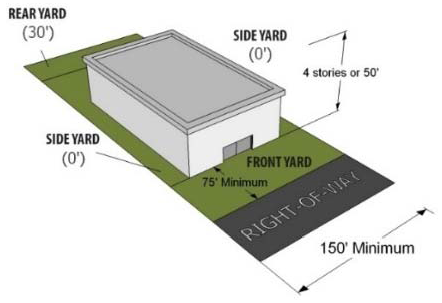
Bulk space and yard regulations. Bulk regulations within the business corridor overlay district, shall be as set out in Table 10-13 and Figure 10-12a of this subsection.
(g)
Design standards.
(1)
Design guidelines. All properties within the business corridor overlay district and the I-57 Interchange overlay district shall be subject to the Bourbonnais Commercial, Office and Industrial Design Guidelines, incorporated into and adopted as part of this section of the Bourbonnais Zoning Ordinance.
(2)
Design review. Administration of the design guidelines shall be as defined in article XIV, Administration and Enforcement of this chapter.
Table 10-13
BCO—Business Corridor Overlay District
Figure 10-12a
(Ord. No. 19-2142, § 2, 4-15-19)
Sec. 36-10-6. - Zoning District Use Table.
(Ord. No. 19-2142, § 2, 4-15-19; Ord. No. 20-2216, § 2, 4-6-20; Ord. No. 22-2362, § 2, 11-21-22; Ord. No. 23-2409, § 2, 9-5-23; Ord. No. 25-2487, § 2, 5-5-25)

