
Bourbonnais City Zoning Code
ARTICLE V
- GENERAL PROVISIONS
Sec. 36-5-1. - Scope of regulations.
No building or structure shall be erected, converted, enlarged, reconstructed, or structurally altered, nor shall any building, structure, or land be used, for any purpose other than is permitted in the district in which the building, structure, or land is located.
(Ord. No. 19-2142, § 2, 4-15-19)
Sec. 36-5-2. - Permits.
No application for a building permit or other permit, license, or certificate shall be approved by the zoning administrator, or her designee, which would authorize the use or change in use of any building, structure, or land contrary to the provisions of this Code, or the erection, moving, alteration, enlargement, or occupancy of any building, structure, or land designed or intended to be used for a purpose or in a manner contrary to the provisions of this chapter.
(Ord. No. 19-2142, § 2, 4-15-19)
Sec. 36-5-3. - Yard requirements.
(a)
Location. Yard requirements shall be set forth under each zoning district for all buildings, structures, and uses of land. All required yards shall be located on the same lot as the building, structure or use of land for which such yard is required. The right-of-way of any public roadway, public alley, or public accessway which exists by dedication, recorded easement, or prescription, and which is located on the lot shall not be included as part of the required yard.
(b)
Existing buildings. No yards, now or hereafter provided, for a building, structure, or use existing on the effective date of this Code, or any amendment hereto, shall subsequently be reduced below, or further reduced if already less than, the minimum yard requirements of this Code for equivalent new construction.
(Ord. No. 19-2142, § 2, 4-15-19)
Sec. 36-5-4. - Lot area and dimensions.
(a)
When two or more parcels of land, any of which lacks adequate area and dimensions to qualify for a permitted use under the requirements of the zoning district in which they are located, are contiguous and held in common ownership, they may be considered to be one zoning lot for such use.
(b)
Any lot or parcel that does not meet the minimum required lot width or lot area on this Code's effective date may be utilized for a permitted use, provided that the lot contains no less than 75 percent of the minimum required lot width or lot area.
(Ord. No. 19-2142, § 2, 4-15-19)
Sec. 36-5-5. - Location of buildings and structures.
Except as otherwise expressly provided in this Code, every building or structure shall be constructed or erected on a lot or parcel of land that abuts upon a public street or permanent access easement connecting to a public street, which easement shall have a minimum width of 26 feet.
(Ord. No. 19-2142, § 2, 4-15-19)
Sec. 36-5-6. - Buildings on a zoning lot.
Every building hereafter erected or structurally altered to provide dwelling units or other occupancy shall be located on a zoning lot, and in no case shall more than one building be located on a zoning lot.
(Ord. No. 19-2142, § 2, 4-15-19)
Sec. 36-5-7. - Flood prone areas.
No building shall be erected in areas subject to flooding, as determined by the floodway and floodplain maps of the Village of Bourbonnais, County of Kankakee, State of Illinois, unless suitable provisions for drainage are approved and constructed in accordance with the village's floodplain ordinance.
(Ord. No. 19-2142, § 2, 4-15-19)
Sec. 36-5-8. - Uses not permitted in districts.
Except as expressly provided elsewhere in this Code, when a use is not specifically identified as a permitted or special use, such uses are prohibited. The zoning administrator is authorized to review proposed uses and determine if a use is a permitted use, special use, or prohibited use, sufficiently comparable to be treated as a permitted use, special use, or prohibited use.
(Ord. No. 19-2142, § 2, 4-15-19)
Sec. 36-5-9. - Storing of recreational vehicles.
Trucks, trailers, boats and recreational vehicles shall not be parked in a front yard within an R district for more than:
(a)
Eight continuous hours;
(b)
Twelve hours within a 24-hour period; or
(c)
Otherwise, in the driveway to the rear of the principal building line that is parallel or most nearly parallel to the street to which the driveway extends to the rear of this line.
(Ord. No. 19-2142, § 2, 4-15-19; Ord. No. 23-2405, § 2, 8-21-23)
Sec. 36-5-10. - Clear vision triangle.
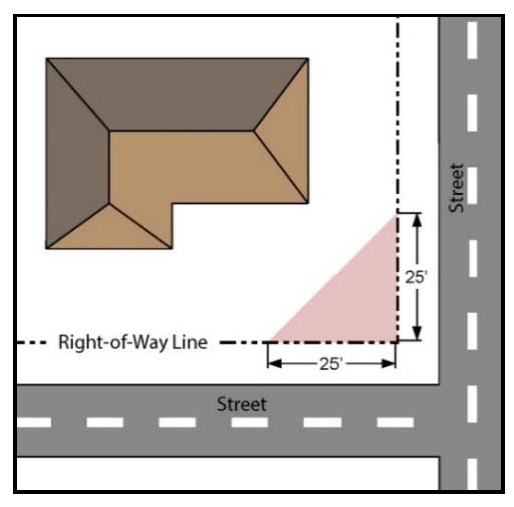
Figure 5-1
(a)
Clear vision triangle defined. An area required in locations where an unobstructed view of approaching traffic is necessary for the safety of pedestrians, bicyclists and drivers (Figure 5-1).
(b)
Measurement. At the intersection of two streets or the intersection of a street and a driveway, the required clear vision triangle shall be established as follows:
(1)
No building or structure hereafter erected and no planting or other obstruction to the vision of drivers of motor vehicles shall be located in any residential, business or industrial district, exceeding a height of three feet above the street grade within 25 feet of the intersecting right-of-way lines bordering corner lots
(Ord. No. 19-2142, § 2, 4-15-19)
Sec. 36-5-11. - Storage of snow removal equipment and salt or other deicing agents.
(a)
Residential districts. No snow removal equipment and no salt or other deicing agent shall be stored within the parking lot or in a covered structure or container in any multiple family residential zoning district.
(b)
Business districts. Snow removal equipment, salt stores, or other deicing agents shall only be stored behind the primary building on the lot.
(c)
Manufacturing districts. Snow removal equipment and salt or deicing agent shall be stored within a rear yard only. Any stored salt or deicing agent shall be placed in a covered structure or container that does not allow for direct contact with any pervious or impervious surface. Said cover shall be secured to prevent the salt or other deicing agent from contact with the elements.
(Ord. No. 19-2142, § 2, 4-15-19)
Sec. 36-5-12. - Building height limitations.
(a)
Height limitations shall be as set forth under each zoning district for all buildings, structures, and uses of land.
(b)
Exceptions: Roof structures for the housing of stairways, tanks, ventilating fans, or similar equipment required to operate and maintain the building, and fire or parapet walls, skylights, steeples, flagpoles, chimneys, smokestacks, of structures deemed to be similar by the zoning administrator may be erected above the height limitations imposed by this Code. No such structure may be erected to exceed by more than 25 feet the height limits of the zoning district in which it is located.
(Ord. No. 19-2142, § 2, 4-15-19)

