
Bourbonnais City Zoning Code
ARTICLE VII
- ACCESSORY USES AND STRUCTURES
Sec. 36-7-1. - Purpose.
The purpose of this article is to regulate accessory structures and uses customarily allowed in addition to those identified as permitted uses in each district, and to provide restrictions or prohibition of other such accessory structures or uses.
(Ord. No. 19-2142, § 2, 4-15-19)
Sec. 36-7-2. - General standards for accessory uses and structures.
All accessory structures or uses, as defined herein, shall:
(1)
Not be built, moved, remodeled, established, altered or enlarged unless the accessory structure or use is permitted by this chapter.
(2)
Be permitted in any zoning district in connection with any principal use which is permitted within the district.
(3)
Be located on the same lot as the permitted use or principal building.
(4)
Be owned or operated by the same person as the principal building.
(5)
Be subject to all applicable design and development standards for the zoning district and the principal use.
(6)
Be maintained in a safe, sanitary, and secure fashion.
(Ord. No. 19-2142, § 2, 4-15-19)
Sec. 36-7-3. - Accessory structures.
(a)
Conformity to regulations. Where an accessory structure is attached to the principal building, it shall be subject to, and must conform to, all regulations of this chapter applicable to the principal building, unless approved by the zoning administrator.
(b)
Time of construction. An accessory building shall not be erected prior to the establishment or construction of the principal building to which it is accessory.
(c)
Yard requirements for accessory structures and uses. Unless otherwise stated within this article, no accessory building, structure or use shall be located in a required front, corner side, or interior side yard.
(d)
Location and height.
(1)
Location.
a.
A detached accessory structure must be located a minimum of ten feet from a principal building, structure or use, and must be located no closer than five feet to any interior side or rear lot line, unless otherwise provided for within this chapter, with the exception of swimming pools, decks, and patios that are not subject to this separation requirement. A roofed detached accessory structure must be located a minimum of four feet from another roofed detached accessory structure.
b.
An accessory building or structure shall not be located in any front yard, and shall not be closer to the front lot line than any principal building.
c.
When an accessory building or structure is located in a side yard, it shall conform to the side yard regulations of that zoning district.
(2)
Height. The maximum height of any detached accessory structure is measured from grade to the peak of the roof. In cases of measuring the height of fences, fence height shall be measured as the vertical distance between the existing grade at the base of the fence and the top edge of the fence material. Grade may not be modified in order to increase fence height.
a.
Residential and business zoning districts. No accessory structure in the residential or business zoning districts, except antennas and flag poles, shall exceed the height of the principal building or structure, or a height of 14 feet, whichever is less, unless otherwise permitted by this chapter.
b.
Manufacturing zoning districts. No accessory structure in the non-residential zoning districts, except antennas and flag poles, shall exceed the height of the principal building or structure, or a height of 25 feet, whichever is less, unless otherwise permitted by this chapter.
(e)
General restrictions.
(1)
No accessory structures may be designed or used for housing.
(2)
All detached accessory structures are limited to a maximum area of 200 square feet each, unless otherwise permitted by this chapter.
(3)
Requirements. In all residential zoning districts:
a.
Maximum height: 14 feet.
b.
Minimum setback: Five feet from any side yard and five feet from any rear yard.
(4)
No accessory structure shall be constructed as a pole-type building with corners or studding installed as posts in the ground to support the structure. Only approved footers and floors are accepted.
(5)
No accessory structure with a roof assembly shall be attached to a dwelling and/or building with pole-type footings. All accessory structures shall have either caisson or continuous footings installed to support the accessory structure. All accessory structures shall have an approved floor assembly and/or deck to support the structure.
(6)
Upon the demolition of a principal building, any remaining non-conforming accessory structures on the same property as the demolished structure must also be demolished or altered to conform with this chapter.
(f)
Garages.
(1)
Requirements for attached garages. In all residential zoning districts:
a.
The maximum width of any attached garage shall not exceed 67 percent of the full width of the building.
b.
The maximum height of any garage door shall not exceed eight feet.
c.
The maximum number of garage doors facing in any one direction shall be limited to three single doors, each having a maximum width of nine feet, or one single door of nine feet maximum width plus one double door having a maximum width of 16 feet.
d.
Residential driveways and access.
1.
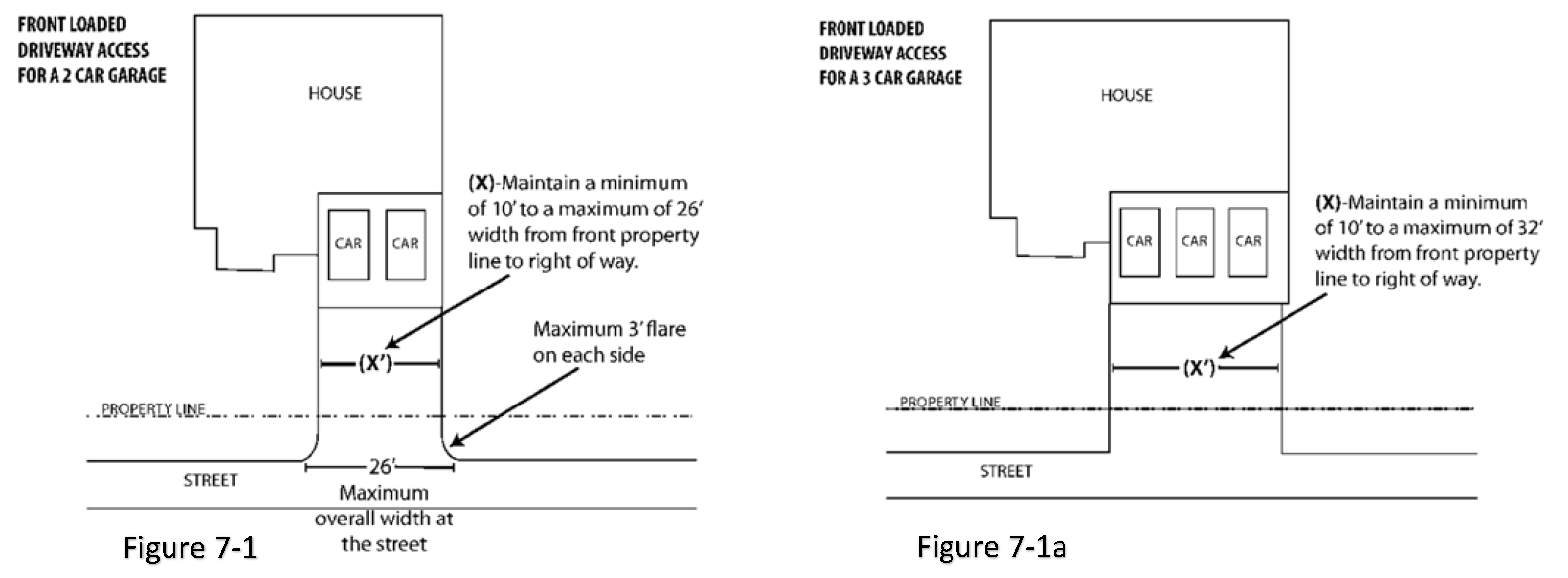
Front loaded driveway access (Figure 7-1)
i.
Driveway width at the front property line shall be a minimum of ten feet and a maximum of 26 feet (shown as (X) in Figure 7-1).
ii.
The driveway shall have a maximum width of 26 feet at the street pavement edge and shall flare to match the driveway as needed, with a maximum flare width of three feet on each side. In no case shall the driveway width at the edge of pavement be more than six feet greater than the driveway width at the property line.
iii.
In case of a three-car garage only, the maximum driveway width of 32 feet may extend to the edge of street pavement at width of 32 feet (as shown in Figure 7.1a).
iv.
Maximum driveway widths for attached garages:
(a)
One car garage: 12 feet.
(b)
Two-car garage: 26 feet.
(c)
Three-car garage: 32 feet.
(2)
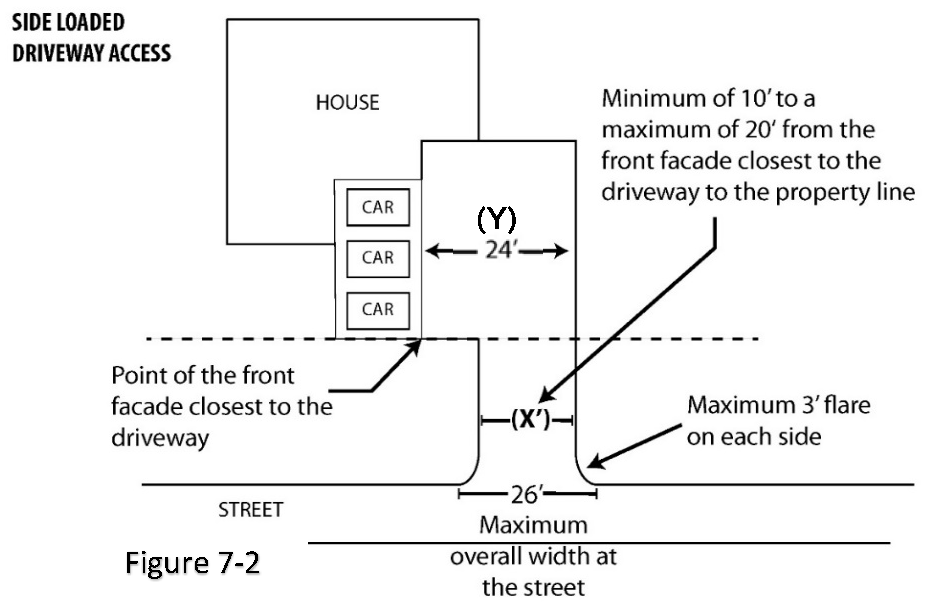
Side loaded driveway access (Figure 7-2).
a.
The driveway pad (shown as (Y) below) shall be a maximum width of 24 feet from the front of the garage doors.
b.
The driveway shall be a minimum of ten feet to a maximum of 24 feet in width to the property line, starting at the point of the front façade closest to the driveway (as shown as (X') below).
1.
The driveway shall have a maximum width of 26 feet at the street with a maximum flare width of three feet on each side.
(3)
Requirements for detached garages. In all residential zoning districts:
a.
Maximum height of gable to ground: 15 feet.
b.
Maximum dimensions: 624 square feet. Unless within the single-family estate district (R-3), in which maximum dimensions shall be 864 square feet.
c.
Maximum driveway widths leading to detached garages:
1.
One car garage: 12 feet.
2.
Two-car garage: 22 feet.
3.
Three-car garage: 32 feet.
(Ord. No. 19-2142, § 2, 4-15-19)
Sec. 36-7-4. - Permitted accessory uses and structures.
(a)
Residential uses. The following accessory uses/activities are allowed in residential zoning districts:
(1)
Bed and breakfast (see section 36-7-11).
(2)
Short term rentals (see section 36-7-11).
(3)
Temporary shelters (see section 36-7-11).
(4)
Home occupations (see section 36-7-14).
(b)
Business uses. The following accessory uses/activities are allowed in business zones:
(1)
Child care facilities.
(2)
Day care facilities.
(c)
Manufacturing uses. The following accessory uses/activities are allowed in manufacturing zones:
(1)
Retail sales of goods (as part of a manufacturing use)
(d)
Permitted accessory structures.
(1)
The following accessory structures below are permitted in specific districts and yards (Table 7-1):
Accessory Structures—Table 7-1
(P = Permitted) (X = Not Permitted) (* = Site Plan Review Required)
(Ord. No. 19-2142, § 2, 4-15-19)
Sec. 36-7-5. - Fences and walls.
(a)
General fence regulations.
(1)
Applicability. All fences and walls must be erected and maintained in conformance with the requirements of this section.
(2)
Permits required. A permit issued by the zoning administrator is required to erect or alter any fence within the village.
(3)
Existing fencing. Legally constructed fences or walls prior to the effective date of the ordinance from which this chapter is derived, shall be allowed to continue; provided, however, that replacement of fencing shall require conformance provisions of this chapter.
(4)
Construction. Fences shall be erected so that all supporting members are on along the property line or within the boundaries of the lot, unless otherwise provided herein. All wooden fences shall be constructed in such a manner that the finished side of all material used shall be to the exterior of the lot fenced.
(5)
Barbed wire and electric fences. No fence may be maintained or constructed composed in whole or part of barbed wire, or with any similar materials designated to cause injury to persons, or wire charged with electrical current, anywhere within the village. In the case of protection of industrial property barbed wire is allowed but must be at least six feet above the sidewalk and extend inward of property, electric fences are not allowed anywhere within the village.
(6)
Height. No fence may be maintained or constructed in whole or part in excess from the below requirements. Fence height shall be measured as the vertical distance between the existing grade at the base of the fence and the top edge of the fence material. Grade may not be modified in order to increase fence height (Table 7-2).
Table 7-2: Fence Height
(7)
Location.
a.
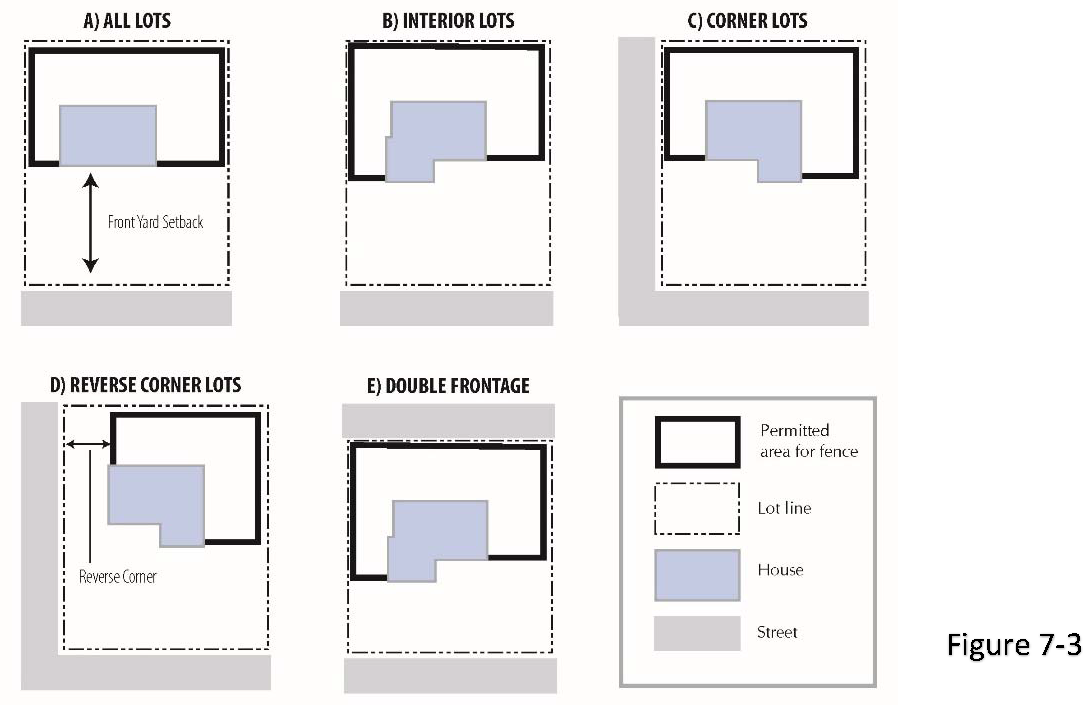
All lots. Fences shall not extend beyond the front of a residential home or structure, and may connect to the principal structure within the boundary of the lot as shown in Figure 7-3.
b.
Interior lots. Fences shall be erected so that all supporting members and connecting elements are on the property line (see Figure 7-3).
c.
Corner lots. All fences shall be erected so that all supporting members are on the property line (see Figure 7-3).
d.
Reverse corner lot. Fences shall not extend beyond the building or structure (see Figure 7-3).
e.
Double frontage or through lot. Fences shall be erected so that all supporting members and connecting elements are on the property line (see Figure 7-3).
Permitted Fence Locations in R Districts
The examples illustrate various building footprints and corresponding permitted locations for fences. The illustrations are not drawn to scale and are not intended to accurately depict required setbacks or other dimensions.
(b)
Solid/privacy fence required on premises used for commercial use.
(1)
Transitional yard setback. A transitional yard setback shall exist and lie along all commercial real estate lot lines, which directly abut or adjoin residential real estate.
(2)
Encroachments. No encroachment may be constructed within the limits of the buffer zone.
(3)
Solid fence required. A solid fence or screening shall be required adjacent to the property line of any buffer zone.
(4)
Waiver of buffer zone requirements. The Village of Bourbonnais Planning And Zoning Commission may waive buffer zone requirements, described above, upon appropriate petition of any landowner, and establishing the existence of a sufficient natural barrier between any commercial and residential properties.
(5)
Supplemental to other regulations. This section is an addition to all other ordinance, rules and regulations concerning encroachments and shall not be construed as repealing or rescinding any other ordinance or part of any ordinance unless and direct conflict therewith.
(Ord. No. 19-2142, § 2, 4-15-19)
Sec. 36-7-8. - Swimming pools, spas, hot tubs and similar devices.
(a)
Location. Swimming pools, spas, hot tubs and similar devices shall not be located in any front yard, shall be setback at least ten feet from the rear lot line, and shall meet the side yard setback of the district.
(b)
Security fencing. All outdoor swimming pools shall be enclosed by a fence. The minimum height from the pool decking shall be 48 inches and the maximum height shall be six feet.
(c)
Exemptions from security fencing. The specifications required in this section shall not be required for any swimming pools or similar devices with a diameter of six feet or less or designed to contain less than two feet of water at any point, nor shall they be required for an aboveground spa or Jacuzzi.
(d)
Requirements. All swimming pools, spas, hot tubs and similar devices shall meet all other relevant regulations of the Bourbonnais Village Code.
(Ord. No. 19-2142, § 2, 4-15-19)
Sec. 36-7-9. - Trash/recycling enclosures.
(a)
Applicability. A permanent enclosure for storage of garbage, refuse and other waste materials shall be provided for every use, other than single-family dwelling and multiple-family dwellings of less than four units.
(b)
Location and placement.
(1)
Trash/recycling enclosures shall not be located in any front yard or corner side yard.
(2)
Placement of enclosures shall be planned and constructed in a manner that allows unobstructed access to each dumpster and the unobstructed opening of the gates during the emptying process.
(3)
Trash/recycling enclosures shall not be located in such a manner that the service vehicle will block any street intersection.
(4)
When adjacent to residentially zoned properties, enclosures shall be placed as far as possible from the abutting residential property line.
(c)
Materials, construction, and design.
(1)
The enclosure area shall be enclosed on three sides with permanent materials and on the fourth side with an access gate.
(2)
Enclosures shall be of sufficient height to conceal contents on all sides including containers, but in no case shall be less than four feet in height above grade.
(3)
All trash/recycling enclosures shall be placed on a concrete surface as approved by the zoning administrator.
(d)
Screening.
(1)
Screen enclosures from adjoining properties and the public right-of-way with fencing or building elements.
(Ord. No. 19-2142, § 2, 4-15-19)
Sec. 36-7-10. - Porches, patios, decks and stoops.
(a)
Front yard. A stoop may project into a required front yard setback for a distance not exceeding four feet in width and the length shall be no greater than the side of the house. Porches, patios and decks are not allowed within the front yard setback.
(b)
Side yard. Porches, decks, stoops and patios must not be closer to an interior side lot line than the minimum required side yard setbacks that apply to the principal building on the property.
(c)
Rear yard. Open porches, patios and decks may project into a required rear yard setback for a distance not exceeding ten feet.
(Ord. No. 19-2142, § 2, 4-15-19; Ord. No. 23-2402, § 2, 8-21-23)
Sec. 36-7-11. - Bed and breakfasts, short term rentals, and temporary shelters.
(a)
Bed and breakfast. Bed and breakfast establishments do not include motels, hotels, boarding houses, or food service establishments.
(1)
The bed and breakfast must be residential in nature and comply with the home occupation regulations of section 36-7-14 of this chapter.
(2)
No more than three guest bedrooms are allowed.
(3)
Guest stays shall not exceed more than ten nights in a 12-month period.
(4)
Breakfast may be provided to the guests only.
(5)
One off-street, non-tandem parking space is required per bedroom; in addition to otherwise required off-street parking.
(6)
The operator of the bed and breakfast shall live on the premises.
(b)
Short term rental/lodging (i.e. AirBnB, vacation rentals).
(1)
Unit must be an owner-occupied principal residence.
(2)
Rentals must be for less than seven days.
(3)
Five or more unrelated people occupying a dwelling unit is not permitted.
(4)
Only one dwelling unit per building may be used for short term rentals.
(5)
The owner must apply for and obtain a certificate of occupancy from the zoning administrator to meet any additional safety requirements of a transient use.
(c)
Temporary shelters.
(1)
Temporary shelters are only permitted as an accessory use operated by a religious institution.
(2)
The accessory temporary shelter use is restricted to the interior of a religious institution's building.
(3)
Hours for the temporary shelter must be reported to the zoning administrator and are restricted one night per week, 6:30 p.m. to 7:00 a.m.
(4)
The temporary shelter must enforce a code of conduct for its employees, volunteers, and guests that prohibits:
a.
Obscene or abusive language;
b.
Use or possession of tobacco, alcohol, or illegal drugs;
c.
Advertising or sale of any services;
d.
Loitering outside the building;
e.
Sleeping outside designated areas;
f.
Use or possession of weapons, including but not limited to any firearm or knife;
g.
Engaging in any sexual acts or behavior;
h.
Criminal activity;
i.
Occupancy by convicted felons or registered sex offenders; and
j.
Failure to cooperate with shelter employees and volunteers.
(5)
The temporary shelter must have at least one supervisor, an employee or volunteer over the age of 21 in the building during all hours of operation. The supervisor must enforce the shelter's code of conduct, and report any and all criminal activity observed or reported to the Bourbonnais Police Department.
(6)
The temporary shelter must keep records of all guests, including names and photos of the persons face.
(7)
The temporary shelter must comply with all laws, including building and life safety codes, including those related to maximum occupancy and fire suppression, and health regulations requiring "sharps containers."
(8)
The temporary shelter must provide the zoning administrator a certificate of liability insurance in an amount no less than $1,000,000.00 covering the shelter and its employees, volunteers, and guests.
(d)
Requirements. All bed and breakfast establishments, short term rentals, and temporary shelters must be registered with the Village of Bourbonnais.
(Ord. No. 19-2142, § 2, 4-15-19)
Sec. 36-7-12. - Drive-thru.
The following requirements are intended to minimize the potentially adverse effects of drive-thru activities on adjacent properties, pedestrians and traffic flow. As appropriate, additional requirements may be established per a special use approval:
(1)
Location. Drive-thru lanes shall not be placed in the front of a building.
(2)
Hours of operation. Hours of operation shall be restricted to the hours of 6:00 a.m. to 10:00 p.m. if located within 150 feet of a residential zoning district.
(3)
Vehicle stacking. The stacking area shall meet the requirements of the off-street parking and loading article VIII, section 36-8-8, Drive-thru stacking of this chapter.
(4)
Pedestrian walkways. Pedestrian walkways shall be clearly visible, and be emphasized by enhanced paving or markings where they intersect and drive thru. See off-street parking and loading article VIII, section 36-8-8, Drive-thru stacking of this chapter.
(5)
Screening requirements. Any drive-thru adjacent to a residential zoning district shall be screened with a six-foot high solid fence, wall, landscaping or combination thereof. All service areas and ground-mounted mechanical equipment shall be screened from ground-level view.
(Ord. No. 19-2142, § 2, 4-15-19)
Sec. 36-7-13. - Telecommunications structures.
(a)
Small wireless facilities.
(1)
Compliance with laws. All small wireless facilities must comply with chapter 18, article VII of the Village of Bourbonnais Code of Ordinances, and all other applicable federal, state, and local laws.
(2)
Districts. Small wireless facilities are allowed as permitted or special uses in the following districts (Table 7-3):
Use Table 7-3
P = Permitted Use, S = Special Use
(3)
Special use. Small wireless facilities allowed as a special use must be:
a.
Designed so as to completely conceal all components of the small wireless facility within a new or existing structure that is architecturally compatible with its surroundings; including, but not limited to, an antenna behind louvers, or in a false roof on a building, or inside a steeple, clock tower, flagpole (with a maximum diameter of 15 inches), campanile or bell tower; or
b.
Camouflaged so as to blend into its surroundings to such an extent that it is no more obtrusive to the casual observer than the structure on which it is:
1.
Placed, such as a rooftop, lighting standard or existing tower; or
2.
Replacing, such as a school athletic field light standard, or other similar structure.
(4)
Height.
a.
The maximum height of a small wireless facility collocated on an existing structure shall be limited to ten feet above the structure on which the small wireless facility is collocated.
b.
The maximum height of a new small wireless facility which is not collocated on an existing structure may not exceed:
1.
Ten feet in height above the tallest existing utility pole that is in place on the date the application is submitted, that is located within 300 feet of the small wireless facility and that is in the same right-of-way within the village; or
2.
Forty-vie feet above ground level.
(5)
Special floor area ratio exception. A small wireless facility collocated on an existing structure shall not count toward any required floor area ratio.
Use Table 7-4
(Ord. No. 19-2142, § 2, 4-15-19)
Sec. 36-7-14. - Home occupations.
Home occupations are permitted in residential districts where such occupations are carried on in the residence and/or accessory buildings subject to the following limitations:
(1)
Such occupations shall be engaged in only by residents of the premises. The use shall be clearly incidental and subordinate to its use for residential purposes by its occupants.
(2)
No more than 25 percent of the residential structure, including basements, may be used for home occupations. A detached garage may be used for a home occupation only for passive incidental storage related to the business, and provided all required off-street parking is provided as otherwise required.
(3)
No outdoor display of goods or materials shall be allowed on the property.
(4)
No equipment or process shall be used in such home occupation, which creates noise, vibration, glare, fumes, odors, or electrical interference detectable to the normal senses off the lot. In the case of electrical interference, no equipment or process shall be used which creates visual or audible interference in any radio or television receivers off the premises, or which causes fluctuation in line voltage off the premises.
(5)
Accessory structures may be used for home occupations provided the structure meets all requirements within this chapter.
(6)
No traffic shall be generated by such home occupation in greater volumes than would normally be expected in a residential neighborhood, and any need for parking generated by the home occupation shall be met off the street in an area other than in a required front yard.
(Ord. No. 19-2142, § 2, 4-15-19)
Sec. 36-7-15. - Temporary accessory uses and structures.
(a)
General regulations. Unless otherwise expressly stated, temporary accessory uses and structures are subject to the lot and setback regulations of the zoning district in which they are located.
(b)
Permitted uses. The following uses and structures are permitted, subject to the specific regulations established in this section and other relevant village regulations.
(1)
Tents or similar temporary covering used for weather protection of goods or activities related to out-of-door or special events.
(2)
Contractor's office and equipment shed (containing no sleeping or cooking accommodations) accessory to a construction project, and to continue only during the duration of such project.
(3)
Christmas tree, pumpkins and similar seasonal sales for a period not to exceed 30 days. Display of such merchandise need not comply with the bulk requirements of the districts or observe setbacks; provided that no merchandise, displays or temporary structures shall be located within 30 feet of the intersection of the curb line of any two streets or at any location within ten feet of a driveway or interfere with the view of either motorists or pedestrians. Merchandise display and temporary structures shall not occupy or interfere with any required parking spaces or circulation aisles providing access thereto. The area occupied by season sales shall not be counted as part of the percentage of outdoor display and sales permitted by the specific district regulations. The temporary use may include the use of temporary signage, as otherwise regulated by this Code.
(4)
Carnivals, fairs, festivals, parades, block parties, and similar events when operated, conducted, or sponsored by a local bona fide educational, fraternal, political, civic, religious, municipality, park district, school or other unit of local government for a duration of time as otherwise permitted by the Village.
(Ord. No. 19-2142, § 2, 4-15-19)
Sec. 36-7-16. - Outdoor accessory sales.
(a)
Outdoor sales in business and manufacturing districts may be permitted in keeping with the following. All other relevant village regulations must be met. Outdoor accessory sales:
(1)
Must be accessory or incidental to the principal use, and provided for the convenience of the customer.
(2)
Related to retail sale only, and not for storage.
(3)
May not exceed an area of ten percent of the indoor gross floor area of the principal structure on the site or 800 square feet, whichever is greater.
(Ord. No. 19-2142, § 2, 4-15-19)

