
Brighton City Zoning Code
19.46 GENERAL
SITE DEVELOPMENT STANDARDS
19.46.050 MINIMUM REQUIREMENTS AND UDNERLYING OR OVERLAY ZONES
- The provisions of this Chapter are the minimum requirements. Where the provisions of this Ordinance conflict with other ordinances, the most restrictive provision shall prevail.
- The underlying zone of a property may impose site development standards in addition to the minimum requirements provided in this Ordinance. Where the provisions of this Ordinance conflict with other ordinances, the most restrictive provision shall prevail.
- Where the provisions of this Ordinance conflict with the Foothills and Canyons Overlay zone, the most restrictive provision shall prevail.
19.46.060 APPLICATION REQUIRED
All requests to establish a use, or construction, alteration, enlargement, repair, or removal of any building, structure, or part thereof, shall be initiated by the submission of a Land Use Application, as required by all Land Use Ordinances and/or Building Permit Application, as required by the adopted Building Code, as applicable.
19.46.070 GENERAL SITE STANDARDS
- Lot Frontage Required. Every lot shall have frontage upon a dedicated or publicly approved road or street, or right-of-way providing direct access to a dedicated or publicly approved road or street. The required lot frontage shall be not less than half of the minimum lot width required in the zone as measured at the front property line except for lots that have been approved as a flag lot.
- Yards and Setbacks Measurement.
- Yards and setbacks shall be measured according to the lengths required in the underlying zone.
- Yards and setbacks shall be measured from the property’s boundary line, as determined by the legal description or subdivision plat on record at the Salt Lake County Recorder’s Office, to the exterior foundation of the proposed or existing building.
- Required Yards for One Building Only.
- No required yard or setback area for a lot or building shall be considered as providing the required yard or setback for any other lot or building.
- No area required to meet the lot width, area, setback, or other requirements of this Ordinance for any lot or building may be divided, sold, or leased separate from such lot or building.
- Required Yards to be Unobstructed.
- All required setback areas shall be open to the sky and unobstructed except for permitted and approved accessory structures and structures and for projections allowed under section 19.46.080 (I.) Projections.
- Walls and fences, complying with the requirements of this Ordinance and required approval by a Land Use Authority, as provided herein may encroach into required yards.
- Buildable Area. Every lot or parcel created after the effective date of this Ordinance shall have a buildable area sufficient to establish a building or structure thereon, which meets the minimum standards of the Zone in which the lot or parcel is located. Buildable areas shall be required to be identified for each lot on all subdivision plats and plans for the purposes of ensuring that an adequate buildable area is provided, and to inform future owners of the allowable buildable area. Any area located within an easement may not be included within any buildable area unless the easement
beneficiary executes and records a release of the easement in a form acceptable to the Municipal Attorney.
Figure 19.46.1: Buildable Area, Required by the Underlying Zone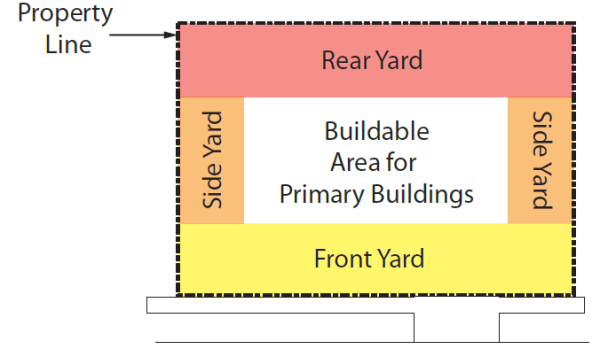
- Snow Storage and Drainage. Where snow removal and storage may pose a problem to traffic circulation or reduce the amount of adequate parking for winter business, the property owner shall designate a snow storage area and remove snow as necessary.
- Required Area: Snow storage areas not less than thirty-three percent (33%) of the parking, sidewalk, and driveways areas shall be incorporated into the site design.
- Location:
- Snow storage shall be located to avoid piling of snow against significant trees.
- Buildings to be on Lots. All buildings and structures, as defined herein, shall be located and maintained on a separate legal lot, such lot meeting all requirements of the Title 19, including the requirements of the Zone in which the lot is located.
- Fencing.
- Fencing Setbacks. A fence, hedge, wall, column, pier, post or any other similar structure for fencing or any combination of such structures is permitted in the required setback if it meets the following conditions:
- No fence, hedge, or wall extends beyond or across a property line without a recorded agreement with the abutting property owner; and
- Only one fence or wall shall be allowed per property line. Double fences, walls, or combination thereof are prohibited.
- Fencing Materials.
- Fencing materials shall be made of high quality, durable, materials that require minimal maintenance. All fencing shall follow the design requirements set forth in Chapter 19.38 Foothills and Canyons Overlay Zone of this Title.
- Prohibited Fencing Materials. The following fencing materials are prohibited:
- Materials not typically used or designated/manufactured;
- Scrap material;
- Security wire; or
- Electrified fencing.
- Fencing Setbacks. A fence, hedge, wall, column, pier, post or any other similar structure for fencing or any combination of such structures is permitted in the required setback if it meets the following conditions:
- Landscaping. Landscaping shall follow the requirements set forth in Chapter 19.38 Foothills and Canyons Overlay Zone of this Title.
- Accumulation of Junk.
- The accumulation of junk is prohibited in the municipality unless occurring in a fully enclosed and permitted structure.
- Exceptions. The following exceptions apply:
- A property owner may have up to two (2) inoperable vehicles on their property, provided
- The vehicle(s) are parked on private property on parking surface in compliance with Chapter 19.48;
- The vehicle(s) are secured with the windows closed, the trunk and hood closed, and the doors locked, and all four tires shall be on the ground;
- The vehicle(s) are not exposing jagged metal or other safety hazards due to damage;
- The vehicle(s) are completely on private property and not encroaching on any sidewalk, park strip, or public street; and
- The vehicle(s) do not visibly drip any fluids such as oil, transmission fluid, brake fluid, or coolant onto the parking surface or its surroundings; and
- A property owner may have up to (2) two inoperable vehicle that do not meet the requirements of Subsection 19.46.070.J.2.a. Subsections ii. and iii. for a total of fourteen (14) days while the vehicle is undergoing major engine, transmission or similar work. At the end of the fourteen (14-day timeframe, the vehicle shall be brought back into compliance with Subsection 19.46.070.J.2.a.
- A property owner may have up to two (2) inoperable vehicles on their property, provided
- Signs. Any development shall follow the sign standards set forth in Chapter 19.52 of this Title.
HISTORY
Amended by Ord. 2025-O-4-1 on 4/8/2025
Amended by Ord. 2025-O-4-1 on 4/8/2025
19.46.090 BUILDING STANDARDS
- Conform to Building Code. The building must meet the Town of Brighton’s building code or, if it is a manufacture home, it must be certified under the National Manufactured Housing Construction and Safety Standards Act of 1974 and must have been issued an insignia and approved by the U.S. Department of Housing and Urban Development and must not have been altered in violation of such codes. A used manufactured home must be inspected by the building official or designee prior to placement on a lot to ensure it has not been altered in violation of such codes.
- Buildings Taxed. The building must be taxed as real property. If the building is a manufactured home, an affidavit must be filed with the State Tax Commission pursuant to Utah Code 59-2-602.
- Utilities. If the building provides human-occupiable space and is constructed in a permanent nature, the building must be connected to and approved for all required utilities. Utilities shall be buried underground with the following exceptions:
- Transformers, pedestals, fire hydrants, and other appurtenances normally associated with “underground” utility installations are permitted on the surface of the ground.
- The development of existing lots in areas of the Town of Brighton now served with existing aboveground utilities, are exempt from this requirement.
- Permanent Foundation. The building must be attached to a site-built permanent foundation which meets the Uniform Building Code or, if the dwelling is a manufactured home, the installation must meet the ICBO Guidelines for Manufactured Housing Installations, including any successors to these standards, and the space beneath the structure shall be enclosed at the perimeter of the dwelling in accordance with such ICBO Guidelines, and constructed of materials that are weather-resistant and aesthetically consistent with concrete or masonry type foundation materials. At each exit door there must be a landing that is a minimum of thirty-six inches (36”) by thirty-six inches (36”) and that is constructed to meet the requirements of the Uniform Building Code. All manufactured home running gear, tongues, axles, and wheels must be removed at the time of installation.
- Roofs. The building shall have a roof surface of asphalt, composition, concrete, fiberglass or metal tiles or slate or built-up gravel materials.
- The Director or Designee may approve deviations from one or more of the developmental or architectural standards provided in subsections A through F of this section on the basis of finding that the architectural style proposed provides compensating design features and the proposed building will be compatible and harmonious with existing structures in the vicinity. The determination of the Director or Designee may be appealed to the Land Use Hearing Officer pursuant to the provisions in Chapter 19.20.
- Building Height Limitations and Exceptions.
- Buildings shall not be erected that contain less than one story above grade, as defined in this Title.
- Roof structures above the maximum height that provide utilities, safety measures, or building code requirements may be erected above the height limits prescribed in this Title, but no space above the height limit shall be allowed for the purpose of providing additional floor space. Roof structure for this purpose may not exceed a maximum of twenty feet (20’) above the maximum allowed building height unless otherwise specified in this Title.
- Public or semipublic utility buildings, when authorized in a zone, may be erected to a height not exceeding seventy-five feet (75’) if the building is set back from each otherwise established building line at zone in which the building is erected. Public or semipublic utility buildings do not include cell towers.
- Flag Poles and Church steeples are not included in building height calculations.
- Parking and Loading. Any development shall follow the parking and loading standards set forth in Chapter 19.48 Off-Street Parking and Mobility of this Title.
19.46.100 INFRASTRUCTURE AND PUBLIC IMPROVEMENTS
The minimum requirements for new public improvements shall be a combination of standards set forth in Title 14 Highways, Sidewalks, and Public Places and applicable standards set forth in this Title or adopted in the Town of Brighton’s Master Transportation Plan.
- Stormwater and Water Quality. Any development shall follow the standards set forth in Title 17 Flood Control and Water Quality.
- Culinary Water and Sanitary Sewer Requirements. All dwellings and other structures used for human occupancy shall be served by an adequate culinary water and sewage disposal facility approved by the Salt Lake County Health Department.
- Geologic Hazards and Floodplains. All development in the Town of Brighton shall be reviewed for compliance with Chapters 19.56 Flood Plain Regulations and Chapter 19.58 Geologic Hazards Ordinance.
- Mechanical Equipment. Air conditioning units, generators and other auxiliary mechanical and building equipment shall be placed at locations where they will be least intrusive in terms of noise, appearance, and odors, particularly for adjacent properties and public rights-of-way. Screening walls, landscaping, and other screening treatments shall be used so all required mechanical equipment is screened from public streets and adjoining properties. All building-mounted mechanical or communications equipment shall be a color to make it as unobtrusive as possible. If located on or adjacent to a building wall, the color of all mechanical and communications equipment shall blend with the color and design details of the building.
- Wildland Urban Interface. Lots found to be within the Wildland Urban Interface (WUI) as determined by the Utah Division of Forestry, Fire, and State Lands or other state-designated agencies may have additional requirements for site development. Lots found to be within the Wildland Urban Interface shall be required to demonstrate compliance with any applicable codes during the site plan approval process or other applicable land use applications.
- Landscaping. Any development shall follow the landscaping standards set forth in Chapter 19.38 Foothills and Canyons Overlay Zone of this Title.
19.46.150 EASEMENTS
- Storm drainage and utility easements for water, sanitary sewer, electricity, gas, and communications improvements shall be provided in the location and to the width as required by the provider.
- Easements for other purposes as required by the Director or designee shall be designed, designated, reserved, and dedicated as appropriate.
- All site plans and plats shall exhibit standard easement notes stating the type and purpose of the easement along with a list of prohibited uses/activities within the easement.
- Any cross-access agreement shall specify maintenance responsibilities and require that access be unrestricted. The agreement and a plat depicting the easement shall be recorded. Copies of the recorded documents and an attorney certification that the requirements for this paragraph have been met shall be provided to the Director or designee.

