
Brighton City Zoning Code
19.54 DARK
SKIES
19.54.010 PURPOSE
- The purposes of this Chapter are to:
- Encourage lighting practices that minimize light pollution, glare, light trespass, and sky glow to preserve and enhance views of the night sky.
- Maintain the mountainous atmosphere and community character of the Town of Brighton.
- Protect ecological conditions and nocturnal wildlife within the Town of Brighton.
- Maintain nighttime safety, utility, and security.
- Encourage lighting practices that promote energy conservation.
19.54.020 DEFINITIONS
- For the purpose of this Chapter, certain words, phrases, and terms used herein shall have the meanings assigned to them by this section:
- “Accent Lighting” means a light source illuminating building surfaces, landscape features, statues, and similar items for the purpose of decoration or ornamentation, or lighting that does not contribute to the safety or security of residents, guests, employees, or customers on a property.
- “Adaptive Controls” means devices such as motion sensors, timers, and dimmers used in concert with outdoor lighting equipment to vary the intensity or duration of the operation of lighting.
- “Backlight, Uplight, and Glare (BUG) Rating” means A BUG Rating stands for backlight, uplight, and glare. Backlight (B) is the light directed behind the light fixture, uplight (U) is any light directed upward above the horizontal plane of the light fixture, and glare (G) is the amount of light emitted from the light fixture “at high angles” (greater than 60-degrees from nadir).
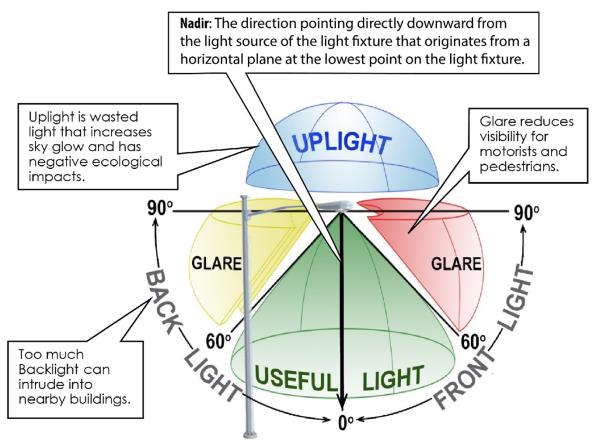 Figure 01: BUG Ratings (Adapted from City of Denver Department of Public Works 2023:
https://www.denvergov.org/files/assets/public/doti/documents/standards/pwes-012.2-street_lighting_design_guidelines.pdf) - “Bulb or lamp” means the source of electric light. To be distinguished from the whole assembly (see light fixture).
- “Candela (cd)” means the intensity of light emitted from a fixture in a certain direction.
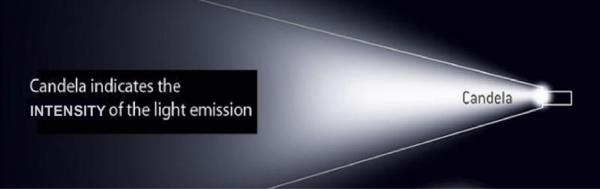
Figure 02: Candela (Adapted from Barco 2023 https://www.barco.com/en/support/knowledge-base/3736-what-is-the-difference-between-cdm2-lux-and-lumens) - “Commercial Property” means any parcel zoned C-1 Commercial, C-V Commercial, or C-2 Commercial Zone.
- “Constant Lighting” means Lighting that does not flash, blink, strobe, or otherwise emit bright bursts of light.
- “Correlated Color Temperature (CCT) or Color Temperature” means a specification of the color appearance of the light emitted by a lamp, relating its color to the color of light from a reference source when heated to a particular temperature, measured in degrees Kelvin (K).
 Figure 03: Correlated Color Temperature (adapted from Tachyon Light 2023 (https://tachyonlight.com/what-is-correlated-color-temperature/)
 - “Cut-off angle of a light fixture” means the angle measured up from the nadir (i.e. straight down) between the vertical axis and the first line of sight at which the bulb or lamp is not visible.
- “Diffuser” means a device used to distribute light from a source.
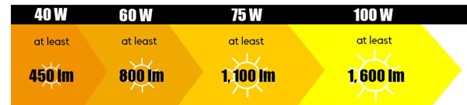
Figure 04: Watts to Lumens Relationship (adapted from Standard Products Inc 2023 https://www.standardpro.com/how-to-measure-light/)- “Floodlight” means a fixture designed to “flood” a well-defined area with light.
- “Footcandle” means a footcandle is a measurement of light intensity. One footcandle is defined as enough light to illuminate a one-foot square located one foot from the light source with one lumen of light.
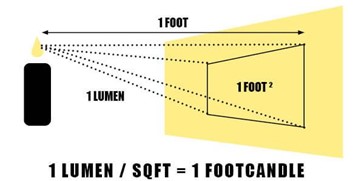
Figure 05: Footcandle (adapted from Standard Products Inc 2023 (https://www.standardpro.com/how-to-measure-light/) - “Full Cut-off fixture” (Fully-shielded fixture): An outdoor light fixture constructed and mounted so that the installed fixture emits no light (zero intensity) at or above horizontal (90° above nadir).
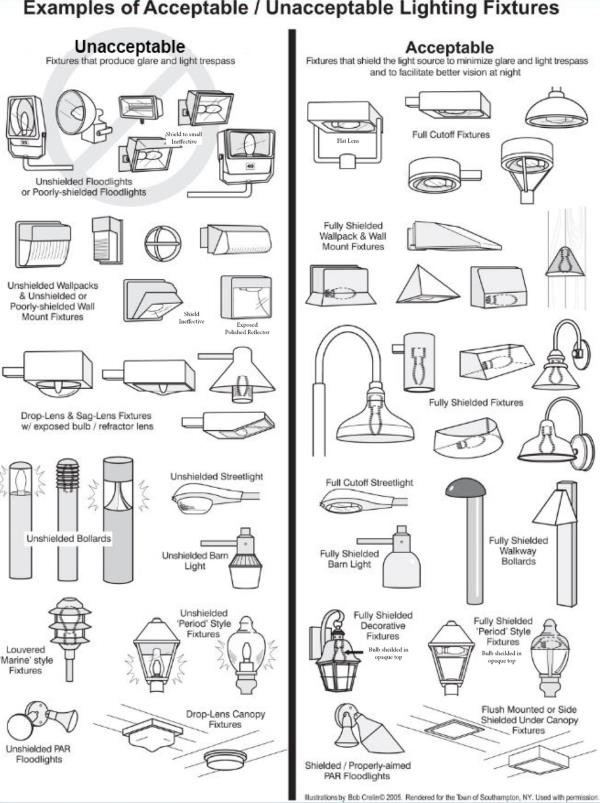
Figure 06: Examples of Unacceptable and Acceptable Light Fixtures (Adapted from International Dark-Sky Association 2023 https://www.darksky.org/) - “Glare” means the visual sensation caused by excessive brightness, and which causes annoyance, discomfort, or a loss in visibility.
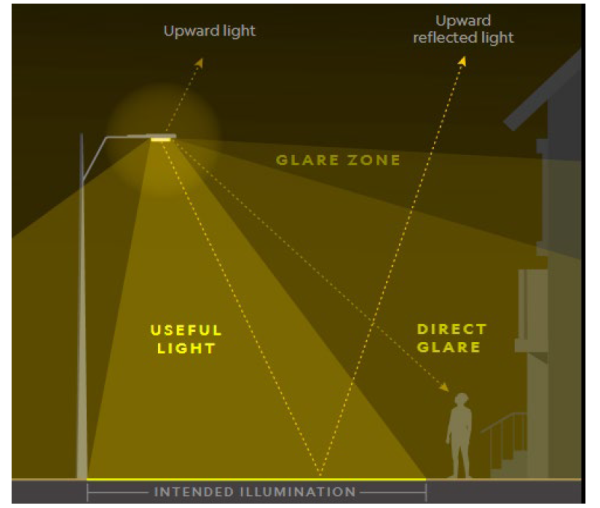
Figure 07: Glare (adapted from National Geographic 2023 https://www.nationalgeographic.com/science/article/nights-are-getting-brighter-earth-paying-the-price-light-pollution-dark-skies?) - “Hardscape” means any non-living horizontal site element, including but not limited to patios, decks, walkways, sidewalks, driveways, and steps.
- “House-side Shield” means opaque material applied to a fixture to block the light from illuminating a residence or other structure being protected from light trespass.
- “Illuminance” means light level measured in footcandles, lux, or lumens.
- “Incandescent lamp” means a lamp in which light is produced by a filament heated to a high temperature by an electric current.
- “Indoor Lighting” means any lamp, pendant, or fixture used to illuminate the interior of any structure.
- “Intensity” means the degree or amount of energy or light.
- “Internally Illuminated” means as it relates to signs, any sign which has a light source entirely enclosed within the sign and not directly visible.
- “International Dark-Sky Association (IDA, Inc.)” means a non-profit organization whose goals are to build awareness of the value of dark skies, and of the need for quality outdoor lighting.
- “kWh or Kilowatt-hour)” means a measure of electrical energy equivalent to a power consumption of 1,000 watts for one hour.
- “Lamp” means a generic term for a manufactured source created to produce optical radiation, meaning ultraviolet radiation (UV), visible light (VIS), and infrared radiation (IR).
- “Lamp Life” means the average lifespan for a specific type of lamp.
- “LED or Light Emitting Diode” means LED lighting products produce light up to ninety percent (90%) more efficiently than incandescent light bulbs.
- “Light Pollution” means the brightening of the night sky caused by man-made sources which has a disruptive effect on natural cycles and inhibits the observation of stars and planets.
- “Light Fixture (Luminaire)” means a complete lighting unit that typically includes components such as a fixture housing, ballast, reflector, shield or diffuser, and a lamp or lamps.
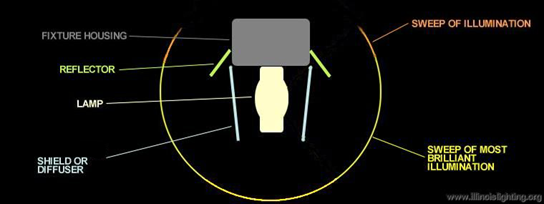
Figure 08: Components of a light fixture (adapted from Illinois Coalition for Responsible Outdoor Lighting 2023 http://www.illinoislighting.org/fixture2.html) - “Light Source” means the part of a light fixture that produces light, e.g., the bulb, lamp, or diode.
- “Light Spill” means unwanted spillage of light onto adjacent areas including residential properties and ecological sites. (See also: Light Trespass.)
- “Light Trespass” means light falling where it is not wanted or needed. (See also: Light Spill.)
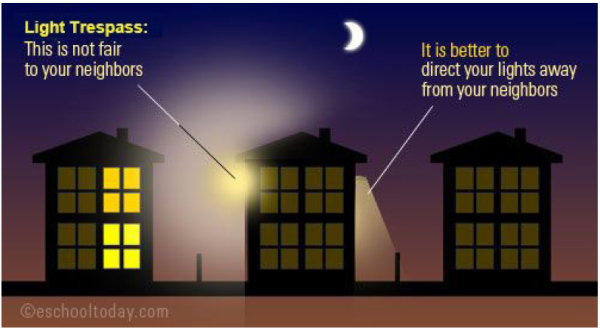
Figure 09: Light Trespass Compared to Adequate Shielding (adapted from E School Today 2023 https://eschooltoday.com/learn/types-of-light-pollution/) - “Lighting Controls” means devices used for either turning lights on and off or for dimming. Photocell Sensors automatically turn lights on and off in response to natural light levels. Some advanced modes can slowly dim or increase the lighting level. See also: Adaptive Controls.
- “Lumen” means a measurement of light intensity. One lumen is approximately equal to the amount of light emitted by one candle at a one-foot distance. A light source with higher lumens emits brighter light.

Figure 10: Comparison of bulb types, lumens, and watts (adapted from Efficiency Maine 2023 https://www.efficiencymaine.com/at-home/lighting-solutions/) - “Lux (lx)” means the unit of illuminance equal to one lumen per square meter.
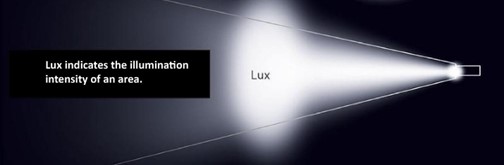
Figure 11: Lux (Adapted from Barco 2023 https://www.barco.com/en/support/knowledge-base/3736-what-is-the-difference-between-cdm2-lux-and-lumens) - “Manufacturer’s Catalog Cut” means a publication or other printed material of a lamp or lighting manufacturer offering visual and technical information about a lighting fixture or lamp.
- “Mounting height” means the height of the light fixture as measured from the point at which light is emitted above the ground plane (pole-mounted) or lowest finished floor elevation (structure-mounted).
- “Multi-Family Residential Property” means any parcel having a building containing five or more dwelling units, or any parcel zoned R-M Residential.
- “Nadir” means the direction pointing directly downward from the light source of the light fixture that originates from a horizontal plane at the lowest point on the light fixture.
- “Optic” means the components of a light fixture such as reflectors, refractors, and protectors which make up its light emitting section.
- “Outdoor Light Fixture or Outdoor Lighting or Exterior Lighting)” means an outdoor, electric, or solar-powered illuminating lamp, or similar device used for lighting structures, parking lots, pathways, service canopies, recreational areas, signs, or other similar outdoor uses.
- “Partially Shielded Light Fixture” means an outdoor light fixture constructed and mounted so that the installed fixture emits most, but not all, of its light below the horizontal plane.
- “Pathway Lights” means a light fixture, or collection of light fixtures, less than eighteen inches (18") in height, lining one or both sides of an outdoor path or walkway that provides illumination to guide persons along the outdoor path or walkway.
- “Photometry” means the quantitative measurement of light level and distribution.
- “Photocell” means an electronic device that changes the light output of a light fixture dynamically in response to the ambient light level around the light fixture.
- “Pool Lighting” means light fixtures located below the surface of the water in a swimming pool, hot tub, reflecting pool, fountain, or other water features.
- “Recreational Lighting” means lighting used to illuminate playing fields, courts, playgrounds, ice rinks, or similar outdoor recreational facilities.
- “Reflector” means an optic that achieves control of light by means of reflection (using mirrors).
- “Refractor” means an optic that achieves control of light by means of refraction (using lenses).
- “Religious Institutions Property” means property containing a religious or spiritually-oriented structure(s) or accessory structure(s), where persons regularly assemble for religious or spiritual purposes and related social events.
- “Security Lights” means lighting designed to illuminate a property or grounds for the purpose of security.
- “Shielding” means an opaque material that blocks the transmission of light.
- “Single-Family Residential Property” means any parcel zoned FR-0.5, FR-1, and FR-20.
- “Skyglow” means the brightening of the nighttime sky resulting from the scattering and reflection of artificial light by moisture and dust particles in the atmosphere. Skyglow is caused by light directed or reflected upwards or sideways, reducing one’s ability to view the nighttime sky.
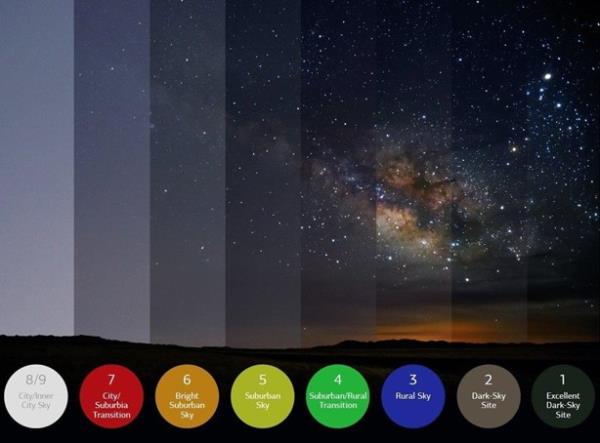
Figure 12: Skyglow Bortle Scale measuring degradation of the night sky (adapted from Skyglow Project 2023 https://skyglowproject.com/#new-page) - “Spotlight” means a fixture or lamp designed to light a small area very brightly. See the definition of Floodlight.
- “Stationary Lighting” means lights that are fixed in a non-moving position.
- “Task Lighting” means task lighting is used to provide direct light for specific activities without illuminating the entire area.
- “Tower” means any monopole, antenna or the like that exceeds eighteen feet (18’) in height.
- “Unshielded Light Fixture” means a fixture that allows light to be emitted above the horizontal plane, either directly from the lamp or indirectly from the fixture or reflector.
- “Visibility” means the distance one can see horizontally as determined by light and weather conditions.
- “Wall Pack” means a light fixture, typically affixed to the side of a structure, used for area lighting.
19.54.030 SCOPE AND APPLICABILITY
- Compliant Lighting.
- Lighting installed and/or replaced after the effective date hereof in all zones in the Town of Brighton shall comply with the requirements established by this Chapter.
- Given the steep and variable topography of the Town of Brighton, it is possible that lighting that is compliant with this Ordinance could cause unwanted effects of light pollution, glare, light trespass, sky glow, and degradation of the night sky environment. In these instances, the Town of Brighton encourages property owners to consider taking steps to mitigate such conditions.
- Non-compliant Lighting.
- Lighting that does not meet the requirements of this Chapter shall be considered non-compliant lighting.
- Amortization: All non-compliant exterior lighting fixtures shall be brought into compliance no later than five (5)-years from the effective date of this Chapter. The Town of Brighton encourages property owners to voluntarily bring non-compliant lighting into compliance with this Chapter as soon as possible.
- Lighting Modifications.
- When a Building Permit is required:
- If the proposed structural modifications necessitate the removal of a non-compliant light fixture, the light fixture shall be replaced or modified to bring it into compliance with the requirements of this Chapter.
- If the proposed structural modifications represent a value of fifty percent (50%) or more of the building value at the time of submittal, a lighting plan for the property shall be submitted subject to the requirements in Section 19.54.090.
- When a building permit is not required and a non-compliant light fixture is replaced, destroyed, damaged, or modified, the replacement fixture shall comply with the requirements of this Chapter.
- When a Building Permit is required:
- Conflicts.
- In the event any federal, state, or county statute or regulation conflicts with any requirement of this Chapter, the most restrictive statute, regulation, or requirement shall govern unless otherwise required by law. In the event any requirement of the Town of Brighton’s other ordinances conflicts with the requirements of this Chapter, the most restrictive requirement shall govern.
19.54.040 STANDARDS
- Minimum Necessary.
- The intensity of outdoor (exterior) lighting shall be the minimum necessary to provide for safety and functionality. The lowest-lumen light source necessary for a lighting application shall be used.
- All lighting shall be purpose-driven:
- Useful: All light used shall have a specific purpose.
- Targeted: Light shall be directed only to where needed.
- Low Light Levels: Light shall be no brighter than necessary.
- Controlled: Light shall be used only when it is useful.
- Color: Where possible, warmer color lights shall be used.
- All lighting shall be purpose-driven:
- The intensity of outdoor (exterior) lighting shall be the minimum necessary to provide for safety and functionality. The lowest-lumen light source necessary for a lighting application shall be used.
- Allowable Applications.
- Outdoor lighting in compliance with this Chapter shall only be allowed in the following applications:
- To illuminate the entrances to buildings (including garage entrances).
- To illuminate pathways and walkways.
- To illuminate parking areas and parking area access lanes.
- To illuminate gathering areas, such as patios, pool and hot tub areas, dining areas, and recreation areas.
- For security purposes, provided all the following conditions are met:
- The lighting is activated by motion sensors and shuts off, within or before, fifteen (15) minutes after each activation or when the activity involved is completed.
- The lighting is placed and directed such that no direct illumination falls outside the property boundaries where the security lighting is placed.
- Sensors are adjusted to meet site conditions to avoid repetitive activation by wildlife, wind, and/or other disturbances.
- To illuminate signage.
- For Accent Lighting, provided all the following conditions are met:
- All accent lighting is mounted on and illuminates only building facades visible from an adjacent public right of way.
- The accent lighting is sufficiently shielded such that the light source is not visible beyond the property boundaries.
- The accent lighting is directed such that all light shines on the building facade, not on the adjacent property or the night sky.
- The accent lighting is not used to illuminate the landscape, landscape elements, statues, or other similar features.
- To illuminate outdoor water features, provided all the following conditions are met:
- The lighting is angled below the horizontal plane.
- The lighting is placed underneath or behind the water such that the water diffuses the light from all points where the light is visible.
- Temporary exterior or decorative lighting utilized for holidays or special events shall be extinguished by 10:00 pm. When in use, the lighting shall not exceed the allowed footcandle limit for the property. This can be accomplished by reducing light usage in other areas of the property. Temporary lighting shall be limited to the following:
- The period of time between Thanksgiving Day and January 8th each calendar year; and,
- Periods of time outside the month of December shall not exceed seven (7) days per calendar month for other holidays and special events.
- Outdoor lighting in compliance with this Chapter shall only be allowed in the following applications:
- Total Light Output.
- Commercial, Government, and Religious Institutions Properties: The total amount of outdoor lighting, whether shielded or unshielded, shall not exceed two (2.0) footcandles per square foot of hardscape.
- Multi-Family Residential Properties: The total amount of outdoor lighting, whether shielded or unshielded, shall not exceed one and one-half (1.5) footcandles per square foot of hardscape.
- Single-Family Residential Properties: The total amount of outdoor lighting, whether shielded or unshielded, shall not exceed one (1.0) footcandle per square foot of hardscape.
- Single-Family Residential Properties used for overnight accommodations or commercial uses shall comply with Single-Family Residential Property standards for total light output.
- For all Properties – Light output from outdoor sources shall not exceed point one (0.1) footcandle at the property line.
- Maximum Color Temperature of All Outdoor Lighting Fixtures.
- The correlated color temperature of any outdoor lighting fixture shall not exceed three thousand degrees Kelvin (3000°K).
- Fully-Shielded Fixture Requirements.
- Unless specifically exempted by this Chapter, all outdoor lighting shall use fully-shielded fixtures that are designed and constructed so that:
- No light is emitted and/or reflected above the horizontal plane of the fixture.
- Light emitted is limited to a value not exceeding ten percent (10%) of lamp lumens at or above eighty degrees (80°) nadir and zero lumens above the horizontal plane (90° nadir).
- Lighting is placed and/or directed at a location, angle, and/or height to prevent direct illumination outside the property boundaries where the light fixtures are located.
- When a light manufacturer provides a BUG rating, the uplight rating (U) shall equal zero (0).
- Characteristics:
- To qualify as a fully-shielded fixture, the top and sides of a light fixture shall be made of completely opaque material, such that light only escapes through the bottom of the fixture. Fixtures with translucent or transparent sides, or sides with perforations or slits, do not qualify as fully-shielded. Any glass or diffuser on the bottom of the fixture must be flush with the fixture (no drop lenses) and must not reflect light that breaks the horizontal plane established at the bottom of the shield. Merely placing a light fixture under an eave, canopy, patio cover or other similar cover does not qualify the fixture as being fully-shielded.
- Unless specifically exempted by this Chapter, all outdoor lighting shall use fully-shielded fixtures that are designed and constructed so that:
- Exemptions To Fully-shielded Fixture Requirements. All lighting described in this Section shall be included in calculating the total footcandle output allowed unless otherwise noted and as set forth in Section 19.54.040. C.
- Spotlights:
- Spotlights controlled by motion sensors having a light output of less than one thousand (1000) lumens per lamp are exempt from the fully-shielded requirement, provided:
- The fixture is a spotlight or other type of directed light that shall be directed at a forty-five-degree (45°) angle or less, where the zero (0) angle is pointing straight down, and
- The fixture must not be placed in such a manner that results in light trespass, and
- The lighting elements controlled by motion sensors shall not be triggered by movement or activity located off the property on which it is located.
- The fixture is hooded or shielded to the extent necessary to prevent glare on adjacent properties or roadways.
- The lighting is activated by motion sensors and shuts off, within or before, fifteen (15) minutes after each activation or when the activity involved is completed.
- The fixture is a spotlight or other type of directed light that shall be directed at a forty-five-degree (45°) angle or less, where the zero (0) angle is pointing straight down, and
- Spotlights controlled by motion sensors having a light output of less than one thousand (1000) lumens per lamp are exempt from the fully-shielded requirement, provided:
- Pathway Lights:
- Pathway lights less than eighteen inches (18") in height are exempt from the fully-shielded fixture requirement if:
- The total light emitted by all pathway light fixtures as measured along the centerline of the pathway lighted does not exceed one (1.0) footcandle; and
- The lights have opaque caps that direct light below the horizontal plane.
- Pathway lights less than eighteen inches (18") in height are exempt from the fully-shielded fixture requirement if:
- Temporary Exterior or Decorative Lighting:
- Temporary exterior or decorative lighting, provided that individual lamps do not exceed seventy (70) lumens, the total output of temporary lighting does not cause the property to exceed total footcandle levels allowed in this Chapter, and the lighting does not cause light trespass or interfere with the reasonable use and enjoyment of surrounding properties.
- Law Enforcement Lighting, Traffic Control Signals, and Traffic Safety Devices:
- Traffic control signals, traffic safety devices, and law enforcement lighting used by a government agency, is exempt from and not governed by the requirements of this Chapter.
- Temporary Emergency Lighting:
- Temporary emergency lighting in use by law enforcement or government agencies, or at their direction, is exempt from and not governed by the requirements of this Chapter.
- Pool Lighting:
- Underwater lighting fixtures providing illumination to all underwater areas of a swimming pool, hot tub, reflecting pool, fountain, or other such water feature provided they are shielded to the greatest extent feasible to prevent light trespass beyond the surface of the water.
- Spotlights:
- Restrictions On Total Amount of Unshielded Lighting.
- Outdoor lighting that is exempt from the shielding requirement in this Chapter shall not contribute more than the equivalent of:
- Zero point two (0.2) footcandle per square foot of hardscape for Commercial, Government, or Religious Institutions Properties.
- Zero point fifteen (0.15) footcandle per total square foot of hardscape for Multi-Family Residential Properties.
- Zero point one (0.1) footcandle per square foot of hardscape for Single-Family Residential Properties.
- All lighting fixtures shall be fully-shielded when installed within twenty-five feet (25’) of adjacent residential property lines.
- Outdoor lighting that is exempt from the shielding requirement in this Chapter shall not contribute more than the equivalent of:
19.54.050 NIGHT LIGHTING LIMITATIONS
- Commercial, Government, and Religious Institutions Properties.
- Shall turn off all outdoor lighting within one (1) hour after closing until 6:00 a.m. the following morning, except those listed below:
- Lighting to illuminate the entrance(s).
- Parking lot and pathway lighting required for the safety of customers, employees, and guests.
- Shall turn off all outdoor lighting within one (1) hour after closing until 6:00 a.m. the following morning, except those listed below:
- Multi-Family and Single-Family Residential Properties.
- Shall be turned off one (1) hour after dusk until 6:00 am the following morning, except those listed below:
- Lighting to illuminate entrances.
- Parking lot and pathway lighting required for the safety of residents or guests.
- Outdoor gathering spaces when in use.
- Shall be turned off one (1) hour after dusk until 6:00 am the following morning, except those listed below:
- Recreational Lighting.
- Shall be turned off when not in use, and from (1) hour after dusk until 6:00 am the following morning, except to conclude a community-approved event that is underway.
- Ski Runs within Ski Resort Boundaries. Lighting for the purpose of illuminating ski runs within the boundaries of a ski resort may be exempt from the standards of this chapter with the exception that all lighting illuminating ski runs shall be turned off within one (1) hour of closing or at 10:00 pm, whichever is later.
19.54.060 SPECIALIZED OUTDOOR LIGHTING
- Roadway/Streetlights.
- Roadways and streetlights are prohibited unless recommended by the County Engineer or required by the Utah Department of Transportation (UDOT). When deemed necessary, streetlights shall utilize lamp types that are fully-shielded light fixtures that minimize sky glow, light trespass, and other unintended impacts of artificial lighting. All street lights shall utilize the lowest light levels accepted by the County Engineer and/or UDOT.
- Parking Lots.
- Spot or flood lighting of parking lots from a building or other structure is prohibited.
- The mounting height of any pole-mounted light fixture used to illuminate parking lots in commercial, government, or religious institution properties shall not exceed fourteen feet (14').
- The mounting height of any pole-mounted light fixture used to illuminate parking lots in all residential properties shall not exceed six feet (6').
- All pole-mounted parking lot lights shall be set back from property lines at a distance equal to two and one-half (2.5) times the height of the pole unless an internal or external shield prevents the fixture from being visible from outside the property boundaries.
- All parking lot lighting shall use fully-shielded fixtures.
- Internal or external shields shall prevent the light source from being visible from outside the relevant parking lot.
- Recreational Lighting.
- All proposals for recreational lighting for playing fields or court areas shall be submitted to the Director or designee, who may approve such requests only after finding:
- The recreational lighting has met the requirements for minimizing glare, light spill, light trespass, and uplight using louvers, hoods, or shielding.
- The recreational lighting only illuminates the playing field or court area and is shielded to prevent illumination from falling outside of those areas.
- Lighting on the playing field or court area shall not exceed twenty (20) footcandles per square foot.
- The light source for recreational lighting is not visible from adjacent properties.
- Pole-mounted recreational lighting is limited to eighteen feet (18') in mounting height. Pole-mounted recreational lighting must be set at a distance equal to two and one-half (2.5) times the height of the pole installed from any adjacent property line unless an internal or external shield prevents the fixture from being visible from outside the property boundaries.
- All proposals for recreational lighting for playing fields or court areas shall be submitted to the Director or designee, who may approve such requests only after finding:
- Amphitheater Lighting.
- Outdoor amphitheaters may use illumination to light the performance area of the amphitheater and provide public safety. The following requirements apply to all amphitheater lighting:
- Lighting used to illuminate the performance area must be either directed spotlighting or fully-shielded lighting. If directed spotlighting, the light source must be located and designed such that it is not visible beyond the property boundaries.
- Lighting used to illuminate the performance area may only be turned on during performances or rehearsals.
- Lighting used to illuminate the seating areas, pathways, and other areas of the amphitheater must meet all the requirements of this Chapter.
- Outdoor amphitheaters may use illumination to light the performance area of the amphitheater and provide public safety. The following requirements apply to all amphitheater lighting:
- Memorial or Commemorative Lighting.
- Memorial or Commemorative lights that are erected or authorized by the Town of Brighton shall be subject to conditions established by the Town Council.
- Signs.
- Where other municipal ordinances are in conflict with the requirements of this Chapter, the more restrictive requirements shall apply.
- Signs may be unlighted, lighted externally, lighted internally, or backlit. All sign lighting must be designed, directed, and shielded in such a manner that the light source is not visible beyond the property boundaries where the sign is located. Lighting for signs must be directed such that only the sign’s copy area is illuminated.
- Lighting for signs must be stationary and constant.
- All signage elements must be stationary.
- Standards for Externally Illuminated Signs:
- Lighting for externally illuminated signs must be aimed and shielded so that light is directed only onto the sign face and does not intrude onto adjacent streets, roads, or properties or into the night sky.
- Lighting for externally illuminated signs must be mounted at the top of the sign (or within two feet (2’) of the top of a building-mounted sign).
- Standards for Internally Illuminated Signs:
- Lighting Is Visible on Both Sides of the Sign:
- Only sign copy areas and logos may be illuminated on an internally illuminated sign.
- Internally illuminated signs shall use semi-opaque materials for sign copy such that the light emanating from the sign is diffused. Transparent or clear materials are not allowed for sign copy. Non-copy portions of the sign (e.g., background and graphics) shall be made of completely opaque material.
- Lighting Is Visible on Both Sides of the Sign:
- Standards for Backlit Signs:
- Only One Side of Sign Is Lit:
- Backlit signs shall be designed such that the light source is not visible.
- Backlit signs shall be designed such that direct illumination does not emanate out of the sign. Rather, the backlighting shall only allow indirect illumination to emanate from the sign. For example, signs that create a "halo" effect around sign copy are allowed.
- Backlit signs shall use low-lumen light sources (450 lumens maximum).
- Only One Side of Sign Is Lit:
- Illuminated Window Signage:
- Illuminated window signs positioned to be primarily visible outside all structures are allowed only if there are no more than two (2) signs. Each sign shall measure less than three and one-half square feet (3.5 sq.ft.) in area.
19.54.070 PROHIBITED LIGHTING
- Accent Lighting that is directed upward above the horizontal plane to illuminate building structures, landscape, landscape features, statues or similar features, vegetation, or for any other use.
- Flashing, blinking, intermittent, or other lights that move or give the impression of movement.
- Unshielded Floodlights or Spotlights affixed to buildings for the purpose of lighting parking lots.
- Searchlights and laser source lights.
- Building-mounted light fixtures in residential properties at a mounting height of more than fourteen feet (14’) above the finished grade at the primary entrance to the corresponding side of the building (i.e., front, sides, rear).
- For buildings having sides without an entrance, the mounting height limitation established by the finished grade at the lowest primary entrance elevation on any side of the structure shall control.
- Wall-mounted lighting may be utilized for patios and decks located above the primary entrance elevation, provided that the lighting is directed so that all light falls only on the deck or patio surface intended to be lit and the light source is shielded and/or diffused such that the light source is not visible outside the property boundary.
19.54.080 TOWERS
- All monopole, antenna, tower, or support facility lighting not required by the Federal Aviation Administration (FAA), the Federal Communications Commission (FCC), or Municipal Fire and Police is prohibited.
- When lighting is required by the FAA, FCC, or Municipal Fire and Police, such lighting shall not exceed the minimum requirements of those agencies.
- All other lighting used on the property not regulated by the FAA, FCC, or Municipal Fire and Police shall conform to the requirements of this Chapter.
19.54.090 APPLICATION AND REVIEW PROCEDURES
- Lighting Plan Required.
- In any application for a sign permit, building permit for new development, and building permit for renovation subject to 19.54.030.D of this Chapter, conditional use permit, subdivision, design/development review, and any other development application within any zoning district, including all municipal projects, the applicant shall, as part of the application process, submit a Lighting Plan including sufficient information to enable the Director or designee to determine whether the proposed lighting complies with the requirements of this Chapter.
- Lighting Plans shall include the following:
- Site plans or drawings indicating the proposed location of all outdoor lighting fixtures, both proposed and any already existing on-site, including:
- mounting height of all light fixtures on the premises, and
- type of light fixture, lamps, supports, shielding, and reflectors used and,
- installation and electrical details.
- A description of each light fixture, lamp, support, and shield, both proposed and existing. The description shall include but is not limited to, the Manufacturer’s Catalog Cuts and illustrations (including sections where required); lamp types, wattages, initial lumen outputs, diffusers, shielding mechanisms, and other accessories. A BUG rating must be included if supplied for each light fixture.
- A table showing the total number of proposed exterior lights, by fixture type, lumens, and lamp type, including a Manufacturer’s Catalog Cuts whenever possible.
- The Lighting Plan must demonstrate that no more than the allotted footcandle of light shall be utilized on the property or properties, as specified in section 19.54.040.C.
- Such other information that the Director or designee may determine is necessary to ensure compliance with the requirements of this Chapter.
- Site plans or drawings indicating the proposed location of all outdoor lighting fixtures, both proposed and any already existing on-site, including:
- If the Director or designee determines that any proposed lighting described in a lighting plan does not comply with the requirements of this Chapter, the lighting plan shall not be approved, and the specific permit applied for shall not be issued.
- In the event lighting installed pursuant to an approved lighting plan is nonetheless not compliant with the requirements of this Chapter, the property owner shall bring the lighting into compliance.
19.54.100 APPEALS, VIOLATIONS, ENFORCEMENT, AND PENALTIES
- Appeal.
- In the event the Director or designee denies the Lighting Plan, the applicant may appeal the decision with the Director or designee.
- The Director or designee may approve a lighting plan that does not comply with this Chapter if the applicant demonstrates that compliance with the Chapter constitutes an undue hardship.
- In the event the Director or designee approves the lighting plan, they may attach other conditions to such approval that will make the proposed lighting comply with the spirit of this Chapter.
- In the event the Director or designee does not approve the proposed lighting plan, the applicant may appeal that decision pursuant to the requirements of Chapter 19.20.030 Appeals of the Town of Brighton Municipal Code.
- The Director or designee may approve a lighting plan that does not comply with this Chapter if the applicant demonstrates that compliance with the Chapter constitutes an undue hardship.
- In the event the Director or designee denies the Lighting Plan, the applicant may appeal the decision with the Director or designee.
- Violations.
- The following constitute violations of this Chapter:
- Failing to comply with the night lighting limitations set forth in Section 19.54.050.
- The installation, maintenance, or operation of any outdoor lighting fixture not in compliance with the requirements of this Chapter if such fixture is installed after the effective date of this Chapter.
- The alteration of any outdoor lighting fixtures after the approval of a lighting plan by the Director or designee, when such alteration does not conform to the requirements of this Chapter.
- Failure to shield, correct or remove lighting that is installed, operated, maintained, or altered in violation of the requirements of this Chapter.
- The following constitute violations of this Chapter:
- Enforcement.
- If, after investigation, the Director or designee finds that any requirement of this Chapter is being violated, the Director or designee shall give notice by hand delivery or by certified mail, return receipt requested, of such violation to the owner and/or occupant of such premises, demanding that the violation be abated within sixty (60) days of the date of hand-delivery or of the date of mailing of the notice. Planning and Development Services Staff shall be available to assist in working with the violator to correct the violation. If the violation is not abated within the sixty (60)-day period, the Director or designee may institute actions and proceedings, either legal or equitable, to enjoin, restrain or abate any such violations and to collect penalties for such violations.
- Penalties.
- Penalties: A violation of the requirements of this Chapter shall be punishable by a civil penalty of $50.00 per day after the expiration of the 60-day abatement period set forth in Section 19.54.100.C.1.

