
Broomfield City Zoning Code
CHAPTER 17
32 - Accessory Buildings and Uses
17-32-010 - Accessory building and use defined.
(A)
Accessory building and use means a subordinate use of a building, other structure, or tract of land, or a subordinate building or other structure:
(1)
Which is clearly incidental to the use of the principal building;
(2)
Which is customary in connection with the principal building;
(3)
Which is ordinarily located on the same lot with the principal building, other structure, or use of land.
(B)
Accessory building and use may include, but is not limited to, the following:
(1)
Home occupations;
(2)
Household pets;
(3)
Signs;
(4)
Off-street parking areas;
(5)
Off-street loading areas;
(6)
Fences, hedges, and walls;
(7)
Private greenhouse;
(8)
Private swimming pool;
(9)
Storage of merchandise in business and industrial districts;
(10)
Fallout shelters;
(11)
Cultivation, storage, and sale of crops, vegetables, plants, and flowers produced on the premises; and
(12)
Detached garages.
(Ord. 149 Art. 18 §2, 1973)
17-32-020 - Home occupations.
(A)
Home occupation means a trade, occupation, or profession conducted by any person within or from a dwelling unit.
(B)
The city council finds and declares that home occupations are an important and vital part of the city and provide benefit to residents of the city; that residents of neighborhoods have an interest in protecting the residential character of their neighborhoods; and that regulation of home occupations is necessary in order to foster and promote an amicable relationship between those who conduct home occupations and their neighbors.
(C)
A home occupation shall be allowed as a permitted accessory use, subject to the following regulations:
(1)
Such use shall be conducted entirely within a dwelling unit or other building on the parcel and conducted by the inhabitants living there and no others;
(2)
Such use shall be clearly incidental and secondary to the use of the dwelling for dwelling purposes, and shall not change the character thereof;
(3)
The total area used for such purposes shall not exceed one-half the first floor area of the user's dwelling unit;
(4)
There shall be no exterior signs or advertising;
(5)
There shall be no exterior storage on the premises of material or equipment used as a part of the home occupation;
(6)
There shall be no offensive vibration, smoke, dust, odors, heat, or glare noticeable at or beyond the property line;
(7)
No more than two motor vehicles associated with patrons of the home occupation shall be parked at any time on the dwelling unit site or on the street;
(8)
No more than one motor vehicle and no more than one trailer as defined in section 10-12-040, B.M.C., used in whole or in part for a home occupation, shall be parked at any time on the dwelling unit site or on the street; and
(9)
No commercial vehicle greater than 10,000 lbs. Gross Vehicle Weight, used in whole or in part for a home occupation shall be parked at any time on the dwelling unit site or on the street.
(D)
Family child care homes, as defined below, shall be allowed as home occupations, subject to the following regulations, except that family child care homes are not subject to the requirements of sections 17-32-020(C), B.M.C., but shall comply with the following:
(1)
Family child care homes must be licensed by the state and comply with all state regulations promulgated by the Colorado Department of Early Childhood, and all local zoning and building regulations.
(2)
Family child care homes may care for no more than twelve children total, including any children of the provider under twelve years of age, at any one time.
(3)
Rear yard storage of playground equipment, swing sets, toys, and other items associated with outdoor activity related to a family child care home is allowed.
(4)
No more than two motor vehicles associated with patrons or employees of immediately adjacent large family child care home may be parked at any time at each dwelling unit site or on the street, other than fifteen minutes or less for the purpose of loading or unloading property or passengers.
(5)
Immediately adjacent large family child care homes shall be clearly incidental and secondary to the use of the dwelling for dwelling purposes, and shall not change the character of the area.
(E)
Adult daycare homes, as defined in section 17-04-018, shall be allowed as home occupations, subject to the following requirements:
(1)
Adult day care homes shall comply with all applicable state, federal and local laws and regulations, including local zoning, building and fire regulations;
(2)
Adult daycare homes shall obtain all necessary licenses and certifications as required by the state;
(3)
Adult daycare homes may only operate after approval from the city council following a public hearing. The city council shall consider the request and shall make a final decision of approval, of approval with conditions or of denial. Along with the other factors set forth in this section, city council shall consider the relation of the requested uses to the character of the surrounding neighborhood, the proposed hours of operation, any proposed expansion or remodeling of the residence, and the desirability and need for such a use in the specific area of the community at the public hearing prior to making its final decision. Notice of such public hearing shall be given in accordance with chapter 17-52, B.M.C.;
(4)
Adult daycare homes may have not more than two motor vehicles associated with patrons or employees other than residents of the adult daycare home parked at any time on the dwelling unit site or on the street frontage of such dwelling unit, other than fifteen minutes or less for the purpose of loading or unloading property or passengers;
(5)
At least 100 square feet of finished interior space, as defined in subsection 17-04-202(C), B.M.C., for each resident and care recipient; and
(6)
At least 100 square feet of finished interior space, as defined in subsection 17-04-202(C), B.M.C., for each resident and care recipient; and
(Ord. 149 Art. 18 §3, 1973; Ord. 433 §2, 1981; Ord. 1394 §1, 1999; Ord. 1590 §2, 2001; Ord. 1817 §1, 2005; Ord. No. 2051, § 1, 2017; Ord. No. 2233, § 8, 7-23-2024)
17-32-030 - Household pets.
Pets, such as dogs and cats which are generally kept within a dwelling, shall be considered as a permitted accessory use, provided that the conditions of all other applicable city ordinances are met.
(Ord. 149 Art. 18 §4, 1973)
17-32-040 - Off-street parking; required spaces.
(A)
Each new building or change of use, or addition to any use, shall provide off-street parking spaces for vehicles as designated in this section. "Parking Maximums" for all land use types are equal to 125% of the parking minimums shown in this table.
* For purposes of this Chapter 17-32, Income-Aligned Multifamily shall mean multifamily housing developments which comply with the City's Inclusionary Housing Ordinance (B.M.C. 17-76) through the provision of On-Site Affordable Units. To the extent a development is not 100% income aligned, then the above parking requirements shall be applied pro-rata based on the percentage of On-Site Affordable Units provided.
(B)
Parking Reduction Areas. Off-street parking requirements for certain land uses are eligible for reductions to the extent the property is within a Parking Reduction Area as set forth on the Broomfield Parking Reduction Area Map dated January 28, 2025.
(C)
Within designated Parking Reduction Areas, for eligible land uses, Parking Maximums are set to the minimum off-street parking requirements for non-Parking Reduction Areas and there are no parking minimums.
(D)
Mixed Use Developments. Parking requirements for buildings containing more than one use shall be established by determining the required number of spaces for each separate use.
(E)
Fractional Spaces. If the calculation of required parking spaces results in a fractional number, that number shall be rounded to the nearest whole number with 0.5 or greater rounded up to the next whole number.
(F)
Legacy Zone Districts. Properties previously located in Adams County, Boulder County, Jefferson County, and Weld County and incorporated into the City and County of Broomfield as of November 15, 2001, may have retained the legacy county zoning in place prior to incorporation. To the extent specific regulations relating to parking for vehicles or bicycles are included in legacy county zoning, typically through a specifically adopted planned unit development or other site development plan, such specific zoning shall apply, or the property owner may comply with the current Broomfield Municipal Code. To the extent general zoning parking requirements are referenced in legacy county zoning, such references shall be interpreted to mean the Broomfield Municipal Code.
(G)
Accessible parking spaces complying with the Americans with Disabilities Act (ADA) for accessibility must be provided at the following minimum rates. The number of accessible parking spaces must be considered separately for each parking structure (lot or garage), not based on the total number of parking spaces provided on a site. This requirement does not apply to single-unit residential, duplexes, or townhomes that utilize private parking associated with each unit or residence.
(H)
Accessible parking spaces meeting the requirements of the Americans with Disabilities Act for accessibility shall be as close as possible to principal accessible entrances, and for multi-building developments or shopping centers, be dispersed in a manner to ensure easy access and to minimize the travel distance.
(I)
Electric Vehicle Parking Space Requirements. Electric vehicle parking spaces shall be provided consistent with the requirements of Chapter 15-33, the Broomfield Electric Ready and Solar Ready Code.
(1)
The location of all EV ready and EV installed spaces shall be noted on the site development plan or urban renewal site plan.
(2)
The site development plan or urban renewal site plan shall include a note stating the total number of EV capable parking spaces consistent with Chapter 15-33, the Broomfield Electric Ready and Solar Ready Code to be verified at the time of Building Permit review and issuance.
(3)
All non-single-unit residential installations of electric vehicle charging spaces with an installed charger shall include signage identifying spaces as restricted parking for Electric Vehicles. If time limits or vehicle removal provisions are to be privately enforced, regulatory signage including parking restrictions shall be installed immediately adjacent to, and visible from the electric vehicle charging station.
(4)
The property owner is not restricted from collecting a service fee for the use of an electric vehicle charger utilized at a required electric vehicle charging space made available to residents, employees, and visitors to the property.
(5)
The property owner may limit the use of the electric vehicle charging space to ensure that it remains available for employees and customers of the business.
(6)
Multifamily Residential Development offered for sale to individual homeowners (condominiums) shall provide one EV ready space per unit.
(J)
EV Installed parking spaces must comply with requirements from the International Building Code (IBC).
(1)
Broomfield counts parking spaces served by EV charging stations toward minimum parking requirements.
(2)
Van-accessible parking spaces that are designed to accommodate a person in a wheelchair, served by an EV charging station, and are not designated as a parking reserved for a person with a disability under Colorado Title 42, section 42-4-1208, will be counted as two standard automobile parking spaces.
(3)
One parking space served by an EV charging station must meet the ADA design standards for a van-accessible parking space. This space is not required to be designated (signed) as an "accessible parking space."
(Ord. 149 Art. 18 §5(part), 1973; Ord. 235 §1, 1974; Ord. 257 Art. 1 §5, 1975; Ord. 1349 §1, 1998; Ord. 1877 §1, 2007)
(Ord. No. 2186, § 2, 8-9-22; Ord. No. 2198, § 9, 9-27-22; Ord. No. 2216, § 4, 8-22-23; Ord. No. 2217, § 1, 12-5-2023; Ord. No. 2268, § 1, 5-13-2025)
17-32-050 - Off-street parking; off premises.
In lieu of locating parking spaces required by this chapter on the lot which generates the parking requirements, such parking spaces may be provided on any lot or premises owned by the owner of the parking generator, within 300 feet of the property generating such parking requirements, for any business, commercial, or industrial use. Ownership in this regard may include participation in a parking district or other joint venture to provide off-street parking areas to the extent that each zoning requirement can be met by a proportionate or greater number of off-street parking spaces in the lot held in joint ownership.
(Ord. 149 Art. 18 §5(1), 1973)
17-32-060 - Off-street parking; to be unobstructed.
All area counted as off-street parking space shall be unobstructed and free of other uses.
(Ord. 149 Art. 18 §5(2), 1973)
17-32-070 - Off-street parking; design requirements.
(A)
Access. Unobstructed access to and from a street shall be provided for all off-street parking spaces. Access should be per the current Broomfield Engineering Standards and Specifications at the time of development or modification.
(B)
Landscaping. Parking Lot Landscaping should be consistent with B.M.C. Chapter 1770.
(C)
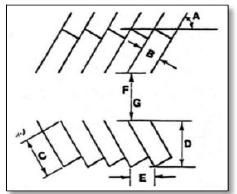
Parking Stall Dimensions. All off-street parking spaces shall meet the minimum size requirements as indicated in the table below.
Standard Vehicle
** Identified fire lanes must meet the requirements of the North Metro Fire Rescue District. Additional width may be necessary.
(D)
Parallel Parking (0°). Parallel Parking should not be placed in the following locations:
(1)
Within twenty feet of an intersection or crosswalk, and should not interfere with North Metro Fire Rescue District's emergency vehicle fire lane turning requirements when applicable.
(2)
Within twenty feet of public or private driveway including alley, and should not interfere with North Metro Fire Rescue District's emergency vehicle fire lane turning requirements when applicable.
(3)
Within fifteen feet of a fire hydrant.
(4)
Within thirty feet of flashing beacon signal, and stop or yield sign.
(E)
Vehicular Overhang. For perpendicular stalls (90°) adjacent to attached sidewalks the following shall apply:
(1)
Curb stops are required in stalls adjacent to sidewalks less than seven feet wide.
(2)
All sidewalks adjacent to perpendicular stalls must be a minimum of six feet wide.
(F)
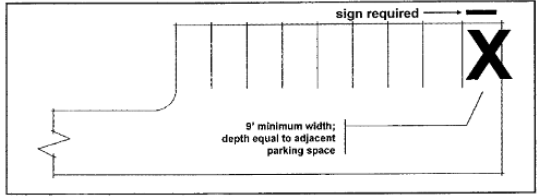
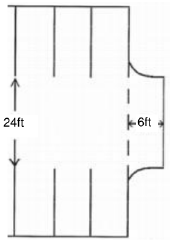
Dead End Parking. Dead end aisles must be avoided wherever possible. Where a dead end aisle is unavoidable, adequate space for unimpeded turn-around must be provided. Below are two options that can be used for turnarounds (designated fire lane dead-end turnarounds must meet the specifications of North Metro Fire Rescue District):
(1)
Parking Stall Turnarounds. Stall turnaround must be identified with a sign or surface graphic and marked, "No Parking," using approved signage (see figure below). The use of accessible parking spaces as the required turnaround is not permitted and space cannot be counted towards your required spaces identified in B.M.C. 17-32-040. Turnarounds should not be used for snow storage.
(2)
Parking Aisle Turnarounds. Aisle turnarounds must be provided with adequate backing and turnaround space. Turnarounds should not be used for snow storage. The required depth of the turnaround space shall be determined as follows:
(G)
Snow Storage. Provisions shall be made for designated snow storage areas within all off-street parking lots.
(H)
Tandem Parking. Tandem parking represents a parking configuration where one vehicle parks directly behind another and the vehicle in back must be moved in order for the front vehicle to leave. Tandem parking shall be limited to a maximum of two cars in depth and no less than nine inches wide and thirty-eight feet long. Tandem parking stalls are only allowed for:
(1)
Residential - single-unit, duplex, and townhome uses. Where a garage is provided for an individual dwelling unit, tandem spaces in front of the garage are counted toward meeting off-street parking requirements for the dwelling unit.
(2)
Multi-family residential uses - subject to the following conditions:
(i)
The tandem spaces should be reserved for and assigned to dwelling units which are required to have two or more parking spaces.
(ii)
Tandem spaces shall not be used for guest parking.
(Ord. 149 Art. 18 §5(3), 1973; Ord. 1349 §2, 1998)
(Ord. No. 2217, § 1, 12-5-2023; Ord. No. 2268, § 1, 5-13-2025)
17-32-080 - Off-street parking and additional parking surface requirements.
(A)
All vehicles, as defined in article II, section 102(88) of the Model Traffic Code, shall be parked in off-street parking spaces or areas as defined in this section, and no more than 20% of the total square footage of a residential lot can be used for off-street parking.
(B)
All off-street parking spaces and access to such spaces from the street shall be surfaced with asphalt or concrete, unless otherwise provided in this section.
(C)
In residential areas (R-1, E-2, or PUD medium or low density residential) the minimum number of off-street parking spaces in the area between the front of a garage and the front lot line and access required by section 17-32-040 must be surfaced with asphalt or concrete.
(D)
In residential areas (R-1, E-2, or PUD medium or low density residential) additional parking area, beyond the minimum set forth in subsection (C) above, may be allowed in said residential zoning districts, for corner lots in the back yard so long as there is access from the street directly to the rear yard and, for all other lots in the area, between the garage and the closest side lot line as such area extends from the front lot line to the rear lot line, provided that:
(1)
Any surface on which a vehicle is driven or parked must be surfaced with asphalt or concrete or consist of rock or gravel at least three inches deep and must be kept free of vegetation; and
(2)
If necessary to prevent rock or gravel from spreading, a border is installed.
(E)
In rural and rural residential areas (A-1, RR, E-1, and E-3 districts), all open off-street parking and additional parking areas, including access to such areas, shall be surfaced with asphalt, concrete or rock or gravel at least three inches deep and must be kept free of vegetation.
(F)
Nothing in this section shall prevent the temporary parking of a vehicle on other areas of a residential lot for purposes of maintenance, provided that such period of time does not exceed one hour.
(Ord. 149 Art. 18 §5(4), 1973; Ord. 1792 §1, 2005; Ord. No. 2268, § 1, 5-13-2025)
17-32-090 - Off-street parking; screening requirements.
All off-street parking areas with more than ten spaces shall screen said spaces in part from view from adjacent streets by providing either:
(A)
A low three-foot to four-foot decorative fence or wall between the required landscaped area and the parking area; or
(B)
Earth mounds of three to four feet in height, which shall be landscaped and placed between the street and the parking area.
(C)
Alternatively, for developments meeting the threshold as defined in section 17-70-020, the development shall be subject to the landscape requirements as defined in section 17-70-080.
(Ord. 149 Art. 18 §5(5), 1973)
(Ord. No. 2215, § 11, 8-22-23)
17-32-100 - Off-street parking; lighting requirements.
Parking lot lighting shall be reflected away from residential areas.
(Ord. 149 Art. 18 §5(6), 1973)
17-32-110 - Off-street parking; prohibited where.
Parking lots shall not be located in front yards in any R-3 or R-5 residential district.
(Ord. 149 Art. 18 §5(7), 1973)
17-32-120 - Off-street parking; joint use permitted when.
Off-street parking spaces may be provided in areas designated to serve jointly two or more buildings or user; provided that the total number of off-street parking spaces shall not be less than that required by this chapter for the total combined number of buildings or uses.
(Ord. 149 Art. 18 §5(8), 1973)
17-32-130 - Bicycle parking; required spaces.
(A)
Each new building or change of use, or addition to any use, shall provide bicycle parking as designated in this section.
(B)
Bicycle Spaces and Type Required. Bicycle parking facilities quantity and type shall be provided in accordance with the following table. Each bicycle parking space shall be no less than six feet long by two feet wide and shall have a bicycle rack system in compliance with the bike rack classifications listed in this section.
(C)
Fractional Spaces. If the calculation of required bicycle parking spaces results in a fractional number, that number shall be rounded to the nearest whole number with 0.5 or greater rounded up to the next whole number.
(D)
Classification of Facilities.
(1)
Short-term bicycle parking means a stand or other device constructed so as to enable the user to secure by locking the frame and one wheel of each bicycle parking therein. Racks must be easily usable with both U-locks and cable locks. Racks should support the bikes in a stable upright position so that a bike, if bumped, will not fall or roll down. Racks that support a bicycle primarily by a wheel, such as standard "wire racks," are not acceptable.
(2)
Long-term bicycle parking means a locker, or a locked enclosure, or supervised area within a building or weather protected enclosure providing an extra layer of security for bicycles parked therein from theft, vandalism, and weather.
(E)
Location and Design of Bicycle Facilities.
(1)
Bicycle parking facilities should be located in highly visible, well lit areas to minimize theft and vandalism.
(2)
Bicycle parking should be located in close proximity to the building's entrance.
(3)
Bicycle parking facilities shall not impede pedestrian or vehicular circulation.
(4)
For long-term bicycle parking areas, hanging racks are not permitted; doubledecker and roll-in racks are acceptable for space saving. Long-term bicycle parking areas are recommended, but not required, to have security cameras.
(5)
For short-term bicycle parking areas, one u-rack is equivalent to two bicycle parking spaces.
(6)
Paving is not required for short-term bicycle parking, but the outside ground surface shall be finished or planted in a way that avoids mud and dust. Racks must be anchored with concrete footings if mounting in unpaved areas.
(7)
All racks shall comply with Association of Pedestrian and Bicycle Professionals guidance.
(8)
Bicycle parking facilities within vehicle parking areas shall be separated by a physical barrier, such as curbs, wheel stops, poles or other similar features, to protect bicycles from damage.
(9)
Bicycle rack spacing shall comply with Association of Pedestrian and Bicycle Professionals guidance and shall be spaced such that they allow cargo bicycles and other alternative bicycle designs as noted in the Association of Pedestrian and Bicycle Professionals guidance to be secured.
(Ord. No. 2217, § 1, 12-5-2023; Ord. No. 2268, § 1, 5-13-2025)
Editor's note— (Ord. No. 2217, § 1, adopted December 5, 2023 repealed the former § 17-32-130, and enacted a new § 17-32-130 as set out herein. The former § 17-32-130 pertained to Off-street parking; other use; replacement space required and derived from Ord. 149 Art. 18 §5(9), 1973.
17-32-140 - Fences, hedges, and walls.
Fences, hedges, and walls may be permitted in the various districts as accessory uses in accordance with the following limitations:
(A)
No fence in any district shall exceed six feet in height, except:
(1)
As necessary to comply with subsection (F) of this section concerning the enclosure of outdoor swimming pools;
(2)
Fences adjacent to the state highways may be up to eight feet in height;
(3)
Fences in the B-1, B-2, I-1, I-2, and I-3 districts may be up to eight feet in height except as required in paragraph (4) below; and
(4)
Fences are required for screening outdoor storage of equipment machinery and vehicles and any permitted outdoor operations in the I-1, I-2, and I-3 districts. Said fences must be between six feet and ten feet in height depending on site conditions, such as topography and views to the site. The specific fence height shall be determined through the permit review process. The intent is to maximize screening of outdoor equipment, machinery, and vehicle storage from adjacent properties and public streets.
(5)
Sound walls along arterial roadways up to ten feet in height or as approved by the city manager or his or her designee.
(B)
No fence, hedge, wall, shrubbery, or sign shall interfere with the vision of motorists at any intersection.
(C)
Only ornamental fences not more than two and one-half feet in height shall be permitted in the front yard in any E-1, E-2, R-1, R-3, or R-5 district.
(D)
All fences and walls located in a required front yard in any business or industrial district shall be set back from the front lot line two feet for each foot of fence height.
(E)
Fences installed within street rights-of-way shall comply with chapter 12-08, B.M.C.
(F)
All outdoor swimming pools, hot tubs, and spas shall be enclosed by a barrier as required by International Residential Code Appendix G.
(G)
Electrified, razor wire, and barbed wire fences are prohibited in all zone districts, except as provided in subsection (H) and (I) below.
(H)
Fences in an I-1 or I-2 districts:
(1)
When required for screening outdoor storage or operations, fencing must be one of the following: chain-link with inserted slats; mesh privacy or wind screen material with opaque screening levels of 80% or greater; wood privacy; vinyl privacy; or a solid material. Solid materials may include stucco, brick, stone, including veneers, vinyl, or comparable material providing a fully opaque screening level. When screening is required along arterial streets or highways, the enclosure must be of a solid material listed above.
(2)
May include up to four strands of barbed wire. This barbed wire must be a minimum of six feet and a maximum of eight feet from the ground. The barbed wire segment may be placed at a forty-five-degree angle.
(I)
Fences installed in RR districts are subject to the following requirements:
(1)
Open fences of not more than forty-two inches in height are permitted in front yards.
(2)
Barbed wire fences of not more than seventy-two inches in height are permitted in side and rear yards.
(3)
Electric fences are permitted as internal fences but not as external fences.
(Ord. 669 §5, 1986; Ord. 678 §2, 1986; Ord. 1365 §2, 1999; Ord. 1878 §1, 2008; Ord. 1923 §1, 2010; Ord. 1927 §3, 2011)
17-32-150 - Outside storage; inoperative automobiles.
(A)
All outdoor storage areas shall be enclosed by a solid fence or wall at least six feet in height.
(B)
Automobiles which cannot meet state inspection standards for travel on public highways shall not be permitted as an accessory use in any zoning district.
(Ord. 149 Art. 18 §7, 1973; Ord. 235 §2, 1974)
17-32-160 - Accessory dwelling units.
Accessory dwelling units are permitted accessory uses in all zoning districts which establish single-unit residential uses as a permitted use, subject to the following conditions:
(A)
A single-unit dwelling must exist as a principal dwelling unit on the lot or be constructed in conjunction with the accessory dwelling unit.
(B)
Only one accessory dwelling unit shall be allowed for each parcel.
(C)
Accessory dwelling units may be located within the principal dwelling unit, attached to the principal dwelling unit, or detached from the principal dwelling unit.
i.
Attached accessory dwelling units, and detached accessory dwelling units that do not meet the minimum separation distance from the principal structure as established by the applicable zone district or section 17-34-020(H) of the Broomfield Municipal Code, as applicable, shall be required to meet all principal structure setbacks of the applicable zone district.
ii.
Detached accessory dwelling units shall meet the standards for accessory buildings established by section 17-34-020(H) of the Broomfield Municipal Code, and shall meet the established accessory building setback requirements for the applicable zone district, with the following exceptions:
1.
The required side setback for a detached accessory dwelling unit shall not be larger than the required setback for the principal building on the same lot.
2.
No accessory dwelling unit shall be permitted between the front of the principal structure and the street.
(D)
The square footage of the accessory dwelling unit shall be no larger than 50% of the principal dwelling unit footprint or 800 square feet, whichever is less.; provided, that, in all cases, an accessory dwelling until may be up to 500 square feet in size regardless of the size of the principal dwelling unit. Square footage calculations, as contained herein, exclude any related garage, porch or similar area for the principal dwelling unit and accessory dwelling unit.
(E)
Accessory dwelling units shall not be eligible for use as a short term rental, as defined in chapter 5-39 of the Broomfield Municipal Code.
(F)
To preserve the appearance of the single-unit dwelling and the greater residential community, accessory dwelling units shall be designed in the following manner:
i.
The design of the accessory dwelling unit shall be consistent with the design of the principal dwelling unit by use of similar architectural style(s), exterior wall material(s) and color(s), window type(s), door and window trim(s), roofing material(s) and roof pitch and color(s).
1.
Proposed ADUs located within a development that is subject to an applicable site development plan and/or planned unit development plan, or overlay district which includes design requirements for a single-unit residence shall be required to meet those design requirements.
2.
Proposed ADUs located in developments with no specific design standards shall be required to be clad in a material similar to the principal structure. Walls facing the street must consist of materials or colors to match the principal structure.
ii.
If the entrance to the accessory dwelling unit is visible from an adjacent street, it shall be designed in a manner to be clearly subordinate to the entrance of the principal dwelling.
(G)
With the exception of telephone, television, electrical and internet service, accessory dwelling units must be served through the utility services of the principal dwelling unit and shall not have separate services.
i.
As part of the application review process, any proposal to add an ADU which uses an on-site septic system shall be required to have their proposal reviewed by Broomfield's Department of Public Health and Environment to verify that there is adequate capacity in the septic system to accommodate the proposed ADU. All septic system modifications to modify capacity shall require Broomfield Department of Public Health and Environment review.
(H)
Home occupations may take place within any accessory dwelling unit approved or lawful pursuant to this section. However, home occupations taking place in any accessory dwelling unit shall comply with section 17-32-020.
(I)
All property owners shall record a declaration of use which will state the size and location of the accessory dwelling unit and shall reference that the accessory dwelling unit must remain in compliance with the regulations contained within the municipal code pertaining to accessory dwelling units. For detached accessory dwelling units this declaration shall be recorded prior to the issuance of certificate of occupancy.
(J)
Travel trailers, recreational vehicles, shipping containers, storage containers, and other such temporary structures shall be prohibited for use as an accessory dwelling unit.
(K)
Manufactured homes and tiny homes shall be permitted for use as an accessory dwelling unit when installed with a foundation that is in compliance with the International Residential Code, which may include tie downs, and clad in materials or colors to match the principal structure, in compliance with section 17-42-320.
(L)
Tiny houses and modular homes shall be permitted for use as an accessory dwelling unit when it is clad in materials or colors to match the principal structure.
(Ord. No. 2097, § 5, 10-8-19; Ord. No. 2217, § 1, 12-5-2023; Ord. No. 2265, § 2, 9-9-2025)
Cross reference— § 13-02-100, water licenses; § 13-08-090, sewer licenses

