
Broomfield City Zoning Code
CHAPTER 17
44 - Sign Code6
Editor's note—Ord. No. 2209, § 4, adopted July 11, 2023, effective January 1, 2024, repealed the former ch. 17-44, §§ 17-44-010—17-44-480, and enacted a new ch. 17-44 as set out herein. The former ch. 17-44 pertained to similar subject matter and derived from Ord. 149 Art. 22 §§1—3, 4(1)—4(9), 4(11)—4(16), 5(1)—5(5), 6(1)—6(7), 7(3), 7(4), 7(6), 8(1)—8(10) adopted 1973; Ord. 249 Art. 1 §§1—3, 4(1)—4(9), 4(11)—4(16), 5(1)—5(5), 6(1)—6(7), 7(3), 7(4), 7(6), 8(1)—8(10), adopted 1975; Ord. 266 §1(a), (f, g), adopted 1976; Ord. 516 §14, adopted 1983; Ord. 521 §§2—4, 1983; Ord. 651 §3, 1985; Ord. 731 §§2—6, adopted 1987; Ord. 856 §§4, 5, 1989; Ord. 1031 §§1—3, adopted 1994; Ord. 1111 §§41—45, adopted 1995; Ord. 1156 §1, adopted 1995; Ord. 1201 §1, adopted 1996; Ord. 1805 §§1, 2, adopted 2005; Ord. 1854 §1, adopted 2006; Ord. 1875 §§1, 2, adopted 2007; Ord. 1858 §§12—15, adopted 2008; Ord. 1935 §§62—67, 72, adopted 2011; Ord. 1974 §3, adopted 2013; Ord. No. 2138, §§ 68—73, adopted April 6, 2021.
17-44-010 - Short title.
This chapter is known and may be cited as the "City and County of Broomfield Sign Code" or "Sign Code."
(Ord. No. 2209, § 4, 7-11-23)
17-44-020 - Purpose.
The purpose of this chapter is to promote the public health, safety and welfare through a comprehensive system of reasonable, effective, consistent, content-neutral and nondiscriminatory sign standards and requirements. This chapter has also been adopted to:
(A)
Promote and accomplish the goals, policies and objectives of the Broomfield Comprehensive Plan and zoning regulations;
(B)
Recognize that signs are a necessary means of visual communication for the convenience of the public;
(C)
To provide minimum standards in order to safeguard life, health, property and public welfare, and promote traffic safety by controlling the design, quality of materials, construction, illumination, size, location and maintenance of signs and sign structures;
(D)
Recognize free speech rights by regulating signs in a content-neutral manner;
(E)
Protect the city's built environment by encouraging signs that are compatible with the architectural style, characteristics and scale of the building to which it may be attached, and to encourage signs that are compatible with adjacent buildings and businesses and the aesthetics of the community;
(F)
Incorporate new technologies for sign design and display;
(G)
These regulations do not entirely eliminate all of the harms that may be created by the installation and display of signs. Rather, they strike an appropriate balance that preserves ample channels of communication by means of visual display while still reducing and mitigating the extent of the harms caused by signs;
(H)
Improve economic viability by assuring that the city is a visually pleasant place to visit, conduct business, and live; and
(I)
Adopt clear, understandable regulations which enable the fair and consistent enforcement of this chapter.
(Ord. No. 2209, § 4, 7-11-23)
17-44-030 - Applicability, interpretations, substitutions and severability.
(A)
Applicability.
(1)
This chapter applies to all signs as defined in section 17-44-050 (Definitions) within the City and County of Broomfield, Colorado except for the following:
(i)
Signs located entirely within the interior of a building or structure and not visible from outside of the building;
(ii)
A sign carried or worn by a person; and
(iii)
Governmental and regulatory signs.
(2)
Legacy zone districts. Properties previously located in Adams County, Boulder County, Jefferson County, and Weld County and incorporated into the City and County of Broomfield as of November 15, 2001, may have retained the legacy county zoning in place prior to incorporation. To the extent specific regulations relating to signage are included in legacy county zoning, typically through a specifically adopted planned unit development or other site specific development plan, such specific zoning shall apply, or the property owner may comply with the current Broomfield Sign Code. To the extent general zoning sign requirements are referenced in legacy county zoning, such references shall be interpreted to mean the Broomfield Sign Code.
(B)
Interpretation.
(1)
This chapter is not intended to, and shall not be interpreted to, restrict speech on the basis of its content, viewpoint, or message. Any classification of signs in this chapter which purports to permit speech by reason of the type of sign, identity of the sign user or otherwise, shall be interpreted to allow commercial or non-commercial speech on the sign. No part of this chapter shall be construed to favor commercial speech over non-commercial speech. To the extent that any provision of this chapter is ambiguous, the term shall be interpreted not to regulate speech on the basis of the content of the message.
(2)
If any of the provisions of this chapter are inconsistent with the provisions of any other law or laws presently existing, or enacted in the future by the city regarding requirements for signs, the provisions containing the more restrictive requirements shall apply.
(3)
For purposes of this chapter, references to lots can also be used interchangeably with a reference to tracts.
(C)
Substitution clause. Messages may be changed without the need for any approval or permit, provided that the size and structure of the sign are not altered. Non-commercial copy may be substituted for commercial copy on any lawful sign structure.
(D)
Severability. If a section, subsection, paragraph, sentence, clause or phrase of this chapter is declared unconstitutional or invalid for any reason, the decision shall not affect the validity of the remaining portions of this chapter.
(E)
Conformance. All signs displayed, constructed, erected, or altered after the effective date of these regulations shall be in conformance with the provisions of these regulations, unless otherwise allowed in a valid planned unit development plan or other site specific development plan approved prior to the effective date of these regulations.
All signs that are existing at the time of the adoption of these regulations shall not be altered or enlarged without being brought into conformance with these regulations.
(Ord. No. 2209, § 4, 7-11-23)
17-44-040 - Nonconforming signs.
Except as provided in this section, signs lawfully in existence on the date the provisions of this sign code were adopted, which do not conform to the provisions of this code, but which were in compliance with the applicable regulations at the time they were constructed, erected, affixed or maintained will be regarded as legal nonconforming.
(A)
Legal nonconforming signs.
(1)
A legal nonconforming sign may be continued and shall be maintained in good condition; provided that such sign shall not be:
(i)
Changed to another nonconforming sign;
(ii)
Structurally altered, except to meet safety requirements;
(iii)
Expanded;
(iv)
Reestablished after its discontinuance for ninety days;
(v)
Continued in use after cessation or change of the business or activity to which the sign pertains; or
(vi)
Reestablished after damage, if repair or reconstruction costs exceed 50% of the sign's replacement cost, as determined by the city.
(2)
Signs accessory to legal nonconforming uses shall be allowed until the existing use of the premises is discontinued, subject to all regulations of the zoning district wherein such signs are located as set forth in this chapter.
(3)
If a legal nonconforming sign is not maintained as described above, then the sign shall be brought into conformance with these regulations promptly by (i) removing the sign, (ii) altering the sign to comply with the current sign code, (iii) applying for an administrative adjustment pursuant to B.M.C. 17-44-160, or (iv) applying for a special exception pursuant to B.M.C. 17-44-170 as applicable.
(B)
Determination of legal nonconforming status.
(1)
To determine the legal status of existing signs, the applicant shall submit the following information to the community development office for a formal determination:
(i)
Type(s) of existing sign(s) located on the property, including the materials with which the sign was constructed;
(ii)
History of the sign, including evidence of the date erected if available;
(iii)
The area and height of all signs;
(iv)
Location of the sign including the distance between the curbline, shoulder or property line;
(v)
Type of sign illumination; and
(vi)
A list of the existing uses on the property and when such uses began and under what authority in the zoning code.
(2)
Within thirty calendar days of receipt of a request for determination, the director of community development shall weigh the evidence presented and make a determination as to whether the sign is nonconforming and must be brought into compliance with this sign code, or if the sign is legal nonconforming and can remain in accordance with the provisions of this sign code. Appeals of the director of community development's decision on the nonconforming status of a sign can be made to the neighborhood board of adjustment pursuant to B.M.C. [section] 2-40-070(A), an application for such appeal shall be made within thirty days of the date of the determination.
(Ord. No. 2209, § 4, 7-11-23)
17-44-050 - Definitions.
The words and phrases used in this section shall be construed as defined in this chapter, unless the context clearly appears otherwise. Unless specifically defined in this section, the definitions set forth in other provisions of this code shall likewise apply to this chapter.
(A)
A-frame sign means a freestanding sign that is readily moveable and not permanently affixed to the ground, generally consisting of two faces connected and hinged at the top, and whose message is targeted to pedestrians and capable of standing without support or attachment. An A-frame sign and similar signs may also be known as a portable sign or sandwich board sign.
(B)
Awning or canopy sign means a sign affixed to or imprinted on an attached shelter composed on non-rigid materials such as an awning, or a permanent architectural projection, such as an awning or canopy, typically affixed to the exterior wall of a building, extending over a door, entrance, window or outdoor service area.
(C)
Balloon sign shall mean a sign composed of non-rigid material supported by gas or air pressure which may or may not contain text with the purpose to attract attention to an object or site. Party balloons are not considered a balloon sign.
(D)
Banner sign means any cloth, vinyl, mesh, canvas, bunting, paper, or similar non-rigid material attached to any structure, staff, pole, rope, wire, or framing which is anchored on two or more edges or at all four corners. Banners are temporary in nature and do not include flags.
(E)
Beacon lighting includes any source of electric light, whether portable or fixed, the primary purpose of which is to cast a concentrated beam of light generally skyward as a means of attracting attention to its location rather than to illuminate any particular sign, structure, or other object.
(F)
Billboard means any freestanding sign directly supported from the ground in excess of 400 square feet in size, oriented to a public street.
(G)
Coordinated election means all elections conducted by the City and County of Broomfield Elections Division.
(H)
Digital sign means an illuminated sign with electrically activated changeable copy sign having variable message or graphic presentation capability that can be electronically programmed by computer or handheld device from a remote location with text, graphics or symbols over non-illuminated background. Digital signs typically use light emitting diodes (LED's) or liquid crystal display (LCD) as a lighting source. Digital signs are also referred to as dynamic signs, electronic variable message signs, electronic message centers and similar terms.
(I)
Directional sign means a sign erected to provide direction to pedestrian, vehicular, bike and similar traffic into and out of, or within a site.
(J)
Display sign means a permanent sign for displaying the bill of fare or information relating to the site. Also known as menu signs or directory signs.
(K)
Electric sign means any sign containing electrical wiring, but not including signs illuminated by exterior light sources, such as floodlights.
(L)
Feather banner sign means a type of temporary sign consisting of cloth, bunting, canvas, or similar fabric, attached to a single vertical support structure with distinctive color, words, patterns, or symbolic logos for display. A feather banner sign or similar sign may also be known as a flying banner or wave banner sign, teardrop signs and sharks signs.
(M)
Flag means a flat piece of cloth, with distinctive colors, patterns or symbols, having one end of the cloth attached to a vertical staff (directly or by rope and pulley mechanism) and all other ends free-flowing under natural movement of wind. A flag is typically three feet by five feet or larger.
(N)
Flashing sign is a sign whose artificial illumination is not kept constant in intensity at all times when in use and which exhibits changes in light, color, direction, or animation. This definition does not include digital signs that meet the requirements set forth herein.
(O)
Freestanding sign means a sign and its support pole or base standing directly on the ground that is independent from any building or other structure, including but not limited to, monument signs, ground signs or other similar signs.
(P)
Governmental and regulatory signs means a sign that is constructed, placed or maintained by the federal, state, city government, public school, or a sign that is required to be constructed, placed or maintained by the federal, state, or local government. Governmental and regulatory signage includes, but is not limited to, traffic signs, utility signs, safety or warning signs, railroad crossing, memorial signs, informational, identification, and directional signs for public facilities.
(Q)
Ground sign means a freestanding low profile sign with the sign width greater than the sign height and designed with a solid base and background which is not mounted on a pole. Signs affixed to a low-profile retaining wall are also considered a ground sign for purposes of this chapter.
(R)
High density residential shall have the meaning set forth in B.M.C. [section] 17-44-100(B)(3) below.
(S)
Holiday or seasonal decorations means signs or displays including lighting which are a non-permanent installation celebrating national, state, and local holidays, religious or cultural holidays, or other holiday seasons.
(T)
Incidental sign means a single-faced sign affixed to a building or structure, machine, equipment, fence, gate, wall, gasoline pump, public telephone or utility cabinet. Examples of incidental signs include no trespass signs, beware of dog signs, no solicitor signs, electric fence signs, address signs or other similar signs.
(U)
Illuminated signs means a sign with electrical equipment installed for illumination, either internally illuminated through its sign face by a light source contained inside the sign or externally illuminated by a light source aimed at its surface.
(V)
Inflatable device is a type of sign that is an air-inflated object, which may be of various shapes, made of flexible fabric, resting on the ground or structure and equipped with a portable blower motor that provides a flow of air into the device which may or may not be constant and may or may not contain text.
(W)
Low density residential shall have the meaning set forth in B.M.C. [section] 17-44-100(b)(1) below.
(X)
Medium density residential shall have the meaning set forth in B.M.C. [section] 17-44-100(b)(2) below.
(Y)
Monument sign means a freestanding sign with the sign height equal to or greater than the sign width which could be ground or pole mounted.
(Z)
Mural means a sign or artwork which consists of a large picture or graphical illustration which is painted, constructed, or affixed directly onto a vertical surface, including a vertical wall, freestanding fence or other structure, that does not contain a commercial message.
(AA)
Pennant is a triangularor irregular piece of fabric or other material, commonly attached in strings or strands, or supported on small poles intended to flap in the wind.
(BB)
Permanent sign means a sign constructed of weather resistant material and that precludes ready removal or movement of the sign and whose intended use appears to be indefinite and that does not otherwise meet the definition of temporary sign.
(CC)
Projecting sign means a sign attached to a building with the face not parallel to the vertical surface of the building. Projecting signs include signs projecting directly from walls, or signs hanging from porch ceilings or other support structures.
(DD)
Public school means schools, including charter schools, governed and regulated by the Colorado Department of Education and the State Board of Education. The term "public school" does not include private, parochial, and independent schools, or non-public schools, which are not regulated by the State Board of Education and are considered private businesses.
(EE)
Reflective sign means a sign containing any material or device which has the effect of intensifying reflected light.
(FF)
Roof sign or roof mounted sign means a sign which projects above the roofline or which is located on the roof of a building or structure, or a sign erected upon or above a parapet wall on a building structure.
(GG)
Service island canopy sign means a permanent sign displayed on the service island of a fuel station, bank, canopy of a carwash or other use that provides a canopy cover for vehicles. Service island canopy signs are not the same as awning or canopy signs as otherwise defined by this chapter.
(HH)
Sign means any device, structure, fixture, painting, figure, emblem, plaque, poster, or other thing designed, intended, or used to advertise or inform.
(II)
Sight distance area means an area, usually triangular, on a lot at the intersection of two streets, a street and a railroad, a street and an alley, or a street and a recreational trail, two sides of which are curb lines as specified in the current version of the Broomfield Standards and Specifications.
(JJ)
Site sign means a temporary freestanding sign constructed of plastic, wood, or metal and designed or intended to be displayed for a limited period of time on a site with an active listing for sale or for rent, or on properties with active building permits.
(KK)
Temporary sign means any sign based upon its materials, location or means of construction, e.g., light fabric, cardboard, wallboard, plywood, paper, or other light materials, with or without a frame, intended or designed to be displayed for a limited period of time. For example temporary signs include A-frame signs, banners, feather signs, and yard signs.
(LL)
Vehicular sign means a sign that is printed, painted upon, or attached to motor vehicles, including semi-truck trailers, used primarily for the delivery of products, passengers or services or for business purposes other than as a sign.
(MM)
Wall sign means a sign which is attached parallel to or painted on a wall, including parapet or canopy fascia, or a building. Wall signs shall also include signs that consist of images or text that are illuminated or projected onto the side of a building or structure, provided the images otherwise meet the requirements of a digital sign in terms of transition method, transition duration, message hold time and lighting so as to avoid creating a flashing sign.
(NN)
Window sign means any sign which is applied or attached to either the interior or exterior of a window or door and intended to be viewed from outside the building or structure.
(OO)
Yard sign means a temporary freestanding or fence mounted sign constructed of paper, vinyl, plastic, wood, metal, or other comparable material, and designed to be displayed for a limited period of time on a lot. Fence mounted signs include balcony mounted for multi-unit dwellings only.
(Ord. No. 2209, § 4, 7-11-23)
17-44-060 - Prohibited Signs.
The following signs are unlawful and prohibited in all zone districts unless the zone district specifically allows such a sign (Note: Governmental and Regulatory signs are specifically exempt from this code):
(A)
Signs not enumerated. Any sign not specifically permitted by this chapter or exempt from a permit in accordance with B.M.C. [section] 17-44-090 below.
(B)
Abandoned signs. A sign, including its structure, that is no longer used or the face of which has been removed or is broken, and is not refaced within ninety days thereafter. Abandoned signs shall also include signs with rusted, faded, peeled, cracked or otherwise deteriorated materials or finishes that have not been repaired within thirty days after the city provides notice of the sign's deteriorated condition under B.M.C. [section] 17-44-150. An abandoned sign is unlawful and declared a public nuisance.
(C)
Billboards.
(D)
Rotating signs. Any sign in which the sign body or any portion rotates, moves up and down, or any other type of action involving a change in position of the sign body or any portion of the sign, whether by mechanical or any other means. Rotating signs do not include digital signs that have changeable, programmable displays.
(E)
Inflatable devices or balloon signs.
(F)
Flashing signs or lights and beacon lighting. A sign that contains an intermittent or flashing light source, or a sign that includes the illusion of intermittent or flashing light by means of animation, or an externally mounted intermittent light source, but specifically excluding holiday and seasonal decorations. Flashing light sources and beacon lighting are prohibited. Digital signs are allowed under the provisions of B.M.C. [section] 17-44-080(E) below.
(G)
Any sign that is dangerous or confusing to motorists on the public right-of-way, including any sign which by its color, wording, design, location or illumination resembles or conflicts with any official traffic control device or which otherwise impedes the safe and efficient flow of traffic is prohibited.
(H)
Any sign, other than traffic control signs, located in a sight distance triangle or an easement (e.g. utility easement or drainage easement).
(I)
Signs in the right-of-way. Any sign in, on or over any public property not installed or permitted by the federal, state or city government, or otherwise permitted to encroach into right-of-way as established in this chapter or by means of revocable permit. Governmental and regulatory signs are exempt from these regulations and may be allowed in the right-of-way.
(J)
Signs may not impede free ingress and egress from any door, window or exit way required by building and fire regulations.
(K)
Signs which emit smoke, visible vapors, particulate matter, sound, odor, contain open flames or involve the use of live animals.
(L)
Reflective signs or signs containing mirrors.
(M)
Roof signs, or roof mounted signs.
(N)
Vehicle signs. No person shall park any vehicle or trailer on public right-of-way, public property, or on private property, so as to be visible from a public right-of-way which has attached thereto or located thereon any sign. This provision applies when the vehicle is placed in a location for the primary purpose of displaying signage and is not intended to prohibit all forms of vehicular sign, see signs exempt from permit requirements below.
(O)
Any banner or sign of any type suspended across a public street, without the permission of the owner of the property and the owner of the street.
(P)
Signs attached to utility poles, traffic control devices or trees whether on public property or private property.
(Ord. No. 2209, § 4, 7-11-23)
17-44-070 - Sign permit required.
(A)
Permit required. It shall be unlawful for any person to erect, maintain, alter or relocate any sign requiring a permit under this chapter without first submitting a sign permit application and receiving approval of the sign permit from the city, unless the sign is identified as exempt under B.M.C. [section] 17-44-090 or not regulated by this chapter. Some sign types may be regulated under other codes adopted by the city, which may require additional permits and be subject to additional regulations, including, but not limited to, the Building Code (see B.M.C. Title 15) and Right-of-Way Use Permits (B.M.C. [section] 14-10-040). Signs for which permits are not required shall nonetheless comply with all applicable provisions of this chapter.
(B)
Permit applications. A sign permit application can be obtained from the department of community development and shall be returned with the applicable permit fees, signed by the applicant and the property owner, if different. The application shall include a site plan that provides the following information:
(1)
The name, address, email address, and telephone number of the owner or tenant of the property on which the sign is to be located or such parties authorized agent, and the name, address, and telephone numbers of the sign contractor or erector, if applicable.
(2)
Tax parcel number or correct address where the proposed sign will be located.
(3)
A site plan for the proposed sign including:
(i)
The location of the affected lot, building(s), and sign(s).
(ii)
The scale of the site plan.
(iii)
A scaled-drawing of the proposed sign or sign revision, including size, height, size of lettering, setbacks as applicable, structural footing details, method of attachment and illumination.
(iv)
The location of all existing signs on the site including the number, type, size and height.
(v)
The scope and structural detail of the work to be done, including details of all connections, guy lines, supports and footings, and materials to be used.
(vi)
Application, and required information for such application, for an electrical permit for all electric signs if the person building the sign is to make the electrical connection.
(vii)
A statement of valuation.
(viii)
For signs subject to spacing regulations, the location of neighboring signs on adjacent properties.
(ix)
Any other information to show compliance with all applicable requirements of this chapter and any other applicable regulations of the city.
(C)
Sign permit review standards. The city shall approve or deny a sign permit application based on the following review standards:
(1)
Review of application. Within forty-five calendar days of the date of the application, the city will either accept the application and provide a notice of decision or refer the application back to the applicant in instances where insufficient information has been furnished or modifications to the sign are needed.
(2)
Notice of decision. The city shall either (i) approve if the application complies with all requirements of this chapter, (ii) approve with conditions to bring the application into compliance with the requirements of this chapter, (iii) or deny the application if not in compliance with this chapter. Permit applications associated with signs shall be reviewed by the city for consistency with the city's Building Code. If the sign uses electrical wiring and connections, a licensed electrician must submit a copy of the electrical permit application with the sign permit application. If the sign requires additional permits, the applicant may be required to submit additional applications for review by the applicable city staff, for example a revocable permit, special event permit, or public private improvement permit.
(3)
Permit issuance. When a sign permit has been issued by the city staff, it shall be unlawful to change, modify, alter, or otherwise deviate from the terms or conditions of the permit without prior approval of authorized city staff. A written record of such approval shall be entered upon the original permit application and maintained in the city's files.
(4)
Expiration of sign permit. Once the sign permit for the sign has been issued, the sign installation must be completed within 180 days or the sign permit will expire. If substantial building operations under any permit issued under this chapter are suspended for a period of 180 consecutive days, the permit shall also expire and become null and void. Building permits and right-of-way use permits shall expire in accordance with other applicable code provisions. No sign may be erected if the sign permit has expired, even if the associated building permit or street right-of-way use permit has not expired.
(5)
Extensions. Delays which are not a result of willful acts or neglect of the contractor, owner, authorized agent, or other persons obtaining the permit shall be excluded from the terms of this subsection, and the city may grant an extension of time in which to start or resume operations. All requests for extension and approval thereof shall be in writing.
(6)
Revocation.
(i)
If the city finds that work under any permit issued is not in accordance with the information supplied in the permit application or is in violation of this or any other ordinance, or should the city find that there has been any misrepresentation in connection with the application for the permit, the city shall notify the property owner and the permit applicant, as applicable, of such findings and that the violation must be corrected without delay. If such correction is not made, the city shall revoke the permit and serve written notice thereof upon the property owner and permit applicant, as applicable. No person shall proceed with any part of such work after such notice is received.
(ii)
When any permit has been revoked under the terms and provisions of this chapter, permit fees shall not be refunded.
(7)
Administrative appeal. Appeals of the city's decision on a sign permit application can be made to the Neighborhood Board of Adjustment pursuant to BMC 2-40-070(A), such appeal shall be made within 30 days of the decision date.
(Ord. No. 2209, § 4, 7-11-23)
17-44-080 - General sign regulations.
(A)
Sign area computation and measurements.
(1)
Sign area.
(i)
The area of a sign shall mean the area of all lettering, wording, and accompanying designs, logos, and symbols. In computing the area of a sign, standard mathematical formulas for common regular geometric shapes (triangle, parallelogram, circle, and ellipse, or combinations thereof) shall be used.
(ii)
In the case of an irregularly shaped sign or a sign with letters or symbols directly affixed to or painted on the wall of a building, the area of the sign shall be the entire area within a single continuous rectilinear perimeter or not more than eight straight lines enclosing the extreme limits of writing, representation, emblem, or any figure of a similar character, together with any material or color forming an integral part or background of the display, or used to differentiate such sign from the backdrop or structure against which it is placed.
(iii)
The area of a sign shall not include any supporting framework, bracing or trim which is incidental to the display, provided that it does not contain any lettering, wording, or symbols.
(iv)
For digital signs the area shall be calculated as described above and include all of the elements capable of illumination utilized for the sign.
(2)
Multi-dimensional signs.
(i)
Signs that consist of two or more faces, the area of all faces shall be included in determining sign area.
(ii)
The total surface area of multiple unit signs shall include the vertical and horizontal spacing between the letters which comprise the word or words that convey the sign's message.
(iii)
Where three-dimensional figures are used as signs, the area shall be the total area, as projected on a vertical plane, of each side of the figure which is visible beyond the boundaries of the lot upon which the figure is located. For purposes of this regulation, a figure shall be considered to have not less than nor more than four sides, and the number of sides to measure shall be determined by the intended location and visibility of the figure.
(3)
All riders and attachments to signs or sign structures, whether temporary or permanent, shall be included as part of the total sign area for the sign to which they are attached.
(B)
Sign height.
(1)
Sign height shall be measured as the distance from the highest portion of the sign to the average of the finished grade of the street closest to the sign.
(2)
Clearance for freestanding and projecting signs shall be measured as the smallest vertical distance between finished grade and the lowest point of the sign, including any framework or other structural elements.
(C)
Sign placement and locations.
(1)
Sign placement. All signs and sign structures must be erected and attached totally within the site except when allowed to extend into the right-of-way by this chapter.
(2)
Signs extending into the public right-of-way.
(i)
Projecting signs. Shall be allowed to extend into the right-of-way a minimum of eight feet above any sidewalk and fourteen feet above any alley surface where vehicles may pass below and shall not exceed the building height. In no circumstance shall a projecting sign pose a possible obstruction to the travel lanes for a sidewalk, roadway or alley.
(3)
Sight distance area. Subject to the authority of the city engineer to make adjustments and special requirements in particular cases for the safety of the public, all signs and sign features within the sight distance area shall be maintained to keep a vertical clear view zone between 2.5 feet and seven feet above the street elevation.
(i)
On corner lots, no sign or sign structure between a height of 2.5 feet and seven feet above the street elevation, other than a pole twelve inches or less in cross-sectional area, shall be erected within the following described area: The interior triangle formed by the right-of-way lines at such corner lots and a straight line joining said right-of-way lines at points which are fifty-five feet from the intersection of the right-of-way lines measured along said right-of-way lines, unless otherwise approved by the city engineer.
(D)
Illumination. Illumination of signs shall be in accordance with the following requirements, in addition to the standards provided herein for each sign type and by zone district:
(1)
Internally illuminated signs.
(i)
No internally illuminated sign shall include any exposed light source, except that neon or aesthetically equivalent tube lighting is allowed.
(2)
Externally illuminated signs.
(i)
All signs that use external illumination shall have their lighting directed in such a manner as to illuminate only the face of the sign without causing glare.
(ii)
The light source must be downcast and fully shielded; except for freestanding signs and flag poles which shall be allowed to have fully-shielded targeted uplighting placed as close to the base as possible that does not distract or pose a threat to the traveling public, either vehicles or aviation traffic.
(iii)
Projecting light fixtures shall be simple and unobtrusive in appearance, and shall not obscure the graphics of the sign.
(3)
For signs with illumination no more than 0.3 foot-candle of light shall be detectable at the boundary of any abutting property due to the sign.
(4)
Illuminated signs shall comply with all applicable provisions of the city's building and electric code.
(E)
Digital signs.
(1)
Digital signs are allowed on freestanding signs, including ground and monument signs and display signs, for nonresidential uses in any zone district. Digital signs are also allowed on service island canopy signs as provided in this chapter. Digital signs are not allowed for solely residential uses.
(2)
Any other digital sign may be allowed only if expressly authorized in the applicable zoning document. The digital sign in a planned unit development plan shall meet the specific standards in this B.M.C. [section] 17-44-080(E) or the applicable zoning document shall include standards and requirements concerning the design and location of the digital sign which shall demonstrate exceptional and unique circumstances warranting the use of alternate digital sign requirements.
(3)
All digital signs shall meet the following requirements:
(i)
The digital sign area of a freestanding sign shall be integrated into the design of the freestanding sign (e.g. a ground or monument sign). Such digital sign portions of freestanding signs shall not be an add-on feature, but rather must be fully integrated into the sign design.
(ii)
All digital signs shall include a malfunction display and the ability to automatically shut off if a malfunction occurs.
(iii)
Transition method. The digital sign shall be limited to static messages, changed only through either dissolve or fade transitions, which may otherwise not have movement, or the appearance or optical illusion of movement, of any part of the sign or structure, design, or pictorial segment of the sign, including the movement of any illumination or the flashing, scintillating or varying of light intensity.
(iv)
Transition duration. The transition duration between messages shall not exceed one second. Message changes shall be completed instantaneously and shall be imperceptible. Transition effects are prohibited.
(v)
Message hold time. Each message on the sign must be displayed for at least eight seconds duration.
(vi)
Lighting from a digital sign shall not exceed 0.3 foot candles over ambient light levels between dusk to dawn as measured from the sign's face. The city may require lower light levels if it determines less light is appropriate for the surrounding area. The digital sign shall have automatic dimmer software or solar sensors to control brightness for nighttime viewing. The intensity of the light source shall not produce glare, the effect of which constitutes a traffic hazard.
(vii)
Existing signage proposed for conversion to the use of a digital sign shall conform to the sign standards in these regulations prior to issuance of a sign permit. Nonconforming signs shall not be eligible for conversion to a digital sign.
(F)
Compliance with the Building Code. All signs must meet the applicable design, construction, and related standards specified in the Building Code as set forth in Title 15 of the Broomfield Municipal Code.
(G)
Electric sign requirements.
(1)
General. Electric signs shall be constructed of incombustible material meeting the requirements of this chapter. Electric signs shall be rain-tight, except that service holes fitted with waterproof covers shall be provided to each compartment of such signs. All electric signs hereafter installed or erected in the city shall bear the label of Underwriters' Laboratories, Inc.
(2)
Interference with radio or television. No electric equipment or electrical apparatus of any kind which causes interference with radio or television reception shall be used in the operation of illuminated signs. Whenever interference is caused by an unfiltered or improperly filtered or otherwise defective sign, or by any other electrical device or apparatus connected to the sign, the city shall order the sign disconnected until repairs are made.
(Ord. No. 2209, § 4, 7-11-23)
17-44-090 - Signs exempt from permit requirements.
The following signs shall be allowed without a sign permit and shall not be included in the determination of the type, number, or area of permanent signs allowed within a zoning district, provided such signs comply with the regulations in this section:
(A)
Governmental and regulatory signs.
(1)
These regulations are not intended to and do not apply to signs erected, maintained or otherwise posted, owned or leased by this state, the federal government, the city or public schools. Bus stop and bus shelter signs are issued a separate revocable permit by the city and are considered governmental signs.
(2)
Signs required to be posted as a matter of law are exempt from the permit requirements, for example, legal notices.
(B)
Holiday or seasonal decorations provided that such signs are not displayed for a period of more than sixty consecutive days.
(C)
Display signs in accordance with B.M.C. [section] 17-44-110(C) below.
(D)
Flags.
(1)
Location. Flags and flagpoles shall not be located within any right-of-way.
(2)
Number and size.
(i)
For lots less than or equal to 10,000 square feet, flags shall be no larger than twenty-four square feet with a maximum of two flags per lot allowed.
(ii)
For lots 10,001 square feet to one acre, flags shall be no larger than fifty square feet with a maximum of two flags per lot allowed.
(iii)
For lots greater than one acre, flags shall be no larger than seventy-five square feet with a maximum of three flags per lot allowed.
(3)
Height. Flagpole heights shall be consistent with the maximum building height permitted within the underlying zone district.
(E)
Vehicular signs. Signs displayed on motor vehicles which are being operated or stored in the normal course of a business, provided that the primary purpose of such vehicle is not for the display of signs and provided that the vehicle is parked or stored in areas customary for the use of the vehicle (e.g. parking lots and driveways).
(F)
Incidental signs. Incidental signs totaling less than four square feet for residential zone districts and ten square feet for commercial, industrial and mixed-use zone districts, or such size as otherwise required by law, shall not require a sign permit. Incidental signs are permitted on fences.
(G)
Directional signs. The city has a compelling interest in ensuring traffic safety. To directly advance that interest, directional signs are allowed provided the following criteria are met:
(1)
Area.
(i)
No single directional sign, except wall signs and projecting signs provided below, shall exceed eight square feet double-faced, no more than four square feet on any one side.
(ii)
No single direction wall sign or projecting sign shall exceed sixteen square feet double-faced, no more than eight square feet on one side.
(2)
Height. Freestanding directional signs shall have a maximum height of five feet.
(3)
Illumination. Directional signs may be illuminated in accordance with this chapter.
(H)
Temporary signs, including A-frame signs, banner signs, feather signs, site signs and yard signs, in accordance with B.M.C. [section] 17-44-120 below.
(I)
Window signs in accordance with B.M.C. [section] 17-44-110(I) below.
(Ord. No. 2209, § 4, 7-11-23)
17-44-100 - Sign regulations by district - Generally.
(A)
Planned unit development zone districts. For the purpose of this chapter the following zone districts are categorized as planned unit development zone districts as follows:
(1)
PUD: PUD, B-1-PUD, B-2-PUD, B-PUD, I-1-PUD, 1-2-PUD, P-D(J), PUD, R-1-PUD, R-3-PUD, R-5-PUD, R-PUD, and other such planned unit development districts as may be established pursuant to the provisions of this title.
(2)
All signs in planned unit development zones must comply with the signage standards detailed in the associated approved planned unit development plan or site specific development plan for the property. If there are no specific sign standards approved in the planned unit development plan or site development plan, then the signage standards for uses in planned unit development zone districts will refer to the comparable non-PUD zone (e.g. multi-family residential shall refer to standards for the residential zone district for high density residential).
(B)
Residential zone districts. For the purpose of this chapter the following zone districts are categorized as residential as follows:
(1)
Low Density Residential: OLPF, OS, A-1, A-1(J), A-1(A), A-2(J), A-2(A), A-3(A), E-1, E-2, E-3, R-1, R-1(J), R-1A(J), R-2(J), RC(J), RE(A), RR, RR(B), and other such open lands, agricultural, or low density residential districts as may be established pursuant to the provisions of this title.
(2)
Medium density residential: R-3 and such other medium density residential zoning districts as may be established pursuant to the provisions of this title.
(3)
High density residential: R-5 and such other high density residential zoning districts as may be established pursuant to the provisions of this title.
(C)
Commercial, industrial, and mixed-use zone districts. For the purpose of this chapter the following zone districts are categorized as commercial, industrial and mixed-use zone districts as follows:
(1)
Commercial: B-1, B-2, C-1(J), C-2(J), GA, and other such commercial districts as may be established pursuant to the provisions of this title.
(2)
Industrial: I-1, I-1(J), I-2, I-2(J), I-3, I-3(J), LI(B), and other such industrial or districts as may be established pursuant to the provisions of this title.
(3)
Mixed-use: As may be established pursuant to the provisions of this title.
(Ord. No. 2209, § 4, 7-11-23)
17-44-110 - Sign regulations by type - Permanent.
The following provisions shall apply to all permanent signs of the type listed. More specific restrictions and requirements by zone district are also found in B.M.C. [section] 17-44-130 below.
(A)
Awning or canopy signs. These regulations do not authorize the installation of awnings, with or without signs, without obtaining any necessary building permits in compliance with the city's applicable building and zoning codes. The standards below apply to all awning or canopy signs:
(1)
Awnings that contain signs shall be designed to be compatible with the storefront in scale, proportion, material, and color. A canopy or awning without letter or other advertising shall not be regulated as a sign, but shall conform to the city's building code.
(B)
Service island canopy signs. Service island signs may be allowed if the service island canopy is necessary to cover a vehicular area used for fueling or charging.
(C)
Display signs. Display signs are subject to the standards below. Display signs may be wall mounted or may orient to occupants in a vehicle. Display signs oriented to occupants in a vehicle may be allowed only in commercial and mixed-use areas, and only if a drive through is expressly authorized by the zoning.
(1)
Display signs shall be appropriate in material, size, location, and design to the character and architectural detail of the building and site.
(2)
Display signs may include digital signs in commercial, industrial and mixed-use areas, subject to B.M.C. [section] 17-44-080(E) above.
(i)
A display sign oriented to a drive through in a commercial or mixed-use area may be a digital sign that contains up to 100% of the sign area, only if the display changes no more than three times in a 24-hour period.
(D)
Ground signs. The standards below apply to all ground signs:
(1)
All ground signs must be constructed of an opaque background of uniform color, and shall be of high quality materials that are compatible with the character of the area.
(2)
Ground sign bases or supports shall be constructed of stone, brick, wood, decorative concrete, high quality metal, or other similar materials.
(E)
Monument signs. The standards below apply to all monument signs:
(1)
All monument signs shall be located outside the sight distance area.
(2)
All monument signs must be constructed of an opaque background of uniform color, and shall be of materials that are compatible with the character of the area.
(3)
Monument signs may be located on private property including within privately owned and maintained medians; provided that the sign does not obstruct or interfere with the safety and flow of traffic.
(4)
Monument signs shall be required to have a masonry clad base.
(F)
Art and murals containing commercial messaging. To the extent art or murals contain commercial messaging as defined below, such commercial message shall be governed by the terms of this sign code.
(1)
Commercial messaging. For purposes of this section, commercial messaging means any sign, wording, logo, other representation that, directly or indirectly, names, advertises, or calls attention to a business, product, service or other commercial activity, or which proposes a commercial transaction.
(2)
Sign area for commercial messaging. To the extent art or a mural contains commercial messaging, the area of such commercial messaging shall be considered a sign pursuant to this sign code and shall reduce the applicable sign area permitted on the lot. For example, a mural containing commercial messaging on the side of a building would reduce the overall wall sign allowance for a lot by the area of the commercial messaging.
(3)
Commercial messaging determinations. If a property owner believes all or a portion of any sign should be considered art or a mural and as a result not subject to the sign code requirements, the party may file a request for a determination from the director of community development and the director shall make a determination based on the following standard of review within thirty calendar days:
(i)
The sign constitutes art and does not contain any commercial messaging.
(ii)
To the extent the director of community development finds that a portion of a sign may be art, that portion found to be art shall be exempt from the sign regulations provided that the art shall continue to meet all building code and electrical code requirements as applicable. Portions of the work that are deemed commercial messaging shall comply with the regulations in this chapter.
(G)
Projecting signs. The standards below apply to all projecting signs:
(1)
Projecting signs shall be designed to be compatible with the building in scale and proportions.
(2)
A projecting sign shall not obstruct any portion of an egress, doorway or other significant architectural detail.
(3)
Projecting signs shall be located adjacent to the business.
(4)
Projecting signs shall not project more than six feet from the wall of the building on which the sign is placed, such protecting signs may encroach into the setback.
(H)
Wall signs. The standards below apply to all wall signs:
(1)
Wall signs shall be designed to be compatible with the building in scale and proportions.
(2)
A wall sign shall not obstruct any portion of an egress, doorway or other significant architectural detail.
(3)
No portion of a wall sign shall project more than twelve inches from the building on which it is affixed, otherwise the sign shall be considered a projecting sign. If the wall sign projects more than six inches from the building wall on which it is affixed, then the wall sign shall be mounted at least eight feet high to avoid conflicts with pedestrians.
(I)
Window signs. The standards below apply to all window signs:
(1)
Window signs include any sign that is mounted internal to the business within three feet of a window and oriented to the window in a manner that is visible from the outside of the building or wraps or film that reduce the transparency of the window. For purposes of this definition, a curtain wall or window wall is not considered a window.
(2)
Area. A maximum of 30% of the total window area of any single window may be used for window signs that are etched, painted, or otherwise permanently affixed to the window.
(3)
Incidental window signs displaying pertinent information such as the hours of operation, open or closed status, and various payment methods accepted, shall be excluded from area calculations for window signs.
(Ord. No. 2209, § 4, 7-11-23)
17-44-120 - Sign regulations by type - Temporary.
Temporary signs, as defined in this section, located on private property, are exempt from standard permit requirements. Temporary signs that comply with the requirements in this subsection shall not be included in the determination of the type, number, or area of signs allowed on a property. Signs not installed in accordance with these regulations may result in code compliance action or the temporary signs may be confiscated pursuant to B.M.C. [section] 17-44-150 below. The city is not responsible for notifying sign owners of confiscation of impermissible signs.
(A)
A-frame signs. The standards below apply to all A-frame signs:
(1)
A-frame signs must be anchored to the ground or weighted sufficiently to prevent movement by wind.
(2)
A parking garage or parking lot shall be considered an establishment and shall be allowed to have A-frame signs.
(B)
Banner signs. The standards below apply to all banner signs:
(1)
Date of posting of a banner sign must be written in indelible ink on the lower right hand corner of the sign.
(2)
Banner signs shall not be illuminated, except to the extent such illumination is already present on the permanent structure to which the banner is attached.
(3)
When multiple banner signs are allowed on a property, applicable duration restrictions apply to each sign allowed.
(4)
Location:
(i)
Banner signs shall be securely fastened to a building or other permanent structure located on private property.
(ii)
Banner signs placed on a wall shall not obstruct any portion of an egress, doorway, or other significant architectural detail.
(iii)
Banner signs mounted on the ground may not be placed within a sight distance area or an easement and shall be set back a minimum of ten feet from any street curb or right-of-way line.
(iv)
Banner signs are permitted on fences.
(C)
Feather signs. The standards below apply to all feather signs:
(1)
Date of posting of a feather sign must be written in indelible ink on the lower right hand corner of the sign.
(2)
Feather signs shall not be illuminated, except to the extent such illumination is already present on the permanent structure or property which inadvertently illuminates the feather sign.
(3)
When multiple feather signs are allowed on a property, applicable duration restrictions apply to each sign allowed.
(D)
Site signs. Site signs are not intended to be installed in place of a permanent sign. Site signs are permitted on fences.
(E)
Yard signs. As set forth in the charts below. Yard signs are permitted on fences.
(1)
It is unlawful for landlords of residential dwellings, including multi-family dwellings in mixed use developments, to limit a tenant's ability to post yard signs or other signs in non-communal spaces in accordance with this chapter; provided, that landlords may define how such signs are attached to reduce any property damage so long as such restrictions do not amount to a prohibition of such signs.
(Ord. No. 2209, § 4, 7-11-23)
17-44-130 - Specific sign regulations by district.
(A)
Residential zone districts. The following are the specific sign regulations for signs for residential and nonresidential developments within the residential zone districts. Signs not specifically listed in the chart are prohibited unless otherwise indicated in this chapter:
(B)
Commercial, industrial, and mixed-use zone districts. The following are the specific sign regulations for signs within the commercial, industrial and mixed-use zone districts. Signs not specifically listed in the chart are prohibited unless otherwise indicated in this chapter:
| Commercial and Industrial and Mixed-Use Zone Districts | |
| Overall Sign Area Allowed | |
| Building Footprint | Total Sign Area Allowed |
| Less than 5,000 sf | 300 square feet |
|
5,001 sf -
10,000sf | 400 square feet |
|
10,000 sf
-75,000 sf | 450 square feet |
| 75,000 sf and greater | 500 square feet |
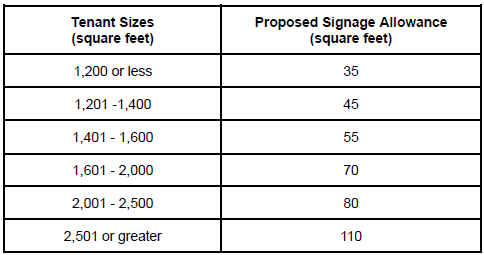
| For Multi-Tenant Buildings |
Each tenant space shall be allowed signage based on their tenant space square footage.
 |
* The abbreviation "sf" refers to "square feet" throughout this chapter.
(Ord. No. 2209, § 4, 7-11-23)
17-44-150 - Enforcement; inspections and maintenance of signs.
(A)
Inspection of signs. All signs shall be subject to inspections by the city. Footing inspections may be required on the day of excavation for all freestanding signs. The city may, within forty-eight hours after being notified that the sign is ready for inspection, also require inspection of electrical signs before erection. The permit holder or its agent shall notify the city when signs are complete and ready for final inspection.
(B)
Maintenance. Every sign including those specifically exempt from this chapter with respect to permits and permit fees, shall be maintained in good structural condition at all times. All signs shall be kept neatly painted and in good repair, including all metal parts and supports thereof that are not galvanized or of rust-resistant metals; missing, broken, damaged or deteriorated (e.g. faded, illegible, torn, weather damaged etc.) signs, frames or support structures shall be repaired. The city shall inspect and shall have the authority to order the painting, repair, alteration, or removal of a sign which constitutes a hazard to safety, health, or public welfare by reason of inadequate maintenance, dilapidation, or obsolescence.
(C)
Repair or removal of signs; emergencies; notice and liens.
(1)
Notice of Violation. If the city finds that any sign is maintained in violation of the provisions of this chapter, the city shall give written notice to the owner of the property where the sign is located.
(i)
Sign removal. Authorized city staff may remove any sign erected, mounted, displayed, maintained or remodeled in violation of this chapter under the following circumstances:
(1)
A sign may be removed immediately without notice when it is determined to present an immediate threat to the safety of the public;
(2)
A sign may be removed immediately without notice when it is illegally placed within the public rights-of-way, attached to a utility pole or city traffic sign, upon public sidewalks or roadway, or on any public building or structure when such facilities are located on public property or within public easements;
(3)
Prohibited signs and temporary signs in excess of the time permitted or temporary signs not in compliance with these regulations may be removed by the city immediately and without notice;
(4)
In all other cases, if after thirty days written notice, such person fails to alter or remove the sign so as to comply with this chapter, the city may cause such sign to be altered or removed at the expense of the owner of the property where the sign is located, and shall, upon the determination of such expenses, certify same to the director of finance.
(ii)
Sign disposal. When a sign has been removed by the city, the city shall take the following actions:
(1)
The city shall hold a sign for at least seven days unless immediate removal is permitted as described above. After seven days the city may dispose of the sign without prior notice to the sign owner. Sign owners wishing to reacquire possession of removed signs prior to their disposal shall make a formal request to the community development department to arrange pick-up.
(2)
For signs with fair market value exceeding $100.00 as determined by the city, the city shall provide written notice by mail to the underlying property owner where the sign was located as identified in the records of the Broomfield Assessor's Office that the sign is available for pick-up at the city within the next thirty days. After such 30-day period the city may dispose of the sign.
(2)
Emergencies. The city shall have the authority to move or remove any sign to facilitate public safety officials in dealing with any public emergency. In addition, the city shall have the authority in emergency situations to place barriers in or around any sign which is dangerous or constitutes a hazard and when the city has attempted to serve notice as required in this section, but has been unable to do so or when such sign constitutes an immediate danger to the public. In such instances, notice after the placement of barriers shall suffice and the property owner where the sign is located shall be responsible for reimbursement to the city for expenses incurred.
(3)
Notice of costs and lien. The director of finance shall notify the property owner of the total costs incurred for such alteration or removal of the sign, and if that person fails within thirty days after the date of notification to pay the entire costs and expenses of such repair, alteration, or removal, than such costs and expenses shall become a lien against and running with the property. The director of finance shall certify the same to the applicable county treasurer for collection in the same manner as general property taxes are collected. The amount certified by the director of finance to the countytreasurer for collection shall include the actual cost of repair or removal of the sign, plus 15% to defray the city's costs and expenses, and any charges of the county treasurer for such collection.
(D)
Authority. The city shall have the authority to enforce provisions of this article. In addition to any other remedies provided in this section, a summons and complaint may be filed in the municipal court to any person for which probable cause exists concerning the violations of this article. These sign regulations are enforced by the city, and nothing in the sign code is intended to create a private cause of action. Any person who violates a provision of this code shall be subject to penalties as prescribed in Chapter 1-12, B.M.C.
(Ord. No. 2209, § 4, 7-11-23)
17-44-160 - Administrative adjustment of sign requirements.
(A)
Administrative adjustment. The city and county manager or their designee may grant minor administrative adjustments of any sign standard, including but not limited to the sign area or height modifications of 10% or less or a greater amount to the extent necessary to meet the minimum requirements for legibility of a sign to serve its intended purpose, upon a finding that:
(1)
The modification to the sign encourages excellence in design, exhibits improved creativity, promotes community aesthetics, and is compatible with the character of the area;
(2)
The modification to the sign shall be compatible with the color, materials, and design of the buildings in the immediate vicinity; and
(3)
The modification to the sign shall be at a scale and location that is compatible with the scale of the lot and the massing of the building in the vicinity with consideration for the legibility of the copy area.
(Ord. No. 2209, § 4, 7-11-23)
17-44-170 - Special exceptions from zoning for signs.
(A)
Special exceptions. The neighborhood board of adjustment, land use review commission or city council may hear and decide requests for special exceptions from the city and County of Broomfield Sign Code to allow signs which do not meet the provisions of this sign code. The neighborhood board of adjustment shall hear cases that relate to applications with the single subject matter being the sign. The land use review commission or city council may hear special exceptions in conjunction with other land use cases, such as site development plan, planned unit development application or other land use process in accordance with Title 17 of the Broomfield Municipal Code, subject to the following limitations:
(1)
Special exceptions are available for permanent signs and will not be considered for temporary signs.
(2)
The neighborhood board of adjustment shall not permit any signs that are specifically prohibited in the sign code.
(B)
Special exception decision criteria.
(1)
The governing body in reviewing and making its decision on a special exception for a sign shall consider the impacts of the proposed sign upon the property and the surrounding area, including but not limited to:
(i)
The sign shall be consistent with the purpose of this chapter as declared in B.M.C. [section] 17-44-020;
(ii)
The sign shall improve the condition of the city as envisioned by the Broomfield Comprehensive Plan or, at a minimum, has no net negative impact;
(iii)
The sign promotes ease of wayfinding for places of significant public interest;
(iv)
The sign shall not adversely affect the community character of the area surrounding the proposed sign;
(v)
The visual and aesthetic impacts, including bulk and scale of buildings as they relate to the sign and the uses on the surrounding properties;
(vi)
The sign shall not create a hazard or nuisance or interfere with the use of public lands or highways; and
(vii)
The effect upon the health, safety and welfare of the residents in the surrounding area.
(2)
Where reasonable methods or techniques are available to mitigate any negative impacts which could be generated by the proposed use upon the surrounding area, the governing body may condition the decision to approve the special exception application upon implementation of such methods or techniques.
(3)
Any decision by the land use review commission shall be subject to call-up by city council as provided in Title 17 of the Broomfield Municipal Code.
(C)
Application and hearing.
(1)
Application. The applicant for a special exception for a sign shall submit an application in substantially the same format as a sign permit application in B.M.C. [section] 17-44-070, which application shall be signed by the applicant and submitted with the special exception sign review fee.
(2)
Hearing. Within forty-five days after the receipt of an application, or as soon thereafter as possible or in conjunction with the other applicable land use hearings if heard before the land use review commission or city council, the governing body, after giving notice, shall hold a public hearing on the application. Notice shall be given in accordance with the provisions of Chapter 17-52, B.M.C.
(3)
Decision. After hearing the application, the governing body shall make its findings, which shall be recorded in the official minutes of the meeting, either:
(i)
Granting the proposal application in whole or in part, with or without modifications or conditions; or
(ii)
Denying the application.
(4)
Final decision. The decision of the governing body shall not become effective until thirty days after the date the governing body renders its decision.
(Ord. No. 2209, § 4, 7-11-23)

