
Bryan County Unincorporated
City Zoning Code
City Zoning Code
ARTICLE VIII
DEVELOPMENT PATTERNS AND DESIGN
This article includes design standards and guidelines for different development patterns.
Sec. 114-800.- Purpose.
To fulfill the county's comprehensive plan's goals and objectives and ensure the county develops in a manner consistent with these goals and objectives, this UDO provides for development patterns, design standards and design guidelines for residential and non-residential development. The purposes of establishing these patterns, guidelines, and standards are:
(a)
To achieve building and site design that is compatible with the neighborhood setting while avoiding monotonous uniformity;
(b)
To protect property values and enhance the value of public and private investments through well-planned and well-maintained development;
(c)
To promote creative designs that surpass the quality of the minimum design standards established herein;
(d)
To foster safe, healthy and sustainable development that becomes increasingly valued in Bryan County as desirable places to live, work, play, and shop;
(e)
To ensure that the scale, massing, and building details are in proportion to and complementary with the surrounding neighborhood;
(f)
To require materials that are durable in the county's environment;
(g)
To foster site development that reflects and reinforces the natural beauty of Bryan County;
(h)
To retain the rural character of the county;
(i)
To protect the health, safety, and welfare of the general public and occupants of the buildings;
(j)
To promote a pedestrian-friendly, walkable streetscape within and between developments;
(k)
To provide for aesthetically pleasing development patterns;
(l)
To promote economic vitality within the county;
(m)
To promote a good business environment serving the needs of the residents and visitors to the county; and
(n)
To create compatible land use transitions between residential and non-residential developments.
(Ord. No. 06-2020, § 3, 12-8-2020)
Sec. 114-801. - Modification of standards.
Unless otherwise noted in the provisions of this article, the community development director may modify building and site design standards upon determining that the applicable design purposes are satisfied. Appeals to the community development director's actions shall be considered by the planning and zoning commission. Any of the provisions of this article may be modified through the planned development process.
(Ord. No. 06-2020, § 3, 12-8-2020)
Sec. 114-802. - General design standards.
Subsequent sections for each development pattern, e.g., single-family, townhouse, multi-family, etc., will identify specific design standards. The objective of design standards for the county is to select building and site design that is compatible with and maintains the rural character while the county transitions, in certain areas, to a more urban environment. Generally, development should be consistent with the Georgia Coastal Regional Character Design Guidelines prepared and published by the Coastal Regional Commission June 30, 2010, ("CRC Design Guidelines") and all subsequent revisions. Depending on the location, development should be consistent with the design guidelines established for Rural Ridge, Southern Coastal Plain, Tidewater Hearth or Barrier Island and Marsh Fringe character areas (collectively "CRC character areas").
Development, therefore, should include the following:
(a)
Open space;
(b)
Pedestrian and bicycle connectivity, as appropriate;
(c)
Walkable and pedestrian friendly features, including outdoor gathering places;
(d)
Streetscapes that define the pedestrian and vehicle corridor and presents an appealing and continuous theme along a sidewalk or road;
(e)
Design elements that limit long blank walls and/or deemphasize the mass of structures;
(f)
Native vegetation that is incorporated into landscaped areas and promotes the protection of the natural environment by limiting clearing, grading, and land disturbance as much as possible;
(g)
Existing natural features, such as protected trees/tree clusters, topography and creeks, that are incorporated into the site planning and enhance the natural environment; and
(h)
Buildings and structures compatible or consistent with the Tidewater Hearth, Southern Coastal Plain or Barrier Island and Marsh Fringe Character Areas in South Bryan or the Rural Ridge Character Areas in North Bryan, that generally reflect or are complementary to a low-country architectural style.
(Ord. No. 06-2020, § 3, 12-8-2020)
Sec. 114-803. - Single-family and duplex development.
(a)
Applicability. The design standards in this section apply to all new detached single-family and duplex residential construction, except for the following:
(1)
Development within a manufactured housing park or manufactured home subdivision;
(2)
Development of a parcel that is not platted as part of a major subdivision or was created through a minor plat;
(3)
Any parcel in an A or RR zoning district;
(4)
Any parcel that is part of an approved PUD for which the approval included residential design guidelines/standards or deed restrictions addressing similar residential design requirements;
(5)
Any parcel for which a sketch plat and construction plans have been approved prior to adoption of the IDO or this UDO shall be exempt from the provisions of single-family and duplex residential design standards; provided the sketch plat and construction plans do not expire. If a sketch plat and construction plans, however, were approved pursuant to the IDO requirements, the applicant may develop under the IDO standards in existence at the time of approval or they may develop under the UDO standards. If the sketch plat and/or construction plans approved under the IDO requirements expire prior to development commencing, the structures must be constructed to these UDO requirements; and
(6)
Those areas within a pending subdivision that the community development director determines to function as a transition areas as identified in section 114-107. In these areas, the community development director may modify any of the standards and guidelines in this section to achieve compatible transitions.
(b)
Theme. In developing single-family detached and duplex sites, the design of buildings should be consistent with the county's overall goal of developing in a low-country style and consistent with the design guidelines identified in the CRC Design Guidelines.
(1)
Southern Coastal Plain, Tidewater Hearth and Barrier Island and Marsh Fringe areas generally include the following elements:
a.
Raised buildings/elevated slabs;
b.
Broad hip roofs;
c.
Covered wraparound porches;
d.
Functioning shutters; and
e.
Transoms.
(2)
Rural Ridge areas generally include the following elements:
a.
Materials such as brick, wood/composite shake or lap siding;
b.
Broad overhangs and projections for eaves; and
c.
Fenestration delineation, i.e., divided lites (windowpanes).
(c)
Building design. Applicable single-family and duplex developments are required to comply with the following building design standards.
(1)
Materials and finishes. All primary buildings shall comply with the following:
a.
Exterior walls shall be finished in brick, tabby, stone, stucco, or composite shake, lap siding, wood or fiber-cement siding. Metal or aluminum may be used as an accent material. The use of vinyl or other plastic siding or metal siding is strictly prohibited except as provided for in paragraph (d) of this section.
b.
Not more than two building materials shall be used for exterior walls (excluding trim and cornices) on sides of buildings facing or visible from a road. If a single material is proposed, but there are multiple textures and/or colors, the community development director shall determine if the overall effect is inconsistent with the intent of this provision.
c.
Roofs shall be galvanized (standing seam or v-crimp), slate, wood or composite/manufactured shingle, architectural shingle, or other roofing material approved by the community development director.
d.
A maximum of two additional materials may be used for accents, but the material used must be listed in paragraph a. Fascia, soffits, and other house trim materials may be vinyl.
e.
Windows shall have exterior trim. The use of fiber cement, composite, or wood for trim is encouraged over the use of vinyl or PVC trim.
f.
The following materials are prohibited and may not be modified by the community development director or planning and zoning commission:
1.
Metal or aluminum siding as a primary building material;
2.
Unfinished concrete block, concrete tilt slab, or block siding; and
3.
Vinyl siding. Fascia, soffits, and other trim materials, however, may be vinyl.
(2)
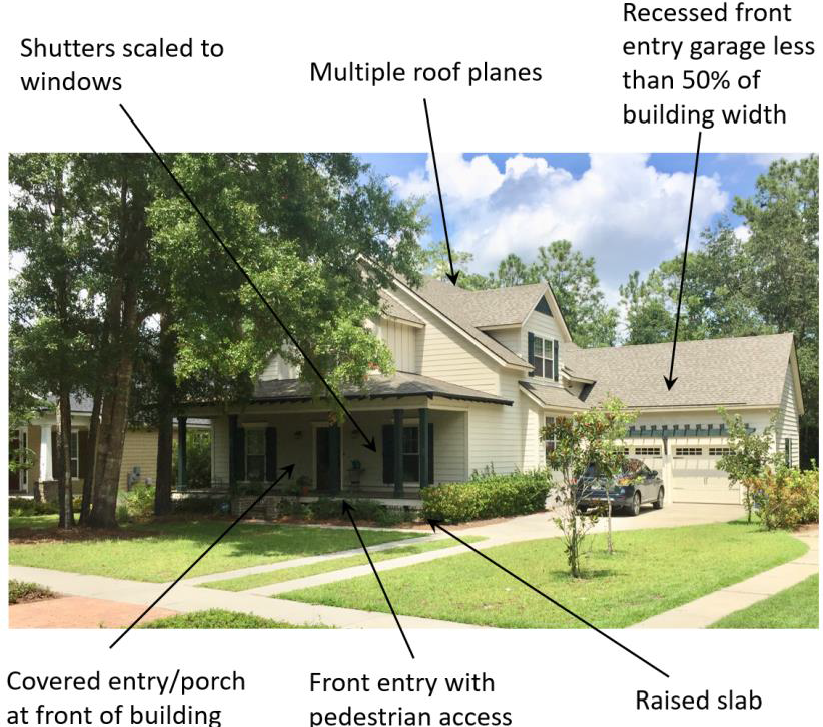
Design features. In developing single-family detached subdivisions, developers shall incorporate required design features and a minimum number of optional features, many of which are illustrated in Exhibit 803. If the developer cannot meet these minimum standards, the developer may propose alternative design features that are consistent with the purposes of this article, for the community development director's review and approval.
a.
Required features. Single-family homes and duplexes shall incorporate the following design features:
1.
Front entry garages shall not exceed 50 percent of the building width.
2.
Side entry garages shall have windows comprising at least ten percent of the front facing wall.
3.
All slabs shall be elevated for development located in the Tidewater Hearth, Southern Coastal Plain or Barrier Island and Marsh Fringe character areas. The finished floor elevation at the front façade shall be located above grade in accordance with the following standards:
i.
The foundation supporting the floor framing on the front façade shall be a minimum of 18 inches above grade;
ii.
Exposed foundation walls or piers shall be clad in face brick, stone, tabby, or some other masonry material accurately imitating these materials. Concrete shall not be considered an acceptable masonry material. Latticework screening or similar type screening shall be installed between piers on front and side building facades.
4.
Entries shall be located at the front of the building and connected to a paved driveway or sidewalk by a clearly delineated pedestrian walkway.
5.
Entries for single-family homes shall be covered by a roof measuring not less than four feet in depth by six feet in length.
6.
Large expanses of blank walls shall be broken up by features such as windows, doors, window reveals, offsets, balconies, projections, recessed or covered entrances, porches or similar elements that comprise not less than 15 percent of the street-facing wall.
b.
Optional features. While each of the following design features is desirable, single-family and duplex residences shall incorporate at least three the following design features:
1.
Side or rear entry garages or detached garages.
2.
At least three roof planes visible from front property line.
3.
Minimum roof pitches of 4:12 (rise:run) for all planes visible from the front of the structure, with the exception of roofs over covered porches, carports, shed dormers, and accessory structures.
4.
Covered porches that are at least five feet in depth at the base. If providing a wraparound porch, the porch shall count for two design features.
Exhibit 803: Sample Illustration of Single-Family Residential Design Features
(3)
Duplex design. The following provisions shall apply to the design of duplex dwellings in addition to the provisions of paragraphs (c)(1) and (2) (Materials and Finishes and Design Features) of this section:
a.
Transparent windows and/or doors on at least 15 percent of the facade (this includes any upper levels, if applicable).
b.
Corner lot duplexes shall be designed with the front pedestrian entry of each unit located on a different street frontage.
c.
Covered entries for each dwelling unit shall be provided with a minimum dimension of four feet in depth by six feet in length.
(Ord. No. 06-2020, § 3, 12-8-2020)
Sec. 114-804. - Townhouse development.
Townhouse developments are subject to the applicability requirements identified in section 114-803(a) and shall be consistent with the design themes identified in section 114-803(b). Townhouse developments are required to comply with the following design standards.
(a)
Materials and finishes. All primary buildings shall comply with the following:
(1)
Exterior walls shall be finished in brick, tabby, stone, stucco, or composite shake, lap siding, wood or fiber-cement siding. The use of vinyl or other plastic siding or metal siding is strictly prohibited except as permitted in paragraph (d).
(2)
Not more than two building materials, per unit, shall be used for exterior walls (excluding trim and cornices) on sides of buildings facing or visible from a road. For townhouse developments, the material finishes are per building. The community development director may allow the use of additional building materials upon reviewing proposed renderings and determining the design is compatible with the goals and objectives of this UDO.
(3)
Roofs shall be galvanized (standing seam or v-crimp), wood or composite/manufactured shingle, architectural shingle, or other material approved by the community development director.
(4)
The development may use different materials for accent, but the material used must be the ones identified in paragraph a. No more than two additional materials, per unit, may be used for accent. Fascia, soffits, and other house trim materials, however, may be vinyl.
(5)
Windows shall have exterior trim. The use of fiber cement siding, composite, or wood for trim is encouraged over the use of vinyl or PVC trim.
(b)
Design features. Similar to single-family subdivisions, townhouse developments are required to include certain design features and a certain number of optional features. If the developer is unable to provide these design features, the developer may propose alternative design features, consistent with the county's goals and objectives, for the community development director's review and approval.
(1)
Required features. Townhouse development shall incorporate the following design features:
a.
Street and rear yards shall be provided for all townhouses, but side yards are only required for exterior townhouses. Building separation requirements shall be maintained for all townhouse structures.
b.
The maximum number of units allowed in a single building is eight.
c.
If the garages are not rear loaded, the following standards apply:
1.
Garages must be inset a minimum of one foot; and
2.
Where garage doors for separate units are adjacent, they shall be offset from each other and at least one unit must feature single-car garage doors.
d.
Carports are prohibited.
(2)
Optional features. While each of the following design features is desirable, townhouse developments shall incorporate at least three the following design features:
a.
Rear-loaded garages.
b.
For multi-car garages (front loaded), paired-single doors.
c.
Changes in massing particularly over garages doors. The use of insets or projecting bays are preferable and encouraged.
d.
Elevated slabs. The finished floor elevation at the front façade shall be located above grade in accordance with the following standards:
1.
The foundation supporting the floor framing on the front façade shall be a minimum of 18 inches above grade;
2.
Exposed foundation walls or piers shall be clad in face brick, stone, tabby, or some other masonry material accurately imitating these materials. Concrete shall not be considered an acceptable masonry material. Latticework screening or similar type screening shall be installed between piers on front and side building facades.
e.
Covered porches that are at least five feet in depth at the base. If providing a wraparound porch for the end units, the porch shall count for two design features.
(Ord. No. 06-2020, § 3, 12-8-2020)
Sec. 114-805. - Multi-family development.
(a)
Applicability. The provisions of this section shall apply to all new multi-family residential developments with five or more dwelling units in any zoning district. The following multi-family developments are exempt from these requirements:
(1)
Multi-family developments with site plans approved prior to the adoption of the UDO. If development is not commenced within 18 months of adoption, the development shall comply with the requirements of this UDO. For purposes of interpreting this exemption, the submittal of a concept plan with a rezoning application, including a PD, shall not constitute an approved site plan.
(2)
Development with an approved site plan pursuant to the IDO design standards. The developer may, however, choose to develop under the UDO standards. If the approved site plan, however, expires (see section 114-419) prior to construction commencing, the development will need to comply with the UDO design standards.
(3)
Multi-family developments included in a PD approved prior to the adoption of this UDO, and the PD has approved design guidelines/standards.
(b)
Theme. Multi-family sites and buildings should be consistent with the county's overall goal of developing in a low-country style with the design patterns identified in the CRC Design Guidelines. Development should avoid inappropriate elements.
(1)
Inappropriate elements. Modern design features are considered inappropriate and the following design features should be avoided:
a.
Monotonous barracks style buildings with long façades lacking roof and wall articulation as viewed from public roads;
b.
Modern architectural design that incorporates glass, steel and reinforced concrete; and
c.
Styles more appropriate in other regions of the country, such as Colonial, Cape Cod, and Northwest Regional style.
(2)
Appropriate elements. These elements include features that are consistent with or further the county's design aesthetic of low-country style architecture.
a.
Southern Coastal Plain, Tidewater Hearth and Barrier Island and Marsh Fringe areas generally should include the following elements:
1.
Broad hip roofs;
2.
Front porches and/or balconies;
3.
Functioning shutters; and
4.
Transoms.
b.
Rural Ridge areas should generally include the following elements:
1.
Materials such as brick, wood/composite shake or lap siding;
2.
Overhangs and projections for eaves; and
3.
Fenestration delineation, i.e., divided lites (windowpanes).
(c)
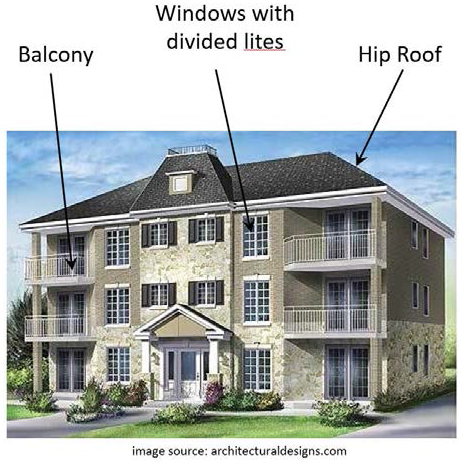
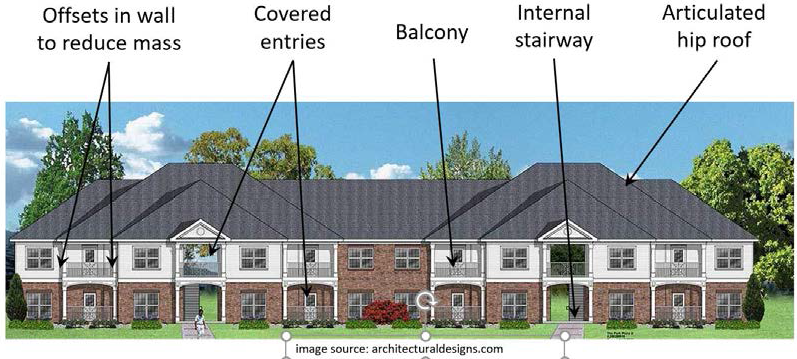
Building design. Multi-family development shall comply with the following design standards, which are illustrated in Exhibits 805a and 805b:
(1)
Materials and finishes.
a.
Buildings shall use distinct, but complementary, materials and colors using a combination of the following materials:
1.
Stucco with smooth, sand or light lace finish as a primary or accent material;
2.
Engineered fiber-cement board or wood, as a primary or accent material;
3.
Brick, as a primary or accent material;
4.
Split-faced block, as a primary or accent material;
5.
Stacked stone, as an accent material;
6.
Marble, travertine, or other related stone materials as accent materials; and
7.
Unglazed tile as an accent material;
b.
The following materials are prohibited and may not be modified by the community development director or Planning and Zoning Commission:
1.
Metal or aluminum siding, but metal and aluminum may be used as an accent material;
2.
Unfinished concrete block, concrete tilt slab, or block siding; and
3.
Vinyl siding. Fascia, soffits, and other trim materials, however, may be vinyl.
(2)
Design features. In developing multi-family buildings, developers shall incorporate required design features and a minimum number of optional features, many of which are illustrated in Exhibits 805a-c. If the developer cannot meet these minimum standards, the developer may propose alternative design features that are consistent with the purposes of this article, for the community development director's review and approval.
a.
Required features.
1.
Roofs. Gable or hip roofs or a mixture of roof types to create articulation and ridgelines is required to break up long roof lines. Large expanses, or gambrel roofs, are prohibited.
Exhibit 805a: Sample Illustrations of Multi-family Design Features
2.
Windows and doors.
i.
Windows shall be rectangular, except accent windows may be round headed with various forms or other approved shapes.
ii.
Arches, gateways, entry courts shall be used to shelter doorways.
iii.
Windows shall be located to minimize views of the private outdoor space of adjacent units' patio areas.
iv.
Windows and doors shall not include silver or gold window frames; reflective glass; or windows flush with wall surface.
Exhibit 805b: Sample Illustration of Multi-family Design Features
3.
Stairways. Stairs shall be designed according to the following techniques:
i.
Freestanding stairways shall not make a straight run from upper floors to the ground floors - they must have a landing and make a right-angle turn.
ii.
Stairway walls shall be smooth or sand finish stucco, block, stone, slate, or other opaque building material with an accent trim cap or banding of tile.
iii.
Exposed prefabricated metal stairs and transparent walls are prohibited.
4.
Cable and antennas. All antennas shall be placed in attics or interior of the residence. Developments shall be pre- wired to accommodate cable or satellite reception. Satellite dishes are permitted to serve individual units.
5.
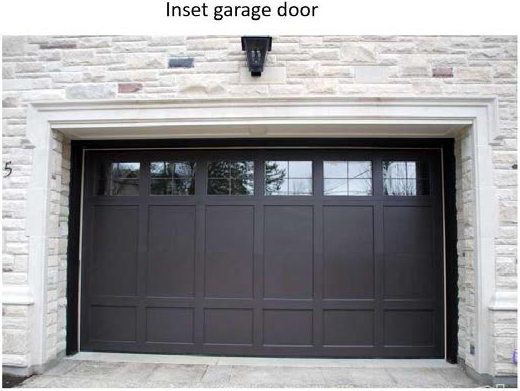
Garage doors. Garage doors shall appear to be set into the walls rather than flush with the exterior wall.
Exhibit 805c: Sample Illustration of Multi-family Design Features
6.
Roof mounted equipment. Roof mounted mechanical equipment other than solar energy systems shall be screened from view in a manner consistent with the building façade.
7.
Ground mounted equipment. Ground mounted mechanical equipment shall be screened from view with landscaping or solid fencing.
b.
Optional features. Multi-family development shall incorporate three of the following design features.
1.
Awnings. Metal or canvas awnings of solid accent colors provided along ground level openings. Vinyl awnings are specifically prohibited.
2.
Balconies. Balconies and porches provided at a ratio of no less than one per every three units.
3.
Windows. Windows with true divided lites or simulated divided lites.
4.
Eaves. Eave treatments for each building within the development that are consistent with the CRC Design Guidelines.
(3)
Building massing.
a.
Building separation. The minimum spacing between buildings is 20 feet, plus one foot for each one foot of building height in excess of 30 feet.
b.
Building length. In attached multi-family projects, buildings shall not exceed 160 feet in length. Building façades should be broken up to reduce massing by changes in rooflines and offsets in walls. Wall offsets of at least two feet shall be provided at separations not exceeding 50 feet.
c.
Clustering and massing. Clustering of multi-family units shall be a consistent site planning element. Buildings shall be designed as a series of varied plans that:
1.
Vary setbacks within the same building;
2.
Use reverse building plans to add articulation; and
3.
Vary wall and rooflines.
(d)
Accessory buildings. Accessory buildings are permitted within multi-family developments, so long as they are for the exclusive use of the residents. Building design shall comply with the following standards:
(1)
Are limited to a single story in height;
(2)
Shall use the same siding materials and be designed to reflect the style of multi-family buildings; and
(3)
Shall use the same roofing materials and have rooflines that reflect those of the multi-family buildings.
(e)
Lighting. Outdoor area lighting shall be provided as required in article VI. Such lighting shall be shielded to direct light downward and not into dwelling units on, or adjacent to, the multi-family site. Lighting shall be provided to illuminate the intersections of primary interior driveways and building entryways. Lighting fixtures shall comply with the character areas standards identified in the CRC Design Standards.
(Ord. No. 06-2020, § 3, 12-8-2020)
Sec. 114-806. - Commercial development.
(a)
Applicability. These design standards and guidelines shall apply as follows:
(1)
All new commercial and mixed-use development and redevelopment projects in the B-1, B-2, P/I, and C-I districts requiring site plan approval shall comply with the standards and guidelines of this section. When applying these design standards, the objectives should be considered in the context of whether the development is small-scale commercial, which is generally development in the B-1 zoning district or projects with total gross floor area less than 10,000 square feet for single tenant or 40,000 square feet for multi-tenant or large-scale development.
(2)
For projects involving remodeling or improvements to an existing structure built prior to this UDO, the owner shall bring the entire building into compliance with the design standards if the total cost of improvements is equal to or greater than 50 percent of the assessed value of the building improvements according to the most recent property tax assessor's records. Existing rooflines and locations of walls do not need to be brought into conformance.
(3)
For projects involving the expansion of an existing building or overall square footage of development, the expansion shall be constructed in compliance with these design standards, as practicable. The community development director shall determine which standards can be reasonably met and are consistent with the goals and objectives of this UDO.
(4)
If a development received site plan approval prior to the adoption of this UDO, the design standards in existence at the time of approval shall apply. If the site plan approval expires (see section 114-419), these UDO design standards shall apply to the development.
(5)
The approval of a preliminary commercial subdivision plat or recording of a final commercial subdivision plat does not exempt structures/development from these design standards unless a site plan has been approved prior to the adoption of this UDO and remains valid.
(b)
Theme. In developing commercial projects, the sites and buildings should be compatible with the county's overall goal of developing in a low-country style and be consistent with the design patterns identified in the CRC Design Guidelines, while being context appropriate especially for commercial development along major highways and interchanges. Generally, commercial development along minor roads and within less dense areas should have a more residential design approach, i.e., incorporating architectural elements like shutters, porches, etc. Large-scale commercial/auto centric development should incorporate design elements that reduce the scale and massing and use sustainable high quality building materials. Appropriate design elements include:
(1)
Use of materials compatible with the design guidelines for the specific CRC character areas including brick, wood, tabby, and composite siding;
(2)
A unified design theme that minimizes corporate logos and use of corporate architecture;
(3)
Use of a neutral color palette, unless located in the Barrier Islands and Marsh Fringe CRC character area;
(4)
Signage that is complementary to the building design and does not dominate the landscape or building facade;
(5)
Buffering and landscaping of large-scale commercial structures/buildings to minimize the visual impact;
(6)
Public plazas for large-scale development that emphasize the active nature of these spaces and incorporate some combination of accent items such as: site furniture (tables, umbrellas, benches, trash receptacles); shade structures; interesting colors and materials; or other focal elements; and
(7)
Strategic site planning for large-scale development that reduces potential nuisances to adjoining residential property by locating trash enclosures, loading areas, and restaurant vents away from residential uses and properly screening utilities and equipment.
(c)
Building design. Commercial development shall comply with the following design standards:
(1)
Materials and finishes. Generally, architectural features should be architecturally valid, not just decorative. While some elements may be wholly decorative, primary architectural features should be related to the building's structure, function and/or engineering, and should not be arbitrary.
a.
Buildings shall use distinct, but complementary materials and colors consistent with the CRC design guidelines for the applicable character area, using a combination of the following materials:
1.
Stucco with smooth, sand or light lace finish as a primary or accent material;
2.
Engineered fiber-cement board or wood, as a primary or accent material;
3.
Brick, as a primary or accent material;
4.
Split-faced block, as a primary or accent material;
5.
Stacked stone, as an accent material;
6.
Marble, travertine, or other related stone materials as accent materials;
7.
Unglazed tile as an accent material;
8.
EIFS used in combination with another material, when the secondary material comprises a minimum of 25 percent of wall area below the roofline; and
9.
Finished concrete tilt up, as approved by the community development department.
b.
The following materials are prohibited and may not be modified by the community development director or Planning and Zoning Commission:
1.
Metal or aluminum siding, but metal and aluminum may be used as an accent material;
2.
Unfinished concrete block, unfinished concrete tilt slab, and block siding; and
3.
Vinyl siding. Fascia, soffits, and other trim materials, however, may be vinyl.
(2)
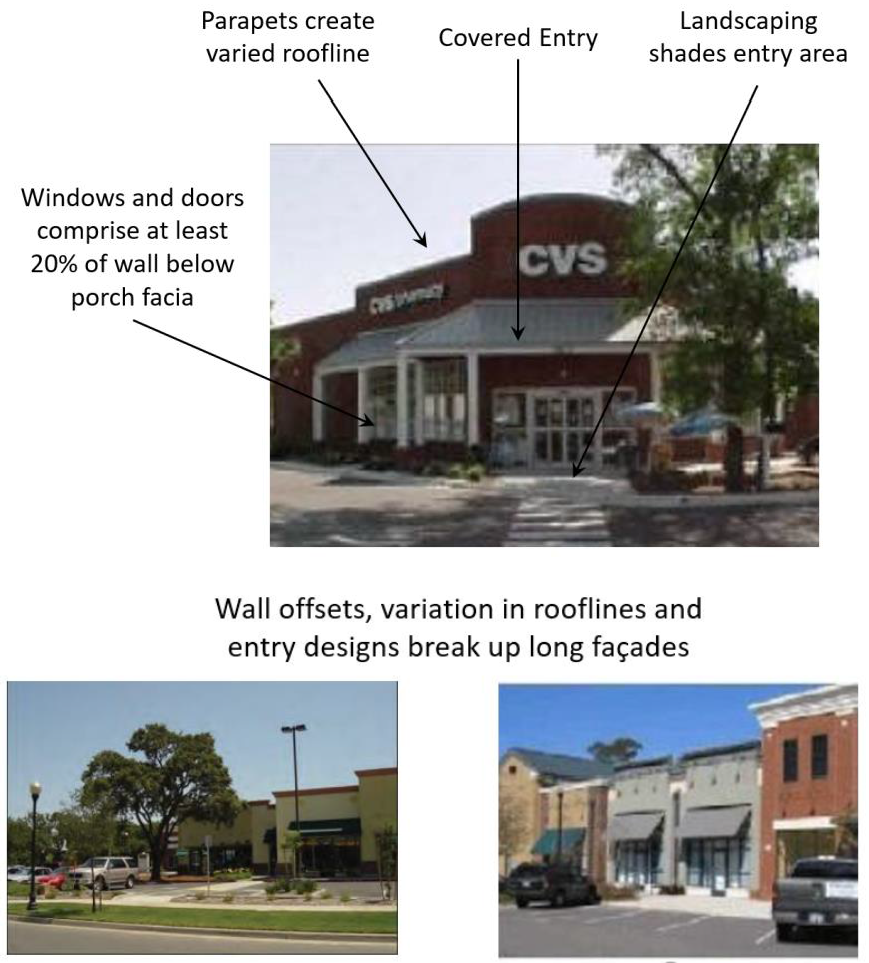
Design features. To ensure high quality and sustainable commercial development, certain design features are required for all commercial development regardless of size; plus, a certain number of optional design features are required. Large-scale development has supplementary required design features. Sample illustrations of some of these design standards are provided in Exhibits 806a-d.
a.
Required features. All development shall include the following features:
1.
Primary facades shall have a heightened level of detail and articulation. Rooflines, wall planes, and wall heights should be varied and significantly articulated to avoid blank expanses of walls. While all building elevations of a structure will not have the same level of detailing and articulation, elements of the architectural style shall be evident on the secondary façades of the buildings within the development.
2.
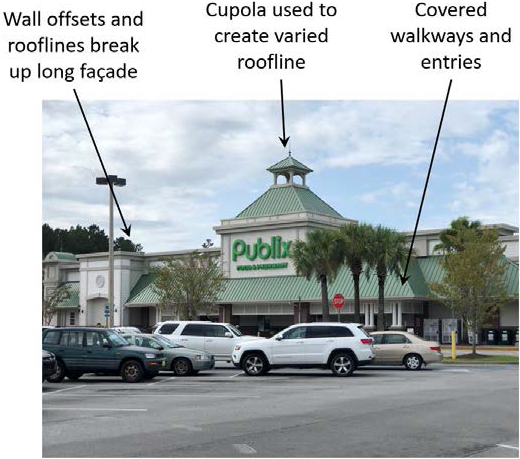
Long facades shall include off-sets and other design features to create the appearance of multiple storefronts that are no more than 50 feet wide.
3.
Pitched roofs shall be hip or gable and have a minimum pitch of six/twelve (6/12). The community development director may approve flat or slightly pitched roofs for larger buildings; provided parapets with varied elevations are incorporated into all sides of the building design to avoid the appearance of long flat rooflines.
4.
Windows and other openings shall be provided along all facades that face a public road or include customer entries. Windows and doors shall comprise at least 20 percent of the wall area below the roofline, lowest point of canopy, bottom of porch fascia or other architectural feature defining the middle of the building. Shapes and panes of the windows and openings shall be taller than wide.
5.
Architectural features shall be used to provide weather protection and highlight building features and create a sense of entry.
Exhibit 806a: Sample Illustrations of Design Features for Commercial Development
b.
Optional features. All development shall incorporate, at least, four of the following optional design features.
1.
Windows and openings.
i.
Windows/openings exceeding the minimum percentage requirement identified in (a)(4) above.
ii.
Decorative trim and detailing along pedestrian areas of the building, such as around display windows and entries.
iii.
Fenestration delineation, i.e., use of muntins to create divided lites (windowpanes)
iv.
Cornice trim at the eaves and in the gables.
2.
Roof overhangs projecting at a minimum of eight inches. Overhangs shall either have open rafters or the appearance of rafters.
3.
Appropriately sized shutters that are functional or appear functional.
4.
Wood or composite exterior doors for primary entrances and along pedestrian areas of the building.
5.
Balconies, awnings, canopies, arcades, wall insets, reveals or similar element, which give a person a sense of their relationship to the structure and provide a human scale.
c.
Additional requirements for large-scale development. The following standards and guidelines apply to developments with single tenant greater than 10,000 square feet or multi-tenant building greater than 40,000 square feet in total floor area.
1.
Retail and service commercial, office, community facilities, and mixed-use development with multiple structures or tenants, should use a "village" or "campus" design concept that integrates clusters of buildings with a combination of walking, landscape, and public space to achieve a desirable pedestrian experience. Site circulation for such developments should consider the functional relationship between buildings, as well as the access and movements of both vehicles and pedestrians, with the goal of providing a safe, convenient, and desirable experience for the user.
Exhibit 806b: Sample Illustration of Design Features for Commercial Development
2.
Development with multiple buildings or tenants shall be designed with one or more pedestrian features. The number, size, location, and particulars of pedestrian amenities will be evaluated on a case-by- case basis taking into consideration the proposed use and development of the site, as well as the relationship to the surrounding neighborhood and street network. Potential pedestrian features, though not exhaustive, are listed below.
i.
Covered pedestrian walkways along storefronts connecting all entrances. Such walkways shall be primarily covered with building overhangs, trellises, awnings, or a combination thereof;
ii.
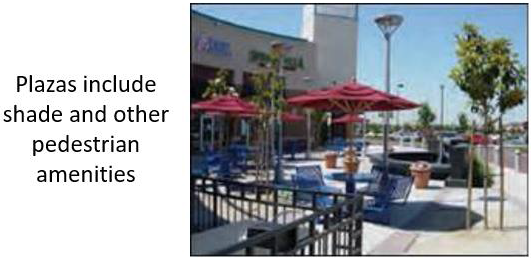
Pedestrian courtyard(s) and/or plaza(s); or
iii.
Primary materials that clearly delineate pedestrian walkways such as broom finish concrete and secondary materials such as colored concrete or brick or concrete pavers.
3.
The incorporation of public gathering places may be required depending on the size, scale, and location of the development. When required, the following objectives apply to the design of pedestrian gathering places.
i.
Design of public plazas should emphasize the active nature of these spaces and incorporate some combination of accent items such as: site furniture (tables, umbrellas, benches, trash receptacles), shade structures, interesting colors and materials, or other focal elements.
ii.
Design and layout of plaza areas shall consider the local climate and seasonal conditions and provide protections from the sun, wind, and rain.
(d)
Project entry landscape. The vehicular entrance to the project should be clearly defined and provide adequate sight distance for vehicles and pedestrians. Entries to multi-tenant projects shall be designed as special statements reflective of the character and scale of the project in order to establish identity for tenants, visitors, and patrons. Landscape design at project entries shall complement any special landscape treatment at intersections of arterial and collector roads or local roads that intersect with arterial/collector roads with common elements. Flowering accent plantings and specimen trees shall be used to reinforce the entry statement. Planting design should have focal points at project entries, plaza areas, and other areas of interest using distinct planting and/or landscape features.
(e)
Landscape for public plazas and building fronts. Landscaping shall be provided along all building facades facing a parking lot or street to soften the appearance of the structure and enhance the pedestrian scale and streetscape. In-ground landscaping should comprise the majority of the landscaping requirement. If raised planters are determined to be acceptable, they shall be designed to accentuate the architecture and/or enhance pedestrian areas. All planting materials shall be sized so that landscaping has an attractive appearance at the time of installation and an established appearance within three years of planting.
Exhibit 806c: Sample Illustration of Design Features for Commercial Development
(f)
Mass, scale, and form. Architectural scale, for purposes of these guidelines, is the relationship between the size of the new buildings and the size of surrounding buildings. Scale also refers to how the size of the building relates to the size of a human being (human scale). The apparent scale of a building should be reduced through the proper use of window patterns, roof overhangs, equipment bays that screen unsightly elements, awnings, moldings, fixtures, the use of darker or subdued colors, upper story setbacks, building and roof articulation and other details.
(1)
Site edge. The building(s) should be compatible with the scale of adjoining development. Where surrounding development is of a small-scale, large-scale buildings should be located internal to the site and transition down in scale as the outer edge of the site approaches.
(2)
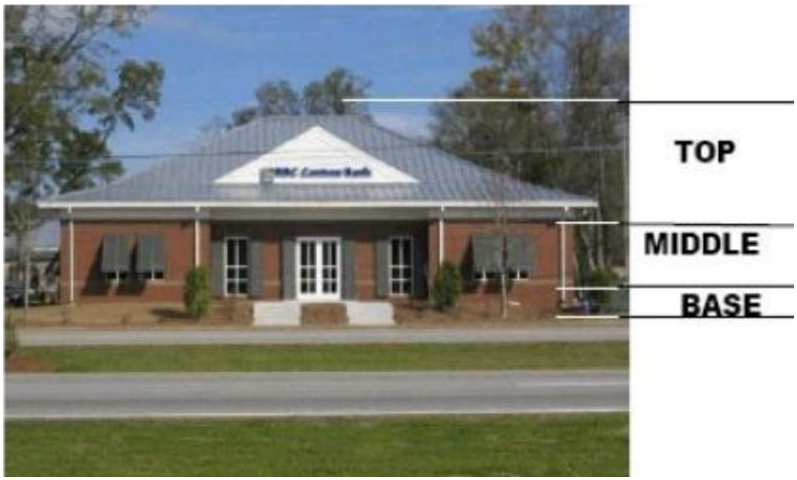
Building height. The design of larger non-residential buildings shall be designed to reduce the perceived building height and length by dividing the building mass into smaller scale components. This may be achieved by providing a well-defined base, middle and top to the building as described below:
a.
A solid building base may be achieved by elements such as low planters and walls, a base architectural veneer banding (wainscot), or treatments defined by a different material, texture or color.
b.
A solid building middle (and a more articulated building mass) may be achieved by the addition of intermittent covered walkways, trellises or architectural awnings that provide deep shadow at ground level.
c.
A solid building top may be achieved by using features such as multiple architectural roof forms, clearly pronounced eaves, and distinct parapet designs and cornice treatments.
Exhibit 806d: Sample Illustration of Design Features for Commercial Development
(g)
Site furnishings. If site furnishings are provided, furniture shall be selected not only for its functional and aesthetic qualities but also for the quality of materials and finishes that provide long-term durability and resistance to vandalism and climate/sun damage.
(h)
Trash/recycling. Trash enclosures and containers shall be sized to accommodate the volume of refuse, but developers should also take advantage of opportunities to centralize enclosures where there are multiple buildings or users. The use of hydraulic compactors are prohibited except where entirely enclosed within a building. Trash enclosure materials and colors shall be consistent with and complementary to the building materials and finishes and comply with the screening requirements in section 114-632.
(i)
Lighting. Outdoor area lighting shall be provided as required in article VI. Such lighting shall be shielded to direct light downward and not into dwelling units adjacent to the commercial development. Lighting shall be provided to illuminate the intersections of primary interior driveways and building entryways. Lighting fixtures shall comply with the character areas standards identified in the CRC Design Standards.
(j)
Sign regulations. In addition to complying with the general and specific sign standards in article VI, development shall comply with the sign standards for the applicable character area identified in the CRC design guidelines.
(Ord. No. 06-2020, § 3, 12-8-2020)
Sec. 114-807. - Industrial development.
(a)
Applicability. These design standards shall apply as follows:
(1)
The provisions of this section apply to new development and redevelopment within the I-1 and I-2 districts.
(2)
Redevelopment or remodeling projects that involve construction costs equal to or greater than 50 percent of the assessed value of site improvements according to the most recent property tax rolls shall be brought into conformance with the provisions of this section except that existing nonconformities due to existing rooflines and the existing locations of walls and parking areas may be retained.
(3)
For projects involving the expansion of an existing building or overall square footage of development, the expansion shall be constructed in compliance with these design standards, as practicable. The community development director shall determine which standards can be reasonably met and are consistent with the purposes of this UDO.
(4)
If a development has received site plan approval prior to the adoption of this UDO, the design standards in existence at the time of approval shall apply. If the site plan approval expires (see section 114-419), these UDO design standards shall apply to the development.
(5)
The approval of a preliminary industrial subdivision plat or recording of a final industrial subdivision plat does not exempt structures/development from these design standards unless a site plan has been approved prior to the adoption of this UDO and remains valid, as required by this UDO.
(b)
Theme. In developing industrial projects, a balance should be achieved between the practical and functional requirements of industrial uses with the overall goals and objectives of the county to obtain high quality, durable, and attractive development complementary to the low-country style of architecture envisioned for residential and commercial areas. Appropriate or expected design elements include:
(1)
Coating, color, and exterior finishes to walls, especially concrete tilt up, to provide a more visually appealing facade;
(2)
Architectural elements to reduce the appearance and scale of massing;
(3)
Windows, openings, or voids to add variation to the building;
(4)
Signage that is complementary to the building design and does not dominate the landscape or building facade;
(5)
Buffering and landscaping of large-scale industrial structures/buildings to minimize the visual impact; and
(6)
Strategic site planning for large-scale development that reduces potential nuisances to adjoining residential property by locating trash enclosures, loading areas, and outdoor storage and uses away from residential uses and by proper screening of utilities and equipment.
(c)
Building design. Industrial development shall comply with following design standards and guidelines.
(1)
Materials and finishes.
a.
Buildings shall use distinct, but complementary materials and colors consistent with the surrounding areas. When two or more materials are used on an exterior wall, the heavier material (e.g., brick) shall be placed below the lighter material (e.g., stucco). The following materials are permitted:
1.
Tilt-up concrete or concrete block. Exterior walls visible from the public right-of-way, private roads, or adjacent properties to the industrial property or park, must be painted or include exterior finishes such as coating or thin brick;
2.
Brick;
3.
Stone;
4.
Stucco or synthetic stucco;
5.
Cement-board or wood siding; and
6.
Materials approved by the community development director, unless specifically prohibited in paragraph b.
b.
The following materials are prohibited and may not be modified by the community development director or Planning and Zoning Commission:
1.
Aluminum siding but it may be used as an accent material or on walls not visible from an existing or planned public street or an adjacent parcel located outside the industrial development. The accent material, cumulatively, may not exceed 20 percent of the area of any individual exterior wall visible from a public street or adjacent development;
2.
Unfinished concrete block, unfinished concrete tilt slab, and block siding;
3.
Highly reflective, shiny or mirror-like materials; and
4.
Vinyl siding. Fascia, soffits, and other trim materials may be vinyl.
c.
The community development director may approve alternative building materials and finishes for walls that are not visible from roads abutting the applicable industrial development or from adjacent properties that are not located within the applicable industrial development.
(2)
Design features. To ensure high quality and sustainable industrial development, the following design features shall be incorporated. Sample illustrations are provided in Exhibit 807.
a.
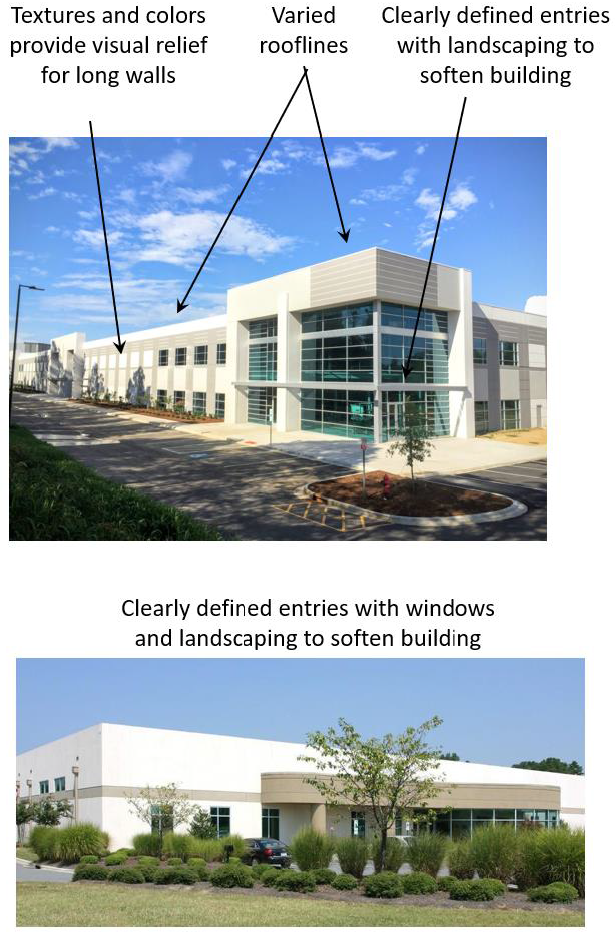
For non-manufacturing or non-warehouse type buildings, building mass must be reduced to smaller components with the use of jogs, offsets or other architectural features to reduce the visual length of long walls;
b.
For manufacturing and warehouse type buildings, the length and height of walls must be relieved through the use of change in color, materials and/or relief such as the inclusion of pilasters, pop outs, etc.
c.
All sides of a building shall be coherently designed and treated. A consistent level of detailing and finish is required for all sides of a building, especially when visible from public right-of-ways, private roads, or adjacent properties (outside of the industrial park).
d.
Average parapet height shall not exceed 15 percent of the supporting wall height. Maximum parapet height shall not exceed 33 percent of the supporting wall height.
e.
Design elements. For building facades that are visible from streets external to a development or from internal collector or arterial roads, at least four of the following elements must comprise 15 percent of façade length for facades longer than 150 feet:
1.
Parapets.
2.
Cornices.
3.
Roofline offsets.
4.
Windows or doors.
5.
Window hoods.
6.
Transoms.
7.
Bulkheads.
8.
Awnings or canopies.
9.
Ribs or columns.
10.
Changes in texture or masonry.
(d)
Project entry. Primary building entrances shall be clearly defined and shall be recessed or framed by a sheltering element such as an awning, arcade, overhangs, or portico (in order to provide weather protection for pedestrians). Public entrances flush with the building wall with no cover are not allowed.
(e)
Landscape entrance. For industrial subdivisions, the primary vehicular entrance to the project should be clearly defined and provide adequate sight distance for vehicles and pedestrians. The entrance shall be designed as a special statement reflective of the character and scale of the development to establish identity for tenants, visitors, and patrons. Landscape design at the subdivision entrance shall complement any special landscape treatment at intersections of arterial and collector roads or local roads that intersect with arterial/collector roads with common elements. Flowering accent plantings and specimen trees shall be used to reinforce the entry statement. Planting design should have focal points at the subdivision entrance and other areas of interest using distinct planting and/or landscape features.
Exhibit 807: Sample Illustrations of Design Features for Industrial Development
(f)
Windows and openings.
(1)
All windows and doors at the ground floor level on any retail building shall be transparent.
(2)
Large areas of glass shall be recessed in shadow or otherwise contrast with the building façade.
(3)
Large, glazed areas shall be divided into smaller parts by using mullions to express individual windows or groupings of windows.
(g)
Sign regulations. In addition to complying with the general and specific sign standards in article VI, development shall comply with the sign standards for the applicable character area identified in the CRC design guidelines. Billboards, where permitted, are not subject to the CRC design guidelines.
(h)
Lighting. Outdoor area lighting shall be provided as required in article VI. Such lighting shall be shielded to direct light downward and not into dwelling units adjacent to the commercial development. Lighting shall be provided to illuminate the intersections of primary interior driveways and building entryways. Lighting fixtures shall comply with the character areas standards identified in the CRC design standards.
(i)
Electrical and service equipment. HVAC and similar types of incidental machinery or equipment trash receptacles, dumpsters, utility meters, above-ground tanks, satellite dishes and antennas shall be screened from view from public streets that are external to the development project, internal collector or arterial streets, abutting residential zoning districts, and public parks.
(j)
Internal and external compatibility. Buildings that are visible from streets abutting the development, from internal collector and arterial streets or from adjacent residential zoning districts shall have compatible scales, bulk, heights, architectural styles, and roof styles. Development shall use a combination of plantings, buffers and building design to ensure compatibility with adjacent development.
(Ord. No. 06-2020, § 3, 12-8-2020; Ord. No. 2022-15, § 2, 10-11-2022)

