
Buena Vista City Zoning Code
ARTICLE 16
03 - Use Regulations
Sec. 3.1. - Table of allowed uses.
Table 3.1 below lists the uses allowed within all base zoning districts. All uses are defined in Article 16.07: Rules of Construction and Definitions. Development or use of a property for any other use not specifically allowed in Table 3.1, and without appropriate approval, is prohibited. Where there is conflict between Table 3.1 and any other standard in this UDC, Table 3.1 shall apply.
3.1.1. Table Abbreviations.
A.
Permitted By-Right Uses (P). A "P" in a cell indicates that the use is permitted by-right in the respective zoning district.
B.
Special Uses (S). An "S" in a cell indicates that the use is permitted only with an approved special use permit in accordance with the procedures in Section 6.5.2.
C.
Accessory Uses (A). An "A" in a cell indicates that the use is permitted only as accessory to a primary use in the respective zoning district.
D.
Temporary Uses (T). A "T" in a cell indicates that the use is permitted only with an approved temporary use permit in accordance with the procedures in Section 6.5.3.
E.
Prohibited Uses (blank). A blank cell indicates that the use is prohibited in the respective zoning district.
3.1.2. Table Organization. The land uses and activities in Table 3.1 are classified first by general "use categories," then by specific "use type" based on common functional, product, or physical characteristics, such as the type and amount of activity, the type of customers or residents, how goods or services are sold or delivered, and typical site conditions. This system provides a basis for assigning present and future land uses into appropriate zoning districts. The use categories are merely an indexing tool and are not regulatory. The far right-hand column, "use-specific standards," cross-references to additional requirements that shall be met for that specific use type.
3.1.3. Classification of New and Unlisted Uses. New types of uses will be proposed that are not anticipated by this UDC. When such application for a use category or use type is not specifically listed in Table 3.1, the Town Administrator shall make a determination as to the appropriate classification of such use category or use type as follows:
A.
The Town Administrator shall provide an interpretation as to the zoning classification into which such uses should be placed. In making such interpretation, the Town Administrator shall consider the nature of the use, the intensity of the use, and the general requirements for public utilities for such use.
B.
Standards for new and unlisted uses may be interpreted as those of a similar use.
C.
Appeal of the Town Administrator's decision shall be made to the Board of Adjustment following procedures under Section 6.7.4.
3.1.4. Table of Allowed Uses.
(Ord. 21 §4, 2018; Ord. 1 §§2, 4, 2020; Ord. 16 §2, 2020; Ord. 5 §9, 2022; Ord. 17 §1, 2022; Ord. 04 §1, 2023; Ord. 05 §1, 2023; Ord. 06 §1, 2023; Ord. 09 §1, 2024; Ord. 14 §2, 2024; Ord. 04 §10, 2026; Ord. 05 §1, 2026)
Sec. 3.2. - Use-specific standards.
3.2.1. Residential Uses.
A.
Dwelling, Single-Family Attached.
1.
Each single-family attached building shall exhibit the characteristics of a series of single-family detached dwellings that are arranged in an attached side-by-side fashion and shall be designed to protect the character of single-family detached residences.
2.
Dwellings fronting a street, except ADUs, shall be located on lots in such a way that each individual dwelling unit has a minimum of fifteen (15) feet of street frontage.
B.
Dwelling, Multifamily Large.
1.
Except as permitted herein, in the MU-MS and HC districts, large multifamily dwellings are only permitted as part of a vertically mixed-use structure.
2.
Large multifamily dwellings, in the HC district, are not required to be part of a mixed-use structure if no more than thirty percent (30%) of the total units may be condominiumized for separate ownership of the units. Such restriction shall be a condition of the special use permit and be imposed as deed restriction on the entire property and any condominiumized units.
3.
For large multifamily dwellings in the HC district, if the developer agrees to certain deed restrictions and conditions on the development, the developer will be eligible for certain density bonuses or other incentives as provided in this section.
a.
A deed restriction requiring that all units to be affordable housing units, in perpetuity, whether rented or sold, to households earning not more than one hundred twenty percent (120%) percent of AMI, the developer is eligible for a thirty percent (30%) reduction in applicable parking requirements.
b.
A deed restriction on the property requiring that all units to be affordable housing units, in perpetuity, whether rented or sold, to households earning not more than one hundred twenty percent (120%) percent of AMI, allowing pets in all units and the development and maintenance of a pet common area, the developer is eligible for a 30% reduction in applicable parking requirements. The pet commons area must be labeled on the site plan and final plat and, be surrounded by a fence, and included in the covenants of the property to be maintained by the ownership entity.
4.
All deed restrictions shall be in a form provided by the Town and contain such terms to ensure the designation of the units as affordable housing unit remain in perpetuity.
C.
Dwelling, Multifamily Small.
1.
In the R-1 district, small multifamily dwellings are only permitted in the Old Town Overlay east of Highway 24.
2.
In the MU-MS and HC districts, small multifamily dwellings are only permitted as part of a vertically mixed-use structure.
3.
In the HC district, subject to the approval a special use permit, small multifamily dwellings may be permitted independent of a mixed-use structure if no subdivision of the units or creation of condominiums is permitted for dwelling units permitted under this subsection.
D.
Co-Housing.
1.
Design Requirements
a.
The minimum project size for co-housing development is one-quarter (¼) acre.
b.
A shared open space equal to at least ten percent (10%) of the project area shall be provided.
c.
Base zoning district lot and setback requirements shall apply to the project site boundaries as a whole, but not to individual co-housing dwellings.
d.
Each attached co-housing dwelling structure shall be separated by a minimum of fifteen (15) feet. Detached co-housing dwelling units shall be separated by a minimum of five (5) feet. Detached co-housing structures built after 1980 shall not exceed eight hundred (800) square feet. Co-housing structures built prior to 1980 are exempt from square footage limitations.
e.
Attached co-housing dwelling units built after 1980 are permitted provided that:
i.
No individual unit in a two-unit attached structure shall exceed eight hundred (800) square feet and the total square footage of the structure shall not exceed one thousand six hundred (1,600) square feet; and
ii.
No individual unit in a three or more-unit attached structure shall exceed sux hundred (600) square feet and the total square footage of the structure shall not exceed the product of the number of units and six hundred (600).
2.
Operation and Ownership.
a.
Each co-housing dwelling unit shall be on a permanent foundation and shall connect to public water and sanitary sewer.
b.
One (1) accessory storage structure less than one hundred (100) square feet may be permitted for any co-housing dwelling unit. Additionally, one (1) shared enclosed storage facility not to exceed six hundred (600) square feet may be permitted if necessary for maintenance of the property. All accessory storage structures shall be separated from other structures by a minimum of three (3) feet.
c.
Co-housing projects shall be organized as condominiums under state law.
d.
Individual lots or portions of the site may not be subdivided for sale.
e.
Each applicant shall enter into a development agreement with the Town agreeing that the condominium association shall maintain all streets, utilities, open space, and infrastructure that is not dedicated to and accepted by the Town.
E.
Live-Work.
1.
Location. Residential areas shall be located above or behind non-residential portions of the structure.
2.
Number of Dwelling Units. A maximum of four (4) dwelling units may be allowed as live-work accessory to the primary use of the subject property.
3.
Occupancy. Only employees of the business and members of their household occupying the non-residential space may occupy the live-work dwelling unit(s).
4.
Standards. Residential units must meet the standards as defined in ADU use-specific standards.
5.
No STR. Live-work units may not be used or licensed as short-term rentals.
F.
Assisted Living Facility.
1.
Facilities in residential districts shall be designed to be residential in character to the maximum extent practicable.
2.
Facilities shall be licensed by the State of Colorado.
G.
Continuum of Care or Nursing Home.
1.
Facilities in residential districts shall be designed to be residential in character to the maximum extent practicable.
2.
Facilities shall be licensed by the State of Colorado.
H.
Day Care Home. Day care homes shall meet all certification and licensing requirements of the State of Colorado.
I.
Group Home. Group homes shall meet all certification and licensing requirements of the State of Colorado.
J.
Placement of Manufactured Homes. Nothing in this UDC shall be construed to prevent the placement of a manufactured home anywhere within the Town; provided, however, that such placement shall be made in accordance with and subject to the applicable provisions of the Municipal Code.
K.
Dwelling, two-family.
1.
Two-family dwellings shall be designed in a manner so that the façade is uniform and consistent as to appear as one (1) larger structure, not two (2) different units.
2.
Driveways off a street to each unit shall be separated and no wider than two (2) parking spaces.
3.
Utilities to each unit must be installed separately.
L.
Single Room Occupancy.
1.
The structure shall be under the ownership of a single owner and may not be subdivided or condominiumized to create individual units for separate ownership.
2.
All rooms shall meet the applicable building code requirements. Rooms without required egress shall not be used for bedrooms.
3.
A change of use shall for the appropriate building occupancy shall be issued to the property prior to occupation of the structure as a single room occupancy, as determined by the building official.
4.
Parking shall be provided per Section 16.04.4.3.
5.
The structure shall be residential in its design and compatible with the architecture of the existing structure in terms of colors and materials of the existing structure, if any, on the property and/or compatible in mass and scale of the surrounding neighborhood it is proposed to be located.
3.2.2. Public, Institutional, and Civic Uses.
A.
Shooting Range.
1.
Owners and/or operators of shooting ranges shall submit a cleanup and mitigation plan demonstrating compliance with all Town standards and applicable state and federal environmental standards.
2.
Shooting ranges shall comply with all other Town standards relating to noise and public safety. The police department shall review all shooting range applications and forward recommendations to the Town for consideration.
3.
All outdoor shooting areas shall be set back a minimum distance of one hundred (100) feet from any public right-of-way.
4.
The shooting backstops for outdoor shooting areas shall be an earthen mound or dugout of sufficient dimensions to stop projectiles.
5.
An accessory retail store, snack shop, and short-term rental of firearms and equipment for use on the premises are permitted. Sale of alcoholic beverages is prohibited.
3.2.3. Commercial Uses.
A.
Community Garden.
1.
The sale of produce and plants shall only include those grown on-site.
2.
No permanent structures other than greenhouses or storage sheds shall be allowed for the sale of produce and plants.
B.
Kennel.
1.
Enclosed Building Requirements.
a.
Those parts of structures in which animals are boarded shall be fully enclosed, with solid core doors and no operable windows, and shall be sufficiently insulated so no unreasonable noise or odor can be detected off the premises.
b.
All boarded animals shall be kept within a totally enclosed part of a structure between the hours of 10:00 p.m. and 6:00 a.m.
2.
Outdoor Runs. Any open or exercise run shall be at least one hundred fifty (150) feet from the property line of any adjoining properties zoned as a residential district.
3.
Kennels must be licensed as required under state law.
C.
Veterinarian Hospital or Clinic.
1.
Outdoor overnight housing for animals is not permitted in the MU-1, MU-2, or MU-MS districts.
2.
A veterinarian hospital or clinic must be licensed as required under state law.
D.
Personal Service. In the MU-1, MU-2, and MU-MS districts, all business and storage activities shall be within a completely enclosed structure.
E.
Retail, General.
1.
In the MU-1, MU-2, and MU-MS districts, storage activities shall be within a completely enclosed structure.
2.
In the R-3 district, grocery store is the only permitted retail use and shall comply with the following standards:
a.
Shall not exceed two thousand five hundred (2,500) square feet; and
b.
Shall be limited to vertical mixed-use buildings.
F.
Equipment Sales. In the HC district, inoperable or wrecked machinery or equipment shall be stored in an enclosed structure.
G.
Recreational Vehicle and Large Equipment Sales. Junked vehicles or wrecked or inoperable equipment or materials shall be stored in an enclosed structure.
H.
Bed and Breakfast.
1.
A proprietor or manager shall reside on the property.
2.
Guest rooms shall be located in the principal building on the property.
3.
Meals shall be served only to overnight guests or employees of the bed and breakfast.
4.
Occupancy at a bed and breakfast shall not exceed thirty (30) days, with the exception of the proprietor or manager.
I.
Short-Term Rentals.
1.
All applicable taxes and fees shall be paid prior to operating a short-term rental.
2.
Occupancy of a short-term rental shall not exceed thirty (30) days.
3.
Short-term rentals shall have valid Town licenses as required, prior to and during any time a unit is rented.
4.
Short-term rentals shall provide a snow removal plan that complies with the Town's snow removal requirements.
5.
Short-term rentals shall comply with the state sanitary standards and regulations for public accommodations in 6 CCR 1010-14.
J.
Bar or Tavern.
1.
Bars and Taverns shall adhere to liquor license requirements regarding hours of operation, location, and other matters regulated by the State.
2.
Outdoor dining facilities on private property shall be permitted provided it complies with all other local and state requirements.
3.
Outdoor dining facilities in the public right-of-way shall require an encroachment license from the Town Administrator or Board of Trustees.
4.
A bar or tavern may include provision of live entertainment and/or dancing; however, a bar or tavern shall not include any sexually oriented business use.
K.
Microbrewery, Distillery, or Winery.
1.
Microbreweries, distilleries, and wineries are subject to the use-specific standards for a bar or tavern pursuant to subsection 3.2.3.J.
2.
Except for in the I-1 district, microbreweries, distilleries, and wineries shall not exceed fifteen thousand (15,000) square feet in size.
3.
Retail sales of food prepared on-site shall be permitted as an accessory use.
4.
Microbreweries, distilleries, and wineries shall provide noise and odor abatement for manufacturing, production, and consumption areas in compliance with Chapter 7, Article 1 (Nuisances).
5.
Outdoor dining facilities on private property shall be permitted provided it complies with all other local and state requirements.
6.
Outdoor dining facilities in the public right-of-way shall require an encroachment license from the Town Administrator.
7.
Raw ingredients or waste shall be stored in a fully-enclosed structure compliant with all building and fire code requirements and applicable standards of the National Fire Protection Association (NFPA).
8.
Fleet vehicles associated with a microbrewery, distillery, or winery shall be parked on-site when not in use.
L.
Restaurant.
1.
In the MU-1, MU-2, and MU-MS districts, drive-through facilities are prohibited.
2.
Outdoor dining facilities on private property shall be permitted provided it complies with all other local and state requirements.
3.
Outdoor dining facilities in the public right-of-way shall require an encroachment permit from the Town Administrator.
M.
Automobile Leasing or Sales.
1.
Inoperable or wrecked automobiles shall be stored in an enclosed structure.
2.
Automobile sales, but not leasing, is prohibited in the AP district.
N.
Automobile Service, Major.
1.
All major repairs and services shall be conducted within an enclosed structure.
2.
Open, unenclosed storage of wrecked or inoperable vehicles, discarded tires, auto parts, or similar materials shall be limited to thirty (30) days per vehicle.
3.
Storage of equipment, auto parts, and supplies used in servicing vehicles shall be located within an enclosed structure.
O.
Automobile Service, Minor.
1.
Open, unenclosed storage of operable vehicles on premises shall not exceed thirty (30) days per vehicle.
2.
Storage of equipment, auto parts, and supplies used in servicing vehicles shall be located within an enclosed structure.
3.
Open, unenclosed storage of wrecked or inoperable vehicles, discarded tires, auto parts, or similar materials shall be limited to thirty (30) days per vehicle.
P.
Fueling Station.
1.
Gasoline pumps and other appliances shall be located at least fifteen (15) feet from any public right-of-way.
2.
All service, storage, or similar activities shall be conducted entirely on the premises.
3.
Open, unenclosed storage of wrecked or inoperable vehicles, discarded tires, auto parts, or similar materials shall be prohibited.
Q.
Railroad Transshipment Facility. Transshipment facilities for coal are prohibited.
R.
Sexually Oriented Business.
1.
Sexually oriented businesses shall be located a minimum of one thousand (1,000) feet from any:
a.
Area zoned for residential use;
b.
Single-family or multifamily dwelling, whether located within or outside of the Town limits;
c.
Church, public park, community center, recreation facility, or any publicly owned or maintained building open for use to the general public;
d.
State-licensed day care facility for children;
e.
School or educational facility serving persons under eighteen (18) years of age, or property owned by a school or educational facility; or
f.
Other sexually oriented business.
2.
The distance between any two (2) sexually oriented businesses shall be measured in a straight line, without regard to intervening structures, from the closest exterior structural wall of each business. The distance between any sexually oriented business and any church, community center, recreation facility, publicly owned or maintained building open for use to the general public, school, school-owned or educational facility-owned property, day care facility, public park, dwelling or residential district shall be measured in a straight line, without regard to intervening structures, from the closest exterior structural wall of the structure used for the sexually oriented business to the nearest property line of the church, community center, recreation facility, publicly owned or maintained building open for use to the general public, school, school-owned or educational facility-owned property, day care facility or dwelling, or the nearest boundary of the public park or residential district.
3.
Sexually explicit advertisements or other promotional displays for sexually oriented businesses shall not be visible to minors from pedestrian ways, walkways, or other public areas.
S.
Reserved.
T.
Natural Medicine Business Regulations.
1.
General Provisions. Terms used in this Section are defined in Section 16.07.7.2 and if not defined in this UDC, shall be defined as provided under state law.
2.
Location Restrictions.
a.
No natural medicine business that provides natural medicine services shall operate out of a building that is within one thousand (1,000) feet of a child care center; preschool; elementary, middle, junior, or high school; or a residential child care facility. The provisions of this Section only apply to application for a new special use permit. These distance restrictions do not apply to licensed premises located or to be located on land owned by a municipality or apply to a license in effect and actively doing business before the school or facility was constructed.
b.
No natural medicine business shall be located within five hundred (500) feet of any other natural medicine business.
c.
The distances established in this Subsection must be computed by direct measurement from the nearest property line of the land used for a school or facility to the nearest portion of the building in which natural medicine services are provided, using a route of direct pedestrian access.
d.
No natural medicine business shall be operated on property owned by the Town.
e.
Each natural medicine business shall be operated from a permanent location. No natural medicine business shall be permitted to operate from a moveable, mobile or transitory location.
f.
Natural medicine businesses providing outdoor administration of natural medicine services at a licensed natural medicine business shall have a six-foot, closed-fenced area consisting of an area no larger than one thousand (1,000) square feet. The fenced area must be screened from public view.
3.
Hours of operation—Natural medicine services. Natural medicine healing centers and natural medicine businesses that provide natural medicine services shall only operate between the hours of 7:00 a.m. to 9:00 p.m., Monday through Sunday.
4.
Public view of natural medicine businesses. All doorways, windows and other openings of natural medicine business buildings shall be located, covered, or screened in such a manner to prevent a view into the interior from any exterior public or semipublic area. All activities of natural medicine businesses with the exception of outdoor administration of natural medicine services shall occur indoors.
5.
Lighting of natural medicine businesses. Primary entrances, parking lots and exterior walkways must be clearly illuminated with downward facing security lights to provide after-dark visibility for facilitators, participants, and employees.
6.
Storage of natural medicine businesses. All storage for natural medicine businesses shall be located within a permanent building and may not be located within a trailer, tent, motor vehicle, or any other temporary structure.
7.
Odor from natural medicine businesses. Natural medicine businesses shall use an air filtration and ventilation system designed to ensure that the odors from natural medicine and natural medicine products are confined to the premises and are not detectable beyond the property boundaries on which the facility is located.
8.
Natural medicine businesses secure disposal. Natural medicine businesses shall provide secure disposal of natural medicine and natural medicine product remnants or by-products. Natural medicine and natural medicine product remnants or by-products shall not be placed within the facilities' exterior refuse container.
9.
Processing of natural medicine.
a.
The processing of natural medicine that includes the use of hazardous materials, including, without limitation, and by way of example, flammable and combustible liquids, carbon dioxide, and liquified petroleum gases, such as butane, is prohibited.
b.
Nonhazardous materials used to process natural medicine shall be stored in a manner so as to mitigate and ensure odors are not detectable beyond the property boundaries on which the processing facility is located, or the exterior walls of the processing facility associated with the processing of natural medicine.
c.
The processing of natural medicine shall meet all of the requirements of all adopted water and sewer regulations promulgated by the applicable water and sewer provider.
10.
Nuisance. It is unlawful to dispose of, discharge out of or from, or permit to flow from any facility associated with natural medicine, any foul or noxious liquid or substance of any kind whatsoever, including, without limitation, by-products of the natural medicine process, into or upon any adjacent ground or lot, into any road, street, alley or public place.
3.2.4. Industrial Uses.
A.
Above-Ground Bulk Storage Tank.
1.
Shall comply with the Town fire code and all applicable standards and regulations of the National Fire Protection Association (NFPA).
2.
In the MU-1, MU-2, MU-MS, and HC districts, above-ground bulk storage tanks shall be limited to nonflammable and/or noncombustible gases or liquids.
B.
Mini-Warehouse.
1.
Doors to individual storage units shall not face any abutting street frontage, or if the site is located on a corner, shall not face the primary street frontage.
2.
No outdoor storage is permitted except for boats or vehicles, which shall be stored only in designated screened areas.
3.
When adjacent to any residential zoning district:
a.
Access to mini-warehousing facilities shall be limited to the hours of 6:00 a.m. to 11:00 p.m.
b.
Mini-warehousing facilities shall be adequately screened pursuant to Section 4.4.6 along any property line adjacent to a residential zoning district.
C.
Temporary Camping.
1.
Purpose and Intent. To allow businesses located in the I-1 and H-C zone districts with a need for workers to allow such workers to camp on such businesses' property. Allowing camping subject to the restrictions set forth herein will support important businesses in the Town while protecting the public health, safety, and welfare by limiting the impact of unregulated camping by such employees in other areas of the Town and Chaffee County. It is anticipated that most camping would be seasonal, although with proper preparedness for water supply, sanitation, and heating such a use could be granted through the winter months at the discretion of the Town Administrator. Camping is being allowed in these zone districts in recognition of the worker housing shortage and high housing costs. In the future, these barriers to worker housing may diminish. Therefore, there is no vested right to camp in these zone districts indefinitely. All permits issued pursuant these provisions shall be subject to renewal as set forth herein and no permittee shall be entitled to a renewal of its permit. All temporary camping, regardless of employer, zone district, or camping structure, shall comply with applicable health, safety, fire, and access standards at all times.
2.
Permit Required. Camping in the I-1 and H-C zone districts is prohibited except as permitted herein. After the initial approval, Temporary Camping Administrative Permits must be renewed annually along with payment of the requisite fees as identified in the fee schedule. Temporary camping may be permitted year round subject to annual renewal.
3.
Scope. Camping may only occur in the I-1 and H-C zone districts. Camping is permitted only for employees of the business applicant and their immediate family members, which shall only mean their spouse or domestic partner and the children of the employee and/or their spouse or domestic partner.
a.
Living and sleeping structures must be fully enclosed, weatherproof, and of suitable quality to withstand local weather for the time period during which the permit shall be in effect. Tent camping is allowed seasonally by outfitter businesses in the I-1 zone district. Seasonal temporary camping may only occur between April 15 and September 30. All other camping may only occur in a camper, including an RV, trailer, or other vehicle or vehicle-mounted unit.
b.
The maximum density for year round camping is five (5) campsites per acre.
c.
The maximum density for seasonal temporary camping by outfitter businesses in the I-1 zone district is twenty (20) campsites per acre with an ability to increase subject to Town Administrator approval, provided that:
i.
All campsites comply with required setbacks from property lines, roadways, and adjacent residential districts;
ii.
Adequate access and parking are provided to prevent congestion, emergency access, or obstruction of rights-of-way; and
iii.
The use does not include permanent or semi-permanent structures.
4.
Restrictions, Requirements, and Review Criteria. Temporary camping in the I-1 and H-C zone districts shall comply with the following:
a.
Screening sufficient to block the camping area from view of neighboring properties and public property at street level. Screening shall meet the standards for storage in Section 16.03.3.3.4(D)(2) of this Code.
b.
Screened, Town-approved toilet facilities sufficient to serve the number of employees camping on the property that has unrestricted, twenty-four-hour access.
c.
Waste facilities sufficient to manage all garbage, including food waste, for the employees camping on the property.
d.
Potable water from the Town water distribution system sufficient to provide for the needs of all employees camping on the property.
e.
All electrical hookups must be approved by the Chaffee County Building and Safety Department.
f.
Camping may only occur on the same parcel or adjoining parcel upon which the primary business activity is located. The property upon which the camping occurs must be owned or leased by the same business for which the employees work.
g.
Site Plan. A site plan showing the camping area, allocated camping spots, all facilities, distance to fire hydrant, distance to fencing, and emergency services ingress and egress, signed by the business and property owner. The initial approval constitutes an Administrative Site Plan.
h.
Management/Operations Plan. A written management plan explaining how the camping area will be managed along with all rules for employees utilizing the camping area. The management plan shall include name, phone, direct messaging and email information for a local point of contact that will be available twenty-four (24) hours per day seven (7) days per week. The management plan shall include the applicant's rules for its camping area applicable to its employees and shall demonstrate how impacts to the neighboring businesses and surrounding area will be minimized. The management plan shall include, without limitation, information on quiet hours, pets, and how the business will enforce any violations of its policies and violations of the Municipal Code.
i.
Camping shall not occur within two hundred fifty (250) feet of Highway 24, as measured from the centerline of the highway. Camping shall only be permitted on parcels with an existing primary structure on the property being used for camping. No camping may occur within fifteen (15) feet from the property line of an adjoining residential use or five (5) feet from non-residential uses.
5.
Review Process. Applicants shall complete an application on a form provided by the Town for the initial permit approval and for subsequent renewal permits. Any application must be signed by both the property owner and the business owner and shall serve as authorization from the property owner for said use of the property. Applications shall be reviewed by the Town Administrator for compliance with the provisions set forth herein.
a.
Initial approval must follow the Administrative Site Plan Procedure detailed in Section 6.5, Site plan and development permits. The application for Temporary Camping shall be noticed pursuant to Section 16.06.6.3.4.
b.
For the initial permit and annual permit renewals, if the Town Administrator determines that the proposed temporary camping can be conducted in compliance with the provisions set forth herein and in a manner that is compatible with the neighboring properties and the I-1 and H-C zone districts, a permit shall be issued for the time period requested or such other time period as determined reasonable by the Town Administrator, not to exceed twelve (12) months in duration. The Town Administrator may consult with other departments and/or agencies during any renewal process. The Town Administrator may impose conditions upon the permit as reasonably necessary to minimize the impact of the camping activity on the neighboring properties.
6.
Suspension and Revocation. The Town Administrator may suspend or revoke a permit for a violation of any provisions set forth in this Section 3.2.4(C) or for any other violation of the Code, including without limitation the nuisance provisions set forth in Chapter 7 of the Code. The permittee may appeal the suspension or revocation of the permit by filing a written appeal with the Town Clerk within five (5) days of receipt of the revocation notice. The written notice shall set forth the grounds of the appeal and may be granted if the permittee demonstrates by a preponderance of the evidence that there was no violation as determined by the Town Administrator. The appeal shall be heard by the Board of Trustees at its next available meeting. The Board of Trustees may rule solely on the written appeal or allow testimony or evidence from the permittee and the Town Administrator.
D.
Manufacturing, Light. In the MU-1, MU-2, and MU-MS districts, a light manufacturing use shall not exceed five thousand (5,000) square feet.
E.
Manufacturing, Medium or Heavy. A medium or heavy manufacturing use shall not include any of the following:
1.
Cement, lime, gypsum, rockwall, or plaster of Paris manufacture;
2.
Concrete and asphalt manufacturing, except for properties with an approved special use permit for such use in the I-1 zoning district;
3.
Acid manufacture;
4.
Explosives manufacture or storage, except for above-ground bulk tank storage of gases or liquids with approval of a special use permit pursuant to Section 6.5.2;
5.
Glue manufacture, fat rendering, distillation of bones, fertilizer manufacture;
6.
Petroleum or petroleum products refining;
7.
Milling or smelting of ores, except for properties with an approved special use permit for such use in the I-1 zoning district;
8.
Garbage, offal, or dead animal reduction or dumping;
9.
Stockyards, feeding yards, or slaughter of animals;
10.
Oil extraction from vegetative materials using flammable solvents;
11.
Manufacture of liquid petroleum gases or petroleum products; or
12.
Other uses similar to those listed above.
F.
Geothermal Facility, Small.
1.
In the R-1, R-1.5, R-2, and R-3 districts, geothermal facilities shall be located entirely within the subject property.
2.
No portion of a geothermal facility shall be located within a stream or required stream buffer.
G.
Geothermal Facility, Large. No portion of a geothermal facility shall be located within a stream or required stream buffer.
H.
Public Utility Distribution or Transmission Facility.
1.
In the R-1, R-1.5, R-2, and R-3 Districts:
a.
All structures shall be located at least twenty-five (25) feet from any lot line;
b.
Fences or other appropriate safety devices shall be installed to protect the public safety and welfare;
c.
No vehicles or equipment shall be stored, maintained, or repaired on the premises;
d.
All structures shall be consistent with the character of the neighborhood; and
e.
Adequate landscaping, screening, or buffering shall be provided to ensure compatibility with the neighborhood.
2.
In the MU-1, MU-2, MU-MS, and HC Districts: Service and storage yards are prohibited.
I.
Public Service Water Facility.
1.
Fences or other appropriate safety devices shall be installed to protect the public safety and welfare.
2.
No vehicles or equipment shall be stored, maintained, or repaired at the location of the public service water facilities.
3.
Adequate landscaping, screening, or buffering shall be provided to ensure compatibility with adjacent uses.
4.
Any water transmission lines shall be located within a recorded easement that is a minimum of 30 feet wide (15 feet on each side of centerline).
5.
Any public water service facility capable of storing more than 100 acre feet of water or designed to occupy more than 15 acres of surface area or any water treatment facility shall require a special use permit.
J.
Radio and Television Transmitting Station and Studio.
1.
All structures shall be consistent with the character of the neighborhood;
2.
All structures shall be located at least thirty-five (35) feet from any lot line; and
3.
Adequate landscaping, screening, and buffering shall be provided to ensure compatibility with the neighborhood.
K.
Wireless Service Facility.
1.
Purpose and Intent. To provide design standards for wireless service facilities in order to ensure their compatibility with surrounding development. The unique and diverse landscapes of the Town are among its most valuable assets. Protecting these assets will require that location and design of wireless service facilities and equipment be sensitive to and in scale and harmony with, the character of the community. The purpose of these regulations is to provide predictable and balanced standards for the siting and screening of wireless service facilities and equipment on property within the jurisdiction of the Town in order to:
a.
Preserve the character and aesthetics of areas which are in close proximity to wireless service facilities and equipment by minimizing the visual, aesthetic and safety impacts of such facilities through careful design, siting and screening; placement, construction or modification of such facilities;
b.
Protect the health, safety and welfare of persons living or working in the area surrounding such wireless service facilities and equipment from possible adverse environmental effects (within the confines of the Federal Telecommunications Act of 1996) related to the placement, construction or modification of such facilities;
c.
Provide development which is compatible in appearance with allowed uses of the underlying zone;
d.
Facilitate the Town's permitting process to encourage fair and meaningful competition and, to the greatest extent possible, extend to all people in all areas of the Town high quality wireless service at reasonable costs to promote the public welfare; and
e.
Encourage the joint use and clustering of antenna sites and structures, when practical, to help reduce the number of such facilities which may be required in the future to service the needs of customers and thus avert unnecessary proliferation of facilities on private and public property.
2.
Applicability.
a.
Except as provided in subsection 3.2.4.J.7, all applications for the installation or development of wireless service facilities and/or equipment must receive building permits, prior to installation. Prior to the issuance of appropriate building permits, wireless service facilities and/or equipment shall be reviewed for approval by the Town Administrator in conformance with this section.
b.
These provisions and criteria do not apply to noncommercial satellite dish antennas, radio and television transmitters, and antennas incidental to residential use. All references made throughout this section, to any of the devices to which this section is applicable, shall be construed to include all other devices to which this subsection J is applicable.
3.
Procedures.
a.
General. The applicant shall conduct a pre-application meeting with staff of the Planning Department. The Planner shall then prepare a pre-application summary describing the submission requirements and any other pertinent land use material, the fees associated with the reviews and the review process in general.
b.
Planning Review. After the pre-application meeting, the applicant shall submit to the Planning Department an application for review and approval with payment of all applicable fees. The application shall be reviewed by the Planning Department for completeness and consistency with the requirements and standards of this Chapter. Upon determination by the Planning Department that the application is complete, the application will proceed through the land use process.
c.
Appeal of Planning Department's Determination. The Planning Department in its administrative approval process outlined in paragraph d below, may apply reasonable conditions to the approval as deemed necessary to ensure conformance with applicable review criteria outlined within in subsection 3.2.4.J.6 If the Planning Department determines that the proposed wireless service facilities and equipment do not comply with the review criteria and denies the application, or the applicant does not agree to the conditions of approval determined by the Planning Department administrative approval, the applicant may apply for the appeal process outlined in paragraph 3.2.4.J.3.f within ten (10) calendar days of the day on which the Planning Department's decision is rendered.
d.
Administrative Review Process. The Planning Department shall provide notice of the application to adjacent property owners (excluding public rights-of-way). The public notice shall summarize the plan and provide notice of their right to comment on or object to the plan by filing such comments or objections with the Planning Department within seven (7) business days of the date the notice is posted on the property. Such notice shall be provided by: (a) prominently and visibly posting the property subject to the application; and (b) delivering notice either by regular mail or personal delivery. Applications shall be reviewed within ten (10) business days, and the Planning Department shall, in writing, approve, deny, or conditionally approve the application based on the criteria set forth within this section.
e.
Building Permit. A building permit application cannot be filed unless and until final land use approval has been granted. When applying for building permits, the applicant shall submit a signed letter indicating his/her compliance with all conditions of approval, as well as a copy of the signed document granting the land use approval for the subject building permit application.
f.
Appeal Process.
i.
An appeal of a decision of the Planning Department approving or denying an application for a wireless service facility shall be made to the Board of Trustees in writing by filing with the Town Clerk within ten (10) days from the date of the decision appealed from.
ii.
All appeals shall be heard by the Board of Trustees de novo and shall be conducted at a public meeting within thirty (30) days from the filing of the appeal, or as soon thereafter as can be accommodated.
iii.
The Town Clerk shall notify the appellant and, if different, the permit applicant by certified mail, return receipt requested, of the date the appeal shall be heard at least seven (7) days in advance of the hearing.
iv.
The decision of the Board of Trustees on appeal may be issued orally, but shall thereafter be reduced to writing within a reasonable period of time after the conclusion of the hearing and mailed to the appellant and, if different, the permit applicant. Such appeal review may be approved, approved with conditions, or denied based on conformance with the applicable review standards outline with in this section.
4.
Application. Except as provided in subsection 3.2.4.J.7, an application for approval of new, modified or additional wireless service facilities and/or equipment shall follow the submittal process set forth in 3.2.4.J.3. Wireless telecommunication services facilities and equipment applications shall contain at least the following information:
a.
Site plan or plans drawn to a scale of one (1) inch equals ten (10) feet or one (1) inch equals twenty (20) feet, including "before and after" photographs (simulations) specifying the location of antennas, support structures, transmission buildings and/or other accessory uses, access, parking, fences, signs, lighting, landscaped areas and all adjacent land uses within one hundred fifty (150) feet. Such plans and drawings should demonstrate compliance with the review standards of this Section.
b.
Site improvement survey including topography and vegetation showing the current status, including all easements and vacated rights of way, of the parcel certified by a registered land surveyor, licensed in the State of Colorado.
c.
Landscape plan drawn to a scale of one (1) inch equals ten (10) feet or one (1) inch equals twenty (20) feet, including "before and after" photographs (simulations) indicating size, spacing and type of plantings and indicating steps to be taken to provide screening as required by the review standards of this Section. The landscape plans shall also indicate the size, location and species of all existing vegetation and whether each of those indicated are proposed for removal (indicate proposed mitigation), relocation (indicate from and to) or preservation. The Town Administrator shall determine if a landscape plan is necessary; for instance, when an antenna is to be attached to a building, this requirement may be waived.
d.
Elevation drawings or "before and after" photographs/drawings simulating and specifying the location and height of antennas, support structures, transmission buildings and/or other accessory uses, fences and signs.
e.
Lighting plan and photometric study indicating the size, height, location and wattage of all proposed outdoor lighting sources. This study shall also include a graphic indicating the spread and degree/intensity of light from each source/fixture.
f.
Structural integrity report from a professional engineer licensed in the State of Colorado documenting the following:
i.
Tower height and design, including technical, engineering, economic and other pertinent factors governing selection of the proposed design;
ii.
Total anticipated capacity of the structure, including number and types of antennas which can be accommodated;
iii.
Failure characteristics of the tower and demonstration that site and setbacks are of adequate size to contain debris in the event of failure; and
iv.
Specific design and reconstruction plans to allow shared use. This submission is required only in the event that the applicant intends to share use of the facility by subsequent reinforcement and reconstruction of the facility.
g.
FAA and FCC Coordination. Applicant shall submit documentation showing compliance with Federal Aviation Administration (FAA) and the Federal Communications Commission (FCC) regulations, indicating that:
i.
(Required only if the facility is near an airfield per FAA distance requirements) The application has not been found to be a hazard to air navigation under 14 CFR Part 77, Federal Aviation, Federal Aviation Regulations, or stating that no compliance with 14 CFR Part 77 is required and the reasons therefore. A letter from the Central Colorado Regional Airport Administrator shall also be required if the Town Administrator determines that the proposed facility may impact airport operations;
ii.
(Required of all wireless service facility or equipment applicants) The application complies with the regulations of the Federal Communications Commission with regard to maximum radio frequency and electromagnetic frequency emissions or a statement from the applicant that no such compliance is necessary and the reasons therefore.
h.
Evidence that an effort was made to locate on an existing wireless service facility site including coverage/interference analysis and capacity analysis and a brief statement as to other reasons for success or no success.
i.
Written documentation in the form of a signed affidavit demonstrating a good faith effort in locating facilities in accordance with site selection order of preference outline within subsection 3.2.4.J.5.b.
j.
All companies and providers of wireless service facilities and equipment within the Town shall, during their pre-application meeting for a new facility, be prepared to verbally outline, to the best of current knowledge, a master or long-term plan for all proposed sites within a three-mile radius of the Town. In particular, companies and providers should be prepared to discuss their need for the proposed site and how it fits into their existing and proposed coverage grids.
5.
General Requirements. Except as provided in subsection 3.2.4.J.7, the following standards apply to all wireless service facilities and equipment applications, sites and uses.
a.
Permitted Districts and Restrictions.
i.
Wireless service facilities are permitted or prohibited per Table 3.1: Table of Allowed Uses.
ii.
Freestanding towers are prohibited within the Old Town Overlay.
iii.
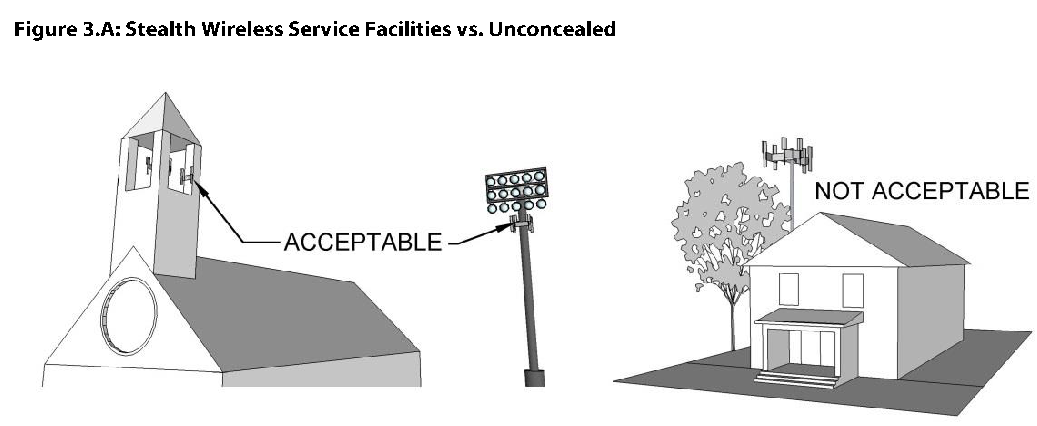
In the R-1, R-1.5, R-2, and R-3 districts, building and/or roof-mounted wireless service facilities shall only be permitted if they are concealed within nonresidential structures using stealth design techniques such as within a church steeple, ball field lighting, water towers, etc.
iv.
Lattice antenna towers and Guyed Mast Towers are prohibited within the Town. For existing Nonconformities, see Section 1.5, Nonconformities.
v.
Customer premises equipment is allowed in residential zoning districts in accordance with all other standards of the UDC.
vi.
All wireless service facilities and equipment not prohibited by this Section shall be allowed in all other zoning districts subject to review and approval by the Town Administrator pursuant to this UDC, including consistency with the dimensional requirements of the underlying zoning district.
b.
Site Selection. Wireless service facilities shall, in accordance with local zoning requirements, be located in the following order of preference:
i.
First: On existing structures such as buildings, communication towers, flagpoles, church steeples, cupolas, ball field lights, water towers, etc.
ii.
Second: In locations where the existing topography, vegetation, buildings, or other structures provide the greatest amount of screening.
iii.
Least: On vacant ground or highly visible sites without significant visual mitigation and where screening or buffering is difficult.
c.
Interference. Radio interference is prohibited. The applicant shall meet FCC requirements for radio interference and if the proposed wireless service facilities or equipment is within one thousand (1,000) feet of the Town's radio controlled model airplane runway, the applicant must provide satisfactory documentation evidencing that the facilities or equipment will not interfere with the model airplanes' radio frequencies.
d.
Airports and Flight Paths. Wireless service facilities and equipment shall not present a hazard to air navigation under 14 CFR Part 77, Federal Aviation, Federal Aviation Regulations.
e.
Public Buildings, Structures and Rights-Of-Way. Leasing of public buildings, publicly owned structures and/or public rights-of-way for the purposes of locating wireless service facilities and/or equipment is encouraged. In cases where a facility is proposed on Town property, specific locations and compensation to the Town shall be negotiated in lease agreements between the Town and the provider on a case-by-case basis and would be subject to all of the review criteria contained in Subsection 3.2.4.J.6. Such agreements shall not provide exclusive arrangements that could tie up access to the negotiated sites or limit competition and must allow for the possibility of "co-locating" (sharing of facilities) with other providers as described in Subsection 3.2.4.J.5.f, below.
f.
Co-Location.
i.
Co-location or sharing, of facilities with other providers is encouraged. Co-location can be achieved as building-mounted, roof-mounted, or ground-mounted facilities. In designing poles, applicants are strongly encouraged to consider the possibility of present or future co-location of other wireless service facility or associated equipment by structurally overbuilding in order to handle the loading capacity of additional antennas, for the use of the company and for other companies to use as well. Co-location on an existing support structure (tower) shall be permitted as an accessory use. A maximum 24-inch diameter dish antenna is permitted per monopole antenna. Projections of any type on the monopole, which are not antennas, are strongly discouraged.
ii.
No wireless service facility owner or operator shall unreasonably exclude a telecommunications competitor from using the same facility or location. Upon request by the Town, the owner or operator shall provide evidence explaining why co-location is not possible at a particular facility or site. If a telecommunications competitor attempts to co-locate a wireless service facility on an existing or approved wireless service facility or location, and the parties cannot reach an agreement, the Town may require a third-party technical study to be completed at the expense of either or both parties to determine the feasibility of co-locations. All multiple use facilities shall be designed to make the appearance of the antenna relatively inconspicuous.
iii.
The co-location requirement may be waived by the Town Administrator upon a showing that either federal or state regulations prohibit the use, the proposed use will interfere with the current use, the proposed use will interfere with surrounding property or uses, the proposed user will not agree to reasonable terms, or such co-location is not in the best interest of the public health, safety, or welfare.
iv.
The co-location device shall match existing color and material of the facility it is located with. All wiring for co-location facilities shall be hidden inside the structure or designed to match if it is demonstrated that wiring cannot be physically placed inside the structure.
g.
Maintenance. All wireless service facilities and equipment and subject sites shall be maintained in a safe and clean manner in accordance with project approvals and building codes. The wireless service facility operator/property owner shall be responsible for maintaining free from graffiti, debris and litter, those areas of the site which are adjacent to the premises over which he or she has control. The applicant shall be responsible for reasonable upkeep of the facility and subject property. All wireless service facilities shall be subject to periodic inspection by the Town to ensure continuing compliance with all conditions of approval and requirements of this Section.
h.
Abandonment and Removal.
i.
All required approvals shall be in effect only so long as the antennas and other structures are operated at the site. Facilities that are not in use for 90 consecutive days for wireless services shall be considered abandoned and shall be removed by the wireless service facility owner following approval of a demolition permit from the Town. The permit issued for the operation of the wireless service facility shall also expire upon abandonment. The site shall be restored to the condition it was in prior to the installation/location of the facility. Such removal shall be carried out in accordance with proper health and safety requirements.
ii.
The owner of wireless service facilities shall provide the Town with a copy of the notice to the FCC of the intent to cease operations within thirty (30) days of delivery of the notice to the FCC. The operator shall have ninety (90) days to remove the facility from the date of the notice.
iii.
If a facility falls into disrepair, repairs are required to be completed within thirty (30) days of the damage occurring. If the cell tower owner is unable to repair the damage within thirty (30) days of occurrence, a request for extension of time to complete the repairs may be submitted to the Town within thirty (30) days of the damage to the structure. If damage to the structure is not repaired within thirty (30) days, and a request for extension is not filed with the Town, the structure shall be determined to be abandoned.
iv.
If the owner fails to remove the wireless service facilities and/or equipment within the timeframe identified in this section, the Town Administrator may cause the demolition and/or removal of all wireless service facilities from the site and recover its costs of demolition and removal from the wireless service facility operator and/or property owner.
6.
Review Standards.
a.
Summary of Dimensional Standards. Except as provided in subsection 3.2.4.J.7, the following standards in this subsection 6 are designed to foster the Town's safety and aesthetic interests without imposing unreasonable limitations on wireless service facilities and equipment:
b.
Setbacks. Wireless service facilities and equipment shall comply with the minimum setback requirements of the underlying zoning district; if the following requirements are more restrictive than those of the base zoning district, the more restrictive standard shall apply.
i.
All wireless service facilities shall be setback fifty (50) feet from any property lines, except when roof-mounted (above the eave line of a building). Flat-roof mounted facilities visible from ground level within one hundred (100) feet of said property shall be concealed to the extent possible within a compatible architectural element, such as a chimney or ventilation pipe or behind architectural skirting of the type generally used to conceal HVAC equipment. Pitched-roof-mounted facilities shall always be concealed within a compatible architectural element, such as chimneys or ventilation pipes.
ii.
Monopole antenna towers shall be set back from any residentially zoned properties a distance of at least three (3) times the monopole antenna's height (e.g., a 60-foot setback would be required for a 20-foot monopole antenna) and the setback from any public road, as measured from the right-of-way line, shall be at least equal to the height of the monopole antenna.
iii.
No wireless service facility may be established within one thousand (1,000) feet of any existing, legally established wireless service facility except when located on the same building or structure.
iv.
No portion of any antenna array shall extend beyond the property lines.
c.
Height.
i.
Wireless service facilities and/or equipment not attached to a building shall not exceed thirty-five (35) feet in height or the maximum permissible height of the base zoning district, whichever is more restrictive; except the height limit for the Town's rodeo grounds in the OSR district shall be two hundred fifty (250) feet, and the height limit in the I-1 zoning district shall be seventy-five (75) feet.
ii.
Notwithstanding any other height limitations in this section, in no case shall a wireless service facility located in any public right-of-way exceed 35 feet in height.
iii.
Whenever an antenna is attached to a building roof, the antenna and support system for panel antennas shall not exceed five feet above the highest portion of that roof, including parapet walls and the antenna and support system for whip antennas shall not exceed 10 feet above the highest portion of that roof, including parapet walls.
iv.
The Board of Trustees may approve a taller antenna height than provided in these regulations if the Board determines that the antenna is suitably camouflaged and allows for co-location of at least two (2) facilities, and documentation is provided indicating FAA and FCC rules and regulation compliance. Camouflaging requirements are set forth in Subsection 3.2.4.J.6.f.
v.
Support and/or switching equipment shall be located inside the building, unless it can be fully screened from view as provided in the "Screening" standards outline with in this Subsection 3.2.4.J.6.f, below.
d.
Architectural Compatibility. Whether manned or unmanned, wireless service facilities shall be consistent with the architectural style of the surrounding architectural environment (planned or existing) considering exterior materials, roof form, scale, mass, color, texture and character. In addition:
i.
All towers in the permitted zoning districts other than the I-1 must be an alternative tower structure. The applicant must present at least two (2) designs for the appropriate decision-making authority to select from.
ii.
If such wireless service facility is accessory to an existing use, the facility shall be constructed out of materials that are equal to or of better quality than the materials of the principal use that meet building codes and safety standards.
iii.
Wireless service equipment shall be of the same color as the building or structure to which or on which such equipment is mounted or as required by the applicable decision-making authority.
iv.
Whenever wireless service equipment is mounted to the wall of a building or structure, the equipment shall be mounted in a configuration designed to blend with and be architecturally integrated into a building or other concealing structure, be as flush to the wall as technically possible, and shall not project above the wall on which it is mounted.
v.
Monopole support buildings, which house cellular switching devices and/or other equipment related to the use, operation or maintenance of the subject monopole antenna, shall be designed to match the architecture of adjacent buildings. If no recent and/or reasonable architectural theme is present, the applicable decision-making authority may require a particular design that is deemed to be suitable to the subject location.
vi.
All utilities associated with wireless service facility or equipment shall be underground (also see "Screening" below).
e.
Compatibility with the Natural Environment. Wireless telecommunication services facilities and equipment shall be compatible with the surrounding natural environment considering land forms, topography and other natural features and shall not dominate the landscape or present a dominant silhouette. In addition:
i.
Site disturbances shall be minimized and existing vegetation shall be preserved or improved to the extent possible, unless it can be demonstrated that such disturbance to vegetation and topography results in less visual impact to the surrounding area.
ii.
Surrounding view planes shall be preserved to the extent possible.
iii.
Wireless service facilities and equipment shall comply with the Federal Communication Commission's regulations concerning maximum radio frequency and electromagnetic frequency emissions.
f.
Screening. Roof-and ground-mounted wireless service facilities and equipment, including accessory equipment, shall be screened from adjacent and nearby public rights-of-way and public or private properties by paint color selection, parapet walls, screen walls, fencing, landscaping and/or berming in a manner compatible with the building's and/or surrounding environment's design, color, materials, texture, land forms and/or topography, as appropriate or applicable. In addition:
i.
Whenever possible, if monopoles are necessary for the support of antennas, they shall be located near existing utility poles, trees or other similar objects; consist of colors and materials that best blend with their background; and, have no individual antennas or climbing spikes on the pole other than those approved by the applicable decision-making authority.
ii.
For ground-mounted facilities, landscaping may be required to achieve a total screening effect at the base of such facilities or equipment in order to screen the mechanical characteristics; a heavy emphasis on coniferous plants for year-round screening may be required. Landscaping shall be of a type and variety capable of growing within one (1) year to a landscape screen which satisfactorily obscures the visibility of the facility. See Section 4.4.6, Screening and Fencing.
iii.
Unless otherwise expressly approved, all cables for a facility shall be fully concealed from view underground or inside of the screening or monopole structure supporting the antennas; any cables that cannot be buried or otherwise hidden from view shall be painted to match the color of the building or other existing structure.
iv.
Chain link fencing shall be unacceptable to screen facilities, support structures or accessory and related equipment (including HVAC or mechanical equipment present on support buildings); fencing material, if used, shall be six (6) feet in height or less and shall consist of wood, masonry, stucco, stone or other acceptable materials that are opaque. A fence permit shall be required if fencing is proposed. See Section 4.4.6, Screening and Fencing.
v.
Notwithstanding the foregoing, the wireless service facility shall comply with all additional measures deemed necessary to mitigate the visual impact of the facility. Also, in lieu of these screening standards, the applicable decision-making authority may allow use of an alternate detailed plan and specifications for landscape and screening, including plantings, fences, walls, sign and structural applications, manufactured devices and other features designed to screen, camouflage and buffer antennas, poles and accessory uses. For example, the antenna and supporting structure or monopole antenna may be of such design and treated with an architectural material so that it complies with an alternative tower structure. The plan should accomplish the same degree of screening achieved by meeting the standards outlined above.
g.
Lighting and Signage. In addition to other applicable sections of the code regulating signage or outdoor lighting, the following standards shall apply to wireless service facilities and equipment:
i.
Wireless services facilities shall not be illuminated, except in accordance with applicable state and federal regulations or by approval from applicable decision-making authority. Wireless service facilities including accessory buildings and equipment shall not incorporate dusk to dawn security lighting. The wireless service facilities may utilize manual switch or motion activated exterior illumination for repair, maintenance, and security purposes. If lighting is proposed it shall meet these requirements:
(a)
The light source for security lighting shall feature down-directional, sharp cut-off luminaries to direct, control, screen or shade in such a manner as to ensure that there is no spillage of illumination off-site. Also refer to Section 18-295(6).
(b)
Light fixtures, whether free standing or tower-mounted, shall not exceed twelve (12) feet in height as measured from finished grade.
ii.
The display of any sign or advertising device other than public safety warnings, certifications or other required seals on any wireless communication device or structure is prohibited.
iii.
The telephone numbers to contact in an emergency shall be posted on each facility in conformance with Section 4.7, Signs.
h.
Access Ways. In addition to ingress and egress requirements of the Building Code, access to and from wireless service facilities and equipment shall be regulated as follows:
i.
No wireless service facility shall be located in a required parking, maneuvering or vehicle/pedestrian circulation area such that it interferes with or in any way impairs the intent or functionality of the original design.
ii.
The wireless service facility must be secured from access by the general public but access for emergency services must be ensured. Access roads must be capable of supporting all potential emergency response vehicles and equipment.
iii.
Any easements required for ingress and egress and for electrical and telephone shall be recorded at the County Clerk and Recorder's Office prior to the issuance of building permits.
7.
Eligible Wireless Service Facility Requests.
a.
Applicability. This Subsection 7 applies to all eligible wireless service facility requests for land use approvals.
b.
Expedited Review.
i.
An eligible wireless service facility request shall be approved or denied within sixty (60) days of the date of the request. This time period may be tolled only by mutual agreement or where an application is incomplete.
ii.
If the Town fails to approve or deny an eligible wireless service facility request within the time frame for review (accounting for any tolling), the request shall be deemed granted; provided that this automatic approval shall become effective only upon the Town's receipt of written notification from the applicant after the review period has expired (accounting for any tolling) indicating that the application has been deemed granted.
c.
Application Materials.
i.
An applicant for an eligible wireless service facility request shall be required to submit only such documentation and information as is reasonably necessary to determine whether a proposed modification would substantially change the physical dimensions of an eligible tower or base station.
ii.
The Town shall prepare, and from time to time revise, and make available an application form which shall be limited to the information necessary for the Town to consider whether an application would substantially change the physical dimensions of an eligible wireless service facility request. Such information may include, without limitation, whether the project: (1) would result in a substantial change; and (2) violates a generally applicable law, regulation, or other rule reasonably related to public health and safety. The application may not require the applicant to demonstrate a need or business case for the proposed modification or collocation.
iii.
Incomplete applications shall be treated as follows:
(a)
When an application is incomplete, the Town shall provide written notice to the applicant within 30 days, clearly and specifically identifying all missing documents or information.
(b)
If an application remains incomplete after a supplemental submission, the Town has ten (10) days to once again notify the applicant. Second or subsequent notices of incompleteness may not require the production of documents or information that was not requested in the original notice of incompleteness.
d.
Review.
i.
Denial. A decision to deny an eligible wireless service facility request shall be in writing and shall provide a description of reasons for the denial.
ii.
Approval.
(a)
Notwithstanding any other provision of this Code, the Town shall approve any eligible wireless service facility request that does not substantially change the physical dimensions of a tower or base station.
(b)
The Town may approve an eligible wireless service facility request that substantially changes the physical dimensions of such tower or base station if it complies with the remainder of this Section.
(c)
The Town may condition the approval of any eligible wireless service facility request on compliance with generally applicable building, structural, electrical, and safety codes or with other laws codifying objective standards reasonably related to health and safety.
e.
Substantial Change.
i.
A substantial change in the height of an existing tower or base station occurs as follows:
(a)
For a tower outside of a public right-of-way, when the height of the tower is increased by more than ten percent (10%) or by the height of one (1) additional antenna array with separation from the nearest existing antenna not to exceed twenty (20) feet, whichever is greater.
(b)
For a tower located in a public right-of-way or for a base station, when the height of the structure increases by more than ten percent (10%) or by more than ten (10) feet, whichever is greater.
ii.
Changes in height are measured as follows:
(a)
When deployments are separated horizontally, changes in height shall be measured from the original support structure, not from the height of any existing wireless service equipment.
(b)
When deployments are separated vertically, changes in height shall be measured from the height of the tower or base station, including any appurtenances, as the tower or base station existed on February 22, 2012.
iii.
A substantial change in the width of an existing tower or base station occurs as follows:
(a)
For a tower outside of public rights-of-way, when the addition of an appurtenance to the body of the tower protrudes from the edge of the tower more than twenty (20) feet, or more than the width of the tower structure at the level of the appurtenance, whichever is greater.
(b)
For a tower in public right-of-way or a base station, when the addition of an appurtenance to the body of the structure would protrude from the edge of the structure by more than six (6) feet.
iv.
A substantial change also occurs for an existing tower in a public right-of-way or an existing base station as follows:
(a)
When the change involves the installation of any new equipment cabinets on the ground, if no ground cabinets presently exist; or
(b)
When the change involves the installation of ground cabinets that are more than ten percent (10%) larger in height or overall volume than any existing ground cabinets.
v.
A substantial change also occurs for an existing tower or base station when any of the following exist:
(a)
When the change involves installation of more than the standard number of new equipment cabinets for the technology involved, or more than four (4) new cabinets, whichever is less.
(b)
When the change entails any excavation or deployment outside the current site.
(c)
When the change would defeat the concealment elements of the eligible support structure.
(d)
When the change does not comply with conditions associated with the original siting approval of the construction or modification of the tower, base station or base station equipment. This limitation does not apply if the non-compliance is due to an increase in height, increase in width, addition of cabinets, or new excavation that would not exceed the thresholds identified in Subsections (7)(e) through (7)(e)(v)(b) herein.
8.
Small Cell Facilities.
a.
Generally. A telecommunications provider or broadband provider may locate or collocate small cell facilities or small cell networks on light poles, light standards, traffic signals, or utility poles in the right-of-way owned by the Town, subject to the following:
i.
A small cell facility or a small cell network shall not be located or mounted on an apparatus, pole, or signal with tolling collection or enforcement equipment attached.
ii.
The construction, installation, operation and maintenance of a small cell facility must comply with applicable federal and state law and the provisions of this Section. If upon inspection, the Town concludes that a wireless service facility fails to comply with such laws and constitutes a danger to persons or property, then, upon written notice being provided to the owner of the small cell facility, the owner shall have thirty (30) days from the date of the notice to bring such facility into compliance. Upon good cause shown by the owner, the Town may extend such compliance period not to exceed ninety (90) days from the date of said notice. If the owner fails to bring such facility into compliance within said time period, the Town may remove such facility at owner's expense or prohibit future, noncompliant use of the light pole, light standard, traffic signal or utility.
b.
Micro Wireless Facilities. No application or permit shall be required for the installation, placement, operation, maintenance, or replacement of micro wireless facilities that are suspended on cable operator-owned cables or lines that are strung between existing utility poles in compliance with the national safety code. The Town may require a permit for installation, placement, operation, maintenance, or replacement of micro wireless facilities where the installation, placement, operation, maintenance, or replacement of micro wireless facilities does any of the following, upon determination of the Town:
i.
Involves working within a highway travel lane or requires the closure of a highway travel lane;
ii.
Disturbs the pavement or a shoulder, roadway, or ditch line;
iii.
Includes placement on limited access rights-of-way; or
iv.
Requires any specific precautions to ensure the safety of the traveling public; the protection of public infrastructure; or the operation of public infrastructure; and such activities either were not authorized in, or will be conducted in a time, place, or manner that is inconsistent with, the approval terms of the existing permit for the facility or structure upon which the micro wireless facility is attached.
(Ord. 15 §§4, 5, 14, 2018; Ord. 18 §1, 2018; Ord. 21 §6, 2018; Ord. 1 §1, 2020; Ord. 3 §§2, 3, 2020; Ord. 4 §1, 2022; Ord. 5 §§10—13, 2022; Ord. 6 §1, 2022; Ord. 7 §1, 2022; Ord. 04 §§3, 4, 2023; Ord. 05 §2, 2023; Ord. 06 §2, 2023; Ord. 03 §§3, 4, 2024; Ord. 14 §1, 2024; Ord. 04 §§1—7, 2026; Ord. 05 §2, 2026; Ord. 10 §§4, 5, 2026)
Sec. 3.3. - Accessory uses and structures.
3.3.1. Purpose. This section authorizes the establishment of accessory uses that are incidental and subordinate to principal uses.
3.3.2. Approval of Accessory Uses and Structures. All principal uses allowed in a zoning district per Table 3.1: Table of Allowed Uses shall be deemed to include those accessory uses, structures, and activities typically associated with the principal use, unless specifically prohibited in this section. Accessory uses shall be subject to the standards in this section as well as any applicable use-specific standards applicable to the associated principal use in Section 3.2 above.
3.3.3. General Standards for all Accessory Uses and Structures.
A.
Compliance with this UDC. All accessory uses and structures are subject to the dimensional standards in Article 16.02: Zoning Districts and the development standards in Article 16.04: Development and Design Standards. Should any standards from this section conflict with any other requirement of the UDC, the more restrictive shall control.
B.
Dimensional Standards for Accessory Structures.
1.
Location of Accessory Structures.
a.
Any accessory use or structure shall be conducted and located on the same lot as the principal use or structure.
b.
In the MU-1, MU-2, and MU-MS districts, accessory structures shall be located behind the front building line of the primary structure.
2.
Size and Use.
a.
For lots/parcels less than one-half (½) acre in size in the R-1, R-1.5, or R-2 zone districts, the maximum size of any accessory structure shall be one thousand (1,000) square feet; provided, however, that the maximum total area of all accessory structures on a lot/parcel shall not be greater than one thousand (1,000) square feet, unless otherwise provided in the UDC. Greenhouses shall be exempt from these size limitations.
b.
For lots/parcels one-half (½) acre or larger in size in the R-1, R-1.5, or R-2 zone districts, the maximum size of any accessory structure shall be limited by the maximum building coverage applicable to the lot/parcel. On these lots/parcels, the accessory structure may be larger than the primary structure.
c.
For accessory structures in any zone district other than the R-1, R-1.5, or R-2 zone districts, the maximum size of the accessory structure shall be less than the footprint of the primary structure on the property. For any accessory structure over one hundred twenty (120) square feet, a site plan shall be required to demonstrate compliance with the appropriate zone district's regulations.
d.
No accessory structure shall begin construction until the construction of the primary structure has commenced.
e.
No accessory structure shall be used unless the primary structure is being used.
3.
Same Ownership Required. Accessory structures and uses shall be under the same ownership as the primary structure and use. The property shall use the same utility meter with the exception of an accessory dwelling unit.
C.
Unenclosed Outdoor Storage Prohibited. Outdoor storage associated with any accessory use or structure shall be within an entirely enclosed structure.
D.
Small Accessory Structures.
1.
A "small accessory structure" means a structure subordinate to the primary structure, such as a detached storage or tool shed, carport, greenhouse, gazebo, pergola, covered patio structure, playhouse, treehouse, hoop house, animal enclosures, or similar structures.
2.
A small accessory structure does not require a permit if it:
a.
will be located on residential property and is two hundred (200) square feet or less; or
b.
will be located on commercial property and is one hundred twenty (120) square feet or less.
2.
No utilities shall be connected to any small accessory structure, regardless of its size, unless a Chaffee County building permit is issued for the structure.
3.
All small accessory structures must meet the requirements of this UDC and any other applicable code provisions.
4.
A small accessory structure may not be intended, built, or used for human habitation.
3.3.4. Standards for Specific Accessory Uses and Structures. The following standards shall apply in addition to the general standards from Subsection 3.3.3.
A.
Accessory Dwelling Unit.
1.
Purpose. Accessory dwelling units are intended to provide increased affordable housing opportunities within the Town and to facilitate housing in close proximity to places of employment.
2.
Size and Quantity.
a.
ADUs used or intended to be used as a short-term rental shall comply with the standards in 3.2.3.I.5.
b.
ADUs shall not exceed eight hundred fifty (850) square feet.
c.
Only one (1) ADU shall be allowed per principal building.
d.
ADUs shall only be permitted with detached single-family dwellings and with two-family dwellings. However, for two-family dwellings, an ADU must be detached.
3.
Design Standards.
a.
Each ADU shall contain a kitchen equipped, at a minimum, with an oven, a stove, a sink, and a refrigerator/freezer. The oven shall have a minimum capacity of 2.0 cubic feet and be installed in a permanent configuration with a slide-in appliance or installed and built-in into a wall cabinet. The stove shall have a minimum of two (2) burners. The refrigerator/freezer shall have a capacity not less than six (6) cubic feet. Countertop appliances shall not be allowed to meet the oven and/or stove requirements.
b.
Each ADU shall contain a bathroom equipped with, at minimum, a sink, a toilet, and a shower.
c.
No ADU shall contain more than two (2) bedrooms.
d.
The design, exterior treatments and color of an ADU shall be the same as, or compatible with, the design and exterior color and treatments of the principal building to which it is accessory.
4.
Site Standards.
a.
All water service connections made to an ADU shall comply with the Town's water service connection requirements, and each ADU sharing and/or connected to the water service line/system serving a principal building shall be assessed a one-time water service expansion/connection fee equal to one-quarter (¼) of the connection fee that would be charged for a new water connection serving the principal building. All sanitary service connections serving an ADU shall comply with the requirements of the Buena Vista Sanitation District.
b.
Detached ADUs in a residential zoning district must be located in the rear half of the residential lot or parcel unless the ADU is to be located within or above a garage or approved pursuant to special use permit for siting in the front half of the lot or parcel.
c.
An ADU must have a unique address as required by Section 505.1 of the International Fire Code, 2021 Edition, entitled "Address Identification" as amended by Section 18-123(9) of the Buena Vista Municipal Code.
5.
Ownership and Occupancy. An ADU may not be condominiumized and/or sold separately from the principal building to which it is accessory.
6.
Inference of ADU.
a.
The Town may infer the creation of an ADU in a primary structure and require compliance with this Section if actions indicate the intent to creation an independent dwelling unit or other similar arrangement for a separate dwelling unit by the presence of any of the following:
i.
The existence of a separate exterior entrance to separate living space;
ii.
The ability or practice of blocking access to the separate living space from the remainder of primary structure or vice versa;
iii.
The existence of secondary cooking facilities; and/or
iv.
A separate living space which could be used for sleeping, either sanitary or cooking facilities, or both.
b.
The Town may infer the creation of an ADU in an accessory detached structure and require compliance with this Section if actions indicate the intent to creation an independent dwelling unit or other similar arrangement for a separate dwelling unit by the presence of any of a living space which could be used for sleeping, either sanitary or cooking facilities, or both.
B.
Home Occupation.
1.
Number and Size.
a.
Multiple home occupations shall be permitted within a principal dwelling, provided the sum of all home occupations comply with the standards in this section.
b.
Home occupations shall not occupy more than twenty-five percent (25%) of the total gross floor area of the dwelling.
2.
Operational and Use Standards.
a.
Home occupations shall be incidental and secondary to the use of a dwelling for dwelling purposes;
b.
Home occupations shall not change the residential character of a dwelling;
c.
No more than two (2) employees of a home occupation, who are not full-time residents of the dwelling, shall be permitted on site at any given time;
d.
All persons engaged in a home occupation shall obtain and maintain all necessary business licenses prior to and during the operation of the home occupation;
e.
No sales of goods or products shall be allowed on the premises of a home occupation, unless such goods or products are incidental to a service provided by the home occupation.
f.
Home occupations shall comply with all building, fire, safety, and other codes applicable to the particular home occupation;
g.
There shall be no storage or display of any goods, products, equipment, or materials outside of the dwelling or accessory structure, and no hazardous or dangerous materials not customarily associated with a residential use shall be stored or used on the premises;
h.
Home occupations shall not disrupt the neighborhood by the creation of traffic, congestion, dust, smoke, vibration, noise from equipment, excessive lighting, offensive odor, or electrical interference.
i.
Vehicle traffic generated by a home occupation shall not create a need for additional off-site parking; and
j.
No use or storage of heavy equipment or commercial or heavy trucks or trailers for the home occupation shall be permitted.
k.
Signs shall be regulated according to Section 4.7.
C.
Retail Display.
1.
Maximum retail display area shall not exceed one hundred fifty (150) square feet for buildings with less than fifty-five (55) linear feet of primary building frontage, or two and three-quarters (2.75) square feet for each one (1) foot of primary building frontage for buildings with primary building frontage of fifty-five (55) linear feet or greater.
2.
Retail display areas in the public right-of-way shall first obtain an encroachment license from the Town.
D.
Screened Storage.
1.
Generally.
a.
No unenclosed or outdoor storage shall be located along a primary building frontage.
b.
Appropriate landscaping, fencing, and screening standards shall apply per Section 4.4.
c.
Outdoor storage directly abutting a residential zoning district shall be screened with a minimum six-foot tall solid fence or enclosure.
d.
The stockpiling of decorative rock, bark or wood chips, or soil and similar loose landscaping material, shall be maintained in neat piles and shall be protected from dispersal by blowing wind and other adverse weather events.
e.
Trees, shrubs, flowers, and similar live plant products displayed by a nursery and/or a landscaping or garden supply retailer shall not constitute unenclosed or outdoor storage.
f.
No materials shall be stacked or stored to a height exceeding a screening fence or wall.
g.
Vehicles and/or equipment stored in association with a commercial or other nonresidential use and not on retail display within an open sales yard shall be screened by a fence or other acceptable physical barrier six (6) feet in height, and all such vehicles and equipment shall be stored at their lowest operating height and in a manner that minimizes their visible profile from view. Vehicles and equipment shall not be stacked.
2.
Screening Standards.
a.
Screening shall consist of durable, low-maintenance materials that effectively block the visual observation of the stored materials when viewed at a height of six (6) feet above finished or natural grade from public walkways or streets adjacent to the storage area.
b.
Screening may consist of fencing, walls, or other structures. All screening shall be maintained in good and effective condition.
c.
Chain link fencing, with or without added material, screening, or slats, is prohibited.
d.
No stored material shall exceed the height of the screening.
e.
Wood fences used for screening shall be made of natural, pressure-treated, or manufactured (recycled) wood of sufficient quality and durability to withstand prolonged exposure to the weather.
f.
The Town Administrator may approve alternative screening materials and/or methods upon written application. All alternative screening shall effectively serve and satisfy the intent and purposes of this section.
E.
Breezeways.
1.
Use of a breezeway shall be considered as a connection between two (2) separate structures.
2.
A breezeway shall count toward the total maximum allowed square footage footprint of accessory structures.
(Ord. 19 §1, 2018; Ord. 5 §8, 2019; Ord. 5 §5, 2021; Ord. 5 §14, 2022; Ord. 18 §1, 2022; Ord. 23 §1, 2022; Ord. 03 §5, 2024; Ord. 21 §4, 2024; Ord. 12 §§5, 7, 2025; Ord. 10 §6, 2026)
Sec. 3.4. - Temporary uses and structures.
3.4.1. Purpose. The purpose of this section is to authorize the establishment of certain uses and structures of a limited duration. This section is intended to ensure that such uses or structures do not negatively impact adjacent properties, are discontinued upon expiration of a set time period, and do not result in any permanent use or structure.
3.4.2. Approval of Temporary Uses and Structures. Review and approval of Temporary Use Permits shall be in accordance with Section 6.5.3, Temporary Use/Structure Permit.
3.4.3. General Standards for All Temporary Uses and Structures. Temporary uses and structures shall comply with the following general requirements unless otherwise specified in this UDC:
A.
A temporary use or structure shall not be detrimental to surrounding properties or to the public health, safety, or general welfare.
B.
Permanent alterations to the site are prohibited.
C.
Temporary signs associated with a temporary use or structure shall be removed when the activity ends or permit expires, whichever occurs first.
D.
A temporary use or structure shall not violate any applicable use-specific standards or conditions of approval applicable to a principal use on the site.
E.
A temporary use or structure shall not disturb any sensitive or protected resources, including floodplains, river protection setbacks, and required landscaping.
F.
At the conclusion of a temporary use or structure, all disturbed areas shall be restored to the condition that existed prior to the use, or improved.
G.
A temporary use or structure shall not impede normal operations of any permanent use located on the property.
H.
Off-street parking shall be sufficient to accommodate the proposed temporary use.
I.
Temporary uses, including temporary vendors, may be revoked by the Town Administrator for failing to comply with the standards in this section and any violation of other standards in this UDC or the Municipal Code. The Town Administrator shall include specific reasons for the revocation, and shall promptly mail or personally deliver to the operator by certified mail with return receipt requested, and to the complainant, if applicable, by regular first class mail.
3.4.4. Standards for Specific Temporary Uses and Structures.
A.
Special Events. Special event vendors shall comply with the standards in Chapter 11, Article VII, Special Events in Public Places.
B.
Temporary Office, Contractor's Quarters, and Equipment Storage. Temporary office, contractor's quarters, and equipment storage may be approved by the Town Administrator in conjunction with a construction project, including sales offices on residential development sites. Such structures and uses shall be located on the site no more than thirty (30) days prior to the start of construction and removed no more than thirty (30) days after issuance of a certificate of occupancy. Residential sales offices may remain on site until all houses or units are sold or leased.
C.
Temporary Vendors.
1.
Generally.
a.
Temporary vendors are those activities and associated structures that may be allowed pursuant to this section on a nonpermanent and temporary basis upon review of their proposed nature, location and duration and their compatibility with surrounding uses and structures within an underlying zoning district.
b.
Except as otherwise provided in this section, no temporary vendor shall be located or permitted in any residential zoning district except upon review and approval of the Board of Trustees in accordance with the procedures, standards, and limitations set forth in Section 6.5.3. Likewise, no temporary vendor shall be located or permitted in any nonresidential zoning district except upon review and approval by the Town Administrator in accordance with the procedures, standards, and limitations set forth in Section 6.5.3.
c.
No person shall conduct business as a temporary vendor without first obtaining a permit from the Town and paying the required fee. It shall be unlawful for any person to sell any goods or services on a temporary basis within the Town except as provided by this section.
d.
Temporary vendor permits shall be issued subject to such safeguards, terms and conditions as deemed necessary and appropriate by the Board of Trustees or the Town Administrator to protect and preserve the intent and purpose of this UDC. Violations of any of the terms and conditions imposed on a temporary vendor shall be deemed to be violations of this section and shall be punishable under the general penalty provisions of this UDC.
e.
Applications for a temporary vendor permit shall be made to the Town on forms provided therefor. A reasonable fee shall be charged for each application as set by the Board of Trustees, and a site plan and other drawings and information as deemed necessary by the Town Administrator shall be required as part of the application.
f.
Applications for a temporary vendor permit in a residential zoning district shall follow the process set forth in Section 6.5.3.
2.
Approval Considerations. Temporary vendor permits shall be granted by written order, but only after finding that the proposed temporary vendor will not adversely impact the neighborhood or the public safety and welfare. In determining whether to grant a temporary vendor permit, the following factors shall be considered:
a.
The location, size, design, operating characteristics and visual impacts of the proposed use or structure.
b.
The ingress and egress to the property and proposed structures, with particular reference to automotive and pedestrian safety, convenience, traffic flow and access in case of fire or other catastrophe. The location of the temporary vendor may not cause congestion of vehicular or pedestrian traffic and shall not be placed in right-of-way sight triangles as determined by the Public Works Department.
c.
Off-street parking and loading areas and the noise, glare or odor effects of the temporary vendor on adjoining properties and the neighborhood generally.
d.
Refuse, sanitation, and service areas.
e.
Utilities, with reference to location, availability and compatibility.
f.
Signs, lighting, screening and buffering with reference to type, dimensions and character. Signage shall comply with Section 4.7.5.C.2.a.
g.
The use of a Town-owned parcel or park may be permitted, denied, or limited by the number of days by the Town Administrator based on the number of existing vendors already using the area, compatibility with existing uses or users of the space, permitted special events or any of the factors as set forth by paragraphs a through f above. Use of Town right-of-way shall require an encroachment license.
3.
Limitations and Expiration.
a.
Permits for temporary vendors shall be granted for a period not to exceed more than three hundred sixty-five (365) days.
b.
The Town may require temporary vendors to move their facility offsite for the purposes of managing sanitation requirements prior to returning their facility to that location.
c.
Up to three (3) temporary vendors may be located on a single property in HC and I-1 zone districts based on review and approval of the site plan. Up to two (2) temporary vendors may be located on a single property in other permissible zone districts based on review and approval of the site plan.
d.
Temporary vendors are prohibited from selling or distributing any form of alcohol.
e.
Any placement of a temporary vendor structure that requires crossing the sidewalk must obtain a sidewalk closure permit and adhere to Public Works requirements to protect the sidewalk from damage. Any damage to public infrastructure shall be repaired by the temporary vendor unless a cash-in-lieu payment is preferred by Public Works. Repair or payment shall occur within thirty (30) days of notification or the license shall be immediately revoked.
f.
Onsite refuse collection and toilets must be provided. Toilet facilities must be located toward the rear of the property or may be supplied by the principal building with a written agreement that the facilities are open and accessible during operating hours of the vendor. A sign directing patrons to the toilet facilities must be prominently displayed. Food vendors must provide hand sanitation.
g.
No accessory features such as an awning, tent, or other shall be constructed or installed on the property unless it is part of an approved site plan for the principal use of the property and according to all applicable provisions of the Municipal Code.
h.
No greywater or blackwater may be discharged onto the site.
i.
No greywater or blackwater may be discharged into the wastewater sanitation system without advanced authority by the Buena Vista Sanitation District.
j.
Operational Footprint and Containment.
i.
Single Stand. A temporary vendor permit authorizes only one (1) vendor stand per permit. The vendor stand and all associated appurtenances shall be contained within the approved temporary vendor area ("approved footprint") shown on the permit site plan.
ii.
No Multiple Components. The approved footprint shall be limited to the minimum area necessary for the vendor stand and customer service counter. Multiple vendor components (including but not limited to separate booths, satellite sales tables, tents, displays, queuing corrals, or secondary cooking/prep stations) are prohibited.
iii.
Outdoor Storage. Outdoor storage is prohibited. All supplies, inventory, containers, and equipment not actively used for immediate operations shall be stored within the vendor stand or removed from the site at the end of each operating day.
k.
The Town may require additional site changes and/or improvements as necessary to accommodate temporary vending and/or to mitigate any potential adverse impacts to surrounding properties.
3.4.5. Revocation Process. See public hearing requirements under Section 6.7.4, Appeal.
(Ord. 03 §6, 2024; Ord. 5 §5, 2025; Ord. 03 §1, 2026)

