
Buffalo City Zoning Code
ARTICLE I
- IN GENERAL
Sec. 50-1.- Intent and purpose.
(a)
The intent of this chapter is to protect the public health, safety and general welfare of the city and its people through the establishment of minimum regulations in regard to location, erection, construction, alteration and use of structures and land.
(b)
Such regulations are established to protect such use areas; to promote orderly development and redevelopment; to provide adequate light, air and convenience of access to property; to prevent congestion in the public right-of-way; to prevent overcrowding of land and undue concentration of structures by regulating land, building, yards and density of population; to provide for compatibility of different land uses; to provide for administration of this chapter, to provide for amendments; to prescribe penalties for violation of such regulations; and to define powers and duties of the city staff, the board of adjustment and appeals, the planning commission, and the council in relation to this chapter.
(Code 1985, § 11.01(1))
Sec. 50-2. - Authority.
This chapter is enacted pursuant to the authority granted by the Municipal Planning Act, M.S.A. §§ 462.351 to 462.365.
(Code 1985, § 11.01(8))
Sec. 50-3. - Definitions.
Words and terms not defined in this section or in section 1-2 shall be given their common meaning according to a widely used dictionary of American standard English. The following words, terms and phrases, when used in this chapter, shall have the meanings ascribed to them in this section, except where the context clearly indicates a different meaning:
Abutting means making contact with another parcel and sharing one of more common points, or separated only by public thoroughfare, railroad, public utility right-of-way or navigable waters.
Accessory building or use means a subordinate building or use which is located on the same lot on which the main building or use is situated, and which is reasonably necessary, incidental to, and supportive of the conduct of the principal use of such building. An accessory building or use shall be lesser in extent, size, or area to that of the principal building or use.
Major accessory building is a building subordinate to the principal building on the same lot that is 200 square feet or greater.
Minor accessory building is a building subordinate to the principal building on the same lot that is 199 square feet or less.
Addition means a physical enlargement of an existing structure.
Adult uses includes adult bookstores, adult motion picture theatres, adult motion picture sales/rental, adult mini-motion picture theatres, adult massage parlors, adult steam room/bathhouse/sauna facilities, adult companionship establishments, adult conversation parlors, adult health/sport clubs, adult cabarets, adult novelty businesses, adult motion picture arcades, adult modeling studios, adult hotels/motels, adult body painting studios, and other premises, enterprises, establishments, businesses or places open to some or all members of the public, at or in which there is an emphasis on the presentation, display, depiction or description of specified sexual activities or specified anatomical areas which are capable of being seen by members of the public. Activities classified as obscene as defined by M.S.A. § 617.241 are not included. The following terms relate to adult uses:
Adult accessory uses means the offering of retail goods for sale which are classified as adult uses on a limited scale and which are incidental to the primary activity and goods or services offered by the establishment. Examples of such items include the sale of adult magazines, the sale or rental of adult motion pictures, the sale of adult novelties, and the like.
Adult principal uses means the offering of goods or services which are classified as adult uses as a primary or sole activity of a business or establishment and include, but are not limited to, the following:
Adult bookstore means a building or portion of a building used for the barter, rental or sale of items consisting of printed matter, pictures, slides, records, audio tape, videotape, or motion picture films if such building or portion of a building is not open to the public generally but only to one or more classes of the public excluding any minor by reason of age or if a substantial or significant portion of such items are distinguished or characterized by an emphasis on the depiction or description of specified sexual activities or specified anatomical areas.
Adult cabaret means a building or portion of a building used for providing dancing or other live entertainment, if such building or portion of a building excludes minors by virtue of age or if such dancing or other live entertainment is distinguished or characterized by an emphasis on the presentation, display, depiction or description of specified sexual activities or specified anatomical areas.
Adult companionship establishment means a companionship establishment which excludes minors by reason of age, or which provides the service of engaging in or listening to conversation, talk or discussion between an employee of the establishment and a customer, if such service is distinguished or characterized by an emphasis on specified sexual activities or specified anatomical areas.
Adult conversation/rap parlor means a conversation/rap parlor which excludes minors by reason of age, or which provides the service of engaging in or listening to conversation, talk or discussion, if such service is distinguished or characterized by an emphasis on specified sexual activities or specified anatomical areas.
Adult health/sport club means a health/sport club which excludes minors by reason of age, or if such club is distinguished or characterized by an emphasis on specified sexual activities or specified anatomical areas.
Adult hotel or motel means a hotel or motel from which minors are specifically excluded from patronage and wherein material is presented which is distinguished or characterized by an emphasis on matter depicting, describing or relating to specified sexual activities or specified anatomical areas.
Adult massage parlor or health club means a massage parlor or health club which restricts minors by reason of age, and which provides the services of massage, if such service is distinguished or characterized by an emphasis on specified sexual activities or specified anatomical areas.
Adult mini-motion picture theatre means a building or portion of a building with a capacity for less than 50 persons used for presenting material if such building or portion of a building as a prevailing practice excludes minors by virtue of age, or if such material is distinguished or characterized by an emphasis on specified sexual activities or specified anatomical areas for observation by patrons therein.
Adult modeling studio means an establishment whose major business is the provision, to customers, of figure models who are so provided with the intent of providing sexual stimulation or sexual gratification to such customers and who engage in specified sexual activities or display specified anatomical areas while being observed, painted, painted upon, sketched, drawn, sculptured, photographed, or otherwise depicted by such customers.
Adult motion picture arcade means any place to which the public is permitted or invited wherein coin or slug-operated or electronically, electrically or mechanically controlled or operated still or motor picture machines, projectors or other image-producing devices are maintained to show images to five or fewer persons per machine at any one time, and where the images so displayed are distinguished or characterized by an emphasis on depicting or describing specified sexual activities or specified anatomical areas.
Adult motion picture theatre means a building or portion of a building with a capacity of 50 or more persons used for presenting material if such building or portion of a building as a prevailing practice excludes minors by virtue of age or if such material is distinguished or characterized by an emphasis on specified sexual activities or specified anatomical areas for observation by patrons therein.
Adult novelty business means a business which has as a principal activity the sale of devices which stimulate human genitals or devices which are designed for sexual stimulation.
Adult sauna means a sauna which excludes minors by reason of age, or which provides a steam bath or heat bathing room used for the purpose of bathing, relaxation, or reducing, utilizing steam or hot air as a cleaning, relaxing or reducing agent, if the service provided by the sauna is distinguished or characterized by an emphasis on specified sexual activities or specified anatomical areas.
Adult steam room/bathhouse facility means a building or portion of a building used for providing a steam bath or heat bathing room used for the purpose of pleasure, bathing, relaxation, or reducing, utilizing steam or hot air as a cleaning, relaxing or reducing agent if such building or portion of a building restricts minors by reason of age or if the service provided by the steam room/bathhouse facility is distinguished or characterized by an emphasis on specified sexual activities or specified anatomical areas.
Body painting studio means an establishment or business which provides the service of applying paint or other substance, whether transparent or non-transparent, to or on the body of a patron when such body is wholly or partially nude in terms of specified anatomical areas.
Specified anatomical areas means less than completely and opaquely covered human genitals, pubic region, buttock, anus, or female breasts below a point immediately above the top of the areola and human male genitals in a discernibly turgid state, even if completely and opaquely covered.
Specified sexual activities means and includes all of the following:
a.
Actual or simulated sexual intercourse, oral copulation, anal intercourse, oral-anal copulation, bestiality, direct physical stimulation of unclothed genitals, flagellation or torture in the context of a sexual relationship, or the use of excretory functions in the context of a sexual relationship, and any of the following sexually oriented acts or conduct: anilingus, buggery, coprophagy, coprophilia, cunnilingus, fellatio, necrophilia, pederasty, pedophilia, piquerism, sapphism, zooerasty;
b.
Clearly depicted human genitals in the state of sexual stimulation, arousal or tumescence;
c.
Use of human or animal ejaculation, sodomy, oral copulation, coitus or masturbation;
d.
Fondling or touching of nude human genitals, pubic region, buttocks or female breast;
e.
Situations involving a person, any of whom are nude, clad in undergarments or in sexually revealing costumes, and who are engaged in activities involving the flagellation, torture, fettering, binding or other physical restraint of any such persons;
f.
Erotic or lewd touching, fondling or other sexually-oriented contact with an animal by a human being; or
g.
Human excretion, urination, menstruation, vaginal or anal irrigation.
Agriculture uses means those uses commonly associated with the growing of produce on farms such as field crop farming; pasture for hay; fruit growing; tree, plant, shrub, or flower nursery without buildings; truck gardening; roadside stand for sale in season of products grown on premises; and livestock raising and feeding, but not including fur farms, commercial animal feed lots, and kennels.
Airport means the Buffalo Municipal Airport.
Airport elevation means the established elevation of the highest point on the usable landing area which elevation is established to be 968 feet above mean sea level.
Airport hazard means any structure, tree, or use of land which obstructs the air space required for, or is otherwise hazardous to, the flight of aircraft in landing or taking off at the airport; and any use of land which is hazardous to persons or property because of its proximity to the airport.
Alley means a public or private right-of-way primarily designed to serve as secondary access to the side or rear of those properties whose principal frontage is on a street.
Antenna, cellular telephone, means a device consisting of a metal, carbon fiber, or other electromagnetically conductive rods or elements, usually arranged on an antenna support structure, and used for the transmission and reception of radio waves in wireless telephone communications.
Antenna, public utility microwave, means a parabolic dish or cornucopia shaped electromagnetically reflective or conductive element used for the transmission or reception of point-to-point UHF or VHF radio waves in wireless telephone communications, but not including the supporting structure thereof.
Antenna, radio and television, broadcast transmitting, means a wire, set of wires, metal or carbon fiber rod or other electromagnetic element used to transmit public or commercial broadcast radio or television programming, but not including the support structure thereof.
Antenna, radio and television, receiving, means a wire, set of wires, metal or carbon fiber element, other than satellite dish antennas, used to receive radio, television, or electromagnetic waves, but not including the supporting structure thereof.
Antenna, satellite dish, means a device incorporating a reflective surface that is solid, open mesh, or bar configured and is in the shape of a shallow dish, cone, horn, or cornucopia. Such device is used to transmit or receive radio or electromagnetic waves between terrestrially or orbitally based uses. The term "antenna, satellite dish" includes, but is not limited to, what are commonly referred to as satellite earth stations, TYROs (television, receive only) and satellite microwave antennas.
Antenna, short-wave radio transmitting and receiving means a wire, set of wires or a device, consisting of a metal, carbon fiber, or other electromagnetically conductive element used for the transmission and reception of radio waves used for short-wave radio communications, but not including the supporting structure thereof.
Antenna support structure, means any pole, telescoping mast, tower, tripod, or any other structure which supports a device used in the transmitting or receiving of radio frequency energy.
Apartment means a dwelling unit which is part of a multiple-family dwelling structure usually for rental, consisting of a room or suite of rooms which is designed for, intended for, or occupied as a residence by a single-family or an individual, and is equipped with common cooking facilities.
Aquifer recharge areas means all land surface areas which by nature of their surface or subsurface soil characteristics are determined to contribute to the replenishment of subsurface water supplies.
Artificial obstruction means any obstruction which is not a natural obstruction (see Obstruction).
Automobile repair, auto body, means providing collision service, including body frame or fender straightening or repair; overall painting or paint job; and vehicle steam cleaning.
Automobile repair, major, means providing general repair, rebuilding or reconditioning engines, motor vehicles or trailers; vehicle steam cleaning.
Automobile repair, minor, means providing minor repairs, incidental body and fender work, painting and upholstering, replacement of parts and motor services to passenger automobiles and trucks not exceeding 12,000 pounds gross weight, but not including any operation specified under automobile repair, major.
Automobile wrecking or junkyard means any place where two or more vehicles not in running condition or not licensed, or parts thereof, are stored in the open and are not being restored to operation or any land, building or structure used for wrecking or storing of such motor vehicles or parts thereof; and including any commercial salvaging and scavenging of any other goods, articles or merchandise.
Basement means that portion of a building between floor and ceiling, which is partly below and partly above grade, but so located that the vertical distance from grade to the floor below is less than the vertical distance from grade to ceiling (see Story). See figure of a basement diagram below:
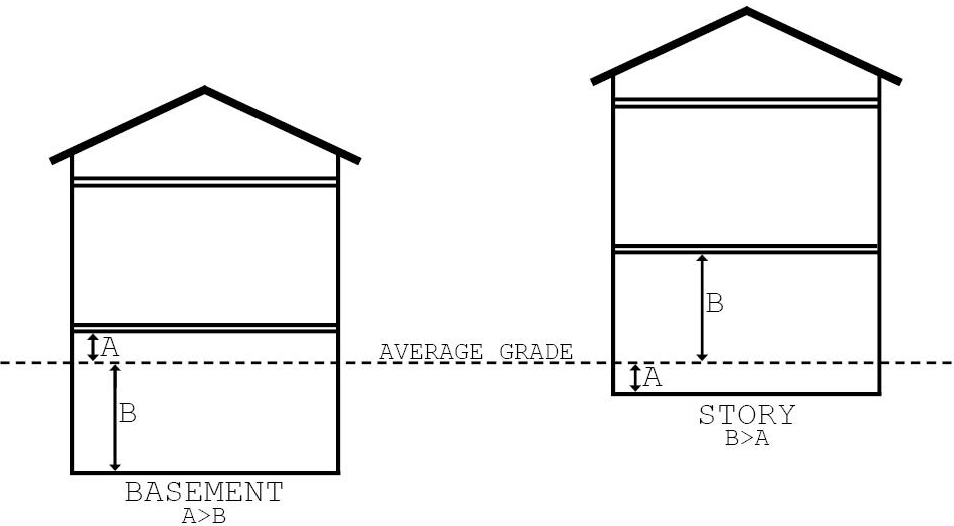
Figure 1. Basement
Bay means cantilevered area of a room.
Bluff means a topographic feature such as a hill, cliff, or embankment having all of the following characteristics:
(1)
Part, or all, of the feature is located in a shoreland area.
(2)
The slope rises at least 25 feet above the ordinary highwater level of the waterbody.
(3)
The grade of the slope from the toe of the bluff to a point 25 feet or more above the ordinary highwater level averages 30 percent or greater.
(4)
The slope must drain toward the waterbody.
An area with an average slope of less than 18 percent over a distance for 50 feet or more shall not be considered part of the bluff.
Bluff impact zone means a bluff and land located within 20 feet from the top of a bluff.
Boardinghouse means a residential building other than a hotel where, for compensation, lodging and meals are provided to three or more persons, not of the principal family therein.
Boathouse means a structure used solely for the storage of boats or boating equipment.
Buildable area means the portion of a lot remaining after required setbacks and yards have been provided but excluding wetlands and floodplains.
Building means any structure used or intended for supporting or sheltering of any use or occupancy.
Building height means a distance to be measured from the mean ground level to the top of a flat roof, to the mean distance of the highest gable on a pitched or hip roof, to the deck line of a mansard roof, to the uppermost point on all other roof types. See figure of building height below:
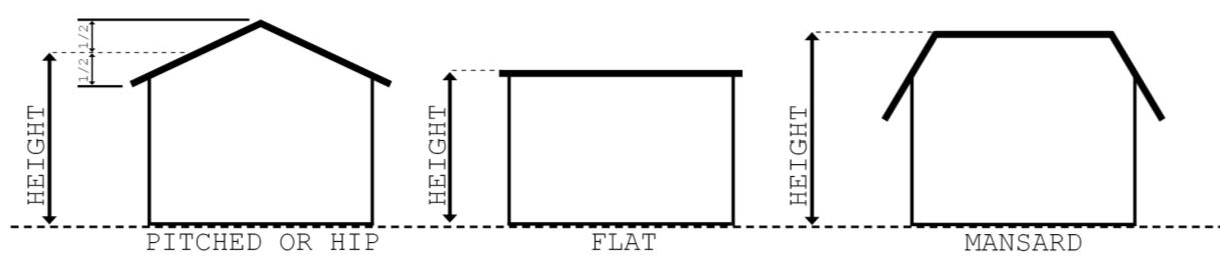
Figure 2. Building Height
Building line means a line parallel to a lot line or the ordinary highwater level at the required setback beyond which a structure does not extend.
Business means any establishment, occupation, employment or enterprise where merchandise is manufactured, exhibited or sold, or where services are offered for compensation.
Carport means a canopy constructed of metal or other materials supported by posts either ornamental or solid and completely open on one or more sides. A carport shall be treated as an accessory building for purposes of this chapter.
Cellar means that portion of a building between floor and ceiling which is wholly or partly below grade and so located that the vertical distance from grade to the floor below is equal to or greater than the vertical distance from grade to ceiling. See Basement.
Channel means a natural or artificial depression of perceptible extent, with definite bed and banks to confine and conduct water either continuously or periodically.
Church. See place of worship.
Clear cutting means the removal of an entire stand of trees.
Club or lodge means a club or lodge is an association of persons who are bona fide members paying annual dues, use of premises being restricted to members and their guests.
Commercial planned unit development means in a shoreland district, uses that provide transient, short-term lodging spaces, rooms, or parcels and their operations are essentially service-oriented. For example, hotel/motel accommodations, resorts, recreational vehicle and camping parks, and other primarily service-oriented activities are commercial planned unit developments.
Commercial recreation means bowling alley, cart track, jump center, golf, pool hall, vehicle racing or amusement, dance hall, skating, trampoline, tavern, theatre, firearms range, boat rental, amusement ride, campground, park and similar use.
Commissioner means the commissioner of the state department of natural resources.
Comprehensive plan means a compilation of policy statements, goals, standards, and maps for guiding the physical, social and economic development, both private and public, of the city and includes, but is not limited to, the following:
(1)
Statements of policies;
(2)
Goals;
(3)
Standards;
(4)
Land use plan;
(5)
Community facilities plan;
(6)
Transportation plan; and
(7)
Recommendations for plan execution.
The comprehensive plan represents the planning commission's recommendations for the future development of the city, as approved by the council.
Conditional use means a use, which because of special problems of control the use presents, requires reasonable, but special, unusual and extraordinary limitations peculiar to the use or location of such use, for the protection of the public welfare, or its potential impacts on public services, and the integrity of the comprehensive plan.
Conditional use permit means a permit issued by the council in accordance with procedures specified in this chapter, as a flexibility device to enable the council to assign dimensions to a proposed use or conditions surrounding it after consideration of adjacent uses and their functions and the special problems which the proposed use presents.
Condominium means a development containing individually owned dwelling units or commercial units, and jointly owned and shared areas and facilities under common management, which dwelling or development is subject to the provisions of the Uniform Condominium Act, M.S.A. § 515A.1-101 et seq.
Conforming use means any structure, tree, or object of natural growth, or use of land that complies with all the applicable provisions of this article or any amendment to this article.
Convenience food establishment means an establishment which serves food in or on disposable or edible containers in individual servings for consumption on or off the premises.
Cooperative housing means a multiple-family dwelling owned and maintained by the residents and subject to the provisions of 26 USC 216(b)(1). The entire structure and real property are under common ownership as contrasted to a condominium dwelling where individual units are under separate individual occupant ownership.
Court means an unoccupied open space other than a yard which is bounded on two or more sides by the walls of the buildings.
Crowding potential means the ratio of total acreage to shore miles.
Cultivation means any activity involving the planting, growing, harvesting, drying, curing, grading, or trimming of cannabis plants, cannabis flower, hemp plants, or hemp plant parts.
Day care facility means any state licensed facility, public or private, which for gain or otherwise regularly provides one or more persons with care, training, supervision, habitation, rehabilitation, or developmental guidance on a regular basis, for periods of less than 24 hours per day. The term "day care facility" includes, but is not limited to, family day care homes, group family day care homes, day care centers, day nurseries, nursery schools, daytime activity centers, day treatment programs, and day services, as defined in M.S.A. § 245A.02.
Deck means a horizontal, unenclosed platform or uncovered porch built up above natural grade, but which is not a patio, with or without attached railings, seats, trellises, or other features, attached or functionally related to a principal use or site and at any point extending more than 12 inches above the natural grade.
Department store means a business which is conducted under a single owner's name wherein a variety of unrelated merchandise and services are housed enclosed and are exhibited and sold directly to the customer for whom the goods and services are furnished.
Deposition means any rock, soil, gravel, sand or other material deposited naturally or by man into a waterbody, watercourse, floodplains or wetlands.
District means a section of the city for which the regulations and provisions governing the use of buildings and land are uniform for each class of use permitted therein.
Diversion means a channel that intercepts surface water runoff and that changes the accustomed course of all or part of a stream.
Dog kennel, commercial, means any place which is not a dog kennel, residential, where three or more dogs over three months of age are boarded, bred or offered for sale, except a veterinary clinic.
Dog kennel, residential, means any residential dwelling unit where three or more dogs over three months of age are kept as domestic pets, and which is in compliance with chapter 6.
Draining means the removal of surface water or groundwater from land.
Dredging means to enlarge or clean-out a waterbody, watercourse or wetland.
Drive-through window means a portion of a commercial establishment which accommodates service to the patron's automobile from which the occupants may receive a service or in which products purchased from the establishment may be received for use or consumption off-site.
Duplex, triplex andquad mean a dwelling structure on a single lot, having two, three, and four units respectively, being attached by common walls and each unit equipped with separate sleeping, cooking, eating, living, and sanitation facilities.
Dwelling means a building or portion thereof, designated exclusively for residential occupancy, including one-family, two-family, and multiple-family dwellings, but not including hotels, motels, boardinghouses, mobile homes or trailers.
Dwelling, multiple (apartment), means a building designed with three or more dwelling units exclusively for occupancy by three or more families living independently of each other but sharing hallways and main entrances and exits.
Dwelling, single-family, means a dwelling unit designed exclusively for occupancy by one family. An attached dwelling is joined to another at one or more sides by a common wall or connected vertically with a common ceiling and floor. A detached dwelling unit is not attached to another dwelling or structure.
Dwelling, two-family, means a dwelling designed exclusively for occupancy by two families living independently of each other. A double bungalow is a two-family dwelling with two units side-by-side. A duplex is a two-family dwelling with one unit above the other.
Dwelling unit means a residential building or portion thereof intended for occupancy by one family, and which includes spaces for sleeping, cooking and sanitation which are available only to occupants of the dwelling unit, but not including hotels, motels, nursing homes, seasonal cabins, boardinghouses or roominghouses, tourist homes or trailers.
Efficiency apartment means a dwelling unit consisting of one principal room exclusive of bathroom, hallway, closets or dining alcove.
Elderly senior citizen housing means a legally restricted multiple dwelling building with open occupancy limited to persons over 55 years of age and their spouses or dependents.
Elevator penthouse means an enclosure located on the top of a building which houses the working mechanisms of an elevator.
Equal degree of encroachment means a method of determining the location of encroachment lines so that floodplain land on both sides of a stream is capable of conveying a proportionate share of flood flows. The term "equal degree of encroachment" is determined by considering the effect of encroachment on the hydraulic efficiency of the floodplain along both sides of a stream for a significant reach.
Essential services means the erection, construction, alteration or maintenance by public utilities or municipal departments of underground or overhead telephone, gas, electrical, communication, water or sewer transmission, distribution, collection, supply or disposal systems, including poles, wires, mains, drains, sewers, pipes, conduits, cables, fire alarm boxes, police call boxes, traffic signals, hydrants and other similar equipment and accessories in connection therewith for the furnishing of adequate service by such private or public utilities or municipal departments. Transmission reception support structures and antennas shall not be considered an essential service.
Established residential neighborhood in a built-up urban area means an area which, if it existed on or before January 1, 1978 shall be considered a conforming use that shall not be prohibited.
Exterior storage means the storage of goods, materials, equipment, manufactured products and similar items not fully enclosed within a building.
Family means a person living alone or any of the following groups, provided that the members of the group live together as a single housekeeping unit and do not exceed the maximum occupancy limits of the applicable building code:
(1)
An individual plus one or more persons related by blood, marriage, adoption, guardianship or other duly authorized custodial relationship, including foster children and bona fide domestic servants employed on a full-time basis by the family in the dwelling unit;
(2)
Two unrelated people and any children related to either of them;
(3)
One or more persons occupying a premises, subject to a limit of not more than three unrelated persons 18 years of age or older. The definition of the term "family" is established for the purpose of preserving the character of residential neighborhoods by controlling population density, noise, disturbance and traffic congestion and shall not be applied so as to prevent the city from making reasonable accommodation where the city determines it necessary under applicable federal fair housing laws; or
(4)
Group residential facilities meeting the definition of this Code, when properly licensed by the state department of human services or the state department of corrections under M.S.A. §§ 245A.11 and 241.021 or such facilities that are registered with the state pursuant to state law.
Farm means a tract of land of ten or more acres in size often with a house and barn plus other buildings on which crops and often livestock are raised which is qualified as an agricultural use under applicable state regulations.
Farm, hobby, means a tract of land generally consisting of ten or less acres in size with a house and accessory buildings on which crops and often livestock are raised but not as a principal source of income. A hobby farm shall not qualify for exemptions provided in this chapter for farms.
Farming means the process of operating a farm for the growing and harvesting of crops which shall include those necessary accessory buildings, related to operating the farm, and the keeping of common domestic farm animals.
Fence means a fence is defined for the purpose of this chapter as any partition, structure, wall or gate erected as a dividing mark, barrier or enclosure. The term "fence" includes retaining walls, but not fences or walls less than 36 inches in height from the adjoining natural grade.
Fence, boundary line, means all fences located within five feet of a property line.
Fence, interior yard, means all fences located five beyond a property line.
Filling means the act of depositing any rock, soil, gravel, sand or other material so as to fill a waterbody, watercourse or wetland.
Flood means a temporary rise in a stream flow or stage which results in inundation of the areas adjacent to the channel.
Flood frequency means the average frequency, statistically determined, for which it is expected that a specific flood stage or discharge may be equaled or exceeded. By strict definition, such estimates are designated exceedance frequency, but in practice the term "frequency" is used. The frequency of a particular stage or discharge is usually expressed as having a probability of occurring once within a specific number of years.
Flood fringe means that portion of the floodplain outside of the floodway.
Flood profile means a graph or a longitudinal plot of water surface elevation of a flood event along a reach of a stream or river.
Floodplain means the channel or beds proper and the areas adjoining a wetland, lake or watercourse which have been or hereafter may be covered by the regional flood. Floodplain areas within the city shall encompass all areas designated as zone a on the flood insurance rate map.
Floodway means the bed of a wetland or lake and the channel of a watercourse and those portions of the adjoining floodplain which are reasonably required to carry or store the regional flood discharge.
Floor area means the sum of the gross horizontal areas of the several floors of the building or portion thereof devoted to a particular use, including accessory storage areas located within selling or working space such as counters, racks or closets, and any basement floor area devoted to retailing activities, to the production or processing of goods, or to business or professional offices. However, the floor area shall not include basement or cellar floor area other than area devoted to retailing activities, the production or processing of goods, or to business or professional offices. The floor area of a residence shall not include the cellar area.
Forest land conversion means the clear cutting of forested lands to prepare for a new land use other than re-establishment of a subsequent forest stand.
Garage, private, means an accessory building or accessory portion of the principal building which is intended for and used to store the private passenger vehicles and trucks not exceeding 12,000 pounds gross weight, of the family or families resident upon the premises, and in which no business service or industry is carried on.
Garage, public, means a building or portion of a building, except any herein defined as a private garage or as a repair garage, used for the storage of motor vehicles, or where any such vehicles are kept for remuneration or hire and in which any sale of gasoline, oil and accessories is only incidental to the principal use.
Grade (adjacent ground elevation) means the lowest point of elevation of the finished surface of the ground, paving or sidewalk within the area between the building and the property line, or when the property line is more than five feet from the building, between the building and a line five feet from the building.
Grading means changing the natural or existing topography of land.
Group care facility means any state licensed facility, public or private, which for gain or otherwise regularly provides one or more persons with a 24-hour per day substitute for care, food, lodging, training, education, supervision, habilitation, rehabilitation, and treatment they need, but which for any reason cannot be furnished in the person's own home. The term "group care facility" includes, but is not limited to, state institutions under the control of the commissioner of public welfare, domestic abuse shelters, foster homes, residential treatment centers, maternity shelters, group homes, residential programs, or schools for physically disabled children, as defined by M.S.A. ch. 245A but not those facilities housing family, as defined in this chapter.
Height, for the purpose of determining the height limits in all zones set forth in this chapter and shown on exhibits, means the datum shall be means sea level elevation unless otherwise specified.
Height of building means the vertical distance between the average elevation between the highest and lowest ground levels at the perimeter of a building, and the highest point of a flat roof or average height of the highest gable of a pitched or hipped roof. See figure of building height below:
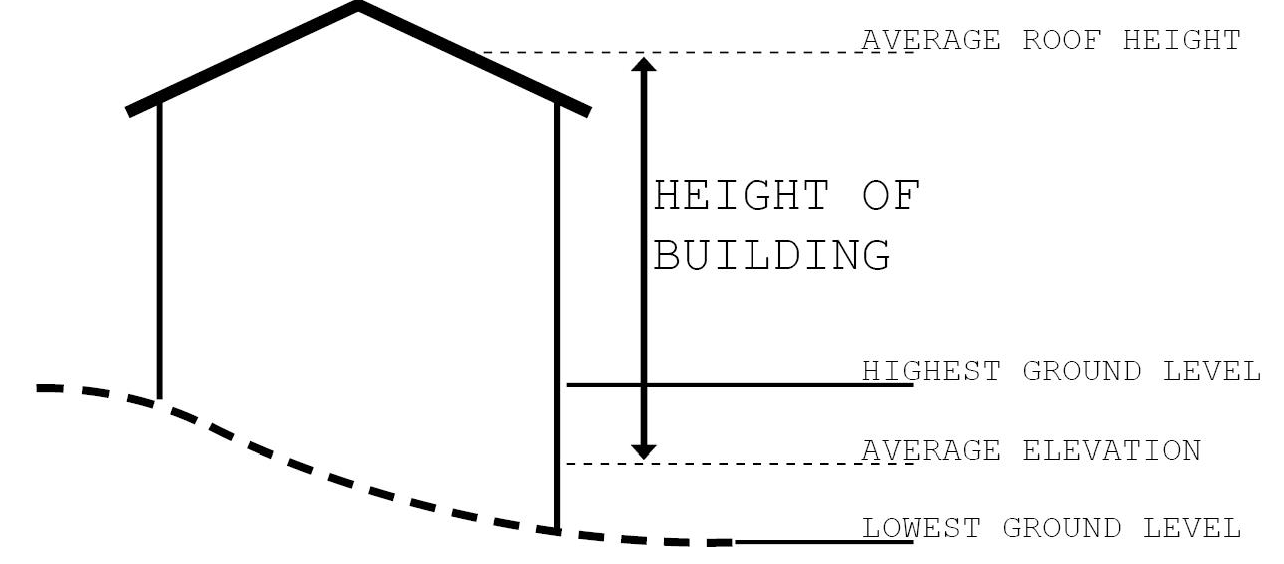
Figure 3. Height of Building
Home occupation means any occupation or profession engaged in by the occupant of a residential dwelling unit, which is clearly incidental and secondary to the residential use of the premises and does not change the character of the premises or neighborhood in which it is located.
Hotel means any building or portion thereof occupied as the more or less temporary abiding place of individuals and containing six or more guest rooms, used, designated or intended to be used, let or hired out to be occupied, or which are occupied by six or more individuals for compensation, whether the compensation be paid directly or indirectly.
Impervious surface means an artificial or natural surface through which water, air or roots cannot penetrate. Any impervious material with a horizontal measurement of one foot or more in any dimension shall be included in the calculation of impervious surface. Elevated structures which allow drainage through to pervious surfaces directly below, such as decks, shall not be included in the calculation of impervious surface. The use of pervious pavement materials when installed to allow the percolation of drainage into the soil shall not be included in the calculation of impervious surface.
Intensive vegetation clearing means the complete removal of trees or shrubs in a contiguous patch, strip, row, or block.
Interlock means this is the painted line or barrier in a parking lot that separates two facing rows of parking from one another.
Interim use means a temporary use of property until a particular date, until the occurrence of a particular event, or until zoning regulations no longer allow it.
Intermittent means a stream or portion of a stream that flows only in direct response to precipitation.
Junkyard means an open area where waste, used, or secondhand materials are bought, sold, exchanged, stored, baled, packed, disassembled or handled, including, but not limited to, scrap iron and other metals, paper, appliances, furniture, rags, rubber, tires and bottles. The term "junkyard" includes an auto wrecking yard, but does not include uses established entirely within closed buildings.
Land reclamation means the process of the re-establishment of, acceptable topography (i.e., slopes), vegetative cover, soil stability and the establishment of safe conditions appropriate to the subsequent use of the land.
Landing area means the area of the airport used for the landing, taking off, or taxiing of aircraft.
Lodginghouse means a building other than a hotel, where for compensation for definite periods, lodging is provided for three or more persons not of the principal family, but not including a building providing this service for more than ten persons.
Lot means land occupied or to be occupied by a building and its accessory buildings, together with such open spaces as are required under the provisions of this zoning regulation, having not less than the minimum area required by this chapter for a building site in the district in which such lot is situated and having its principal frontage on an improved public street.
Lot area means the area of a horizontal plane within the lot lines.
Lot, base, means lots meeting all the specifications in the zoning district prior to being subdivided into a two-family dwelling or quadraminium subdivision.
Lot, corner, means a lot situated at the junction of and abutting on two or more intersecting streets; or a lot at the point of deflection in alignment of a single street, the interior angle of which is 135 degrees or less.
Lot, depth, means the shortest horizontal distance between the front lot line and the rear lot line measured from a 90-degree angle from the street right-of-way within the lot boundaries. See figure of lot depth as follows:
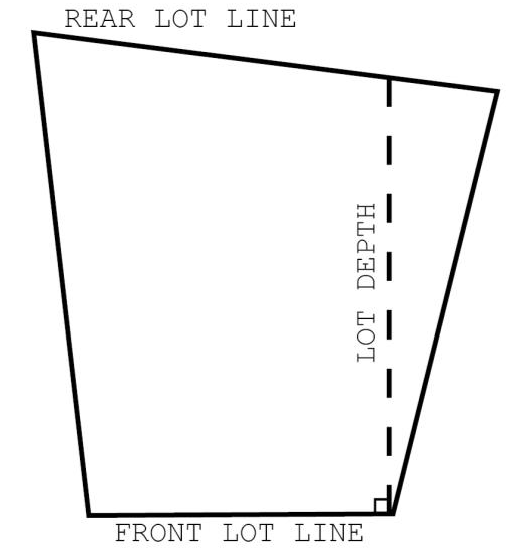
Figure 4. Lot Depth
Lot, frontage, means the front of a lot shall be, for purposes of complying with this chapter, that boundary abutting a public right-of-way which meets the minimum width of the applicable zoning district, but which has the least width if the lot has more than one frontage. See figure of lot frontage diagram as follows:
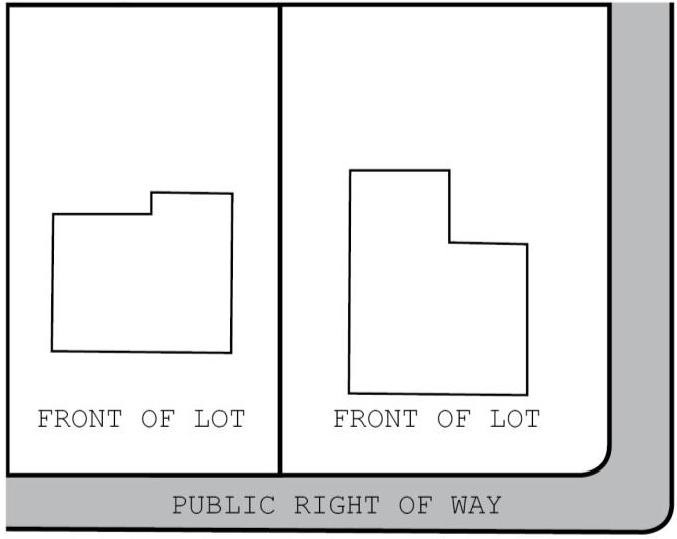
Figure 5. Lot Frontage
Lot, interior, means a lot, other than corner lot, including through lots.
Lot, line, means a property boundary line of any lot held in single or separate ownership; except that where any portion of the lot extends into the abutting street or alley, the lot line shall be deemed to be the easement or property line marking the street or alley right-of-way.
Lot of record means a parcel of land, whether subdivided or otherwise legally described and recorded prior to the effective date of the ordinance from which this chapter is derived, or approved by the city as a lot subsequent to such date and which is occupied by or intended for occupancy by one principal building or principal use together with any accessory buildings and such open spaces as required by this chapter and having its principal frontage upon an improved public street.
Lot, through, means a lot fronting on two generally parallel streets.
Lot, unit, means lots created from the subdivisions of a two-family dwelling, townhouse, or quadraminium having different minimum lot size requirements than the conventional base lots within the zoning district.
Lot width means the minimum horizontal distance between the side lot lines measured at right angles to the lot depth, at the front building setback line and also at the shoreline setback line if applicable. See figure of lot width diagram as follows:
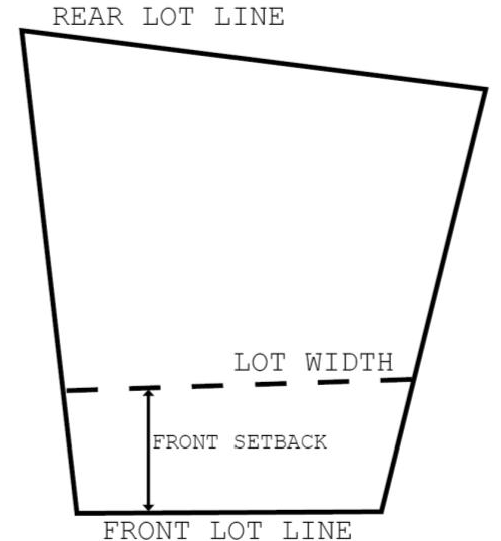
Figure 6. Lot Width
Measured distances means expressed in feet shall be the nearest tenth of a foot.
Medical and dental clinic means a structure intended for providing medical and dental examinations and service available to the public. This service is provided without overnight care available.
Minerals means soil, clay, stone, sand and gravel and other similar solid material or substance to be mined from natural deposits.
Mining means all or any part of the process involved in the extraction of minerals by removing the overburden and extracting directly from the mineral deposits thereby exposed.
Mobile (manufactured) home means any single-family dwelling transportable in one or more sections, which in the traveling mode is eight body feet or more in width or 40 body feet or more in length, or, when erected on site, is 320 or more square feet, and which is built on a permanent chassis, with or without a permanent foundation when connected to the required utilities, and includes the plumbing, heating, air conditioning, and electrical systems contained therein, and complies with the manufactured home building code, M.S.A. ch. 327.
Model home means a home which is similar to others in a development and which is open to public inspection for the purpose of selling the other homes.
Motel/motor hotel means a building or group of detached, semi-detached or attached buildings containing guest rooms or units, with garage or parking space conveniently located to each unit, and which is designed, used or intended to be used primarily for the accommodation of transient guests.
Motor fuel station means a place where gasoline is stored only in underground tanks, kerosene or motor oil and lubricants or grease, for operation of automobiles, are retailed directly to the public on premises, and not including minor accessories and services for automobiles, but not including automobile major repairs and rebuilding.
Motor freight terminal (truck terminal) means a building in which freight brought by motor truck is assembled and sorted for routing in intrastate and interstate shipment.
Natural drainage system means all land surface areas which by nature of their contour configuration, collect, store and channel surface water runoff.
Natural obstruction means any rock, tree, gravel or analogous natural matter that is an obstruction and has been located within a waterbody, watercourse or wetland by a non-human cause.
Nonconforming building, structure or use means a building, structure or use which does not conform with the district regulations and development standards in which it is situated.
Nonconforming use means any preexisting structure, tree, natural growth, or land use which is inconsistent with the provisions of this article or an amendment hereto.
Nonconformity, legal, means a nonconforming building, structure, or use which was legally established under the applicable rules and regulations in effect at the time that the building, structure or use was established.
Nonprecision instrument runway means a runway having an existing or planned straight-in instrument approach procedure utilizing air navigation facilities with only horizontal guidance, and for which no precision approach facilities are planned or indicated on an approved planning document.
Normal highwater mark means a continuous mark of reference at an elevation where land and water meet for some period of record; is commonly that point where the natural vegetation changes from predominantly aquatic to predominantly terrestrial.
Nursing home (rest home) means a building having accommodations where care is provided for two or more invalids, infirmed, aged, convalescent or physically disabled persons, as defined by M.S.A. ch. 144A, that are not of the immediate family; but not including hospitals, clinics, sanitariums or similar institutions.
Obstruction (floodplain) means any storage of material or equipment, any dam, wall, wharf, embankment, levee, road, dike, pile, abutment, projection, excavation, channel rectification, culvert, building, wire, fence, stockpile, refuse, fill, deposit, clearing of trees or vegetation, structure or matter in, along, across, or projecting, in whole or in part, into any floodplain.
Off-street loading space means a space accessible from the street, alley or way, in a building or on the lot, for the use of trucks while loading or unloading merchandise or materials.
Open sales lot means any open land used or occupied for the purpose of buying, selling or renting merchandise and for the storing of same prior to sale.
Ordinary highwater level means the boundary of public waters and wetlands and shall be an elevation delineating the highest water level which has been maintained for a sufficient period of time to leave evidence upon the landscape, commonly that point where the natural vegetation changes from predominantly aquatic to predominantly terrestrial. For watercourses, the ordinary highwater level is the elevation of the top of the bank of the channel. For reservoirs and flowages, the ordinary highwater level is the operating elevation of the normal summer pool.
Outpatient care means medical examination or service available to the public in a clinic or hospital. This service is provided without overnight care and shall be considered a separate, independent, principal use when combined or operated in conjunction with a hospital.
Overburden means the earth, rock and other materials that lie above a natural deposit of mineral.
Parking ramp means an accessory structure designed and used for the storage of motor vehicles at, below, or above grade.
Parking space means an area, enclosed in the main building, in an accessory building, or unenclosed, sufficient in size to store one passenger vehicle, which has adequate access to a public street or alley and permitting satisfactory ingress and egress of an automobile.
Patio means a surfaced space used for outdoor recreation, relaxation or entertaining which does not extend more than 12 inches above the natural grade at any point.
Permitted use means a use which may be lawfully established in a particular district or districts, provided it conforms with all requirements, regulations, and performance standards (if any) of such districts.
Personal services means establishments that primarily engage in providing services generally involving the care of the person or person's possessions. Personal services may include, but are not limited to: barber shops, beauty salons, health and fitness studios, music schools, informational and instructional services, nail salons, tanning salons, body art (including tattooing), and portrait studios.
Place of worship. A building, or structure, in which assemblies or activities of an organized religious group are conducted as the principal use of the premises, and which includes the grounds and any other buildings on the grounds used for such assemblies or activities and accessory uses. A place of worship shall not include a school regulated by Minnesota educational standards or licensed daycares for compensation, for purposes of this chapter.
Accessory uses, for the purposes of this definition, shall include other uses allowed in the zoning district in which the place of worship is located, when conducted on the same property or within the same building, as the principal use of place of worship. Childcare, education classes, study groups, and similar activities that cater to the parishioners of such place of worship, conducted contemporaneously, or occasionally throughout the week, shall be considered accessory uses to this principal use, provided they are related to the principal use, and clearly subordinate and incidental to the place of worship in scope, size, extent, or other measurement.
Other uses proposed on the same premises that exceed the scope of an accessory use may be considered by the zoning administrator to be a second principal use, and shall be processed only in accordance with the requirements of this Code.
Planned means those proposed future airport developments that are so indicated on a planning document having the approval of the Federal Aviation Administration, the state department of transportation office of aeronautics, and the city.
Planned unit development means a type of development characterized by a unified site design for a number of commercial uses, dwelling units or dwelling sites on a parcel, whether for sale, rent, or lease, and also usually involving clustering of these units or sites to provide areas of common open space, density increases, and a mix of structure types and land uses. The term "planned unit development" may be organized and operated as condominiums, time-share condominiums, cooperatives, full fee ownerships, commercial enterprises, or any combination of these, or cluster subdivisions of dwelling units, residential condominiums, townhouses, apartment buildings, campgrounds, recreational vehicle parks, resorts, hotels, motels, and conversions of structures and land uses to these uses. A planned unit development may be established as a zoning district by ordinance, or as a special zoning approval, such as conditional use permit, by council resolution.
Principal use means the main use of land or buildings as distinguished from subordinate or accessory uses. A principal use may be either permitted or conditional.
Public uses means uses owned or operated by municipal, school districts, county, state, or other governmental units.
Public waters means any waters as defined by M.S.A. § 103G.005(15).
Quadraminium means a single structure which contains four separately owned dwelling units, all of which have individually separate entrances from the exterior of the structure.
Recreation field or building means an area of land, water, or any building in which amusement, recreation or athletic sports are provided for public or semi-public use, whether temporary or permanent, except a theatre, whether provision is made for the accommodation of an assembly or not. A golf course, arena, baseball park, stadium, circus or gymnasium is a recreation field or building for the purpose of this chapter.
Recreational vehicle means a motor home, travel trailer, boat, snowmobile, dirt bike, or other such mobile equipment including the trailer on which a recreational vehicle is kept and transported, which is intended for leisure time, recreational purposes.
Regional flood means a flood which is representative of large floods known to have occurred generally in the state and reasonably characteristic of what can be expected to occur on an average frequency in the magnitude of the 100-year reoccurrence interval. The term "regional flood" is synonymous with the term "base flood" used in the flood insurance study.
Regulatory flood protection elevation means a point not less than one foot above the elevation of the floodplain, plus any increase in flood heights attributable to encroachments on the floodplain. It is the elevation to which uses regulated by this chapter are required to be elevated or floodproofed.
Restaurant means an establishment which serves food in or on non-disposable dishes to be consumed primarily while seated at tables or booths within the building.
Roofline means the top of the coping, or when the building has a pitched roof, as the intersection of the outside wall with the roof.
Runway means any existing or planned paved surface or turf covered area of the airport which is specifically designated and used or planned to be used for the landing or taking off of aircraft.
Satellite dish means a combination of:
(1)
Antenna or dish antenna whose purpose is to receive a communication or other signals from orbiting satellites and other extra-terrestrial sources;
(2)
A low-noise amplifier (LNA) which is situated at the focal point of the receiving component and whose purpose is to magnify and transfer signals; and
(3)
A coaxial cable whose purpose is to carry the signals into the interior of the building.
Satellite dish height means the height of the antenna or dish measured vertically from the highest point of the antenna or dish when positioned for operation, to the bottom of the base which supports the antenna.
Semi-public use means the use of land by a private, nonprofit organization to provide a public service that is ordinarily open to some persons outside the regular constituency of the organization.
Sensitive resource management means the preservation and management of areas unsuitable for development in their natural state due to constraints such as shallow soils over groundwater or bedrock, highly erosive or expansive soils, steep slopes, susceptibility to flooding, or occurrence of flora or fauna in need of special protection.
Setback means the minimum horizontal distance between a building or sewage treatment system and lot line. Distances are to be measured from the most outwardly extended portion of the structure at ground level, except as provided hereinafter.
Sewage treatment system means a septic tank and soil absorption system or other individual or cluster type sewage treatment system.
Sewer system means pipelines or conduits, pumping stations, and force main, and all other constructions, devices, appliances, or appurtenances used for conducting sewage or industrial waste or other wastes to a point of ultimate disposal.
Shopping center means an integrated grouping of commercial stores, under single ownership or control.
Shore impact zone means land located between the ordinary highwater level of a public water and a line parallel to it at a setback of 50 percent of the structure setback.
Shoreland means land located within the following distances from public water:
(1)
1,000 feet from the ordinary highwater level of a lake, pond, or flowage; and
(2)
300 feet from a river or stream; or
(3)
The landward extent of a floodplain designated by ordinance on a river or stream, whichever is greater.
The limits of shorelands may be reduced whenever the waters involved are bounded by topographic divides which extend landward from the waters for lesser distances and when approved by the commissioner.
Shoreland dwelling unit within the shoreland area means any structure or portion of a structure, or other shelter designed as short- or long-term living quarters for one or more persons, including rental or time share accommodations such as motel, hotel, and resort rooms and cabins.
Shoreland residential planned unit development means a use in a shoreland district where the nature of residency is non-transient and the major or primary focus of the development is not service-oriented. For example, residential apartments, manufactured home parks, time-share condominiums, townhouses, cooperatives, and full fee ownership residences would be considered as residential planned unit developments.
Sign means the use of any words, numerals, figures, devices, or trademarks by which anything is made known such as are used to show an individual, firm, profession, or business, and are visible to the general public.
Significant historic site means any archaeological site, standing structure, or other property that meets the criteria for eligibility to the National Register of Historic Places or is listed in the state register of historic sites, or is determined to be an unplatted cemetery that falls under the provisions M.S.A. § 307.08. A historic site meets these criteria if it is presently listed on either register or if it is determined to meet the qualifications for listing after review by the state archaeologist or the director of the state historical society. All unplatted cemeteries are automatically considered to be significant historic sites.
Slope means the degree of deviation of a surface from the horizontal, usually expressed in percent or degrees or as a ratio.
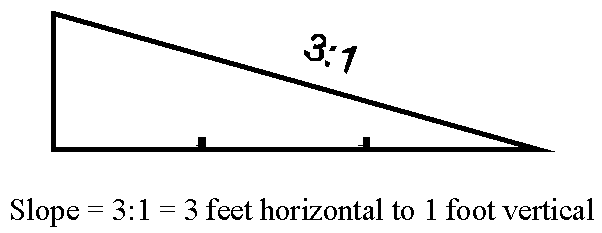
Figure 7. Slope
Steep slope means land where agricultural activity or development is either not recommended or described as poorly suited due to slope steepness and the site's soil characteristics, as mapped and described in available county soil surveys or other technical reports, unless appropriate design and construction techniques and farming practices are used in accordance with the provisions of these regulations. Where specific information is not available, steep slopes are lands having average slopes over 12 percent, as measured over horizontal distances of 50 feet or more, that are not bluffs.
Story means the three-dimensional area of a building including space from the upper surface of a floor and upper surface of floor next above, except that the topmost story shall be that portion of a building, between the upper surface of the topmost floor and the ceiling above. If the finished floor level within a basement or cellar, or unused underfloor space is more than six feet above grade as defined herein for more than 50 percent of the total perimeter or is more than 12 feet above grade as defined herein at any point, such basement, cellar, or unused underfloor space shall be considered a story. See figure of a story below:
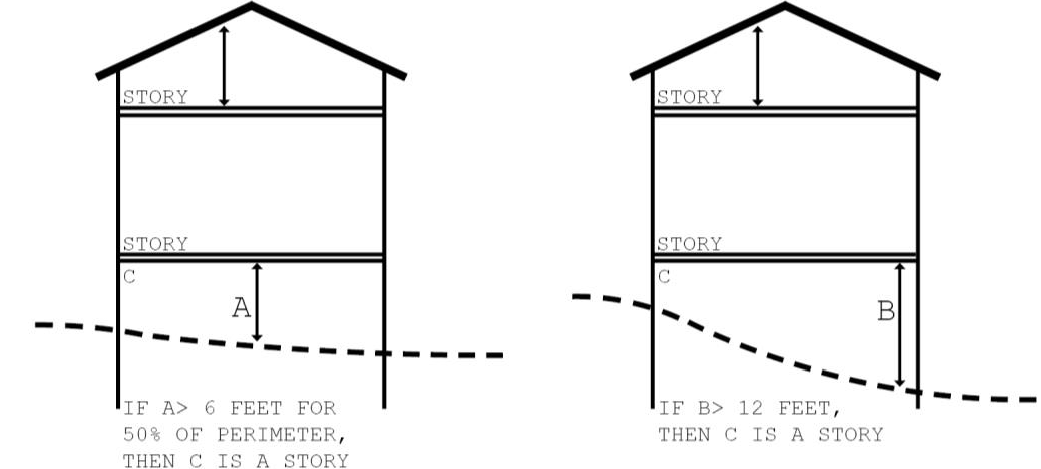
Figure 8. Story
Street frontage means the proximity of a parcel of land to one or more streets. An interior lot has one street frontage and a corner lot has two frontages. When a parcel has no direct abutting street frontage, its frontage shall be the segment of the parcel through which its primary access travels.
Structure means anything which is built, constructed or erected; an edifice or building of any kind; or any piece of work artificially built up or composed of parts joined together in some definite manner whether temporary or permanent in character.
Structure, public, means an edifice or building of any kind, or any piece of work artificially built up or composed of parts joined together in some definite manner which is owned, or rented and operated by a federal, state, or local government agency.
Surface water-oriented commercial use means the use of land for commercial purposes, where access to and use of a surface water feature is an integral part of the normal conductance of business. Marinas, resorts, and restaurants with transient docking facilities are examples of such use.
Toe of the bluff means the lower point of a 50-foot segment with an average slope exceeding 18 percent.
Top of the bluff means the higher point of a 50-foot segment with an average slope exceeding 18 percent.
Townhouse means a structure housing three or more dwelling units contiguous to each other only by the sharing of one common wall, such structures to be of the town or row houses type as contrasted to multiple apartment structures. No single structure shall contain in excess of eight dwelling units and each dwelling unit shall have separate and individual front and rear entrances.
Traverse ways, for the purpose of determining height limits as set forth in this article, shall be increased in height by 17 feet for interstate highways; 15 feet for all other public roadways; ten feet or the height of the highest mobile object that would normally traverse the road, whichever is greater, for private roads; 23 feet for railroads; and for waterways and all other traverse ways not previously mentioned, an amount equal to the height of the highest mobile object that would normally traverse it.
Tree means any object of natural growth.
Usable open space means a required ground area or terrace area on a lot which is graded, developed, landscaped and equipped and intended and maintained for either active or passive recreation or both, available and accessible to and usable by all persons occupying a dwelling unit or rooming unit on the lot and their guests. Such areas shall be grassed and landscaped or covered only for a recreational purpose. Roofs, driveways and parking areas shall not constitute usable open space.
Use means the purpose or activity for which the land or building thereof is designated, arranged, or intended or for which it is occupied, utilized or maintained, and shall include the performance of such activity as defined by the performance standards of this chapter.
Utility runway means a runway that is constructed for and intended to be used by propeller-driven aircraft of 12,500 pounds maximum gross weight and less; and is less than 4,900 feet in length.
Variance means the waiving by board action of the literal provisions of this chapter in instances where their strict enforcement would cause practical difficulties in putting the property to a reasonable use because of physical circumstances unique to the individual property under consideration.
Vegetation means the sum total of plant life in some area; or a plant community with distinguishable characteristics.
Visual runway means a runway intended solely for the operation of aircraft using visual approach procedures, with no straight-in instrument approach procedure and no instrument designation indicated on an approved planning document.
Water surfaces, for the purpose of this article, shall have the same meaning as land for the establishment of protected zones.
Waterbody means a body of water (lake, pond) or a depression of land or expanded part of a river, or an enclosed basin that holds water and surrounded by land.
Watercourse means a channel or depression through which water flows, such as rivers, streams, or creeks, and may flow year-round or intermittently.
Watershed means the area drained by the natural and artificial drainage system, bounded peripherally by a bridge or stretch of high land dividing drainage areas.
Wetlands means any area which meets the conditions and characteristics of M.S.A. ch. 103G.
Wind energy conservation system (WECS) means any device that is designed to convert wind power to another form of energy such as electricity or heat (also referred to by such common names as wind charger, wind turbine, and windmill).
Yard means an open space on the lot which is unoccupied by any building or structure and unobstructed from its lowest level to the sky. See figure of yards below:
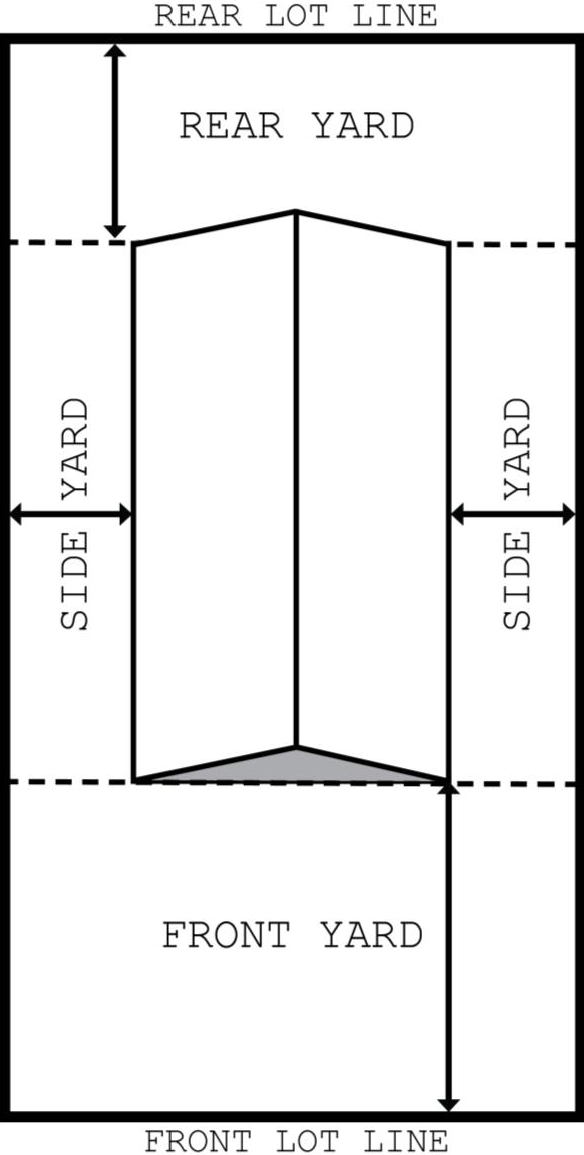
Figure 9. Yard
Yard, front, means that area extending along the full length of a lot between side lot lines from that portion of the lot bordering the public right-of-way to the front building line. In the case of a lot abutting one or more roads such as a corner lot or through lot, all yards fronting on a public street shall be treated as front yards for the purpose of applying zoning regulations, unless otherwise specified in this chapter. When a parcel has no direct street frontage, the front yard shall be that yard which lies between the building line and the street frontage.
Yard, rear, means a yard extending across the full width of the lot and lying between the rear line of the lot and the nearest line of the principal building.
Yard, required, means that distance specified in the yard requirements pertaining to setbacks. The terms "setback" and "required yard" are used interchangeably.
Yard, side, means a yard between the side line of the lot and the nearest line of the principal building and extending between the front line of the building and the rear yard.
(Code 1985, § 11.02; Ord. of 10-5-2010, §§ I, III; Ord. No. 2021-4, § 1(11.02), 7-19-2021; Ord. No. 2023-13, § 1, 12-28-2023; Ord. No. 2024-8, § 1, 12-2-2024)
Sec. 50-4. - Relation to comprehensive municipal plan.
It is the policy of the city that the enforcement, amendment, and administration of this chapter be accomplished with due consideration of the recommendations contained in the comprehensive plan as developed and amended from time to time by the planning commission and the council. The council recognizes the comprehensive plan as the policy for regulating land use and development in accordance with the policies and purposes herein set forth. When a policy or recommendation of the comprehensive plan is determined to be in conflict with a regulation in this chapter, the regulation in this chapter shall prevail.
(Code 1985, § 11.01(2))
Sec. 50-5. - Conflicting provisions; minimum standards.
(a)
Where the conditions imposed by any provision of this chapter are either more or less restrictive than comparable conditions imposed by other provisions of this Code, rule or regulation of the city, this chapter, rule or regulation which imposes the more restrictive condition, standard, or requirement shall prevail.
(b)
In their interpretation and application, the provisions of this chapter shall be held to be the minimum requirements for the promotion of the public health, safety and welfare. The council may impose more extensive or rigorous standards where the council determines that such standards are necessary to protect the public health, safety, or welfare and promote the intent of this chapter.
(Code 1985, § 11.01(3), (4))
Sec. 50-6. - Compliance required.
(a)
It is unlawful for any person to erect, convert, enlarge, reconstruct or alter any structure, or to use any structure or land for any purpose or in any manner which is not in conformity with the provisions of this chapter.
(b)
Except as herein provided, it is unlawful for any person to hereafter use or occupy any building, structure or premises that does not conform to the requirements of this chapter, and no building permit shall be granted unless in conformance with this chapter.
(Code 1985, § 11.01(5), (6))
Sec. 50-7. - Signs.
Sign design and construction specifications are not addressed in this chapter. Signs shall be erected in conformance with the provisions of chapter 34.
(Code 1985, § 11.26)

