
Buffalo City Zoning Code
ARTICLE IV
YARD, LOT AND AREA REQUIREMENTS
Sec. 50-191.- Purpose.
This article identifies yard, lot area, building size, building type, and height requirements in each zoning district.
(Code 1985, § 11.18(1))
Sec. 50-192. - Usable open space.
Each multiple family dwelling site shall contain at least 500 square feet of usable space, as defined in section 50-3 for each dwelling unit contained thereof.
(Code 1985, § 11.18(2))
Sec. 50-193. - Height.
The building height requirements in subsections (1) through (3) of this section shall apply to residential, business and industrial districts, as shown in the following table:
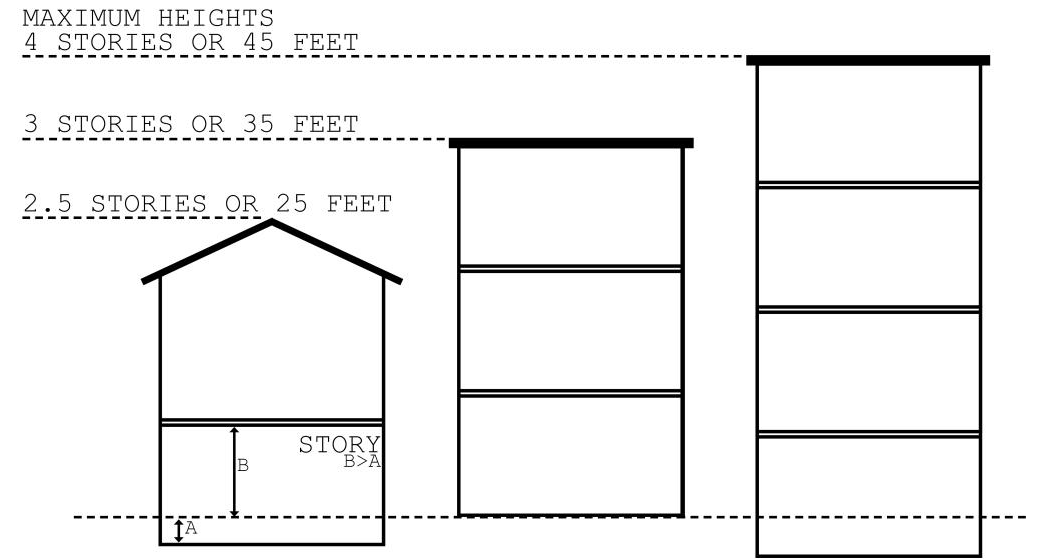
Figure 10. Maximum Heights
(1)
Except for farm buildings and school buildings, no structure in the A-1, R-R, R-A, R-1, R-2, R-3, R-4, R-MH, and B-2 districts shall exceed 2½ stories or 25 feet, whichever is least. In these districts, school buildings may not exceed 60 feet in height.
(2)
No structure shall exceed three stories or 35 feet, whichever is least, in the R-B, B-3, B-4, or B-W districts.
(3)
No structure shall exceed four stories or 45 feet in the R-5, R-6, R-7, B-5, I-1, or I-2 districts.
(4)
Building heights in excess of these above noted standards may be permitted through a conditional use permit, provided that:
a.
The site is capable of accommodating the increased intensity of use.
b.
The increased intensity of use does not cause an increase in traffic volumes beyond the capacity of the surrounding streets.
c.
Public utilities and services are adequate.
d.
For each additional story over three stories or for each additional ten feet above 40 feet, front and side yard setback requirements shall be increased by five percent.
e.
The increased height is not in conflict with airport zoning regulations.
f.
The provisions of section 50-699 are considered and satisfactorily met.
(5)
The building height limits established in this section for districts shall not apply to the following:
a.
Belfries.
b.
Chimneys or flues.
c.
Church spires.
d.
Cooling towers.
e.
Cupolas and domes which do not contain usable space.
f.
Elevator penthouses.
g.
Flag poles.
h.
Monuments.
i.
Parapet walls extending not more than three feet above the limiting height of the building.
j.
Poles, towers and other structures for essential services.
k.
Necessary mechanical and electrical appurtenances.
l.
Farming buildings.
m.
Wind energy conversion system towers as regulated section 50-486.
(6)
No excluded equipment or structural element listed in subsection (5) of this section extending beyond the limited height of a building may occupy more than 25 percent of the area of any roof on which it is mounted, nor exceed ten feet in height above the principal structure on the property unless otherwise allowed by this chapter.
(Code 1985, § 11.18(3); Ord. No. 2021-5, § 11.18, 9-20-2021)
Sec. 50-194. - Building type and construction.
(a)
No galvanized or unfinished steel, galvalum or unfinished aluminum buildings (walls or roofs), except those specifically intended to have a corrosive designed finish such as corten steel shall be permitted in any zoning district, except in association with farming activities.
(b)
Buildings in all zoning districts shall maintain a high standard of architectural and aesthetic compatibility with surrounding properties to ensure that they will not adversely impact the property values of the abutting properties or adversely impact the public health, safety, and general welfare.
(c)
Exterior building finishes shall consist of materials comparable in grade and quality to the following:
(1)
Brick.
(2)
Natural stone.
(3)
Decorative concrete block.
(4)
Cast in place concrete or precast concrete panels.
(5)
Wood, provided the surfaces are finished for exterior use and wood of proven exterior durability is used, such as cedar, redwood, cypress.
(6)
Curtain wall panels of steel, fiberglass and aluminum (nonstructural, non-load bearing), provided such panels are factory fabricated and finished with a durable non-fade surface and their fasteners are of a corrosion resistant design.
(7)
Glass curtain wall panels.
(8)
Stucco or similar finish, such as exterior insulated finish system (EIFS).
(d)
"B" business districts. In all the "B" business zoning districts of the city, any exposed metal or fiberglass finish on all buildings shall be limited to no more than 25 percent of any individual wall if it is coordinated into the architectural design. Masonry (brick, stone, or decorative concrete), glass, stucco, or composite stucco material such as "EFIS," shall comprise no less than 75 percent of each wall of the building. Any roof that that is less than 4:12 slope must include a parapet wall screening the slope from view of any neighboring property or public right-of-way. A developer may request a review of alternative materials or design by seeking comment from the planning commission at a public hearing, and approval by the city council, following the process for a conditional use as regulated by article XIII, division 3 of this chapter. Such alternative shall demonstrate distinctive architectural design and be consistent with, or exceed, the quality of other conforming buildings in the area.
(e)
"I" industrial districts.
(1)
In the "I" districts, all buildings constructed of curtain wall panels of finished steel, aluminum or fiberglass shall be required to be faced with brick, wood, stone, architectural concrete cast in place or pre-cast concrete panels on all wall surfaces. The required wall surface treatment may allow a maximum of 50 percent of the metal or fiberglass wall to remain exposed if it is coordinated into the architectural design.
(2)
The city may grant a deferment to a developer of industrial metal buildings or building additions from the exterior wall design requirements of subsection (e)(1) of this section, when the building or building addition will be constructed in more than one phase.
a.
The deferment shall be until the second construction phase is completed or five years, whichever is less.
b.
The developer shall provide the city with an irrevocable letter of credit for an amount 1½ the estimated cost of the required exterior wall treatment. The bank and letter of credit shall be subject to the approval of the city attorney. The letter of credit shall secure compliance with this section.
(3)
The city may grant an exemption to subsection (e)(1) of this section when it is determined that the building character of an area would be more appropriately served by a different standard. Such a determination shall be based upon the following considerations:
a.
The established character of existing buildings in the immediate area.
b.
The planning commission reviews the proposal at a public hearing, and the city council considers the item according to the process for conditional uses in article XIII, division 3 of this chapter.
(Code 1985, § 11.18(4))
Sec. 50-195. - Yards.
No lot, yard or other open space shall be reduced in area or dimension so as to make such lot, yard or open space less than the minimum required by this article, and if the existing yard or other open space as existing is less than the minimum required, it shall not be further reduced. No required open space provided about any building or structure shall be included as a part of any open space required for another structure.
(1)
The following shall not be considered as encroachments on yard setback requirements:
a.
Chimneys, flues, leaders, sills, pilasters, lintels, ornamental features, cornices, eaves, gutters, and the like, provided they do not project more than two feet into a yard.
b.
In front and side yards:
1.
Terraces, steps, uncovered porches or patios, stoops, or similar features provided they do not extend above the height of the ground floor level of the principal structure nor more than one foot above the natural grade, whichever is less, nor to a distance less than two feet from any lot line.
2.
A vestibule for weather protection for an exterior entrance, provided such vestibule extends no more than five feet into the setback area, covers no more than 40 square feet of encroachment, and is not closer than three feet from any lot line. Such vestibule shall not be considered when calculating setback averaging in subsection (2) of this section.
c.
In rear yards: Recreational and laundry drying equipment, arbors, and trellises, balconies, breezeways, open porches and decks, detached outdoor living rooms such as gazebos, garages, and air conditioning or heating equipment, provided they are at a distance of at least five feet from the rear or side lot line.
d.
A cantilevered extension may extend from the principal building into the required front, side, or rear yard up to a maximum encroachment of two feet and a maximum exterior area of 20 feet, for the purpose of permitting such features as bay windows or other similar building features. The encroachment shall be cantilevered and shall not have footings or foundation supporting the encroachment within the required setback area.
(2)
Where adjacent structures have front yard setbacks different from those required, the minimum front yard setback shall be the average setback of such adjacent structures. If only one adjacent lot is occupied by a structure, the minimum front yard shall be the average of the required setbacks and the setback of such adjacent structure. In no case shall the setback requirement exceed the minimum established for the respective zoning district. See Figure 11 as follows:
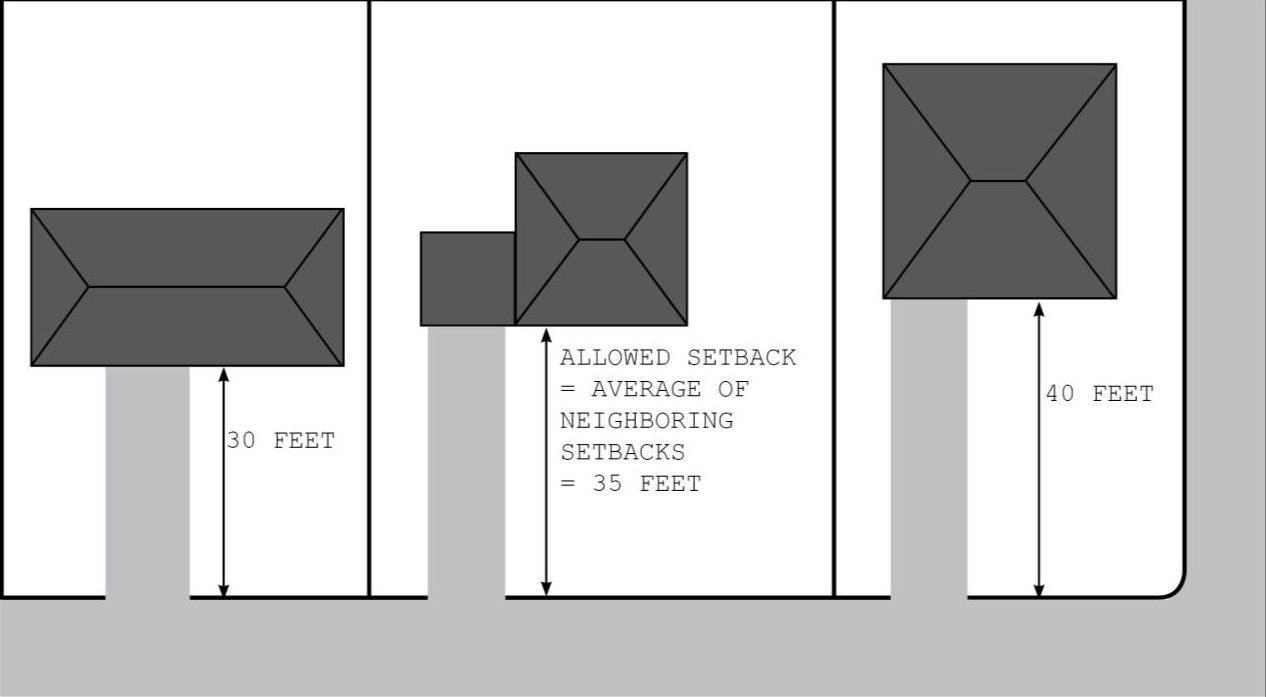
Figure 11. Adjacent Structures
(3)
Wetland buffer zone. Except for fences and recreational equipment, no building, structure, paved surface, or use shall be located within a buffer zone around any wetland. The buffer zone shall be equal to the building setback as required by the zoning district and yard area in which the wetland is located, however, in no case shall the buffer zone be reduced to a distance of less than 20 feet. The buffer zone shall be left in its natural vegetative state where practicable. If disturbed, the buffer zone shall be replanted with natural vegetation, or landscaped with ornamental trees, shrubs, or grass.
(Code 1985, § 11.18(5))
Sec. 50-196. - Minimum floor area per dwelling unit.
(a)
Single-family dwelling units. Except as otherwise specified in the zoning district provisions, single-family homes as classified in the table below shall have the following minimum floor areas per unit:
(b)
Multiple dwelling units. Except for elderly housing, living units classified as multiple dwelling shall have the following minimum floor areas per unit:
(c)
Elderly (senior citizen) housing. Living units classified as elderly (senior citizen) housing units shall have the following minimum floor areas per unit:
(d)
Double bungalows, quadraminiums and townhouses. Except as otherwise specified in the zoning district provisions, double bungalows, quadraminiums and townhouses, as classified below, shall have the minimum floor area per one-bedroom unit:
(Code 1985, § 11.18(6))
Sec. 50-197. - Efficiency apartments.
Except for elderly (senior citizen) housing, the number of efficiency apartments in a multiple dwelling shall not exceed 25 percent of the total number of apartments. In the case of elderly (senior citizen) housing, efficiency apartments shall not exceed 30 percent of the total number of apartments.
(Code 1985, § 11.18(7))
Sec. 50-198. - Minimum floor area; commercial and industrial structures.
Commercial and industrial buildings (principal structure) which are to be less than 1,000 square feet of floor area may only be allowed upon approval of a conditional use permit as provided for in article XIII, division 3 of this chapter.
(Code 1985, § 11.18(8))
Sec. 50-199. - Minimum lot area per unit.
The lot area per unit requirement for two-family, townhouses, apartments and planned unit developments shall be calculated on the basis of the total area in the project and as controlled by an individual and joint ownership.
1 In the R-5, R-6, and B-5 districts, the minimum lot area per unit may be reduced by conditional use permit, providing all other conditions of the district are met, with maximum density as listed in the individual districts.
(Code 1985, § 11.18(9))
Sec. 50-200. - Townhouse, quadraminium, apartments.
(a)
No single townhouse structure shall contain more than eight dwelling units.
(b)
Minimum unit lot frontage for townhouses shall be not less than 28 feet.
(c)
Townhouses, quadraminiums and multiple family units intended for owner occupancy shall be subdivided on an individual unit basis according to the provisions of section 50-169 or under the Uniform Condominium Act, M.S.A. § 515A.1-101 et seq.
(Code 1985, § 11.18(10))
Sec. 50-201. - Subdivision of two-family or quadraminium lots.
The subdivision of base lots containing two-family dwellings or quadraminiums to permit individual private ownership of a single dwelling within such a structure is acceptable upon the approval by the council. Approval of a subdivision request is contingent on the following requirements:
(1)
Prior to a two-family dwelling or quadraminium subdivision, the base lot must meet all the requirements of the zoning district.
(2)
The following are minimum unit lot requirements for two-family and quadraminium subdivisions where the city sewer or water systems are available:
a.
Lot area per dwelling unit:
1.
Two-family dwelling: 7,500 square feet.
2.
Quadraminium: 5,000 square feet.
b.
Lot width: 50 feet.
c.
Setbacks:
1.
Front yard: 30 feet.
2.
Rear yard: 30 feet.
3.
Side yard adjacent to another lot: ten feet. (Side yard setback is not applicable where structure has a shared wall as in the case of two-family dwellings and quadraminiums.)
4.
Side yard adjacent to street: 20 feet.
(3)
There shall be no more than one principal structure on a base lot in all residential districts. The principal structure on unit lot created in a two-family or quadraminium subdivision will be the portion of the attached dwelling existing or constructed on the platted unit lots.
(4)
Permitted accessory uses as defined by the zoning districts are acceptable, provided they meet all the zoning requirements.
(5)
A property maintenance agreement must be arranged by the applicant and submitted to the city attorney for his review and subject to approval. The agreement shall ensure the maintenance and upkeep of the structure and the lots to meet minimum city standards. The agreement is to be filed with the county recorder's office as a deed restriction against the title of each unit lot.
(6)
Separate public utility service shall be provided to each subdivided unit and shall be subject to the review and approval of the city engineer.
(7)
The subdivision is to be platted and recorded in conformance with the requirements of chapter 40.
(Code 1985, § 11.18(11))
Sec. 50-202. - Minimum lot area, unsewered lots.
Lot sizes where public sewer is not available shall conform to the minimum requirements set forth in this section.
(1)
The minimum single-family lot size is five acres unless otherwise specified in the zoning district. This minimum lot size shall not apply to smaller separate parcels of record in separate ownership lawfully existing prior to January 1, 1985, provided that it can be demonstrated by means satisfactory to the city that the smaller parcels will not result in groundwater, soil or other contamination which may endanger the public health.
(2)
Apartments and multiple-family dwellings are not allowable uses.
(3)
Subject to other provisions of this chapter, other uses may be permitted by conditional use permit when such use is allowed in the applicable zoning district. The minimum lot size for each principal use is five acres. A conditional use permit shall not be granted unless it can be demonstrated by means satisfactory to the city that the use:
a.
Will not result in groundwater, soil or other contamination which may endanger the public health.
b.
Will not increase future city utility service demands and expense.
c.
Will not jeopardize public safety and general welfare.
d.
No public sanitary sewer system is available to the property and is not planned to be available within the next 12 months.
(Code 1985, § 11.18(12))
Sec. 50-203. - Single-family dwellings.
All single-family detached homes, except in the R-MH district shall:
(1)
Be constructed upon a continuous perimeter foundation that meets the requirements of the state uniform building code.
(2)
Not be less than 30 feet in length and not less than 22 feet in width over that entire minimum length. Width measurements shall not take account of overhang and other projections beyond the principal walls. Dwellings shall also meet the minimum floor area requirements as set out in this chapter.
(3)
Have an earth covered, composition, shingled or tiled roof, or utilize another roof material and design approved for residential uses as determined by the zoning administrator.
(4)
Receive a building permit. The application for a building permit in addition to other information required shall indicate the height, size, design and the appearance of all elevations of the proposed building and a description of the construction materials proposed to be used. The exterior architectural design of a proposed dwelling may not be so at variance with, nor so similar to, the exterior architectural design of any structure or structures already constructed or in the course of construction in the immediate neighborhood, nor so at variance with the character of the surrounding neighborhood as to cause a significant depreciation in the property values of the neighborhood or adversely affect the public health, safety or general welfare.
(5)
Meet the requirements of the state uniform building code or the applicable manufactured housing code.
(Code 1985, § 11.18(13))
Sec. 50-204. - Building relocation.
(a)
The relocation of any building or structure on a lot or onto another lot within the city shall be subject to review and approval through a conditional use permit.
(b)
Upon relocation, the building shall comply with the applicable requirements of the state uniform building code.
(c)
The proposed relocated building shall comply with the character of the neighborhood in which it is being relocated as determined by an architectural review board.
(d)
The relocated use will not result in a depreciation of neighborhood or adjacent property values.
(e)
An applicant for a building relocation conditional use permit shall provide a proposed route and time for the moving operation.
(f)
An applicant for a building relocation conditional use permit shall coordinate with the building inspector to verify building code compliance requirements prior to the relocation.
(Code 1985, § 11.18(14))

