
Buffalo City Zoning Code
ARTICLE VI
BUILDING AND PERFORMANCE REQUIREMENTS
Sec. 50-323. - Site/building plan review.
(a)
Purpose. The purpose of this article is to establish a formal plan review procedure and provide regulations pertaining to the enforcement of site design and construction standards as agreed to by the contractor through his officially submitted plan documents.
(b)
Plan required. In addition to other plan requirements outlined in this chapter, site and construction plans will be required and shall be submitted to and approved by the building official prior to the issuance of any building permit.
(c)
Council action not required.
(1)
When the development of land is proposed for a lot of record, and the zoning administrator determines that the proposal meets all applicable zoning requirements, no formal review of the plans shall be required by the planning commission or city council. The zoning administrator shall report regularly to the commission and council as to building activity. Building and site plans for multiple-family, commercial or industrial construction shall be subject to review by the planning commission and approval by the council when any zoning permit or subdivision application is necessary for complete processing under the requirements of this chapter or the city's subdivision regulations.
(2)
In all cases where developments are proposed for locations adjacent to state trunk highways 55 and 25, a site plan for such proposed development shall be provided for review by the planning commission and the council for informational purposes. Property developers are encouraged to introduce their projects to the planning commission and city council when available.
(3)
Concept plan review. Prior to submission of an application for a zoning action or permit (such as a conditional use permit, variance, or rezoning application), applicants may request a concept plan review to seek preliminary feedback on their development plans from the planning commission and city council. Such concept plan review shall have a separate fee and escrow as provided in the city fee schedule. Concept plan reviews are intended to gain comment and feedback only, and no such comment or feedback shall be binding on any party in relation to any future zoning application.
(d)
Plan agreements. All site and construction plans officially submitted to the city shall be treated as a formal agreement between the building contractor and the city. Once approved, no changes, modifications or alterations shall be made to any plan detail, standard or specifications without prior submission of a plan modification request to the building official for his review and approval.
(e)
Enforcement. The building official shall have the authority to order the stopping of any and all site improvement activities, when and where a violation of the provisions of this section has been officially documented by the building official.
(Code 1985, § 11.21)
Sec. 50-324. - Certificate of occupancy.
(a)
No building or structure erected or moved without certificate. Except for farm buildings, no building or structure hereafter erected or moved, or that portion of an existing structure or building erected or moved shall be occupied or used in whole or in part for any purpose whatsoever until a certificate of occupancy shall have been issued by the building official stating that the building or structure complies with all of the provisions of this chapter and applicable state building code sections.
(b)
Application. The certificate shall be applied for coincident with the application for a building permit, conditional use permit, or variance and shall be issued within ten days after the building official shall have found the building or structure satisfactory and given final inspection. The application shall be accompanied by a fee as established by ordinance.
(Code 1985, § 11.11)
Sec. 50-352. - Purpose.
The purpose of this division is to establish general development performance standards. These standards are intended and designed to:
(1)
Assure compatibility of uses;
(2)
Prevent urban blight, deterioration and decay; and
(3)
To enhance the health, safety and general welfare of the residents of the city.
(Code 1985, § 11.17(1))
Sec. 50-353. - Building use restriction.
(a)
No garage, tent, accessory building or motor home shall at any time be used as living quarters, temporarily or permanently.
(b)
Basements and cellars may be used as living quarters or rooms as a portion of the principal residential dwelling. Energy conserving designs in housing are not prohibited by this provision of this division, provided that a conditional use permit is approved by the council and the structure complies with standards imposed by the state and city building code.
(c)
Tents, playhouses or similar structures may be used for play or recreational purposes on a temporary basis when accessory to residential dwellings.
(d)
No tent, canvas hoop structure, or any other structure not meeting the building code, or not complying with the building materials requirements of this chapter, shall be used for any principal or accessory use, unless specifically provided for by this chapter.
(e)
Pursuant to the allowances in M.S.A. § 462.3593, the city opts out of the provisions of the statute, prohibiting the use of temporary health care dwellings as otherwise authorized. Any accessory dwelling, whether consistent with the statute, or otherwise, shall meet applicable requirements of this Code.
(Code 1985, § 11.17(2))
Sec. 50-354. - Platted and unplatted property.
(a)
Any person desiring to improve property shall submit to the building official a certificate of survey of the premises and information on the location and dimensions of existing and proposed buildings, location of easements crossing the property, encroachments, and any other information which may be necessary to insure conformance to provisions of this Code.
(b)
All buildings shall be so placed so that they will not obstruct future streets which may be constructed by the city in conformity with existing streets and according to the system and standards employed by the city.
(c)
Except in the case of properties in shoreland or floodplain districts and except where sanitary sewer has not previously been provided to the lot, a lot of record existing upon the effective date of the ordinance from which this section is derived in a residence district, which does not meet the requirements of this chapter as to area or width may be utilized for single-family detached dwelling purposes, provided the measurements of such area or width are at least 60 percent of the requirements of this chapter. This section is not intended to allow reduction in setbacks and required yards.
(d)
Except in the case of planned unit developments as provided for in article III of this chapter, not more than one principal building shall be located on a lot. The words "principal building" shall be given their common, ordinary meaning as defined in section 50-3, in case of doubt or on any questions or interpretation the decision of the zoning administrator shall be final, subject to the right to appeal in accordance with the terms and procedures specified in this chapter.
(e)
On a through lot (a lot fronting on two generally parallel streets), both street lines shall be front lot lines for applying the yard and parking setback regulations of this chapter, unless otherwise specifically provided for in this chapter.
(Code 1985, § 11.17(3))
Sec. 50-355. - Accessory buildings and structures.
(a)
Farm buildings are exempt from the requirements of this subdivision.
(b)
One major and one minor accessory building shall be allowed on the same lot. The total floor area for a detached major and minor accessory building and attached garage shall not exceed 1,200 square feet on a single-family residential lot except by conditional use permit.
(c)
A garage shall be considered an integral part of the principal building if it is attached to the principal building or is connected to it by a covered passageway. For the purposes of measuring allowable garage space, no conditional use permit for accessory garage size shall be granted that results in the total garage footprint area exceeding the footprint size of the principal residence building. When attached living space is built over attached garage space, living space shall be counted toward the principal residence footprint area, and the garage space shall be counted toward the accessory garage space allowance.
(d)
Accessory buildings may encroach into the required side and rear yard setbacks applicable to principal buildings, except, however, that no such encroachment may occur on required side yard setbacks abutting street in the case of a corner lot. For detached accessory buildings, the following standards shall apply: See Figure 13:
(1)
The accessory building or structure shall not exceed 25 percent of the rear yard.
(2)
With the exception of swimming pools, all other accessory buildings and structures in the A-1 and R-R districts shall be set back from all adjoining lots a distance equivalent to the height of the accessory building and shall be located at least ten feet away from any other building or structure on the same lot.
(3)
Swimming pools in the A-1, R-R, and R-1 districts shall not be located within five feet of any principal structure, frost footing or side or rear yard lot line.
(4)
In all districts other than A-1 and R-R, accessory buildings and structures shall be set back from all adjoining lots a distance equivalent to five feet. Accessory buildings and structures shall be located ten feet away from any other building or structure on the same lot.
(5)
No accessory building or structure shall be located within a utility easement.
(6)
Garages having direct access onto an alley shall be set back 20 feet.
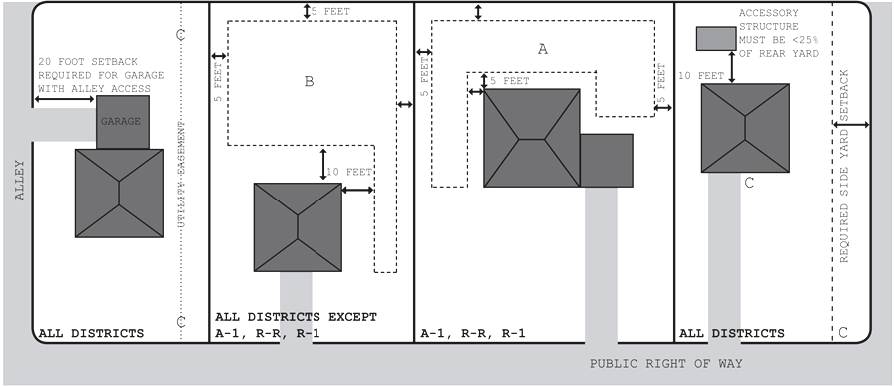
Figure 13. Garage District Access
(e)
Except as expressly permitted by conditional use permit, accessory buildings shall comply with the following height limitations:
1 R-4 Except garages which shall not exceed 15 feet, accessory buildings in all other zoning districts shall be limited to 20 feet.
(f)
The same or similar quality exterior building material shall be used in the accessory building and in the principal building. All accessory buildings shall also be compatible with the principal building on the lot. The term "compatible" means that the exterior appearance of the accessory building is not at variance with the principal building from an aesthetic and architectural standpoint as to cause:
(1)
A difference to a degree to cause incongruity as determined by an architectural review board; or
(2)
A depreciation of neighborhood or adjacent property values.
(g)
Conditional use permits. The height and area limits for accessory buildings may not exceed that allowed in subsections (c), (d), and (e) of this section, except by a conditional use permit. In addition, no permit shall be issued for the construction of more than one major or minor accessory building per lot in residential zones except by conditional use permit. Application for a conditional use permit under this subsection shall be regulated by article XIII, division 3 of this chapter. Such a conditional use permit may be granted, provided that:
(1)
There is a demonstrated need and potential for continued use of the structure for the purpose stated.
(2)
No commercial or home occupation activities are conducted on the property.
(3)
The building has an evident reuse or function related to a single-family residential environment in urban service areas or hobby farm environment in nonurban service areas of the city.
(4)
Accessory building shall be maintained in a manner that is compatible with the adjacent residential uses and does not present a hazard to public health, safety and general welfare.
(5)
The provisions of section 50-699 shall be considered and a determination made that the proposed activity is in compliance with such criteria.
(h)
Outlots. Temporary/seasonal docks shall be allowed upon designated outlots, provided that:
(1)
The outlot is owned by owners of a conforming parcel within the shoreland/floodplain district.
(2)
Only one dock, which may accommodate the storage of two watercraft, is permitted per 75 feet of lakeshore.
(Code 1985, § 11.17(4); Ord. No. 2023-13, § 1, 12-28-2023)
Sec. 50-356. - Drainage plans.
(a)
No land shall be developed and no use shall be permitted that results in water runoff causing flooding, erosion, or deposit of minerals on adjacent properties. Such runoff shall be properly channeled into a storm drain, watercourse, ponding area, or other public facilities subject to the review and approval of the city engineer.
(b)
In the case of all residential subdivisions, multiple-family, business and industrial developments, the drainage plans shall be submitted to the city engineer for his review and the final drainage plan shall be subject to his written approval. In the case of such uses, no modification in grade and drainage flow through fill, erection of retaining walls or other such actions shall be permitted until such plans have been reviewed and received written approval from the city engineer.
(c)
Except for written authorization of the zoning administrator, the top of the foundation and garage floor of all structures shall be one foot above the grade of the crown of the street.
(Code 1985, § 11.17(5))
Sec. 50-357. - Fences.
Fences shall be permitted in all yards, subject to the following:
(1)
Permit required. It is unlawful for any person, except on a farm and related to farming, to hereafter construct or cause to be constructed or erected within the city, any fence of seven feet in height or greater without first making an application for and securing a building permit and conditional use permit.
(2)
Locations. All fences shall be located entirely upon the private property of the person constructing, or causing the construction, of such fence and shall be set back two feet from all lot lines unless the owner of the property adjoining agrees, in writing, that such fence may be erected on the division line of the respective properties. The building official may require the owner of the property upon which a fence now exists or may require any applicant for a fence permit to establish the boundary lines of his property by a survey thereof to be made by any registered land surveyor, or other appropriate and effective means.
(3)
Construction and maintenance. Every fence shall be constructed in a substantial, workman-like manner and of substantial material reasonably suited for the purpose for which the fence is proposed to be used. Every fence shall be constructed in such a way that the more finished side, in the judgement of the building official, shall face out, away from the property on which it is located and toward neighboring property or public spaces. Every fence shall be maintained in a condition of reasonable repair and shall not be allowed to become and remain in a condition of disrepair or danger, or constitute a nuisance, public or private. Disrepair shall include, but not be limited to, conditions such as broken or rotted boards or fence portions, posts more than ten percent out of true vertical alignment, peeling paint, or other similar conditions. Any such fence which is, or has become dangerous to the public safety, health or welfare, is a public nuisance, and the zoning administrator shall commence proper proceedings for the abatement thereof. Link fences, wherever permitted shall be constructed in such a manner, that no barbed ends shall be at the top. Electric fences shall only be permitted in the A-1 and R-A district when related to farming, and on farms in other districts when related to farming, but not as boundary fences. Barbed wire fences shall only be permitted on farms except as hereinafter provided.
(4)
Solid walls. Solid walls eight feet in height may be constructed and maintained only in the buildable area of a lot only by a conditional use permit.
(5)
Corner lots. On corner lots, no fence or screen shall be permitted within the triangular area defined as beginning at the intersection of the property line or right of line of two intersecting streets, thence 30 feet from the point of beginning on the other property or right-of-way line, thence to the point of beginning, unless the fence or screening is at least 75 percent open or less than 30 inches in height above the centerline of the adjoining streets. See Figure 14 as follows:
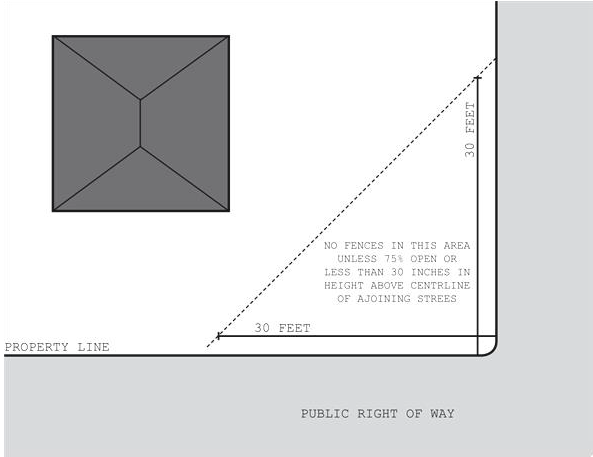
Figure 14. Corner Lots
(6)
Residential fencing and screening.
a.
Except as provided herein, fences shall be at least five percent open for passage of air and light.
b.
Except as provided herein, fences outside the buildable area of a lot may not exceed six feet in height.
c.
Except as provided herein, fences within the buildable area of a lot or in the case of the rear lot line at least ten feet from the rear lot line, may not exceed eight feet in height.
d.
Fences extending across front yards shall not exceed 48 inches in height and shall be at least 75 percent open space for passage of air and light, except that fences which abut public rights-of-way which are designated and constructed as alleys shall not exceed six feet in height, shall be at least five percent open for passage of air and light, and shall be set back from the alley right-of-way a minimum of five feet. All such fences shall conform to subsection (8) of this section. See Figure 15.
e.
Except as permitted by subsection (6)f of this section, yard requirements of through lots defined in section 50-355(e) also apply to fence requirements, and yards on both streets shall be front yards. See Figure 15.
f.
On lots where a collector or arterial street abuts their side or rear property line, fences shall be set back from the collector street right-of-way a minimum of 20 feet and shall not exceed six feet in height. All such fences located on corner lots shall conform to subsection (6)e of this section. See Figure 15. Fences in the rear yards of such lots which are less than 20 feet from the right-of-way shall conform to all other requirements of this section for fences in front yards.
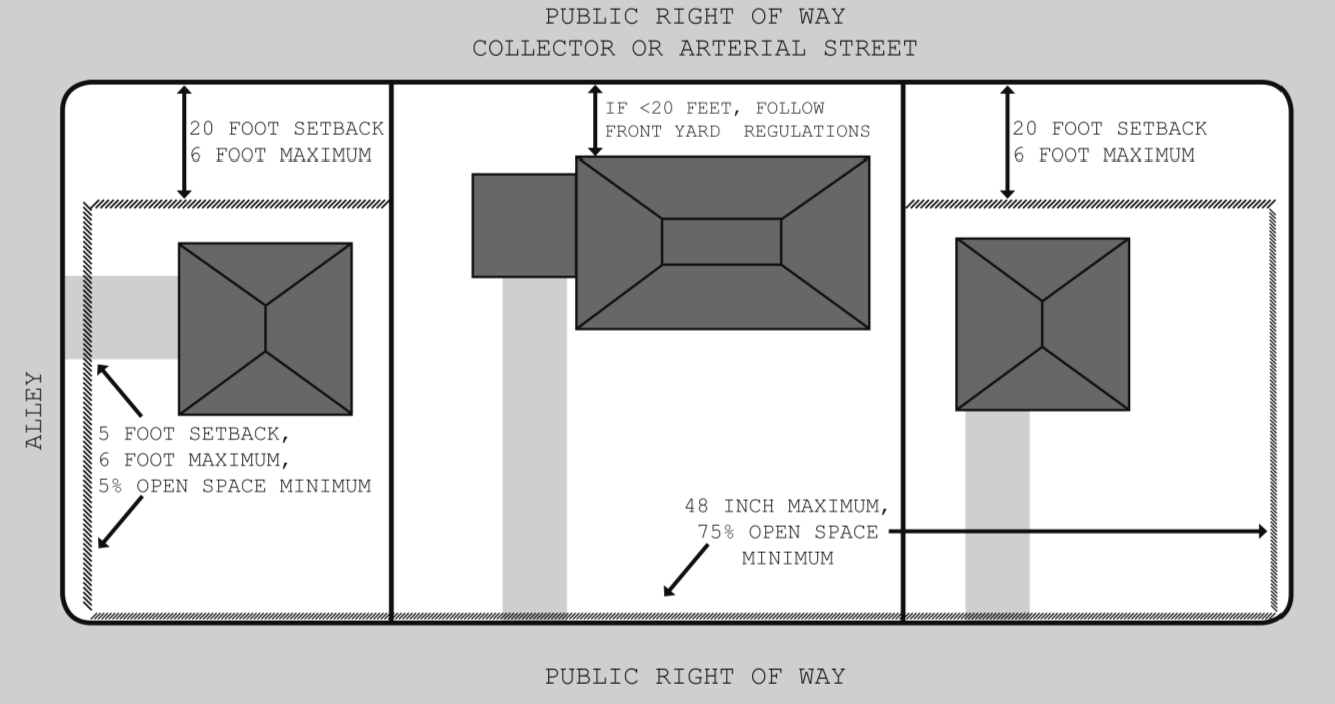
Figure 15. Fences
(7)
Swimming pool protection.
a.
A permit shall be required for permanent swimming, temporary swimming, special use, and spa pools constructed below ground and above ground level considered to be of permanent construction with a capacity of more than 5,000 gallons and/or two feet or more of depth. Each application for a permit to construct or erect a swimming pool shall be accompanied by plans of sufficient detail to show:
1.
The proposed location and its relationship to the other principal buildings on the lot.
2.
The size of the pool.
3.
Fencing and other fixtures existing on the lot, including utility location and trees.
4.
The location, size and types of equipment to be used in connection with the pool, including, but not limited to, the filter unit, pump fencing and the pool itself.
5.
That the requirements contained in subsection (7)b of this section will be satisfied.
b.
All belowground and aboveground pools for which a permit is required and granted shall be provided with safety fencing to prevent uncontrolled access meeting the following standards:
1.
All safety fencing shall be a minimum of four feet in height and be constructed as to completely enclose the pool.
2.
All gates shall be equipped with self-closing, self-latching gates capable of being locked. The latches shall be placed at least three feet above ground.
3.
There shall be no opening in the fence greater than four inches.
4.
There shall be no opening below the fence greater than two inches.
5.
The fence shall be constructed of non-corrosive materials.
6.
The fence shall not be of a readily climbable design, including:
(i)
No footholds or handholds.
(ii)
Chainlink fencing shall not exceed 1½ inch mesh.
Belowground pools with an ASTM standard certified pool cover do not require fencing.
c.
An aboveground swimming pool with sidewalls that are at least four feet high does not require enclosure by a separate fence as long as the pool has a removable or lock-up ladder, gate, or other access entry point. This ladder or access shall be secured or removed to prevent access when the facility is not in use or unattended.
(8)
Business and industrial fencing.
a.
Business and industrial fences may be erected up to eight feet in height. Fences in excess of eight feet shall require a conditional use permit.
b.
Business and industrial fences with barbed wire security arms shall be erected a minimum of six feet in height (measured without the security arm). The security arm shall be angled in such a manner that it extends only over the property of the permit holder and does not endanger the public.
(9)
Special purpose fences. Fences for special purposes and fences differing in construction, height or length may be permitted in any district in the city by issuance of a conditional use permit review by the planning commission and approved by the council. Findings shall be made that the fence is necessary to protect, buffer or improve the premises for which the fence is intended, and that there are special conditions present that distinguish the need for a fence that is not consistent with the generally applicable regulations.
(Code 1985, § 11.17(6); Ord. No. 2023-13, § 1, 12-28-2023)
Sec. 50-358. - Required fencing, screening and landscaping.
(a)
Fencing and screening. Where any business or industrial use (i.e., structure, parking or storage) abuts property zoned for residential use, that business or industry shall provide screening along the boundary of the residential property. Screening shall also be provided where a business or industry is across the street from a residential zone, but not on that side of a business or industry considered to be the front (as defined by this chapter). All fencing and screening specifically required by this chapter shall be subject to section 50-359 and shall consist of either a fence or a green belt planting strip as provided for in the following subsections.
(1)
A green belt planting strip shall consist of evergreen trees or deciduous trees and plants and shall be of sufficient width and density to provide an effective visual screen. This planting strip shall be designed to provide complete visual screening to a minimum height of six feet. Earth mounding or berms may be used but shall not be used to achieve more than three feet of the required screen. The planting plan and type of plantings shall require the approval of the council.
(2)
A required screening fence shall be constructed of masonry, brick, wood or metal. Such fence shall provide a solid screening effect six feet in height. The design and materials used in constructing a required screening fence shall be subject to the approval of the council. Fences in excess of six feet in height shall require approval of the zoning administrator and the building official.
(b)
Landscaping; general residential. The lot area remaining after providing for off-street parking, off-street loading, sidewalks, driveways, building site and/or other requirements shall be landscaped using ornamental grass, shrubs, trees or other acceptable vegetation or treatment generally used in landscaping within one year following the date of building occupancy. Fences or trees placed upon utility easements are subject to removal if required for the maintenance or improvement of the utility. Trees on utility easements containing overhead wires shall not exceed 20 feet in height. The planting of large trees is not recommended under overhead wires.
(1)
For single- and two-family parcels, the lot shall be sodded with suitable lawn grasses from the front curb line to the rear building line on both sides of the structure. The remainder of the rear portion of the lot shall be seeded with similar grass variety. Areas planted as gardens with trees, shrubs, and/or perennial plants shall be mulched, and shall be exempt from the requirement for seed or sod. When a structure is constructed on a lot with more than one frontage, the entire parcel shall be sodded.
(2)
No fewer than two overstory trees per street frontage shall be planted on each parcel.
(3)
This requirement shall be the joint and several responsibility of the developer, builder, and/or the buyer of any lot, and may be enforced by any remedy available to the city.
(c)
Landscaping; new residential subdivision, semi-public and all income producing property uses. Excluding residential structures containing less than four dwelling units). Prior to approval of a building permit, all referenced uses in subsections (a) and (b) of this section shall be subject to mandatory landscape plan and specification requirements. The landscape plan should be developed with an emphasis upon the following areas:
(1)
Boundary or perimeter. The boundary or perimeter of the proposed site at points adjoining other property and the immediate perimeter of the structure.
(2)
Standards and criteria of plan. All landscaping incorporated in the plan shall conform to the following standards and criteria:
a.
Minimum size. All plants must at least equal the following minimum size:
1 Type and mode are dependent upon time of planting season, availability, and site conditions (soils, climate, groundwater, manmade irrigation, grading, etc.).
b.
Spacing.
1.
Plant material centers shall not be located closer than three feet from the fence line or property line and shall not be planted to conflict with public plantings based on the judgment of the city staff.
2.
Where plant materials intended to provide screening are planted in two or more rows, plantings shall be staggered in rows unless otherwise approved by the city staff.
3.
Deciduous trees shall be planted not more than 40 feet apart.
4.
Where massing of plants or screening is intended, large deciduous shrubs shall not be planted more than four feet on center or evergreen shrubs shall not be planted more than three feet on center.
c.
Types of new trees. Plantings, suitable trees include:
1.
Oak - Quercus (varieties).
2.
Norway maple (and Schwedler, Emerald queen, etc.) - Acer platanoides (and varieties).
3.
Sugar Maple - Acer saccharum.
4.
Hackberry - Celtis accidentalis.
5.
Birch - Betula (varieties).
6.
Honeylocust (Imperial, Majestic skyline, Sunburst and Thornless) - Gleditsia triacanthos).
7.
Linden varieties - Tilia varieties.
8.
Ginkgo - Ginkgo biloba (male tree only).
9.
Kentucky coffee tree - Gymnocladus dioicus.
10.
Other species may be acceptable as approved by the zoning administrator.
d.
Design.
1.
The landscape plan must show some form of designed site amenities, (i.e., composition of plant materials, or creative grading, decorative lighting, exterior sculpture, etc., which are largely intended for aesthetic purposes).
2.
All areas within the property lines (or beyond, if site grading extends beyond) shall be treated. All exterior areas not paved or designated as roads, parking or storage, must be planted into ornamental vegetation (lawns, ground covers or shrubs) unless otherwise approved by the zoning administrator.
3.
Turf slopes in excess of 4:1 are prohibited.
4.
All ground areas under the building roof overhang must be treated with a decorative mulch or foundation planting.
5.
All buildings must have an exterior water spigot to ensure that landscape maintenance can be accomplished. In addition, all multifamily, commercial, institutional, and industrial developments shall utilize in-ground irrigation for all landscaped areas, unless specifically approved by the zoning administrator based on a demonstration that the design and materials used will not need regular irrigation.
6.
Quantities. Minimum landscape quantities shall be listed in the individual zoning districts.
e.
Landscape guarantee. All new plants shall be guaranteed for two full years from the time planting has been completed. All plants shall be alive and in satisfactory growth at the end of the guarantee period or be replaced.
f.
Existing trees. With respect to existing trees in new developments, all trees on the site are to be saved which do not have to be removed for street, buildings, utilities, drainage or active recreational purposes. Trees over six inches in diameter that are to remain, are to be marked with a red band, and to be protected with snow fences or other suitable enclosure, prior to any excavation. The city may further require that the developer retain a professional forester to prepare a forest inventory and management plan for the development, in order to control and abate any existing or potential shade tree disease.
g.
Tree replacement. When more than 50 percent of the existing tree crown cover is proposed to be removed to accommodate development, the owner or developer shall be required to prepare a tree replacement plan. Such plan shall provide that replacement trees are to be planted at a rate of one caliper inch of planting for each one caliper inch of tree removal, up to a maximum required replacement planting of 40 caliper inches per acre of planting for all trees removed above the 50 percent removal threshold. The tree crown cover shall be measured by the zoning administrator utilizing the maximum tree crown cover shown by aerial photography at any time in the last five years.
(d)
Mechanical equipment. All mechanical equipment such as air conditioning units, etc., erected on the roof of any structure, shall be screened so as not to be visible from the property line when abutting neighboring private property, or from the centerline of any abutting public street.
(Code 1985, § 11.17(7))
Sec. 50-359. - Traffic visibility.
On corner lots in all districts, no structure or planting in excess of 30 inches above the street centerline grade shall be permitted within a triangular area defined as follows: beginning at the intersection of the projected property lines of two intersecting streets, thence 30 feet from the point of beginning on the other property line, thence to the point of beginning.
(Code 1985, § 11.17(8))
Sec. 50-360. - Glare.
Any lighting used to illuminate an off-street parking area, sign or other structure, shall be arranged as to deflect light away from any adjoining residential zone or from the public streets. Direct or sky-reflected glare, where from floodlights or from high temperature processes such as combustion or welding shall not be directed into any adjoining property. The source of lights shall be hooded or controlled in some manner so as not to light adjacent property. Bare light sources shall not be permitted in view of adjacent property or public right-of-way. Any light or combination of lights which cast light on a public street shall not exceed one footcandle (meter reading) as measured from the right-of-way line of the street. Any light or combination of lights which cast light on neighboring commercial or industrial property shall not exceed one footcandle (meter reading) as measured at the property line. Any light of combination of lights adjacent to neighboring residential or property other than commercial or industrial shall be designed to have a zero footcandle meter reading at the property line.
(Code 1985, § 11.17(9))
Sec. 50-361. - Smoke.
The emission of smoke by any use shall be in compliance with and regulated by Minn. R. ch. 7009, ambient air quality standards. Outdoor wood-burning furnaces shall not be allowed within the city limits. The burning of combustible materials outside of the principal building shall only be allowed in accordance with the recreational fires requirements of this Code.
(Code 1985, § 11.17(10))
Sec. 50-362. - Dust and other particulated matter.
The emission of dust, fly ash or other particulated matter by any use shall be in compliance with Minn. R. ch. 7009 ambient air quality standards.
(Code 1985, § 11.17(11))
Sec. 50-363. - Odors.
The emission of odor by any use shall be in compliance with Minn. R. ch. 7009, ambient air quality standards.
(Code 1985, § 11.17(12))
Sec. 50-364. - Noise.
Noises emanating from any use shall be in compliance with Minn. R. ch. 7030, noise pollution control.
(Code 1985, § 11.17(13))
Sec. 50-365. - Refuse.
(a)
Removal.
(1)
Passenger automobiles and trucks not currently licensed by the state, or which are because of mechanical deficiency incapable of movement under their own power, parked or stored outside for a period in excess of 30 days, and all materials stored outside in violation of provisions of this Code are considered refuse or junk and shall be disposed of.
(2)
Any accumulation of refuse on any premises not stored in containers which comply with provisions of this Code, or any accumulation of refuse on any premises which has remained thereon for more than one week is declared to be a nuisance and may be abated by order of the health officer, as provided by M.S.A. ch. 145A and the cost of abatement may be assessed on the property where the nuisance was found, as provided by law.
(3)
Waste resulting from the handling, storage, sale, preparation, cooking and serving of foods with insufficient liquid content to be free flowing is called garbage. The storage and removal of this refuse must meet the provisions of this Code.
(b)
Location and screening.
(1)
All refuse and refuse handling equipment, including, but not limited to, charitable donation boxes, garbage cans and dumpsters shall be stored within the principal structure, within an accessory building, or totally screened from eye-level view for all uses, except for the following:
a.
Detached single-family residences.
b.
Double bungalows and duplexes.
c.
All other residential structures with four dwelling units or less.
(2)
Screening shall be at least six feet in height and provide a minimum opaqueness of 80 percent at the time of construction or planting. Accessory structures shall comply with minimum setback requirements and shall be constructed of materials similar to those of the principal building. Attached trash enclosures are preferred, and no trash handling areas shall be permitted where they would be visually prominent or obstruct traffic visibility. All dumpsters and trash handling equipment shall be kept in a good state of repair with tight-fitting lids to prevent spilling of debris.
(3)
For public health purposes, uses existing on the effective date of the ordinance from which this section is derived shall come into compliance at the time of the grant of any building permit or zoning permit on the property.
(Code 1985, § 11.17(14))
Sec. 50-366. - Outside storage; residential, commercial and industrial uses.
(a)
All outside storage of materials and equipment for residential uses (excluding farms) shall be stored within a building or fully screened so as not to be visible from adjoining properties, except for the following:
(1)
Clothesline pole and wire.
(2)
Not more than two recreational vehicles and equipment.
(3)
Construction and landscaping material currently being used on the premises.
(4)
On and off-street parking of currently registered and operable passenger vehicles and trucks not exceeding a gross weight of 12,000 pounds.
(5)
Lawn furniture or furniture used and constructed explicitly for outdoor use.
(6)
Rear or side yard exterior storage of firewood for the purpose of consumption only by the person on whose property it is stored.
(b)
Only when specifically allowed by district use provisions, outside storage of equipment, materials and inventory as a principal or accessory use for commercial and industrial uses shall require a conditional use permit subject to the provisions of article XIII, division 3 of this chapter and all nonresidential outside storage shall conform to the following conditions in addition to all conditions imposed by the applicable zoning district:
(1)
The area occupied is not within a required front or required side yard.
(2)
The storage area is totally fenced, fully screened and landscaped according to a plan approved by the zoning administrator and a landscape guarantee as determined by the zoning administrator is provided.
(3)
If abutting an R district or use, screening and landscaping is provided according to a plan approved by the zoning administrator.
(4)
The storage area is grassed or hard surfaced to control dust. Should a grassed surface prove to be unmaintainable, the city shall require that a hard surface be installed within three months of formal written notice to the property owner.
(5)
All lighting shall be hooded and so directed that the light source shall not be visible from the public right-of-way or from neighboring residences and shall be in compliance with subsection (b)(9) of this section.
(6)
The storage area does not encroach upon required parking space, required loading space, or snow storage area as required by this chapter.
(7)
A site plan documenting the location and grading of the storage operation shall be submitted and shall be subject to the approval of the city engineer.
(8)
A site plan documenting the location of the storage operation shall be submitted and shall be subject to the approval of the city fire chief.
(9)
The storage area shall, at all times, be kept in a neat and orderly condition to ensure the health and safety of employees, visitors, and emergency services personnel.
(c)
Temporary transient produce stands/operations. Produce stands are structures for the display and sale of locally grown agricultural products. All produce stands shall be required to obtain a temporary permit, the cost of which shall be set by resolution. The zoning administrator shall have the authority to issue the permit to operations located in "B" business districts, provided the produce stand conforms to the following criteria:
(1)
Such structures shall not exceed 250 square feet in floor area and shall have no space for customers within the structure.
(2)
Structures shall be located so as to provide safe ingress and egress from public roads.
(3)
Each stand will be permitted no more than two signs, one flat wall sign not to exceed 16 square feet, and one freestanding sign not to exceed 32 square feet in area. All signs must be no closer than five feet to any property line.
(4)
All stands and related structures shall be considered seasonal or temporary in nature and shall be removed at the end of the produce season consistent with the requirements and conditions of the stand's temporary permit, the date to be specified in the permit.
(5)
All applications for permits must be accompanied by a site plan showing the proposed location of the stand, parking areas, entrances to property from adjacent routes and proposed sign locations.
(6)
All such produce stands shall be operated in accordance with any conditions set forth in the permit, as well as all applicable state or local health regulations.
(7)
Written consent of property owner must accompany permit application.
(8)
Produce stands shall not be allowed on public property.
(9)
Violation of any of these regulations, or other conditions of the permit, shall constitute cause for immediate revocation of the permit, and removal of the structure per conditions set forth herein.
(10)
In the event a structure used as a produce stand is not removed by the end of the produce season, per the date specified in the permit, the structure may be removed at the direction of the zoning administrator, after seven days' notice to the landowner. The expenses of such removal shall be the responsibility of the landowner.
(d)
Shipping containers of up to eight feet by eight feet by 40 feet in size for the temporary storage of materials are subject to the following requirements:
(1)
Permission for one container for up to 60 days shall require an administrative permit.
(2)
Permission for more than one container or for a duration longer than 60 days shall require the processing of an interim use permit through the planning commission with the submission of a site plan.
(3)
Container must be located on a paved area not needed for required parking or circulation and only in rear or side yard of commercial or industrial-zoned property. Containers for temporary storage are not allowed in residential zones longer than 60 days and must be placed on a paved surface.
(4)
Container must be located no closer than five feet from any property line or located in any utility or drainage easement. The location of any container must also accommodate fire department access.
(5)
Container must be painted/maintained to cover rust. If visible from street, container must be painted a neutral or natural paint color, such as off-white, tan, brown.
(6)
Container is to be kept closed at all times unless being actively loaded or unloaded.
(7)
Container must not be used for purposes other than temporary storage.
(8)
Container use will require fire department review and inspection if necessary to ensure no unsafe, explosive, hazardous material storage is present.
(Code 1985, § 11.17(15); Ord. No. 2024-7, § 1, 10-21-2024)
Sec. 50-367. - Sewage disposal.
(a)
Once available, all property, other than existing single-family dwellings, which are developed and utilizing on-site sewage disposal systems shall be connected to the public sanitary system within two years. The term "available" shall mean public sanitary sewer mains are installed where such utility is within 300 feet of the property in question. For existing single-family dwellings, connection shall be required within ten years when the property is served by an on-site sewage disposal system which has been certified as fully compliant with current regulations, and which remains in compliance. However, no new on-site sewage disposal systems shall be installed or reconstructed for any property when public sanitary sewer is available.
(b)
The installation of on-site sewage treatment systems shall be in conformance with the provisions of the state uniform building code and shall only be permitted where sanitary sewer is not available.
(Code 1985, § 11.17(16))
Sec. 50-368. - Waste material.
Waste material resulting from or used in industrial or commercial manufacturing, fabricating, servicing, processing or trimming shall not be washed into the public storm sewer system nor the sanitary sewer system or any public water body but shall be disposed of in a manner approved by the state fire marshal, the pollution control agency, and the department of natural resources.
(Code 1985, § 11.17(17))
Sec. 50-369. - Bulk storage (liquid).
(a)
All uses associated with the bulk storage (liquid) dispensing of all gasoline, liquid fertilizer, chemical, flammable and similar liquids shall comply with the requirements of the state fire marshal, department of agriculture offices, pollution control agency and have documents from those offices stating the use is in compliance and also in conformance with each of the following:
(1)
That the bulk storage/dispensing of fuel shall be required to meet each of the following requirements, and shall be installed only in those districts which specifically allow the use:
a.
That the use is an accessory use to a permitted or conditional principal use in that district for which it is located and subject to all applicable zoning district requirements.
b.
That the provisions of section 50-696 are considered satisfactorily met.
c.
That any pollution or damage caused by the tank is the responsibility of the property owner on which the tank is located.
d.
Lightning protection. Each tank shall be protected against natural lightning strikes in conformance with the city's adopted electrical code.
e.
Compliance with electrical code. Storage tanks, electrical equipment and connections shall be designed and installed in adherence to the city's adopted electrical code.
f.
A site plan documenting the location and grading of the storage operation shall be submitted and shall be subject to the approval of the city engineer.
(2)
The below ground storage of fuel as an accessory use shall be prohibited in all districts except may be allowed by conditional use permit in the B-3, B-4, B-5, BC, I-1, I-2, and I-4 districts, provided that all requirements as outlined in subsection (a)(1) of this section are complied with.
(3)
The aboveground storage/dispensing of fuel facilities shall be prohibited in all districts except in the A-1 district by conditional use and limited to two tanks per property, provided each of the following criteria are met:
a.
That all requirements as outlined in subsection (1) of this section are complied with.
b.
That the use is only for vehicles associated with the principal use and shall not be used for commercial retail sales.
c.
That the use shall be setback from all property lines in compliance with the district provisions for which it is located in and that the area is not within a required front or required side yard.
d.
That the use shall not be located closer than 250 feet from a residentially used property.
e.
That the area shall be improved with containment and spillage control as required by the fire chief and any applicable laws.
f.
All lighting shall be hooded and so directed that the light source shall not be visible from the public right-of-way or from neighboring properties and shall be in compliance with section 50-360.
g.
The storage area does not encroach upon required parking space.
h.
That the storage areas shall be totally fenced, fully screened and landscaped according to a plan approved by the zoning administrator.
(b)
Farm operations as defined in this chapter are exempt from the provisions of this section.
(Code 1985, § 11.17(18); Ord. No. 2025-2, § 1, 7-21-2025)
Sec. 50-370. - Radiation emission.
All activities that emit radioactivity shall comply with the minimum requirements of the state pollution control agency.
(Code 1985, § 11.17(19))
Sec. 50-371. - Electrical emission.
All activities which create electrical emissions shall comply with the minimum requirements of the Federal Communications Commission.
(Code 1985, § 11.17(20))
Sec. 50-372. - Bus shelter and bus benches.
The erection or placement of bus shelters and covered bus benches in the public right-of-way shall require a permit from the zoning administrator. Such placements shall contain no advertising but may include a plaque with the name of the donor up to one-half of one square foot in area mounted on the structure.
(Code 1985, § 11.17(21))

