
Calexico City Zoning Code
CHAPTER 17
01 - GENERAL PROVISIONS
Article XI.- Signs[1]
Editor's note— Section 5 of Ord. No. 1121, adopted Aug. 17, 2010, repealed §§ 17.01.1100 and 17.01.1110, which had comprised Art. XI, Signs, and enacted similar provisions to read as herein set out. Former Art. XI sections derived from prior code §§ 8181 and 8182; Ord. 606, adopted in 1966; and Ord. 648, adopted in 1970.
17.01.110 - Purpose and scope.
For the purpose of promoting and protecting the public health, safety, and welfare of the people of the city, to safeguard and enhance the appearance and quality of development of the city, and to provide for the social, physical and economic advantages resulting from comprehensive and orderly planned use of land resources, a zoning ordinance defining classifications of zones and regulations within those zones is established and adopted by the city council.
(1992 zoning ord. (part))
17.01.120 - Private agreements.
The provisions of this title are not intended to abrogate any easements, covenants, or other existing agreements which are more restrictive than the provisions of this title.
(1992 zoning ord. (part))
17.01.130 - Repeal of conflicting ordinances.
Whenever the provisions of this title impose more restrictive regulations upon construction or use of buildings or structures or the use of lands or premises than are imposed or required by other ordinances previously adopted, the provisions of this title or rules or regulations promulgated thereunder shall govern.
(1992 zoning ord. (part))
17.01.140 - Establishment of zones.
A.
In order to classify, regulate, restrict, and separate the use of land, buildings and structures in the various districts and to regulate the areas of yards and other open areas abutting and between buildings and structures and to regulate the density of population, the city is divided into the following zones:
1.
Residential Zones.
2.
Commercial Zones.
3.
Industrial Zones.
4.
Special Purpose Zones.
B.
Adoption of Zones—Maps. Several zones and boundaries of those zones are established and adopted as shown, delineated and designated on the "official zoning map" of the city of Calexico, Imperial County, California, which map, together with all notations, references, data, zone boundaries, and other information thereon, is made a part hereof and is adopted concurrently herewith.
C.
Filing. The original and current official zoning map shall be kept on file with the city clerk and shall constitute the original record. A copy of said map shall be also filed with the planning department.
D.
Changes to the Zoning Map. Changes in the boundaries of the zones shall be made by ordinance and shall be reflected on the official zoning map.
(1992 zoning ord. (part))
(Ord. No. 1173, § 2, 10-12-16)
17.01.150 - Clarification of ambiguity.
If ambiguity arises concerning the appropriate zone or classification of a particular use within the meaning and intent of this title, or if ambiguity exists with respect to matters of height, yard requirements, area requirements or zone boundaries as set forth herein, it shall be the duty of the planning director to ascertain all pertinent facts and forward said findings and interpretations, to the planning commission for a recommendation and then submit said recommendation to the council. If said recommendation is approved by the council, thereafter such interpretation shall govern.
(1992 zoning ord. (part))
17.01.160 - Effects of zoning.
A.
Application of Provisions. The provisions of this title governing the use of land, buildings, and structures, the size of yards abutting buildings and structures, the height and bulk of buildings, the density of population, the number of dwelling units per acre, standards of performance, and other provisions are declared to be in effect upon all land included with the boundaries of each and every zone established by this title.
B.
Buildings under Construction. Any building for which a building permit has been issued under the provisions of earlier ordinances of the city which are in conflict with this title, and on which substantial construction has been performed by integration of materials on the site before the effective date of the ordinance codified in this title, may nevertheless be continued and completed in accordance with the plans and specifications upon which the permit was issued.
C.
Approved Tentative Tract Maps or Tentative Parcel Maps. Any approved tentative tract map or tentative parcel map which has been approved pursuant to the provisions of earlier ordinances of the city and which is in conflict with this title may nevertheless be continued and completed in accordance with the provisions of its approval provided it is completed within the time limit in effect at the time of its approval, without extension of time thereof, and provided it complies with all other ordinances and laws in effect at the time of this approval. Final tract maps may be approved pursuant to this section, and building and other permits may be issued for lots created pursuant to this section consistent with such approval.
(1992 zoning ord. (part))
17.01.170 - Enforcement.
A.
Enforcement by City Officials. The city council, planning commission, city attorney, city manager, building official, planning director, city engineer, public works director, city clerk, and all officials charged with the issuance of licenses or permits, shall enforce the provisions of this title. Any permit, certificate, or license issued in conflict with the provisions of this title shall be void.
B.
Actions Deemed a Nuisance. Any building or structure erected hereafter, or any use of property contrary to the provisions of a duly approved development review, variance, conditional use permit, or administrative permit, and/or this title shall be and the same is declared to be unlawful and a public nuisance per se and subject to abatement in accordance with city ordinance.
C.
Remedies. All remedies concerning this title shall be cumulative and not exclusive. The conviction and punishment of any person hereunder shall not relieve such persons from the responsibility of correcting prohibited conditions or removing prohibited buildings, structures, signs, or improvements, and shall not prevent the enforced correction or removal thereof.
D.
Penalties. Any person, partnership, organization, firm or corporation, whether as principal, agent, employee or otherwise, violating any provisions of this title or violating or failing to comply with any order or regulation made hereunder, shall be guilty of a misdemeanor and, upon conviction thereof, shall be punishable as provided by city ordinance.
(1992 zoning ord. (part))
17.01.210 - Permits and applications.
A.
Application Deposits. Concurrent with the submittal of an application for development and/or permit under this title, a fee shall be paid, in the amount prescribed in the Maximus Citywide Master User Fee Schedule, to cover the costs incurred in the processing of the application. Additionally, a deposit shall be made, in the amount estimated if a consultant is necessary to assist the city in the processing of an application, including without limitation, consultant fees to perform CEQA review, costs for engineering services, costs for plan checks, and/or costs of any technical studies required by traffic or other technical consultants. In no case shall the application be set for hearing or action by the planning commission or city council until such time as any balance for such application processing fees is paid in full. In the event the amount of the deposit exceeds the actual amount of costs, the difference shall be refunded to the applicant.
B.
Complete Applications. Any application for a permit or entitlement pursuant to this title must be accepted as complete for processing by the director of planning in order to initiate the official review process. Standard submittal requirements for each permit outlining the form and content of a complete application shall be established by the director. In addition to the standard submittal requirements, the director may request information specific to the permit or entitlement necessary for the complete analysis of an application. All required material, information and fees shall be provided by the applicant before the application is determined by the director to be complete for processing.
C.
Proof that the Applicant Holds a Legal or Equitable Interest in the Development Site Shall be Required. As one of the application submittal requirements, the property owner or the applicant, in the event the applicant is not the property owner, shall show written proof to the director of possession of a legal or equitable interest in the property that is to be the subject of a permit or entitlement pursuant to this title. No application for a permit or entitlement shall be deemed complete unless the legal or equitable interest is verified. Further, this requirement of having a legal or equitable interest in the property shall be maintained throughout permit processing and shall be verified prior to final action or the setting of any planning commission or city council hearing on the permit or entitlement.
For purposes of this title, "legal or equitable interest" shall mean possession of:
1.
An estate in fee simple;
2.
A joint tenancy;
3.
A tenancy in common;
4.
A leasehold estate;
5.
An easement (if it encompasses the extent of development sought);
6.
An option to purchase;
7.
An option to lease;
8.
A binding agreement or contract to exchange or transfer an interest in land;
9.
An interest as a beneficiary of a trust;
10.
An interest as a trustee with a power of sale;
11.
Any other real property interest(s) that the director, in consultation with the city attorney, determines is a legal or equitable interest in real property for purposes of this title.
D.
Check for Completeness. Within thirty calendar days after the receipt of an application, the director shall review the application and determine if it is complete for processing and shall notify the applicant in writing of such determination. In addition to the standard submittal requirements, the director may request information specific to the permit or entitlement necessary for the complete analysis of an application.
E.
Incomplete Applications. In the event an application is determined not to be complete, written notice shall be provided to the applicant specifying those portions of the application which are incomplete. Said notice shall also indicate the information and/or plans necessary to make the application complete. The applicant must supply the requested plans and/or information within sixty calendar days of the notice of incomplete filing. Upon receipt of the required items by the director, the information shall be reviewed for completeness and a determination of completeness shall be made within thirty calendar days. Once an application has been deemed complete, a decision shall be made pursuant to timelines set forth in state law.
(1992 zoning ord. (part))
(Ord. No. 1122A, § 1, 9-21-10)
17.01.220 - Denials.
A.
In the event that information need for the reasons shown below is not provided by the applicant within the time limits specified by this section, the city may deny a permit or entitlement for a development project to allow time to obtain the needed information. Information whose absence would constitute a reason for such a denial are:
1.
Information which is to be supplied by the applicant and is necessary to prepare a legally adequate environmental document; or
2.
Information necessary to prepare a supplemental environmental impact report in compliance with the California Public Resources Code, Section 21166; or
3.
Information without which the city's decision to approve a project would not be supported by substantial evidence.
B.
Denial for the above reasons may be deemed by the city to be a denial without prejudice to the applicant's right to reapply for the same permit.
(1992 zoning ord. (part))
17.01.230 - Public hearing and notification.
The planning commission and/or the city council shall hold a public hearing on applications for a change in zone boundaries or regulations, as specifically required by state law (and for conditional use permits and variances, or for other applications), as determined necessary or desirable by the commission and/or council. The hearing shall be set and notice given as prescribed below:
A.
Setting of the Hearing. The secretary to the planning commission, in the case of the planning commission, and the city clerk in the case of the city council, shall set the time and place of the public hearing, required by this title; the planning commission or council, at the time of their hearing may continue the time or place of a hearing.
B.
Hearing. The planning commission shall hold a public hearing on a rezoning request, amendment, conditional use permit or variance within forty calendar days after the compliance with the California Environmental Quality Act, Public Resources Code Section 21000 through and including Section 21176 and amendments thereof. Within thirty calendar days after action of the planning commission, the city council shall hold a public hearing to act upon the action of the planning commission.
C.
Notice. Notice of a public hearing shall be given not less than ten calendar days nor more than thirty calendar days prior to the date of the hearing by publication in a newspaper of general circulation published in the city. The notice in the event of a change of the zoning map, shall include the alternate zone classifications indicated in Section 17.01.330. When the hearing concerns matters other than an amendment to the text of this title, notices of public hearings before the planning commission or city council shall be mailed to all persons whose names appear on the latest adopted tax roll of Imperial County as owning property within three hundred feet of the exterior boundaries of the property that is the subject of the hearing.
(1992 zoning ord. (part))
17.01.240 - Action by the planning commission.
Prior to the public hearing on the particular permit and/or application, the planning director shall investigate the application and prepare a written report thereon and submit the report to the planning commission and the applicant. The planning commission shall review and consider the director's report, comments from the applicant and the public within forty calendar days after compliance with the California Environmental Quality Act Sections 21000 through 21176 inclusive of the Public Resources Code. Action of the planning commission shall be made through the adoption of a resolution with appropriate findings to the particular permit and/or application, as detailed in Sections 17.01.440, 17.01.540, 17.01.630, 17.01.640 and 17.01.650. Action of the planning commission shall be deemed final within ten calendar days unless an appeal is filed with the city clerk, or unless the application is for a change of zone amendment to the zoning ordinance or zoning determination. In those such cases the application shall be scheduled for city council action. (1992 zoning ord. (part))
17.01.250 - Action by the city council.
The planning director shall prepare a report on the action of the commission on applications for change of zone, amendments to the zoning ordinance, zoning determinations, and appeals of planning commission actions. The council shall review and consider the planning commission recommendation(s), comments by the applicant and the public. The council shall act to approve or deny the application or appeal and make the appropriate findings detailed in Sections 17.01.440, 17.01.540, 17.01.630, 17.01.640 and 17.01.650. All actions of the city council are final. (1992 zoning ord. (part))
17.01.310 - Purpose.
The zoning map and/or zoning ordinance may be amended by changing the boundaries of any zone or by changing any zoning regulation or any other provision of this title in accord with the procedure prescribed in this article. (1992 zoning ord. (part))
17.01.315 - Initiation.
A.
A change in the boundaries of any zone may be initiated by the owner or the authorized agent of the owner of the property by filing an application for a change in zone boundaries as prescribed in this article. If the property for which a change of zone is proposed is in more than one ownership, all the owners or their authorized agents shall join in filing the application.
B.
A change in the boundaries of any zone or a change in the regulations may be initiated by resolution of the planning commission when approved by the city council; or initiated directly by the city council.
C.
A change in the zoning ordinance text may only be initiated by resolution of the planning commission when approved by the city council; or initiated directly by the city council. (1992 zoning ord. (part))
17.01.320 - Application—Data and maps to be furnished.
A property owner or his authorized agent, desiring to propose a change in the boundaries of the zone in which his property is located, may file with the planning director, an application for a change in zone boundaries on a form prescribed by the planning director and shall include the following data:
A.
Name and address of the applicant.
B.
Statement that the applicant is the owner or the authorized agent of the owner of the property for which the change in zone boundaries is proposed.
C.
Address and legal description of the property.
D.
An accurate scale drawing of the site and the surrounding areas showing existing streets and property lines, and existing and proposed zone boundaries, for a distance determined by the planning director to be necessary to illustrate the relationship to and impact on the surrounding area, but not less than three hundred feet or more than six hundred feet from the property proposed for rezoning.
E.
A property ownership list, listing the names, addresses, and assessor's parcel number of all property owners within three hundred feet of the exterior boundaries of subject property. The list shall be obtained from the latest equalized assessment roll issued by the Imperial County Assessor.
F.
A radius map drawn on the assessor's parcel maps, indicating the subject property with a three hundred foot radius drawn around the property.
G.
Complete environmental assessment information on forms supplied by the planning director.
H.
The planning director may require additional information or maps if they are necessary to enable the planning commission and council to determine whether the change is consistent with the objectives of this title. The planning director may authorize omission of the map required by this section, if the director deems it is not necessary. (1992 zoning ord. (part))
17.01.325 - Public hearing by planning commission and city council.
The planning commission and the city council shall each hold a public hearing on every application for a change in zone boundaries or for a change of the zoning regulations. The hearing shall be set and notice given as prescribed in Section 17.01.230. (1992 zoning ord. (part))
17.01.330 - Alternate classification in lieu of proposed classification.
Following a public hearing on a change in the boundaries of any zone, if the planning commission and/or council determines that a change to a zone classification other than the proposed classification request by the applicant in the hearing notice is desirable, the planning commission may recommend and the council may adopt an alternate classification to a proposed classification in accord with the following schedule:
In order to more properly accommodate these alternate zone classifications, the notice of public hearing shall indicate the alternate classifications, if any, which the planning commission and city council could consider. (1992 zoning ord. (part))
17.01.350 - New application.
Following the denial of an application for a change in zone boundaries or a change in the zoning regulations, an application or request for the same or substantially the same change shall not be filed within one calendar year of the date of denial. (1992 zoning ord. (part))
17.01.355 - Change of zoning map.
A change in zone boundaries upon approval by the city council, shall be indicated by listing on the zoning map the number of the ordinance amending the map. (1992 zoning ord. (part))
17.01.410 - Purpose and initiation.
In order to ensure that the zoning regulations will permit similar uses in each zone, the planning commission and/or the city council, upon its own initiative or upon written request shall determine whether a use, not specifically listed as a permitted or conditional use, shall be deemed a permitted use or a conditional use, in one or more zones, on the basis of similarity to uses specifically listed. The procedures of this article shall not be substituted for the amendment procedure as a means of adding new uses to the list of permitted or conditional uses. (1992 zoning ord. (part))
17.01.420 - Application.
Application for determination of similar uses shall be made in writing to the planning director and shall include a detailed description of the proposed use and such other information as may be required by the planning director to facilitate the determination. (1992 zoning ord. (part))
17.01.430 - Investigation and report.
Within thirty calendar days of the filing of the request for determination, the planning director shall prepare a report. The planning director shall make such investigations of the application as necessary to compare the nature and characteristics of the proposed use with those uses specifically listed and shall make a report of the findings to the planning commission. The planning commission shall review said report and forward its recommendation to the city council for their action. (1992 zoning ord. (part))
17.01.440 - Findings.
A.
In permitting or classifying an unlisted use, all of the following findings must be made:
1.
The use furthers the objectives of the zone; and
2.
The subject use and its operations are compatible with the uses permitted in the zone; and
3.
The subject use is similar to one or more uses permitted in the zone; and
4.
The subject use will not cause substantial injury to the property in the zone within which it is proposed to be located or in any abutting zone. (1992 zoning ord. (part))
17.01.450 - Determination.
The planning commission shall review the director's report and forward a recommendation on the city council for their determination. The city council shall hear the item at their next regularly scheduled meeting and render said decision in writing. (1992 zoning ord. (part))
17.01.510 - Purpose.
In order to give the use regulations the flexibility necessary to achieve the objectives of this title, conditional uses are permitted, subject to the granting of a conditional use permit. Because of their unusual characteristics, conditional uses require special consideration so that they may be located properly with respect to the objectives of the zoning ordinance and with respect to their effects on surrounding properties. In order to achieve these purposes, the planning commission is empowered to grant and to deny applications for use permits for such conditional uses in such zones as are prescribed in the zoning ordinance and to impose reasonable conditions upon the granting of conditional use permits. (1992 zoning ord. (part))
17.01.515 - Application—Data and maps to be furnished.
Application for a conditional use permit shall be filed with the planning director on a form prescribed by the planning director and shall include the following data and maps:
A.
Name and address of the applicant.
B.
Statement that the applicant is the owner or the authorized agent of the owner of the property on which the use is proposed to be located. This provision shall not apply to a proposed public utility right-of-way.
C.
Address and legal description of the property.
D.
Statement indicating the precise manner of compliance with each of the applicable provisions of this title, together with any other data pertinent to the findings prerequisite to the granting of a use permit, prescribed in Section 17.01.540.
E.
A list of all owners of property located within three hundred feet of the exterior boundaries of the subject property; the list shall be keyed to a map showing the location of these properties.
F.
Plot plans and elevations, fully dimensioned, indicating the type and location of all buildings and structures, parking and landscape areas and signs. Elevation plans shall be of sufficient detail to indicate the type and color of materials to be employed and methods of illumination for signs. Screening, landscape and irrigation plans shall be included in the plans.
G.
The planning director may waive requirements of subsection F of this section and/or require additional data as deemed necessary to the decision-making process. (1992 zoning ord. (part))
17.01.520 - Public hearing.
The hearing shall be set and notice given as prescribed in Section 17.01.230. At the public hearing, the planning commission shall receive pertinent evidence concerning the proposed use and the proposed conditions under which it would be operated or maintained, particularly with respect to the findings prescribed in Section 17.01.540. (1992 zoning ord. (part))
17.01.530 - Investigation and report.
The planning director shall make an investigation of the application and shall prepare a report thereon which shall be submitted to the planning commission and made available to the applicant on the Friday prior to the public hearing. (1992 zoning ord. (part))
17.01.535 - Conditions of approval.
A.
A conditional use permit may be revocable, may be granted for a limited time period, or may be granted subject to such conditions as the commission may prescribe. Conditions may include, but shall not be limited to requiring:
1.
Special yards;
2.
Open spaces;
3.
Buffers;
4.
Fences;
5.
Walls;
6.
Installation and maintenance of landscaping;
7.
Street dedications and improvements;
8.
Regulations of points of vehicular ingress and egress;
9.
Regulation of traffic circulation;
10.
Regulation of signs;
11.
Regulation of hours of operation and methods of operations;
12.
Control of potential nuisances;
13.
The prescription standards for maintenance of building and grounds;
14.
Prescription of development schedules and development standards; and
15.
Such other conditions as the commission may deem necessary to ensure compatibility of the use with surrounding developments and uses and to preserve the public health, safety, and welfare.
B.
Variations from the regulations prescribed elsewhere in this section for fences, walls, hedges, screening, and landscaping; site area, width and depth; front, rear and side yards; coverage; height of structures; distances between structures; usable open space; signs; off-street parking facilities or frontage on a public street, shall be separately administered in accordance with the procedures in Article VI, Variances, of this chapter. (1992 zoning ord. (part))
17.01.540 - Findings.
The planning commission shall make the following findings before granting a conditional use permit:
A.
That the proposed location size, design, and operating characteristics of the proposed use is in accord with the title and purpose of this zoning title, the purpose of the zone in which the site is located, the Calexico general plan, and the development policies and standards of the city; and
B.
That the location, size, design, and operating characteristics of the proposed use will be compatible with and will not adversely affect or be materially detrimental to adjacent uses, residents, buildings, structures, or natural resources, with consideration given to:
1.
Harmony in scale, bulk, coverage, and density,
2.
The availability of public facilities, services and utilities,
3.
The harmful effect, if any, upon desirable neighborhood character,
4.
The generation of traffic and the capacity and physical character of surrounding streets,
5.
The suitability of the site for the type and intensity of use or development which is proposed,
6.
The harmful effect, if any, upon environmental quality and natural resources, and to
7.
Any other relevant impact of the proposed use; and
C.
That the proposed location size, design, and operating characteristics of the proposed use and the conditions under which it would be operated or maintained will not be detrimental to the public health, safety, or welfare, or materially injurious to properties or improvements in the vicinity; and
D.
That the proposed conditional use will comply with each of the applicable provisions of this title, except for an approved variance. (1992 zoning ord. (part))
17.01.545 - Lapse of conditional use permit.
A.
A conditional use permit shall lapse and shall become void three years following the date on which the use permit was approved, unless prior to the expiration of the permit:
1.
A building permit is issued and construction is commenced and diligently pursued toward completion on the site which was the subject of the use permit application; or
2.
A certificate of occupancy is issued for the structure which was the subject of the use permit application; or
3.
The site is occupied in accordance with conditional use, if no building permit or certificate of occupancy is required; or
4.
The use which was the subject of the use permit application is commenced, provided that a use permit for a public utility installation may be valid for a longer period if specified by the commission.
B.
A conditional use permit subject to lapse may be renewed for an additional period of three years, provided that ninety calendar days prior to the expiration date, an application for renewal of the use permit is filed with the director of planning on the prescribed form and accompanied by the necessary data and deposits.
C.
The planning commission may grant or deny an application for renewal of a conditional use permit.
D.
If the use, business, or service for which the conditional use permit was issued terminates or ceases operation for a continuous period of time in excess of one hundred and eighty calendar days except for:
1.
Destruction or damage by acts of God; or
2.
Destruction or damage by malicious acts; or
3.
Remodeling or rehabilitation requiring prolonged closure;
The conditional use permit shall expire and the permit shall thereafter have no further force or effect.
(1992 zoning ord. (part))
(Ord. No. 1173, § 4, 10-12-2016)
17.01.550 - Pre-existing conditional uses.
A.
A conditional use legally established prior to the effective date of the ordinance codified in this title, or prior to the effective date of subsequent amendments to this title or zone boundaries, shall be permitted to continue, provided that it is operated and maintained in accordance with the conditions prescribed at the time of its establishment, if any; and provided that it meets the requirements of Section 17.01.545.
B.
Alteration or expansion of a pre-existing conditional use shall be permitted only upon the granting of a conditional use permit as prescribed in this article, provided that minor alterations as determined by the director of planning shall be permitted without the granting of a conditional use permit.
C.
A conditional use permit shall be required for the reconstruction of a structure which has a pre-existing conditional use, if the structure is destroyed by fire or other calamity, by act of God, or by the public enemy to an extent greater than fifty percent. The extent of damage or partial destruction shall be based upon the ratio of the estimated cost of restoring the structure to its condition prior to such damage or partial destruction to the estimated cost of duplicating the entire structure as it existed prior thereto. Estimates for this purpose shall be made by or shall be reviewed and approved by the city engineer and building official and shall be based on the minimum cost of construction in compliance with the building code. (1992 zoning ord. (part))
17.01.560 - Modification of conditional use.
Sections 17.01.510 through 17.01.540 shall apply to an application for modification, expansion, or other change in a conditional use, provided that minor revisions or modifications may be approved by the planning director, if it is determined that the changes would not affect the findings prescribed in Section 17.01.540, Findings. (1992 zoning ord. (part))
17.01.565 - Suspension and revocation.
A.
Suspension. If in the opinion of the director of planning, a violation of any applicable provision of this title; or, if granted subject to conditions, upon failure to comply with conditions; or that, as a result of evidence now available and not available at the prior hearing when permit was granted and could not have been obtained with reasonable diligence at that hearing, the findings made, pursuant to Section 17.01.540, can no longer be made; or that the permit was obtained by fraud, a conditional use permit shall be suspended automatically.
B.
Revocation. The planning commission shall hold a public hearing within forty calendar days, in accordance with procedure prescribed in Section 17.01.230, Public hearing and notification. The planning commission, if it is not satisfied that the regulation, general provision, or condition(s) is being complied with, may revoke the conditional use permit or take such action as may be necessary to ensure compliance with the regulation, general provision, or condition(s). The decision shall become final thirty calendar days following the date on which the use permit was revoked unless a request for an appeal has been filed within the ten calendar days, in which case Section 17.01.250, Action by the city council, shall apply. (1992 zoning ord. (part))
17.01.570 - New applications.
Following the denial of a use permit application or the revocation of a use permit, no application for a use permit for the same or substantially the same conditional use on the same or substantially the same site shall be filed within one year from the date of denial or revocation of the use permit. (1992 zoning ord. (part))
17.01.575 - Use permit to run with the land.
A use permit granted pursuant to the provisions of this article shall continue to be valid upon a change of ownership of the site, business, service, use or structure which was the subject of the use permit application. (1992 zoning ord. (part))
17.01.580 - Use permit and change of zone filed concurrently.
Application for a conditional use permit may be made at the same time as application for a change in zone boundaries including the same property, in which case the city shall hold the public hearing on the zoning change and the use permit at the same meeting and may combine the two hearings. (1992 zoning ord. (part))
17.01.610 - Purposes and authorization.
A.
Variances from the terms of the zoning ordinance shall be granted only when, because of special circumstances applicable to the property, including size, shape, topography, location or surroundings, the strict application of the zoning ordinance deprives such property of privileges enjoyed by other properties in the vicinity, and under identical zoning classification. Any variance granted shall be subject to such conditions that will assure that the deviation thereby authorized shall not constitute a grant of special privileges inconsistent with the limitations upon other properties in the vicinity and zone in which such property is situated.
B.
The power to grant a variance does not extend to use regulations. Flexibility to the zoning regulations is provided in the conditional uses provisions of this title.
C.
The planning commission may grant variances to the zoning ordinance in accordance with the procedure prescribed in this article, with respect to fences, walls, hedges, screening and landscaping; width, and depth; front, rear, and side yards; coverage; height of structures; distances between structures; usable open space; signs; off-street parking facilities, or frontage on a public street. (1992 zoning ord. (part))
17.01.615 - Application—Data and maps to be furnished.
Application for a variance shall be filed with the planning director on a form prescribed by the planning director and shall include the following data and maps:
A.
Name and address of the applicant.
B.
Statement that the applicant is the owner or the authorized agent of the owner of the property on which the variance is being requested.
C.
Address and legal description of the property.
D.
Statement of the precise nature of the variance requested and the practical difficulty or unnecessary physical hardship inconsistent with the objectives of the zoning ordinance that would result from a strict or literal interpretation and enforcement of the specified regulation, together with any other data pertinent to the findings prerequisite to the granting of a variance, prescribed in Section 17.01.630, Findings.
E.
An accurate scale drawing of the site and any adjacent property affected, showing, when pertinent, the contours at intervals of not more than one foot, and all existing and proposed locations of streets, property lines, uses, structures, driveways, pedestrian walks, off-street parking facilities, and landscaped areas.
F.
A list of all owners of property located within three hundred feet of the exterior boundaries of the subject property; the list shall be keyed to a map showing the location of these properties.
G.
The planning director may require additional information or plans, if they are necessary, to enable a determination as to whether the circumstances prescribed for the granting of a variance exist. The planning director may authorize omission of any or all of the plans and drawings required by this article, if they are not necessary. (1992 zoning ord. (part))
17.01.620 - Public hearing.
The hearing shall be set and notice given as prescribed in Section 17.01.230. At a public hearing, the commission shall review the application, statements, and drawings submitted therewith and shall receive pertinent evidence concerning the variance, particularly with respect to the findings prescribed in Section 17.01.630, Findings. (1992 zoning ord. (part))
17.01.630 - Findings.
The planning commission may grant a variance to a regulation prescribed by this title with respect to fences, walls, hedges, screening, or landscaping; width, or depth; front, rear, or side yards, coverage; height of structures; usable open space, or frontage on a public street, as the variance was applied for or in modified form, if, on the basis of the application and the evidence submitted, the commission makes findings of fact that establish that the circumstances prescribed in subsections A, B, C, D, E, and F of this section do apply.
A.
That there are special circumstances applicable to the property, (size, shape, topography, location or surroundings) or the intended use of the property, and because of this, the strict application of the zoning ordinance deprives the property of privileges enjoyed by other properties in the vicinity under identical zoning classification; and
B.
That granting the variance or its modification is necessary for the preservation and enjoyment of a substantial property right possessed by other property in the same vicinity and zone and denied to the property for which the variance is sought; and
C.
That granting the variance or its modification will not be materially detrimental to the public health, safety or welfare, or injurious to the property or improvements in such vicinity and zone in which the property is located; and
D.
The granting of this variance does not constitute a special privilege inconsistent with the limitations upon other properties in the vicinity and zone in which such property is situated; and
E.
The granting of this variance does not allow a use or activity which is not otherwise expressly authorized by the zoning regulation governing the parcel of property; and
F.
That granting the variance or its modification will not be incompatible with the city general plan. (1992 zoning ord. (part))
17.01.640 - Signs—Additional findings.
The planning commission may grant a variance for sign location and other similar performance standards as the variance was applied for or in modified form, if on the basis of the application and the evidence submitted, the planning commission makes findings of fact that establish that the circumstances prescribed in Section 17.01.630, Findings, apply and the following circumstances also apply.
A.
That the granting of the variance will not detract from the attractiveness or orderliness of the city's appearance or the surrounding neighborhood.
B.
That the granting of the variance will not create a hazard to public safety. (1992 zoning ord. (part))
17.01.650 - Parking—Additional findings.
The planning commission may grant a variance to a regulation prescribed by this title with respect to off-street parking facilities as the variance was applied for or in modified form if, on the basis of the application and the evidence submitted, the planning commission makes findings of fact that establish that the circumstances prescribed in Section 17.01.630, Findings, apply and the following circumstances also apply:
A.
That neither present nor anticipated future traffic volumes generated by the use of the site or the uses of the sites in the vicinity reasonably require strict or literal interpretation and enforcement of the specified regulation; and
B.
That the granting of the variance will not result in the parking or loading of vehicles on public streets in such a manner as to interfere with the free flow of traffic on the streets; and
C.
That the granting of the variance will not create a safety hazard or any other condition inconsistent with objectives of this title. (1992 zoning ord. (part))
17.01.655 - Effective date of variance.
A decision of the planning commission on a variance shall be effective within ten calendar days unless an appeal of the decision is filed within the ten calendar days. (1992 zoning ord. (part))
17.01.660 - Lapse of variance.
A.
A variance shall lapse and shall become void one year following the date on which the variance became effective unless, prior to the expiration of one year, a building permit is issued and construction is commenced and diligently pursued toward completion on the site which was the subject of the variance application, or a permit is issued authorizing occupancy of the site or structure which was the subject of the variance application, or the site is occupied if no building permit or certificate of occupancy is required.
B.
A variance may be renewed for an additional period of one year provided that ninety calendar days prior to the expiration of one year from the date when the variance became effective, an application for renewal of the variance is filed with the planning director.
C.
The planning commission may grant, grant conditionally, or deny an application for renewal of a variance. (1992 zoning ord. (part))
17.01.670 - Revocation.
A variance granted by the planning commission, subject to conditions may be revoked by the commission if the applicant has not complied with the conditions. The decision of the commission revoking a variance shall become effective ten calendar days following the date on which it was revoked, unless an appeal is received within the ten calendar days. (1992 zoning ord. (part))
17.01.675 - Variance related to plans submitted.
Unless otherwise specified at the time a variance is granted, it shall apply only to the plans and drawings submitted as part of the application. (1992 zoning ord. (part))
17.01.710 - Purpose.
A.
The provisions of this article shall be known as the development review procedure.
B.
The city finds that a development review process supports the implementation of the Calexico general plan. The city further finds that the quality of residential, commercial, industrial, and public/quasi-public uses has a substantial impact upon the visual appeal, environmental soundness, economic stability, and property values of the city. This section is not intended to restrict imagination, innovation or variety, but rather to focus on design principles which can result in creative imaginative solutions for the project and quality design for the city. It is, therefore, the purpose of this section to:
1.
Recognize the interdependence of land values and aesthetics and provide a method by which the city may implement this interdependence to its benefit.
2.
Encourage the orderly and harmonious appearance of structures and property within the city, along with associated facilities, such as but not limited to signs, landscaping, parking areas, and streets.
3.
Maintain the public health, safety, and general welfare, and property throughout the city.
4.
Assist private and public developments to be more cognizant of public concerns for the aesthetics of development.
5.
Reasonably ensure that new developments, including residential, commercial, industrial and public/quasi-public development, do not have an adverse impact on aesthetics, health, adjoining properties, or the city in general.
6.
Ensure that the proposed development complies with all of the provisions of the zoning ordinance and the general plan. (1992 zoning ord. (part))
17.01.720 - Applicability.
In order to safeguard and enhance the appearance and quality of development of the city, development review approval shall be required prior to the issuance of any building permit for single-family subdivision developments; mobilehomes on permanent foundations; single-family homes (custom); multiple-family developments; mobilehome parks; commercial or industrial establishments, including additions, alterations and redevelopment thereof. (1992 zoning ord. (part))
17.01.730 - Plans and drawings submission.
In addition to meeting all of the other requirements of the zoning ordinance, any applicant for a building permit for the establishment of single-family subdivision development; mobilehomes on permanent foundations; single-family home (custom); multiple-family developments; the establishment of commercial or industrial uses; including additions, alterations and redevelopment thereof shall submit the following plans and drawings to the director of planning for review:
A.
A site plan, drawn to scale, showing the proposed location of structures and other improvements including, where appropriate, driveways, pedestrian walks, off-street parking areas, landscaped areas, fences, and walls. The site plan shall indicate the locations of off-street parking areas including entrances and exits and the direction of traffic flow into and out of off-street parking areas.
B.
A conceptual landscape plan, drawn to scale, showing the locations of existing trees proposed to be removed or retained on the site, the location and design of landscaped areas and the varieties and sizes of plant materials to be planted therein, and other landscape features as may be necessary to illustrate the landscape concept.
C.
Architectural drawings drawn to scale, including floor plans in sufficient detail to permit computation of yard requirement and all elevations of the proposed structures as they will appear upon completion. All exterior surfacing materials and colors shall be specified.
D.
Accurate scale drawings of all signs indicating their size, material, color, and illumination, if any.
E.
Conceptual grading and drainage plans.
F.
Such other data as may be required by the director of planning to ensure that the purposes of this section are satisfied. (1992 zoning ord. (part))
17.01.740 - Review and evaluation.
The director shall review and evaluate development plans submitted in accordance with the following guidelines:
A.
Scope. The director shall review and evaluate development plans for conformance with the site plan review standards and criteria set forth in the pertinent sections of the zoning ordinance.
B.
Modifications Required for Approval of the Development Plan. The director may specify modifications, changes, and additions to the development plan in his recommendation or requirements for its approval. Such recommendations may be suggested by the director to eliminate or mitigate significant adverse environmental effects disclosed by any environmental impact report or modifications, changes and additions that are necessary to meet the purposes of this article.
C.
Improvements Required for Approval of the Development Plan. The director shall insure that all development plans provide for on and off-site improvements which may be required to implement the purposes of this article of the zoning ordinance, the general plan and all policies of the city council. (1992 zoning ord. (part))
17.01.750 - Action by director.
The director shall have the authority to approve, deny or modify applications for development review. Within fifteen calendar days of the date that application is deemed complete by the director, the director shall approve, conditionally approve, or disapprove the application, or shall request the applicant to revise said application. Failure of the director to act within fifteen calendar days shall be deemed approval of the application unless the applicant shall consent to an extension of time. (1992 zoning ord. (part))
17.01.760 - Appeal to planning commission.
A decision of the director may be appealed in writing, within ten calendar days to the planning commission by the applicant or any other interested person, upon paying the established deposit, or the director's decision may be appealed by a member of the planning commission and/or city council without deposit. (1992 zoning ord. (part))
17.01.770 - Action by planning commission.
Action by the planning commission shall follow the procedures established by Section 17.01.240. Failure of the planning commission to act within thirty calendar days from the appeal shall be deemed approval of the plan and drawings unless the applicant shall consent to an extension of time. (1992 zoning ord. (part))
17.01.780 - Conditions.
Development reviews may be approved or modified subject to the performance of such conditions, including the provision of required improvements as the director shall deem to be reasonable and necessary, or advisable under the circumstances, so that the objectives of the zoning ordinance, general plan, planning commission and city council policies shall be achieved. Such conditions shall be imposed and enforced as follows:
A.
Security May be Required to Ensure Performance. In order to ensure the performance of conditions imposed concurrent with the granting or modification of a development plan, the applicant may be required to furnish security in the form of money or surety bond in the amount fixed by the authority granting or modifying the development plan. Such security shall be furnished as required by local ordinance.
B.
Provision of Required Improvements. Whenever a development review approval is granted or modified subject to the condition that specified improvements be provided by the applicant, such improvements shall be installed by the applicant and approved and accepted by the cognizant city authority pursuant to local ordinance to make such improvements prior to the time or events specified in the development review approval. Improvements shall include but not be limited to curbs, gutters, sidewalks, street pavement and off-site improvements.
C.
Condition Declared Void. Whenever there becomes final any judgement of a court of competent jurisdiction declaring one or more of the conditions of a development review approval to be void or ineffective, or enjoining or otherwise prohibiting the enforcement or operation of one or more of such conditions, said development review approval shall cease to be valid and all rights or privileges granted thereby shall lapse, as provided by Section 17.01.785.
D.
Violation of Condition. Whenever a development review is approved or modified by the approving authority subject to a condition or conditions, use or enjoyment of the development review approval in violation of or without observance of any such condition shall constitute a violation of the zoning ordinance and said development review approval may be revoked or modified as provided in Section 17.01.785. (1992 zoning ord. (part))
17.01.785 - Revocation or modification of development review approval for cause.
A development review approval may be revoked or modified by the approving authority for cause as provided by the provisions of this section. For purposes of this section, the modification of a development review approval may include the modification of the terms of the development review approval itself or the waiver, alteration, or imposition of new conditions pursuant to Section 17.01.780.
A.
Grounds for Revocation or Modification. A development review approval may be revoked or modified by the approving authority pursuant to the provisions of this section upon a finding of any one or more of the following grounds:
1.
That such development review approval was obtained or extended by fraud.
2.
That one or more of the conditions upon which such development review approval was granted have been violated.
3.
That the use for which the development review approval was granted is so conducted as to be detrimental to the public health or safety, or as to be a nuisance.
4.
That construction on the subject property is not in conformance with the development review approval or other applicable requirements.
B.
Notification. The director shall notify the owner of the property of his action in the same manner as specified in the building code for revocation of a building permit, or by written notice to the owner of the subject property as shown on the latest assessment roll or as indicated by later information available to the director.
C.
Appeal. Revocation or modification of a development review approval may be appealed pursuant to Section 17.01.760. (1992 zoning ord. (part))
17.01.790 - Automatic revocation of development review approval.
Whenever there becomes final any judgement of a court of competent jurisdiction declaring one or more of such conditions to be void or ineffective, or enjoining or otherwise prohibiting the enforcement or operation of one or more of such conditions said development review approval shall also cease to be valid. (1992 zoning ord. (part))
17.01.795 - Expiration and extension.
Any approval of a development review shall expire within one year of such approval except where construction or use of the property in reliance on such development review approval has commenced prior to its expiration. If construction and use of the property in reliance on a development review approval has not commenced within the three years period, said period may be extended by the director for a period not exceeding six years from the date of original approval.
(1992 zoning ord. (part))
(Ord. No. 1173, §5, 10-12-16)
17.01.810 - Purposes.
A.
Uses. This section is intended to limit the number and extent of nonconforming uses by prohibiting or limiting their enlargement, their re-establishment after abandonment, and the alteration or restoration after destruction of the structures they occupy.
B.
Structures. While permitting the use and maintenance of existing nonconforming structures, this section is intended to:
1.
Limit the number and extent of nonconforming structures by prohibiting their relocation, alteration, or enlargement in a manner that would increase the nonconformity; and
2.
Prohibit restoration of nonconforming uses and structures after destruction. (1992 zoning ord. (part))
17.01.820 - Continuation and maintenance.
A.
A use lawfully occupying a structure or a site, that does not conform with the use regulations or the performance standards for the zone in which the use is located shall be deemed to be a nonconforming use and may be continued, except as otherwise provided in this section.
B.
A structure, lawfully occupying a site, that does not conform with the property development standards for front yard, side yards, rear yard, height coverage, or distances between structures, for the zone in which the structure is located, shall be deemed to be a nonconforming structure and may be used and maintained, except as otherwise provided in this section.
C.
Routine maintenance and repairs may be performed on a structure or site, the use of which is nonconforming, and on a nonconforming structure. (1992 zoning ord. (part))
17.01.830 - Alterations and additions to nonconforming uses and structures.
A.
A nonconforming structure shall not be altered or reconstructed to increase the nonconformity for front yard, side yards, rear yard, height of structures, or distances between structures, or usable open space prescribed in the zone in which the structure is located. No nonconforming structure shall be moved or enlarged unless the new location or enlargement shall conform to the property development standards for front yard, side yards, rear yard, height of structures, and distances between structures, or usable open space prescribed in the zone in which the structure is located.
B.
A structure, the use of which is nonconforming, shall not be moved, altered, or enlarged, unless required by law, or unless the moving, alteration, or enlargement will result in the elimination of the nonconformity, except as permitted in this section.
C.
A nonconforming use may be enlarged or extended only within the structure in which it is wanted, provided no structural alterations, except those required by law are made.
D.
A use which fails to meet the performance standards of the zone in which it is located shall not be enlarged or extended or shall have equipment replaced that results in failure to meet performance standards unless the enlargement, extension, or replacement will result in elimination on nonconformity with performance standards. (1992 zoning ord. (part))
17.01.840 - Discontinuation of nonconforming use.
Whenever a nonconforming use has been discontinued or changed to a conforming use for a continuous period of one hundred eighty calendar days or more, the nonconforming use shall not be re-established, and the use of the structure or site thereafter shall be in conformity with the regulations for the zone in which it is located. Discontinuation shall include cessation of a use regardless of intent to resume the use, unless the director of planning is notified in writing of the intent to resume and has approved a schedule for resumption of said use. (1992 zoning ord. (part))
17.01.850 - Restoration of a damaged structure.
A.
Whenever a structure which does not comply with the property development standards for front yard, side yards, rear yard, height of structures, or distances between structures prescribed in the zone in which the structure is located, or the use of which does not conform with the performance standards for the zone in which it is located, is destroyed by fire or other calamity, by act of God, or by the public enemy to the extent of fifty percent or less, the structure may be restored and the nonconforming use may be resumed, provided that restoration is started within one year and diligently pursued to completion. When the destruction exceeds fifty percent or the structure is voluntarily razed or is required by law to be razed, the structure shall not be restored except in full conformity with the property development standards for the zone in which it is located and the nonconforming use shall not be resumed.
B.
The extent of damage or partial destruction shall be based upon the ratio of the estimated cost of restoring the structure to its condition prior to such damage or partial destruction to the estimated cost of duplicating the entire structure as it existed prior thereto. Estimates for this purpose shall be made by or shall be reviewed and approved by the building official and shall be based on the minimum cost of construction in compliance with the building code. (1992 zoning ord. (part))
17.01.860 - Exceptions to provisions for elimination of nonconforming uses and structures.
The following uses, when nonconforming, need not be removed and under certain conditions may be expanded provided that they shall be subject to the provisions of Section 17.01.840, Discontinuation of nonconforming use, and Section 17.01.850, Restoration of a damaged structure.
A.
In any zone, a residential use, provided that the number dwelling units shall not be increased.
B.
In an R zone, a nonresidential use that is a permitted use or a conditional use in the CO or CN zone may be continued and a conditional use permit may be granted for expansion of the floor area or the site area occupied by the use by not more than a total of ten percent in any five year period.
C.
In a CH zone, a use that is a permitted use or a conditional use in any C zone or any I zone may be continued and a conditional use permit may be granted for expansion of the floor area or the site area occupied by the use by not more than a total of ten percent in any five year period.
D.
In an I zone, a use that is a permitted use or a conditional use in any I zone may be continued, provided that nonconformity with screening and performance standards requirements shall be eliminated as prescribed in Section 17.01.880. A use permit may be granted for expansion of the floor area or the site area. (1992 zoning ord. (part))
17.01.870 - Change to another nonconforming use.
A use permit may be granted for conversion of a nonconforming use to another nonconforming use, provided that the planning commission makes the following findings:
A.
The proposed nonconforming use will not have a greater adverse impact on the surrounding area than the existing or former nonconforming use; and
B.
The proposed nonconforming use shall be a use that would be permitted to continue in the zone in which it would be located as prescribed in Section 17.01.860, Exceptions to provisions for elimination of nonconforming uses and structures. (1992 zoning ord. (part))
17.01.880 - Elimination of nonconforming uses and structures.
Except as permitted in Section 17.01.860, Exceptions to provisions for elimination of nonconforming uses and structures, and Section 17.01.870, Change to another nonconforming use, nonconforming uses, and structures, shall be discontinued and removed from their sites, altered to conform, or altered as prescribed to decrease the degree of nonconformity, within the specified time after they become nonconforming.
A.
Uses.
1.
In any zone, removal of a nonconforming use that does not occupy a structure or a use occupying a structure having an assessed valuation of less than five hundred dollars shall be removed or made to conform within five years from the date of notification as set forth in Section 17.01.895 herein.
2.
In an R zone, a use that is not a permitted use or a conditional use in a CO or CN zone; or in a CH zone, a use that is not a permitted use or a conditional use in any C zone or an I zone shall be removed or made to conform within fifteen years from the date of notification as set forth in Section 17.01.895 herein.
B.
Structures.
1.
Removal or alteration of a nonconforming structure having an assessed valuation of less than five hundred dollars shall be removed or made to conform within five years from the date of notification as set forth in Section 17.01.895 herein. (1992 zoning ord. (part))
17.01.890 - Time when use and structure become nonconforming.
Whenever a use and/or a structure become nonconforming because of a change of zone boundaries or a change of regulations for the zone in which it is located, the period of time prescribed in this article for the elimination of the use, and the removal of the structure, shall be computed from the effective date of the change of zone boundaries or regulation. (1992 zoning ord. (part))
17.01.895 - Notice of elimination date for nonconforming use and structure.
When the planning director determines the existence of nonconforming uses listed in Section 17.01.880, Elimination of nonconforming uses and structures, and notifies the owner by certified or registered mail of the provisions and dates for compliance with the provisions of Section 17.01.880 the time periods prescribed shall commence. The first notification shall precede the date by which elimination is required by not less than the time periods prescribed in Section 17.01.880. Thereafter, notification shall be given annually in the same manner as the first notification. (1992 zoning ord. (part))
17.01.900 - Definitions.
A.
For the purposes of this title, certain words, phrases, and terms used herein shall have the meaning assigned to them by this section.
When not inconsistent with the context, words used in the present tense include the future; words in the singular number include the plural; and those in the plural number include the singular. The word "shall" is mandatory; the word "may" is permissive.
1.
"Abut" means two adjoining parcels of property with a common property line, including two or more lots adjoining only at a corner, except where such common property line is located in a public street right-of-way.
2.
"Access" or "access way" means the place, means, or way by which pedestrians and vehicles shall have safe, adequate and usable ingress and egress to a property or use as required by this title.
3.
"Accessory building" means a building, part of a building, or structure, which is incidental or subordinate to the main building or use on the same building site.
4.
Reserved.
5.
Reserved.
6.
"Accessory use" means a use incidental, related, appropriate and clearly subordinate to the main use of the lot or building, which accessory use does not alter the principal use of such lot or building.
7.
Adult Arcade. See "adult motion picture arcade."
8.
"Adult bookstore" means an establishment that devotes more than fifteen percent of the total floor area utilized for the display of books and periodicals to the display and sale of the following:
a.
Books, magazines, periodicals, or other printed matter, or photographs, films, motion pictures, video cassettes, slides, tapes, records, or other forms of visual or audio representations which are characterized by an emphasis upon the depiction or description of specified sexual activities or specified anatomical instruments, devices or paraphernalia which are designed for use in connection with specified sexual activities.
An adult bookstore does not include an establishment that sells books or periodicals as an incidental or accessory part of its principal stock-in-trade and does not devote more than fifteen percent of the total floor area of the establishment to the sale of books and periodicals.
9.
"Adult cabaret" means a nightclub, bar, theater, restaurant or similar establishment which regularly features live performances which are distinguished or characterized by an emphasis on specified sexual activities or by exposure of specified anatomical areas and/or which regularly features films, motion pictures, video cassettes, slides or other photographic reproductions which are distinguished or characterized by an emphasis upon the depiction or description of specified sexual activities or specified anatomical areas for observation by patrons.
10.
"Adult drive-in theater" means an open lot or part thereof, with appurtenant facilities, devoted primarily to the presentation of motion pictures, films, theatrical productions and other forms of visual productions, for any form of consideration, to persons in motor vehicles or on outdoor seats, and presenting material distinguished or characterized by an emphasis on matter depicting, describing or relating to specified sexual activities or specified anatomical areas for observation by patrons.
11.
"Adult hotel or motel" means a hotel, motel or similar establishment offering public accommodations for any form of consideration which provides patrons with closed-circuit television transmissions, films, motion pictures, video cassettes, slides or other photographic reproductions which are distinguished or characterized by an emphasis upon the depiction or description of specified sexual activities or specified anatomical areas.
12.
"Adult mini-motion picture theater" means an establishment, with a capacity of more than five but less than fifty persons, where, for any form of consideration, films, motion pictures, video cassettes, slides or similar photographic reproductions are shown, and in which a substantial portion of the total presentation time is devoted to the showing of material which is distinguished or characterized by an emphasis upon the depiction or description of specified sexual activities or specified anatomical areas for observation by patrons.
13.
"Adult model studio" means any establishment open to the public where, for any form of consideration or gratuity, featuring models who display specified anatomical areas to be observed, sketched, drawn, painted, sculptured, photographed, or similarly depicted by persons, other than the proprietor, paying such consideration or gratuity. This provision shall not apply to any school of art which is operated by an individual, firm, association, partnership, corporation or institution which meets the requirements established in the Education Code of the state of California for the issuance or conferring of, and is in fact authorized thereunder to issue and confer, a diploma.
14.
"Adult motion picture arcade" means any place to which the public is permitted or invited wherein coin or slug-operated or electronically, electrically or mechanically controlled still or motion picture machines, projectors, or other image-producing devices are maintained to show images to five or fewer persons per machine at any one time, and where the images so displayed are distinguished or characterized by an emphasis on depicting or describing specified sexual activities or specified anatomical areas.
15.
"Adult motion picture theater" means an establishment, with the capacity of fifty or more persons, where, for any form of consideration, films, motion pictures, video cassettes, slides or similar photographic reproductions are shown, and in which a substantial portion of the total presentation time is devoted to the showing of material which is distinguished or characterized by an emphasis upon the depiction or description of specified sexual activities or specified anatomical areas for observation by patrons.
16.
"Adult theater" means a theater, concert hall, auditorium or similar establishment, either indoor or outdoor in nature, which for any form of consideration, regularly features live performances which are distinguished or characterized by an emphasis on specified sexual activities or by exposure of specified anatomical areas for observation by patrons.
17.
"Alley" means any dedicated or implied dedication of an access or way intended for vehicular use to the rear or side of a property served by a street.
18.
"Ambient level" means that general noise level in the area at the given time.
19.
"Amendment to ordinance" means a change in the wording, context or substance of this title when adopted by ordinance.
20.
Anatomical Areas. See "specified anatomical areas."
21.
"Animal hospital" means a place where animals are given medical or surgical treatment and are cared for during the time of such treatment. Use as a kennel shall be limited to short-time boarding and shall be only incidental to such hospital use.
22.
"Apartment" means a building or portion thereof designed and used for occupancy by two or more individual persons or families living independently of each other.
23.
"Apartment hotel" means a building or portion thereof designed for or containing both individual guestrooms or suites or rooms and dwelling units.
24.
"Apartment house" means a multiple dwelling.
25.
"Arcades" means a place of business where five or more electronic or electrical coin operated games are operated for compensation.
26.
"Auditorium" means the part of a church, school, college, university or other public building assigned to the audience or a room assigned for public assembly, lectures, entertainment, dances or similar uses.
27.
"Auto court" means a motel.
28.
"Automobile service station" means a lot or portion of a lot used for the servicing of motor vehicles. Such servicing may include sale of motor fuel and oils, lubrication, incidental car washing, waxing and auto accessories. Such servicing shall not include tire recapping, sale of major auto accessories, wheel repair or parts, sale or rebuilding of engines, battery manufacturing or rebuilding, radiator repair or steam cleaning, body repair, painting or upholstery, or installation of auto glass.
29.
"Automobile wrecking" means the dismantling or wrecking of used motor vehicles or trailers, or the storage, sale or dumping of dismantled or wrecked vehicles or their parts. The presence on any lot or parcel of land of one or more motor vehicles which for a period exceeding thirty days have not been capable of operating under their own power, and from which parts have been or are to be removed for reuse or sale shall constitute prima facie evidence of an automobile wrecking yard.
30.
"Basement" means a story partly or wholly underground. A basement shall be counted as a story for purposes of height measurement where more than one-half of its height is above grade.
31.
"Block" means all property fronting upon one side of a street between intersecting and intercepting streets, or between a street and a right-of-way, waterway, terminus of a dead-end street, or city boundary. An intercepting street shall determine only the boundary of the block on the side of the street which it intercepts.
32.
"Boarding or rooming house" means a building containing a dwelling unit where lodging is provided with or without meals for compensation for five or more persons.
33.
"Borrow pit" means any place or premises where dirt, soil, sand, gravel or other material is removed by excavation or otherwise for any purpose other than necessary and incidental to grading or to building construction or operation on the premises where such necessary and incidental removal is completed within six months.
34.
"Building" means any structure having a roof and enclosed on all sides, constructed for the shelter, enclosure of persons, animals or property of any kind.
35.
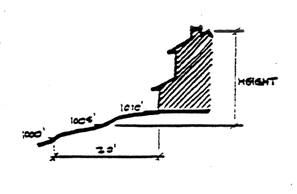
"Building height" means the vertical distance from the average grade to the highest point of the coping of a flat roof or to the deck line of a mansard roof or to the highest point of the highest gable of a pitch or hip roof, but exclusive of vents, air conditioners, chimneys, or other such incidental appurtenances.
36.
"Building site" means a legally created parcel or contiguous parcels of land in single or joint ownership, which provides the area and the open spaces required by this title, exclusive of all vehicular and pedestrian rights-of-way and all other easements that prohibit the surface use of the property, by the owner thereof.
37.
"Building site" means the ground area of one lot or the ground area of two or more lots when used in combination for a building or permitted group of buildings, together with all open spaces as required by this title.
38.
"Building site front" means, in the case of an interior lot, the portion adjacent to the street; in the case of a double-frontage or through lot, both street frontages; on corner lots, the front shall be on the street where the majority of the lots in the block front.
39.
"Business" or "commerce" means the purchase, sale or other transaction involving the handling or disposition of any article, service, substance or commodity for livelihood or profit; or the management of office buildings, offices, recreational or amusement enterprises; or the maintenance and use of offices, structures, and premises by professions and trades rendering services.
40.
"Canopy" means a small roof or awning attached to the wall of a structure which is supported by no means other than its attachment to the wall.
41.
"Carport" means a permanent roofed structure with not more than two enclosed sides used or intended to be used for vehicle storage for the occupants of the premises.
42.
"Change of zone" means a change in the zone map affecting the classification of any property shown thereon.
43.
"City" means the city of Calexico.
44.
"Clinic" means a place for medical services to patients human or animal not involving the overnight housing of patients.
45.
"Club" means an association of persons (whether or not incorporated) for a common purpose, but not including groups organized solely or primarily to render a service as a business for profit.
46.
"Coffee shop" means a completely enclosed restaurant facility wherein the customers are served at a counter and/or tables.
47.
"College" means a college, junior college or university supported by public funds, or a private college, junior college or university which gives comparable general academic instruction and degrees.
48.
"Commission" means the planning commission of the city of Calexico.
49.
"Community apartment" means a development in which an undivided interest in the land is coupled with the right of exclusive occupancy of an apartment located thereon.
50.
"Conditional use permit" means a permit granted by resolution of the city council in accordance with the terms of this title for specific cases to suspend the use requirements on a particular property.
51.
"Condominium" means an estate in real property consisting of an undivided interest in common in a portion of a parcel of real property, together with a separate interest in space in a residential, industrial or commercial building on such real property, such as an apartment, office or store.
52.
"Condominium conversion" means the conversion of rental units, residential or commercial, into a condominium project.
53.
"Convalescent home" means a facility licensed by the state Department of Public Health, the state Department of Social Welfare, or the county of Imperial, which provides bed and ambulatory care for patients with post-operative convalescent, chronically ill or dietary problems, and persons aged or infirm unable to care for themselves; but not including alcoholics, drug addicts or persons with mental or contagious diseases or afflictions.
54.
"Council" means the city council of the city of Calexico.
55.
"County" means the county of Imperial.
56.
"County recorder" means the county recorder of the county of Imperial.
57.
"Day nursery" (including pre-school and nursery schools) means any building, buildings or portion thereof used for the daytime care of six or more children at any location other than their normal place of residence, excluding any children who normally reside on the premises.
58.
"Density" means the total number of dwelling units permitted on a net acre of land exclusive of all existing public or private streets and right-of-way. Rounding shall be to the lowest whole number.
59.
"Development" means any man-made change to improved or unimproved real estate, including but not limited to buildings or other structures, mining, dredging, filling, grading, paving, excavation or drilling operations.
60.
"Director" means the planning director of the city of Calexico or the duly authorized representative.
61.
"Dormitory" means a building intended or used principally for sleeping accommodations, where such building is related to an educational institution.
62.
"Drive-in or drive-through restaurant" means a place of business which sells food products and/or beverages and which:
a.
Delivers such food products and/or beverages to customers outside of the building in which they are prepared by means of service, a window, counter, or similar method or device; or
b.
Delivers such food products and/or beverages to customers outside of the building which is designed in such a manner that a majority of the customers will remove such food products and/or beverages from the building for consumption either on the premises or in the immediate vicinity.
63.
"Dump" means an area devoted to the disposal of refuse, including incineration, reduction, or dumping of ashes, garbage, combustible or noncombustible garbage or refuse, offal or dead animals.
64.
"Dwelling" means a building or portion thereof designed exclusively for residential occupancy.
65.
Reserved.
66.
Dwelling, Multiple. "Multiple dwelling" means a building containing two or more dwelling units or a combination of two or more separate single-family dwelling units on one lot.
67.
"One-family dwelling" means a detached building used exclusively for occupancy by one family, including necessary servants and employees of such family, and containing one dwelling unit.
68.
Dwelling, Single-Family. "Single-family dwelling" means a detached building designed exclusively for residential occupancy.
69.
"Two-family dwelling" means a building used exclusively for occupancy by two families, including necessary servants and employees of each such family, living independently of each other and containing two dwelling units.
70.
"Dwelling unit" means one or more rooms and a single kitchen in a single-family dwelling, apartment house or hotel designed as a unit for occupancy by one family for living and sleeping purposes.
71.
Dwelling Unit, Accessory. "Accessory dwelling unit" means an attached or a detached residential dwelling unit which provides complete independent living facilities for one or more persons. It shall include permanent provisions for living, sleeping, eating, cooking, and sanitation on the same parcel as the single-family dwelling is situated. An accessory dwelling unit also includes an efficiency unit, as defined in California Health and Safety Code section 17958.1, and a manufactured home, as defined in section 18007.
72.
"Educational institutions" means public and other nonprofit institutions conducting regular academic instruction at kindergarten, elementary, secondary, or collegiate levels, and including graduate school, universities, nonprofit research institutions and religious institutions.
72a.
"Emergency shelters" means housing with minimal supportive services for homeless persons that is limited to occupancy of six months or less by a homeless person. No individual or household may be denied emergency shelter because of an inability to pay. The housing is provided on a first-come first serve basis where the homeless persons must vacate the emergency shelter each morning & have no guarantee of a bed for the next night.
72b.
"Employee housing" means on-site living accommodation provided by an employer in a single family structure in R-1, residential zones in connection with any work whether or not rent is involved for six or fewer persons. Per Section 17021.5(b) of the Health and Safety Code, employee housing shall not be deemed a use that implies that the employee housing is an activity that differs in any other way from an agriculture use. No conditional use permit, variance, or other zoning clearance shall be required of employee housing that would not be required of a single family dwelling of the same type in the same zone.
73.
"Exception" means a variance to the yard and lot requirements set forth in Chapters 17.28 through 17.44 granted by the city in accordance with the terms of this title.
74.
"Family" means one or more persons living together as a single housekeeping unit in a dwelling and that shares household responsibilities and activities such as expenses, chores, eating evening meals together and participating in recreational activities and having close social, economic and psychological commitments to each other. A family also includes the residents of residential care facilities and group homes for people with disabilities. A family does not include larger institutional group living situations such as dormitories, fraternities, sororities, monasteries or nunneries, nor does it include such commercial group living a arrangements as boardinghouses, lodging houses and farm labor camps.
74a.
"Family care home" means a small or large family care home licensed by the state providing twenty-four-hour, non-medical care for persons, including mentally or physically handicapped persons.
a.
"Large family care home" means a home that provides care for seven to fourteen persons including children under the age of eighteen years who reside at the home, as set forth in the California Health and Safety Code.
b.
"Small family care home" means a home that provides family care for six or fewer persons including children under the age of eighteen years who reside at the home, as set forth in the California Health and Safety Code.
74b.
"Family care institution" means a state-authorized, certified, or licensed family care home, foster home, or group home which does not quality as a family care home.
75.
"Feed lot" or "feed yard" means a lot, or portion of a lot, used for enclosing and fattening of livestock for market, and not operated in connection with a bona fide farm.
76.
"Garage" means a detached accessory building or a portion of a main building on the same lot for the parking and temporary storage of vehicles of the occupants of the premises.
77.
Garage, Private. "Private garage" means an accessory building or an accessory portion of the main building designed and/or used for the shelter or storage of vehicles owned or operated by the occupants of the main building.
78.
Garage, Public. "Public garage" means a building other than a private garage used only for the shelter or storage or operating of motor vehicles, and/or for the care, repair, equipping, hire or sale of such vehicles.
79.
"General plan" means the general plan of the city of Calexico, and shall consist of the general plan maps and text adopted by the city council.
80.
"Grade" means the average level of the finished ground surfaces surrounding a building.
81.
"Gross area" means the total horizontal area within the lot lines of a lot or parcel of land before public streets, easements or other areas to be dedicated or reserved for public use are deducted from such lot or parcel.
82.
"Guest room" means a room which is designed to be occupied by one or more guests for sleeping purposes, and having no kitchen facilities.
83.
Reserved.
84.
"Highway" means a street shown as a freeway, major, primary, or secondary highway on the general plan of the city.
85.
"Home occupation" means an occupation customarily conducted entirely within a dwelling by the occupant of the dwelling as a secondary use in connection with which there is no display, no stock in trade or commodity sold upon the premises, and no person employed.
86.
"Hospital" means an institution for the diagnosis, care, and treatment of human illness, including surgery and primary treatment.
87.
"Hotel" means a structure or portion thereof or a group of attached guest rooms or suites occupied on a transient basis for compensation.
88.
"Kennel" means any lot, building, structure, enclosure or premises whereupon or wherein are kept seven or more dogs, cats or similar small animals in any combination for more than ten days, whether such keeping is for pleasure, profit, breeding, or exhibiting, and including places where dogs or cats or similar animals in any combination are boarded, kept for sale, or kept for hire.
89.
Kennel, Commercial. "Commercial kennel" means any kennel maintained for the purpose of boarding, breeding, raising or training dogs or cats over the age of four months for a fee or for sale.
90.
Kennel, Noncommercial. "Noncommercial kennel" means any property where four or more dogs or cats, over the age of four months, are kept or maintained for the use of enjoyment of the occupancy for noncommercial purposes.
91.
"Kitchen" means any room used or intended to be used or designed to be used for cooking or the preparation of food, including any room having a sink and either a gas opening or provision for an electric stove.
92.
"Large animals" means and includes equine or cleft-hoofed animals and shall include other such animals described and assumed by their size, weight, and/or appearance to be large animals.
93.
"Legal lot" means a) a parcel of real property shown as a delineated parcel of land with a number or letter designation, on a subdivision map, or parcel map recorded in the office of the county recorder and created in conformance with the state Subdivision Map Act; b) a parcel of real property shown on a recorded record of survey map, lot division plat, or other official map filed in the office of the county recorder or county engineer, when such map or plat was filed as the result of and was made a condition of a lot division approved by the county of Imperial under the authority of prior or existing county ordinances; c) any parcel of real property which existed as a separate parcel on or before March 4, 1972 as evidenced by a valid deed recorded on or before that date; d) a parcel of real property described in a recorded certificate of compliance, approved and filed by the city of Calexico in the county of Imperial in accordance with the state Subdivision Map Act and county or city code.
94.
"Loading space" means an off-street space or berth used for the loading or unloading of commercial vehicles.
95.
"Lot" means:
a.
A parcel of real property with a separate and distinct number or other designation shown on a plat recorded in the office of the county recorder; or
b.
A parcel of real property delineated on an approved record of survey, parcel map or subdivision map as filed in the office of the county recorder or in the office of the planning department, and abutting at least one public street or right-of-way or easement determined by the city engineer to be adequate for the purpose of access; or
c.
A parcel of real property abutting at least one public street or right-of-way or easement determined by the city engineer to be adequate for the purpose of access and held under separate ownership from abutting property prior to February 1, 1972.
96.
"Lot area" means the total area exclusive of streets or alleys within the boundary lines of a lot.
97.
Lot, Corner. "Corner lot" means a lot located at the intersection or interception of two or more streets at an angle of not more than one hundred thirty-five degrees. If the angle is greater than one hundred thirty-five degrees, the lot shall be considered an "interior lot."
98.
"Lot coverage" means the ratio between the ground floor area of the building or buildings and the net area of the lot, exclusive of the ultimate street right-of-way.
99.
"Lot depth" means the average horizontal distance between the front and rear lot lines measured in the mean direction of the side lot lines.
100.
Lot, Flag. "Flag lot" means a lot which utilizes a narrow strip as its means of providing frontage on a street and/or providing vehicular access to the lot.
101.
Lot, Interior. "Interior lot" means a lot other than a corner lot.
102.
"Lot line" means any line bounding a lot as herein defined.
103.
Lot Line, Front. On an interior lot, the front lot line means the property line abutting the street. On a corner or reverse corner lot, the front lot line means the shorter property line abutting a street, except in those cases where the subdivision or parcel map specifies another line as the front lot line. On a through lot or a lot with three or more sides abutting a street or a corner or reverse corner lot with lot lines of equal length, the director shall determine which property line shall be the front lot line for the purposes of compliance with yard and setback provisions of this title. On a private street or easement, the front lot line shall be designated as the edge of the easement.
104.
Lot Line, Interior. "Interior lot line" means a lot line not abutting a street.
105.
Lot Line, Rear. "Rear lot line" means a lot line not abutting a street, which is opposite and most distant from the front lot line. In the case of an irregular-shaped lot, a line within the lot, parallel to and at a maximum distance from the front lot line, having a length of not less than ten feet. A lot which is bounded on all sides by streets may have no rear lot line.
106.
Lot, Reverse Corner. "Reverse corner lot" means a corner lot, the side line of which is substantially a continuation of the front lot lines of the lot to its rear, whether across an alley or not.
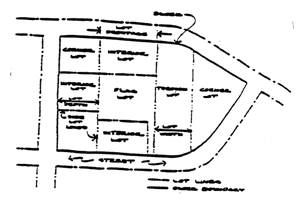
107.
Lot Line, Side. "Side lot line" means any lot line not a front lot line or rear lot line.
108.
Lot, Through. "Through lot" means a lot having frontage on two dedicated parallel or approximately parallel streets.
109.
"Lot width" means the average horizontal distance between the side lot lines, measured at right angles to the lot depth at a point midway between the front and rear lot lines.
110.
"Main building" means the principal building on a lot or building site designed or used to accommodate the primary use to which the premises are devoted. Where a permissible use involves more than one structure designed or used for the primary purpose, as in the case of group houses, each such permissible building on one lot as defined in this title shall be construed as constituting a main building.
111.
"Mobilehome" means a movable or transportable vehicle, other than a motor vehicle, designed as a permanent structure intended for occupancy for one family and having no foundation other than jacks, piers, wheels, or skirtings.
112.
"Mobilehome unit space" means a plot of ground within a mobile home park designed for the accommodation of one mobilehome unit.
113.
"Motel" means the same as "hotel."
114.
"Net acre" means all land within a given area or project including residential lots, and other open space which directly serves the residents of the net acre; but exclusive of all public or private streets and other easements.
115.
"Nonconforming building" means a building or portion thereof which was lawful when established but which does not conform to the provisions of this title.
116.
"Nonconforming lot" means a lot, the area, frontage, or dimensions of which do not conform to the provisions of this title.
117.
"Nonconforming use" means a use lawful when established but which does not conform to the provisions of this chapter.
118.
"Nonprofit institution" means a nonprofit establishment maintained and operated by a society, corporation, individual, foundation or public agency for the purpose of providing charitable, social, educational or similar services to the public, groups or individuals.
119.
"Parcel" means a contiguous quantity of land in the possession of, or owned by, or recorded as the property of, the same person.
120.
"Parking space" means a space or area, other than a street or alley, not less than nine feet wide and twenty feet long provided with adequate ingress and egress, and which is permanently reserved and maintained for the parking of motor vehicles. Where more than four parking spaces are grouped as a common facility, the area per parking space plus the area used for driveways shall total not less than three hundred square feet per parking space.
121.
"Person" means any individual, firm, copartnership, joint venture, association, social club, fraternal organization, corporation, estate, trust, receiver, syndicate, this and any other city, county, district or other political subdivision, or any other group or combination acting as a unit.
122.
"Regulation golf course" means a golf course having grassed fairway with a total length not less than five thousand four hundred yards.
123.
"Rest home or home for the aged" means premises used for the housing of and caring for the ambulatory aged or infirm, which premises require a license from the state or county. There shall be only incidental convalescent care not involving a physician residing on the premises. There shall be no surgery or other similar activities such as customarily provided in sanitariums and hospitals. Also see the State and Safety Code.
123a.
"Residential care facility" means various types of facilities operated by licensed staff that provide twenty-four-hour non-medical supportive and custodial care for children, adults, and the elderly who need general assistance for everyday living. The facilities are licensed by the state department of social services and are not considered to be health facilities. The facilities are referred to by a variety of terms, including: group homes, family care homes, foster family homes, small family homes, special needs housing, adult residential facilities, social rehabilitation facilities, residential board and care facilities, assisted living facilities, supportive housing, residential care facilities for the chronically ill, residential care facilities for the elderly. See California Health and Safety Code Section 1502(a).
123b.
"Residential care facility, small" means a residential care facility, such as a small family care home of group home, that provides care for six or fewer persons, including children under the age of eighteen years, who reside at the home. A group home or small family care home, by definition, is small residential care facility since care is provided for six or fewer persons.
123c.
"Residential care facility, large" means a residential care facility, such as a large family care home, that provides care for seven or more persons, including children under the age of eighteen years, who reside at the home.
124.
"Sanitarium" means a health station or retreat or other place where resident patients are kept, and where medical or surgical treatment is given to persons suffering from a sickness, disease, disorder or ailment other than a mental sickness, disease, disorder or ailment, but which does not specialize in giving clinical, temporary or emergency service.
125.
Reserved.
126.
"Service station" means the same as "automobile service station."
127.
Setback, Front Yard. "Front yard setback" means the area which defines the depth of the required front yard. Said setback shall be measured from the ultimate street right-of-way or the line established by the general plan, whichever is greater, and be removed therefrom by the perpendicular distance prescribed for the front yard setback of the zone in which the property is located.
128.
Setback, Rear Yard or Side Yard. "Rear yard or side yard setback" means the area which defines the width or depth of the required rear or side yard setbacks. Said setbacks shall be measured from the property line, removed therefrom by the perpendicular distance prescribed for the yard setback in the zone. Where the side or rear yard abuts a street, the distance shall be measured as set forth in "setback, front yard."
129.
"Sexual encounter establishment" means an establishment, other than a hotel, motel or similar establishment offering public accommodations, which, for any form of consideration, provides a place where two or more persons may congregate, associate, or consort in connection with specified sexual activities or the exposure of specified anatomical areas. This definition does not include an establishment where a medical practitioner, psychologist, psychiatrist or similar professional person licensed by the state engages in sexual therapy. For the purposes of these regulations, sexual encounter establishment shall include massage or rap parlor and other similar establishments.
130.
"Site plan" means a plan, prepared to scale, showing accurately and with complete dimensioning, all of the buildings, structures and uses and the exact manner of development proposed for a specific parcel of land.
130a.
"Single room occupancy buildings" means a building providing single-room units for one or more persons with or without shared kitchen and bath facilities, including efficiency units per Health and Safety Code Section 17958.1.
131.
"Small animals" means pygmy goats, miniature horses, domestic, and those other such comparably-sized animals distinguished from those described as large animals, not including poultry or rabbits.
132.
"Specific anatomical areas" means:
a.
Less than completely and opaquely covered human genitals, pubic region, buttocks, anus, or female breasts below a point immediately above the top of the areola; or
b.
Human male genitals in a discernibly turgid state, even if completely and opaquely covered.
133.
"Specified sexual activities" means:
a.
The fondling or other touching of human genitals, pubic region, buttocks, anus, or female breasts; or
b.
Sex acts, normal or perverted, actual or simulated, including intercourse, oral copulation, or sodomy; or
c.
Masturbation, actual or simulated; or
d.
Excretory functions as part of or in connection with any of the activities set forth in subsections (99)(a) through (99)(c).
134.
Stable, Commercial. "Commercial stable" means a stable for horses, mules or ponies which are rented, used or boarded on a commercial basis for compensation.
135.
Stable, Private. "Private stable" means an accessory building for the keeping of horses, mules or ponies owned by the occupants of the premises and not rented, used or boarded on a commercial basis for compensation.
136.
"State" means the state of California.
137.
"Storage of nonoperating motor vehicles" shall not include automobile wrecking. The presence on any lot or parcel of land of five or more motor vehicles which for a period exceeding thirty days have not been capable of operating under their own power, and from which no parts have been or are to be removed for reuse or sale, constitutes prima facie evidence of the storage of nonoperating motor vehicles.
138.
"Story" means that portion of a building included between the surface of any floor and the surface of the floor next above it, or if there be no floor above it, then the space between such floor and the ceiling next above it.
139.
"Street" means a public thoroughfare or right-of-way or approved private thoroughfare or right-of-way determined by the city engineer to be adequate for the purpose of access, which affords the principal means of access for abutting property including avenue, place, way, drive, lane, boulevard, highway, road and any other thoroughfare, except as excluded in this chapter. The word "street" shall include all major and secondary highways, traffic collector streets, and local streets.
140.
"Street line" means the boundary line between a street and the abutting property.
141.
Street, Side. "Side street" means a street which is adjacent to a corner lot and which extends in the general direction of the line determining the depth of the lot.
142.
"Structure" means a mobilehome or anything constructed or erected, building of any kind, or any piece of work artificially built up or composed of parts joined together in some definite manner, which requires location on or in the ground or is attached to something having a location on or in the ground, including swimming and wading pools and covered patios, excepting paved areas, walls, tennis courts, and similar outdoor areas, and further excepting fences or walls thirty-six inches or less in height.
143.
"Structural alteration" means any change in or alteration to a structure involving a bearing wall column, beam or girder, floor or ceiling joists, roof rafters, roof diaphragms, foundations, piles, retaining walls, or similar components.
143a.
"Supportive housing" means housing with no limit on length of stay, that is occupied by the target population, and that is linked to onsite or offsite services that assist the supportive housing resident in retaining the housing, improving his or her health status, and maximizing his or her ability to live and, when possible, work in the community. "Target population" per this section means persons, including persons with disabilities, and families who are "homeless," as that term is defined by Section 11302 of Title 42 of the United States Code, or who are "homeless youth," as that term is defined by paragraph (2) of subdivision (e) of Section 11139.3 of the Government Code. Supportive housing that is provided in single-family, duplex, manufactured housing, multi-family, mixed use units, or group dwellings shall be permitted, conditionally permitted or prohibited in the same manner as the other single family. Duplex, manufactured housing, multi-family, mixed-used units, or group dwellings under this chapter. See California Health and Safety Code (50675.14(b)).
144.
"Trailer coach" means any camp car, trailer or other vehicle, with or without motive power, designed and constructed to travel on the public thoroughfares at the maximum allowable speed limit and in accordance with the provisions of the Vehicle Code, and designed or used for human habitation.
145.
"Trailer court" or "trailer park" means any premises on which there is located one or more occupied trailer coaches or where space for trailer coaches is rented, held for rent or on which free occupancy or camping is permitted to trailer coach users, but shall not include premises on which unoccupied trailer coaches are parked for inspection and sale or premises on which there is one occupied trailer coach occupied by the owner thereof and for which there is a valid unexpired and unrevoked permit issued by the city.
145a.
"Transitional housing" means buildings configured as rental housing developments, but operated under program requirements that call for the termination of assistance and recirculation of the assisted unit to another eligible program recipient at some predetermined future point in time, which shall be no less than six months. Transitional housing that is provided in single-family, duplex, manufactured housing, multi-family, mixed-use units, or group dwellings shall be permitted, conditionally permitted or prohibited in the same manner as the other single-family, duplex. Manufactured housing, multi-family, mixed-use units, or group dwelling under this chapter. See California Health and Safety Code 50675.2(h) and 50801(i).
146.
"Use" means the purpose for which land or a building is arranged, designed, or intended, or for which either land or building is or may be occupied or maintained.
147.
"Used" includes the terms "arranged," "designed" or "intended" to be used.
148.
"Variance" means a modification of the regulations of Chapters 17.28 through 17.44 granted by the city in accordance with the terms of this title.
149.
"Wholesaling" means the selling of any type of goods for purpose of resale.
150.
"Yard" means any open space on the same lot with a building or dwelling group, which open space is unoccupied and unobstructed except for the projections permitted by this chapter.
151.
Yard, Front. "Front yard" means a space between the front yard setback and the front lot line or future street line, and extending the full width of the lot.
152.
Yard, Rear. "Rear yard" means a space between the rear yard setback and the rear lot line, extending the full width of the lot.
153.
Yard, Side. "Side yard" means a space extending from the front yard, or from the front yard lot line where no front yard is required by this chapter, to the rear yard, or rear lot line between a side lot line and the side yard setback line.
154.
For "zone change," see "change of zone."
155.
"Zoning code or ordinance" means the zoning regulations of the city of Calexico.
(Ord. 1006 § 1, 2003: Ord. 959 § 1, 1996; 1992 zoning ord. (part))
(Ord. No. 1148, § 2, 12-17-13; Ord. No. 1182, § 3, 6-20-2018; Ord. No. 1182, §§ 3, 4, 6-20-18)
17.01.1000 - Lot coverage and yards—Exceptions.
A.
Additional Coverage. On corner lots, an additional ten percent coverage shall be permitted.
B.
Side Yard. On corner lots, a side yard of at least fifteen feet is required adjacent to the side street.
C.
Projections. Cornice or eave projections shall be a minimum of two feet six inches from the side lot line, except as provided elsewhere in this title, and shall not extend into the required side yard to exceed twenty-five percent of such side yard width. Drainage from roofs or projections shall be diverted from the adjoining owner's property.
D.
Accessory Buildings. A detached one-story accessory building may disregard the above yard requirements, provided the total floor area of the accessory building is not more than five hundred square feet in area and not more than thirty feet in total length. Such building as limited in this section may also disregard side yard requirements if placed entirely within the rear forty percent of the lot or back of the front seventy feet of the lot.
E.
Thoroughfare along Side or Rear Yard. Where an alley, walk or other public thoroughfare, other than a street of ten feet or greater width, abuts said side or rear yard, one-half the width of such alley, walk, or thoroughfare, up to a maximum of ten feet at the extreme rear of the lot, and the difference must be provided between buildings on the lot in addition to the legally required space between buildings.
F.
Access through Side Yard. Where side yards are designed to be used as the principal access to living quarters, they shall have a clear and unobstructed width of not less than ten feet.
G.
Detached Dwellings. Detached dwellings shall maintain a minimum distance of six feet between dwellings and three feet between the dwelling and detached auxiliary building.
H.
Alteration of Nonconforming Buildings. Residential buildings not conforming to these yard requirements may be altered or enlarged to a total amount not to exceed fifty percent of the assessed value as of the effective date of the ordinance codified in this title, provided the additions observe all existing zoning requirements.
I.
Reduction of Side and Rear Yard Requirements. The above side and rear yard requirements may be reduced by an amount equal to twenty percent of the required amount of any existing lot of less than two thousand square feet in area, provided the buildings or structures erected thereon are not more than one story in height; and provided, also, the above allowable lot coverage may be increased ten percent of any existing lot of less than two thousand square feet in area, if the buildings or structures erected thereon are not more than one story in height.
(Ord. 606 § 2 (part), 1966: prior code § 8144.1)
17.01.1100 - Title.
This chapter shall be known as the "Sign Ordinance."
(Ord. No. 1121, § 5, 8-17-10)
17.01.1101 - Regulatory scope.
This chapter regulates signs, as defined herein that are located on private property (not including public rights-of-way), or on property owned by public entities other than the city of Calexico, and over which the city holds land use regulatory authority, when such property is located within the corporate limits of the city of Calexico. The policies for private party use of owned property and public rights-of-way for sign purposes are stated in a separate policy statement or resolution adopted by the city council from time to time.
(Ord. No. 1121, § 5, 8-17-10)
17.01.1102 - Purpose.
The purpose of this chapter is to establish a comprehensive system for the regulation of signs in the city of Calexico. Sign regulation is enacted to serve the interests of community aesthetics, vehicular and pedestrian safety, to protect and preserve property values, to improve the visual environment of the city so as to promote commerce, investment, tourism, and visitation, and the overall quality of life for persons living in, doing business in, or visiting the city. The provisions of this chapter are also intended to promote the public health, safety and general welfare of persons driving, parking, walking, residing, or conducting business within the city by reducing visual distractions to motorists, by making signs and advertising displays more attractive, aesthetically pleasing, and more effective. It is the further purpose of this chapter to ensure that every use of property within the city receives adequate identification. This chapter shall supplement the provisions for signs and advertising displays as defined in this zoning ordinance for each of the city's zones.
The regulations of this chapter are not intended to permit any violations of the provisions of any other lawful ordinance, or to prohibit the use of any sign required by any law superior to that of this ordinance.
(Ord. No. 1121, § 5, 8-17-10)
17.01.1103 - Basic policies.
The policies and provisions of this section shall apply to all signs regulated by this chapter.
A.
Message Neutrality. Consistent with both the federal and state constitutions, it is the city's policy to regulate signs in a manner that is content neutral as to noncommercial signs and viewpoint neutral as to commercial signs.
B.
Regulatory Interpretations. All regulatory interpretations of this chapter are to be exercised in light of the city's message neutrality policy. Where a particular type of sign is proposed in a permit application, and the type is neither expressly allowed nor prohibited by this chapter, or whenever a sign does not qualify as a "structure" as defined in Section 17.01.900, then the director shall approve, conditionally approve, or disapprove the application based on the most similar sign type that is expressly regulated by this chapter. Architectural compatibility shall be analyzed without consideration of the message to be displayed on a sign, other than the distinction between on-site and off-site commercial messages.
C.
Discretionary Approvals. Whenever a sign or proposed sign is subject to any discretionary approval process, including, but not limited to, variance, conditional use permit, or special use permit, then no consideration will be given to sign copy or message to be displayed, other than a determination as to whether the message will constitute off-site commercial copy. This principle applies equally at all levels of approval, from the director to the city council.
D.
Message Substitution Policy. Subject to a property owner's consent, a noncommercial message of any type may be substituted for any duly permitted or allowed commercial message or any duly permitted or allowed noncommercial message, provided that the sign structure or mounting device is legal, without consideration of message content. Such substitution of message may be made without any additional approval or permitting. This provision prevails over any more specific provision to the contrary within this chapter. The purpose of this provision is to prevent any inadvertent favoring of commercial speech over noncommercial speech, or favoring of any particular noncommercial message over any other noncommercial message. This provision does not create a right to increase the total amount of signage on a parcel or land use, nor does it affect the requirement that a sign structure or mounting device be properly permitted.
E.
Noncommunicative Aspects of Signs. All rules and regulations concerning the noncommunicative aspects of signs, such as location, size, height, illumination, spacing, orientation, and so forth, stand enforceable independently of any permit or approval process.
F.
Billboard Policy. It shall be the policy of the city of Calexico to regulate the placement of "billboards" by requiring consideration of such signs via the conditional use permit (CUP) process pursuant to applicable provisions of the Zoning Code. The following requirements shall be met:
1.
The location shall be zoned commercial or industrial;
2.
There must be a business activity within one thousand feet of the proposed sign;
3.
No sign shall be permitted within one-quarter mile radius of another legally permitted billboard;
4.
No sign shall be permitted within three hundred feet distance from another legally permitted on-site freestanding/freeway sign;
5.
Other considerations regarding compatibility of placement as required by the CUP process;
6.
No sign shall be permitted on parcels of land less than two acres in size;
7.
The city adopts this policy pursuant to California Government Code Section 65850, California Business and Professions Code Sections 5354(a) and 5408.3 (both effective January 1, 2003).
G.
Multiple Use Zones. In any zone where both residential and nonresidential uses are allowed, the signage rights and responsibilities applicable to any particular use shall be determined as follows: residential uses shall be treated as if they were located in a residential zone, and nonresidential uses shall be treated as if they were located in a zone where that particular use would be allowed, either as a matter of right or subject to a conditional use permit or similar discretionary process.
H.
Property Owner's Consent. No sign may be displayed on real or personal property without the consent of the legal owner of the property on which the sign is mounted or displayed. For purposes of this subsection, "owner" means the holder of legal title to the property and all parties and persons holding a present right of possession, control, or use of the property.
I.
Projection Over Public Right-of-Way. No sign may project over the public right-of-way unless such projection is specifically authorized by this chapter or by a policy statement or resolution, adopted by the city council, authorizing such projection.
J.
Legal Nature of Signage Rights and Duties. As to all permanent signs attached to property, real or personal, the signage rights, duties and obligations arising from this chapter attach to and travel with the land or other property on which a sign is mounted or displayed. This subsection does not modify or affect the law of fixtures, or sign-related provisions in private leases regarding signs (so long as they are not in conflict with this chapter).
K.
Compliance with Safety Codes. In addition to the requirements of this chapter, all signs displayed in the city must comply with the provisions of Title 15, regulating building and construction in the city.
L.
Compliance with Other Laws. All signs displayed in the city must comply with the requirements of this chapter and the requirements of all other applicable laws.
M.
Permit Requirement. It is illegal to display any sign within the city without a sign permit as required in Section 17.01.1105, unless the particular sign is expressly exempted from the permit requirement by any provision of this chapter.
N.
Right to Permit. When a given sign is subject to the permit requirement of Subsection (M) of this section, or Section 17.01.1105, and the applicant satisfies all of the requirements of this chapter and all other applicable law, the permit shall be issued upon the terms and conditions stated in this chapter and such other applicable laws.
O.
Right to Sign. When a sign is not subject to a permit requirement, and fully conforms with all the provisions of this chapter and all other applicable laws, the sign may be displayed as a matter of right.
P.
Severance. If any section, sentence, clause, phrase, word, portion, or provision of this chapter is held invalid, unconstitutional or unenforceable, by any court of competent jurisdiction, such holding shall not affect, impair, or invalidate any other section, sentence, clause, phrase, word, portion, or provision in this chapter that can be given effect without the invalid portion. In adopting this chapter the city council affirmatively declares that it would have approved and adopted the chapter even without any portion that may be held invalid or unenforceable.
(Ord. No. 1121, § 5, 8-17-10)
17.01.1104 - Definitions.
For the purpose of this chapter, certain terms used herein are defined as follows:
A.
"Balloon" means an inflatable bag or other inflatable device of any size.
B.
"Billboard" means a permanent structure sign with a display face exceeding thirty-two square feet that is used to display off-site commercial messages.
C.
"Building frontage" means the lineal extent of a building or unit along either a street or a public parking area serving the business, not including loading or service areas.
D.
"Business identification sign" means any sign erected or maintained for the purpose of identifying a bona fide business being conducted upon the premises on which the sign is located.
E.
"Center identification sign" means a freestanding sign structure containing the name identifying an integrated business development and may also include identification signs on which the names and nature of business only within the development are uniformly displayed.
F.
"Commercial development" means one or more nonresidential or noninstitutional types of use engaged in commerce on a parcel or on adjacent parcels of land which are planned, developed, or managed as a unit.
G.
"CMC" means the city of Calexico Municipal Code as amended from time to time.
H.
"Commercial sign" means any sign excluding noncommercial signs.
I.
"Director" means the director of community development department.
J.
"Double-face sign" means a single sign with two parallel sign faces back-to-back.
K.
"Electronic message display" is a sign with either a fixed or changeable display which may be changed by electronic processes or remote control, which may include words and/or pictures and composed of a series of lights, light emitting diodes (LEDs) or liquid crystal displays (LCDs) or functionally similar signs.
L.
"Freestanding sign" means any permanent sign not attached to a building.
M.
"Freeway" means a highway with respect to which the owners of abutting lands have no right of easement or access to or from their abutting lands, or in respect to which such owners have only limited or restricted easement or access and which is declared to be such in compliance with the Streets and Highway Code of the state. "Highway" includes roads, streets, boulevards, lanes, courts, places, commons, trails, ways or other rights-of-way or easements used for or laid out and intended for the public passage of vehicles or of vehicles and persons.
N.
"Integrated development" means a development consisting of five or more interrelated business establishments, in separate units, using common driveways and on-site parking facilities.
O.
"Interstate highway" means any highway at any time officially designated as a part of the national system of interstate and defense highways by the director and approved by appropriate authority of the federal government.
P.
"Monument sign" means a low profile sign, not exceeding six feet in height, supported by a solid pedestal extending under the entire length of the sign.
Q.
"Noncommercial sign" means any sign, including political signs, not advertising a business, services offered or rendered, goods produced, sold, or available for sale, whether on- or off-site.
R.
"Off-site sign" means any sign, including billboards, which directs attention to a business, commodity, service or entertainment conducted, sold or offered elsewhere than on the premises, and only incidentally on the premises if at all. All noncommercial signs are considered on-site signs; the definition and rules for off-site signs apply only to commercial speech on signs.
S.
"On-site sign" means any structure, housing, sign, device, figure, statuary, painting, display, message placard, or other contrivance, or any part thereof, that has been designed, constructed, created, intended, or engineered to have a useful life of fifteen years or more, and intended or used to advertise, or to provide data or information in the nature of advertising, for any of the following purposes:
1.
To designate, identify, or indicate the name or business of the owner or occupant of the premises upon which the advertising display is located.
2.
To advertise the business conducted, services available or rendered, or the goods produced, sold, or available for sale, upon the property where the advertising display has been lawfully erected.
T.
"Permanent reader panel" means a permanently constructed changeable copy bulletin board lighted or unlighted with detachable precut letters and figures.
U.
"Noncommercial campaigning sign" means a sign relating to a forthcoming public election or referendum indicating the name and/or picture of an individual seeking election to a public office, or a sign pertaining to issues, or a sign pertaining to the advocacy by persons, groups, or parties of political views or policies.
V.
"Portable sign" means any movable external sign that is not permanently secured or attached to an approved permanently established structure, support or anchor.
W.
"Projecting sign" means any sign which is affixed or attached to, and is supported solely by a building wall or structure, or parts thereof, and extends beyond building wall, or structure or parts thereof more than twelve inches and whose angle of incidence to said building wall, structure or parts thereof, is greater than thirty degrees.
X.
"Primary highway" means any highway, other than an interstate highway, designated as a part of the federal-aid primary system in existence on June 1, 1991, and any highway that is not in that system but which is in the National Highway System.
Y.
"Roofline" means the height above the eaves line on sloped roofs, and above the roof covering on flat roofs except parapet walls.
Z.
"Roof sign" is any sign erected, constructed and maintained wholly or partially above the roofline.
AA.
"Sign" means and includes every announcement, declaration, demonstration, display, illumination, insignia, surface or space when erected or maintained in view of the general public for identification, advertisement or promotion of the interests of any business or person.
BB.
"Sign area" means the entire area within the outside border of the sign. The area of a sign having no continuous border or lacking a border shall mean the entire area within a single continuous perimeter formed by no more than eight straight lines enclosing the extreme limits of writing, representations, emblem, or any fixture or similar character, integral part of the display or used as a border excluding the necessary supports or uprights on which such sign is placed. Where a sign has two or more faces, the area of all faces shall be included in determining the area of the sign, except that where two such faces are placed back-to-back and are at no point more than three feet from one another, the area of the sign shall be taken as the area of one face if the two faces are of equal area, or as the area of the larger face if the two faces are of unequal area.
CC.
"Sign value" means the current cost of construction of the sign, as reasonably estimated by the director, assuming the sign meets the standards established by International Conference of Building Officials and as adopted periodically by the city council.
DD.
"Street frontage" means the lineal extent of a parcel of land along a street.
EE.
"Temporary sign" means any sign constructed of or painted on, cloth, canvas, light fabric, cardboard, wallboard, plastic, or other light material.
FF.
"Wall sign" includes all flat signs, either of solid face construction or individual letters, which are placed against the exterior wall of any building or structure and extending not more than one foot from the face of the building and having the advertisement on one face only.
(Ord. No. 1121, § 5, 8-17-10)
17.01.1105 - Permit required.
A sign permit shall be required to be obtained from the planning division for new signs and/or change of face or copy on existing signs. A building permit and electrical permit (a grading, fire and mechanical, plumbing permit requirement may also be triggered per the discretion of the director) shall be required from the building division prior to the placing, erecting, moving, reconstructing, altering, or displaying of any exterior signs unless exempted by Section 17.01.1108, and not including merely refurbishing (i.e., repainting, etc.) existing signs.
(Ord. No. 1121, § 5, 8-17-10)
17.01.1106 - Procedure.
A.
Application for Sign Permit and Approval shall be made upon forms provided by the community development department, planning and building and safety divisions and shall include the following information and materials:
1.
Three copies of plan showing:
a.
Site plan illustrating general location of and placement of the proposed sign in relation to driveways, property lines and buildings;
b.
Position of sign or other advertising structure in relation to adjacent buildings or structures. If a freestanding sign is proposed, illustrate the location in relation to lot layout;
c.
The design, color, materials used and size of all proposed signs. For freestanding signs, dimension and description of materials supporting sign. Structural details shall be required for all freestanding signs in excess of three feet with calculations and specifications signed by a registered professional engineer;
d.
A current photograph(s) showing existing signs on the premises and adjacent property, and certifying the date on which the photographs were taken;
e.
A statement showing the size and dimensions of all signs existing on the premises at the time of making such applications;
f.
Applicant's statement as to whether the sign will display onsite or offsite commercial and/or noncommercial messages.
B.
Fees. Every applicant, before the granting of a sign permit, shall pay to the planning and building and safety divisions the permit fees as established by resolution for each sign or other advertising structure regulated by this chapter.
C.
Issuance of Permits. It shall be the duty of the planning and building and safety divisions, upon the filing of an application for a sign permit, to examine such plans and specifications and other data and the premises upon which it is proposed to erect the sign or advertising structure; and if it shall appear that the proposed structure is in compliance with all the requirements of this chapter and all other adopted laws, guidelines and ordinances of the city, they shall then issue the sign permit except as otherwise provided in this chapter.
1.
The planning and building and safety divisions must make a determination about whether the application should be granted or denied within thirty days of the application being submitted to the departments. Failure to reach a decision within thirty days will result in the application being deemed approved.
2.
Within ten calendar days from the day the city denied an application to construct or modify a sign, the applicant may file an appeal, in writing, and attach all evidence or documents the applicant believes to be relevant to the appeal. The appeal and supporting documents must be filed with the office of the city manager. The appeal will be reviewed by the city manager or his or her designee, and shall be decided within 30 days after the city of Calexico has received the appeal. The city manager or designee may, in the exercise of his or her discretion, allow the applicant to present testimony orally in addition to the written appeal documents required by this section.
D.
Revocation of Permit. The director is authorized and empowered to revoke any permit upon failure of the holder thereof to comply with any provision of this chapter, with written statement for reasons of revocation.
E.
Failure to Obtain Permit. Failure to acquire a permit before commencing work shall trigger issuance of a citation pursuant to Chapter 1.27 of this Code and a double permit fee assessment. Nothing in this section restricts the city from seeking any other legal remedy for violations of this chapter.
(Ord. No. 1121, § 5, 8-17-10)
17.01.1107 - Stop orders.
The issuance of a sign permit shall not constitute a waiver of this section or any ordinance of the city, and the building and safety division is authorized to stop any sign or advertising structure installation which is being carried on in violation of this chapter, or of any other ordinance of the city.
Recipient of a stop order may contest that there was a violation of this chapter by completing a request for a hearing form and returning it to the city within fifteen days from the issuance of the stop order.
(Ord. No. 1121, § 5, 8-17-10)
17.01.1108 - Exemptions.
The following nonilluminated signs shall be permitted in all districts with no permit required, subject to the limitations provided in this chapter, or as otherwise provided by state law:
A.
One double-faced or two single-faced real estate signs per street frontage not exceeding six feet in area nor six feet in height pertaining to the sale or rental of the property on which displayed, provided that such signs shall be removed at the time the property is sold or rented. On vacant parcels larger than ten thousand square feet in area, one double-faced real estate sign per street frontage not exceeding thirty-two square feet in area may be placed in lieu of the smaller sign, provided that it shall be a minimum of fifteen feet from any street right-of-way or driveway and shall not exceed ten feet in height.
B.
One professional nameplate or occupational sign denoting only the name and occupation of an occupant in a commercial building or public institutional building, provided that said sign does not exceed two square feet in area and is attached to and mounted parallel to the face of the building not exceeding one inch from the wall.
C.
One nameplate, denoting only the name of occupants of a dwelling, and not exceeding two square feet in area not located closer than two feet to the property line.
D.
Municipal signs, railroad crossing or danger signs, official notices issued by any court or public body or officer, notices posted by any public officer in performance of a public duty or by any person in giving any legal notice, directional warning or information signs or structures required by or authorized by law or by federal, state or county authority, a sign erected near a city or county boundary that contains the name of that city or county and the names of, or any other information regarding, civic, fraternal, or religious organizations located within that city or county. These items are not considered "signs" under state law.
E.
Nonadvertising warning signs or trespassing signs on private property posted no closer than one hundred feet apart not exceeding three feet in area.
F.
Nonadvertising signs of public utility companies as may be required in their operations in providing services for the health and welfare of the general public, or as required by any law or regulations of the state or any agency thereof.
G.
One sign per street frontage identifying the development and denoting the architect, engineer or contractor when placed upon work under construction; provided, however, that no such sign shall exceed thirty-two square feet in area nor eight feet in height.
H.
Noncommercial window display signs advertising specific event. Each business may display one such sign in its window containing a maximum of four square feet in area, for not more than thirty days before the event takes place. The sign must be removed within twenty-four hours after the event takes place.
I.
Nonadvertising displays commemorating legal holidays; providing, however, that said displays are not detrimental to public health, safety and general welfare.
J.
Temporary noncommercial signs displaying political campaign messages subject to the regulations in Section 17.01.1114, Temporary noncommercial campaigning signs.
(Ord. No. 1121, § 5, 8-17-10)
17.01.1109 - Nonconforming signs.
A.
Removal or Alteration of Nonconforming On-Premises Signs.
1.
Without compensation. Any sign that does not conform to the provisions of this chapter and that was constructed or displayed prior to the adoption of this chapter shall be considered nonconforming and removed or brought into conformance with this chapter without compensation when said sign meets any of the following requirements:
a.
The sign did not comply with all ordinances and regulations in effect at the time of its construction and erection or use.
b.
The sign was lawfully erected, but has become illegal or abandoned, as those terms are defined in California Business and Professions Code Section 5499.1, as that section is amended from time to time, and were illegal or abandoned under the previous chapter and prior to the adoption of this chapter. All abandoned and illegal signs and advertising structures shall be abated pursuant to the notice and hearing procedures for removal of illegal or abandoned signs required by California Business and Professions Code Sections 5499.1 to 5499.16 as those sections are amended from time to time.
c.
The sign was legal when initially constructed or erected, but has been relocated, or any nonconformity has been expanded.
d.
The sign is the subject of an agreement between the sign owner and the city for its removal as of a given date.
e.
The sign is temporary.
f.
The sign is located where building permit or sign permit is issued for a site located within a redevelopment project area created pursuant to California Community Redevelopment Law.
g.
The sign has been damaged to the extent that the cost of repair, other than copy replacement, will exceed fifty percent of the sign value, as defined in Section 17.01.1104. The sign value shall be reasonably determined by the director.
2.
Removal of nonconforming signs. After determining that a sign is nonconforming in accordance with the provisions of this section, the director shall issue a written notice of such nonconformance to the owner of the property upon which said sign is located and state:
a.
The requirements to bring the sign into compliance with this chapter.
b.
The date upon which said sign shall achieve conformance or be removed.
3.
Alterations. A sign permit shall be required for any alteration or relocation required to bring a sign(s) into compliance with the provisions of this chapter.
4.
Time limit for conformance:
a.
Unless otherwise required by this chapter or state law, a sign that exists at the time of adoption of this chapter and does not conform to all of the requirements of this chapter shall not be structurally or electrically altered, increased in area, or relocated unless it is made to comply with all of the provisions of this chapter. However, any nonconforming sign may be maintained, repaired, painted, or remain in existence for a period of fifteen years from the date on which Ordinance No. 1121 was enacted by the city.
b.
For purposes of this section, every on-site sign is assumed to have a useful life of fifteen years as established in Section 5495 of the California Business and Professions Code.
c.
Fair and just compensation shall be provided by the city for any signs required to be removed, except as otherwise required by this chapter, during the fifteen-year amortization period. Any sign required to be so removed before the amortization period has lapsed shall be entitled to fair and just compensation that is equal to one-fifteenth of the duplication cost of construction of the display being removed multiplied by the number of years of useful life remaining for the sign. At the end of the amortization period or at the time compensation is provided for nonconforming signs, the owner thereof shall cause the sign to be removed or so altered to conform fully with the requirements of this chapter. A sign permit shall be required for any such alteration or relocation.
5.
Removal of amortized signs. Any nonconforming sign required to be removed in compliance with the provisions of this chapter because of expiration of the applicable time period or payment of fair and just compensation are deemed to be fully amortized and a public nuisance, and may be abated pursuant to the procedures established in this chapter.
6.
Declaration of amortization; notice of removal:
a.
All nonconforming signs required to comply with the provisions of this chapter because of expiration of the applicable time period or payment of fair and just compensation are deemed to be fully amortized and a public nuisance, and may be removed by any city employee or private contractor at the direction of the city manager or designee, upon the expiration of thirty days after written notice of such nonconformance and order of removal has been made. The actual cost for such removal shall be charged to the property owner.
b.
Written notice for removal shall be mailed by certified mail to the property owner upon which said display is located. The notice shall state the date for removal.
7.
Removal of temporary signs. Temporary signs that do not conform to this ordinance shall, within thirty days after the effective date of this chapter, be removed or made to conform with the requirements of this chapter, including the requirement to obtain a permit as set out in Section 17.01.1117(A) of this chapter.
B.
Removal of Nonconforming Billboards and Off-Premises Advertising Structures.
1.
Any off-premises advertising structure or billboard that was lawfully erected prior to the adoption of this chapter shall be deemed a nonconforming off-premises advertising structure.
2.
Maintenance. Any existing off-premises advertising structure or billboard that has been determined to be nonconforming may continue in its customary use and maintenance until such time that the city requires the removal of said structure in accordance with the provisions of this chapter and any state or federal provisions for removal and compensation for such required removal of nonconforming off-premises advertising structures.
3.
Removal without compensation; illegal structures and relocation agreements. Except as limited by state law, after proper written notice, the city may require the removal of any nonconforming outdoor advertising structure or billboard, without compensation, when said structure meets any of the following conditions:
a.
The off-site advertising structure did not comply with all ordinances and regulation for such structures in effect at the time of its construction or use, without consideration of messages.
b.
The offsite advertising structure was lawfully erected, but has not contained copy for public display for a consecutive period of eighteen months or longer.
c.
The sign has been damaged to the extent that the cost of repair, other than copy replacement, will exceed fifty percent of the sign value, as defined in Section 17.01.1104. The sign value shall be reasonably determined by the director.
d.
The structure is the subject of an agreement between the owner and the city for its removal as of any given date.
4.
Removal without compensation; residential areas and agricultural areas. Except as limited by state law, the city may require the removal of a nonconforming off-premises advertising structure that was legally erected and maintained in existence on the effective date of this chapter but that has become nonconforming with the provisions of this section that meets all of the following requirements:
a.
The display is located within an area shown as residential on the city's general plan.
b.
The display is located in an area zoned for residential use either on the date on which the removal requirement is adopted or becomes applicable to the area.
c.
The display is not located within six hundred sixty feet from the edge of the right-of-way of an interstate or primary highway with its copy visible from the highway, nor is placed or maintained beyond six hundred sixty feet from the edge of the right-of-way of an interstate or primary highway with the purpose of its message being read from the main traveled way.
d.
The display is allowed to remain in existence for a period of time as set forth in Section 5412.1 of the California Business and Professions Code or any subsequent amendments or adjustments thereof, which section is hereby incorporated by this reference.
e.
The display is located within an incorporated area shown as agricultural on the city's general plan as of either the date this chapter is first enacted.
f.
The display is located within an area zoned for agricultural use either on the date on which the removal requirement is adopted or becomes applicable to the area.
g.
The display is not required to be removed because of an overlay zone, combining zone, or any other special zoning district whose primary purpose is the removal or control of signs.
h.
The display is allowed to remain in existence for the period of time set forth below after the enactment or amendment after January 1,1983, of any ordinance or regulation necessary to bring the entity requiring removal into compliance with Business and Professions Code Section 5412, and after giving notice of the removal requirement.
5.
Removal with compensation. Nothing in this section shall prohibit the city from requiring the abatement and removal of a nonconforming off-premises advertising structure in commercial or industrial areas with proper notification and payment of compensation in accordance with the provisions of Section 5412 of California Business and Professions Code.
6.
Notwithstanding any provisions to the contrary in this chapter, no nonconforming advertising structure is required to be removed solely by the passage of time if such action is prohibited by state or federal law.
7.
Notification for removal of nonconforming off-premises advertising structures. After determining that an off-premises advertising structure is nonconforming in accordance with the provisions of this section, the director shall cause a written notice of such nonconformance to be sent to the owner of the property upon which said structure is located, and to the owner of said structure, that states the requirements to bring the sign into compliance with this chapter, and the date upon which said sign shall achieve conformance or be removed.
8.
A demolition permit shall be required for any removal required to bring a structure into compliance with the provisions of this chapter.
9.
Structures determined to be nonconforming pursuant to this chapter and determined to be a public nuisance due to unsafe structural conditions as determined by the building official are required to be abated immediately.
10.
Written notice for removal shall be mailed by certified mail to the property owner upon which said structure is located and to the owner of the structure. The notice shall state the date for removal.
11.
All nonconforming structures required to comply with the provisions of this chapter because of expiration of an applicable time period or payment of fair and just compensation shall be deemed a public nuisance, and may be removed by any city employee or private contractor at the direction of the city manager or his designee, upon the expiration of sixty days after written notice of such nonconformance and order of removal has been made. The actual cost for such removal may be charged to the property owner.
(Ord. No. 1121, § 5, 8-17-10)
17.01.1110 - Noncommercial signs and messages.
A.
Noncommercial signs, including political signs, shall be allowed under any circumstance in which a commercial sign is allowed, pursuant to the same rules and regulations as are applicable to any commercial sign, and as additionally allowed pursuant to this chapter.
B.
Subject to a property owner's consent, a noncommercial message of any type may be substituted for any duly permitted or allowed commercial message or any duly permitted or allowed noncommercial message, providing that the sign structure or mounting device is legal, without consideration of message content. Such substitution of message may be made without any additional approval or permitting. This provision prevails over any more specific provision to the contrary within this chapter. The purpose of this provision is to prevent any inadvertent favoring of commercial speech over noncommercial speech, or favoring of any particular noncommercial message over any other noncommercial message. This provision does not create a right to increase the total amount of signage on a parcel or land use, nor does it affect the requirement that a sign structure or mounting device be properly permitted.
(Ord. No. 1121, § 5, 8-17-10)
17.01.1111 - Construction, maintenance and removal of signs.
A.
Construction. Every sign and all parts, portions, units and materials comprising the same, together with the frame, background, supports, or anchorage therefore, shall be manufactured, fabricated, assembled, constructed, and erected in compliance with all applicable state, federal and city laws and regulations, including, but not limited to, all applicable safety codes.
B.
Maintenance. Every sign and all parts, portions, units, and materials comprising the same, together with the frame, background, supports, or anchorage therefore, shall be maintained in proper repair and a proper state of preservation and repair. The display surface of all signs shall be kept neatly painted and/or posted.
C.
Notices to maintain, alter, or repair. Upon a written notice from the director, the necessary maintenance, alterations, or repairs shall be made within ten days after the date of such notice. Orders to maintain, alter or repair are appealable in the same manner as sign permit decisions.
D.
Removal. Except as otherwise provided in this chapter, signs pertaining to enterprises, occupants or activities that are no longer using the premises for which the sign relates, or that are inoperative, shall be painted out, obliterated or removed from the premises within sixty days after the enterprise or occupant has vacated the premises or the sign is found to be inoperative. Any nonconforming signs that exist at the time a business become inoperative, as defined in this chapter, shall be removed and may not be replaced, restored or revised unless brought into conformance with this chapter. Allowable temporary signs shall be removed no later than five days after the occurrence or completion of the event or election or other purposes served by the sign.
E.
Public Nuisance Abatement. Any sign violating the provisions of this section shall constitute a public nuisance and shall be subject to abatement, using the following procedure:
1.
The director shall make an initial decision that a sign is in violation of this chapter, and shall give notice of that determination to the property owner, and business owner or sign owner. The notice shall specify the grounds for considering the sign a public nuisance and provide thirty calendar days in which the nuisance may be remedied, unless the sign qualifies as an immediate peril, in which case Section 17.01.1111(E)(3) shall apply. A notice to abate a public nuisance sign is appealable in the same manner as a sign related decision.
2.
If the nuisance condition is not remedied within thirty days or such extension of time as the director may allow on the ground that remedy is not feasible within thirty days, the director may cause the sign to be removed, and the cost of removal shall be billed to the sign's owner, the property owner, business or establishment owner, or other responsible party. Said cost may be assessed as a lien against the property upon which the sign was displayed.
3.
Notwithstanding the foregoing, the director may cause any sign that is an immediate peril to persons or property to be removed summarily and without prior notice. If a sign is summarily removed pursuant to this section, the director shall give notice of the removal to the appropriate parties as soon as it is reasonably possible after the removal.
4.
Any sign directed to be so removed shall also require that the structure from which the sign is removed be left in good condition.
(Ord. No. 1121, § 5, 8-17-10)
17.01.1112 - Prohibited signs.
All signs not specifically permitted by other provisions of this chapter shall be prohibited. The following signs shall not be permitted unless specifically allowed by a specific plan, overlay district or other section of this Code:
A.
Portable signs, such as freestanding or wheeled signs higher than forty-two inches in height, and metallic balloons.
B.
Vehicles containing advertising intentionally parked on public or private property for extended amounts of time at the same location for the primary purpose of advertising or directing attention to a permanent business.
C.
Signs that incorporate in any manner any flashing, moving, or intermittent lighting.
D.
Rotating or animated signs, or signs that contain any moving parts.
E.
No signs, lights or other advertising structure shall be:
1.
Located within the right-of-way of any highway;
2.
Visible from any highway and simulating or imitating any directional, warning, danger or information sign permitted under the provisions of this chapter, or be likely to be mistaken for any permitted sign, or if intended or likely to be construed as giving warning to traffic, by, for example, the use of the words "stop" or "slow down";
3.
Maintained in any other but a safe condition;
4.
Visible from any highway and displaying any red or blinking or intermittent light likely to be mistaken for a warning or danger signal;
5.
Illuminated so as to impair the vision of travelers on adjacent highways; Illuminations shall be considered vision impairing when its brilliance exceeds the values set forth in Section 21466.5 of the California Vehicle Code;
6.
Visible from a state regulated highway and displaying any flashing, intermittent, or moving light or lights, or that appear to be moving.
F.
Signs that exceed the roofline or parapet to which such signs are attached (including decals on mechanical equipment).
G.
Yard sale and real estate signs in the public right-of-way.
H.
Off-site signs as defined in Section 17.01.1104 of this chapter.
(Ord. No. 1121, § 5, 8-17-10)
17.01.1113 - Advertising on public property.
A.
No person, except a public officer or city employee in the performance of his duty shall paste, post, paint or erect any flag, pennant, sign or notice of any kind or cause the same to be done upon public property, street, bridge, or sidewalk within the city and no person shall attach any item to private utility poles.
B.
Exceptions. Signs and banners for special public events to the benefit of the entire community and authorized by the director or designee.
(Ord. No. 1121, § 5, 8-17-10)
17.01.1114 - Temporary noncommercial signs.
A.
General. Noncommercial signs are permitted (without the requirement of seeking a permit from city personnel) in any district subject to the following limitations:
1.
Time Limits. No sign shall be posted more than ninety days prior to the election or event or subject matter to which it pertains. All signs shall be removed within thirty days following the election, event, or subject matter to which they pertain.
B.
Exceptions. Temporary noncommercial campaigning signs shall be prohibited in locations listed below:
1.
Public right-of-way. No sign shall be posted within the street right-of-way (including, but not limited to, median islands, tract entry planters, treewells and parkways), or on any traffic-control sign, private or public utility company poles;
2.
Public facilities. No sign shall be posted on any building or on any property owned by the city.
(Ord. No. 1121, § 5, 8-17-10)
17.01.1115 - Temporary advertising for new residential developments.
This section provides the standards for the implementation of on-site subdivision signs. The purpose of these standards is to avoid adverse impacts to existing residential neighborhoods, to direct the public to new residential developments, and to help reduce the aesthetic impacts on the streetscape.
A.
On-Site Signs and Flags. New residential developments that offer ten or more units for sale, rent or lease may erect temporary on-site advertising signs subject to the following:
1.
Size.
a.
One sign per residential development may be located within the boundaries of the development. Such signs shall not exceed one hundred square feet in area and with a total height of twenty feet above grade;
b.
Additionally, up to ten flags (which direct the public to the location of the model home complex or outline the primary entrance to the development) may be allowed, such flags shall not exceed fifteen square feet in area and with a total height of twenty feet above grade;
c.
One sign per model home complex (if one is proposed) for the primary identification of the model home complex. Such sign shall not exceed thirty-two square feet in area with a total height of eight feet above grade.
2.
Approval required. Signs and flags are subject to approval of a temporary sign permit by the director or designee. The permit shall be valid for one year. Extensions may be granted by the director upon request of the applicant.
3.
Bond required. Such signs and flags are subject to a five hundred dollar cash bond or deposit as determined by director in order to guarantee prompt removal upon expiration of the approval period, not to exceed thirty days.
4.
Removal of signs. The bond/deposit shall be forfeited if signs and/or flags are not removed within the expiration date.
(Ord. No. 1121, § 5, 8-17-10)
17.01.1116 - Temporary advertising for developments other than new residential developments.
Temporary advertising for new developments other than residential projects shall be permitted subject to the following:
A.
One freestanding sign per development may be erected. Such signs shall not exceed thirty-two square feet in area, nor ten feet in height.
B.
One wall sign per building may be displayed. Such signs shall not exceed one square foot per lineal foot of building frontage, provided however, that no sign shall exceed fifty square feet.
C.
Signs shall not be displayed for more than one year.
(Ord. No. 1121, § 5, 8-17-10)
17.01.1117 - Temporary advertising devices "temporary signs".
Temporary signs such as pennants, banners, spinners, flags, nonmetallic inflatable devices "balloons", and portable signs shall be permitted for promotional purposes only subject to the following regulations:
A.
All temporary signs shall require a permit and shall be subject to the review and approval of the planning division.
B.
Pennants, banners, spinners, flags, nonmetallic inflatable (small or large) devices "balloons", and portable signs including air operated signs shall be displayed only at the location where the promotion occurs.
C.
The maximum number of temporary signs permitted per occurrence period shall be two sign types.
D.
The display of temporary signs for promotional purposes shall be subject to the following additional regulations:
1.
Pennants and flags (defined as small strips of cloth or plastic fabric triangularly or rectangular shaped and a rectangular piece of fabric on poles used as advertising devices):
a.
Pennants and/or flags on strings and flags on poles shall be allowed for a maximum of thirty consecutive days per occurrence period, six times per calendar year. No more than two occurrence periods shall be combined at any one time. Each occurrence period shall be separated by at least fourteen consecutive days if not combined;
b.
Flags on poles shall be limited to ten flags per occurrence period. Each flag shall not exceed fifteen square feet in area;
c.
The height of pennants and/or flags on strings and flags on poles shall not exceed twenty feet above grade;
d.
Pennants and/or flags shall be kept in good condition at all times.
2.
Banners (defined as large strips of cloth or plastic fabric used as an advertising device):
a.
Banners shall be allowed a maximum of thirty consecutive days per occurrence period, four times per calendar year. Each occurrence period shall be separated by at least thirty consecutive days;
b.
Only one banner shall be permitted per building and/or tenant space;
c.
Banner sign area shall not exceed sixty square feet;
d.
Banners shall be attached to the building or canopy parallel to the building face. No portion of any banner shall project more than six inches from the face of the building or canopy to which it is attached;
e.
Banner shall be kept in good condition at all times.
3.
Small inflatable nonmetallic devices "balloons":
a.
Balloons twelve inches or less in diameter may be allowed without a temporary sign permit;
b.
The height of the balloons shall not exceed forty-five feet above grade.
4.
Large inflatable nonmetallic devices "balloons":
a.
Balloons greater than twelve inches in diameter such as inflatable statuary or a hot air balloon may be may be allowed with a temporary permit a maximum of thirty consecutive days per occurrence period, four times per calendar year. Each occurrence period shall be separated by thirty consecutive days and must be included as part of a permitted promotional period;
b.
The height of the balloons shall not exceed the distance from the proposed location to the nearest property line;
c.
Balloon shall be allowed only on private property;
d.
Balloon shall be placed so as not to impede pedestrian and vehicular traffic;
e.
Balloon shall be properly secured to the ground or a structure to withstand extreme wind conditions;
f.
Balloon shall be kept in good condition at all times;
g.
Only one balloon shall be permitted per building or tenant space.
E.
Movable signs defined as sandwich boards, made of wood, plastic, or metal that may contain commercial information may be allowed with a sign permit reviewed and approved by the planning division on a yearly basis subject to the following additional regulations:
1.
Only one movable sign shall be permitted per tenant space;
2.
Sign shall not be allowed within the public right-of-way (i.e., public side walk, etc.);
3.
Sign area shall not exceed thirty inches wide and forty-two inches high and have no more than two faces;
4.
Sign must be placed so as not to impede pedestrian and vehicular traffic;
5.
Sign must be placed so as not to impede line-of-sight for vehicular traffic;
6.
Sign shall be allowed only on private property;
7.
Sign shall be displayed only during operating business hours. Sign shall be kept in good condition at all times.
F.
Temporary window signs may be allowed without a temporary sign permit subject to the following regulations:
1.
They shall be permitted only inside a window of the business to which such sign pertains;
2.
Sign area shall not exceed twenty-five percent of the window pane area;
3.
Total area occupied by said sign shall not screen the view of the inside of said tenant space;
4.
Signs shall be displayed in a neat and orderly manner and shall not contain any words, symbols or pictures that may be offensive to the general public;
5.
Holiday window decorations shall be permitted. The duration for the decoration of the window shall be limited to a period not exceeding six weeks prior to the holiday and two weeks following the holiday.
(Ord. No. 1121, § 5, 8-17-10)
17.01.1118 - Identification signs in residential zones.
The following regulations shall apply to all signs and outdoor advertising structures in residential zones, except as provided in Section 17.01.1108, Exemptions:
A.
All signs shall require a permit and shall be subject to the review and approval of the planning division.
B.
For other than single-family detached residential, developments on lots less than one hundred feet in width may be permitted one wall sign containing a maximum sign area of ten square feet.
C.
Large scale developments having more than six units and a lot width greater than one hundred feet may be permitted one sign per street frontage containing no more than one square foot per each ten feet of linear lot frontage and shall not exceed thirty-two square feet of sign area. Such signs may be freestanding or wall signs.
D.
All signs shall harmonize with the scale and design of the development and if lighted shall be indirectly lighted.
E.
Freestanding signs shall have an overall maximum height of six feet above grade. Such sign shall not extend out from the furthest projection of the main building more than five feet on any side of front yard.
F.
A wall sign shall be fastened parallel to the surface of the main building and may be placed at a height not greater than two-thirds of the height of the building surface upon which it is located.
(Ord. No. 1121, § 5, 8-17-10)
17.01.1119 - Signs in commercial zones.
The following regulations shall apply to all signs and outdoor advertising structures in the CO, CN, and CH zones:
A.
All signs shall require a permit and shall be subject to the review and approval of the planning division.
B.
No sign shall be permitted that does not pertain directly to an approved business conducted on the premises, except as provided in Section 17.01.1108, Exemptions.
C.
All signs, except those provided for in Section 17.01.1117, Temporary advertising devices, shall be permanent in nature and shall be consistent with and reflect the architectural design of the building with which they are associated, and shall incorporate unifying features such as materials, styles and colors.
D.
Wall sign ratio 1:1. The total sign area permitted per building frontage shall not exceed one square foot per lineal foot of building frontage on which the sign is located subject to the following:
1.
Building frontage may not be combined to permit a larger sign on any one building frontage;
2.
Signs shall be attached to the building or canopy, parallel to the building face. No portion of any sign or its supporting structure, may project more than six inches from the face of the building or structure to which it is attached.
E.
Sign program requirement. Businesses in an integrated development shall be required to submit for review and approval a uniform sign program approved by the director. The purpose of the sign program is to develop a cohesive and consistent design theme for all proposed sign types taking into consideration the layout of the proposed development and identifying unique advertizing needs for the end users. All signs within an integrated development shall comply with the established sign program regulations and are subject to Section 17.01.1105, Permit Required.
F.
Freestanding signs. In addition to the above, businesses in a separate or independent building and occupying at least one hundred feet of frontage on one street may be permitted one freestanding sign subject to the following:
1.
Sign area per street frontage shall not exceed twenty square feet per one hundred lineal feet of the street frontage on which the sign is located; provided, however, that no one sign shall exceed sixty square feet in area;
2.
Maximum height of freestanding signs shall not exceed eight feet above the public sidewalk elevation;
3.
Signs shall reflect the architectural design of the building with which they are associated, and shall incorporate unifying features such as materials, styles and colors. Simple pole signs are discouraged because these do not incorporate features associated to buildings;
4.
No portion of any sign or supporting structure shall be located closer than five feet to any property line, nor be located in such a manner as to constitute a hazard to pedestrian or impede appropriate line-of-sight for vehicular traffic;
5.
No sign is permitted for frontages on local residential streets;
6.
All freestanding signs shall include the address of the business in numerals and/or letters at least six inches high. Addresses shall not be obscured by landscaping or other obstructions;
7.
All freestanding signs shall be located in a planter area not less than fifty square feet in area and with a minimum width of five feet.
G.
Center ID Signs. In addition to the above, one center identification sign per street frontage is permitted for integrated developments of five or more separate units subject to the following:
1.
The sign shall not exceed thirty square feet per one hundred lineal of street frontage on which the sign is located, provided, however, that the maximum sign area shall not exceed three hundred twenty square feet per sign;
2.
No sign shall exceed the height of the building with which it is associated or the structure height limits of the zone;
3.
Signs shall reflect the architectural design of the building with which they are associated, and shall incorporate unifying features such as materials, styles and colors;
4.
No portion of any sign or supporting structure shall be located closer than five feet to any property line, nor be located in such a manner as to constitute a hazard to pedestrian or impede appropriate line-of-sight for vehicular traffic;
5.
No sign is permitted for frontages on local residential streets;
6.
All freestanding signs shall include the address of the center in numerals and/or letters at least six inches high. Addresses shall not be obscured by landscaping or other obstructions;
7.
All freestanding signs shall be located in a planter area not less than one hundred square feet in area with a minimum width of five feet;
8.
All freestanding center identification signs shall be subject to the review and approval of the Director or designee subject to the provisions of Article VII, Development Review Procedure, Section 17.01.710, Purpose.
H.
Reserved.
I.
Small suspended or projecting signs may be permitted in addition to provisions of Subsections (D), (F), (G), and (H), subject to the following:
1.
A maximum of one such sign per building frontage is permitted provided that it is perpendicular to the main face of the building and suspended from a canopy or projects not more than three feet from the building face;
2.
Signs shall not exceed two square feet in area and shall have a minimum ground clearance of eight feet;
3.
All such signs shall be nonenergized and nonelectrical.
J.
Freeway identification signs. Signs oriented to freeway traffic shall be permitted subject to the following limitations:
1.
Signs Permitted Within Six Hundred Sixty Feet from the Edge of the Right-of-Way of an Interstate Or Primary Highway (Types). No signs or advertising displays shall be placed or maintained within six hundred sixty feet from the edge of the right-of-way of an interstate or primary highway, except as follows:
a.
Signs or advertising displays that are not freeway-oriented, and that conform in all other respects to the provisions of this chapter setting out types of signs permitted, may be permitted as freestanding signs (pole or monument) and wall or building face signs only;
b.
All freeway-oriented signs shall be approved in accordance with Section 17.01.1119(J)(2) of this chapter;
c.
Signs erected by local government to direct traffic to roadside or community business areas. Pole or freestanding signs may be utilized for this use; and
d.
Signs required by law, including legal notices or advertisements prescribed by law or posted by any lawful officer or agent, are allowed without permit, so long as they conform to the law requiring their posting or display.
e.
Properties containing such signs shall be adjacent to a freeway or a freeway ramp.
2.
Signs Permitted Within Six Hundred Sixty Feet from the Edge of the Right-of-Way of an Interstate or Primary Highway. All freeway-oriented signs within six hundred sixty feet of a freeway right-of-way shall be processed in accordance with this section. A sign application shall be submitted and the required fees paid. Some freeway-oriented signs may be approved by the director and others may be approved by the planning commission, as described in the following sections:
a.
The director may approve subject to the provisions of Article VII, Development Review Procedure, Section 17.01.710, Purpose, freeway-oriented freestanding and building face or wall signs as follows:
i.
If the commercial development, as defined in Section 17.01.1104 of this chapter, is less than two acres in size, a freestanding sign may be permitted up to a maximum height of thirty-five feet;
ii.
If the commercial development is two acres or more in size, a freestanding sign may be permitted up to a maximum height of forty-five feet;
iii.
Regardless of the permitted height, total sign area shall not exceed thirty square feet per one hundred lineal feet of freeway frontage, provided, however, that the maximum sign area shall not exceed one hundred fifty square feet;
iv.
Said sign shall be located in a planter area not less than fifty square feet with one dimension being at least five feet;
v.
In no case may the total number of freestanding signs, or monument, freeway-oriented or not, exceed the total number of street and freeway frontages; and
vi.
Freeway-oriented building face or wall signs shall be limited to a maximum sign area of one and one-half square feet for each lineal foot of building face or wall directed toward the freeway of the building floor area occupied by the applicant.
b.
The planning commission may approve freeway-oriented freestanding signs as follows:
i.
If the commercial development is two acres or more in size, a freestanding sign greater than forty-five feet in height may be granted by conditional use permit if it can be shown that a greater height is necessary in order to gain adequate identification. Such showing shall include a comparison (line-of-sight analysis) of the elevation of the site and the elevation of the adjacent freeway including off-ramps and accessory freeway features;
ii.
Regardless of the permitted height, total sign area shall not exceed forty square feet per one hundred lineal feet of freeway frontage; provided, however, that the maximum sign area shall not exceed three hundred twenty square feet per sign;
iii.
In no case shall the total number of freestanding signs, or monument, freeway-oriented or not, exceed the total number of street and freeway frontages.
K.
Temporary window signs, including signs painted on windows shall be permitted subject to the regulations for temporary window signs set out in Section 17.01.1117(F)(1) through (5).
L.
Signs for gasoline dispensing establishments shall comply with the provisions of Section 17.01.1122.
(Ord. No. 1121, § 5, 8-17-10)
17.01.1120 - Signs in the Calexico Downtown District (CS Zone).
All signs within the boundaries of the Calexico Downtown Design and Implementation Program - Study Area shall comply with regulations pursuant to Section 3.4, Signage Standards, of said program.
(Ord. No. 1121, § 5, 8-17-10)
17.01.1121 - Signs in the industrial zones.
The following regulations shall apply to all signs and outdoor advertising structures in the "I" and "IR" Zones:
A.
All signs shall require a permit and shall be subject to the review and approval of the planning division.
B.
No sign shall be permitted that does not pertain directly to an approved business conducted on the premises.
C.
All signs, except those provided for in Section 17.01.1117, Temporary advertising devices, shall be permanent in nature and shall be consistent with and reflect the architectural design of the building with which they are associated, and shall incorporate unifying features such as materials.
D.
Wall sign ratio 1:1. The total sign area permitted per building frontage shall not exceed one square foot per linear building frontage on which the sign is located subject to the following:
1.
Maximum size of any sign shall be one hundred square feet;
2.
Building frontages may not be combined to permit a larger sign on any one building frontage;
3.
Signs shall be attached to the building or canopy, parallel to the building face. No portion of any sign or its supporting structure may project more than six inches from the face of the building or structure to which it is attached.
E.
Sign program requirement. Businesses in an integrated development as defined in this chapter, shall be required to submit for review and approval a uniform sign program approved by the director. The purpose of the sign program is to develop a cohesive and consistent design theme for all proposed sign types taking into consideration the layout of the proposed development and identifying unique advertizing needs for the end users. All signs within an integrated development shall comply with the established sign program regulations and subject to Section 17.01.1105, Permit required.
F.
Freestanding signs. In addition to the above, businesses in a separate building and occupying the entire building area on a parcel with a street frontage of at least one hundred feet on one street may be permitted a freestanding monument sign subject to the following:
1.
Sign area per street frontage shall not exceed twenty square feet per one hundred lineal feet of the street frontage on which the sign is located, provided, however, that no one sign shall exceed sixty square feet;
2.
Maximum height of the sign shall not exceed six feet in height;
3.
No portion of any sign or supporting structure shall be located closer than five feet to any property line, not be located in such a manner as to constitute a hazard to pedestrian or vehicular traffic;
4.
No sign is permitted for frontages on local residential streets;
5.
All freestanding signs shall include the address of the business in numerals and/or letters at least six inches high. Addresses shall not be obstructed by landscaping or other obstructions;
6.
All freestanding signs shall be located in a planter area not less than fifty square feet in area and with a minimum width of five feet.
G.
In addition to the above, one center identification sign per street frontage is permitted for integrated developments of five or more separate units subject to the same regulations stipulated in Section 17.01.1119(G).
H.
Freeway identification signs. Shall comply with the provisions of Section 17.01.1119(J) of this chapter.
I.
Signs for gasoline dispensing establishments shall comply with the provisions of Section 17.01.1122.
(Ord. No. 1121, § 5, 8-17-10)
17.01.1122 - Signs for gasoline dispensing establishments "gas stations".
The following regulations shall apply to all signs and advertising structures for service stations, including mini-markets or similar associated uses:
A.
One freestanding sign per street frontage may be permitted subject to the following:
1.
Sign area shall not exceed twenty square feet per one hundred lineal feet of street frontage, plus twenty-four square feet. Price signing shall be included within this sign area;
2.
Maximum height of the sign shall not exceed six feet above the adjacent public sidewalk;
3.
Signs shall reflect the architectural design of the building with which they are associated and shall incorporate unifying features such as materials;
4.
Street frontages may not be combined to permit a larger sign on any frontage;
5.
All freestanding signs shall include the address of the business in numerals and/or letters at least six inches high. Addresses shall not be obstructed by landscaping or other obstructions;
6.
All freestanding signs shall be located in a planter area not less than fifty square feet in area and with a minimum of five feet.
B.
The total sign area of all wall signs per building frontage shall not exceed one square foot per lineal foot of building frontage on which the sign is located.
C.
Signs above pump and pump islands shall be limited to directions for use of pumps and payments, or other signs required by state regulations, and sign area shall not exceed a total of ten square feet per pump island.
D.
Temporary window signs, including signs painted on windows shall be permitted subject to the regulations for temporary window signs set out in Section 17.01.1117(F)(1) through (5).
E.
Temporary advertising signs may be permitted subject to the provisions of Section 17.01.1116, Temporary advertising devices.
(Ord. No. 1121, § 5, 8-17-10)
17.01.1123 - Signs in open space zones.
Except as provided in Section 17.01.1108, Exceptions, all signs in open space and recreational areas shall be subject to review and approval of the planning commission, which shall consider the special circumstances of these zones, including special hazards and overlay zones which may be associated with them. Generally, the regulations set forth in Section 17.01.1119, Signs in commercial zones, shall be used as guidelines for signs in these districts.
(Ord. No. 1121, § 5, 8-17-10)
17.01.1124 - Illegal and abandoned signs.
A.
An illegal or abandoned sign shall mean any of the following:
1.
Any sign described in Section 17.01.1109(A)(1);
2.
A sign that is otherwise a danger to the public or is unsafe;
3.
A sign that is a traffic hazard;
4.
Any sign listed under Section 17.01.1112.
B.
Illegal and abandoned signs located within the city and existing as of the date of the adoption of this ordinance shall be inventoried and identified for potential abatement as provided by Section 5491.1 of the California Business and Professions Code. This inventory and identification must commence within one hundred twenty days from the date of adoption of the ordinance.
C.
Any applicable amortization schedule for the ordinance shall not expire until at least six months after the date on which the city confirms the continuing need for the ordinance to take effect.
D.
Upon the completion of the required identification and inventory, the city shall, at a public hearing, consider whether there is a need for the ordinance to take effect.
E.
The city may impose reasonable fees upon all owners or lessees of the illegal signs for the purpose of covering its actual cost of inventorying and identifying illegal and abandoned signs. The actual cost shall be fixed upon a determination of the total estimated reasonable costs. The amount of that cost and the fee to be charged is exclusively within the discretion of the city and shall be set forth by resolution.
F.
Illegal or abandoned signs located within the city are to be declared by the city council, by resolution, as public nuisances and to be abated in accordance with this Code.
G.
The notice shall be substantially in the following form:
NOTICE TO REMOVE ILLEGAL
ADVERTISING DISPLAY
Notice is hereby given that on the ___ day of ________, 20___, the City Council of the City of Calexico adopted Resolution Number ___ declaring that an illegal advertising display is located upon or in front of this property which constitutes a public nuisance and must be abated by the removal of the illegal display. Otherwise, it will be removed, and the nuisance abated by the City. The cost of removal will be assessed upon the property from or in front of which the display is removed and will constitute a lien upon the property until paid. Reference is hereby made to the resolution for further [p]articulars. A copy of this resolution is on file in the office of the City Clerk.
All property owners having any objection to the proposed removal of the display are hereby notified to attend a meeting of the City Council of the City of Calexico to be held (give date, time and place), when their objections will be heard and given due consideration.
Dated this ___ day of ________, 20___.
Title
City of Calexico
(Ord. No. 1121, § 5, 8-17-10)
17.01.1200 - Required.
To assure compliance with the parking requirements and other provisions of this title, a certificate of occupancy shall be obtained from the building department before:
A.
Any new building is initially occupied or used;
B.
Any existing building is altered or a change of type of class of use is made; and
C.
A change of use of any unimproved premises is made.
(Ord. 606 § 2 (part), 1966: prior code § 8281)
17.01.1210 - Conformance of licenses and permits.
All departments, officials or public employees vested with the law or authority to issue permits or licenses where required by law shall conform to the provisions of this title. No such license or permit for uses, buildings or purposes where the same would be in conflict with the provisions of this title shall be issued. Any such license or permit, if issued in conflict with the provisions of this title, shall be null and void.
(Ord. 606 § 2 (part), 1966: prior code § 8282)

