
Calexico City Zoning Code
CHAPTER 17
03 - RESIDENTIAL ZONES2
Editor's note— Ord. No. 1250, § 4, adopted Dec. 17, 2025, repealed the former Ch. 17.03, Art. II., §§ 17.03.210—17.03.270, and enacted a new Art. II as set out herein. The former Art. II pertained to regulations for accessory dwelling units and derived from Ord. No. 1181, §§ 2(Z101—Z106), adopted June 20, 2018.
Editor's note— Ord. No. 1250, § 4, adopted Dec. 17, 2025, repealed the former Ch. 17.03, Art. III., §§ 17.03.310—17.03.370, which pertained to junior accessory dwelling units and derived from Ord. No. 1181, §§ 2(Z201—Z206), adopted June 20, 2018.
17.03.100 - Purposes.
In addition to the objectives outlined in Section 17.01.110, Purpose and scope, the residential zones are included in the zoning regulations to achieve the following purposes:
A.
To reserve appropriately located areas for family living at a broad range of dwelling unit densities consistent with the general plan and with sound standards of public health, safety and welfare.
B.
To ensure adequate light, air, privacy, and open space for each dwelling.
C.
To minimize traffic congestion and to avoid the overloading of public services and utilities by preventing the construction of buildings of excessive bulk or number in relation to the land area around them.
D.
To protect residential properties from noise, illumination, unsightliness, odors, smoke and other objectionable influences.
E.
To facilitate the provision of utility services and other public facilities commensurate with anticipated population, dwelling unit densities, and service requirements.
RR Residential Rural Zone. This zone is intended as an area for very low density residential uses with minimum lot sizes of one acre and maximum densities of one unit per net acre. It is intended to permit the continuation of agricultural and farm uses while allowing the development of single-family residential. Additional uses are permitted that are complimentary to, and can exist in harmony with, a rural residential neighborhood.
R-1 Residential Single-Family Zone. This zone is intended as an area for single-family residential development on minimum lot sizes of six thousand square feet and maximum densities of six units per net acre. Additional uses are permitted that are complimentary to, and can exist in harmony with, a residential neighborhood.
RC Residential Condominium Zone. This zone is intended as an area for the development of residential condominiums with provisions for adequate light, air, open space and landscaped areas at a maximum density of twenty units per net acre. Additional uses are permitted that are complimentary to, and can exist in harmony with, a residential condominium development.
RA Residential Apartment Zone. This zone is intended as an area for the development of residential apartments with provisions for adequate light, air, open space and landscaped areas at a maximum density of thirty units per net acre. Additional uses are permitted that are complimentary to, and can exist in harmony with, a residential apartment development.
R-2 Zone. This zone provides for the development of a mix of residential dwelling units, including single-family detached homes, mobilehomes, patio homes, duplexes and townhomes. The purpose of this zone is to bridge the gap between traditional single-family detached units on large parcels and attached owner-occupied units.
(1992 zoning ord. (part))
(Ord. No. 1108, § 3(Exh. A), 2-2-10)
17.03.110 - Permitted and conditional uses—R zones.
The following uses shall be permitted uses where the symbol "P" appears and shall be permitted uses subject to a conditional use permit where the symbol "C" appears in the column beneath each zone designation; the symbol "X" indicates prohibition:
1 A second granny flat shall only be permitted in this zone when the lot is larger than 5,000 square feet and developed with a single-family detached home.
(Ord. No. 1108, § 3(Exh. A), 2-2-10; Ord. No. 1072, § 1, 3-4-08; Ord. 1006 § 2, 2003; Ord. 959 § 2, 1996; 1992 zoning ord. (part))
(Ord. No. 1148, § 3, 12-17-13)
17.03.120 - Property development standards—R zones.
Except as otherwise provided, prior to the construction of any building or structure on any lot within the R zones, a development review is required pursuant to Section 17.01.700. The following property development standards shall apply to all land and buildings other than accessory buildings, permitted in their respective residential zones. Any legal lot may be used as a building site, except no building permit shall be issued for a lot size of less than four thousand square feet. Each building site shall have a minimum twenty-foot wide vehicular access to a street.
A.
General Requirements. The following requirements are minimum unless otherwise stated.
2 The maximum density permitted may be increased for affordable housing projects that qualify for a density bonus in accordance with state law.
3 Minimum lot sizes may vary in this zone for planned communities and affordable housing projects provided that the lot size shall only be reduced if appropriate amenities or affordability criteria are met.
* In the RC, R-2 and RA zones, approval of projects at the maximum density shall only be given on the basis that the project exceeds the standards of the zone and the general plan. Any density beyond the maximum of 20 units/acre permitted by the zone will require planning commission and city council approval.
B.
Special Requirements. In all residential zones the following special requirements are applicable:
1.
Street setbacks shall be measured from the ultimate street right-of-way or the maximum required street width if said street or proposed street is to be private.
2.
Each lot or parcel on a cul-de-sac, curved street or dead-end street shall meet the minimum lot width requirement at the required front setback of the zone except for RC, R-2 and RA zones (see example as follows):
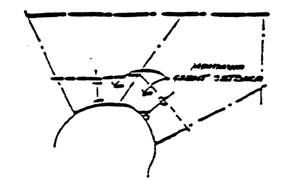
3.
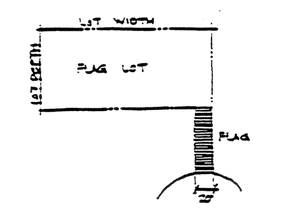
Flag lots shall meet the minimum lot width requirement at the termination of the flag except for the RC, R-2 and RA zones (see example as follows):
4.
The flag portion of a flag lot shall not be counted toward the minimum lot area requirement.
5.
Lot coverage shall include all buildings, structures and accessory buildings and structures. Patio covers, open on three sides, pools, spas and freestanding open air gazebos and patios shall not count toward the lot coverage requirement.
6.
For public and semi-public buildings and uses a minimum of fifty feet landscaped setback shall be maintained from any single-family zone.
7.
In RC, R-2 and RA zones, any building exceeding fifteen feet in height shall maintain a minimum setback of fifty feet from any single-family zone; and buildings less than fifteen feet in height shall maintain a minimum setback of twenty-five feet from any single-family zone.
8.
New construction of R-1 dwelling units shall include two-car covered garage situated in accordance with zoning setback requirements.
9.
Conversion of existing garages into habitable space is permitted when in compliance with the following requirements:
a.
Suitable replacement covered off-street parking spaces shall be provided with direct street access;
b.
Parking spaces and driveway access shall be improved with asphalt or concrete;
c.
Replacement covered parking spaces shall be provided as carport or garage, in compliance with the zoning regulations for yard setbacks.
10.
Exceptions to the garage conversion requirements under Section 17.03.120(B)(9)(a), (b) and (c) may be granted in order to allow the construction of a carport within the front yard setback area of single-family residences located in the R-1 zone that:
a.
Were originally constructed with single-car garages or carports located behind and adjacent to the front yard setback;
b.
Never included garages or carports; or
c.
Include single-car garages or carports that were legally converted.
11.
Qualifying residences may be allowed to construct carports within the front yard setback area subject to the following conditions:
a.
Carport shall encroach no more that one-half the distance into the required front yard setback;
b.
Carport shall be attached to the residence and shall be designed to match the architecture of the existing residence;
c.
Carport shall be designed and constructed to provide for a minimum of two off-street parking spaces.
C.
Second-kitchen dwelling units in R-1 zones shall have the following development standards:
1.
Allow second-kitchen dwellings units in the R-1 zone subject to a conditional use permit being issued. Applicable building and other codes, and zoning requirements (building main in building setbacks) except for the density regulation shall apply to accessory apartments.
2.
Limit the number of units in a single-family residential lot to not more than two (the main house and the second-kitchen dwelling unit).
3.
Require the second unit to be attached to the existing residence and to be located within the living area of the existing dwelling.
4.
Whenever an increase in floor area is involved, it shall not exceed ten percent of the existing living area.
5.
Limit the second-kitchen dwelling unit to six hundred forty square feet.
6.
Limit occupancy to a maximum of two persons.
7.
Require the property owner to reside on the site.
8.
Require one additional uncovered or covered off-street parking space. Garage conversions are prohibited unless replacement of covered off-street parking is provided concurrently.
9.
The accessory apartment unit shall be exclusively for rental occupancy. Separate sale or ownership of said unit from the primary dwelling on a lot or parcel is prohibited. No lot split.
10.
The owner/applicant shall sign an affidavit agreeing to accessory apartment occupancy requirements as stipulated. The affidavit shall include provisions stating that:
a.
The owner/applicant consents to inspection of the accessory apartment by the code enforcement officer in order to verify occupancy; and
b.
That the owner/applicant shall furnish a new affidavit to said officer upon request (yearly).
D.
Accessory second-kitchen granny flat units in R-1 zones shall have the following development standards:
1.
Allow second-kitchen granny flat units in the R-1 zone subject to a development review permit being issued. Applicable building codes and zoning requirements except for the density regulation shall apply to accessory granny flat units.
2.
Limit the number of units in a single-family residential lot to not more than two (the main house and the accessory granny flat unit).
3.
Require the accessory granny flat unit to be attached to the existing residence and to be located within the living area of the existing dwelling. Detached structures established by legal permit prior to enactment of this ordinance amendment, may be converted to a granny flat unit.
4.
For attached granny flat units, whenever an increase in floor area is involved, it shall not exceed ten percent of the existing living area, or exceed six hundred forty square feet.
5.
Limit occupancy to a maximum of two adults:
a.
Of which one shall be a minimum of sixty years of age, or have a physical handicap, as defined by the State Health and Safety Code.
b.
Of which one is related to property owner by blood, marriage, or adoption.
6.
Require the property owner to reside on-site.
7.
Require one additional uncovered or covered off-street parking space. Garage conversion is prohibited unless replacement of covered off-street parking is provided concurrently.
8.
The accessory granny flat unit may be rented. Separate sale or ownership of said unit from the primary dwelling on a lot or parcel is prohibited. No lot split.
9.
The owner/applicant shall sign an affidavit agreeing to accessory granny flat occupancy requirements as stipulated. The affidavit shall include provisions stating that:
a.
The owner/applicant consents to inspection of the accessory granny flat unit by the code enforcement officer in order to verify compliance with occupancy requirements; and
b.
That the owner/applicant shall furnish a new affidavit to said officer upon request yearly.
(Ord. 1006 § 3, 2003; Ord. 959 § 3, 1996; Ord. 955, 1995; 1992 zoning ord. (part))
(Ord. No. 1072, §§ 2, 3, 3-4-08; Ord. No. 1108, § 3(Exh. A), 2-2-10)
17.03.125 - R-1 zone—Improvement on more than forty percent of lots.
In blocks in the R-1 residence zone wherein forty percent or more of the lots facing such street have been improved, the setbacks on all remaining lots shall be not less than the average setbacks of the improved lots. A building to be placed upon a building site, located between two existing buildings not more than one hundred feet apart, shall observe not less than the average of the two existing buildings.
(Ord. 606 § 2 (part), 1966: prior code § 8152)
(Ord. No. 1108, § 3(Exh. A), 2-2-10)
17.03.126 - R-2 zone—Affordable housing lot size reduction.
Lots of no less than five thousand square feet may be considered for development of affordable housing projects provided the following criteria are met:
A.
The project is proposed to be developed by a recognized organization that promotes affordable housing;
B.
The project developer verifies that all home sales are to below moderate income purchasers;
C.
The project developer submits information justifying the need for reduced lot size in order to meet affordability criteria; and
D.
The project is consistent with the adopted general plan housing element targeted goals and policies for very-low, low and special needs families.
(Ord. No. 1108, § 3(Exh. A), 2-2-10)
17.03.130 - Performance standards—R zones.
A.
In all R zones, the following performance standards shall be met:
1.
Air conditioners, antennas, heating, cooling, ventilating equipment and all other mechanical, lighting or electrical devices shall be so operated they do not disturb the peace, quiet and comfort of neighboring residents and shall be screened, shielded and/or sound buffered from surrounding properties and streets. All equipment shall be installed and operated in accordance with all other applicable ordinances. Heights of said equipment shall not exceed the required height of the zone in which they are located.
2.
Required front and street side yards shall be landscaped and shall consist predominantly of trees, plant materials, groundcover and decorative rocks, except for necessary walks, drives and fences. All required landscaping shall be permanently maintained in healthy and thriving condition, free from weeds, trash and debris.
3.
For second single-family units located on the same lot as an existing single-family dwelling the following standards must be met:
a.
A deed restriction shall be recorded which states the lot shall not be further divisible and shall list all requirements contained herein.
b.
The second unit shall be attached to the main residence by a sound structural means approved by the building department.
c.
The second unit shall not exceed one story in height unless it is contained within or an addition to a two-story structure.
d.
The second unit shall not encroach into the yard setback area and no variance shall be granted for encroachment into the setback.
e.
Second units shall be restricted to homes built prior to January 1, 1991.
4.
All utility connections shall be designed to coordinate with the architectural elements of the site so as not to be exposed except where necessary. Pad-mounted transformers and/or meter box locations shall be included in the site plan with any appropriate screening treatment. Power lines and overhead cables shall be installed underground.
5.
The noise level emanating from any residential use or operation shall not exceed 60 dBA CNEL for the RR, R-2 and R-1 zones and 65 dBA CNEL for the RC and RA zones, as the acceptable outdoor noise exposure level when measured at the property line. The interior noise levels shall not exceed 45 dBA CNEL for all residential uses.
6.
For schools, libraries, churches, hospitals, nursing homes, parks and recreation areas, the outdoor acceptable exposure level shall not exceed 70 dBA CNEL when measured at the property line.
7.
Energy conservation buildings shall be located on the site to provide adjacent buildings adequate sunlight for solar access. All new construction and remodeling shall be preplumbed for solar hot water heating. Buildings shall be designed to minimize energy consumption requirements, and may include, but not necessarily be limited to, the following conservation measures:
a.
Cogeneration;
b.
South facing windows;
c.
Eave coverage for windows;
d.
Double glazed windows;
e.
Earth berming against exterior walls;
f.
Green houses; and
g.
Deciduous shade trees.
B.
In the RC, R-2 and RA zones, including the conversion of apartments to condominiums where permitted by Section 17.03.110(A)(7), the following performance standards shall be met:
1.
Masonry walls six feet in height, from the highest finished grade, shall be required on the rear and side property lines. No walls are required on street side yards unless needed for noise attenuation and/or privacy.
2.
Where a lot fronts on more than one street it shall be considered to have multiple frontages and be required to meet the front yard setback requirement on all street frontages.
3.
When a RC, R-2 and/or RA lot is adjacent to any single-family zone, a minimum of fifteen feet of landscaping shall be maintained on the RC, R-2 and/or RA lot between such uses.
4.
A minimum of two hundred square feet of private open area per ground floor unit shall be provided and a minimum of one hundred fifty square feet of private open space for units contained wholly on the second story shall be provided.
5.
A minimum of two hundred fifty cubic feet of lockable, enclosed storage per unit shall be provided in the garage or carport area; substitutions may be approved by the planning director.
6.
The following recreation facilities shall be provided at a minimum unless waived by the planning commission:
a.
Landscaped park-like quiet area;
b.
Children's play area;
c.
Family picnic area; and
d.
Swimming pool with cabana or patio cover.
7.
A minimum of two clothes washers and one clothes dryer per eight dwelling units located conveniently throughout the development.
8.
Individual trash areas, screened from view of a roadway, shall be provided for each dwelling unit in the RC zone; conveniently located trash enclosures, per city standards, shall be provided for dwelling units in the R-2 and RA zone.
9.
A minimum of thirty-five trees per gross acre shall be required as part of the landscaping requirements; twenty percent shall be twenty-four inch box size or larger, seventy percent shall be fifteen gallon size and ten percent shall be five gallon size. Drought tolerant species with low maintenance requirements shall be utilized, where possible.
10.
Recreation vehicle parking areas shall be provided, fully screened from view or the development shall prohibit all parking of recreation vehicles.
(1992 zoning ord. (part))
(Ord. No. 1108, § 3(Exh. A), 2-2-10)
17.03.140 - Accessory structures—R zones.
A.
Accessory Buildings and Structures. Accessory buildings and structures, attached or detached, used either wholly or in part for living purposes, shall meet all of the requirements for location of the main structure, except as provided in this section:
1.
Accessory buildings or structures that are attached to the main building shall be allowed to encroach into the required rear yard setback up to one-half of the distance.
2.
A detached accessory structure shall meet the setback requirements of the main building for the front and street side yard areas.
3.
A detached accessory structure may be located within an interior side yard or rear yard; provided, that such structure is located no closer than five feet to an interior side or rear lot line and is at least ten feet from the main structure.
B.
Canopies, Patios and Breezeways. Canopies, patios and breezeways attached to the main building or connecting the main building with a detached accessory building, may extend into a required rear or interior side yard provided that portions of such structures extending into the yard:
1.
Shall not exceed fifteen feet in height or project closer than five feet to an interior side yard or rear lot line.
2.
Shall be entirely open on at least three sides for patios and canopies except for necessary supporting columns. A roof connecting main building and an accessory building shall be open on two sides.
C.
Other structures, porches, steps, architectural features, such as eaves, awnings, chimneys, balconies, stairways, wing walls or bay windows may project not more than four feet into any required front or rear yard area, nor into any required side yard area more than one-half of said required side yard.
D.
Carports. Carports attached or detached from the main building shall be allowed to encroach into the required front yard setback and shall maintain a setback of no less than five feet provided that the proposed carport is open on at least three sides and is used or intended to be used as vehicle storage for the occupants of the premises.
(1992 zoning ord. (part))
(Ord. No. 1108, § 3(Exh. A), 2-2-10; Ord. No. 2023-1233, § 2, 11-1-23)
17.03.150 - Walls and fences—R zones.
A.
In any required front yard or side yard adjacent to a street, a wall or fence shall not exceed six feet in height, except as provided in this section.
B.
A wall or fence not more than six feet in height may be maintained along the interior side or rear lot lines; provided, that such wall or fence does not extend into a required front yard or side yard adjacent to a street except as provided in this section.
C.
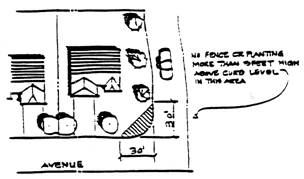
A wall or fence adjacent to a driveway or street providing vehicular access to an abutting lot or street shall not exceed thirty-six inches in height within fifteen feet of the intersection of said driveway and the street right-of-way. Corner cut-offs may be required in special circumstances for safety and visibility (see example as follows):
D.
A wall or fence shall not be constructed in such a manner so as to block or restrict vehicular access to a dedicated or implied dedicated alley, access, or way.
E.
A wall or fence may be constructed a minimum distance of five feet from the ultimate right-of-way at a maximum height of five feet when there is no parkway planting area adjacent to the sidewalk. Where there is a parkway planting area adjacent to the curbing no setback is required to construct a fence five feet in height.
F.
Fiberglass sheeting, bamboo sheeting or other similar temporary material shall not be permitted as a fencing material on street yard frontages.
(1992 zoning ord. (part))
(Ord. No. 1108, § 3(Exh. A), 2-2-10)
17.03.160 - Signs—R zones.
No sign or outdoor advertising structure shall be permitted in any R zone except as provided in Chapter 17.01, Article XI.
(1992 zoning ord. (part))
(Ord. No. 1108, § 3(Exh. A), 2-2-10)
17.03.200 - Accessory dwelling units.
A.
Purpose. The purpose of this section is to allow and regulate accessory dwelling units (ADUs) and junior accessory dwelling units (JADUs) in compliance with Chapter 13 of Division 1 of Title 7 of the California Government Code.
B.
Effect of Conforming Accessory Dwelling Unit. An ADU or JADU that conforms to the standards in this section will not be:
1.
Deemed to be inconsistent with the city's general plan and zoning designation for the lot on which the ADU or JADU is located.
2.
Deemed to exceed the allowable density for the lot on which the ADU or JADU is located.
3.
Considered in the application of any local ordinance, policy, or program to limit residential growth.
4.
Required to correct a nonconforming zoning condition, as defined in subsection C.8. below. This does not prevent the city from enforcing compliance with applicable building standards in accordance with Health and Safety Code section 17980.12.
C.
Definitions. As used in this section, terms are defined as follows:
1.
"Accessory dwelling unit" or "ADU" means an attached or a detached residential dwelling unit that provides complete independent living facilities for one or more persons and is located on a lot with a proposed or existing primary residence. An accessory dwelling unit also includes the following:
a.
An efficiency unit, as defined by section 17958.1 of the California Health and Safety Code; and
b.
A manufactured home, as defined by section 18007 of the California Health and Safety Code.
2.
"Accessory structure" means a structure that is accessory and incidental to a dwelling located on the same lot.
3.
"Complete independent living facilities" means permanent provisions for living, sleeping, eating, cooking, and sanitation on the same parcel as the single-family or multifamily dwelling is or will be situated.
4.
"Efficiency kitchen" means a kitchen that includes all of the following:
a.
A cooking facility with appliances.
b.
A food preparation counter and storage cabinets that are of a reasonable size in relation to the size of the JADU.
5.
"Junior accessory dwelling unit" or "JADU" means a residential unit that satisfies all of the following:
a.
It is no more than 500 square feet of interior livable space in size.
b.
It is contained entirely within an existing or proposed single-family structure. An enclosed use within the residence, such as an attached garage, is considered to be a part of and contained within the single-family structure.
c.
It includes its own separate sanitation facilities or shares sanitation facilities with the existing or proposed single-family structure.
d.
If the unit does not include its own separate bathroom, then it contains an interior entrance to the main living area of the existing or proposed single-family structure in addition to an exterior entrance that is separate from the main entrance to the primary dwelling.
e.
It includes an efficiency kitchen, as defined in subsection C.4. above.
6.
"Livable space" means a space in a dwelling intended for human habitation, including living, sleeping, eating, cooking, or sanitation.
7.
"Living area" means the interior habitable area of a dwelling unit, including basements and attics, but does not include a garage or any accessory structure.
8.
"Nonconforming zoning condition" means a physical improvement on a property that does not conform with current zoning standards.
9.
"Passageway" means a pathway that is unobstructed clear to the sky and extends from a street to one entrance of the ADU or JADU.
10.
"Proposed dwelling" means a dwelling that is the subject of a permit application and that meets the requirements for permitting.
11.
"Public transit" means a location, including, but not limited to, a bus stop or train station, where the public may access buses, trains, subways, and other forms of transportation that charge set fares, run on fixed routes, and are available to the public.
12.
"Tandem parking" means that two or more automobiles are parked on a driveway or in any other location on a lot, lined up behind one another.
D.
Approvals. The following approvals apply to ADUs and JADUs created under this section:
1.
Ministerial ADU and Building Permits Required. Every ADU and JADU requires an ADU permit and a building permit. The city will review and approve permit applications in accordance with subsection D.3. below.
2.
Processing Fee. The city may charge a fee to reimburse it for costs incurred in processing ADU permits, including the costs of adopting or amending the city's ADU ordinance. The ADU-permit processing fee is determined by the planning & building director (director) and approved by the city council by resolution.
3.
Process and Timing.
a.
Completeness.
(i)
Determination in 15 days. The city will determine whether an application to create or serve an ADU or JADU is complete and will provide written notice of the determination to the applicant within 15 business days after the city receives the application submittal.
(ii)
Incomplete items. If the city's determination under subsection D.3.a.(i) above is that the application is incomplete, the city's notice must list the incomplete items and describe how the application can be made complete.
(iii)
Cure. After receiving a notice that the application is incomplete, the applicant may cure and address the items that were deemed by the city to be incomplete.
(iv)
Subsequent submittals. If the applicant submits additional information to address incomplete items, within 15 business days of the subsequent submittal the city will determine in writing whether the additional information remedies all the incomplete items that the city identified in its original notice. The city may not require the application to include an item that was not included in the original notice.
(v)
Deemed complete. If the city does not make a timely determination as required by this subsection a., the application or resubmitted application is deemed complete for the purposes of subsection D.3.c. below.
(vi)
Appeal of incompleteness. An applicant may appeal the city's determination that the application is incomplete by submitting a written appeal to the city clerk. The city council will review the written appeal and affirm or reverse the completeness determination and provide a final written determination to the applicant within 60 business days after receipt of the appeal.
b.
No discretion or hearing. Ministerial permits for an ADU or JADU are considered and approved without discretionary review or a hearing.
c.
Deadline to approve or deny ministerial approvals. The city must approve or deny an application to create an ADU or JADU within 60 days from the date that the city receives a complete application. If the city has not approved or denied the complete application within 60 days, the application is deemed approved unless either:
(i)
The applicant requests a delay, in which case the 60-day time period is tolled for the period of the requested delay, or
(ii)
When an application to create an ADU or JADU is submitted with a permit application to create a new single-family or multifamily dwelling on the lot, the city may delay acting on the permit application for the ADU or JADU until the city acts on the permit application to create the new single-family or multifamily dwelling, but the application to create the ADU or JADU will still be considered ministerially without discretionary review or a hearing.
d.
Denial. If the city denies an application to create an ADU or JADU, the city must provide the applicant with comments that include, among other things, a list of all the defective or deficient items and a description of how the application may be remedied by the applicant. Notice of the denial and corresponding comments must be provided to the applicant within the 60-day time period established by subsection D.3.c. above.
e.
Appeal of denial. An applicant may appeal the city's denial of the application by submitting a written appeal to the city clerk. The city council will review the written appeal and affirm or reverse the denial and provide a final written determination to the applicant within 60 business days after receipt of the appeal.
f.
Concurrent review of demolition. A demolition permit for a detached garage that is to be replaced with an ADU is reviewed with the application for the ADU and issued at the same time.
E.
Classes.
1.
Class 1: Statutorily Regulated. Class 1 ADUs and JADUs are approved under Government Code section 66323. If an ADU or JADU complies with each of the general requirements in subsection F. below, it is allowed in each of the scenarios provided in this subsection E.1. An ADU and JADU approved under subsection E.1.a. may be combined with an ADU approved under subsection E.1.b., and ADUs approved under subsection E.1.c. may be combined with ADUs approved under subsection E.1.d.
a.
Converted on Lot with Single-Family: One ADU as described in this subsection E.1.a. and one JADU on a lot with a proposed or existing single-family dwelling on it, where the ADU or JADU:
(i)
Is either: within the space of a proposed single-family dwelling; within the existing space of an existing single-family dwelling; or (in the case of an ADU only) within the existing space of an accessory structure, plus up to 150 additional square feet if the expansion is limited to accommodating ingress and egress; and
(ii)
Has exterior access that is independent of that for the single-family dwelling; and
(iii)
Has side and rear setbacks sufficient for fire and safety, as dictated by applicable building and fire codes.
(iv)
The JADU complies with the requirements of Government Code sections 66333 through 66339.
b.
Limited Detached on Lot with Single-Family: One detached, new-construction ADU on a lot with a proposed or existing single-family dwelling, if the detached ADU satisfies each of the following limitations:
(i)
The side- and rear-yard setbacks are at least four feet.
(ii)
The total floor area is 800 square feet of livable space or smaller.
(iii)
The peak height above grade does not exceed the applicable height limit in subsection F.2. below.
c.
Converted on Lot with Multifamily: One or more ADUs within portions of existing multifamily dwelling structures that are not used as livable space, including but not limited to storage rooms, boiler rooms, passageways, attics, basements, or garages, if each converted ADU complies with state building standards for dwellings. Under this subsection E.1.c., at least one converted ADU is allowed within an existing multifamily dwelling, up to a quantity equal to 25 percent of the existing multifamily dwelling units.
d.
Limited Detached on Lot with Multifamily: No more than two detached ADUs on a lot with a proposed multifamily dwelling, or up to eight detached ADUs on a lot with an existing multifamily dwelling, if each detached ADU satisfies all of the following:
(i)
The side- and rear-yard setbacks are at least four feet. If the existing multifamily dwelling has a rear or side yard setback of less than four feet, the city will not require any modification to the multifamily dwelling as a condition of approving the ADU.
(ii)
The peak height above grade does not exceed the applicable height limit provided in subsection F.2. below.
(iii)
If the lot has an existing multifamily dwelling, the quantity of detached ADUs does not exceed the number of primary dwelling units on the lot.
2.
Class 2: Locally Regulated. Class 2 ADUs are approved under Government Code sections 66314-66322. Except for Class 1 ADUs approved under subsection E.1. above, all ADUs are subject to the standards set forth in subsections F. and G. below.
F.
General Requirements. The following requirements apply to all Class 1 and Class 2 ADUs and JADUs:
1.
Zoning.
a.
A Class 1 ADU approved under subsection E.1. may be created on a lot in a residential or mixed-use zone.
b.
A Class 2 ADU approved under subsection E.2. above may be created on a lot that is zoned to allow single-family dwelling residential use or multifamily dwelling residential use.
c.
In accordance with Government Code section 66333(a), a JADU may only be created on a lot zoned for single-family residences.
2.
Height.
a.
Except as otherwise provided by subsections F.2.b. and F.2.c. below, a detached ADU created on a lot with an existing or proposed single family or multifamily dwelling unit may not exceed 16 feet in height when encroaching into a required front, side or rear yard area of the underlying zone.
b.
A detached ADU may be up to 18 feet in height if it is created on a lot with an existing or proposed single family or multifamily dwelling unit that is located within one-half mile walking distance of a major transit stop or high quality transit corridor, as those terms are defined in Section 21155 of the Public Resources Code, and the ADU may be up to two additional feet in height (for a maximum of 20 feet) if necessary to accommodate a roof pitch on the ADU that is aligned with the roof pitch of the primary dwelling unit.
c.
An attached or detached ADU created on a lot in the R-2, RC, and RA Zones with an existing or proposed multifamily dwelling that has more than one story above grade may not exceed 35 feet in height or two stories.
d.
An ADU that is attached to the primary dwelling may not exceed 25 feet in height or the height limitation imposed by the underlying zone that applies to the primary dwelling, whichever is lower. Notwithstanding the foregoing, ADUs subject to this subsection F.2.d. may not exceed two stories.
e.
For purposes of this subsection F.2., height is measured from existing legal grade or the level of the lowest floor, whichever is lower, to the peak of the structure.
3.
Fire Sprinklers.
a.
Fire sprinklers are required in an ADU or JADU if sprinklers are required in the primary residence.
b.
The construction of an ADU or JADU does not trigger a requirement for fire sprinklers to be installed in the existing primary dwelling.
4.
Rental Term. No ADU or JADU may be rented for a term that is shorter than 30 days. This prohibition applies regardless of when the ADU or JADU was created.
5.
No Separate Conveyance. An ADU or JADU may be rented, but, except as otherwise provided in Government Code section 66341, no ADU or JADU may be sold or otherwise conveyed separately from the lot and the primary dwelling (in the case of a single-family lot) or from the lot and all of the dwellings (in the case of a multifamily lot).
6.
Septic System. If the ADU or JADU will connect to an onsite wastewater-treatment system, the owner must include with the application a percolation test completed within the last five years or, if the percolation test has been recertified, within the last 10 years.
7.
Owner Occupancy.
a.
ADUs. ADUs are not subject to an owner-occupancy requirement.
b.
JADUs.
(i)
Generally. As required by state law, JADUs are generally subject to an owner-occupancy requirement. A natural person with legal or equitable title to the property must reside on the property, in either the primary dwelling or JADU, as the person's legal domicile and permanent residence.
(ii)
Exceptions. The owner-occupancy requirement in this subsection F.7.b. does not apply in either of the following situations:
(I)
The JADU has separate sanitation facilities (i.e., does not share sanitation facilities with the existing primary dwelling unit structure).
(II)
The property is entirely owned by another governmental agency, land trust, or housing organization.
8.
Deed Restriction. Prior to issuance of a certificate of occupancy for a JADU, a deed restriction must be recorded against the title of the property in the county recorder's office and a copy filed with the planning & building director (director). The deed restriction must run with the land and bind all future owners. The form of the deed restriction will be provided by the city and must provide that:
a.
The JADU may not be sold separately from the primary dwelling.
b.
The JADU is restricted to the approved size and to other attributes allowed by this section.
c.
The deed restriction runs with the land and may be enforced against future property owners.
d.
The deed restriction may be removed if the owner eliminates the JADU, as evidenced by, for example, removal of the kitchen facilities. To remove the deed restriction, an owner may make a written request of the director, providing evidence that the JADU has in fact been eliminated. The director may then determine whether the evidence supports the claim that the JADU has been eliminated. Appeal may be taken from the director's determination consistent with other provisions of this Code. If the JADU is not entirely physically removed, but is only eliminated by virtue of having a necessary component of an JADU removed, the remaining structure and improvements must otherwise comply with applicable provisions of this Code.
e.
The deed restriction is enforceable by the director or his or her designee for the benefit of the city. Failure of the property owner to comply with the deed restriction may result in legal action against the property owner, and the city is authorized to obtain any remedy available to it at law or equity, including, but not limited to, obtaining an injunction enjoining the use of the JADU in violation of the recorded restrictions or abatement of the illegal unit.
9.
Building & Safety.
a.
Must comply with building code. Subject to subsection F.9.b. below, all ADUs and JADUs must comply with all local building code requirements.
b.
No change of occupancy. Construction of an ADU does not constitute a Group R occupancy change under the local building code, as described in Section 310 of the California Building Code, unless the building official or Code Enforcement officer makes a written finding based on substantial evidence in the record that the construction of the ADU could have a specific, adverse impact on public health and safety. Nothing in this subsection F.9.b. prevents the city from changing the occupancy code of a space that was uninhabitable space or that was only permitted for nonresidential use and was subsequently converted for residential use in accordance with this section.
10.
Certificate of Occupancy Timing.
a.
Generally. No certificate of occupancy for an ADU or JADU may be issued before the certificate of occupancy is issued for the primary dwelling unit.
b.
Limited Exception for State-declared Emergencies. Notwithstanding subsection F.10.a. above, a certificate of occupancy for an ADU may be issued before a certificate of occupancy for the primary dwelling if each of the following requirements are met:
(i)
The county is subject to a proclamation of a state of emergency made by the California Governor on or after February 1, 2025.
(ii)
The primary dwelling was substantially damaged or destroyed by an event referenced in the governor's state of emergency proclamation.
(iii)
The ADU has been issued construction permits and has passed all required inspections.
(iv)
The ADU is not attached to the primary dwelling.
G.
Specific ADU Requirements. The following requirements apply only to Class 2 ADUs approved under subsection E.2. above. This subsection G. does not apply to Class 1 ADUs or JADUs approved under subsection E.1. above.
1.
Maximum Size.
a.
The maximum size of a detached or attached ADU subject to this subsection G. is 1,000 square feet of interior livable space for a studio or one-bedroom unit and 1,400 square feet of interior livable space for a unit with two or more bedrooms.
b.
An attached ADU that is created on a lot with an existing primary dwelling is further limited to 50 percent of the floor area of the existing primary dwelling.
c.
Application of other development standards in this subsection G., such as FAR or lot coverage, might further limit the size of the ADU, but no application of the percent-based size limit in subsection G.1.b. above or of an FAR, front setback, lot coverage limit, or open-space requirement may require the ADU have less than 800 square feet of interior livable space.
2.
Floor Area Ratio (FAR). No ADU subject to this subsection (g) may cause the total FAR of the lot to exceed 60 percent in the RR and R-1 Zones, subject to subsection G.1.c. above.
3.
Setbacks.
a.
ADUs that are subject to this subsection G. must conform to 4-foot side and rear setbacks. ADUs that are subject to this subsection G. must conform to 25-foot front setbacks, subject to subsection G.1.c. above.
b.
No setback is required for an ADU that is subject to this subsection (g) if the ADU is constructed in the same location and to the same dimensions as an existing structure.
4.
Lot Coverage. No ADU subject to this subsection G. may cause the total lot coverage of the lot to exceed 50 percent, subject to subsection G.1.c. above.
5.
Minimum Open Space. No ADU subject to this subsection G. may cause the total percentage of open space of the lot to fall below 25 percent, subject to subsection G.1.c. above.
6.
Passageway. No passageway, as defined by subsection C.9. above, is required for an ADU.
7.
Parking.
a.
Generally. One off-street parking space is required for each ADU or bedroom, whichever is less. The parking space may be provided in setback areas or as tandem parking, as defined by subsection C.12. above.
b.
Exceptions. No parking under subsection G.7.a. is required in the following situations:
(i)
The ADU is located within one-half mile walking distance of public transit, as defined in subsection C.11. above.
(ii)
The ADU is located within an architecturally and historically significant historic district.
(iii)
The ADU is part of the proposed or existing primary residence or an accessory structure.
(iv)
When on-street parking permits are required but not offered to the occupant of the ADU.
(v)
When there is an established car share vehicle stop located within one block of the ADU.
(vi)
When the permit application to create an ADU is submitted with an application to create a new single-family or new multifamily dwelling on the same lot, provided that the ADU or the lot satisfies any other criteria listed in subsections G.7.b.(i) through (v) above.
c.
No Replacement. When a garage, carport, covered parking structure, or uncovered parking space is demolished in conjunction with the construction of an ADU or converted to an ADU, those off-street parking spaces are not required to be replaced.
8.
Architectural Requirements.
a.
The materials and colors of the exterior walls, roof, and windows and doors must be the same as those of the primary dwelling.
b.
The roof slope must match that of the dominant roof slope of the primary dwelling. The dominant roof slope is the slope shared by the largest portion of the roof.
c.
The exterior lighting must be limited to down-lights or as otherwise required by the building or fire code.
d.
The ADU must have an independent exterior entrance, apart from that of the primary dwelling.
e.
The interior horizontal dimensions of an ADU must be at least 10 feet wide in every direction, with a minimum interior wall height of seven feet.
9.
Landscape Requirements. Evergreen landscape screening must be planted and maintained between the ADU and any public right-of-way as follows:
a.
At least one 15-gallon size plant must be provided for every five linear feet of exterior ADU wall. Alternatively, at least one 24" box size plant or tree must be provided for every ten linear feet of exterior ADU wall.
b.
All landscaping must be drought-tolerant.
10.
Historical Protections. An ADU that is on or within 600 feet of real property that is listed in the California Register of Historic Resources must be located so as to not be visible from any public right-of-way.
11.
Allowed Stories. No ADU subject to this subsection G. may have more than one story, except that an ADU that is attached to the primary dwelling may have the stories allowed under subparagraph F.2.d. of this section. However, an ADU subject to subsection G. may be allowed as a single-floor, second-story ADU if it conforms to the height provisions of subsection F.2. above.
H.
Fees. The following requirements apply to all Class 1 ADUs and JADUs and Class 2 ADUs that are approved under subsections E.1. or E.2. above.
1.
Impact Fees.
a.
No impact fee is required for a JADU or for an ADU that has less than 750 square feet of interior livable space. For purposes of this subsection H.1., "impact fee" means a "fee" under the Mitigation Fee Act (Gov. Code § 66000(b)) and a fee under the Quimby Act (Gov. Code § 66477). "Impact fee" here does not include any connection fee or capacity charge for water or sewer service.
b.
A JADU or ADU with less than 500 square feet of interior livable space does not increase assessable space by 500 square feet for purposes of Education Code section 17620(a)(1)(C), and is therefore not subject to school fees under Education Code section 17620.
c.
Any impact fee that is required for an ADU that has 750 square feet or more of interior livable space must be charged proportionately in relation to the square footage of the primary dwelling unit. (E.g., the floor area of the ADU, divided by the floor area of the primary dwelling, times the typical fee amount charged for a new dwelling.)
2.
Utility Fees.
a.
If an ADU or JADU is constructed with a new single-family home, a separate utility connection directly between the ADU or JADU and the utility and payment of the normal connection fee and capacity charge for a new dwelling are required.
b.
Except as described in subsection H.2.a, JADUs and converted ADUs on a single-family lot that are created under subsection E.1.a. above are not required to have a new or separate utility connection directly between the JADU or ADU and the utility. Nor is a connection fee or capacity charge required. Notwithstanding the rest of this paragraph, a direct utility connection is required for separate conveyance of an ADU when separate conveyance is allowed under this code.
c.
Except as described in subsection H.2.a., all ADUs that are not covered by subsection H.2.b. require a new, separate utility connection directly between the ADU and the utility for any utility that is provided by the city. All utilities that are not provided by the city are subject to the connection and fee requirements of the utility provider.
(i)
The connection is subject to a connection fee or capacity charge that is proportionate to the burden created by the ADU based on either the floor area or the number of drainage-fixture units (DFU) values, as defined by the Uniform Plumbing Code, upon the water or sewer system.
(ii)
The portion of the fee or charge that is charged by the city may not exceed the reasonable cost of providing this service.
I.
Nonconforming Zoning Code Conditions, Building Code Violations, and Unpermitted Structures.
1.
Generally. The city will not deny an ADU or JADU application due to a nonconforming zoning condition, building code violation, or unpermitted structure on the lot that does not present a threat to the public health and safety and that is not affected by the construction of the ADU or JADU.
2.
Unpermitted ADUs and JADUs constructed before 2020.
a.
Permit to Legalize. As required by state law, the city may not deny a permit to legalize an existing but unpermitted ADU or JADU that was constructed before January 1, 2020, if denial is based on either of the following grounds:
(i)
The ADU or JADU violates applicable building standards, or
(ii)
The ADU or JADU does not comply with state ADU or JADU law or this ADU ordinance.
b.
Exceptions:
(i)
Notwithstanding subsection I.2.a. above, the city may deny a permit to legalize an existing but unpermitted ADU or JADU that was constructed before January 1, 2020, if the city makes a finding that correcting a violation is necessary to comply with the standards specified in California Health and Safety Code section 17920.3.
(ii)
Subsection I.2.a. above does not apply to a building that is deemed to be substandard in accordance with California Health and Safety Code section 17920.3.
(Ord. No. 1250, § 4, 12-17-25)

