
Calexico City Zoning Code
CHAPTER 17
13 - OFF-STREET PARKING
17.13.110 - Purpose.
These regulations are for the purpose of providing convenient off-street parking for vehicles, and are to be considered as the minimum necessary for such uses permitted by the respective zone.
The intent of these regulations is to provide adequately designed parking areas with sufficient capacity, and adequate circulation to minimize traffic congestion and promote public safety. It shall be the responsibility of the developer, owner, or operator of the specific use to provide and maintain adequate off-street parking. (1992 zoning ord. (part))
17.13.120 - General provisions.
A.
Off-street parking facilities, for both motor vehicles and bicycles, shall be provided for any new building constructed, for any new use established, for any addition or enlargement of an existing building or use, and for any change in the occupancy of an existing building.
B.
For additions or enlargements of any existing building or use, or any change of occupancy or manner of operation that would increase the number of parking spaces required, the additional parking spaces shall be required only for such addition, enlargement, or change and not for the entire building or use, unless required as a condition of approval of a conditional use permit.
C.
The required parking facilities needed for any development shall be located on the same site or, if an irrevocable access and/or parking easement is obtained, the parking may be on an adjacent site. Property within the ultimate right-of-way of a street or highway shall not be used to provide required parking or loading or unloading facilities.
D.
The requirements of this title shall apply to temporary as well as permanent uses.
E.
No existing use of land or structure shall be deemed to be nonconforming solely because of the lack of off-street parking facilities prescribed in this title. However, the facilities being used for off-street parking on the effective date of the ordinance codified in this title shall not be reduced in capacity to less than the minimum standards prescribed in this section.
F.
Projects with unexpired development review approval or conditional use permits approved prior to the effective date of the ordinance codified in this title shall meet the requirements of the parking ordinance in effect on the date the development review approval or conditional use permits were approved.
G.
All required off-street parking spaces shall be designed, located, constructed, and maintained so as to be fully usable during workday periods or as needed by the use of the premises.
H.
Where the application of these schedules results in a fractional space, then the fraction shall be rounded to the higher whole number.
I.
The parking requirement for uses not specifically listed in the matrix shall be determined by the approval body for the proposed use on the basis of requirements for similar uses, and on any traffic engineering and planning data that is appropriate to the establishment of a minimum requirement.
J.
In the calculation of parking requirements for centers off peak hour uses, from the normal operating hours of the center, shall not be counted toward the parking requirement.
K.
In situations where a combination of uses are developed on a site, parking shall be provided for each of the uses on the site according to the schedule given in this section. (1992 zoning ord. (part))
17.13.130 - Schedule of off-street parking requirements.
E.
Single-family residential, multiple-family residential and mobilehome parks are indicated in their respective zones.
F.
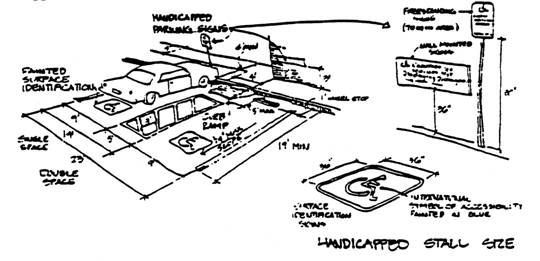
Handicapped parking requirements are established by the state of California. The parking standards contained in this section are identical to those established by the state at the time of the adoption of the ordinance codified in this title. Any future change in the state handicapped parking standards would preempt the requirements given in this section.
1.
Handicapped parking for residential uses shall be provided at the rate of one space for each dwelling unit that is designed for occupancy by the handicapped.
2.
Handicapped parking spaces shall be provided for all uses other than residential at the following rate:
3.
Handicapped parking spaces required by this section shall count toward fulfilling automobile parking requirements.
G.
Bicycle Parking Requirements. The matrix below contains the minimum bicycle parking requirements. Only those uses identified in the matrix are required to install bicycle parking. Bicycle parking facilities shall be a stationary storage rack or device designed to secure the frame and wheel of the bicycle.
H.
Motorcycle Off-Street Parking Requirements. Motorcycle parking areas shall be provided for all uses, except residential, at the following rate:
1.
Uses with more than twenty-five automobile parking spaces shall provide one designated area for use by motorcycles.
2.
Uses with more than one hundred automobile parking spaces shall provide motorcycle parking areas at the rate of one motorcycle parking area for every one hundred automobile parking spaces provided. (1992 zoning ord. (part))
17.13.140 - Off-street loading berth requirements.
All commercial and industrial uses; unless specifically exempted by the city council upon recommendation of the planning commission, which has an aggregate gross floor area of twenty-five thousand square feet or more shall provide off-street truck loading or unloading berths in accordance with the following table:
(1992 zoning ord. (part))
17.13.150 - Property development standards for off-street loading facilities.
The following property/development standard shall apply to all commercial and industrial buildings who are required loading facilities. All off-street loading facilities shall conform to the following standards:
A.
Each loading berth shall be not less than forty-five feet in length and twelve feet in width exclusive of aisle or maneuvering space.
B.
Such space may occupy all or any part of any required yard space, except front and street side yards and shall not be located closer than fifty feet to any lot in any residential zone unless enclosed on all sides except the entrance by a wall not less than eight feet high.
C.
Sufficient room for turning and maneuvering vehicles shall be provided on the site so that vehicles shall cross a property line only by driving forward.
D.
Each loading berth shall be accessible from a street or alley or from an aisle or drive connecting with a street or alley.
E.
Entrance from and exits to streets and alleys shall be designed to minimize traffic congestion.
F.
The loading area, aisles, and access drives shall be improved so as to provide a durable, dustless surface and shall be so graded and drained so as to dispose of surface water without damage to private or public properties, streets or alley.
G.
Bumper rails shall be provided at locations where needed for safety or to protect property.
H.
If the loading area is illuminated, lighting shall be deflected away from abutting residential sites so as to cause no annoying glare.
I.
No repair work or servicing of vehicles shall be conducted in a loading area.
J.
Off-street loading facilities shall be located on the same site with the use for which the berths are required.
K.
If more than one use is located on a site, the number of loading berths provided shall be equal to the sum of the requirements prescribed in this title for each use. If more than one use is the minimum for which loading berths are required but the aggregate gross floor area is greater than the minimum for which loading berths are required, off-street loading berths shall be provided as if the aggregate gross floor area were used for the use requiring the greatest number of loading berths.
L.
Off-street loading facilities for a single use shall not be considered as providing required off-street loading facilities for any other use.
M.
At the time of initial occupancy, major alteration or enlargement of a site, or of completion of construction of a structure or of a major alteration or enlargement of a structure, there shall be provided off-street loading berth requirements. The number of loading berths provided for a major alteration or enlargement of a site or structure shall be in addition to the number existing prior to the alteration, or enlargement.
N.
Space allocated to any off-street loading berth shall not be used to satisfy the space requirements for any off-street parking facility. (1992 zoning ord. (part))
17.13.160 - Property development standards—Off-street parking.
The following property development standards shall apply to all land, buildings, and uses authorized by the zoning ordinance.
A.
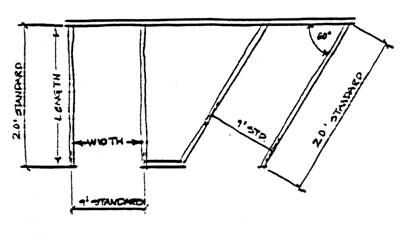
General Requirements. The following are minimums unless otherwise stated:
3.
Automobile, Handicapped, Motorcycle, and Bicycle. All parking stalls and maneuvering areas shall be paved and permanently maintained with asphalt, concrete, or any other all-weather surfacing approved by the director of planning and subject to current city standards.
4.
Striping and Identification.
a.
Automobile. All parking stalls shall be clearly outlined with lines on the surface of the parking facility.
b.
Handicapped. All handicapped spaces shall be striped and marked according to the applicable state standards.
c.
Motorcycle. All motorcycle spaces shall have bollards installed and appropriately spaced to prevent automobile usage of the motorcycle area. Motorcycle spaces shall be marked so that they can be clearly identified for motorcycle usage.
d.
Bicycle. All bicycle spaces shall be clearly identified.
B.
Special Requirements.
1.
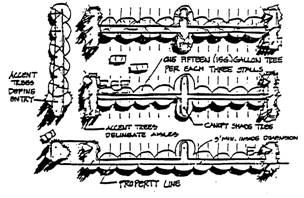
One five gallon tree, per city specifications, shall be provided for every three parking spaces.
2.
Any unused space resulting from the design of the parking area shall be used for landscaped purposes.
3.
All parking lot landscaped islands shall have a minimum inside dimension of four feet and shall contain a twelve inch wide walk adjacent to parking stall and be separated from vehicular areas by a six inch high, six inch wide Portland concrete cement curbing.
4.
All landscaping areas shall be automatically irrigated and kept in a healthy and thriving condition free from weeds, debris and trash.
5.
All parking facilities shall have lighting in accordance with the current city standards. The lighting shall be designed and installed so as to confine direct rays to the site. Parking lot lights shall be a maximum height of eighteen feet from the finished grade of the parking surface and directed away from all property lines and shall be low pressure sodium.
6.
All parking facilities shall be graded and drained so as to provide for the disposal of all surface water on the site.
7.
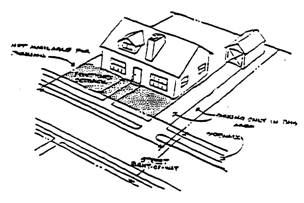
In any R zone except the RC and RA, parking of motorized and nonmotorized vehicles shall be subject to the following requirements and those shown in the example below:
a.
No motorized or nonmotorized vehicle shall be parked, stored or kept in the front yard as shown below except on land adjacent to the driveway or the driveway. In all cases the surface shall be Portland concrete cement.
b.
If motorized or nonmotorized vehicles are to be parked, stored, or kept on the lot, other than as permitted in subsection (B)(7)(a) of this section, they must be for the personal use of the resident.
(1992 zoning ord. (part))
17.13.162 - Determination of requirements for unlisted uses.
Where the parking requirements for a use are not specifically defined in this chapter, the parking requirements for each use shall be determined by the planning commission with the approval of the city council, and such determination shall be based upon the requirements for the most comparable use specified in this chapter.
(Ord. 606 § 2 (part), 1966: prior code § 8173)
17.13.163 - Size and access.
Each off-street parking space shall have an area of not less than one hundred eighty square feet, exclusive of driveway or aisles, and a width of not less than nine feet. Each such space shall be provided with adequate ingress and egress.
(Ord. 606 § 2 (part), 1966: prior code § 8174.1)
17.13.164 - Location.
A.
Generally. Off-street parking facilities shall be located as specified in subsection B of this section, and further provided, that when a parking lot is located on a site other than that on which the facility being served is located, an agreement approved by the city council reserving the site for parking purposes shall be recorded in the office of the county recorder.
B.
Off-street parking facilities shall be located as follows:
1.
For one, two, or multiple-family dwellings, on the same lot or building site as the buildings they are required to serve;
2.
For hospitals, sanitariums, homes for the aged, asylums, orphanages, rooming houses, lodging houses, club rooms, fraternity and sorority houses, not more than one hundred and fifty feet from the buildings they are required to serve; and
3.
For uses other than those specified in this section, not over three hundred feet from the building they are required to serve.
(Ord. 606 § 2 (part), 1966: prior code § 8174.2)
17.13.165 - Mixed uses.
In the case of mixed uses in a building or on a lot, the total requirements for off-street parking facilities shall be the sum of the requirements for the various uses computed separately. Off-street parking facilities for one use shall not be considered as providing required parking facilities for any other use except as specified for joint use in Section 17.13.166.
(Ord. 606 § 2 (part), 1966: prior code § 8174.3)
17.13.166 - Joint use.
A.
Designated. The city planning commission with approval of the city council may, upon application by the owner or lessees of any property, authorize the joint use of parking facilities by the following uses or activities under the conditions specified in this section:
1.
Up to fifty percent of the parking facilities required by this chapter for a use considered to be primarily a daytime use may be provided by the parking facilities of a use considered to be primarily a nighttime use. Up to fifty percent of the parking facilities required by this chapter for use considered to be primarily a nighttime use may be provided by the parking facilities of a use considered to be primarily a daytime use, provided such reciprocal parking area is subject to conditions set forth in subsection C of this section.
2.
Up to one hundred percent of the parking facilities required by this chapter for a church or for an auditorium incidental to a public or parochial school may be supplied by parking facilities of a use considered to be primarily a daytime use, provided such reciprocal parking area is subject to conditions set forth in subsection C of this section.
B.
Daytime and Nighttime Uses.
1.
The following uses are typical daytime uses: banks, business offices, retail stores, personal service shops, clothing or shoe repair or service shops, manufacturing or wholesale buildings and similar uses.
2.
The following uses are typical of nighttime and/or Sunday uses: auditoriums incidental to a public or parochial school, churches, dancehalls, theaters and bars.
C.
Conditions Required for Joint Use:
1.
The building or use for which an application is being made for authority to utilize the existing off-street parking facilities provided by another building or use shall be located within one hundred and fifty feet of such parking facility.
2.
The applicant shall show that there is no substantial conflict in the principal operating hours of the buildings or uses for which the joint use of off-street parking facilities is proposed.
3.
Parties concerned in the joint use of off-street parking facilities shall evidence agreement for such joint use by a proper legal instrument approved by the city council as to form and content. Such instrument when approved as conforming to the provisions of this title shall be recorded in the office of the county recorder and copies thereof filed with the planning commission and the city council.
(Ord. 606 § 2 (part), 1966: prior code § 8174.4)
17.13.167 - Common facilities.
Common parking facilities may be provided in lieu of the individual requirements contained in this chapter, but such facilities shall be approved by the commission as to size, shape and relationship to business sites to be served, provided the total of such off-street parking spaces, when used together, shall not be less than the sum of the various uses computed separately. When any such common facility is to occupy a site of five thousand square feet or more, then the parking requirements as specified in this chapter for each of two or more participating buildings or uses may be reduced not more than fifteen percent upon approval of the city council in the manner prescribed for a conditional use permit.
(Ord. 606 § 2 (part), 1966: prior code § 8174.5)
17.13.168 - Fee in lieu of parking.
In commercial and industrial zones, in lieu of furnishing the parking spaces required by the provisions of this chapter, the requirements thereof may be satisfied by the payment of such amount as may be prescribed by resolution of the city council. The funds shall be used and expended exclusively for the purpose of acquiring and developing off-street parking facilities.
(Ord. 824 § 1, 1982)
17.13.170 - Performance standards—Off-street parking.
A.
All parking facilities required by this title shall be maintained in good operating condition for the duration of the use requiring such facilities. Such facilities shall be used exclusively for the parking of vehicles. The parking facilities shall not be used for the storage of merchandise, or for the storage or repair of vehicles or equipment. Parking facilities shall not be used for the sale of merchandise, except on a temporary basis pursuant to Section 17.11.110.
B.
All shopping centers that use shopping carts shall provide convenient and safe on-site storage areas for the shopping carts.
C.
Handicap, motorcycle, and carpool parking spaces when required, shall be located within one hundred feet of the entrance to the facility. (1992 zoning ord. (part))

