
Carnation City Zoning Code
CHAPTER 15
40 - PERMISSIBLE USES7
Editor's note— Prior ordinance history: Ords. 625, 670 and 681.
15.40.010 - Table of permissible uses.
The table of permissible uses set forth in this chapter establishes the permissible uses for the various zoning districts in the city, subject to other applicable provisions in this title. Land uses are defined in Section 15.08.010.
(Ord. 700 § 7 (Exh. G) (part), 2006)
(Ord. No. 890, § 2(Exh. A), 10-17-2017; Ord. No. 957, § 2(Exh. A), 6-21-2022; Ord. No. 25-1006, § 1(Att. A), 1-22-2025)
15.40.015 - Reserved.
Editor's note— Ord. No. 957, § 2(Exh. A), adopted June 21, 2022, repealed § 15.40.015, which pertained to Interpretation—North American Industrial Classification System and derived from Ord. 700 § 7 (Exh. G) (part), adopted 2006; Ord. No. 890, § 2(Exh. A), adopted Oct. 17, 2017.
15.40.020 - Table interpretation.
A.
Permitted use (P). Where the letter "P" appears in the use tables, the subject use is permitted (subject to Section 15.40.030).
B.
Special use (S). Where the letter "S" appears in the use tables, the subject use is allowed and subject to the special use permit criteria in CMC 15.18.040.
C.
Conditional use (C). Where the letter "C" appears in the use tables, the subject is allowed and subject to the conditional use permit criteria in CMC 15.18.040.
D.
Use not permitted ( ). Where no letter appears in the use tables, the subject use is prohibited.
E.
Use limitations and conditions (X). Where a use contains a subscript symbol such as (X), (Y), or (Z), the use is subject to the limitations or code reference in the right column next to the subscript. Where uses have a size limit, "GSF" means gross square feet of floor area.
F.
When a combination use comprises two or more principal uses that require separate types of permits (e.g., special use and conditional use), the combination use shall be permitted under the most procedurally and substantially restrictive permit type applicable.
G.
Whenever a development could fall within more than one use classification, the classification that most closely and most specifically describes the development controls.
H.
Unclassified uses. The city planner shall determine whether a proposed land use not specifically listed in this section is allowed in a zone. The city planner's determination shall be based on whether or not permitting the proposed use in a particular zone is consistent with the purposes of this title and the zone's purpose as set forth in Chapter 15.36 CMC, by considering the following factors. The determination shall be final unless the applicant or an adverse party files an appeal to the hearing examiner pursuant to CMC Section 15.11.010.
1.
The physical characteristics of the use and its supporting structures, including but not limited to scale and type of buildings.
2.
Hours of operation anticipated for the use.
3.
The amount, type, and pattern of vehicular traffic anticipated for the use.
4.
The expected outdoor uses and activities associated with the use.
5.
Whether or not the use complements or is compatible with other uses permitted in the zone.
I.
Except as previously provided, the use tables shall not be construed as excusing full compliance with all CMC requirements applicable to a particular use, regardless of whether such regulations are specifically cross-referenced in the table or not.
(Ord. 700 § 7 (Exh. G) (part), 2006)
(Ord. No. 890, § 2(Exh. A), 10-17-2017; Ord. No. 957, § 2(Exh. A), 6-21-2022)
15.40.030 - Jurisdiction over otherwise permissible uses.
Notwithstanding any other provisions of this chapter, whenever the Table of Permissible Uses, interpreted in light of the provisions of this chapter, provides that a use is permissible within a particular zone, a special use permit may nevertheless be required if the city planner finds that the proposed use would have an extraordinary impact on neighboring properties or the general public. In making this determination, the city planner shall consider, among other factors, whether:
A.
The use is proposed for an undeveloped or previously developed lot; and
B.
The proposed use is proposed for a site that poses peculiar traffic or other hazards or difficulties, and whether the proposed use is substantially unique or is likely to have impacts that differ substantially from those presented by other uses that are permissible in the zoning district in question.
(Ord. 700 § 7 (Exh. G) (part), 2006)
(Ord. No. 890, § 2(Exh. A), 10-17-2017; Ord. No. 957, § 2(Exh. A), 6-21-2022)
15.40.040 - Permissible uses and specific exclusions.
Table of Permissible Uses, and are either allowed or not allowed thereby. But because the list of permissible uses set forth in Section 15.40.010 (Table of Permissible Uses) cannot be all inclusive, those uses that are listed shall be interpreted liberally to include other uses that have similar impacts (Table of Permissible Uses), even given the liberal interpretation mandated by subsection A of this section, are prohibited in that zoning district. The fact that a related or similar use may be permissible in another zoning district shall not form the basis for allowing such use in a particular zone where not listed in the Table of Permissible Uses. Similarly, all uses listed but left blank under the zone
A.
Without limiting the generality of the foregoing provisions, the following uses are specifically prohibited in all districts:
1.
Any use that involves the manufacture, handling, sale, distribution, or storage of any highly combustible or explosive materials in violation of the city's fire prevention code.
(Ord. 700 § 7 (Exh. G) (part), 2006)
(Ord. No. 890, § 2(Exh. A), 10-17-2017; Ord. No. 957, § 2(Exh. A), 6-21-2022)
15.40.050 - Accessory uses.
A.
The Table of Permissible Uses (Section 15.40.010) classifies different principal uses according to their different impacts. Whenever an activity is conducted in conjunction with another principal use and the former use (i) constitutes only an incidental or insubstantial part of the total activity that takes place on a lot, and (ii) is commonly associated with the principal use and integrally related to it, then the former use may be regarded as accessory to the principal use and may be carried on underneath the umbrella of the principal use. For example, a swimming pool/tennis court complex is customarily associated with and integrally related to a residential subdivision or multifamily development and would be regarded as accessory to such principal uses, even though such facilities, if developed apart from a residential development, may require a special use permit.
B.
For purposes of interpreting subsection A of this section:
1.
A use may be regarded as incidental or insubstantial if it is incidental or insubstantial in and of itself or in relation to the principal use;
2.
To be "commonly associated" with a principal use it is not necessary for an accessory use to be connected with such principal use more times than not, but only that the association of such accessory use with such principal use takes place with sufficient frequency that there is common acceptance of their relatedness.
C.
Without limiting the generality of subsection A of this section, the following activities, so long as they satisfy the general criteria set forth above, are specifically regarded as accessory to residential principal uses:
1.
Home occupations as authorized by Chapter 15.44 CMC.
2.
Hobbies or recreational activities of a noncommercial nature.
3.
The renting out of one or two rooms within a single-family residence (which one or two rooms do not themselves constitute a separate dwelling unit) other than on a daily or weekly basis to not more than two persons who are not part of the family that resides in the single-family dwelling.
4.
Yard sales or garage sales, so long as such sales are not conducted on the same lot for more than four days (whether consecutive or not) during any ninety-day period.
D.
Without limiting the generality of subsections A and B of this section the following activities shall not be regarded as accessory to a residential principal use and are prohibited in residential districts.
1.
Storage outside of an enclosed structure of any abandoned or junked motor vehicles as prohibited by CMC Chapter 10.34
2.
Parking outside a substantially enclosed structure or a vehicle accommodation area of more than four motor vehicles between the building setback of the principal building and any property line on any lot used for purposes that fall within the residential use classifications.
(Ord. 700 § 7 (Exh. G) (part), 2006)
(Ord. No. 890, § 2(Exh. A), 10-17-2017; Ord. No. 957, § 2(Exh. A), 6-21-2022)
15.40.060 - Permissible uses in all zones.
Notwithstanding any other provisions of this title, the following uses are allowed in all zones, subject to any applicable regulatory requirements:
1.
Streets, roads, alleys, or other transportation and mobility improvements located within a public right-of-way or other easement or property dedicated to the city.
2.
Electric power, telephone, telegraph, cable television, communication cable, gas, water, and sewer lines, wires or pipes, together with conduits, vaults, and supporting poles or structures owned, operated and maintained by a franchised utility company or agency, located within a public right-of-way designed primarily to serve the city of Carnation.
3.
All uses and/or facilities specifically allowed by applicable state or federal law and with respect to which the city's regulatory and/or permitting authority is pre-empted, to the extent of such pre-emption.
(Ord. 700 § 7 (Exh. G) (part), 2006)
(Ord. No. 890, § 2(Exh. A), 10-17-2017)
15.40.070 - Change in use.
A.
A substantial change in use of property occurs whenever the essential character or nature of the activity conducted on a lot changes. This occurs whenever the change involves a change from one use defined by this Title to another, except as provided in subsection B below.
B.
Where multiple tenants are located in a building or commercial center, a change from one business enterprise to another that falls within the same principal use as defined by this Title will not be considered a change of use, unless the city planner finds that the proposed use would have an extraordinary impact on neighboring properties or the general public. In making this determination, the city planner shall consider, among other factors, whether the proposed use is substantially unique or is likely to have impacts that differ substantially from the previous use.
C.
A mere change in the status of property from unoccupied to occupied or vice versa does not constitute a change in use. Whether a change in use occurs shall be determined by comparing the two active uses of the property without regard to any intervening period during which the property may have been unoccupied, unless the property has remained unoccupied for more than one hundred eighty consecutive days after which the use in question shall be deemed to have been abandoned.
D.
A mere change in ownership of a business or enterprise or a change in the name shall not be regarded as a change in use.
(Ord. 700 § 7 (Exh. G) (part), 2006)
(Ord. No. 890, § 2(Exh. A), 10-17-2017; Ord. No. 957, § 2(Exh. A), 6-21-2022)
15.40.080 - Reserved.
Editor's note— Ord. No. 957, § 2(Exh. A), adopted June 21, 2022, repealed § 15.40.080, which pertained to combination uses and derived from Ord. 700 § 7 (Exh. G) (part), adopted 2006; Ord. No. 890, § 2(Exh. A), adopted Oct. 17, 2017.
15.40.090 - Reserved.
Editor's note— Ord. No. 957, § 2(Exh. A), adopted June 21, 2022, repealed § 15.40.090, which pertained to more specific use controls and derived from Ord. 700 § 7 (Exh. G) (part), adopted 2006; Ord. No. 788, § 2(Exh. A), 12-7-2010; Ord. No. 808, § 2(Exh. A), 2-7-2012; Ord. No. 813, § 2(Exh. A), 4-3-2012; Ord. No. 839, § 3(Exh. C), 12-3-2013; Ord. No. 866, § 4(Exh. C), 8-4-2015; Ord. No. 862, § 2(Exh. A), 8-4-2015; Ord. No. 890, § 2(Exh. A), 10-17-2017; Ord. No. 909, § 4(Exh. C), 10-16-2018; Ord. No. 931, § 2(Exh. A), 9-1-2020.
15.40.100 - Uses permitted in residential zones.
Chapter 15.40 Table 1
Table of Permitted Uses in Residential Zones
"P" = Use is permitted
"S" = Use is allowed and subject to the special use permit criteria in CMC 15.18.040
"C" = Use is allowed and subject to the conditional use permit criteria in CMC 15.18.040
" " = Use is prohibited
(Ord. No. 957, § 2(Exh. A), 6-21-2022; Ord. No. 25-1006, § 1(Att. A), 1-22-2025)
15.40.105 - R12 zone housing mix requirement.
A.
In the R12 zone, subdivisions shall integrate a mixture of at least three different housing types and no single housing type may occupy more than 60 percent of the total dwelling units in a subdivision. This standard shall apply to the whole subdivision rather than each lot in the subdivision. Conditions on the plat shall be provided to ensure conformance with this standard for a period of ten years from the date of final subdivision approval. Applicable housing types:
1.
Single family detached residences.
2.
Cottage housing units. For the purposes of complying with this housing mix standard, each individual cottage shall count as a separate dwelling unit for the purpose of calculating density.
3.
Townhouse.
4.
Duplex.
5.
Multifamily.
6.
Assisted living facility. For the purposes of complying with this housing mix standard, a dwelling unit is defined as a place of residence or a room. For a facility where residents have individual rooms that open onto central corridors, each room is considered a unit. Similarly, a room that opens onto a central corridor and contains two patient beds should also be considered one dwelling unit.
Note: Dwelling units in a senior housing development shall be counted based on the housing type defined above they utilize.
B.
Exceptions: For lots less than ten gross acres in area as of the adoption date of this ordinance, at least two housing types shall be utilized and no single housing type may occupy more than 80 percent of the total dwelling units on a lot. Lots less than five gross acres in area as of the effective date of the ordinance from which this section derives [October 31, 2018] are exempt from the requirements of this section.
Figure 15.40.105(A) R12 zone development example illustrating how a mixture of housing types can be
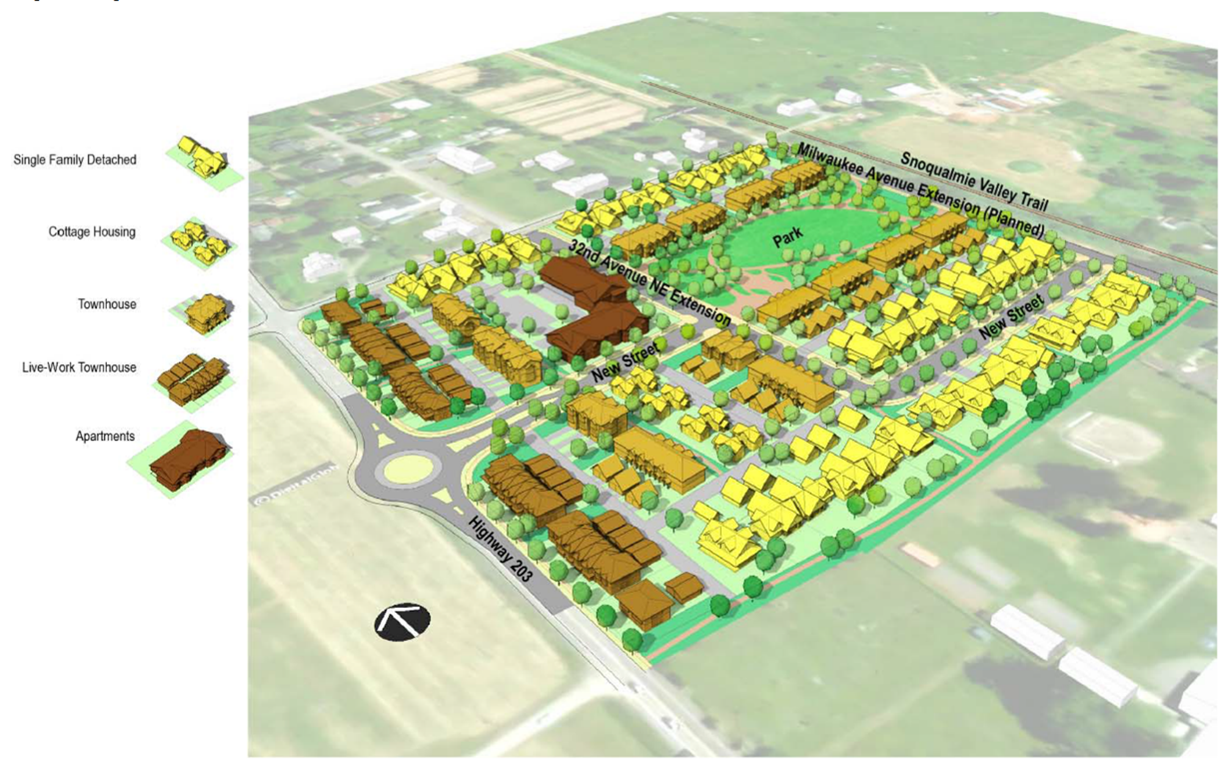
Note that the properties adjacent to SR-203 lie outside of the R12 zone. Live-work townhouses refer to units that have high floor to ceiling heights along the street-front portions of the units that allow for ground level commercial use and a live + work arrangement.
(Ord. No. 957, § 2(Exh. A), 6-21-2022; Ord. No. 25-1006, § 1(Att. A), 1-22-2025)
15.40.110 - RMHP zone uses.
A.
Permitted uses.
1.
Class A, B, and C mobile/manufactured home.
(Ord. No. 957, § 2(Exh. A), 6-21-2022; Ord. No. 25-1006, § 1(Att. A), 1-22-2025)
15.40.120 - Uses permitted in non-residential zones.
Chapter 15.40 Table 2
Table of Permitted Uses in Non-Residential Zones
Note: For non-residential development in the MU zone, refer to CMC 15.40.140.
"P" = Use is permitted
"S" = Use is allowed and subject to the special use permit criteria in CMC 15.18.040
"C" = Use is allowed and subject to the conditional use permit criteria in CMC 15.18.040
" " = Use is prohibited
(ZZ) Maximum allowable stay per vehicle of 30 days per 12 months, except that Council may permit an extended stay for economic development purposes of up to 180 days per 12 months under a development agreement. The recreational vehicle park must be professionally run with on-site office hours.
(Ord. No. 957, § 2(Exh. A), 6-21-2022; Ord. No. 25-1006, § 1(Att. A), 1-22-2025; Ord. No. 25-1012, § 2, 5-6-2025)
15.40.130 - PR zone uses (parks).
A.
Permitted uses:
1.
Parks.
B.
Special uses:
1.
Caretaker residence.
2.
Indoor recreation.
3.
Outdoor recreation.
4.
Recreational camps.
5.
Public service facilities.
6.
Cemetery.
C.
Conditional uses:
1.
Wireless telecommunications facility. Must meet all requirements of CMC 15.98. (Ord. No. 957, § 2(Exh. A), 6-21-2022)
(Ord. No. 957, § 2(Exh. A), 6-21-2022; Ord. No. 25-1006, § 1(Att. A), 1-22-2025)
15.40.140 - MU zone hours of operation.
A.
All non-residential uses in the MU zone are subject to limitations on hours of operation.
B.
Nighttime hours are 10:00 PM to 7:00 AM.
C.
Activities that may be restricted by the city planner during any portion of nighttime hours include:
1.
Outdoor dining, entertainment, and recreational activities.
2.
Outdoor use of commercial tools and equipment.
3.
Non-essential exterior lighting and sound amplification.
4.
Deliveries and freight loading.
5.
Any other activities that create excessive noise, vibrations, or odors which may impact residents on the same property or adjacent properties.
(Ord. No. 957, § 2(Exh. A), 6-21-2022; Ord. No. 25-1006, § 1(Att. A), 1-22-2025)
15.40.150 - Non-residential construction standards.
A.
CBD and MU zones. All permitted mixed use and non-residential development on parcels that front on Tolt Avenue must have a permitted nonresidential use occupying the ground floor along Tolt Avenue and meet all commercial building standards.
B.
MU zone. All permitted residential development on parcels that front West Entwistle Street must have a permitted non-residential use occupying the ground floor along West Entwistle and meet all commercial building standards.
(Ord. No. 957, § 2(Exh. A), 6-21-2022; Ord. No. 25-1006, § 1(Att. A), 1-22-2025)

