
Carnation City Zoning Code
CHAPTER 15
48 - DENSITY AND DIMENSIONAL REGULATIONS
15.48.010 - Minimum lot size requirements.
Subject to the provisions of CMC 15.16.060, CMC 15.16.070, CMC 15.16.230 and CMC 15.16.240, lots in residential zones shall have at least the amount of square footage indicated in Table I—Table of Density and Dimensional Standards codified at the end of this chapter. If there is any conflict between the number of dwelling units allowed in a development project by density and minimum lot size requirements, the more restrictive (lower number of units) regulation shall apply to the extent of such conflict.
(Ord. 714 § 1 (Exh. A) (part), 2007: Ord. 670 § 7 (Exh. G) (part), 2005)
(Ord. No. 889, § 2(Exh. A), 8-15-2017; Ord. No. 949, § 2(Exh. A), 3-15-2022)
15.48.020 - Residential density.
A.
Subject to the provisions of CMC 15.16.060, CMC 15.16.070, CMC 15.16.230 and CMC 15.16.240, in determining the number of dwelling units permissible on a tract of land, fractions shall be rounded to the nearest whole number.
B.
A "net" acre excludes any space that would not be factored into computing minimum lot size, such as right-of-way and open space tracts.
C.
If there is any conflict between the number of dwelling units allowed in a development project by density and minimum lot size requirements, the more restrictive (lower number of units) regulation shall apply.
(Ord. 745 § 7, 2008; Ord. 714 § 1 (Exh. A) (part), 2007; Ord. 670 § 7 (Exh. G) (part), 2005)
(Ord. No. 889, § 2(Exh. A), 8-15-2017; Ord. No. 949, § 2(Exh. A), 3-15-2022)
15.48.030 - Minimum lot widths.
A.
No lot may be created under the provisions of this title that is so narrow or otherwise so irregularly shaped that it would be impracticable to construct on it a building that:
1.
Could be used for purposes that are permissible in that zoning district; and
2.
Could satisfy any applicable setback requirements for that district.
B.
Without limiting the generality of the foregoing standard, Table I indicates minimum lot widths that are recommended and are deemed presumptively to satisfy the standard set forth in subsection A of this section. The lot width shall be measured along a straight line connecting points A and B, where point A is the midpoint of the shorter side property line and point B is the point on the opposite side property line measured an equal distance from the front property line as point A.
C.
No lot created after the effective date of this title that is less than the recommended width shall be entitled to a variance from any building setback requirement.
(Ord. 714 § 1 (Exh. A) (part), 2007: Ord. 670 § 7 (Exh. G) (part), 2005)
(Ord. No. 889, § 2(Exh. A), 8-15-2017)
15.48.040 - Building setback requirements.
A.
Subject to Sections 15.48.050 (Accessory building setback requirements) and the other provisions of this section, no portion of any building or any freestanding sign may be located on any lot closer to any lot line or than is authorized in Table I, unless a variance is granted.
1.
As used in this section, the term "building" includes any substantial structure which by nature of its size, scale, dimensions, bulk, or use tends to constitute a visual obstruction or generate activity similar to that usually associated with a building. Without limiting the generality of the foregoing, the following structures shall be deemed to fall within this description:
a.
Gas pumps and overhead canopies or roofs;
b.
Fences and hedges running along lot boundaries adjacent to public street rights-of-way if such fences and hedges exceed forty-two inches, except that the setback for fences or hedges up to six feet high shall be ten feet from the right-of-way along exterior side yard lot boundaries adjacent to public streets provided that the area between the right-of-way and fence are well landscaped and maintained by the property owner.
2.
Notwithstanding any other provision of this title, a sign may be erected on or affixed to a structure that: (i) has a principal function that is something other than the support of the sign (e.g., a fence), but (ii) does not constitute a building as defined in this title, only if such sign is located so as to comply with the setback requirement applicable to freestanding signs in the district where such sign is located.
B.
Whenever a lot in a nonresidential district has a common boundary line with a lot in a residential district, and the property line setback requirement applicable to the residential lot is greater than that applicable to the nonresidential lot, then the lot in the nonresidential district shall be required to observe the property line setback requirement applicable to the adjoining residential lot; except that in all cases, where a lot zoned light industrial/manufacturing has a common boundary with a residential district the setback for the industrially zoned property along that common boundary shall be thirty feet.
C.
Setback distances shall be measured from the street right-of-way line, or where no street right-of-way line exists, from the property line, to a point on the lot that is directly below the nearest exterior wall of the building.
D.
Whenever a private road that serves more than four lots or more than four dwelling units or that serves any nonresidential use tending to generate traffic equivalent to more than four dwelling units is located along a lot boundary, then:
1.
If the lot is not also bordered by a public street, buildings and freestanding signs shall be set back from the centerline of the private road just as if such road were a public street.
2.
If the lot is also bordered by a public street, then the setback distance on lots used for residential purposes shall be measured from the inside boundary of the traveled portion of the private road.
E.
Encroachments.
1.
Eaves, bay windows and chimneys that are permanently incorporated into the building may encroach up to eighteen inches into any setback area; provided, that such features shall not encroach within any area covered by a public or private easement, and shall not extend over any lot line. Bay windows that encroach into the setback area shall be limited to two per building façade and each shall not exceed eight feet in width.
2.
In all residential zones, unenclosed covered entry features may encroach within the front yard setback a maximum of six feet.
3.
In the Mixed Use zone (except on Tolt Avenue and Entwistle Street), unenclosed covered entry features for residential uses may encroach within the front yard setback a maximum of six feet.
(Ord. 714 § 1 (Exh. A) (part), 2007: Ord. 670 § 7 (Exh. G) (part), 2005)
(Ord. No. 889, § 2(Exh. A), 8-15-2017; Ord. No. 949, § 2(Exh. A), 3-15-2022)
15.48.050 - Accessory residential building setback and general lot coverage requirements.
A.
All accessory buildings in residential districts (i.e., those districts established by Section 15.36.010) must comply with the side yard boundary setbacks set forth in Section 15.48.040, but (subject to the remaining provisions of this subsection) shall be required to observe only a five-foot setback from rear lot boundary lines.
B.
This subsection applies only in residential districts where no alley abuts the lot's rear property boundary. If the high point of the roof or any appurtenance of an accessory building exceeds twelve feet in height, the accessory building shall be set back from the rear lot boundary lines an additional one foot for every foot of height exceeding twelve feet.
(Ord. 714 § 1 (Exh. A) (part), 2007: Ord. 670 § 7 (Exh. G) (part), 2005)
(Ord. No. 809, § 2(Exh. A), 2-7-2012; Ord. No. 889, § 2(Exh. A), 8-15-2017)
15.48.060 - Building height limitations and modifications.
A.
For purposes of this section:
1.
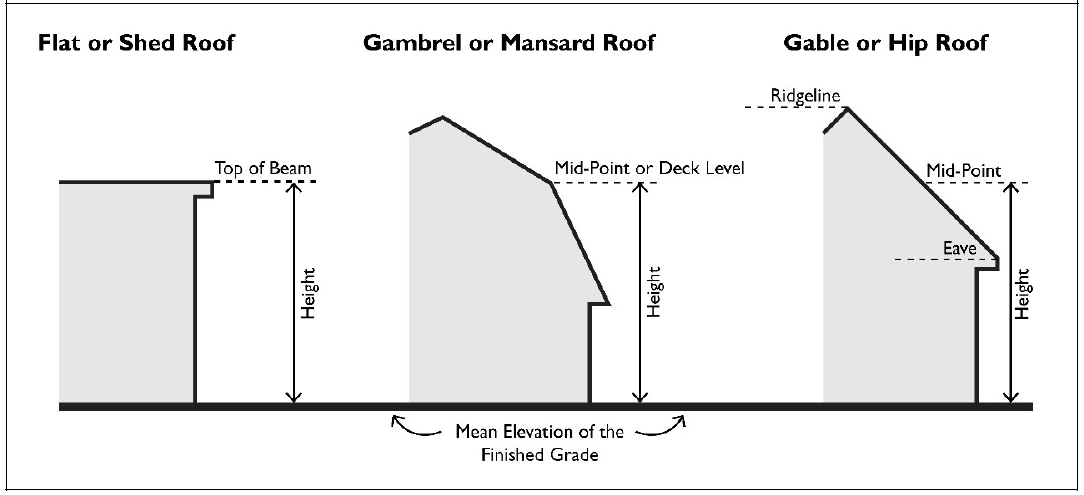
The height of a building shall be the vertical distance measured from the mean elevation of the finished grade at the front of the building to the mid-point between the ridgeline and the eaves of the building for gable, hip and gambrel roofs; the vertical distance from finished grade to the top of the highest roof beams on a flat or shed roof; and to deck level on a mansard roof.
2.
A point of access to a roof shall be the top of any parapet wall or the lowest point of a roof's surface, whichever is greater. Roofs with slopes greater than seventy-five percent are regarded as walls.
Figure 15.48.060(A)
Examples of measuring building height limit
B.
Subject to the remaining provisions of this section, building height limitations in the various zoning districts shall be as listed in Table I.
C.
Subject to subsection D of this section, the following features are exempt from the district height limitations set forth in subsection B of this section:
1.
Chimneys, church spires, elevator shafts, and similar structural appendages not intended as places of occupancy or storage;
2.
Flagpoles and similar devices;
3.
Heating and air conditioning equipment, solar collectors, and similar equipment, fixtures, and devices.
D.
The features listed in subsection C of this section are exempt from the height limitations set forth in subsection B of this section if they conform to the following requirements:
1.
Not more than one-third of the total roof area may be consumed by such features.
2.
The features described in subsection (C)(3) above must be set back from the edge of the roof a minimum distance of one foot for every foot by which such features extend above the roof surface of the principal building to which they are attached.
3.
The permit-issuing authority may authorize or require that parapet walls be constructed (up to a height not exceeding that of the features screened) to shield the features listed in subsections (C)(1) and (C)(3) of this section from view.
E.
Notwithstanding subsection B of this section, in any zoning district the vertical distance from the ground to a point of access to a roof surface of any nonresidential building or any multifamily residential building containing four or more dwelling units may not exceed thirty-five feet unless the fire chief certifies to the permit-issuing authority that such building is designed to provide adequate access for fire fighting personnel or the building inspector certifies that the building is otherwise designed or equipped to provide adequate protection against the dangers of fire.
F.
Towers and antennas are allowed in all zoning districts to the extent authorized in the Chapter 15.98 CMC.
G.
Building height modifications.
1.
In the R12 zone, the height limit for buildings is increased to 35 feet when the lot is located 100 feet or more from the Highway 203 right-of-way, the Milwaukee Avenue right-of-way, the NE 55th Street right-of-way, or any lower-intensity zones.
2.
In the R24 and MU zones, the height limit for buildings is reduced to 25 feet for lots located within 20 feet of any single-family zone. For lots located between 20 to 60 feet from a single-family zone, the maximum building height shall be 35 feet where the building features a third floor step-back at least ten feet deep.
(Ord. 714 § 1 (Exh. A) (part), 2007: Ord. 670 § 7 (Exh. G) (part), 2005)
(Ord. No. 889, § 2(Exh. A), 8-15-2017; Ord. No. 949, § 2(Exh. A), 3-15-2022)
15.48.065 - Floor area ratio (FAR).
The floor area ratio (FAR) shall be defined as the total floor area of all habitable buildings on a lot divided by the total lot area. Except as expressly provided by this code, the total floor area shall include stairways, hallways, closets and storage rooms, and all other floor areas within the walls of the building. FAR calculations do not include garages and non-habitable accessory buildings.
(Ord. 714 § 1 (Exh. A) (part), 2007)
(Ord. No. 889, § 2(Exh. A), 8-15-2017)
15.48.070 - Residential zone density and dimensional standards.
Note: All R6 development shall comply with the applicable provisions of this Table I as well as the provisions of CMC 15.96.050.
Table I Residential Zones Density and Dimensional Standards
(Ord. No. 949, § 2(Exh. A), 3-15-2022; Ord. No. 25-1006, § 1(Att. A), 1-22-2025)
15.48.080 - Non-residential zone density and dimensional standards.
Table II Non-Residential Zones Density and Dimensional Standards
(Ord. No. 949, § 2(Exh. A), 3-15-2022; Ord. No. 25-1006, § 1(Att. A), 1-22-2025)
15.48.085 - MU zone front setback reduction.
A.
The MU zone front setback on Tolt Avenue and Entwistle Street may be reduced to five feet if the following standards are met:
1.
For buildings, or portions thereof, designed for ground floor residential use, elevate the ground floor 18 to 60 inches and provide a physical "threshold" feature such as a hedge, retaining wall, rockery, stair, gate, railing, or a combination of such elements on private property, not to exceed 42 inches in height, that defines and bridges the boundary between the public and private realms. See also CMC 15.40.150.
2.
For buildings, or portions thereof, designed for ground floor non-residential use, employ at least three of the following features:
a.
At least 200 square feet of Type D landscaping (as defined in CMC 15.76.040) within or adjacent to the entry;
b.
Pedestrian amenities such as vestibules, benches, outdoor eating areas, or water fountains;
c.
A trellis, canopy, or porch that incorporates landscaping;
d.
Special pedestrian scaled lighting;
e.
Special building ornamentation or paving.
B.
The MU zone front setback on Tolt Avenue and Entwistle Street may be reduced to zero feet for buildings, or portions thereof, designed as pedestrian-oriented façades (storefronts) as described by the Carnation Design Standards and Guidelines and CMC 15.40.150.
C.
In the event of is a conflict between the provisions of this section and the Carnation Design Standards and Guidelines, the provisions of this section shall control to the extent of such conflict.
(Ord. No. 949, § 2(Exh. A), 3-15-2022)
15.48.090 - PR zone dimensional standards.
A.
Maximum building height: 40 feet.
B.
Minimum building setbacks: Same as surrounding zone and consistent with use. Where a park use is surrounded by more than one zone, the requirements for setbacks will be consistent with the abutting zone of each frontage.
(Ord. No. 949, § 2(Exh. A), 3-15-2022)
Appendix A
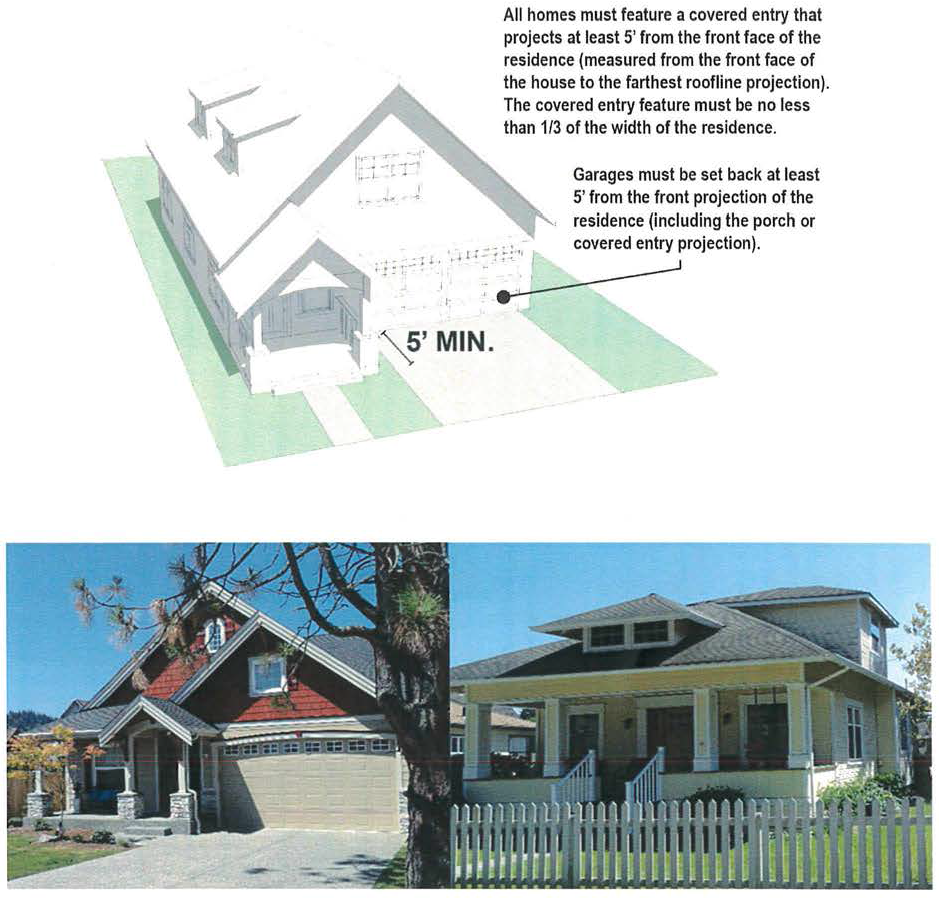
Figure 1. Illustrating covered entry and garage setback requirements. The photographs illustrate two ways of meeting these standards. In the left example (as in the illustration), the garage is placed at least five feet behind the front of the porch/covered entry. The right example includes a full length porch and the garage is located off of the alley.
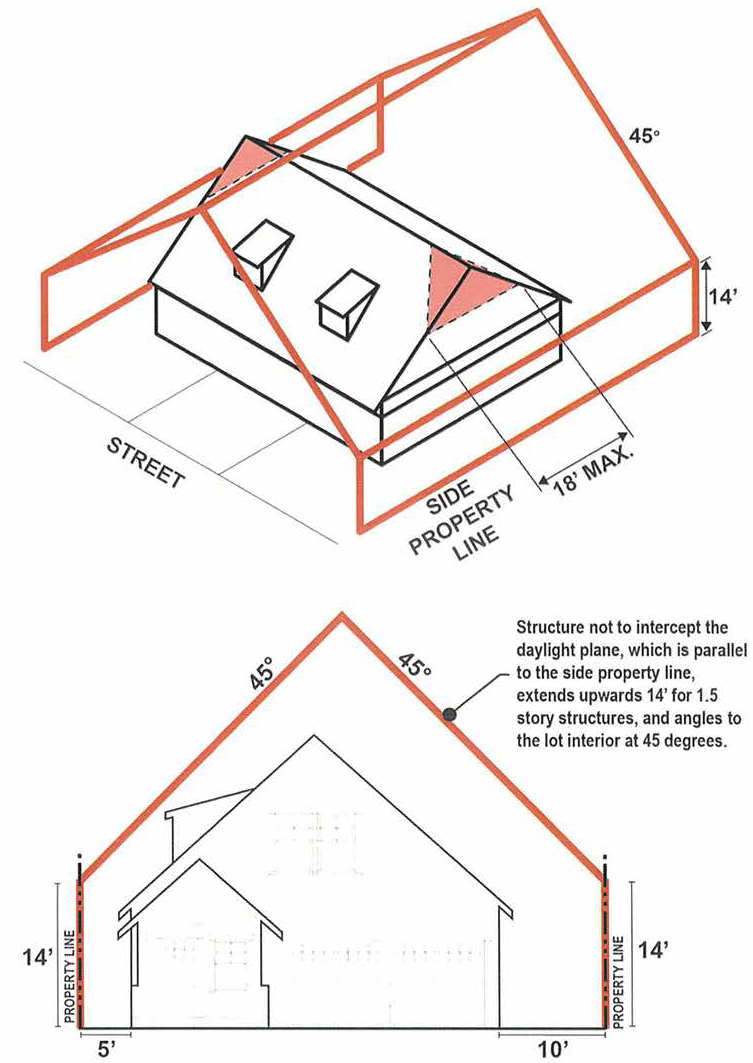
Figure 2. The graphics above illustrate the special side yard height and setback limitations for a one and one-half story residence. The top example includes a gabled roof facing the side property line. The lower example shows the gabled roof end facing the street and rear property line.
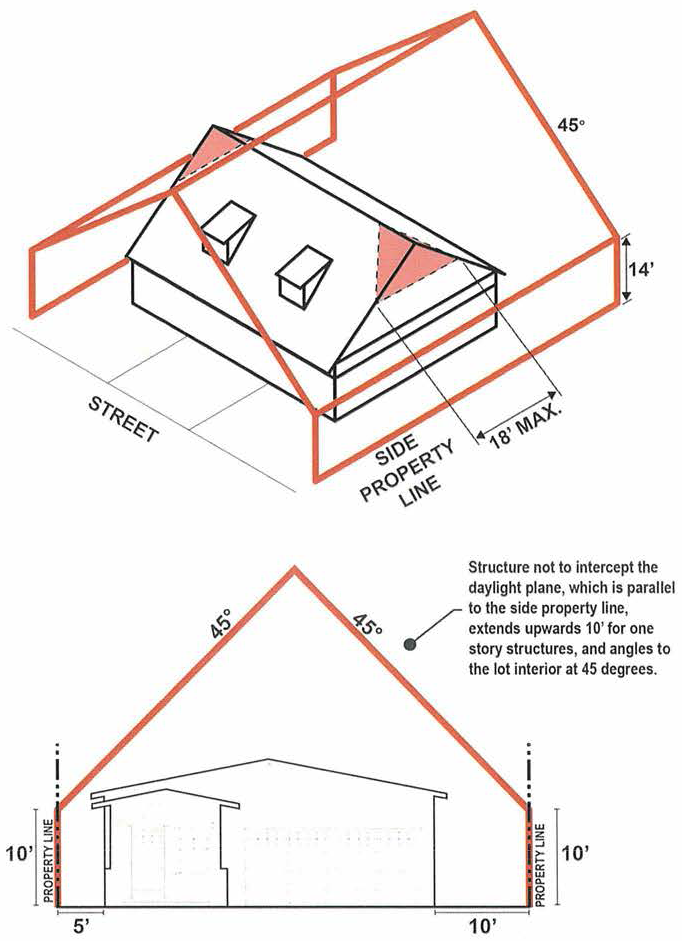
Figure 3. The illustrations above show how to comply with the special side yard height and setback limitations for a one-story residence. The top example includes a gabled roof facing the side property line. The lower example shows the gabled roof end facing the street and rear property line.
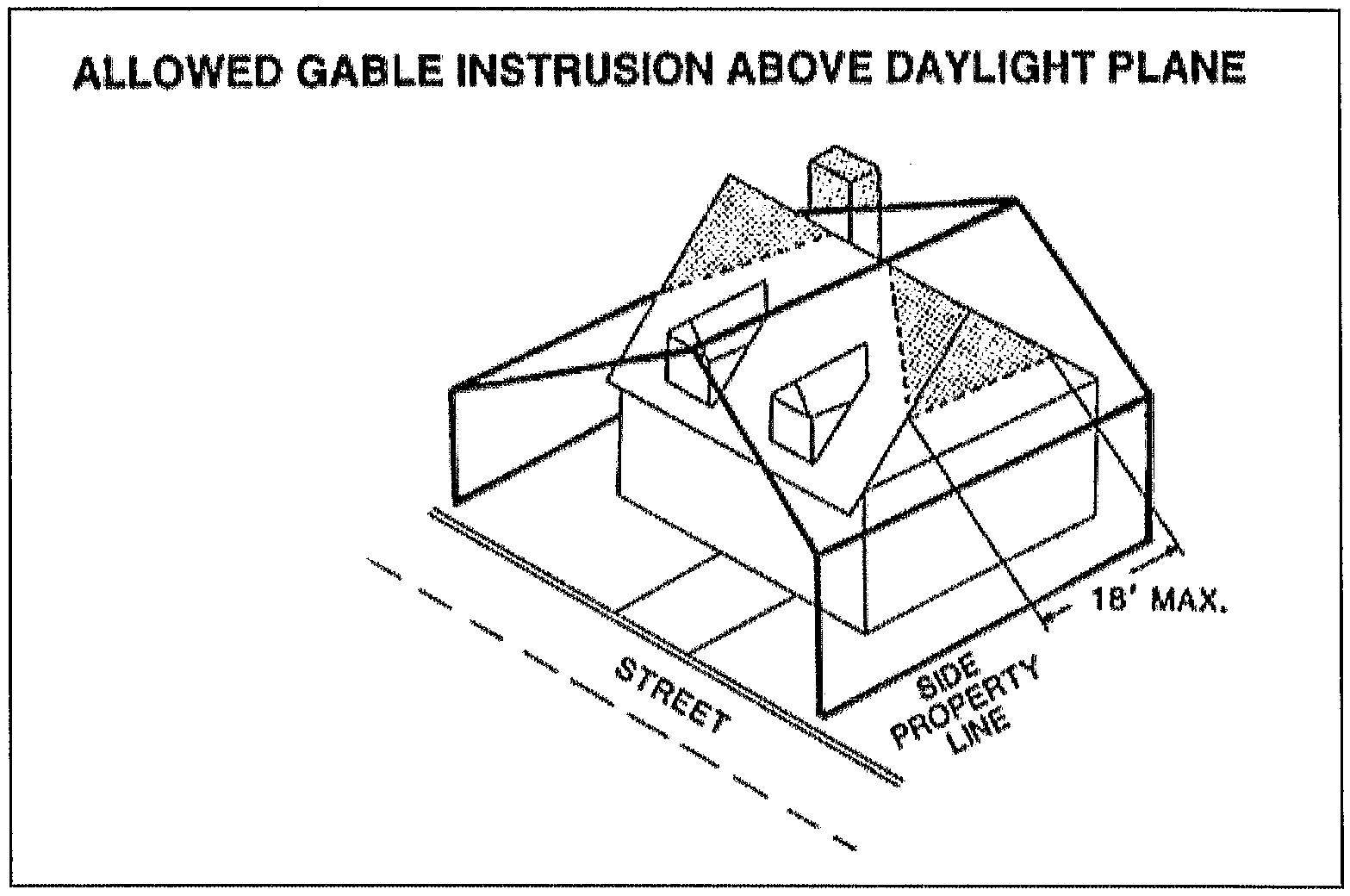
Figure 4. Gables or similar architectural features, provided that the horizontal length of all such features shall not exceed a combined total of eighteen feet on each side, measured along the intersection with the daylight plane, and provided that the intersection of the gable with the daylight plane closest to the front property line is along the roof line.
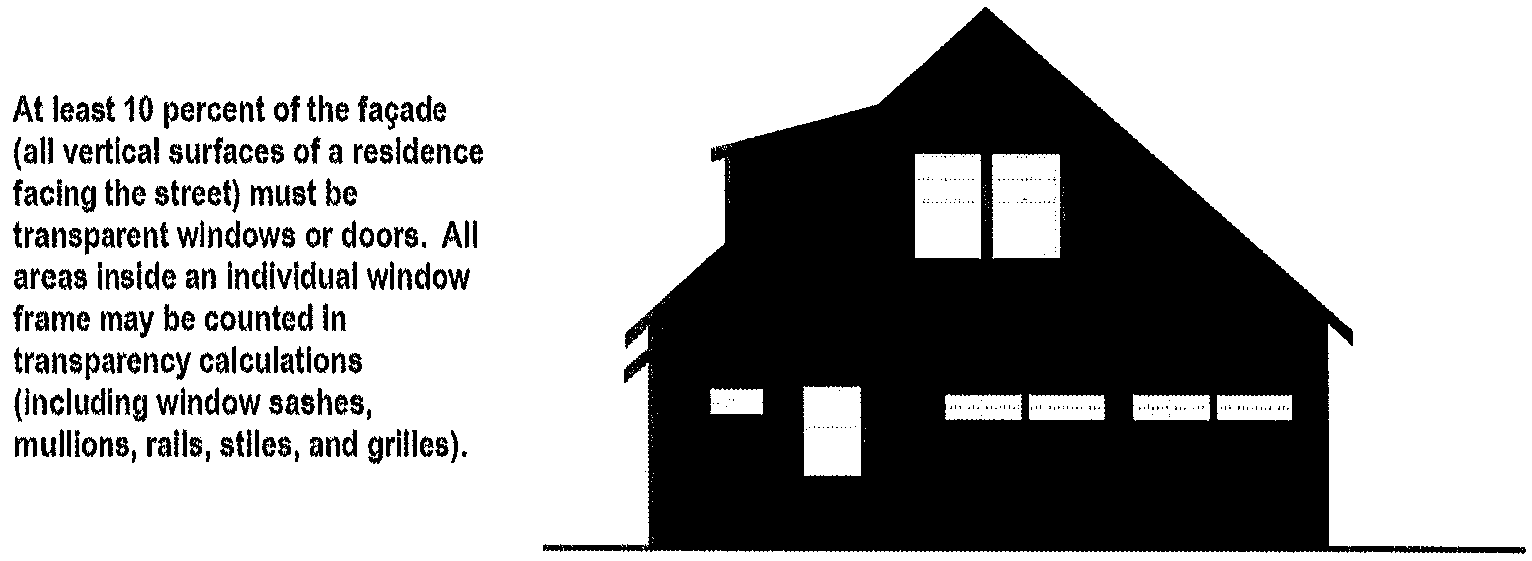
Figure 5. Illustrating the minimum transparency requirement.
(Ord. 728 § 3 (Exh. B), 2007; Ord. 714 § 1 (Exh. A) (part), 2007: Ord. 700 § 8 (Exh. H), 2006: Ord. 670 § 7 (Exh. G) (part), 2005; Ord. No. 764, § 1, 8-4-2009; Ord. No. 809, § 3(Exh. B), 2-7-2012; Ord. No. 858, § 2(Exh. A), 3-17-2015; Ord. No. 889, § 2(Exh. A), 8-15-2017; Ord. No. 890, § 3(Exh. B), 10-17-2017; Ord. No. 909, § 7(Exh. D), 10-16-2018)

