
Carnation City Zoning Code
CHAPTER 15
76 - LANDSCAPING AND TREES10
Editor's note— Ord. No. 996, § 1(Exh. A), adopted Sept. 17, 2024, repealed the former Ch. 15.76, §§ 15.76.010—15.76.160, and enacted a new Ch. 15.76 as set out herein. The former Ch. 15.76 pertained to screening, landscaping and trees and derived from Ord. No. 782, § 2(Exh. A), adopted July 20, 2010.
15.76.005 - Council findings concerning the need for screening and landscaping requirements.
The Council finds that:
A.
Screening and landscaping between two lots lessens the transmission from one lot to another of noise, dust, and glare.
B.
Screening and landscaping can lessen the visual pollution that may otherwise occur within an urbanized area. Even minimal screening can provide an impression of separation of spaces, and more extensive screening can shield entirely one use from the visual intrusion of an adjacent use.
C.
Screening and landscaping can establish a greater sense of privacy from visual or physical intrusion, the degree of privacy varying with the intensity of the screening.
D.
The provisions of this part are necessary to safeguard the public health, safety and welfare.
(Ord. No. 996, § 1(Exh. A), 9-17-2024)
15.76.010 - Applicability.
The requirements of this chapter shall apply to all new development and any redevelopment, alteration, or addition to any existing building or structure unless exempted under CMC 15.76.025. A landscape plan is required and shall be submitted to the city with all land use applications and/or for a building permit for the following:
A.
Residential subdivisions with respect to public right-of-way, open space, landscape buffers, and utility tracts;
B.
Industrial uses, commercial uses, multifamily uses, binding site plans, site plans, and building permits of developments of four (4) or more units;
C.
Additions, expansions, or alterations that result in the exterior modification of existing building, structure, parking lot, or site layout. Minor additions, expansions, or alterations that do not trigger parking additions or substantially increases land use intensity, as determined by the Director or City Planner, are exempt.
D.
Change of Use. When a residential structure is changed into a commercial or industrial structure landscaping shall be provided for the commercial or industrial use as required by this chapter.
E.
Residential Development Exemption: A landscape plan is not required for residential developments of three (3) units or less. The project will need to comply with CMC 15.76.030(M).
(Ord. No. 996, § 1(Exh. A), 9-17-2024)
15.76.015 - Exemptions.
Exceptions to this Chapter may be allowed at the discretion of the Director or City Planner under the following circumstances:
A.
Existing Detached Single-Family Residential Properties. The landscaping provisions of this article shall not apply to lots which are, as of the effective date of the ordinance codified in this title, used as a detached dwelling use type.
B.
Interior Tenant Improvement. The landscaping provisions of this article shall not apply to existing structures where interior tenant improvements, such as interior remodel, occur and where there is no addition to the number of parking spaces provided or the proposed use significantly increase the land use intensity requiring additional landscape screening.
C.
Existing Structure Exterior Improvement. The landscaping provisions of this article shall not apply to existing structures where exterior improvements, such as new exterior signs or façade improvements, occur and where there is no addition to the number of parking spaces provided, impacts to the existing landscape buffer, or the use will significantly increase the land use intensity requiring additional landscape screening.
D.
Combination Uses. When two or more principal uses are combined to create a combination use, screening shall not be required between the component principal uses unless they are clearly separated physically and screening is determined by the Director or City Planner to be necessary to satisfy the standard set forth in Section 15.76.040.
(Ord. No. 996, § 1(Exh. A), 9-17-2024)
15.76.020 - Landscape Review Process.
Landscaping plans shall be reviewed and approved prior to land use permit, construction permit, or building permit. Procedures shall be as follows:
A.
Landscaping associated with project permit applications, clearing or grading permit, construction permit, or building permit shall be reviewed according to the procedures of the associated permit as outlined in CMC 15.09.050.
B.
A project permit application, construction permit or building permit submittal shall include a preliminary landscape plan in compliance with the guidelines outlined in this chapter. A final landscape plan that is consistent with the preliminary plan, that checklist, and with the conditions of approval, shall be submitted and approved prior to a construction drawing approval (if not associated with a building permit or building permit occupancy issuance).
C.
Subdivision applications under CMC 15.16 shall include a conceptual plan that is included on the site plan or as an individual plan for preliminary subdivision approval. A final landscape plan that is consistent with the concept plan, and consistent with conditions of approval, shall be submitted and approved prior to construction drawing approval or final subdivision approval.
D.
As determined by the city, the city may use a licensed landscape architect to perform peer review of submitted landscape plans. The costs of such review shall be paid by the developer.
(Ord. No. 996, § 1(Exh. A), 9-17-2024)
15.76.025 - Landscape plan—Submittal requirements.
The landscape plan shall contain at least the following information:
A.
Drawings to scale of one inch equals 50 feet or larger (e.g., one inch equals 30 feet, one inch equals 20 feet) including a bar scale for reference;
B.
Name and address or location of the project;
C.
North arrow and date of the plan;
D.
Property boundaries, easements, rights-of-way, streets, walks, paths, vehicular drives, parking lots, existing and proposed structures, service or loading areas, open spaces, plaza, open space, and/or recreational amenities;
E.
Existing and proposed contours (minimum five-foot intervals);
F.
Landscape buffer type details;
G.
Location, size, and species of existing significant trees as defined in this chapter within required landscape areas;
H.
The location and type of irrigation systems; the source of the water should be noted;
I.
Plant legend listing botanical and common names recognized by the ANSI-Z60.1 American Standards for Nursery Stock, identification if the plants are native or drought resistant, and required size;
J.
The location of all existing and proposed underground utilities, electrical, and communication facilities; and;
K.
The location of all critical areas and associated buffer designated by the critical area ordinance and the location of all shorelines and associated buffer designated by the Shoreline Master Program
(Ord. No. 996, § 1(Exh. A), 9-17-2024)
15.76.030 - General landscaping requirements.
A.
Landscape plans shall enhance building designs, attractively screen parked vehicles and unsightly areas, and provide for adequate visibility at street intersections and driveway entrances.
B.
Landscape plans shall incorporate pedestrian and bicycle trails in conformance with the comprehensive plan for pedestrian and/or bicycle circulation adopted by the city.
C.
Where critical areas such as streams, wetlands, and steep slopes, or their buffers, exist on a proposed development site, the landscape plan shall be coordinated with measures for their protection and enhancement required by the critical area ordinance.
D.
Combination Uses. When two or more principal uses are combined to create a combination use, screening shall not be required between the component principal uses unless they are clearly separated physically, and screening is determined by the Director or City Planner to be necessary to satisfy the standard set forth in Section 15.76.040.
E.
New landscaping materials shall include species native to the coastal region of the Pacific Northwest or noninvasive naturalized species that have adapted to the climatic conditions of the coastal region of the Pacific Northwest in the following amounts:
1.
Seventy-five percent of ground cover and shrubs;
2.
Fifty percent of trees.
F.
At least sixty percent of new landscaping materials shall consist of drought tolerant species, except where site conditions within the required landscape areas assure adequate moisture for growth.
G.
All landscaped areas shall be graded to prevent erosion and to facilitate the installation, growth, and maintenance of the landscaping. Berms or mounds should be no steeper than 3(H):1(V), unless otherwise approved by the city for screening purposes. All turf areas located in public rights-of-way shall have a grade no greater than 3:1.
H.
Trees and very large shrubs should be located with consideration to underground and overhead utility lines or public improvements.
I.
Landscaping buffering shall be placed outside of fences unless it is determined by the Community and Economic Development Department that such an arrangement would be detrimental to the stated purpose of this article. Arterials such as Entwistle Street and Stossel Avenue shall have vegetative buffer on the outside of the fence for visual interest.
J.
All trash containers shall be screened from abutting properties and streets by a one hundred (100) percent sight-obscuring fence or wall and appropriate landscaping.
K.
Foundation Plantings:
1.
Multifamily Buildings: foundation plantings shall be provided to soften the overall impact and scale of the building. Foundation plantings shall be provided around each individual building, at the base of the building.
2.
Office/Industrial Buildings: an average depth of ten (10) feet from the face of the building shall be provided around the building.
L.
Residential Development three (3) units or less: one (1) deciduous tree, see City of Carnation approved tree list, and soil stabilization.
M.
Relationship to other Regulations: In the case of a conflict between Chapter 15.76 CMC, Landscaping and Trees, and the City of Carnation Design Standards, the regulations in the City of Carnation Design Standards shall control.
N.
Bioswales: Comply with Carnation Street and Storm Sewer System Standards for bioswale planting requirements
O.
Where a new subdivision adjoins an existing subdivision or neighborhood, perimeter buffers, fences and landscaping shall be required when these features serve to mitigate any adverse impacts of the new subdivisions on adjoining neighborhoods.
(Ord. No. 996, § 1(Exh. A), 9-17-2024)
15.76.040 - Screening and landscaping requirements.
The following requirements apply to all new development or redevelopment projects , unless otherwise noted.
A.
Standards.
1.
All Projects. Buffering, screening, and provisions for required landscaping shall be in accordance with Table 1 below.
Table 1. Perimeter Landscaping Requirements
Table 1 Exceptions:
Required perimeter landscape buffer width is measured from the property line.
Where an alley divides the subject property from a single-family zoned property, developments are exempt from landscaping buffer requirements.
Where special topographic or other site conditions minimize or eliminate the need to provide landscaping buffers, the Director or City Planner may reduce or eliminate these requirements.
Tolt Avenue/SR 203 landscape buffer requirements do not apply to public development (fire station, school, cemetery, etc.) or commercial buildings.
(Ord. No. 996, § 1(Exh. A), 9-17-2024)
15.76.045 - Landscape requirements for parking lots.
A.
Internal landscaping for surface parking lots containing ten or more parking spaces shall be provided. Specifically:
1.
There shall be no more than eight parking spaces in a row without a landscaping island containing a tree, shrubs, and ground cover.
2.
Internal landscape islands shall be the same depth as the adjacent parking stall and have a minimum interior width of four feet.
3.
At least one tree for every eight parking spaces shall be provided (this excludes trees in the required perimeter areas).
4.
Wheel stops, curbs, or walkways shall be used to protect landscaping from vehicles.
5.
Minimum required internal surface parking lot landscaped areas:
B.
The landscaping requirement for parking lots of ten or more parking spaces shall be in effect even if the parking lot and/or the number of parking spaces is not required by the application of this title.
C.
Architectural elements used as an alternative for landscaping: Trellises or arbors may be substituted for trees if the Director or City Planner finds that these architectural elements will provide adequate screening between a parking lot and a street or between a parking lot and any side or rear lot, or that such elements shall provide adequate shading, screening, and visual relief, and to reinforce safe pedestrian access routes within the parking area. To be approved, architectural elements must:
1.
Be at least five feet above the surrounding grades;
2.
Use horizontal elements to create shade; and
3.
Contain plantings that at maturity will be integrated with the architectural elements (e.g., vines that will grow up a trellis).
D.
Architectural elements that meet the criteria above may be substituted as follows:
1.
Three hundred square feet of footprint of an architectural element may replace an evergreen tree.
2.
Five hundred square feet of footprint of an architectural element may replace a deciduous tree.
(Ord. No. 996, § 1(Exh. A), 9-17-2024)
15.76.050 - Descriptions of screens and landscape types.
A.
Type A Landscaping: Lightly Dense Screen.
1.
Intent. To provide a dense landscaping screen separating nonresidential and residential uses.
2.
Standards.
a.
For landscaping strips ten to fifteen feet wide:
i.
Trees. At least one row of trees spaced no more than ten feet on center. Utilize tree species appropriate to perform the screening function;
ii.
Shrubs: A rate of one shrub per twenty square feet of landscaped area.
iii.
Ground cover. At a rate of twelve inches on-center for four-inch pots or twenty-four inches on- center for one gallon or greater containers.
b.
For landscaping strips wider than fifteen feet:
i.
A minimum of one tree (species as described below) at least eight feet tall for every one hundred fifty square feet arranged in a manner to obstruct views into the property;
ii.
Shrubs and ground cover as required above.
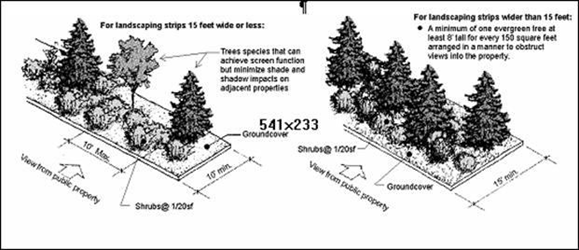
Figure 33: Type A Landscaping.
B.
Type B Landscaping: Moderately Dense Screen.
1.
Intent. To provide a moderately dense and naturalistic vegetation screen to offer visual relief and integrate built elements into the natural environment.
2.
Standards.
a.
For landscaping strips less than fifteen feet wide:
i.
Trees: Informal groupings of evergreen and/or deciduous. Trees to be spaced at an average of twenty feet on-center, but may be grouped in asymmetrical arrangements;
ii.
Shrubs: One shrub per twenty square feet of landscaped area;
iii.
Ground cover. At a rate of twelve inches on-center for four-inch pots or twenty-four inches on-center for one gallon or greater containers
b.
For landscaping strips wider than fifteen feet:
i.
At least one tree per three hundred square feet of landscaped area;
ii.
Shrubs and ground cover as required above.
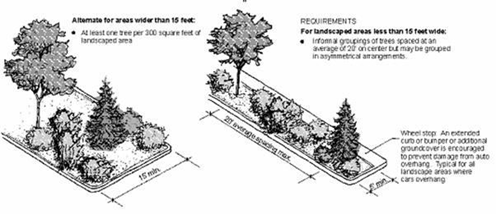
Figure 34: Type B Landscaping.
C.
Type C Landscaping: Broken Screen.
1.
Intent. To provide visual relief in parking areas and between roadways and buildings where both a canopy of trees and visibility is required.
2.
Standards.
a.
For landscaping strips five to twenty feet wide:
i.
Trees at twenty feet on-center;
ii.
Permitted tree species are those that reach a mature height of between twenty-five and forty feet (tall enough to be able to perform a canopy function);
iii.
Shrubs at a rate of one shrub per twenty square feet of landscaped area;
iv.
Ground cover. A rate of at twelve inches on-center for four-inch pots or twenty-four inches on-center for one gallon or greater containers;
v.
Care must be taken to maintain visibility into (view from the street) and through the parking lot for safety. Developments should follow the three is to eight rule: Shrubs trimmed to three feet or less and canopy trees trimmed up to eight feet maintain views across the parking lot.
b.
For landscaping strips wider than twenty feet:
i.
At least one tree per three hundred square feet of landscaped area or twenty-foot separation (on average). Place trees to create a canopy in desired locations without obstructing necessary view corridors;
ii.
Shrubs and ground cover as required above.
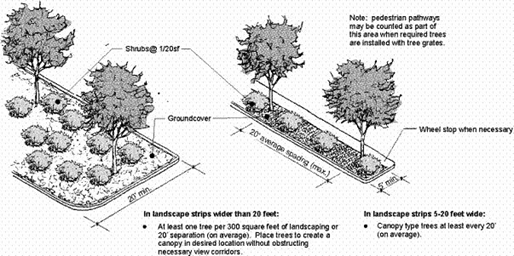
Figure 35: Type C Landscaping.
D.
Type D Landscaping.
1.
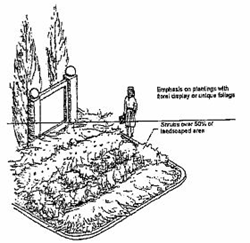
Intent. To create a decorative landscaped display with colorful flowers or foliage as a focal setting for signs, special site elements and/or high visibility or pedestrian areas.
2.
Standards.
a.
Shrubs, at least fifty percent of which must exhibit decorative floral or foliage, shall cover at least fifty percent of the landscaped area. They shall be planted to cover the allocated area within three years.
b.
The remaining fifty percent of the landscaped area may be planted with low shrubs, ground cover, or cultivated flower beds. Taller trees or shrubs are acceptable behind the sign.
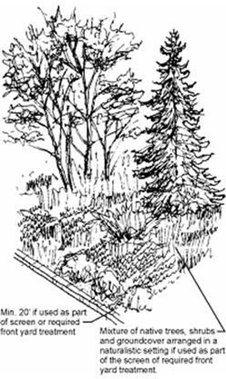
Figure 36: Type D Landscaping.
E.
Type E Landscaping.
1.
Intent. To enhance natural areas and to integrate developments into existing conditions.
2.
Standards.
a.
Landscaping shall consist of trees, shrubs, and ground covers that are native to the Puget Sound and are appropriate to the conditions of the site. Species are subject to the approval by the Director or City Planner. Arrangement of plants shall be asymmetrical and plant material shall be sufficient in quantity to cover the soil in one growing season.
b.
Minimum twenty feet in width if used as a screen.
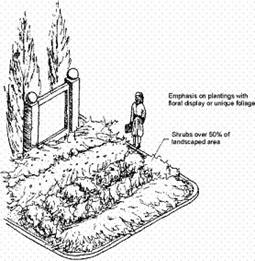
Figure 37. Type E Landscaping.
F.
Type F Landscaping - Screen Fencing.
1.
Intent. To minimize visual impacts of uses to adjacent properties, where applicable.
2.
Standards.
a.
Fence or wall at least six feet tall, constructed of masonry, solid wood, or a combination thereof.
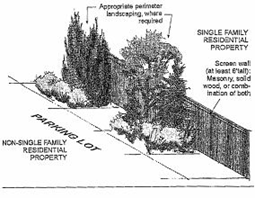
Figure 38. Type F Landscaping.
(Ord. No. 996, § 1(Exh. A), 9-17-2024)
15.76.060 - Flexibility in administration permitted.
A.
The permit-issuing authority may allow deviations from the presumptive requirements of Section 15.76.040 and may either require more intensive or allow less intensive screening whenever it finds such deviations are more likely to satisfy the applicable intent statements set forth in Section 15.76.040 and providing a greater public benefit than strict adherence to the landscaping requirements. Some examples of permissible deviations may include, but are not necessarily limited to: (1) additional density of vegetation in exchange for a reduction in buffer width, and (2)reduce planting densities in exchange for additional pedestrian amenities.
B.
Without limiting the generality of subsection A of this section, the permit-issuing authority may modify the presumptive requirements for:
1.
Commercial developments located adjacent to residential uses in business zoning districts;
2.
Commercial uses located adjacent to other commercial uses within the same zoning district.
C.
Existing Structures. Where existing structures are situated so as to preclude installation of required landscaping, the Director or City Planner, at his/her sole discretion may reduce the required landscaping as required per CMC 15.76.040 for the area affected by such structure. The Director or City Planner may request greater intensity of landscaping screening within the existing landscape buffer if the proposed land use warrants greater screening.
D.
Existing Vegetation. Where existing vegetation can provide the same level of screening as required by the landscaping requirements (Section 15.76.040 and 15.76.045), the Director or City Planner may grant a waiver to some or all of the standard requirements. In such case, the applicant shall be responsible for submitting to the Director or City Planner, an alternate conceptual landscape plan, supporting photographs and a brief explanation as to how the alternate plan satisfies the intent of the landscape standard required. Supplemental plant material may be required to be installed within, or adjacent to, the natural landscape area to fully comply with the intent of the required landscape standards.
E.
Whenever the permit-issuing authority allows or requires a deviation from the presumptive requirements set forth in Section 15.76.040, it shall enter on the face of the permit the screening requirement that it imposes to meet the standard set forth in Section 15.76.030 and the reasons for allowing or requiring the deviation.
(Ord. No. 996, § 1(Exh. A), 9-17-2024)
15.76.070 - Planting materials and soil requirements.
The following standards apply to all landscaping required by this chapter:
A.
Minimum sizes at installation shall be as follows:
1.
Street trees: two-inch caliper, with lower crown limbs no less than five feet above grade;
2.
Deciduous trees: A minimum of two inches diameter measured at breast height.
3.
Evergreen trees: Six-foot minimum height above grade at the time of planting.
4.
Low shrubs: A two-gallon minimum size and two-foot minimum height with multiple canes and good density;
5.
Medium and tall shrubs: five-gallon minimum size;
6.
Ground cover: Four-inch pots at twelve inches on-center or one gallon or greater sized containers at twenty-four inches on-center.
B.
Maximum Size. Species approved within a landscape plan shall have a growth pattern in scale with the development and be consistent with the preservation of significant trees.
C.
All trees shall be double staked for the first two (2) years.
D.
Deciduous or broadleaf evergreen trees should be planted at least four feet from curbs, especially in front of parking stalls. Where possible, coniferous trees should be planted at least seven feet from curbs.
E.
Exotic or invasive plants are not permitted. The director can require any plant type to be exchanged for another based upon peer review of a landscape plan. Groundcover shall be selected for rapid growth and coverage in order to reduce erosion and maintenance.
F.
Prohibited Plant Species. The following species have been determined harmful to the environment or noxious to other properties due to their ability to spread rapidly and/or invade other areas, and may not be used in any landscape plan subject to approval by the city:
1.
Any species listed on the Washington State Noxious Weed List and/or King County Noxious Weed List (including Class A, B, and C and monitor weeds).
2.
The following additional aggressive nonnative tree species:
a.
Common European Hawthorne (Crataegus monogyna)
b.
European mountain ash (Sorbus aucuparia)
c.
Bradford pear (Pyrus calleryana "Bradford")
d.
Tree of heaven/Chinese sumac (Ailanthus altissima)
e.
Black locust (Robinia pseudoacacia)
f.
English holly (Ilex aquifolium)
3.
The following additional aggressive nonnative shrub and ground cover species:
a.
English/Atlantic ivy (Hedera hibernica/Hedera helix)
b.
English laurel (Prunus laurocerasus)
c.
Spurge laurel (Daphne laureola)
d.
Portuguese laurel (Prunus lusitanica)
e.
Pampass grass (Cortaderia spp.)
f.
Yellow archangel (Lamiastrum galeobdolon)
g.
Perrywinkle (Vinca minor)
h.
Winter creeper (Euonymus fortune)
i.
Bamboo (Phyllostachys aurea and all "running" bamboo species)
G.
Existing soils shall be augmented with a two-inch layer of fully composted organic material tilled a minimum of six inches deep.
H.
Landscape areas shall be covered with a layer of mulch a minimum of two inches in depth to minimize evaporation. Mulch shall be placed two inches from root crown to surround the new planting at a diameter of 36" for trees, 24" for plants and shrubs, and 12" for grasses and groundcover. Mulch shall consist of fully composted materials such as yard waste, sawdust, and/or manure. The use of beauty bark as a mulching material is discouraged.
(Ord. No. 996, § 1(Exh. A), 9-17-2024)
15.76.080 - Irrigation and maintenance.
A.
Irrigation Standards.
1.
All landscaping areas where new landscaping is required shall be provided with temporary irrigation systems. Exception: Areas of undisturbed existing vegetation, low areas with existing high soil moisture conditions, or landscape areas consisting of drought-tolerant vegetation shall not require irrigation systems.
2.
New developments are encouraged to use planting materials that require only temporary irrigation systems. Such systems are encouraged to be removed after twenty-four months or two growing seasons, whichever occurs first, provided that the plantings are established.
3.
All landscape areas shall be maintained by the property owner in accordance with the following standards:
a.
All landscaping shall be maintained with respect to pruning, trimming, mowing, watering, insect control, fertilizing, or other requirements to create a healthy growing condition and attractive appearance and to maintain the purpose of the landscape type.
b.
Dead, diseased, stolen, vandalized, or damaged plants shall be replaced within three months with the plants indicated on the approved landscape plan.
c.
All landscaped areas shall be maintained reasonably free of weeds and trash.
d.
The requirements of this subsection shall be recorded on the landscaped property to apply to all subsequent owners of the property. The covenant shall provide that the city shall be entitled to its costs and attorney fees in any action in which it prevails in enforcing the covenant.
B.
Maintenance Standards.
1.
Replacement. The property owner shall replace any unhealthy or dead plant materials in conformance with the approved landscape plan, shall maintain all plant material and irrigation facilities, and shall keep all landscape areas free of invasive species.
2.
Maintenance Assurance. The city shall require a maintenance assurance devices and landscape maintenance agreement for a period of three years from the completion and approval of the planting to ensure compliance with this section. The amount of the maintenance assurance devices shall be 20 percent of the cost of plant materials plus installation. This could be either a CD (certificate of deposit) in the city's name, a letter of credit from the developer's bank, or cash. A maintenance assurance devices and landscape maintenance agreement are not required for an individual single-family home constructed outside of a new subdivision.
3.
Minimal Landscape Project Fee-In-Lieu of Maintenance Assurance. For projects that have a landscape project cost for plant materials and installation valued at $5,000 or less, an applicant may provide a fee- in-lieu of maintenance assurance devices to the city in the amount of 10 percent of the value of the landscaping, subject to entering a fee-in-lieu landscape agreement with the city.
(Ord. No. 996, § 1(Exh. A), 9-17-2024)
15.76.085 - Performance assurance.
The required landscaping must be installed prior to issuance of a certificate of occupancy, or issuance of any other final permit necessary to approve land development or construction; provided, however, that the Director or City Planner in his or her sole discretion may accept a bond, letter of credit, or other performance assurance devices to ensure installation of all required landscaping by such later date as determined by the director. Any such performance assurance devices shall be in a form acceptable to the Director or City Planner and in an amount determined by the director of not less than 150 percent of the cost of all required plant materials and installation. In no case shall such performance security devices be in an amount less than $1,500.
(Ord. No. 996, § 1(Exh. A), 9-17-2024)
15.76.090 - Council findings and declaration of policy on shade trees.
A.
The council finds that retention of trees is an important means of mitigating development impacts and protecting the public health, safety and welfare by:
1.
Enhancing the economic value of properties;
2.
Reducing soil erosion and runoff from precipitation;
3.
Stabilizing and enriching the soil;
4.
Improving water and air quality;
5.
Moderating the effects of wind and temperature;
6.
Buffering unwanted sound;
7.
Providing and protecting varied and rich habitats for wildlife;
8.
Enhance tree canopy aesthetics, sustainability, and health.
B.
Based upon the findings set forth in subsection (a), the council declares that it is not only desirable but essential to the health, safety, and welfare of all persons living or working within the city's planning jurisdiction to require the retention of existing trees and the planting of new trees under the circumstances set forth in this chapter and to establish tree protection and maintenance standards.
C.
The purpose and intent of this part chapter is to:
1.
Minimize the removal of significant trees in order to maintain the quality of the environment;
2.
Encourage the protection of significant trees to the maximum extent possible in the design of new buildings, roadways, and utilities;
3.
Mitigate the environmental and aesthetic consequences of tree removal in land development through on- site tree replacement;
4.
Encourage tree protection efforts by granting flexibility of certain other development requirements;
5.
Provide measures to protect trees that may be impacted during construction;
6.
Maintain and protect the public health, safety and general welfare.
(Ord. No. 996, § 1(Exh. A), 9-17-2024)
15.76.095 - Definitions.
The following words and phrases shall have the meanings indicated:
A.
Damage—Any injury to or destruction of a tree, including but not limited to: uprooting; severance of all or part of the root system or main trunk; storage of material on or compaction of surrounding soil; a substantial change in the natural grade above a root system or around a trunk; surrounding the tree with impervious paving materials; or any trauma caused by accident or collision.
B.
Public Right-of-Way—The area along a public street between the curb and the sidewalk; or if there is no curb or sidewalk, the unpaved portion of the area between the street right-of-way line and the paved portion of the street or alley.
C.
Significant Tree—Any tree (using current Urban Forestry Standard) that is 6" diameter at breast height (DBH) or more.
D.
Top or Topping—The non-standard practice of cutting back of limbs to stubs within a tree's crown to such a degree so as to remove the normal canopy and disfigure the tree.
(Ord. No. 996, § 1(Exh. A), 9-17-2024)
15.76.100 - Required trees along streets and public rights-of-way.
A.
If required by this title or by the city of Carnation Street and Storm Sewer System Standards, or if the street to be newly created, widened, or improved is classified as a local access or neighborhood access roadway in the city of Carnation Street and Storm Sewer System Standards, the developer shall either plant or retain street trees.
B.
All street trees shall meet the following standards:
1.
A minimum of one street tree every twenty feet of street frontage, unless otherwise approved by the Director or City Planner and City Engineer.
2.
Street trees shall be located and placed within the street rights-of-way in accordance with the requirements of the City Engineer, unless otherwise permitted in subsection (B)(3) of this section.
3.
Street trees may be planted within ten (10) feet of the right-of-way only if the right-of-way is insufficient to accommodate street trees, or if curbs, gutters and sidewalks already exist.
4.
The minimum street tree size shall be two-inch minimum caliper measured six inches above the root flare and conform to the most recent ANSI Z60.1 American Standard for Nursery Stock.
5.
The first branch of the tree shall be a minimum of five feet above the ground except where the tree location does not present an obstruction to pedestrians, passing vehicles, or sightlines.
6.
Trees planted within five (5) feet of public or private road pavement edge, curbing or sidewalk, or within parking areas shall be surrounded by a root control barrier. Root control barriers shall consist of galvanized metal or plastic sheets extending a minimum of two (2) feet below the finished grade of the surrounding surface.
7.
Once planted, street trees shall be watered immediately and thoroughly, twice per week during the first month, then once per week through the remainder of the dry season. Street trees shall be watered a minimum of once per month during the second summer season.
8.
All street trees shall be of a species approved by the Community and Economic Development Department. See City of Carnation approved Street Tree List in the Carnation Street and Storm Sewer System Standards.
9.
Street trees cannot be removed without the prior approval of the City Engineer or City Manager.
(Ord. No. 996, § 1(Exh. A), 9-17-2024)
15.76.110 - Retention and replacement of significant trees.
A.
Tree retention requirements shall be as follows:
B.
The volume of significant trees to be retained shall be calculated from the area of the lot or parcel to be developed, rounded to the nearest number. This calculation is the minimum number of trees that shall be retained unless replacement is allowed by subsection C.
C.
At the discretion of the Director or City Planner, additional significant trees may be removed and replaced if the removal is required for the siting and placement of driveway and road access, buildings, vision clearance areas, utilities, sidewalks or pedestrian walkways, or storm drainage facilities and other similar required improvements.
D.
Damaged Trees. Trees will not be considered "significant" if, following inspection and a written report by a registered landscape architect, certified nursery professional or certified arborist, and upon review of the report and concurrence by the City, they are determined to be:
1.
Safety hazards due to root, trunk or primary limb failure;
2.
Damaged or diseased, and do not constitute an important wildlife habitat. At the discretion of the City, damaged or diseased or standing dead trees may be retained and counted toward the significant tree requirement, if demonstrated that such trees will provide important wildlife habitat and are not classified as a safety hazard.
E.
If replacement is required, said significant trees removed shall be replaced with trees at a ratio provided for in subsection (A) and the following standards: provided CMC 15.76.120.
F.
Trees located in critical areas or their buffers as determined by a critical areas report approved by the city as part of a development permit or on lands regulated by the city's Shoreline Master Program (SMP) shall not be counted towards the tree preservation requirement of this chapter. No clearing of existing vegetation in critical areas or their buffer is allowed except as provided for in Chapter 15.88 CMC. No clearing of existing vegetation on lands regulated by the city's SMP except as provided for in Chapter 14.06 CMC.
G.
Nothing in this chapter shall supersede specific tree preservation or replacement if required as a mitigation measure under SEPA.
(Ord. No. 996, § 1(Exh. A), 9-17-2024)
15.76.115 - Reduction of parking requirement permitted to preserve significant trees.
If space that would otherwise be devoted to parking cannot be so used because of the requirements of this chapter, and, as a result, the parking requirements set forth in Chapter 15.72 cannot be satisfied, the number of required spaces may be reduced by up to a maximum of fifteen percent of the required spaces.
(Ord. No. 996, § 1(Exh. A), 9-17-2024)
15.76.120 - Tree replacement.
A.
All Sites. Replacement trees shall be planted on the site from which significant trees are removed unless off- site replacement is approved by the Director or City Planner.
B.
Tree Replacement Guidelines and Requirements, see Carnation Street and Storm Sewer System Standards for complete list.
1.
When individual significant trees are protected, replacement trees should be planted to enhance such trees.
2.
Replacement trees shall be planted in locations appropriate to the species' growth habit and horticultural requirements.
3.
Replacement trees shall be located to provide screening of the development from adjacent properties, in accordance with CMC 15.76.040.
4.
Replacement trees should be planted in areas that connect or are adjacent to native growth protection areas or other open spaces.
5.
Replacement trees shall be integrated into the required landscape plans for a development.
6.
Replacement trees should not be planted next to or under power lines.
7.
Replacement trees shall be a minimum of two-inch caliper for deciduous trees and six-foot minimum height for evergreen trees;
8.
The species of replacement trees shall not be identified as a noxious weed by the most recently available King County noxious weed list and shall not include any species from the list of species identified as nonsignificant in CMC 15.08.
9.
Applicants are encouraged to select replacement trees from the approved street tree list found in the city of Carnation Street and Storm Sewer System Standards.
10.
The Director or City Planner may approve the installation of smaller-sized replacement trees if the applicant can demonstrate that smaller trees are more suited to the species, site conditions, and to the purposes of this section, and are planted in sufficient quantities to meet the intent of this section.
11.
The condition of replacement trees shall meet or exceed current American Nursery and Landscape Association or equivalent organization's standards for nursery stock.
12.
If the replacement trees are to be planted on building lots, the developer shall provide adequate protection from damage during construction as provided for in this chapter, or planting shall occur after construction, in which case a planting plan and security shall be provided to ensure their planting.
13.
Only trees listed as ornamental trees on the official city tree species list may be planted under or within 15 lateral feet of any overhead utility wire.
14.
No tree may be planted within the visibility triangle of a street intersection or within 10 feet of a fire hydrant.
C.
Installation.
1.
Installation of required replacement trees shall be performed in a manner that reasonably ensures, to the maximum extent practicable, the tree's long-term health and survival.
2.
All required tree replacement and other required mitigation shall be completed prior to issuance of final plat, binding site plan, final site development review, or other regulatory approval required for development, unless approved by the Director or City Planner and bonded in accordance with this title.
(Ord. No. 996, § 1(Exh. A), 9-17-2024)
15.76.125 - Protection of trees during construction.
A.
To ensure long-term viability of existing trees identified for protection, permit plans and construction activities shall comply with the following minimum required tree protection:
1.
All minimum required tree protection measures shall be shown on the landscape plan and the site grading plan.
2.
All construction activities, including staging and traffic areas, shall be prohibited within the root protection zone of a protected tree. The root protection zone, also known as the limits of disturbance, shall be determined by a certified arborist hired by the applicant and shall be marked on the construction documents.
3.
To ensure that structures, utilities, and roadways are located an adequate distance from the dripline of a protected tree and to allow adequate room for construction activities, the construction limit line for a structure, utility, or roadway shall be located no closer than the root protection zone of a protected tree.
4.
Except as otherwise authorized by this chapter, no proposed structure, utility, or roadway shall be located in the root protection zone of a protected tree, except where such structure is a raised deck, bay window, or cantilevered or otherwise raised above the ground's surface so as not to disrupt the tree's roots.
5.
Sidewalks and utilities may be located within the dripline of a protected tree, provided that construction methods and materials used will result in minimal disruption of the tree's roots, and that additional measures for tree protection are proposed and approved which will ensure the long-term viability of the tree. The Director or City Planner may allow construction limits or an alteration of grades within the root protection zone, provided that the applicant submits an evaluation by a certified arborist which demonstrates that the proposed construction will not reduce the long-term viability of the tree.
6.
The Director or City Planner may require an evaluation by a certified arborist to determine if protective measures should be required beyond the root protection zone.
7.
Tree protection barriers shall be installed along the outer edge and completely surround the root protection zone of significant trees to be protected prior to any land disturbance.
8.
Tree protection barriers shall be a minimum of four feet high, constructed of chain link, or polyethylene laminar safety fencing or similar material, subject to approval by the Director or City Planner. "Tree protection area" signs shall be posted visibly on all sides of the fenced areas. On large or multiple-project sites, the Director or City Planner may also require that signs requesting subcontractor cooperation and compliance with tree protection standards be posted at site entrances.
9.
If any significant tree that has been specifically designated to be retained in the tree preservation plan dies or is removed within three (3) years of the development of the site, then the significant tree shall be replaced pursuant to CMC 15.76.120 .
B.
Preventative Measures. In addition to the above minimum tree protection measures, the applicant shall support tree protection efforts by employing preventative measures, consistent with best management practices for maintaining the health of the trees, including but not limited to:
1.
Pruning of visible deadwood on trees to be protected or relocated;
2.
Application of fertilizer to enhance the vigor of stressed trees;
3.
Use of soil amendments and soil aeration in tree protection and planting areas;
4.
Mulching over tree dripline areas; and
5.
Ensuring sufficient water availability for tree roots during and immediately after construction.
C.
Prior to final plat, binding site plan, final site development review, or other regulatory approval required for development, a certified arborist hired by the applicant shall be required to inspect all trees remaining on a site and provide a written report as to the status of such trees. Any protected tree found to be irreparably damaged, severely stressed, or dying shall be replaced as provided for in this chapter.
D.
Alternative Methods. The Director or City Planner may approve the use of alternative tree protection techniques if applicant demonstrates that a protected tree will be protected to an equal or greater degree than through the techniques listed above.
(Ord. No. 996, § 1(Exh. A), 9-17-2024)
15.76.130 - Designation of protected trees.
A.
The landscape plan and any application and permit plans that cover such areas shall show all trees designated for protection/retention. These areas may be shown by labeling them as "protected trees" or such other designation as may be approved by the Director or City Planner. Protected vegetation, including protected trees, shall not be modified, harmed or removed except as provided in this chapter.
B.
The Director or City Planner may require that protected trees be permanently preserved within a tract, easement or other permanent protective mechanism when preservation of significant stands of trees is a condition of the permit. When required, the location, purpose, and limitation of these protected areas shall be shown on the face of the deed, plat, site plan, or similar document and shall be recorded with the King County department of records and elections. The recorded document shall include the requirement that the protected areas shall not be removed, amended or modified without the written approval of the city manager or his/her designee.
(Ord. No. 996, § 1(Exh. A), 9-17-2024)
15.76.140 - Maintenance.
A.
All new and retained trees required pursuant to this chapter shall be permanently maintained in healthy condition by and at the sole expense of the property owner unless otherwise approved by the Director or City Planner in accordance with this section. The Director or City Planner may require that new and/or retained trees be permanently designated for preservation within a tract, easement, restrictive covenant, or other permanent protective mechanism as a condition of the original permit or approval. When so required, such designation and restriction shall be shown on the face of the deed, plat, site plan, covenant, or similar document and shall be recorded with King County. The recorded document shall include the requirement that the new and/or retained trees shall not be removed without the written approval of the Director or City Planner. The Director or City Planner's decision to approve, approve with conditions, or deny any such request shall be processed as a Type II project permit application in accordance with Chapter 15.09.
B.
The owner of land adjacent to any city street or highway may maintain trees in the adjacent public right of way area in compliance with this section.
C.
No property owner shall allow a tree, or other plant growing on his or her property to obstruct or interfere with pedestrians, the public right of way or the view of drivers, thereby creating a hazard. If an obstruction persists, the City shall notify the property owner to prune or remove the tree or plant. If the owner fails to comply with the notice, the City may undertake the necessary work and charge the cost to the property owner and assess fines and fees. See Chapter 8.26 for Nuisance fines and fees.
D.
Utilities: Notification to the City by the public agency or franchised utility is required prior to tree maintenance or removal within City rights-of-way and shall comply with subsection D.
E.
Cutting and Pruning.
1.
Protected and street trees shall not be topped.
2.
Protected and street trees cutting, trimming and pruning shall conform to the to the American National Standards Institute (ANSI) A-300 "Standards for Tree Care Operations" and shall follow all tree care Best Management Practices (BMPs) published by the International Society of Arboriculture.
3.
Pruning and maintenance of protected trees shall be performed in a manner reasonably calculated, to the extent practicable, to further the long-term health of the tree.
(Ord. No. 996, § 1(Exh. A), 9-17-2024)
15.76.160 - Enforcement.
A.
All provisions, conditions or requirements of the landscape plan shall be legally enforceable against the owner, and any person acquiring a lease or other ownership interest in the property subject to the landscape plan.
B.
Fine for each designated protected tree removed without Director or City Planner approval or for each designated protected tree that dies within a three-year period as a result of the damage to the tree in violation of this chapter, shall be subject to a $2,500 fine per tree. Protected trees over 20 inches DBH shall be subject to a $350 per DBH inch fine. If the DBH cannot be measured, the penalty may be assessed per inch based on the remaining tree stump. If the stump has been removed, a monetary penalty in the amount of $10,000 may be assessed.
C.
Violations of this chapter shall be subject to the penalty and enforcement provisions of Chapter 15.28 CMC and Chapter 8.25 CMC.
(Ord. No. 996, § 1(Exh. A), 9-17-2024)

