
Carnation City Zoning Code
CHAPTER 15
96 - DESIGN STANDARDS AND HISTORIC PRESERVATION11
Editor's note— Ord. No. 998, § 1(Exh. A), adopted Sept. 24, 2024, repealed the former Ch. 15.96, §§ 15.96.010—15.96.080, and enacted a new Ch. 15.96 as set out herein. The former Ch. 15.96 pertained to similar subject matter and derived from Ord. No. 909, § 9(Exh. F), adopted Oct. 16, 2018; Ord. No. 950, § 2(Exh. A), adopted March 15, 2022.
Part 2 - Commercial and Multifamily Design Standards
INTRODUCTION
15.96.001 - Purpose.
The purposes of this chapter are to:
A.
Designate, preserve, protect, enhance, and perpetuate those sites, buildings, districts, structures and objects which reflect significant elements of Carnations, the county's, state's and nation's cultural, aesthetic, social, economic, political, architectural, ethnic, archaeological, engineering, historic, and other heritage;
B.
Foster civic pride in the beauty and accomplishments of the past;
C.
Stabilize and improve the economic values and vitality of landmarks;
D.
Protect and enhance Carnation's tourist industry by promoting heritage-related tourism;
E.
Promote continued use, exhibition and interpretation of significant sites, districts, buildings, structures, and objects for the education, inspiration and welfare of the people of Carnation;
F.
Promote and continue incentive for ownership and utilization of landmarks;
G.
Assist, encourage and provide incentive to public and private owners for preservation, restoration, rehabilitation and use of landmark buildings, sites, districts, structures and objects;
H.
Work cooperatively with other jurisdictions to identify, evaluate, and protect historic resources in furtherance of the purposes of this chapter.
(Ord. No. 998, § 1(Exh. A), 9-24-2024)
15.96.002 - Landmarks and heritage commission.
A.
The King County landmarks and heritage commission established pursuant to King County Code, Chapter 20.62, is hereby designated and empowered to act as the landmarks commission for the city pursuant to the provisions of this chapter.
B.
The special member of the King County landmarks and heritage commission provided for in Section 20.62.030 of the King County Code shall be appointed by the mayor, subject to confirmation of the council. Such special member shall have a demonstrated interest and competence in historic preservation. Such appointment shall be made for a three-year term. Such special member shall serve until his or her successor is duly appointed and confirmed. In the event of a vacancy, an appointment shall be made to fill the vacancy in the same manner and with the same qualifications as if at the beginning of the term, and the person appointed to fill the vacancy shall hold the position for the remainder of the unexpired term. Such special member may be reappointed, but may not serve more than two consecutive three-year terms. Such special member shall be deemed to have served one full term if such special member resigns at any time after appointment or if such special member serves more than two years of an unexpired term. The special members of the commission shall serve without compensation except for out-of-pocket expenses approved in advance by the city incurred in connection with commission meetings or programs. The city shall reimburse such approved expenses incurred by such special member.
C.
The commission shall not conduct any public hearings required under this chapter with respect to properties located within the city of Carnation until its rules and regulations, including procedures consistent with this chapter, have been filed with the city clerk.
(Ord. No. 998, § 1(Exh. A), 9-24-2024)
15.96.003 - Incorporation of King County provisions.
The following sections of King County Code Chapter 20.62, are incorporated by reference the same as though they were set forth herein and made a part of this chapter:
A.
KCC 20.62.020—"Definition," except as follows:
1.
Paragraph F is changed to read "Council" is "Carnation City Council."
2.
Paragraph P is changed to read "Manager" is the "Carnation Building Official."
B.
KCC 20.62.040—Designation Criteria, except all references to "King County" are changed to read "Carnation."
C.
KCC 20.62.050—Nomination Procedure.
D.
KCC 20.62.070—Designation Procedure, except all references to "King County" are changed to read "Carnation."
E.
KCC 20.62.080—Certificate of Appropriateness Procedures, except the last sentence of paragraph "A" thereof.
F.
KCC 20.62.100—Evaluation of Economic Impact.
G.
KCC 20.62.110—Appeal Procedure.
H.
KCC 20.62.130—Penalty for Violation of Section 20.62.080 (paragraph "E" above).
I.
KCC 20.62.140—Special Valuation for Historic Properties.
(Ord. No. 998, § 1(Exh. A), 9-24-2024)
15.96.010 - Purpose.
Design standards are a critical tool to help guide private development in a way that can help realize the community's goals and objectives. Ultimately, the design standards are intended to:
1.
Provide clear objectives for those embarking on the planning and design of projects in Carnation.
2.
Increase awareness of design considerations among the residents of Carnation.
3.
To maintain and enhance property values within Carnation.
(Ord. No. 998, § 1(Exh. A), 9-24-2024)
15.96.020 - Applicability.
The standards herein apply to the following zones and areas
1.
The "Downtown Core" which encompasses the Central Business District and Mixed- Use, Multi- Family Residential, and Public Use zoned properties along Tolt Avenue.
2.
The "Gateway Corridors" along the northern (north of Bagwell Street) and southern ends Tolt Avenue/SR 203 which encompasses land areas within 200 feet of the Tolt Avenue right-of-way (both sides of the street).
3.
All multifamily development within the City.
4.
All other Mixed-Use and non-residential zoned properties within the City. Some standards will apply only to "non-residential" development, while others may only apply to a small section of Tolt Avenue. In such cases, the applicable location or use is stated clearly in bold at the beginning of the standard or guideline.
(Ord. No. 998, § 1(Exh. A), 9-24-2024)
15.96.030 - Remodels and additions.
For building additions, remodels, and site improvements, three different thresholds have been established to determine how the standards herein are applied to such projects:
Note: When a proposed building addition occurs within three years of a previous addition (or multiple additions) based on the date of the previous building permit issuance, then such additions shall be considered collectively for the purpose of determining the percentage increase in the size of a building's floor area.
A.
Level I improvements include all exterior remodels and other improvements that cumulatively increase the gross floor area on a site by up to 25-percent. Proposed improvements shall meet the relevant standards and not lead to further nonconformance with the standards. For example, if a property owner decides to replace a building façade's siding, then the siding shall meet the applicable exterior building material standards, but elements such as building articulation would not be required.
B.
Level II improvements include all improvements that cumulatively increase the gross floor area on a site by 25-percent to 100-percent. All standards that do not involve repositioning the building or reconfiguring site development shall apply to Level II improvements.
C.
Level III improvements include all improvements that cumulatively increase the gross floor area on a site in any zone by more than 100-percent. Such developments shall conform to all applicable standards, except in a case where there are multiple buildings on one site, and only one building is being enlarged. In that scenario, improvements to the additional buildings are not required, but conformance with all other standards apply.
The standards do not apply to remodels that do not change the exterior appearance of the building.
(Ord. No. 998, § 1(Exh. A), 9-24-2024)
15.96.040 - Review process.
These standards should be studied at the beginning of a prospective applicant's planning process and are intended to make people aware of the design issues that warrant early consideration. The City encourages prospective applicants to engage in a "Pre-Application Review" meeting with the Director or City Planner prior to the submission of a building permit application and relevant land use permits. The goal of this meeting is to provide clear direction to the applicant early in the process, provide for an informal discussion of site-specific design issues and opportunities, and minimize the need for costly design changes late in the design phase.
All permit applications are reviewed by City staff as a Type II permit application, unless otherwise required, governed by Chapter 15.09 CMC. The Director or City Planner shall determine if the application complies with the standards. As specified in Chapter 15.09 CMC, appeals are referred to the Hearing Examiner.
(Ord. No. 998, § 1(Exh. A), 9-24-2024)
15.96.050 - Interpretation.
The provisions of Part 2 are additional to the underlying zoning standards (permitted uses, setbacks, building heights, etc.). Most sections within this chapter herein include the following elements:
A.
Purpose statements are overarching objectives. For example, one of the purpose statements for the sub-chapter on Building Location and Orientation is to "Create an active and safe pedestrian environment."
B.
Standards use words such as "must", "shall", "is/are required", or "is/are prohibited" and signify required actions. Provisions that use words such as "should" or "is/are recommended" to signify voluntary measures.
Furthermore, the document contains some specific standards that are easily quantifiable, while others provide a level of discretion in how they are complied with. In the latter case, the applicant shall demonstrate to the Director or City Planner, in writing, how the project meets the purpose of the standard.
C.
Departures may be allowed for specific standards as noted in Section 15.96.060 below. They allow alternative designs provided the Director or City Planner determines the resulting design and overall development meets the "purpose" of the standards and other applicable criteria.
(Ord. No. 998, § 1(Exh. A), 9-24-2024)
15.96.060 - Departures.
A number of specific departure opportunities to the design standards contained in this chapter are provided. Departure opportunities are signaled by the capitalized word DEPARTURE. The purpose is to provide applicants with the option of proposing alternative design treatments, when they can demonstrate to the satisfaction of the Director or City Planner that it is equal to or better than the standard, provided such departures meet the "purpose" of the particular standard, and any additional relevant departure criteria.
(Ord. No. 998, § 1(Exh. A), 9-24-2024)
SITE PLANNING
15.96.100 - Building location and orientation.
A.
Purpose.
1.
To create an active and safe pedestrian environment by encouraging development to orient towards the street.
2.
To upgrade Carnation's visual identity.
3.
To reduce the impact of parking lots and blank walls located adjacent to the street.
4.
To reinforce Carnation's pattern of storefronts along Tolt Avenue in the downtown area.
5.
To reinforce the landscaped character of the Tolt Avenue corridor at the southern entrance into Carnation.
B.
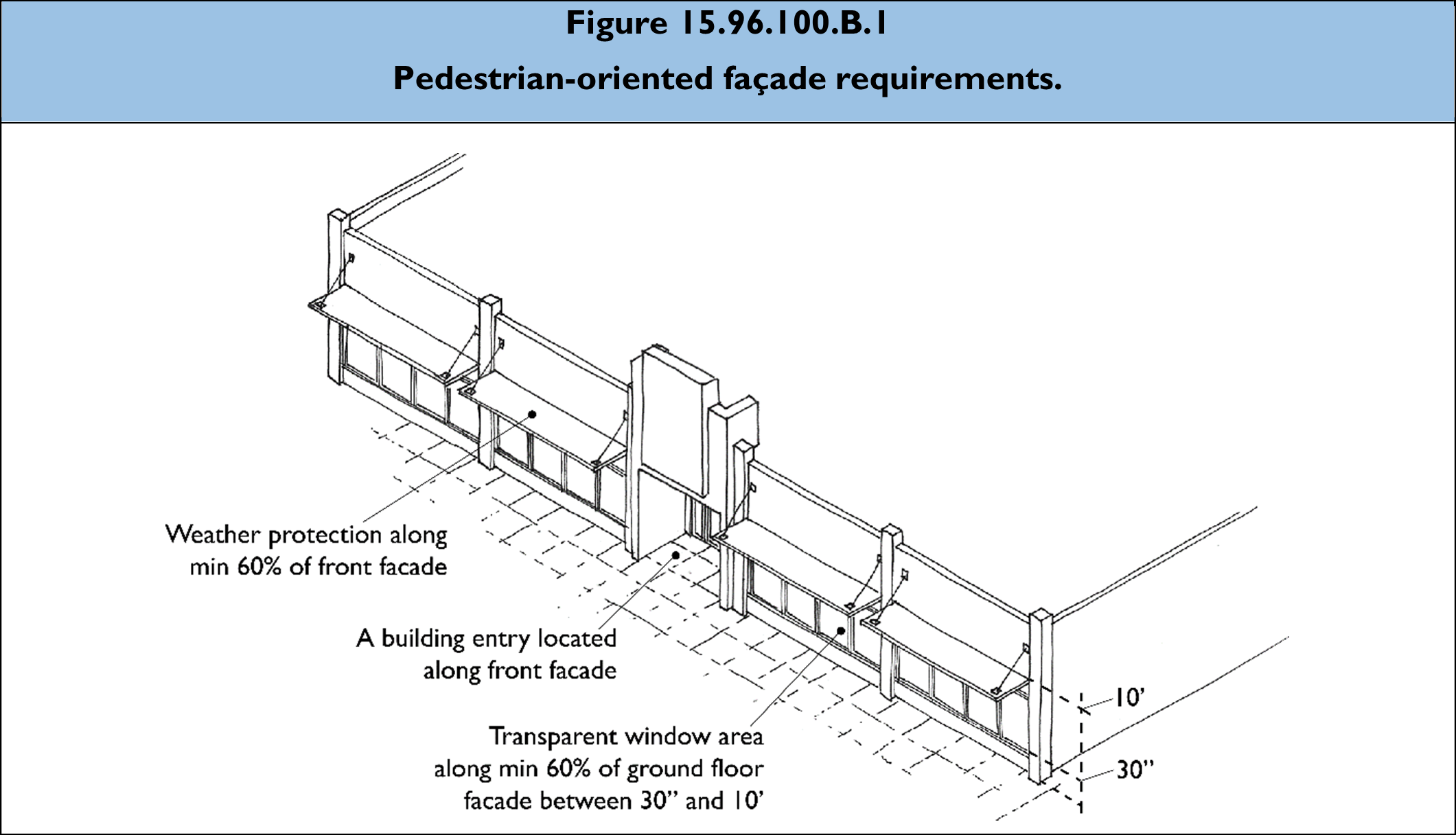
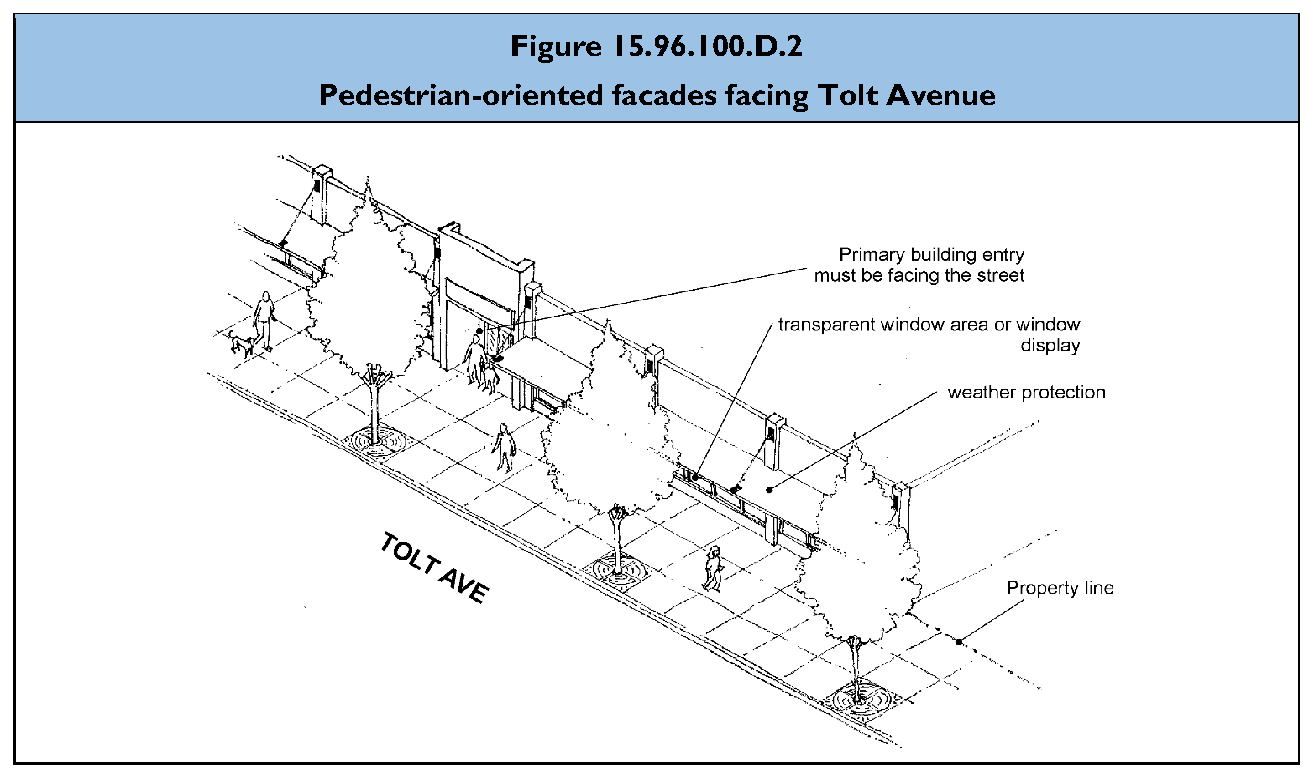
Non-residential uses may be placed up to the edge of the sidewalk of any street (unless otherwise noted) only if they feature a pedestrian-oriented façade, including the following elements:
1.
Weather protection at least five feet deep on average along at least 60-percent of the façade.
2.
Building entry(s) located along the street facing façade.
3.
Transparent window area along at least 60-percent of the ground floor façade between 30- inches and 10-feet above the sidewalk level.
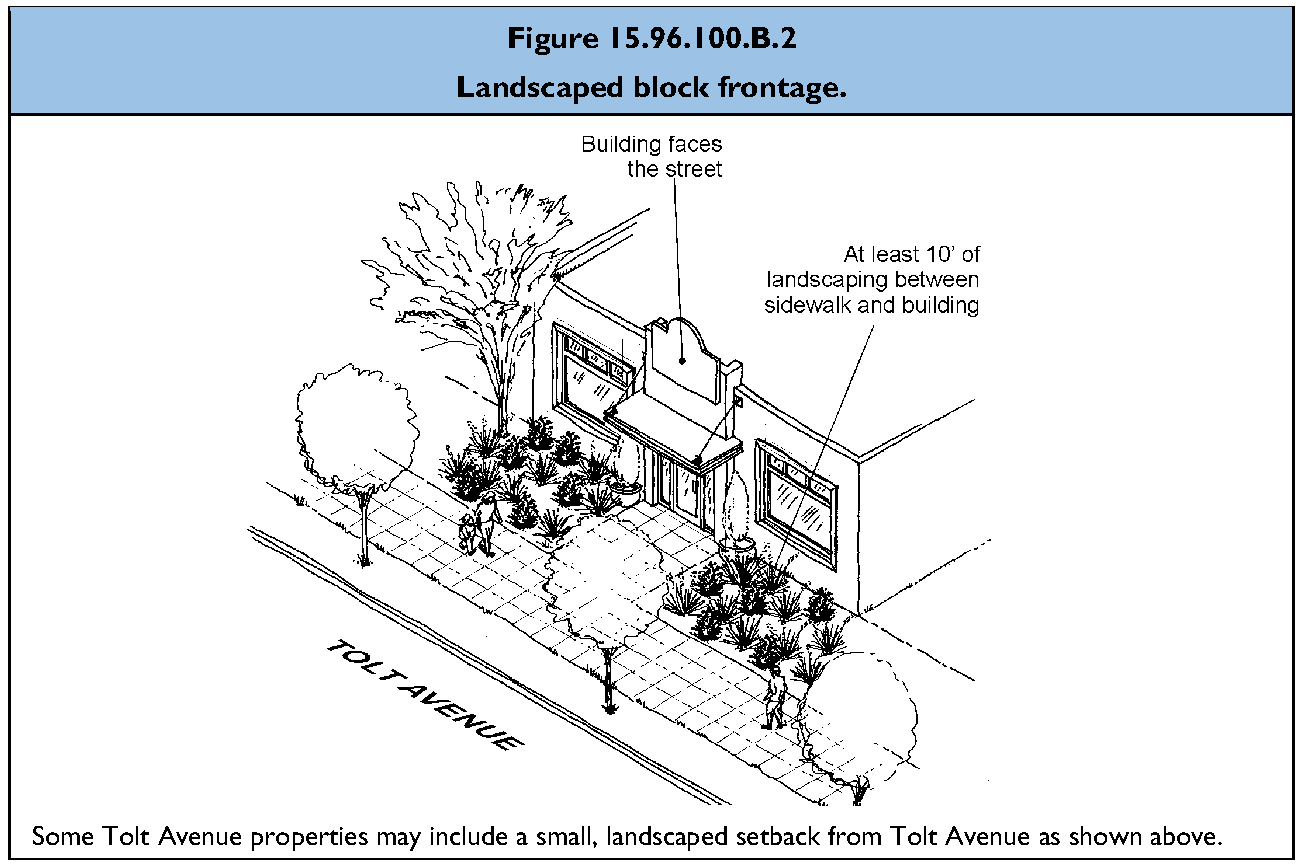
Otherwise, developments shall feature landscaped block frontages with at least 10 feet of Type A, B, C, D, or E Landscaping as defined in CMC15.76.040 or pedestrian-oriented space between the sidewalk or front property line and any building, parking area, storage, or service area (see Figure 15.96.100.B.2 below and Table 15.96.100 below for illustrations and options).
C.
Blank walls - A wall (including building façades and retaining walls) is considered a blank wall if:
1.
A ground floor wall or portion of a ground floor wall over 6 feet in height has a horizontal length greater than 15 feet and does not include a window
2.
Any portion of a ground floor wall having a surface area of 400 square feet or greater does not include a window
3.
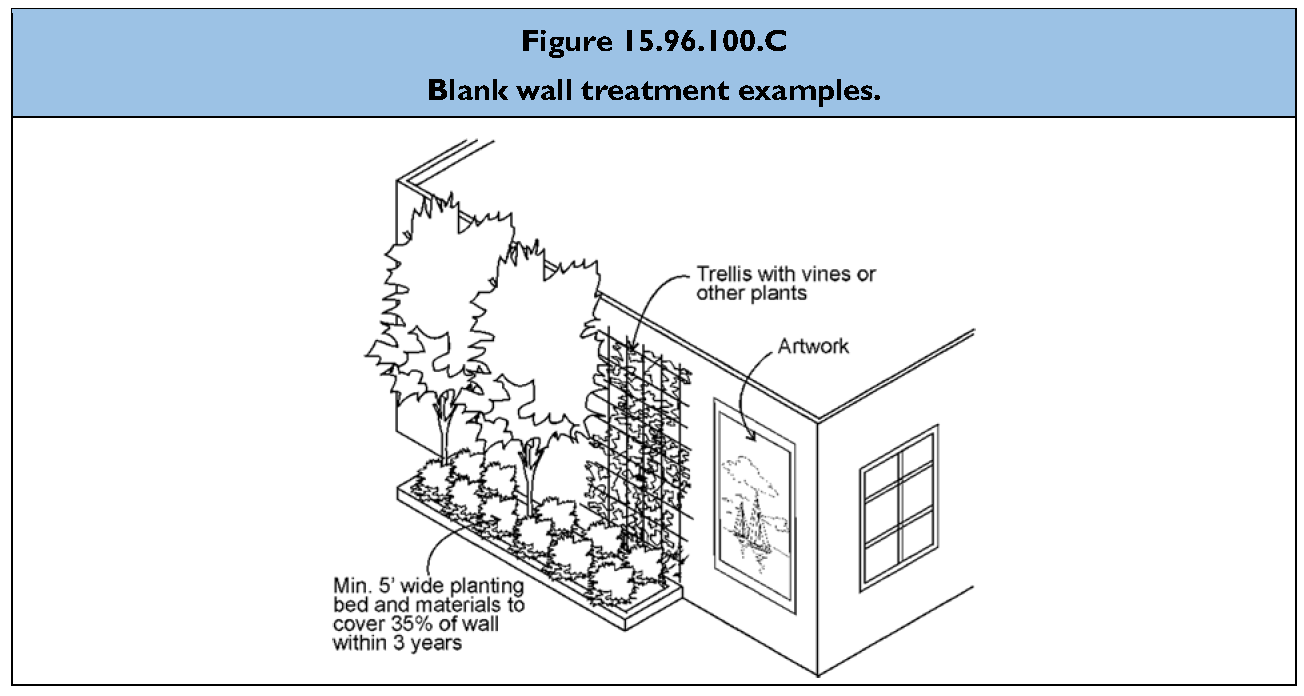
All Sites: Untreated Blank walls visible from a public street or pedestrian pathway are prohibited. Methods to treat blank walls can include:
4.
Transparent windows or doors;
5.
Display windows (at least 30 inches deep)
a.
Landscape planting bed at least 5 feet wide or a raised planter bed at least 2 feet high and 3 feet high in front of the wall with planting materials that are sufficient to obscure or screen at least 35 percent of the wall's surface within three years.
b.
Installing a vertical trellis in front of the wall with climbing vines or plant materials.
c.
Other methods that meet the purpose.
d.
Mural art related to Carnation's history.
D.
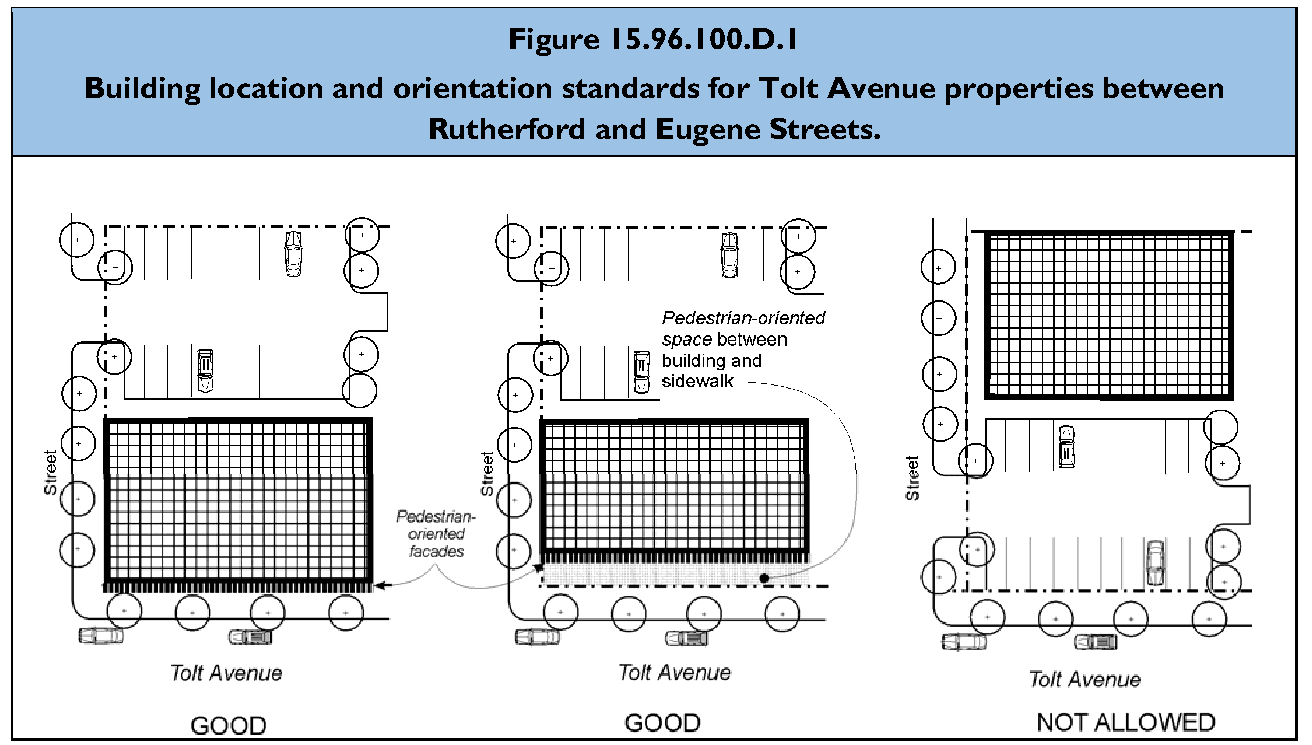
Properties adjacent to Tolt Avenue between Eugene and Rutherford Streets: Buildings shall be located adjacent to the sidewalk on Tolt Avenue and feature pedestrian-oriented facades. Exception: Buildings may be setback from the sidewalk where pedestrian-oriented space is included between the sidewalk and the building.
E.
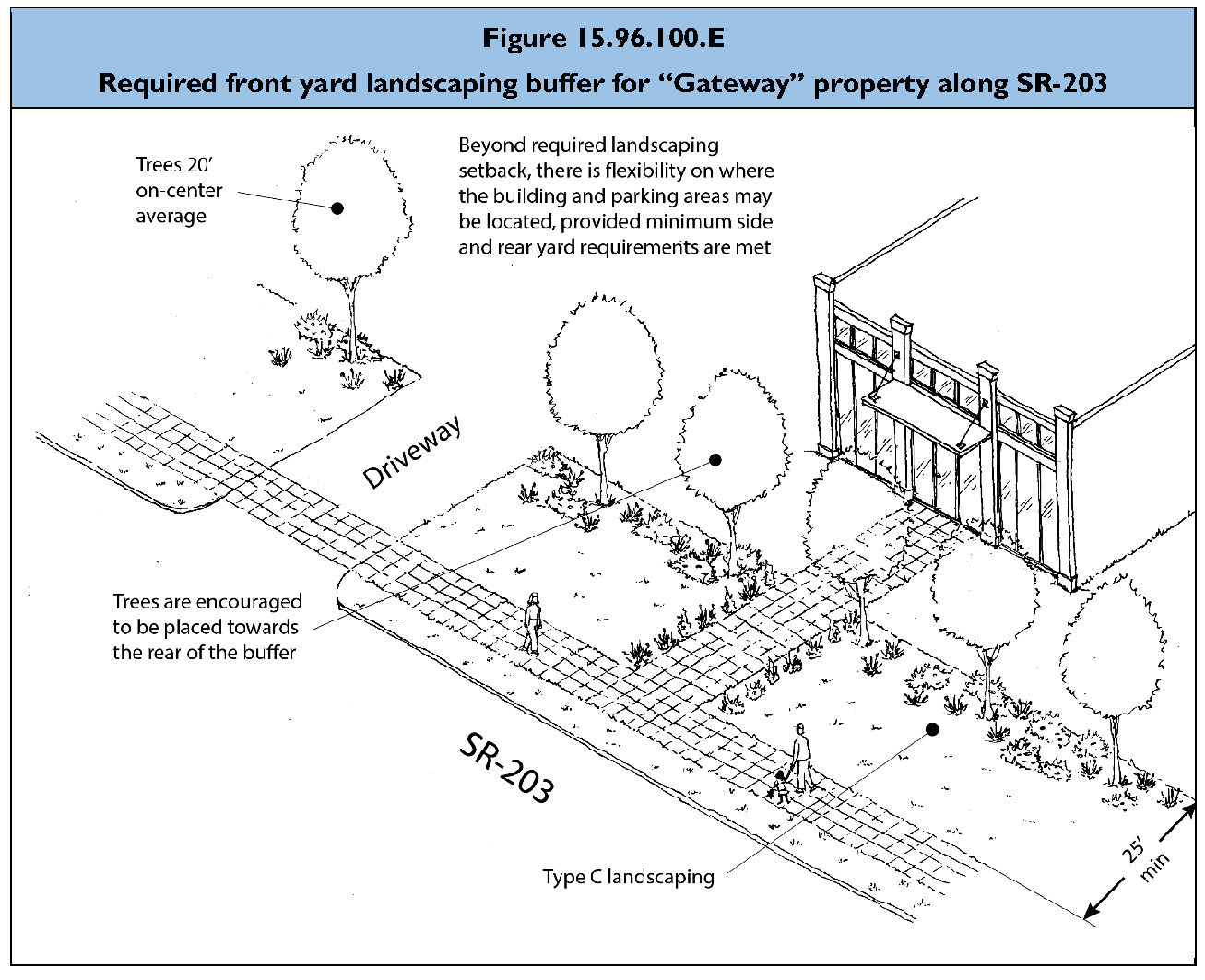
Gateway Properties (sites south of the northern edge of Tolt Middle School on both sides of Tolt Avenue/SR 203) shall provide 25 feet of Type C Landscaping along the front property adjacent to SR-203 (measured from the back of the sidewalk, where installed) with the following standards and exceptions (see Figure 15.96.100.E for an example):
1.
Driveway and walkways, where permitted and/or required, are allowed within this landscaped area. Vehicular parking, storage areas, or buildings are prohibited within this area.
2.
The required trees are encouraged to be located towards the back of the 25-foot landscape area further from the street to reinforce the pattern of openness along the street.
3.
The required trees may be clustered to increase visibility into the site from Tolt Avenue.
4.
Reduced shrub and tree coverage will be allowed where grassy swales are incorporated into the landscape area. However, no less than 1 tree per 30 lineal feet parallel to SR-203 shall be included between the street and any building, parking lot, or storage area (required trees may be placed beyond the 25-foot landscape area if necessary).
5.
Parking lot location: Beyond the required landscape area, Gateway Property project applicants shall comply with the provisions of subsection (F) below.
F.
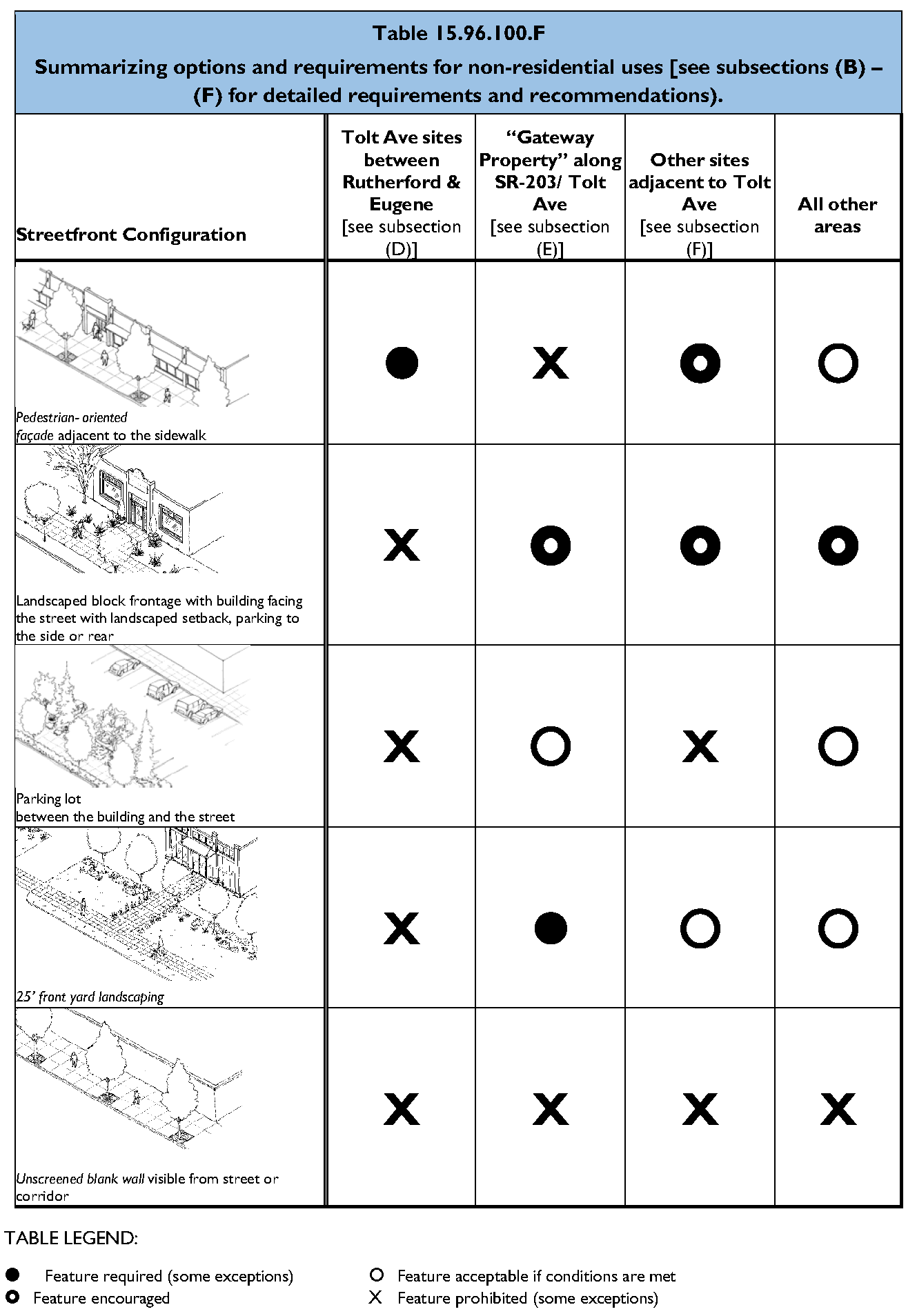
Other properties adjacent to Tolt Avenue [sites not included in Subsections (D) and (E)]: Parking areas or open storage of vehicles shall be located to the side or rear of the building. Parking lots or open storage of vehicles may not be located between a building and Tolt Avenue, except on sites with multiple buildings where no more than 50-percent of the street frontage may be occupied by parking areas. Table 15.96.100 on the following page clarifies street front options for these properties. Also see CMC 15.96.100 for large site development provisions.
G.
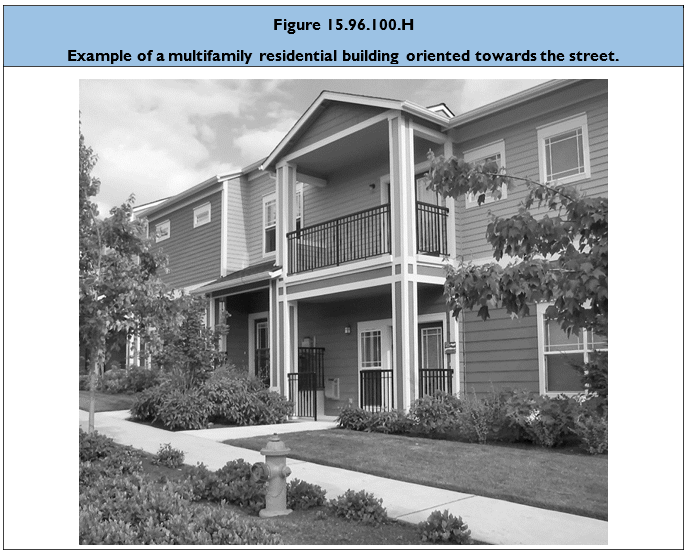
Multifamily residential buildings shall be oriented towards streets, interior private roadways, or common open space and not parking lots or adjacent properties. Specifically:
1.
The primary building entry shall face the street. Alternatively, building entries that face onto a common open space which is oriented towards the street is acceptable.
2.
Buildings with individual ground floor entries should face the street to the extent possible.
3.
Buildings shall also provide windows that face the street to provide "eyes on the street" for safety.
H.
Multifamily residential buildings located adjacent to Tolt Avenue shall provide at least 15 feet of landscaping between the sidewalk or front property line and the building. Such landscaping shall maintain visual access between the dwelling units and the street.
Note: Live-work units may be exempted from this standard where they occupy with pedestrian oriented façade standards of subsection (B).
(Ord. No. 998, § 1(Exh. A), 9-24-2024)
15.96.110 - Service & storage elements.
A.
Purpose.
1.
To encourage thoughtful siting of service and storage elements that balances the need for service and storage with the desire to screen its negative impacts.
2.
To screen the negative impacts of service elements.
B.
All Sites: Services and storage areas should be located to minimize impacts on the pedestrian environment and adjacent uses, Service elements should generally be concentrated and located where they are accessible to service vehicles and convenient for tenant use.
C.
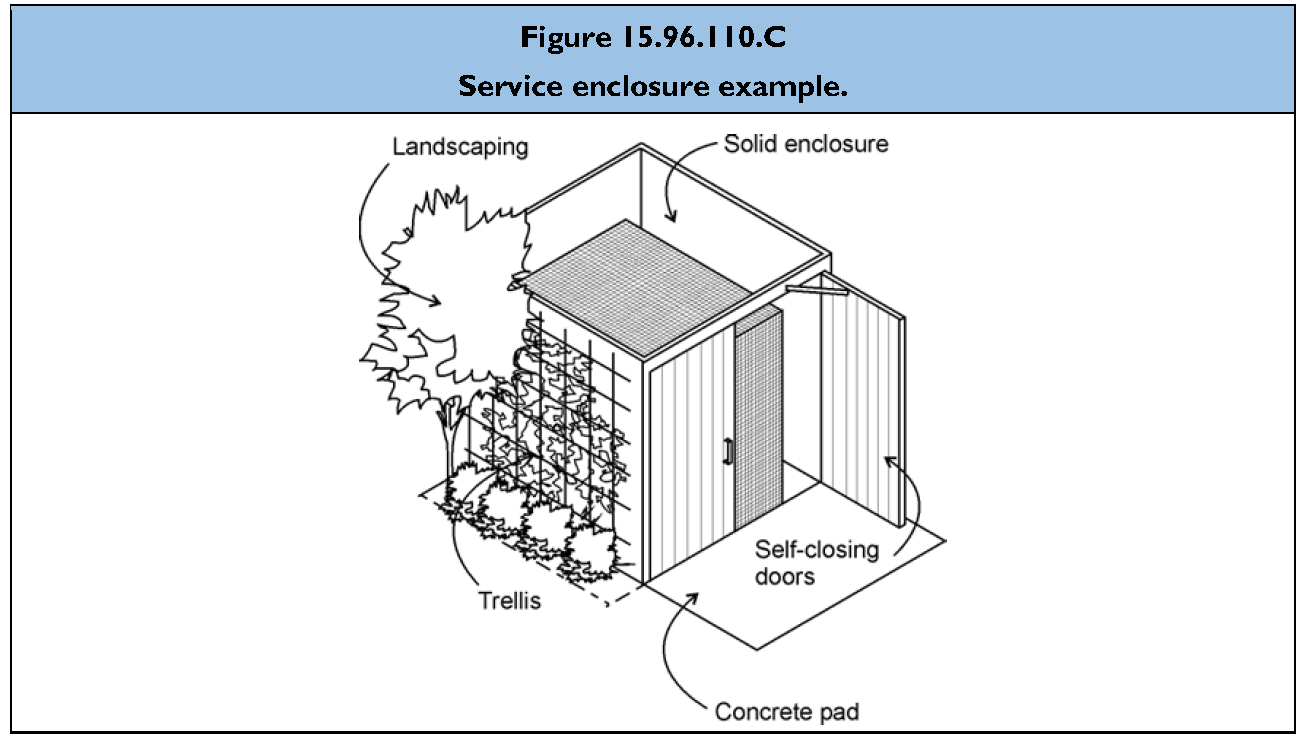
All sites: Service areas visible from the street, pathway, pedestrian-oriented space or public parking area (alleys are exempt) shall be enclosed and screened around their perimeter by a wall or fence:
1.
Structural enclosures shall be constructed of masonry, heavy-gauge metal, heavy timber, or other decay-resistant material that is also used with the architecture of the main building. Alternative materials other than those used for the main building are permitted if the finishes are similar in color and texture, or if the proposed enclosure materials are more durable than those for the main structure. The walls shall be sufficient to provide full screening from the affected roadway, pedestrian areas, or adjacent use, but shall be no greater than seven feet tall.
2.
Gates shall be made of heavy-gauge, sight-obscuring material. Chain link or chain link with slats is not an acceptable material for enclosures or gates.
3.
Where the interior of a service enclosures is visible from surrounding streets, walkways, or residential units, an opaque or semi-opaque horizontal cover or screen shall be used to mitigate unsightly views. The horizontal screen/cover should be integrated into the enclosure design (in terms of materials and/or design).
4.
Screening elements shall allow for efficient service delivery and removal operations.
5.
If the area is adjacent to a public street, sidewalk, or interior pathway, a landscaped planting strip, minimum three feet wide, shall be located on three sides of such facility.
DEPARTURES will be considered, provided the enclosure and landscaping treatment meet the purpose of the standards and add visual interest to site users.
D.
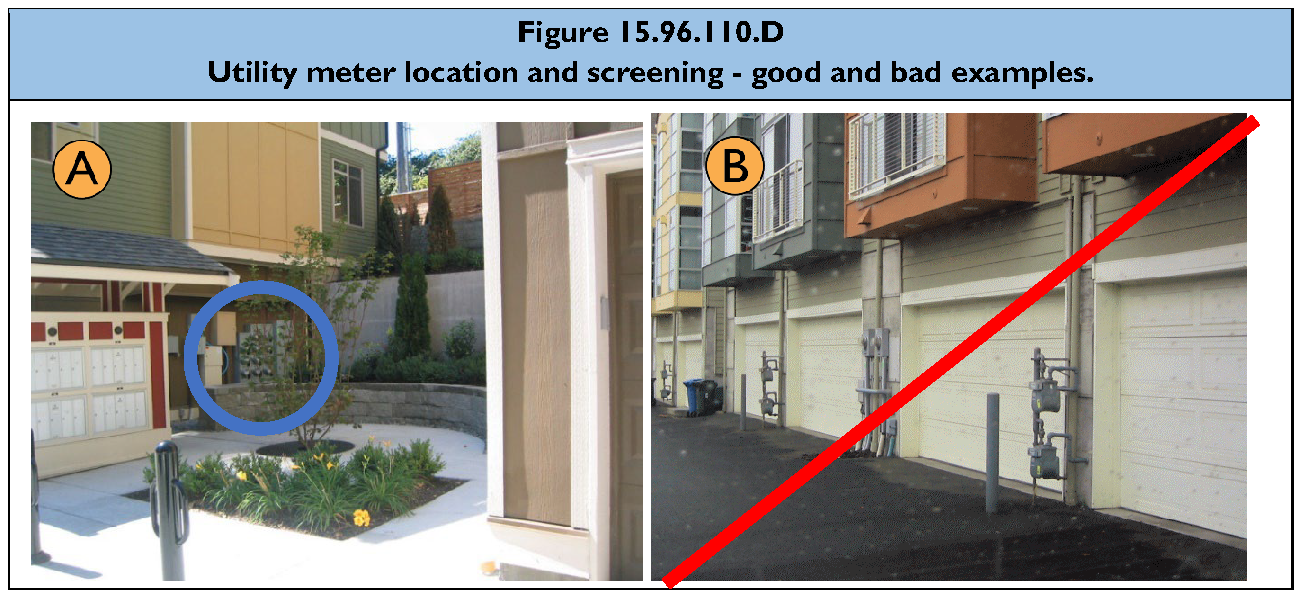
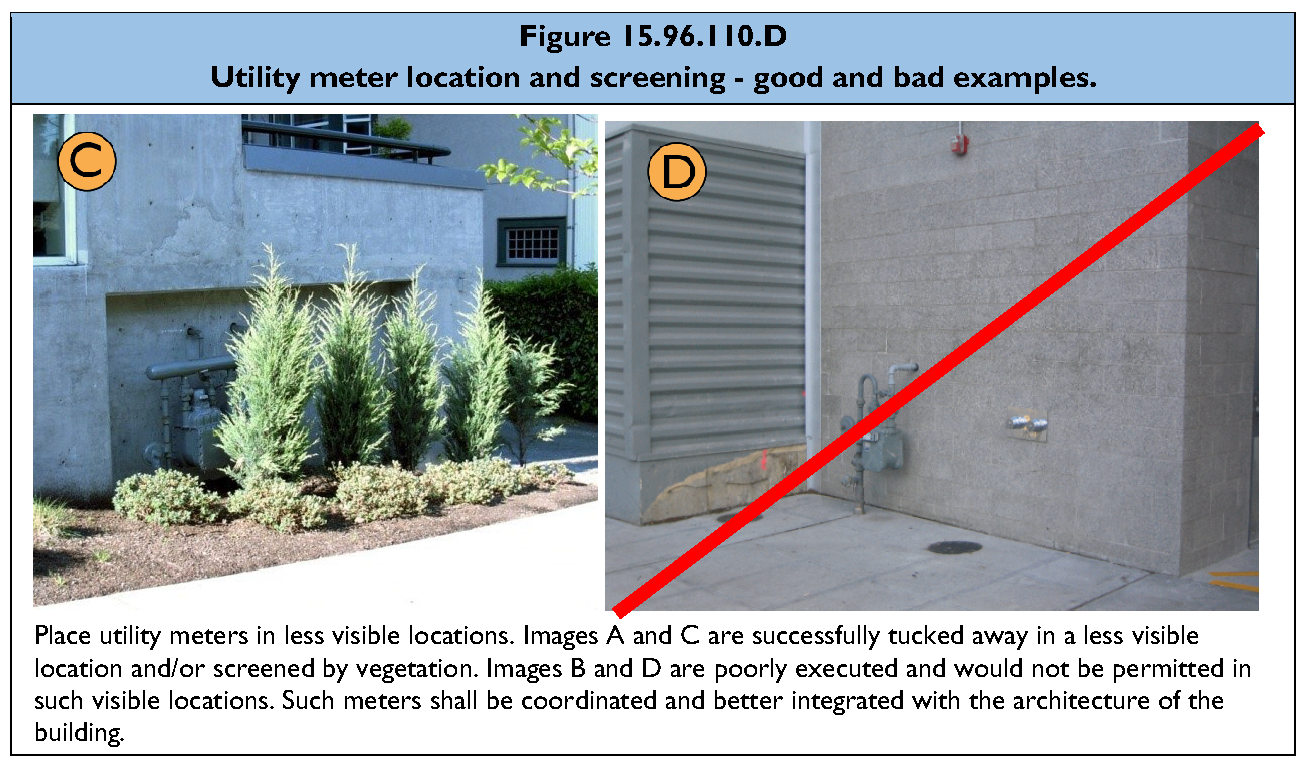
All Sites: Utility meters, electrical conduit, and other service utility apparatus. These elements shall be located and/or designed to minimize their visibility to the public. Project designers are strongly encouraged to coordinate with applicable service providers early in the design process to determine the best approach in meeting these standards. If such elements are mounted in a location visible from the street, internal walkway, common outdoor recreation area, or shared auto courtyards, they shall be screened with vegetation and/or integrated into the building's architecture.
E.
All Sites: Roof-mounted mechanical equipment shall be located so as not to be visible from the street, public open space, parking areas, or from the ground level of adjacent properties. Screening features should utilize similar building materials and forms to blend with the architectural character of the building.
(Ord. No. 998, § 1(Exh. A), 9-24-2024)
PEDESTRIAN ACCESS, AMENITIES, AND OPEN SPACE
15.96.200 - Sidewalks and pathways.
A.
Purpose.
1.
To improve the pedestrian environment by making it easier, safer and more comfortable to walk throughout the City, particularly in the Downtown area.
2.
To promote walking both as a social activity and an alternative to driving.
3.
To increase the vitality of Carnation's business districts and multifamily areas.
B.
All Sites: Public sidewalks shall conform to Carnation Street and Storm Sewer System Standards, as well as the requirements in CMC, Chapter 12.06.
C.
All Sites: Standards for interior pathways:
1.
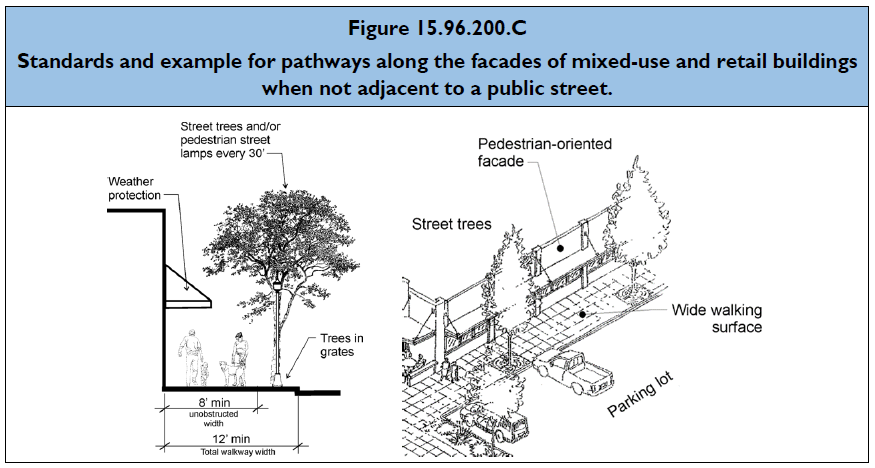
Sidewalks and pathways along the façade of mixed-use and retail buildings 100 or more feet in width (measured along the façade) that are not located adjacent to a public street shall provide sidewalks at least 12 feet in width. The walkway shall include an 8-foot minimum unobstructed walking surface and street trees placed on average 30 feet on-center. Exceptions:
a.
Pedestrian lighting fixtures are not required but may be placed at 30 feet on-center as an alternative to up to 50-percent of the required street trees.
b.
To increase business visibility and accessibility, breaks in the required tree coverage will be allowed adjacent to major building entries (for businesses with at least 5,000 square feet of floor area).
However, no less than one tree per 60 lineal feet of the required walkway shall be required.
c.
For all other interior pathways, the applicant shall successfully demonstrate that the proposed walkway is of sufficient width to accommodate the anticipated number of users. At a minimum, walkways shall feature 5 feet of unobstructed width and meet the construction standards of CMC Chapter 12.06.
d.
All pedestrian pathways shall correspond with Federal, State, and local codes for mobility impaired persons, and the Americans with Disabilities Act.
(Ord. No. 998, § 1(Exh. A), 9-24-2024)
15.96.210 - Pedestrian network.
A.
Purpose.
1.
To promote walking in Carnation.
2.
To enhance connectivity between uses and properties where desirable.
3.
To enhance the quality of new developments.
B.
All buildings shall have clear pedestrian access to the sidewalk. Where a use fronts two streets, access shall be provided from the road closest to the main entrance, but preferably from both streets.
C.
All Sites, where applicable: Pedestrian paths or walkways connecting all businesses and the entries of multiple commercial buildings frequented by the public on the same development site shall be provided.
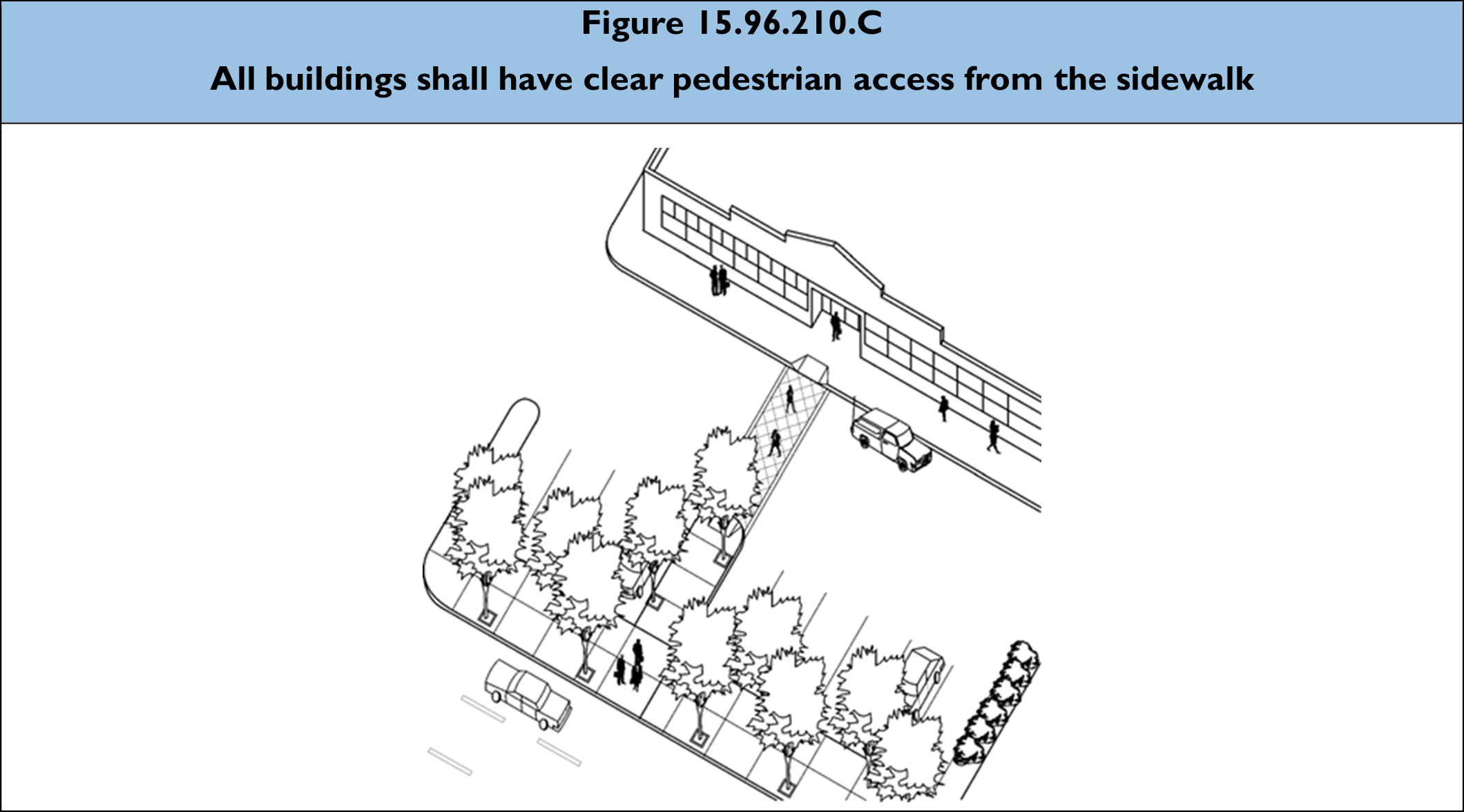
D.
For large sites (over 2 acres) abutting vacant, undeveloped land, the Director or City Planner may require new development to provide for the opportunity for future connection to its interior pathway system using pathway stub-outs, building configuration, and/or parking lot layout. For example, a grid of pedestrian connections at intervals of no more than every 400 feet would meet the purpose statements above and be scaled like Carnation's block sizes in the Central Business District.
E.
All sites, where applicable: Provide pathways through parking lots. A paved walkway or sidewalk shall be provided for safe walking areas through parking lots greater than 150 feet long (measured either parallel or perpendicular to the street front). Walkways shall be provided for every three parking aisles or at less than 150 feet shall be maintained between paths (whichever is more restrictive). Such access routes through parking areas shall be separated from vehicular parking and travel lanes by use of contrasting paving material which may be raised above the vehicular pavement. Speed bumps may not be used to satisfy this requirement.
1.
All sites, where applicable: Crosswalks are required when a walkway crosses a paved area accessible to vehicles.
2.
All sites, where applicable: Applicants shall continue the sidewalk pattern and material across driveways.
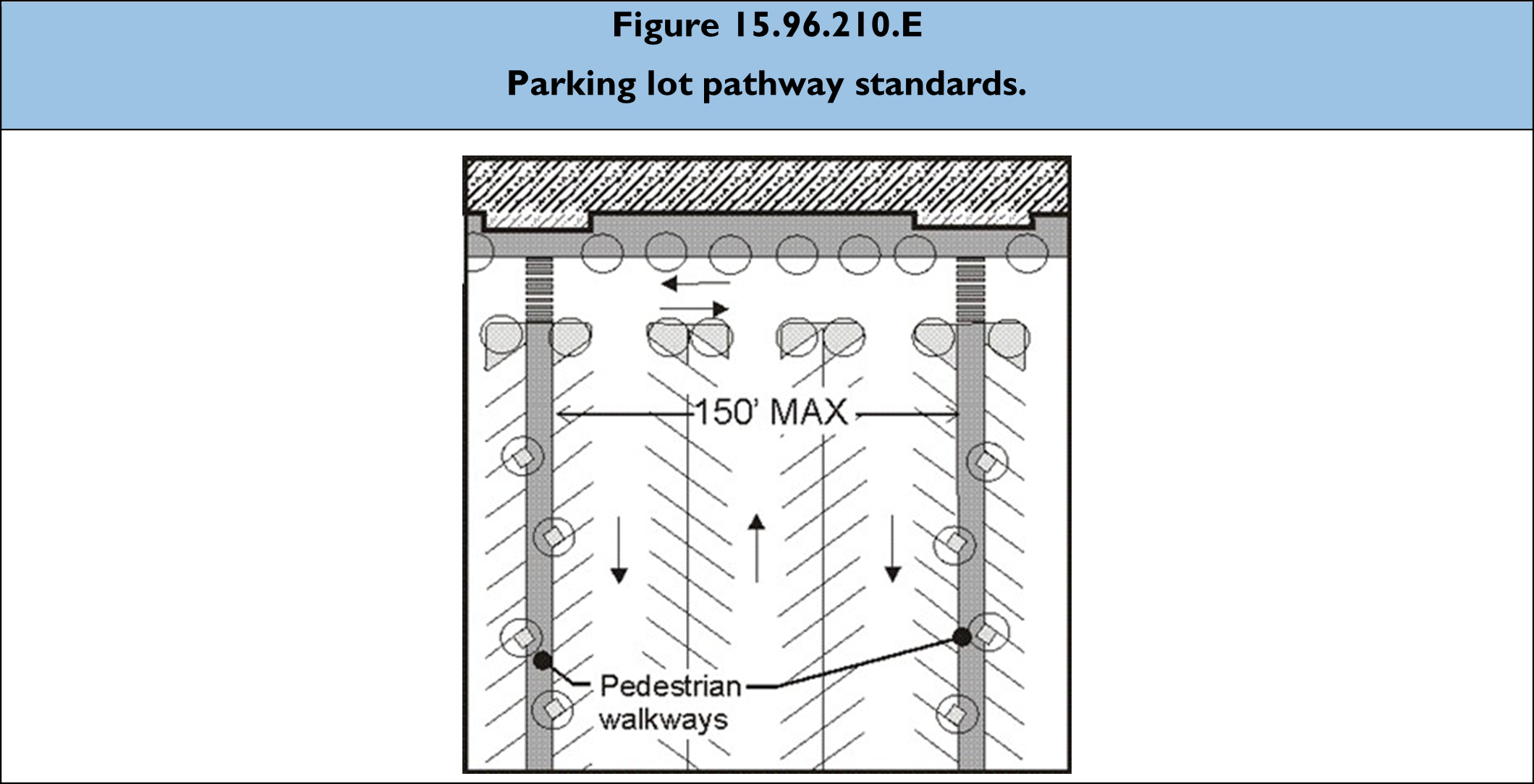
F.
All sites, where applicable: Developments should include an integrated pedestrian circulation system that connects buildings, open spaces, and parking areas with the adjacent street sidewalk system. Multifamily residential complexes and commercial developments should not be isolated enclaves separated from each other by fences, walls, and parking lots. Also, connections to adjacent properties are particularly important.
G.
All sites, where applicable: Buildings with entries not facing the street (where allowed) should have a clear and obvious pedestrian accessway from the street to the entry.
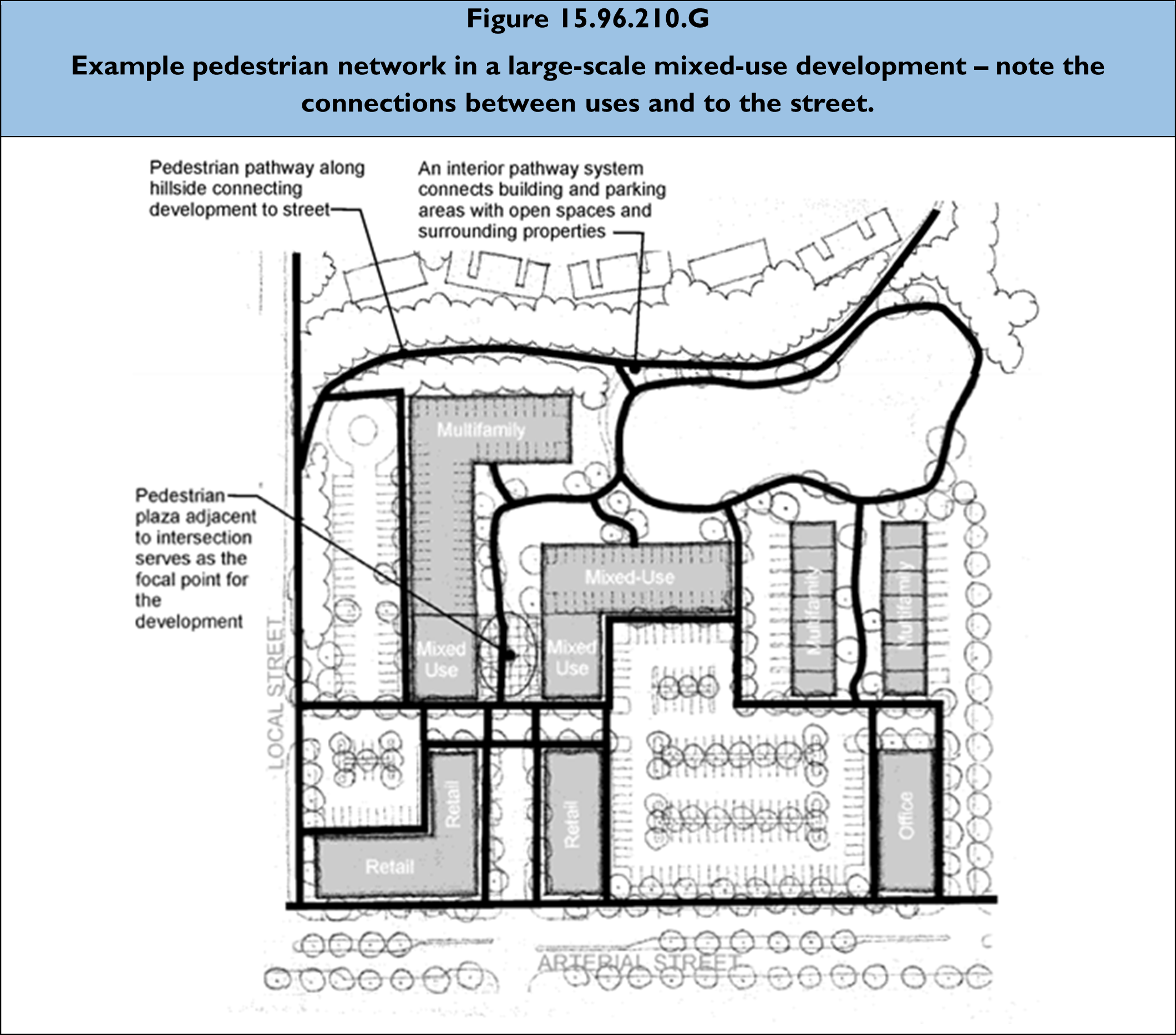
(Ord. No. 998, § 1(Exh. A), 9-24-2024)
15.96.220 - Pedestrian-oriented spaces.
A.
Purpose.
1.
To provide a variety of pedestrian-oriented areas to attract shoppers to commercial areas and enrich the pedestrian environment.
2.
To create gathering spaces for the community.
3.
To create inviting spaces that encourage pedestrian activity.
B.
Definition and requirements of pedestrian-oriented spaces:
1.
To qualify as a pedestrian-oriented space, an area shall have:
a.
Pedestrian access to the abutting structures from the street, private drive, or a nonvehicular courtyard.
b.
Paved walking surfaces of either concrete or approved unit paving.
c.
Pedestrian-scaled lighting (no more than 14' in height) at a level averaging at least 2-foot candles throughout the space. Lighting may be on-site or building-mounted lighting.
d.
At least three feet of seating area (bench, ledge, etc.) or one individual seat per 60 square feet of plaza area or open space.
e.
Spaces shall be positioned in areas with significant pedestrian traffic to provide interest and security - such as adjacent to a building entry.
f.
Landscaping components that add seasonal interest to the space.
2.
The following features are encouraged in pedestrian-oriented space:
a.
Pedestrian amenities such as a water feature, drinking fountain, and/or distinctive paving or artwork.
b.
Provide pedestrian-oriented building facades on some or all buildings facing the space.
c.
Consideration of the sun angle at noon and the wind pattern in the design of the space.
d.
Transitional zones along building edges to allow for outdoor eating areas and a planted buffer.
e.
Movable seating.
3.
The following features are prohibited within pedestrian-oriented space:
a.
Asphalt or gravel pavement.
b.
Adjacent unscreened parking lots.
c.
Adjacent chain link fences.
d.
Adjacent blank walls.
e.
Adjacent dumpsters or service areas.
f.
Outdoor storage or retail sales that do not contribute to the pedestrian environment. An example is stacked bags of potting soil or compost, which are common in front of grocery stores during the spring and summer. The area used for such purposes will not be counted as pedestrian-oriented space.
C.
All non-residential uses shall provide pedestrian-oriented space in conjunction with new development according to the formula below.
1.
Pedestrian access to the abutting structures from the street, private drive, or a nonvehicular courtyard.
2.
Paved walking surfaces of either concrete or approved unit paving.
3.
Pedestrian-scaled lighting (no more than 14' in height) at a level averaging at least 2-foot candles throughout the space. Lighting may be on-site or building-mounted lighting.
4.
At least three feet of seating area (bench, ledge, etc.) or one individual seat per 60 square feet of plaza area or open space.
5.
Spaces shall be positioned in areas with significant pedestrian traffic to provide interest and security - such as adjacent to a building entry.
6.
Landscaping components that add seasonal interest to the space.
D.
The following features are encouraged in pedestrian-oriented space:
1.
Pedestrian amenities such as a water feature, drinking fountain, and/or distinctive paving or artwork.
2.
Provide pedestrian-oriented building facades on some or all buildings facing the space.
3.
Consideration of the sun angle at noon and the wind pattern in the design of the space.
4.
Transitional zones along building edges to allow for outdoor eating areas and a planted buffer.
5.
Movable seating.
E.
The following features are prohibited within pedestrian-oriented space:
1.
Asphalt or gravel pavement.
2.
Adjacent chain link fences.
3.
Adjacent blank walls.
4.
Adjacent dumpsters or service areas.
5.
Outdoor storage or retail sales that do not contribute to the pedestrian environment. An example is stacked bags of potting soil or compost, which are common in front of grocery stores during the spring and summer. The area used for such purposes will not be counted as pedestrian-oriented space.
F.
All non-residential uses shall provide pedestrian-oriented space in conjunction with new development according to the formula below.
1.
One percent of the lot area + one percent of the non-residential building area.
Note: Minimum required sidewalks or interior walkway areas shall not count as pedestrian- oriented space. However, where walkways are widened beyond minimum requirements, the widened area may count as pedestrian-oriented space if the Director or City Planner determines that the area meets the definition of pedestrian-oriented space.
Exemption: Development fronting on Tolt Avenue between Rutherford and Eugene Streets are exempt from the above pedestrian-oriented space requirements.
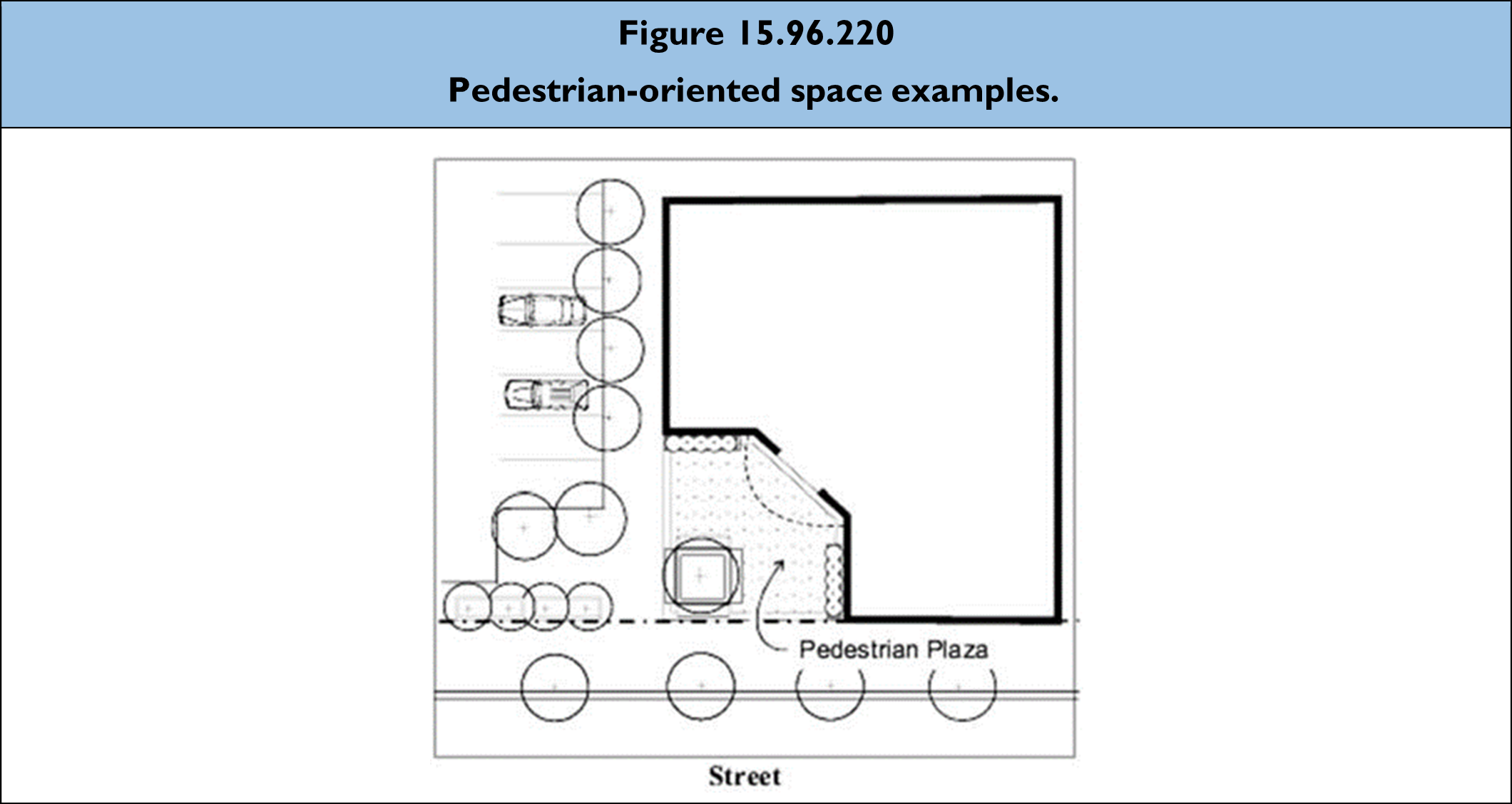
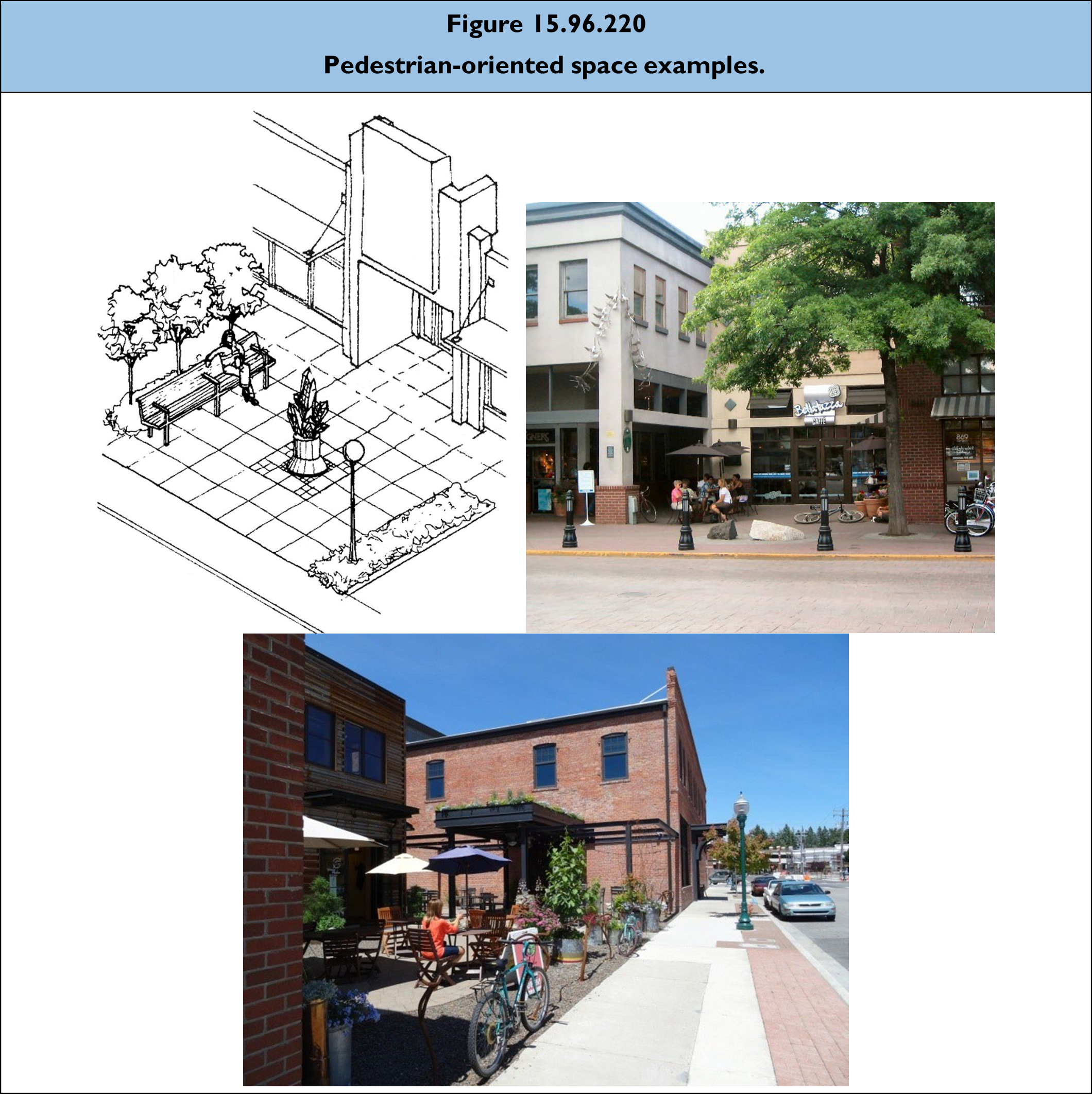
(Ord. No. 998, § 1(Exh. A), 9-24-2024)
15.96.230 - Open space and recreation for residential uses.
A.
Purpose. To create usable, accessible and inviting open spaces for residents.
B.
Multifamily residential uses shall provide at least 120 square feet of open space per unit. Open space may include private or shared (common) courtyards, patio areas, multi-purpose green spaces, and balconies. Developments have the option of integrating multiple types of open space provided the amounts and design meet the standards herein.
Special standards and considerations:
1.
Private ground level open space that is directly adjacent and accessible to dwelling units. Such space must have minimum dimensions of at least 12 feet on all sides and be configured to accommodate human activity such as outdoor eating, gardening, toddler play, etc. Street setbacks may be used to meet this standard, provided they are defined with a fence (meeting standards of Chapter 15.76 CMC).
Individual private ground level open space in excess of 120 square feet must not be used in the calculations for determining the development's minimum collective open space requirement.
2.
Common open space.
a.
Shall be large enough to provide functional leisure or recreational activity per the Director or City Planner. For example, long narrow spaces (less than 20 feet wide) rarely, if ever, can function as usable common space.
b.
Shall be visible from adjacent units.
c.
Individual entries onto the common open space from ground floor residential units are encouraged. Small, semi-private open spaces for adjacent ground floor units that maintain visual access to the common area are strongly encouraged to enliven the space.
d.
Shall feature paths, seating, lighting and other pedestrian amenities to make the area more functional and enjoyable.
e.
Shall be separated from service areas and parking lots with landscaping and/or low-level fencing.
f.
Should be oriented to receive sunlight, facing east, west or (preferably) south, when possible.
g.
Minimum required setback areas shall not count as common open space in calculations unless they are designed in such a way that the area meets the purpose.
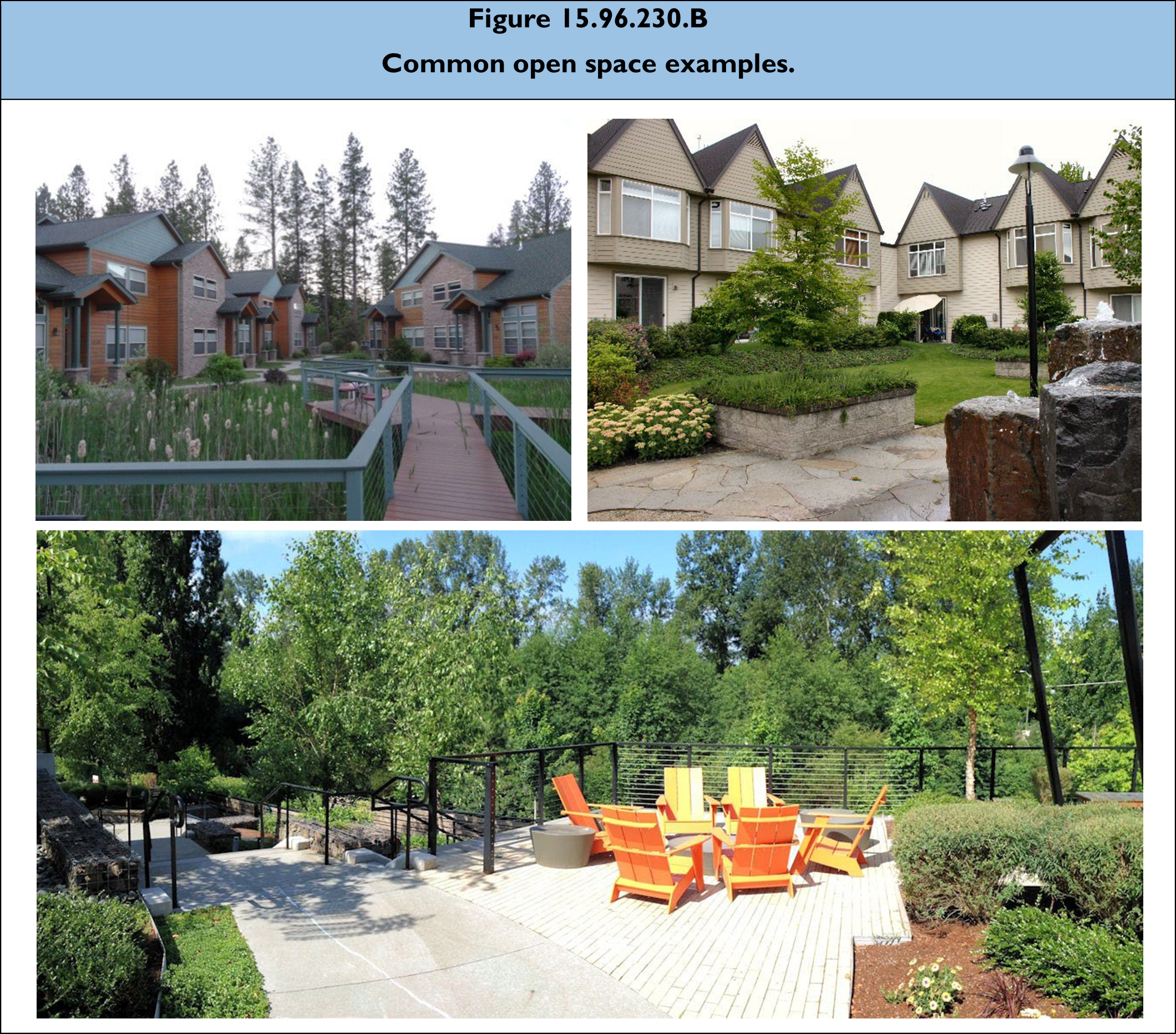
3.
Private balconies may account for up to 50 percent of the required open space and shall be at least 35 square feet with no dimension less than 4 feet to provide a space usable for human activity.
4.
Shared rooftop decks may account for up to 50 percent of the required open space.
(Ord. No. 998, § 1(Exh. A), 9-24-2024)
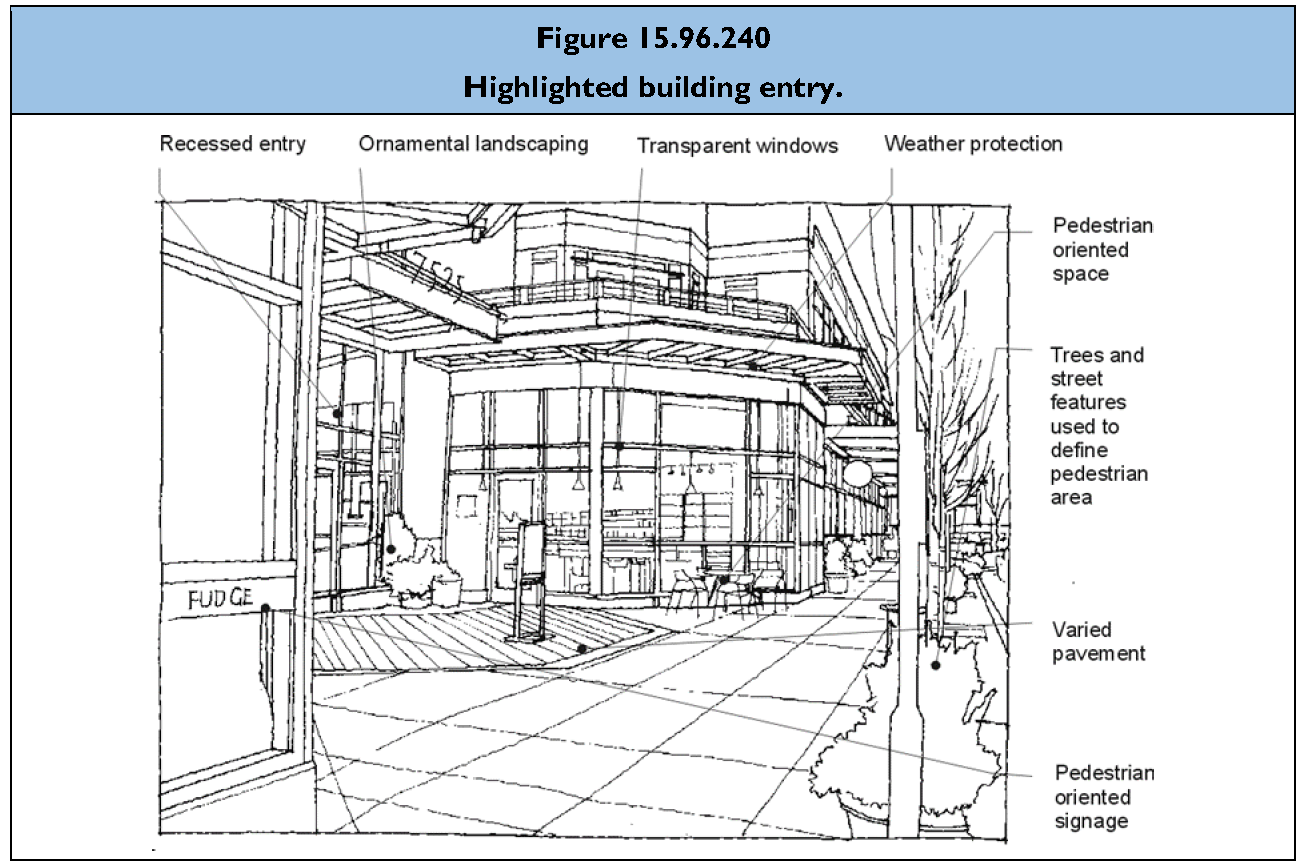
15.96.240 - Pedestrian amenities.
A.
Purpose.
1.
To enhance the pedestrian environment.
2.
To highlight building entries.
B.
All primary building entries: Weather protection at least 4-1/2 feet wide is required over all primary building, individual business, and individual residence entries.
C.
All primary non-residential building entries, except for storefronts on Tolt Avenue between Eugene and Rutherford Streets: In addition to weather protection, building entries shall be enhanced by one or more of the following means:
1.
At least 200 square feet of Type D landscaping within or adjacent to the entry.
2.
Pedestrian amenities such as vestibules, benches, outdoor eating areas, or water fountains.
3.
A trellis, canopy, or porch that incorporates landscaping.
4.
Special pedestrian scaled lighting.
5.
Special building ornamentation or paving.
(Ord. No. 998, § 1(Exh. A), 9-24-2024)
VEHICULAR ACCESS AND PARKING
15.96.300 - Access roads.
A.
Purpose.
1.
To mitigate traffic impacts.
2.
To create a safe, convenient network for vehicular circulation and parking.
B.
All sites, where applicable: Where abutting developed land provides road stub-outs, easements, or other methods to provide the opportunity for future road connections, the interior network of new development shall be designed to utilize these connections.
C.
All sites, where applicable: Developments should provide a safe and convenient network of vehicular circulation that connects to the surrounding road/access network and provides the opportunities for future connections to adjacent parcels, where applicable. For example, large sites (at least 2 acres) should generally utilize a network of vehicular connections at intervals of no more than every 400 feet. This is on a scale like Carnation's block sizes in the Central Business District.
(Ord. No. 998, § 1(Exh. A), 9-24-2024)
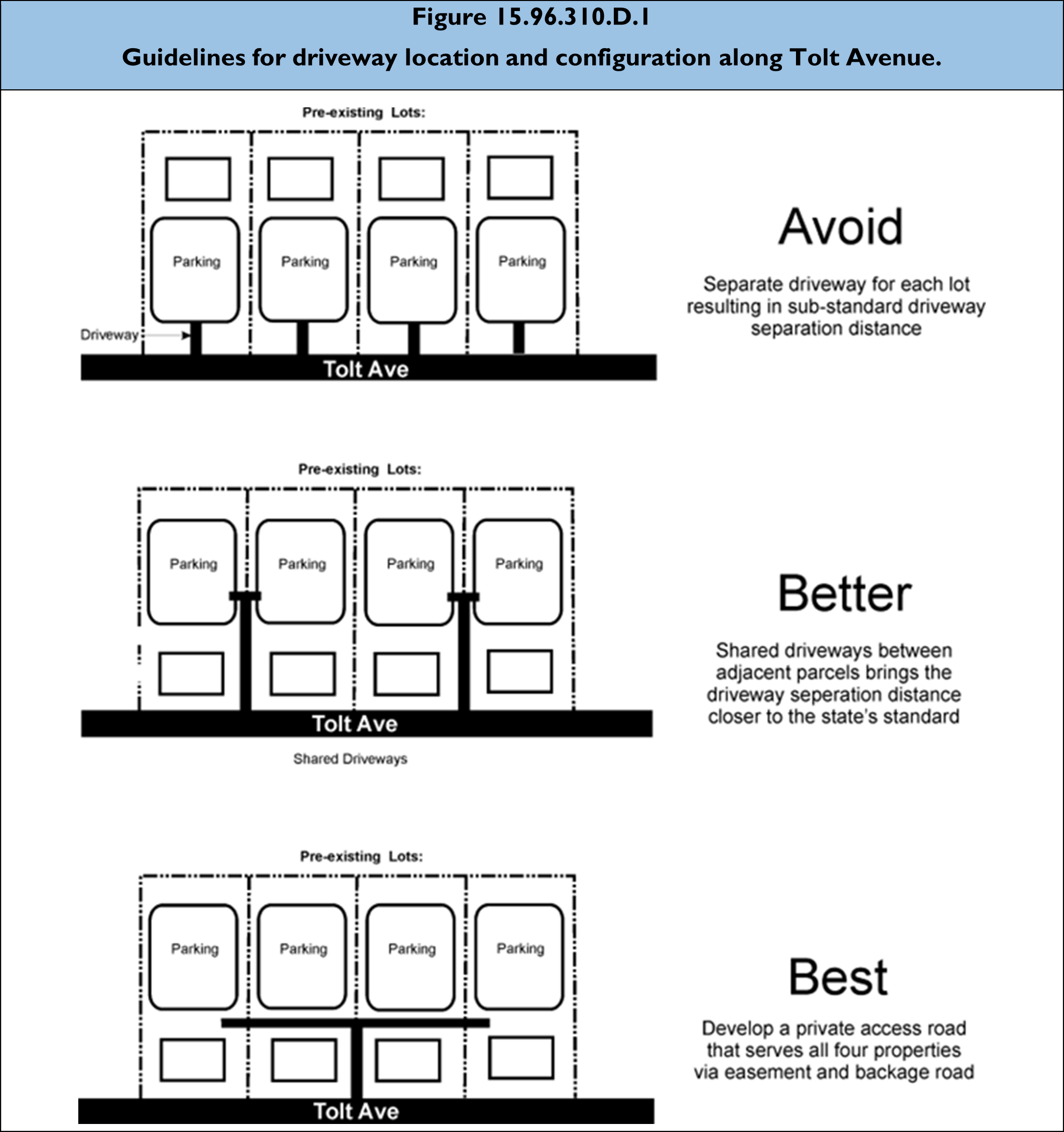
15.96.310 - Vehicular entrances and driveways.
A.
Purpose.
1.
To minimize negative impacts of vehicular access on the streetscape and pedestrian environment.
B.
Projects adjacent to Tolt Avenue shall comply with the State's Access Management Regulations.
C.
Projects adjacent to Tolt Avenue and located on corner lots shall take access from the applicable side street.
D.
Projects adjacent to Tolt Avenue that do not have access to an alley or other public street should locate driveways where they can be shared with adjacent properties where possible and where applicable. This is most applicable to the lots facing Tolt Avenue between Eugene and Blanche Streets.
(Ord. No. 998, § 1(Exh. A), 9-24-2024)
15.96.320 - Parking layout and design.
A.
Purpose.
1.
To minimize the negative impacts of parking lots on the streetscape and pedestrian environment.
2.
To promote shared parking between compatible uses.
B.
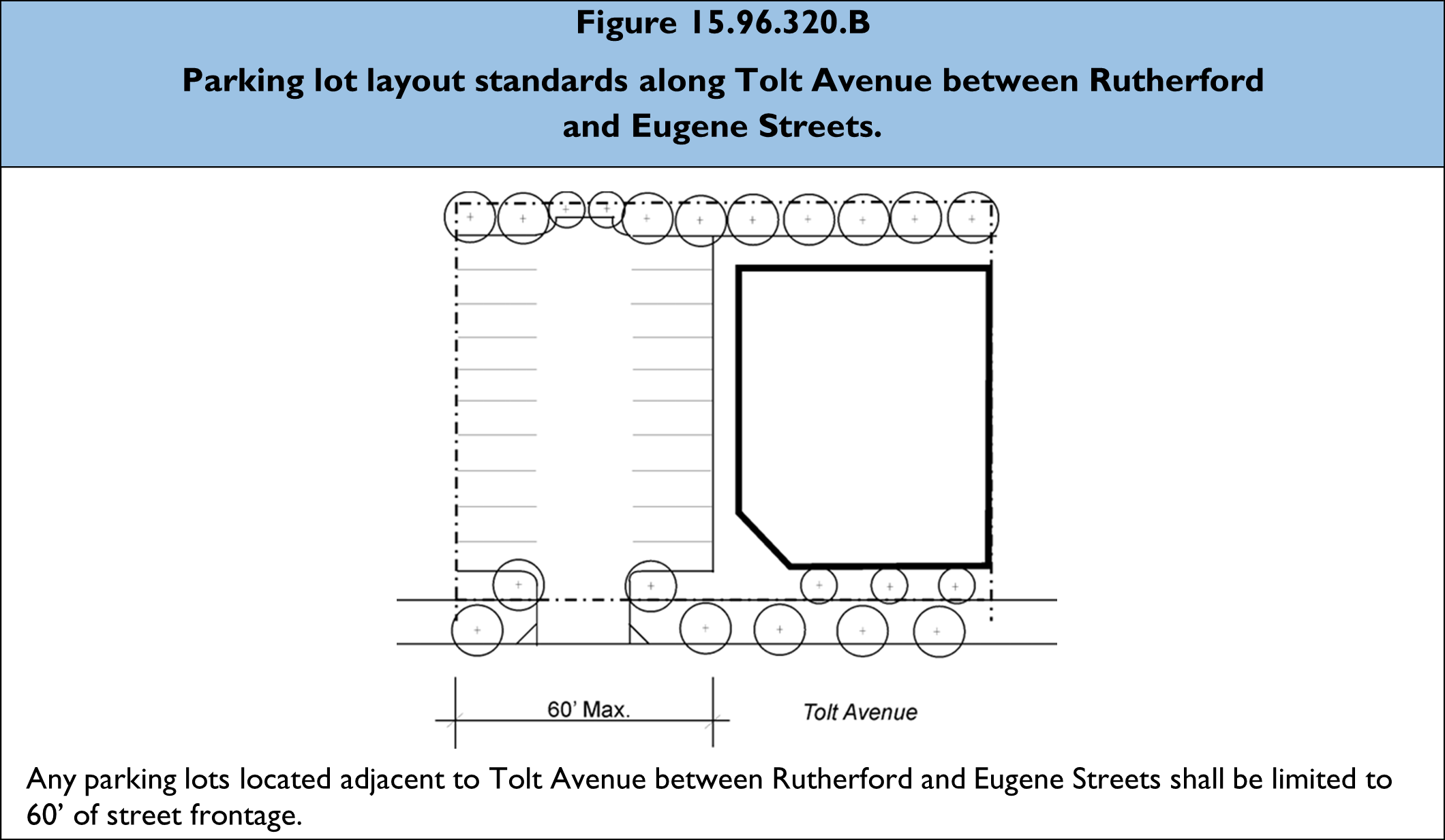
Properties adjacent to Tolt Avenue between Eugene and Rutherford Streets: Off-street parking areas shall be located behind buildings away from Tolt Avenue [also see CMC 15.96.100(D)]. Where unavoidable, any parking lots located adjacent to Tolt Avenue in this area shall be limited to 60 feet in width parallel to the street.
C.
Other properties adjacent to Tolt Avenue (those north of Rutherford Street and south of Eugene Street): Parking lots or open storage of vehicles may not be located between a building and Tolt Avenue. Parking or open storage of vehicles shall be located to the side or rear of the building (also see CMC 15.96.100(E)).
D.
Site located on intersections: Parking lots shall not be located adjacent to intersections. DEPARTURES may be granted where alterative site configurations can more successfully meet the collective purpose statements of the Site Planning and Pedestrian Access, Amenities, and Open Space sections. Such parking areas shall incorporate at least one of the following design treatments to add seasonal interest and reduce the visual impact of the parking lot on the street:
1.
Install substantial landscaping (at least 400 square feet of area adjacent to the street corner) utilizing a combination of decorative ground cover, shrubs, and/or trees.
2.
Install a trellis or other similar architectural element that incorporates landscaping.
E.
Sites not adjacent to Tolt Avenue: Off-street parking areas shall be located to the rear or side of buildings to the extent reasonably possible.
F.
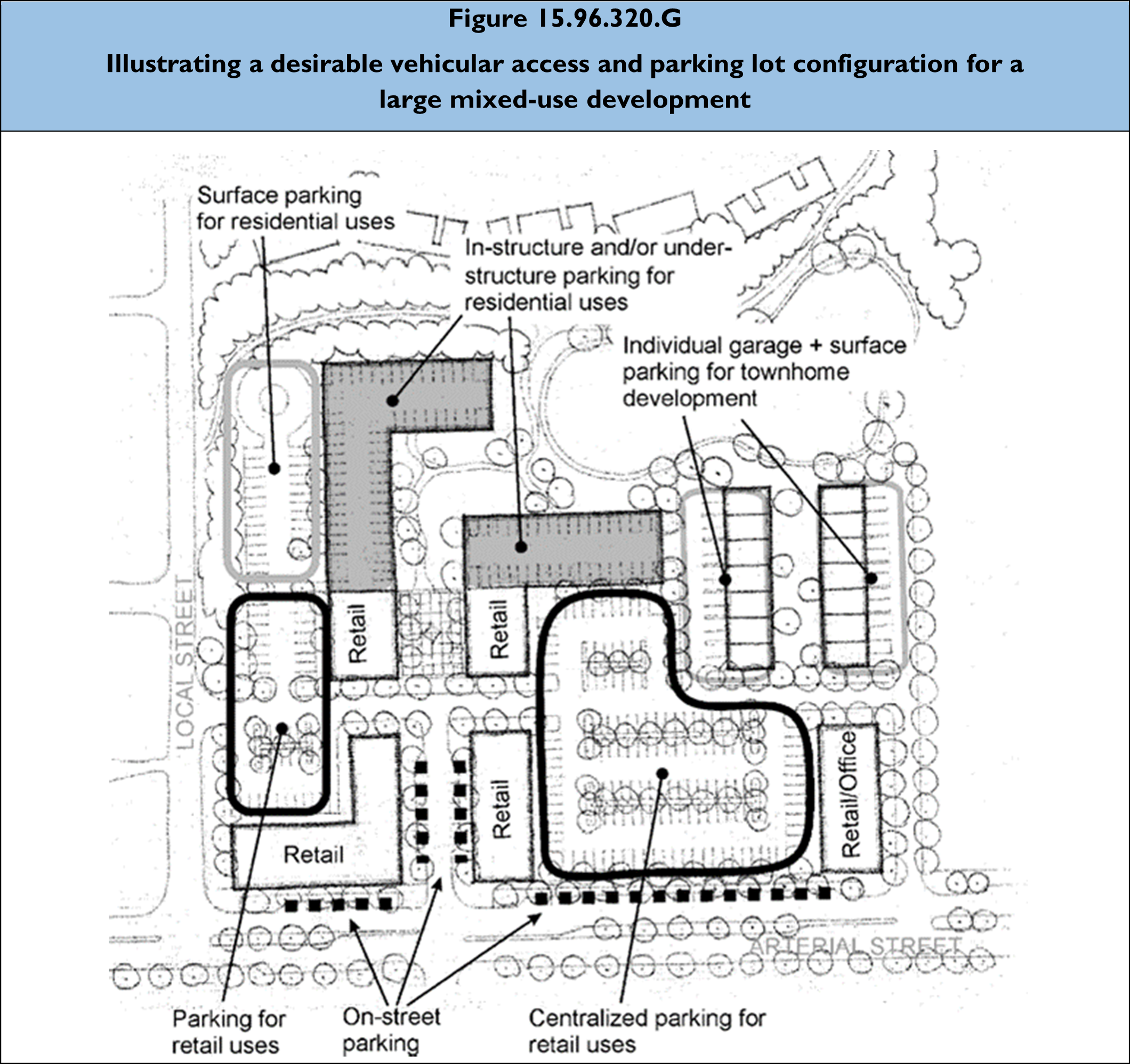
All sites, where applicable: Developments should break up large parking lots into smaller areas to the extent reasonably possible.
G.
Applicants of multiple building commercial developments shall successfully demonstrate how they've organized parking in a manner that provides for shared parking between uses on the site.
(Ord. No. 998, § 1(Exh. A), 9-24-2024)
BUILDING DESIGN
15.96.400 - Historic properties.
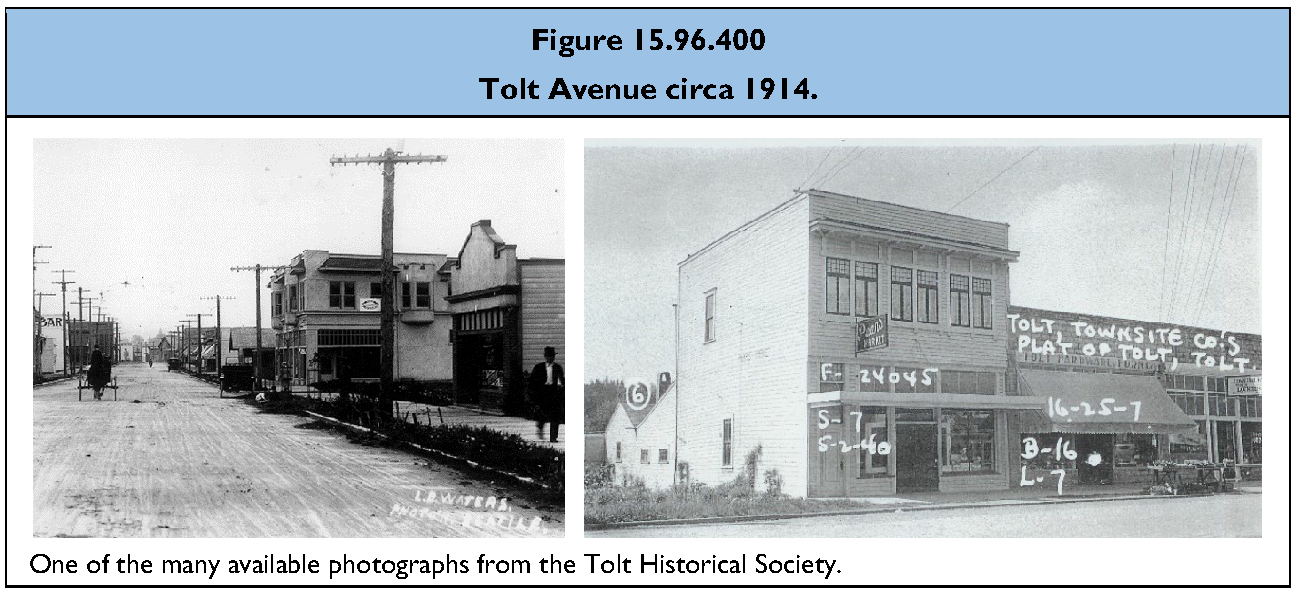
King County's Historic Preservation Program conducted a survey and inventory of Carnation's historic properties in 1995. The survey report provides a historical overview of the community, lists important sites and structures, analyzes trends and threats to historic properties, and makes recommendations for preserving and restoring historic properties. Inventory forms for individual properties contain detailed information on each building inventoried. The inventoried files contain photocopies of the historic photos readily available in 1995. A map and listing of inventoried properties are contained in the report Appendix.
Owners of historic properties should contact the City of Carnation, the Tolt Historical Society, or King County Historic Preservation Program to obtain a copy of the inventory form and historic photos of their property prior to embarking on a project.
The Tolt Oddfellows Hall, Entwistle House and Commercial Hotel are designated City of Carnation landmarks that are eligible for grants, loans, tax reductions and other incentives for preservation.
Changes to these properties go through King County's design review process to ensure that their significant historic features are preserved when they shall be altered for new uses.
A.
Purpose. To encourage preservation, rehabilitation, restoration, or reconstruction of historical properties based on appropriate historic information, materials, and methods.
B.
Property owners of identified historic buildings (from the 1995 survey identified above) and other early 20th century buildings are encouraged to use the Secretary of Interior's Standards for the Treatment of Historic Properties (available online) as a guide to preserve, rehabilitate, restore, or reconstruct historic properties. These standards provide detailed recommendations on restoration, maintenance, repair, replacement, design, alterations, building materials, roofs, interiors, etc. Contact the King County Landmarks Coordinator for technical assistance.
Historic photographs are extremely useful in determining historic precedent. Contact the Tolt Historical Society or King County regarding historical photographs.
(Ord. No. 998, § 1(Exh. A), 9-24-2024)
15.96.410 - Architectural style and character.
A.
Purpose.
1.
To reinforce the unique small-town character of Carnation.
2.
To encourage developments to employ desirable architectural features found in historical Carnation buildings without promoting a false sense of historicism.
3.
To promote the integration of design form, themes, and/or details associated with historic regional agricultural structures.
B.
All sites. Architecture that is defined predominately by corporate identity features (and difficult to adapt to other uses) is prohibited. For example, some fast-food franchises have very specific architectural features that reinforce their identity. Besides diluting the town's identity with corporate (and therefore generic) identities these buildings are undesirable because they are not adaptable to other uses when the corporate franchises leave.
C.
All sites. Unusual design themes or architectural styles that have no history with Carnation such as Eclectic Alpine, Southwest, English Tudor, International styles, are prohibited.
D.
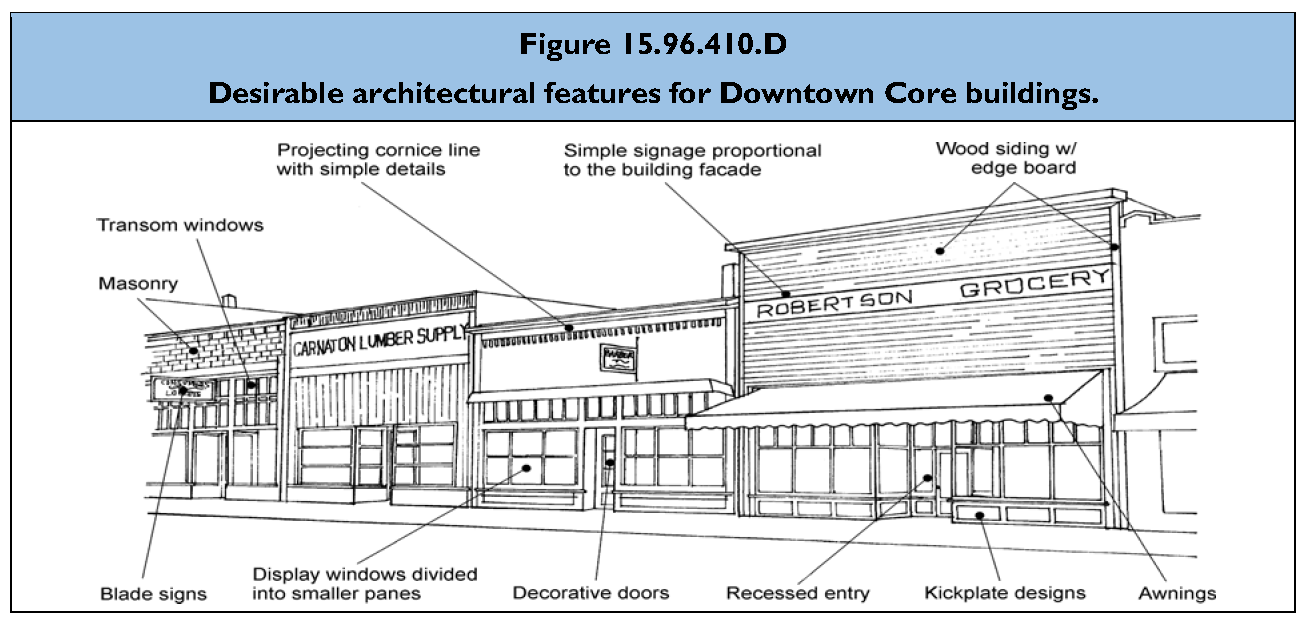
Properties adjacent to Tolt Avenue. Applicants are encouraged to base a building's architectural character on building elements and form common to early 20th century Carnation structures. Desirable building elements for commercial structures are shown in this illustration of 1916 Carnation downtown streetscape (see Figure 15.96.410.D).
E.
For sites outside of the Downtown Core area, applicants are encouraged to consider forms common to Carnation's early 20th Century residential structures (see Figure 15.96.410.E).
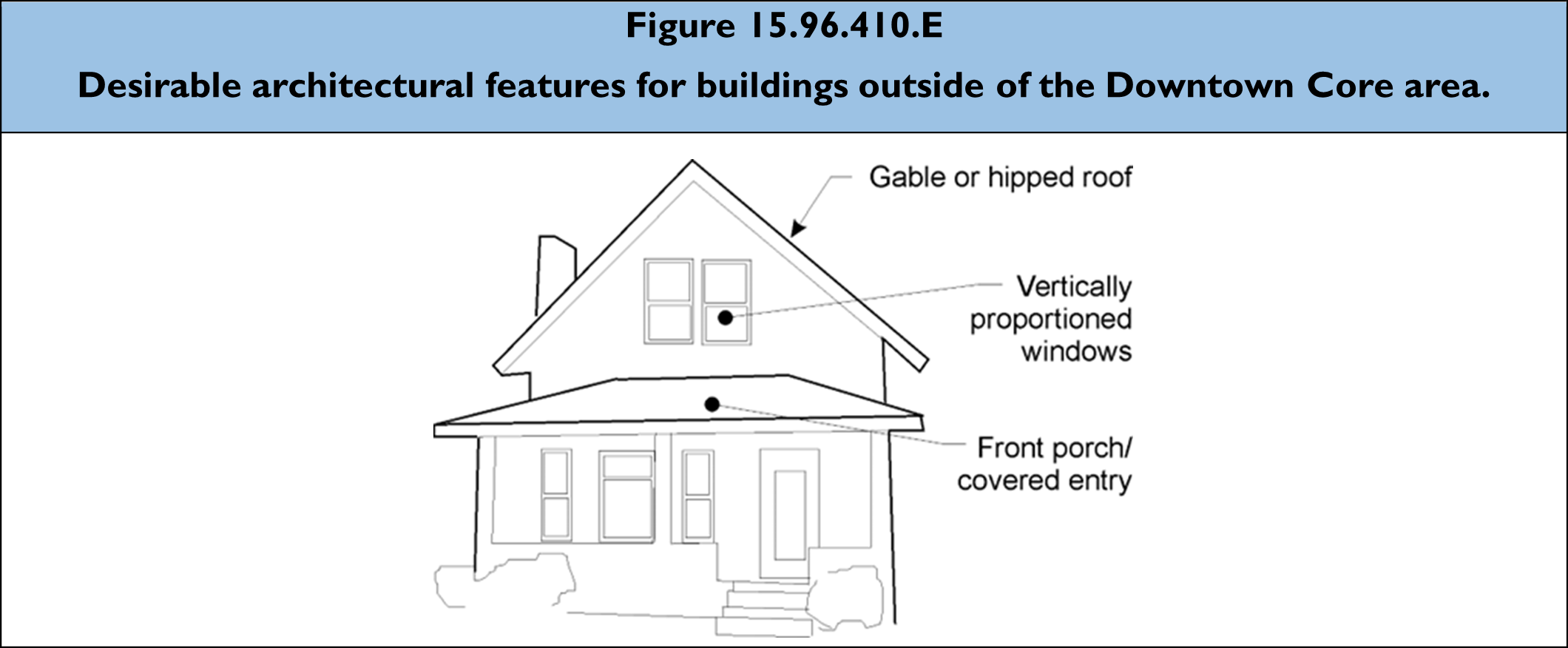
However, applicants are discouraged from employing these components in a manner that evokes a false sense of historicism (i.e. when buildings are designed precisely to look aged or old). Rather, applicants are encouraged to consider modern interpretations of these building elements and components in a way that complements the surrounding context.
F.
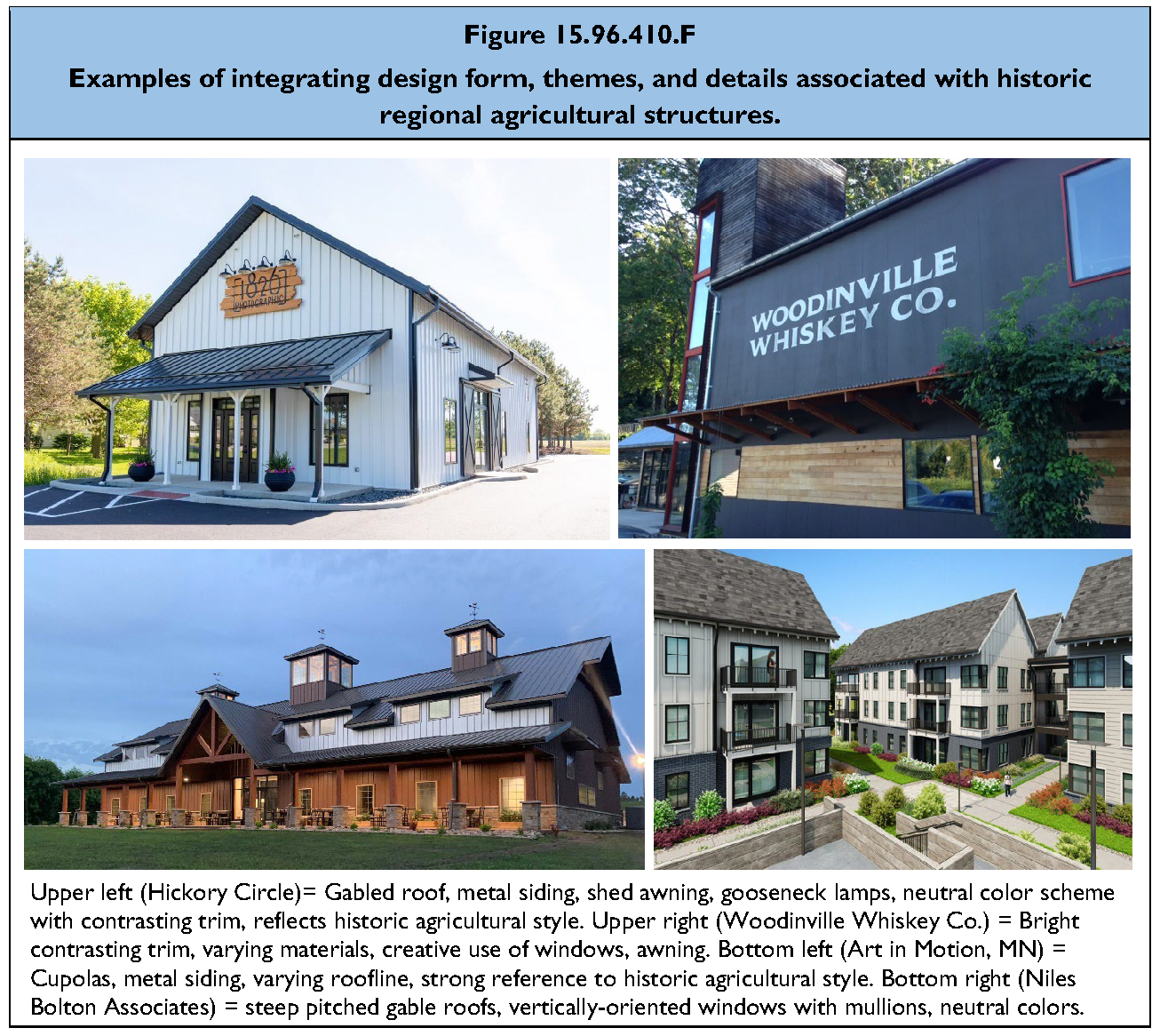
All freestanding non-residential buildings (excluding attached storefront buildings adjacent to Tolt Avenue between Eugene and Rutherford Streets). Applicants shall integrate historic regional agricultural structure -inspired design themes and/or elements into new buildings. At least three of the following design elements shall be integrated into new buildings and major remodels. Examples/components include:
1.
Barn-like roof form including gambrel or simple gable roof featuring overhanging eaves (minimum of 18" for residential, 24" for commercial), decorative braces, and brackets.
2.
Horizontal siding, board and batten, metal siding (excluding flat metal panels), masonry, or combination.
3.
Symmetrical window fenestration pattern with vertical (min 2:1) or square window shape.
4.
Other enhancements (each item integrated counts as one "element"): Decorative shutters, proportional dormers, traditional cornice line, exposed rafter tails, geometric patterns, windmills, cupola, weather vanes, water towers, or other similar details associated with historic regional agricultural structures.
DEPARTURES. The integration of only two elements will be considered provided the design composition meets the purpose of the standards and is approved by Director or City Planner.
G.
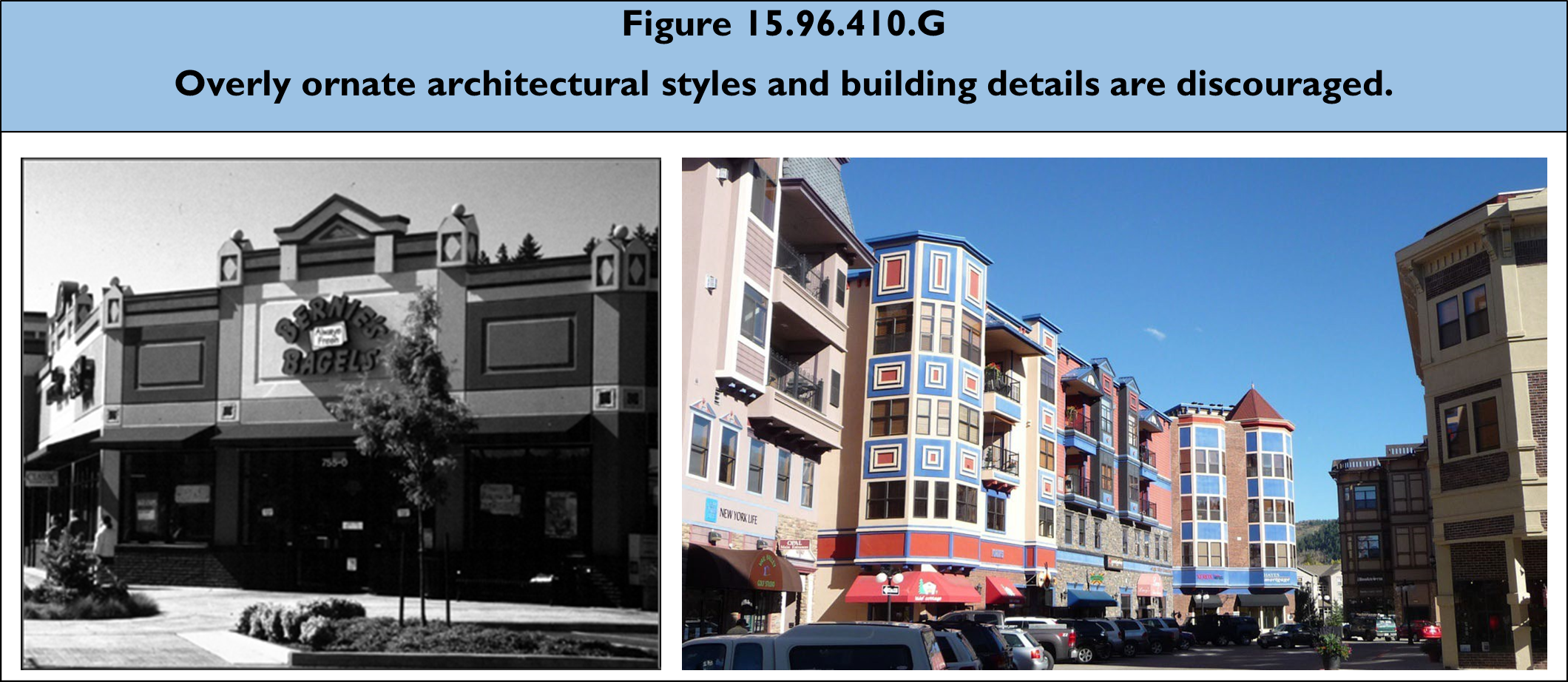
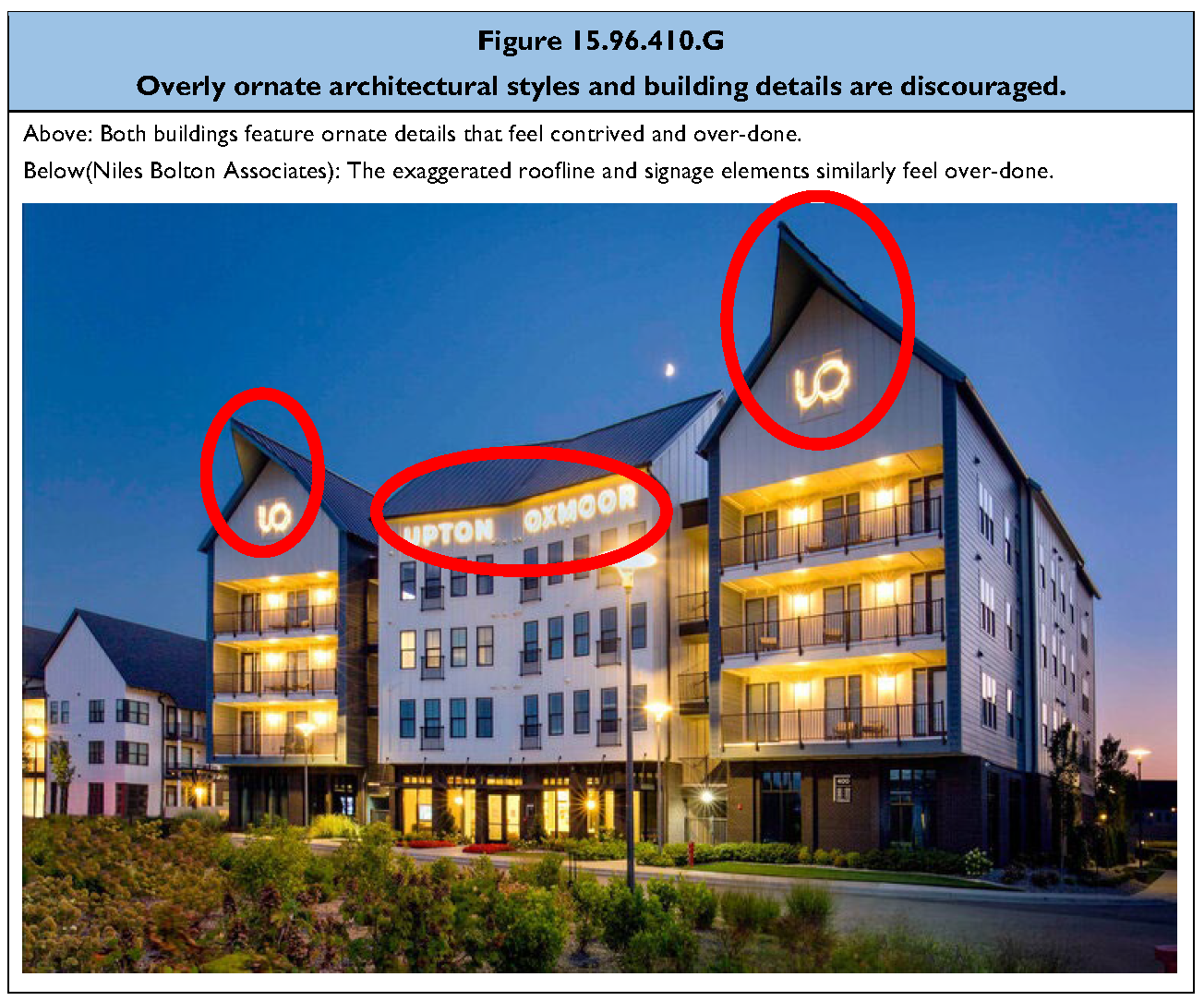
All non-residential buildings: The use of overly ornate building details that make a building look fake or contrived are strongly discouraged. See Figure 15.96.410.G below for an example.
H.
Multiple building commercial developments are encouraged to employ a variety of colors, building materials, and architectural treatments to reduce monotony and reinforce the City's small sense of scale and independent rural character.
(Ord. No. 998, § 1(Exh. A), 9-24-2024)
15.96.420 - Architectural scale and massing.
A.
Purpose.
1.
To reduce the bulk and mass of buildings compatible with Carnation's small sense of scale.
2.
To add visual interest to buildings.
3.
To enhance the character and identity of Carnation.
B.
Properties adjacent to Tolt Avenue between Eugene and Rutherford Streets: Buildings facing Tolt Avenue shall include articulation features every 25 feet to reinforce the area's pattern of small storefronts. At least three of the following methods shall be employed:
1.
Use of window and/or entries that reinforce the pattern of 25-foot storefront spaces.
2.
Use of weather protection features that reinforce 25-foot storefronts. For example, for a business that occupies three lots, use three separate awnings to break down the scale of the storefronts. Alternating colors of the awnings may be useful as well.
3.
Use of vertical piers/columns.
4.
Change of roofline, including a change in the height of a cornice by at least two feet or integration of a pitched roof form that is at least 20 feet wide with a minimum slope of 5:12.
5.
Change in building material or siding style.
6.
Other methods that meet the purpose of the standards.
Tolt Avenue facades less than 40 feet wide are exempt from this standard.
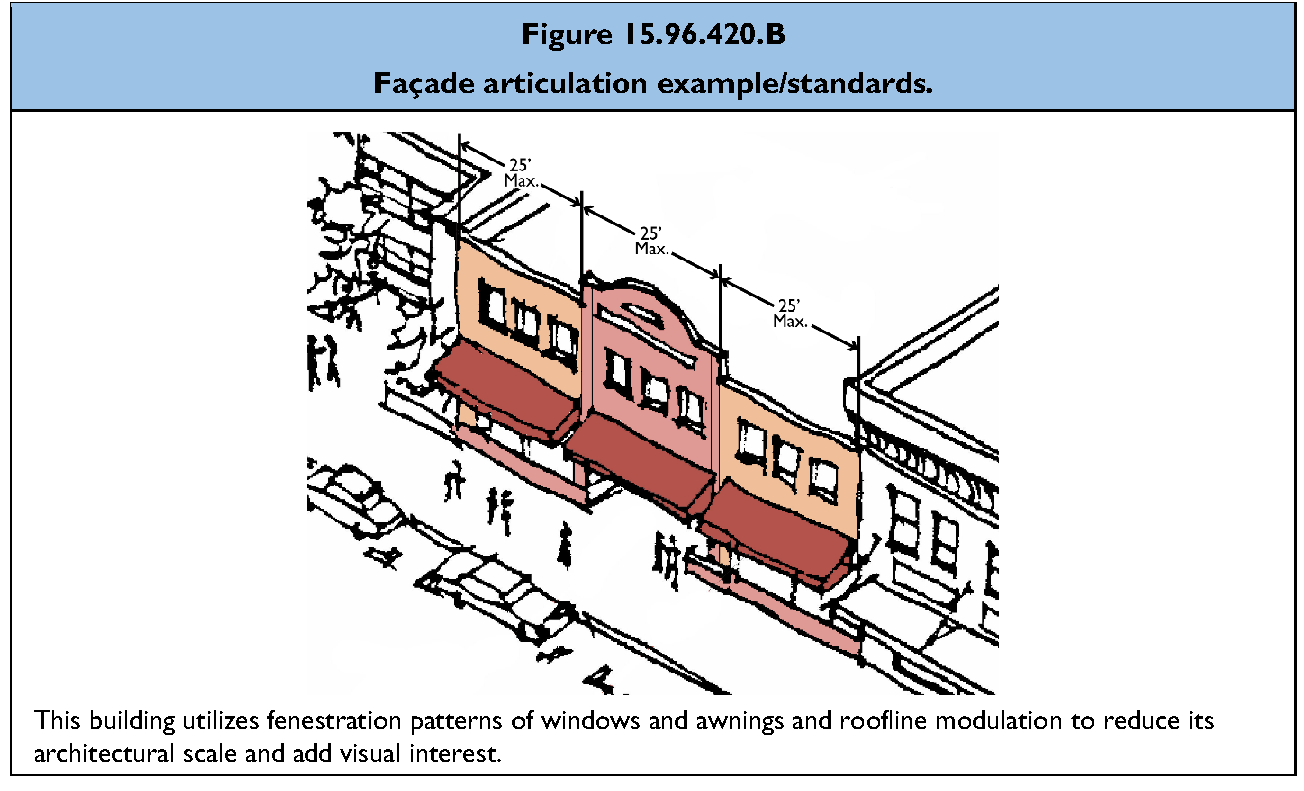
DEPARTURES. A reduction in the number of articulation features (down to two at a minimum) and/or an increase in the width of the articulation interval (no more than 35 feet in width) will be considered provided the composition of the building and its articulation treatments meet the purpose of the standards above and the design criteria in subsection (E) below.
C.
Other non-residential buildings [not included in subsection (B) above]: Buildings wider than 100 feet (measured along the primary façade) shall include at least three of the following modulation and/or articulation features along all facades containing the public building entries (alley facades are exempt) at intervals of no more than 40 feet:
1.
Providing building modulation of at least 12 inches in depth if tied to a change in roofline or a chance in building material, siding style, and/or color.
2.
Repeating distinctive window patterns at intervals less than the articulation interval.
3.
Providing a covered entry or separate weather protection feature for each articulation interval.
4.
Change of roofline, including a change in the height of a cornice by at least two feet or integration of a pitched roof form that is at least 20 feet wide with a minimum slope of 5:12.
5.
Changing materials and/or color with a change in building plane.
6.
Providing lighting fixtures, trellis, tree, or other landscape feature within each interval.
7.
Alternative methods that meet the purpose of the standards.
DEPARTURES that include only two of the above features and/or features used at larger intervals will be considered provided the building composition meets the purpose of the standards.
D.
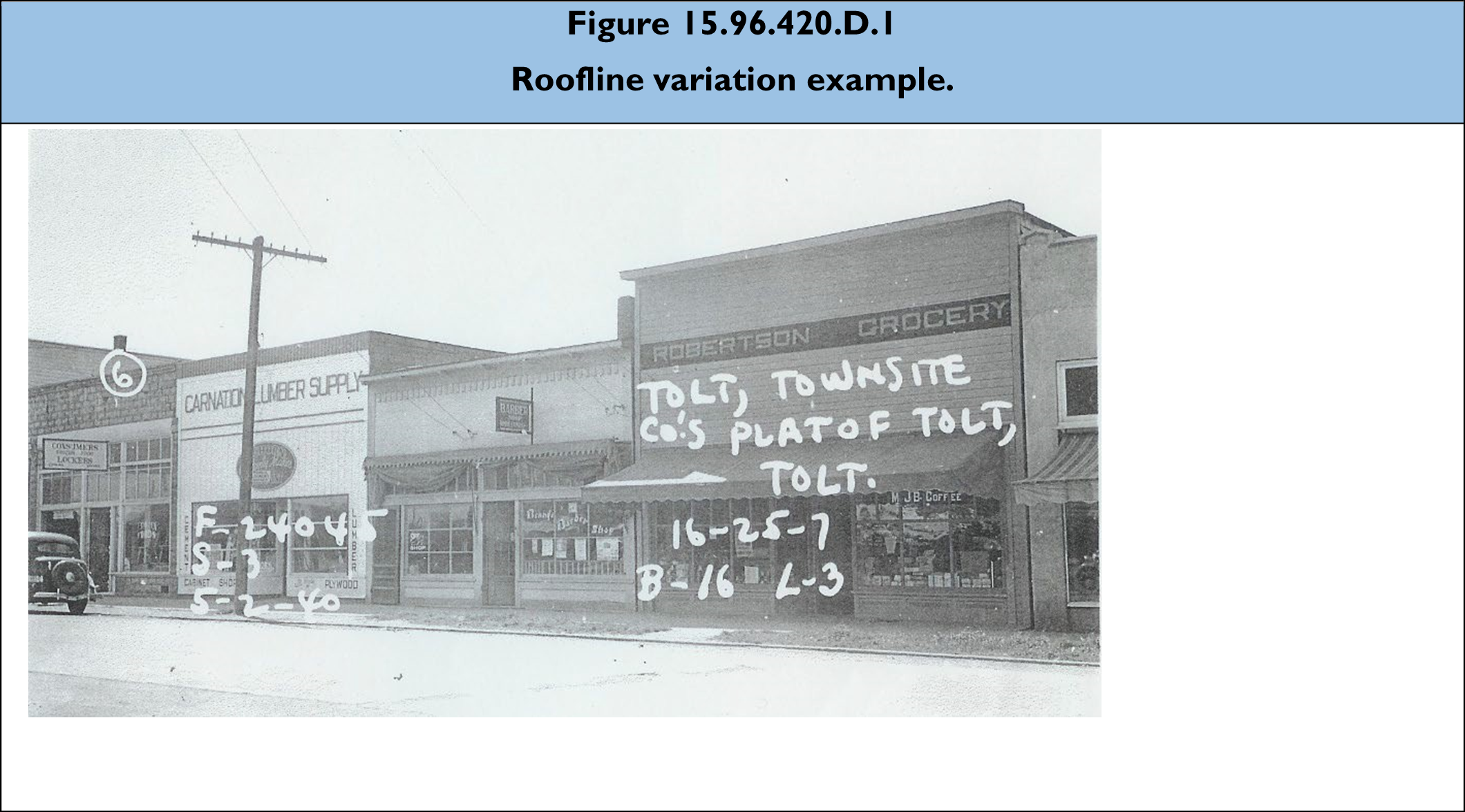
All non-residential buildings - rooflines: Rooflines visible from a public street, open space, or public parking area shall be varied by emphasizing dormers, chimneys, stepped roofs, gables, prominent cornice or fascia, or a broke or articulated roofline. The width of any continuous flat roofline should extend no more than 75 feet without modulation. Modulation should consist of either:
1.
A change in elevation of the visible roofline of at least 4 feet if the roof segment is less than 50 feet wide and at least 8 feet if the roof segment is greater than 50 feet in length.
2.
A sloped or gabled roofline segment of at least 20 feet in width and no less than 3 feet vertical in 12 feet horizontal.
3.
A combination of the above.
DEPARTURES. Relaxation of the dimensional standards (up to 50-percent) will be considered provided the design treatment meets the purpose of the standards.
E.
Buildings fronting on Tolt Avenue in the CBD zone featuring a pitched roof shall provide a traditional false front (a parapet above the storefront with a cornice line at the top) to conceal the pitched roofline from the street.
F.
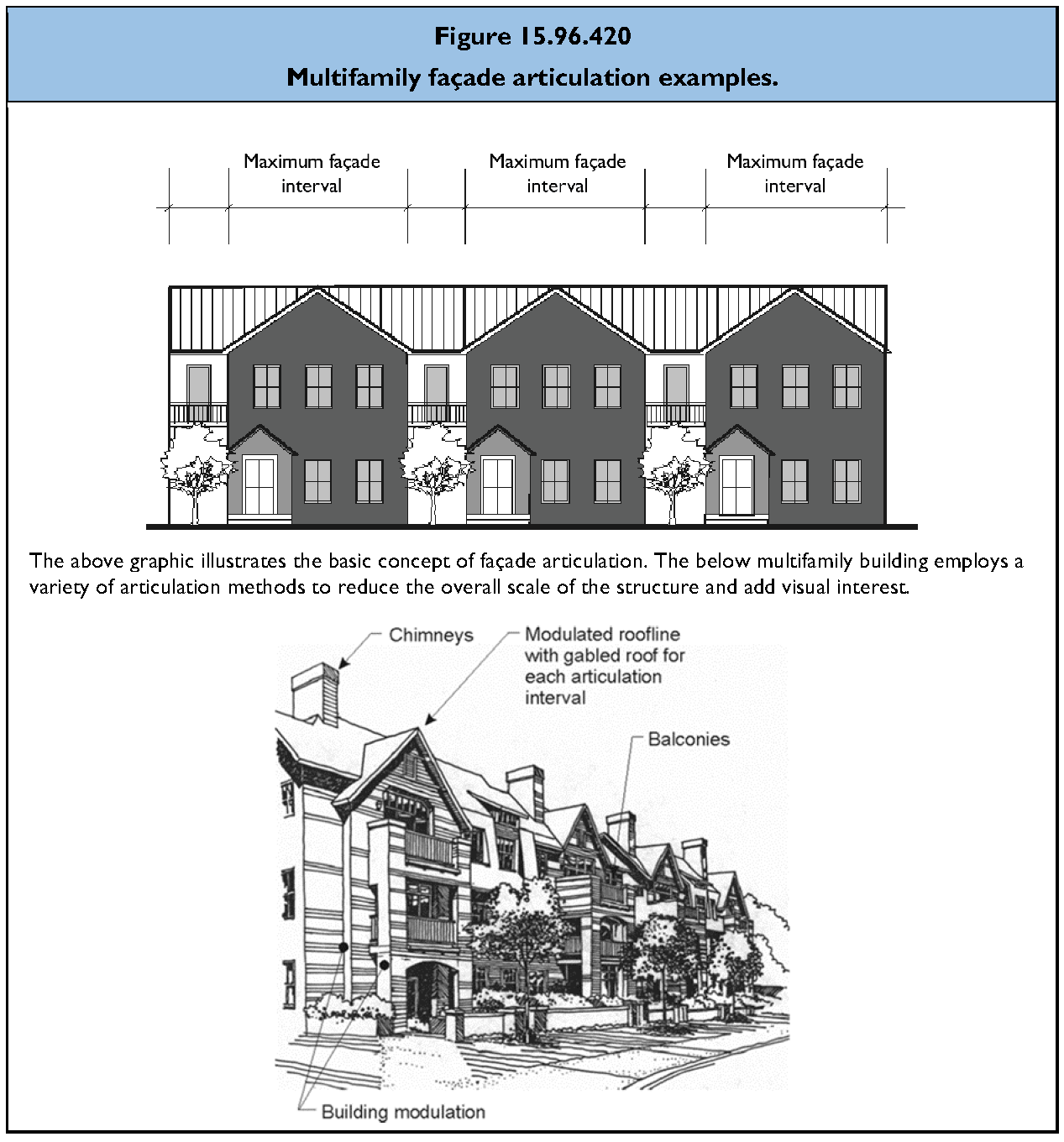
Multifamily residential buildings: New buildings shall include façade articulation features at no more than the designated maximum intervals to create a human-scaled pattern. This standard applies to building elevations facing streets, parks, containing primary building entrances, and adjacent to lower intensity zones. Alley-facing building elevations not adjacent to a lower intensity zone are exempt.
1.
The maximum horizontal length of intervals is 30 feet.
2.
At least three of the following articulation features shall be employed in compliance with maximum interval standard above:
a.
Use of windows and/or entries.
b.
Use of weather protection features.
c.
Use of vertical piers/columns (applies to all floors of the façade, excluding upper level stepbacks).
d.
Roofline modulation, including a change in pitched roof (including integration of roof dormer), provided the minimum slope is at least 5:12.
e.
Change in building material, siding style, and/or window pattern (applies to all floors of the façade, excluding upper level stepbacks).
f.
Vertical elements such as a trellis with plants, green wall, art element that meet the purpose of the standard.
g.
Providing vertical building modulation of at least 12-inches in depth if tied to a change in roofline per subsection (d) above or a change in building material, siding style, or color. Balconies may be used to qualify for this option if they are recessed or projected from the façade by at least 18-inches. Juliet balconies or other balconies that appear to be tacked on to the façade will not qualify for this option unless they employ high quality materials and effectively meet the purpose of the standards.
h.
Other design techniques that effectively reinforce a pattern of small facades compatible with the building's surrounding context.
DEPARTURES: A reduction in the number of articulation features (down to no less than two) and/or an increase in the width of the articulation interval (no more than 45 feet in width) will be considered provided the composition of the building and its articulation treatments meet the purpose of the standards.
F.
DEPARTURE criteria associated with articulation standards. Proposals shall meet the purpose of the standards. The following criteria will be considered in determining whether the proposed articulation treatment meets the "purpose".
1.
Consider the type and width of the proposed articulation treatment and how effective it is in meeting the purpose given the building's current and desired context.
2.
Consider the size and width of the building. Smaller buildings warrant greater flexibility than larger buildings.
3.
Consider the quality of façade materials in concert with doors, windows, and other façade features and their ability to add visual interest to the street from a pedestrian scale and more distant observable scales.
G.
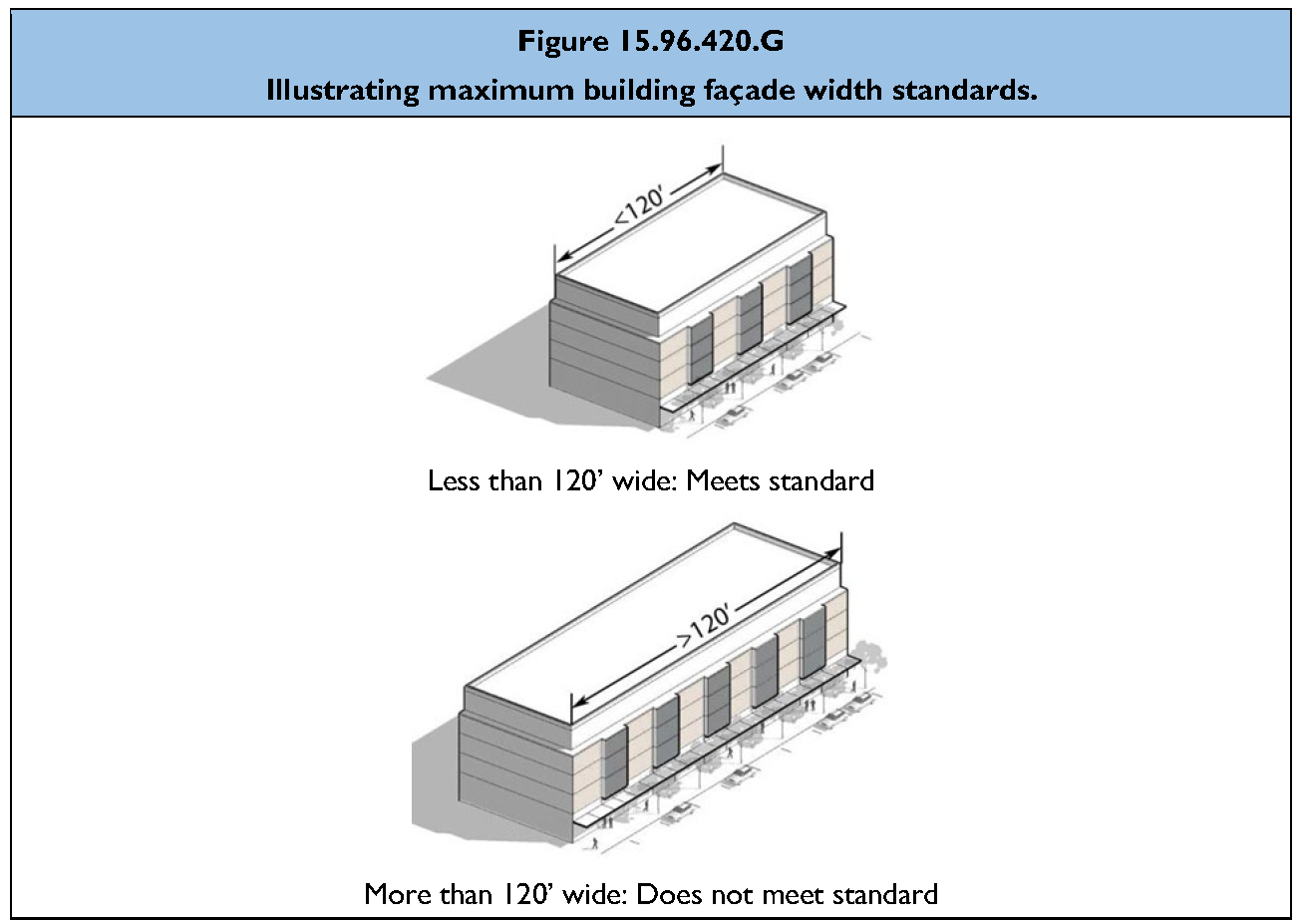
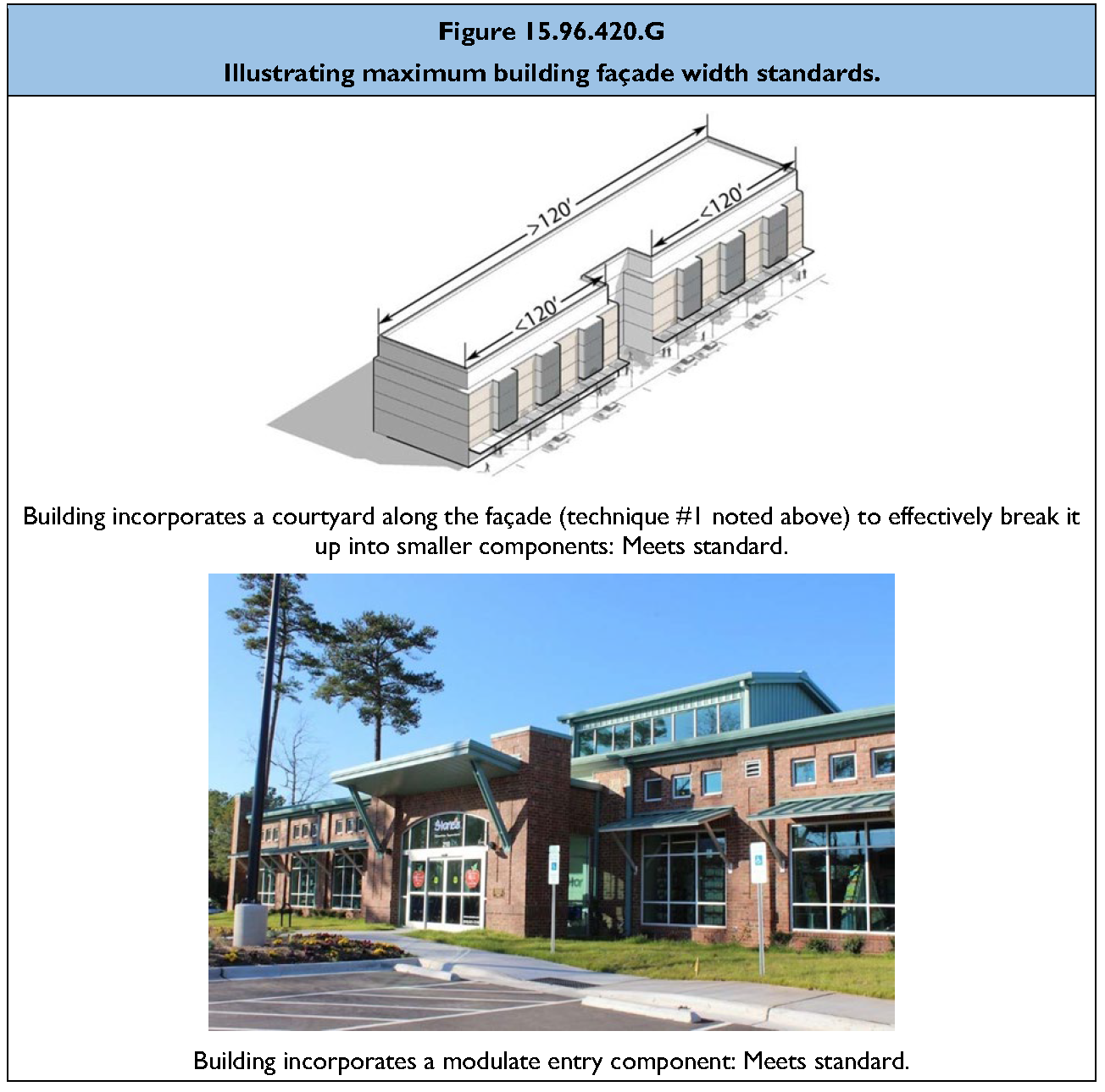
Maximum façade width standards. All uses - large street facing elevations and other building elevations facing a lower intensity zone edge shall include at least one of the following features to break up the massing of the building and add visual interest. This standard applies to applicable building elevations wider than 120-feet. Lower intensity zones are any zone designated for less dense and less intensive use of land in comparison to the development's zone.
1.
Provide building modulation at least six feet deep and 15 feet wide. For multi-story buildings, the modulation shall extend through at least one-half of the building floors.
2.
Use of a contrasting vertical modulated design component featuring all of the following:
a.
Utilizes a change in building materials that effectively contrast from the rest of the façade
b.
Component is modulated vertically from the rest of the façade by an average of six inches
3.
Façade employs building walls with contrasting articulation that make it appear like multiple distinct buildings. To qualify for this option, these contrasting façades shall employ all the following:
a.
Different building materials and/or configuration of building materials.
b.
Contrasting window design (sizes or configurations).
4.
DEPARTURES. Alternative designs will be considered provided the design meets the purpose of the standards. Supplemental consideration for approving alternative designs:
a.
Width of the façade. The larger the façade, the more substantial articulation/ modulation features need to be.
b.
The type of articulation treatment and how effective it is in meeting the purpose given the building's context.
(Ord. No. 998, § 1(Exh. A), 9-24-2024)
15.96.430 - Building details and sustainable design integration.
A.
Purpose.
1.
To encourage the incorporation of design details and small-scale elements into building facades that are attractive at a pedestrian scale.
2.
To encourage creativity in the design of building facades to add visual interest.
3
To integrate window design that adds depth, richness, and visual interest to the façade.
4.
To encourage sustainable building design techniques and components that reduce energy and/or water consumption.
B.
Façade details - non-residential and mixed-use buildings. The ground floor of commercial and mixed-use buildings shall be enhanced with appropriate details as set forth in subsection (C) below. The façade details standards in subsection (C) apply to building façades and building elevations facing parks and containing primary building entrances. All new buildings shall employ at least one detail element from each of the three categories in subsection (C) for each façade articulation interval (see CMC 15.96.420.B). For site adjacent to Tolt Avenue between Rutherford and Eugene Streets, see CMC 15.96.400 for desirable design details):
C.
Façade details categories.
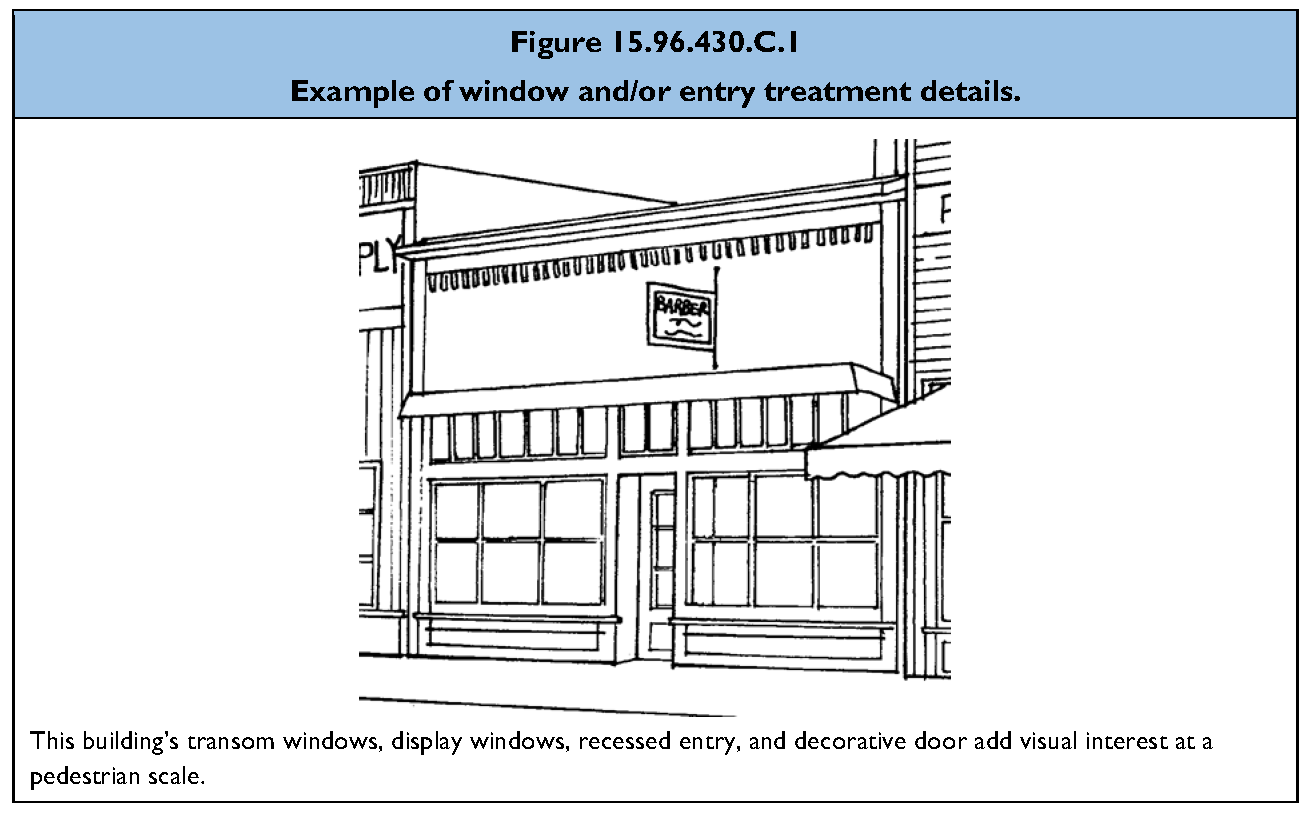
1.
Window and/or entry treatment:
a.
Display windows divided into a grid of multiple panes
b.
Recessed entry
c.
Decorative door
d.
Transom windows
e.
Roll-up windows/doors.
f.
Other distinctive window treatment that meets the purpose of the standards.
g.
Other decorative or specially designed entry treatment that meets the purpose of the standards.
2.
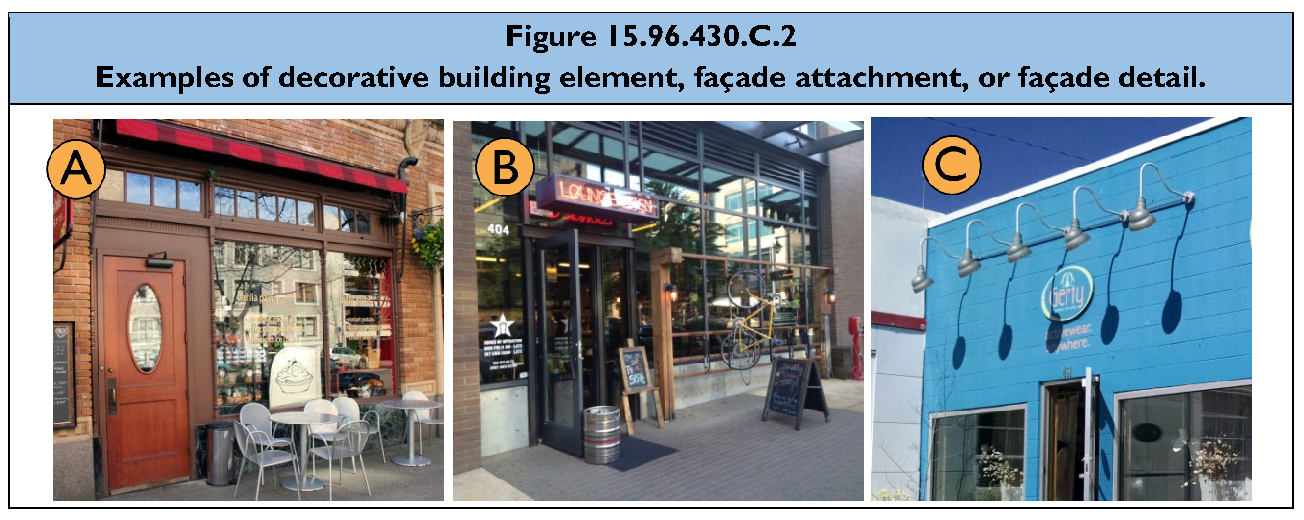
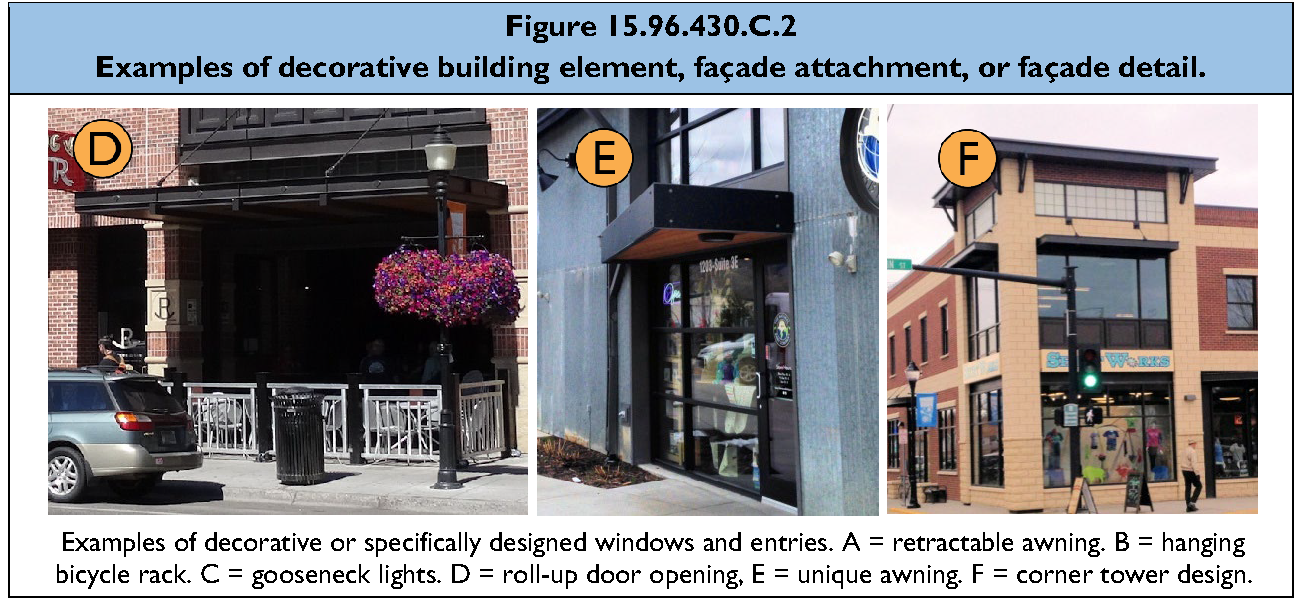
Building element, façade attachment, or façade detail:
a.
Custom-designed weather protection element such as a steel canopy, cloth awning, or retractable awning.
b.
Decorative building-mounted light fixtures.
c.
Bay windows, trellises, towers, and similar elements.
d.
Other details or elements that meet the purpose of these standards.
3.
Decorative material and artistic elements:
a.
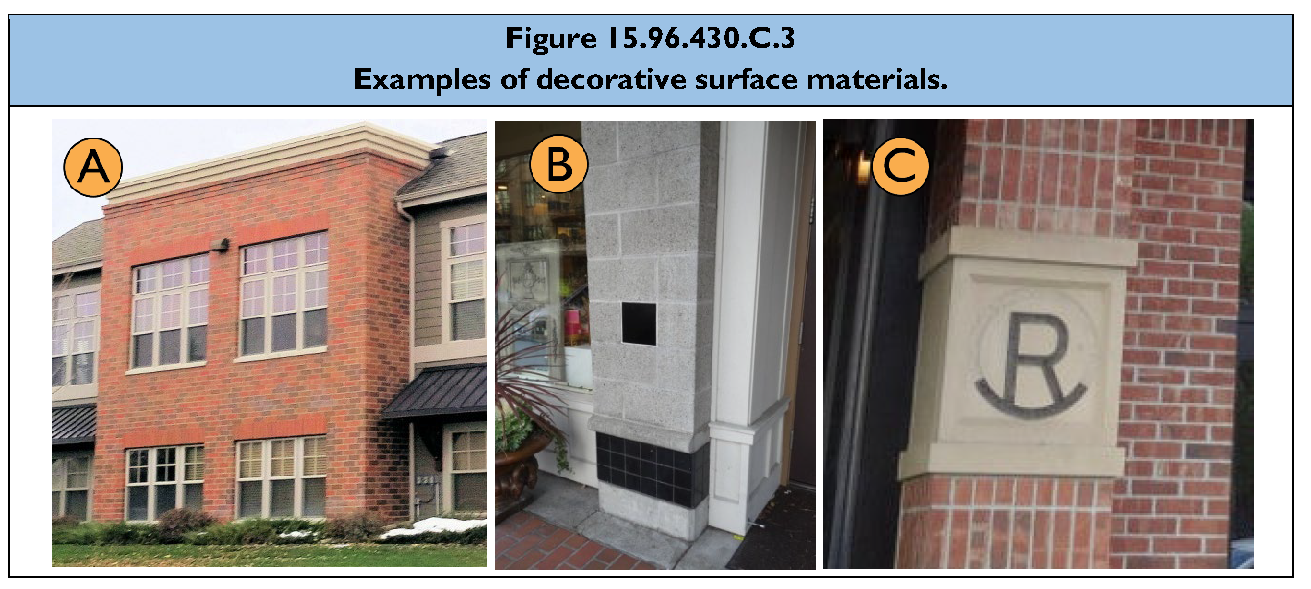
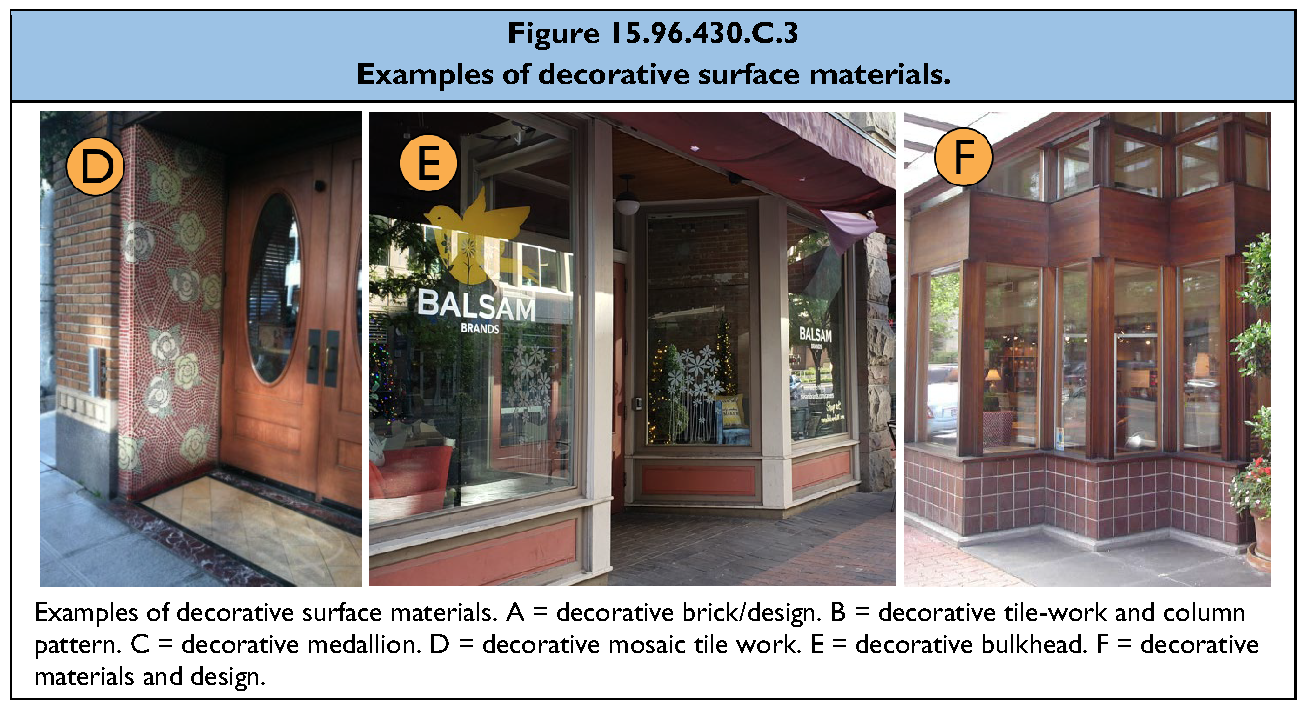
Decorative building materials/use of building materials. Examples include, but are not limited to, decorative use of brick, tile, or stonework.
b.
Artwork on building, such as a mural or bas-relief sculpture.
c.
Decorative bulkhead pilaster, base panel, or other similar feature.
d.
Hand-crafted material, such as special wrought iron or carved wood.
e.
Other details that meet the purpose of the standards.
D.
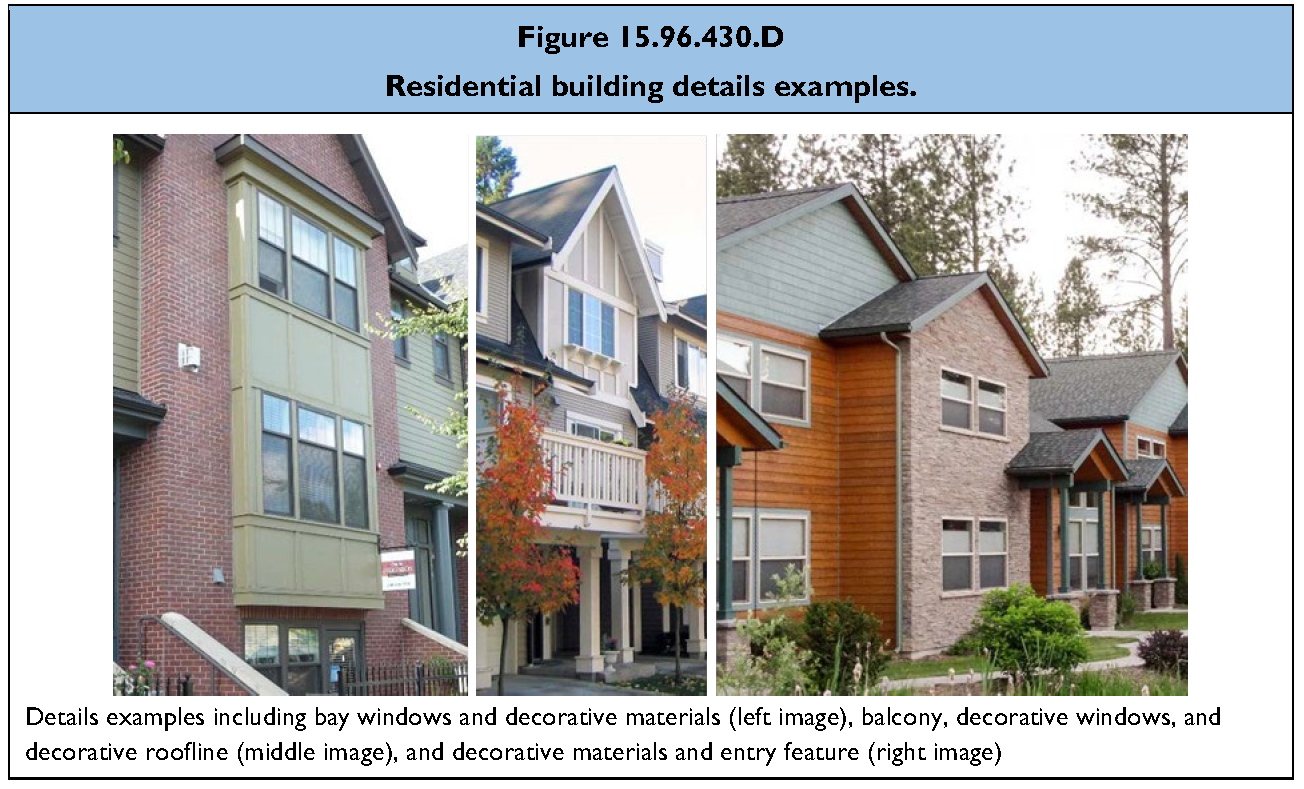
All residential buildings shall be enhanced with architectural details that add visual interest to the neighborhood and are well proportioned to achieve good human scale. Specifically, incorporate at least three of the following detail elements into the façade of residential buildings:
1.
Decorative porch/entry design, such as decorative columns or railings.
2.
Bay windows.
3.
Decorative balcony design.
4.
Decorative molding / framing details around all ground floor windows and doors.
5.
Decorative door design including transom and/or side lights or another distinctive feature.
6.
Decorative roofline elements including brackets, multiple dormers, and chimneys.
7.
Decorative building materials, including decorative masonry, shingle, brick, tile, stone, or other materials with decorative or textural qualities.
8.
Landscaped trellises or other decorative element that incorporates landscaping near the building entry.
9.
Other decorative façade elements that meet the purpose of the standards.
E.
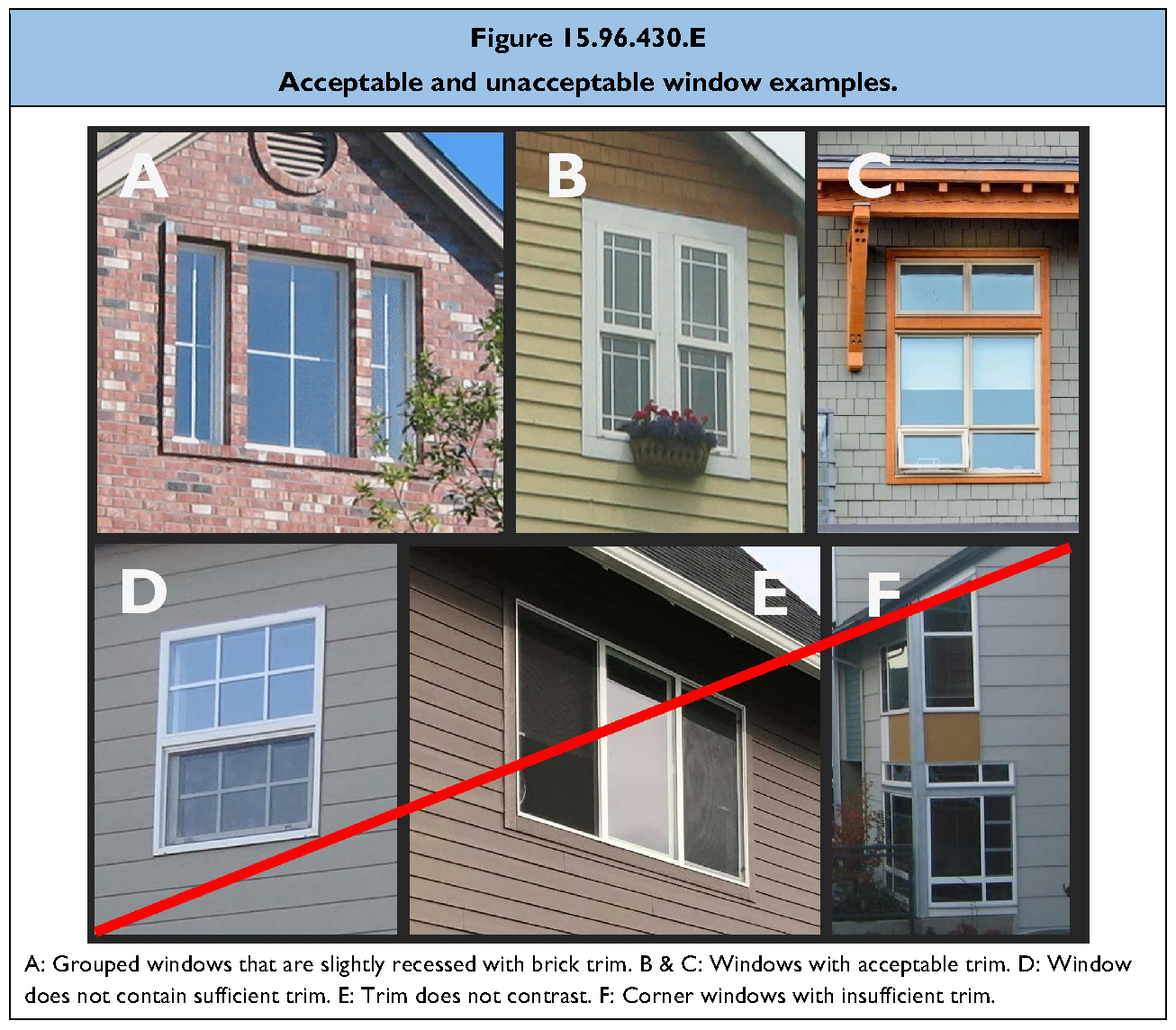
All windows (except storefront display windows) shall employ designs that add depth and richness to the façade. At least one of the following features shall be included to meet this requirement:.
1.
Incorporate window trim (at least 3.5 inches wide) around windows.
2.
Recess windows at least 1.5 inches from the façade.
3.
Incorporate other design treatments that add depth, richness, and visual interest to the façade.
DEPARTURES from the window standards above will be considered, provided the design meets the purpose of the standards.
F.
Sustainable design. New buildings and/or site development must demonstrate green building certification through Built Green 4-Star, PHIUS+, or similar green building certification program or integrate at least one of the following features:
1.
Special window shade structures that help to regulate sunlight for south and west facing windows.
2.
Solar panels.
3.
Urban wind turbines.
4.
Use of reclaimed wood in exterior cladding.
5.
Use of green wall(s).
6.
Visible rainwater harvesting system (including rain barrels or cisterns).
7.
Use of pervious pavement.
8.
Use of other sustainable design features or techniques that are visible (from the street, sidewalk, and other publicly accessible spaces).
(Ord. No. 998, § 1(Exh. A), 9-24-2024)
15.96.440 - Exterior building materials and color.
A.
Purpose.
1.
To encourage high quality building materials that will upgrade the character and identity of Carnation.
2.
To discourage poor materials with high life cycle costs.
3.
To discourage materials and colors that are not compatible with the character and scale of Carnation.
4.
To discourage materials and treatments of buildings that create a false sense of historicism in new development.
B.
All buildings - incorporating metal siding: If metal siding is used on non- residential buildings, it shall have visible corner moldings and trim. Metal siding is prohibited on residential buildings.
C.
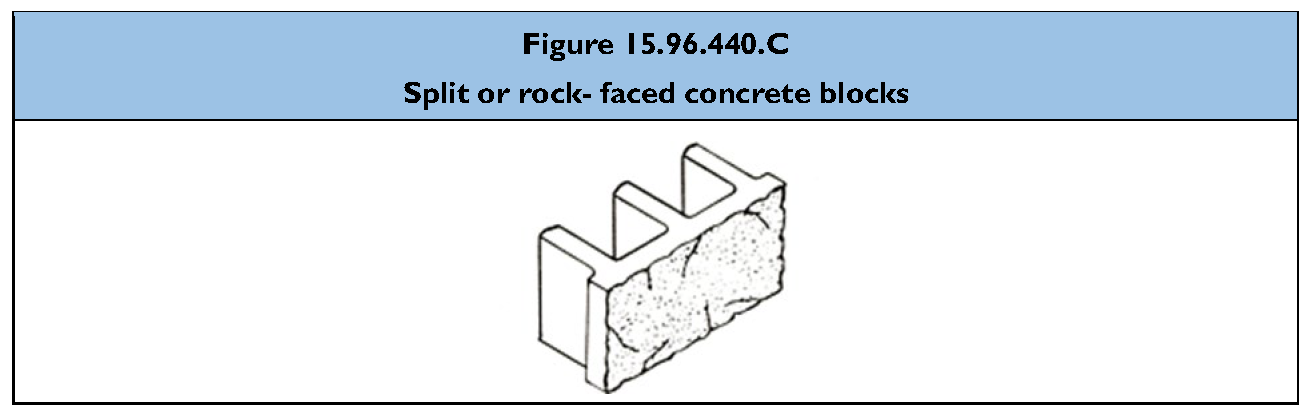
All non-residential buildings incorporating concrete block: When used for the primary façade of any building, concrete blocks shall be split or rock-faced and limited to 30 percent of the façade area.
DEPARTURES will be considered, provided the material's integration and overall façade composition meets the purpose of the standards.
D.
All buildings - incorporating EIFS: Non-residential building facades incorporating Exterior Insulation and Finish system or "EIFS" shall be trimmed in wood or masonry and should be sheltered from extreme weather by roof overhangs or other methods. EIFS is limited to no more than 30 percent of the façade area. Weather exposed horizontal surfaces shall be avoided. Masonry, stone, or other durable permanent material is required near the ground level (first 2 feet above sidewalk or ground level).
EIFS is not allowed on residential buildings.
E.
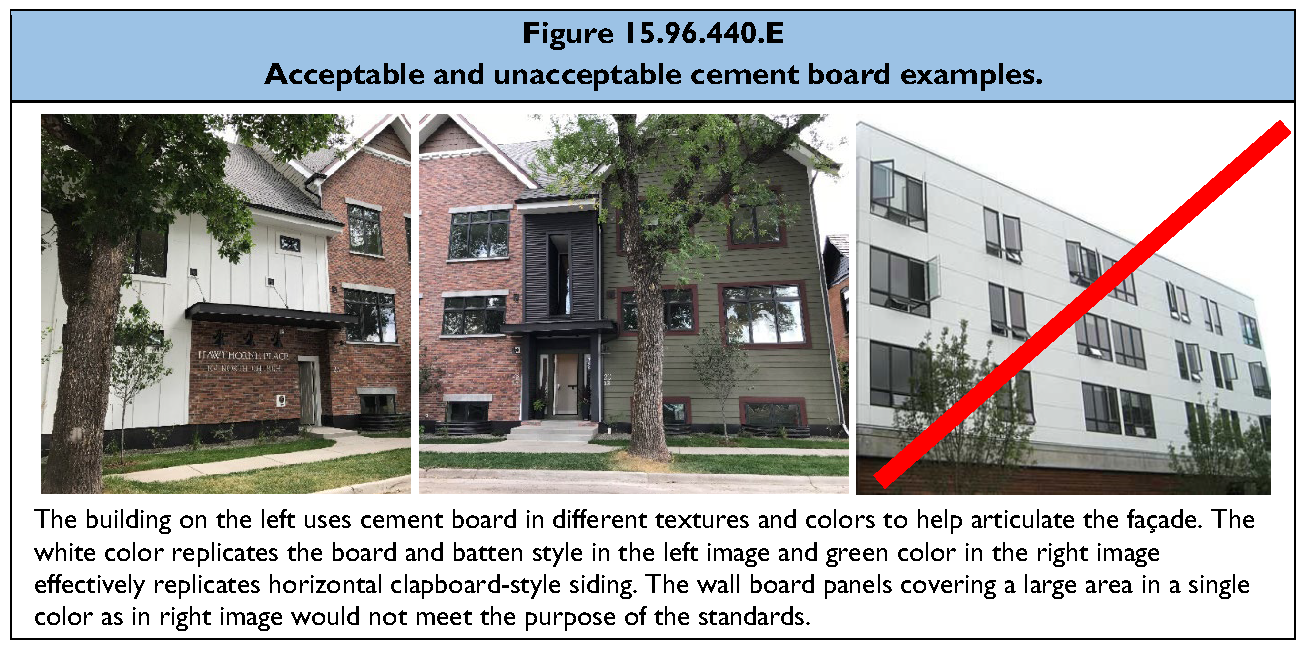
All buildings - special conditions and limitations for cement board paneling/siding. Such material may be used, provided it meets the following provisions:
1.
Cement board paneling/siding may not be used on the ground floor of nonresidential or mixed- use buildings where adjacent to a sidewalk or other internal walkway.
2.
Residential buildings or portions of mixed-use buildings. Flat panel style cement board is prohibited. Acceptable cement board products include those that mimic horizontal clapboard- style siding or board and batten.
DEPARTURES will be considered, provided the material's integration and overall façade composition meets the purpose of the standards.
F.
All buildings: The following materials are prohibited:
1.
Mirror glass
2.
Textured or scored plywood (including T-111 or similar plywood except for board and batten)
G.
All non-residential uses: Concrete block use on the side or rear of buildings when visible from a public street, pedestrian plaza, or parking area (alleys are excluded) should utilize changes in textures and shapes, colors, and/or other masonry materials to complement the design of the primary façade and add visual interest. Alternately, murals and/or decorative signage, as approved by the City, may be used to treat concrete block walls in a way that meets the purpose.
H.
All buildings: Treatment of building materials that creates a false sense of historicism in new buildings is strongly discouraged.
I.
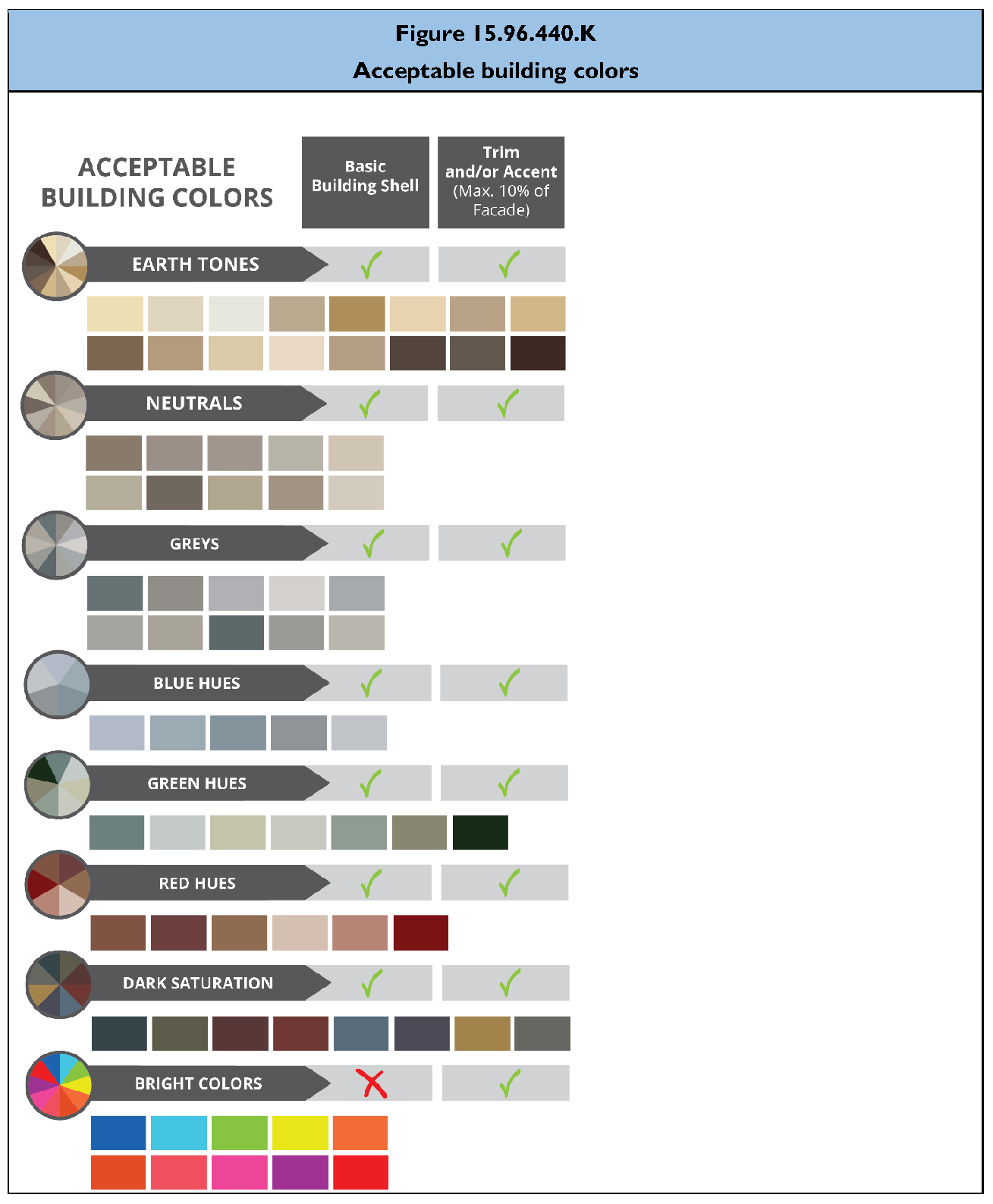
All buildings: Muted and dark saturated colors, earth tone, neutral colors, or grays shall be utilized for the primary background of buildings. See Figure 15.96.440.B for details.
J.
All buildings: Bright building colors shall be limited to trim and accents, generally no more than 10 percent of the façade. Awnings may not use the bright colors. See Figure 15.96.440.B for details.
K.
All buildings: Contrasting colors should be utilized for trim. For example, where a dark background color is used for the shell of the building, white trim works particularly well. Dark trim colors can be effective where light colors are used for the basic building shell. Consideration should be given to contrasting the colors of new or remodeled buildings with the colors of the existing buildings in its vicinity.
(Ord. No. 998, § 1(Exh. A), 9-24-2024)
LANDSCAPING
15.96.500 - Tree & landscaping integration.
The provisions herein apply in addition to the standards in Chapter 15.76 (Landscaping and Trees). Where there is a conflict, the provisions herein apply.
A.
Purpose.
1.
To promote a healthy community and stable environment.
2.
To help reduce the urban heat island effect.
3.
To enhance the visual appearance of streets.
4.
To enhance the livability of new developments.
B.
Landscape coverage standards. Landscaped surfaces equal to 25 percent of the development site shall be provided. The following landscaped types and credits may be used to meet the standards.
1.
Ground level planting beds qualify as landscaped surfaces at a 100 percent rate. Ground level planting area that supports trees (which will require deeper soil depths) may qualify for bonus credit. Specifically:
a.
Planting areas that support a large tree (height greater than 30 feet at maturity) may be counted at a 200 percent rate (includes planting area under projected dripline at maturity).
b.
Planting areas that support a medium-sized tree (height greater than 15 feet at maturity) may be counted at 150 percent rate.
c.
Terraced or other raised planting surfaces qualify as landscaped surfaces at the same rates as ground level planting beds depending on the soil depth [shallow soil depths (less than six inches deep) capable of supporting only ground cover plants qualify at a 50 percent rate].
B.
Green roof.
a.
Green roofs qualify as a landscaped surface at a 50 percent rate (i.e., two square feet of green roof qualifies as one square foot of landscaped area).
b.
Green roof areas with soil depths greater than 12 inches and planned to support large shrubs and trees qualify as a landscaped surface at a 100 percent rate.
C.
Green walls/trellises/arbors.
i.
Green walls qualify as landscaped surfaces at a 75 percent rate.
ii.
A trellis/arbor/wall with vine or climbing plants qualify as landscaped surfaces at a 50 percent rate. Planter areas must feature minimum soil depth necessary to maintain healthy vine growing conditions as determined by regional best landscaping practices.
Developments in the CBD zone are exempt from this standard.
(Ord. No. 998, § 1(Exh. A), 9-24-2024)
15.96.600 - Single Family & Duplex Design Standards
A.
Purpose and applicability: The purpose of this section is to build upon the established character of Carnation's downtown residential areas on a citywide basis by applying development standards for all new single family and duplexes on lots within subdivisions with four or more lots created after September 24, 2024.
B.
Covered entry. All dwelling units must include a covered entry feature that projects at least five feet from the front facade (measured from the front exterior wall of the structure to the farthest roofline projection). The covered entry feature(s) must be no less than one-third of the width of the structure, including attached garages, and shall be unenclosed on all sides except for the side abutting the front exterior wall of the residence(s).
C.
Unit orientation. The primary entry of single family homes shall face the street. For duplexes, the primary entry for at least one of the dwelling units shall face the street. For corner lots, dwelling units may face either street.
D.
Driveways. Driveway widths are limited to 18 feet for lots with single family structures and 22 feet for lots with multi-family structures (measured at the sidewalk). Single family homes are limited to one driveway. Duplexes may have two driveways (10 feet wide maximum each).
E.
Garage location. Garages must be setback at least five feet from the front projection of the residence (including the porch or covered entry feature), and no less than twenty feet from the front property line.
F.
Minimum usable open space for lots served by alleys.
1.
A contiguous open space to the side or rear of the dwelling with a minimum dimension of fifteen feet on all sides is required for each dwelling unit.
2.
The open space(s) must be equivalent to ten percent (minimum) of the lot area. For example, a four thousand square foot single family lot would require a contiguous open space of at least four hundred square feet, or twenty feet by twenty feet in area.
3.
Drive aisles must not count in the calculations for usable open space.
4.
Additions must not create or increase any non-conformity with this standard.
G.
Façade transparency. At least ten percent of the façade (all vertical surfaces of a residence facing the street) must be comprised of transparent windows or doors. All areas inside an individual window frame may be counted in such transparency calculations (including, without limitation, window sashes, mullions, rails, stiles, and grilles). Windows on garage doors are encouraged, but don't count as transparent window area for the purpose of this design standard.
H.
Façade massing and rooflines. Homes on corner lots are required to comply with the provisions on both street facing elevations.
1.
Facades up to 35 feet wide shall integrate a covered entry feature as set forth in subsection (B) above to help break up the massing of structures and add visual interest. For corner lot homes, secondary street facing elevations (not containing the home entrance) shall integrate other façade offsets and corresponding roofline changes (similar or larger in scale to the required covered entry feature).
2.
Facades more than 35 feet wide shall integrate roofline variation such as multiple gables (beyond the required covered entry component) facing the street or changing roofline orientation to break up the massing of large structures and add visual interest.
I.
Façade details. Provide for architectural details that add visual interest to the neighborhood and are well proportioned to achieve good human scale. Specifically, incorporate at least three of the following detail elements into the façade of the house(s):
1.
Decorative porch design, including decorative columns or railings.
2.
Bay windows or balconies.
3.
Decorative molding/framing details around all ground floor windows and doors.
4.
Decorative door design including transom and/or side lights or another distinctive feature.
5.
Decorative roofline elements including brackets, multiple dormers, and chimneys.
6.
Decorative building materials, including decorative masonry, shingle, brick, tile, stone, or other materials with decorative or textural qualities.
7.
Landscaped trellises or other decorative elements that incorporate landscaping near the building entry.
8.
Other decorative facade elements or details that meet the purpose of criteria.
J.
Window and door trim. All windows and doors shall feature trim at least three and one-half inches wide with color contrasting with the façade. Alternatively, windows and doors may be recessed from the façade by at least two inches.
K.
Materials/siding style.
1.
Primary materials and styles include narrow (no wider than six inches) machined (beveled or otherwise) clapboard style siding, cedar shakes, shingles, board and batten, and brick or stone. A combination of such materials/styles may be used.
2.
Secondary materials and styles (no more than 25 percent of the façade siding) include panel-style siding.
3.
Vinyl siding is prohibited.
L.
Eaves and gables shall provide a minimum of 18-inches of overhang for residential buildings.
(Ord. No. 998, § 1(Exh. A), 9-24-2024)
15.96.610 - Townhouse design standards.
A.
Purpose. To provide livable and pedestrian-oriented townhouse designs that can be well integrated into Carnation's neighborhoods.
B.
Applicability. All townhouses within Carnation are subject to the following supplemental standards.
C.
Landscaping. Townhouses are subject to the landscaping standards as set forth in Chapter 15.76 CMC.
D.
Setbacks. See Chapter 15.48 CMC for minimum building and garage setbacks for the applicable zone. The minimum setbacks set forth in Chapter 15.48 CMC Table 1 apply to development frontage and external side and rear setbacks of the entire townhouse development.
E.
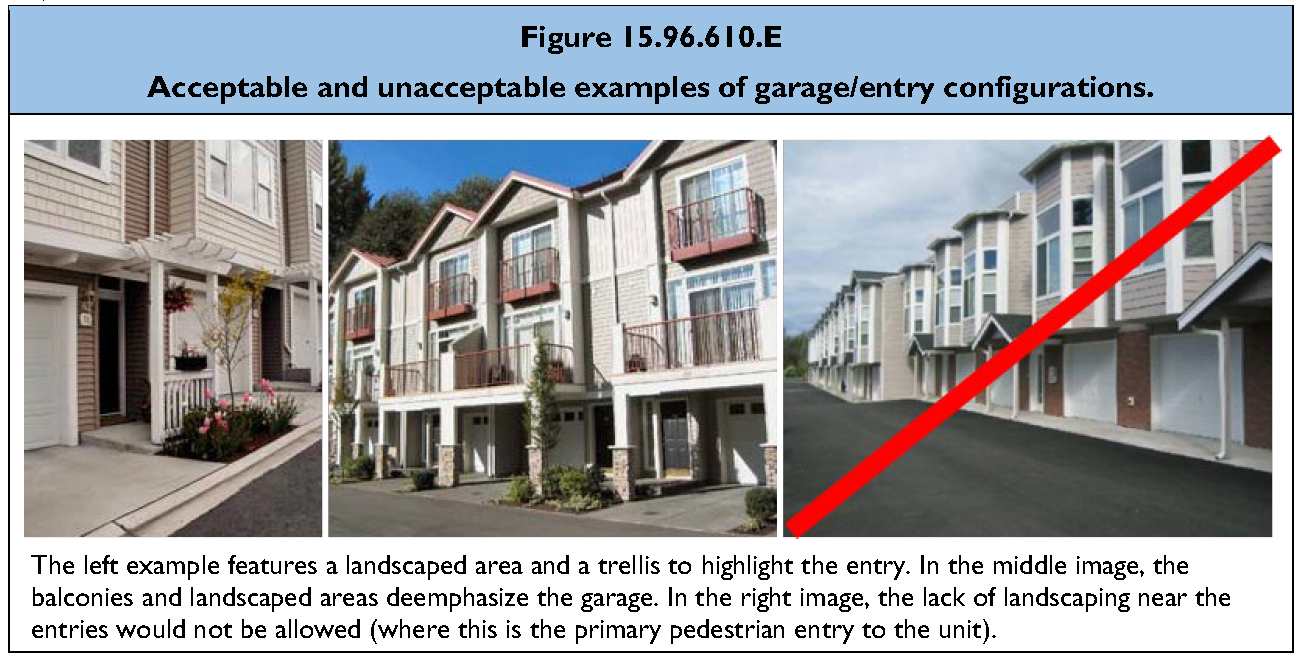
Entries. For townhouses where the primary pedestrian access to the dwelling is from an alley or private internal vehicular access, buildings shall emphasize individual pedestrian entrances over private garages by using both of the following measures:
1.
Enhance entries with a trellis, small porch, or other architectural features that provides cover for a person entering the unit and a transitional space between outside and inside the dwelling.
2.
Provide a planted area in front of each pedestrian entry of at least 20 square feet in area, with no dimension less than four feet.
F.
Façade transparency. Transparent windows and/or doors are required on at least ten percent of the facades (all vertical surfaces of street facing elevation). For corner lots, this standard is only applied to the elevation containing the dwelling entry.
G.
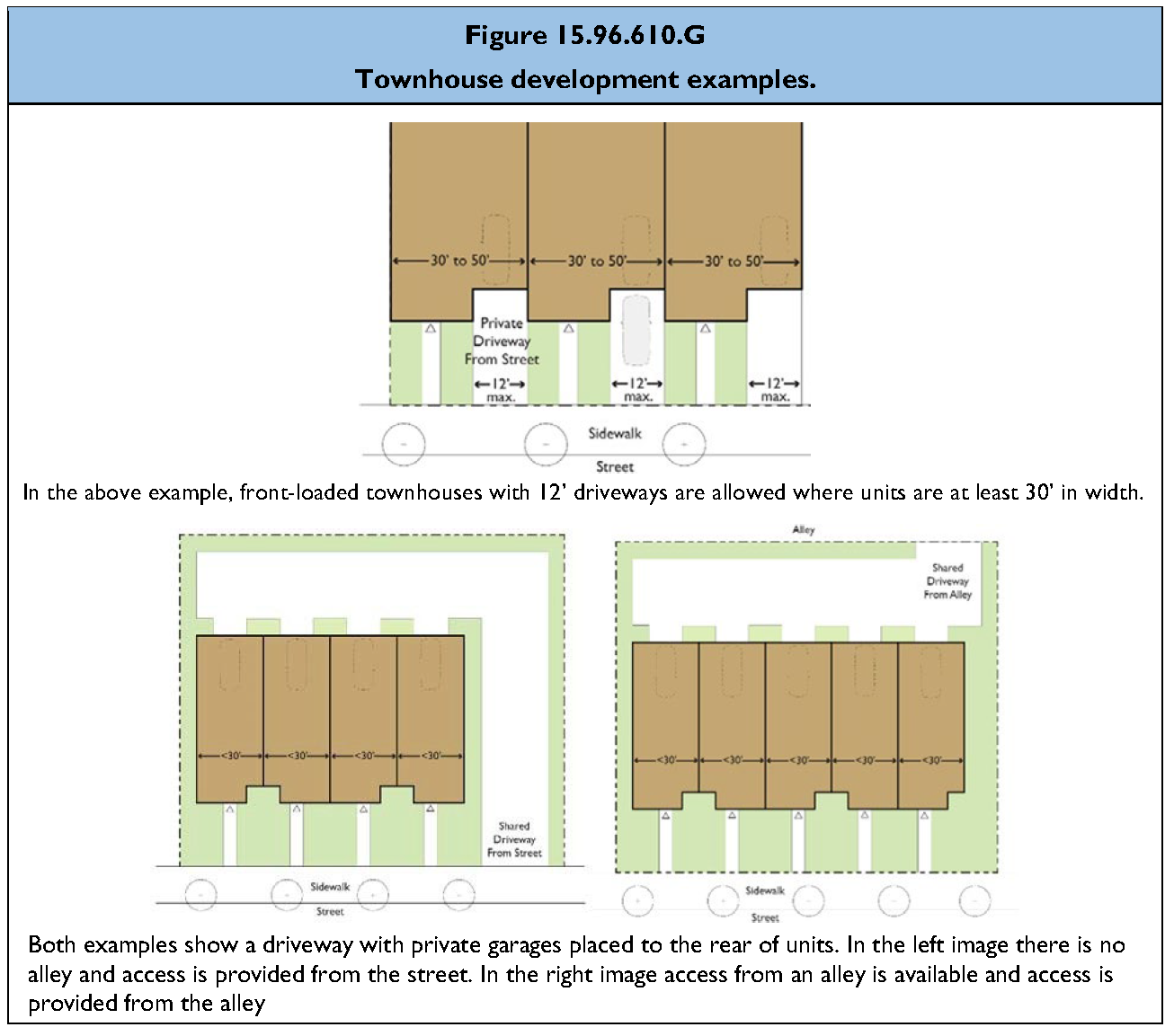
Private garages facing the street - maximum garage widths:
1.
Twelve feet where townhouse dwellings are at least 30 feet wide.
2.
Individual garages facing the street are not allowed for townhouse dwellings less than 30 feet wide. Garages may be provided to the rear of the dwelling via alley access or shared driveway as depicted below.
H.
Access and parking.
1.
Off-street parking standards for townhouses are set forth Chapter 15.72 CMC as a type of multifamily residential use.
2.
Internal driveway standards:
a.
Shall meet minimum widths and other standards such as turning radii of any city adopted International Fire Code.
b.
Minimum building separation along uncovered internal drive aisles shall be 24 feet. The purpose is to provide adequate vehicular turning radius, allow for landscaping elements on at least one side, and to provide adequate light and air on both sides of the dwelling units and vehicle areas, which often function as usable open space for residents.
c.
Upper-level building projections over vehicle areas are limited to three feet, and shall comply with provisions above.
I.
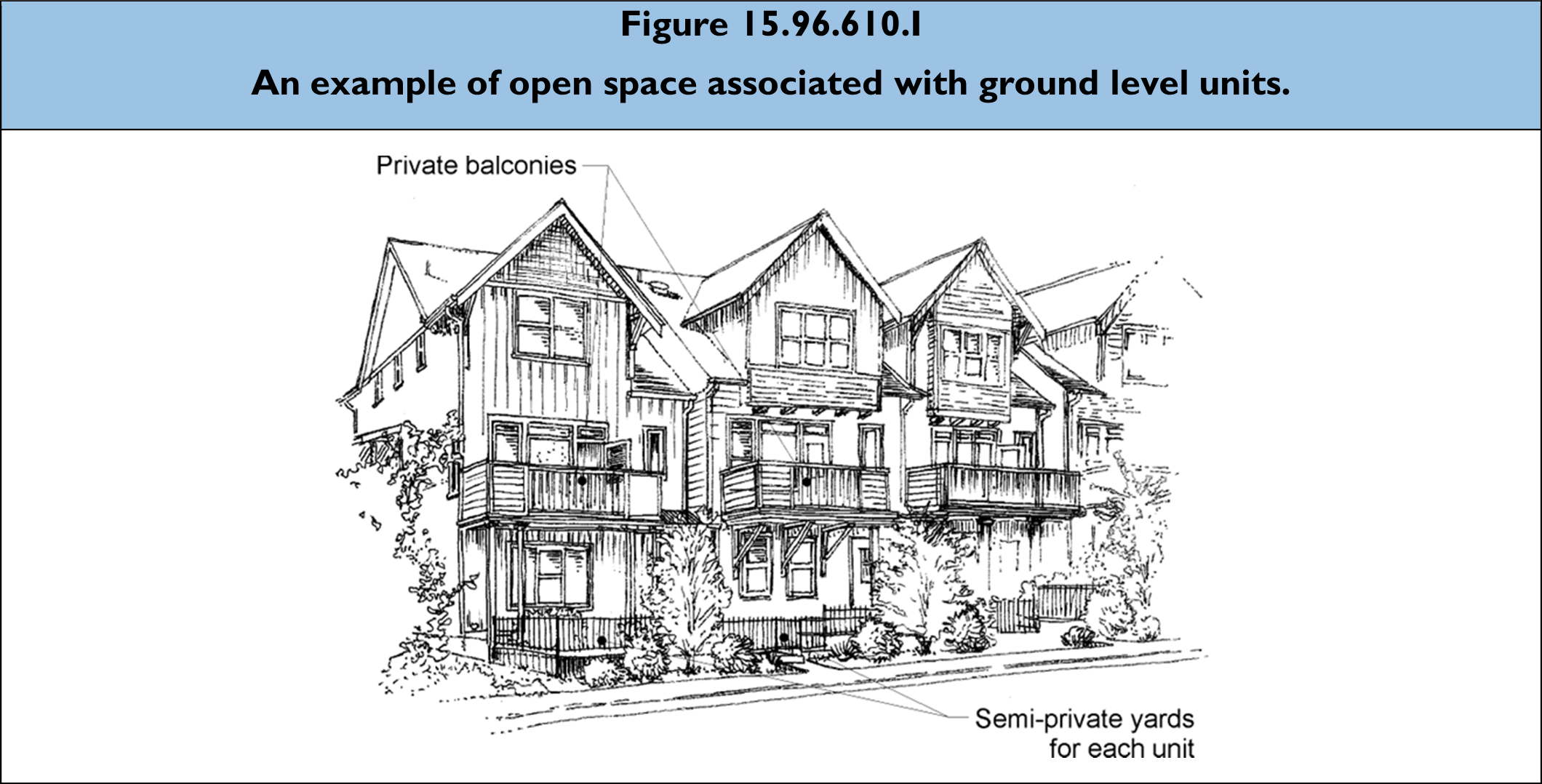
Usable open space. Townhouse dwellings shall provide open space at least equal to ten percent of the habitable floor area. The required open space may be provided by one or more of the following:
1.
Private ground level open space that is directly adjacent and accessible to dwelling units. Such space shall have minimum dimensions of at least 12 feet on all sides and be configured to accommodate human activity such as outdoor eating, gardening, toddler play, etc. Street setbacks may be used to meet this standard, provided they are defined with a fence (meeting standards of Chapter 15.76 CMC).
2.
Balconies, roof decks, or porches.
J.
Building design.
1.
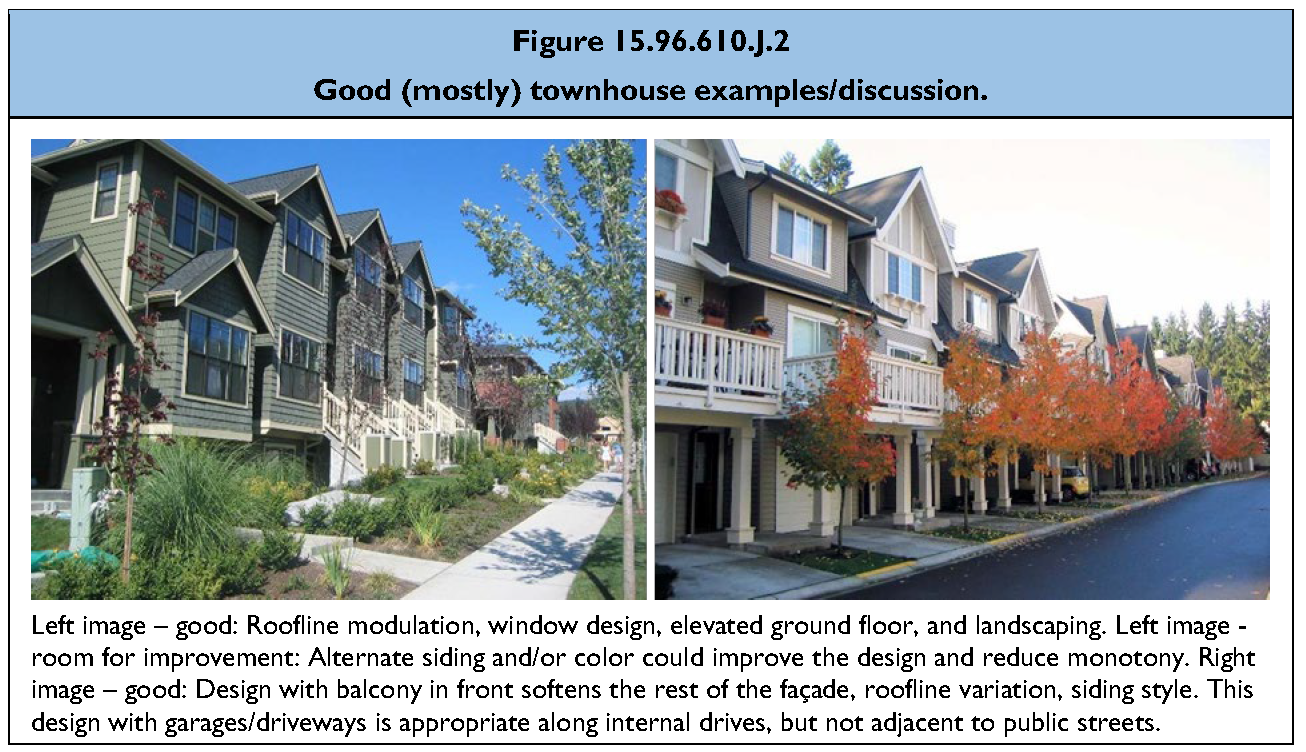
Townhouse articulation. Townhouse buildings shall comply with multifamily building articulation standards as set forth in CMC15.96.420.E except that the articulation intervals shall be no wider than the width of units in the building. Thus - if individual units are 15 feet wide, the building shall include at least three articulation features for all facades facing a street, common or other shared open space, and common parking areas at intervals no greater than 15 feet.
2.
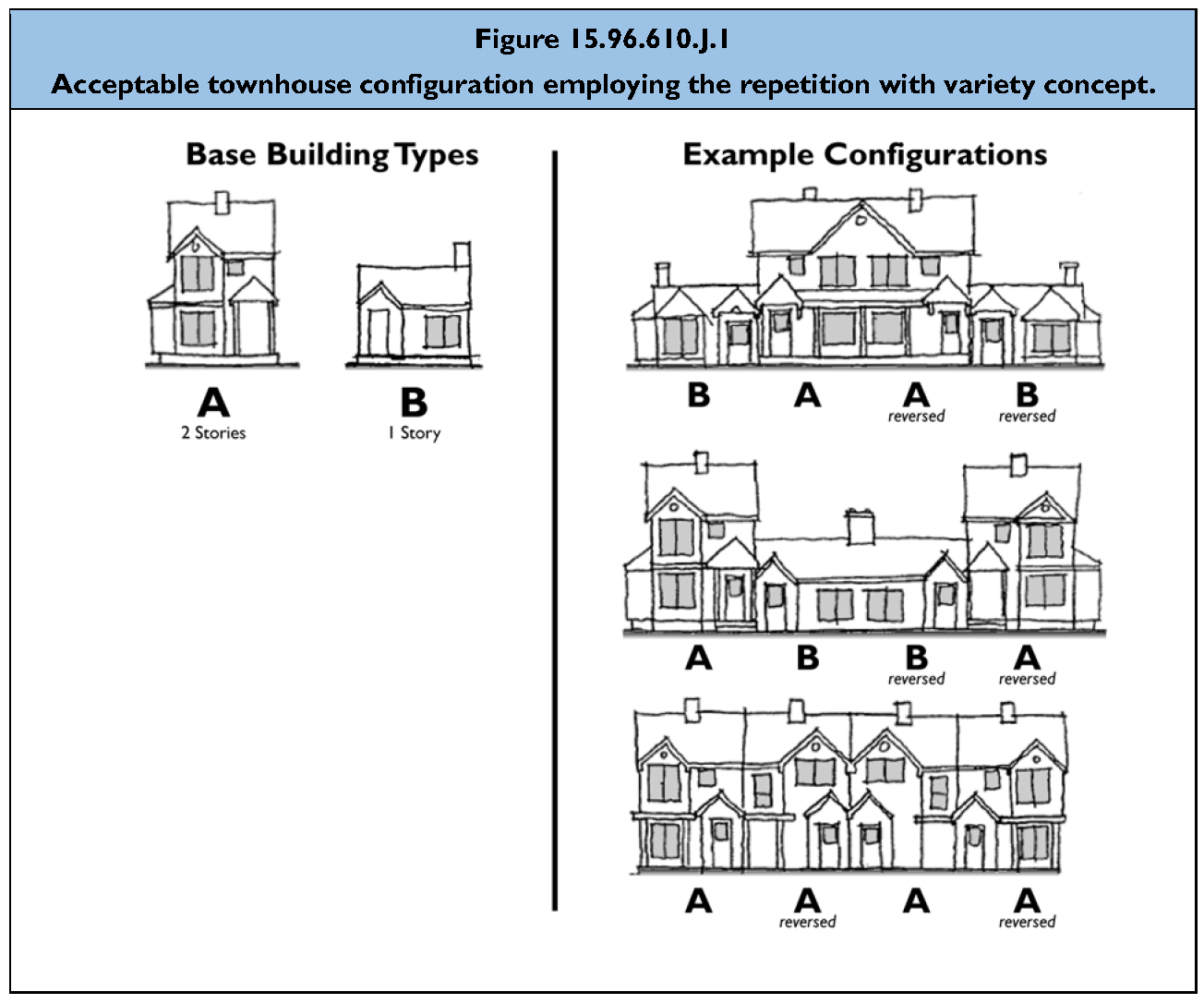
Repetition with variety. Townhouse developments shall employ one or more of the following "repetition with variety" articulation elements:
a.
Reversing the elevation of two out of four dwellings.
b.
Providing different building elevations for external (units on the end or corner of a building) townhouse units (versus internal units) by changing the roofline, articulation, windows, and/or building modulation patterns.
c.
Adding a different dwelling design or different scale of the same design, such as adding a one- story version of the basic dwelling design where two- stories are typical (or a two-story design where three stories are typical).
d.
Other design treatments that add variety or provide special visual interest, such as different cladding materials, window sizes and groupings, roof slopes, porch designs, balconies, etc. While the variable use of color on buildings can be effective in reducing the perceived scale of the building and adding visual interest, color changes alone are not sufficient to meet the purpose of the standards.
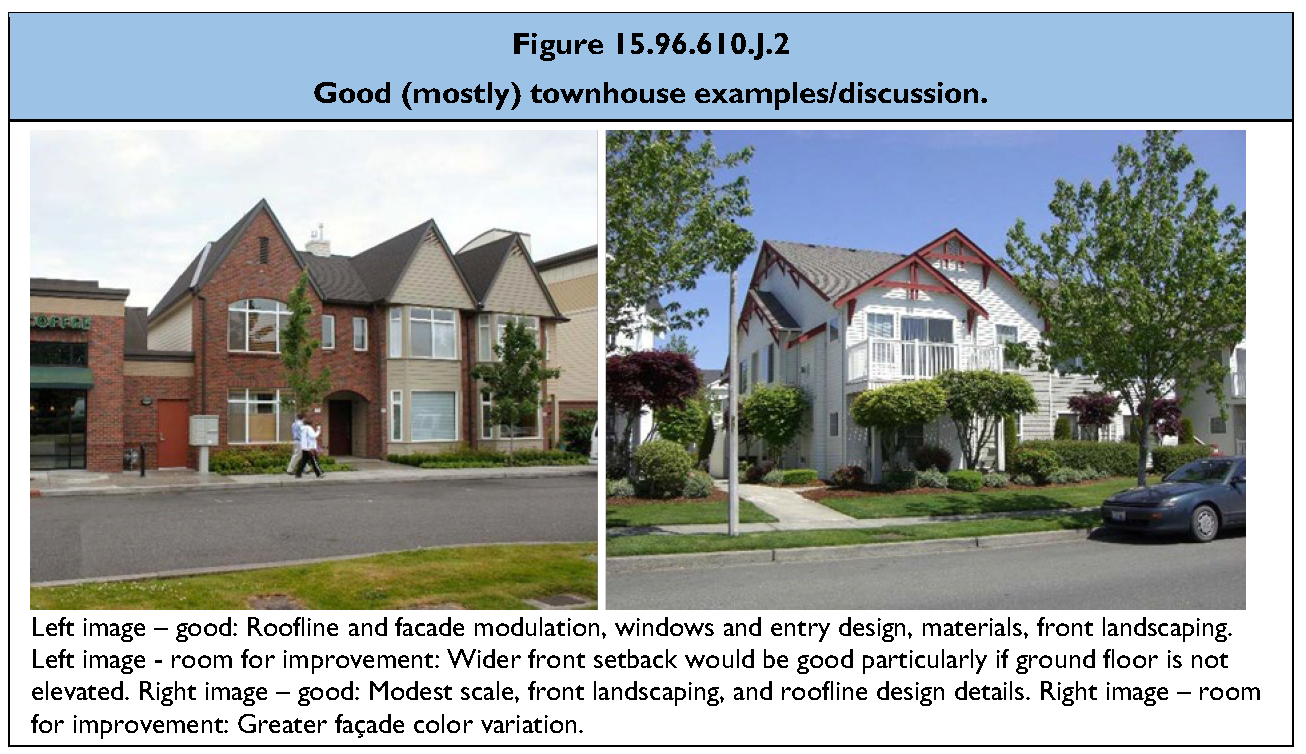
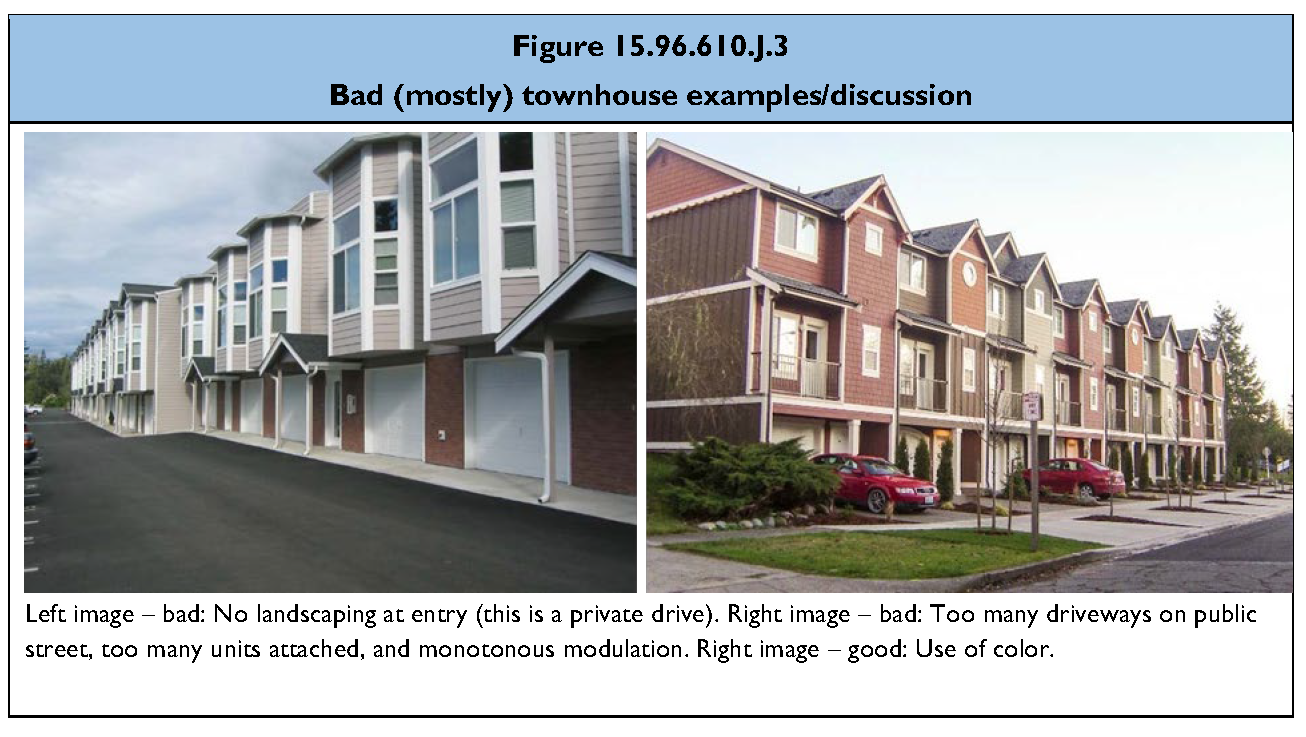
(Ord. No. 998, § 1(Exh. A), 9-24-2024)
15.96.620 - Cottage Housing Design Standards.
A.
Purpose.
1.
Provide opportunities for creative, diverse and high-quality infill development that is compatible with existing neighborhoods.
2.
Promote housing affordability and greater choice by encouraging smaller and more diverse home sizes in accordance with the Carnation Comprehensive Plan.
3.
Support compatibility with existing neighborhoods by promoting high-quality design.
4.
Support more efficient use of land zoned for residential development.
5.
Enhance the character of residential neighborhoods.
6.
Provide usable open space for residents.
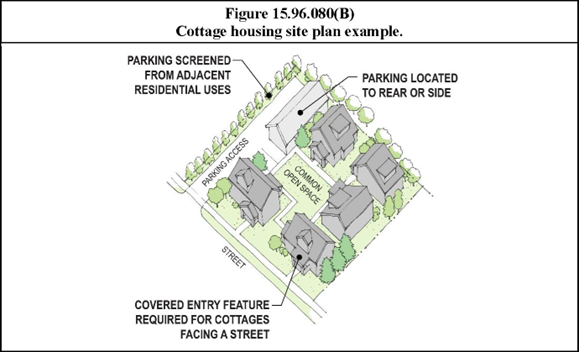
B.
Standards.
1.
Lot Size. Cottages are exempt from minimum lot area and lot width standards provided they comply with density and design standards herein.
a.
Cottages are exempt from minimum lot area and lot width standards provided they comply with density and design standards herein.
b.
In the R2.5, R3, R4, and R6 zones, the minimum size of the parent parcel prior to subdivision or development is one acre.
2.
Density. Due to the smaller relative size of cottage units, each cottage may be counted as one- half a dwelling unit for the purpose of calculating density. For example, a cluster of six cottages would be equivalent to three dwelling units.
3.
Minimum and Maximum Number of Cottages. Cottage housing developments must contain a minimum of four cottages. Four to twelve cottages may make up a cluster. There is no limit on the number of clusters provided all other standards are met.
4.
Setbacks and Separation.
a.
The minimum setbacks set forth in CMC Chapter 15.48 Table 1 apply to development frontage and external side and rear property lines of the entire cottage development.
b.
Internal to the cottage development individual cottages must be separated by at least ten feet [excluding permitted setback projections as set forth in CMC 15.48.040(C)].
5.
Building Height. Cottages have a maximum building height of twenty-five feet. All parts of the roof above eighteen feet must be pitched with a minimum roof slope of 5/12.
6.
Cottage Size. Cottages must contain no more than one thousand two hundred square feet gross floor area in total. Cottages are exempt from the floor area ratio standards set forth in CMC Chapter 15.48 Table 1.
7.
Entries.
a.
Clear and obvious pedestrian access between the sidewalk (or the street if there is no sidewalk) and the building entry is required for new dwellings.
b.
All new dwellings must provide a covered pedestrian entry with minimum weather protection of three feet by three feet (a covered porch or recessed entry).
8.
Façade transparency. Transparent windows and/or doors are required on at least eight percent of the facades (all vertical surfaces of street facing elevation). For corner lots, this standard is only applied to the elevation containing the dwelling entry.
9.
Common Open Space.
a.
Minimum Size. Common open space must be at least four hundred square feet per cottage.
b.
Minimum Dimensions. Common open space must have no dimension less than fifteen feet.
c.
Elements. Common open space may include a lawn, courtyard, plaza, garden, or other shared central open space and may not include parking areas. Common open space must be useable and may not include critical areas or critical area buffers, including steep slopes.
d.
Access. Cottages must be within one hundred feet walking distance of the common open space.
e.
Orientation. Cottages must be oriented around and have the main entry from the common open space. Common open space must have cottages abutting on at least two sides and must abut at least fifty percent of the cottages in a cottage housing development.
f.
A shared community building may be integrated into the larger common open space area. However, such a community building may not be included in the minimum common open space area calculations.
10.
Private Open Space.
a.
Minimum Size. The minimum private open space adjacent to each cottage must be at least two hundred square feet.
b.
Minimum Dimensions. The private open space must have no dimension less than ten feet.
c.
Access. The private open space must have access from the cottage via a door, porch, or pathway.
d.
The required porch (see section (e) below) does not count toward the size requirement of this section. The private open space is encouraged to be located between the cottage and the common open space.
e.
Porches. Cottage facades facing the common open space or common pathway must feature a roofed porch at least seventy square feet in size with a minimum dimension of seven feet on any side. Cottages sited between a street and the common open space are also subject to the entry requirements in subsection (B)(7) above.
f.
Private open space must be useable and may not include critical areas or critical area buffers, including steep slopes.
11.
Parking and Driveways.
a.
Off-street parking standards are set forth in CMC Chapter 15.72 Table VI and driveway and access requirements are set forth in CMC 15.72.040.
b.
Parking areas must be located to the side or rear of cottage clusters and not between the street and cottages.
c.
Parking and access lanes must be screened from adjacent residential uses by landscaping or architectural screens. For parking areas and access abutting residential uses, at least five feet of Type A, B, or C landscaping must be provided.
d.
Parking is encouraged to be consolidated under cover. Uncovered parking must be located in clusters of not more than five adjoining spaces (except where adjacent to an alley).
e.
Garages with a footprint of up to three hundred square feet may be attached to individual cottages provided all other standards herein are met. Such garages must be located away from the common open spaces.
f.
No more than one driveway per cottage cluster may be permitted, except where clusters front onto more than one street.
12.
Accessory dwelling units are not permitted in cottage housing developments.
(Ord. No. 998, § 1(Exh. A), 9-24-2024)
15.96.630 - Residential Subdivision Design Standards
A.
Purpose.
1.
Promote the development that reinforces the traditional, pedestrian-oriented development pattern of Carnation.
2.
Encourage a diversity of dwelling designs that reinforce and enhance the character of Carnation.
3.
Promote flexibility in the design of subdivisions that maximize the use of limited lot space.
B.
Applicability. The subdivision provisions herein apply to new subdivisions with four or more lots intended for single family or duplex development.
C.
Reverse and double frontage lots. Reverse and double frontage lots (where subdivision is designed with lots backing up to an arterial or collector-like streets and functionally walling off the subdivision from such street) are prohibited. Lots fronting on a street or trail and an alley are not considered reverse or double frontage lots.
D.
Setback variation. To avoid long monotonous rows of homes, offsets in front yard building setbacks may be required and noted on the plat. Minimum setbacks may be reduced or increased by five feet on individual lots on the plat to achieve the required variation. No more than three consecutive homes shall be placed with identical front yard setbacks.
E.
Architectural variety. Developments shall achieve architectural variety by accommodating a variety of architectural styles, variations of the same architectural style, and through the use of multiple design elements. Specifically:
1.
Duplicative house, cottage, or duplex designs adjacent to each other are prohibited. Simple reverse configurations of the same design on adjacent lots are not sufficient to meet architectural variety goals. Exceptions may be granted where architectural unity is desired for homes fronting a park or common open space.
2.
Generally, the more houses in a subdivision, the greater the number of different facade elevations will be required. Specifically:
a.
Four to nine homes, a minimum of three different façade elevations shall be used.
b.
Ten to nineteen homes, a minimum of four different facade elevations shall be used.
c.
Twenty to thirty-nine homes, a minimum of five different facade elevations shall be used.
d.
Forty or more homes, a minimum of six different facade elevations shall be used.
Alternatives will be considered provided the design and configurations of the subdivision meet the purpose of the standards.
3.
In order to qualify as a different façade elevation, dwellings shall have different roofline configurations, different color palettes, and different porch/entry design. In addition, a minimum of three of the following alternatives shall be utilized:
a.
Different window openings (location and design).
b.
One- and two-story houses.
c.
Different exterior materials and finishes.
d.
Different garage location, configuration, and design.
e.
Other different design element that helps to distinguish one façade elevation from another as determined by the Director or City Planner.
4.
Variation in lot size within a subdivision is encouraged for single family lots. For example, larger corner lots can provide more visual interest, and also allow for more usable open space for such residents, as those lots have two street frontages.
5.
Variation in house sizes is encouraged within developments. A combination of one and two story structures is attractive to a wider demographic (particularly seniors).
F.
Lot design options. To maximize site efficiency and usable open space, small lot developments (generally less than five thousand square feet in area and less than fifty feet wide) are encouraged to utilize zero-lot line provided they meet access, design, and other applicable standards set forth in this Title.
1.
Zero Lot Line. This is a configuration where the house and/or garage is built up to one of the side property lines, providing the opportunity for more usable side yard space. Standards:
a.
Dwelling units and accessory structures may be placed on one interior side property line. The opposite side yard shall be at least ten feet. Also see CMC 15.96.060 for special detached single family and duplex design standards, including minimum usable open space.
b.
Privacy wall. In order to maintain privacy, no windows, doors, air conditioning units, or any other types of openings in the walls along a zero lot line structure are allowed except for windows that do not allow for visibility into the side yard of the adjacent lot. Examples include clerestory or obscured windows. See Figure 15.96.630.F.1 below for an example of a privacy wall for a zero lot line house.
c.
Eaves along a zero lot line may project a maximum of eighteen inches over the property line.
d.
Lots intended for zero lot line homes shall be noted on the plat, together with minimum side yard areas and maximum building envelopes.
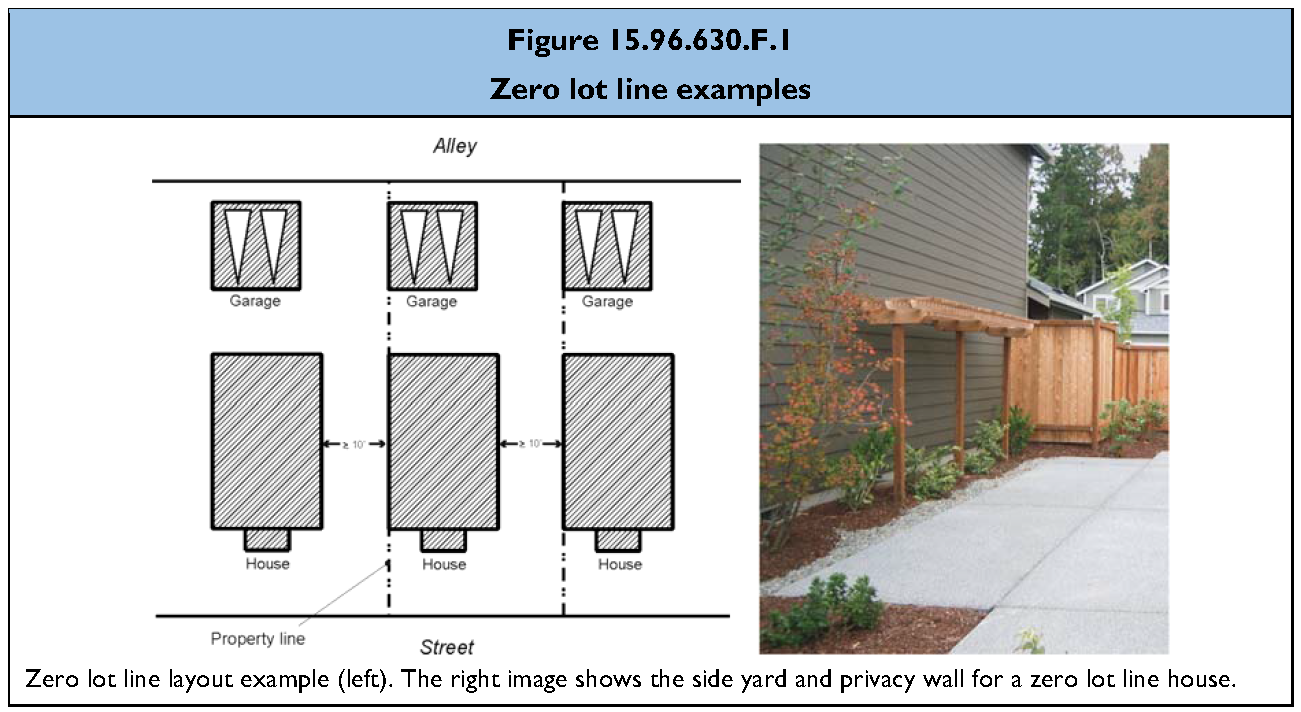
2.
Reciprocal Use Easement Lots. This works similar to the zero lot line configuration, except that the homes and accessory structures meet the standard setbacks and easements are granted on one side yard to allow consolidated use of the side yards by the adjacent property (see Figure 15.96.63.F.2 for example). Also, configurations providing for reciprocal use easements in the rear yard are allowed to maximize usable open space. Standards/provisions:
a.
Reciprocal easements shall be noted on the plat. Easement areas may be used for minimum usable open space requirements set forth in CMC 15.96.060(F).
b.
Privacy Wall. In order to maintain privacy, no windows, doors, air conditioning units, or any other types of openings in the walls of a structure along a reciprocal use easement are allowed except for windows that do not allow for visibility into the side yard of the adjacent lot. Examples include clerestory or obscured windows. See 15.96.630.F.1 above for an example of a privacy wall.
c.
Areas within reciprocal use easements may count towards usable open space requirements for applicable lots.
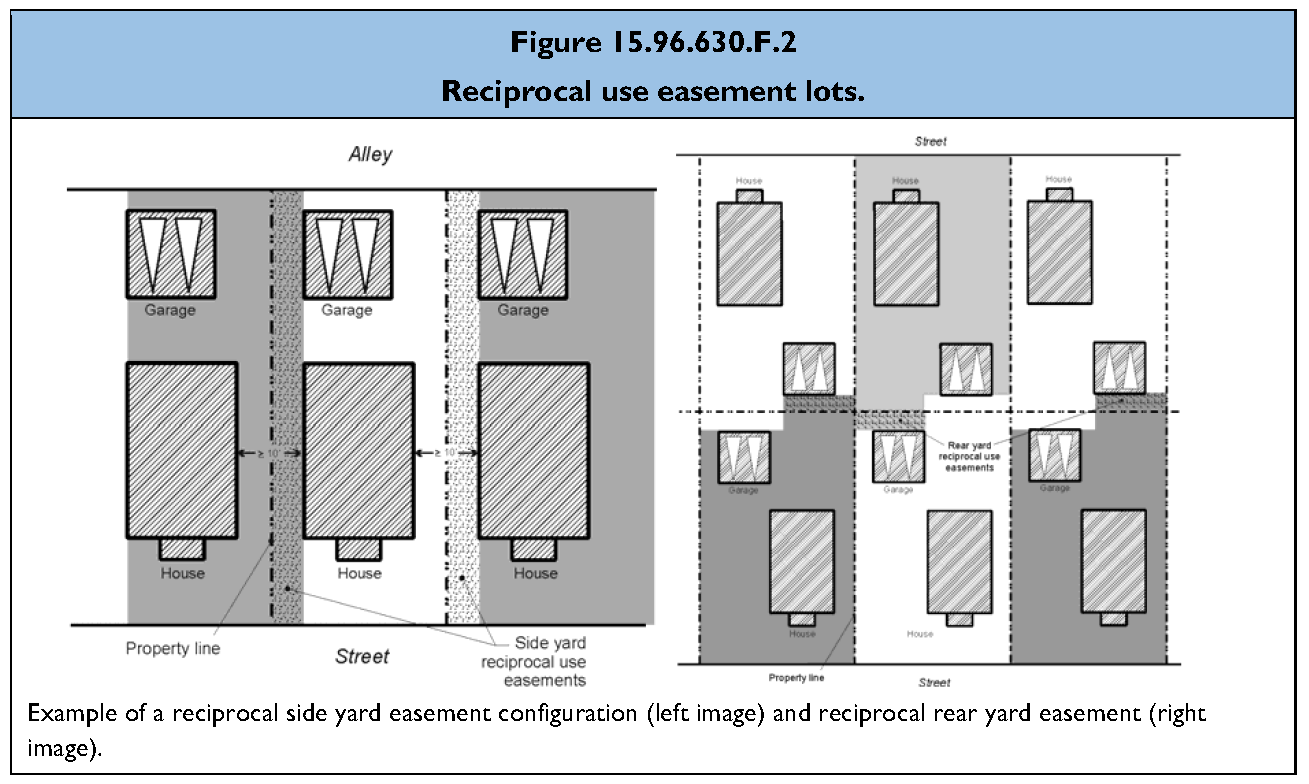
[3.]
Alley Access Lots. This includes configurations where lots are provided with vehicular access by an alley but where the lot fronts on a trail corridor or park. Pedestrian access to each alley access lot must be provided by a trail within a dedicated city park, designated common open space, and/or a pedestrian easement a minimum of ten feet wide with a five-foot minimum sidewalk.
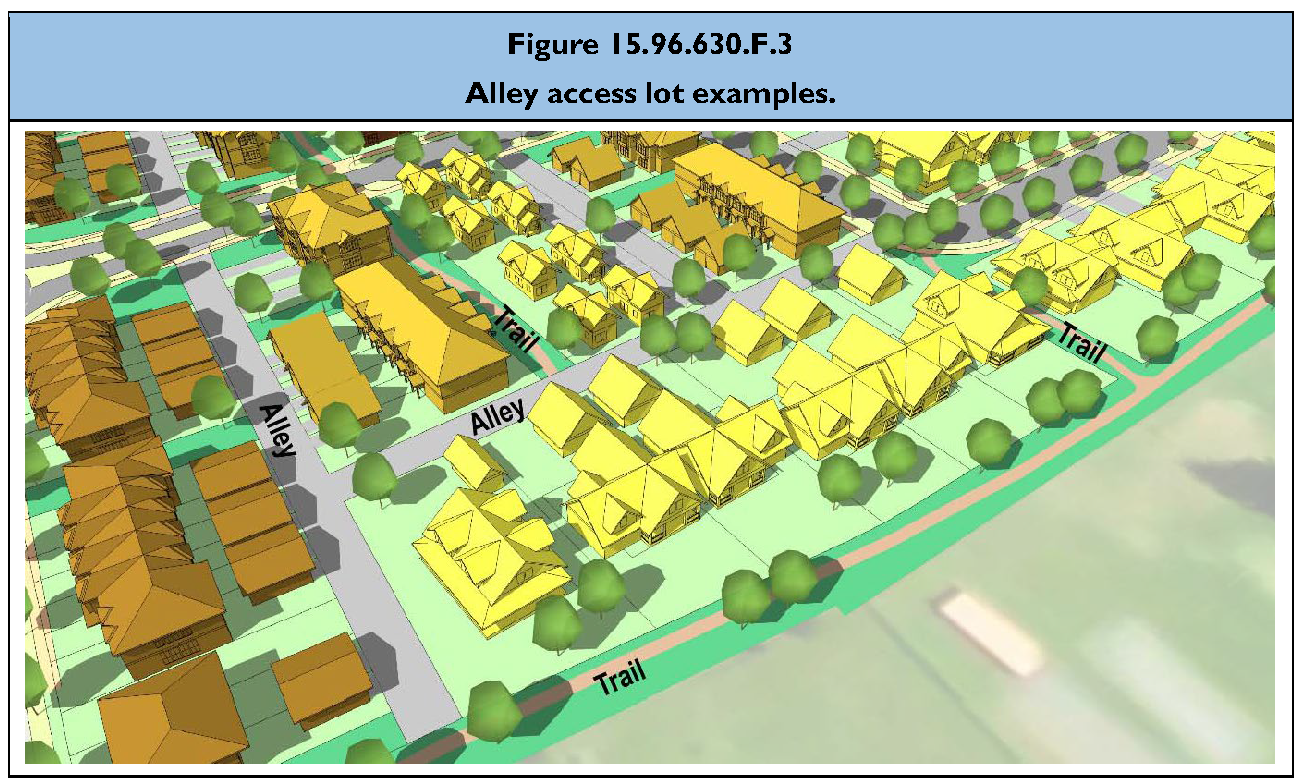
(Ord. No. 998, § 1(Exh. A), 9-24-2024)
15.96.700 - Special design standards for the R6 zone.
A.
Purpose and applicability: The purpose of this section is to reinforce and enhance the established, unique historical character of Carnation's downtown residential areas by imposing specific development standards for the R6 zone. The provisions of this section are supplemental and additional to all other applicable development standards set forth in this code. Provided, that in the event of an irreconcilable conflict between the provisions of this section and any other applicable code provision, the provisions of this section shall control to the extent of such conflict.
B.
All homes must include a covered entry feature that projects at least five feet from the front facade of the residence (measured from the front exterior wall of the house to the farthest roofline projection). The covered entry feature must be no less than one-third of the width of the residence, including attached garages, and shall be unenclosed on all sides except for the side abutting the front exterior wall of the residence. See Figure 15.96.700.B for examples.
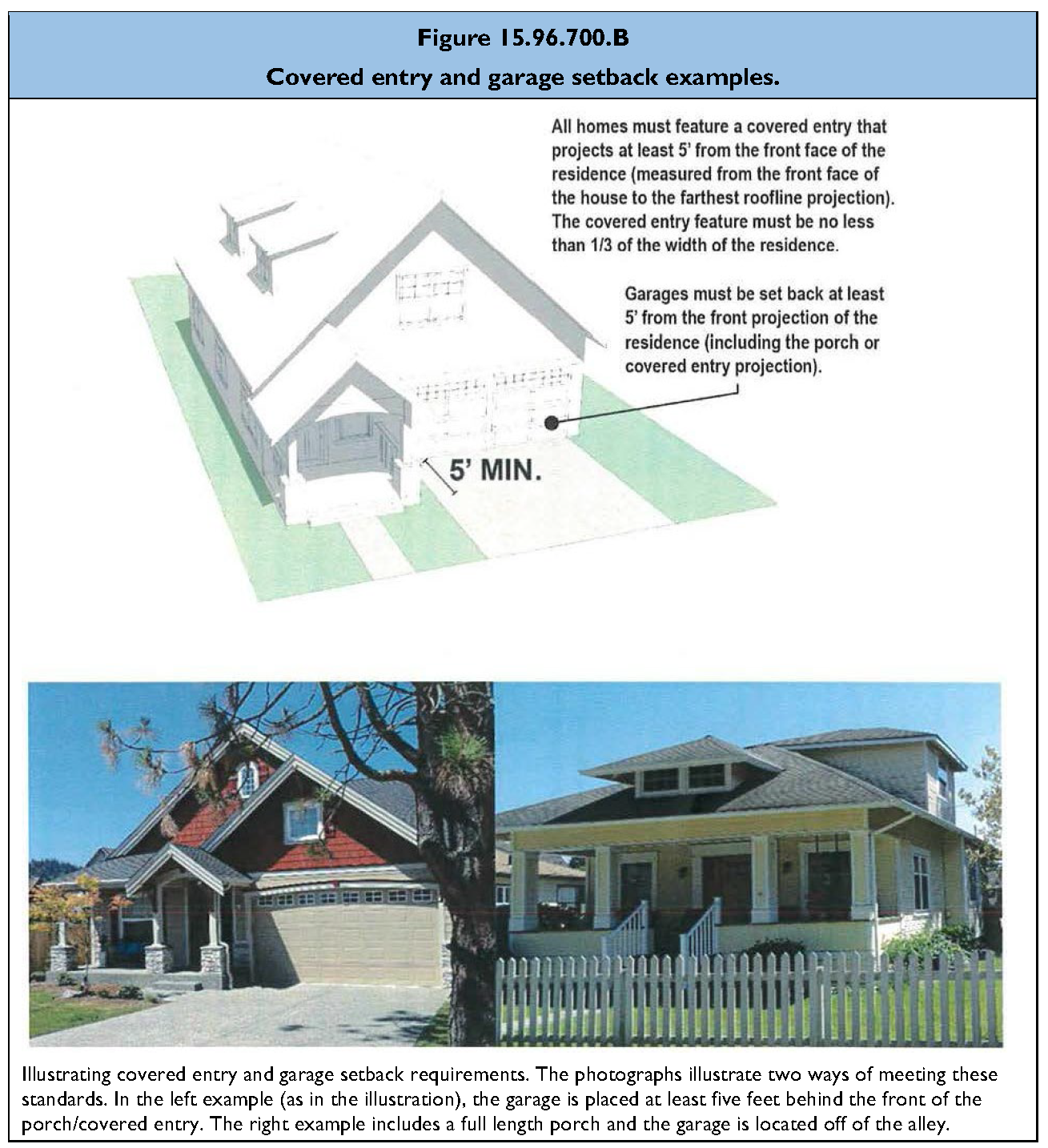
C.
At least ten percent of the front and street facing side yard façades (all vertical surfaces of a residence facing the street) must be comprised of transparent windows or doors. All areas inside an individual window frame may be counted in such transparency calculations (including, without limitation, window sashes, mullions, rails, stiles, and grilles). (see Figure 15.96.700.C)
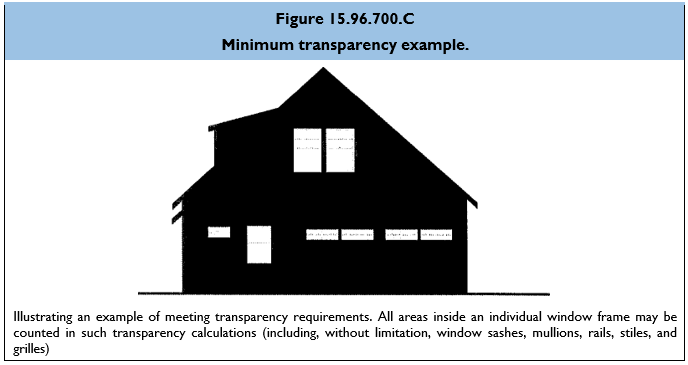
D.
Garages must be setback at least five feet from the front projection of the residence (including the porch or covered entry feature), and no less than twenty feet from the front property line. See Figure 15.96.700.B for examples.
E.
Front facing garages in the R6 zone shall not exceed twenty feet in width overall, and the aggregate garage door openings shall not be greater than sixteen feet wide. Garages with two individual doors are permitted provided each door does not exceed eight feet in width.
F.
Residences shall be limited to one and one-half stories as defined in CMC 15.08.010.
G.
Special side yard height and setback limitations: Buildings must not extend above or beyond a daylight plane (i) having a height of ten feet at the side property line for single story residences and extending into the parcel at an angle of forty-five degrees, or (ii) having a height of fourteen feet at the side property for one and one-half story residences and extending into the parcel at an angle of forty-five degrees, with the following encroachments allowed in either case:
1.
Chimneys, flues, eaves, or skylights.
2.
Dormers or similar architectural features; provided, that the horizontal length of all such features shall not exceed a combined total of fifteen feet on each side, measured along the intersection with the daylight plane.
3.
Gables or similar architectural features; provided, that the horizontal length of all such features shall not exceed a combined total of eighteen feet on each side, measured along the intersection with the daylight plane; and provided, that the intersection of the gable with the daylight plane closest to the front property line is along the roof line (see Figure 15.96.700.G).
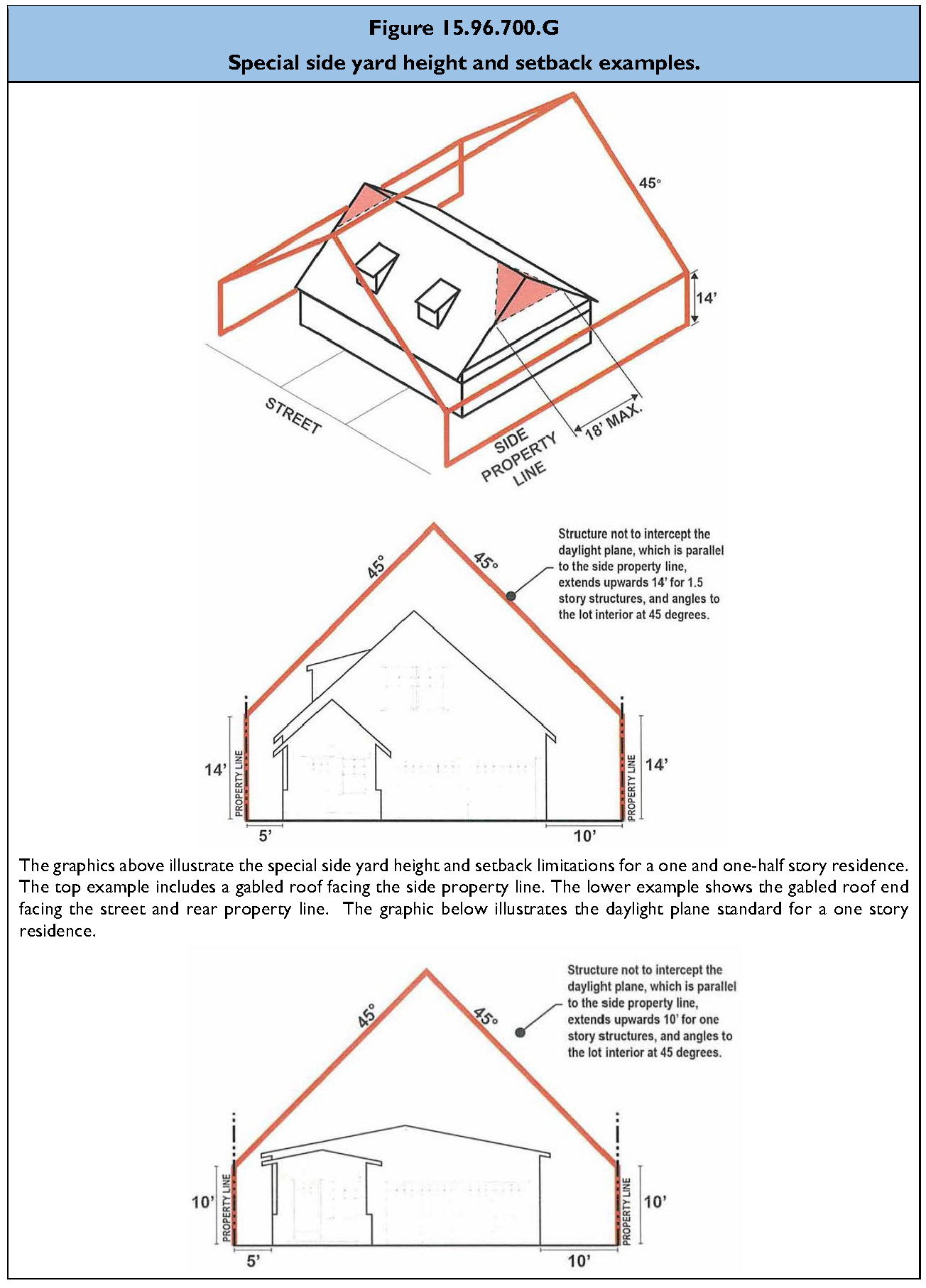
H.
To qualify for the one and one-half story daylight plane provisions the second floor (one-half story) shall satisfy the following criteria:
1.
No less than sixty percent of the total floor area of the second floor shall be designated as bedroom, kitchen, living room, study, home office and/or den space; and
2.
The upper floor must be enclosed by a pitched roof on at least two sides, whereby the roofline starts at no higher than twelve feet. The roofline on one or more sides may be intersected by:
a.
Dormers or similar architectural features, provided that the horizontal length of all such features shall not exceed a combined total of fifteen feet on each side; or
b.
Gables or similar architectural features; provided, that the horizontal length of all such features shall not exceed a combined total of eighteen feet on each side.
See Figure 15.96.700.H below for clarification of these standards.
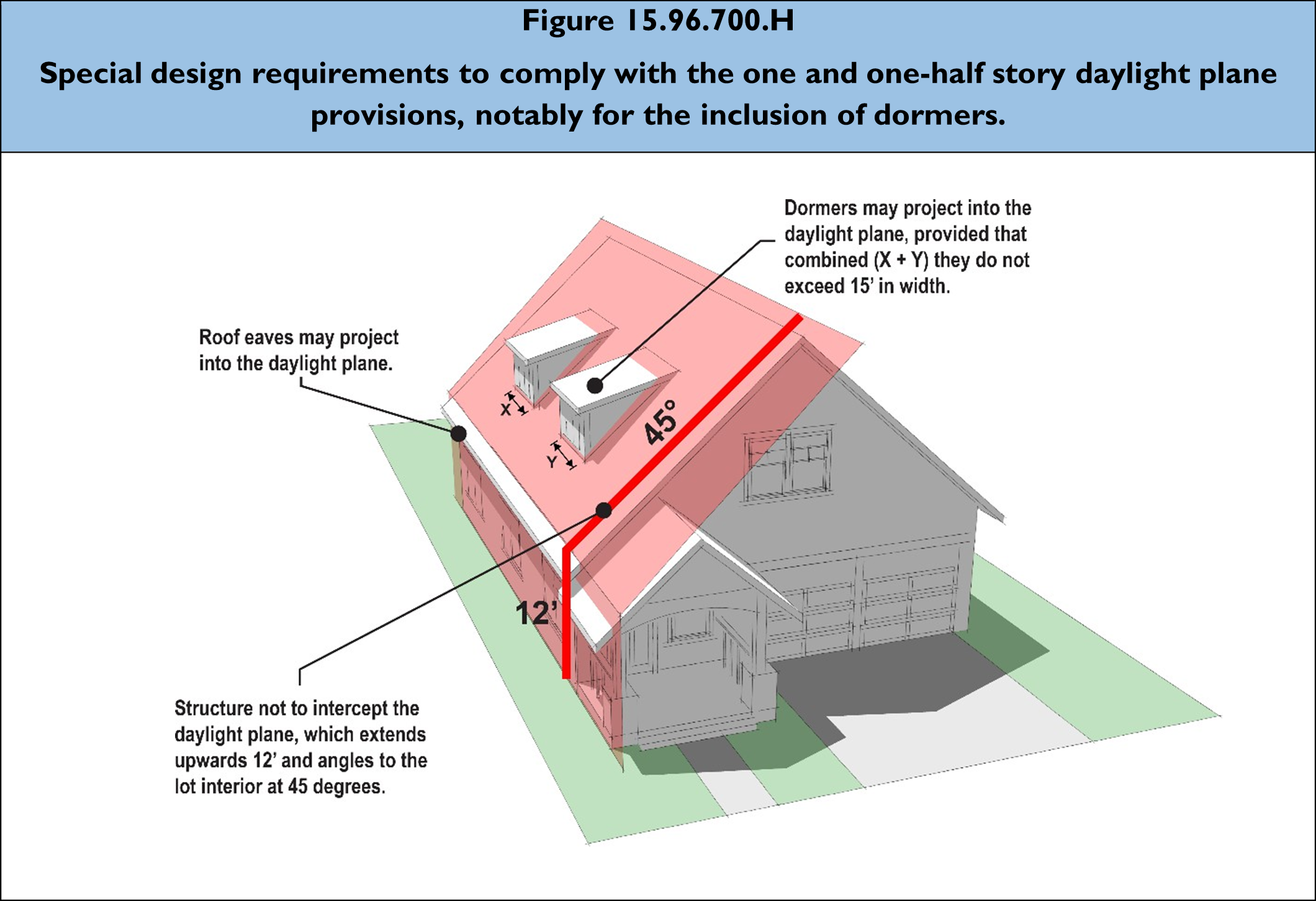
(Ord. No. 998, § 1(Exh. A), 9-24-2024)
15.96.710 - Special detached single family and duplex design standards for the R12 zone.
A.
Purpose. The purpose of this section is to reinforce and enhance the established, unique historical character of Carnation's downtown residential areas by imposing specific development standards for the R12 zone. The provisions of this section are supplemental and additional to all other applicable development standards set forth in this code. Provided, that in the event of an irreconcilable conflict between the provisions of this section and any other applicable code provision, the provisions of this section shall control to the extent of such conflict.
B.
Covered Entry. All homes must include a covered entry feature that projects at least five feet from the front facade of the residence (measured from the front exterior wall of the house to the farthest roofline projection). The covered entry feature must be no less than one-third of the width of the residence, including attached garages, and shall be unenclosed on all sides except for the side abutting the front exterior wall of the residence. See Figure #1 for examples.
C.
Façade Transparency. At least ten percent of the front and street facing side yard façades (all vertical surfaces of a residence facing the street) must be comprised of transparent windows or doors. All areas inside an individual window frame may be counted in such transparency calculations (including, without limitation, window sashes, mullions, rails, stiles, and grilles).
D.
Garage standards for detached single family uses:
1.
Garages must be setback at least five feet from the front projection of the residence (including the porch or covered entry feature), and no less than twenty feet from the front property line.
2.
Front facing garages shall not exceed twenty feet in width overall, and the aggregate garage door openings shall not be greater than sixteen feet wide. Garages with two individual doors are permitted provided each door does not exceed eight feet in width.
E.
Garages for duplexes shall be accessed from alleys only.
F.
Minimum usable open space for lots served by alleys.
1.
A contiguous open space to the side or rear of the dwelling with a minimum dimension of fifteen feet on all sides is required for each dwelling unit.
2.
The open space(s) must be equivalent to ten percent (minimum) of the lot area. For example, a four thousand square foot single family lot would require a contiguous open space of at least four hundred square feet, or twenty feet by twenty feet in area.
3.
Drive aisles must not count in the calculations for usable open space.
4.
Additions must not create or increase any non-conformity with this standard.
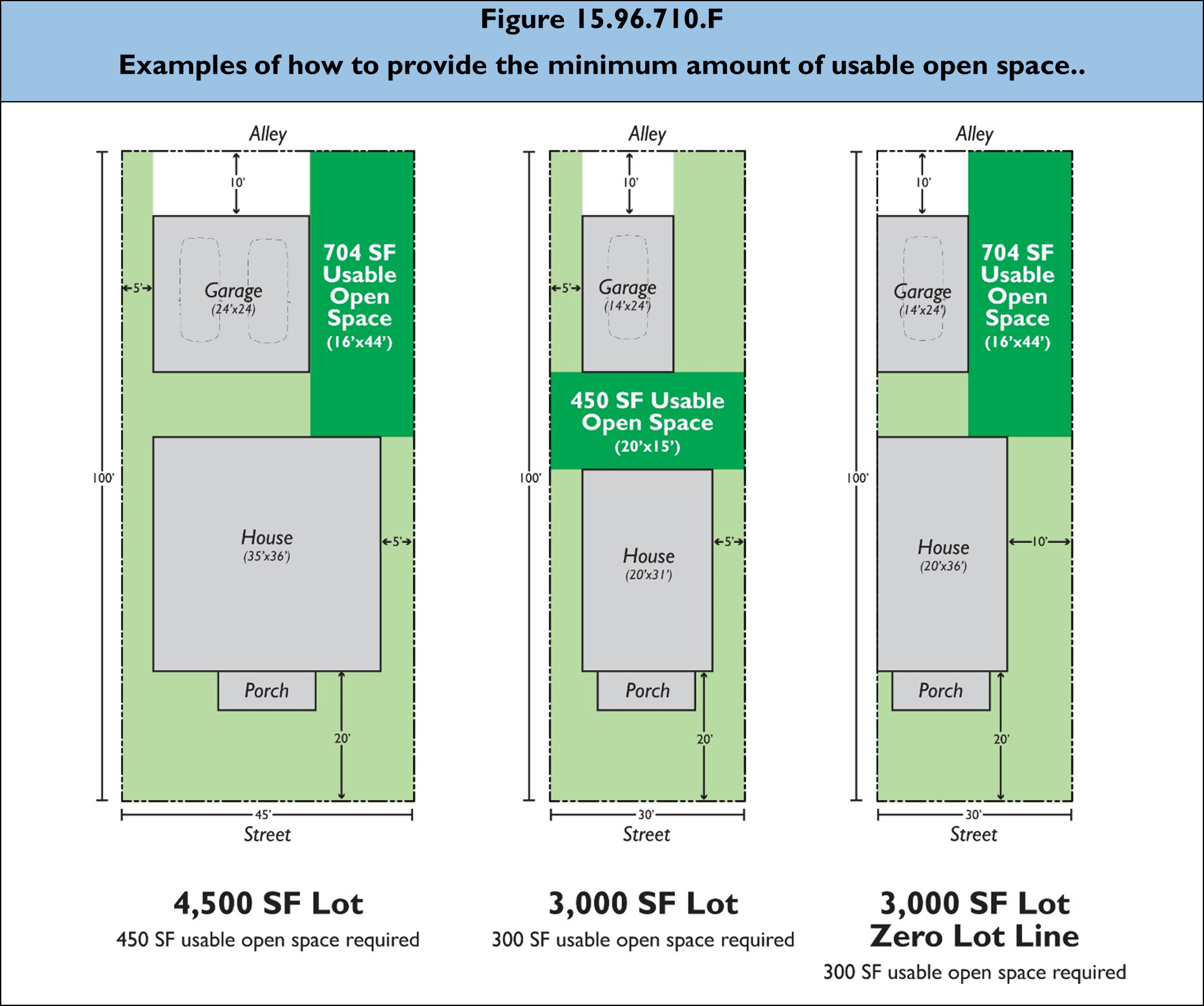
G.
Façade articulation. The façade shall include at least one projecting element, such as a covered entry feature, bay or gabled window or other horizontal wall modulation [see acceptable examples in Figure 15.96.060(G)]. However, the projected façade elements shall not be the dominant façade component [see acceptable examples in Figure 15.96.060(G)].
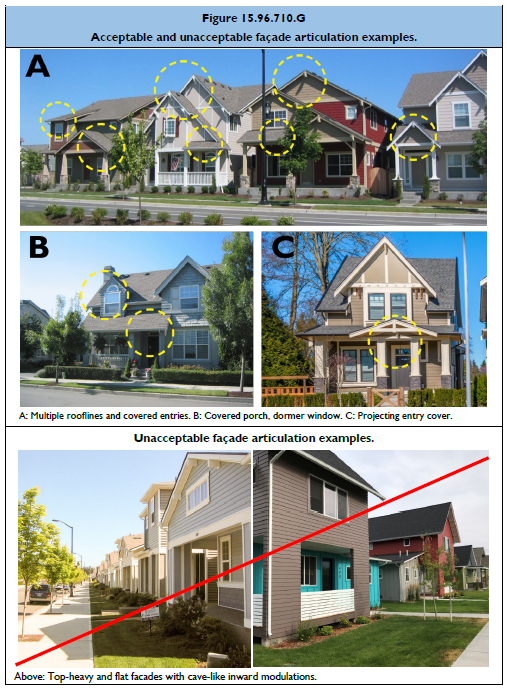
H.
Façade Details. Provide for architectural details that add visual interest to the neighborhood and are well proportioned to achieve good human scale. Specifically, incorporate at least three of the following detail elements into the façade of the house:
1.
Decorative porch design, including decorative columns or railings.
2.
Bay windows or balconies.
3.
Decorative molding/framing details around all ground floor windows and doors.
4.
Decorative door design including transom and/or side lights or other distinctive feature.
5.
Decorative roofline elements including brackets, multiple dormers, and chimneys.
6.
Decorative building materials, including decorative masonry, shingle, brick, tile, stone, or other materials with decorative or textural qualities.
7.
Landscaped trellises or other decorative elements that incorporate landscaping near the building entry.
8.
Distinctive paint schemes.
9.
Other decorative facade elements or details that meet the purpose of the standards.
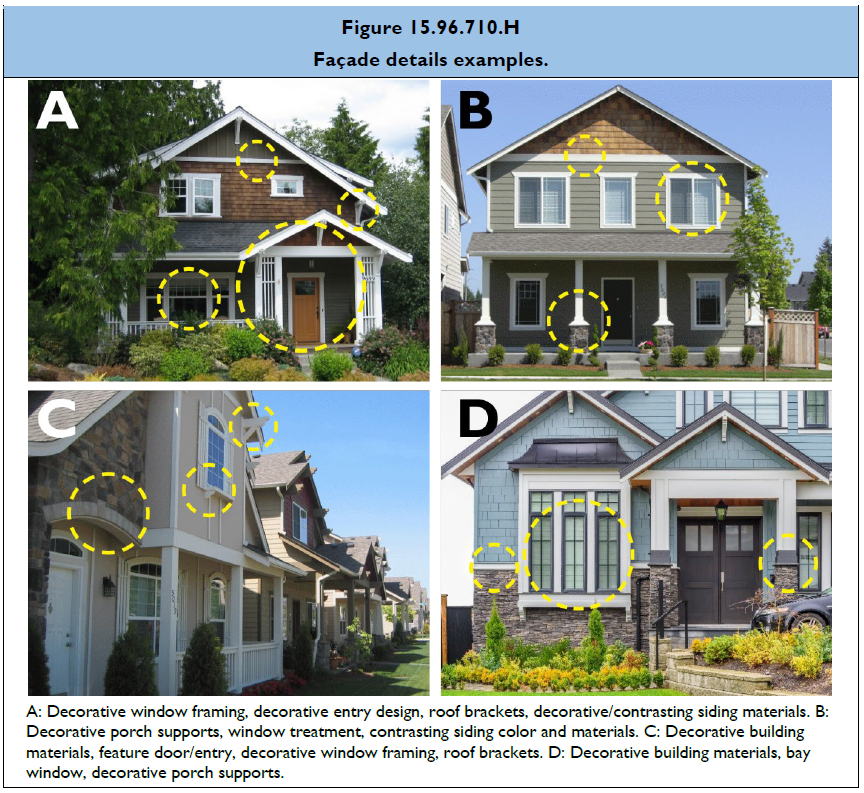
I.
Façade Window Design.
1.
Grouped double-hung style windows are acceptable. Individual accent windows with other shapes are also acceptable provided they are smaller than most other façade windows.
2.
Offset, corner, and/or unusually shaped windows (except for accent windows discussed above) are prohibited.
3.
Windows shall feature trim at least four inches wide with color contrasting with the façade. Alternatively, windows may be recessed from the façade by at least two inches.
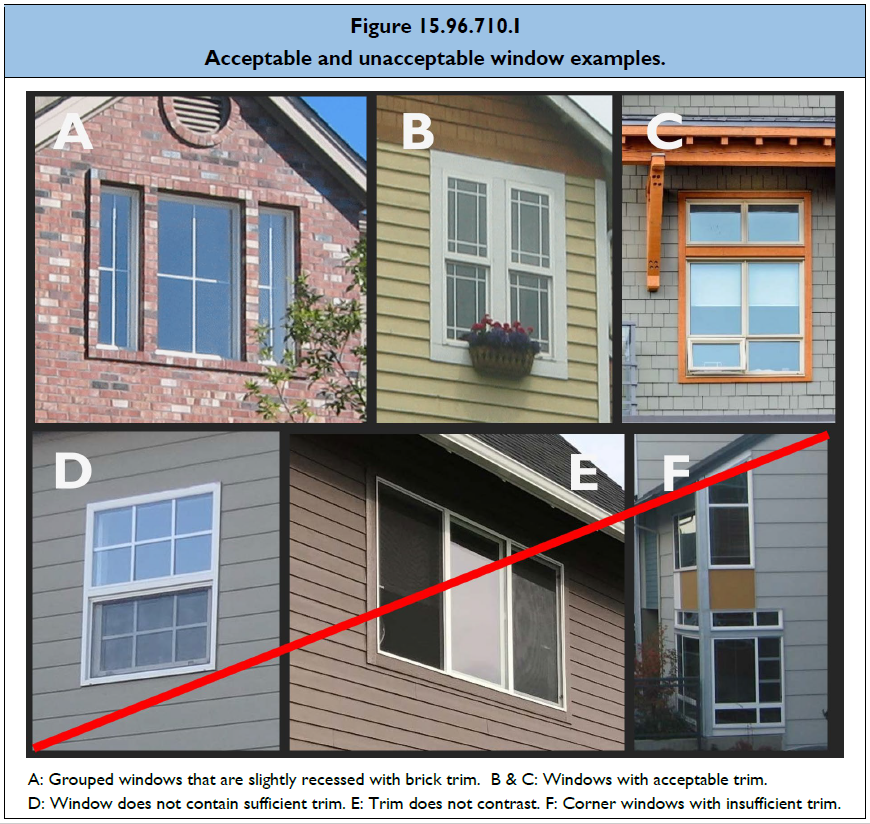
J.
Prohibited materials.
1.
Exterior insulation finishing systems (EIFS).
2.
T-111 siding or other similar plywood types of siding (board and batten is an exception).
K.
Roofline design.
1.
Rooflines visible from the street shall feature a minimum 5/12 roof pitch. Shallower roof pitches may be used provided one or more gabled rooflines facing the street feature the minimum 5/12 roof pitch.
2.
Rooflines for two-story elevations within ten feet of a side lot line shall slope away from the side yard (no gabled roof facing side lot line).
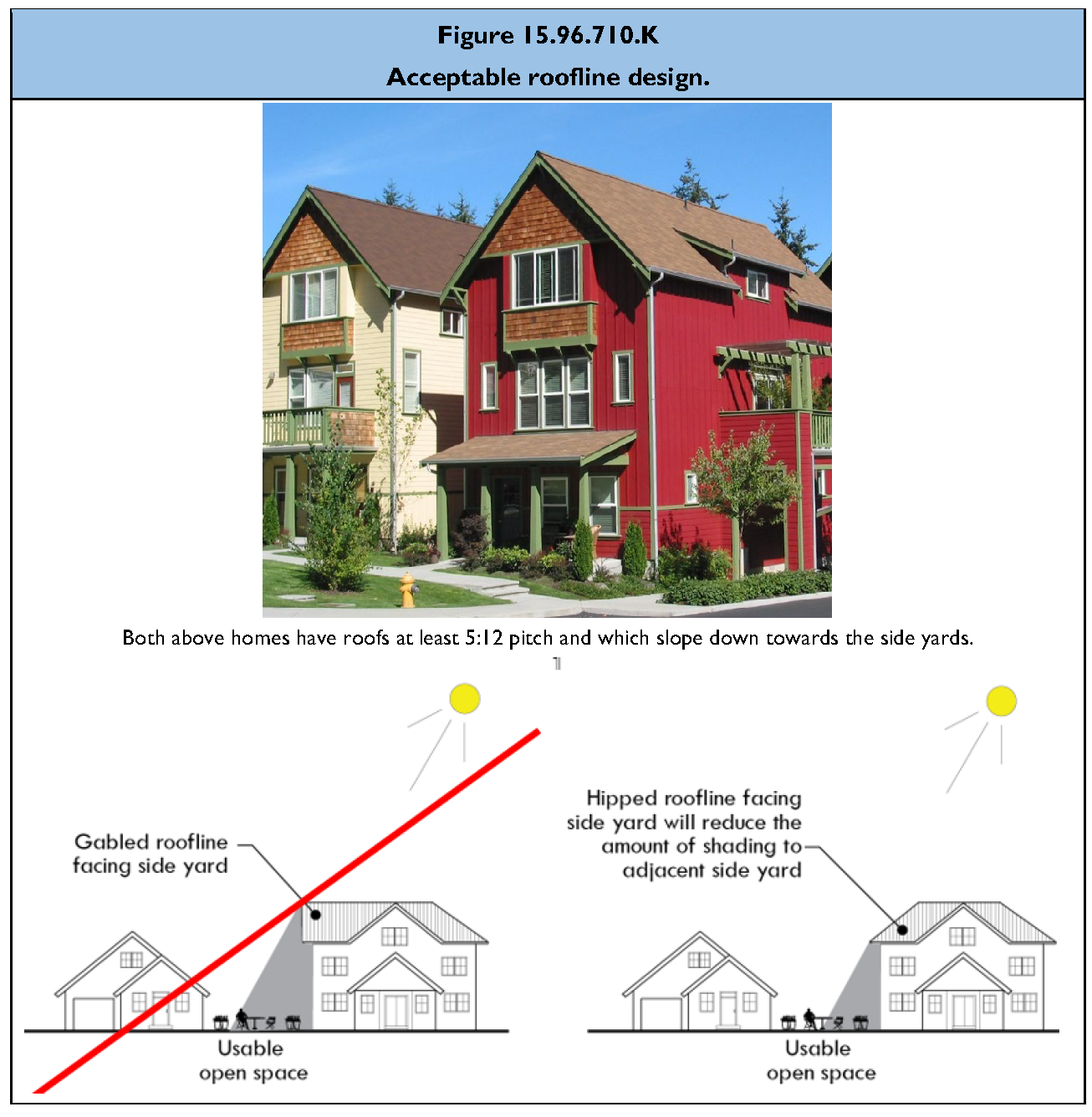
(Ord. No. 998, § 1(Exh. A), 9-24-2024)
15.96.720 - Subdivision design standards for the R12 zone.
A.
Purpose. The purpose of this section is to:
1.
Promote the development that reinforces the traditional, pedestrian-oriented development pattern of downtown Carnation neighborhoods.
2.
Promote a mixture of housing types that fit into the existing and desired context of Carnation.
3.
Encourage a diversity of dwelling designs that reinforce and enhance the character of Carnation.
4.
Avoid monotonous and auto-dominated forms of development that would degrade the traditional small-town character of Carnation.
5.
Promote flexibility in the design of subdivisions that maximize the use of limited lot space.
B.
Street Grid. To the extent practical, new developments shall integrate a grid of streets generally consistent with the street grid of downtown (area bound by West Bagwell Street, Entwistle Street, Stewart Avenue, and Milwaukee Avenue). This includes alley loaded east-west blocks no longer than six hundred fifty feet and between two hundred to two hundred fifty feet wide. Extensions of existing streets around the edge of the site are required. Exceptions and variation from the street grid will be allowed for the integration of parks, trails, and public facilities.
C.
Front Yard Setback Variation. To avoid long monotonous rows of homes, offsets in front yard building setbacks may be required and noted on the plat. Minimum setbacks may be reduced or increased by five feet on individual lots on the plat to achieve the required variation. No more than three consecutive homes may be placed with identical front yard setbacks.
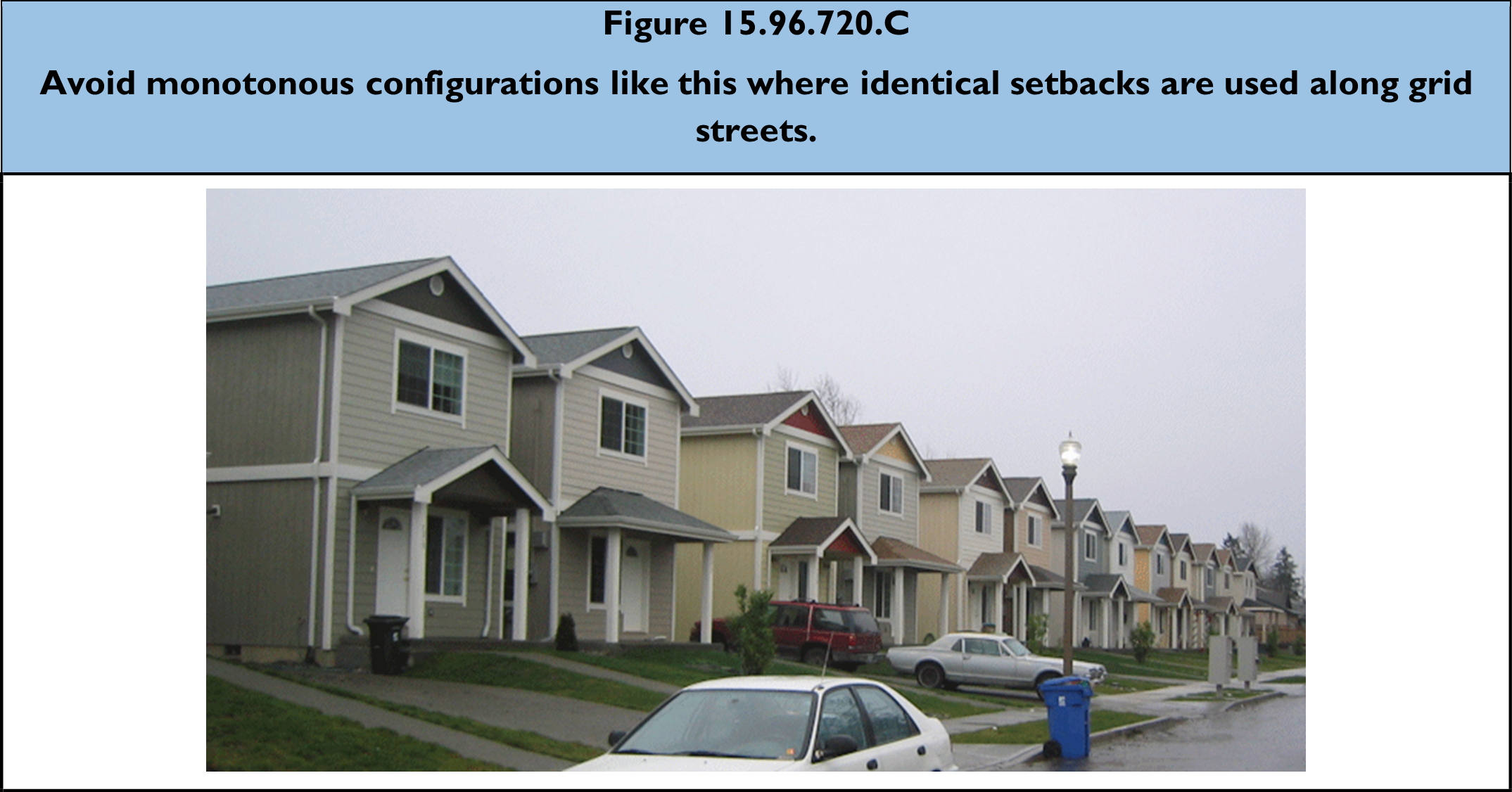
D.
Architectural Variety. Developments shall achieve architectural variety by accommodating a variety of architectural styles, variations of the same architectural style, and through the use of multiple design elements. Specifically:
1.
Duplicative house, cottage, or duplex designs adjacent to each other are prohibited. Simple reverse configurations of the same design on adjacent lots are not sufficient to meet architectural variety goals. Exceptions may be granted where architectural unity is desired for homes fronting a park or common open space.
2.
Generally, the more houses in a subdivision, the greater the number of different facade elevations will be required. Specifically:
a.
Ten to nineteen homes, a minimum of four different facade elevations shall be used.
b.
Twenty to thirty-nine homes, a minimum of five different facade elevations shall be used.
c.
Forty or more homes, a minimum of six different facade elevations shall be used.
Alternatives will be considered provided the design and configurations of the subdivision meet the intent.
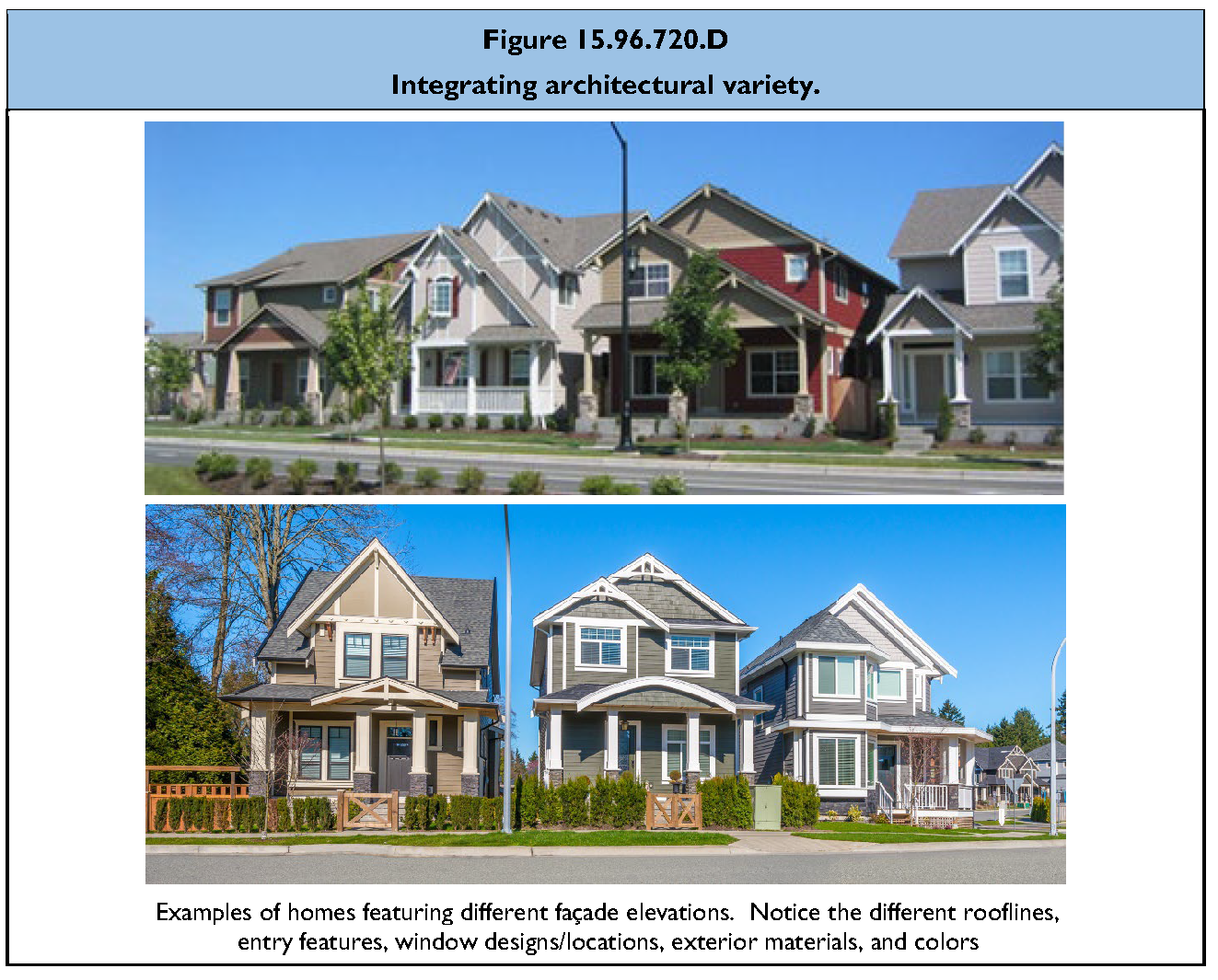
3.
In order to qualify as a different façade elevation, dwellings shall have different roofline configurations, different color palettes, and different porch/entry design. In addition, a minimum of two of the following alternatives shall be utilized:
a.
Different window openings (location and design).
b.
One- and two-story houses.
c.
Different exterior materials and finishes.
d.
Different garage location, configuration, and design.
e.
Other different design element that helps to distinguish one façade elevation from another as determined by the director.
4.
Variation in lot size within a subdivision is encouraged for single family lots. For example, larger corner lots can provide more visual interest, and also allow for more usable open space for such residents, as those lots have two street frontages.
5.
Variation in house sizes is encouraged within developments. A combination of one and two story structures is attractive to a wider demographic (particularly seniors).
E.
Corner Lot Emphasis. Structures on corner lots are encouraged take advantage of the dual frontage, make an architectural statement, and create interest in architecture and human activity on the street. This could be accomplished by providing one or more of the following: (1) Wrap around porches; (2) Bay windows or turrets; (3) Varied exterior materials, roof feature, colors, and/or articulation. Varied materials shall complement each other.
F.
Reverse and Double Frontage Lots. Reverse and double frontage lots are prohibited except where essential to provide access to development adjacent to limited access streets or to overcome topography or other physical conditions. Lots fronting on a street or trail and an alley are not considered reverse or double frontage lots.
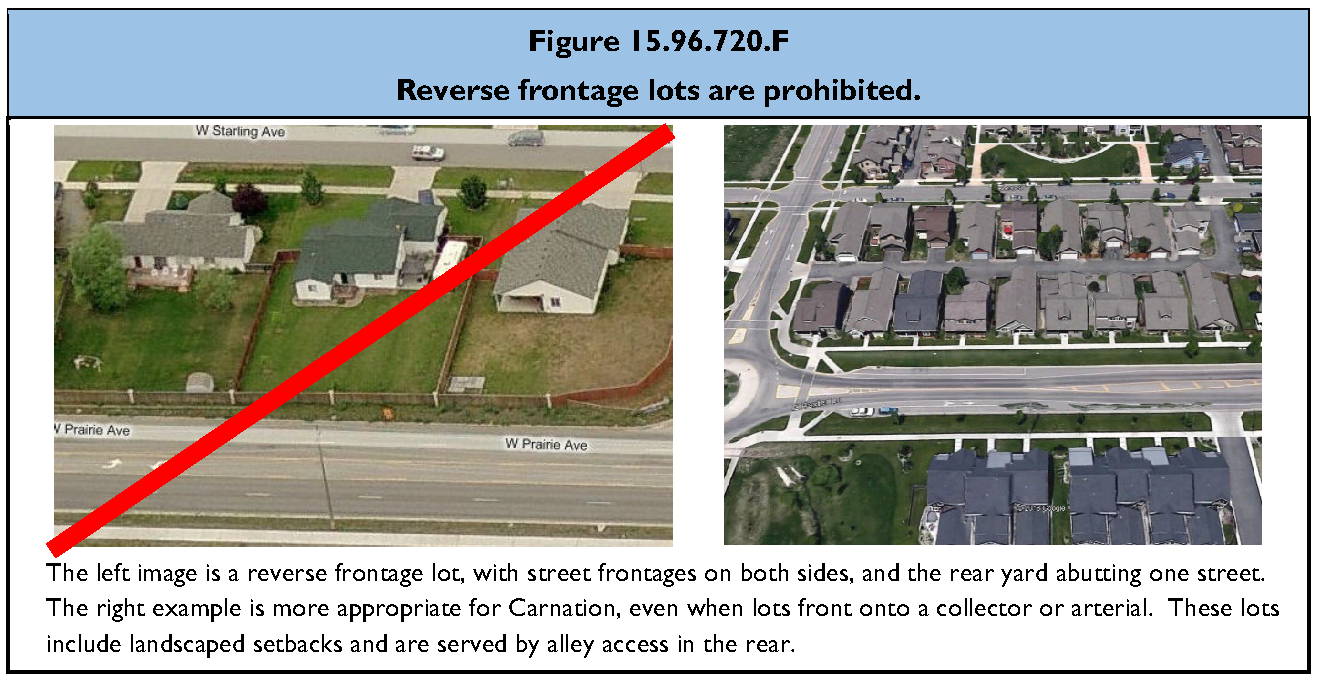
G.
Lot Design Options. To maximize site efficiency and usable open space, small lot developments (generally less than five thousand square feet in area and less than fifty feet wide) are encouraged to utilize zero-lot line provided they meet access, design, and other applicable standards set forth in this Title.
(Ord. No. 998, § 1(Exh. A), 9-24-2024)

