
Carrabelle City Zoning Code
ARTICLE VII
DESIGN STANDARDS AND IMPROVEMENT REQUIREMENTS
PART 7.00.00 - PURPOSE AND INTENT
The purpose of this article is to ensure that future growth, development, and redevelopment in the City of Carrabelle conforms to certain minimum criteria. These criteria are provided for the express purpose of achieving the objectives of the city as stated in its comprehensive plan as well as implementing the policies adopted to ensure fulfillment of those objectives. The design standards and criteria contained in this chapter are provided to protect the general health, safety, and welfare of the city and its citizens; to guard against the negative impacts of growth; and to protect the general public from potential adverse impacts from a proposed use.
The standards and criteria provided in this chapter are mandatory and apply to all properties in the city. These standards describe the minimum acceptable design and development standards which must be met in order to receive approval for a proposed development.
The approval of standards of this code shall not be construed to invalidate deed restrictions or restrictive covenants, nor does the city enforce such private contractual agreements.
PART 7.01.00 - ZONING DISTRICT PERFORMANCE AND DIMENSIONAL STANDARDS
The purpose of the following sections is to describe those site design standards which apply to specific zoning districts. these standards regulate lot area, building placement, dwelling unit type, density and intensity of development.
PART 7.02.00 - SUBDIVISION DESIGN AND IMPROVEMENT STANDARDS
All lands included within the subdivision shall be suitable for the various purposes proposed in the application for subdivision approval. Further, no subdivision plan shall be approved unless the city determines after full consideration of all pertinent data that the proposed subdivision conforms to all the provisions of these regulations.
PART 7.03.00 - TRANSPORTATION SYSTEM STANDARDS
The purpose of this section is to describe regulations which apply to the transportation system, including bikeways, pedestrian access, parking and loading. This section shall be construed and implemented to create an efficient, safe, and balanced system of traffic circulation accommodating vehicles, bicycles, and pedestrians, and providing for adequate parking and loading.
All roadway construction or repair activities performed by, or under the supervision of the public works department shall be conducted in accordance with the standards set forth by the department.
PART 7.08.00 - SUPPLEMENTAL STANDARDS FOR SPECIAL USES
The purpose of the supplemental standards is to set forth general rules and regulations for uses, building and structures applying to all zoning districts; as well as to provide for additional regulations for restricted uses applying to specific zoning districts as enumerated herein.
Sec. 7.01.01 - General development standards.
A.
It is the intent of the City that all development shall be served by the City's central water and central sewer system.
B.
All development shall provide on-site stormwater retention area and facilities as determined by the Comprehensive Plan. Land to be dedicated for stormwater retention may include land required to meet buffer standards, wetlands protection, or habitat protection.
C.
All development shall have a total land area sufficient to meet all site design standards in this Code including, but not limited to, land required to provide setbacks from abutting rights-of-way, buffers, stormwater management, off-street parking and circulation, protection of wetlands, or other provisions which may require land area to be set aside. Minimum lot sizes (area) are detailed for each zoning district. Density requirements also are established per each zoning district.
D.
An impervious surface ratio is specified for each zoning district to provide a control of the intensity of development of land. Impervious surface is that portion of the land which is covered by buildings, pavements, or other cover through which water cannot penetrate. Porous concrete, asphalt, porous turf block, or similar materials may be used, subject to the specifications in the Appendices, and shall be calculated based on the portion of the material which is impervious.
Sec. 7.01.01.01 - Lot requirements.
All lots of record, or combination of lots of record under single ownership, which have width, depth, and area which constitute sufficient size to construct or erect a structure thereon, as of the date of recording of a deed or other legal instrument shall continue to be vested with the same rights to construct or erect a structure thereon, provided the proposed use of the lot, or combination of lots, meets all other current provisions of city regulations; and
No lot area, lot width, or lot depth shall be reduced or diminished so that the yards or other open space shall be smaller than prescribed by this code except as expressly approved by the city commission.
No space which has been counted as part of a yard, or other open space required by this code, may, by reason of change in ownership or otherwise, be counted or calculated to satisfy or comply with a yard or other open space requirement of or for any other building.
Sec. 7.01.01.02 - Required frontage of lots and required orientation of primary buildings.
All lots of record that are to be used for buildings shall have frontage on a public right-of-way. All primary buildings (residential, commercial or industrial) shall have primary access from a public right-of-way. Where possible primary access be from an alley, crosswalk or pedestrian way. All single family and duplex dwelling units shall have a primary entrance facing a public right-of-way and be on a lot which has street frontage where possible.
All lots of record that are to be used for buildings shall have adequate access to a public street by direct frontage or via a public right-of-way. Adequacy of access shall be determined by the planning and zoning board if not by direct street frontage. Specific criteria for adequacy of access shall be approved by city commission.
Sec. 7.01.01.03 - Building setbacks.
Minimum setbacks are established to provide open space and ventilation between structures and to comply with fire codes for specific types of construction. All setbacks shall be measured horizontally from the foundation.
Sec. 7.01.01.04 - Height regulations.
No building shall exceed a height of 35 feet measured from the elevation of the first inhabitable floor required to meet flood protection standards.
No building shall be erected, reconstructed or structurally altered to exceed the height established for the district in which such building is located, subject to the following:
A.
Special industrial structures such as cooling towers, elevators bulkheads, fire towers, tanks, water towers, which require a greater height than provided in the district, may be erected to a greater height than permitted provided:
1.
The structure shall occupy more than 25 percent of the lot area; and
2.
All setback requirements of the district in which the structure is erected shall be increased by one foot for each foot of height above 30 ft.
B.
The height limitations of this code shall not apply to flagpoles, church spires, chimneys, and antenna towers.
C.
Notwithstanding the foregoing provisions and the height limitations as set forth in each zoning district, in no case shall a structure exceed in height the limitations determined to protect the approach and clear air zones established for the Carrabelle Municipal Airport, as currently adopted or subsequently amended.
Sec. 7.01.02 - Density, area, height and bulk requirements.
All development shall adhere to the specific density, area, height and bulk requirements for the zoning district in which it is located and as prescribed in Table 7.01.01.
Sec. 7.01.02.01 - Minimum floor area for dwelling units.
No dwelling unit shall contain less than 600 square feet of habitable floor area.
Table 7.01.01: Density, Area, Height and Bulk Requirements
Notes:
1 Land Based Classification System, Standard Color Code, American Planning Association.
2 Dwelling units per gross acre.
3 Minimum of 1,000 sq. ft. of enclosed heating area.
4 Exception for lots created prior to November 2, 1992.
5 With public water and sewer.
6 10,890 sq. ft. where an OSDS and connection to a public potable water system are used and a half acre when OSDS and private water systems are used.
7 Minimum setback of 25 ft. on property bordering US 98 or County Rd 67.
8 Prohibited in Coastal High Hazard Area.
9 Exception for lots created prior to November 2, 1992.
10 With public water and sewer.
11 10,890 sq. ft. where an OSDS and connection to a public potable water system are used and a half acre when OSDS and private water systems are used.
12 Minimum setback of 25 ft. on property bordering US 98 or County Rd 67.
13 Minimum site size: Five acres.
14 Prohibited in Coastal High Hazard Area.
15 One mobile home per lot.
16 For mobile homes.
17 Area not to be less than 2,900 sq. ft. per family for multi-family.
18 With public water and sewer.
19 10,890 sq. ft. where an OSDS and connection to a public potable water system are used and a half acre when OSDS and private water systems are used.
20 Minimum setback of 25 ft. on property bordering US 98 or County Rd 67.
21 With public water and sewer.
22 10,890 sq. ft. where an OSDS and connection to a public potable water system are used and a half acre when OSDS and private water systems are used.
23 Minimum setback of 25 ft. on property bordering US 98 or County Rd 67.
24 Existing lots may not be subdivided.
25 Minimum 100 ft. where an OSDS is used.
26 Minimum setback of 25 ft. on property bordering US 98 or County Rd. 67.
27 Existing lots may not be subdivided.
28 Minimum setback of 25 ft. on property bordering US 98 or County Rd. 67.
29 Existing lots may not be subdivided.
30 Minimum 100 ft. where an OSDS is used.
31 Minimum setback of 25 ft. on property bordering US 98 or County Rd. 67.
32 Existing lots may not be subdivided.
33 Minimum setback of 25 ft. on property bordering US 98 or County Rd. 67.
34 Existing lots may not be subdivided.
35 Minimum setback of 25 ft. on property bordering US 98 or County Rd. 67.
Sec. 7.01.03.01 - Very low density residential (RVL).
The following requirements and standards shall apply to development within the RE district:
1.
Provide an enhanced stormwater volume reduction and water quality treatment system by limiting post-development stormwater discharge volumes to be no greater than predevelopment stormwater discharge volumes;
2.
Use native vegetation for residential lots and common open spaces. Native vegetation to be used can be identified from Waterwise Florida Landscape Handbook, as produced by Florida's water management districts;
3.
Connect to central water and sanitary sewer systems;
4.
Preserve at least 30 percent of the site as common open space; and
5.
Develop and implement a restoration and management plan for environmentally sensitive lands (e.g., wetlands).
Sec. 7.01.03.02 - Low density residential (RL).
The following requirements and standards shall apply to development within the RL district:
1.
Provide an enhanced stormwater volume reduction and water quality treatment system by limiting post-development stormwater discharge volumes to be no greater than predevelopment stormwater discharge volumes;
2.
Use native vegetation for residential lots and common open spaces. Native vegetation to be used can be identified from Waterwise Florida Landscape Handbook, as produced by Florida's water management districts;
3.
Connect to central water and central sewer systems;
4.
Preserve at least 30 percent of the site as common open space;
5.
Develop and implement a restoration and management plan for environmentally sensitive lands (e.g., wetlands); and
6.
In order to encourage infill development and workforce attainable housing within the city limits, a transfer of development rights program shall be the required method for transferring density within this land use category.
Sec. 7.02.01.01 - Use of natural features.
The arrangement of lots and street system should make the most advantageous use of topography and preserve mature trees and other natural features wherever possible.
Sec. 7.02.01.02 - Consideration of soil conditions, flood hazard and water resources.
A subdivision plan shall not be approved unless all land intended for use as building sites can be used safely for building purposes, without the danger of flooding and adverse soil conditions affecting structural stability and human health, safety and welfare. Further, no subdivision plan shall be approved unless design measures to minimize the adverse impact on the quality and quantity of the natural hydrological system are included as components of said subdivision. In particular, this shall apply to all subdivision affecting lakes, ponds, swamps, water courses (creeks, streams, and rivers), and the subsurface aquifer system. The planning and zoning board shall take into consideration the essential usages of water (i.e., domestic supplies and sewage effluent), for each plan submitted.
Sec. 7.02.01.03 - Lots and blocks.
Minimum area requirements in relation to the sewage disposal method provided in the subdivision are stated in section 7.02.02.08. All lots shall provide satisfactory building sites. Lots for industrial and commercial purposes shall be adequate to provide off-street parking, loading, service facilities, stormwater retention, and landscaping as specified in current zoning regulations.
A.
Access. Each lot shall abut a public street for a minimum distance of twenty five feet. This requirement shall not be construed to prohibit private streets within development where there is a legal entity acceptable to city commission which is responsible for street maintenance.
In determining the adequacy of access for new buildings not fronting on a dedicated street, the Administrator will utilize the following criteria:
1.
Single family and duplex units. Access to five or fewer dwelling units must provide a minimum of 20 feet recorded unobstructed right-of-way with a fourteen-foot vertical clearance and sufficient area for turnaround of city sanitation and emergency vehicles (32 ft. turning radius on a continuous street or 45-foot radius on a dead-end). No pavement is required.
Access to six or more dwelling units must provide a minimum of a 20-foot recorded unobstructed right-of-way with a 14-foot vertical clearance and sufficient area for turnaround of city sanitation and emergency vehicles (32-foot turning radius on a continuous street or 45-foot radius on a dead-end). The minimum pavement width will be 20 feet and constructed to city standards for a local street.
2.
Multi-family, commercial, industrial. Access to multi-family or commercial development anticipated to generate fewer than 100 trips per day (using ITE trip generation rates) must provide a minimum of a 20-foot recorded unobstructed right-of-way with a 14-foot vertical clearance and sufficient area for turnaround of city sanitation and emergency vehicles (32-foot turning radius on a continuous street or 45-foot radius on a dead-end). The minimum pavement width will be 20 feet and constructed to city standards for a local street.
Access to multi-family or commercial development anticipated to generate more than 100 and fewer than 500 trips per day (using ITE trip generation rates) must provide a minimum of a 30-foot recorded unobstructed right-of-way with a 14-foot vertical clearance and sufficient area for turnaround of city sanitation and emergency vehicles (32-foot turning radius on a continuous street or 45-foot radius on a dead-end). The minimum pavement width will be 24 feet and constructed to City standards for a local street.
Access to multi-family or commercial development anticipated to generate 500 or more trips per day (using ITE trip generation rates), and all industrial development, must provide a minimum of a 60-foot recorded unobstructed right-of-way with a 14-foot vertical clearance and sufficient area for turnaround of trailer trucks (60-foot turning radius). The minimum pavement width will be 26 feet and constructed to city standards for a collector street.
B.
Lot lines. Side lot lines shall be, as nearly as practical at right angles to straight street lines and radial to curved street lines. In subdivisions which overlap municipal, county, tax district boundaries, or other district boundaries, lot lines shall follow the boundary lines.
C.
Double frontage lots. Double frontage lots shall be permitted only where necessary to separate a development from collector or arterials, or to overcome disadvantages of topography and orientation. Where double frontage lots are created they shall all front in the same direction, the rear of the lots shall be screened from the abutting roadway and access rights shall be dedicated to the city. A note stating "Vehicular Access Rights Dedicated to City of Carrabelle" shall be lettered along the right-of-way line of the plat adjacent to the lots affected.
D.
Block lengths. The length of blocks should not exceed 1,320 feet.
E.
Block crosswalks. When deemed necessary by the administrator, rights-of-way for pedestrian crosswalks shall be provided to give pedestrian access to schools, local shopping centers, and parks. Said right-of-way shall be a minimum of five feet in width and shall be improved in accordance with plans as approved by the administrator.
Sec. 7.02.01.04 - Streets.
Streets shall be designed and constructed to comply with the Florida Department of Transportation Manual of Uniform Minimum Standards for Design, Construction and Maintenance for Streets and Highways.
A.
Minimum street right-of-way.
Table 7.02.01 Street Design
B.
Cul-de-sacs. Cul-de-sacs shall be provided on all dead end streets, with a minimum paved radius of 45 feet and a minimum right-of-way of fifty foot radius. Dead end streets should have a maximum length of 660 feet, however, the city commission may approve a longer length to serve odd-shaped parcels of land which cannot be developed in any other manner.
C.
Continuation of existing street pattern. The proposed street layout shall be coordinated with the street system of the surrounding area. Streets in the proposed subdivision shall be connected to platted streets in adjacent areas. The developer shall be responsible for providing paved egress from all entrances of the subdivision to the nearest paved roadway. All new pavement will be 24 feet wide unless the roadway is a designated arterial, in which case the pavement will be 26 feet wide. If the projected traffic impact at buildout exceeds five percent of the two land collector roadway capacity at level of service C (i.e. 485 trip ends/day), the developer may be required to contribute a portion of costs incurred to upgrade the effected roadway capacity. The developer contribution will be in direct proportion to the percent of post improvement roadway capacity attributable to the subject development. Developer contributions may include value of donated right-of-way if required.
D.
Street access to adjoining property. Street stubs or rights-of-ways to adjoining unplatted areas shall be provided to give access to such areas or to provide for proper traffic circulation. The developer of the adjoining area shall pay the cost of extending or paving adjoining street stubs upon development of his property.
E.
Intersection design. Streets shall be laid out on intersect as nearly as possible at right angles.
F.
Intersection separation. Where feasible intersections on streets or roads designated as principle arterials shall not be less than 1,320 feet apart and intersections on streets or roads designated as minor arterials shall not be less than 600 feet apart, centerline measurement. On local and collector streets, where feasible, intersections with centerline offsets shall be not less than 150 feet.
G.
Alleys. When provided, alleys shall have a minimum right-of-way width of 20 feet.
H.
Street names. Street names shall not be used which will duplicate or be confused with the names of existing streets, except that new streets which are an extension of or in alignment with existing streets. All street names and numbers shall have written approval by the building official with concurrence of the postmaster and 911 coordinator.
I.
Subdivision on arterial streets. Where a subdivision abuts or contains an existing or proposed arterial street, the planning and zoning board may required marginal access streets, double frontage lots with screening walls or landscaping, access rights to be arterial dedicated to the city, or such other treatment as may be necessary for adequate protection of residential properties and to separate through and local traffic. Such buffer screens shall not be located on public right-of-way.
J.
Half streets.Half streets shall be prohibited.
K.
Local streets. Local streets shall be designed to discourage excessive speed and through traffic.
L.
Additional right-of-way. A proposed subdivision that includes a platted street which does not conform to the minimum right-of-way requirements shall provide for the dedication of additional right-of-way along either one or both sides of said street so that a minimum required right-of-way can be established. If the proposed subdivision abuts only one side of said street, then a minimum of one-half of the required extra right-of-way shall be dedicated by each subdivision.
M.
Obstructions within right-of-way. No obstruction shall be placed within any public right-of-way which would result in less than 14 feet of vertical clearance. No obstruction shall be placed within any public right-of-way less than ten feet from the edge of pavement to a height of 14 feet. Existing trees of eight inches or greater in diameter (measured at three feet above existing grade) will be permitted to remain if they are at least six feet from the edge of pavement and protected by a vertical curb and/or other means of deflecting accidental vehicular impact.
Sec. 7.02.01.05 - Easements.
The use of all easements shall be clearly shown and shall conform to the following:
A.
Utilities. Utility easement on side or rear lot lines shall be provided where deemed necessary by the planning and zoning board. Easements on rear lot lines shall be at least five feet in width on each side of lot line, but those on side lot lines may be narrower as long as the width is adequate for the intended purpose. Additional width may be required for sewer or drainage easements. In addition, utility easements may be required along the periphery of the development as deemed necessary by the utility standards to meet future requirements.
B.
Drainage. Where a proposed subdivision is traversed by or abuts a water course, drainage way, or stream, there shall be provided a stormwater easement or drainage right-of-way which shall conform substantially with the aforementioned hydrological features; and/or water course boundary as designated by the Northwest Florida Water Management District. Where a drainage way or canal is required an easement approved as adequate by the building official shall be provided for maintenance purposes. Open drainage ways shall be designed so that the side slopes thereof are not less than four feet horizontal to one foot vertical.
Sec. 7.02.01.06 - Recreational sites and open spaces.
Open space where possible shall be designed as a contiguous area easily accessible to the residents, and preserving natural features.
Developers that include private recreational facilities in subdivisions shall be required to maintain and pay taxes on the facilities until such facilities are legally transferred to the city or to a homeowner's association with concurrence of the city commission.
If a homeowner's association fails to accept or maintain said property, it shall revert to the city as public open space. If a homeowner's association is formed, it shall be governed according to the following:
A.
The organization is organized by the developer and operating with financial subsidization by the developer, if necessary, before the sale of any lots within the development.
B.
Membership in the organization is mandatory for all purchases of homes therein and their successors.
C.
The organization shall be responsible for maintenance of insurance and payment of taxes on common open space.
D.
The members of the organization shall share equitably the costs of maintaining the developing common open space in accordance with procedures established by them.
E.
The organization shall common facilities and maintain the common open space.
F.
In the event that the organization established to own and maintain common open space or any successor organization shall, at any time after establishment, fail to maintain the common open space in reasonable order and condition in accordance with the development plan, the city may serve written notice upon such organization or upon the residents and owners of the development setting forth the manner in which the organization has failed to maintain the common space in reasonable condition, and said notice shall include a demand that such deficiencies of maintenance be cured within thirty days thereof, and shall state the date and place of a hearing thereon which shall be held within 15 days of the notice.
At such hearing, the city may modify the terms of the original notice as to the deficiencies and may give an extension of time within which they shall be cured.
If the deficiencies set forth in the original notice or in the modifications thereof shall not be cured within said thirty days or any extension thereof, the city, in order to preserve the taxable values of the properties within the development and to prevent the common open space from becoming a public nuisance, may enter upon said common open space and maintain the same for a period of one year. Said entry and maintenance shall vest in the public rights to use of the common open space.
Before the expiration of said year, the city shall, upon its initiative or upon the request of the organization theretofore responsible for the maintenance of the common open space, call a public hearing upon notice to such organization, or to the residents and owners of the development, to be held by the city, at which hearing such organization or the residents and owners of the development shall show cause why such maintenance by the city shall not, at the election of the city, continue for a succeeding year.
If the city commission determines that such organization is ready and able to maintain said common open space in reasonable condition, the city shall cease to maintain said common open space. If the city commission determines that such organization is not ready and able to maintain said common open space in a reasonable condition, the city may, in its discretion, continue to maintain said common open space.
The decision of the city commission in any such case shall constitute a final administration decision subject only to judicial review.
Sec. 7.02.02 - Improvement standards.
A Florida registered professional engineer shall be employed to design and inspect the installation of all required improvements such as streets, drainage structures, bridges, bulkheads, and water and sewerage facilities. All plans for improvements shall be prepared by such engineer and approved by the building official prior to construction.
Sec. 7.02.02.01 - Monuments.
The use of all monuments shall conform to the following:
A.
Permanent referenced monuments. Permanent reference monuments shall be placed as required by Chapter 177, Florida Statutes. Monuments shall be set in the ground so that the tip is flush or no more than one foot above the finish grade.
B.
Permanent control points. Permanent control points shall be set along the street rights-ofway or block lines at "PC's" or "PT' s", and other changes in direction excluding those points located by "PRM's."
Sec. 7.02.02.02 - Streets.
Street improvements shall be provided consistent with FDOT Manual of Uniform Minimum Standards for Design, Construction and Maintenance for Streets and Highways.
Streets designed as arterials or collectors in the Comprehensive Plan will be constructed with a minimum of 24 feet of pavement. All other streets will be constructed with a minimum of 20 feet of pavement. Where the proposed subdivision includes or abuts an existing street, said street shall also be improved as required for new streets.
Sec. 7.02.02.03 - Sidewalks and block crosswalks.
Paved sidewalks at least three feet in width shall be provided on both sides of streets and at least six feet for block crosswalks. Location of sidewalks will be consistent with FDOT Design Standards when within arterial or collector streets. Double frontage lots shall have sidewalks on both frontages. The Administrator may waive sidewalks on local streets, inside industrial areas, and in residential areas where the lots are 20,000 square feet or larger in size. Sidewalks shall be constructed at least 3,000 P.S.I. or natural or colored concrete with a minimum thickness of four inches, or of brick or stone paving laid on a three-inch thick concrete slab base, except at driveway approaches. Complete expansion joints must be provided for four times the sidewalk width. No black topping will be acceptable. Driveway approaches shall be 3,000 P.S.I. concrete at least six inches thick with wire mesh reinforcement.
Block sidewalks shall have a chain link fence four feet high or equal effective fencing on both sides. Installation of block crosswalks including fencing shall be the responsibility of the developer and shall be installed prior to acceptance of subdivision streets by the city for maintenance.
Longitudinal sidewalks slope shall conform to the slope of the adjacent street and curb if present.
Curb cuts to accommodate persons with disabilities will be provided at all street crosswalks. Qualifications to conform to ADA Standards.
Sec. 7.02.02.04 - Stormwater management.
A complete storm water management system shall be provided in all areas of the subdivision for handling stormwater runoff that flows onto or across the subdivision without causing undesired additional flooding of any other lands. Soil types shall be considered and ultimate land usage assumed for selection of proper runoff coefficients. If other approved disposition is not available, retention ponds shall be provided sufficient to hold the stormwater runoff to be expected from the site following developments. Where drainage runoff from outside the area passes over or through the subdivision via a defined channel, such runoff shall be included in the drainage system design. The minimum retention system shall be designed for a "design flood" of twenty-five year rainfall interval with an expected intensity of 3.6 inches per hour. Watershed for less than 200 acres (Rational Method). Watershed of greater than 200 acres will require a more detailed analysis be made by the engineer of record. The drainage system shall be designed for long life and shall be suitable for low cost maintenance by normal maintenance methods.
A.
Roadside swales. Roadside swales within street right-of-ways shall have side slopes and back slopes no steeper than six feet horizontal to one foot vertical. The minimum shoulder width shall be eight feet on both sides. Ditches shall be located within the right-of-way where roadside swale drainage is to be employed.
Runoff may be accumulated and carried in swales within the right-of-way up to but not above the point where flooding of the shoulders or roadside property would occur. Water in excess of this quantity shall be diverted from the roadside swales and carried away by storm sewers, ditches, or other approved means.
The maximum ditch velocity allowed, without erosion protection, shall be governed by the following table:
Table 7.02.02
Table 7.02.03 Ditch Protection
* Where irrigation is available
B.
Disposition of stormwater runoff. Those areas having "excessively drained" or somewhat excessively drained to moderately well drained soils compromise the prime aquifer recharge area of Franklin County. Subdivisions located predominately on such soils shall provide for percolation of rain water back into the ground as nearly as possible to the same extent as when the land was in its undisturbed state. This shall be accomplished through methods approved by the administrator prior to construction. Typical methods include the use of grading to retard runoff, artificial seepage basins, and utilization of natural percolation areas. Specific guidelines are as follows:
1.
Treatment of stormwater runoff. All drainage facilities shall include design features which encourage the removal of oils, suspended solids, and other objectionable material in stormwater runoff.
2.
Drainage. Subdivisions shall be developed to maximize the amount of natural rainfall which is percolated into the soil and to minimize direct overland runoff into adjoining streets and water courses. Stormwater runoff from roofs, streets and other impervious surfaces shall be diverted into natural or artificial percolation areas, terraces, or swales, within the subdivision whenever possible. Street drainage by grassed ditches may be used except where slopes exceed 2 percent. Drainage shall be provided to maximize retention for aquifer recharge. Whenever any land adjacent to any lake, stream or river is developed, acceptable means as determined by the Administrator shall be provided to minimize direct stormwater runoff into the water feature to avoid degradation of water quality from runoff.
3.
Inlet spacing. Inlets shall be spaced in such a manner as to accept 100 percent of the design runoff. Inlets shall be spaced in accordance with good engineering practices so that the accumulation of water above the point where flooding of the shoulders or roadside property will not occur.
Sec. 7.02.02.05 - Street name signs.
Street name signs shall be placed at each street intersection on metal posts erected in concrete, by the subdivider. Top of sign shall be seven feet above the centerline grade of road. Sign shall be located ten feet from edge of pavement.
All signs shall be uniform to conform to the following specifications:
Green reflectorized background, baked on six-inch white aluminum blanks. Name letter shall be four-inch silver reflectorized letters, abbreviations are permissible as follows:
Street name signs shall be installed prior to request for final inspection and release of security. If no security is posted, street name signs shall be installed as prerequisite for final plat approval.
Sec. 7.02.02.06 - Street lights.
Street lighting shall be required as per plans approved by the appropriate utility company and the building official.
At any time after 75 percent of the lots are occupied, the property owners may petition the city to assume ownership and transfer all contracts required for operation and maintenance. Minimum requirements are one street light at each intersection. Maximum lighting for which the city will assume operating and maintenance costs is one street light per 300 linear feet of street centerline.
Sec. 7.02.02.07 - Potable water supply.
A central water system shall be provided in all subdivisions. Costs of distribution systems and fire hydrants shall be paid by the developer and included in the performance bond for improvements.
The system shall be designed and constructed to meet water quality requirements established by the "Florida Department of Environment Regulation," American Water Works Association (AWWA) standards utilized by the city, and fire flow requirements based on minimum standards established by the Insurance Service Office (ISO).
Table 7.02.04 Fire Flows
*Note: In this class, fire flows would be determined by ISO formula.
Fire hydrant spacing shall be measured along the centerline of the street as follows:
Table 7.02.05 HYDRANT SPACING
No fire hydrant shall be installed on a main smaller than six inches in diameter. Mains larger than eight inches shall be required for long mains not properly gridded to supply the required fire flow or when the fire flow demand exceeds the normal gridding of eight inch mains.
Fire hydrants shall be double 2½ nipple with a 4½ pumper connection. All threads shall be NST. The lowest outlet shall be a minimum of 18 inches above the finished grade and the turning nut shall not be over four feet above the finished grade. The pumper connection shall face the street, or a direction practical for a fire truck to hook up to the hydrant. No obstructions or plantings will be placed that would hide the hydrant from plain view, or pose a safety hazard to personnel or restrict the use of the hydrant.
Valves shall be installed so that no break or repair would necessitate shutting down a length of pipe greater than 1,000 feet in single and duplex residential and 500 feet in other areas.
The location of laterals to each lot shall be marked by a painted mark on the edge of the pavement or curb.
Sec. 7.02.02.08 - Sanitary sewer system.
The requirements for the use of sanitary sewer systems are as follows:
A.
Individual sewage disposal systems may be permitted, if approval by the Franklin County Health Department, where a central sewerage system is not otherwise required. Individual sewage disposal systems shall be located to provide a convenient and economical connection to a future central sewerage system. Furthermore, no part of any individual sewerage system shall be located below an established base flood elevation.
B.
Central sewer system. Central sewerage systems shall be designed by a Florida registered engineer in accordance with the regulation of the Florida Department of Environmental Regulations. A central sewer system shall be provided in all nonresidential subdivisions and in residential subdivisions when minimum lot size is less than 43,560 square feet (one acre). A central sewerage system shall be provided for all site where soil and water table conditions are not satisfactory for the installation of drain fields pursuant to the regulation of the Florida Department of Environmental Regulations.
When the the city commission determines that use of individual sewerage systems would hinder or obstruct the orderly and economic extension or development of a municipal sewerage system, a central sewer system shall be provided.
Sewerage systems shall be designed, constructed and maintained in such a manner as not to adversely affect the water quality of any existing stream, lake, or underground aquifer.
The location of laterals to each lot shall be marked by a painted mark on the edge of pavement or curb.
C.
No package Sewage Systems are allowed.
Sec. 7.02.02.09 - Screening walls and landscaping.
Screens separating residential lots from abutting arterial streets shall be in the form of maintenance-free walls, landscaping, or planted earth mounds. Such screens shall be at least six feet in height and at least 75 percent opaque. When landscaping is used for screening, the height and opacity requirements shall be attained within one year after the issuance of the first letter of acceptance. Such walls, landscaping, or planted earth mounds shall be located on the abutting lots no nearer to the arterial's right-of-way than one foot.
Sec. 7.02.03.01 - When appropriate.
A developer shall be required to dedicate, or convey as a prerequisite or incident to record plat, land; access rights, improvements; water and sewer systems, including lines, wells, pumping stations and other appurtenances; interests in real property or other real or personal property where:
A.
The review of a record plat, submitted by the developer indicates that such a dedication, transfer or conveyance is necessary to assure adequate traffic flow to and through the land; adequate drainage; and to otherwise assure the suitability of the site for the proposed use;
B.
Such dedication, transfer, deed, or conveyance is necessary to insure consistency with the goals, objectives, policies, and recommendation of adopted comprehensive plans or elements which project the anticipated needs of the community with regard to roads, drainage, or other public facilities;
C.
Such dedication, transfer, deed, or conveyance is necessary to meet needs for public facilities which are solely or substantially attributable to the proposed development;
D.
Such dedication, transfer, deed, or conveyance is necessary in order to expand existing public facilities so as to meet the increased demand or burden placed upon such facilities as a result of the impact of the proposed use or of new users generated by the proposed use; or
E.
Such dedication, transfer, deed, or conveyance is necessary to promote, expand, unify, or preserve and acceptable or approved existing pattern of development or existing system of public improvements.
Mandatory dedication of water and sewer facilities shall be limited to those developers seeking to connect into or utilize the city's utility system.
Sec. 7.02.03.02 - Form and conditions of dedication.
Dedication by plat shall be required for all subdivisions as follows:
A.
The owners of land to be developed shall show on the plat, all roads; streets and alleys; drainage easements; land and easements upon which utility facilities and improvements, including vehicular access rights, where required.
The record plat shall contain a narrative note granting utility easements to the City of Carrabelle which reads substantially as follows:
"Know all men by these presents, that Grantors hereby convey to the City of Carrabelle, a Municipal corporation, duly organized and existing under and by virtue of the constitution of the State of Florida; and the laws of this State, those easements identified on this plat at "public" in perpetuity and right-of-way to survey, construct, operate, maintain, test, inspect, repair, remove, replace, or abandon in place and control, utility facilities, together with all necessary appurtenances thereto in, over, upon, across, through and under the above described real property situated in the City of Carrabelle, State of Florida. Reserving, however, to the owner, their heirs and assigns the right to utilize and enjoy the above described premises providing the same shall not interfere with the construction, maintenance, repairing, inspection, and operation of said utilities, and providing further that the grantor shall not erect or place any building or tree on the above-described right-of-way and easement and the City shall not be liable for their removal if they are so placed."
B.
No liens, mortgages, bonds, or other financial encumbrances shall exist against such improvements at the time of such dedication and the lack of such encumbrances shall be certified on the plat by all necessary parties. If the property is encumbered by a mortgage, the owner and mortgagee shall join in the dedication or in some other manner subordinate the mortgagee's interest to the dedication of public right-of-way.
C.
Areas specified for particular purposes or uses on a plat, or other instrument of dedication or conveyance, shall be deemed dedicated for such uses and may not be used by any person in a manner inconsistent with such uses or purposes unless vacated or conveyed away by the city commission in the manner provided by law.
D.
Nothing herein shall be construed as creating an obligation on the city to perform any act of construction, maintenance on or operation of dedicated property, improvements or facilities except when the obligation is voluntarily assumed by the city.
E.
Developers utilizing dedicated right-of-way or other dedicated or public property for the installation of improvements shall be required to dedicate or convey such improvements to the use and benefit of the public.
Sec. 7.02.04 - Phased development.
In the case of development completed in phases, the developer may meet the dedication or conveyance requirements of this code by initially dedicating or conveying property sufficient to meet the total requirements for all phases, provided that the areas so dedicated must be designed to serve all such phases of the of the development and such a dedication is approved by the City Commission.
Where a developer chooses to dedicate property as each phase of a project is developed, he may be initially required to provide an assurance document, agreement, lien, or other instrument which guarantees the dedication of property or improvements sufficient to serve any or all subsequent phases. The intent is that each phase of development will function adequately in the event that subsequent scheduled phases of the development are not built.
An approved master plan for subsequent phases of development may be voided by the city commission if the developer fails to meet the dedication requirements of the preceding paragraph.
Sec. 7.03.01 - Traffic study requirements.
A.
Proposed development projects are required to provide plans of their development projects to the administrator, including a traffic study designed to predict the impact on the transportation system.
B.
A traffic impact analysis shall be prepared by the developer or his designee which includes a projection of the total trips to be generated by the project and the distribution of the trips onto adjacent streets. Institute of Traffic Engineers (ITE) trip generation rates or another approved source shall be used as the basis for trip generation calculations. Calculations should include "existing" [levels of service.]
If the number of daily trips projected to travel adjacent streets is greater than five percent of the level of service "IC" capacity of said streets, a detailed traffic analysis shall be provided. The detailed traffic analysis shall include, but not be limited to, the following:
1.
Level of service calculations at each project access point for both the a.m. and p.m.. peak hour.
2.
Level of service calculations at nearby intersections for both the a.m. and p.m. peak hour.
3.
Level of service calculations at major intersections impacted by the project for both the a.m.. and p.m. peak hour.
4.
A determination of need for auxiliary lanes.
5.
A determination of need for traffic signals or other traffic control devices.
Both analyses shall be prepared using generally accepted traffic analysis standards and guidelines.
Sec. 7.03.02.01 - Right-of-way widths.
A.
Right-of-way requirements for road construction shall be as follows:
Table 7.03.01
B.
Future right-of-way requirements are identified in the traffic circulation element of the City of Carrabelle Comprehensive Plan. Where roadway construction, improvements, or reconstruction is not required to serve the needs of the proposed development project, future rights-of-way shall nevertheless be reserved for future acquisition. No part of the reserved area shall be used to satisfy minimum requirements of this code.
Sec. 7.03.02.02 - Protection and use of rights-of-way.
A.
No encroachment shall be permitted into existing rights-of-way, except for temporary use authorized by the city commission.
B.
Use of the right-of-way for public or private utilities, including, but not limited to, sanitary sewer, potable water, telephone wires, cable television wires, gas lines, or electricity transmission, shall be allowed. A right-of-way utilization permit shall be required from the public works director.
C.
Sidewalks and bicycle ways shall be placed within the right-of-way. Proposed sidewalks and bicycle ways shall be approved as an element of the specific site plan.
Sec. 7.03.02.03 - Vacation of rights-of-ways.
Applications to vacate a right-of-way shall be approved upon a finding that all of the following requirements are met:
A.
The requested vacation is consistent with the traffic circulation element of the comprehensive plan.
B.
The right-of-way does not provide the sole access to any property. (Remaining access shall not be by easement.)
C.
The vacation would not jeopardize the current or future location of any utility.
D.
The proposed vacation is not detrimental to the public interest, and provides a positive benefit to the city.
E.
Requests shall be reviewed by the administrator and the planning and zoning board and approved by city commission.
Sec. 7.03.03.01 - Access and circulation plan required.
All proposed development projects required to submit a preliminary site plan shall provide an access and circulation plan with the application for development approval. The plan shall demonstrate that the following standards for vehicular access and circulation are met by the proposed development:
A.
All projects shall have access to a public right-of-way.
1.
A nonresidential development on a corner lot may be allowed two points of access, provided that the center line of neither point of access onto a principal arterial or collector roadway shall be less than 150 feet from the intersection of the center lines of the rights-of-way.
2.
Schools may have one additional access, provided that the additional access drive is limited to school busses only.
B.
All streets proposed in a new development shall be designed and constructed to comply with FDOT Manual of Minimum Standards for Design Construction and Maintenance for Streets and Highways, whether they are to be dedicated to the city or to remain private.
C.
Proposed development shall not degrade the Level of Service adopted by the city for affected roadways.
D.
Projects proposed on arterials should include frontage or service roads, and have access from the frontage road rather than the arterial. These criteria may be met through interconnecting parking lots which abut the arterial. Where natural features or property ownerships cause this requirement to be physically infeasible, alternate access may be approved.
E.
Access points on arterial roadways shall be separated a minimum of sixty feet. However, two adjacent projects may share a common driveway, provided that appropriate access easements are granted between or among property owners.
F.
All proposed rights-of-way shall be located and sized in compliance with the traffic circulation element of the comprehensive plan.
G.
The street layout in all new development shall be coordinated with and interconnected to the street system of the surrounding area. Streets in proposed subdivisions shall be connected to rights-of-way in adjacent areas to allow for proper inter-neighborhood traffic flow. If adjacent lands are unplatted, stub outs in the new development shall be provided for future connection to the adjacent unplatted land.
H.
Access to nonresidential uses shall not be through an area designed, approved, or developed for residential use other than multi-family.
I.
A minimum distance of 150 feet shall separate each driveway or parking lot entrance or exit from any adjacent driveway or parking lot entrance or exit and any street intersection if feasible.
J.
No parking lot or driveway shall be designed to permit vehicles to back into or onto any street designated as a collector or arterial street.
K.
Acceleration, deceleration and storage lanes shall be required for all access/egress where the number of vehicles turning during the peak hour is projected to exceed 300 per hour.
Sec. 7.03.03.02 - Pedestrian access standards.
A.
Projects abutting roadways designated on MAP TRA-4 of the City of Carrabelle Comprehensive Plan shall provide sidewalks adjacent to the roadway. Location of sidewalks shall be consistent with planned roadway improvements.
B.
Where a proposed development includes improvements or new construction of collector or arterial facilities, facility designs shall include provision for sidewalks and bikeways within the right-of-way.
C.
Residential projects adjacent to an activity center comprised of commercial, office, service, or recreation activities shall provide pedestrian and bicycle access and other from the development to the activity center.
D.
Design and construction of sidewalks, bikeways, or other footpaths shall conform to the requirements of this code.
Sec. 7.03.03.03 - Standards for drive-up facilities.
All facilities providing drive-up or drive-through service shall provide on-site stacking lanes in accordance with the following standards:
A.
Drive-in facilities and stacking lanes shall be located and designed to minimize turning movements in relation to the driveway access to streets and intersection.
B.
Drive-in facilities and stacking lanes shall be located and designed to minimize or avoid competing conflicts between vehicular traffic and pedestrians.
C.
A bypass lane shall be provided.
D.
Stacking lane distance shall be measured from the service window to the property line bordering the furthest street providing access to the facility.
E.
Minimum stacking lane distance shall be as follows:
1.
Financial institutions shall have a minimum of four stacking spaces for each window. For purposes of this item, a stacking space shall be defined as an area ten feet wide by 20 feet long in size, located so as to not impede the flow of traffic along any adjacent right-of-way or within the parking area serving the financial institution.
F.
Alleys may be used for circulation of traffic for drive-up facilities provided the development provides proper signage to eliminate standing vehicles and otherwise control traffic.
G.
Where turns are required in the exit lane, the minimum distance from any drive-up station to the beginning point of the curve shall be 34 feet. The minimum inside turning radius shall be 25 feet.
Sec. 7.03.03.04 - Clear sight triangle.
In order to provide a clear view of intersecting streets to the motorist, there shall be a triangular area of clear visibility formed by two intersecting streets or the intersection of a driveway and a street. The following standards shall be met:
A.
A clear sight triangle is required to maintain a minimum of 200 feet sight distance for motorists at all intersections of roadways or roadways and driveways.
B.
The clear sight triangle must be free from obstruction such as vehicles, walls, fences, plants, or landscape materials in excess of 30 inches above the abutting roadway.
The above provisions shall not apply to the intersection of an alley and a street. At each intersection of an alley and street, each landowner must maintain a setback of no less than ten feet from right-of-way of streets and alleys. The setback area must be maintained free from sight obstruction by vehicles, walls, fences, plants, landscaping materials, or other opaque objects in excess of 30 inches above the abutting roadway.
Sec. 7.03.04.01 - Intent.
It is the intent of these standards to ensure the appropriate location and quantity of off-street parking and to ensure that all developments provide for adequate and safe storage and movement of vehicles consistent with good site design principles.
Sec. 7.03.04.02 - Applicability.
The provisions of this section shall apply to all development except single family residential approved commencing with the effective date of this code. The provisions of this section shall apply to redevelopment, or amendments to existing development approvals, as follows:
A.
All parking lot development shall be done in accordance with this section.
B.
For those uses not specifically mentioned herein, off-street parking shall be provided on the basis of the parking requirements of comparable uses, in the judgment of the building official.
C.
Where a building has a change in use which requires additional parking, such use shall not be licensed until requirements for the additional parking have been met.
D.
As a result of change in use, or expansion of a business, when an existing unpaved parking lot is:
1.
Increased in size by fifty percent; or
2.
The number of required parking spaces is increased by 25 percent, both the new portion and remaining unpaved portion shall be improved to the paving standard stated herein.
E.
Parking spaces may be located on a lot other than that containing the principal use only with the approval of city commission.
F.
Any off-street parking area shall be sloped for proper drainage and shall be surfaced so as to provide a durable surface, such as turf block, concrete or bituminous concrete surface, and shall be so arranged as to provide for orderly and safe parking of vehicles. Areas for occasional parking only (i.e. less than twice/week) may be grassed.
G.
Any lighting used to illuminate any off-street parking shall be so arranged as to reflect the light away from adjoining residential premises and public rights-of-way.
H.
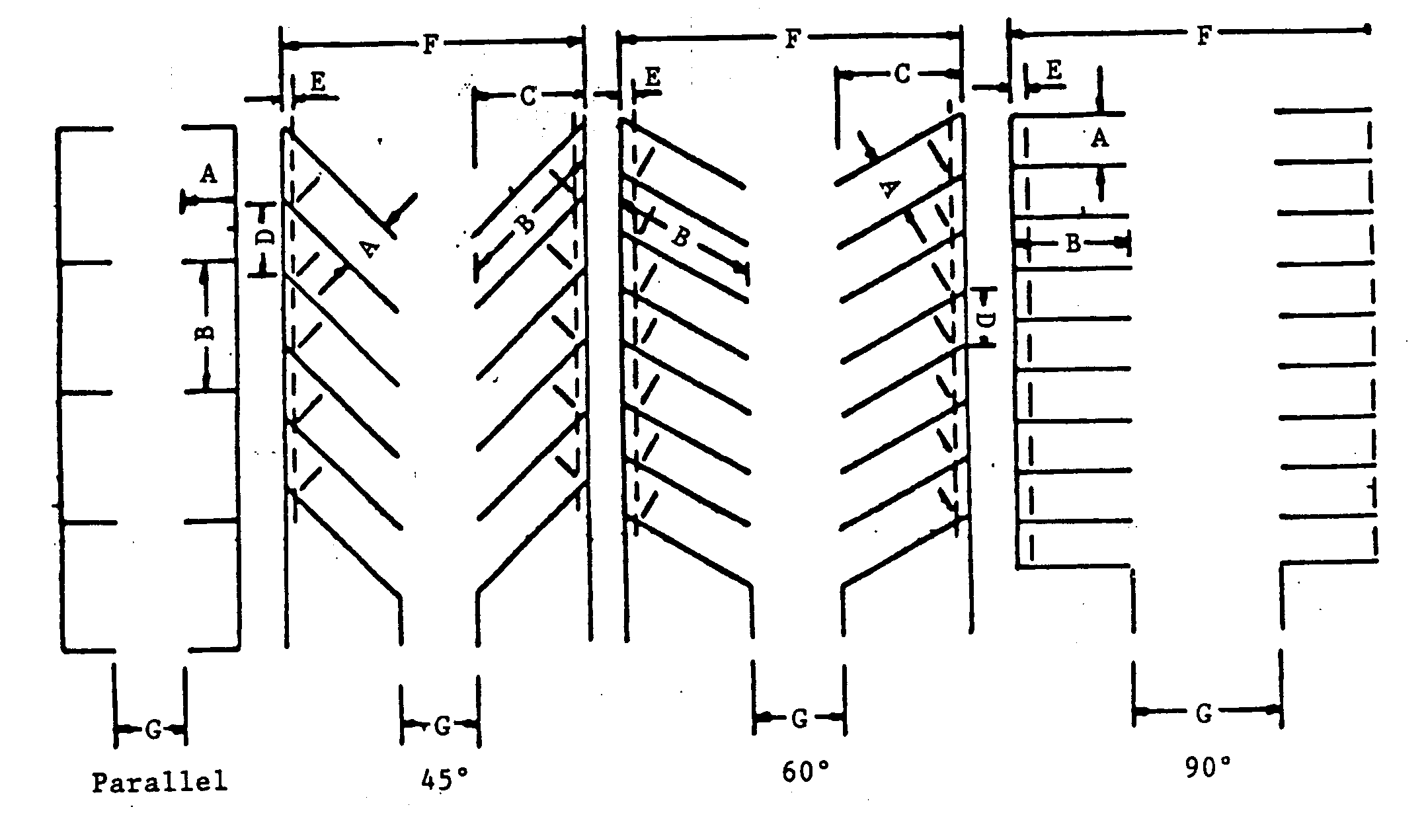
The minimum dimensions of all spaces and parking lots shall be shown in a drawing titled "Parking Lot Design Standards." All spaces must be arranged to permit easy entry and exit. An appropriate turn radius into each space should make each space usable. The referenced drawing shows the minimum acceptable dimensions for different parking lot arrangements for passenger cars. These minimums shall be increased to accommodate larger vehicles where appropriate, and shall in every case be designed to accommodate sanitation trucks, fire trucks, and other service vehicles.
I.
The curb line of any space or parking lot shall be set back at least three feet from any lot line, building, sidewalk, or pedestrian walkway or any other structure. In addition, no parking space shall be permitted within any exit, walkway, or emergency access lane; within ten feet of any fire hydrant; or within five feet of a designated fire lane.
J.
Where appropriate, parking lots shall be designed to include fire lanes required by the fire code.
K.
Parking lots serving businesses open to the public shall be lighted.
Sec. 7.03.04.03 - Parking standards.
1.
Automobile, mobile home, boat, recreational vehicle and similar rental or sales area: Two off-street parking spaces for each 1,000 square feet of enclosed floor area.
2.
Automobile service station or repair facility: Three off-street parking spaces for each service bay, plus parking for any retail sales at the rate of one off-street parking space for each 200 square feet of gross floor area.
3.
Bar and lounge: One off-street parking for each 15 square feet denoted to public usage, plus one off-street parking space for each employee on the largest working shift.
4.
Bank, clinics, professional offices: Two spaces per 1,000 square feet of enclosed floor area.
5.
Bowling Alley: Two spaces per lane.
6.
Carpet and flooring sales: One off-street parking space for each 500 square feet of gross floor area, or five off-street parking spaces, whichever is greater.
7.
Church, chapel, temple, synagogue or place of worship: One space for each 12 seats.
8.
Commercial (general) and retail sales: General commercial and retail sales establishments shall provide one off-street parking space for each 200 square feet of gross floor area.
9.
Congregate living facility: One off-street parking space for each four adults housed plus one parking space for each two employees on the combined largest and second largest working shifts.
10.
Day care center, nursery school, kindergarten (public or private): Five off-street parking spaces, plus one off-street parking space for each employee, plus a loading/unloading area of sufficient size to preclude the need to park on any adjacent right-of-way.
11.
Dance halls, assembly halls: One space per each ten seats (without fixed seats) or One space per each 100 square feet of floor area.
12.
Dwellings: Minimum of two spaces for each dwelling unit.
13.
Financial institution: One off-street parking space for each 200 square feet of gross floor area. In addition, if said institution is equipped with a drive-in window, sufficient area for four stacking spaces for each window shall be provided. For purposes of this item, a stacking space shall be defined as an area ten feet wide by twenty feet long in size, located so as to not impede the flow of traffic along any adjacent right-of-way or within the parking area serving the financial institution.
14.
Funeral chapel, funeral home, mortuary: Two spaces per 1,000 square feet of enclosed floor area.
15.
Government office and service facility: One off-street parking space for each 200 square feet of gross floor area, plus one off-street parking space for each vehicle normally parked or stored at that facility.
16.
Hospital: One off-street parking space for each four patient beds.
17.
Hotel, motel, lodging houses: One off-street parking space per guest room or suite.
18.
Indoor and outdoor commercial recreational facility: One off-street parking space for each three patrons, based on maximum capacity of the facility. Additional off-street parking spaces shall be required for accessory uses, such as lounges, restaurants, etc.
19.
Library and museums: One off-street parking space for each 200 square feet of gross floor area.
20.
Lumber and building materials: One off-street parking space for every 200 square feet of enclosed retail sales area, plus one off-street parking space for every one thousand square feet of outside retail sales space, plus sufficient open area for loading and unloading.
21.
Maufacturing plant: One space for each four employees on maximum shift.
22.
Marina: One space per slip.
23.
Medical office, dentist, veterinarian, and other health related professional offices and clinics: One off-street parking space for each 150 square feet of gross floor area.
24.
Nursing, retirement homes: One space for each six beds plus one space per employee.
25.
Office: One off-street parking space for each 200 square feet of gross floor area.
26.
Personal services: One space for each employee plus one space for each work station.
27.
Plant nursery: One off-street parking space for every 200 square feet of enclosed retail sales area, plus one off-street parking space for everyone thousand square feet of outside retail sales area, but in not case less that five off-street parking spaces.
28.
Private, civic, fraternal club or lodge: One off-street parking space for each 100 square feet of floor space or one off-street parking space for each three seats of the rated seating capacity in total.
29.
Recreational vehicle park: One and one-half parking spaces for each recreational vehicle.
30.
Restaurant, cafeteria, fast food establishment: Eight spaces per 1,000 square feet.
31.
School (elementary and junior high): Two off-street parking spaces per classroom or office, plus one off-street parking space for each one hundred fifty square feet of any auditorium or place of assemble, plus adequate additional area for bus parking, loading and unloading.
32.
School (senior high): Five off-street parking spaces per classroom or office, plus one off-street parking space for each 150 square feet of any auditorium or place of assembly, plus adequate additional area for bus parking, loading and unloading.
33.
Shopping center, retail stores, and supermarkets: One off-street parking space for each 200 square feet of gross floor area.
34.
Taxi service: One off-street parking space for each employee on the largest working shift, plus one off-street parking space for each vehicle used in connection with the business.
35.
Theatre, auditorium, performing arts centers, assembly halls: One off-street parking space for each six seats.
36.
Vocational - technical - trade school: Ten off-street parking spaces for each classroom, plus one off-street parking space for each 150 square feet of any office or clerical area.
37.
Wholesale - warehouse - industrial: One off-street parking space for each two employees on the combined largest and second largest working shift.
Sec. 7.03.04.04 - Maintenance.
All off-street parking areas shall be well maintained, free of potholes, debris, weeds, broken curbs, and broken wheel stops, clearly striped, and with all lighting in working condition. Facilities shall be maintained as soon as the use exists which the facilities were designed to serve.
Sec. 7.03.04.05 - Design of parking lots.
Parking lot design, including by not limited to, arrangement of spaces, width of aisles and access drives, width, length, and angle of spaces, installation of curbs, etc., shall be specified in the illustration below.
Sec. 7.03.04.06 - Adjustments to requirements.
A.
Parking deferral. To avoid requiring more parking spaces than actually needed to serve a proposed development, the admnistrator may defer the provision of some portion of the off-street parking spaces required by this section if the conditions and requirements of this section are satisfied.
The administrator may authorize a reduction in the total number of required parking spaces for two or more uses jointly providing off-street parking when their respective hours of need of maximum parking do not normally overlap. Reduction of parking requirements because of joint use shall be approved if the following conditions are met:
B.
The developer submits a parking study with sufficient data to demonstrate that hours of maximum demand for parking at the respective uses do not normally overlap.
Sec. 7.03.05 - Handicapped access.
A.
Level parking spaces shall be reserved for physically handicapped persons according to the following requirements.
Table 7.03.02
B.
Parking spaces reserved for physically handicapped persons shall meet the following design and location requirements:
1.
All spaces shall be accessible to curb ramp or curb cut, when necessary to allow access to building, structure, or use served, and shall be so located that users are not compelled to wheel behind parked vehicles.
2.
Diagonal or perpendicular parking spaces shall be a minimum of 12 feet wide by 20 feet in length.
3.
Parallel parking spaces shall be located either at the beginning or end of a block or adjacent to an alley entrance. Curbs adjacent to such premises shall be of a height which will not interfere with the opening and closing of motor vehicle doors.
4.
Each such parking space shall be prominently outlined with blue paint and posted with a nonmoveable, above grade, fixed sign of a color and design approved by the Florida Department of Transportation, bearing the internationally accepted wheelchair symbol and the caption "PARKING BY DISABLED PERMIT ONLY".
Sec. 7.03.06 - Required landscaping in off-street parking area.
All
off-street parking areas, except single family and duplex structures, shall meet the following landscape requirements:
A.
A permit shall be required for the development or redevelopment of any off-street parking area to serve an existing use. Such permit is required when the parking area is (re)developed separately from the existing use, or is part of a development order application process.
B.
An off-street parking area which abuts a public right-of-way shall include a landscaped strip on the perimeter of the parking area adjacent to the right-of-way.
C.
In addition to the landscaping required in B. above, additional landscaping equal to at least five percent of the total off-street parking area shall be provided in the interior of the parking area. Perimeter landscaping beyond the minimum required may not be counted as part of the interior landscaping requirement. Interior landscaping may be in one or more areas to total the five percent requirement. Interior landscaping shall include at least one tree for each 400 square feet, or fraction thereof, of interior landscaped area.
D.
Off-street parking areas which abut an area designated, approved, or developed for residential use shall provide a landscaped strip along the perimeter of the parking area adjacent to the residential area.
E.
All landscaped areas required in this section shall be protected from encroachment by a barrier such as curbs, wheel stops, or similar devices consistent with parking lot specifications.
Sec. 7.03.07 - Loading areas.
A.
The off-street loading requirements of this section are intended to provide minimum standards necessary for the loading and unloading of goods for the various commercial and industrial uses permitted by this code, to protect the capacity of the street system, avoid undue congestion resulting from loading and unloading activities, and to lessen unnecessary conflicts between trucks and other vehicles.
B.
The requirements of this section shall apply to all commercial and industrial development, whether new structures or alterations to existing structures. Off-street loading shall be available for use prior to the issuance of any certificate of occupancy or occupational license, and its continued maintenance shall be the obligation of the property owner and occupant as long as the use requiring loading facilities continues. No off-street loading shall be altered or discontinued except in accordance with this code.
C.
Loading spaces shall not be used for the storage of vehicles and/or materials. Loading spaces shall not be used to meet off-street parking requirements.
D.
The following loading space requirements shall be met:
1.
Each off-street loading space shall have minimum dimensions of 14 feet in height, 12 feet in width, and 55 feet in length. However, upon sufficient demonstration that a particular loading space will be used exclusively by shorter vehicles, the administrator may reduce the minimum length to as little as 35 feet, or height to eight feet.
2.
Each required off-street loading space shall have direct access to a street or have a driveway which offers satisfactory ingress and egress for trucks.
3.
There shall be provided for each institution, hotel/motel, commercial or industrial building or complex requiring the receipt or distribution of materials or merchandise by truck, and having a gross floor area of 10,000 square feet or more, at least one off-street loading space for each 10,000 square feet of floor area or fraction thereof. Such loading space shall be located as not to hinder the free movement of pedestrians and vehicles over a sidewalk, street or alley.
4.
There shall be provided for each institution, hotel/motel, commercial or industrial building or complex requiring the receipt or distribution of materials or merchandise by truck, and having a gross floor area of less than 10,000 square feet, sufficient off-street loading space located to not hinder the free movement of pedestrians and vehicles over a sidewalk, street or alley - sharing between adjacent establishments is encouraged.
5.
There shall be provided sufficient space to accommodate the maximum number of buses or trucks to be stored or to be loaded at the terminal at anyone time.
6.
Areas reserved for off-street loading in accordance with the requirements of this section shall not be reduced in area or changed to any other use unless the permitted use which is served is discontinued or modified so that the space is provided elsewhere in accordance with these regulations and as approved by the building official.
Sec. 7.07.01 - Purpose and intent.
This part is intended and shall be interpreted to protect, maintain, and enhance both the immediate and the long-term health, safety and general welfare of the citizens of Carrabelle through the following:
1.
Protecting and maintaining the chemical, physical and biological integrity of ground and surface waters.
2.
Preventing activities which adversely affect ground and surface waters.
3.
Encouraging the construction of stormwater management systems that aesthetically and functionally approximate natural systems, consistent with regulatory agency requirements.
4.
Protecting natural drainage systems.
5.
Minimizing runoff pollution to ground and surface waters.
6.
Minimizing erosion and sedimentation of receiving waters.
Sec. 7.07.02 - Applicability.
In addition to meeting the requirements of this section, the design and performance of all stormwater management systems shall comply with applicable state regulation (Chapter 17-25 Florida Administrative Code), requirements of the Northwest Florida Water Management District (NWFWMD) Chapter 40D-4, and 40D-40, FAC.
All construction activities shall comply with the Stormwater Management Standards of Chapter 62-25 Florida Administrative Code (FAC), Environmental Resource Permitting requirements of the Northwest Florida Water Management District (NWFWMD) Chapter 40D-4; 40D-40; and 40D-400, FAC, and with local environmental codes.
This section shall apply to all incorporated land within the City of Carrabelle.
Sec. 7.07.02.01 - Exemptions.
A.
The following development activities are exempt from the requirements of this part. Developments which are exempt under this part shall nevertheless be constructed in such a manner as to prevent flooding from stormwater entering the site from adjacent property, including roadways. Sites shall be graded in such a manner as to provide on-site retention of the first one and one-half inch of runoff.
1.
The construction of a single family or duplex residential dwelling unit and accessory structures on a lot of record.
2.
Any development within a subdivision if each of the following conditions have been met:
a.
Stormwater management provisions for the subdivision were previously approved and remain valid as part of a final plat or development plan, and
b.
The development is conducted in accordance with the stormwater management provisions submitted with the final plat or development plan.
3.
Bona fide agricultural activity.
4.
Maintenance activity that does not change or affect the quality, rate, volume or location of stormwater flows on the site or runoff from the site.
5.
Action taken under emergency conditions to prevent imminent harm or danger to persons, or to protect property from imminent fire, violent storms, hurricanes or other hazards. A report of the emergency action shall be made to the city administrator as soon as practicable.
Sec. 7.07.03 - Standards.
A.
The proposed development activity shall not violate the water quality standards as set forth in Chapter 17-3, Florida Administrative Code.
B.
The design and construction of the proposed stormwater management system shall be certified as meeting the requirements of this code by a professional engineer registered in the State of Florida.
C.
No surface water shall be channeled or directed into a sanitary sewer.
D.
The proposed stormwater management system shall be compatible with the drainage systems or drainage ways on surrounding properties or streets.
E.
In phased developments the stormwater management system for each integrated stage of completion shall be capable of functioning independently.
F.
All detention and retention basins, except natural water bodies used for this purpose, shall be freely accessible for maintenance from streets or public easements.
G.
The characteristics of stormwater conveyed from the site should approximate the rate, volume, quality, and timing that occurred on the site under conditions preceding the proposed development.
Sec. 7.07.04 - Surface water quality protection.
Development in Carrabelle has frequently occurred near surface water and related watersheds. Development near surface waters and watersheds contribute varying amounts of untreated stormwater runoff to the water bodies. The purpose of this section is to describe requirements for the protection of surface water quality to ensure both the safety and aesthetic appeal of water bodies in the Carrabelle area for existing and future residents and visitors.
A.
All structures shall be a minimum of thirty feet from the mean high water line except existing structures on lots of record.
B.
Site preparation and/or land clearing shall not be permitted prior to final development approval pursuant to the provisions in Article XI.
C.
The development proposal shall include adequate evidence and assurances that the following requirement shall be met during construction.
1.
A minimum twenty foot buffer measured from "mean high water" as designed by State of Florida shall be established adjacent to the water body to protect the water body from adverse impacts of construction activity, including but not limited to, erosion and siltation. The proposal shall document that a twenty foot buffer is adequate for such protection, or shall indicate a wider buffer deemed to be adequate which shall be provided to meet this requirement.
2.
No alteration of the buffer shall be permitted, including destruction of existing vegetation or alteration of the natural topography.
3.
After construction, natural vegetation shall be retained or replaced on the site in order to minimize and stabilize erosion and decrease pollution of the water body and shall be removed upon completion.
4.
For lots or parcels which are cleared, silt screens shall be placed between the construction site and the water body to prevent erosion and siltation.
D.
All development shall control stormwater runoff for the purpose of preventing flooding in adjacent areas, or pollution of water bodies.
E.
Canals shall not be permitted in proposed development or redevelopment, unless clear and specific proof of public benefit is provided. Such public benefit shall be based upon the irrefutable need for canal(s) for flood control, water quality management, and/or resource management. Development proposals containing proposed canals shall supply written conceptual approval from NWFWMD, FDEP, DNR, and/or ACOE along with the application for development proposal.
F.
Where a development proposal includes provisions for deposition of fill, shores resulting from such deposition shall not exceed a slope of 6:1.
G.
Shorelines with existing slopes steeper than 10:1 shall be protected by shallow filter or spreader berms.
Sec. 7.08.01 - Accessory uses and structures.
The following regulations shall apply to all new accessory uses and structures incidental to any permitted or conditional use:
A.
Zoning of accessory structures. All accessory uses to a principal use shall be located in a zoning district that permits the principal use. Structures up to 625 square feet and no more than 16 feet in height, at a maximum point of roof pitch, from the grade, shall be allowed or permitted in residential and office professional districts. Structures more than 625 or in excess of 16 feet to the peak of the roof, as measured from the grade, shall be listed as conditional uses in residential and office professional districts. Conditional use requests shall include requirements and/or data pertaining to height, increased setbacks and landscaping plans around the perimeter of the building.
B.
Construction timing. No accessory building shall be constructed upon a lot or parcel or contiguous lot or parcel except in conjunction with, or after construction of, the primary building.
C.
Location of accessory structures. Structures shall be located on the same lot or parcel as the principal building to which it is accessory; or on a contiguous lot, and shall meet all district setbacks unless otherwise stated. For this purpose, a lot will be considered contiguous if separated from the primary lot by an alley, street, right-of-way or easement.
D.
Accessory structure not permitted outside of required setbacks. Accessory structures shall not be permitted in any required front, secondary front, side or rear yard setback.
E.
Limitation on use. Nonresidential accessory buildings shall be used only by the employees of the owner, lessee, or tenant of the premises.
F.
Accessory structures not to be inhabited. Residential accessory uses such as garages, greenhouses, or workshops shall not be rented or inhabited.
G.
Accessory uses in multi-family developments. Accessory uses in multi-family developments may include, but shall not be limited to, private laundry facilities, clubhouse, and other recreational facilities for the convenience of the residents.
H.
Accessory structures—Portable utility structures and work sheds (residential districts). Within the residential districts and residential uses, portable utility sheds shall be permitted within the side and rear yard setbacks provided that the following regulations are adhered to:
1.
Must meet impervious surface standards.
2.
No more than two utility sheds as defined in H. above, shall be permitted on any single residential lot.
3.
Shall not be located on any easement.
4.
Such sheds may be located upon a concrete pad. At no time, however, shall the shed be secured so as to become a permanent structure. If the pad is structured with a footer, the required setbacks shall be maintained.
5.
A five-foot setback measured from the lot line is maintained.
I.
Portable shelters shall be defined as any roof structure designed to shelter vehicles, persons, goods, merchandise, equipment, materials or property of any kind that is capable of being carried or moved, and which does not require a building permit for construction or installation. Any portable shelter must comply with setbacks for the zoning districts where it is erected. Portable shelters found in violation of this ordinance shall be removed within 30 days after notification by the building official, or his designees, if said structure predates the implementation of the ordinance from which this land development code derives, unless said time is extended by the building official for good cause.
J.
Accessory buildings and structures in specific zoning districts. Accessory buildings and structures located in residential zoning districts that exceed 150 square feet, shall be constructed of masonry, wood frame, aluminum or vinyl. Aluminum or vinyl shall be residential grade materials. Construction shall be consistent with the existing architecture of the principal building and the adjacent properties. Metal fabricated type structures that are designed and intended for industrial/commercial use are prohibited.
Sec. 7.08.03 - Auto service stations, repair garages and car washes.
Site plan approval is required.
Sec. 7.08.04 - Churches.
This use includes temples and similar religious institutions.
A.
The maximum lot coverage by all impervious surfaces shall not exceed 50 percent of the lot area.
B.
Any accessory residential use or private school upon the premises shall provide additional lot area. Accessory uses include convents, rectories, or church halls.
C.
Site plan approval required.
Sec. 7.08.05 - Congregate care and group homes.
A.
It is the purpose of this section to provide for the provision of special living facilities for other than the traditional nuclear family.
B.
Group home and congregate living facilities for seven or more persons shall be permitted as prescribed in Table 2.01.01. Categories of group or congregate care facilities which fall within this section include youth shelter, youth crisis, youth attention, spouse abuse, displaced youth and adult, mental health, substance and alcohol abuse, offender halfway, or facilities serving persons adjudged delinquent or criminal.
C.
Any group or congregate care facility required to be licensed by the Florida State Department of Health and Rehabilitative Services may be authorized by the city with respect to any approval of a special exception, conditional use, or building permit subject to obtaining such state license as may be required and to the continuing validation of the same.
D.
Group and congregate facilities shall meet all applicable building, fire, safety and health code requirements of the State of Florida, Franklin County, and the City of Carrabelle. All permits or licensures issued by the city will be subject to initial and continuing compliance with all applicable requirements.
E.
A group home facility which treats less than seven persons shall be treated as a one-family dwelling for the purposes of determining lot area, lot width, building setback, building height, parking, sign, fence and other miscellaneous requirements of the respective zoning district in which such facility is located; however, the owner of the facility must operate and reside there on a full-time basis. In addition, no such facility shall be designed to house more individuals per, or within, one bedroom than permitted by the state licensing authority.
F.
Expansion of the capacity of a given group or congregate facility by more than ten percent from the originally approved capacity shall require reapplication and all attendant procedures.
G.
The building for a group or congregate living facility must provide a minimum of 1,200 square feet of living floor area for the first four residents and 120 additional square feet of living area for each additional resident. Twenty percent of the site must be landscaped and not covered with an impervious surface.
H.
The maximum number of residents at any group/congregate care facility is limited to three times the dwelling unit density per acre as established within this Code. The maximum resident capacity of a facility to be use for density calculations will be the maximum number approved by the Florida Department of Health and Rehabilitative Services or other regulatory agency.
I.
Kitchen facilities, for purposes of this section defined as a cooking area (oven and/or stove burners), shall not be permitted within bedrooms or a group or congregate living facility. Individual dwelling units may contain bar sinks, refrigerators and cooking facilities within an area specifically designed as a kitchen area.
Sec. 7.08.06 - Cottage industries.
The cottage industry is family owned and operated by family members who reside on the premises.
A.
All activity is carried on within a single family dwelling.
B.
The profession or activity shall not occupy more than one-third of the residence.
C.
The activity is not conducted within an accessory structure.
D.
No advertising is visible from the street except for a small professional announcement.
Sec. 7.08.07 - Day care facilities.
A.
All day care facilities must be permitted by the Florida Department of Health and Rehabilitative Services.
B.
In any district the minimum open play space shall be no less than that required by the Florida Department of Health and Rehabilitative Services Regulations in effect at the time of the application. Said play area shall be completely enclosed by a fence six feet in height.
C.
The ratio per child of usable floor space excluding kitchen, storage, and toilet facilities shall conform to Florida Department of Health and Rehabilitative Services Regulations at the time of application.
D.
A fence or wall six feet in height shall be constructed along any rear or side property line adjoining any residential district.
E.
No building shall cover more than 50 percent of the lot area.
Sec. 7.08.08 - Flea markets and outdoor amusements (temporary only).
A.
No buildings used for open sales or amusement purposes shall be located nearer than 150 feet from any residential district.
B.
All vehicles, trailers, structures, mobile homes, vehicles, tents, mechanical devices or animal enclosures associated with such use shall be set back not less than 50 feet from any property line.
C.
The minimum lot frontage shall be 300 feet.
D.
Sounds emanating from the use shall not adversely affect surrounding residential property.
E.
Residential accommodations shall be limited to temporary quarters.
F.
Sufficient lighting is required to illuminate the use and parking areas.
G.
Outdoor sales are permitted.
H.
Must occur on Commercial property only.
Sec. 7.08.09 - Funeral homes and mortuaries.
A.
Must be on commercial property only.
B.
Must have site plan.
C.
State codes must be met.
Sec. 7.08.10 - Home occupations.
A home occupation shall be allowed in a bona fide dwelling unit, subject to the following requirements:
A.
The use of the dwelling unit for the home occupation shall be clearly incidental and subordinate to its use for residential purposes by its occupants, and shall under no circumstances change the residential character of the structure.
B.
There shall be no change in the outside appearance of the building or premises, or other visible evidence of the conduct of such home occupation, other than one sign not exceeding two square foot in area, non-illuminated, mounted flat against the wall of the principal building at a position not more than two feet from the main entrance of the residence.
C.
No home occupation shall occupy more than 25 percent of the floor area of the dwelling unit.
D.
No traffic shall be generated by such occupation in greater volumes than would normally be expected in a residential neighborhood, and any need for parking generated by the conduct of such home occupation shall be met off the street.
E.
No equipment, tools, or process shall be used in such a home occupation which creates interference to neighboring properties due to noise, vibration, glare, fumes, odors, or electrical interference. In the case of electrical interference, no equipment or process shall be used which creates visual or audible interference in any radio, telephone, or television receivers off the premises or causes fluctuations in line voltage off the premises.
F.
Fabrication of articles commonly classified under the terms arts and handicrafts may be deemed a home occupation, subject to the other terms and conditions of this definition, and providing no retail sales are made at the home.
G.
Outdoor storage of materials shall not be permitted.
H.
The following shall not be considered home occupations: Public dining facility or tearoom, antique or gift shop, fortune telling or similar activity, outdoor repair, food processing, retail sales.
1.
A single operator only for permitted occupations.
I.
A home occupation shall be subject to all applicable city occupational licensing requirements, fees, and other business taxes.
J.
Permits shall be issued to the person and not the dwelling; as such they may not be passed on with the land.
Sec. 7.08.11 - Manufactured homes/mobile homes.
Manufactured homes/mobile homes shall be permitted in compliance with the following standards.
A.
General standards: Each manufactured / mobile home shall be:
1.
Located, occupied or used only in compliance with this code.
2.
A structure that meets United States Department of Housing and Urban Development Standards.
3.
A structure transportable in one or more sections.
4.
A structure built on an integral and permanent chassis and attached to a permanent foundation.
5.
A structure to be used as a dwelling when connected to the required utilities and includes plumbing, heating, air conditioning and electrical systems.
6.
A structure which otherwise meets the Florida Building Code.
B.
Zoning standards: Manufactured / mobile homes shall be permitted by right in those zoning districts designated with the letter "P" in Table 2.02.01 and as a special exception in those zoning districts designated with the letters "SE" in Table 2.02.01. Approval as a special exception shall satisfy the following criteria:
1.
Demonstration that the design of the manufactured / mobile home is compatible with that of other residential structures within the subdivision, neighborhood or vicinity in which the structure is to be located.
Sec. 7.08.12 - Mini-warehousing and storage units.
A.
Mini-warehouses are defined as a building or group of buildings in a controlled access and/or fenced compound that contain individual, compartmentalized or controlled access stalls or lockers for the dead storage of goods or wares belonging to individual lessees of the stalls and accessible to the lessees at all times through individual doors.
B.
Dead storage is defined as the storage of goods, wares, and physical objects only with no sales, conferences, repairs or other activity other than placement, removal and sorting of goods. One office space for a manager shall be permitted.
C.
The applicant shall provide a site plan with information on property lines, street lines, curb cuts, landscaping, location of structures including signs, parking spaces and travel lanes, and location of walls or fences.
D.
Lot coverage shall not exceed 50 percent.
F.
Signs shall be limited to one per adjacent street frontage, and shall not exceed the maximum height of 25 feet, or exceed 50 square feet in area. No sign shall be permitted on the building other than on building frontage walls.
G.
All lights shall be shielded to direct light onto the uses established and away from adjacent property or streets.
H.
All equipment and materials of any type shall be stored within a building.
I.
Storage shall be as follows:
1.
No business activity other than rental of storage units shall be conducted on the premises and the units shall be used for dead storage only.
2.
All equipment and materials of any type shall be stored within a building.
3.
Storage of explosive or highly flammable material shall be prohibited.
J.
Fencing shall be required to shield adjoining properties, as well as the protection of the lessees. Said fence shall be of new material and a minimum if eight feet in height. Fencing which shall adjoin residential districts or residential uses, shall be a solid masonry, chainlink with slats or wood with a life of at least ten years. The finished side of fences shall face adjoining properties. Maintenance of said fence shall be the responsibility of the owner.
K.
Access and parking shall be as follows:
1.
All one-way drives shall provide for one parking lane 12 feet in width and one travel lane 12 feet in width. All two-way driveways shall provide for one parking lane 12 feet in width and two travel lanes each 12 feet in width. Traffic direction and parking areas shall be designated by signs or painted lines. Parking lanes may be eliminated from driveways not serving any storage areas.
2.
A minimum of two parking spaces for the manager and office personnel shall be located near the manager's office.
Sec. 7.08.13 - Nursing homes.
A.
The maximum number of persons for which beds or other overnight accommodations are provided shall not exceed two and one-half times the maximum number of dwelling units per gross acre permitted by the commercial zoning district.
B.
The minimum lot area and minimum width shall not be less than one acre/150 feet in width.
C.
The maximum lot coverage by all buildings shall not exceed 40 percent of the lot area.
D.
Not less than 30 percent of the lot shall be landscaped and retained as usable open space for occupants with adequate accommodations for wheelchair use.
Sec. 7.08.14 - Recreational vehicles including travel trailers, motor homes/camping trailers, auto campers, park trailers.
The following regulations shall govern:
A.
No permanent structures attached. No owner of travel trailer site, travel trailer lot, campground or recreational vehicle park shall permit to be constructed on said site or sites any type of utility building screen room glass room, carport, or other type of other permanent structure other than a concrete slab. All accessory appurtenances must be erected in a manner which facilitates disassembly and removal within 24 hours.
B.
Attachment of collapsible structures. No owner of a travel trailer, camping trailer, truck camper, motor home, or park trailer shall construct or allow to be constructed on his travel trailer, camping trailer, truck camper, motor home or park trailer any structure other than a collapsible nature which may be folded compactly and drawn away with said travel trailer, camping trailer, truck camper, motor home, or park trailer.
C.
Smaller mobile home classified as park trailers. In mobile home or recreational vehicle parks existing at the time of adoption of this code, permanent structures commonly attached to mobile homes are permitted to be attached to small mobile homes now classified as park trailers under the State of Florida's size classification providing these units are permanently established and the required separation between permanent structures, as required by the N.F.P.A. is met.
D.
No owner of a mobile home or recreational vehicle park shall permit the number of occupants of any form of recreational vehicle to exceed two persons in less than 280 square feet of gross floor area; three persons in less than 400 square feet of gross floor area; four persons in less than 500 square feet of gross floor area, and in no situation can the number of occupants exceed five.
E.
General regulations for all mobile homes—Pursuant to N.F.P.A.
1.
An awning or carport may be erected, constructed, or maintained on a mobile home lot only as an accessory to a mobile home located on the same lot. An awning shall not be enclosed with rigid materials or walls or converted for use as a habitable room.
2.
An awning or carport may be erected on a lot line provided the awning or carport is constructed of material which does not support combustion and is not less than three feet from a mobile home or mobile home accessory building or structure on an adjacent lot.
3.
An awning or carport supported in part by a mobile home shall not have a slab that exceeds 12 feet in width (projection) as measured from the wall of the mobile home to the outer edge of the awning or carport slab, and must be properly anchored.
4.
Clearance for mobile homes to other structures:
a.
In mobile home parks in existence at the time of adoption of this Code, mobile homes shall not be located closer than ten feet from any other mobile home or permanent building within or adjacent to the mobile home park except that structures grandfathered in need not be moved. A mobile home accessory building or structure shall not be closer than three feet from any adjacent mobile home or structure except that structures grandfathered in need not be moved.
b.
In the development of new mobile home parks or new land additions to existing parks, or in any other mobile home situations other than as described in a. above, the separation between mobile homes and permanent structures on an adjacent space or lot shall be a minimum of 15 feet.
Sec. 7.08.15 - Recreational vehicles, temporary parking.
The temporary parking of recreational vehicles in residential zoning districts shall not exceed 14 days.
Sec. 7.08.16 - Recycling centers.
A.
All recycling operations must comply with applicable federal and Florida statutes.
B.
All recycling operations must be totally within an enclosed structure or shall have a fence at least eight feet high from ground level constructed of new materials which may be concrete block, galvanized metal, aluminum or wood. Wood fencing shall, as a minimum, be constructed of wood one inch in thickness. Required fence shall have a minimum life of ten years, with the finished side of said fence facing adjoining properties. Maintenance of said fence is the responsibility of the owner. All fencing shall be of solid type with only such openings as will permit ingress and egress for normal business purposes.
C.
All recycling centers shall be arranged and storage contained so as to permit access by firefighting equipment and to prevent the accumulation of water.
E.
Signs shall be limited to one per adjacent street frontage and shall not exceed the maximum permitted height of 25 feet. No signs shall be placed on any roof or required fence.
F.
All recycling centers shall be maintained in such a manner as to cause no public or private nuisance, nor to cause any offensive or noxious sounds, or odors, nor to cause the harboring of snakes, rates, flies, or other disease vectors.
G.
Minimum acreage of ten acres is required.
H.
A site plan review is required.
Sec. 7.08.17.01 - Purpose.
The purpose of this section is to set forth those standards necessary to protect the safety of the general public. Swimming pools may be considered an attractive nuisance; therefore, standards for location are necessary.
Sec. 7.08.17.02 - General standards.
Swimming pools (private) shall not encroach into any required building setback.
The following regulations shall apply to swimming pools owned and operated by an individual and used exclusively by the owner, family and guests, or a pool owned an operated by an association, club or other nonprofit agency, and used exclusively by members and guests.
A.
Accessory use. A private swimming pool is an accessory use, is intended, and is to be used solely for the enjoyment of the occupants of the principal use of the property on which it is located.
B.
Setbacks required. The swimming pool shall not be located within the front yard. No private swimming pool shall be otherwise constructed, within any building setback area as established for that district. Where double frontage lots exist, the required front yard shall be on both streets.
C.
Fence required. Any swimming pool having a depth of 18 inches or more shall be so walled or fenced with a locking gate as to prevent uncontrolled access by children from the street or from adjacent properties. Said barrier shall not be less than four feet in height and maintained in good conditions.
D.
Screen enclosures. Pools surrounded by screen enclosures shall not require fencing. No screen enclosure is permitted within any building setback area as established for that district.
E.
Excavations for pools to be installed for existing dwellings shall not exceed a 2:1 slope from the foundation of the house, unless a trench wall is provided.
F.
Lights. Lights used to illuminate any swimming pool shall be so arranged and shadowed as to reflect light away from adjoining premises.
G.
Swimming pool design, construction, operation, maintenance, and management requirements shall comply with Chapter 10D-5, F.A.C.
Sec. 7.08.19 - Temporary buildings for construction purposes.
Temporary buildings for construction purposes are permitted for a period not to exceed the duration of such construction. A certificate of occupancy shall not be issued until all temporary buildings are removed.
Sec. 7.08.20 - Tents (commercial only).
This section applies to nonresidential types of tents; for purposes of this code defined as tents used for public assembly or commercial purposes, but not camping or sleeping, and which must meet minimum standards as set forth in the Standard Building Code and the N.F.P.A.
A.
Prohibited in residential districts unless approved by the fire chief and building official. Commercial tent use is expressly prohibited in residential areas without the express approval of the city commission. The city commission shall also determine the placement of the structure, and length of time it will be permitted.
B.
Permitted in commercial and industrial districts. Commercial tents shall be permitted in commercial and industrial zoning districts on a temporary basis. Location and length of time shall be determined by the building official or his designee. Permits for temporary tents, other than those utilized as part of a remodeling effort, may be granted for a period not to exceed seven days, with one extension of seven days allowed upon reapplication to the building department. Tents utilized as part of a remodeling effort may be issued permits of up to 30 days.
C.
Tents must comply with Standard Building Code and N.F.P.A. All tents permitted under this sections shall meet the requirements of the Standard Building Code, and shall be approved by the city's fire chief.
Sec. 7.08.21 - Veterinarian/animal hospital.
A.
All activities shall be conducted wholly within a completely enclosed building except for fenced kennel areas.
B.
No such use shall be located within a radius residential zone.
Sec. 7.09.01 - Design standards for large scale retail projects.
A.
Purpose. These standards are intended to provide developers of large retail building development with guidelines for creating safer, efficient, pedestrian-friendly projects with human-scale orientation, while discouraging large, nondescript buildings and "unfriendly" pedestrian design, limited landscaping, and vast non-shaded parking lots. As a basis for developing such guidelines, the citizens of the city and visitors alike will benefit from enhanced large retail project design, which accomplishes the following activities:
1.
To encourage large, single building construction with definition that has the appearance of multiple buildings rather than enormous warehouses with unbroken, blank walls. Good design encourages clearly defined entryways, articulated roof lines to prevent monotony, pedestrian amenity areas, and concealment of unsightly mechanical structures from public view.
2.
To encourage efficient, pedestrian-oriented design which effectively resolves the incompatibility between pedestrians and motorists, while providing interconnectivity between buildings, parking areas and other internal/external components.
3.
To encourage parking lot design that meets vehicular needs, while providing a safer, efficient comfortable pedestrian flow.
4.
To encourage adequate landscaping that allows large buildings and their components to blend with their surroundings, while providing screening and shade for the public benefit.
5.
To encourage enhanced lighting and signage design, to avoid forms of nuisance and intrusiveness into adjacent areas, while enhancing public safety.
B.
Definition. Any new commercial retail building, whose total gross leasable area equals or exceeds 25,000 square feet, specifically, mercantile uses, and/or shopping center uses.
C.
Additional development standards. The following additional standards shall be required for all large retail projects:
1.
Facades/detail features. No uninterrupted and/or unadorned length of any portion of the facade shall exceed 100 linear feet (this measurement shall not apply to the backs of buildings that are not visible to the public). Interruptions of such continuous lengths of the facade shall include wall plane projections and/or recesses of not less than five feet in off-set, and a minimum of 20 feet in length, and one or more of the following: Architectural features such as pilasters; columns; canopies/porticos; arcades, colonnades, and/or parapets (See Figure 7.10.02.a). All facades shall include repeating patterns at intervals of no more than 30 feet, horizontally or vertically. Such repeating patterns shall include windows, color changes, texture changes, material module changes, and/or surface modeling changes such as, reveals, or ribs of no less than 12 inches in width (See Figure 7.10.02b).
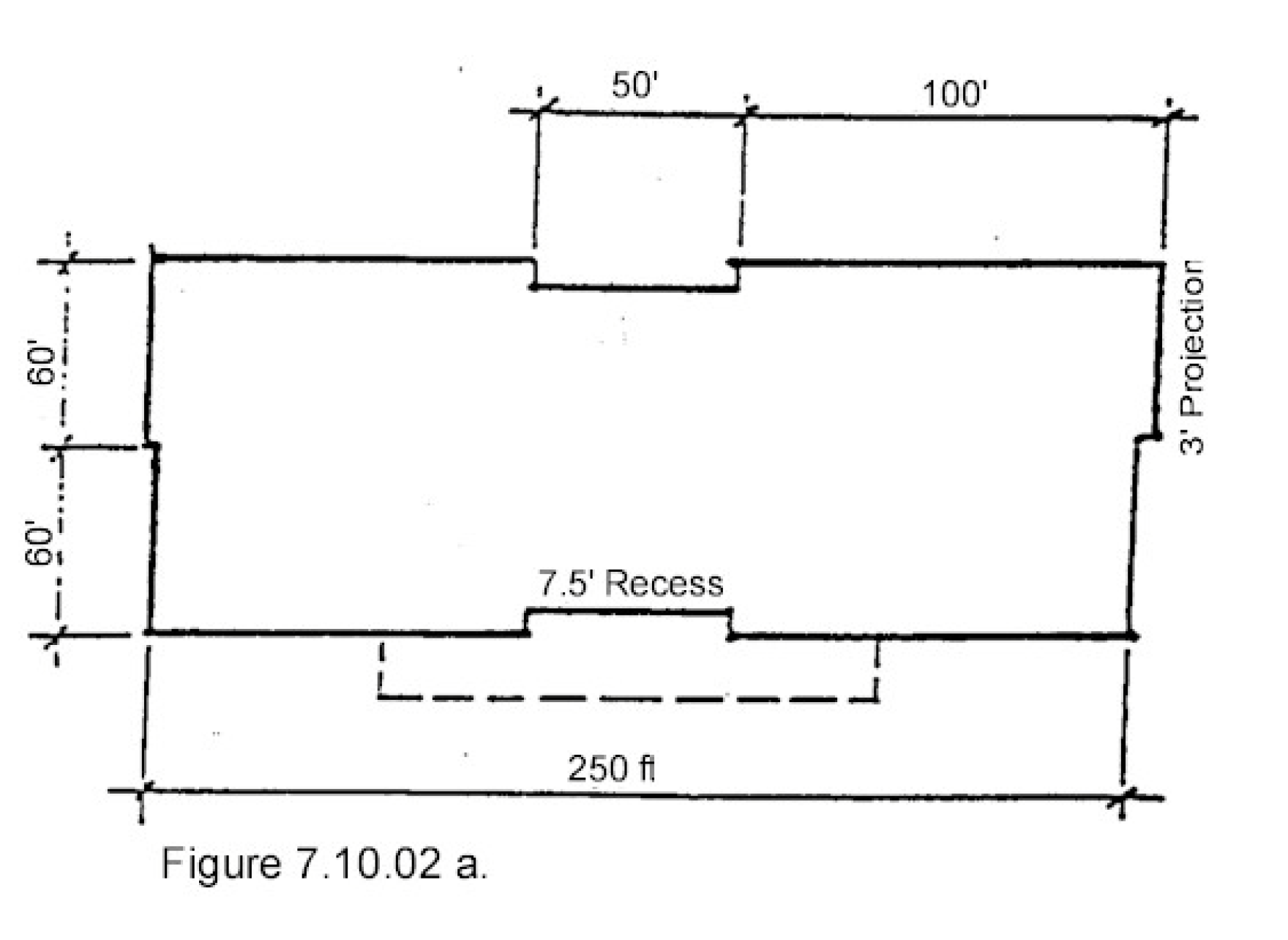
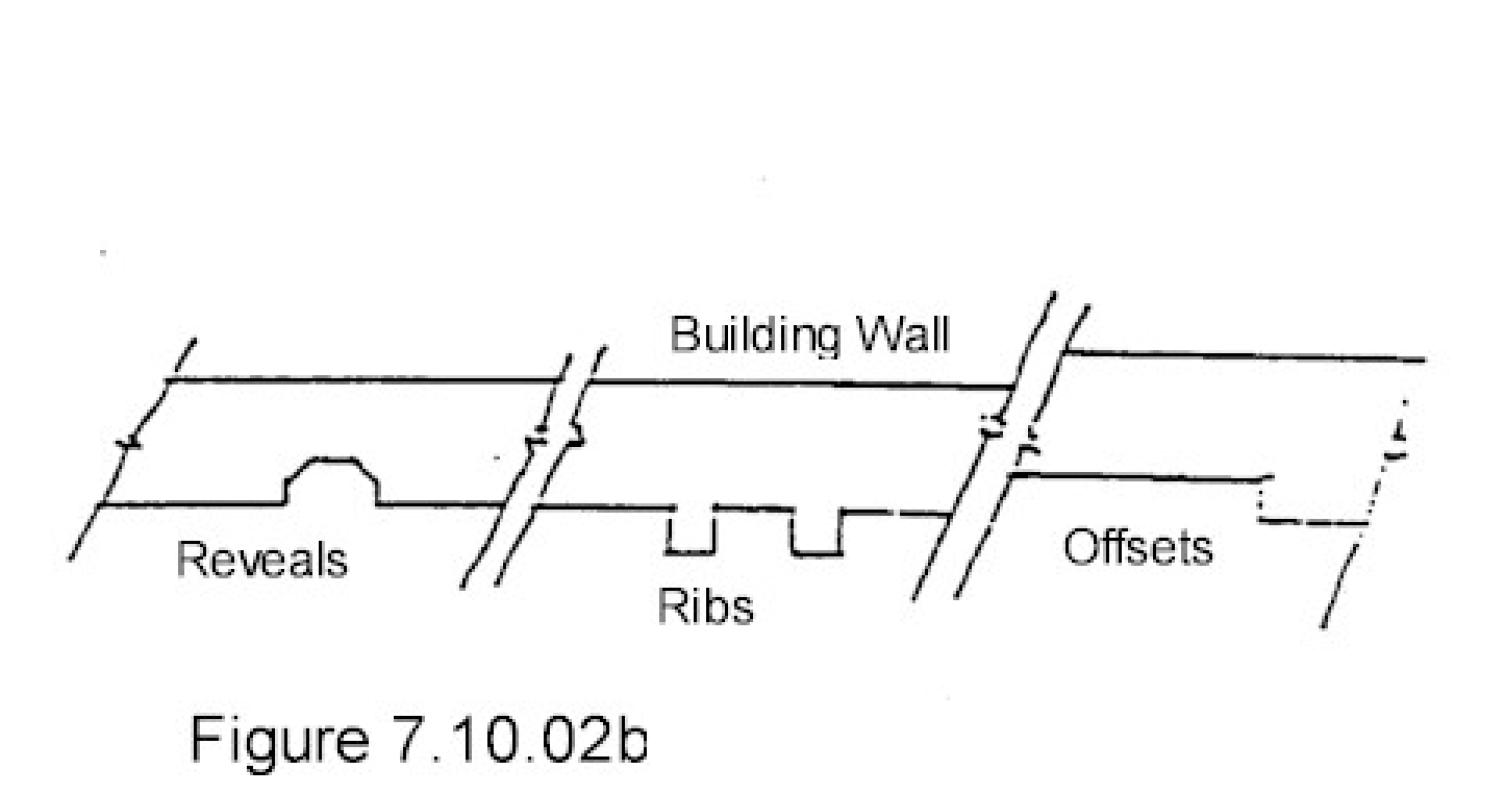
a.
Multiple stores within a single building. Where a large retail project contains individual stores that are less than 25,000 square feet of gross floor area each, with separate, exterior customer entrances, the street level facade of each store shall provide the design and/or placement such as windows between the height of three feet and eight feet above the walkway grade, for no less than 60 percent of the horizontal length of the building facade of each store.
2.
Entryways. Each business facade without an entrance shall include at least one customer entrance, or be screened from public view with no less than 20-foot wide buffer. (This criteria is intended to improve aesthetics of buildings whose entrance may not be along the front facade and to improve appearance of an otherwise blank wall.) Customer entrances shall be clearly defined and include at least two of the following features: canopies/porticos, overhangs, recesses/projections, arcades, raised above-the-doorway cornice parapets, peaked roof forms, arches, outdoor patios, display windows, integrated architectural details such as tile work, moldings, planters or wing walls, and/or landscaped sitting areas. The non-customer/loading areas shall be screened from public view with a landscaped buffer to be installed and approved by the administrator.
3.
Roofs. Flat unarticulated roof lengths, longer than 100 feet in length shall be concealed or addressed by utilizing at least two of the following options (See Figure 7-10-02c):
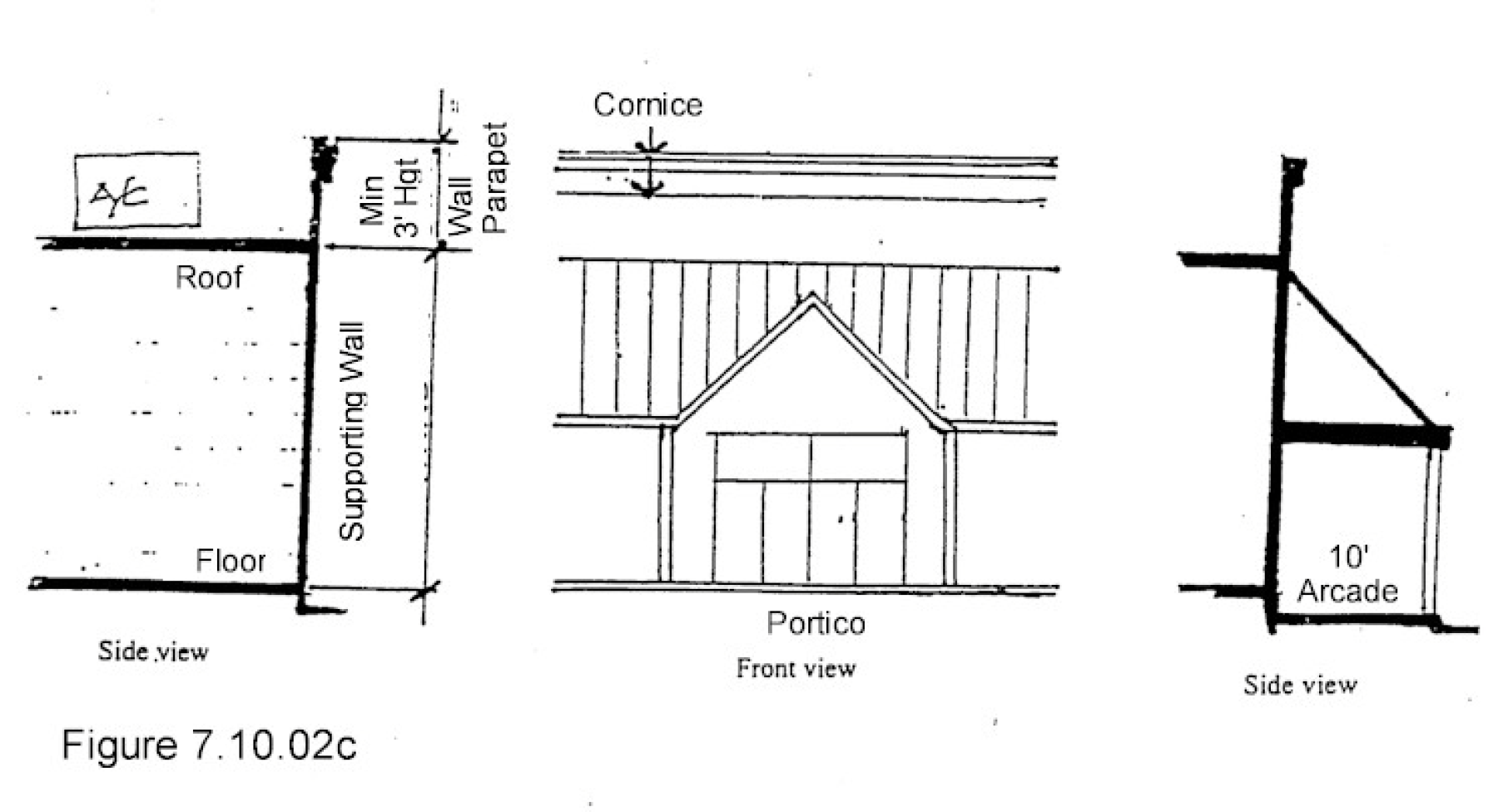
a.
Effective concealment of flat roof lines, rooftop equipment, and heating, ventilating, and air conditioning (HVAC) units from any facade view by adjacent land uses of lesser intensity, and public right-of-way. The parapet design shall be a minimum of three feet in height and shall incorporate a three dimensional cornice treatment. Alternative designs such as varying the parapet height for a minimum linear distance of 100 feet, and a minimum vertical height of two feet shall be subject to approval by the administrator.
b.
Overhanging eaves that extend no less than three feet past the supporting walls.
c.
Two or more sloping roof planes.
4.
Pedestrian circulation. Large retail projects shall be pedestrian oriented through design features that enhance pedestrian safety, efficiency and connectivity with a clear definition between vehicular areas and pedestrian walkways.
a.
Sidewalks. Pedestrian connectivity between the project building entrances and parking areas, public sidewalks, out parcel buildings, and transit stops shall be clearly indicated through the use of landscaped areas and sidewalks which are made of materials such as scored concrete, pavers, or bricks. All projects building sides with customer entrances shall include such a sidewalk along the full length of each facade.
b.
Pedestrian amenity area. Large retail projects shall include design features such as pedestrian amenity areas, which include well landscaped sitting areas with design components such as seating elements and/or other amenities in shaded areas. A minimum of four benches, or other similar amenity, shall be provided at each customer entrance/pedestrian amenity area.
5.
Parking areas. Parking lots and access aisleways shall be designed utilizing the following standards:
a.
Parking lot design. Vast, unbroken parking lots are prohibited. Parking areas shall be designed so that no more than 100 spaces of the total required spaces are part of a clearly defined grouping of spaces. Such groups shall be broken into individual lots and/or clearly separated by well landscaped or weather-protected pedestrian walkways, significant landscape or geographic features, and/or by design components of the proposed building(s). Separations shall be no less than eight feet in width at any point. No required parking space shall be located further than 500 feet from the nearest customer entrance. At least 20 percent of the required parking spaces shall be placed in the rear or side areas of the proposed development, if feasible, as determined by the administrator. Alternative designs that incorporate existing natural resources are encouraged, subject to approval by the administrator.
b.
Parking spaces. The number of parking spaces shall be determined in accordance with the land development code standards. Each parking space in excess of the minimum shall require an additional landscaped area of ten square feet to be placed within the internal parking area, frontage road, and/or right-of-way buffer. The use of pervious parking areas, including turf block may be considered for no more than 20 percent of the total constructed required parking spaces, subject to approval by the administrator.
6.
Landscaping. The following landscaping standards shall be incorporated into the design of all large retail projects:
a.
Foundation. Foundation landscaping shall be required for at least 50 percent of each facade length located along a public right-of-way, parking area, or which includes a customer entrance (See Figure 7.10.02.d). Such landscaping shall be incorporated into a minimum of a five-foot wide landscaped bedding area located between, and in addition to the required building sidewalk and the first vertical wall of the building facade. Large commercial planters or alternative designs may be used to meet these criteria (See Figure 7.10.02.e).
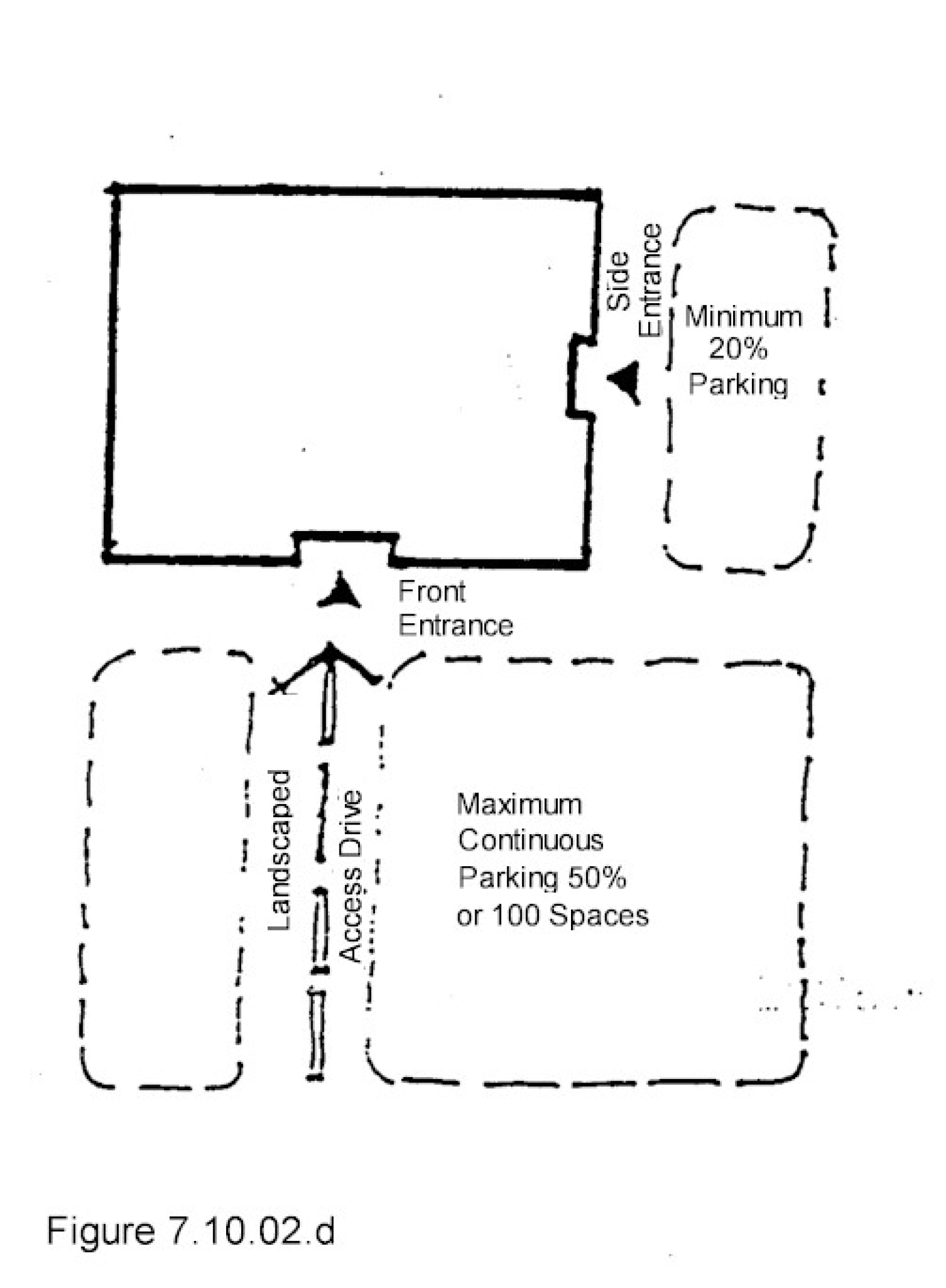
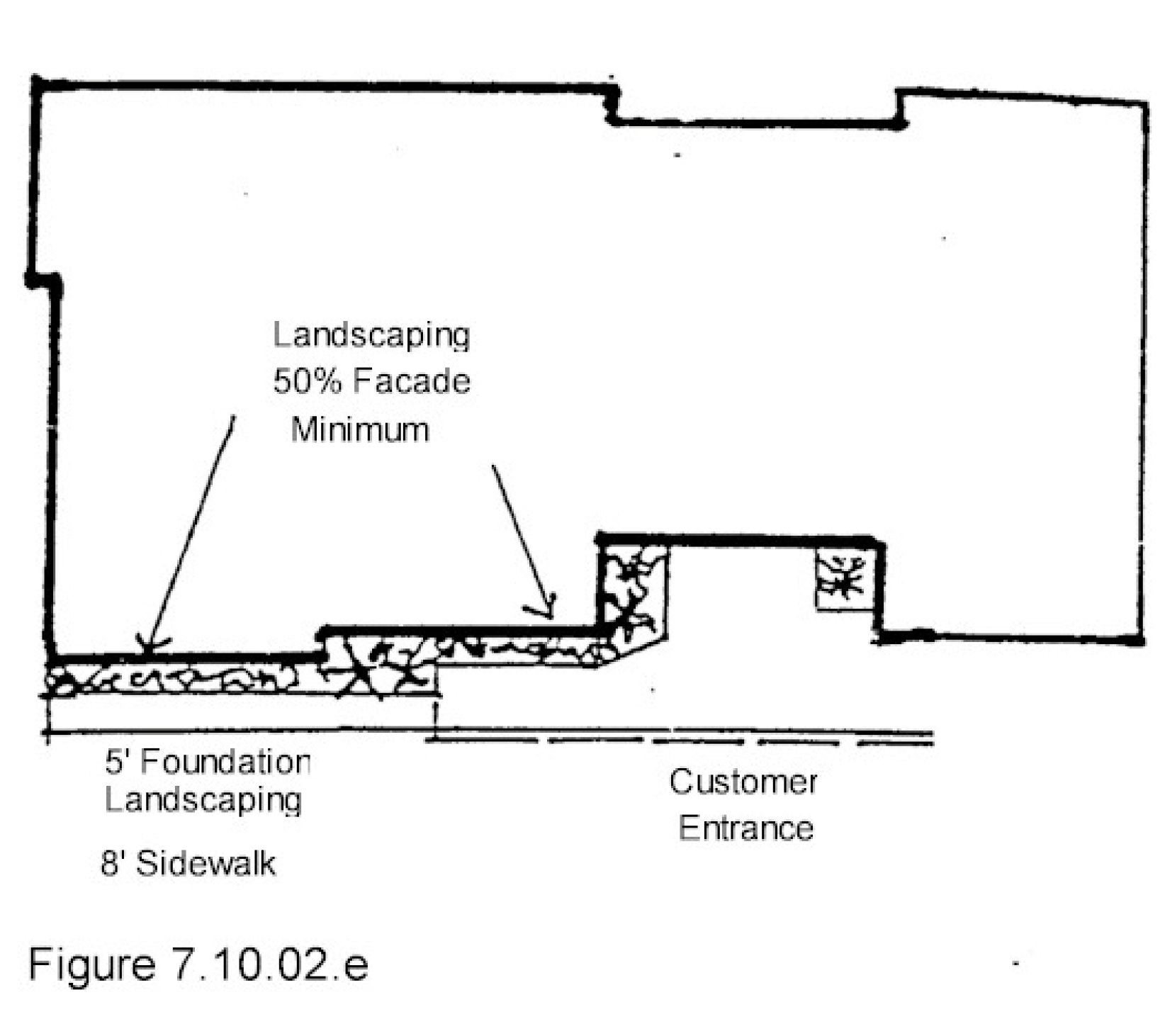
b.
Bufferyards. Bufferyards, rather than setbacks, shall be required along all collector and arterial roadways, which include an unbroken (except for required driveways, sidewalks, and other public safety elements), landscaping area no less than 30 feet in width and planted according to buffer standards. If existing vegetation is to be preserved, a varying buffer design may be utilized where the average width is 20 feet. Alternative designs are subject to approval by the ADMINISTRATOR.
c.
Parking areas. Every ten spaces shall be designed with 400 square feet of landscaping to be placed in medians or islands, and shall include at least one over-story tree, one under-story tree and six shrubs. No median shall be less than five feet in width, and no more than ten spaces shall be continuous without landscaping (See Figure 7.10.02.f). Grouping of landscaped islands is encouraged to promote the healthy growth of larger trees. Alternative designs are subject to approval by the administrator, but in no case shall the total required landscaping area be decreased.
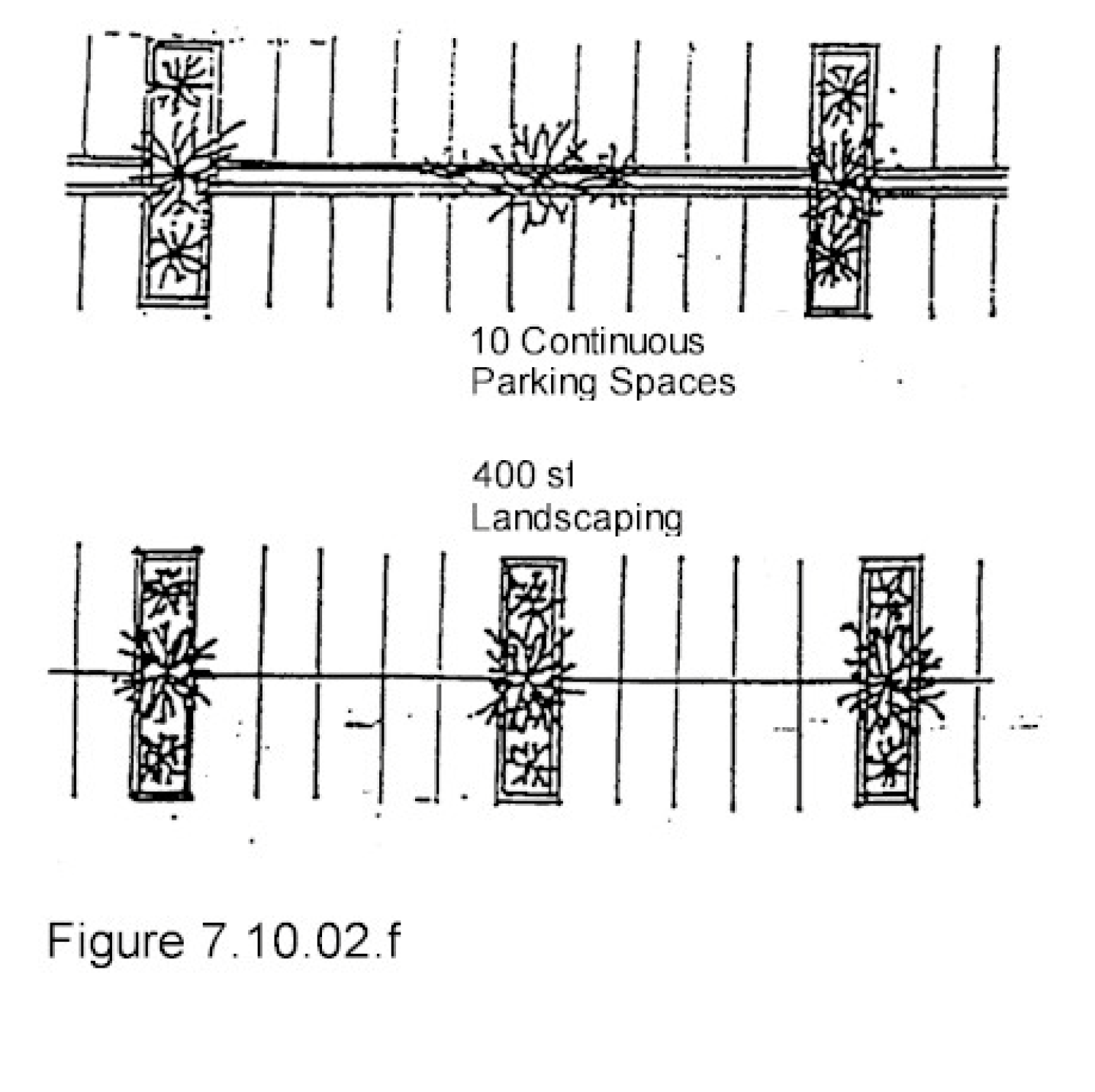
d.
Access driveway. Main access driveways from the public right-of-way into the proposed development shall be completely separated from any parking area and/or pedestrian walkway by a landscaped island, not including intersection and walkways. At least one, four-inch (dbh), over-story tree shall be planted or preserved at 40 feet on-center spacing.
e.
Frontage roads. Frontage roads need not be landscaped; however, when parking area landscaping cannot be met, the administrator may approve no more than 20 percent of the required parking area landscaping for placement along frontage roads.
f.
Drainage retention areas (DRA). In addition to all land development requirements, a landscaped Buffer shall be planted adjacent to public right-of-way and/or access drives, in coordination with an approved DRA. Alternative DRA design is encouraged, subject to approval by the Administrator.
g.
Tree preservation. All large retail projects shall comply with tree preservation standards, and such requirements shall be in addition to C.7a, C.7b, and C.7c, as referenced above.
7.
Exterior lighting. Exterior lighting design shall enhance security of pedestrians and motorists alike. All pedestrian walkways and parking spaces shall be adequately lighted through the use of individual or combination lighting features such as standard luminaire, street lamp, and/or bollard types of fixtures. Alternative designs are subject to approval by the administrator (See Figure 7.10.02.g). Lighting shall be designed according to the following standards:
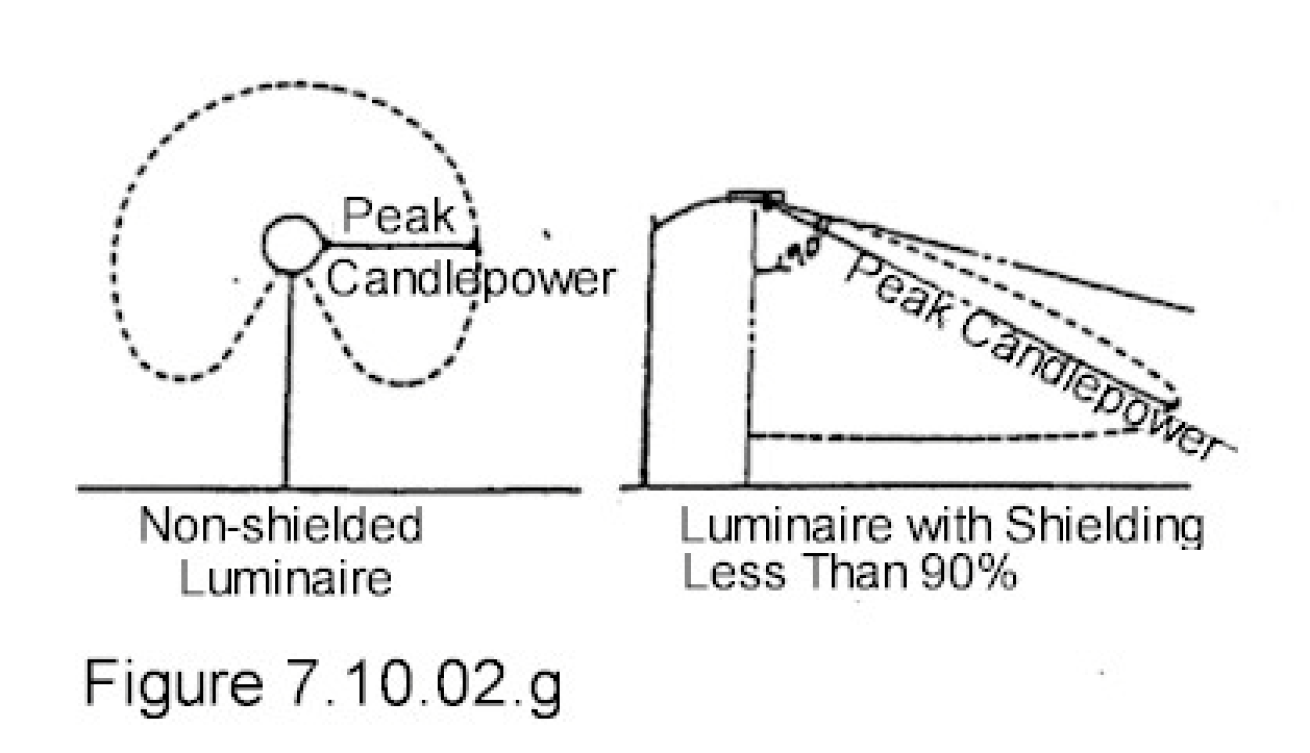
a.
Maximum height. Exterior light sources such as luminaries or lampposts shall not exceed 20 feet in height. Shielded light sources may not exceed 35 feet in height.
b.
Illumination. All lighting shall be designed to minimize the spillage onto adjacent noncompatible land uses. Non-shielded fixtures are permitted and maximum illumination factor of five foot candles. Shielded fixtures are permitted a maximum illumination factor of 12 foot candles.
c.
Location design. Lighting sources (interior or exterior) shall be shielded from vehicular travel lanes so that glare to motorists is minimized. Areas located on waterways, such as docks and nature trails, and other regulated areas shall utilize shielded light fixtures so that the light source is adequately shielded from view on the waterway or regulated area. Lighting and other improvements, such as cart returns, shall be incorporated into the landscape design.
d.
Exterior illumination. Exterior illumination shall be engineered for public safety and not impact adjacent properties to an extent greater than is necessary to address the safety issue. Lighting plans may be required by the administrator, and extensive lighting systems justified by appropriate study at the applicant's expense.
8.
Signage. Signage shall be designed as part of a complete system, and may be approved as part of the overall site plan, without acquiring a separate permit.
9.
Outdoor storage and sales. Outdoor storage (including seasonal storage trailers) and sales shall be permitted in designated areas only, as approved during development site plan review, and shall be screened from view from residential land districts and uses through landscaping and/or other design features.
10.
Compliance. In addition to the application requirements of the LDC, a colored facade rendering shall be submitted to the Administrator at time of application submission to ensure that the development standards required herein are adhered to.

