
Carrabelle City Zoning Code
ARTICLE VIII
SIGNS
PART 8.01.00 - EXEMPT SIGNS
The following signs are exempt from the enforcement of these sign regulations, and from the requirement in this code that a permit be obtained for the erection of permanent signs, provided they are not placed or constructed so as to create a hazard of any kind:
A.
Signs that are not designed or located so as to be visible from any street or adjoining property.
B.
Signs of two square feet or less and signs that include no letters, symbols, logos, or designs in excess of two inches in vertical or horizontal dimension, provided that such sign, or combination of such signs, does not constitute a sign prohibited by section 8.02.02 of this code.
C.
Signs necessary to promote health, safety and welfare, and other regulatory, statutory, traffic control or directional signs erected on public property with permission as appropriate from the State of Florida, the United States, Franklin County, or the City of Carrabelle.
D.
Legal notices and official instruments.
E.
Decorative flags and bunting for a celebration, convention, or commemoration of significance to the entire community when authorized by the city commission for a prescribed period of time.
F.
Holiday lights and decorations.
G.
Flags, emblems, or insignias of the United States, State of Florida, Franklin County, or the City of Carrabelle.
H.
Signs incorporated into machinery or equipment by a manufacturer or distributor, which identify or advertise only the product or service dispensed by the machine or equipment, such as signs customarily affixed to vending machines, newspaper racks, telephone booths, and gasoline pumps.
I.
Advertising and identifying signs located on taxicabs, buses, trailers, trucks, or vehicle bumpers. Except for signs identified in section 8.02.02, subparagraph "V".
J.
Public warning signs to indicate the dangers of trespassing, swimming, animals, or similar hazards.
K.
Strings of light bulbs used on commercially developed parcels for commercial purposes, other than traditional holiday decorations.
L.
Religious displays.
M.
Political signs. Political Signs are defined as any sign that requires a political disclaimer under F.S. ch. 106. Political signs must meet the following standards.
1.
Placement. Signs shall be placed on private property only and with the permission of the property owner. The signs may be placed back-to-back, or single face, but multiple signs of the same candidate shall not be placed within ten feet of one another, regardless of size.
2.
Dimensions. Political signs shall not exceed eight square feet per sign face and shall not exceed five feet in sign height measured from the aggregate grade.
3.
Timelines for placement. All political signs shall not be displayed prior to 90 days before the date of any election and shall be removed within ten days following the end of any election cycle. If a primary or run off exists, only candidates or issues advancing will be allowed to continue sign placement.
N.
Sandwich/sandwich board signs with a sign face of four square feet or less. Sandwich signs shall be in good taste, located on private property, and with a minimum distance of twenty feet between consecutive signs. There shall be a maximum of two sandwich signs per parcel and/or business.
O.
Under canopy signs which shall be limited to two per occupancy and no more than four square feet per sign.
P.
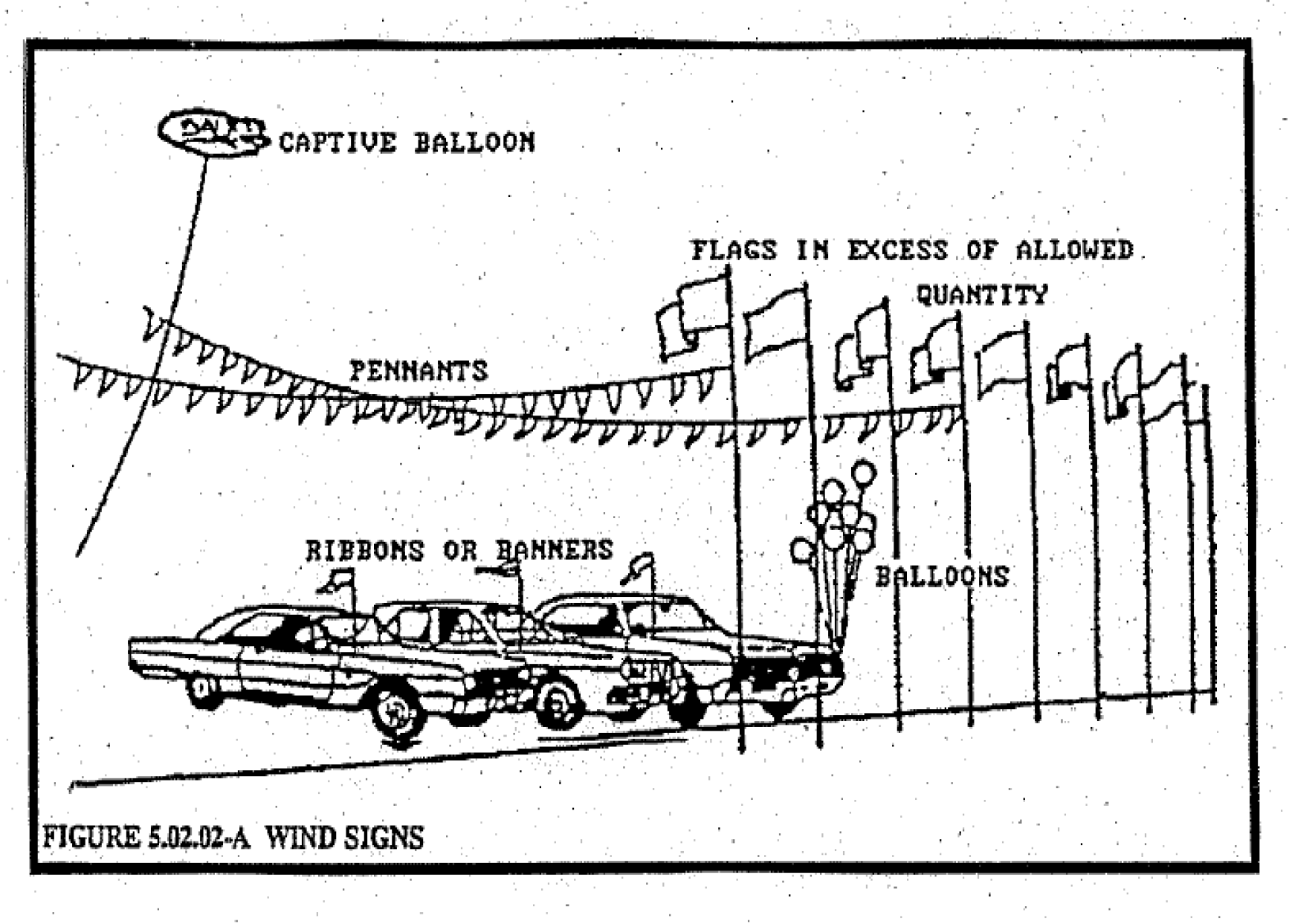
Signs, commonly referred to as "wind signs," consisting of one or more pennants, ribbons, spinners, streamers, captive balloons, or other objects or material fastened in such a manner as to move upon being subjected to pressure by wind and determined to be in good taste by the planning and zoning board.
PART 8.09.00 - PERMITS AND LICENSES REQUIRED
All signs existing in the city on the effective date of this code, other than temporary signs, are required to have a sign permit application on file at city hall within 180 days of the effective date of this code, to establish a record of existing signs in the city. Applications for permits for signs existing on the effective date of this code are exempt from any sign permit fees adopted as a part of this code, if submitted within 180 days of the effective date of this code. Information included on the application shall contain sufficient information for the city administrator to make a determination as to whether the sign is in conformance with this code. The erection of a permanent sign after the effective date of this code shall require a sign permit as required in Article VII of this code.
PART 8.10.00 - PENALTIES
Any person, firm, or corporation violating any of the provisions of this article shall, upon conviction thereof, for each such offense, be guilty of a misdemeanor and subject to a fine not to exceed $250.00 per offense or imprisonment of up to 30 days, or by both fine and imprisonment in the discretion of the court.
In addition to the penalties set forth above, violation of this article shall be a civil penalty and each violation shall be considered a separate offense. The city shall send a notice of violation of this article to any real estate broker or agent whose name(s) appear on an offending sign and give such person(s) seven days to correct the violations(s). If the violation is not removed within 7 days from the mailing of such notices, then the new owner and the real estate broker or agent whose name(s) appear on the offending sign will be fined a minimum of $100.00 and up to $10.00 per day for every day that the offending sign is in violation. The city shall always retain the right to remove any sign it deems to be in violation of this ordinance or any sign ordinance or law of this city or State without the city incurring any penalty or liability whatsoever to the owner of any sign(s).
Sec. 8.00.01 - Relationship to building and electrical codes.
These sign regulations are intended to complement the requirements of the building and electrical codes adopted by the city. Wherever there is inconsistency between these regulations and the building or electrical code, the more stringent requirements shall apply.
Sec. 8.00.02 - No defense to nuisance action.
Compliance with the requirements of these regulations shall not constitute a defense to an action brought to abate a nuisance under the common law.
Sec. 8.00.03 - Maintenance.
All signs, including their supports, braces, guys and anchors, electrical parts and lighting fixtures, and all painted and display areas, shall be maintained in accordance with the building and electrical codes adopted by the city, and shall present a neat and clean appearance. The vegetation around, in front of, behind, and underneath the base of ground signs for a distance of ten feet shall be neatly trimmed and free of unsightly weeds, and no rubbish or debris that would constitute a fire or health hazard shall be permitted under or near the sign.
Sec. 8.00.04. - Definitions.
Accessory sign: A permanent ground or building sign that is permitted under this Code as incidental to an existing or proposed use of land.
Advertising: Sign copy intended to directly or indirectly promote the sale or use of a product, service, commodity, entertainment, or real or personal property.
Abandoned sign: A sign which no longer identifies or advertises a bona fide business, leaser, service, owner, product, or activity, or for which no legal owner can be found.
Animated sign: Any sign which uses movement or change of lighting to depict action or to create a special effect or scene.
Awning: A shelter projecting from and supported by the exterior wall of a building constructed of nonrigid materials on a supporting framework.
Awning sign: A sign painted on, printed on, sewn, or attached against the surface of an awning.
Banner: A sign on which copy or graphics may be displayed, made of paper, plastic, fabric or any flexible, nonrigid material with no enclosing framework or frames. For purposes of this ordinance, the term "banner" shall not be deemed to include flexible sign face substrates, which are used as the enclosed face on advertising signs using back illumination, consisting generally of a polyester scrim embedded between two layers of white pigmented vinyl formulated to accepted opaque and translucent films, and meeting Federal Standards #191-A (Textile Test Methods)
Billboard: See "Off-premises sign."
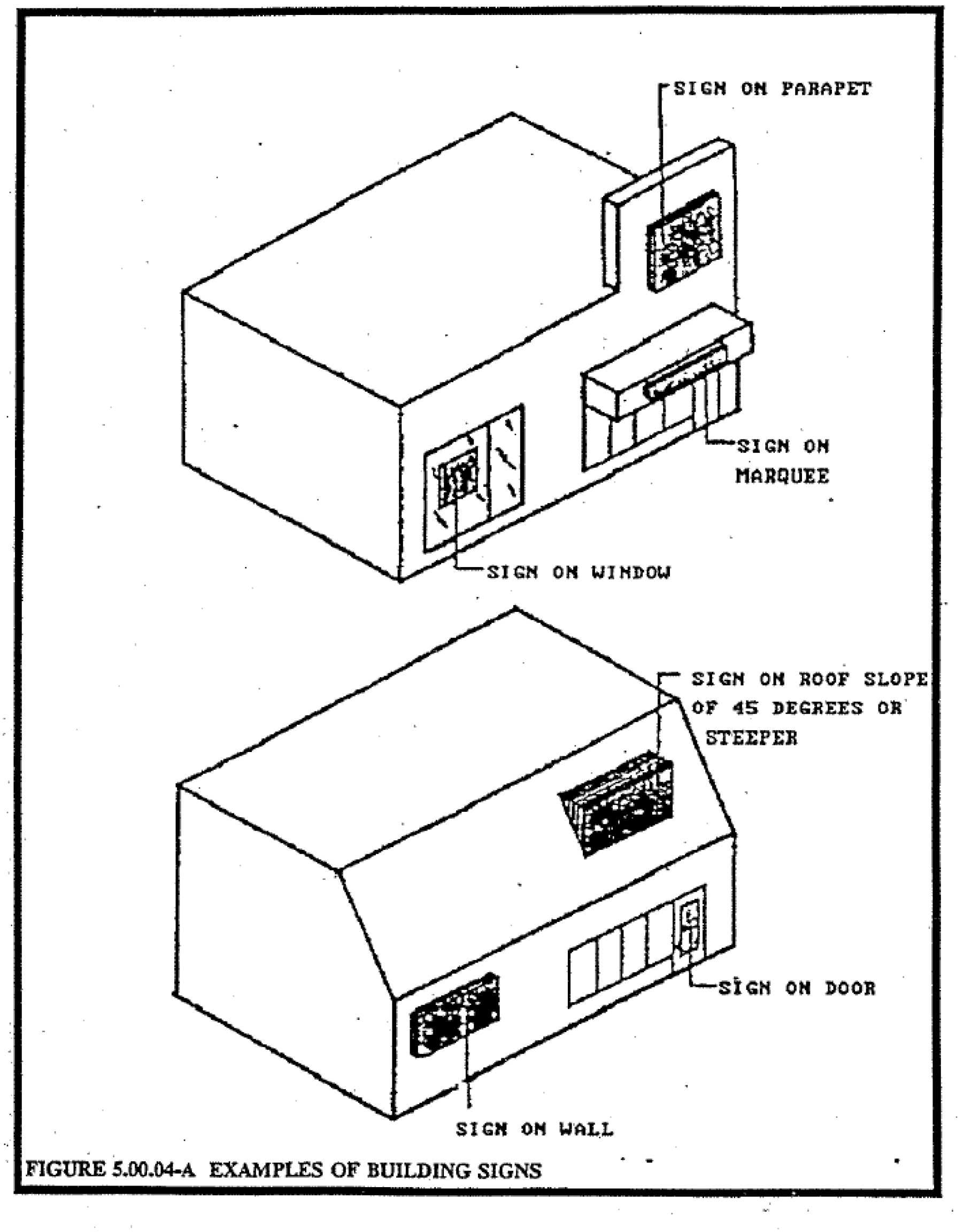
Building sign: A sign displayed upon or attached to any part of the exterior of a building, including walls, windows, doors, parapets, marquees, and roof slopes of 45 degrees or steeper. See Figure 5.00.04-A.
Commercially developed parcel: A parcel of property on which there is at least one walled and roofed structure used, or designed to be used, for other than residential or agricultural purposes.
Construction sign: A temporary sign identifying an architect, contractor, subcontractor, financial institution, developer, or material supplier participating in construction on the property on which the sign is located.
Copy: The linguistic or graphic content of a sign.
Double-faced sign: A sign with two faces.
Electric sign: Any sign containing electric wiring.
Erect a sign: To construct, reconstruct, build, relocate, raise, assemble, place, affix, attach, create, paint, draw, or in any other way bring into being or establish; but it shall not include any of the foregoing activities when performed as an incident to the change of message, or routine maintenance.
Facade: The entire building front including the parapet.
Face of sign: The area of the sign in which the copy is located.
Festoons: A string of ribbons, tinsel, small flags, or pinwheels.
Flags: A flexible, graphic device representing a government, business, or other identifiable entity.
Frontage: The length of the property line of any one parcel along a street on which it borders.
Frontage, building: The length of an outside building wall facing a public right of way.
Governmental Sign: Any temporary, portable, or permanent sign erected and maintained by the city, county, state, or federal government for traffic direction or for designation of or direction to any school, hospital, historical site, or public service, property, or facility; or used for any other public purpose.
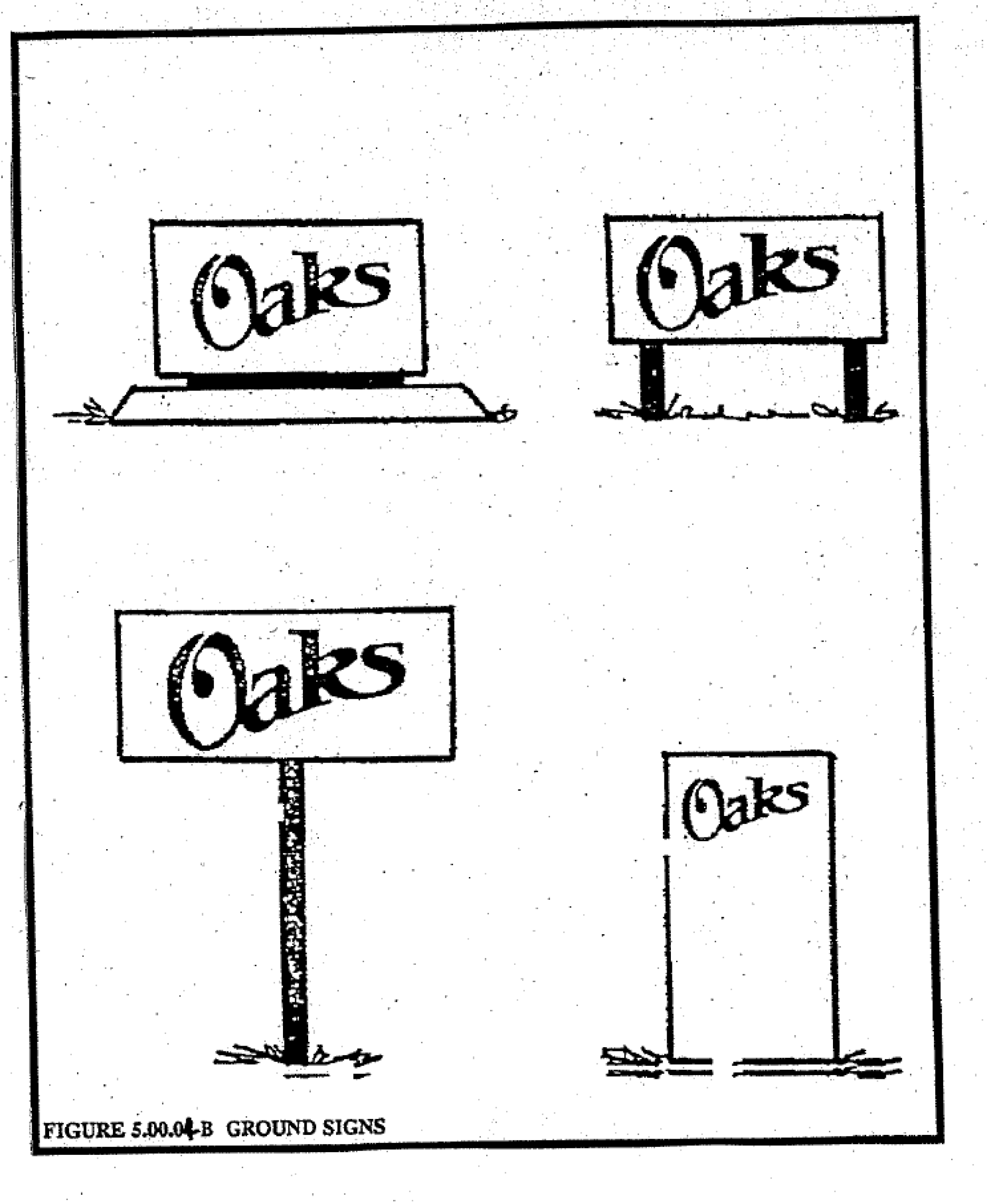
Ground Sign: A sign that is supported by one or more columns, upright poles, or braces extended from the ground or from an object on the ground, or that is erected on the ground, where no part of the sign is attached to any part of a building. See Figure 5.00.01-B.
Identification Sign: A sign whose copy is limited to the name and address of a building, institution, or person, activity or occupation being identified.
Illegal sign: A sign which does not meet the requirements of this chapter and which has not received legal nonconforming status.
Illuminated sign: A sign which contains a source of light or which is designed or arranged to reflect light from an artificial source including indirect lighting, neon, incandescent lights, back-lighting, and shall also include signs with reflectors that depend upon automobile headlights for an image.
Incidental sign: A small sign, emblem, or decal, located on the window or wall of the building, informing the public of goods, facilities, or services available on the premises, e.g., a credit card sign or sign indicating the hours of business.
Inflatable sign: A sign or sign statuary that is either expanded to its full dimensions or supported by gases contained within the sign, or sign parts, at a pressure greater than atmospheric pressure.
Mansard: A sloped roof or roof-like facade architecturally comparable to a building wall.
Marquee: A structure projecting from and supported by a building which extends beyond the building line or property line and fully or partially covers a sidewalk, public entrance or other pedestrian way.
Monument sign: A sign designed to be mounted on a concrete footing or similar support which allows the base of the sign structure to be placed at grade level and not supported by poles or attached to other structures.
Multiple occupancy complex: A commercial use, i.e., any use other than residential or agricultural, consisting of a parcel of property, or parcel of contiguous properties, existing as a unified or coordinated project, with a building or buildings housing more than one occupant.
Nonconforming sign: Any sign within the city on the effective date of this code (or a sign existing within any area annexed to the city after the effective date of this code) which is prohibited by, or does not conform to the requirements of, this code; except signs that are within ten percent of the height and size limitations of this code, and that in all other respects conform to the requirements of this code, shall be deemed in conformity with this code.
Occupant: Also referred to as occupancy. A commercial use, i.e. any use other than residential or agricultural.
Off-premises sign: A sign structure advertising an establishment, merchandise, service, or entertainment, which is not sold, produced, manufactured, or furnished at the property on which said sign is located, e.g., "billboards" or "outdoor advertising"
Outdoor advertising sign: A permanent ground sign supported by a post, or posts, attached to which is a sign face intended to directly or indirectly promote the sale or use of a product, commodity, entertainment, real or personal property, or a service.
Owner: The record owner of the property. For the purposes hereof, the owner of property on which a sign is located is presumed to be the owner of the sign unless facts to the contrary are officially recorded or otherwise brought to the attention of the city, e.g., a sign leased from a sign company.
Parapet: The extension of a false front or wall above a roofline.
Parcel: A unit of land within legally established property lines. If, however, the property lines are such as to defeat the purposes of this code or lead to absurd results, a "parcel" may be as designated for a particular site by the board.
Permanent: Designed, constructed, and intended for more than a short time.
Plaza sign: An on-premises sign of a facility which is a multiple occupancy complex for more than one business, consisting of a parcel of property, or parcel of contiguous properties, existing as a unified or coordinated project, with a building or buildings housing more than one occupant.
Point of purchase display: Advertising of a retail item on the product display, e.g., an advertisement on a product dispenser.
Political sign: For the purposes of this land development code, a temporary sign used in connection with a local, state, or national election or referendum.
Portable sign: Any sign designed to be moved easily and not permanently affixed to the ground or to a structure or building, not including portable governmental signs.
Projecting sign: A sign, other than a flat wall sign, which is attached to and projects from a building wall or other structure not specifically designed to support the sign.
Real estate sign: A temporary sign advertising the real estate upon which the sign is located as being for rent, lease, or sale.
Roof line: A horizontal line intersecting the highest point or points of a roof.
Roof sign: A sign placed above the roof line of a building or on or against a roof slope of less than 45 degrees.
Sandwich sign: Also referred to as a "sandwich board sign." Signboard consisting of two hinged boards that hang front and back from the shoulders of a walker and are used to display advertisements; these signs are not secured or attached to the ground or any building or structure and displayed in or proximate to areas of pedestrian traffic
Sign: Any writing, pictorial presentation, number, illustration, or decoration, flag, banner or pennant, or other device which is used to announce, direct attention to, identify, advertise, or otherwise make anything known. The term "sign" shall not be deemed to include the terms "building" or "landscaping" or any architectural embellishment of a building not intended to communicate information.
Sign face: The part of a sign that is or may be used for copy.
Sign face area: The area of any regular geometric shape which contains the entire surface area of a sign upon which copy may be placed.
Sign structure: Any construction used or designed to support a sign.
Snipe sign: Any temporary, unpermitted sign, banner, or poster made of any material, including paper, cardboard, wood, and metal, when such sign is tacked, nailed, posted, pasted glued, or otherwise attached to trees, telephone poles, fences, conventional sign pole(s), pedestal, other similar object, or having wire legs located or situated on public or private property. Snipe signs shall not include "posted property" signs.
Street: A public or private right of way for vehicular traffic, including highways, thoroughfares, lanes, roads, ways, and boulevards.
Temporary: Designed, constructed, and intended to be used on a short-term basis.
Total sign area: Unless otherwise qualified, e.g. square footage "per face," any reference in this chapter to "sign area" or to a square footage without more, shall mean total square footage of all faces for the sign.
Under-canopy sign: A sign suspended beneath a canopy, ceiling, roof, or marquee.
Unit: That part of a multiple occupancy complex housing one occupant.
Vehicle sign: Any sign affixed to a vehicle.
Wall sign: A sign attached parallel to and extending not more than 12 inches from the wall of a building; this definition includes painted, individual letter, and cabinet signs, and signs on a mansard.
Window sign: A sign installed inside a window and intended to be viewed from outside.
Sec. 8.02.01 - Generally.
It shall be unlawful to erect, cause to be erected, maintain or cause to be maintained, any sign not expressly authorized by, or exempted from, this code.
Sec. 8.02.02. - Specifically.
The following signs are expressly prohibited unless exempted by Part 8.01.00 of this Code or expressly authorized by Part 8.03.00 or Part 8.04.00 of this code:
A.
Signs that are in violation of the building code or electrical code adopted by the city.
B.
Any sign that, in the opinion of the Board, does or will constitute a safety hazard.
C.
Blank temporary signs.
D.
Signs with visible moving, revolving, or rotating parts or visible mechanical movement of any description or other apparent visible movement achieved by electrical, electronic, or mechanical means, except for traditional barber poles.
E.
Signs with the optical illusion of movement by means of a design that presents a pattern capable of giving the illusion of motion or changing of copy.
F.
Signs with lights or illuminations that flash, move, rotate, scintillate, blink, flicker, or vary in intensity or color except for time/temperature/date signs.
G.
Signs carried by a person.
H.
Banners, except for temporary banners as authorized in section 8.03.05, subsection "F", of this code.
I.
Inflatable signs.
J.
Signs that incorporate projected images emit any sound that that is intended to attract attention, or involve the use of live animals.
K.
Signs or sign structures that interfere in any way with free use of any fire escape, emergency exit, or standpipe, or that obstruct any window to such an extent that light or ventilation is reduced to a point below that required by any provision of this code or other ordinance of the city.
L.
Signs that emit audible sound, odor, or visible matter such as smoke or steam.
M.
Signs that resemble any official sign or marker erected by any governmental agency, or that by reason of position, shape or color, would conflict with the proper functioning of any traffic sign or signal, or be of a size, location, movement, content, color, or illumination that may be reasonable confused with or construed as, or conceal, a traffic control device.
N.
Signs that obstruct the vision of pedestrians, cyclists, or motorists traveling on or entering public streets.
O.
Non-governmental signs that use the words "stop," "look," "danger," or any similar work, phrase, or symbol.
P.
Signs that are of such intensity or brilliance as to cause glare or impair the vision of any motorist, cyclist, or pedestrian using or entering a public way, or that are a hazard or a nuisance to occupants of any property because of glare or other characteristics.
Q.
Searchlights used to advertise or promote a business or to attract customers to a property.
R.
Signs that are painted, pasted, or printed on any curbstone, flagstone, pavement, or any portion of any sidewalk or street, except house numbers and traffic control signs.
S.
Signs placed upon benches, bus shelters, or waste receptacles, except as may be authorized in writing pursuant to F.S. § 337.407.
T.
Signs erected on public property, or on private property (such as private utility poles) located on public property, other than signs erected by a public authority for public purposes.
U.
Signs erected over or across any public street except as may otherwise be expressly authorized by this code, and except governmental signs erected by or on the order of a public officer.
V.
All off-premises outdoor advertising signs.
W.
No person or business shall operate or park any vehicle or trailer in a non-designated parking spot/lot on public right of way or public property so as to be visible from the public right of way, which has attached thereto or located thereon any sign or advertising device for the primary purpose of advertisement of products or directing people to a business or activity located on the same or nearby property or any other premises.
X.
Any sign erected or displayed in any fresh water wetlands or salt marsh areas subject to periodic inundation by tidal saltwater.
Y.
Any sign on, or towed behind, a boat or raft on waters within the city or its purview.
Z.
Portable signs.
AA.
Snipe signs.
Sec. 8.03.01 - Where allowed.
Temporary signs are allowed throughout the city, subject to the restrictions imposed by this section and other parts of this code.
Sec. 8.03.02 - Sign types allowed.
A temporary sign may be a ground or building sign but may not be an electric sign.
Sec. 8.03.03. - Permits.
Temporary signs as defined in this Code shall not require a permit from the city.
Sec. 8.03.04. - Removal of illegal temporary signs.
Any temporary sign not complying with the requirements of this section is illegal and subject to immediate removal. The city administrator or his designee shall have the authority to remove all illegal signs, without notice to the owners thereof, prohibited by this Code, and to impound them for a period of 30 days. The owner or person entitled to possession of a sign impounded may recover any impounded sign prior to the expiration of the 30-day impoundment period upon the payment to the city of the costs incurred in the impounding of such sign, including attorney's fees and any applicable fines. In the event any impounded sign is not claimed within 30 days, the city administrator, or his designee, may dispose of the sign in the same manner as surplus or abandoned city property.
Sec. 8.03.05. - Permissible temporary signs.
A temporary sign may display any message as long as it is not advertising as defined by this code, except that advertising for the following purposes may be displayed:
A.
To indicate that an owner, either personally or through an agent, is actively attempting to sell, rent or lease the property on which the sign is located; provided that if the property is for lease or rent such sign shall be attached or affixed to the building or structure and shall not be staked or placed into the ground. Temporary real estate signs advertising he lease or rental of property shall not exceed two signs per unit and each individual rental sign shall not exceed a total of four square feet. Property which is for sale is covered under section 8.03.06 of this code.
B.
To indicate the grand opening of a business or other activity. Such message may be displayed for a period not exceeding 14 days within the first three months that the occupancy is open for business.
C.
To identify construction in progress. Such signs shall be 32 square feet or less and any construction sign shall not be displayed more than 60 days prior to the beginning of actual construction of the project, and shall be removed when construction is completed. If a message is displayed pursuant to this section, but construction is not initiated within 60 days, the sign shall be removed, pending initiation or continuation of construction activities.
D.
To indicate the existence of a new business, or a business in a new location, if such business has no permanent signs. Such message may be displayed for a period of not more than 60 days or until installation of permanent signs, whichever shall occur first.
E.
To announce or advertise such temporary uses as fairs, carnivals, circuses, revivals, sporting events, flea markets, or any public, charitable, educational, or religious event or function. Such message shall be removed within five days after the special event.
F.
Upon written application to, and approval by, the city, a temporary banner may be erected in the city only under the following terms and conditions:
1.
A temporary banner covering a sign in a business district which has been damaged by windstorm or other casualty, provided such banner is displayed for not more than the 45-day period following such windstorm or casualty; and
2.
During a special event, a temporary banner not exceeding 32 square feet may be approved for use. Any banner approved for a special event must be one-sided, located entirely against a solid structure or sign, and stretched tight and securely fastened at each corner or edge. All such banners shall be permitted for a maximum length of time of two weeks.
G.
Wind signs may be permitted for as long as they are displayed in good taste and in a non-excessive manner. Upon determination by the city administrator, the city can order the removal of such wind signs determined to be excessive or outstandingly bad in their display.
Sec. 8.03.06. - Permissible size, height, and number of temporary signs.
A.
One-family and two-family residences/businesses: A parcel on which is located a single one-family or two-family residence or business may display not more than two temporary signs indicating the sale of such property with an aggregate sign area of not more than eight square feet per unit. No individual sign for the sale of the property shall exceed six square feet nor exceed six feet in height.
B.
Three-family and four-family residences/businesses: A parcel on which is located a single three-family or four-family residence or business may display not more than two temporary signs per individual unit indicating the sale of such property with an aggregate sign area of not more than eight square feet per unit. No individual sign for the sale of such property shall exceed six square feet nor exceed six feet in height.
C.
On all other parcels:
1.
All other parcels may display one square foot of temporary signage for the sale of such property per ten feet of frontage up to a maximum of 48 square feet of total signage. No individual sign shall exceed 12 square feet nor exceed eight feet in height. Signs must be spaced at least 100 feet apart. All parcels shall be permitted a minimum of six square feet of temporary signage indicating it is for sale.
2.
"Display Signs" shall be defined as signage for the sale of five or more residential or commercial units while under construction or thereafter, including single-family and multi-family residential and commercial units, and shall be limited to no more than two signs per property or project with an aggregate sign area of 64 square feet. No such individual sign for the sale of such property shall exceed 32 square feet nor exceed eight feet in height. These display signs shall be erected in place of and not in addition to the signs described above in subsection C.1. Should four or fewer units of a larger multi-unit project be placed on the market for sale, see the above subsections A. and B. as applicable.
3.
All signs erected under this section shall conform to the Florida Building Code and certification of compliance by a state licensed engineer or architect may be required by the city or its designated building agent or city administrator.
D.
All other signage requirements for dwellings or parcels that are for sale which are not directly covered by these above sections shall be determined in the sole discretion of the city administrator applying these above sections in a fair and equitable manner.
Sec. 8.04.01 - Sign types allowed.
A permanent accessory sign may be a ground or building sign or a work of art placed with the intention of advertising a commercial establishment or entity. A permanent accessory sign may not be a roof sign.
Sec. 8.04.02 - Permissible number, area, spacing, and height of permanent accessory signs.
A.
Ground signs: The permissible number, area, spacing, and height of permanent accessory ground signs for each multiple occupancy complex and each occupant not located in a multiple occupancy complex shall be determined according to the following tables and text:
Permissible Ground Signs
B.
Building signs: Subject to the design criteria in Part 5.07.00 of this article, the maximum height of a building sign shall be 18 feet, except that on a building of more than two stories, a single building sign is allowed above eighteen (18) feet on each side of the building.
1.
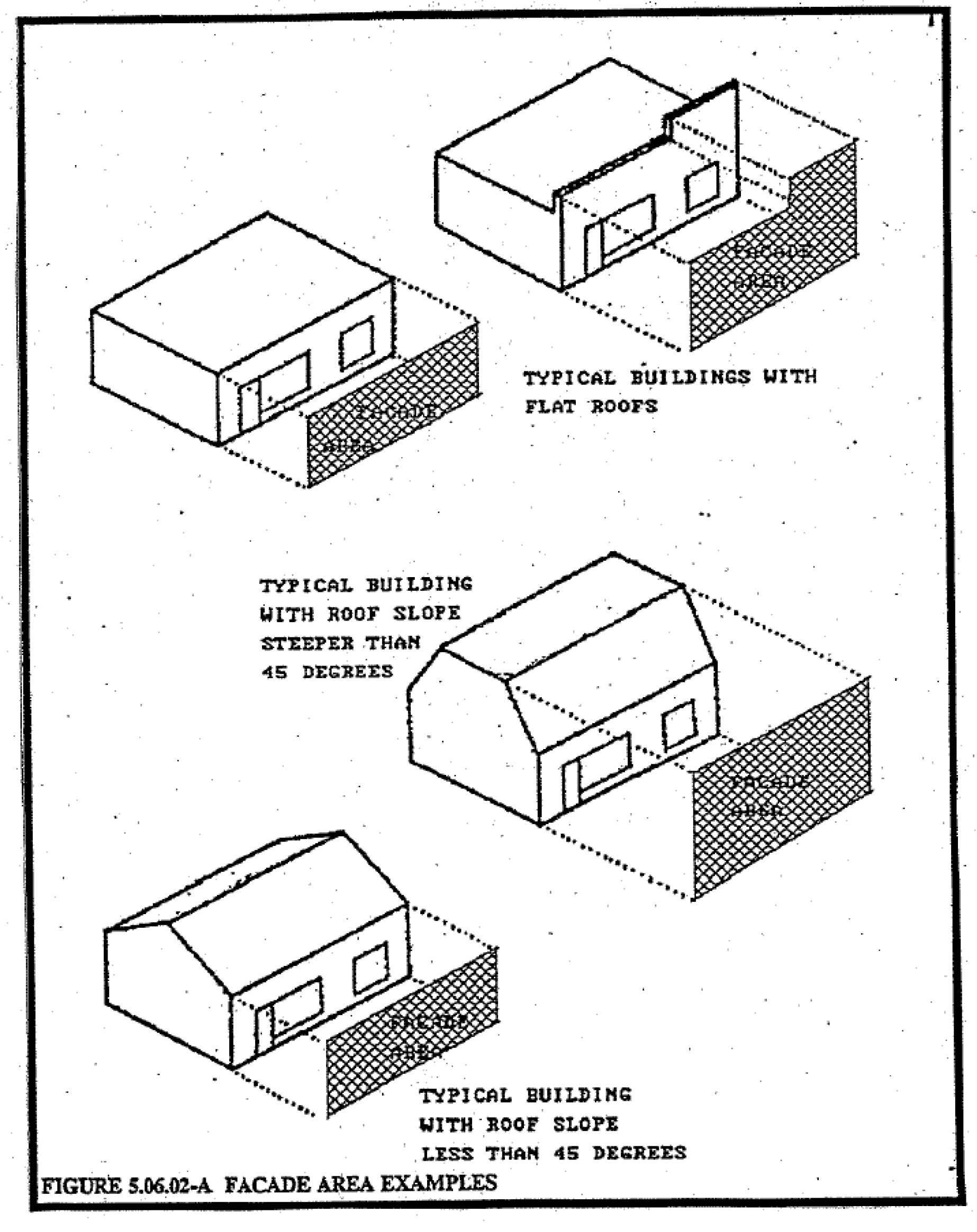
Each multiple occupancy complex may display one (1) permanent accessory building sign on each side of the principal building or buildings in which the complex is located, not to exceed a sign area of up to ten percent of the façade area (see Part 5.06.00, Measurement Determinations) of each building side or two hundred square fee, whichever is smaller.
2.
Each occupant of a multiple occupancy complex may display three permanent accessory building signs on any exterior portion of the complex that is part of the occupant's unit (not including a common or jointly owned area), not to exceed a total combined sign area of fifteen percent of the façade area (see part 5.06.00, Measurement Determinations) of such exterior portion or 200 feet, whichever is smaller.
3.
Each occupant not located in a multiple occupancy complex may display three permanent accessory building signs on each side of the principal building in which the occupancy is located, not to exceed a total combined sign area for each building side of 20 percent of the façade area (see Part 5.06.00, Measurement Determinations) of the building side or 200 square feet, whichever is smaller.
C.
Multiple frontages: If a building has frontage on two or more streets, each frontage shall be separately considered for the purposes of determining compliance with the provisions of these regulations, but the permitted sign area for one frontage may not be combined with that permitted on another frontage to increase the permitted sign area on one frontage. However, no ground sign on one right of way may be closer than 100 feet to a sign on another right of way, measured as the sum of distances measured continuously along the rights-of-way through a common point or points.
Sec. 8.04.03. - Time/temperature/date signs.
Time/Temperature/Date signs are permitted as a permanent accessory sign on commercially developed parcels notwithstanding the general prohibition on changing signs. These signs may only display numerical information in an easily comprehensible way and shall be kept accurate. They may be ground or building signs and are subject to the regulations applicable to such signs. They shall be counted as part of an occupancy's allowable sign area.
Sec. 8.04.04 - Directional signs.
Directional signs are limited in area to four square feet, giving directions to motorists regarding the location of parking areas and access drives shall be permitted as permanent accessory signs on all parcels and shall not be counted as part of occupancy's allowable sign area.
Sec. 8.04.05 - Signs at entrances to residential developments.
A.
Generally: A permanent accessory sign may be displayed at the entrance to residential developments.
B.
Restrictions:
1.
One sign is permitted at only one entrance into the development from each abutting street. The sign may be a single sign with two faces of equal size or may be two single-faced structures of equal size located on each side of the entrance. No face of the sign shall exceed 32 square feet in size and may be illuminated with a steady light only.
2.
When considering the placement of such signs, the planning and zoning board shall consider the location of public utilities, sidewalks, and future street widening.
3.
The planning and zoning board shall ensure that such signs shall be maintained perpetually by the developer, the owner of the sign, a pertinent owners' association, or some other person who is legally accountable under a maintenance arrangement approved by the board. If no accountable person accepts legal responsibility to maintain the sign(s) and no other provision has been made for the maintenance of them, the sign(s) shall be removed by the developer or owner.
Sec. 8.04.06 - Utility signs.
Public utility signs that identify the location of underground utility lines and facilities, high voltage lines and facilities, and other utility facilities and appurtenances are permitted so long as they do not exceed three) feet in height, and so long as the sign face does not exceed one-half square foot.
Sec. 8.05.01 - Where allowed.
It is the purpose and intent of this section to prohibit permanent outdoor advertising signs in order to maintain the aesthetic appearance of the city.
Sec. 8.05.02 - Types prohibited.
All permanent outdoor advertising signs, as defined by this code, are prohibited.
Sec. 8.06.01 - Distance between signs.
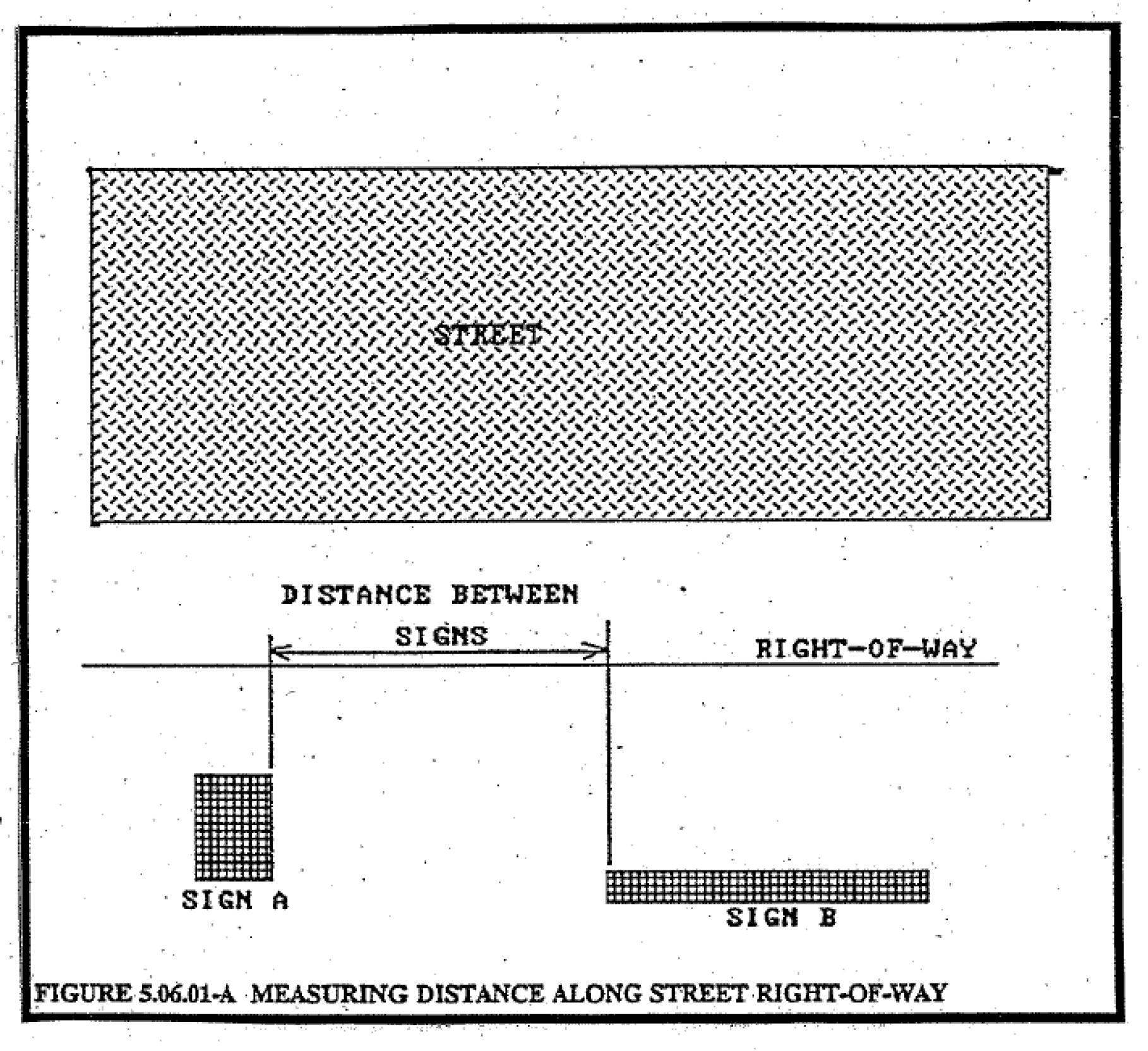
The minimum required distance between signs shall be measured along street rights of way from the closest parts of any two signs. See Figure 5.06.01-A.
Sec. 8.06.02 - Facade area.
The facade area shall be measured by determining the area within a two-dimensional geometric figure coinciding with the edges of the walls, windows, doors, parapets, marquees, and roof slopes of greater than 45 degrees that from a side of a building or unit. See Figure 5.06.02-A.
Sec. 8.06.03 - Sign area.
A.
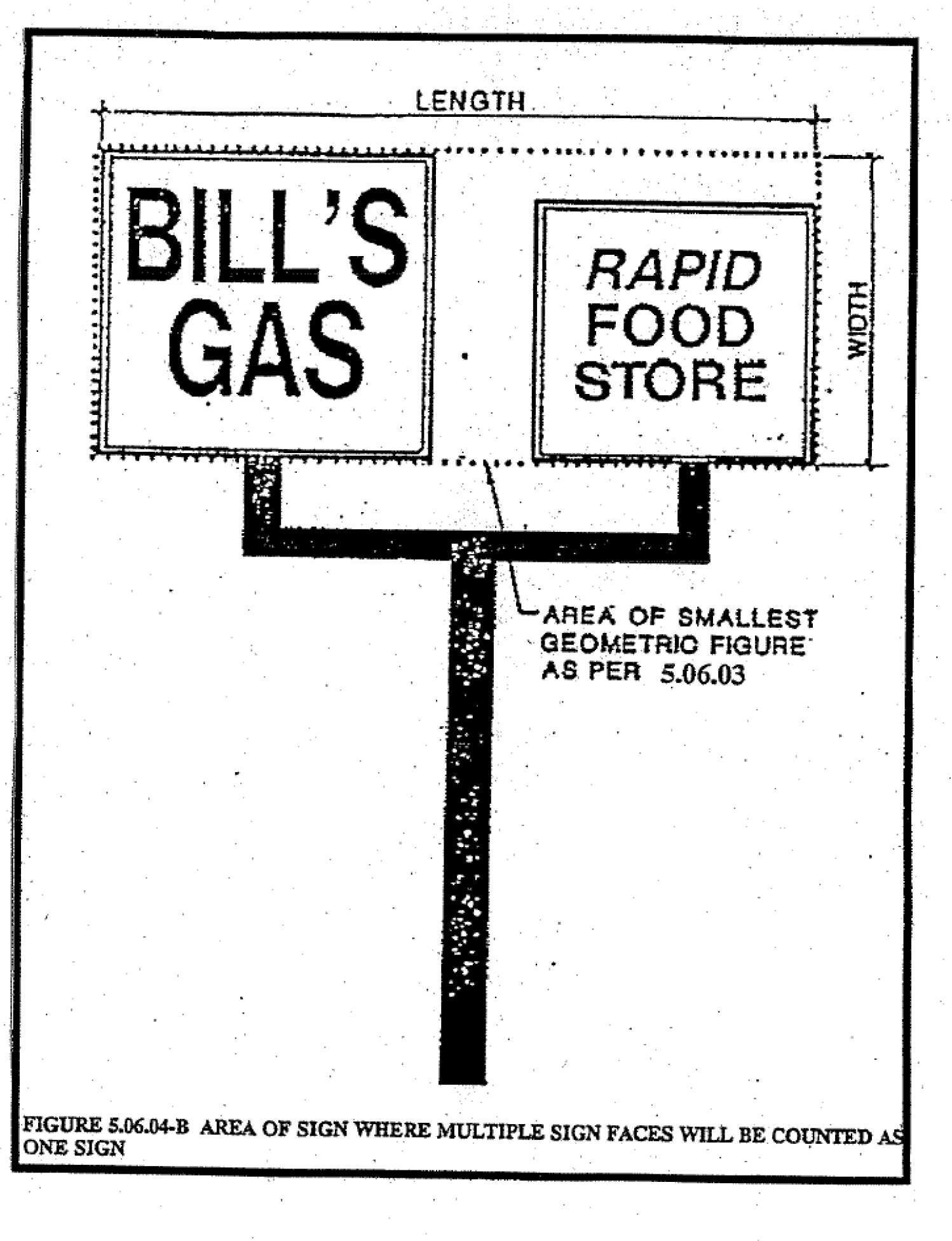
Generally: The area of a sign shall be the area within the smallest square, rectangle, parallelogram, triangle, circle, or semicircle, the sides of which touch the extreme points or edges of the sign face.
B.
Special situations:
1.
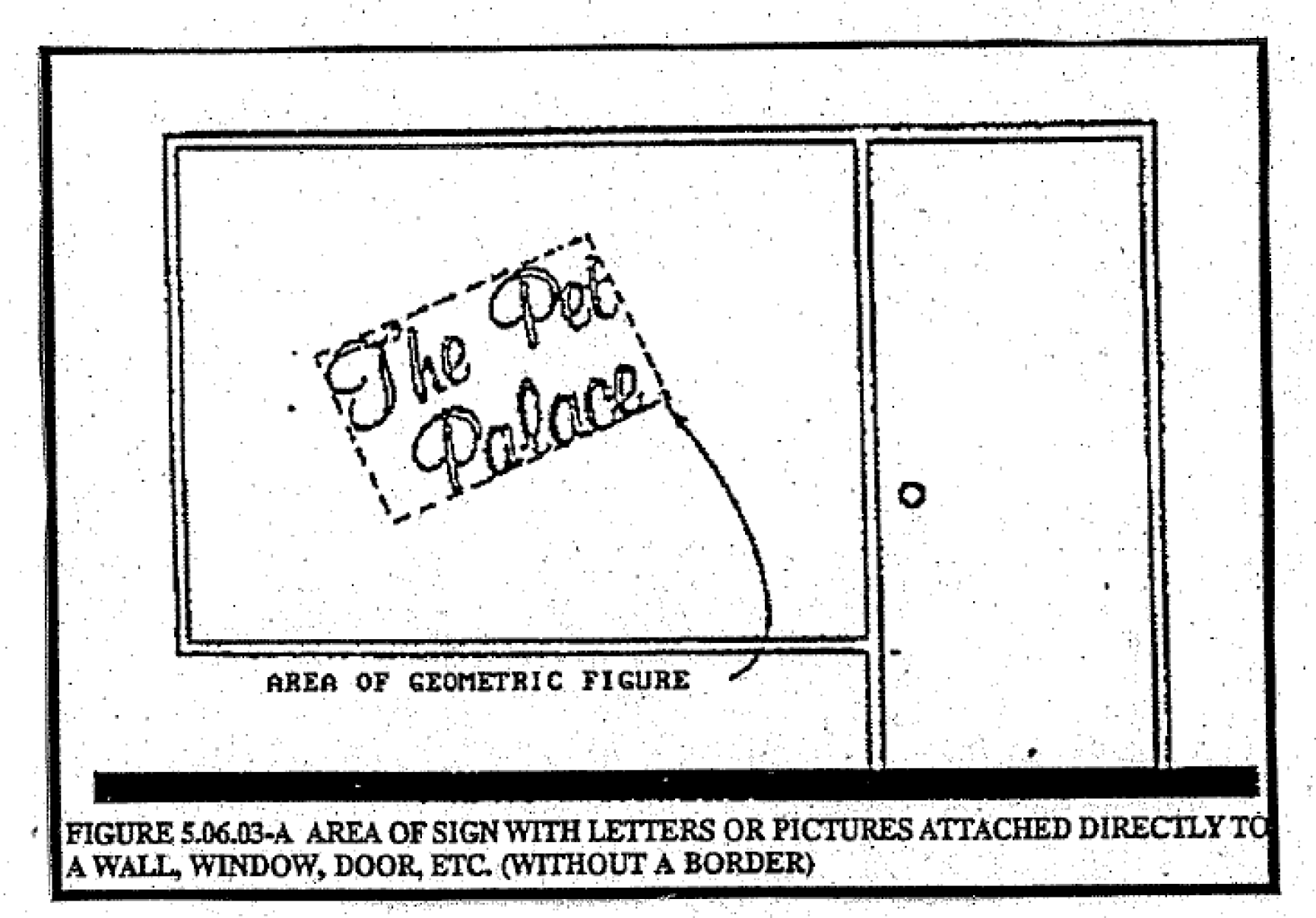
Where a sign is composed of letters or pictures attached directly to a facade, window, door, or marquee, and the letters or pictures are not enclosed by a border or trimming, the sign area shall be the area within the smallest rectangle, parallelogram, triangle, circle or semicircle, the sides of which touch the extreme points of the letters or pictures. See Figure 5.06.03-A.
2.
Where two sign faces are placed back to back on a single sign structure and the faces are at no point more than four feet apart, the area of the sign shall be counted as the area of one of the faces.
3.
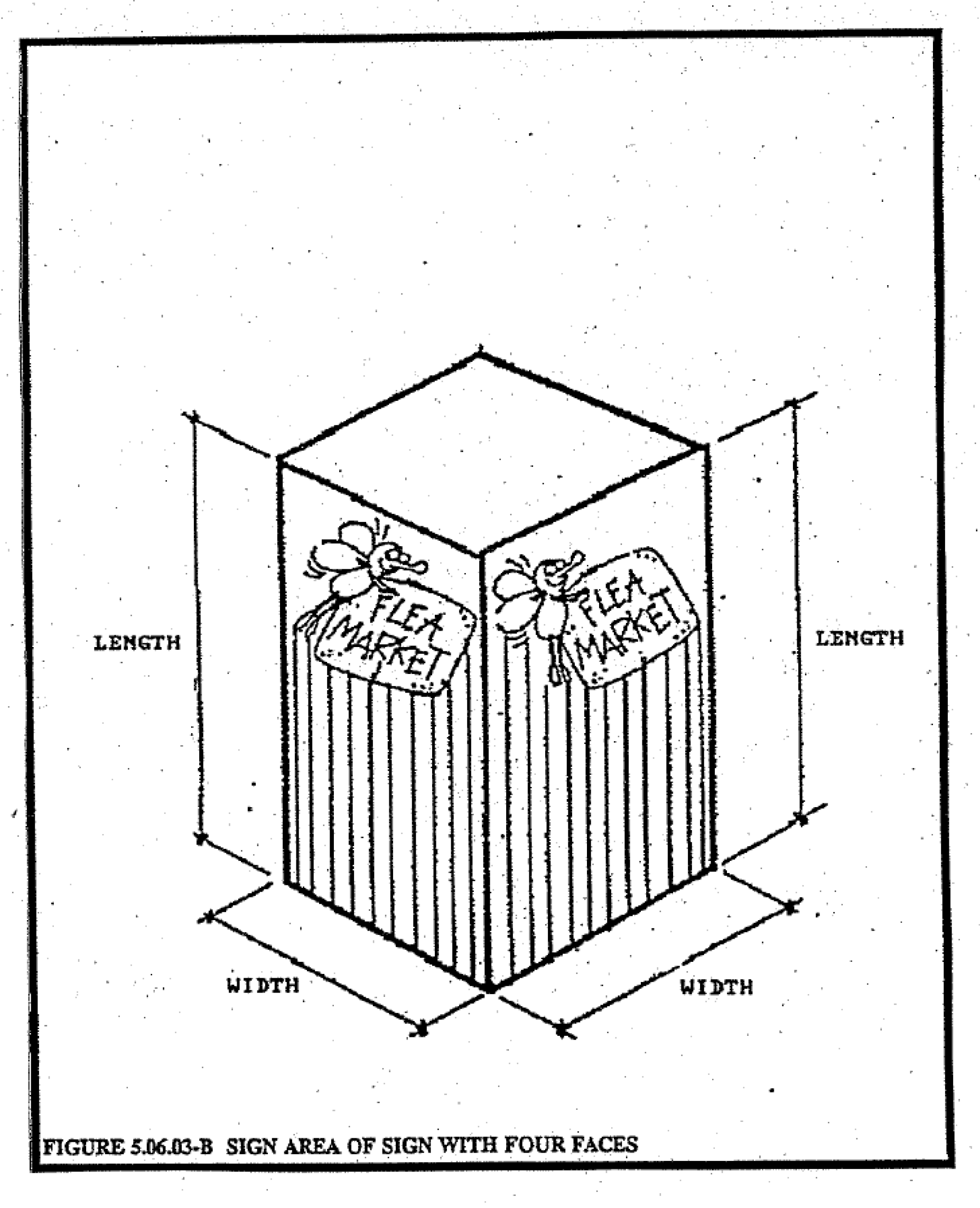
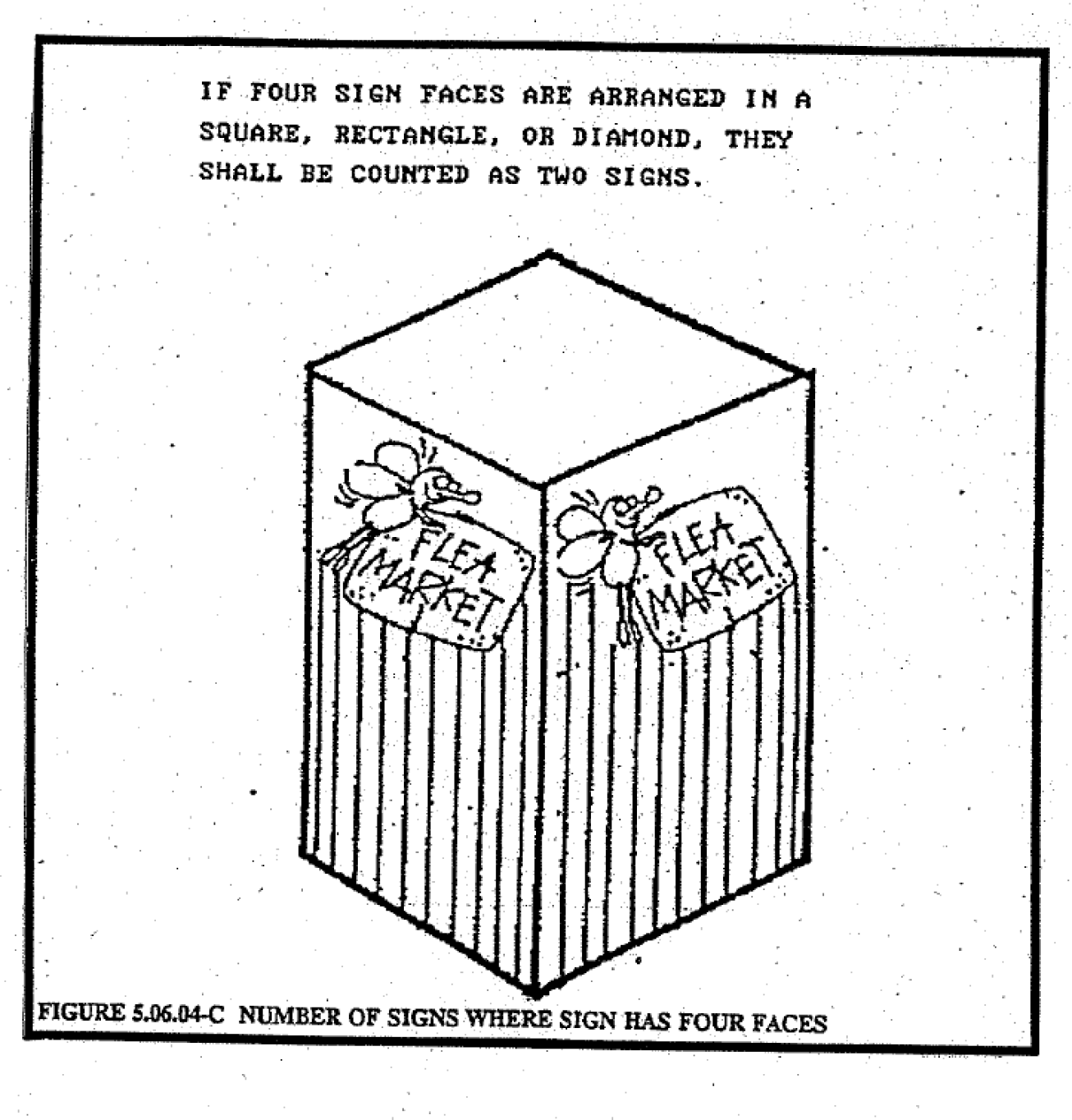
Where four sign faces are arranged in a square, rectangle, or diamond, the area of the sign shall be the area of the two largest faces. See Figure 5.06.03-B.
4.
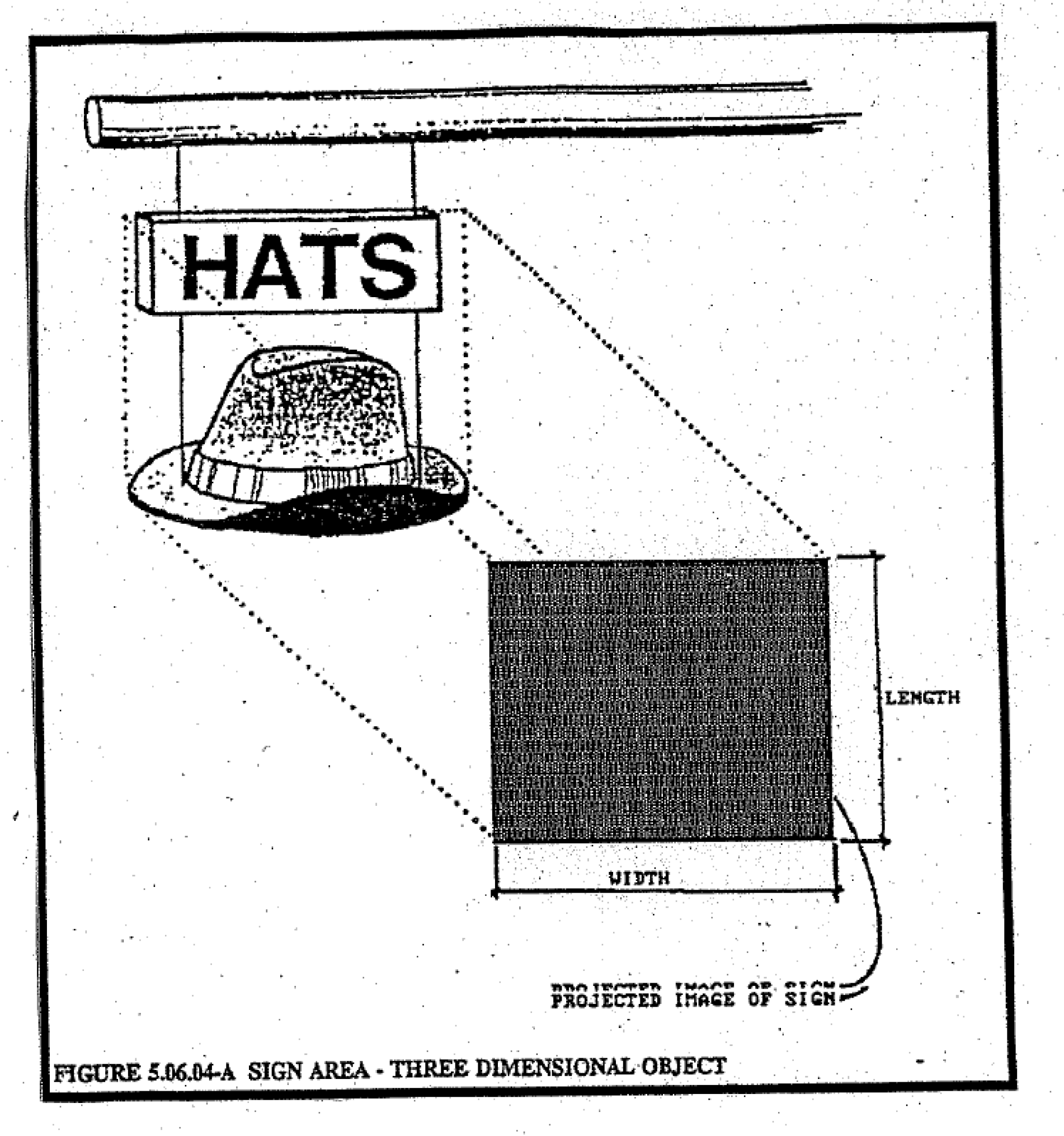
Where a sign is in the form of a three-dimensional object, the area shall be determined by drawing a square, rectangle, parallelogram, triangle, circle, or semicircle, the sides of which touch the extreme points or edges of the projected image of the sign and multiplying that area by two (2). The "projected image" is that image created by tracing the largest possible two dimensional outlines of the sign. See Figure 5.06.04-A.
Sec. 8.06.04 - Number of signs.
A.
Generally: In general, the number of signs shall be the number of non-contiguous sign faces. Multiple non-contiguous sign faces may be counted as a single sign if all the sign faces are included in the geometric figure used for determining the sign area. See Figure 5.06.04-A.
B.
Special Situations:
1.
Where two sign faces are placed back to back and are at no point more than three feet apart, it shall be counted as one sign.
2.
If a sign has four faces arranged in a square, rectangle, or diamond, it shall be counted as two signs. See Figure 5.06.04-C.
Sec. 8.06.05 - Sign height.
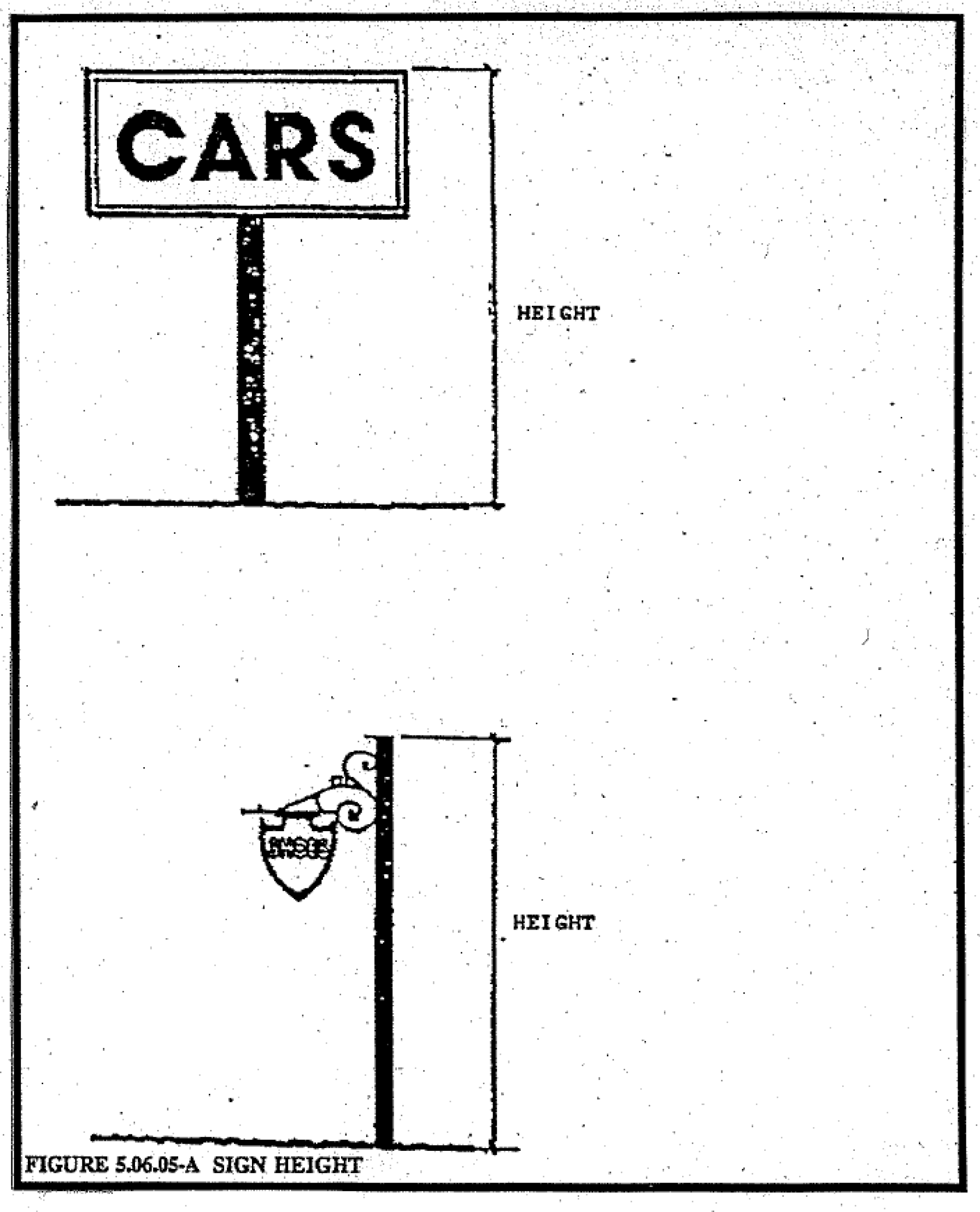
The height of a sign shall be measured as the vertical distance from the finished grade at the base of the supporting structure to the top of the sign, or its frame or supporting structure, whichever is higher. See Figure 5.06.05-A.
Sec. 8.07.01 - Generally.
All permanent signs must comply with the following design, construction, and location standards.
Sec. 8.07.02 - Compliance with building and electrical codes required.
All permanent signs, and the illumination thereof, shall be designed, constructed, and maintained in conformity with applicable provisions of the building and electrical codes adopted by the city. Additionally, the following will apply:
A.
All freestanding signs shall have self-supporting structures erected on or permanently attached to concrete foundations.
B.
Wind loads. All signs shall be designed and constructed to meet the wind loading requirements as set forth in the Florida Building Code.
C.
All signs containing electrical components shall be constructed according to the specifications of the Florida Building Code as well as the specifications of Underwriters' Laboratories or other approved testing agency. All such signs shall have a clearly visible testing agency label permanently affixed.
Sec. 8.07.03 - Illumination standards.
A.
Sign lighting may not be designed or located to cause confusion with traffic lights.
B.
Illumination by floodlights or spotlights is permissible so long as none of the light emitted shines directly onto an adjoining property or into the eyes of motorists or pedestrians using or entering public streets.
C.
Illuminated signs shall not have lighting mechanisms that project more than 18 inches perpendicularly from any surface of the sign over public space.
Sec. 8.07.04 - Placement standards.
A.
Near street and driveway intersections: Signs located within a clear visibility triangle shall conform to the requirements of this code, Florida Building Codes, and the Manual of Uniform Minimum Standards for Design, Construction, and Maintenance for Streets and Highways published by the Florida Department of Transportation.
B.
In right-of-way: Supports for signs or sign structures shall not be placed in or upon public right of way or public easement.
C.
Over Right-of-way: No ground sign shall project over a public right-of-way.
D.
Blocking exits, fire escapes, etc.: No sign or sign structure shall be erected that impedes the use of any fire escape, emergency exit, or standpipe.
E.
Public lands: The placement of any sign or signs of any nature, including political signs, except by local, state or federal governments, or their respective agencies, on any public lands, tracts, or parcels shall be prohibited. Public lands, tracts or parcels, or portions thereof, shall include, but not be limited to, all right of ways, known public easements, parks, piers, public roads, and public waterways.
F.
Vacant lands: The placement of any sign or signs of any nature, including political signs, except by local, state, or federal governments, or their respective agencies, on any vacant land shall be prohibited. Vacant land shall be defined as any lot, parcel, or tract of land without a properly approved structure erected on such land. Roads, streets, bridges and other infrastructure or utility improvements shall not be considered a "structure" for purposes of this section. Properly approved and erected real estate signs advertising the vacant property on which such signs are erected shall be permitted and shall not violate this section.
G.
No sign shall be attached in any form, shape, or manner which will interfere with any opening required for ventilation.
Sec. 8.07.05 - Clearance standards.
A.
Over pedestrian ways: All signs over pedestrian ways shall provide a minimum of seven feet six inches of clearance.
B.
Over vehicular ways: All signs over vehicular ways shall provide a minimum of 13 feet six inches of clearance.
C.
Signs shall be located in such a way as to maintain horizontal and vertical clearance of all overhead electrical conductors in accordance with Florida Building Code specifications.
Sec. 8.07.06 - Relationship to building features.
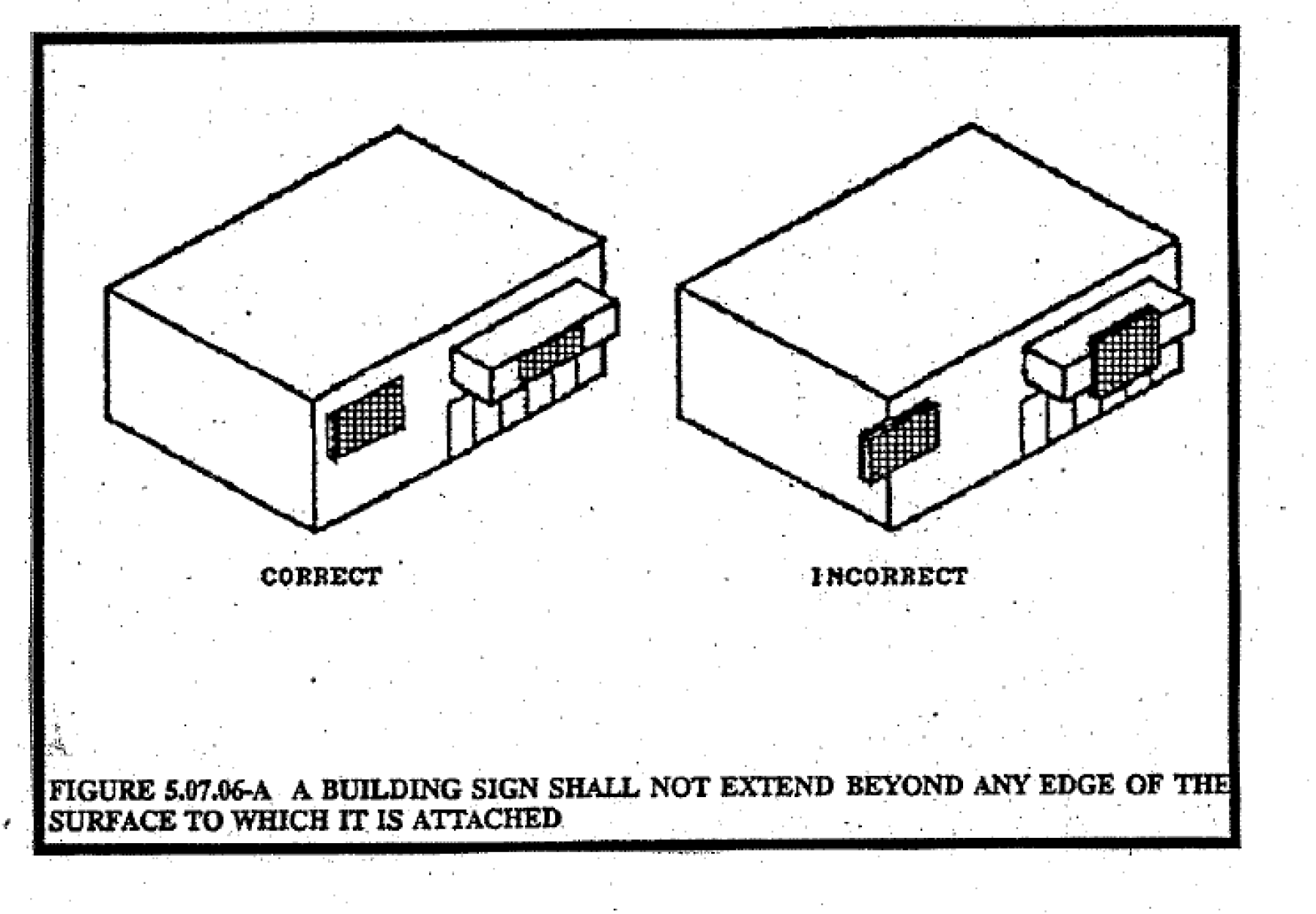
A building sign shall not extend beyond any edge of the surface to which it is attached, nor disrupt a major architectural feature of the building. See Figure 5.07.06-A and Figure 5.07.06-B.
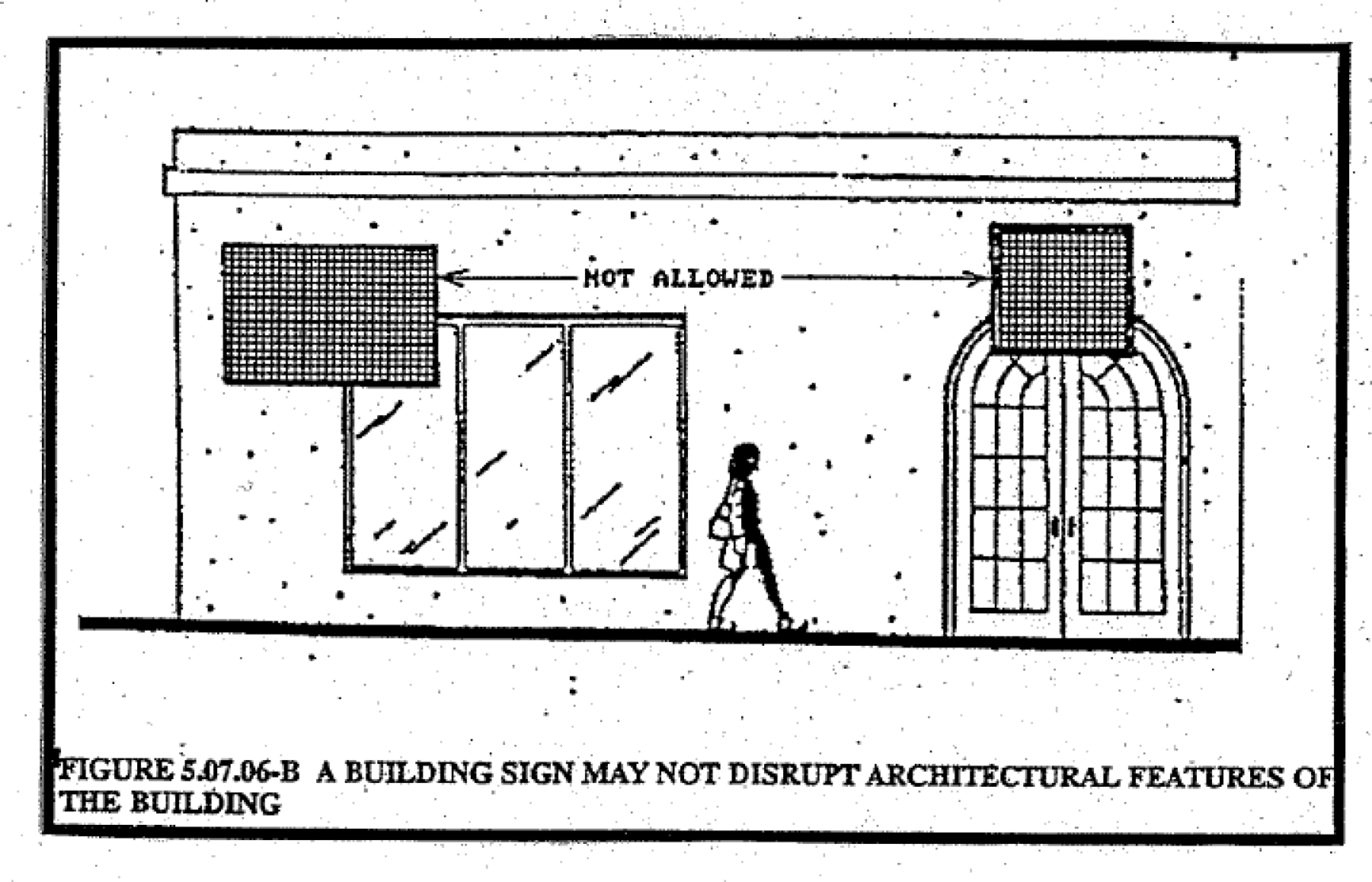
Sec. 8.07.07 - Maximum projection.
A building sign may project no more than four feet perpendicularly from the surface to which it is attached.
Sec. 8.07.08 - Maximum window coverage.
The combined area of permanent and temporary signs placed on or behind windows shall not exceed 25 percent of the total window area at the same floor level on the side of the building or unit upon which the signs are displayed.
Sec. 8.07.09 - Format for multiple occupancy complexes.
Building signs for multiple occupancy complexes constructed, remodeled, undergo a change in use, or a change in ownership after the effective date of this code shall conform to an approved sign format. The sign format shall be included as a submittal for authorization to erect such a sign and shall be maintained on file in city hall. The format shall be presented in a plan or sketch, together with written specifications in sufficient detail to enable the board to authorize signs based on the specifications. As a minimum, the sign format shall specify the types of signs and dimensions (not to exceed the size limits contained in this article) which will be permitted each occupant within the complex. The sign format shall also contain common design elements, such as placement, color, shape, or style of lettering, which lend a unified appearance to the signs of the occupants within the complex. The sign format may only be modified with the approval of the board upon submission of a revised plan and specifications detailing the revised format.
Sec. 8.08.01 - Defined.
Any sign within the city on the effective date of this code (or a sign existing within any area annexed to the City after the effective date of this code) which is prohibited by, or does not conform to the requirements of, this code; except signs that are within ten percent of the height and size limitations of this code, and that in all other respects conform to the requirements of this code, shall be deemed in conformity with this code.
Sec. 8.08.02 - Continuation of use.
A.
All nonconforming signs and all signs prohibited by Part 8.02.00 (Prohibited Signs) of this code with a replacement cost of less than $100.00, shall be removed within 60 days of the enactment of this code.
B.
All other nonconforming signs other than nonconforming accessory or permanent signs, but including portable signs, shall be removed within one year of the effective date of this code. Within 30 days from the effective date of this code, any animated component of any portable sign shall be turned off.
C.
Nonconforming accessory and other permanent signs may be continued indefinitely subject to the restrictions of section 8.08.03 below.
Sec. 8.08.03 - Continuation of use restrictions.
Subject to the restrictions of section 8.08.02, a nonconforming sign may be continued and shall be maintained in good condition as required by this Code, but it shall not be:
A.
Structurally changed to another nonconforming sign, but its pictorial content may be changed.
B.
Structurally altered to prolong the life of the sign, except to meet safety requirements.
C.
Altered in any manner that increases the degree of nonconformity.
D.
Expanded.
E.
Re-established after damage or destruction if the estimated cost of reconstruction exceeds 50 percent of the appraised replacement cost as determined by the planning and zoning board.
F.
Continued in use when a conforming sign or sign structure shall be erected on the same parcel or unit.
G.
Continued in use after the structure housing the occupancy is demolished or requires renovations the cost of which exceeds 50 percent of the assessed value of the structure.
H.
Continued in use after the structure housing the occupancy changes ownership.
I.
Signs where either the business or structure no longer exists shall be removed.
J.
Signs that do not conform to these regulations will be removed upon transfer of ownership.
In addition to the above, permanent signs such as animated signs or signs with flashing lights shall conform to the signage regulations contained in this article by turning off the animated or flashing portion of the sign, where practicable.
Sec. 8.08.04 - Removal of real estate sales signs.
Temporary signs erected for the sale of real property as set forth in sections 8.03.05 and 8.03.06 shall be removed by the property owner or the real estate agent/broker whose name is on such real estate sign within 15 days from the closing of the sale of such property. The closing and sale date for such properties shall be defined as the date on which the seller signs the deed or other transfer documents to actually convey such property. The earliest executed document(s) shall control.
Upon violation of section 8.08.04 of this Code by the owner of the new property or the real estate broker or agent of the recently sold property, the offending party will be subject to the penalties specified in section 8.10.00. The city, at its discretion, shall be permitted to remove any such offending sign and retain such sign until any and all fines are paid in full. The city, at its discretion, may suspend or withhold the business license of any broker or agent whose name appears on such signs if more than two violations of this code occur in any 12-month period.
Sec. 8.09.01 - Licenses.
No person may engage in the business of erecting, altering, relocating, constructing, or maintaining signs without a valid occupational license and all required state and federal licenses.
Sec. 8.09.02 - Indemnification.
All persons involved in the maintenance, installation, alteration, or relocation of signs near any public right-of-way or property shall agree to hold harmless and indemnify the city, its officers, agents, and employees, against any and all claims of negligence resulting from such work.

