
Castle Rock City Zoning Code
CHAPTER 17
54 - Off-Street Parking
17.54.010 - Purpose and intent.
The purpose of this Chapter is to ensure that safe and convenient off-street parking in adequate numbers is provided to serve the requirements of all land uses in the Town and to avoid congestion in the streets. This Chapter establishes the standards for the amount, location and development of off-street parking and standards for on-site loading areas. The intent is to develop off-street parking that meets operational and safety requirements while preserving the aesthetic, historic or cultural resources and characteristics of the Town. The provisions of this Chapter have been established to:
A.
Allow flexibility in order to encourage parking lots that are efficiently designed and are sensitive to the land use context and neighborhood.
B.
Ensure that parking is not oversized, thereby resulting in unproductive use of land and excessive runoff, but is responsive to parking demand.
C.
Promote safe vehicular and pedestrian circulation within the parking area and provide for the safe and convenient entry and exit of vehicles.
(Ord. 2012-18 §1)
17.54.020 - General provisions.
The requirements of this Chapter concerning off-street parking spaces and parking areas are minimum requirements only, except where specifically noted otherwise. The owner or developer may install facilities exceeding the minimum standards in this Chapter, except that the requirements concerning the maximum number of access ways to and from parking areas shall not be reduced.
A.
Applicability. The off-street parking requirements of this Chapter shall apply to newly constructed buildings and parking areas, for new uses on previously vacant land, for all uses in an expanded building and for enlarged parking areas. In the event of a conflict between the requirements of this Chapter and the provisions of an approved PD Zoning Ordinance containing requirements for off-street parking, the provisions contained in the approved PD Zoning Ordinance shall govern and control.
B.
Exclusive Use.
1.
No off-street parking space shall be used for any purpose other than parking of vehicles and no obstruction shall be placed on any off-street parking space that may interfere with its utility as a parking space. Parking areas shall not be used for the sale, repair, dismantling or servicing of any vehicles or equipment, or for the storage of any vehicles, materials or supplies. If a required off-street parking space is converted to another use or can no longer be used for off-street parking space, it shall be replaced immediately by another off-street parking space meeting all of the requirements of this Chapter.
2.
In residential districts, no truck exceeding 2.5-ton capacity, no truck-tractor or semi-trailer, earth-moving equipment or other similar vehicle, object or machine which conflicts with the residential character of a neighborhood shall be parked or stored on any lot.
3.
The on-site storage of junked, wrecked or abandoned vehicles, as defined by Section 10.20.010, CRMC, shall be governed by Section 10.20.030.
C.
Recreational vehicles. The on-site parking of recreational vehicles in a residential zone district is allowed subject to the following restrictions:
1.
No recreational vehicle may be stored or parked on property closer than 18-inches to the sidewalk or other nearest public right-of-way line.
2.
No recreational vehicle shall be parked in the sight triangle defined in the Transportation Design Criteria Manual.
3.
No parked recreational vehicle may be used for the conduct of business or for living or housekeeping purposes.
4.
The recreational vehicle must be secured such that the vehicle is not moved by high winds.
5.
No recreational vehicle shall be stored out-of-doors on a residential lot unless it is in such a condition as to provide for the safe and effective performance of its intended function.
(Ord. 2012-18 §1)
17.54.040 - Parking space requirements by use.
The purpose of required parking spaces is to provide enough on-site parking to accommodate the majority of parking demand and traffic generated by the range of uses that might locate on the site over time.
A.
Parking requirements shall be based on the land use. Should the use category not specifically address the proposed use, the Director of Development Services shall determine the appropriate category.
B.
Minimum and maximum number of spaces on a site. The minimum required and maximum permitted number of off-street parking spaces to be provided for a use is listed in Table 64-1 of this Section.
C.
Floor area calculations. Where required parking and loading is determined on the basis of gross floor area (GFA), gross floor area shall be determined as the sum of the gross horizontal areas of the several floors of the building, including accessory storage area, and any basement floor area devoted to retailing activities, the production or processing of goods, or offices. Gross leasable area (GLA) shall be defined as that portion of the gross floor area available to leasing to a tenant, and excluding common areas, such as lobbies, stairwells and elevators, restrooms, storage, utility and equipment rooms.
1.
Parking ratios are based upon the GFA or the GLA contained within the building, the amount of seating available or the number of employees. When the computation of the required off-street parking spaces results in a fraction, the requirement shall be rounded up to the nearest whole interval.
D.
Capacity of persons. Where required parking spaces are determined on the basis of capacity of persons, such requirement shall be used on the maximum number of persons that can avail themselves of the goods or services of a use at any one time year round, as determined by the required floor space per person established in the building code.
E.
Number of employees computation. Where required parking spaces are determined on the basis of number of employees, such requirement shall be based on the maximum number of employees on the premises at any one time.
F.
Multiple-use developments. When there are two or more separate primary uses on a site, the required parking for the site shall be the sum of the required parking for the individual primary uses. Where the two or more separate uses are located on separate lots, yet are planned as a complete development, the total number of parking spaces for the uses can be distributed over the separate lots, provided that ownership, lease arrangements or other means shall guarantee the continued provision and use of the parking spaces.
G.
Repair bays. Within an automobile service station, repair garage or other similar use, repair bays shall not be counted as part of the required off-street parking spaces.
H.
Outside dining. All outside dining areas with a seating area of 500-square feet or larger shall be subject to the same requirements as indoor dining.
I.
Bicycle required for nonresidential land uses. All nonresidential land uses shall provide bicycle parking spaces equal to 5% of the total off-street vehicle parking spaces. All bicycle parking spaces shall be inverted U-style racks, unless otherwise approved by the Town Manager. Each inverted U-style rack counts as two bicycle parking spaces.
(Ord. No. 2023-015, § 2, 7-18-2023; Ord. No. 2023-007, § 19, 4-4-2023; Ord. No. 2018-024, § 8, 8-21-2018; Ord. No. 2018-015, § 2, 5-15-2018; Ord. 2012-18 §1, 2012)
_____
17.54.050 - Accessible parking space requirements for the disabled.
A.
Dimensions. The dimensions of all accessible parking spaces, accessible aisles, accessible paths, and passenger loading zones shall be governed by American National Standards Institute (ANSI) Standard ICC A117.1, "accessible and usable buildings and facilities," as adopted pursuant to Section 15.28.010.a.5 of this Code.
B.
Number Required. The following number of accessible parking spaces as identified in Table 64-2 below shall be provided for all sites in all office, commercial, industrial, multifamily and public land use districts. These spaces shall count in fulfilling the off-street parking requirements and the allocation cannot be reduced.
Table 64-2
Minimum Number of Accessible
Parking Spaces Required
C.
Vans. Of the total required number of accessible spaces, one (1) out of every six (6) shall be sized to accommodate vans.
D.
Location and Accessible Route. Accessible parking spaces shall be located as close to the main building entrance as practically possible. Exterior accessible routes may include parking access aisles, crosswalks at vehicular ways, sidewalks and ramps. Parked vehicle overhangs shall not reduce the clear width of an accessible route to less than five (5) feet. All accessible parking spaces, loading zones and accessible aisles shall not have slopes exceeding the maximum surface slope allowed by ANSI Standard ICC A117.1, "accessible and usable buildings and facilities," as adopted pursuant to Section 15.28.010.a.5 of this Code.
E.
Signs. Parking spaces for the disabled shall be identified through the use of appropriate signage showing the International Symbol of Accessibility. Van accessible spaces shall have an additional sign indicating "Van Accessible" mounted below the symbol of accessibility. Each sign shall be no smaller than one (1) foot by one (1) foot and shall be located at the end of the parking space at a height between five (5) feet and seven (7) feet. The sign may either be wall-mounted or freestanding. In addition, the symbol of accessibility shall be painted on the pavement.
(Ord. No. 2023-007, § 20, 4-4-2023; Ord. No. 2015-06, § 3, 2-17-2015; Ord. 2003-35 §1, 2003; Ord. 2012-18 §1)
17.54.060 - Joint use of parking spaces.
Joint use of required parking spaces may be approved by the Director of Development Services where an owner or developer can document that two (2) or more separate uses are able to share parking spaces because their respective hours of peak operation do not overlap. Only when it can be clearly shown that the uses have substantially different operating hours shall the joint use parking arrangement be approved. The following criteria shall be used to evaluate whether such joint use of parking spaces may be granted:
A.
Analysis showing that the peak parking times of the uses occur at different times, the size of each use and the twelve- to twenty-four-hour parking demand characteristics of each use. Daily, weekly and monthly variations in parking demand must also be presented for consideration.
B.
Provision that the location and number of parking spaces being shared is large enough for the total peak demands of all uses and that the spaces are conveniently located for all uses.
C.
Occupancy factors for the uses in order to determine the rates and times of utilization of the parking spaces should be considered in the analysis.
(Ord. 2003-35 §1, 2003; Ord. 2012-18 §1)
17.54.070 - Location of parking areas.
A.
Parking for Residential Uses. For all residential developments, the required parking spaces shall be wholly provided on the same site as the building. Parking is permitted only on the driveway, parking lot or other paved surfaces on a property. Parking spaces or drive aisles shall not be located within a required front yard setback except for single-family detached and two-family residential use areas.
B.
Parking for Nonresidential Uses. Off-street parking spaces may be located on any part of the lot occupied by the buildings or uses for which such parking space is required; however, no parking space or drive aisles shall be located in a minimum front yard or side yard setback and shall be at least eight (8) feet from any right-of-way, regardless of setback.
C.
Off-Site Parking. Except for residential uses, off-site parking is permitted, provided that the off-site parking spaces are under the same ownership or control as the building or with a long-term lease arrangement, or other means satisfactory to the Director of Development Services. The off-site parking spaces should be no further than eight hundred (800) feet from the building site, measured along the shortest public pedestrian route between the parking area and the building being served. These parking spaces shall be identified as being associated with the specific use or building by the use of appropriate signage.
D.
Valet Parking. The off-street parking requirement for restaurants, bars and hotels can be fulfilled by providing a valet parking service for customers. The valet service shall provide service to and from the main entrance. An approved passenger loading area shall be provided near the main entrance of the building for this service. The provision of this service shall be signed both inside and outside of the establishment, near the main entrance. Valet parking shall be provided in an off-street lot, and tandem parking is permitted for parking served by valet service.
(Ord. No. 2015-06, § 3, 2-17-2015; Ord. 2012-18 §1)
17.54.080 - Large parking areas.
For proposed parking areas requiring more than two hundred fifty (250) parking spaces, the applicant shall supply to the Director of Development Services a report indicating the number and siting of parking spaces and the relationship to the various uses served by the parking. A parking plan indicating separate zones where parking relates to specific building areas shall be provided. Interior landscaped islands shall be placed to provide visual relief, to assist vehicular circulation and to organize large areas of parking into smaller areas. Pedestrian walkways through and adjacent to the parking area shall be defined by a change in paving material, borders of landscaping and rows of trees. Large parking areas must also provide a minimum throat length of two hundred (200) feet from the edge of the right-of-way to the nearest parking aisle, driving aisle, or parking space. The minimum throat length may be adjusted if justified by a traffic impact analysis.
(Ord. 2003-35 §1, 2003; Ord. 2012-18 §1)
17.54.090 - Reduction of required parking spaces.
A.
Based on the following criteria, the Director of Development Services may grant a parking reduction, not to exceed twenty-five (25) percent of the required parking, for commercial, institutional, industrial and mixed-use developments:
1.
The nature of the use, the size of the site or other physical constraints, or location of the site within the Downtown or the Historic District result in a situation where the parking requirements cannot be met on site without unnecessary hardship, practical difficulties or negative impact on the visual character of the site or neighborhood;
2.
The applicant can satisfactorily demonstrate by means of a parking study that the parking needs of the use will be adequately served, and, if the reduction is due to the nature of the use, the applicant shall provide assurance that the nature of the use will not change;
3.
A mix of uses is proposed and the parking needs of all the uses can be accommodated through joint use of parking spaces with varying time periods of use; or
4.
The applicant provides an acceptable proposal for an alternate mode of transportation program, including assurances that the use of alternate modes of transportation will adequately supplant the need for on-site parking on an ongoing basis.
5.
For each parking space eliminated as a result of a reduction in parking requirements granted by the Director of Development Services within the North or South Downtown Non-Residential Downtown Parking Area, the property owner/developer shall pay to Town ten thousand dollars ($10,000.00) for each parking space eliminated. Such payment shall be paid to Town prior to and as a condition to recordation of the applicable Site Development Plan.
B.
If the Director of Development Services denies a request for a parking reduction herein, the applicant may appeal the decision to the Town Council. Approval with conditions may be considered a denial for purposes of appeal. Such appeal shall be made in writing to the Manager within fifteen (15) days of the Director of Development Services action. Development Services shall schedule the appeal for public hearing before the Town Council. The public hearing shall be noticed in accordance with the provisions of Chapter 17.04.
C.
Requests for a parking reduction greater than twenty-five (25) percent shall be reviewed and acted on by the Town Council after a public hearing noticed in accordance with Chapter 17.04.
(Ord. No. 2018-015, § 3, 5-15-2018; Ord. 2012-18 §1)
17.54.100 - Design of parking areas.
The following requirements shall apply for all parking areas, except where the parking area is to serve single-family and attached single-family residential uses.
A.
Access. Safe, convenient and efficient access shall be provided for the entry and exit of vehicles to parking areas.
1.
Unobstructed, direct and convenient access for vehicles to and from a street or alley shall be provided for all off-street parking spaces. All parking areas must be designed to allow vehicles to enter and exit the roadway in a forward motion.
2.
Entry and access points should be located in order to provide the least number of access points and to maximize storage space and maximum distance from intersections and/or alleys. The location, spacing and design of all proposed curb cuts to the public right-of-way shall be approved by the Director of Public Works. Each driveway access between a public street and the parking area shall be not less than eighteen (18) feet in width for one-way traffic and not less than twenty-four (24) feet in width for two-way traffic.
3.
All necessary accesses, driveways and other paved portions of parking areas shall not be located within required front yard setbacks. Where there is no front yard setback, accesses, drive aisles, and other paved portions of the parking area shall be set back at least eight (8) feet from the right-of-way. Driveways may cross setbacks and shall intersect the roadway at a ninety-degree angle.
4.
Sole access to a property through an alley may be allowed if approved by the Department of Development Services after review of the following:
a.
The extent the alley is free of obstructions;
b.
The width of the unobstructed portion of the alley;
c.
The ability to facilitate safe traffic movements; and
d.
The ability to accommodate emergency access.
During the review of the request, the applicant shall send a certified mailing of a Town-approved letter to all property owners and businesses adjacent to the alley, to all utility companies and to all Town-serving waste management companies. This letter shall describe the request, depict the alley location graphically, indicate that no parking or obstructions shall occur in the alley and solicit comments to be sent to the Town within ten (10) days of receipt of the letter. There shall also be public posting of notices in accordance with the provisions of Chapter 17.04 at both ends of the alley to notify third parties of the proposed alley access. If the alley access is approved and prior to utilizing the alley as a primary access, the alley shall be posted at the applicant's expense with Town-approved signs depicting that the alley shall not be obstructed by parked vehicles or other objects. A yellow line of a width approved by the Town shall also be painted by the applicant along the entire length of the alley to depict the alley edges.
B.
Parking Space and Aisle Dimensions. The standard parking stall size shall be nine (9) feet wide and eighteen (18) feet long. The size of parking spaces and the width of access aisles shall meet the dimensions contained in Table 64-3 and Figure 64-2 for the specified angles. Parking angles between zero and forty-five (45) degrees or between seventy-five (75) degrees and ninety (90) degrees are not permitted. Angled spaces of zero degrees, forty-five (45) degrees, sixty (60) degrees, seventy-five (75) and ninety (90) degrees are permitted. The aisle width must be at least twenty-four (24) feet wherever two-way traffic occurs with angle parking.
_____
Table 64-3
Parking Lot Dimensions for Universal Sized Stall (9 feet × 18 feet)
(All dimensions in feet)
_____
Figure 64-2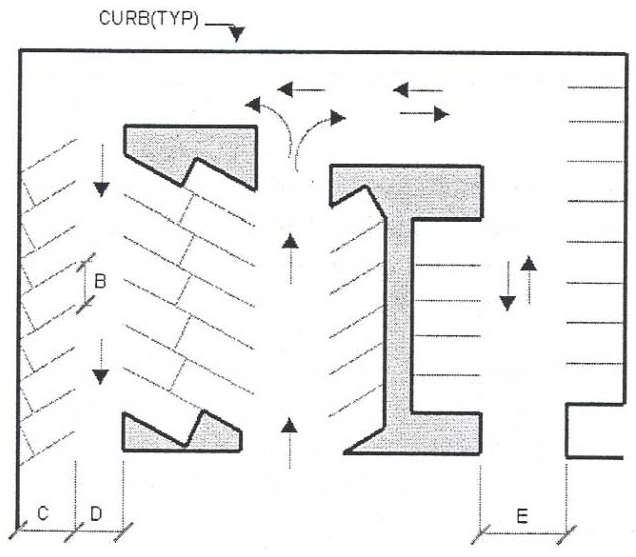
The Director of Development Services may permit up to twenty percent of the spaces in parking lots to be a small-car size of nine feet wide and sixteen feet long.
C.
Layout. Vehicles parked in a required parking space shall not protrude into the drive aisle or any access driveways. Parking on both sides of a drive aisle shall be at the same angle unless approved otherwise by the Director of Development Services.
D.
Turnaround Area. A turnaround area of five feet in depth and with a width of the drive aisle shall be provided for all dead-end aisles in ninety-degree parking configurations.
E.
Walkways. All pedestrian walkways shall be at least four feet in width. Where head-in parking is adjacent to pedestrian walkways, the pedestrian walkway shall be at least six feet in width.
F.
Curbs in Parking Areas. Concrete curbs shall be used for the perimeter of the parking lot and all landscaped islands. Parking rows containing ten or more parking stalls shall have raised curb islands with landscaping to identify the end of each parking row. All perimeter and interior landscaped areas must have protective curbs along the edges. Curbs separating landscaped areas from parking areas may be perforated to allow stormwater runoff to pass through them. Trees must have adequate protection and separation from car doors as well as car bumpers.
G.
Bumper Overhang. The portion of a standard parking space which is adjacent to a sidewalk or a landscaped area may be reduced by up to two feet, as long as the following conditions are met:
1.
For landscape buffers:
a.
The landscaped area may be up to two feet from the front of the space as measured from a line perpendicular to the curb of the parking stall.
b.
The landscaping must be ground-cover planted behind the curb for a minimum distance of two feet.
2.
For sidewalks:
a.
The sidewalk adjacent to the parking area shall be a minimum six-foot width, measured from the back of the curb.
Parking spaces meeting the standards in this subparagraph G are considered to be standard parking spaces.
H.
Paving. All vehicle access ways between a public street or alley and off-street parking spaces or areas and the surfaces of all off-street parking spaces, driveways and aisles shall be surfaced with asphalt or concrete, or an alternative material as approved by the Director of Development Services.
I.
Temporary Parking, Drive Aisles and Loading Areas. Temporary parking may be permitted by the Director of Development Services for up to a year and may be renewed on an annual basis, provided that an all-weather surface as approved by the Director of Development Services is placed as the surfacing material for the parking area.
J.
Overflow Parking. Where a specific land use can be shown as having a fluctuating parking demand, overflow parking areas may be permitted, dependent on location, size and anticipated frequency of use. The Director of Development Services shall review surfacing materials, and impervious paving materials are discouraged.
K.
Marking of Parking Areas. All parking areas shall have the parking stalls and drive aisles clearly marked on the pavement in conformance with the parking dimension standards of Table 64-3 above. Such marking shall be maintained in a clearly legible condition. All non-parking spaces, such as loading zones, fire lanes or required spaces in front of entrances, shall be clearly delineated.
L.
Snow Storage. All off-street parking areas shall include space for snow storage and removal of snow. Up to fifteen percent of the required parking spaces may be designed for snow storage and removal.
M.
Screening. Where abutting a residential use or Zoning District, commercial or industrial parking areas shall be screened by utilizing coniferous vegetation, berms, opaque fencing or a similar visual barrier of a minimum five-foot height. Parking areas (excluding single-family and attached residential units) shall be screened so as to prevent disturbance to any adjacent residential development due to the maneuvering of vehicles entering and leaving the parking area.
N.
Parking structures. Structures that contain vehicle parking areas are subject to the building setbacks of the land use district. Where structures that contain vehicle parking do not have setbacks, the garage entrance must be set back a minimum of twenty feet from the nearest edge of any public sidewalk. The Director of Development Services may approve reducing the size of parking stalls to a small car size of eight feet wide and sixteen feet long within a parking structure, to a maximum of thirty percent of the total spaces required, provided that a parking study has been submitted and approved. All smaller spaces shall be signed for use by compact vehicles.
O.
Placement of bicycle racks. Racks shall be placed within thirty feet of building entrances, unless otherwise approved by the Manager. Covered parking is encouraged. All bicycle parking shall be located a minimum distance from walls, depending on orientation:
1.
Orientation - Minimum distance of rack from wall.
2.
Parallel to wall - Twenty-four inches.
3.
Perpendicular to wall - Thirty inches.
(Ord. No. 2015-06, § 3, 2-17-2015; Ord. 2012-18 §1)
17.54.110 - Stormwater management.
A drainage plan for managing stormwater runoff in parking areas in conformance with the Town's regulations shall be submitted for review to the Town. An approved drainage plan or system must be provided prior to the construction of any off-street parking.
(Ord. 2003-35 §1, 2003; Ord. 2012-18 §1)
17.54.120 - Loading areas.
For buildings in excess of 3,000 square feet of gross floor area, an unloading area of at least twelve feet by thirty feet shall be provided on the lot; however, this requirement can be waived if a portion of the off-street parking area is designed to function in a safe and attractive manner as the unloading area. The area used for unloading shall not be used to meet the off-street parking requirements. In order to control dust and mud, all loading areas must be paved with concrete or asphalt. All loading areas adjacent to residential areas, parks, public roadways and adjoining commercial sites shall be screened with a wall of fence that is in keeping with the architectural character of the building or development.
(Ord. 2012-18 §1)
17.54.130 - On-street parking.
All persons shall comply at all times with all parking regulations promulgated by the Town. In addition, no person shall keep, maintain, store or park any trailer of any type, boat or detached pickup camper in violation of Chapter 10.20, CRMC.
(Ord. 2012-18 §1)

