
Centerville City Zoning Code
12.55 Supplementary
Development Standards
12.55.010 Purpose
Adopted by Ord. 2016-20 on 7/15/2016
12.55.020 Scope
Adopted by Ord. 2016-20 on 7/15/2016
12.55.030 Definitions
Adopted by Ord. 2016-20 on 7/15/2016
12.55.040 Abandoned, Wrecked Or Junk Vehicles
Adopted by Ord. 2016-20 on 7/15/2016
12.55.050 Adequate Public Facilities
Adopted by Ord. 2016-20 on 7/15/2016
12.55.060 Accessory Buildings For Animals And Fowl
An accessory building for animals or fowl which is located in a residential zone and which exceeds 500 square feet of gross floor area shall be at least:
- Same Lot or Parcel: 50 feet from a dwelling on the same lot or parcel;
- Adjacent Lot or Parcel: 75 feet from a dwelling on an adjacent lot or parcel, and
- Existing or Proposed Right-of-Way: 50 feet from an existing or proposed street right-of-way.
Adopted by Ord. 2016-20 on 7/15/2016
12.55.070 Accessory Uses And Structures
- Permitted. Accessory uses and structures shall be permitted in all zones provided they are incidental to, and do not substantially alter a principal use or structure, subject to the provisions of this Section and the zone where they are located.
- Front Yard. No accessory building or structure nor group thereof shall be located in a front yard unless expressly authorized by a provision of this Title.
- Rear Yard. No accessory building nor group of accessory buildings in any residential zone shall cover more than 20% of a rear yard.
- Side Yard. Accessory buildings may be located in a side yard to the extent permitted by the zone where it is located.
- Minimum Setback and Drainage. An accessory building shall be located at least three feet from a property line. Drainage from the building shall not discharge onto an adjoining lot or parcel.
Adopted by Ord. 2016-20 on 7/15/2016
12.55.080 Buildable Area
Adopted by Ord. 2016-20 on 7/15/2016
12.55.090 Condominium Projects
- State Law Requirements. The owner of real property may construct a new condominium project or convert existing land and/or structures into a condominium project by complying with the provisions of the Utah Condominium Ownership Act, as set forth in Utah Code Ann. §§ 57-8-1, et seq., and applicable provisions of this Title and the Centerville Muncipal Code.
- Uses Permitted. Uses permitted within a condominium project shall be limited to those uses permitted within the zone in which the project is located.
- Lot or Parcel Size. No lot or parcel within a condominium or planned development plat shall be smaller than the minimum lot or parcel size required by the zone where it is located unless a smaller lot or parcel is approved as part of a planned development.
Adopted by Ord. 2016-20 on 7/15/2016
12.55.100 Easements
- Acknowledgment Required. No dwelling, main building, or permanent accessory building shall be located within a recorded easement area unless the property owner either produces evidence satisfactory to the City Attorney that the easement has been abandoned, or executes a recordable document, in a form approved by the City Attorney, acknowledging that notwithstanding apparent abandonment of the easement, the structure may be subject to the superior interest of the easement holder and may be required to be relocated at the property owner’s expense to accommodate such interest.
- Location. Any structure in an easement area shall be located pursuant to the setback and other applicable requirements of this Title.
- No Change in Legal Rights. Nothing in this Section is intended to expand or restrict the rights or obligations of any party to any recorded easement.
Adopted by Ord. 2016-20 on 7/15/2016
12.55.110 Fences And Walls
- Height of Fences and Walls. No fence, wall, or other similar structure exceeding six feet in height shall be erected in any rear or side yard except for accessory buildings and structures permitted by this Title, except as provided below.
- When a difference in grade exists on either side of a fence or wall, the height of the fence or wall shall be measured from:
- The average elevation of the finished grade of adjoining properties at the fence line; or
- If excavated or filled, the native elevation.
- The average elevation of the finished grade of adjoining properties at the fence line; or
- No fence need be less than 48 inches in height.
- The Planning Commission may approve a fence, wall or similar structure not to exceed 10 feet in a rear area or side yard in the A-M, R-M, R-H, C-M, C-H, C-VH, I-H, I-VH, PF-L, PF-M, PF-H, or PF-VH zones as part of a site plan review, or amended site plan, with the findings by the Planning Commission that is to be a benefit to the surrounding properties and/or help to buffer the use, and is in the City’s best interest.
- The Zoning Administrator may approve a fence, wall, or similar structure not to exceed a height of eight feet, as a buffering element, where a differing zone district boundary is present. Such fence shall be subject to the following:
- A “permitted use” application shall be submitted to the City for any fence higher than six feet.
- The increased height placement shall be limited to placement or location along a zone district boundary between two differing zones, when and where there is a difference in zone intensity and the higher intensity zone is missing the buffering element of CZC 12.51.070 or between any A-L and R-L Zone boundary.
- In no case shall the increased height be placed, located, or extended into any front yard or street side yard setback requirement of any zone.
- Where utility easements are present, the “permitted use” request shall comply with CZC 12.55.100 Easements.
- All fencing above six feet in height shall comply with any or all applicable building code regulations and/or shall meet the adopted applicable wind loading regulations.
- South side of Porter Lane, from 400 West to Main Street. For all legally approved rear yard fronting lots along the creek channel, the fence height shall not exceed eight feet in height along the rear yard lot line.
- Street Side Yard, Corner Lots. For residential zones, fencing up to 6 feet in height may be allowed within the street side yard portion of a corner lot, as measured from an interior lot line of the lot to a line intersecting at the Front Yard Setback line of the lot along the other street. Exception, fences shall not exceed 4 feet in height for a minimum distance of at least 12 feet, when a driveway on an adjacent lot is locate within 12 feet of the interior lot line of the corner lot (see Figure 1.1 for a visual reference).
- When a difference in grade exists on either side of a fence or wall, the height of the fence or wall shall be measured from:
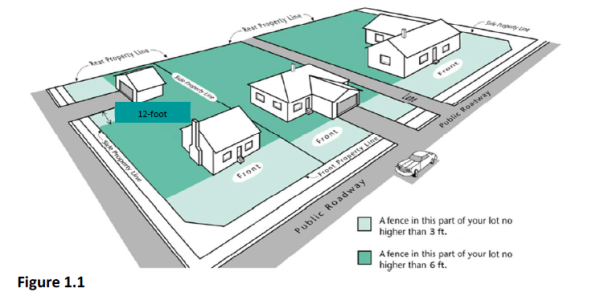
- Fences in Front Yard and Street Side Yard. Except as otherwise provided herein, no fence or wall or other similar structure exceeding 48 inches in height shall be erected within a front yard or a street side yard.
Adopted by Ord. 2016-20 on 7/15/2016
Amended by Ord. 2018-17 on 7/17/2018
Amended by Ord. 2021-19 on 9/7/2021
12.55.120 Height Exceptions And Limitations
- Exceptions to Height Limitations. Roof structures for the housing of elevators, stairways, tanks, ventilating fans or similar equipment required to operate and maintain the building, parapet walls, skylights, towers, steeples, flagpoles, chimneys, water tanks, wireless or television masts, theater lofts, silos or similar structures may be erected above the height limits herein prescribed, but no space above the height limit shall be allowed for the purpose of providing additional floor space for human occupancy.
- Maximum Height of Accessory Building. No building which is accessory to a single-family or a multiple-family dwelling with four or fewer dwelling units shall be erected to a height greater than 20 feet without a conditional use permit.
- Minimum Height of Main Building. No dwelling shall be erected to a height less than one story above grade except earth-sheltered dwellings authorized by the provisions of this Title.
Adopted by Ord. 2016-20 on 7/15/2016
12.55.130 Lots, Parcels, And Yards
- Every Building on Legally Created Lot or Parcel. Every building shall be located and maintained on a legally created lot or parcel as defined in this Title, unless such lot or parcel is a legally nonconforming lot or parcel. Not more than one single-family dwelling or commercial structure shall occupy any one lot or parcel except as authorized by the provisions of this Title. Any development or use of a parcel located outside a recorded subdivision shall comply with CZC 12.55.132 (Development or Use of Parcel).
- Sale or Lease of Required Land. No land needed to meet the size, width, yard, area, coverage, parking or other requirements of this Title shall be sold, leased, or otherwise transferred away, whether by subdivision lot line adjustment or metes and bounds, so as to create or increase the nonconformity of a lot or parcel, building, or site development. No lot or parcel having less than the minimum width and area required by the zone in which it is located may be divided from a larger parcel of land, except as permitted by this Section or by the Board of Adjustment pursuant to the requirements of this Title.
- A reduction in the minimum required area of a lot or parcel owned by the City, County, State, or other public entity or utility provider may be granted a special exception approved by the Board of Adjustment provided such lot or parcel:
- Is used exclusively for public purposes; and
- No living quarters are located thereon.
- Is used exclusively for public purposes; and
- If a portion of a lot or parcel which meets minimum lot or parcel area requirements is acquired for public use in any manner, including dedication, condemnation or purchase, and such acquisition reduces the minimum area required, the remainder of such lot or parcel shall nevertheless be considered as having the required minimum lot or parcel area if all of the following conditions are met:
- The lot or parcel contains a rectangular space of at least 30 by 40 feet, exclusive of applicable front and side yard requirements and one-half of the applicable rear yard requirements, usable for a principal use or structure;
- The remainder of the lot or parcel has an area of at least one-half of the required lot or parcel area of the zone in which it is located; and
- The remainder of the lot or parcel has access to a public street.
- The lot or parcel contains a rectangular space of at least 30 by 40 feet, exclusive of applicable front and side yard requirements and one-half of the applicable rear yard requirements, usable for a principal use or structure;
- A reduction in the minimum required area of a lot or parcel owned by the City, County, State, or other public entity or utility provider may be granted a special exception approved by the Board of Adjustment provided such lot or parcel:
- Reduction of Lot or Parcel Width and Area Requirements. Minimum lot or parcel area, or lot or parcel width requirements of this Title shall not be construed to prevent the use of a lot or parcel for a single-family dwelling so long as such lot or parcel was:
- Held in separate ownership on the effective date of this Title; and
- Was legally created when it became nonconforming as to area or width.
- Held in separate ownership on the effective date of this Title; and
- Reduction of Minimum Yard Requirement. Any lot or parcel under separate ownership from adjacent lots or parcels, and recorded before the effective date of this Title which has a smaller width than required by the zone in which the lot or parcel is located shall be deemed a buildable lot or parcel if:
- For interior lots, the smaller of the two side yards is at least five feet wide and the larger is at least eight feet wide; and
- For corner lots, the street side yard is at least 15 feet wide and the other side yard is at least five feet wide.
- For interior lots, the smaller of the two side yards is at least five feet wide and the larger is at least eight feet wide; and
- Adjacent Lots or Parcels When Used As One Building Site. When a common side lot line separating two or more contiguous lots or parcels is covered or proposed to be covered by a building, such lots or parcels shall constitute a single building site and the setback requirements of this Title shall not apply to the common lot or parcel line if a document is recorded indicating the owner’s intent to use the combined lots or parcels as a single development site. The setback requirements of this Title shall apply only to the exterior side lot lines of the contiguous lots or parcels so joined.
- Double Frontage Lot. A lot or parcel having frontage on two or more streets shall be prohibited except for corner lots and double frontage lots in subdivisions which back onto streets shown on the Master Street Plan. Such double-frontage lots shall be accessed only from an internal subdivision street. Frontage on lots having a front lot line on more than one street shall be measured on one street only.
- Setback - Deck or Patio. Any part of a deck or patio covered with a roof or enclosed on two or more sides, or which exceeds three feet in height at any point above finished grade shall conform to applicable yard setback requirements.
- Setback Measurement. The depth of a required yard abutting a street shall be measured from the lot line except as set forth below:
- In blocks where more than 50% of the buildable lots or parcels have main buildings which do not meet the current front yard setback of the zone in which the block is located, the minimum front yard requirement for new construction shall be equal to the average existing front yard size on the block.
- Whenever a front, side, or rear yard abuts a public street proposed to be constructed or widened as shown on the Master Street Plan the depth of such yard shall be measured from a line which is one-half of the proposed right-of-way width from the center line of the street to be constructed or widened, or from the current lot line, whichever is greater.
- In blocks where more than 50% of the buildable lots or parcels have main buildings which do not meet the current front yard setback of the zone in which the block is located, the minimum front yard requirement for new construction shall be equal to the average existing front yard size on the block.
- Yard Space for One Building Only. No required yard or other open space around an existing building, or which is hereafter provided around any building for the purpose of complying with the provisions of this Title, shall be considered as providing a yard or open space for any other building. Nor shall any yard or other required open space on an adjoining lot or parcel be considered as providing a yard or open space on a lot or parcel whereon a building is to be erected or established.
- Lot Coverage. In no zone shall a building or group of buildings with their accessory buildings cover more than 50% of the area of the lot or parcel.
- Lot Grade. The grade of a lot or parcel along a property line shall be:
- The grade shown on an approved subdivision grading plan; or
- The naturally occurring grade.
- The grade of a slope from a property line shall not exceed 25%.
- The grade shown on an approved subdivision grading plan; or
- Multiple-Family Dwelling Unit Project Rear and Side Setback Adjustment. A multiple-family dwelling unit project in the R-M or R-H Zone consisting of real property over one acre in size, shall be allowed to utilize the following provisions for the purpose of providing more flexible and aesthetic building layout and project design.
- All minimum rear and side setbacks shall be determined by the orientation of any main building closest to the lot line. No main building shall have a rear or side setback smaller than 10 feet. Any building on a corner lot must meet the required street side yard setback of 20 feet.
- If the narrow portion of a one story building faces a rear or side property line, the setback may not be smaller than 10 feet. If the building is adjacent to a R-L Zone, the minimum setback shall increase an additional five feet per story, up to a maximum of 20 feet.
- If the long portion of a main building faces a rear or side property line, the setback shall be 20 feet.
- All minimum rear and side setbacks shall be determined by the orientation of any main building closest to the lot line. No main building shall have a rear or side setback smaller than 10 feet. Any building on a corner lot must meet the required street side yard setback of 20 feet.
Adopted by Ord. 2016-20 on 7/15/2016
Amended by Ord. 2022-17 on 8/16/2022
12.55.132 Development Or Use Of Parcel
- Single-Family Dwelling. Any development of a single-family dwelling or other associated single-family use on a parcel located outside a recorded subdivision shall comply with CZC 12.55.134 (Single-Family Development on Parcel).
- Commercial, Industrial, or Other Use. Any commercial, industrial, public or civic, multi-family, or other non-single-family development or use on a parcel located outside a recorded subdivision shall comply with CZC 12.21.110 (Site Plan Review).
Adopted by Ord. 2022-17 on 8/16/2022
12.55.134 Single-Family Development On Parcel
- Permitted Use Permit. The Zoning Administrator is authorized to issue a permitted use permit for the development of a single-family dwelling or other associated single-family use on a parcel located outside a platted subdivision in accordance with the procedures and standards for review as set forth in this Section and CZC 12.21.090 (Permitted Use Review).
- Administrative Decision. Any decisions regarding the review, approval, or denial of a permitted use permit for the development of a single-family dwelling or other associated single-family use on a parcel located outside a platted subdivision is an administrative decision and shall be made in accordance with the provisions of CZC 12.21.060 (General Decision-Making Standards) regarding decision-making standards for administrative proceedings.
- Application Requirements. The application for permitted use permit for development of a single-family dwelling or other associated single-family use on a parcel located outside a platted subdivision shall, in addition to the requirements of Subsection CZC 12.21.090, include:
- A vicinity map showing significant natural and man-made features on the parcel and within 100 feet of the parcel;
- Boundary lines of the parcel with dimensions shown;
- Topographic contour lines at no greater intervals than five feet;
- Total acreage and tax identification number for the parcel;
- An accurate and complete survey for the parcel with traverses of the exterior boundaries of the parcel to close within a tolerance of one foot to 20,000 feet when computed from field measurements on the ground;
- Proposed addressing for the parcel in accordance with CMC 11.03.050;
- Designation of any portions of the parcel located in a floodplain zone or containing designated wetlands;
- The right-of-way lines of each street, and the width of any portion being dedicated and widths of any existing dedications;
- The side lines of all recorded and proposed easements shall be shown by fine dashed lines. The width of all easements and sufficient ties thereto to locate the same with respect to the parcel shall be shown. All recorded and proposed easements shall be clearly labeled and identified;
- A description or layout of existing and proposed utilities, including culinary water, irrigation water, sewer, stormwater, electrical, and gas service;
- Satisfactory evidence that all utilities and services will be available for the parcel and that the utilities and easements therefor have been reviewed by the utility providers;
- Construction plans in accordance with the requirements and standards set forth in CMC 15.07 (Public Improvements) for any required public improvements;
- Improvements Agreement bond acceptable to the City and bond for any required public improvements in accordance with CMC 15.04.090; and
- A current title report disclosing all recorded matters of title regarding the parcel which is prepared and dated not more than 30 days from the date of submittal of the application for permitted use permit.
- Parcel Development Requirements. Any development of a single-family dwelling or other associated single-family use on a parcel located outside a platted subdivision shall:
- Provide all necessary street and public improvements in accordance with CZC 12.55.190;
- Provide all necessary street and right-of-way dedication in accordance with CZC 12.55.190;
- Provide all required public utility easements and other necessary easements in accordance with CMC 15.05.060;
- Pay all applicable development and impact fees; and
- Comply with all applicable provisions of CMC 15.05 (General Requirements for All Subdivisions) specifically related to lot development standards and restrictions.
Adopted by Ord. 2022-17 on 8/16/2022
12.55.140 Outdoor Lighting
- General Provisions. Outdoor lighting fixtures shall be arranged to direct light away from adjoining residential property.
- Lighting fixtures mounted on utility poles shall be fully shielded, cut-off type fixtures that will not allow light dispersion or direct glare to shine above a 90 degree horizontal plane from the base of the fixture.
- Detached lighting of signs, buildings and displays shall be directed downward. Uplighting shall be prohibited except as allowed in landscaped areas as part of an approved site plan, conditional use permit, or other plan or permit.
- Electrical service to outdoor lighting fixtures shall be underground unless fixtures are mounted directly on utility poles.
- Lighting fixtures mounted on utility poles shall be fully shielded, cut-off type fixtures that will not allow light dispersion or direct glare to shine above a 90 degree horizontal plane from the base of the fixture.
- Exemptions. The following types of outdoor lighting shall be exempt from the provisions of this Section:
- Holiday lighting during the months of November, December and January, provided such lighting does not create dangerous glare on adjacent streets or property;
- Temporary lighting for temporary uses approved as part of a temporary use permit pursuant to CZC 12.56 (Temporary Uses);
- Lighting associated with agricultural operations;
- Construction or emergency lighting, provided such lighting is temporary and is discontinued when the need for such lighting ends; and
- Roadway lighting.
- Holiday lighting during the months of November, December and January, provided such lighting does not create dangerous glare on adjacent streets or property;
Adopted by Ord. 2016-20 on 7/15/2016
12.55.150 Private Rights-Of-Way
The Zoning Administrator shall not authorize a building permit for a dwelling located on a lot or parcel accessed only by a private right-of-way except under one of the following conditions:
- Nonconforming Lot or Parcel. The lot or parcel was legally created and recorded prior to the effective date of this Title;
- Variance. A variance is granted by the Board of Adjustment; or
- Planned Development or Condominium. The lot or parcel is part of an approved planned development or condominium.
Adopted by Ord. 2016-20 on 7/15/2016
12.55.160 Second Kitchen In Single-Family Dwelling
- Authorized. A second kitchen shall not be created within a dwelling unit unless such kitchen meets the following requirements:
- The dwelling unit has only one:
- Front entrance;
- Street address; and
- Electrical meter;
- Front entrance;
- An interior access is maintained to all parts of the dwelling with no keyed or deadbolt locks, or other manner of limiting or restricting access to the second kitchen from the remainder of the dwelling;
- The second kitchen is part of the primary structure; and
- The dwelling owner executes a written document prescribed and recorded by the City which declares that the dwelling will not be converted into two or more dwelling units without prior approval by the City.
- The dwelling unit has only one:
- Occupancy Limitation. When a second kitchen is approved pursuant to Subsection (a), both present and future owners of the premises shall limit the use of the dwelling unit to family occupancy only and no roomers or boarders shall be permitted.
- Inspections. Upon request by the City, the dwelling owner shall allow inspection of the dwelling unit at reasonable times to determine compliance with this Section.
Adopted by Ord. 2016-20 on 7/15/2016
12.55.170 Slope Limits - Driveways
Adopted by Ord. 2016-20 on 7/15/2016
12.55.180 Storage Of Trash And Debris Prohibited
Adopted by Ord. 2016-20 on 7/15/2016
12.55.190 Street Improvements Required
- Street Improvements Required. No construction shall be permitted on an unimproved lot or parcel unless planned street improvements abutting the lot or parcel, as shown on the Master Street Plan, including without limitation, sidewalk, curb and gutter, parking strips and associated landscaping, street pavement and fire hydrant improvements, are provided simultaneously in conformance with CMC 10.04.150 and applicable Construction Codes. Constructing such improvements shall be a condition precedent to final inspection and occupancy of any building and other improvement on the lot or parcel, subject to the provisions of this Section. Such improvements shall conform to City Standards and Specifications.
- Dedication and Construction of Improvements. When widening of a public street is planned, as shown on the Master Street Plan, street right-of-way and frontage improvements associated with proposed development shall be dedicated to the public and improved without cost to the City to the extent the such improvements are roughly proportional to the developer's fair share of needed public improvements, as determined by the Planning Commission after receiving a recommendation from the City Engineer.
- Appeal. If a street dedication and improvement requirement is alleged to not be roughly proportional to the demand created by new development, such requirement may be appealed to the Board of Adjustment as provided in CZC 12.21.200.
- Deferral. In limited circumstances, upon the request of the applicant, the City may defer or waive the installation of any required street improvements in accordance with the provisions of CZC 12.55.200.
Adopted by Ord. 2016-20 on 7/15/2016
Amended by Ord. 2018-01 on 1/16/2018
12.55.200 Street Improvements - Methods Of Providing
In limited circumstances, the City may allow the developer to defer or waive the installation of any required public improvements when deemed appropriate in accordance with and subject to the provisions of CMC 10.04.170.
Adopted by Ord. 2016-20 on 7/15/2016
Amended by Ord. 2018-01 on 1/16/2018
12.55.210 Street Improvements - Reimbursement
Any developer who voluntarily installs at his or her own expense street improvements associated with an approved development permit may receive reimbursement of part of that expense as follows:
- Written Agreement. The developer installing the street improvements shall enter into a written reimbursement agreement with the City prior to construction of the improvements.
- Calculation and Payment of Reimbursement.
- The amount of the reimbursement shall be limited to improvements which:
- Provide a direct benefit to property abutting such improvements; and
- Are greater than the developer's roughly proportional share of improvements needed to service the development.
- Provide a direct benefit to property abutting such improvements; and
- If within 10 years from the date of the reimbursement agreement, the property abutting such street improvements is developed, the developer who installed the street improvements may, when abutting development is completed, request reimbursement from the City for such improvements as provided in this Section.
- Funds for such reimbursement shall come from the person who develops the property abutting the previously installed street improvements. Such person shall pay to the City the cost of such street improvements as provided in Subsection (b)(3).
- In no event shall the amount of a reimbursement exceed the amount actually collected by the City from an abutting developer.
- Money paid by an abutting developer pursuant to this Section is separate from and in addition to payment of any other street related fees.
- Funds for such reimbursement shall come from the person who develops the property abutting the previously installed street improvements. Such person shall pay to the City the cost of such street improvements as provided in Subsection (b)(3).
- The reimbursement payment for street improvements shall be based on average improvement costs over the last two years as determined by the City.
- The amount of the reimbursement shall be limited to improvements which:
- Reimbursement From Abutting Owners. If the City installs street improvements at City expense, the City may receive reimbursement from abutting property owners when such property is developed, pursuant to this Section. The agreement described in Subsection (a) shall not be required for reimbursement to the City.
- Timing of Payment. A reimbursement payment required pursuant to this Section shall be paid to the City in its entirety prior to final inspection and approval of an occupancy permit. The rate of reimbursement per frontage foot shall be the rate in effect when the improvements are made.
Adopted by Ord. 2016-20 on 7/15/2016
12.55.220 Swimming Pools
Adopted by Ord. 2016-20 on 7/15/2016
12.55.230 Visual Obstructions
To avoid creating a visual obstruction and to promote public safety, a fence, wall, sign, or other similar structure or landscaping located in a required front yard shall meet the following requirements:
- Driveway. No sight-obscuring fence, wall, sign, or other similar structure, or landscaping which exceeds two feet in height shall be placed within a triangular area formed by a driveway line, the street property line, and a line connecting them at points 12 feet along the driveway line and 12 feet along the street property line or back of sidewalk, whichever is greater, except for a reasonable number of trees pruned high enough to permit unobstructed vision for drivers of motor vehicles.
Figure 1. Driveway Sight Triangles
- Clear View of Intersecting Street. In all zones, no fence, wall, sign, or other similar structure, or landscaping which exceeds two feet in height shall be placed on any corner lot within a triangular area formed by the street property lines and a line connecting them at points 30 feet from the intersection of the street curb lines, except for public safety signs and equipment. Tree canopies pruned to seven feet above grade are permitted provided no tree trunk shall be located inside the clear view area. Trees existing as of the date of adoption of this Ordinance with trunks located within the clear view area defined herein may remain at the discretion of the City based upon safety and visibility standards, but may not be replaced once removed.
Figure 2. Street Intersection Sight Triangles.

Adopted by Ord. 2016-20 on 7/15/2016
12.55.235 Drinking Water Source Protection Regulations
- Drinking Water Source Protection Ordinance. The City has enacted CMC 9.3 known as the Drinking Water Source Protection Ordinance to insure the provision of a safe and sanitary drinking water supply for the City by the establishment of drinking water source protection zones surrounding drinking water wells and springs that are supply sources for the public water systems within the City and by designation and regulation of property uses and conditions that may be maintained within such zones.
- Compliance with Drinking Water Source Protection Ordinance. All use, construction, and development of or activity on property located within the jurisdiction of Centerville City shall be subject to and comply with applicable provisions of the Drinking Water Source Protection Ordinance as set forth in CMC 9.3.
- Drinking Water Source Protection Regulations. Pursuant to the requirements of Utah Code § 19-4-113 requiring the City to adopt a zoning provision regulating the storage, handling, use, or production of a hazardous or toxic substance within a drinking water source protection zone, the City hereby adopts and incorporates herein the provisions of CMC 9.3.090 regarding Uses and Restrictions within Protection Zones. All applicable exemptions, exclusions and definitions set forth in CMC 9.3 are also adopted and incorporated herein. The Drinking Water Source Protection Zones within the City are more particularly defined and designated in CMC 9.3.070 and incorporated herein by this reference.
- Enforcement. Any violation of this Section may be enforced as a Zoning Code violation in accordance with applicable provisions of this Title and/or as a violation of CMC 9.3 as more particularly set forth therein.
Adopted by Ord. 2016-20 on 7/15/2016
12.55.240 Raising Of Chickens And/Or Rabbits
The following criteria relates to the raising of chickens and/or rabbits for the purpose of animal and fowl for recreation and family food production within approved zones found in CZC 12.36 (Table of Uses).
- Allowance. The raising of rabbits and hen chickens (roosters prohibited), shall be allowed as an accessory use within the Agricultural Zones and Residential-Low (R-L) Zone for personal family food production by permit only.
- No more than a combination of 10 hen chickens/rabbits shall be allowed on a single lot; provided, the number of rabbits shall not exceed six.
- A permit shall be obtained from the City as described in CZC 12.21.090. In addition to the permit application forms, the City shall provide with all permit application packets, educational information as deemed necessary and appropriate by the City, including, but not limited to, information regarding the raising of chickens or rabbits, poultry and rabbit health care, and maintenance issues. All permits shall be non-transferable to another person or property. Permits shall expire after 12 months of continuous non-use. City Staff shall send out an Annual Survey to determine status of permits. All permit applications shall also include the following:
- The name, address, email and telephone number of applicant.
- Total number of hen chickens/rabbits requested.
- Site plan indicating the location and dimensions of coop/cage, property lines, fencing.
- Applicable application fee as set forth in the City Fee Schedule.
- An acknowledgment and consent form requiring signature from the applicant that he or she has read the supplemental educational information and agrees to abide by the terms and conditions of applicable ordinances. The acknowledgment shall also include language acknowledging that the permit is not transferable to another person or property and expires after one year of non-use.
- The name, address, email and telephone number of applicant.
- Any roosters hatched and any chickens exceeding the allowed total or combined number of 10 shall be properly removed from the property within five months of age.
- The number of rabbits born that exceed the allowed total or combined number of six shall be removed within five months of age.
- No more than a combination of 10 hen chickens/rabbits shall be allowed on a single lot; provided, the number of rabbits shall not exceed six.
- Containment.
- All hen chickens/rabbits shall be contained within a proper coop/cage for their containment. In addition to the proper coop/cage requirement, hen chickens/rabbits can be free-ranged within a fenced run or a fully fenced backyard sufficient for containment. All hen chickens shall have their wings regularly clipped.
- Coops/cages shall be detached from the home and shall be at least six feet from any on-site structure, at least 18 feet from an adjacent dwelling and three feet from any rear or side property line.
- Coops/cages shall provide at least two and one-half square feet per chicken/rabbit.
- Coops/cages shall not be larger than 120 square feet unless a building permit is issued for its construction.
- All hen chickens/rabbits shall be contained within a proper coop/cage for their containment. In addition to the proper coop/cage requirement, hen chickens/rabbits can be free-ranged within a fenced run or a fully fenced backyard sufficient for containment. All hen chickens shall have their wings regularly clipped.
- Maintenance.
- All feed shall be properly stored within a rodent proof container.
- Coops/cages and other enclosures shall be maintained in a sanitary condition and shall be cleaned as necessary as to prevent any odor detectable at the property line of adjacent parcels.
- All feed shall be properly stored within a rodent proof container.
- Slaughtering. The slaughtering of hen chickens/rabbits shall be permitted for personal food use with all discarded material being placed within a secured container and disposed of properly.
- Removal. Roosters, hen chickens and rabbits that are no longer desired or in excess of the allowed number shall be properly slaughtered and disposed of or removed from the property. It shall be strictly prohibited for unwanted animals to be deposited and abandoned at an off premise location within the City or County.
- Nuisance. It shall be unlawful for any person to keep any chickens/rabbits in a manner contrary to the provisions of this Section. Any such violation shall be subject to enforcement procedures found within CZC 12.23 (Enforcement) and/or be subject to the provisions of City/County Animal Control regulations.
Adopted by Ord. 2016-20 on 7/15/2016
Amended by Ord. 2018-04 on 2/20/2018
12.55.250 Apiaries (Beekeeping)
The following criteria relates to the keeping of one or more colonies of bees within the City.
- Allowance. The keeping of bees shall be allowed as a permitted use within the Agricultural–Low (A-L) or Residential–Low (R-L) Zones. All apiaries within these zones are permitted for personal, family, and recreational enjoyment, without need of obtaining any approval or permit from the City. However, such allowance does not relieve any person or entity from complying with the provisions of this Section or other applicable County or State regulations. Apiaries shall not be kept for a commercial production purpose, which is considered an agricultural industry use.
- Unlawful Conduct. It shall be unlawful for any beekeepers to keep any colony or colonies in such a manner or of such disposition as to cause any unhealthy condition, interfere with the normal use and enjoyment of human or animal life of others, or interfere with the normal use and enjoyment of any public property or property of others.
- Flyways. In each instance in which any colony is situated within 25 feet of a public or private property line of the parcel, tract, or property upon which the apiary is situated, as measured from the nearest point on the hive to the property line, the beekeeper shall establish and maintain a flyway barrier at least 6 feet in height consisting of a solid wall, fence, dense vegetation or combination thereof that is parallel to the property line and extends 10 feet beyond the colony in each direction so that all bees are forced to fly at an elevation of at least 6 feet above ground level over the property lines in the vicinity of the apiary.
- Water. Each beekeeper shall ensure that a convenient source of water is available to the bees at all times during the year so that the bees will not be encouraged to congregate at swimming pools, pet watering bowls, bird baths or other water sources where they may cause human, bird or domestic pet contact.
- Beekeeping Equipment. Each beekeeper shall ensure that no unused or abandoned bee comb or other beekeeping equipment are left upon the grounds of an apiary site. Upon removal from a colony, all such equipment shall promptly be disposed of in a sealed container or placed within a secured building or other bee proof enclosure.
- Number of Colonies. It shall be unlawful to keep more than the following number of colonies on any parcel, tract, or property within the city, based upon the size or configuration of the tract on which the apiary is situated:
- ½ acre or less tract size – up to four colonies
- Over ½ acre to 1 acre tract size – up to six colonies
- Over 1 acre tract size – up to eight colonies
- Nuisance. It shall be unlawful for any person to keep any colony or associated beekeeping equipment in a manner contrary to the provisions of this Section. Any such violation shall be deemed a nuisance and shall be subject to enforcement procedures found in CZC 12.23 (Enforcement) and/or be subject to the provisions of any other applicable enforcement procedures deemed necessary to remedy a violation.
Adopted by Ord. 2016-20 on 7/15/2016
12.55.260 Body Art Facilities And Related Facilities
Body Art Facilities and Permanent Cosmetics, as defined in CZC 12.12.040, are regulated activities governed by County and State laws, ordinances, and regulations, including, but not limited to, Utah Code § 26B-7-402 authorizing the State Department of Health and Human Services to promulgate minimum rules of sanitation for body art facilities, and the Davis County Body Art Regulations adopted by the Davis County Board of Health regulating body art and body art facilities within Davis County. Any such facilities permitted herein shall be subject to City, County, and State standards, regulations, and permitting requirements.
Adopted by Ord. 2025-07 on 8/19/2025

