
Champaign City Zoning Code
ARTICLE V
- PROVISIONAL AND SPECIAL USES
DIVISION 3. - STANDARDS FOR SPECIFIC PROVISIONAL USES[8]
Editor's note— C.B. No. 2018-149, § 1(Exh. A), adopted Sept. 18, 2018, amended div. 3 in its entirety to read as herein set out. Former div. 3, §§ 37-241—37-264.3, pertained to similar subject matter, and derived from: C.B. Nos. 97-23, 2-18-97; 98-132, 6-2-98; 99-17, 1-19-99; 99-118, 5-4-99; 99-240, 8-17-99; 2001-71, 4-17-01; 2002-272, 11-5-02; 2004-066, 4-6-04; 2004-295, 11-16-04; 2006-211, 8-15-06; 2007-041, 2-20-07; 2007-050, 3-6-07; 2007-179, 7-10-07; 2009-227, 12-1-09; 2010-006, 1-19-10; 2010-164, 8-3-10; 2011-227, 11-15-11; 2012-041, 4-3-12; 2012-073, 5-15-12; 2012-194, 11-20-12; 2014-125, 7-15-14; 2015-031, 3-3-15; 2016-065, 4-19-16; 2016-194, 9-20-16; 2016-211, 10-18-16; and 2017-014, 2-7-17.
DIVISION 6. - SPECIAL PROCEDURES AND STANDARDS FOR THE MHC, MANUFACTURED HOUSING COMMUNITY DISTRICT[9]
Editor's note— C.B. No. 2019-119 renamed Div. 6 from "Special Procedures and Standards for the MH, Manufactured Housing Park District" to "Special Procedures and Standards for the MHC, Manufactured Housing Community District," as herein set out.
Sec. 37-231. - Purpose.
The purpose of this article is to establish procedures for provisional and special use review. The article establishes additional standards for those uses identified as a provisional or special use. The provisional and special use processes allow more flexibility in the ordinance by allowing uses in certain districts that would not otherwise be permitted. Such uses may generally be compatible in a district, but depending on how the use is designed and operated, there is potential that the use could be incompatible with the rest of the neighborhood. The review requirements and design standards minimize potential conflicts.
(C.B. No. 2018-149, § 1(Exh. A), 9-18-18; C.B. No. 2019-119, § 1(Exh. A), 7-9-19)
Sec. 37-232. - Definitions.
Provisional use shall mean a use which is considered generally compatible in a zoning district provided it complies with certain restrictions established in this Chapter.
Special use shall mean a use which is potentially compatible in a zoning district, but due to the scale and nature of the use, may have the potential to create negative impacts in the district. Special uses require review and approval of a site plan from the Plan Commission and City Council via a public hearing with notification to surrounding property owners.
(C.B. No. 2008-201, § 1, 9-16-08; C.B. No. 2018-149, § 1(Exh. A), 9-18-18; C.B. No. 2019-119, § 1(Exh. A), 7-9-19)
Sec. 37-233. - Submittal requirements for provisional use approval.
Sec. 37-234. - Reserved.
Sec. 37-241. - Standards for non-commercial freestanding towers.
Refer to Section 37-605.
(C.B. No. 2018-149, § 1(Exh. A), 9-18-18; C.B. No. 2019-119, § 1(Exh. A), 7-9-19)
Sec. 37-242. - Standards for salvage yards in the I2 District.
Any salvage yard in an I2, Heavy Industrial Zoning District shall meet each of the following standards:
(a)
If there is crushing and demolition of the automobiles, no such activity shall be located within five hundred (500) feet of a residential district. If there is only dismantling, disassembly, or storage of automobiles, the activity shall not be located within three hundred (300) feet of a residential district.
(b)
The area used for any outdoor storage shall be enclosed by an opaque screen fence of not less than eight (8) feet in height. There shall be no outdoor storage between the fence and the street. Screening shall be provided in accordance with Article X, Landscaping and Screening.
(C.B. No. 2018-149, § 1(Exh. A), 9-18-18; C.B. No. 2019-119, § 1(Exh. A), 7-9-19)
Sec. 37-243. - Standards for bed and breakfasts in the SF1, SF2, MF1, MF2, and In-Town Zoning Districts.
A bed and breakfast in the SF1, SF2, MF1, MF2, IT-SF1, and In-Town Zoning Districts shall meet each of the following standards:
(a)
The property shall be owner-occupied and the owner shall be the operator of the establishment.
(b)
The maximum length of stay for any guest for any consecutive period of time shall be seven (7) days.
(c)
The maximum number of bedrooms for a bed and breakfast use shall not exceed three (3).
(d)
No cooking facilities shall be permitted in any of the rented rooms.
(e)
Breakfast may be served to overnight guests only. No other meals shall be served to guests and no other food service is allowed.
(f)
No advertising sign, other than a nameplate, which does not exceed one square foot in total face area, shall be displayed in connection with the bed and breakfast facility.
(g)
All bed and breakfast establishments shall meet all applicable requirements of the Illinois Compiled Statutes.
(C.B. No. 2018-149, § 1(Exh. A), 9-18-18; C.B. No. 2019-119, § 1(Exh. A), 7-9-19)
Sec. 37-244. - Standards for day care center, adult and day care center, child.
Day care center, adult and day care center, nursery school shall meet the following standards as applicable:
(a)
All day care centers, child, shall hold a license from the State of Illinois. Lack of a license shall be a per se zoning violation.
(b)
All day care centers shall provide a minimum of four (4) vehicular spaces for off-street drop-off and loading.
(c)
All day care centers shall be designed and used so that there is no play equipment in the front or side yard setback.
(d)
Outdoor activities at all day care centers shall only be permitted between 8:00 a.m. and 6:00 p.m.
(e)
No point on a lot on which a day care center is a principal use and located in a Residential District shall be located within six hundred (600) feet from any point on another lot that is the site of a day care center that is a principal use.
(C.B. No. 2018-149, § 1(Exh. A), 9-18-18; C.B. No. 2019-119, § 1(Exh. A), 7-9-19; C.B. No. 2022-050, § 1(Exh. 1), 4-5-22; C.B. No. 2025-037, § 1(Exh. A), 3-18-25)
Sec. 37-245. - Standards for emergency shelters and transitional housing.
Emergency shelters and transitional housing shall meet each of the following standards:
(a)
If the emergency shelter or facility for transitional housing is located in the CG, CB1, CB2, CB3, or CI Districts, and if the property was acquired by the current owner on or after November 1, 1989, the operator of the emergency shelter or facility for transitional housing shall provide the Zoning Administrator with an Illinois Responsible Property Transfer Act disclosure statement signed by the owner.
(b)
The owner must conform with any other applicable governmental regulations regarding the siting and operation of emergency shelters or facility for transitional housing.
(c)
The length of stay in an emergency shelter shall be limited to no more than sixty (60) consecutive days, with a minimum of thirty (30) days between stays. The period between October 31 and March 31 shall not be subject to this provision.
(d)
The length of stay in a facility for the transitional housing shall be limited to no more than two (2) consecutive years, with a minimum of one year between residency periods. Each person residing in the facility shall be enrolled in a required rehabilitation and/or training program.
(e)
Such facilities located within the MF2, Multifamily Medium Density District shall be limited to no more than twenty (20) persons or the limitation of the Building Code, whichever is less. Such facilities within the MF3, Multifamily Medium Density District shall be limited to no more than sixty (60) people or the limitation of the Building Code, whichever is less.
(C.B. No. 2018-149, § 1(Exh. A), 9-18-18; C.B. No. 2019-119, § 1(Exh. A), 7-9-19; C.B. No. 2024-028, § 1(Exh. 1), 3-5-24)
Sec. 37-246. - Standards for financial institutions in the CI, CO, I1, and IT-MX Districts.
Financial institutions in the CI, CO, I1 and IT-MX Districts shall meet the following standards:
(1)
The floor area of a financial institution in these districts shall not exceed five thousand (5,000) square feet.
(2)
Financial institutions in the IT-MX may be permitted to have drive-throughs only if the lot has frontage on an arterial street. Any financial institution in the CI, CO, I1 and IT-MX Districts shall be limited to a maximum of three (3) lanes.
(3)
Financial institutions in these districts shall be separated by a minimum of five hundred (500) feet.
(4)
Financial institutions in these districts shall not be open between the hours of 9:00 p.m. to 7:00 a.m.
(5)
Automatic teller machines are excluded from the hours of operation requirement, as long as the facility is inside the principle structure or if the property has frontage on an arterial street or is zoned CI or I1.
(C.B. No. 2018-149, § 1(Exh. A), 9-18-18; C.B. No. 2019-119, § 1(Exh. A), 7-9-19)
Sec. 37-247. - Standards for office conversions in the IT-MR1 and IT-MR2 Districts.
Office conversions in the IT-MR1 and IT-MR2 Districts shall meet each of the following standards:
(a)
There shall be no change in the residential appearance of the structure except as required by the Building Safety Division to meet minimum code requirements to convert the structure for office use.
(b)
Uses allowed shall be those allowed in an office, provided that no more than six (6) employees shall occupy an individual office conversion.
(c)
In no case shall an office conversion be open to customers or clients at a time earlier than 8:00 a.m. or later than 8:00 p.m.
(d)
No commercial deliveries, other than the United States Postal Service and private package and letter delivery services shall be permitted. Under no circumstances shall commercial deliveries by semi-trailer trucks be permitted.
(e)
The regulations pertaining to signs are the same as in the MF1 District.
(f)
There shall be no storage of equipment or supplies associated with office use outside the structure.
(g)
No activity shall be allowed that would interfere with radio or television transmission in the area, nor shall there be any offensive noise, vibration, smoke, dust, odors, heat, or glare noticeable outside the structure.
(C.B. No. 2018-149, § 1(Exh. A), 9-18-18; C.B. No. 2019-119, § 1(Exh. A), 7-9-19)
Sec. 37-248. - Standards for residential care facilities in the MF1 District.
Residential care facilities in the MF1 Districts shall meet each of the following standards:
(a)
The side yard and landscape setback of a nonresidential land use applicable to the district in which the residential care facility is located shall be met.
(b)
The residential care facility shall be located with direct access to an arterial or collector street as identified in the Street Classification Map. This requirement does not entitle the use to an access point as a matter of right or without meeting the requirements of the Subdivision Regulations.
(c)
A minimum lot area of six hundred (600) square feet per each bed shall be maintained.
(d)
The use shall meet all applicable State and Federal requirements.
(C.B. No. 2018-149, § 1(Exh. A), 9-18-18; C.B. No. 2019-119, § 1(Exh. A), 7-9-19; C.B. No. 2022-185, § 1(Exh. A), 12-6-22)
Sec. 37-249. - Standards for restaurants, personal services and retail food and drug in the MF3 District.
Restaurants, personal services and retail food and drug in the MF3 District shall meet each of the following standards:
(a)
For multifamily structures with less than one hundred (100) dwelling units or office buildings less than five (5) stories in height. Such accessory services shall not exceed, in the aggregate, five (5) percent of the total floor area of the principal building. Such uses may only locate in the basement or first floor.
(b)
For multifamily complexes or buildings with one hundred (100) or more units, or office buildings with five (5) or more stories in height, the accessory use shall not exceed ten (10) percent of the total floor area of the building or four thousand (4,000) square feet, whichever is greater. Such use may be located in the basement, first floor, or uppermost floor of the building.
(c)
Such accessory uses shall not include a retail or wholesale store, outlet, or distributor of goods or merchandise.
(d)
There shall be no display of goods or services outside of the building in which such accessory services are housed, and no advertising pertaining to such use shall be visible from the exterior of the building.
(e)
The loading and unloading of trucks and service vehicles shall be conducted inside a building, or if outside the building, any loading or unloading of trucks, and any area used or designated to be used primarily for trucks and service vehicles shall be no less than fifty (50) feet from the nearest lot line located in or abutting an SF1, SF2, MF1, IT-SF1, IT-SF2, IT-MR1, or IT-MR2 Districts.
(C.B. No. 2018-149, § 1(Exh. A), 9-18-18)
Sec. 37-250. - Standards for restaurants in the CO, CI and IBP Districts.
Restaurants in the CO, CI and IBP Districts shall meet each of the following standards:
(a)
Restaurants shall not exceed seven thousand, five hundred (7,500) square feet.
(b)
Restaurants shall not serve food or alcohol between the hours of 11:00 p.m. and 6:00 a.m. Sunday through Thursday, or 12:00 p.m. to 6:00 a.m. Friday and Saturday.
(c)
Restaurants shall not be permitted to hold a liquor license of a designation higher than an "R" (Restaurant) license.
(d)
Restaurants shall be separated from any other restaurant within a CO District by a minimum of seven hundred fifty (750) feet, lot line to lot line.
(e)
Restaurants shall not be permitted to have any outdoor amplified sound including loudspeakers or music, nor outdoor unamplified music.
(C.B. No. 2018-149, § 1(Exh. A), 9-18-18; C.B. No. 2019-119, § 1(Exh. A), 7-9-19)
Sec. 37-251. - Standards for Event Centers.
Event Centers shall meet each of the following standards:
(a)
Facilities with permanent outdoor seating for less than two hundred (200) people are not further regulated.
(b)
Facilities with permanent outdoor seating for more than two hundred (200) people and less than one thousand (1,000) people, shall be located a minimum of two hundred (200) feet from the property line of any residentially zoned lot.
(c)
Facilities with permanent indoor or outdoor seating equal to or greater than one thousand (1,000) people shall be located a minimum of five hundred (500) feet from the property line of any residential zoned lot.
(d)
For purposes of this section, the distance separating the facility from residential zoned lots shall be measured from the nearest point of a lot line to a residential zoned lot to the nearest point of the fence, structure, bleachers, or other portion of the structure comprising the stadium, arena, or outdoor assembly facility.
(C.B. No. 2018-149, § 1(Exh. A), 9-18-18; C.B. No. 2019-119, § 1(Exh. A), 7-9-19)
Sec. 37-252. - Standards for liquor establishments in the CN District.
Liquor establishments, as defined in this Chapter and including Taverns, located in the CN District shall meet each of the following standards, determined by their distance from nearby residences and the area of the particular CN District:
(a)
Any liquor establishment located in a CN District of at least eight (8) acres in area and that has no part of its licensed premises located closer than five hundred (500) feet from the boundary of any lot zoned SF1, SF2, IT-SF1, or IT-SF2, other than a lot dedicated for a park or other non-residential use, shall comply with the following requirements:
(1)
Such liquor establishments shall not sell or serve alcoholic liquor or beverages between the hours of 12:00 midnight and 11:00 a.m. daily. Liquor establishments shall close and not permit the public to remain within the premises between the hours of 12:30 a.m. and 11:00 a.m. daily; provided however, that on New Year's Eve such liquor establishments may, sell or serve alcoholic liquors until 1:00 a.m. of New Year's Day and permit the public to remain on the premises until 1:30 a.m. of New Year's Day.
(2)
The floor area where liquor may be consumed on the premises shall not exceed three thousand (3,000) square feet.
(b)
Any liquor establishment located in CN Districts less than eight (8) acres in area or any liquor establishment that has any part of its licensed premises less than five hundred (500) feet from the boundary of any lot zoned SF1, SF2, IT-SF1, or IT-SF2, other than a lot dedicated for a park or other non-residential use, shall comply with the following requirements:
(1)
Liquor establishments shall not remain open to the public during the hours of 11:00 p.m. to 11:00 a.m., provided however, that such liquor establishments may, remain open to the public on New Year's Eve. On New Year's Eve such Liquor Establishments may open at 11:00 a.m., and sell or serve alcoholic liquors until 1:00 a.m. of New Year's Day and permit the public to remain on the premises until 1:30 a.m. of New Year's Day.
(2)
The total floor area in the establishment to be used for the display of packaged alcoholic liquors or the consumption of alcoholic liquors on the premises shall not exceed two thousand (2,000) square feet.
(3)
There shall be no amplified sounds or speakers outside the establishment.
(c)
All lights related to advertising signs for the liquor establishments, or any products sold on-site, visible from outside the establishment shall be turned off at the close of business hours. Lights for purposes of security are not subject to this provision.
(d)
No accessory parking for a liquor establishment may be located in a residential district.
(C.B. No. 2018-149, § 1(Exh. A), 9-18-18; C.B. No. 2019-119, § 1(Exh. A), 7-9-19)
Sec. 37-253. - Standards for recycling centers and solid waste transfer stations in CI, I1 and I2 Districts.
Recycling centers and solid waste transfer stations in the CI, I1 and I2 Districts shall meet each of the following standards:
(a)
The processing of materials shall be completely indoors.
(b)
No solid waste may be stored on-site.
(c)
Any recyclable or related materials to be stored outdoors shall be stored in containers, dumpsters, or similar apparatus that can be covered when not in use. Any outside storage area for recyclable materials or processed materials shall be enclosed by a minimum eight (8) foot high opaque fence or solid wall. Screening shall be in accordance with Article X, Landscaping and Screening.
(d)
Screening requirements for said use shall be equal to Type E screening (see Article X) in the front yard. Screening in the side and rear yard shall only be required when the use adjacent to the property is a less intense use that would normally require screening.
(e)
Parking and storage of all vehicles related to the business shall be on an approved surface in accordance with the provisions of Article VII, Parking, Loading, and Access Drives.
(f)
Such use shall be located a minimum of four hundred (400) feet from any lot in a residential zoning district.
(g)
Such use shall provide the Zoning Administrator with evidence that it has complied with all Federal and State licenses, certifications, and other regulations.
(h)
There shall be a plan for regular shipping or reprocessing of recyclable materials, such that the size of the storage yard is minimized in relationship to the amount of recyclable materials estimated to be received. In no event shall any recyclable material remain on-site for a period exceeding one (1) year. Such plan shall be submitted to the Zoning Administrator as part of the provisional use approval.
(i)
Any drop-off areas for recyclable materials shall meet the stacking requirements for drive-through uses in Section 37-369. Each dumpster is equivalent to a drive through window. Any dumpsters for drop-off materials must be screened on three (3) sides by an eight-foot high opaque fence or solid wall.
(C.B. No. 2018-149, § 1(Exh. A), 9-18-18; C.B. No. 2019-119, § 1(Exh. A), 7-9-19)
Sec. 37-254. - Standards for retail food and drug in the CO District.
Retail food and drug uses in the CO District shall meet each of the following criteria:
(a)
Retail food and drug uses in the CO District shall not exceed three thousand (3,000) square feet or more than twenty-five (25) percent of the floor area of any building.
(b)
Retail food and drug uses in the CO District shall not be open to the public between the hours of 10:00 p.m. and 6:00 a.m.
(C.B. No. 2018-149, § 1(Exh. A), 9-18-18; C.B. No. 2019-119, § 1(Exh. A), 7-9-19)
Sec. 37-255. - Standards for freestanding telecommunication towers.
Refer to Section 37-606.
(C.B. No. 2018-149, § 1(Exh. A), 9-18-18; C.B. No. 2019-119, § 1(Exh. A), 7-9-19)
Sec. 37-256. - Standards for warehouses in the CG, General Commercial District.
(a)
The size of the lot be limited to three (3) acres.
(b)
Outdoor storage shall not be permitted.
(c)
For landscape screening purposes, as described in Article X of this Ordinance, the use be considered a medium impact use.
(d)
Buildings shall be finished on all sides with split faced block, brick, or masonry; wood, vinyl, or aluminum siding; or architectural metal or masonry panels. Concrete block or pole barn construction shall not be permitted.
(e)
Heat and plumbing shall be provided to all individual units of the facility.
(f)
Parking shall be provided at a rate of one space per one thousand (1,000) square feet.
(g)
Each individual unit shall contain at least one side-hinged swinging door for ingress-egress.
(h)
No overhead door in a flexible office/warehouse facility shall front upon an arterial street.
(C.B. No. 2018-149, § 1(Exh. A), 9-18-18; C.B. No. 2019-119, § 1(Exh. A), 7-9-19; C.B. No. 2025-037, § 1(Exh. A), 3-18-25)
Sec. 37-257. - Standards for warehouse, self-storage.
All warehouse, self-storage facilities shall meet the following requirements:
(a)
Parking for warehouse, self-storage facilities shall be required and designed in accordance with Article VII, Parking, Loading and access drives for the office portion of the facility only. If a residential unit for an on-site manager is constructed, two parking spaces for the residential unit shall also be required.
(b)
There shall be a vehicle queue space of at least sixty (60) feet from the property line to the entry gate or fence.
(c)
There shall be a minimum of twenty-five (25) feet between structures for driveway aisles and parking along the warehouse, self-storage units. All aisles and intersections of aisles shall accommodate a vehicle with a wheelbase of at least twenty (20) feet (WB20).
(d)
Each unit may have a single electrical light, but no unit shall have plumbing or electricity outlets.
(e)
All paved areas shall have a landscaping setback in accordance with section 37-555, Parking Lot Screening—Perimeters.
(C.B. No. 2018-149, § 1(Exh. A), 9-18-18; C.B. No. 2019-119, § 1(Exh. A), 7-9-19)
Sec. 37-258. - Standards for Research and Testing Facilities within the CB1, CB2, CB3, CG, CO, and IBP Districts.
Research and Testing Facility within the above-referenced zoning districts shall meet each of the following criteria:
(a)
Principal activities shall be located indoors, except training activities.
(b)
There shall be no manufacturing of parts on-site.
(c)
Any outdoor storage of materials shall be one hundred (100) percent screened with opaque fencing.
(C.B. No. 2018-149, § 1(Exh. A), 9-18-18; C.B. No. 2019-119, § 1(Exh. A), 7-9-19)
Sec. 37-259. - Standards for kennels.
Kennels shall be subject to the following provisions:
(1)
Any building used as a kennel shall be soundproofed so as not to produce clearly audible sound beyond the boundary line of the property.
(2)
Drop-off and pick-up areas shall be screened or separated from areas where animals are kept.
(3)
The animals and facility must be kept free of odors or stench which is offensive to a person of ordinary sensibility detectible from neighboring properties.
Additionally, any outdoor animal yards shall be subject to the following provisions:
(1)
Any kennel with an outdoor animal yard shall be on a lot with a minimum area of one (1) acre.
(2)
Animals shall be permitted outdoors only between the hours of 7:00 a.m. and 10:00 p.m.
(3)
Outdoor animal yards shall be surrounded by an eight-foot tall tight board fence, and landscaping shall be provided around the exterior perimeter of the fence equivalent to one (1) tree and five (5) shrubs for each twenty (20) feet of frontage.
(4)
Outdoor animal yards shall be separated from residential structures or undeveloped residential lots by a minimum of three hundred (300) feet.
(C.B. No. 2018-149, § 1(Exh. A), 9-18-18; C.B. No. 2019-119, § 1(Exh. A), 7-9-19)
Sec. 37-260. - Standards for Schools K—12 in CN, Commercial Neighborhood and CO, Commercial Office Districts.
(a)
The City Engineer or City Engineer's designee, hereinafter referred to collectively as the "City Engineer", shall review and approve of the design of vehicular parking and loading areas on the school site to ensure that the design provides adequate capacity to promote pedestrian and vehicular safety and minimize traffic congestion. The City Engineer shall consider the maximum permissible enrollment of the proposed school, and the following additional factors when reviewing said design:
(1)
Whether adequate stacking spaces are provided on the site for student drop-off.
(2)
Whether safe drop-off and parking areas are provided for anticipated school bus traffic.
(3)
Whether traffic conflicts with nearby uses are minimized.
(4)
Whether safe ingress from and egress to public streets is provided.
Prior to the City Engineer's review of design of the parking and loading area, the City Engineer may require the developer to submit a written study or report prepared by a qualified engineer licensed in the State of Illinois that documents how the proposed design addresses the aforementioned factors.
(b)
Such facility shall be designed and used so that there is no play equipment, nor recreation or instruction of children in the front or side yard setback.
(c)
Outdoor activities shall only be permitted between 8:00 a.m. and 6:00 p.m.
(d)
Schools, K—12 in the CO, Commercial Office Zoning District shall not be located on a lot greater than six (6) acres.
(C.B. No. 2018-149, § 1(Exh. A), 9-18-18; C.B. No. 2019-119, § 1(Exh. A), 7-9-19; C.B. No. 2025-037, § 1(Exh. A), 3-18-25)
Sec. 37-261. - Standards for gas stations and restaurants in the I1 and I2 Zoning Districts.
Gas Stations and Restaurants shall be permitted in the I1, Light Industrial and I2, Heavy Industrial Zoning Districts subject to the following restrictions:
(a)
A gas station and a restaurant shall only be permitted in a large I1 or I2 District, defined as a district consisting of one or more contiguous properties with a Zoning Classification of I1 and/or I2 and having a total area of two hundred (200) or more acres. Properties separated only by a public right-of-way shall be considered contiguous for the purposes of this restriction.
(b)
Only one gas station and one restaurant shall be permitted in each large I1 or large I2 District.
(c)
If a gas station and a restaurant are located in the same contiguous I1 or I2 District as defined in subsection (a) above, said uses shall be located on the same property or on properties that are immediately adjacent to one another.
(C.B. No. 2018-149, § 1(Exh. A), 9-18-18; C.B. No. 2019-119, § 1(Exh. A), 7-9-19)
Sec. 37-262. - Standards for Multifamily Dwellings and Common Lot Line Dwellings in the CB1, CB2, and CB3 Districts.
Any multifamily dwelling or common lot line dwelling in the CB1, CB2, or CB3 District shall meet the following standards:
(a)
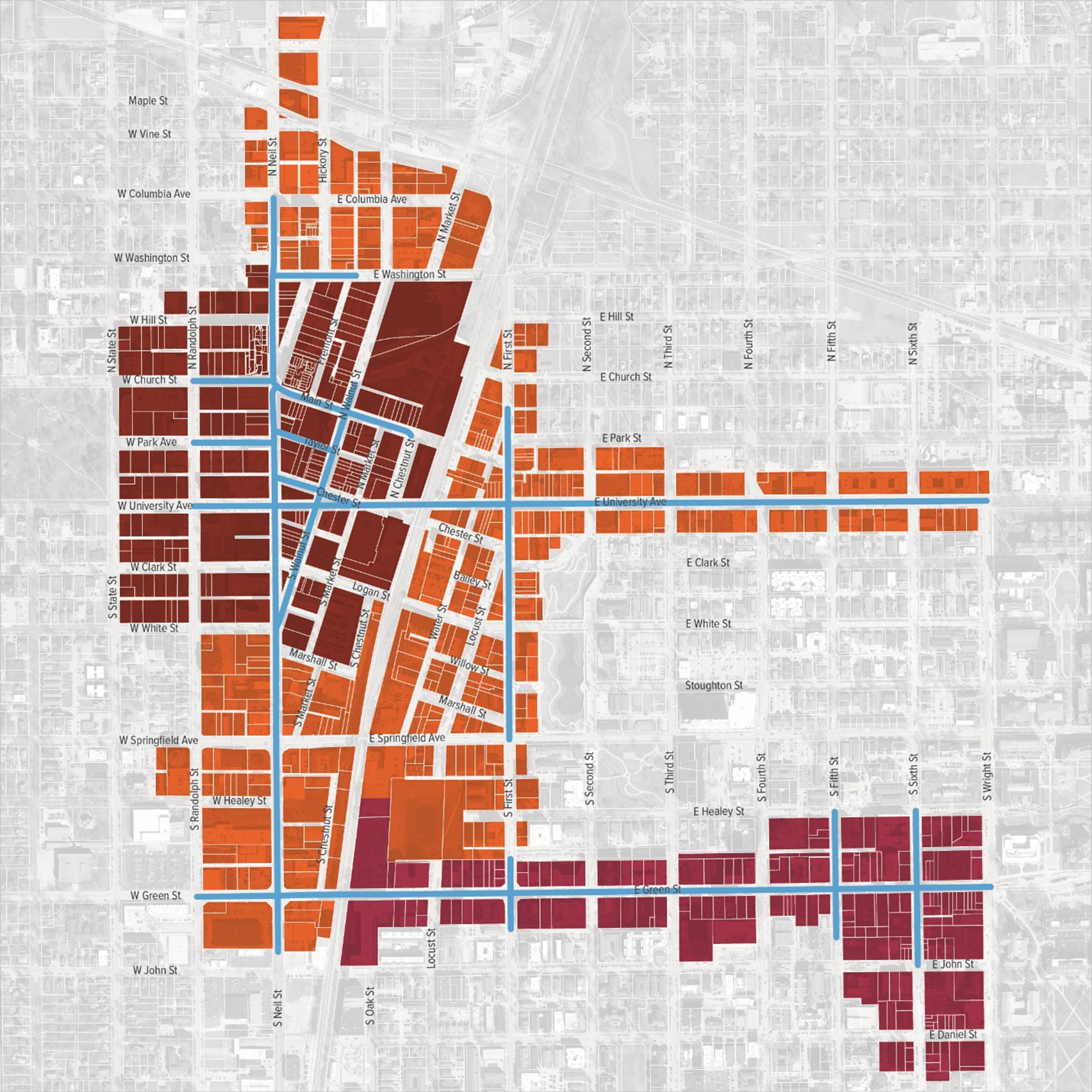
There shall be no dwelling units on the ground floor facing either side of the portions of public streets identified in Map V-A in this article and further described in paragraph (c) below.
(b)
No more than twenty-five (25) percent of the ground floor frontage facing either side of the portions of public streets identified in Map V-A in this article and further described in paragraph (c) below may be dedicated to accessory residential uses, such as lobbies and commons areas.
(c)
The portions of public streets identified in Map V-A in this article and referenced in paragraph (a) above, are further described as follows:
(1)
Neil Street between Columbia Avenue and John Street
(2)
Washington Street between Neil Street and Fremont Street
(3)
Hickory Street between Washington Street and Church Street
(4)
Church Street between Randolph Street and Neil Street
(5)
Main Street between Neil Street and Chestnut Street
(6)
Park Avenue between Randolph Street and Neil Street
(7)
Taylor Street between Neil Street and Walnut Street
(8)
Chester Street between Neil Street and Market Street
(9)
Walnut Street between White Street and 120 feet north of Main Street
(10)
University Avenue between Randolph Street and Wright Street
(11)
First Street between Springfield Avenue and 132 feet north of Park Street
(12)
First Street between Green Street and 220 feet north of Green Street
(13)
Green Street between Randolph Street and Wright Street
(14)
Fifth Street between the Boneyard Creek Greenway and 190 feet south of Green Street
(15)
Sixth Street between Healey Street and John Street
Map V-A: Restrictions on Ground Level Residential
(C.B. No. 2018-149, § 1(Exh. A), 9-18-18; C.B. No. 2019-119, § 1(Exh. A), 7-9-19; C.B. No. 2022-016, § 1(Exh. A), 2-1-22)
Sec. 37-263. - Standards for Vehicle Storage Lots in the CI, I1 and I2 Zoning Districts.
Vehicle Storage Lots shall be permitted in the CI, Commercial Industrial, I1, Light Industrial and I2, Heavy Industrial Zoning Districts subject to the following provisions:
(a)
Vehicle Storage Lots are not subject to the requirements of Article X, Landscaping and Screening, except that all Vehicle Storage Lots shall be enclosed with an 8-foot-high opaque fence.
(b)
There shall be no storage of vehicles or other materials or equipment outside the required opaque fencing, including between the Vehicle Storage Lot and the property boundaries.
(c)
The surface of a Vehicle Storage Lot must be a weed-free surface made of gravel, crushed stone, asphalt, Portland cement, or brick pavers as approved by the Zoning Administrator.
(d)
The surface of the entry/apron to the Vehicle Storage Lot must be paved with Portland cement as specified by Chapter 25 of the Manual of Practice.
(C.B. No. 2021-030, § 1(Exh. A), 5-2-21; C.B. No. 2024-028, § 1(Exh. 1), 3-5-24)
Sec. 37-264. - Standards for Commissary Kitchens in the CG, CB1, CI and I1 Districts.
Commissary Kitchens shall meet the following criteria:
(a)
Parking for the commissary kitchen area is calculated using the "Flexible Office/Warehouse Facility" standard in Table VII-C, Sec. 37-359.4.
(b)
Dine-in and carry-out food service are accessory uses limited to 25% of Gross Floor Area.
(c)
Food trucks shall be stored in designated parking spaces.
(d)
Outdoor food truck storage shall be screened by an eight-foot opaque fence.
(C.B. No. 2023-204, § 1(Exh. 1), 12-5-23)
Sec. 37-265. - Uses permitted through a special use permit.
Some uses of land, for one or more of the following reasons, cannot normally appear as uses permitted as a matter of right, or provisional use in a particular district, but may be permitted through approval of a special use permit:
(a)
The use may involve a great area of land.
(b)
The use may be of a public or semi-public character, and as such be important in the development of the community as a whole.
(c)
The use may be reasonably approved as to a particular location on account of factors or reasons not applicable to the zoning district as a whole.
(C.B. No. 2018-149, § 1(Exh. A), 9-18-18; C.B. No. 2019-119, § 1(Exh. A), 7-9-19)
Sec. 37-266. - Site plan requirements for special uses.
Each application for site plan approval for a special use shall be accompanied by a site and landscape plan and shall be drawn to a scale no greater than one hundred (100) feet to the inch. The said site and landscape plans may be combined into one plan. The said site plan shall include the following data and information:
(a)
The location, dimension, material, and configuration of all buildings, structures, and other improvements.
(b)
The location, extent and proposed use of usable open space, if applicable.
(c)
The location, access, dimensions of proposed off-street parking facilities, and the number and configuration of spaces to be provided.
(d)
The location, dimensions, and materials of sidewalks, driveways, and other impervious surfaces.
(e)
The location and intensity of illumination of any illuminated areas as required by Article X, Supplementary Regulations.
(f)
A landscape plan in accordance with the requirements of Article X, Landscaping and Screening.
(g)
The location of all property lines, utilities, and related easements, including electric lines, storm drainage, sanitary sewers, and water services.
(h)
The location and extent of required setbacks and yards.
(i)
An architectural elevation of buildings and structures.
(j)
Location, size and design of signs.
(k)
The lot size in square feet and the dimensions thereof.
(l)
The number and type of dwelling units proposed.
(m)
The land uses surrounding the lot(s) for which site plan approval is being sought.
(n)
A date, north arrow, scale, and name of the development.
(C.B. No. 2019-119, § 1(Exh. A), 7-9-19)
Editor's note— C.B. No. 2019-119 added new provisions designated as § 37-266, as herein set out above, and further amended the Code by renumbering existing §§ 37-266—37-273 as §§ 37-267—37-274.
Sec. 37-267. - Application for special use.
No use indicated as a special use or any use not indicated as a permitted or provisional use shall receive zoning approval without applying for and receiving special use approval from the Plan Commission and City Council. The application for a special use shall be made to the Planning and Development Department and shall include each of the following:
(a)
Application for a special use permit on forms provided by the Planning and Development Department, evidence of ownership, and fee.
(b)
Site plan meeting the requirements for a special use in section 37-266.
(c)
A development schedule for the proposed development.
(d)
Any other information requested by the Zoning Administrator to determine if the conditions for the special use will be met.
(C.B. No. 2018-149, § 1(Exh. A), 9-18-18; C.B. No. 2019-119, § 1(Exh. A), 7-9-19)
Sec. 37-268. - Procedure for special use review.
(a)
Upon receipt of a complete application with the accompanying material, the Zoning Administrator shall schedule the item to be reviewed by Plan Commission at a public hearing. A staff report shall be prepared by the Planning and Development Department with comments from the City Engineer, Fire Department, and other relevant City Officials regarding the applicability of City Codes to the proposed development.
(b)
The requirements for notification for hearings established in Article XV, Amendments and Hearings, shall apply to the special use.
(c)
The Plan Commission shall conduct the hearing and make a recommendation to City Council on the application for a special use in accordance with the procedures established in Article XV, Amendments and Hearings. The recommendation shall include findings and recommend conditions as provided for in this article.
(d)
City Council shall make the final determination to grant or deny the special use application in accordance with the procedures established in Article XV, Amendments and Hearings.
(C.B. No. 2018-149, § 1(Exh. A), 9-18-18; C.B. No. 2019-119, § 1(Exh. A), 7-9-19)
Sec. 37-269. - Findings for granting a special use.
Before making any recommendation to City Council to approve or deny the application for a special use, the Plan Commission shall make a determination, based solely upon the evidence presented at a public hearing conducted by the Plan Commission, on whether the application satisfies all of the following criteria:
(a)
That the proposed use is designed, located, and proposed to be operated so that it will not be unreasonably injurious or unreasonably detrimental to the district in which it may be located or otherwise injurious to the public welfare.
(b)
That the proposed use conforms to all the applicable regulations and standards of the district in which it shall be located that is reasonably possible.
(c)
That the proposed use preserves the essential character of the district in which it shall be located.
(d)
That adequate measures have been or will be taken to minimize potential increases in traffic congestion or possible situations that would create poor traffic circulation, including access issues.
(e)
That the proposed use prevents blighting influences by redeveloping a parcel or improves the compatibility of the use with the surrounding neighborhood.
(C.B. No. 2001-15, § 1, 2-6-01; C.B. No. 2018-149, § 1(Exh. A), 9-18-18; C.B. No. 2019-119, § 1(Exh. A), 7-9-19)
Sec. 37-270. - Conditions for special uses.
The Plan Commission shall make a recommendation to the City Council to approve, approve with conditions, or to deny the proposed special use. The conditions may be recommended as appropriate or necessary for the public health, safety, and welfare, and to satisfy the findings required for granting a special use. Such conditions may include, but are not limited to the following:
(a)
Regulate the location, extent, business hours, and intensity of such uses.
(b)
Require additional landscaping or screening of such uses by means of fences, walls, and vegetation.
(c)
Stipulate required minimum lot sizes, minimum yards, and maximum height of buildings and structures.
(d)
Regulate vehicular access and traffic volume, and the design and location of parking and loading areas and structures.
(e)
A time limit on the use to allow for review of the use and reapproval of the terms of approval.
(f)
Regulate signs, architectural features, and outdoor lighting to be more compatible with the surrounding neighborhood.
(g)
Require that certain covenants or dedications for public streets be designed and recorded in accordance with regulations in the Subdivision Ordinance.
(h)
Any other conditions deemed necessary to effect the purposes of this chapter.
(C.B. No. 2018-149, § 1(Exh. A), 9-18-18; C.B. No. 2019-119, § 1(Exh. A), 7-9-19)
Sec. 37-271. - Special use permit.
A special use permit shall be included as an attachment to the Council Bill approving the special use. The permit shall contain the following information:
(a)
A legal description, permanent parcel index number, and common address of the subject property.
(b)
The type of special use being granted.
(c)
A statement for each finding summarizing how such finding has been satisfied.
(d)
Any conditions imposed on the special use as a condition of approval.
(e)
A list of any element of the special use site plan which may be subject to flexible requirements during the permit approval stage and the degree of flexibility allowed.
(f)
The date the special use permit becomes effective and an expiration date for establishing the special use. Also, the date of expiration of the special use, if one is recommended.
(g)
Any exhibits, including the site plan and elevation, shall be attached to the special use permit with a statement that the special use approval is conditioned on the project being built in accordance with such plans, unless specific exceptions are stated in the special use permit.
(h)
The special use permit shall be recorded as a covenant running with the land, with the Champaign County Recorder.
(C.B. No. 2018-149, § 1(Exh. A), 9-18-18; C.B. No. 2019-119, § 1(Exh. A), 7-9-19)
Sec. 37-272. - Special use amendments minor.
(a)
A special use shall be developed in compliance with the special use permit. Minor amendments to the approved special use permit are allowed as follows:
(1)
The applicant shall apply for the minor amendment to the approved special use permit on forms provided by the Planning and Development Department.
(2)
The Zoning Administrator shall review the application for a minor amendment, which will be approved by the Planning and Development Director. The Planning and Development Director may approve minor amendments to the special use permit during the building permit review stage, or separately. In no case shall a minor amendment be approved that permits changes beyond the minimum or maximum requirements set forth in this chapter. Minor amendments include the following:
a.
Changes that have been allowed through an amendment to the special use permit which are not listed as a major amendment as defined below.
b.
Minor changes in location, siting, and height of the buildings that are not a major amendment as defined below. Such change may only be authorized if engineering or other physical limitations of the site, not foreseen at the time the special use permit was approved, warrant such a change.
(b)
The findings, determination, and notification shall be made not more than twenty (20) calendar days after the date a complete application for site plan approval is received. Upon expiration of the twentieth day, after receipt of the complete application for minor amendment is received by the Zoning Administrator, the applicant may consider the application denied and appeal that decision to the Zoning Board of Appeals in accordance with the provisions of this article.
(C.B. No. 2018-149, § 1(Exh. A), 9-18-18; C.B. No. 2019-119, § 1(Exh. A), 7-9-19)
Sec. 37-273. - Special use amendments major.
Major amendments to an approved special use permit may only be requested by application of a new special use permit in accordance with section 37-266, unless additional flexibility is provided for in the original special use permit. Otherwise, the following constitute major amendments:
(a)
An increase in overall lot coverage of the structure by more than ten (10) percent.
(b)
An increase in height that results in an additional story on any building.
(c)
A reduction in overall amount of usable open space or a reduction of any area designated as common open space.
(d)
A reduction in off-street loading and parking spaces by ten (10) percent.
(e)
The change in location of any structure by more than ten (10) feet in any direction.
(f)
An overall reduction in the area designated for landscaping treatment in any one phase.
(g)
A change in the circulation pattern that would reduce or increase points of access, change access to another street, or increase projected traffic volumes.
(h)
A combination of three (3) or more changes classified as minor amendments, which have not been specifically allowed by the special use permit, shall constitute a major amendment.
(i)
A major amendment to the approved special use permit shall not be requested in order to obtain a variation from the minimum requirements of the applicable development standards. The Zoning Administrator reserves the right to determine that an application for a major amendment is requesting a variation from the applicable development standards.
(C.B. No. 2018-149, § 1(Exh. A), 9-18-18; C.B. No. 2019-119, § 1(Exh. A), 7-9-19)
Sec. 37-274. - Special use expiration and violations.
Once a special use is established under the terms of the special use permit, the special use may continue as approved under the following limitations:
(a)
The special use permit may be suspended in accordance with the provisions of Article XIII, Administration and Enforcement, if work authorized by the special use permit is not commenced within six (6) months of the date of the Council Bill approving the special use or within six (6) months of the date of an approved development plan.
(b)
In any case where a special use permit has been approved, and the special use has been established, a change in use from the approved special use to another use shall cause the special use permit to expire.
(c)
When a special use is discontinued for twelve (12) consecutive months, the special use permit shall expire.
(d)
The removal or destruction of a structure containing a special use shall cause the special use permit to expire. Destruction for the purpose of this subsection, is defined as damage to an extent of more than fifty (50) percent of its fair market value immediately prior to the time of destruction.
(e)
The construction of a special use in variation with the approved site plan, elevation, or conditions of the special use permit, shall be considered a violation of this chapter and shall be subject to the enforcement mechanisms specified in Article XIII, Administration and Enforcement.
(C.B. No. 2018-149, § 1(Exh. A), 9-18-18; C.B. No. 2019-119, § 1(Exh. A), 7-9-19)
Sec. 37-276. - Standards for manufacturing, heavy uses in the I2 District.
Heavy manufacturing uses in the I2 District shall meet each of the following criteria:
(a)
Such uses shall be located a minimum of five hundred (500) feet from any residential zoning district and two hundred (200) from any office zoning district.
(b)
There shall be a minimum setback of one hundred (100) feet from the lot line to any structure on the lot.
(c)
As part of the findings for the special use, the Plan Commission shall determine that the proposed use will not adversely affect the public health, safety, or general welfare of adjoining properties.
(C.B. No. 2018-149, § 1(Exh. A), 9-18-18; C.B. No. 2019-119, § 1(Exh. A), 7-9-19)
Sec. 37-277. - Standards for gas stations in the CN District.
Gas stations in the CN District shall meet each of the following criteria:
(a)
Fuel pumps shall be set back at least twenty (20) feet from the right-of-way line or from any residential property line, and at least eighty-five (85) feet from any school, hospital, church, or other place of public assembly.
(b)
No part of the operation, including the queuing of vehicles at the fuel pump, or display of merchandise, shall encroach within the public right-of-way, buffer yard, or required area for parking spaces and aisles.
(c)
All auto repair and service functions shall take place in an enclosed area. No inoperable vehicles may be stored on-site for more than two (2) weeks. No more than three (3) visibly inoperable vehicles may be stored outside of a completely enclosed area at any one time. "Completely Enclosed" for these purposes means completely surrounded by a solid fence a minimum of eight (8) feet in height. No more than three (3) vehicles may be displayed for sale at one time, and vehicle sales are limited to those connected with mechanics liens.
(d)
Outdoor storage and display of merchandise associated with the use is permitted in the CN District, but may not exceed a total area of one hundred and fifty (150) square feet nor five (5) feet in height, and must be set back a minimum of twenty-five (25) feet from any property line.
(C.B. No. 2001-206, § 1, 8-21-01; C.B. No. 2018-149, § 1(Exh. A), 9-18-18; C.B. No. 2019-119, § 1(Exh. A), 7-9-19)
Sec. 37-286. - Definitions.
Factory built home shall mean a home including modular, precut, paneled, kit, and log homes. Such homes consist of panels or precut materials which are shipped to the site and assembled on-site.
Manufactured home shall mean a structure, transportable in one (1) or more sections, which while in the traveling mode is eight (8) body feet wide or more in width or forty (40) body feet or more in length, or, when erected on-site, is 320 square feet or more, and which is built on a permanent chassis and designed to be used as a dwelling with or without a permanent foundation when connected to the required utilities, and includes the plumbing, heating, air conditioning, and electrical systems contained therein. Manufactured homes must be compliant with State of Illinois and Housing and Urban Development (HUD) requirements.
Manufactured Home Community shall mean a tract of land or two or more contiguous tracts of land that contain individual pads available for lease for manufactured homes as defined herein. Manufactured Home Communities have commonly be referred to as Mobile Home Parks.
(C.B. No. 2018-149, § 1(Exh. A), 9-18-18; C.B. No. 2019-119, § 1(Exh. A), 7-9-19)
Sec. 37-287. - Site plan submittal requirements.
All manufactured home communities must receive site plan approval from the Zoning Administrator consistent with the provisions for Provisional Uses as specified in this Article:
(a)
Site plan requirements. The following information must be contained on the site plan:
(1)
The plan must contain all information required on a site plan in accordance with section 37-234.
(2)
Existing structures, vegetation, and an indication of items to be removed or retained.
(3)
All proposed buildings, sidewalks and individual manufactured home sites.
(4)
Internal circulation system.
(5)
Exterior dimensions, dimensions of interior drives, and manufactured home sites.
(b)
Project data:
(1)
Total number of manufactured homes to be in the park.
(2)
Total area and gross density of park.
(3)
Usable open space in terms of total acres and percent of the park.
(4)
Total number of parking spaces.
(5)
Development schedule.
(c)
Any proposed covenants, dedications, or other documents that may require recording.
(C.B. No. 2018-149, § 1(Exh. A), 9-18-18; C.B. No. 2019-119, § 1(Exh. A), 7-9-19)
Sec. 37-288. - Design standards for manufactured home parks.
Developments in the MHC District shall comply with the design standards in Table V-A of this article.
(C.B. No. 2018-149, § 1(Exh. A), 9-18-18; C.B. No. 2019-119, § 1(Exh. A), 7-9-19)
TABLE V-A
DESIGN STANDARDS IN THE MHC DISTRICT
1.0
MANUFACTURED HOME INDIVIDUAL SITES
1.1
The required setback from the manufactured home to the boundary line of the manufactured home site shall be:
Front setback = 20 feet
Rear setback = 10 feet
Side setback = 10 feet
1.2
The minimum size of a manufactured home site shall be three thousand two hundred (3,200) square feet for a single-wide unit and five thousand (5,000) square feet for a double-wide unit.
1.3
The manufactured home stand, anchor, and skirting shall be constructed in accordance with local building regulations and applicable State and Federal regulations.
1.4
Each manufactured home site shall be provided with an outdoor living area. Such area shall either be paved or constructed of masonry or concrete blocks to create a single usable surface adjacent to the manufactured home. The area shall be a minimum of one hundred sixty (160) square feet, with a minimum dimension of eight (8) feet.
1.5
Any additions or alterations made to a manufactured home unit including porches, awnings, and overhangs shall not exceed one hundred sixty (160) square feet, shall be setback a minimum distance of fifteen (15) from an adjacent manufactured home, conform in color with the existing unit, and be of compatible material.
2.0
SERVICE BUILDINGS AND ACCESSORY USES
2.1
All manufactured home developments shall provide the following service buildings and other community facilities:
(a)
A management office
(b)
Maintenance storage facilities
(c)
Other facilities required by State law
2.2
Laundries, daycare, and other permitted uses accessory to the manufactured housing development may only be established as part of an approved site plan for the provisional use.
2.3
Accessory storage structures for individual manufactured home sites shall not exceed two hundred fifty (250) square feet in area and shall not be located within two (2) feet of any edge of the manufactured home site.
3.0
SIZE, DENSITY, AND SETBACKS
3.1
The minimum size of a manufactured housing park shall not be less than five (5) acres.
3.2
The overall density of a manufactured housing park shall not exceed eight (8) units per acre.
3.3
The setback along the periphery of the manufactured housing park shall be as follows:
Front Yard Adjacent to Interstate = 45 feet
Front Yard Adjacent to Arterial Street = 35 feet
Front Yard Adjacent to Minor Street = 25 feet
Side and Rear Yard = 15 feet
4.0
RECREATIONAL OPEN SPACE, LANDSCAPING, AND SCREENING
4.1
Not less than ten (10) percent of the gross site area of the manufactured housing community shall be devoted to recreational open space.
4.2
The area of each parcel designated as recreational open space, shall not be less than six thousand (6,000) square feet in area nor less than thirty (30) feet in its smallest dimension.
4.3
Unpaved areas between manufactured homes shall have permanent lawns or groundcover as approved in the Plant List which is available for inspection in the office of the city clerk. Such areas shall be maintained in accordance with Article X, Landscaping and Screening.
4.4
Manufactured housing communities shall meet the requirements for screening contained in Article X, Landscaping and Screening.
5.0
WASTE DISPOSAL
5.1
All refuse shall be stored in watertight containers located on each mobile home site or at a common collection site within one hundred fifty (150) feet of each site.
5.2
Solid waste shall be collected and disposed of in conformance with applicable State and City regulations.
6.0
STREETS, PARKING, AND LIGHTING STANDARDS
6.1
All manufactured housing communities shall be provided with adequate, safe, and convenient vehicular access from abutting public streets.
6.2
Public street dedications within or abutting mobile home parks shall be constructed in accordance with the Subdivision Regulations of the Municipal Code.
6.3
Entrance drives shall meet the requirements for residential access drives contained in Article VII, Parking, Loading, and Access Drives.
6.4
Individual walkways to each mobile home stand from the parking area is required and shall be a minimum of two (2) feet in width. The walkway shall either be paved or constructed of masonry or concrete blocks to create a single usable surface. Location of the parking area adjacent to the mobile home stand is sufficient to meet this standard.
6.5
Common walks are required at locations where heavy pedestrian traffic is likely to occur, such as at entrances, service facilities, and recreation areas. Common walks should be located through interior areas removed from streets wherever possible and shall be constructed to the same standards as an individual walkway.
6.6
Two (2) parking spaces per unit shall be provided within the manufactured home development. One parking space shall be provided on the individual manufactured home site. One parking space shall either be provided on the manufactured home site, on the access drive in front of the site, or in a guest parking area. The guest parking space shall be located within two hundred (200) feet of the site it is intended to serve.
6.7
All internal access drives shall be lighted between sunset and sunrise with electric lights emitting light at an intensity of at least five thousand (5,000) lumens, and the light poles shall be not more than two hundred fifty (250) feet apart.
7.0
UTILITIES
7.1
Water, sanitary sewer, electrical, telephone, and cable television services shall be provided in accordance with State and local regulations.
7.2
Stormwater management shall be provided in accordance with the City of Champaign Subdivision Regulations regulating this aspect of the development.
7.3
Fire hydrants shall be provided in accordance with State and local regulations.
(C.B. No. 2018-149, § 1(Exh. A), 9-18-18; C.B. No. 2019-119, § 1(Exh. A), 7-9-19)
Editor's note— Table V-A above, was relocated from § 37-289 at the direction of the city.
Sec. 37-289. - Requirements for existing manufactured home communities.
(a)
Manufactured housing communities in existence on the date of adoption of this chapter, may be altered to bring such communities into greater conformity with this article upon approval of a provisional use in accordance with this article. Such developments may be exempted from some of the design standards in this article upon demonstrating that as many of the nonconforming elements as possible have been brought into compliance. In no case, however, shall an existing manufactured housing community be altered to increase the nonconformity for any standard increase density above that permissible in this article.
(b)
Additions made to manufactured housing communities in existence on the date of adoption of this chapter, shall only be allowed in conformity with the provisional use approval and design requirements of this article. The total area of the manufactured housing community including such additions or alterations, shall consist of at least three (3) acres.
(c)
Manufactured housing communities in existence on the date of adoption of this chapter and at least three (3) acres in area and which do not make any alterations or additions, may continue to operate without a provisional use permit. Such manufactured housing developments less than three (3) acres in size shall be considered nonconforming uses and shall comply with the requirements in Article XII, Nonconformities.
(d)
If any site in a manufactured housing community is designed to accommodate a single-wide unit, it shall not be replaced by a double-wide unit unless all applicable setbacks and area requirements for a double-wide unit are met and the stand is modified to accept the double-wide unit. The modification of a site or combination of two sites to make this change shall be considered a minor amendment to the provisional use.
(C.B. No. 2018-149, § 1(Exh. A), 9-18-18; C.B. No. 2019-119, § 1(Exh. A), 7-9-19)

