
Champaign City Zoning Code
ARTICLE VII
PARKING, LOADING AND ACCESS DRIVES
Sec. 37-331. - Purpose.
The purpose of this article is to alleviate traffic congestion by providing parking facilities with adequate capacity for employees, residents, and customers to promote safe and efficient design of parking facilities, and to minimize negative impacts of large parking facilities.
(C.B. No. 2018-149, § 1(Exh. A), 9-18-18)
Sec. 37-332. - Compliance with this article.
(a)
Any use of land or structure that is established, enlarged, converted, or structurally altered shall provide and maintain motor vehicle and bicycle parking and loading spaces according to the requirements of this article.
(b)
When any addition or change of use, requiring a permit, is made to a building containing less than the required motor vehicle parking or loading requirements, the required amount of parking shall be recalculated to bring the entire use or structure on the lot into compliance.
(c)
When a parking lot is enlarged, the added area shall comply with the requirements of this article. When a motor vehicle and bicycle parking lot is enlarged by more than fifty (50) percent in area, both the existing and new portions of the parking lot shall conform with these requirements.
(d)
The requirements in this article shall apply to all motor vehicle and bicycle parking and loading areas, regardless of whether said area is required parking or in excess of required parking. Excess parking for storage lots used for motor vehicle sales, rental and leasing establishments shall not be subject to the size and dimensional requirements of this article.
(e)
Notwithstanding other provisions, the owner or occupant of an existing building occupied by a conforming use may remodel the structure solely for the purpose of meeting the minimum requirements of applicable fire, health and safety regulations or state, local or federally mandated accessibility regulations without complying with the parking requirements that might otherwise be required due to the mandated changes. If other changes are made, then parking requirements as applicable shall be met.
(C.B. No. 2008-220, § 1, 10-21-08; C.B. No. 2018-149, § 1(Exh. A), 9-18-18)
Sec. 37-333. - Site plan requirements for parking lots.
A site plan is required prior to the construction or redesign of any accessory parking lot or any parking lot in excess of three (3) parking spaces. Said site plan may be part of a larger site plan for the development of the property. The site plan shall be reviewed and approved by the Zoning Administrator to ensure compliance with the provisions of this article. The site plan shall contain the following components:
(a)
The site plan shall be drawn to scale or with accurate measurements and dimensions indicating the location and dimensions of all pavement, parking stalls, aisles, walkways, driving lanes, and loading areas.
(b)
The location and type of screening and landscaping materials shall be provided in accordance with Article X, Landscaping and Screening.
(c)
The lighting details indicate the location, height, and type of lighting in accordance with requirements in Article XI, Supplementary Regulations.
(d)
The location and dimensions of any handicap or long-term spaces.
(e)
The location, dimensions, and design type of all required bicycle parking.
(f)
For parking lots with a surface area exceeding one acre, a drainage plan is required in accordance with Chapter 29.
(g)
For parking lots with a surface area of one (1) acre or less, a grading plan with curbing shall be indicated.
(h)
An indication of adjoining land uses.
(C.B. No. 2008-220, § 2, 10-21-08; C.B. No. 2018-149, § 1(Exh. A), 9-18-18)
Sec. 37-334. - Site plan requirements for access drives.
Two (2) copies of a site plan are required prior to the construction of any access drive over, across, or upon any public sidewalk or parkway in any business or industrial district. These site plans shall be filed with the Zoning Administrator for examination and subsequent approval or disapproval.
The site plan submitted to the Zoning Administrator shall be drawn to scale or with accurate measurements and dimensions. The site plan information for access drives may be included on the site plan for parking lots if such a plan is also required.
The Zoning Administrator shall retain one copy of the site plan and return one copy of the plan to the petitioner upon approval or disapproval thereof. The site plan shall contain the following information:
(a)
The north point, scale, and date.
(b)
The property lines of the property for which the access drive approval is requested including existing street and right-of-way lines.
(c)
Immediately adjacent properties on the same frontage, and adjacent properties on the opposite frontage, indicating location of ingress and egress to such properties.
(d)
The exact location and dimensions of facilities of ingress and egress to the subject property, existing and proposed curb cuts, if any, and the proposed direction of traffic flow on the subject property to and from public ways.
(e)
The location of any visual obstructions in the right-of-way adjoining the property such as street lights, traffic control devices, or similar devices.
(f)
The location and dimensions of existing and proposed access drives on the subject property.
(g)
The name and address of the person seeking approval and the owner of the proposed access drives.
(h)
Details of construction in the public right-of-way.
(i)
Signature and date lines where the Zoning Administrator can evidence approval if the plan is approved.
(C.B. No. 2018-149, § 1(Exh. A), 9-18-18)
Sec. 37-336. - Prohibited uses of parking lots and loading areas.
(a)
It shall be unlawful to lease, sell, convey, or use a lot that is required for off-street parking, or any other purpose or use by another property without providing other parking facilities which meet the requirements of this chapter.
(b)
It shall be unlawful to store merchandise, materials, equipment, refuse containers, inoperable vehicles, or to conduct the major repair of vehicles in required off-street parking and stacking spaces.
(C.B. No. 2018-149, § 1(Exh. A), 9-18-18)
Sec. 37-337. - Sales in parking areas.
(a)
It shall be unlawful to maintain a permanent outdoor sales area in required off-street parking spaces.
(b)
Temporary sales may be conducted utilizing off-street parking spaces under the following conditions:
(1)
Temporary sales are allowed at any time in parking areas that exceed the minimum required spaces.
(2)
Temporary sales in required spaces shall not exceed five (5) continuous days or a total of five (5) days in one month.
(C.B. No. 2008-220, § 3, 10-21-08; C.B. No. 2018-149, § 1(Exh. A), 9-18-18)
Sec. 37-338. - Parking in front yards.
Motor vehicle parking in required front yards shall only be permitted in accordance with the following regulations. All parking shall be upon an "approved surface" as defined in section 37-370 for single- and two-family residential uses and group quarters, and as defined in section 37-349 for all other uses.
(a)
In any SF1, SF2, IT-SF1, and IT-SF2 District, or for single- and two-family uses or uses that constitute group quarters in any MF2 or MF3 District, where it is not physically possible to provide the minimum number of motor vehicle parking spaces required in this article in side or rear yards, motor vehicle parking spaces required to meet that minimum requirement may be provided in the required front yard, on a driveway meeting all of the requirements for residential driveway design in Section 37-370 or any amendment thereto, except that no vehicle may park within five (5) feet of the front property line.
(b)
In any MF1, MF2, MF3, IT-MR1, IT-MR2, and IT-MXD District, when a townhouse or rowhouse building is located on a street that is a cul-de-sac, then motor vehicle parking may be provided in the required front yard setback contiguous to the street, as long as said parking space is at least fifteen (15) feet from the townhouse or rowhouse. Two (2) parking spaces for each dwelling unit may be provided on the lot in the required front yard setback in this instance.
Parking spaces provided in this manner shall not be enclosed, covered, or otherwise obstructed. Any truck over three-quarter (¾) ton capacity is not permitted to park in such spaces.
(c)
In any Commercial or Industrial District except the CB1, CB2, and CB3 Districts, motor vehicle parking spaces may be situated in a required front yard; provided that, the parking lot meets the design standards for parking lots in this Article.
(d)
In any district, when motor vehicle parking is permitted in the required front yard, or when no front yard is required, a parking lot which accommodates more than three (3) cars shall be set back from the property line and landscaped in accordance with section 37-355 of Article X, entitled "Landscaping and Screening.
(C.B. No. 2003-019, § 1, 2-4-03; C.B. No. 2008-220, § 4, 10-21-08; C.B. No. 2010-164, § 10, 8-3-10; C.B. No. 2016-211, § 1(Exh. A), 10-18-16; C.B. No. 2018-149, § 1(Exh. A), 9-18-18)
Sec. 37-339. - Parking in side yards.
Parking in required side yards is permitted in accordance with the following regulations:
(a)
All parking shall be upon an approved surface.
(b)
Motor vehicle parking spaces may be situated in a side yard under the following conditions: When parking is situated in a side yard, and no other landscaping or screening is required, then an opaque screen fence of not less than four (4) feet nor more than six (6) feet in height, or living screen not less than four (4) feet in height, shall be provided between such motor vehicle parking and the abutting property.
(c)
Where a shared driveway spanning a property line between two (2) residential lots existed prior to the adoption of this ordinance, such driveway shall not be required to comply with the side yard setback provisions or the screening requirements in this section.
(C.B. No. 2008-220, § 5, 10-21-08; C.B. No. 2018-149, § 1(Exh. A), 9-18-18)
Sec. 37-340. - Parking in rear yards.
Parking in required rear yards is permitted in accordance with the following regulations:
(a)
All parking shall be upon an approved surface.
(b)
Motor vehicle parking spaces may be situated in any rear yard. Motor vehicle parking areas adjacent to residential zoning districts that are located within the required rear yard line, and contain more than three (3) spaces, shall provide a screen as specified in Article X, Landscaping and Screening.
(c)
Such screening shall not be required when the property adjoins an alley.
(C.B. No. 2008-220, § 6, 10-21-08; C.B. No. 2018-149, § 1(Exh. A), 9-18-18)
Sec. 37-341. - Restrictions on oversized vehicles, watercraft and construction equipment in residential districts.
In residential districts, in addition to other provisions of this Code regulating the parking or storing of the oversized vehicles, watercraft and construction equipment described below, the following shall regulate the parking or storing of said vehicles, watercraft or construction equipment.
(a)
No person(s) shall park or store any of the following on any lot in a residential zoning district:
i.
Any vehicle having a Gross Vehicle Weight Rating in excess of twelve thousand (12,000) pounds as defined in Chapter 33 of this Code;
ii.
Any truck tractor, semi-trailer or pole trailer;
iii.
Any vehicles with FARM category license plates, unless the principal use of the property is agriculture;
iv.
Any bus as defined in Chapter 33 of this Code;
v.
Any vehicle with specialized vehicle beds;
vi.
Any construction equipment, such as bulldozers and backhoes, unless said equipment is on the property for on-site work pursuant to a building permit.
(b)
Two-Axle, Six-Tire, Single-Unit Trucks which have a D plate designation or lower and a non-specialized bed are permitted.
(c)
No more than one (1) recreational vehicle or watercraft may be stored outdoors at any one (1) time. Such vehicles or watercraft stored to the side or front of the principal structure must provide an approved surface for the vehicle or watercraft which shall consist of either approved pavement, bricks, or concrete pavers set into the ground. Dirt, wood, or sod surfaces are prohibited. Parking of recreational vehicles or watercraft on gravel is only permitted in the rear yard. If gravel is used, the surface must be surrounded with a solid form to hold the gravel in place.
(d)
No vehicle shall be used for living, sleeping, or housekeeping purposes while store[d] on the property or upon public right-of-way.
(C.B. No. 2008-220, § 7, 10-21-08; C.B. No. 2012-216, § 6, 1-15-13; C.B. No. 2018-149, § 1(Exh. A), 9-18-18)
Editor's note— Council Bill No. 2012-216, § 6, adopted Jan. 15, 2013, retitled § 37-341 from "Recreational vehicles, watercraft and commercial vehicles" to "Restrictions on oversized vehicles, watercraft and construction equipment in residential districts."
Sec. 37-342. - Parking facilities off-site—Permitted locations.
(a)
Parking facilities for residential uses, in any district except the CB1, CB2, and CB3 Central Business Districts, must be provided on the same lot where the residential use is located.
(b)
A required parking facility that is otherwise permitted on a lot other than the lot where the principal use is located must also comply with the following requirements:
(1)
It must be on a lot located in the same zoning district as the principal use, unless and except to the extent it is permitted on a lot in a different zoning district in Table VII-A of this Article.
(2)
It must be on a lot that is within six hundred (600) feet of the lot where the principal use is located, except that if it is located within the SF1, Single-Family District, the SF2 Single- and Two-Family District, the IT-SF1 In-Town Single-Family District, or the IT-SF2 In-Town Single-and Two-Family District, it must be located on a lot that is immediately adjacent to the lot where the principal use is located.
(c)
If the principal use is, or becomes, a nonconforming use, expansion of the parking facility which is not located on the lot of the principal use is not permitted.
(d)
The distance specified herein and the distances specified in the District Use Regulations shall be measured from the nearest point of the parking facility to the nearest point of the lot occupied by the building or use that such facility is required to serve.
(e)
Accessory parking lots located within the IT-MR1 District must be provided on property adjacent to permitted uses within any district. Said accessory parking lots shall have vehicular access only through the property on which the associated use is located or through adjacent alleys between the accessory parking lots and the associated use.
Table VII-A
(C.B. No. 97-172, § 3, 8-19-97; C.B. No. 98-199, § 1, 7-21-98; C.B. No. 2011-127, § 1, 7-19-11; C.B. No. 2016-211, § 1(Exh. A), 10-18-16; C.B. No. 2018-149, § 1(Exh. A), 9-18-18; C.B. No. 2022-050, § 1(Exh. 1), 4-5-22; C.B. No. 2025-037, § 1(Exh. A), 3-18-25)
Sec. 37-343. - Required covenants for off-site parking.
When off-street parking facilities are provided on a lot other than the lot upon which the building or use requiring such facilities is located, the owner of the lot upon which the principal use is located and the owner of the lot upon which parking is provided, shall execute a written covenant containing at least the following terms:
(a)
In consideration of the issuance of a building permit for the principal use, the lot or portion of the lot on which the parking facility is located will be used and maintained solely for off-street parking purposes for such principal use.
(b)
Such covenant shall be in effect so long as the structures comprising such principal use continue to exist without sufficient parking elsewhere or upon the lot with the principal use.
(c)
The parking lot or portion of the parking lot shall contain appropriate signage to indicate that certain parking spaces are reserved for the use herein described.
(d)
The owners shall notify the Zoning Administrator if the right to use such facilities lapses for any reason within twenty-eight (28) days of the cessation of the right to use.
(e)
The covenant shall not be released except with the written approval of the Zoning Administrator.
(f)
The instrument shall be in a form acceptable to the City Attorney, and recorded with the Champaign County Recorder.
(C.B. No. 2018-149, § 1(Exh. A), 9-18-18)
Sec. 37-344. - Accessory parking lots in residential districts.
In addition to the regulations provided for elsewhere in this article, accessory parking lots in Residential Districts must comply with the following stipulations:
(a)
Accessory parking lots may only be used for the temporary parking of vehicles for the customers or employees of its associated use.
(b)
Design standards.
(1)
Setbacks:
Yard immediately adjacent to use: zero (0) feet.
Front yard: fifteen (15) feet.
Side yard: ten (10) feet.
Street side yard: fifteen (15) feet.
Rear yard: ten (10) feet, unless adjacent to a public alley. Setback would then be zero (0) feet.
(2)
Size: Paved area not to exceed twenty thousand (20,000) square feet or comprise more than fifty (50) percent of any block face.
(3)
Screening: Accessory parking lots shall adhere to the screening requirements in Article X, Landscaping and Screening.
(C.B. No. 2018-149, § 1(Exh. A), 9-18-18)
Sec. 37-346. - Landscaping and lighting for parking lots.
(a)
Landscaping. Parking lots shall comply with landscaping standards in Article X, Landscaping and Screening.
(b)
Lighting. Parking lot lighting shall comply with the lighting regulations in Article XI, Supplementary Regulations.
(C.B. No. 2018-149, § 1(Exh. A), 9-18-18)
Sec. 37-347. - Detention requirements.
(a)
Areas greater than one (1) acre. A combination of stormwater storage and controlled release is required for parking areas which exceed one (1) acre of impervious surface area. A permit shall be obtained for any connection to the City's stormwater drainage system, in accordance with chapter 29 of this Code. The required stormwater storage and controlled release rate shall comply with the design criteria set forth in the administrative rules implementing the Subdivision Ordinance, even if the Subdivision Ordinance is not otherwise applicable to the activity for which the parking area is being created.
(b)
Areas less than or equal to one (1) acre. Stormwater storage and controlled release of stormwater is not required for parking areas which are less than, or equal to, one (1) acre of impervious surface area. However, the creation of impervious surface area shall not create any adverse impacts to or additional stormwater runoff onto adjacent properties. Any additional stormwater runoff created by the impervious surface area may be stored on-site, or may be discharged onto public rights-of-way if in the opinion of the City Engineer such rights-of-way can accept the stormwater runoff without adverse impact to the stormwater collection system.
If the property owner elects to control the stormwater release of a parking area, which is less than or equal to one (1) acre of impervious surface area, by discharge to the City's stormwater drainage system, a permit from the City Engineer in accordance with Chapter 29, of this Code shall be required.
(c)
Motor vehicle parking lots with three (3) or more parking spaces. Motor vehicle parking lots with three (3) or more parking spaces, shall separate the edge of the parking area from the adjacent public right-of-way or adjacent property line in accordance with the following requirements:
(1)
A minimum eight-foot landscaped buffer from the sidewalk or adjoining property line, except that the setback may be reduced to six (6) feet in accordance with section 37-555, Parking Lot Screening—Perimeters, Table X-F.
(2)
The edge of the parking lot shall include a minimum six-inch curb or barrier.
(C.B. No. 97-170, § 1, 7-1-97; C.B. No. 2008-220, § 8, 10-21-08; C.B. No. 2018-149, § 1(Exh. A), 9-18-18)
Sec. 37-348. - Requirements for parking garages.
All ramps providing vehicular access to underground or above ground parking facilities shall be designed in conformance with Chapter 25 of the Manual of Practice. Design and construction shall be approved by the City Engineer.
(C.B. No. 2005-095, § 1, 3-29-05; C.B. No. 2018-149, § 1(Exh. A), 9-18-18)
Sec. 37-349. - Supplementary requirements for parking within the MFUniv, CB1, CB2, and CB3 Districts.
(a)
Parking provided for buildings within the MFUniv District is subject to the supplementary design requirements of Section 37-197.
(b)
Parking provided for buildings within the CB1, CB2, and CB3 Districts is subject to the supplementary design requirements of Section 37-198.
(C.B. No. 2016-211, § 1(Exh. A), 10-18-16; C.B. No. 2018-149, § 1(Exh. A), 9-18-18)
Sec. 37-350. - Construction standards.
(a)
Any off-street motor vehicle parking lots and loading areas shall be graded and surfaced with bituminous concrete a thickness of at least three (3) inches over a base of at least four (4) inches of compacted stone or crushed rock; or Portland cement concrete to a thickness of not less that five (5) inches or equivalent. Gravel multifamily and commercial parking lots shall be brought into conformance with this section within two (2) years of the adoption of the ordinance.
(b)
For head-in parking spaces, where the surface area is within six (6) feet of the property line, wheelstops of precast concrete or other manufactured material shall be placed two (2) feet from the end of the parking space. Wheelstops shall be at least four (4) inches, but no more than six (6) inches above the grade of the adjoining parking spaces.
(C.B. No. 2008-220, § 9, 10-21-08; C.B. No. 2016-211, § 1(Exh. A), 10-18-16; C.B. No. 2018-149, § 1(Exh. A), 9-18-18)
Sec. 37-351. - Dimensions for parking spaces.
Sec. 37-352. - Dimensions for parking modules.
Off-street parking lots shall meet the standards in Table VII-B of this article regarding minimum stall depth, aisle, and module widths. The number and location of handicap spaces shall comply with the Illinois Vehicle Code. Motor vehicle display lots are not required to park vehicles in accordance with these standards. Such display lots are required to meet all other applicable standards for parking lots.
Table VII-B
Parking Space Size
Parking Space Dimensions
Notes:
Aisle widths are for one-way aisles except for 90° parking which must provide a two-way aisle.
Long-Term parking spaces have a minimum width of 8'3" regardless of their angle.
(C.B. No. 2016-211, § 1(Exh. A), 10-18-16; C.B. No. 2018-149, § 1(Exh. A), 9-18-18; C.B. No. 2022-050, § 1(Exh. 1), 4-5-22)
Editor's note— Table VII-B above, was relocated from § 37-354 at the direction of the city.
Sec. 37-353. - Additional provisions for long-term spaces.
The long-term stall width may be substituted for the standard stall width if the following conditions are met.
(a)
Long-term spaces shall be specifically designated as employee, rental, valet, or overnight parking spaces.
(b)
Long-term spaces shall be located in a separate parking lot from visitor or customer parking. Such lot shall be considered a separate lot if it has an individual access that is not shared by users of the visitor or customer parking lot, or if there is a shared access but the portion designated for long-term spaces is separated by a barrier that limits access of visitors or customers.
(c)
Long-term spaces shall only be permitted for the following uses:
(1)
Bus/Train Station.
(2)
Business/Professional Office.
(3)
Elementary/High School.
(4)
Wholesale/Warehouse.
(5)
Industrial/Manufacturing.
(6)
Exclusive valet parking.
(d)
No more than thirty (30) percent of required parking spaces may be designated as long-term spaces.
(C.B. No. 2016-211, § 1(Exh. A), 10-18-16; C.B. No. 2018-149, § 1(Exh. A), 9-18-18)
Sec. 37-354. - Additional provisions for handicap spaces.
Sec. 37-356. - Rules for computing required spaces.
(a)
The number of parking spaces required for each land use is governed by Table VII-C of Section 37-359. Where Table VII-C of Section 37-359 does not specify a use, the number of parking spaces required for that use shall be equal to the number for the most similar use which appears in Table VII-C of Section 37-359.
(b)
The number of parking spaces required by Section 37-359 may be reduced by the application of Section 37-357 (Collective Parking Provision) and Section 37-358 (Exemptions or Reductions from Required Number of Parking Spaces).
(c)
In the case of mixed uses or businesses with multiple components, the total requirements for off-street parking facilities shall be the sum of the requirements for the various uses computed separately, except as otherwise provided herein.
(d)
In the cases of uses where floor area is the unit for determining the required number of off-street parking spaces, such floor area shall mean gross floor area measured to the outside walls, but shall not include such floor area as may be used for parking facilities within the principal building.
(e)
When units of measurement determining the number of required parking spaces result in requirements of a fractional space, any fraction shall not require a parking space.
(f)
In stadiums, arenas, auditoriums, religious institutions, and other places of assembly in which those in attendance occupy benches, pews, and other similar seating facilities, each twenty-two (22) inches of such seating facilities shall be counted as one seat for the purpose of determining the off-street parking requirements of this chapter. If a stadium, arena, auditorium or other similar place of assembly is an accessory use to a school, grades K—12 and/or a religious institution, the total number of required parking spaces for said school and/or religious institution, and the stadium, arena, auditorium or other similar place of assembly accessory thereto shall be the larger of the following requirements:
i.
The total number of parking spaces required for the religious institution and/or school other than the accessory stadium, arena, auditorium or other similar place of assembly;
ii.
The number of parking spaces that would have been required if the stadium, arena, auditorium or other similar place of assembly in question were a principal use.
For that portion of any place of assembly that is designed for assembly but that does not have fixed seats, the number of required parking spaces that shall be provided shall equal one-quarter (¼) of the maximum number of persons that may lawfully occupy said assembly area in accordance with the pertinent provisions of the fire code in effect as adopted in this Code at the time of the construction of the place of assembly.
In places that have both fixed seats and open assembly area, requirements shall be computed separately for each type and added together.
(g)
Floor area calculations shall include area devoted to outdoor table service for patrons of the establishment.
(C.B. No. 2004-295, § 4, 11-16-04; C.B. No. 2008-220, § 10, 10-21-08; C.B. No. 2008-258, § 3, 12-16-08; C.B. No. 2013-209, § 1(Exh. A), 11-19-13; C.B. No. 2018-149, § 1(Exh. A), 9-18-18; C.B. No. 2025-037, § 1(Exh. A), 3-18-25)
Sec. 37-357. - Collective parking provision.
The required total of off-street parking spaces for two (2) or more commercial, office, residential, industrial or institutional uses collectively providing parking spaces, shall meet the following requirements:
(a)
The zoning administrator may authorize a reduction in the total number of required parking spaces for two (2) or more uses jointly providing off-street parking when their respective hours of peak operation do not overlap. Shared parking shall be located on the same lot, abutting, or adjacent lots, lots shall not be separated by an arterial or collector street. Shared parking shall meet the following conditions:
(1)
Computation. The number of shared spaces for two (2) or more distinguishable land uses shall be determined by the following procedure:
a.
Determine the minimum number of parking spaces required for each separate use as identified in Table VII-C of this ordinance.
b.
Calculate the minimum number of parking spaces needed to meet the expected parking demand for each of the uses sharing the parking for each of the six (6) designated time periods in Table VII-E by multiplying the minimum number of spaces required in Table VII-C for each use by the percentage shown for that use for the time period in question in Table VII-E.
c.
Calculate the minimum number of parking spaces needed to meet the expected total parking demand for the shared parking facilities for each of the six time periods identified in Table VII-E by totaling the results for all of the uses for the time period in question as calculated in paragraph (1)b.
d.
Select the time period with the highest total number of parking spaces required for all of the uses sharing the parking and use that total as the shared parking requirement.
(2)
Other Uses. If one (1) or all of the land uses proposing to make use of the shared parking facilities do not conform to the general land use classifications in Table VII-E, Shared Parking Calculations, then the Zoning Administrator shall determine the most closely related use listed in the table, and the appropriate shared parking requirement, if any, for such uses.
(3)
Process. An application for shared parking shall be submitted on a form approved by the Zoning Administrator at the time of a building permit.
TABLE VII-E
SHARED PARKING CALCULATIONS
(b)
The number of required parking spaces shall not be less than the largest amount required for any of the uses computed separately.
(c)
A recorded cross access easement or covenant for the shared parking locations shall be submitted for review and approval prior to the issuance of a building permit. The covenant shall include the follow:
(1)
Such covenant shall be in effect so long as the structures comprising such principal use continue to exist without sufficient parking elsewhere or upon the lot with the principal use.
(2)
The parking lot or portion of the parking lot shall contain appropriate signage to indicate that certain parking spaces are shared for the uses herein described.
(3)
The owners shall notify the Zoning Administrator if the right to use such facilities lapses for any reason within twenty-eight (28) days of the cessation of the right to use.
(4)
The covenant shall not be released except with the written approval of the Zoning Administrator.
(5)
The instrument shall be in a form acceptable to the City Attorney, and recorded with the Champaign County Recorder.
(d)
Documentation shall be submitted to the Zoning Administrator for review and approval prior to the removal of any cross access easements or covenants designated for shared parking.
(e)
Prior to any change in use for any site participating in a shared parking agreement, property owners shall be required to demonstrate the required minimum parking to meet the requirements of the City of Champaign Municipal Code.
(f)
Shopping Centers which reduce their minimum parking requirement through the Shared Parking Calculations shall be required to be under one ownership or one management company.
(g)
In the case of collective usage involving a school, grades K—12, and a religious institution affiliated with said school, when said school and religious institution are located on the same or adjacent lots, the minimum number of parking spaces required shall be the largest number required of the numbers required for each use computed separately.
(C.B. No. 2004-295, § 4, 11-16-04; C.B. No. 2010-095, § 1, 6-1-10; C.B. No. 2018-149, § 1(Exh. A), 9-18-18)
Sec. 37-358. - Exemptions or reductions from required number of parking spaces.
(a)
No off-street vehicle parking is required for any use within the MFUniv, CB1, CB2, and CB3 Districts.
(b)
A reduction in parking for historic structures may be permitted in accordance with the provisions in Article IX, Historic Preservation.
(c)
Off-street parking facilities required for theaters and churches may be reduced or omitted provided that such uses are within six hundred (600) feet of a parking lot serving a business or industrial use which would make parking available during the peak hours of operation for the church or theater.
(d)
If enough land unimproved with any buildings or other permanent structures is retained on-site to meet the parking requirements for industrial uses described in Section 37-359.9, the actual number of parking spaces provided for such an industrial use may be reduced to 1.5 times the maximum number of employees on the largest shift for the industrial use. Written documentation verifying the maximum number of employees on the largest shift shall be submitted by an authorized agent of the owner of the industrial use to the planning director on a form provided by said planning director prior to the issuance of any building permit authorizing such a reduction in parking.
(e)
There shall be no vehicular parking requirement for institutional, office, or eleemosynary student foundation uses in an area bound by the centerlines of Healey, Wright, and Fourth Streets, and Armory Avenue. The bicycle parking requirement shall be calculated based upon the vehicular parking that would otherwise be required.
(C.B. No. 2002-226, § 1, 9-3-02; C.B. No. 2009-235, § 5, 12-15-09; C.B. No. 2011-175, § 4, 9-6-11; C.B. No. 2013-209, § 1(Exh. A), 11-19-13; C.B. No. 2015-157, § 1(Exh. A), 9-1-15; C.B. No. 2016-211, § 1(Exh. A), 10-18-16; C.B. No. 2018-149, § 1(Exh. A), 9-18-18; C.B. No. 2022-050, § 1(Exh. 1), 4-5-22)
Sec. 37-359. - Required number of parking spaces by use.
Off-street parking spaces shall be required in accordance with Table VII-C [sections 37-359.1 through 37-359.9].
(C.B. No. 2008-220, § 11, 10-21-08; C.B. No. 2010-164, § 10, 8-3-10; C.B. No. 2016-211, § 1(Exh. A), 10-18-16; C.B. No. 2018-149, § 1(Exh. A), 9-18-18)
Sec. 37-359.1. - Agricultural uses.
Table VII-C
Required Number of Parking Spaces by Use
(C.B. No. 2008-220, § 12, 10-21-08; C.B. No. 2018-149, § 1(Exh. A), 9-18-18)
Sec. 37-359.2. - Residential uses.
(C.B. No. 97-206, § 1, 8-5-97; C.B. No. 2007-039, § 1, 2-20-07; C.B. No. 2008-220, § 12, 10-21-08; C.B. No. 2009-084, § 5, 5-19-09; C.B. No. 2009-235, § 6, 12-15-09; C.B. No. 2013-209, § 1(Exh. A), 11-19-13; C.B. No. 2016-021, § 1(Exh. A), 2-16-16; C.B. No. 2016-211, § 1(Exh. A), 10-18-16; C.B. No. 2018-149, § 1(Exh. A), 9-18-18; C.B. No. 2020-019, § 1(Exh. A), 3-3-2020; C.B. No. 2022-050, § 1(Exh. 1), 4-5-22)
Sec. 37-359.3. - Public and quasi-public.
1) Classroom space refers to traditional classrooms and does not include labs, performing arts space and recreational and leisure space.
(C.B. No. 2002-292, § 1, 12-3-02; C.B. No. 2005-114, § 1, 5-3-05; C.B. No. 2008-220, § 12, 10-21-08; C.B. No. 2008-258, § 4, 12-16-08; C.B. No. 2018-149, § 1(Exh. A), 9-18-18; C.B. No. 2019-163, § 1(Exh. A), 9-17-19)
Sec. 37-359.4. - Office and related uses.
(C.B. No. 98-132, § 6, 6-2-98; C.B. No. 2008-220, § 12, 10-21-08; C.B. No. 2018-149, § 1(Exh. A), 9-18-18)
Sec. 37-359.5. - Service business uses.
(C.B. No. 2008-220, § 12, 10-21-08; C.B. No. 2018-149, § 1(Exh. A), 9-18-18)
Sec. 37-359.6. - Retail business uses.
Sec. 37-359.7. - Recreational uses.
Sec. 37-359.8. - Transportation and related uses.
(C.B. No. 2008-220, § 12, 10-21-08; C.B. No. 2018-149, § 1(Exh. A), 9-18-18)
Sec. 37-359.9. - Industrial Uses.
Sec. 37-361. - Locating loading areas.
(a)
All required off-street loading areas shall be located on the same lot as the use served.
(b)
All loading areas shall be located so that a public street or public sidewalk will not be occupied during the loading or unloading process.
(c)
Loading spaces shall not be located within fifty (50) feet of a residential district.
(d)
No loading space shall be located in any required side or front yard. If located in a required rear yard, the space shall be open to the sky.
(e)
No part of any loading space shall be located within the site distance triangle as defined elsewhere in this ordinance.
(C.B. No. 2018-149, § 1(Exh. A), 9-18-18)
Sec. 37-362. - Loading design standards.
(a)
Loading spaces shall have a vertical clearance of at least fourteen (14) feet.
(b)
Each loading space shall be served by appropriate means of vehicular access to a street or alley in a manner which will not interfere with traffic movements on a public street.
(C.B. No. 2018-149, § 1(Exh. A), 9-18-18)
Sec. 37-363. - Number of required loading spaces.
Sec. 37-366. - Access drives compliance.
No person shall hereafter construct, build, establish or maintain any access drive over, across, or upon any public sidewalk or parkway in any business or industrial district, without first obtaining a permit to do so in accordance with the provisions of this article.
(C.B. No. 2018-149, § 1(Exh. A), 9-18-18)
Sec. 37-367. - Access drive design commercial and industrial.
Commercial and industrial access drives shall conform with the following requirements:
(a)
No property shall have more than two (2) access drives per frontage. For the purpose of this section a property shall be defined as:
(1)
A platted lot under single ownership which is of record on July 29, 1968; or
(2)
Two (2) or more platted lots or combinations of lots and portions of lots with continuous frontage under single ownership which are of record on July 29, 1968; or
(3)
An unplatted parcel of land with continuous frontage under single ownership.
(b)
No access drive shall be less than two hundred (200) feet from any parallel access drive on the same property to the centerline thereof.
(c)
No access drive shall be located less than one hundred fifty (150) feet from any parallel street thereof; except in cases where an arterial street intersects another street, then no access drive shall be located less than two hundred fifty (250) feet from either intersecting street measured from centerline-to-centerline.
(d)
No access drive shall be located less than two hundred (200) feet from the base of any bridge incline, measured from the centerline of the access drive to the base of the bridge incline.
(e)
No access drive shall be located less than four hundred (400) feet from an interchange ramp, measured from centerline-to-centerline.
(f)
No access drive shall be less than ten (10) feet nor more than the maximum width allowed by Chapter 9 of the Manual of Practice.
(g)
Standards for access drive construction shall meet the requirements of Chapter 30 of this Code.
(h)
No access drive shall be permitted in violation of the Subdivision Regulations.
(i)
If any platted legal lot of record, by reason of location or size, cannot be developed in compliance with the above requirements, access shall be provided at locations which most closely comply with these regulations while maintaining safety and functionality as determined by the City Engineer. Access not in compliance with the above requirements must be approved in writing by the City Engineer. Such access shall be in accordance with Chapter 9 of the Manual of Practice (Vehicular Access Control).
(C.B. No. 2005-073, § 2, 3-15-05; C.B. No. 2006-090, § 1, 4-18-06; C.B. No. 2014-048, § 1, 3-18-14; C.B. No. 2018-149, § 1(Exh. A), 9-18-18)
Sec. 37-368. - Exceptions for automobile service stations and mini-marts.
An exception to the above provisions shall be made for automobile service stations. At street intersections, a minimum distance of ten (10) feet shall be provided between the terminus of the public street curb radius and the nearest access drive edge line extended. In no case, however, shall the distance between the curb line (extended) of the public street and the nearest access drive curb line be separated by less than thirty (30) feet. A distance of not less than twenty-five (25) feet shall be provided between access drives, measured from the nearest drive edge thereof. Not more than two (2) access drives per street frontage shall be allowed. These exceptions will apply unless otherwise prohibited by the Subdivision Ordinance.
(C.B. No. 2018-149, § 1(Exh. A), 9-18-18)
Sec. 37-369. - Standards for drive-through uses.
(a)
Drive-through facilities shall provide a stacking lane for the stacking of automobiles waiting to drive through the facility. Each stacking lane shall have a minimum number of stacking spaces as provided below. The space directly adjacent to the service window is considered a stacking space. Each stacking space for automobiles shall be eight (8) feet six (6) inches in width and eighteen (18) feet six (6) inches in length. Such stacking lanes shall not include any portion of any access aisles or driveway for off-street parking lots and shall not encroach in any front yard.
(b)
Drive-through restaurants shall provide a minimum of eight (8) stacking spaces in the required stacking lane per pick-up window.
(c)
All other drive-through uses, including but not limited to, car washes, dry cleaners, financial institutions, and automatic teller machines, shall provide a minimum of four (4) stacking spaces per drive-up window or kiosk.
(d)
This requirement shall not be applied to gas stations, except to those which have drive-in car washes. Only the car wash portion of the use shall be subject to the stacking requirement.
(e)
Drive-through uses with four (4) or more stacking lanes shall be required to submit a site plan for review and approval.
(C.B. No. 97-327, § 1, 12-2-97; C.B. No. 2018-149, § 1(Exh. A), 9-18-18; C.B. No. 2022-050, § 1(Exh. 1), 4-5-22)
Sec. 37-370. - Residential driveways design.
Driveways for all single- and two-family uses and group quarters shall conform with the following requirements:
(a)
No parcel shall have more than two (2) driveway curb cuts.
(b)
No driveway shall be located less than five (5') feet from any parallel access drive on the same property frontage measured edge-to-edge along the curb line.
(c)
No driveway curb cut shall be located less than thirty-five (35) feet from any parallel street, measured from the rear of the parallel curb to the nearest edge of the driveway.
(d)
No individual driveway approved under this section shall be less than ten (10) feet nor more than twenty-seven (27) feet in width at any point in the required front yard, measured at a right angle to the centerline thereof, provided that if there is a garage on the premises that is wider than twenty-seven (27) feet as measured between the outer edges of any overhead doors on said garage, then the driveway serving said garage shall not exceed that dimension in width; provided that the driveway tapers to match the permitted curb cut at the property line. A second complete driveway (curb cut + driveway) on a frontage shall be permitted only to provide access to a second garage, circular or through driveways shall be an exception to this rule.
(e)
In addition to other approved surfaces, driveways for single-family homes may use brick as a surface upon approval of the Zoning Administrator. Gravel driveways for single-family homes in existence prior to adoption of this chapter are not required to be resurfaced unless a new principal structure is constructed. Expansion of the driveway or parking area shall only be permitted with an approved surface.
(f)
If any platted legal lot of record, by reason of location or size, cannot be developed in compliance with the above requirements, access shall be provided at locations which most closely comply with these regulations while maintaining safety and functionality as determined by the City Engineer. Access not in compliance with the above requirements must be approved in writing by the City Engineer. Such access shall be in accordance with Chapter 9 of the Manual of Practice (Vehicular Access Control).
(C.B. No. 2003-019, § 2, 2-4-03; C.B. No. 2004-121, § 1, 5-18-04; C.B. No. 2006-090, § 2, 4-18-06; C.B. No. 2016-193, § 1, 9-20-16; C.B. No. 2017-195, § 1, 10-3-17; C.B. No. 2018-149, § 1(Exh. A), 9-18-18; C.B. No. 2022-050, § 1(Exh. 1), 4-5-22)
Sec. 37-376. - Required Bicycle Parking.
(a)
Required Bicycle Parking shall be provided in compliance with Table VII-C of this chapter.
(b)
Uses in the CB1, CB2, and CB3 Districts shall not be required to provide bicycle parking for non-residential uses. However, if the non-residential use provides automobile parking, it shall be required to provide bicycle parking in compliance with Table VII-C of this chapter.
(C.B. No. 2008-220, § 13, 10-21-08; C.B. No. 2016-021, § 2(Exh. A), 2-16-16; C.B. No. 2016-211, § 1(Exh. A), 10-18-16; C.B. No. 2018-149, § 1(Exh. A), 9-18-18)
Sec. 37-377. - Bicycle parking facilities.
(a)
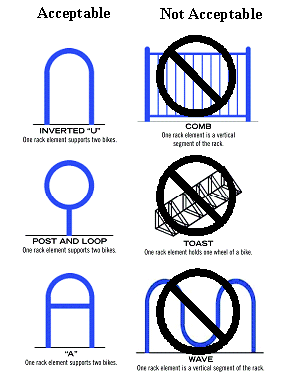
Required bicycle parking facilities must be designed as an "Inverted U," "Post and Loop," an "A" type of facility, or a wheelwell-secure rack in order to allow a bicycle to be secured by its frame with a U-shaped bicycle lock. A wheelwell-secure rack includes an element that secures one wheel and a vertical element that allows for locking.

(b)
Bicycle lockers are permitted as a substitute for bicycle loops as required bicycle parking facilities. The number of spaces provided with bicycle lockers must be equivalent to the number of spaces provided with a bicycle loop. Bicycle lockers shall be secure enclosures which protect bicycles from the weather.
(c)
All bicycle parking areas must constructed of asphaltic cement concrete, Portland cement concrete, or manufactured paving materials, such as brick.
(d)
Any use which is required to provide twenty (20) or more bicycle parking spaces shall be required to cover at least fifty (50) percent of its required bicycle parking with an awning or other feature that will cover the entire bicycle while parked at the facility. K—12 schools are exempt from this requirement.
(e)
Garages are permitted as a substitute for bicycle loops as required bicycle facilities for residential uses, provided that each garage is secure and exclusive for a particular dwelling unit.
(C.B. No. 2008-220, § 13, 10-21-08; C.B. No. 2016-021, § 3(Exh. A), 2-16-16; C.B. No. 2018-149, § 1(Exh. A), 9-18-18; C.B. No. 2019-163, § 1(Exh. A), 9-17-19)
Sec. 37-378. - On-Site Bicycle Parking Location.
(a)
Required bicycle parking facilities shall be located as follows:
(1)
Required bicycle parking facilities shall be located within one hundred (100) feet of a main building entrance as measured along a reasonable walking route. Required bicycle parking shall be visible and accessible from the public right-of-way.
(2)
Required bicycle parking facilities may not be located above the ground floor.
(b)
All bicycle parking facilities shall observe the following location standards:
(1)
Bicycle parking shall not extend into a pedestrian walkway or vehicular lane.
(2)
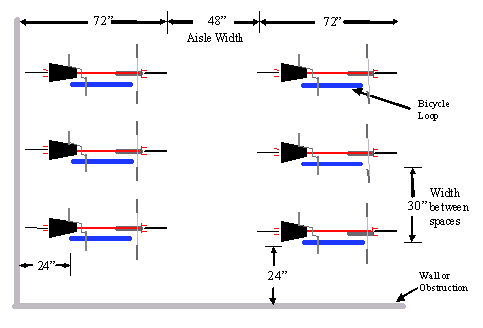
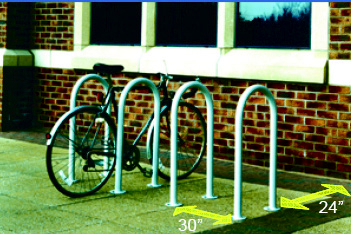
A four-foot aisle width shall be maintained between multiple rows of bike parking facilities with a two-foot six-inch space between bike spaces for circulation while using the facility.
(3)
Twenty-four (24) inches of unobstructed paved surface shall surround the bicycle loops to allow the wheels of the parked bicycles to rest on a paved surface and to allow for a minimum distance from adjacent walls or structures.
(C.B. No. 2008-220, § 13, 10-21-08; C.B. No. 2009-084, § 6, 5-19-09; C.B. No. 2016-021, § 4(Exh. A), 2-16-16; C.B. No. 2018-149, § 1(Exh. A), 9-18-18)
Sec. 37-379. - Alternative Bicycle Plan.
In the event a property owner wishes to provide required bicycle parking in a manner not provided for in this Article, they may apply to the Planning Director for approval for an alternative method of compliance. The following findings shall be met before approval of an alternative bicycle parking plan:
(a)
The bicycle parking plan achieves the intent of the ordinance specifically in regards to location and type.
(b)
The proposal is at least the equivalent of that specifically prescribed by this Article in quality, effectiveness, and durability of the facilities provided.
(c)
The number of spaces provided by the alternative bicycle parking plan shall be equal to or greater than the number of spaces required by the proposed use as defined in Table VII-C of this chapter.
(C.B. No. 2008-220, § 13, 10-21-08; C.B. No. 2016-021, § 5(Exh. A), 2-16-16; C.B. No. 2018-149, § 1(Exh. A), 9-18-18)

