
Cherry Hills Village
City Zoning Code
City Zoning Code
ARTICLE III
Lots, Buildings, and Structures
Sec. 16-3-10. - General lot and building standards for residential zoning districts.
(a)
Generally. This Section sets out the general lot and building standards for the Residential Zoning Districts. In addition to these standards, the massing of buildings is controlled by the bulk plane regulations in Section 16-3-30, Bulk Plane Regulations, also apply within the R-1, R-2, R-3, R-4, and R-5 zoning districts.
(b)
Maximum Building Height. Building height shall not exceed the maximums set out in Table 16-3-10.A., Maximum Building Height.
(c)
Minimum Lot Area. Lot area shall not be less than the minimums set out in Table 16-3-10.B., Minimum Lot Area.
(d)
Building Setbacks, Buffers, Floor Area Ratio, and Building Coverage.
(1)
R-1, R-2, R-3, R-4, and R-5 Zoning Districts. Building setbacks and floor area ratio in the R-1, R-2, R-3, R-4, and R-5 zoning districts shall not be less than the minimums set out in Table 16-3-10.C.1., Minimum Building Setbacks and Maximum Floor Area Ratio.
(2)
R-3A Zoning Districts. Except as otherwise provided in this subsection (d)(2), building setbacks and building coverage in the R-3A zoning district shall be as set out in Table 16-3-10.C.2., Minimum Building Setbacks and Maximum Building Coverage (R-3A).
(Ord. 7, §1, 2019; Ord. 1, §§2, 3, 2025)
Sec. 16-3-20. - Lot and building standards for nonresidential zoning districts.
(a)
Maximum Building Height. Building height shall not exceed the maximums set out in Table 16-3-20.A., Maximum Building Height.
(b)
Minimum Lot Area. Lot area shall not be less than the minimums set out in Table 16-3-20.B., Minimum Lot Area.
(c)
Minimum Building Setbacks, Floor Area Ratio, and Building Coverage.
(1)
Building setbacks in the O-1, O-2, C-1, and C-2 zoning districts shall not be less than the minimums, and floor area ratio shall not be more than the maximums, set out in Table 16-3-20.C., Minimum Building Setbacks and Maximum Floor Area Ratio. However, buildings that exist on the effective date of this Chapter shall be considered "conforming" for the purposes of this subsection as to their existing footprints.
(d)
Minimum Recreational Structure Setbacks for O-1. Recreational structure setbacks in the O-1 zoning district shall not be less than the minimums set out in Table 16-3-20.D., Minimum Recreational Structure Setbacks for O-1.
Table 16-3-20.D - Minimum Recreational Structure Setbacks for O-1
(Ord. 7, §1, 2019; Ord. 13, §2, 2022)
Sec. 16-3-30. - Bulk plane regulations.
(a)
Generally. Bulk planes apply to principal and accessory buildings and structures in the R-1, R-2, R-3, R-4, R-5, and O-1 Zoning Districts.
(b)
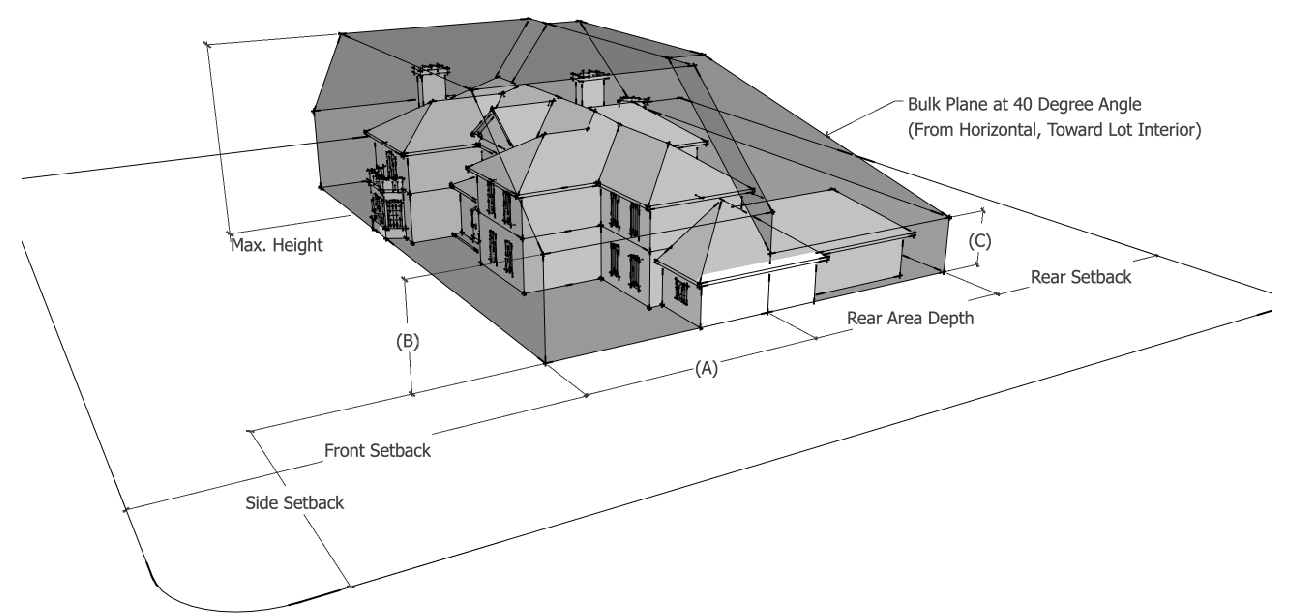
Bulk Planes. Bulk planes shall have the boundaries set out in Table 16-3-30, Bulk Plane Standards by Zoning District. They are applied along side and rear setback lines, beginning at the applicable starting height. Their boundaries are illustrated in Figure 16-3-30.B.1., Illustrative Bulk Plane Boundaries.
|
Figure 16-3-30.B.1.
Illustrative Bulk Plane Boundaries |
|---|
 |
(c)
Special Standards for Accessory Buildings.
(1)
For zoning districts where the minimum side or rear setback for an accessory building is less than the minimum side or rear setback specified for a primary building, a special accessory building bulk plane shall begin at a starting height of twelve (12) feet, six (6) inches above the minimum side and rear setback lines for accessory building.
(2)
The special accessory building bulk plane shall rise at a forty (40) degree angle towards the center of the lot until it reaches the maximum permitted height for the zoning district or intersects with the bulk plane that begins at the minimum side or rear setback for the primary building.
(d)
Measurement. The starting height for the bulk plane shall be measured from the natural grade along the minimum side and/or rear setback lines using one (1) of the following methods:
(1)
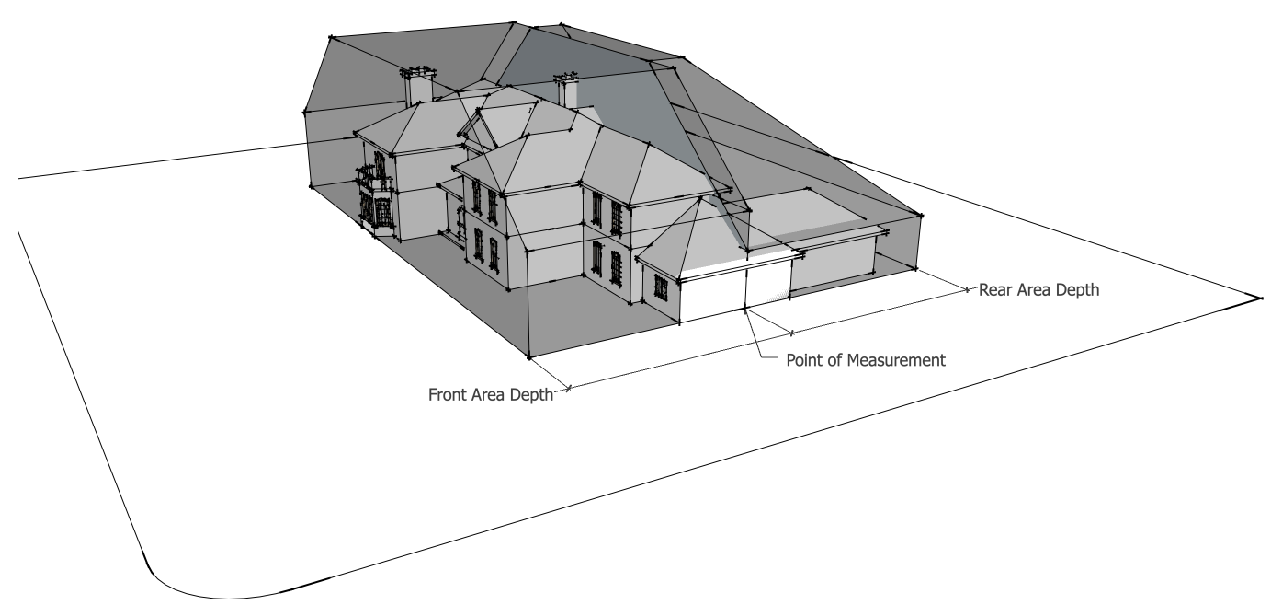
For a lot where the average natural grade does not differ by more than seven (7) percent along the minimum front, side or rear setback lines: The starting height shall be measured from the points of measurement at each minimum side setback line that coincide with the minimum front area depth for the bulk plane as shown in Figure 16-3-20.B.2., Illustrative Bulk Plane Standards (Average Lot Grades up to 7 Percent Slope.)
|
Figure 16-3-20.B.2.
Illustrative Bulk Plane Standards (Average Lot Grades up to 7 Percent Slope) |
|---|
 |
(2)
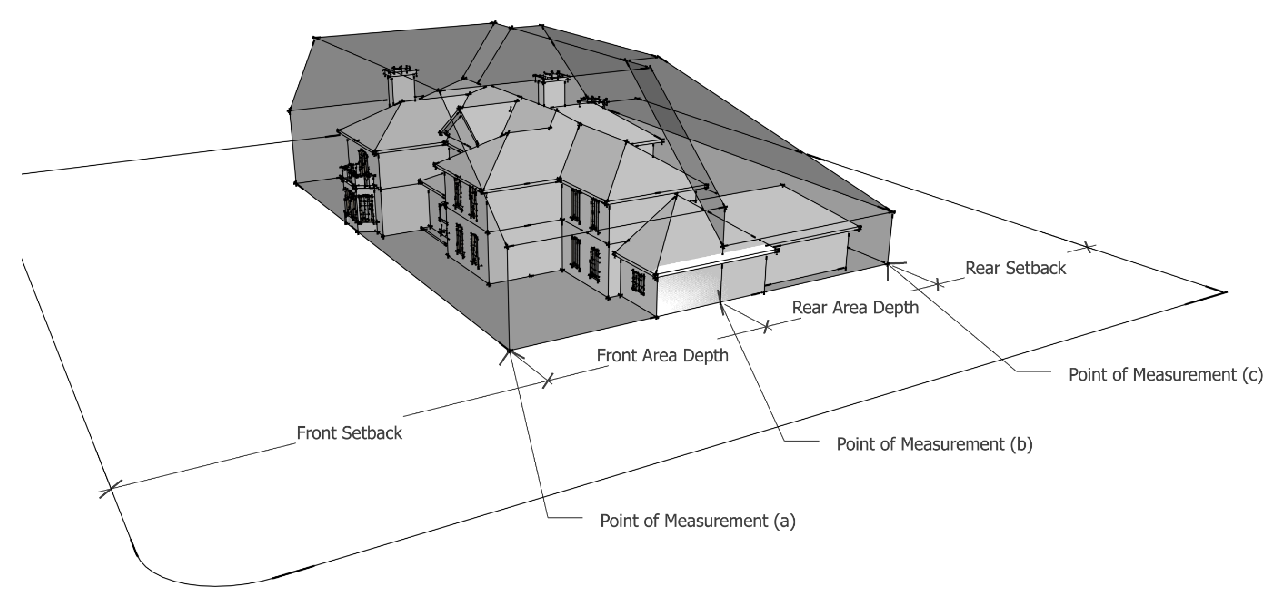
For a sloping lot where the average natural grade differs by more than seven (7) percent along the minimum front, side or rear setback lines: The starting height shall be measured at each of the following points of measurement as shown in Figure 16-3-30.B.3., Illustrative Bulk Plane Standards (Average Lot Grades More than 7 Percent Slope):
a.
The points at each minimum side setback line that coincide with the minimum front setback line;
b.
The points at each minimum side setback line that coincide with the minimum front area depth for the bulk plane; and
c.
The points at each minimum side setback line that coincide with the minimum rear setback line.
|
Figure 16-3-30.B.3.
Illustrative Bulk Plane Standards (Average Lot Grades More than 7 Percent Slope) |
|---|
 |
(e)
Permitted Encroachments. The following building elements may encroach beyond the bulk plane as specified.
(1)
Roof overhangs or eaves, provided that they do not extend more than thirty (30) inches horizontally beyond the bulk plane.
(2)
A rooftop solar system (photovoltaic or solar water heater) that is flush-mounted to the roof or mounted at up to a fifteen (15) degree angle, measured from a horizontal plane, provided that the roof structure supporting the solar system does not extend beyond the bulk plane.
(3)
The gable end of a sloping roof form, provided that:
a.
It does not extend more than eleven (11) feet horizontally beyond the bulk plane including any roof overhang.
b.
It does not extend more than nine (9) feet vertically beyond the bulk plane.
c.
It has a maximum width of forty-two (42) feet, including any roof overhang.
(4)
Dormers, provided that:
a.
The highest point of any dormer is at or below the height of the primary roof ridge.
b.
The portion of any dormer that extends beyond the bulk plane has a maximum width of twelve (12) feet including any roof overhang.
c.
The dormer does not extend more than six (6) feet vertically beyond the bulk plane.
d.
The combined width of all dormers does not exceed fifty (50) percent of the length of the roof on which they are located.
e.
The space between dormers is not less than six (6) feet.
f.
The dormer is inset at least three (3) feet from the nearest building wall.
(5)
Chimneys, provided that:
a.
The highest point of any chimney does not extend more than five (5) feet vertically beyond the bulk plane.
b.
The portion of any chimney that extends beyond the bulk plane has a maximum width of six (6) feet including any roof overhang.
(6)
Wireless communications facilities provided that they conform to the requirements of Chapter 20, Wireless Communications Facilities, Cherry Hills Village Municipal Code.
(7)
Satellite dishes and antennae (including amateur radio antennae), provided that they conform to the requirements of Section 16-3-150, Satellite Dishes and Antennae.
(Ord. 7, §1, 2019)
Sec. 16-3-110. - Community guardhouses.
(a)
Generally. In addition to meeting all other requirements of this Article (except as provided in subsection (c), below), community guardhouses are permitted on tracts under common ownership ("Guardhouse Tracts") in the R-1, R-2, R-3, R-3A, R-4, and R-5 Zoning Districts, subject to the standards of this Section.
(b)
Standards. Community guardhouses are subject to the following standards:
(1)
Location.
a.
A community guardhouse may only be permitted on a guardhouse tract. The guardhouse tract must be separate from any tract that contains a private street.
b.
All guardhouse tracts shall be located within and entirely surrounded by a private street, or contiguous with a private street. For purposes of this standard, "contiguous" means having at least 25 percent (25%) of the perimeter coincident with the edge of one (1) or more private streets.
(2)
Configuration.
a.
All guardhouse tracts shall be adequate in area to allow for simultaneous parking of one (1) employee vehicle and one (1) service vehicle.
b.
There shall be at least four (4) lanes of vehicular access past a community guardhouse, including two (2) lanes in and two (2) lanes out.
c.
No buildings or structures other than the community guardhouse, fencing, and gates are permitted on a guardhouse tract.
(3)
Other Standards.
a.
Community guardhouses shall be lighted so as to ensure safe vehicular and pedestrian passage.
b.
No gate or gate opening/locking mechanism may be permitted unless approved by the South Metro Fire and Rescue District.
(c)
Exemptions. Community guardhouses are exempt from the following standards of this Chapter:
(1)
Minimum lot area and lot width.
(2)
Accessory building setbacks.
(d)
Documentation. The homeowners' association documents, including, but not limited to, the applicable covenants, conditions and restrictions ("Covenants") shall provide, or shall be amended to provide, adequate maintenance and operation of the guardhouse in a form acceptable to the City. The covenants shall state that the City shall have the right, but not the obligation, to enforce the community guardhouse maintenance and operation provisions.
(Ord. 7, §1, 2019)
Sec. 16-3-120. - Fences, garden walls/perimeter walls, and enclosures.
(a)
Generally. Fences, garden walls/perimeter walls, and enclosures are subject to compliance with the standards of this Section.
(b)
Fences, Garden Walls, and Gates on Residential Lots.
(1)
Height and Opacity. Fences and garden walls/perimeter walls on residential lots shall be subject to the height and opacity standards in Table 16-3-120, Fence and Wall Height and Opacity: Residential Lots.
Figure 16-3-120.A - Fence Locations for Interior Lots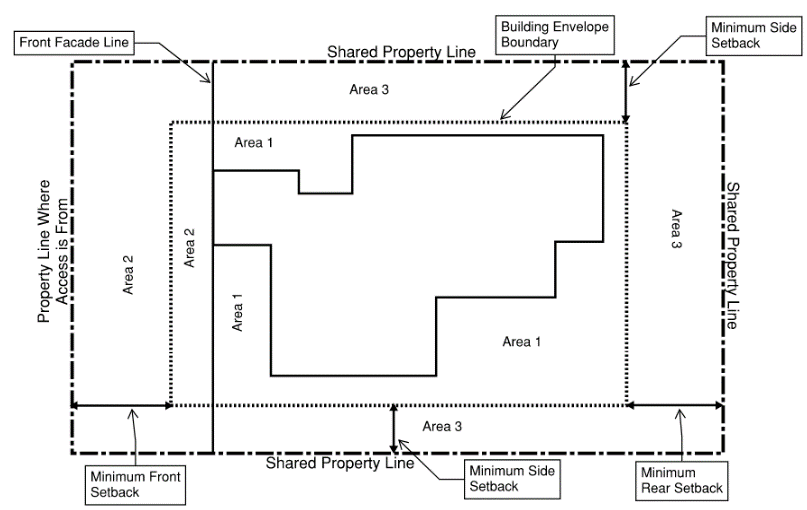
Figure 16-3-120.B - Fence Locations for Lots Adjacent to Roads, Highways, or Parks
and Trails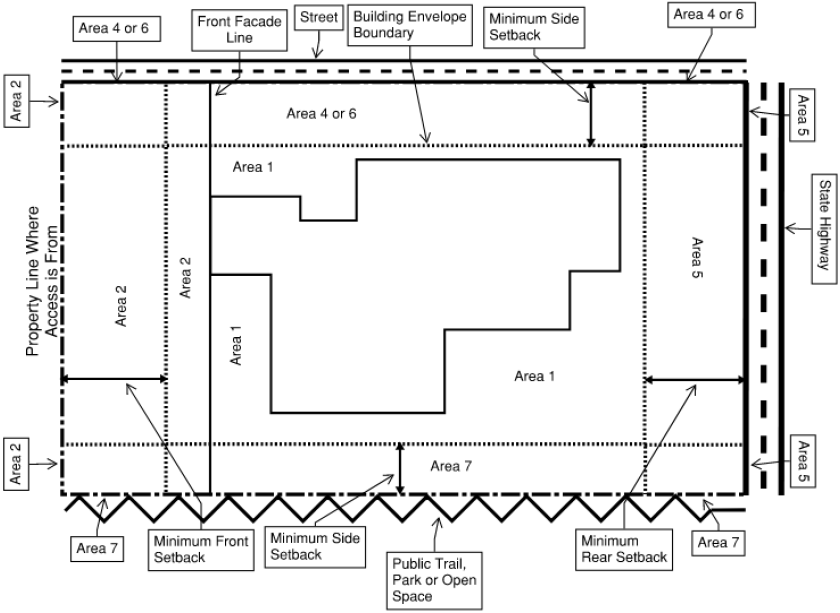
(2)
Setback and Landscape Requirements in Residential Zoning Districts. This subsection applies as set out in Table 16-3-120, Fence and Wall Height and Opacity: Residential Lots. Fences that are subject to this subsection shall:
a.
Be setback not less than four (4) feet from right-of-way lines, with the area between the fence or garden wall and the street planted with not less than two (2) trees or evergreen shrubs per one hundred (100) linear feet; or
b.
Be set back less than four (4) feet (including zero (0) feet), but with regular offsets of not less than four (4) feet, running for distances of not less than fifteen (15) nor more than twenty-five (25) feet, such that not less than twenty-five percent (25%) of the length of the fence along each street right-of-way line is so offset; and with the street-side area of each offset planted with at least two (2) trees or evergreen shrubs; or
c.
Be designed and constructed to meet two (2) of the following three (3) criteria:
i.
A setback of twenty-five (25) feet from the edge of the pavement of the adjacent paved street or forty (40) feet from the centerline of the adjacent unpaved street.
ii.
A landscaped area between the street and the fence is provided, with trees planted at a density of one (1) tree for every twenty (20) to thirty (30) linear feet of fence as determined by the Director given the type and planting size proposed (note that compliance with this criterion may include use of the City right-of-way if such use of the right-of-way is approved by the City Manager and the trees are subject to an ongoing maintenance agreement acceptable to the City).
iii.
A landscaped area between the street and fence is provided and planted such that at least twenty-five percent (25%) of the face of the fence is screened from view from the street within three (3) growing seasons (note that compliance with this standard shall not involve the use of City right-of-way).
(3)
Exceptions for Gates in Residential Zoning Districts.
a.
Front yard Gates, Generally. Up to two (2) gates that provide for ingress and egress from a street right-of-way to a front yard (including driveway gates) may exceed the otherwise applicable height limitations for a fence or garden wall by up to four (4) feet, provided that:
i.
The gates are, individually, not more than eighteen (18) feet in width; and
ii.
The gates have a maximum opacity of twenty-five percent (25%).
b.
Driveway Gate Stacking Area. Driveway gates must be located such that a minimum driveway area of nine (9) feet wide by eighteen (18) feet deep is provided in front of and perpendicular to the gates, as measured from the street right-of-way line, front lot line, or back edge of the sidewalk, whichever provides more setback from the flowline of the street. For a property with a driveway located on a cul-de-sac or dead-end street, the Director may allow a reduction in the required setback if the Director finds that the reduction will not have an impact on public safety.
c.
Other Gates. One (1) gate that provides for ingress and egress to each yard other than a front yard may exceed the otherwise applicable height limitations for a fence or garden wall by up to two (2) feet, provided that the gate is not more than four (4) feet in width.
(c)
Recreational Enclosures.
(1)
Generally. Fenced enclosures surrounding recreational facilities (except swimming pools) on residential lots (e.g., tennis courts, volleyball courts, etc.) may be up to ten (10) feet in height, provided that their opacity does not exceed twenty-five percent (25%). For the purposes of this subsection, wind screens are not counted in the evaluation of opacity.
(2)
Swimming Pools. Swimming pools shall strictly comply with Section 305, Barrier Requirements, 2018 International Swimming Pool and Spa Code. Variances to this requirement shall not be allowed.
(d)
Fences and Garden Walls on Nonresidential Lots.
(1)
Utility Stations. Fences and garden / perimeter walls that enclose utility stations shall not exceed eight feet in height and shall have an opacity of 100 percent.
(2)
Other Nonresidential Uses.
a.
Fences and garden/perimeter walls are allowed on nonresidential property for the following purposes:
i.
To enclose outdoor dining areas, gardens, or recreational facilities;
ii.
To enclose utilities, backup generators, loading areas, dumpsters, recycling bins, and/or utility meters;
iii.
To enhance safety or security, provided that the need for such additional safety or security is demonstrated; or
iv.
To comply with the requirements of this Chapter.
b.
The height of such fences or garden/perimeter walls shall not exceed eight (8) feet within required setback areas or ten (10) feet within the building envelope, unless otherwise provided in this Chapter, or unless the decision-maker finds that:
i.
Extraordinary circumstances justify the increased height; and
ii.
The visual impact of the additional height of the fence or garden/perimeter wall on adjoining property is fully mitigated by way of setbacks, landscaping, topography, intervening structures or buildings, or design.
(e)
Fence and Retaining Wall Combinations.
(1)
Fences and garden/perimeter walls may be constructed on, or in combination with, retaining walls, as follows:
a.
On residential property, fences and garden/perimeter walls must comply with the requirements of Table 16-3-120, Fence and Wall Height and Opacity: Residential Lots, with height measured from the side of the retaining wall with the higher grade.
b.
On nonresidential property, fences and garden/perimeter walls must comply with the requirements of subsection (d), above, with height measured from the side of the retaining wall with the higher grade.
(2)
In cases where guardrails are required by the applicable building code, fences and garden/perimeter walls shall also comply with the building code standards that apply to guardrails. If the building code standards conflict with the standards of this subsection (e), the building code standards shall control to the extent of the conflict.
(Ord. 7, §1, 2019; Ord. 3, §s; 1—6, 2024)
Sec. 16-3-130. - Retaining walls.
(a)
Generally. Retaining walls are subject to the standards of this Section.
(b)
Minimum Setbacks.
(1)
Where the exposed side of a retaining wall faces a public right-of-way or adjoining property, the retaining wall shall be set back a minimum distance from the lot line of: 4/3 x [height of retaining wall].
(2)
For tiered retaining walls, the height used to determine the minimum setback shall be the tallest point of the combined height of all tiers, and the setback shall be measured from the closest point of the tiered retaining wall to the affected lot line.
(c)
Maximum Height. The height of a retaining wall shall be measured from natural grade or finished grade, whichever is more restrictive.
(1)
For retaining walls that are located within a building envelope for a building or accessory building, the maximum height of the retaining wall shall be the same as the maximum building or accessory building height (as applicable) that is allowed within the building envelope within which the retaining wall is located.
(2)
For retaining walls located outside of a building envelope, the maximum height of the retaining wall (including the combined height of tiered retaining walls) is six (6) feet.
(d)
Design. Retaining walls must be tiered if they are more than six (6) feet in height, measured from finished grade, and no individual tier shall exceed six (6) feet in height, as measured from finished grade or the top of the wall upon which it is tiered. Tiers shall be set back from each other a horizontal distance of one (1) foot per two (2) feet of height of the higher tier.
(Ord. 7, §1, 2019)
Sec. 16-3-140. - Berms.
(a)
Generally. The construction of berms is permitted only in accordance with this Section. With the exception of berms constructed within Area 3 of a Residential Lot (see Table 16-3-140, Berm Height and Width), a berm permit is required prior to construction of a berm.
(b)
Maximum Height and Width. The maximum height and width for berms, based on their location, is set out in Table 16-3-140, Berm Height and Width.
(c)
Maximum Slope. Berms shall not exceed the maximum slope of one (1) unit vertical to four (4) units horizontal (1:4).
(d)
Design Standards.
(1)
Berms are prohibited within sight triangles. SeeSec. 16-4-70, Visibility at Intersections.
(2)
All areas of a berm shall be covered with grasses, groundcovers, rock, mulch, or other landscaping materials that are appropriate and sufficient to prevent erosion. Such landscaping materials must be installed within ninety (90) days after completion of finished grading.
(3)
Berms shall not collect, redirect, or release surface water upon adjacent property in a manner that is inconsistent with the historic or pre-construction conditions or applicable law without the written consent of the adjacent landowner in the form of a drainage easement.
(4)
No buildings or structures of any kind (except fences and garden walls) shall be permitted upon or within any berm.
(5)
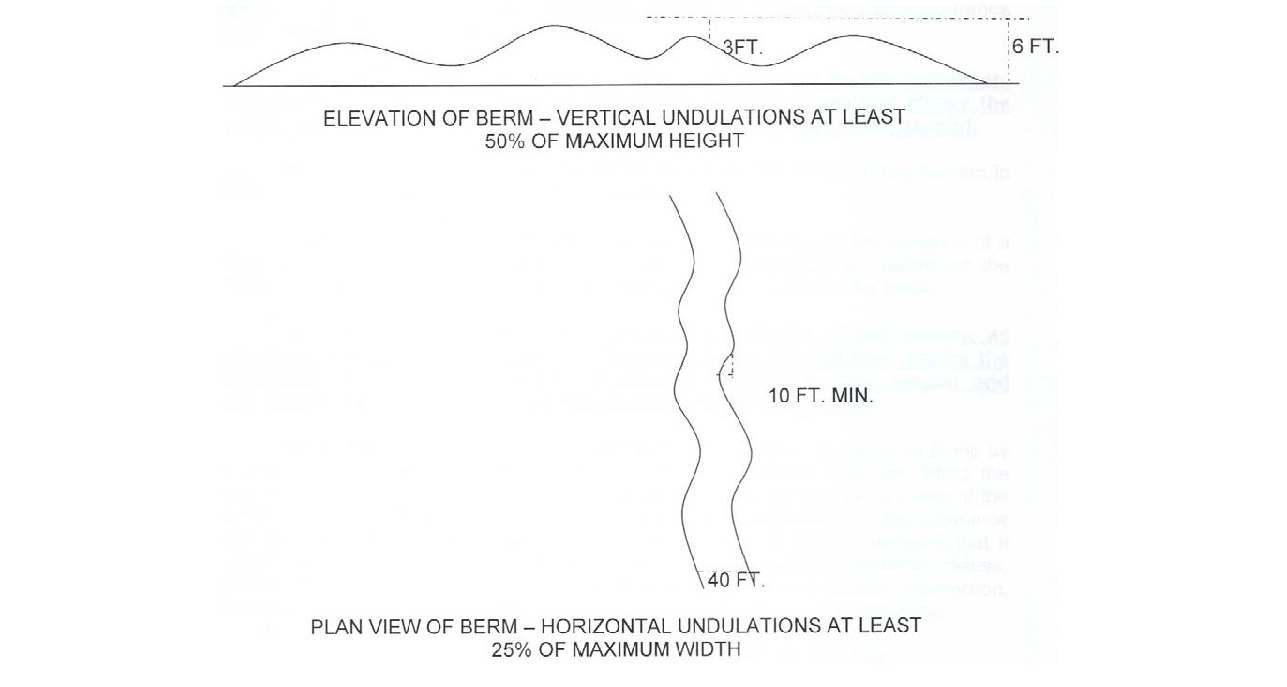
Berms shall be designed with both horizontal and vertical variation, so that the top of the berm undulates and the sides of the berm meander to form a natural-looking, serpentine-like pattern. To this end:
a.
Vertical undulations shall be at least fifty percent (50%) of the maximum height of the berm (see Figure 16-3-140, Illustrative Berm Variation); and
b.
Horizontal undulations shall be at least twenty-five percent (25%) of the maximum width of the berm (see Figure 16-3-140, Illustrative Berm Variation).
|
Figure 16-3-140
Illustrative Berm Variation |
|---|
 |
(6)
Berms shall connect smoothly into existing grades along the perimeter to ensure that berms appear natural.
(e)
Additional Requirements.
(1)
Grading for berms is prohibited in City rights-of-way and easements, unless a right-of-way permit is issued by the City for such purpose.
(2)
Grading for berms is prohibited within any floodplain unless authorized by a City-issued floodplain development permit. See Article V., Floodplain Management and Flood Damage Prevention.
(3)
During construction of the berm and until all landscaping is completed, appropriate erosion control is required.
(Ord. 7, §1, 2019)
Sec. 16-3-150. - Satellite dishes and antennae.
(a)
Generally. The standards of this section apply to satellite dishes and antennae that are typically associated with residential uses. They are not applicable to facilities that are used for commercial purposes or the provision of personal wireless services to people who do not reside on the lot on which the dish or antenna is located.
(b)
TV Antennae, DTV Antennae, Wireless Cable Antennae, and Satellite Dishes.
(1)
The following are allowed if they are attached to a building or mounted on a mast that extends not more than twelve (12) feet above the highest peak of the roof:
a.
TV antennae;
b.
DTV antennae;
c.
Wireless cable antennae; or
d.
Satellite dishes that are one (1) meter or less in diameter; or
e.
Antennae for MMDS, ITFS, or Wireless Internet, that are one (1) meter or less in diameter or diagonal measurement.
(2)
All cabling must be run internally (when feasible), securely attached, and as inconspicuous as practicable.
(3)
Masts that are greater than twelve (12) feet above the peak of the roof are allowed if it is demonstrated that:
a.
An adequate signal cannot be obtained at a lower height; and
b.
The mast and antenna are lower than overhead utility lines, or set back from overhead utility lines such that a collapse of the mast will not result in contact with the lines.
(4)
Satellite dishes that are more than one (1) meter in diameter are allowed if:
a.
They are located on the ground in the rear yard and are not visible from ground-level views from public rights-of-way or abutting properties; or
b.
If the dish cannot be located in the rear yard, it is located on the ground within the permitted building envelope on the side of the building, and the dish or antenna is fully screened from view from public rights-of-way with:
i.
A masonry wall; or
ii.
An evergreen hedge or evergreen shrubs and understory trees.
(c)
Amateur Radio Antennae. Amateur radio antennae are permitted if the height, setbacks, and screening for the antenna structure are as provided in Table 16-3-150, Amateur Radio Antennae.
(Ord. 7, §1, 2019)
Sec. 16-3-160. - Storage of recreational vehicles.
(a)
Generally. It is unlawful to park or store recreational vehicles in the front yard of any property, or on any public street, highway, road, alley, or other right-of-way for a period of time in excess of twenty-four (24) hours.
(b)
On-Lot Storage. Recreational vehicles may be stored on residential lots, provided that:
(1)
They are owned by the occupant of the lot, or by a guest of the occupant;
(2)
They are located behind the front facade line of the lot, unless the front yard of the lot is enclosed by a perimeter fence or wall, in which case they may be located within such enclosure; and
(3)
They are reasonably screened from view from adjacent property and public rights-of-way with a visual barrier (or combination of barriers, which may be structural or natural).
(Ord. 7, §1, 2019)
Sec. 16-3-170. - Trash containers; portable, on-demand storage; and roll-offs.
(a)
Trash Containers.
(1)
All Land Uses.
a.
Either portable or permanent containers may be used for the storage of non-hazardous solid waste (e.g., brush, rubbish, trash, garbage, dung, etc.), generated on the same lot, in order to facilitate collection for proper permanent recycling or disposal.
b.
Trash and recycling containers shall not be offensive or injurious because of odor, dust, windblown debris, pests, or other nuisances.
c.
Trash and recycling containers shall have lids that remain closed except during the process of being filled or emptied; except that open containers for landscape wastes do not require lids.
(2)
Residential and Agricultural Uses. On residential or agricultural lots:
a.
All trash and recycling containers shall be completely screened from the view of those off the property, except as provided in subsection (2)b., below.
b.
Small, portable containers (ninety-six (96) gallon or less) may be set at the edge of the right-of-way on a temporary basis for pickup. Once the containers have been emptied, they must be returned to their storage areas within twelve (12) hours.
(3)
Nonresidential Land Uses. On nonresidential (other than agriculture) lots, trash and recycling containers shall be located within the building envelope (unless the Director determines that a different location is required due to servicing needs, in which case they shall be located as close as possible to the building envelope), and completely screened from view from adjacent property and public rights of way.
(Ord. 7, §1, 2019)
Sec. 16-3-180. - Nonresidential antennae.
In the C-1 zoning district, radio and television antennae that are not subject to Chapter 20, Wireless Communications Facilities, Cherry Hills Village Municipal Code, may be built to a height not exceeding fifty (50) feet. Such antennae are subject to the same setback requirements as a principal building.
(Ord. 7, §1, 2019)
Sec. 16-3-210. - Purpose; application; exceptions.
(a)
Purpose. This Division is intended to regulate the erection and maintenance of both permanent and temporary signs within the City.
(b)
Sign Permit Required. Subject to certain exemptions provided by this Division, a sign permit from the City is required prior to the installation or posting of signs, in order to ensure conformance with the standards of this Division.
(c)
Exceptions to Permit Requirement. The following signs do not require a sign permit, but are subject to the standards of this Division, and may also be subject to applicable building and/or electrical codes:
(1)
Temporary Signs.
(2)
Any sign erected by the City acting in its governmental capacity (by way of illustration and not limitation, wayfinding signs, and signs identifying public facilities).
(3)
Up to two (2) flags located on any one (1) platted lot, parcel, or tract of land, provided that no flag shall exceeds sixty-four (64) square feet in area, and no flagpole exceeds thirty-five (35) feet in height.
(4)
Signs that are required by applicable life-safety codes, or regulations related to public health and safety (e.g., a sign identifying the address of a property).
(5)
One (1) sign incorporated into the design or architecture of a building (by way of illustration and not limitation, such signs typically include the building name, owner, and/or date of construction), provided that:
a.
The building is nonresidential; and
b.
The sign area does not exceed twelve (12) square feet.
(6)
Two (2) residential signs, provided that:
a.
The sign area does not exceed one (1) square foot per sign;
b.
Not more than one (1) of the signs is detached, and if a detached sign is used, it is not more than three (3) feet in height;
c.
The signs are not internally illuminated.
(7)
One (1) scoreboard, located on or immediately adjacent to each athletic field owned and controlled by a private or public school, provided that no such sign shall be used for the purpose of commercial advertisement.
(d)
Exemptions from Sign Regulation. The following signs are not subject to the regulations of this Division, but may be subject to building and/or electrical codes, as applicable:
(1)
Traffic control signs (e.g., signs required by the Manual on Uniform Traffic Control Devices for Streets and Highways ("MUTCD")) that are installed by or required by the City, Arapahoe County, or the Colorado Department of Transportation ("CDOT"), whether in a right-of-way or not.
(2)
Holiday decorations, clearly incidental and commonly associated with any national, local, or religious holiday, provided that such decorations do not advertise or identify a product or a business, and are located and configured so as not to conflict with traffic control devices or traffic safety.
(3)
Signs that are located wholly within a building that are not visible from any point within a public right-of-way.
(4)
Signs that are incorporated into and made part of a bus bench lawfully located within the public right-of-way, provided that such signs do not exceed twenty-five (25) square feet in area.
(5)
Signs that are incorporated into and made part of a public transit shelter or public bus stop shelter lawfully located within a public right-of-way, provided that such signs do not exceed two (2) panels, each measuring not more than twenty-five (25) square feet in sign area.
(6)
Signs that are required by law, including but not limited to building and safety codes (e.g., address signs, NFPA diamonds, etc.).
(Ord. 7, §1, 2019)
Sec. 16-3-220. - Prohibited signs.
(a)
Generally. The following signs and sign designs are prohibited and within all zoning districts:
(1)
Any sign not expressly permitted by or conforming to this Division (except legal nonconforming signs).
(2)
Any permanent sign for which a permit is required but has not been issued.
(3)
Animated or moving signs, including any sign for which all or any part or attachment moves, swings, rotates, flashes or twirls.
(4)
Signs covered or painted in whole or in part with light-reflecting paint or materials (except retroreflective paint or materials used on traffic control devices designed in accordance with the MUTCD).
(5)
Inflated or floating objects, balloons, dirigibles, or any similar type of object or sign designed to utilize air pressure, gas, or wind in its display (except flags).
(6)
Off-premises commercial signs.
(7)
Electronic message centers.
(8)
Signs that include flashing or blinking illumination sources.
(9)
Roof signs.
(10)
Search lights.
(11)
Portable signs or wheeled signs.
(12)
Vehicles used for sign purposes. Signs painted on, or attached to, a motor vehicle parked within fifty (50) feet of a public right-of-way unless:
a.
The vehicles are operational, regularly used as motor vehicles, and have current registration and tags;
b.
The display of signage is incidental to the motor vehicle use; and
c.
The motor vehicle is legally parked:
i.
In a striped parking space;
ii.
On-street, in a location where on-street parking is allowed; or
iii.
In a residential driveway.
(13)
Trailers or containers used for sign purposes. Semi-trailers, shipping containers, or portable storage units, unless:
a.
The trailers, containers, or portable storage units:
i.
Are structurally sound and capable of being transported;
ii.
Used for their primary purpose (e.g., storage, pick-up, or delivery); and
iii.
If subject to registration, have current registration and tags; and
b.
The display of signage is incidental to the primary purpose; and
c.
The semi-trailer, shipping container, or portable storage unit is parked or placed in a designated loading area or on a construction site at which it is being used for its primary purpose.
(14)
Any sign found by the Director to be hazardous by reason of inadequate maintenance, dilapidated condition, or obsolescence such that the sign creates an imminent hazard to the public health or safety.
(15)
Signs designed, shaped, and/or painted to mimic, simulate, or represent official traffic control devices, such as but not limited to stop signs, yield signs, caution signs, or speed limit signs.
(b)
Prohibited Locations. No sign shall be:
(1)
Attached to a tree.
(2)
Painted on a fence, garden wall, or building.
(3)
Posted on or projecting over public property, public rights-of-way, public street medians, islands or parkways, except by the entity that controls the right-of-way, or by permission of that entity.
(4)
Attached to traffic control devices or traffic control signs or fixtures, except by the entity that controls the right-of-way, or by permission of that entity.
(5)
Attached to utility equipment, poles, and wires, except as required by life-safety codes.
(6)
Posted in a location or manner that materially impedes visibility at a street intersection (a sign shall be presumed to materially impede visibility if it is located within a required sight triangle).
(c)
Hazards. The following signs are considered hazards in the City, and the Director may cause the them to be summarily removed at the owner's expense:
(1)
Any sign that violates subsection (b)(2), (b)(3), (b)(4), (b)(5), or (b)(6); and
(2)
Any sign that violates subsection (a)(12) or (a)(13).
(Ord. 7, §1, 2019)
Sec. 16-3-230. - Permanent signs.
(a)
Authorized Permanent Signs. The following signs shall be authorized as permanent signs upon issuance of a sign permit in accordance with this Section:
(1)
R-1, R-2, R-3, R-3A, R-4, R-5, O-1, and O-2 Zoning Districts. Within the R-1, R-2, R-3, R-3A, R-4, R-5, O-1, and O-2 Zoning Districts:
a.
Residential Subdivision Entrances. Two (2) permanent signs are allowed at each entry into a platted subdivision from a public right-of-way, provided that such signs are located within an easement, outlot, or on a lawfully existing permanent fence or structure owned or maintained collectively by the owners of lots within the subdivision (e.g., by a homeowners' association). Such signs shall not exceed a total of twenty-five (25) square feet of sign area per entry, and shall not exceed eight (8) feet in height.
b.
Residential Lots. Each residential lot may include residential signs as allowed by Section 16-3-210(c)(6).
c.
Nonresidential Lots. Each nonresidential lot may include:
i.
One (1) permanent sign (either attached or detached) not exceeding twenty-five (25) square feet of sign area. If detached, the sign area is allowed for each face, the sign shall not exceed eight (8) feet in height.
ii.
One (1) permanent detached sign not exceeding three (3) square feet of sign area for each face (a total of six (6) square feet of sign area for a two-sided sign), and three (3) feet in height, located within ten (10) feet of the principal vehicular entrance to the property.
iii.
Not more than ten (10) signs (either attached or detached) containing noncommercial messages. No sign shall exceed two (2) square feet in sign area. If detached, the sign shall not exceed three (3) feet in height.
(2)
C-1 and C-2 Zoning Districts. Within the C-1 and C-2 Zone Districts:
a.
Within the C-1 Zoning District: One (1) sign not to exceed six (6) square feet in sign area is allowed for each lot. If detached, the sign shall not exceed five (5) feet in height.
b.
Within the C-2, Limited Commercial Zone District:
i.
Attached signs that do not exceed twenty-five (25) square feet of sign area are allowed as follows:
1.
One (1) per ground-floor tenant, located on the side of the building on which the principal entrance to the tenant's space is located;
2.
One (1) per corner ground-floor tenant, located on the side elevation of the building; and
3.
One (1) per ground-floor tenant, located on the rear elevation of the building.
ii.
Two (2) detached signs, not to exceed twenty-five (25) square feet of sign area, and not to exceed six (6) feet in height.
(b)
Illumination.
(1)
Artificial illumination shall be permitted only for:
a.
Subdivision entry signs;
b.
Detached signs on nonresidential lots; and
c.
Attached wall-mounted signs for lots zoned C-2, Limited Commercial District.
(2)
Illumination, where allowed, shall be provided only from a concealed and focused light source directed in a manner that prevents illumination beyond the face or surface area of the sign.
(3)
If a sign is illuminated, the light source shall be turned off between the hours of 11:00 p.m. and sunrise the following morning.
(Ord. 7, §1, 2019; Ord. 1, §4, 2025)
Sec. 16-3-240. - Temporary signs.
(a)
Generally. Temporary signs may be posted on property in any zoning district, subject to the requirements of this Section and those applicable provisions stated elsewhere in this Division.
(b)
Maximum Aggregate Sign Area. The total (aggregate) sign area for all temporary signs posted on a lot, property, or parcel shall not exceed:
(1)
In All Zoning Districts Except C-2. Twelve (12) square feet, with no individual sign face exceeding six (6) square feet in area.
(2)
In the C-2 Zoning District. Sixty-four (64) square feet, with no individual sign face exceeding the dimensions of four (4) feet by eight (8) feet.
(c)
Location.
(1)
No temporary sign shall obstruct or impair access to a public sidewalk, public or private street, or driveway, traffic control sign, bus stop, fire hydrant, or any type of street furniture, or otherwise create a hazard, including a tripping hazard.
(2)
A temporary sign shall only be posted with the consent of the property owner or occupant.
(d)
Design.
(1)
A temporary sign shall be designed to be stable under normal weather conditions. Signs constructed of plywood or metal shall be installed in a manner to withstand high winds.
(2)
No temporary sign shall be illuminated.
(3)
Temporary signs shall not be used as off-premises commercial signs.
(e)
Duration of Display.
(1)
A temporary sign may be posted for a period of up to ninety (90) days, at which time the sign shall be removed or replaced with a new sign.
(2)
In addition to the requirements stated above, temporary commercial signs shall comply with the following requirements:
a.
A temporary sign advertising the availability of a property for-sale or for-rent shall be removed within five (5) days after the date of closing or occupancy of the property, whichever occurs first.
b.
All other temporary signs advertising commercial activity that is date-specific (such as those announcing yard sales and special events to occur on one (1) or more particular dates), shall be removed within twenty-four (24) hours after the conclusion of the sale or event that the sign is promoting.
(Ord. 7, §1, 2019)
Sec. 16-3-250 - Special events.
In addition to other signs allowed by Section 16-3-230, Temporary Signs, not more than six (6) temporary signs, each sign not greater than eight (8) square feet of sign area (per face), may be displayed for up to than fourteen (14) days for the purposes of a special event pursuant to a temporary sign permit for the special event. Not more than four (4) special event sign permits may be issued for any property in any one (1) calendar year.
(Ord. 7, §1, 2019)

