
Cherry Hills Village
City Zoning Code
City Zoning Code
ARTICLE IV
Site Design and Environmental Stewardship
Sec. 16-4-10. - Off-street parking requirements.
(a)
Generally. Off-street parking shall be provided in accordance with Table 16-4-10, Off-Street Parking Requirements. Where more than one (1) land use is conducted on a single lot, parking shall be required for each land use.
(Ord. 7, §1, 2019; Ord. 4, §1, 5-5-2020; Ord. 14, §4, 2022)
Sec. 16-4-20. - Parking reductions.
(a)
Generally. In conjunction with a site plan approval, the City may grant a parking reduction up to fifty percent (50%) of the parking spaces required by Section 16-4-10, Off-Street Parking Requirements, according to the standards of this Section.
(b)
Required Findings. Parking requirements may be reduced if the City makes the following findings, based on a parking study submitted pursuant to Section 16-4-30, Special Parking Studies:
(1)
The parking needs of the use will be adequately served, in that the typical parking demands will not exceed parking supply, and in the case of extraordinary parking demands, appropriate locations are available to accommodate the additional vehicles; and
(2)
If joint use of the parking areas is proposed, the relative hours of peak parking demand among the uses justifies the reduction in parking spaces based upon shared parking principles.
(c)
Land Banking. As a condition of approval of a parking reduction, the City may require that land be reserved or land-banked for additional parking if there is a demonstrably high probability that:
(1)
The variability of the special parking study suggests that the land use may result in a materially higher parking demand than anticipated;
(2)
The intensity or nature of the use of the subject property and its existing improvements is likely to change in a manner that results in a materially higher demand for parking.
(d)
Mitigation Agreement. If grass or other non-hardened surface area parking is proposed, a minimum of fifty percent (50%) of required parking shall comply with the hard-surface requirements set forth in Section 16-4-50, Surfacing, and the use of grass or other natural, non-hardened areas shall be solely to accommodate overflow, special event, or other similar temporary peak parking demands, provided that the applicant has agreed to enter into a written mitigation agreement with the City to address the use and maintenance of any such natural off-street parking areas, including but not limited to the establishment of monthly or annual usage limits, inclement weather usage restrictions, re-seeding and re-vegetation requirements, watering or irrigation requirements, and conditions designed to limit the amount of mud or debris tracked onto adjacent City rights-of-way, including but not limited to the required installation of a vehicle tracking control ("VTC") system.
(Ord. 7, §1, 2019)
Sec. 16-4-30. - Special parking studies.
(a)
Generally.
(1)
Some of the land uses that are listed in the tables set out in Section 16-4-10, Off-Street Parking Requirements, have nonlinear or widely varying parking demand characteristics. Accordingly, their parking requirements are listed in the tables as "special study." Required parking for these uses shall be established according to the standards of this section.
(2)
Special parking studies may also be submitted to support a request to reduce the number of required parking spaces to less than that set out in Section 16-4-10, Off-Street Parking Requirements, due to the nature of the operations or specific location of a proposed use. Such special parking studies shall include and support all requested reductions in parking.
(b)
Special Parking Study Technical Requirements.
(1)
Special parking studies shall be conducted by a qualified professional transportation planner or traffic engineer at the applicant's expense. The Director shall be responsible for determining whether the qualifications of any proposed transportation planner or traffic engineer are acceptable to the City for this purpose.
(2)
The special parking study shall provide:
a.
A peak parking analysis of at least three (3) functionally comparable uses.
b.
Documentation regarding the comparability of the referenced uses, including: name, function, location, gross floor area, parking availability, access to transportation network (including vehicular, bicycle, pedestrian, and transit), use restrictions, and other factors that could affect the parking demand.
(3)
The City may rely upon the special study or may request additional information or analysis, including, but not limited to alternative or new data points, or consideration of additional or alternative factors related to comparability or peak demand, as supported by sound engineering principles.
(Ord. 7, §1, 2019)
Sec. 16-4-40. - Off-street parking design.
(a)
Generally. Off-street parking shall be designed in accordance with the requirements of this Section.
(b)
Location and Access.
(1)
Off-street parking areas shall have adequate access to a public street or other thoroughfare.
(2)
Off-street parking areas shall be set back:
a.
Ten (10) feet from street right-of-way lines and nonresidential lot lines; and
b.
Twenty (20) feet from residential lot lines.
(c)
Configuration of Parking Modules.
(1)
All parking spaces located across from each other, on the opposite side of a drive lane, shall be located at the same angle to the drive lane, except that parallel parking may be provided on one (1) side of the drive lane in order to enhance accessibility.
(2)
Angle parking located on a drive lane with a dead-end is not allowed unless:
a.
The angle of the parking space is ninety (90) degrees to the direction of travel and sufficient space is provided for turn-around; or
b.
The geometry of the subject property requires such a configuration for an efficient parking layout and the Director determines that the design provides for safe circulation and emergency access.
(d)
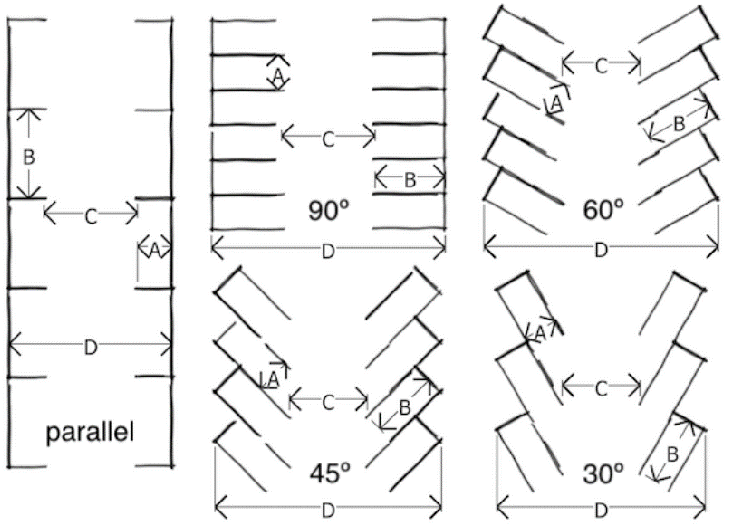
Dimensions. Parking spaces and aisles shall be dimensioned according to the standards set out in Table 16-4-40, Parking Space, Aisle, and Module Dimensions. Standards from the table are depicted in Figure 16-4-40, Illustrative Parking Dimensions, for illustrative purposes.
|
Figure 16-4-40
Illustrative Parking Dimensions |
|---|
 |
(e)
Overhangs. The length of standard parking spaces may be reduced by up to two (2) feet where the adjacent sidewalk or landscape area is protected by a curb and not less than seven (7) feet in width, allowing for vehicle overhang and an unobstructed walkway or landscape area of at least five (5) feet in width. The use of wheel barriers in such locations is prohibited.
(f)
Alternative Parking Dimensions. The Director may approve angles and dimensions that are different from those set out in Table 16-4-40, Parking Space, Aisle, and Module Dimensions, provided that the applicant demonstrates that the angles and dimensions will provide for safe circulation and parking within the parking lot based on an AASHTO 2011 (US) - P design vehicle template, or such other template as the Director determines is appropriate based on the proposed land use.
(g)
Compact Parking Spaces. Up to thirty percent (30) of the parking spaces in a parking lot may be compact parking spaces. Compact parking spaces shall be at least eight (8) feet in width and sixteen (16) feet in length. Compact parking spaces shall not be configured as parallel parking spaces.
(Ord. 7, §1, 2019)
Sec. 16-4-50. - Surfacing and striping.
(a)
Generally. Off-street parking areas shall be hard-surfaced with asphalt, concrete or porous surfacing engineered to support the weight of vehicles but permitting grass to grow through.
(b)
Striping. Parking lots with more than five (5) paved parking spaces shall be striped.
(c)
Unpaved Parking Areas. Off-street parking areas for which a mitigation agreement has been approved pursuant to Section 16-4-20, Parking Reductions, may be located on natural, non-hardened surfaces. Any natural area approved for parking shall be exempt from the landscaping, striping and lighting requirements of this Division and Section 16-4-130, Lighting of Parking Lots.
(Ord. 7, §1, 2019)
Sec. 16-4-60. - Structured parking.
(a)
Generally. No structured parking, attached or detached, above or below ground, shall be permitted in any zoning district unless specifically permitted as set forth in this Section.
(b)
Standards. Structured parking may be accessory to nonresidential uses, provided that such structures meet the following criteria:
(1)
Maximum Height. The maximum height of structured parking shall be established as either:
a.
No portion of any such structure fronting on or adjacent to any private or public property line or right-of-way shall exceed eight (8) feet above the elevation of the natural grade at the midpoint (center point) of the footprint of the structure (plan view).
b.
The maximum height above grade called for in this subsection (b)(1) may be increased to twelve (12) feet above the midpoint of the structure at natural grade if additional fill is placed at a slope no greater than one (1) vertical to three (3) horizontal, so that no more than six (6) feet of the structure projects above the revised grade at the structure.
(2)
Screening. Structured parking shall be screened from view from neighboring properties and rights-of-way by densely planted trees and shrubs, berms and other landforms or fences.
(3)
Setback. Structured parking shall be set back at least fifty (50) feet from all property lines.
(Ord. 7, §1, 2019)
Sec. 16-4-70. - Visibility at intersections.
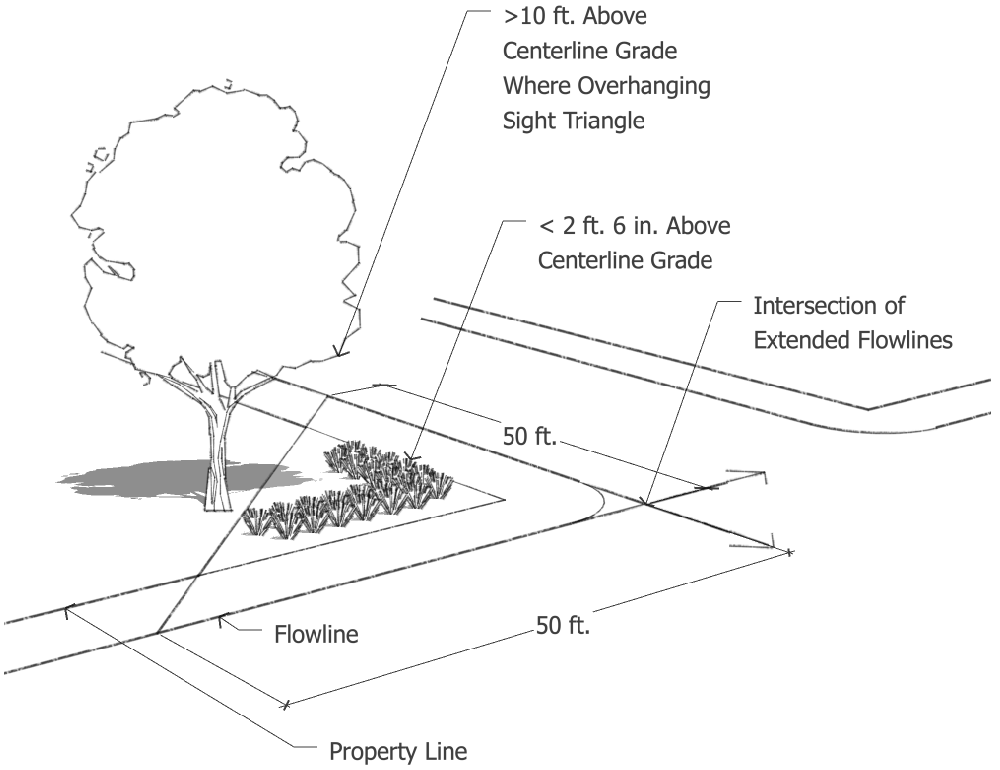
On a corner lot, nothing shall be constructed, placed, planted or allowed to grow in such a manner as materially to impede vision between a height of two and one-half (2 ½) feet and ten (10) feet above the centerline grades of the intersecting streets within a "sight triangle" defined by the area bounded by the flowlines of the intersecting streets (extended to cross each other) and a line joining points along said flowlines fifty (50) feet back from the point of their intersection. See Figure 16-4-70, Illustrative Sight Triangle.
|
Figure 16-4-70
Illustrative Sight Triangle |
|---|
 |
Sec. 16-4-110. - Utilities.
(a)
Generally. The purpose and intent of this Section is to protect and improve the aesthetics of the City by requiring that new or existing service lines associated with public utilities (telephone, electric service, cable television, gas lines and other similar utilities) be placed underground in conjunction with new development and redevelopment.
(b)
Requirements. The burial of new or existing service lines shall also be required for:
(1)
New development of a principal building on a lot; or
(2)
Redevelopment of a lot.
(c)
Exceptions. The obligation to place service lines underground shall not extend to existing overhead transmission or distribution lines that provide service to other properties. Facilities appurtenant to underground facilities or other required equipment may be placed aboveground if the City determines it is necessary.
(Ord. 7, §1, 2019)
Sec. 16-4-120. - Exterior lighting, generally.
(a)
Generally. The purpose and intent of this Section is to accommodate reasonable lighting needs in a manner that preserves the semi-rural character of the City and the qualities associated with this character, including the ability to view stars against a dark sky, while protecting the health, safety, and general welfare of the community. The City Council finds that these regulations are necessary in order to:
(1)
Promote safety and security;
(2)
Preserve the semi-rural character of the community;
(3)
Reduce the amount of nighttime light pollution;
(4)
Reduce offensive light glare and light trespass onto adjacent properties and rights-of-way;
(5)
Conserve energy; and
(6)
Promote appropriately designed and installed outdoor lighting.
(b)
Lighting Requirements. Except as provided in subsection (c), below, all land uses are subject to the following lighting requirements:
(1)
Generally.
a.
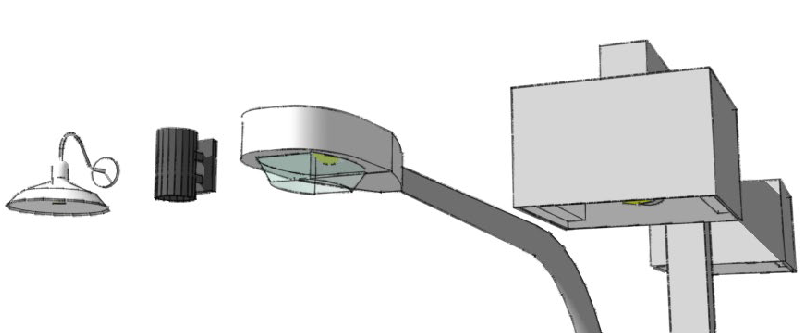
All exterior lights shall include full cut-off fixtures unless otherwise specified in this Section. See Figure 16-4-120, Examples of Full Cut-Off Fixture;i§ .....i;.
|
Figure 16-4-120
Examples of Full Cut-Off Fixtures |
|---|
 |
b.
Each light fixture shall not emit more than one thousand eight hundred (1,800) lumens (approximately equivalent to a one-hundred-watt incandescent bulb) unless otherwise specified in this Section.
c.
All exterior lights shall be designed and oriented in a way to minimize glare and light spillover onto adjacent lots, streets, and rights-of-way. Exterior lights shall not be allowed to shine directly onto abutting residential lots or in any manner that creates a hazard to adjacent properties or to pedestrian or vehicular traffic on adjacent streets and rights-of-way.
(2)
Landscape and Architectural Accent Lighting. Lighting used exclusively to illuminate landscape elements, such as trees, bushes, sculptures, and fountains, and lighting used exclusively to illuminate building facades and structures as accent lighting shall be turned off from 11:00 p.m. to sunrise the following day. Landscape and architectural accent lighting may include up-lighting as long as such lighting is shielded and the bulb is not visible by a direct line of sight from an adjacent property or right-of-way.
(3)
Recreation Use and Recreation Accessory Structure Lighting.
a.
Light standards that are twelve (12) feet or more in height and associated with accessory or recreational uses or structures shall be turned off between 11:00 p.m. and sunrise the following day.
b.
These fixtures may exceed one thousand eight hundred (1,800) lumens, provided that:
i.
The light source is not directly visible from adjoining lots or streets; and
ii.
The lighting does not result in more than 0.2 foot-candles of additional illuminance at any property line, measured in the horizontal plane at ground level and the vertical plane at four (4) feet above ground level.
(4)
Motion-Sensor Security Lighting. Unshielded spotlights activated by a motion sensor shall be allowed with a maximum output of two thousand eight hundred (2,800) lumens (approximately equivalent to a one-hundred-fifty-watt incandescent bulb). The light shall only be activated by movement located on the property on which the light is located, and shall turn off within five (5) minutes after the detected motion ceases.
(c)
Exceptions. The standards of this Section shall not apply to the following types of lighting:
(1)
Seasonal and holiday lighting displays, not to exceed forty-five (45) days per calendar year.
(2)
Up-lighting of flags when the light source is shielded from the sides.
(3)
Sign illumination as set forth in Article III, Division 4, Signs.
(4)
Outdoor lights associated with an approved permit for a nonresidential use that specifically addresses lighting and approves lighting that deviates from the standards of this Section.
(5)
Outdoor lights associated with an approved major special event permit that specifically addresses lighting and approves lighting that deviates from the standards of this Section.
(6)
Lighting that is required by an adopted building code or other life-safety code.
(7)
Lighting installed by the City, or required by the City, for the benefit of public health, safety, and welfare, including but not limited to traffic control devices, streetlights, and construction lights.
(8)
Decorative lighting fixtures, provided that no individual fixture produces more than one thousand two hundred (1,200) lumens.
(9)
Lighting of parking lots, which is subject to Section 16-4-130, Lighting of Parking Lots.
(Ord. 7, §1, 2019)
Sec. 16-4-130. - Lighting of parking lots.
(a)
Generally. The lighting of parking lots for nonresidential uses is subject to the standards of this Section. The following standards shall apply to such lighting plans and installations:
(b)
Orientation and Arrangement of Lighting Fixtures. Fixtures shall be oriented and shielded such that the source of illumination (bulb or direct lamp image) is not visible in a direct line of sight from any portion of any other property or right-of-way. Lights must be arranged so as not to create an unreasonable risk to the safety of vehicular or pedestrian traffic on a street or public property.
(c)
Spillover. The maximum horizontal illumination at the property line at ground level shall not exceed 0.2 foot-candles.
(d)
Fixture Height. Lighting fixtures shall not exceed eighteen (18) feet in height, inclusive of any base or support, measured from the parking lot surface. Any lighting fixture damaged to the extent of more than seventy-five percent (75%) of replacement cost must be brought into conformance with this standard upon replacement or repair.
(e)
Hours of Operation. Lights shall be off between 11:00 p.m. and sunrise the next day. The Director may, upon a showing of good and sufficient cause, grant an exception to the lighting curfew required by this Section for events that extend past the lighting curfew. Lights left on for these purposes shall nevertheless comply with the requirements of subsections (b), (c) and (d), above.
(Ord. 7, §1, 2019)
Sec. 16-4-210. - Minimum requirements for landscape materials.
(a)
Generally. Trees and shrubs that are required by this Chapter shall meet the minimum standards of Table 16-4-210, Minimum Requirements for Landscape Materials.
(b)
Planting and Maintenance. Landscaping shall be planted and maintained in a neat, clean, and healthy condition. Landscape maintenance shall include routine irrigation, pruning, mowing, and weeding as necessary to ensure an appearance of quality and care. Damaged or dead landscaped material shall be promptly repaired or replaced (weather permitting) in cases where the material is required by this Chapter; or removed, repaired, or replaced in cases where the material is not required by this Chapter.
(Ord. 7, §1, 2019)
Sec. 16-4-220. - Parking lot landscaping.
(a)
Screening.
(1)
The City shall require screening between off-street parking and uses on adjoining residential properties when:
a.
The use of the subject property is likely to generate traffic after sunset and the parking lot is configured such that light from headlights will create glare upon a dwelling unit; or
b.
The parking lot is located less than fifty (50) feet from a residential property line; or
c.
The City finds that the land use will involve high-volume, high-turnover parking, and buffering is necessary to reduce the impacts of the use of the parking lot on adjoining property owners.
(2)
Required screening may take the form of densely planted trees and shrubs, berms and other landforms or fences. Screening shall be opaque (e.g., densely plated shrubs, perimeter walls, berms, or privacy fences) from ground level to a height of three (30 feet above the parking surface, and within a period of not more than three (3) years after installation of the buffer, at least fifty percent (50%) opaque between three (3) and six (6) feet above the parking surface.
(b)
Minimum Landscape Area. In addition to the screening required by subsection (a), above, an area or a combination of areas within are adjacent to the parking lot, equal to at least forty-two (42) square feet per hard-surfaced parking space, shall be landscaped to beautify the area and avoid the appearance of an unbroken expanse of parking surface. The required landscaping must include a minimum ten-foot wide landscape strip along any street frontage. Any parking area in excess of thirty (30) parking spaces shall include interior landscape islands.
(c)
Minimum Planting Requirements.
(1)
A minimum of seventy-five percent (75%) of all required landscaped areas must be covered by living material.
(2)
Overall, parking lot landscaped areas shall contain a minimum of two (2) trees and four (4) shrubs per five hundred (500) square feet of landscaped area, plus one (1) additional tree for every fifty (50) feet of parking lot frontage along a public or private street; and these additional trees must be placed along the street frontage within twenty (20) feet of the right-of-way line (or as close thereto as possible if planting within twenty (20) feet of the right-of-way line will conflict with utility or drainage easements). Each island must contain a minimum of one (1) tree and four (4) shrubs. One (1) additional tree may be substituted for each four (4) shrubs required herein.
(Ord. 7, §1, 2019)
Sec. 16-4-230. - Tree preservation.
(a)
Generally. The purpose and intent of this Section is to provide minimum requirements for protecting established trees in order to preserve the semi-rural character of the Village and qualities associated with that character, while protecting the health, safety and general welfare of the community. The City Council finds that these regulations are necessary in order to:
(1)
Preserve the privacy and value of existing homes;
(2)
Preserve the semi-rural character of the community;
(3)
Screen nighttime light pollution from roads and adjacent properties; and
(4)
Preserve wildlife habitat and shade.
(b)
Applicability.
(1)
Generally. Any established tree removed from within the minimum primary structure setback area required in the R-1, R-2, R-3, R-3A, R-4, or R-5 zoning districts by Section 16-3-10, General Lot and Building Standards for Residential Zoning Districts must be replaced in accordance with the requirements of subsection (d), below, if the tree was removed:
a.
In conjunction with:
i.
Development of a new residence; or
ii.
An expansion of an existing residence that increases the floor area of such residence by fifty percent (50%) or more; or
b.
Within the twelve (12) months preceding the date upon which a building permit application for such development or expansion was submitted.
(2)
City Rights-of-Way. Established trees shall not be removed from City rights-of-way without prior written permission from the City. Where the City approves removal of an established tree from a City right-of-way (e.g., to facilitate development on an adjacent lot), the City may require replacement of the tree.
(3)
Exceptions. This Section does not require replacement of established trees that are:
a.
Listed on the State of Colorado Noxious Weeds Lists A, B, or C, as designated by C.R.S. § 35-5.5-108(2)(a), as amended; or
b.
Listed in Section 7-4-10, Cherry Hills Village Municipal Code.
(c)
Transplantation. In lieu of replacement, established trees may be transplanted to another location within the same lot, or from the right-of-way to the lot. However, if transplanted trees do not survive at least thirty-six (36) months after planting, they shall be replaced as required by this section within six (6) months after it is determined that they did not survive.
(d)
Replacement Requirements.
(1)
Established trees that have been or will be removed must be replaced, in the aggregate, as provided in Table 16-4-230, Tree Replacement Schedule.
(2)
All replacement trees shall have a minimum caliper size of two (2) inches at the time of planting.
(e)
Noxious Species. No species of tree shall be planted if it is listed on the State of Colorado Noxious Weeds Lists A, B, or C, as designated by C.R.S. § 35-5.5-108(2)(a), as amended, or in Section 7-4-10, Cherry Hills Village Municipal Code.
(f)
Waiver of Replacement Requirements. The Director may authorize a waiver from the replacement requirements of this Section upon the written request of the applicant if it is demonstrated that:
(1)
The removal of the established tree is beyond the reasonable control of the applicant, or a professional arborist has issued a written recommendation that the established tree be removed because of the poor or unhealthy condition of the tree; and
(2)
The requested waiver of the replacement requirements affords reasonable protections to adjacent properties (i.e., the removed tree did not have a substantial role in buffering the actively used areas of the subject property from the actively used areas of adjacent property); and will not cause a material, undesirable change in the character of the neighborhood or have an adverse effect on the physical or environmental conditions of the surrounding property.
(Ord. 7, §1, 2019; Ord. 18, § 1, 2022; Ord. 1, §5, 2025)

