
Cherry Hills Village
City Zoning Code
City Zoning Code
ARTICLE IX
Measurements, Calculations, Acronyms and Definitions
Sec. 16-9-10. - Building height.
(a)
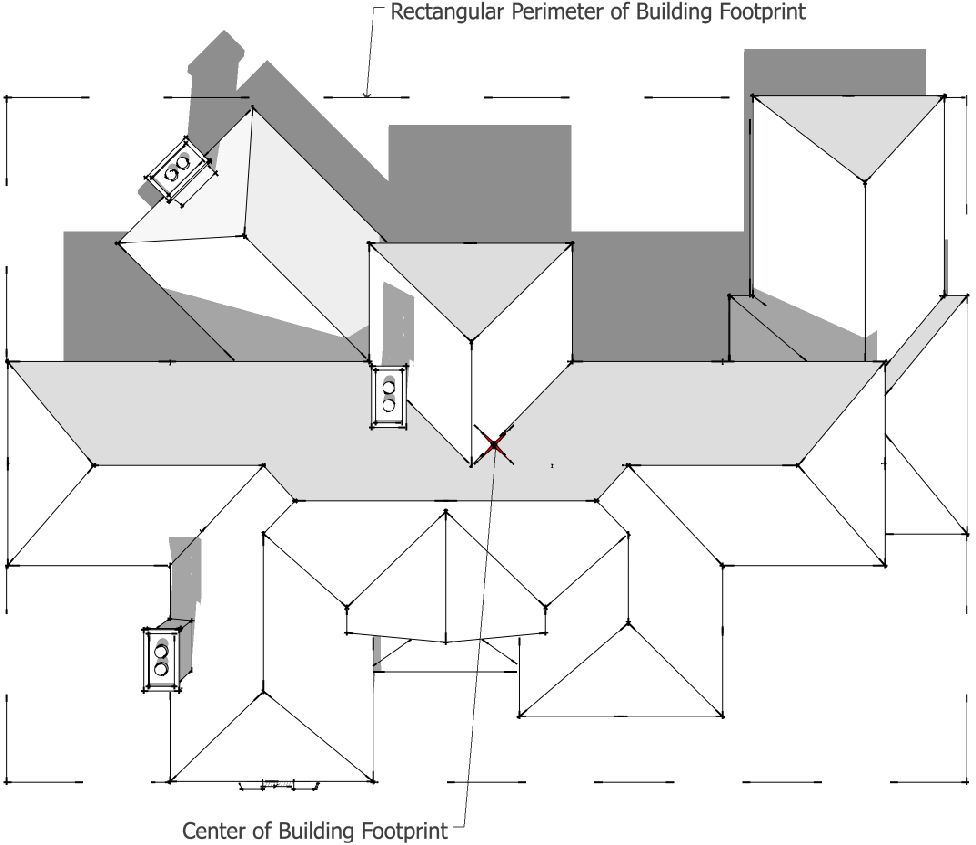
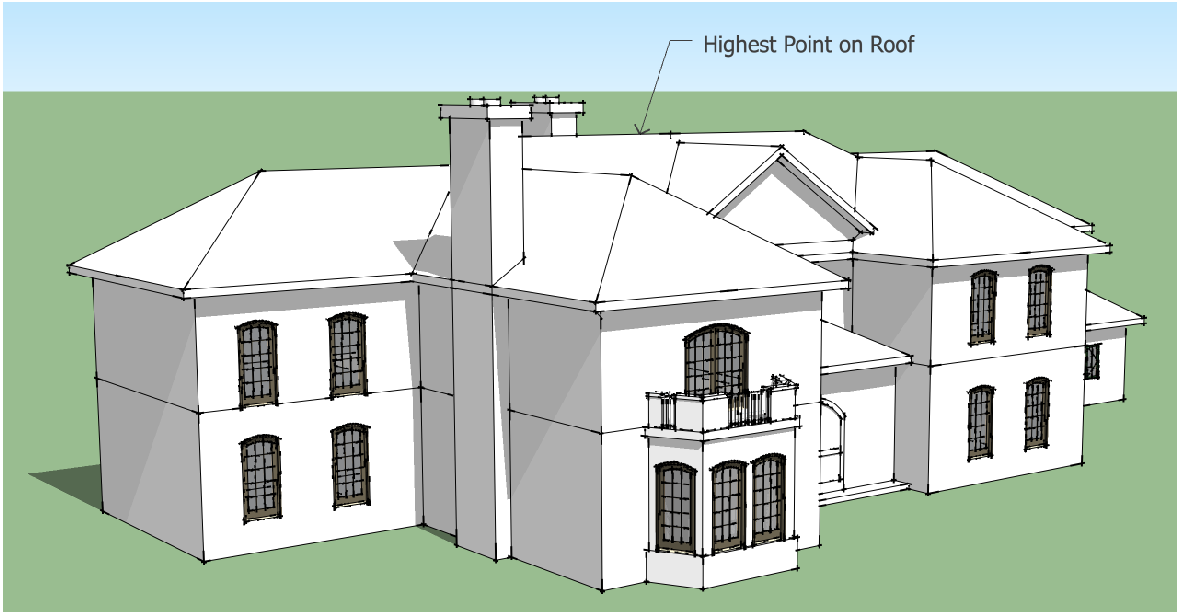
Measurement of Height. Building height is measured from the natural grade at the center of the rectangular perimeter of the building footprint to the highest point of the roof.
(b)
Exceptions.
(1)
In all zoning districts, Chimneys may be built to a height of five (5) feet above the highest point of the roof.
(2)
In the C-2 zoning district, roof-mounted mechanical equipment may be built to a height of five (5) feet above the highest point of the roof, provided that it is screened from view from surrounding rights-of-way.
|
Figure 16-9-10
Illustrative Building Height Measurement |
|---|
 |
|
Figure 16-9-10
Illustrative Building Height Measurement |
|---|
 |
(Ord. 7, §1, 2019)
Sec. 16-9-15. - Fence, garden wall, and perimeter wall height.
(a)
Generally.
(1)
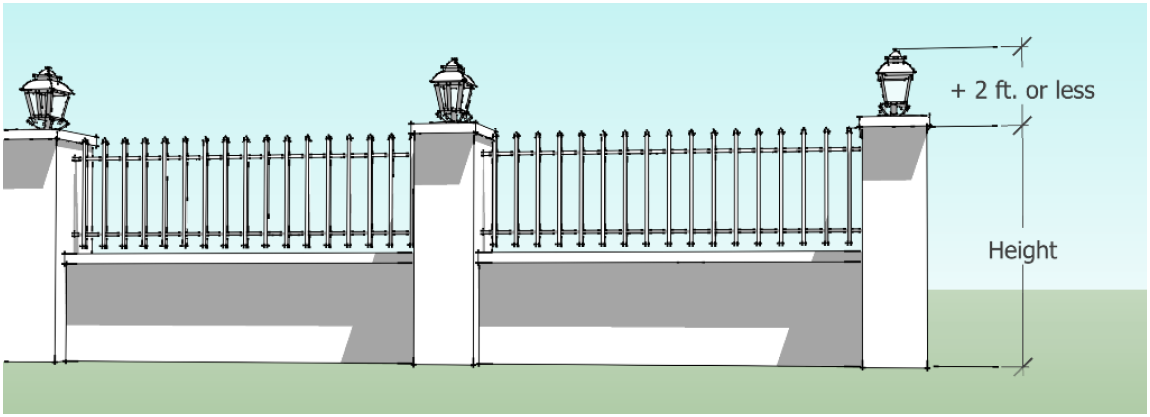
The height of fences and garden walls is calculated by measuring the vertical distance between the natural grade, or from the grade of an approved overlot grading plan, to the top of the fence.
(2)
Where fences are constructed upon berms, the height of such fences shall be measured as the sum of the height of the fence and the berm.
(b)
Exceptions. Neither a column nor a light fixture attached to a column shall be included within the calculation of the height of a fence so long as the height of the column, or combination of the height of the column and the light fixture, is not more than two (2) feet greater than the otherwise applicable height limitations for the fence, and the columns that exceed the otherwise applicable height limitations are spaced at least six (6) feet apart.
|
Figure 16-9-15
Illustrative Fence and Garden Wall Height Measurement |
|---|
 |
(Ord. 7, §1, 2019)
Sec. 16-9-20. - Structure height.
(a)
Structures Without Roofs. The height of structures that do not have a roof is calculated by measuring the vertical distance from the average natural grade, or from the grade of an approved overlot grading plan, around the base of the structure to the highest point on the structure (including any attachments thereto, such as antennae).
(b)
Structures With Roofs. The height of roofed structures that are not "buildings" (e.g., gazebos and loafing sheds) is calculated in the same manner as the height of buildings. See Section 16-9-10, Building Height.
(Ord. 7, §1, 2019)
Sec. 16-9-25. - Setbacks.
(a)
Generally. Setbacks are the minimum required distances between lot lines and buildings, patios, decks, porches, or impervious surfaces not specifically exempted in subsection (b), below. They are generally measured as an offset from the referenced lot lines (or curves) toward the interior of the lot. This Chapter may establish different setbacks for different types of buildings or structures.
(b)
Exceptions.
(1)
The following are not subject to setback requirements except where specifically identified in this Chapter:
a.
Fences;
b.
Perimeter walls;
c.
Driveways;
d.
Sidewalks;
e.
Utility boxes or equipment (not including HVAC equipment or generators); and
f.
Landscape features.
(2)
Wall signs may extend up to eighteen (18) inches from a building wall, and may encroach into required setbacks.
(c)
Specific Setbacks.
(1)
Measurement. Setbacks are measured as follows:
a.
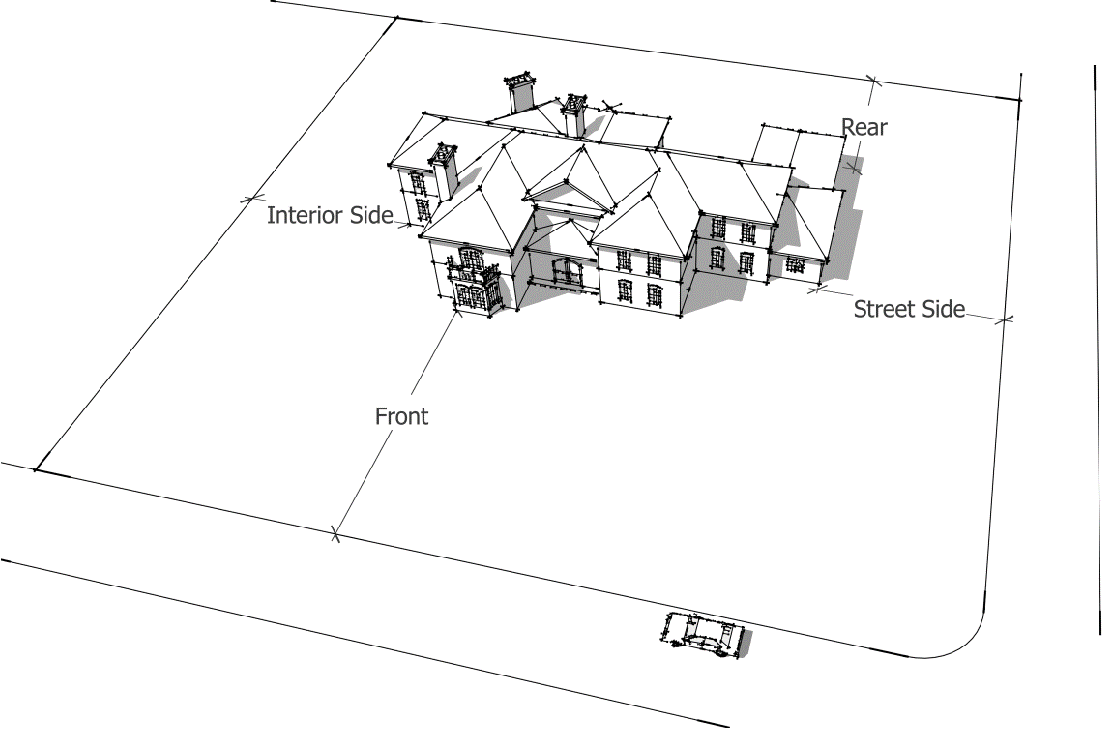
Front Setbacks. Front setbacks are measured from the front property line.
b.
Interior Side Setbacks. Interior side setbacks are measured from side property lines that are not street right-of-way boundaries.
c.
Street Side Setbacks. Street side setbacks are measured from street side property lines.
d.
Rear Setbacks. Rear setbacks are measured from rear property lines.
(2)
Director Discretion. For corner lots, through lots, and odd-shaped lots, the Director shall determine which property lines are front, interior side, street side (where applicable), and rear.
|
Figure 16-9-25
Illustrative Setback Measurements |
|---|
 |
(Ord. 7, §1, 2019)
Sec. 16-9-30. - Lot width.
Lot width is measured as the linear distance between the points where the front setback line intersects with the side lot lines.
(Ord. 7, §1, 2019)
Sec. 16-9-35. - Lot depth.
Lot depth is measured as the shortest distance between the front lot line and the rear lot line.
(Ord. 7, §1, 2019)
Sec. 16-9-40. - Lot area.
(a)
Generally. Lot area is the total area within the lot lines of a lot.
(b)
Addition to Lot Area. Areas outside of the lot lines of a lot may be counted towards lot area in certain zoning districts, as follows:
(1)
R-1, R-2, R-3, R-4, O-1, and C-1 Zoning Districts. In the R-1, R-2, R-3, R-4, O-1, and C-1 zoning districts, lot area may also include adjoining public street rights-of-way to the centerlines of the streets, or the area extending 30 feet into the right-of-way from the street lot lines, whichever results in less additional area.
(2)
R-3A Zoning District. In the R-3A zoning district, lots that are at least one-half (½) acre in lot area may include (within the one-half (½) acre or more) the area identified in subsection (B)(1), above, provided that such area does not exceed twenty percent (20%) of the total area of the lot.
(3)
Exception for Lawful Lots of Record. Lots of record that were measured to the centerline of a street that is more than thirty (30) feet from the lot line shall be considered conforming as to lot area if they were lawfully created before the effective date of this Chapter.
(c)
Canals. The measurement of lot area does not include any areas within canal rights-of-way that are under separate ownership from the lot (e.g., Highline Canal).
(Ord. 7, §1, 2019)
Sec. 16-9-45. - Floor area.
(a)
Generally. Floor area is equal to the sum of the area of standard building areas (as defined in subsection (b), below) and two (2) times the area of high volume building areas (as defined in subsection (c), below), but not including the area of exempt areas (as defined in subsection (d), below).
(b)
Standard Building Areas. Standard building areas are the areas of the following spaces and building elements:
(1)
Rooms, mezzanine, loft and attic spaces where the distance between the floor and the ceiling or roof rafters directly above is greater than six (6) feet but not more than sixteen (16) feet;
(2)
Stairways with a maximum footprint of one hundred (100) square feet;
(3)
Utility areas;
(4)
Attached garages;
(5)
Roofed porches, balconies, loggias and breezeways that are enclosed on more than two (2) sides.
(6)
Walkout basement areas.
(c)
High Volume Building Areas. High volume building areas are the areas of the following spaces and building elements:
(1)
High volume spaces where the distance between the floor and the ceiling or roof rafters directly above is greater than sixteen (16) feet.
(2)
Stairways with a footprint greater than one hundred (100) square feet.
(d)
Exempt Areas. Exempt areas are the areas of the following spaces and building elements:
(1)
Attic areas where the distance between the floor and the roof rafters directly above is six (6) feet or less;
(2)
Accessory structures that are detached from the primary structure;
(3)
Roofed porches, balconies, loggias and breezeways that are not enclosed by solid walls on more than two (2) sides; and
(4)
Standard basement areas.
(Ord. 7, §1, 2019)
Sec. 16-9-50. - Floor area ratio.
Floor area ratio is the floor area of the principal building (measured as provided in Section 16-9-45, Floor Area), divided by the lot area (measured as provided in Section 16-9-40, Lot Area, subsection (a), and not including any of the additions set out in subsection (b)).
(Ord. 7, §1, 2019)
Sec. 16-9-55. - Sign area.
(a)
Generally. Sign area is the area within a continuous polygon with up to eight (8) straight sides that completely encloses the limits of text and graphics of a sign, together with any frame or other material or color forming an integral part of the display or used to differentiate the sign's contents from the background against which they are placed.
(b)
Inclusions and Exclusions. Sign area does not include the structure upon which the sign is placed (unless the structure is an integral part of the display or used to differentiate it), but does include any open space contained within the outer limits of the display face, or between any component, panel, strip, or figure of any kind composing the display face, whether this open space is enclosed by a frame or border or not, except that wall signs that are separated by a distance of more than three (3) feet shall be considered separate signs.
(c)
Multiple Sign Faces and Three-Dimensional Sculptural Elements. Free-standing and projecting signs may include multiple faces or three-dimensional sculptural elements.
(1)
If two (2) sign faces are parallel to each other and facing opposite directions (a "back-to-back" configuration), or offset from each other along the horizontal plane by an internal angle of less than forty-five (45) degrees, then the sign area is measured as the area of one (1) of the sign faces (if the sign faces have different areas, the larger sign face is measured).
(2)
If a sign with multiple sign faces or three-dimensional sculptural elements does not qualify for measurement according to subsection (c)(1), above, then the area of such signs is measured using the vertical cross-section that represents the sign's maximum projection upon a vertical plane.
(Ord. 7, §1, 2019)
Sec. 16-9-110. - Rules of construction.
(a)
Generally. For the purposes of this Chapter and unless the context clearly indicates otherwise, certain terms and words used herein shall be interpreted as follows:
(1)
The present tense includes the future tense;
(2)
The singular number includes the plural and the plural number includes the singular;
(3)
The word shall is mandatory and the word may is permissive;
(4)
The words used or occupied include the words intended, designed or arranged to be used or occupied; and
(5)
The word lot includes the words plot or parcel.
(b)
Specific Words and Phrases.
(1)
The term "construct" or "construction," as used herein shall also mean reconstruction, structural alteration, placement, erection, or movement of a building or structure.
(Ord. 7, §1, 2019)
Sec. 16-9-120. - Table of acronyms.
Table 16-9-120, Table of Acronyms, sets out the acronyms that are used in this Chapter.
(Ord. 7, §1, 2019)
Sec. 16-9-130. - Definitions.
1-9
100-year flood means a flood having a recurrence interval that has a one-percent chance of being equaled or exceeded during any given year (1-percent-annual-chance flood). The phrases "one-hundred-year flood" and "one (1) percent chance flood" are synonymous with the phrase "100-year flood." The phrase does not imply that the flood will necessarily happen once every one hundred (100) years.
100-year floodplain means the area of land susceptible to being inundated as a result of the occurrence of a 100-year flood.
A
Accessory building means a building that is:
(1)
Subordinate to the use and scale of the principal building or principal structure, or supportive of and incidental to an outdoor land use;
(2)
Customary in connection with the principal building, principal structure, or use of land; and
(3)
Ordinarily located on the same lot with the principal building, principal structure, or outdoor use of land.
Examples of accessory buildings include, but are not limited to, detached garages, storage sheds, playhouses, maintenance buildings, and barns.
Accessory structure means a detached subordinate structure located on the same lot as a principal structure, the use of which is customary and incidental to the use of the principal structure. Examples of accessory structures include, but are not limited to, gazebos, pergolas, and agricultural or livestock structures, where permitted. Swimming pools, tennis courts (when not enclosed), detached patios (when not enclosed), and built-in fireplaces and barbeque grills shall not be considered accessory structures, except for setback requirements. The phrase "accessory structure" does not include the phrase "landscape feature."
Accessory use means a use of land that:
(1)
Is clearly subordinate to the principal use in terms of extent and purpose;
(2)
Is essential or convenient to the operation or function of the principal use, or within the City is customarily associated with the principal use;
(3)
Is conducted by the owner of the principal use; and
(4)
Is located on the same lot or parcel as the principal use.
Addition, with respect to a building or structure, means any activity that expands the enclosed footprint or increases the floor area of an existing building or structure.
Agricultural land uses means a general classification of land uses that includes Crops and Livestock.
Area of shallow flooding means a designated Zone AO or AH on the City's Flood Insurance Rate Map ("FIRM") with a one (1) percent chance or greater annual chance of flooding to an average depth of one (1) to three (3) feet where a clearly defined channel does not exist, where the path of flooding is unpredictable and where velocity flow may be evident. Such flooding is characterized by ponding or sheet flow.
B
Base flood means the flood that has a one (1) percent chance of being equaled or exceeded in any given year (also known as a 100-year flood). This term is used in the National Flood Insurance Program ("NFIP") to indicate the minimum level of flooding to be used by a community in its floodplain management regulations.
Base flood elevation ("BFE") means the elevation shown on a FEMA Flood Insurance Rate Map for Zones AE, AH, A1-A30, AR, AR/A, AR/AE, AR/A1-A30, AR/AH, AR/AO, V1-V30, and VE that indicates the water surface elevation resulting from a flood that has a one (1) percent chance of equaling or exceeding that level in any given year.
Basement, for the purposes of the Floodplain Management Regulations, means any area of a building having its floor sub-grade (below ground level) on all sides. For all other purposes in this Chapter, it means "Basement, Standard" or "Basement, Walkout," depending upon the context.
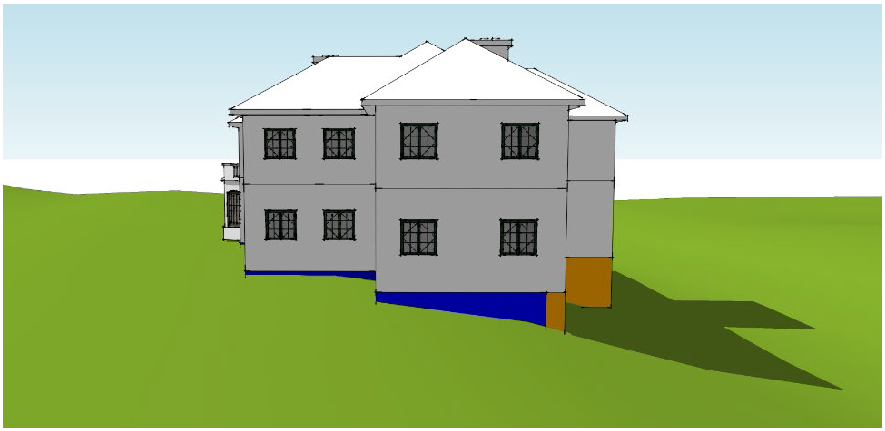
Basement, standard means any interior floor area having a ceiling height of at least six (6) feet and bounded by an exterior wall that is not exposed more than four (4) feet above the adjacent finished grade, or by the standard basement's interior boundary, which is a vertical plane that connects two (2) vertical lines on the outer walls that are located at the point where the exterior wall is exposed at a height of four (4) feet. See Illustration: Standard Basement Versus Walkout Basement.
Basement, walkout means any interior floor area on the same level as a basement, having a ceiling height of at least six (6) feet and bounded by an exterior wall that is exposed to a height of more than four (4) feet above the adjacent finished grade or by the interior perimeter of a standard basement. See Illustration: Standard Basement Versus Walkout Basement, and definition of Basement, Standard.
|
ILLUSTRATION
Standard Basement Versus Walkout Basement |
|---|
| Exposed areas 4 ft. or less (standard basement) shown in blue; more than 4 ft. (walkout basement) shown in orange. |
 |
Berm means a graded or constructed mound, pile, hill, or bank composed of soil or rock, or a combination of earth materials and other suitable building material (as approved by the Director), the peak or ridge of which is perceptibly above the preconstruction grade, usually constructed for the purpose of noise mitigation, privacy, surface drainage alteration or control, or landscaping amenity.
Buildable area means the portion of a lot remaining after required yards have been provided.
Building means an enclosed, roofed structure intended for the shelter or enclosure of persons, animals, chattels, property, or substances of any kind. The term "building" includes portions of the structure that are not fully enclosed, such as covered porches, balconies, patios, and attached decks. The term "building" does not include uncovered, at-grade hardscape elements (e.g., walkways, concrete slabs, paved areas, pool decks, etc.) that are installed adjacent to the building.
Building envelope means the three-dimensional space within which a building may be constructed on a lot, the boundaries of which are generally defined by maximum height regulations, bulk plane requirements, and minimum yard requirements.
Building permit means a written document granting permission to construct, erect, repair, or alter buildings or structures in accordance with the building and zoning codes of the City in effect at the time the application for the permit is filed.
Bulk plane means a plane that begins at a specified starting height above the minimum side and rear yard lines on a lot or parcel, then rises at an angle towards the center of the lot until it reaches the maximum permitted height in the applicable zoning district or intersects with a bulk plane rising from another yard line. The starting height for the bulk plane may vary for the front and rear areas of a lot. See Section 16-3-030, Bulk Plane Regulations.
C
Caliper means the diameter measurement of the stem or trunk of nursery stock. The location of the measurement depends on the plant type. For fruit trees, small fruits, understock, and seedling trees and shrubs, caliper measurement is taken at the root collar or at other points expressly described in ANSI Z60.1. For all other nursery stock, caliper measurement is taken six (6) inches above the ground level for field grown stock, from the soil line for container grown stock (generally at or near the top of the root flare), and six (6) inches above the root flare for bare root plants, up to and including the four-inch caliper size interval (i.e., from four (4) inches up to, but not including, 4.5 inches). If the caliper measured at six (6) inches is four and one-half (4½) inches or more, the caliper is measured at twelve (12) inches above the ground level, soil line, or root flare, as appropriate.
Candela means the SI unit of luminous intensity in a given direction.
Cemetery means any place, including a mausoleum, niche, or crypt, in which there is provided space below the surface of the ground for the interment of the remains of human bodies.
Channel means the physical confine of stream or waterway consisting of a bed and stream banks, existing in a variety of geometries.
Channelization means the artificial creation, enlargement or realignment of a stream channel.
Code of Federal Regulations ("CFR") means the codification of the general and permanent Rules published in the Federal Register by the executive departments and agencies of the Federal Government. It is divided into fifty (50) titles that represent broad areas subject to Federal regulation.
Columbarium means a sepulchral vault or other structure with recesses in the walls to receive the ashes of human remains.
Column means a sporadic structural support pillar or architectural element with comparable aesthetic effect, used in the construction of a fence or perimeter wall.
Commercial greenhouse means the use of greenhouse buildings or open land for the propagation and cultivation of trees, shrubs, ornamental plants, flowers, herbs, fruiting plants, and vegetable plants that are sold as live plants at wholesale (e.g., to landscape contractors or retail stores) or retail.
Commercial land uses means a general classification of principal land uses where goods or services are exchanged for money that are not clearly subordinate and incidental to the primary use of the property as determined by the Director. Examples include, but are not limited to; medical or professional offices; restaurants; retail sales and services, type A; pet day care or training; veterinary offices; fueling or services stations; and vehicle washes.
Common building means a building located on property under common ownership, that is available for access and use by its common owners (e.g., a community clubhouse, restroom facility, etc.), or is used to provide services to or storage for the benefit of its common owners (e.g., a maintenance facility or building used to store landscaping equipment to maintain commonly owned property).
Common ownership, with respect to real property, means that fee title or a leasehold interest in the real property is held by an association that is organized under the Colorado Common Interest Ownership Act (C.R.S. § 38-33.3-101, et seq.), or an association or corporation of condominium unit owners as provided by C.R.S. § 38-33-105, or a cooperative housing corporation organized under C.R.S. § 38-33.5-101, et seq.
Community land uses means a general classification of principal land uses that includes governmental offices; parks; places of assembly; private clubs; schools or daycares; and cemeteries and columbaria.
Community guardhouse means a building or structure, associated parking area, and gates operated for the benefit of a subdivision or area's residents, for the purpose of monitoring access to private streets. A community guardhouse is not a private club.
Community Supported Agriculture Farm ("CSA Farm") means an agricultural use in which, in return for subscribing to a harvest, shareholders or subscribers who invest in the harvest prior to the start of the season, or who contributed labor in lieu of share or subscription costs, periodically receive a box of produce or other agricultural goods during the production season.
Conditional Letter of Map Revision ("CLOMR") means FEMA's comment on a proposed project, which does not revise an effective floodplain map, that would, upon construction, affect the hydrologic or hydraulic characteristics of a flooding source and thus result in the modification of the existing regulatory floodplain.
Construction trailer means a temporary trailer used for storage of construction materials and equipment, construction site security, or construction site administration.
Construction yard means an area of land that is used on a temporary basis for the parking and storage of equipment used in a construction project, and/or the storage and preparation of materials and other items used in the construction project.
Critical facility means a building, structure, or related infrastructure, but not the land on which it is situated, as specified in Section 16-5-280, Standards for Critical Facilities, that if flooded may result in significant hazards to public health and safety or interrupt essential services and operations for the community at any time before, during and after a flood. SeeSection 16-5-280, Standards for Critical Facilities.
Crops means aquaculture involving plants, floriculture, horticulture, silviculture, or viticulture. The definition of Crops does not include the phrases; "community garden", "intensive agriculture," "hemp production," "marijuana cultivation," or "personal garden," nor does it include the treatment of wastewater or biosolids (e.g., sprayfields or land application).
D
Development means:
(1)
For all purposes except the application and administration of Floodplain Management Regulations:
a.
The principal use of any building, structure, or land, specifically including:
i.
New principal land uses;
ii.
Changes of principal land use;
iii.
Material physical expansions of existing principal land uses;
iv.
Material changes in the operations of existing principal land uses; and
b.
The accessory use of any building, structure, or land;
c.
The temporary use of any building, structure, or land; and
d.
The disturbance of land, soil, vegetation, or waterways, including alteration of land for construction or other purposes, but not including:
i.
Routine landscape maintenance;
ii.
Customary agricultural operations on lots where agriculture is a principal land use;
iii.
Installation or removal of landscaping on residential or agricultural lots, except as such landscaping may be subject to an approved landscape plan (if applicable);
e.
Construction or installation of buildings, infrastructure, or other structures, except as may be exempt from City regulation under Colorado law;
f.
Any division of land for sale or lease, whether by metes and bounds, subdivision plat, condominium plat/declaration of condominium, or other technique; and
g.
Expansions or modifications of buildings or structures which change their footprint and/or height, but not including exterior modifications that do not perceptibly affect the dimensions of the building (e.g., reroofing, repainting, changing windows, etc.).
(2)
For the purposes of the application and administration of the Floodplain Management Regulations: any man-made change to improved or unimproved real estate, including but not limited to construction or substantial improvement of buildings or other structures, mining, dredging, filling, grading, paving, excavating or drilling operations or storage of equipment or materials located within the special flood hazard area.
DFIRM Database means a database (usually spreadsheets containing data and analyses) that accompanies DFIRMs. The FEMA Mapping Specifications and Guidelines outline requirements for the development and maintenance of DFIRM databases.
Diameter at breast height ("DBH") means the outside bark diameter of a tree at 4.5 feet above the ground on the uphill side of the tree ("breast height"). Diameter at breast height is used to measure trees in their natural environment, or after they are planted. Nursery stock is generally measured by caliper (see definition of "Caliper.").
Digital Flood Insurance Rate Map ("DFIRM") means a FEMA digital floodplain map. These digital maps serve as "regulatory floodplain maps" for insurance and floodplain management purposes.
Director means the Community Development Director or designee thereof.
Disposal, with regard to land use, means the use of land for permanent disposal of wastes, including such activities that are required to obtain a Certificate of Designation under C.R.S. § 25-15-201 (hazardous waste disposal sites), or Title 30, Article 20, Colorado Revised Statutes (various other types of disposal sites).
Domestic employee means an employee who works within the employer's household, performing domestic services, including but not limited to childcare, housekeeping, cooking, driving, laundry, and shopping.
Dwelling unit means any building or part thereof, providing complete independent living facilities for one (1) or more persons (with areas for living, cooking, eating, sanitation, bathing, and sleeping), that is designed to be occupied for residential purposes. The phrase "dwelling unit" does not include hotels, motels, resorts, boarding or rooming houses, assisted living units, congregate care units, nursing home rooms, convalescent care rooms, memory care rooms, tents, recreational vehicles, or other structures designed or used primarily for temporary or transient occupancy.
E
Elevated building means a non-basement building:
(1)
Built, in the case of a building in Zones A1-30, AE, A, A99, AO, AH, B, C, X, and D, to have the top of the elevated floor above the ground level by means of pilings, columns (posts and piers), or shear walls parallel to the flow of the water and
(2)
Adequately anchored so as not to impair the structural integrity of the building during a flood of up to the magnitude of the base flood.
In the case of Zones A1-30, AE, A, A99, AO, AH, B, C, X, and D, "elevated building" also includes a building elevated by means of fill or solid foundation perimeter walls with openings sufficient to facilitate the unimpeded movement of flood waters.
Enclosure means a fence, wall, or other barrier that regulates access to an area of land, including recreational facilities such as swimming pools.
Established tree means a small tree, medium tree, or large tree that is present on a subject property at the time an application under this Chapter is filed.
Existing manufactured home park or subdivision means a manufactured home park or subdivision for which the construction of facilities for servicing the lots on which the manufactured homes are to be affixed (including, at a minimum, the installation of utilities, the construction of streets, and either final site grading or the pouring of concrete pads) is completed before the effective date of the floodplain management regulations adopted by a community. As of the Effective Date of this Chapter, there are no Existing Manufactured Home Parks or Subdivisions in the City.
Expansion to an existing manufactured home park or subdivision means the preparation of additional sites by the construction of facilities for servicing the lots on which the manufactured homes are to be affixed (including the installation of utilities, the construction of streets, and either final site grading or the pouring of concrete pads). As of the Effective Date of this Chapter, there are no Existing Manufactured Home Parks or Subdivisions in the City.
F
Family means one (1) or more persons occupying a single dwelling unit as a single housekeeping unit, related by blood, marriage or adoption; or not more than three (3) unrelated persons living together as a single housekeeping unit; provided that domestic employees who work on the premises may reside on the premises without being counted towards the limitations on unrelated persons set out in this definition; and provided further that residents of a group home, as defined in this Article, shall also be deemed to constitute a family for the purposes of this Chapter.
Federal Register means the official daily publication for Rules, proposed Rules, and notices of Federal agencies and organizations, as well as executive orders and other presidential documents.
FEMA means the Federal Emergency Management Agency, the agency responsible for administering the National Flood Insurance Program.
Fence means a structure that serves as an enclosure, barrier, screen, or boundary, or that serves to mark a boundary, enclose a piece of land or divide a piece of land into distinct portions and that is usually constructed from wood, metal, wire, vinyl, masonry, stone, or other manufactured material.
Flood or flooding means:
(1)
A general and temporary condition of partial or complete inundation of normally dry land areas from:
a.
The overflow of inland or tidal waters.
b.
The unusual and rapid accumulation or runoff of surface waters from any source.
c.
Mudslides (i.e., mudflows) which are proximately caused by flooding as defined in paragraph (1)b. of this definition and are akin to a river of liquid and flowing mud on the surfaces of normally dry land areas, as when earth is carried by a current of water and deposited along the path of the current.
(2)
The collapse or subsidence of land along the shore of a lake or other body of water as a result of erosion or undermining caused by waves or currents of water exceeding anticipated cyclical levels or suddenly caused by an unusually high water level in a natural body of water, accompanied by a severe storm, or by an unanticipated force of nature, such as flash flood or an abnormal tidal surge, or by some similarly unusual and unforeseeable event which results in flooding as defined in paragraph (1) of this definition.
Flood control structure means a physical structure designed and built expressly or partially for the purpose of reducing, redirecting, or guiding flood flows along a particular waterway.\These specialized flood modifying works are those constructed in conformance with sound engineering standards.
Flood elevation determination means a determination by the Federal Insurance Administrator of the water surface elevations of the base flood, that is, the flood level that has a one (1) percent or greater chance of occurrence in any given year.
Flood Hazard Boundary Map ("FHBM") means an official map of a community, issued by the Federal Insurance Administrator, where the boundaries of the flood, mudslide (i.e., mudflow) related erosion areas having special hazards have been designated as Zones A, M, and/or E.
Flood Insurance Rate Map ("FIRM") means an official map on which the Federal Emergency Management Agency has delineated both the Special Flood Hazard Areas and the risk premium zones applicable to the community.
Flood Insurance Study ("FIS") means an examination, evaluation and determination of flood hazards and, if appropriate, corresponding water surface elevations, or an examination, evaluation and determination of mudslide (i.e., mudflow) and/or flood-related erosion hazards. A "Flood Insurance Study" may also be referred to as a "Flood Elevation Study".
Floodplain or flood-prone area means any land area susceptible to being inundated as the result of a flood, including the area of land over which floodwater would flow from the spillway of a reservoir.
Floodplain Administrator means the official designated by title to administer and enforce the floodplain management regulations. SeeSec. 16-7-50, Floodplain Administrator.
Floodplain development permit means a permit required before construction or development begins within any Special Flood Hazard Area ("SFHA"). If FEMA has not defined the SFHA, the City shall require Floodplain Development Permits for all proposed construction or other development (including the placement of manufactured homes), so that it may determine whether such construction or other development is proposed within flood-prone areas. Floodplain Development Permits are required to ensure that proposed development projects meet the requirements of the NFIP and the Floodplain Management Regulations.
Floodplain management means the operation of an overall program of corrective and preventive measures for reducing flood damage, including but not limited to emergency preparedness plans, flood control works and floodplain management regulations.
Floodplain Management Regulations means, collectively, Article V, Floodplain Management and Flood Damage Prevention; Section 16-7-50, Floodplain Administrator; Section 16-7-360, Floodplain Development Permit; Section 16-7-530, Floodplain Variances; and Section 16-7-550, Administrative Appeals to City Council, to the extent that it involves Floodplain Development Permits. The phrase "Floodplain Management Regulations" also includes any other provision of this Chapter (e.g., the standard approval procedures set out in Article VII, Division 2, Permits and Approvals, and Article VII, Division 3, Standardized Procedures), to the extent they are applied to a Floodplain Development Permit, Floodplain Variance, or appeal from a decision of the Floodplain Administrator; and any definitions set out in this Article that refer to the Floodplain Management Regulations or that define terms or phrases that are used in other parts of the Floodplain Management Regulations.
Floodproofing means any combination of structural and/or non-structural additions, changes, or adjustments to buildings or structures which reduce or eliminate flood damage to real estate or improved real property, water and sanitary facilities, buildings, structures, and their contents.
Floodway (regulatory floodway). The channel of a river or other watercourse and adjacent land areas that must be reserved in order to discharge the base flood without cumulatively increasing the water surface elevation more than a designated height. On the Effective Date of this Chapter, the Colorado statewide standard for the designated height to be used for all newly studied reaches shall be one-half (½) foot (six (6) inches). Letters of Map Revision to existing floodway delineations may continue to use the floodway criteria in place at the time of the existing floodway delineation.
Floor area. See Section 16-9-45, Floor Area.
Floor area ratio ("FAR"). See Section 16-9-50, Floor Area Ratio.
Flowline means the curb line of a street, or where a curb is not present, the edge of pavement of a street.
Foot-candle (fc) means a non-SI unit of illuminance or light intensity on a surface. A foot-candle is the amount of illumination on the inside surface of a sphere with a one-foot-radius if there is a uniform point source of light that is one (1) candela in intensity in its exact center. A foot-candle is also the illuminance on a one-square foot surface on which there is a uniformly distributed flux of one (1) lumen.
Footprint means the area of ground that is encompassed within the outer perimeter of a building, structure, or other improvement, measured on a horizontal plane.
Freeboard means a factor of safety usually expressed in feet above a flood level for purposes of flood plain management. "Freeboard" tends to compensate for the many unknown factors that could contribute to flood heights greater than the height calculated for a selected size flood and floodway conditions, such as wave action, bridge openings, and the hydrological effect of urbanization of the watershed.
Front area, with reference to a bulk plane, means the buildable area of the lot closest to the front setback line. See Section 16-3-030, Bulk Plane Regulations.
Front area depth, with reference to a bulk plane, means the horizontal depth of the front area, measured from the front setback line towards the rear of the lot along the side setback lines. See Section 16-3-030, Bulk Plane Regulations.
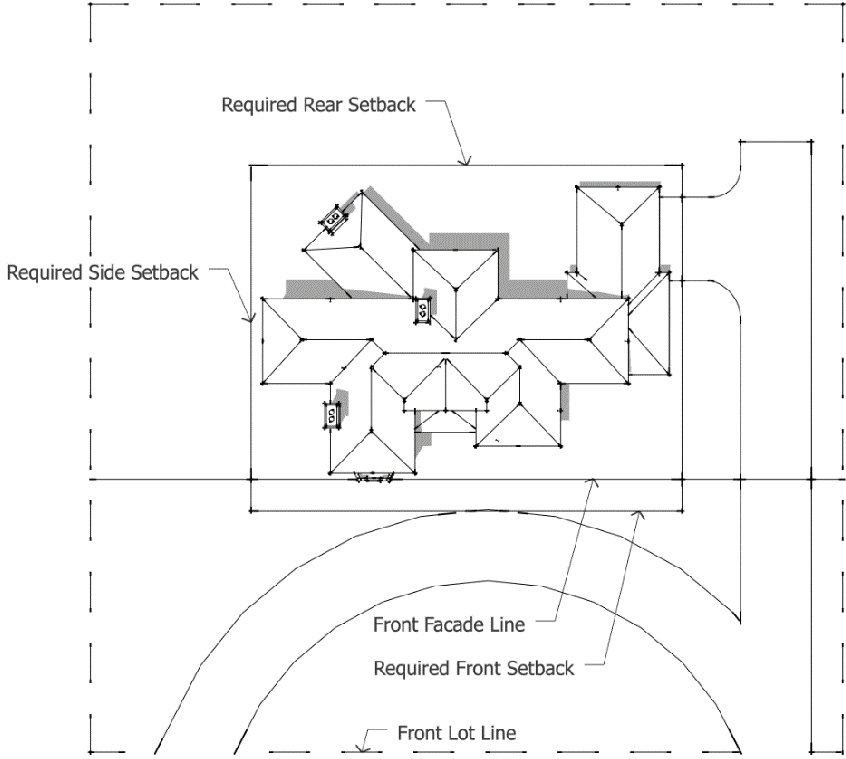
Front facade line means a line generally perpendicular to the side property lines emanating from the outer wall of the facade of the house at the point closest to the front property line. The front facade line is not necessarily the same as the front setback line.
|
ILLUSTRATION
Front Façade Line |
|---|
 |
Front setback line means a line, curve, or combination thereof that is offset into a lot from the front lot line, the distance of the required front setback. The front setback line may also be referred to as the Required Front Setback, Front Yard Line, or Minimum Front Yard Line.
Front yard line, minimum. See "Front Setback Line"
Fueling or service station means:
(1)
Gasoline service stations or fuel stations (e.g., hydrogen, compressed natural gas, or liquefied petroleum gas) for alternative fuel vehicles;
(2)
Gasoline or fuel station convenience marts (a gasoline service station, fuel station, and/or charging station with a convenience store);
(3)
Automated, self-service, or full-service car wash or detailing (cars, light trucks, and sport utility vehicles only);
(4)
Quick service oil, tune-up, brake, and muffler shops in which:
a.
Repairs are made in fully enclosed bays;
b.
Repairs are of a type that is typically completed in less than two (2) hours (e.g., oil changes, brake service, tire rotation and balancing, glass repair, battery replacement, tire replacement, fluid checks and replacement, muffler service, spark plug replacement, and comparable services); and
c.
Vehicles are generally not stored on-site, and on the occasion when overnight storage is necessary, vehicles are stored indoors; or
(5)
Any combination of items (1), (2), (3), or (4), above.
Functionally dependent use means a use which cannot perform its intended purpose unless it is located or carried out in close proximity to water. The term includes only docking facilities, port facilities that are necessary for the loading and unloading of cargo or passengers, and ship building and ship repair facilities, but does not include long-term storage or related manufacturing facilities.
G
Gate means a part of a fence that can be readily moved to block or provide access through an entrance or passageway.
Governmental offices means offices, meeting rooms, and other facilities in which public employees engage in the administration of federal, state, municipal, or quasi-municipal governments with jurisdiction or service areas in Cherry Hills Village. The phrase "governmental offices" includes, but is not limited to, the Village Center, the Joint Public Safety Facility, and South Metro Fire Rescue Authority fire stations.
Group home means a state-licensed group home that is specifically identified in C.R.S. §§ 31-23-303(2)(a) (community residential homes with eight (8) or fewer residents), (2)(b)(II) (group homes for the aged with eight (8) or fewer residents), and (2)(b.5) (group homes for persons with behavioral or mental health disorders with eight (8) or fewer residents). Group homes are subject to the spacing requirements set out in the referenced provisions of the Colorado Revised Statutes without modification. The phrase "group home," for the purposes of this Chapter, specifically does not include any other type of group living arrangement involving more than three (3) unrelated persons or involving any number of unrelated persons who do not operate as a single housekeeping unit.
Guardhouse tract means a tract of land created by a plat or deed, held in common ownership, on which a community guardhouse is located or anticipated.
Guest house means a residential accessory building that may be occupied by members of the family occupying the dwelling, their non-paying guests (on a temporary basis), or domestic servants.
H
High volume space means a room, attached garage or other building element with an especially tall ceiling height, such as an entry area with a cathedral ceiling.
Highest adjacent grade means the highest natural elevation of the ground surface prior to construction next to the proposed walls of a building or structure.
Historic building or structure means any building or structure that is:
(1)
Listed individually in the National Register of Historic Places (a listing maintained by the Department of Interior) or preliminarily determined by the Secretary of the Interior as meeting the requirements for individual listing on the National Register;
(2)
Certified or preliminarily determined by the Secretary of the Interior as contributing to the historical significance of a registered historic district or a district preliminarily determined by the Secretary to qualify as a registered historic district;
(3)
Individually listed on a state inventory of historic places in states with historic preservation programs which have been approved by the Secretary of Interior; or
(4)
Individually listed on a local inventory of historic places in communities with historic preservation programs that have been certified either:
a.
By an approved state program as determined by the Secretary of the Interior or;
b.
Directly by the Secretary of the Interior in states without approved programs.
Home occupation means a commercial use carried out within a dwelling unit, which is clearly incidental and secondary to the use for residential purposes.
I
Industrial and logistics uses means a general category of principal land uses that involve industrial, logistics, or storage activities, including but not limited to airports, bulk storage facilities, disposal (landfill) facilities of any type, energy production involving either combustion or nuclear reactions, food or beverage (including alcoholic beverage) processing and packaging, heavy industrial uses, helistops, light industrial uses, product testing, recycling drop-off or processing centers, resource extraction, salvage yards, shipping terminals, storage yards, warehousing, and waste transfer stations.
Industrial hemp means the plant Cannabis sativa L. and any part of such plant, whether growing or not, with a delta-9 tetrahydrocannabinol concentration of not more than 0.3 percent on a dry weight basis.
Industrial hemp production means cultivation of industrial hemp for commercial or research and development purposes.
Intensive agriculture means:
(1)
Any use where animals are tightly confined in buildings or outdoor pens or pastures, including, but not limited to; feedlots, hog farms, and poultry operations;
(2)
Concentrated animal feeding operations ("CAFOs") of any size as defined by 40 C.F.R. § 122.23, Concentrated Animal Feeding Operations;
(3)
Concentrated aquatic animal production facilities ("CAAPs"), as defined by 40 C. F. R. § 122.24, Concentrated Aquatic Animal Production Facilities;
(4)
Fur Farms; or
(5)
Any other agricultural use that is required to obtain a discharge permit under the Federal Clean Water Act due to animal wastes.
J
Joint public safety facility means the public facility for the administration of police and fire protection services, located at 2460 East Quincy Avenue, Cherry Hills Village, Colorado.
K
Kennel means a facility in which four (4) or more household pets of the same species (except fish) are boarded overnight, and may also be groomed, bred, trained, or incidentally treated for medical conditions. The term "kennel" includes for-profit facilities (e.g., facilities where animals are boarded, or facilities where animals are both bred and sold); as well as not-for-profit or public facilities (e.g., facilities at which abandoned or rescued animals are housed and offered for adoption). The term "kennel" does not include the breeding or boarding of animals as an accessory to an agricultural use. Kennels may be accessory to retail uses that principally involve the sale of pets or pet supplies.
L
Land means an area of ground (regardless of its surface, whether earth, water, landscaping, or improvements) that is located within specific boundaries.
Land use means the principal use of land ("principal land use"), which is the use of land on an ongoing basis for a particular purpose, or an ongoing use which occupies permanent buildings or facilities on the land (e.g., a dwelling unit, a farm, or a retail center). Land uses are classified and enumerated in Article II, Division 2, Land Use by Zoning District, and defined in this Article. Land uses that are not listed in Section 16-2-120, Land Use by Zoning District, or specifically prohibited throughout the City by Section 16-2-130, Land Uses That Are Not Allowed in Any Zoning District, may be permitted pursuant to Section 16-2-140, Land Uses that are Not Listed.
Landscape features means natural features that include: lawns, trees, plants, other natural materials such as rock and wood chips, as well as decorative landscaping features, including but not limited to sculptures, sidewalks, fountains, ponds, mailbox structures, or trellises. The phrase "landscape features" is not included within the definition of the phrase "accessory structure."
Large tree means an established tree that measures twenty (20) inches or larger DBH.
Letter of Map Revision ("LOMR") means FEMA's official revision of an effective Flood Insurance Rate Map ("FIRM"), or Flood Boundary and Floodway Map ("FBFM"), or both. LOMRs are generally based on the implementation of physical measures that affect the hydrologic or hydraulic characteristics of a flooding source and thus result in the modification of the existing regulatory floodway, the effective Base Flood Elevations ("BFEs"), or the Special Flood Hazard Area ("SFHA").
Letter of Map Revision Based on Fill ("LOMR-F") means FEMA's modification of the Special Flood Hazard Area ("SFHA") shown on the Flood Insurance Rate Map ("FIRM") based on the placement of fill outside the existing regulatory floodway.
Levee means a man-made embankment, usually earthen, designed and constructed in accordance with sound engineering practices to contain, control, or divert the flow of water so as to provide protection from temporary flooding. For a levee structure to be reflected on the FEMA FIRMs as providing flood protection, the levee structure must meet the requirements set forth in 44 CFR § 65.10.
Levee system means a flood protection system that consists of a levee, or levees, and associated structures, such as closure and drainage devices, which are constructed and operated in accordance with sound engineering practices.
Livestock means apiaries, aquaculture of animals, bovine, equine, llamas, alpaca, sheep, goats, pigs, rabbits, fowl, and other animals that are not otherwise prohibited by Chapter 7 of the Municipal Code. Livestock does not include the phrase "intensive agriculture".
Lot means a defined area of land that is intended for development.
Lot frontage means the boundary of a lot that is also the boundary of a public or private street right-of-way.
Lot line means a legal boundary of a lot.
Lot of record means a lot that is identified on an approved subdivision plat that is recorded in the office of the Arapahoe County Clerk and Recorder, or a lot that is created by deed or other similar instrument recorded with the Arapahoe County Clerk and Recorder prior to the effective date of this Chapter (which may describe the lot with reference to a plat, by metes and bounds, or by aliquot parts). If a defined area of land was conveyed with reference to a plat, but includes multiple lots or combinations of partial lots from that plat, the entire area of land is considered a "lot" for the purposes of this Chapter if it is developed or used as a single development site or was conveyed by a single recorded deed referencing the multiple lots or portions of lots or a metes and bounds description, after the plat was recorded, but prior to the effective date of this Chapter.
Lowest floor means the lowest floor of the lowest enclosed area (including basement). Any floor used for living purposes which includes working, storage, sleeping, cooking and eating, or recreation, or any combination thereof. This includes any floor that could be converted to such a use such as a basement or crawl space. The lowest floor is a determinate for the flood insurance premium for a building, home, or business. An unfinished or flood resistant enclosure, usable solely for parking or vehicles, building access, or storage in an area other than a basement area is not considered a building's lowest floor; provided that such enclosure is not built so as to render the structure in violation of the applicable non-elevation design requirement of Section 60.3 of the National Flood insurance Program regulations.
Lumen (lm) means a measure of the total quantity of visible light emitted by a source per unit of time.
M
Major special event means any organized assemblage of more than two thousand (2,000) people during any one (1) day for the purpose of participation, attendance and observation of a nationally or regionally advertised or televised sporting, recreational, entertainment, conference, seminar, or other similar event or activity. A major special event shall not include normal day-to-day, routine, regularly scheduled or seasonal operations lawfully conducted by places of assembly, schools, private clubs, or parks within the City, such as but not limited to regularly scheduled or seasonal religious services, funerals, weddings, or regularly scheduled local high school sporting events. A major special event shall not include events or functions expressly authorized by a development approval, a development agreement, or other contract approved by the City.
Major utility facility means:
(1)
Electrical generation facilities of any type, except photovoltaic panels and small wind generators that are designed to offset the power requirements of the property upon which they are located;
(2)
Substations used for switching, regulating, transforming, or otherwise modifying the characteristics of electricity;
(3)
Transmission lines and distribution feeder lines operated at one hundred ten (110) kilovolts or more;
(4)
Structures and equipment associated with such substations or transmission lines;
(5)
Centralized water treatment plants; or
(6)
Centralized wastewater treatment plants.
The phrase "major utility facility" does not include utility or communications uses that are more specifically defined elsewhere in this Chapter, such as minor utilities and wireless communications facilities.
Manufactured home, for the purposes of the Floodplain Management Regulations, means a building that is transportable in one (1) or more sections, which is built on a permanent chassis and is designed for use with or without a permanent foundation when connected to the required utilities. The phrase "manufactured home" does not include the phrase "recreational vehicle."
Manufactured home park or subdivision, for the purposes of the Floodplain Management Regulations, means a parcel (or contiguous parcels) of land divided into two (2) or more manufactured home lots for rent or sale.
Marijuana means all parts of the plant of the genus cannabis whether growing or not, the seeds thereof, the resin extracted from any part of the plant, and every compound, manufacture, salt, derivative, mixture, or preparation of the plant, its seeds, or its resin, including marijuana concentrate. The term "marijuana" does not include the phrase "industrial hemp," nor does it include fiber produced from the stalks, oil, or cake made from the seeds of the plant, sterilized seed of the plant which is incapable of germination, or the weight of any other ingredient combined with marijuana to prepare topical or oral administrations, food, drink, or other product.
Marijuana use means the following operations, as the same are defined by the Colorado Statutes or rules of the Colorado Department of Revenue, Marijuana Enforcement Division ("MED"), from time to time:
(1)
A medical marijuana center;
(2)
A medical marijuana-infused product manufacturer;
(3)
An optional premises cultivation operation;
(4)
A medical marijuana testing facility;
(5)
A retail marijuana store;
(6)
A retail marijuana cultivation facility;
(7)
A retail marijuana products manufacturing facility; or
(8)
A retail marijuana testing facility.
If the MED establishes additional licenses with respect to marijuana production, testing, sale, or on-premises consumption, the phrase "marijuana use" shall include any land use that requires such a license.
Material safety data sheet ("MSDS") means a form with data regarding the properties of a particular substance. An important component of product stewardship and workplace safety, it is intended to provide workers and emergency personnel with procedures for handling or working with that substance in a safe manner, and includes information such as physical data (melting point, boiling point, flash point, etc.), toxicity, health effects, first aid, reactivity, storage, disposal, protective equipment, and spill-handling procedures.
Mean sea level, for purposes of the Floodplain Management Regulations, means the North American Vertical Datum ("NAVD") of 1988 or other datum, to which Base Flood Elevations shown on the City's Flood Insurance Rate Map are referenced.
Medical or professional office means:
(1)
A facility that provides medical, psychiatric, or surgical service for sick or injured persons, or provides preventative care or monitoring, exclusively on an outpatient basis, including such activities as diagnostic services, medical treatment, training, administration, and related services to outpatients, employees, or visitors, with or without appointment;
(2)
Immediate care facilities, where urgent (non-emergency) care treatment is the dominant form of care provided at the facility, medical laboratories to the extent necessary to carry out diagnostic services for the medical clinic's patients, and physical therapy, licensed massage, chiropractic, acupuncture, hypnotherapy, nutrition counseling, homeopathy, Ayurveda, and other comparable services; and
(3)
Offices from which professional, business, or financial services are provided, including but not limited to such services as accounting, auditing and bookkeeping; advertising and graphic design; architectural, engineering, and surveying services; attorneys and court reporters; "back-office" operations of banks, mortgage companies, insurance companies, and financial services ("front office" services are classified as "Retail Sales and Services, Type A"); call centers; web design, application development, and computer programming; corporate headquarters or administrative offices; counseling services (except medical counseling services); consulting services; data processing, data mining, and word processing services; detective agencies; interior design; retail catalog, internet, and telephone order processing (but not warehousing); and virtual office services.
Medium tree means an established tree that measures more than ten (10) inches, but less than twenty (20) inches DBH.
Minor utility facility means above- and below-ground electrical transmission lines (except as included in the definition of "major utility"); above- and below-ground natural gas lines; flood control or drainage facilities; communications lines and related poles, pedestals, or vaults, and similar facilities of public agencies or public utilities; utilities that are necessary to support legally established uses that involve only minor structures such as electrical distribution lines, poles, or cables; switch boxes; transformer boxes; cap banks; and underground water and sewer lines. Such "minor utility" facilities generally do not have employees on site, and the services may be publicly or privately provided. The phrase "minor utility" does not include uses more specifically defined elsewhere in this Chapter, such as wireless communications facilities.
Mobile home means a detached residential dwelling unit designed, after fabrication, for transportation on streets or highways on its own wheels, or on a flatbed or other trailer, and arriving at the site where it is to be occupied as a dwelling complete and ready for occupancy except for minor and incidental unpacking and assembly operations, location on jacks or other temporary or permanent foundations, connections to utilities and the like. The phrase "mobile home" does not include the phrase "recreational vehicle" or the phrase "manufactured home."
N
National Flood Insurance Program ("NFIP") means FEMA's program of flood insurance coverage and floodplain management administered in conjunction with the Robert T. Stafford Relief and Emergency Assistance Act. The NFIP has applicable Federal regulations promulgated in Title 44 of the Code of Federal Regulations. The U.S. Congress established the NFIP in 1968 with the passage of the National Flood Insurance Act of 1968.
Natural grade means the grade of a lot undisturbed by construction techniques such as adding or removing fill, landscaping, or berming. If the natural grade has been disturbed prior to a proposed development, the Director shall determine the natural grade based on the best available information. The phrase "Natural Grade" may be used interchangeably with the phrase "Preconstruction Grade."
New construction, with respect to the Floodplain Management Regulations, means the construction of a new building or structure (including the placement of a mobile home) or facility or the replacement of a structure or facility which has been totally destroyed.
New manufactured home park or subdivision, with respect to the Floodplain Management Regulations, means a manufactured home park or subdivision for which the construction of facilities for servicing the lots on which the manufactured homes are to be affixed (including at a minimum, the installation of utilities, the construction of streets, and either final site grading or the pouring of concrete pads) is completed on or after the effective date of the Floodplain Management Regulations.
No-rise certification means a record of the results of an engineering analysis conducted to determine whether a project will increase flood heights in a floodway. A No-Rise Certification must be supported by technical data and signed by a registered Colorado Professional Engineer. The supporting technical data should be based on the standard step-backwater computer model used to develop the 100-year floodway shown on the Flood Insurance Rate Map ("FIRM") or Flood Boundary and Floodway Map ("FBFM").
O
Off-premises commercial sign means a sign that is displayed for the purpose of conveying information regarding goods, services, commercial opportunities, or commercial events that are unrelated to and not available at the premises on which the sign is located. An off-premises commercial sign does not include any sign that displays only noncommercial messages.
Off-street public trail means any area included in a publicly dedicated bridle path, trail, or similar pedestrian easement, but excludes trails or sidewalks that are located within street rights-of-way and on-street designated trails.
Official Zoning Map means a map that displays the locations of the various zoning districts that are established by this Chapter. SeeSec. 16-2-20, Official Zoning Map Adopted.
Other wireless communications facility means:
(1)
Communications facilities that are mounted on a base station; or
(2)
Modification of an existing wireless communications tower or base station that involves:
a.
Collocation of new transmission equipment;
b.
Removal of transmission equipment; or
c.
Replacement of transmission equipment.
Opacity means the degree to which a structure obstructs a view. For the purposes of fence, garden wall, and gate regulation, "opacity" is measured from a vantage point that is perpendicular to the elevation view of the fence, garden wall, or gate.
Outdoor shooting range means an outdoor facility for shooting firearms at targets or clays.
Overlot grading plan means a plan for grading of a site that is not related to an individual building permit. The overlot grading plan is usually associated with a new subdivision.
Overnight accommodation unit means an individual room, rooms, or suite that is occupied, designed to be occupied, or held out to be occupied as a single unit for temporary occupancy. Overnight accommodation units are a component of overnight accommodations uses.
Overnight accommodations means a facility containing one (1) or more overnight accommodation units, the occupancy of which occurs, or is offered or advertised as being available, for a term of less than thirty (30) days, regardless of the form of ownership of the property or unit, regardless of whether the occupant has a direct or indirect interest in the property or unit; and regardless of whether the right of occupancy arises from a rental agreement, fractional ownership, membership agreement, other agreement, or the payment of consideration.
Owner means an individual or entity holding a fee-simple or leasehold ownership interest in property that is subject to this Chapter, and includes an applicant for approval under this Chapter who is acting with the consent or direction of a fee-simple owner.
P
Park means an outdoor place for passive or active recreation, which may include facilities such as equestrian trails, playgrounds, tennis courts, racquetball courts, fitness courses, picnic areas, polo grounds, botanical gardens, jogging trails, cycling facilities, tot-lots, playing fields, outdoor swimming pools, golf courses, and wildlife sanctuaries.
Person means an individual person, but in the context of provisions related to administration and enforcement (Article VII and Article VIII of this Chapter) may also mean a joint venture, estate, receiver, syndicate, firm, association, organization, partnership, trust, corporation, limited liability company, public benefit corporation, nonprofit corporation, homeowners' association, this City and any other municipality, special district, or other political subdivision or officer thereof.
Personal garden means the cultivation of fruits and vegetables in a defined space for the sole use and enjoyment of the resident of the property on which the personal garden is located.
Pet day care or training means a place kept or maintained for the care, grooming, training, exercising, and socializing of dogs or other common household pets by a person other than the owner of the animal. The phrase "pet day care or training" does not include facilities that:
(1)
Breed or sell animals, or
(2)
Provide overnight accommodations for animals, or
(3)
Provide licensed veterinary services.
Physical Map Revision ("PMR") means FEMA's action whereby one (1) or more map panels are physically revised and republished. A PMR is used to change flood risk zones, floodplain and/or floodway delineations, flood elevations, and/or planimetric features.
Place of assembly means a building in which people assemble for scheduled civic, educational, religious, or cultural purposes, such as civic clubs, lecture halls, places of worship, conference centers, and meeting halls.
Post, with respect to signs, means to erect, attach or affix in any manner, including without limitation nailing, tacking, tying, taping, gluing, pasting, painting, staking, marking or writing.
Principal land use means the use of land on an ongoing basis for a particular purpose, or an ongoing use which occupies permanent buildings or facilities on the land (e.g., a dwelling unit or a park).
Principal structure means the one structure that facilitates the primary use of the property. Examples of a principal structure include, but are not limited to, a single-family home, a church, a clubhouse, or a school.
Private club means buildings and land that are operated for the benefit of members, which are not generally open to the public, for the purposes of providing social engagement, space for special events (e.g., receptions, parties, weddings, etc.), and indoor and/or outdoor recreational activities such as golf, tennis, racquetball, squash, basketball, swimming, personal fitness training, lacrosse, polo, horseback riding and equestrian training, and other comparable or compatible activities. The phrase "private club" does not include the word "guardhouse." While private clubs are not generally open to the public, they may host special events that are open to the general public pursuant to a major special event permit (see Article II, Division 6, Major Special Events).
Property line means a legal boundary of a lot, tract, or other defined parcel of land.
Public right-of-way means a strip of land, generally located between private property boundaries, which is owned by a governmental entity, dedicated to public use, or impressed with an easement for public use, which is primarily used for pedestrian or vehicular travel, and which is publicly maintained, in whole or in part, for such use. Public right-of-way may include without limitation the street, gutter, curb, shoulder, sidewalk, sidewalk area, on-street parking area or parking strip, drainage swale, planting strip, and any public way.
Q
Qualified professional means a person who has education, training, licensure, certification, and/or experience (as determined by the Director or applicable law) in a given field (e.g., civil engineering, landscape architecture, architecture, etc.).
R
Rear area, with reference to a bulk plane, means the portion of the lot that is not within the front area as specified for the zone district. See Section 16-3-030, Bulk Plane Regulations.
Rear yard line, minimum means the virtual line created by the minimum rear yard requirements for a zone district, beyond which buildings and certain structures may not be built. See Section 16-3-030, Bulk Plane Regulations.
Recreational path means paths used by the public for activities such as walking, jogging, bicycling, and horseback riding, but not for use by motorized vehicles except for maintenance or public safety purposes.
Recreational use or structure means swimming pools, tennis and other play courts when not enclosed by walls (safety fences are not considered enclosures for this purpose).
Recreational vehicle for all purposes other than Floodplain Management Regulations, means: (1) a vehicular portable structure built on a chassis, either towed or self-propelled, designed to be used as a temporary dwelling for travel and recreational purposes, having a body width not exceeding eight (8) feet; (2) watercraft; and (3) trailers used to transport watercraft, motorcycles, or all-terrain vehicles. The phrase "recreational vehicle" does not include trailers used to transport horses.
For the purposes of Floodplain Management Regulations, the phrase "recreational vehicle" means a vehicle that is:
(1)
Built on a single chassis;
(2)
Four hundred (400) square feet or less when measured at the largest horizontal projections;
(3)
Designed to be self-propelled or permanently towable by a light duty truck; and
(4)
Designed primarily not for use as a permanent dwelling but as temporary living quarters for recreational, camping, travel, or seasonal use.
Redevelopment means renovation, modification, or reconstruction of a site that is already developed with one (1) or more buildings, such that:
(1)
More than fifty (50) percent of the aggregate floor area of buildings on the site is demolished and reconstructed (regardless of how many buildings are affected);
(2)
There is a cumulative increase in the aggregate floor area of buildings (regardless of how many buildings are affected), or the footprint of a use, by at least fifty (50) percent, compared to the condition that existed on the effective date of this Chapter; or
(3)
The value of new building permits exceeds two (2) times the appraised value of the existing land and improvements.
Residential land uses means a general classification of principal land uses that includes single-family detached dwelling units.
Residential sign means a small wall sign affixed to a residential building on its front elevation, or a small detached sign. Typically such signs include the name of the owner, the name of the property, or a welcome message, but the sign may include any noncommercial message.
Restaurant means any establishment in which the principal business is the sale of food and beverages to customers in a ready-to-consume state, and where the design or principal method of operation includes at least one (1) of the following characteristics:
(1)
Customers are served their food and/or beverages by a restaurant employee at a table or counter, at which the items are consumed;
(2)
Customers are served their food and/or beverages by means of a cafeteria-type operation where the food or beverages are consumed within the restaurant building; or
(3)
Customers are served their food and/or beverages for consumption on-site or off-site, and food is generally prepared and packaged within five (5) minutes and served in disposable containers.
A restaurant may include outdoor eating areas and/or drive-up or drive-through facilities. Fermented malt beverages, and/or malt, special malt, or vinous and spirituous liquors may be produced on the premises as an accessory use pursuant to applicable alcohol beverage licenses.
Resource extraction means the extraction of, or exploration for, oil, gas, coal, or other mineral resources (whether solid, liquid, or gas in form) from the land (surface or subsurface). The phrase "resource extraction" does not include water wells, cut and fill operations within a property, construction or maintenance of canals or reservoirs, or the removal and transportation of fill from one (1) property to another as part of an approved development plan (provided that both properties are controlled by the same landowner).
Retail sales and services, Type A means a use involving the sale, lease, or rental of consumer, home, and business goods to consumers. Such uses include but are not limited to department stores, furniture stores, clothing stores, and establishments providing the following products or services: antiques, appliances, art, art supplies, beauty supplies, bicycles, books, magazines and newspapers, craft supplies, copies, costumes, dry goods, electronics, fabric, framing, garden supplies, gifts, groceries, hardware, home improvement goods, household products, jewelry, music, musical instruments, office supplies, party supplies, pet supplies, pharmaceuticals, phones, photography equipment, produce, signs, sporting goods, stationary, toys, and videos; and new automotive parts and accessories. The phrase "Retail Sales and Services, Type A" also includes services such as banking, picture framing, installation of electronics (e.g., audio systems and navigation systems) into motor vehicles, real estate offices that are open for walk-in traffic; repairs of products sold by the establishment (e.g., a computer store may also repair computers), repairs of consumer electronics, and comparable services. The phrase "Retail Sales and Services, Type A" does not include uses that are classified or defined more specifically in this Chapter, including but not limited to Retail Sales and Services, Type B; Restaurants (all types); and Marijuana Uses.
Retail sales and services, Type B means the following types of establishments: attended charitable donation collection centers; coin laundries; off-track betting centers; second-hand stores; thrift shops; consignment stores; head shops or drug paraphernalia stores; tattoo parlors; check cashing stores; payday loan providers; motor vehicle sales and rentals; outdoor retail uses; and pawn shops.
Right-of-way means any public street or road that is dedicated to public use for vehicular traffic except for those rights-of-way owned by the Colorado Department of Transportation within the City limits. Right-of-way excludes any trails or recreational paths used for pedestrian, bicycle, or equestrian use.
Roof sign means any sign posted on or attached to or that extends or protrudes above the lowest elevation point of a roof, typically identified by the existence of a gutter, eave, overhang, soffit, parapet or other similar structural or building element.
S
School or daycare means:
(1)
A public or private licensed preschool; a public, private, or charter K-8, elementary (which may also include kindergarten), middle, junior high, or high school;
(2)
A vocational or language school; or
(3)
A facility, by whatever name known, that is maintained for the whole or part of a day for the care of five (5) or more children under the age of sixteen (16) years and not related to the owner, operator, or manager thereof, whether such facility is operated with or without compensation for such care and with or without stated educational purposes, including:
a.
Facilities commonly known as "day care centers," "day nurseries," "nursery schools," "kindergartens," "preschools," "play groups," "day camps," "summer camps," "centers for mentally retarded children;"
b.
Facilities that provide 24-hour care for dependent and neglected children; and
c.
Facilities for children under the age of six (6) years with stated educational purposes operated in conjunction with a public, private, or parochial college or a private or parochial school.
Searchlights means any artificial light source used in a manner that is intended to attract public attention from outside of a subject property by illuminating a building, clouds, uses, or activities, whether temporary or permanent. Searchlights do not include lawfully permitted or authorized lighting of parks, school or institutional playing fields, major special events, or parking areas, provided that such lighting meets any illumination standards or requirements imposed by this Chapter.
Self-storage facility means a facility that provides individual storage compartments for household or commercial goods within a building, with individual compartments accessed from either interior hallways or individual outside doors.
Setback. See Section 16-9-25, Setbacks.
Short-term rental means the renting or leasing of a single-family detached dwelling unit for a term of less than thirty (30) consecutive days, other than a house exchange for which there is no payment. The phrase "short-term rental" does not include month-to-month tenancies that immediately follow lease terms of thirty (30) days or more.
Sign means any writing, pictorial representation, illustration, decoration (including any material used to differentiate sign copy from its background), landscaping form, emblem, symbol, design, trademark, banner, flag, pennant, captive balloon, streamer, spinner, ribbon, sculpture, statute, or any other figure or character that:
(1)
Is a structure or any part thereof (including the roof or wall of a building); or
(2)
Is written, printed, projected, painted, constructed, or otherwise placed or displayed upon or designed into landscaping, a structure, or a building, or a board, plate, canopy, awning, marquee, or vehicle, or upon any material object or device whatsoever; and
(3)
By reason of its form, color, wording, symbol, design, illumination, or motion attracts or is designed to attract attention to the subject thereof or is used as a means of identification, advertisement, or announcement, or political or artistic expression or decoration.
However, notwithstanding any other provision of this definition, landscaping constitutes a sign only to the extent that it is planted, trimmed, graded, arranged, or installed in such a manner as to convey an explicit commercial message.
Sign permit means a building permit issued for the erection, construction, enlargement, alteration or moving of any sign, issued pursuant to the building and zoning code of the City.
Sign structure means the supports, uprights, braces, and framework of a sign, but does not include any portion of the sign message.
Single-family detached dwelling unit means a dwelling unit other than a mobile home or manufactured home, that is designed for use and occupancy by one (1) family on a stable and permanent basis, and located within a building that is free-standing and surrounded on all sides by open areas or yards.
Small tree means an established tree that measures more than six (6) inches, up to and including ten (10) inches DBH.
Start of construction, for the purposes of the Floodplain Management Regulations, means the date the building permit was issued, provided the physical commencement of construction, repair, reconstruction, rehabilitation, addition placement, or other improvement is within one hundred eight (180) days of the permit date. The actual start means either the first placement of permanent construction of a structure on a site, such as the pouring of slab or footings, the installation of piles, the construction of columns, or any work beyond the stage of excavation; or the placement of a manufactured home on a foundation. Permanent construction does not include land preparation, such as clearing, grading and filling; nor does it include the installation of streets and/or walkways; nor does it include excavation for a basement, footings, piers, or foundations or the erection of temporary forms; nor does it include the installation on the property of accessory buildings, such as garages or sheds not occupied as dwelling units or not part of the main structure. For a substantial improvement, the actual start of construction means the first alteration of any wall, ceiling, floor, or other structural part of a building, whether or not that alteration affects the external dimensions of the building.
Starting height, with reference to a bulk plane, means the specified vertical distance above the minimum side and rear setbacks where the bulk plane begins. See Section 16-3-030, Bulk Plane Regulations.
Street line means the boundary line of a street right-of-way.
Structure means anything constructed or erected with a fixed location on the ground, or attached to something having a fixed location on the ground. The term "structure" includes, but is not limited to, perimeter walls, fences, swimming pools, and tennis courts. The term "structure" may also include the term "building" where the context so indicates; however, the regulations of this Chapter that apply to buildings may be different from the regulations that apply to other types of structures.
Structured parking means a structure that is composed of one (1) or more above-ground or below-ground levels that are used for the parking of passenger motor vehicles. Structured Parking may be totally below grade (underground structured parking); or partially or totally above grade (above-ground structured parking); and may be separate from or integrated into a building that is used for other purposes. Structured parking includes parking lifts associated with nonresidential land uses. The phrase "structured parking" does not include:
(1)
Garages that are attached to or incorporated into single-family detached dwelling units;
(2)
Free-standing garage buildings that are accessory to single-family detached dwelling units; or
(3)
Surface parking spaces that are covered by shade structures, hail protection canopies, or solar panels.
Substantial damage, for the purposes of the Floodplain Management Regulations, means damage of any origin sustained by a building, roofed structure, or above-ground storage tank, whereby the cost of restoring the building or above-ground storage tank to its before damaged condition would equal or exceed fifty (50) percent of the market value of the building, roofed structure, or above-ground storage tank before the damage occurred.
Substantial improvement, for the purposes of the Floodplain Management Regulations, means any reconstruction, rehabilitation, addition, or other improvement of a building, roofed structure, or above-ground storage tank, the cost of which equals or exceeds fifty (50) percent of the market value of the building, roofed structure, or above-ground storage tank before the "start of construction" of the improvement. The phrase "substantial improvement" includes the building, roofed structure, or above-ground storage tank that have incurred "substantial damage," regardless of the actual repair work performed. The phrase "substantial improvement" does not include either:
(1)
Any project for improvement of a building, roofed structure, or above-ground storage tank to correct existing violations of state or local health, sanitary, or safety code specifications that have been identified by the local code enforcement official and which are the minimum necessary to assure safe occupancy or use conditions or
(2)
Any alteration of an "historic building" or historic roofed structure, provided that the alteration will not preclude the building or structure's continued designation as a "historic".
Substantial modification, with reference to a land use or its operational characteristics, means a change or expansion of the nature of the land use, or a change in the operation of the land use, resulting in an obvious change with respect to the impacts of the land use on surrounding property or public infrastructure. For example, adding a school or day care to a place of assembly would be a substantial modification if it resulted in obvious changes to traffic patterns, outside activities, or peak hours of use.
Support services means any use of property to provide services in support of a major special event, including but not limited to parking areas, passenger drop-off and pick-up areas, concession or vendor booths, equipment staging and storage areas, media equipment areas, information centers, bus stops and bus staging areas, sanitation facilities, and trash collection areas.
Swimming pool or pool means a body of water having a depth at any point in excess of two (2) feet in an artificial or semi-artificial receptacle or other container located outdoors and used, or intended to be used, for public, semipublic, or private swimming by adults or children. The phrase "swimming pool" includes in-ground swimming pool installations and above-ground pool structures, and further includes, but is not limited to, hot tubs, spas, portable spas, and non-portable wading pools.
T
Temporary land use means the temporary use of land (with or without temporary structures or temporary trailers) for a purpose that is related to construction, sales, special events, or emergency response.
Temporary mobile wireless communication facility means a wireless communication facility that is capable of being moved and consists of a cellular antenna tower and electronic radio transceiver equipment on a truck or trailer designed to provide expanded cellular network coverage or capacity.
Temporary structure means a structure without any foundation or footing, that is designed for temporary placement or installation for a particular purpose or event. The phrase "temporary structure" includes, but is not limited to, tents, portable stages, portable bleachers, portable amusement rides and game booths, farm stands, or other purposes, provided that the purposes are authorized by Article II, Division 6, Major Special Events; Section 16-2-440, Temporary Trailers and Temporary Structures; or other applicable provisions of this Chapter.
Temporary trailer means a transportable container or building that is constructed on a permanent chassis, which may be used for storage, office, security, classroom, meeting room, or other purposes, provided that the purposes are authorized by (as applicable) Article II, Division 6, Major Special Events; Section 16-2-440, Temporary Trailers and Temporary Structures; or other applicable provisions of this Chapter.
Text amendment means any amendment to the text of this Chapter.
Threshold planning quantity ("TPQ") means a quantity designated for each chemical on the list of extremely hazardous substances that triggers notification by facilities to the State that such facilities are subject to emergency planning requirements.
Tower, when used in the context of wireless communications facilities, means any structure built for the sole or primary purpose of supporting any FCC-licensed or authorized antennas and their associated facilities, including structures that are constructed for wireless communications services including, but not limited to, private, broadcast, and public safety services, as well as unlicensed wireless services and fixed wireless services such as microwave backhaul, and the associated site.
U
Utility and communications land uses means a general classification of principal land uses that includes major utility facilities; minor utility facilities; wireless communications towers; wireless communications base stations; and alternative communications facilities.
V
Vehicle wash means any commercial self-service, in-bay automatic, or conveyor equipment for cleaning and washing motor vehicles, whether as a part of another business operation (e.g., as an accessory use to Fueling or Service Station), or as a stand-alone operation, of any type.
Veterinary office means an office in which medical care is provided for household pets. The phrase "veterinary office" does not include medical care for wild animals or livestock.
W
Wall sign means a sign that is attached flat or flush against a wall (within eighteen (18) inches of the wall surface) that comprises a structural and supporting exterior component of a lawfully existing structure or building, and which does not extend above the height of the wall to which it is attached, or above the lowest point of any roof, parapet, or gutter.
Water surface elevation means the height, in relation to the North American Vertical Datum ("NAVD") of 1988 (or other datum, where specified), of floods of various magnitudes and frequencies in the floodplains of coastal or riverine areas.
Wireless communication facilities mean facilities that transmit and/or receive electromagnetic wireless communication signals. It includes antennas, microwave dishes, horns and other types of equipment for the transmission or receipt of such signals, communication towers or similar structures supporting said equipment, equipment buildings, parking area and other accessory development. A wireless communication facility does not include a facility entirely enclosed within a permitted building where the installation does not require a modification of the exterior of the building; nor does it include a device attached to a building, used for serving that building only and otherwise permitted under other provisions of this Chapter.
Wireless communications tower. See "Tower."
X
Xeriscape means a set of garden design and landscape maintenance principles that promote good horticultural practices, drought-tolerant landscaping, and efficient use of water. The term "xeriscape" is a registered trademark of the National Xeriscape Council.
Y
Yard means that portion of any land or lot on which no building, structure, or improvement other than fences, walls, driveways, sidewalks, utility boxes or equipment, or landscape features is constructed or placed. Yards are defined based on the actual position of buildings and structures on a lot in relation to the lot lines, that is, a yard may be a larger area than what minimum setback distances require, or if setbacks are nonconforming, it may be a smaller area. There are three (3) types of yards:
(1)
Front yard means that portion of a yard between the front lot line and the principal building, and between the two (2) side lot lines, the depth of which is measured as the least distance between the front lot line and the principal building or other improvement or structure that is not allowed in a yard.
(2)
Rear yard means that portion of a yard between the rear of a structure and a rear lot line, and between the two (2) side lot lines, the depth of which is measured as the least distance between the rear lot line and the principal building or other improvement or structure that is not allowed in a yard.
(3)
Side yard means all the yard between the front and rear yards, the width of which is measured as the least distance between the side lot line and the principal building or other improvement or structure that is not allowed in a yard.
Z
Zoning district means a specifically delineated area within which uniform development standards govern the use, placement, spacing, area, size, and design of land, buildings, and structures.
(Ord. 7, §1, 2019; Ord. 3, § 5, 2022; Ord. 14, §5, 2022)

