
Cherry Hills Village
City Zoning Code
City Zoning Code
ARTICLE VII
Development Review Process
Sec. 16-7-10. - City council.
(a)
Powers. With respect to the implementation of this Chapter, the City Council shall have all powers conferred upon it by the City of Cherry Hills Village Home Rule Charter and the constitution and laws of the State of Colorado and the United States.
(b)
Delegations. The City Council may delegate authority as provided in this Chapter, the Cherry Hills Village Municipal Code, and the City of Cherry Hills Village Home Rule Charter.
(c)
Appointments. The City Council shall appoint members of the Planning Commission and Board of Adjustment, as provided in this Division and the City of Cherry Hills Village Home Rule Charter.
(d)
Decisions.
(1)
The City Council shall decide applications or petitions for approval of:
a.
Annexation;
b.
Amendments to the text of this Chapter;
c.
Rezoning (Zoning Map Amendments);
d.
Creation or extension of statutory vested rights; and
e.
Vacations of plats, easements, or rights-of-way.
(2)
The City Council shall decide applications for approval or major amendment of
a.
Conditional use permits; and
b.
Development agreements (however titled).
(e)
Appeals. The City Council shall hear and decide administrative appeals from final decisions of the Planning and Zoning Commission.
(f)
Planning Documents. The City Council may also adopt or approve, as it determines appropriate, the Master Plan and other plans for the physical development of the City. If the City Council decides to adopt or approve the Master Plan or other plans for the physical development of the City, then subsequent amendments to said plans shall be subject to City Council adoption or approval, unless the ordinance or resolution adopting or approving the plan provides otherwise.
(Ord. 7, §1, 2019)
Sec. 16-7-20. - Planning and zoning commission.
(a)
Generally. The Planning and Zoning Commission is created by Section 8.3, City of Cherry Hills Village Home Rule Charter ("Home Rule Charter") and Section 2-6-10, City of Cherry Hills Village Municipal Code.
(b)
Powers. Without limiting the duties, responsibilities, or powers conferred upon the Planning and Zoning Commission by the Home Rule Charter or Chapter 2 of this Code, the Planning and Zoning Commission shall:
(1)
Review all applications listed in Section 16-7-130, Discretionary Approval, for which a recommendation from the Planning and Zoning Commission is required, and make a recommendation to the City Council to approve, approve with conditions, or deny the application based on whether the application complies with the applicable requirements of this Chapter; and
(2)
Review all preliminary applications for major special event permits, and identify pertinent issues and suggest conditions or changes to the proposal for inclusion in the final application that is presented to the City Council.
(c)
Membership, Term, and Rules of Procedure. SeeChapter 2, Article VI, Planning and Zoning Commission, City of Cherry Hills Village Municipal Code.
(Ord. 7, §1, 2019)
Sec. 16-7-30. - Board of adjustment and appeals.
(a)
Generally. The Board of Adjustment and Appeals ("Board") is created by Section 8.2, City of Cherry Hills Village Home Rule Charter ("Home Rule Charter").
(b)
Powers. Except where the authority is specifically granted to the City Council elsewhere in this Chapter or in the Home Rule Charter, and without otherwise limiting the duties, responsibilities, or powers conferred upon the Board by the Home Rule Charter or other Chapters of this Code, the Board shall have the power to hear and decide:
(1)
Administrative appeals under this Chapter and Chapter 18 of this Code;
(2)
Requests for variances under this Chapter; and
(3)
Applications brought under Article VI, Nonconformities, as specified therein.
(c)
Membership.
(1)
Generally. The Board shall consist of five (5) members and one (1) alternate member appointed by the City Council.
(2)
City Council Membership. The City Council may from time to time appoint a member of the City Council to serve as a member of the Board. At the time of such appointment, the City Council may designate the length of the City Council member's term on the Board.
(3)
Alternate Member. The alternate member may attend and participate in all meetings of the Board, but shall vote only in the event that one (1) of the members is absent or abstains from considering a specific application.
(d)
Term. Subject to the City Council's designation of the length of the term of any City Council member appointed to the Board, members and alternate members shall be appointed by the City Council for overlapping terms of three (3) years each. Terms of office shall expire on the third Tuesday of May in each respective year.
(e)
Rules of Procedure.
(1)
Generally. The Board may adopt reasonable rules and regulations for the conduct of its affairs that are consistent with the provisions of this Chapter and Chapter 18 of this Code. Such rules, and any amendments to such rules, shall be approved by the City Council.
(2)
Hearings.
a.
The chairperson, or in the chairperson's absence the vice chairperson, may administer oaths and compel the attendance of witnesses.
b.
All hearings before the Board shall be open to the public.
c.
All evidence and testimony shall be presented publicly. The Board may take notice of, and may consider, any relevant facts within the personal knowledge of a member of the Board which are publicly stated into the record.
d.
All relevant evidence and testimony presented shall be considered by the Board in reaching its decision.
e.
The Board shall make specific findings as to each criterion upon which this Chapter requires its decision to be based.
(3)
Decision-Making. The concurring vote of four (4) members of the Board shall be necessary to reverse or modify any order, requirement, decision, or determination of the Director on appeal; or to approve an application on any matter upon which the Board has been granted jurisdiction.
(4)
Records.
a.
Minutes shall state the grounds for each decision, and shall indicate by name the maker and second of each motion and the vote on each motion.
b.
The Board shall cause a record of its proceedings to be prepared, which shall include all documents and physical evidence considered in each case, together with minutes of the proceedings.
c.
The record of proceedings shall be filed in the office of the City Clerk.
(Ord. 7, §1, 2019)
Sec. 16-7-40. - Director.
(a)
Generally. The Director shall be selected by the City Manager. The City Manager may appoint himself or herself as the Director.
(b)
Duties and Responsibilities. The Director shall supervise the administration and enforcement of this Chapter, including the following functions:
(1)
Developing and promulgating application forms and checklists as provided in Section 16-7-220, Application.
(2)
Coordinating and conducting pre-application meetings.
(3)
Coordinating and conducting various meetings with applicants and citizens relating to development review and planning activities.
(4)
Processing and reviewing all applications (or causing applications to be reviewed) and either deciding the applications or making a recommendation regarding how the application should be decided based on the record documents and the applicable provisions of this Chapter.
(5)
Setting applications on the agendas of the Planning and Zoning Commission, Board of Adjustment and Appeals, or City Council, as appropriate.
(6)
Providing public notice (or verifying public notice) as required by this Chapter.
(7)
Promptly issuing written approvals, permits, resolutions, or orders that reflect the substance of approvals granted pursuant to this Chapter.
(8)
Maintaining the Zoning Map, including:
a.
Updates to reflect rezoning;
b.
Resolution numbers to indicate conditional use approvals.
(9)
Tracking the term of approvals, and keeping records of approvals that have expired.
(10)
Enforcing the provisions of this Chapter and approvals granted hereunder.
(11)
Making recommendations regarding amendments to this Chapter and to the Master Plan and other land use or strategic plans approved or adopted by the City.
(12)
Developing or supervising the development of master plans, special area plans, or strategic plans, however titled, as directed by the City Council.
(c)
Additional Authorization.
(1)
The Director is authorized to:
a.
Create illustrations, figures, and illustrative examples, and include them in this Chapter as the Director determines appropriate to provide additional clarity as to the intent of the standards set out herein;
b.
Add and maintain cross-references within this Chapter as the Director determines appropriate to facilitate navigation of this Chapter;
c.
Add and maintain external hyperlinks from this Chapter as the Director determines appropriate to facilitate access to materials referenced in this Chapter; and
d.
Correct typographical and punctuation errors within this Chapter.
(2)
If the Director exercises the authority that is delegated by this subsection (c), the Director shall report same to the Planning and Zoning Commission and City Council at their next regular meetings.
(Ord. 7, §1, 2019)
Sec. 16-7-50. - Floodplain administrator.
(a)
Generally. A Floodplain Administrator shall be selected by the City Manager or designee. The City Manager or designee may appoint himself or herself as Floodplain Administrator.
(b)
Duties and Responsibilities. Duties and responsibilities of the Floodplain Administrator shall include, but not be limited to:
(1)
Review all development permit applications to determine that all requirements of Article V, Floodplain Management and Flood Damage Prevention, and Section 16-7-360, Floodplain Development Permit, have been satisfied.
(2)
Review, approve, approve with conditions, or deny applications for Floodplain Development Permits.
(3)
Review Floodplain Development Permit applications to determine whether a proposed building site (including the placement of manufactured homes) will be reasonably safe from flooding.
(4)
Review permits for proposed development to assure that all necessary permits have been obtained from those Federal, State or local governmental agencies (including Section 404 of the Federal Water Pollution Control Act Amendments of 1972, 33 U.S.C. § 1334) from which prior approval is required.
(5)
Inspect all development at appropriate times during the period of construction to ensure compliance with all provisions of Article V, Floodplain Management and Flood Damage Prevention, and any related permit or variance conditions, including proper elevation of the building or structure.
(6)
Review all development permits to determine if the proposed development is located in the floodway. If located in the floodway, assure that the encroachment provisions of Section 16-5-240, Floodways, are met.
(7)
Review and coordinate the issuance of building permits with the requirements of Article V, Floodplain Management and Flood Damage Prevention.
(8)
When base flood elevation data has not been provided in accordance with Section 16-5-120, Basis for Establishing the Special Flood Hazard Area, the Floodplain Administrator shall obtain, review and reasonably utilize any base flood elevation data and floodway data available from a federal, state, or other source as a basis for administering the requirements of Article V, Floodplain Management and Flood Damage Prevention.
(9)
When a regulatory floodway has not been designated, the Floodplain Administrator must require that no new construction, substantial improvements or other development (including fill) shall be permitted within Zone AE on the City's FIRM, unless it is demonstrated that the cumulative effect of the proposed development, when combined with all other existing and anticipated development, will not increase the water surface elevation of the base flood more than one-half (½) foot at any point within the City.
(c)
Information to be obtained and maintained.
(1)
The Floodplain Administrator shall maintain and hold open for public inspection all records pertaining to the provisions of Article V, Floodplain Management and Flood Damage Prevention (including related permits and/or variances), including the actual elevation (in relation to mean sea level) of the lowest floor (including basement) of all new or substantially improved structures and any floodproofing certificate required by Article V, Floodplain Management and Flood Damage Prevention.
(2)
Obtain and record the actual elevation (in relation to mean sea level) of the lowest habitable floor (including basement) of all new or substantially improved buildings or structures, and whether or not the building or structure contains a basement.
(3)
For all new or substantially improved floodproofed buildings or structures:
a.
Verify and record the actual elevation (in relation to mean sea level) to which the building or structure has been floodproofed.
b.
Maintain the floodproofing certifications required in Article V, Division 3, Flood Hazard Reduction.
(4)
Maintain for public inspection all other records pertaining to the provisions of Article V, Floodplain Management and Flood Damage Prevention.
(d)
Alteration of Watercourses.
(1)
Notify adjacent communities, the Colorado Water Conservation Board and the Urban Drainage and Flood Control District prior to any alteration or relocation of a watercourse, and submit evidence of such notification to the Federal Emergency Management Agency.
(2)
Require that maintenance be provided within the altered or relocated portion of said watercourse so that the flood-carrying capacity is not diminished.
(e)
Interpretation of FIRM Boundaries. Where interpretation is needed as to the exact location of the boundaries of the Special Flood Hazard Area (for example, where there appears to be a conflict between a mapped boundary and actual field conditions) the Floodplain Administrator shall make the necessary interpretation.
(Ord. 7, §1, 2019)
Sec. 16-7-30. - Referral agencies.
(a)
Generally. The Director shall maintain a list of referral agencies that may be affected by land use and development within the City, or that may provide technical expertise with respect to development review. Such list shall include, but not be limited to:
(1)
The Colorado Department of Transportation ("CDOT");
(2)
Arapahoe County;
(3)
The City of Englewood;
(4)
The City of Greenwood Village;
(5)
The City and County of Denver;
(6)
The Urban Drainage and Flood Control District;
(7)
The Colorado Geological Survey;
(8)
The Tri-County Health Department;
(9)
The South Metro Fire Protection District;
(10)
The Cherry Creek School District;
(11)
Other affected special districts;
(12)
Ditch or reservoir companies;
(13)
Irrigation districts;
(14)
Homeowners' associations, upon request of said associations; and
(15)
Utility providers.
(b)
Referral. The Director shall refer applications to affected referral agencies as required by this Chapter (e.g., Section 16-7-250, Referrals), intergovernmental agreement, or applicable law; or, if not so required, as the Director may determine appropriate.
(Ord. 7, §1, 2019)
Sec. 16-7-110. - Approvals or permits required.
Approvals or permits are required for development, redevelopment, and changes in the use of land in the City unless specifically exempted by this Chapter. The required approvals and permits are described in this Division.
(Ord. 7, §1, 2019)
Sec. 16-7-120. - Administrative approvals and permits.
(a)
Generally. Administrative approvals and permits are issued by the Director upon a finding of compliance with the requirements of this Chapter. No public hearing is required.
(b)
Administrative Approvals and Permits Established. The administrative approvals and permits that are required by this Chapter are set out in Table 16-7-120, Administrative Approvals and Permits. These approvals and permits are in addition to other reviews, approvals, and permits that may be required for compliance with other laws, statutes, or regulations, such as:
(1)
State or Federal law, including, but not limited to, the Clean Water Act, the Clean Air Act, or the Endangered Species Act;
(2)
Adopted building and safety codes;
(3)
Ordinances that require permits for activities on public land or within public rights-of-way; or
(4)
Business licensing ordinances.
(Ord. 7, §1, 2019)
Sec. 16-7-130. - Discretionary approvals.
(a)
Generally. Discretionary approvals and permits are issued by the City after compliance with applicable requirements of this Chapter is demonstrated to the decision-maker(s) at a hearing. Discretionary approvals from City Council shall be by resolution.
(b)
Discretionary Permits Established. The discretionary approvals and permits that are required by this Chapter are set out in Table 16-7-130, Discretionary Approvals and Permits. These approvals and permits are in addition to other reviews, approvals, and permits that may be required for compliance with other laws, statutes, or regulations, such as:
(1)
State or Federal law, including, but not limited to, the Clean Water Act, Clean Air Act, and the Endangered Species Act;
(2)
Further administrative permits (e.g., site plans or final plats);
(3)
Adopted building codes;
(4)
Ordinances that require permits for activities in public the rights-of-way; or
(5)
Business licensing ordinances.
(Ord. 7, §1, 2019; Ord. 3, § 2, 2022; Ord. 1, §6, 2025)
Sec. 16-7-205. - Standardized review process.
(a)
Generally. The standard development approval procedures of this Division apply to all applications for approvals or permits that are set out in Article VII, Division 2, Permits and Approvals.
(b)
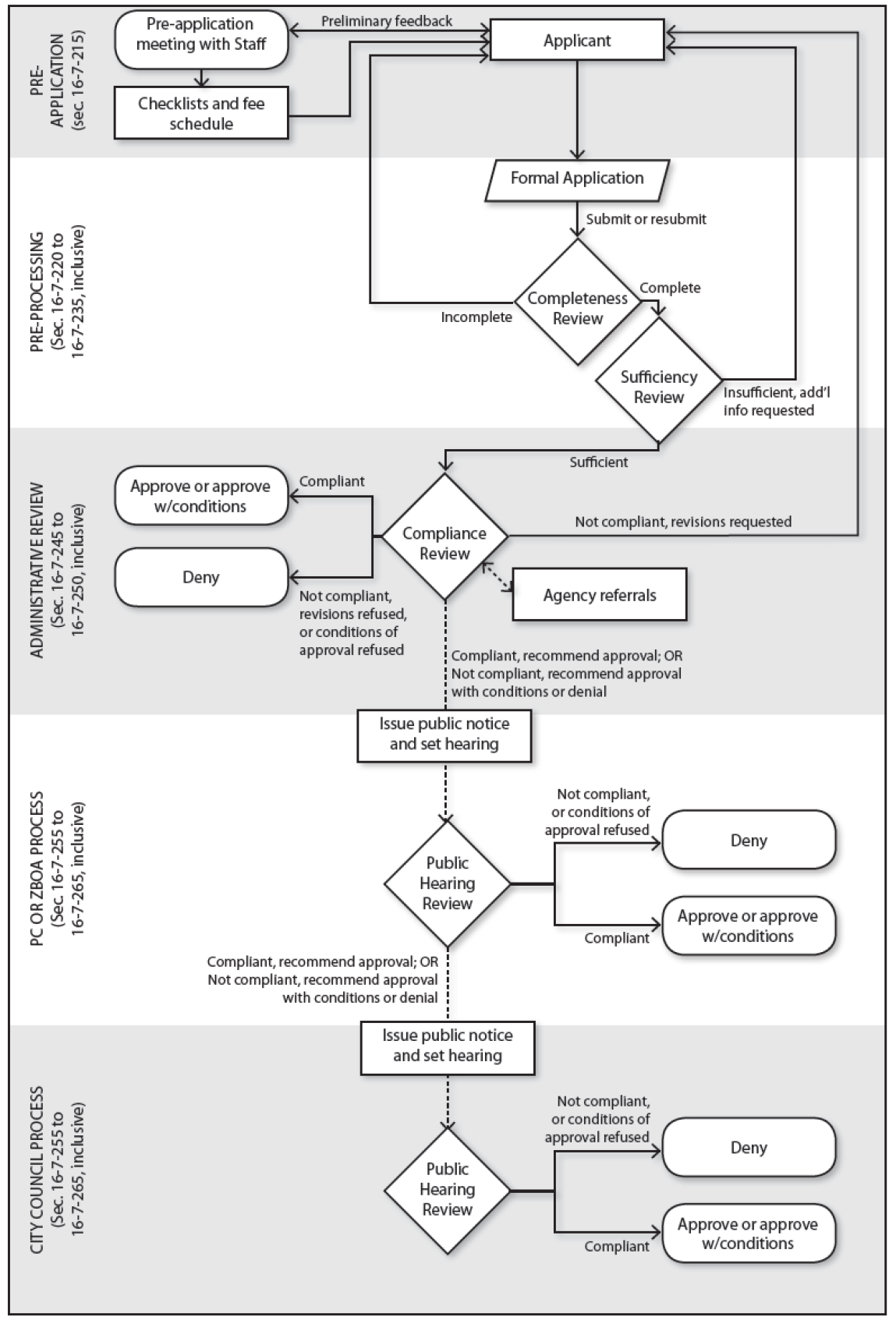
Process. The approval procedures set out in Section 16-7-215 to Section 16-7-295, inclusive, are undertaken in sequence until an application is considered and decided by the designated decision-maker for the type of application at issue. Table 16-7-205, Standardized Procedures, lists the approval steps that are required, based on the decision-maker. Figure 16-7-205, Standardized Procedures, illustrates the flow of application processing.
(c)
Special Review Types. The communications uses that are listed in Table 16-2-20, Land Use by Zoning District, are subject to the review procedures set out in Chapter 20, Wireless Communications Facilities, City of Cherry Hills Village Municipal Code.
|
Figure 16-7-205
Standardized Procedures |
|---|
 |
(Ord. 7, §1, 2019)
Sec. 16-7-210. - Ex parte communications.
(a)
Generally. It is the policy and practice of the City to decide applications only on the merits presented in the application, on-record public comments, and at public hearings (if public hearings are required). Therefore, ex parte communications are not allowed.
(b)
Timing. The prohibition on ex parte communications begins on the date of application and ends when the appeal period for an issued development order has expired.
(c)
Inadvertent Communications.
(1)
It is not always possible to prevent ex parte communications. Elected and appointed officials who hear applications required by this Chapter shall not privately discuss the merits of a pending application or appeal.
(2)
If a communication is received outside of the record (e.g., it is not in the application, agency comments, or public comments, nor was it presented at a noticed public hearing), then the official shall disclose the communication, including the speaker and the substance of the communication, on the record of the public hearing before the application is heard.
(3)
The decision-maker or recommending body must base its decision only on the evidence presented on the record. The contents of the ex parte communication shall not be considered part of the record for decision-making unless the information in the communication is also presented at the hearing (other than through the required disclosure).
(Ord. 7, §1, 2019)
Sec. 16-7-215. - Pre-application meeting.
(a)
Generally.
(1)
A pre-application meeting is an opportunity for the potential applicant to meet with City staff before filing an application, in order to:
a.
Identify the applicable review procedures and likely timelines;
b.
Review preliminary materials and identify potential issues and related information requirements; and
c.
Identify what fees will be due, including whether an escrow payment will be required for professional consultant review.
(2)
Suggestions and comments by City Staff at a pre-application meeting are advisory in nature and shall not bind the City with respect to decision-making on the subsequent application.
(b)
When Required.
(1)
A pre-application meeting is required for all application types, except:
a.
Permits for single-family detached dwelling units on individual lots;
b.
Permits for fences on individual residential lots;
c.
Permits for accessory buildings and structures on individual residential lots;
d.
Permits for signs; and
e.
Permits for home occupations.
(2)
Informal meetings may be scheduled prior to a pre-application meeting, at the discretion of the Director.
(c)
Meeting Logistics. Pre-application meetings may be conducted in person, by telephone, or by internet-based communication tools, as may be agreed between the potential applicant and the Director.
(d)
Meeting Materials. The potential applicant shall bring to (or submit prior to) the pre-application meeting sufficient supporting materials to explain, as applicable to the type of application to be submitted.
(e)
Summary. Upon request by the potential applicant, within twenty-one (21) calendar days of the pre-application meeting, the Director shall deliver to the applicant:
(1)
A checklist of submittal materials that will be necessary for the type(s) of application(s) sought; and
(2)
A copy of the City's application fee schedule.
(f)
Courtesy Presentations. At the pre-application meeting, a potential applicant may request an opportunity to make a courtesy presentation of a proposed development concept or conceptual subdivision map in a design charrette process. Attendees may include appropriate staff, referral agencies, design professionals, and other persons identified by the Director or the potential applicant.
(Ord. 7, §1, 2019)
Sec. 16-7-220. - Application.
(a)
Generally. Every application for approval that is required by this Chapter shall be submitted on a form approved by the Director, along with the corresponding application fee (fees are established by resolution of the City Council). Unless waived by the Director, all applications shall include electronic versions of all attachments in a format approved by the Director.
(b)
Forms.
(1)
The Director shall promulgate and periodically revise, as necessary, forms for each type of application required by this Chapter.
(2)
Application forms shall include the specific information that is required to process each type of application. The specific information requirements shall be established and periodically revised by the Director, and have the purpose of facilitating:
a.
The evaluation of applications for compliance with the standards of this Chapter; and
b.
The administration of this Chapter.
(3)
The Director is authorized to establish a standardized format for each type of required submittal, and to allow deviations from the format in instances where the Director finds that an alternative format would provide for more efficient review.
(c)
Waiver or Expansion of Requirements. Application requirements may be waived or expanded by the Director if the nature of the application is such that the requirements would serve no useful purpose, or such that additional information is needed to evaluate compliance with the requirements of this Chapter. The Director may not waive application fees.
(d)
Schedule. The Director is authorized, but not required, to establish regular intake days or times for any or all classifications of applications for development approval, except sign permits and administrative appeals.
(Ord. 7, §1, 2019)
Sec. 16-7-225. - Application fees and escrows.
(a)
Generally. Fees shall be charged to offset the cost of application processing (including any application for amendments of existing approvals), reviews, public notices, hearings, and recordkeeping. Application fees to be charged by the City shall be established, from time to time, by resolution adopted by the City Council.
(b)
Recording Fees. Recording fees of the Arapahoe County Clerk and Recorder's Office shall be paid to the County by the Applicant at the time of any required recording.
(c)
Referral Agency Fees. The Applicant may be required to pay any fees assessed by referral agencies in advance of their review and comment. Failure to obtain comments from referral agencies due to failure to pay review fees may result in delay or denial of an application.
(d)
Escrow for Consultant Review.
(1)
Consultant Review Authorized.
a.
The Director is authorized to retain professional consultants at the Applicant's expense to assist in the review of applications or petitions submitted pursuant to this Chapter, Chapter 15, Chapter 17, Chapter 18, Chapter 19, or Chapter 20.
b.
The Director may make an initial determination as to the use of consultants at the time of the pre-application meeting, and may revise the determination at the time of application if new or changed information in the application materials justifies the revision.
(2)
Initial Escrow Payment.
a.
If the Director determines that an application will require review by professional consultants, then the Director shall execute an escrow agreement in a form approved by the City Attorney, and make an initial escrow payment in an amount sufficient to cover the estimated review costs. A schedule of minimum required escrows for different application types may be attached to the fee resolution described in subsection (a), above.
b.
The Director shall provide the Applicant with a preliminary estimate of professional consultant review fees at a time established during the pre-application meeting by agreement with the Applicant. Alternatively, the Director may advise the Applicant regarding the amount of a fixed-fee that has been established in advance for the type of application presented.
(3)
Use of Escrow Payment. The City may draw upon the escrow, in the City's discretion, to pay the fees and expenses of professional consultants retained by the City to review the application.
(4)
Additional Escrow Funds.
a.
The Director may require additional escrow funds to be paid for additional services related to the application, should they become necessary. Failure of the applicant to timely provide additional escrow funds may result in delays in application processing.
b.
If a balance is due at the time an application is approved, it shall be paid by the applicant as a condition of approval.
c.
If a balance is due at the time an application is denied, it shall be paid by the applicant within thirty (30) days after delivery of an invoice to the applicant.
(5)
Return of Escrow Funds. Escrow funds shall be returned to the Applicant as follows:
a.
If the Director decides not to use consultants, then escrow funds shall be returned to the Applicant within thirty (30) days of said decision.
b.
If the Applicant withdraws the application, then the Director shall notify the consultants to stop work within one (1) business day after the withdrawal. Promptly after receipt of a final invoice from the consultants, the Director shall return the escrow to the Applicant, less the amount required to pay the consultants for work actually performed.
c.
When the application is decided, any positive escrow balance shall be returned to the Applicant within sixty (60) days.
(6)
Account Reports. Applicants shall be provided with a monthly accounting of the use of escrow funds.
(7)
Delinquent Payments.
a.
If the Applicant does not pay additional escrow funds required by subsection (d)(4), above within ten (10) days after written notice from the City, then, in addition to the other remedies the City may have, the City shall be entitled to a lien on the subject property, or the City may elect to certify the assessed costs and expenses to the office of the County Treasurer for collection in the same manner as general property taxes are collected. Such lien shall be perfected and may be foreclosed upon in accordance with applicable state laws.
b.
Nothing herein shall authorize the City to charge the applicant for costs and expenses the City incurs as a result of litigating a matter against the applicant or against a third party, unless such charges are otherwise authorized by law.
(8)
Fixed-Fee Consultant Review. The Director is authorized to establish:
a.
A roster of consultants that are pre-qualified to conduct reviews of various types; and
b.
For routine application types with predictable review fees, a schedule of fixed-fees for consultant review.
(Ord. 7, §1, 2019)
Sec. 16-7-230. - Completeness review.
(a)
Generally. The Director shall review all submitted applications for completeness. A complete application includes all of the materials required on the application forms, materials requested at the pre-application conference, any required professional certifications, and all fees and escrows that are required for application processing.
(b)
Schedule. Generally, all applications shall be reviewed for completeness within seven (7) calendar days after an application is submitted.
(c)
Incomplete Applications.
(1)
Incomplete applications shall be returned to the Applicant, along with any fee included with the application, with a written explanation that describes in general terms the materials that must be submitted in order to complete the application.
(2)
An application that does not include the applicable processing fee shall not be considered complete.
(3)
Incomplete applications are not considered filed.
(d)
Complete Applications. Complete applications shall be processed according to the applicable procedures of this Article.
(Ord. 7, §1, 2019)
Sec. 16-7-235. - Sufficiency review.
(a)
Generally. All applications shall be technically sufficient for review, meaning that:
(1)
The application materials are internally consistent and are presented as required by this Chapter and the applicable application forms.
(2)
Materials are prepared by qualified professionals (where such qualifications are required), and signatures and certifications are present, if required.
(3)
The application materials are technically sufficient (e.g., legal descriptions and calls and distances on surveys describe closed polygons within acceptable tolerances, calculations that are provided are performed according to the methodologies set out in this Chapter, etc.) to demonstrate compliance with applicable standards of this Chapter.
(b)
Insufficient Applications.
(1)
An application is insufficient if it does not meet the standards of subsection (a), above.
(2)
If an application is determined to be insufficient, the Director shall notify the Applicant and provide a written explanation regarding the materials that must be submitted, or revisions that must be made, in order to continue processing the application.
(3)
The Applicant shall provide the materials or revisions that are required to make the application sufficient within twenty-one (21) days of the date of the notice.
(4)
If an Applicant fails to submit the required materials within the time period specified in subsection (b)(3), above, or if the Applicant fails to submit a sufficient application after three (3) rounds of review, then the application fee shall be retained and the application shall be returned to the Applicant as insufficient.
(c)
Sufficient Applications. Technically sufficient applications shall be processed according to the applicable standards and procedures of this Chapter.
(Ord. 7, §1, 2019)
Sec. 16-7-240. - Stale applications.
(a)
Generally. This Section is intended to extinguish applications that become stale due to inaction by the Applicant.
(b)
Expiration of Stale Applications. When an action by the Applicant is required for further processing of an application (for example, if revisions are requested after agency referrals), the application shall become void:
(1)
Six (6) months after the date that the action is requested if the Applicant either fails to take action or fails to request an extension of time pursuant to subsection (c) below; or
(2)
Upon failure to timely provide requested information to make an application technically sufficient pursuant to Section 16-7-235,Sufficiency Review.
(c)
Extension of Time. The time for expiration of an application may be extended by up to six (6) additional months upon written request of the Applicant before the end of the period set out in Subsection (b), above.
(Ord. 7, §1, 2019)
Sec. 16-7-245. - Administrative review.
(a)
Generally. Upon determination that an application is complete and sufficient, the Director shall cause the application to be reviewed for technical compliance with all applicable requirements of this Chapter, as follows:
(1)
Appropriate City staff or consultants shall review the application; and
(2)
The application shall be promptly referred to applicable referral agencies and individuals for review and comment pursuant to Section 16-7-250, Referrals.
(b)
Recommended Revisions.
(1)
The Director shall provide comments from City staff or consultants (collectively, "Staff Comments"). The staff comments shall provide Staff or consultant input and address or include comments by referral agencies and interested individuals. The Applicant shall revise and resubmit the application with appropriate changes based on staff comments, and with responses to staff comments that did not result in changes to the application.
(2)
Upon receipt of the re-submittal, the Director may refer the application to referral agencies again if the changes substantially affect the interests of the agency in ways not anticipated by the agency's original comments (or lack thereof), or require the agency's technical expertise for appropriate review.
(3)
The re-submittal shall not require an application fee unless both of the following conditions are met:
a.
The revisions are inappropriate or incomplete; and
b.
Repeated failure to address comments requires more than three (3) rounds of revisions.
(c)
Administrative Recommendation, Decision, or Referral. Promptly after determination that a complete application addresses the comments and recommendations provided pursuant to subsection (b), above (or, after finding that no revisions will be required):
(1)
If the application is for an administrative approval or permit, then the Director shall verify public notice has been given, if required (seeSec. 16-7-255, Public Notice), and:
a.
Approve, approve with conditions, or deny the application, as appropriate, and promptly provide written notice, including the reasons for the decision, to the applicant; or
b.
Upon a determination that the development, as proposed, may have material impacts on neighboring properties or City resources that are unusual in kind or degree, or that there is material potential for disagreement regarding whether the application complies with the standards of this Chapter, the Director may refer the application to the Planning and Zoning Commission for review and recommendation and City Council for decision, according to the applicable standards of this Chapter.
(2)
If the application is for a public hearing approval or permit, then the Director shall make a recommendation regarding the application and forward the recommendation and the application materials and referral comments to the next body that will consider it for further recommendation or approval.
(d)
Meeting Logistics.
(1)
If the application is for a public hearing approval or permit, then the Director shall set the application on the agenda of the next body that will consider the application.
(2)
Generally, the application shall be heard during the next regular meeting of the body which meets the following two (2) conditions:
a.
There is sufficient time to meet applicable public notice requirements; and
b.
There is available room on the agenda.
(3)
The Director shall coordinate with recommending and decision-making bodies to fix reasonable times for hearings. Said bodies are authorized to convene special meetings to hear applications as they determine appropriate.
(4)
The Director, or a designee, shall notify the Applicant regarding the time and place of the public hearings.
(Ord. 7, §1, 2019)
Sec. 16-7-250. - Referrals.
(a)
Generally. Applications may be referred for additional review by agencies or consultants according to the procedures set out in this Section.
(b)
Inter-Jurisdictional Referrals.
(1)
As part of the review process, the City may seek review and comment by referral agencies that have expertise in the subject matter impacted by the application, that have jurisdiction over one (1) or more aspects of the proposed development, or whose operations will likely be affected by the proposed development. Referral agency comments are advisory to the City.
(2)
The Director may refer an application to any agency, jurisdiction, ditch company, land management entity, utility, or department that the Director determines is likely to be materially affected by the application. The Director's determination regarding referrals is not appealable.
(3)
The agency referral period is twenty-one (21) calendar days, which can be extended by up to thirty (30) additional days by mutual consent of the Applicant and the Director.
(4)
Failure of an agency to respond within the prescribed time period (or extended period) is interpreted as consent by that agency to the contents of the application. However:
a.
Such consent does not waive the authority of agencies which have concurrent jurisdiction with the City; and
b.
Such consent is not implied if the Applicant fails to pay the agency's required review fees.
(c)
Consultant Review. Upon notice to the Applicant, the Director may refer the application to consultants selected by the City, in order to obtain technical review and recommendations. The cost of such referrals shall be borne by the Applicant.
(Ord. 7, §1, 2019)
Sec. 16-7-255. - Public notice.
(a)
Generally. For applications that require public notice, public notice shall be provided according to the standards of this Section.
(b)
Contents of Public Notice. Public notice shall include the following elements:
(1)
The phrase "PUBLIC NOTICE" or "NOTICE OF PUBLIC HEARING" at the top of the notice. For posted notice, these letters shall be not less than two (2) inches in height.
(2)
A brief description of the type of application (e.g., Conditional Use Permit).
(3)
The date, time, and place of the hearing.
(4)
A brief summary of what the Applicant is requesting (e.g., approval of a 10,000 sf. place of public assembly).
(5)
The physical address of the subject property, or if an address is not available, a location map of the property or a statement that the legal description is on file with the Director.
(6)
A notice that interested persons may obtain more information from the Director.
(7)
Contact information for the Director.
(c)
Types of Public Notice. Table 16-7-255C, Types of Public Notice, sets out standardized requirements for publication, posting, and mail notice that are used for different application types and different phases of the application process. The types of notice that are set out in the table are used to establish notice requirements for each type of application in Table 16-7-255D, Required Public Notice by Application Type. Applicant shall pay all costs associated with notice.
(d)
Type of Public Notice Required by Application Type. Table 16-7-255D, Required Public Notice by Application Type, sets out the notices that are required at each state of processing for each type of application for which notice is required.
(e)
Standards for Required Notices.
(1)
Publication. Published notice shall be printed in a newspaper of general circulation in the City of Cherry Hills Village and provided on the City of Cherry Hills Village website.
(2)
Posting. Posted notice shall be on a sign in a form approved by the City and installed by the applicant.
(3)
Mail. Mailed notice shall be delivered via first class U.S. Mail and sent by the applicant.
(f)
Optional Notices.
(1)
Electronic Mail. Electronic mail notice may be delivered to an opt-in distribution list that is created for the purpose of notifying people about applications for approvals and permits in the City. Electronic mail notice shall include the subject line "PUBLIC NOTICE OF PROPOSED DEVELOPMENT," and the statement in the body of the e-mail that "Electronic mail notice is provided as a courtesy to opt-in subscribers. Failure of an e-mail communication to reach a subscriber does not constitute failure of public notice."
(2)
Reserved.
(g)
Errors in Notices. The standard for compliance with this Section shall be "substantial compliance." If the Director determines that there has been substantial compliance with the requirements of this Section, despite any particular technical error, then the decision or recommendation reached at the noticed hearing shall be final. If the Director determines that there has not been substantial compliance with the requirements of this Section due to an error, then the decision or recommendation reached at the noticed hearing shall be vacated (or the hearing on the item cancelled), and a new hearing shall be scheduled with proper notice provided.
(Ord. 7, §1, 2019; Ord. 3, § 3, 2022)
Sec. 16-7-260. - Public meetings and public hearings.
Public meetings and public hearings shall be carried out in accordance with the procedural rules of the body conducting the meeting or hearing.
(Ord. 7, §1, 2019)
Sec. 16-7-265. - Continuances and withdrawal.
(a)
Continuances. Requests for continuance by the Applicant of any proceeding called for in this Chapter may be granted at the discretion of the body holding the public meeting or public hearing. If granted, the Applicant shall pay all additional costs associated with the rescheduling of the proceeding.
(b)
Withdrawal. Any application may be withdrawn, either in writing or on the record, prior to or during the meeting or hearing at which the application is considered, provided that it is withdrawn before official action is taken on the application.
(Ord. 7, §1, 2019)
Sec. 16-7-270. - Successive applications.
(a)
Generally. It is the policy of the City not to hear successive applications for the same approval or permit after a substantially similar application is denied. The limitations of this Section prevent the consideration of successive applications.
(b)
Time Required Between Substantially Similar Applications. If an application for a permit or approval is denied, a substantially similar application will not be accepted for:
(1)
Six (6) months from the date of denial in the case of administrative permits; and
(2)
Twelve (12) months from the date of denial for all other permits or approvals.
(c)
Exceptions to Successive Application Restrictions. The Director may allow exceptions to this Section if there has been a material change of circumstances that justifies consideration of a substantially similar application. By way of example and not limitation:
(1)
If a spacing requirement was the reason for the denial, and the use from which spacing is required moved away; or
(2)
If a subsequent amendment to this Chapter now allows for approval of the application.
(Ord. 7, §1, 2019)
Sec. 16-7-275. - Recording of approvals.
The following permits and approvals shall be recorded in the public records of Arapahoe County at the Applicant's expense:
(1)
Conditional Use Approvals
(2)
Development Agreements, Public Improvements Agreements, and Reimbursement Agreements
(Ord. 7, §1, 2019)
Sec. 16-7-280. - Effect of approvals.
(a)
Generally. It is the intent of the City that development approved pursuant to this Chapter be carried out in a timely manner pursuant to the specifications, terms, and conditions of approval; and that the steps within each approval process be carried out with diligence.
(b)
Effect of Approval or Permit.
(1)
Approval of an application means that the City consents to the particular use, plan, or other specific activity for which the approval was granted. Physical development of land may require a sequence of related (and increasingly detailed) approvals.
(2)
Supplemental materials that are provided in support of an approval become part of the approval (e.g., elevations, lists of building materials, etc.) unless otherwise noted in the approval itself.
(3)
Approvals and permits may be transferred to a subsequent owner of the property for which the approval or permit was issued, unless the approval or permit is specifically designated as non-transferable by condition of approval. Transferred permits shall continue to be valid for their full original terms, and the transferee may apply for an amendment to the approval or permit in the same manner as the original Applicant.
(Ord. 7, §1, 2019)
Sec. 16-7-285. - Duration of approvals.
(a)
Approvals. Except as provided in subsections (b) and (c), below, the administrative approvals described in Table 16-7-120, Administrative Approvals and Permits, and in Table 16-7-130, Discretionary Approvals and Permits, shall expire one (1) year from the date of approval if they are not utilized.
(b)
Development Agreements. A development agreement is valid for the term set out in the development agreement.
(c)
Approvals That Do Not Lapse. Rezonings, vacations or abandonments of easements or rights-of-way, text amendments, Master Plan amendments, and administrative appeals do not lapse.
(Ord. 7, §1, 2019)
Sec. 16-7-290. - Extensions of approvals.
(a)
Generally. The term of permits and approvals may be extended by written request according to the standards and procedures of this Section.
(b)
Timing of Application for Extension. Expired permits and approvals cannot be extended. Written requests for extensions shall be received not later than thirty (30) days prior to the expiration of the permit or approval. Untimely requests for extensions will not be granted unless it is demonstrated that extraordinary circumstances (e.g., an unusual severe weather event) justify the request.
(c)
Extensions for Extraordinary Circumstances. The City Council may, by resolution, extend the term of all permits and approvals City-wide or in designated areas of the City in response to extraordinary circumstances, such as flood, wildfire, tornado, or other natural or man-made disaster which makes it temporarily infeasible to commence or continue with construction. The period of such extensions shall be determined by the City Council.
(d)
Administrative Extensions. Unless otherwise provided in the permit or approval, the Director may grant one (1) extension of any permit or approval for a period not to exceed the twelve (12) months. Such extensions may be granted upon timely written request with good cause shown.
(e)
Extensions after Hearing.
(1)
Unless otherwise provided in the permit or approval, a hearing is required for:
a.
Extensions for terms that are longer than those which can be granted by the Director pursuant to subsection (d), above; and
b.
Second (and subsequent) extensions.
(2)
Extensions of discretionary permits and approvals pursuant to this subsection shall be heard by the body that granted the original approval. Extensions of administrative permits and approvals pursuant to this subsection shall be heard by the Planning Commission.
(3)
Extensions may be granted after hearing if it is demonstrated that:
a.
There is good and reasonable cause for the request; and
b.
The Applicant has provided reasonable assurances that it will perform (or cause to be performed) the work authorized by the permit or approval within the extended term.
(f)
Extensions Pursuant to Permit or Approval Terms. If a method of extension is provided within a permit, approval, or related development agreement between the Applicant and the City, then such method of extension shall supersede this Section with respect to said permit or approval.
(g)
Effect of Appeals, Litigation, or Mediation.
(1)
If there is an appeal, litigation, or mediation during the time period that limits the Applicant's ability to use or develop land pursuant to a permit or approval granted by the City, then the term of the permit or approval shall be tolled for the duration of the appeal, litigation, or mediation, and the date shall be recalculated upon conclusion of the appeal, litigation, or mediation.
(2)
The new expiration date shall be established by adding the number of days that the approval would have remained valid before the appeal, litigation, or mediation commenced to the date the appeal, litigation, or mediation was concluded by:
a.
The expiration of the subsequent appeal period after final judgment or order in the initial appeal or litigation, or, if no appeal is available, after issuance of the final judgment or order; or
b.
The termination of mediation by resolution of the conflict or impasse.
(3)
This subsection does not apply to litigation which is related to enforcement of a violation of any part of the Cherry Hills Village Municipal Code.
(Ord. 7, §1, 2019)
Sec. 16-7-295. - Correction of approvals.
(a)
Generally. Permits and approvals may be corrected pursuant to this Section.
(b)
Correction of Scrivener's Errors. Development approvals plats may be corrected by the Director or upon application to the Director as follows:
(1)
Generally. The Director may approve an application to reform a scrivener's error in a development approval, including an error in an application or notice, which error causes the permit or approval to inaccurately reflect the decision-maker's intent, and where it is demonstrated that:
a.
The correction does not include a change of judgment, policy, or prior intent of the decision-maker;
b.
The reformation of the permit or approval is essential to ensure that the documentation reflects the intent and decision of the decision-maker;
c.
The record, including, but not limited to, the Staff recommendation, minutes, and motion, evidences the clear intent of the decision-maker;
d.
The substance of the decision was clearly evident at the time of the decision, and there was no intent to deceive the public or the decision-maker on the part of the current Applicant at any time;
e.
Failure to approve the reformation would lead to an unjust result;
f.
The error in the development approval did not mislead anyone in a way that would cause them to be prejudiced by the reformation; and
g.
Any errors related to public notice did not affect the legal sufficiency of the required notice.
(2)
Correction Within Thirty (30) Days. In the alternative, the Director, within thirty (30) days of the decision on an application for development approval, may correct a clerical or scrivener's error in the development approval if:
a.
The error is not related to public notice;
b.
The error causes the approval, as written, to inaccurately reflect the clear decision of the decision-maker; and
c.
The Director promptly notifies the applicant and the decision-maker regarding the corrections.
(c)
Effect on Approval. A permit or approval that is modified pursuant to this Section shall relate back to the date of the corrected approval, such that the effective date of the corrected language shall be deemed to be the same as the effective date of the original approval.
(Ord. 7, §1, 2019)
Sec. 16-7-310. - Purpose and application of division.
(a)
Purpose of Division. The purpose of this Division is to set out specific provisions for review of certain applications that are listed in Article VII, Division 2, Permits and Approvals. Not all of the application types are covered in this Division. If an application type is not addressed in this Division, then it is reviewed in accordance with the applicable procedures set out in Article VII, Division 2 and Division 3 and the applicable substantive standards of this Chapter and/or this Code, and no additional modifications of those standards or procedures are applicable.
(b)
Application of Division. This Division may establish or modify certain procedures from Article VII, Division 3, Standardized Procedures, for certain application types (e.g., time limitations, etc.). To the extent of a direct, irreconcilable conflict between the standardized procedures and this Division, the procedures articulated in this Division control.
(Ord. 7, §1, 2019)
Sec. 16-7-315. - New residences or expansions of existing residences.
For all new single-family dwelling units, and proposals to increase the floor area of a single-family dwelling unit by fifty percent (50%) or more, that applicant shall demonstrate that all lighting on the property will meet the requirements of Section 16-4-120, Exterior Lighting, Generally and Section 16- 4-230, Tree Preservation.
(Ord. 7, §1, 2019)
Sec. 16-7-320. - Site plans.
(a)
Generally. Site plan review is required prior to the issuance of building permits or GESC permits for all development except single-family detached dwelling units and accessory buildings or structures on individual residential lots. Site plan review may be administrative or may require public hearings, as specified in Article VII, Division 2, Permits and Approvals.
(b)
Relationship to Former Expanded Use Permit. For the purposes of this Chapter, Expanded Use Permits that were issued prior to the effective date of this Chapter (pursuant to Article XX of the former Chapter 16) shall be considered site plans, and shall be amended by site plan amendment.
(c)
Administrative Approvals of Site Plans and Site Plan Amendments. Site plans and site plan amendments may be processed by the Director (as provided in Section 16-7-120, Administrative Approvals and Permits) in any of the following three (3) situations:
(1)
The subject property is located in the C-2 zoning district.
(2)
The site plan approval is a required component of a wireless communications facility approval that is allocated to the Director under Chapter 20, Wireless Communications Facilities, Cherry Hills Village Municipal Code, and does not provide for improvements unrelated to the wireless communications facility.
(3)
The site plan or site plan amendment does not:
a.
Expand the total floor area of buildings and the footprint of structures on the subject property by more than:
i.
One thousand (1,000) square feet on properties that are less than fifty (50) acres; or
ii.
Five thousand (5,000) square feet on properties that are fifty (50) acres or more.
b.
Significantly change the location, extent, or configuration of any parking area. Re-striping of existing parking areas in conformance with Article IV, Division 1, Parking and Circulation, shall not be considered a significant change unless the flow of traffic is materially altered.
c.
Reduce the number of parking spaces to less than that required by Article IV, Division 1, Parking and Circulation, including approved parking reductions; or increase the parking demand such that the subject property does not meet the requirements of Article IV, Division 1, Parking and Circulation.
d.
Increase in number, size, or intensity of exterior lighting fixtures, or change the orientation of existing exterior lighting fixtures, unless the changes bring exterior lighting into greater conformance with the requirements of Article IV, Division 2, Utilities and Lighting.
e.
Create, add, modify, or increase the area of outdoor recreational facilities, including, but not limited to, playgrounds, parks, play courts, or swimming pools, unless the facilities are set back at least one hundred (100) feet from property lines.
f.
Result in a predicted increase in traffic generation of more than ten (10) trips per day or a predicted decrease in the level of service of any City street or intersection.
g.
Result in an increase in the number of employees, enrollment, attendees, or memberships above:
i.
Current City-approved limits (if any); or
ii.
Maximum levels documented in a prior application reviewed and approved (or conditionally approved) by the City.
(d)
Public Hearing Approvals of Site Plans and Site Plan Amendments.
(1)
Site plans and site plan amendments that do not qualify for processing by the Director as set out in subsection (c), above, shall be processed as discretionary approvals. SeeSec. 16-7-130, Discretionary Approvals.
(2)
Even if a site plan or site plan amendment qualifies for processing by the Director, the Director may require processing as a discretionary approval if the Director finds that:
a.
A condition of a prior approval or development agreement requires processing as a discretionary approval;
b.
The unusual nature of the proposed site plan amendment justifies consideration at public hearing in order to ensure that the application is thoroughly considered from multiple perspectives; or
c.
The cumulative effect of site plan amendments already processed by the Director, along with the proposed site plan amendment, would result in a material change to the subject property compared to its condition on the later of:
i.
The effective date of this Chapter; or
ii.
The date that construction pursuant to the most recent site plan or site plan amendment approved by the City Council was completed.
(e)
Approval Standards. Site plans and site plan amendments may be approved if it is demonstrated that they comply with the applicable requirements of this Chapter, and:
(1)
The proposed development is consistent with and furthers or implements the goals and strategies of the Master Plan, including preservation of the semi-rural character of the City.
(2)
The proposed development complies with all applicable City ordinances and is consistent with all other City policies and plans.
(3)
The bulk and scale of any proposed buildings, structures, or expansions thereto is consistent with the context of the site, and does not materially change the physical character or function of the surrounding area.
(4)
Drainage systems are designed to utilize natural materials and low-maintenance best management practices to the maximum feasible extent, and to appear consistent with the character of the surrounding area.
(5)
The proposed development will not result in unreasonable traffic congestion or create a safety hazard to vehicular or pedestrian traffic and adequate provisions will be provided to manage any traffic-related issues.
(6)
Construction will be timed and staged to minimize impacts on adjacent residential properties, including but not limited to lighting, visual impacts, vibration, and noise.
(Ord. 7, §1, 2019)
Sec. 16-7-325. - Conditional uses.
(a)
Generally. Conditional use permits are required as set out in Article II, Division 4, Requirements and Conditions for Conditional Uses. An application for a conditional use permit is separate and distinct from any other type of application under this Chapter. However, conditional use permit applications may be processed concurrently with other types of applications, such as site plans, site plan amendments, or variances.
(b)
Approval Standards. The standards for approval of conditional uses are set out in Article II, Division 4, Requirements and Conditions for Conditional Uses.
(c)
Concurrent Processing of Site Plans.
(1)
When Required. An application for site plan or site plan amendment approval shall be submitted along with the conditional use application, unless the proposed conditional use will not involve modifications to the subject property or buildings or structures thereon that would require approval by site plan or site plan amendment.
(2)
When Not Required. In cases where site plan or site plan amendment approval is not required pursuant to subsection (c)(1), above, the Director may require a survey or drawing depicting the current conditions of the subject property, including such additional information as the Director may determine necessary to evaluate compliance with the applicable standards of this Chapter.
(Ord. 7, §1, 2019)
Sec. 16-7-330. - Major special events.
(a)
Generally. Permits for major special events are subject to the procedures of Article VII, Division 3, Standardized Procedures, as modified by the provisions of this Section.
(b)
Director and City Council Discretion.
(1)
The Director may waive the deadlines set out in this Section for good cause shown, provided that the Director determines that adequate time will be available to review the application, comprehensively evaluate the potential impacts of the major special event, and ensure that appropriate services and mitigation measures will be in place during the special event.
(2)
The Director may waive requirements regarding application materials, including required reports and studies, if the Director determines that the materials, reports, or studies are not necessary to evaluate the application. The Director may not waive fees or escrow requirements.
(3)
Even if waived pursuant to subsection (b)(2), above, the City Council may require the preparation and submission of any plans, studies, or reports, deemed by the City Council as necessary to evaluate fully the impacts of any major special event.
(c)
Timing of Pre-Application Meeting. The pre-application meeting required by Section 16-7-215, Pre-Application Meeting, shall be requested by the applicant at least one (1) year prior to the date that the major special event is proposed to commence.
(d)
Preliminary Review Requirements.
(1)
Generally. Following the pre-application meeting and not less than nine (9) months prior to the date of the proposed major special event, an applicant for a major special event permit shall submit an application for preliminary administrative review by the Planning and Zoning Commission.
(2)
Review Procedure.
a.
The preliminary application is subject to Section 16-7-210, Ex Parte Communications, and Section 16-7-220, Application, through Section 16-7-265, Continuances and Withdrawals, inclusive, except Section 16-7-255, Public Notice. The Planning and Zoning Commission shall consider the application administratively at a public meeting. A public hearing is not required.
b.
The Planning and Zoning Commission shall administratively review the preliminary application to evaluate whether the application and proposed event are generally consistent with the applicable standards set forth in this Chapter and this Code.
c.
The Planning and Zoning Commission may recommend or suggest changes to the application and proposed plan for the major special event.
d.
Recommendations and suggestions by the Planning and Zoning Commission are advisory in nature, and shall not be deemed binding decisions by the City regarding the applicant's preparation of a formal application for a major special event permit.
(e)
Final Review Requirements.
(1)
Generally. Following preliminary review as set out in subsection (d), above, and not less than six (6) months prior to the commencement date of the proposed major special event, the applicant shall submit a complete final application for a major special event permit pursuant to this subsection (e).
(2)
Review Procedure. The final application is subject to Section 16-7-210, Ex Parte Communications, and Section 16-7-220, Application, through Section 16-7-295, Correction of Approvals, inclusive. Following administrative review and referrals, the City Council shall consider the application at a public hearing.
(f)
Major Special Event Agreement.
(1)
Unless otherwise determined by the City Council as unnecessary or inappropriate for the particular major event request, the applicant shall enter into a written agreement memorializing the applicant's obligations and duties in, and the conditions imposed upon, the conduct of the major event.
(2)
The agreement shall include terms and conditions deemed appropriate by the City to guarantee and ensure the applicant's conduct of the major event in accordance with the approved major event permit.
(3)
The agreement may include requirements for the applicant to provide cash deposit(s) or other forms of financial security or guarantees, at the City's election, in amounts and forms sufficient to protect the City from incurring costs or expenses resulting from the applicant's nonperformance or default in the conduct of the major event.
(4)
The agreement shall require each applicant to agree to indemnify, hold harmless and defend the City, its City Council, agents and employees from any and all liability, actions, claims, damages, costs or expenses, including attorney's fees, that may be asserted by any person or entity, including the applicant, arising out of or in connection with any willful act or negligence of the applicant, its agents, employees, vendors and affiliates.
(5)
The agreement may provide, in the sole and absolute discretion of the City Council, that all or a portion of the review fees may be reimbursed to the applicant when the major event generates tax revenues pursuant to Article VI, Chapter 4 of this Code sufficient to fund such reimbursement.
(6)
The form of agreement shall be approved by the City Attorney.
(Ord. 7, §1, 2019)
Sec. 16-7-335. - Sign permits.
(a)
Generally. Before any sign for which a permit is required by Article III, Division 3, Signs, is erected, displayed, altered, relocated or reconstructed, an application for approval of such sign shall be submitted to the City and a sign permit issued by the Director. Other permits, such as building permits and electrical permits, may also be required, and may be processed concurrently with the sign permit application.
(b)
Approval Standards. Sign permits shall be issued if the Director finds that the proposed sign complies with the applicable requirements of Article III, Division 3, Signs.
(c)
Timing of Administrative Review. Administrative review of sign permits shall be conducted according to the following schedule:
(1)
Completeness review (seeSec. 16-7-230, Completeness Review) shall be completed within three (3) business days after the filing of the application (or revision thereto) for a sign permit;
(2)
Sufficiency review (seeSec. 16-7-235, Sufficiency Review) shall be completed within five (5) business days after the filing of the application (or revision thereto) for a sign permit; and
(3)
The Director shall approve, approve with specified conditions, or deny the application for a sign permit within three (3) business days after the application has been determined to be sufficient as provided in Sec. 16-7-235, Sufficiency Review. SeeSec. 16-7-245, Administrative Review.
(Ord. 7, §1, 2019)
Sec. 16-7-340. - Temporary uses and temporary structures.
(a)
Generally. This Section sets out supplemental procedural requirements for the issuance of temporary use permits described in Article II, Division 5, Temporary Uses and Temporary Structures.
(b)
Relationship to Major Special Event Permit. Nothing in this Section shall be construed to limit or prohibit the approval of a temporary use or temporary structure as part of a major special event permit or contract approved by the City. Temporary uses and temporary structures that are authorized by major special event permits are not subject to the requirements of this Section.
(c)
Agreement and Security.
(1)
Prior to issuance of a temporary use permit, the applicant shall:
a.
Execute an agreement with the City as to the duration of the temporary use or schedule for installation and removal of the temporary structure, which shall include the plan for the temporary use or structure, and which shall acknowledge that the Director has the authority to revoke the permit and terminate the temporary use or require removal of the temporary structure if the applicant fails to comply with the requirements of the permit and this Chapter; and
b.
Provide security to the City in the form of a cash deposit, surety bond, or irrevocable standby letter of credit in a form approved by the Director, authorizing the City's use of such security to terminate the temporary use, remove the temporary structures, and restore the subject property upon the applicant's breach of the agreement described in subsection (d)(1)a., above. The amount of such security shall be equal to one hundred twenty-five percent (125%) of the City's estimated costs to complete said activities, including costs of administration and legal fees.
(2)
The agreement described in subsection (c)(1), above may include such additional terms as the City determines are necessary to ensure that the risks and expenses associated with the temporary use or temporary structure (e.g., potential damage to adjacent streets) are borne by the applicant.
(d)
Approval Standards. The Director shall administratively issue a written permit for a temporary use or temporary structure upon a finding by the Director that:
(1)
The proposed temporary use or temporary structure is permissible by this Chapter.
(2)
The proposed temporary use or temporary structure complies with all applicable requirements of this Chapter and this Code.
(3)
The temporary use or temporary structure will not present an unreasonable adverse impact upon an adjacent residential property; or, by the Director's imposition of conditions upon the permit, such adverse impacts will be appropriately mitigated (see subsection (f), below).
(4)
No previously issued permit for a temporary use or temporary structure has been revoked by the City for the same property within a period of five (5) years prior to the date of application.
(e)
Permit Conditions.
(1)
Discretionary Conditions. The Director is authorized to impose reasonable conditions upon any permit issued in accordance with this Section that the Director determines are necessary or desirable to mitigate potential adverse impacts of the proposed temporary use or temporary structure or to ensure the conformance of the proposed temporary use or temporary structure with this Chapter or other applicable law.
(2)
Standard Conditions. In addition to any conditions imposed by the Director pursuant to subsection (f)(1), above, the following standard conditions shall be imposed upon all permits issued in accordance with this Section:
a.
The Director may revoke any permit upon a finding by the Director that:
i.
The permittee failed to comply with any applicable provision of this Chapter or any condition imposed upon the permit; or
ii.
The temporary use or temporary structure failed or fails to meet the requirements of Article II, Division 5, Temporary Uses and Temporary Structures, as applicable.
b.
The permit shall expire on the first anniversary of the date of permit issuance; or at such earlier or later date that may be stated within the permit.
c.
The permittee shall obtain all required building and other permits prior to commencing the temporary use or locating, installing, erecting, or constructing the temporary structure on the subject property.
(f)
No Renewal. A permit for a temporary use or temporary structure issued in accordance with this Section shall be nonrenewable. Continuation of a previously permitted temporary use or temporary structure shall require reapplication for a new permit.
(Ord. 7, §1, 2019)
Sec. 16-7-345. - Major home occupation permit.
(a)
Generally. This Section sets out supplemental procedural requirements for the issuance of major home occupation permits described in Article II, Division 8, Business Use of the Home. Only those business uses of the home that are specifically identified in Article II, Division 8, Business Use of the Home, as requiring major home occupation permits are subject to the major home occupation permit requirement.
(b)
Approval Standards. The Director shall administratively issue a written permit for a major home occupation upon a finding by the Director that:
(1)
The proposed major home occupation is permissible by this Chapter.
(2)
The proposed major home occupation complies with all applicable requirements of this Chapter and this Code.
(3)
The proposed major home occupation will not present an unreasonable adverse impact upon an adjacent residential property; or, by the Director's imposition of conditions upon the permit, such adverse impacts will be appropriately mitigated (see subsection (c), below).
(c)
Permit Conditions.
(1)
Discretionary Conditions. The Director is authorized to impose reasonable conditions upon any permit issued in accordance with this Section that the Director determines are necessary or desirable to mitigate potential adverse impacts of the proposed major home occupation, or to ensure the conformance of the proposed major home occupation with this Chapter or other applicable law.
(2)
Standard Conditions. In addition to any conditions imposed by the Director pursuant to subsection (c)(1), above, the following standard conditions shall be imposed upon all permits issued in accordance with this Section:
a.
Unless renewed in accordance with subsection (d), below, the permit shall expire on the anniversary of the date of permit issuance.
b.
The permittee shall obtain all required building and other permits, as may be required by this Chapter and other applicable law, prior to commencing the major home occupation.
(d)
Renewal. A permit for a major home occupation issued in accordance with this Section is renewable by the applicant on an annual basis upon thirty (30) days' notice to the Director and the payment of a renewal fee established by the City Council. The Director is authorized to refuse to renew a major home occupation permit if the Director finds that the applicant failed to comply with the requirements of the permit or this Chapter in the prior year.
(Ord. 7, §1, 2019)
Sec. 16-7-350. - Rezoning.
(a)
Generally. Amendments to the zoning map ("rezoning") at any scale may be initiated by the City Council without formal application. Rezoning of a specific parcel, lot, or property, may be initiated by application of the property owner.
(b)
Planning and Zoning Commission Recommendation. All applications for rezonings shall be referred to and considered by the Planning and Zoning Commission at a public hearing. The Planning and Zoning Commission shall examine the proposal and its conformity to the requirements of this Chapter and to the Master Plan. The Planning and Zoning Commission shall thereafter make a recommendation to the City Council, along with reasons therefor.
(c)
Approval. A rezoning shall not be approved without the affirmative vote of the majority of the membership of the entire City Council.
(d)
Documentation. The Director shall promptly document rezonings on the zoning map.
(Ord. 7, §1, 2019)
Sec. 16-7-355. - Wireless communications facilities.
Wireless Communications Facilities are processed as provided in Chapter 20, Wireless Communications Facilities, City of Cherry Hills Village Municipal Code.
(Ord. 7, §1, 2019)
Sec. 16-7-360. - Floodplain development permit.
(a)
Generally. The Floodplain Administrator may grant a floodplain development permit if it is demonstrated that the application complies with the applicable requirements of Article V, Floodplain Management and Flood Damage Prevention, and the criteria for approval set out in subsection (c), below. The floodplain development permit is required before construction or development commences within any special flood hazard area or area that is the subject of a LOMR-F.
(b)
Limitations.
(1)
Floodplain development permits may be granted only for the following types of development:
a.
Bank stabilization; and
b.
Dredging of ponds and lakes
(2)
Any other proposed development within any special flood hazard area or area that is the subject of a LOMR-F shall require a floodplain variance.
(c)
Referenced Standards.
(1)
The bank stabilization design and/or description of dredging procedures (as applicable) shall follow all applicable regulations of the Arapahoe County Stormwater Management Manual ("ACSMM") and Urban Drainage and Flood Control District ("UDFCD") criteria, and, with regard to dredging of ponds and lakes, the state dam safety requirements, as each of them may be amended from time to time.
(2)
Hydraulics shall meet the following standards, as determined by the City Engineer:
a.
For bank stabilization, floodplain hydraulics shall be analyzed in accordance with Section 12.2.6 of the ACSMM, and the analysis shall demonstrate that the bank stabilization will not alter the floodplain boundary or increase base flood elevations.
b.
For dredging of ponds and lakes, the analysis shall demonstrate that the dredging will not alter the floodplain boundary or increase base flood elevations.
(d)
Special Notice Requirements.
(1)
The applicant shall provide written notification of the request to all owners of property that are adjacent to the bank stabilization request and with floodplain intersecting the property. Such written notification shall be sent by certified mail, return receipt requested. No decision shall be made on the application until at least 15 days have elapsed after the date of the notice.
(2)
The Director may waive notice requirements for bank stabilization projects that are necessary to avoid an imminent threat to public safety.
(e)
Approval Standards.
(1)
Approval or denial of a Floodplain Development Permit by the Floodplain Administrator shall be based on the applicant's demonstration of compliance with the standards set out in the referenced standards identified in subsection (c), above, and confirmation that the analysis in subsection (c)(2), above, is technically competent.
(2)
The Floodplain Administrator may also consider all of the provisions of Article V, Floodplain Management and Flood Damage Prevention, and the following relevant factors:
a.
The danger to life and property due to flooding or erosion damage;
b.
The susceptibility of the proposed facility and its contents to flood damage and the effect of such damage on the individual owner;
c.
The danger that materials may be swept onto other lands to the injury of others;
d.
The compatibility of the proposed use with existing and anticipated development;
e.
The safety of access to the subject property in times of flood for ordinary and emergency vehicles;
f.
The costs of providing governmental services during and after flood conditions, including maintenance and repair of streets and bridges, and public utilities and facilities such as sewer, gas, electrical, and water systems;
g.
The expected heights, velocity, duration, rate of rise, and sediment transport of the flood waters and the effects of wave action, if applicable, expected at the subject property;
h.
The necessity to the facility of a waterfront location, where applicable;
i.
The availability of alternative locations, not subject to flooding or erosion damage, for the proposed use, building, structure, or improvement; and
j.
The relationship of the proposed use to the Master Plan as it pertains to the subject property.
(f)
Decision or Referral to City Council.
(1)
The Floodplain Administrator may approve, approve with conditions, or deny an application or, in the Floodplain Administrator's reasonable discretion, present the application for review and decision by the City Council at a public meeting.
(2)
The Floodplain Administrator's discretion includes, but is not limited to, applications that may negatively impact other properties.
(3)
Notice of the City Council meeting shall be provided as set out in subsection (d), above.
(4)
The City Council review shall be based on the approval standards of subsection (e), above.
(Ord. 7, §1, 2019; Ord. 3, § 4, 2022)
Sec. 16-7-365. - Agreements.
(a)
Generally. Certain approvals that are authorized by this Chapter require that the applicant and the City enter into an agreement regarding the approval. In addition to the specific requirements of this Chapter, the City may condition an approval on the execution of an agreement that sets out conditions of approval. Applicants may also propose agreements, for example, to create vested rights.
(b)
Purposes. Agreements may be used for any lawful purpose, including but not limited to:
(1)
Establishing the terms and conditions for the installation of public improvements and landscaping, and providing security and warranties for same;
(2)
Specifying and providing for the timing, staging, and/or phasing of development;
(3)
Vesting development rights;
(4)
Providing for the dedication of property and/or the payment of fees-in-lieu;
(5)
Providing for the payment of other development-related fees and escrows;
(6)
Specifying the parameters for the temporary use of property, the temporary installation or placement of structures, or the setup, conduct, and tear-down of major special events.
(c)
Form of Agreements. The City Council may approve form agreements for specific purposes (e.g., escrow agreements, public improvements agreements, etc.), and may authorize the Director to execute agreements that are in substantially the approved form.
(Ord. 7, §1, 2019)
Sec. 16-7-370. - Text amendments.
(a)
Generally. The City Council may amend any provision of this Chapter in its sole legislative discretion, subject to the limitations of the Colorado statutes that affect home rule municipalities and the Colorado and United States Constitutions. Text amendments shall be adopted by ordinance of the City Council.
(b)
Referral to Planning and Zoning Commission. All proposed text amendments to this Chapter shall be referred to and considered by the Planning and Zoning Commission at a duly noticed meeting. The Planning and Zoning Commission shall provide a recommendation to the City Council with regard to the likely effect of the proposed text amendment on the implementation of the Master Plan.
(c)
Exceptions. Amendments to the fee resolution referred to in Section 16-7-225, Application Fees and Escrows, shall not be considered text amendments to this Chapter.
(d)
Documentation. If an amendment should receive the required vote for adoption by the City Council, a certified copy of the amendment shall then be filed with the City Clerk.
(Ord. 7, §1, 2019)
Sec. 16-7-375. - Berm permits.
(a)
Generally. A berm permit is required prior to the construction of a berm. Berm permits are issued by the Director.
(b)
Term of Berm Permit.
(1)
A berm permit shall be valid for ninety (90) days following the date the permit is issued. All work on the subject property that is authorized by such berm permit shall be completed within ninety (90) days of the date of issuance thereof; thereafter, said berm permit shall expire and be deemed cancelled.
(2)
If work is not completed within the term of the berm permit, a new berm permit will be required to complete the work. The new permit fee will be based on the remaining work to be completed.
(3)
If a new berm permit is not obtained, the property shall be restored to its preconstruction grade within ninety (90) days after the expiration of the berm permit.
(c)
As-Built Survey Required. At the time of completion of the berm and prior to final inspection, the property owner shall submit to the City an as-built survey that shows the width, height and length of the finished berm(s) along all points of the berm(s).
(Ord. 7, §1, 2019)
Sec. 16-7-380. - Reasonable accommodation.
(a)
Generally. The Director may authorize a reasonable accommodation as provided in this Section, in order provide an efficient process for ensuring compliance with the requirements of the Fair Housing Act.
(b)
Purpose and Scope. The purpose and scope of the reasonable accommodation is to allow for the administrative modification of physical development standards of this Chapter (e.g., fence standards, building or structure setbacks, etc.) in order to afford a disabled person equal opportunity to use and enjoy a dwelling, compared to a person who is not disabled.
(c)
Limitations.
(1)
A reasonable accommodation that is authorized pursuant to this Section shall be necessary (indispensable or essential) to ensure that the disabled person has the same housing opportunity that non-disabled people enjoy.
(2)
Reasonable accommodations shall not be authorized in order to create opportunities or advantages (including but not limited to economic advantages) that are not also available to non-disabled people who do not receive a reasonable accommodation.
(3)
This Section shall not be used to modify the definition of "family" or change the scope of any land use that is defined by this Chapter.
(Ord. 7, §1, 2019)
Sec. 16-7-405. - Purpose.
It is the purpose of this Division to provide procedures necessary to implement Article 68, Title 24, C.R.S., titled "Vested Property Rights".
(Ord. 7, §1, 2019)
Sec. 16-7-410. - Eligibility.
Vested property rights shall not be created except upon specific application for approval of such rights by a landowner, as hereinafter provided in this Division, and approval by the City Council of a site specific development plan. Any landowner may, but is not required to, apply for the creation of vested property rights, provided that at least the following conditions exist:
(1)
The site is located within the City.
(2)
The site is zoned to permit the specific use or uses for which vesting is sought.
(3)
A subdivision final plat has been approved and recorded in the County Clerk's office for the subject property, or for land of which the subject property is a part.
(4)
The landowner has completed and submitted all documents and information required by this Division, and notice and hearing requirements of this Chapter have been met.
(5)
The landowner has obtained all other related development approvals, including but not limited to variances, site plan, zoning changes, subdivision, or conditional uses.
(Ord. 7, §1, 2019)
Sec. 16-7-415. - Limitations.
The vesting procedure set forth in this Chapter shall not, under any circumstances, be construed as a means by which zoning changes, site plans, expanded uses (from former Chapter 16), variances, or conditional uses, or changes in use, density, height limits, or other established development standards are warranted, varied, changed, waived or otherwise approved or amended, nor shall it be construed to extend the term of a variance, which variance, if granted, is only for the term set out in Section 16-7-285, Duration of Approvals.
(Ord. 7, §1, 2019)
Sec. 16-7-420. - Required certifications.
(a)
Generally. The proposed site specific development plan shall include the certifications set out in this Section on its cover page.
(b)
Acknowledgment. The acknowledgment of the property owner shall be in the following form (the notary block may be changed as appropriate to the type of entity and the location of the notary):
I, _______, owner, do hereby agree that the above described property will be developed in accordance with the uses, restrictions and conditions contained in this Site Specific Development Plan. I understand that failure to abide by the terms and conditions of this Site Specific Development Plan shall result in the forfeiture of any development rights which may be vested by virtue of the approval of this proposed Site Specific Development Plan.
___________
Signature of Owner
State of Colorado }
} ss:
_______ County of _______ }
The foregoing instrument was acknowledged before me this _______ day of ___________, 20_____, by ___________ as ___________ of ___________, a ___________.
Witness my hand and notarial seal.
My commission expires _______.
[SEAL]
___________
Notary Public
(c)
Vested Rights Notice and City Approval Certification. The notice of creation of vested rights shall be in the following form:
APPROVAL OF THIS PLAN MAY CREATE A VESTED PROPERTY RIGHT PURSUANT TO ARTICLE 68 OF TITLE 24, COLORADO REVISED STATUTES.
Approved this ___________ day of ___________, 20_____, by the Cherry Hills Village City Council.
___________
Mayor
APPROVED AS TO FORM:
___________
City Attorney
ATTEST:
___________
City Clerk
This document was filed for record in the office of the County Clerk and Recorder of Arapahoe County at _____ .m. on the _______ day of ___________ A.D. 20_____, in Book _______, Map _______, Reception No. ___________.
County Clerk and Recorder
By:
___________
Deputy Clerk and Recorder
(Ord. 7, §1, 2019)
Sec. 16-7-425. - Record of regulations at time of application.
(a)
Meeting Required. The Director shall schedule a completeness-check meeting with the Applicant to confirm the completeness of the application form and proposed site specific development plan. The meeting shall take place within the time specified for completeness review in Section 16-7-230, Completeness Review, or at such other time as may be agreed to between the City the applicant.
(b)
Record. In order to ensure appropriate implementation of C.R.S. § 24-68-102.5, on the next business day following the Director's determination that the application form and proposed site specific development plan are complete, this Chapter and Chapter 17 of this Code and any amendatory ordinances in effect on that day shall be copied at the applicant's expense and become part of the City's official file on the matter.
(Ord. 7, §1, 2019)
Sec. 16-7-430. - Special notice requirements.
(a)
Generally. The notice requirements of this Section apply to the hearing on the vested rights application. Notice is required after the hearing (if the application is approved or approved with conditions) in accordance with Section 16-7-440, Effective Date of Approval; Public Notice.
(b)
Notice Requirements.
(1)
Mailing. At least ten (10) calendar days prior to the public hearing date, the applicant shall send notice of the time, place, and subject matter of the public hearing by certified mail to the owners of all adjacent properties. The applicant shall obtain the names of said owners from the last preceding real property tax roll of the County Assessor's office.
(2)
Posting.
a.
Not less than fifteen (15) calendar days prior to the City Council public hearing date, the landowner shall cause the site to be posted by means of one (1) or more signs, erected in a conspicuous location, with at least one (1) sign posted along each street frontage of the subject property.
b.
Signs shall be at least three (3) feet by four (4) feet in dimension, supported by corner posts, with the bottom of the sign face at least four (4) feet above ground level. Letters shall be at least one (1) inch in height, or large enough to be intelligible from the nearest public street.
c.
Signs shall read as follows:
NOTICE OF PUBLIC HEARING
TO CREATE VESTED PROPERTY RIGHTS
NOTICE IS HEREBY GIVEN THAT APPLICATION HAS BEEN MADE TO CREATE VESTED PROPERTY RIGHTS FOR THIS SITE PURSUANT TO ARTICLE 68 OF TITLE 24, C.R.S.
A PUBLIC HEARING WILL BE HELD BEFORE THE CITY COUNCIL AT THE VILLAGE CENTER, 2450 E. QUINCY AVENUE, CITY OF CHERRY HILLS VILLAGE, COLORADO 80110, AT _______ P.M. ON THE _______ OF ___________, 20_____.
ALL THOSE WISHING TO BE HEARD SHOULD BE PRESENT AT THE TIME AND PLACE STATED ABOVE.
[NAME OF LANDOWNER]
(3)
Publication. Notice of the public hearing shall be published in the City's legal newspaper at least fifteen (15) calendar days prior to the City Council hearing. The notice shall read as follows:
NOTICE OF PUBLIC HEARING
TO CREATE VESTED PROPERTY RIGHTS
PURSUANT TO ARTICLE 68 OF TITLE 24, C.R.S., NOTICE IS HEREBY GIVEN THAT APPLICATION HAS BEEN FILED WITH THE CITY OF CHERRY HILLS VILLAGE TO CREATE VESTED PROPERTY RIGHTS FOR THE PROPERTY DESCRIBED AS [general legal description or address].
A PUBLIC HEARING WILL BE HELD BEFORE THE CHERRY HILLS VILLAGE CITY COUNCIL AT THE VILLAGE CENTER, 2450 E. QUINCY AVENUE, CHERRY HILLS VILLAGE, COLORADO 80110, AT _______ P.M. ON THE _______ DAY OF ___________, 20_____, AT WHICH TIME ALL THOSE WISHING TO BE HEARD SHOULD BE PRESENT AT THE TIME AND PLACE STATED ABOVE.
Dated this _______ day of ___________, 20_____.
[NAME OF LANDOWNER]
(c)
Certified Statements. The landowner shall submit to the Director, not less than seven (7) calendar days prior to the scheduled public hearing date, certified statements that the mailing, posting, and publication did occur in compliance with the requirements set out in subsection (b), above. The statement certifying to the adequacy of the sign posted on the subject property shall be accompanied by photographs showing the placement of the sign on the subject property, and shall be sufficiently legible to read the text of the notice on the sign. A publisher's affidavit is adequate to certify that the published notice meets City requirements.
(Ord. 7, §1, 2019)
Sec. 16-7-435. - Special provisions for stale vested rights applications.
(a)
Generally. An application form and proposed site specific development plan shall expire one (1) year after the Director determines completeness pursuant to Section 16-7-425, Record of Regulations at Time of Application if it is not pursued by the applicant.
(b)
Required Revisions. After the date specified in subsection (a), above, a site specific development plan may continue to be processed if the applicant agrees to revise the application form and proposed site specific development plan to conform to the requirements of any changes to this Chapter and amendatory ordinances that have taken effect since the date of the completeness determination on the original application form and plan.
(Ord. 7, §1, 2019)
Sec. 16-7-440. - Effective date of approval; public notice.
(a)
Generally. For all purposes, including judicial review and referendum, the effective date that a vested property right is deemed to be created shall be the date of publication of a notice advising the general public of the approval of the vested property right.
(b)
Notice Requirement.
(1)
Contents of Notice. The landowner shall cause such publication to be made, which shall occur not later than fourteen (14) days following the date of the second reading of the ordinance adopted by the City Council approving the site specific development plan. Such notice shall read:
NOTICE
VESTED PROPERTY RIGHTS CREATED
Notice is hereby given that on the _______ day of___________, 20_____, the City Council of Cherry Hills Village approved a Site Specific Development Plan for the property described as [general legal description or address]. This publication of the approval of such Site Specific Development Plan may have created vested property rights pursuant to Article 68 of Title 24, C.R.S.
The approved Site Specific Development Plan, for the property described hereinabove, has been recorded in the County of Arapahoe in Book _______ at Page _______. Such approval is subject to all rights of referendum and judicial review.
[NAME OF LANDOWNER]
(2)
Proof of Notice. A publisher's affidavit shall be provided to the Director as certification that the required notice pursuant to subsection (b)(1), above, was published.
(Ord. 7, §1, 2019)
Sec. 16-7-445. - Subsequent regulation prohibited.
(a)
Generally. Any vested property right, once established, shall not be subject to any zoning or land use action by the City which would alter, impair, prevent, diminish or otherwise delay the development or use of the site as set forth in an approved site specific development plan, with the following exceptions:
(1)
Without payment of compensation by the City, upon the consent of the affected landowner;
(2)
Without payment of compensation by the City, upon the discovery of natural or man-made hazards on or in the immediate vicinity of the site, which hazards could not reasonably have been discovered at the time of site specific development plan approval or, if reasonably discoverable, are not the result of error or misrepresentation by the applicant or his agents, and which hazards, if uncorrected, would pose a serious threat to the public health, safety and welfare; or
(3)
As long as neither subsection (a)(1) nor (a)(2), above has occurred, to the extent that the affected landowner receives just compensation for all costs, expenses and liabilities incurred by the landowner, including, but not limited to, all fees paid in consideration of financing, and all architectural, planning and marketing, legal and other consultant fees incurred after approval of the site specific development plan by the City Council, together with interest thereon at the legal rate until paid. Just compensation shall not include any diminution in the value of the site that is caused by such action.
(b)
Limitations. The establishment of a vested property right pursuant to this Division shall not preclude the application of ordinances or regulations which are general in nature and are applicable to all property within the City, including, but not limited to, building, fire, plumbing, electrical and mechanical codes.
(Ord. 7, §1, 2019)
Sec. 16-7-450. - Extension and amendments.
(a)
Extensions.
(1)
Generally. No extension of the vesting period shall be granted unless such extension is approved by the City Council in its sole discretion following a public hearing. Such request for extension shall be filed by the landowner, together with all materials and fees required by this Chapter to be submitted for original approval.
(2)
Limitation. No extension shall be granted by the City Council for a period greater than one (1) year.
(b)
Amendments.
(1)
Applications for amendment to an approved site specific development plan must be submitted and reviewed under the same procedures set forth in this Chapter as required for original approval.
(2)
Amendments to an approved site specific development plan shall not automatically extend the approved vesting period. Specific application for the extension of an approved vesting period shall be processed in the same manner as the original approval.
(Ord. 7, §1, 2019)
Sec. 16-7-455. - Repealer.
Nothing in this Division is intended to create any vested property right, but only to implement the provisions of Article 68, Title 24, C.R.S. In the event of the repeal of said article or a judicial determination that said article is invalid or unconstitutional, this Article shall be deemed to be repealed and the provisions hereof shall no longer be in effect.
(Ord. 7, §1, 2019)
Sec. 16-7-510. - Administrative modification to bulk plane requirement.
(a)
Generally. The Director may authorize a modification of up to ten (10) percent above the maximum angle limitations specified in Section 16-3-30, Bulk Plane Regulations, to provide for up to a maximum of two hundred (200) square feet of additional floor area or additional building coverage, subject to the standards and requirements of this Section.
(b)
Application Requirements. The Director may request any reasonable information deemed necessary to evaluate the variance request, including but not limited to an improvement survey, site plan, landscape plan, building elevations and renderings.
(c)
Approval Standards. The Director may grant a requested modification if the Director finds all of the following:
(1)
The reasons set forth by the applicant justify the granting of the variance. For the purposes of making this finding, the City Manager may not consider issues of inconvenience or aesthetics.
(2)
Unique physical circumstances or conditions exist, not caused or created by the applicant, that create the need for the modification, including, but not limited to, the configuration of the applicant's property boundaries, the location of existing buildings and structures on the property, or the existence of exceptional topographic conditions on the property.
(3)
The requested modification will not cause an undesirable change in the character of the neighborhood or have an adverse effect on the physical or environmental conditions of the surrounding property.
(4)
The requested modification is the minimum variance that will make possible the reasonable use of the land, building, or structure.
(d)
Decision; Effect of Decision. The Director may approve, approve with conditions or deny an application for an administrative modification. The variance shall only authorize the specific improvement described in the modification application and shall not constitute or be construed as a precedent, grounds or cause for any other administrative modification.
(e)
Term; Extension.
(1)
A modification shall be initially effective for a period of one (1) year commencing upon the date the modification is granted. A modification shall expire and be void in the event that a building permit is not issued prior to the expiration of the one-year time period for the improvement authorized by the modification.
(2)
The Director may approve an extension of the initial one-year time period for an additional one (1) year where the Director finds that:
a.
The applicant requested an extension in writing prior to the initial one-year expiration date;
b.
Just cause for the extension exists; and
c.
The extension would not adversely affect or harm adjacent property owners.
(3)
Following the construction of the improvement authorized by the modification, the modification shall remain effective only during such period of time that the specific improvements described in the application for the modification exists.
(4)
Repairs and cosmetic alteration of the improvement shall be permitted subject to applicable requirements imposed by uniform building or safety codes, provided that such repair or alteration does not increase or enlarge the improvement. The destruction of the improvement by any cause or for any reason whatsoever other than destruction by act of God shall cause the modification to expire and be void.
(f)
Special Notice Requirements. The applicant shall be responsible for:
(1)
Providing written notice of the modification request to all adjacent property owners. The notice shall include a statement that the Director may act upon the variance request after 15 days elapses from the date of the notice. Such written notice shall be sent by certified mail with return receipt requested. Addressees shall be identified as provided in Section 16-7-255, Public Notice.
(2)
Posting a notice sign on the subject property. Such notice sign shall be furnished by the City, and posted continuously for fifteen (15) days on the subject property in a location clearly visible from an adjoining street. Final decision by the City Manager may not take place until the City has received the certified mail and return receipts and the 15-day posting period has expired.
(Ord. 7, §1, 2019)
Sec. 16-7-520. - Variances.
(a)
Generally. The Board of Adjustment and Appeals ("Board") may authorize variances from the requirements of this Chapter subject to terms and conditions fixed by the Board. A variance from the terms of this Chapter shall be considered an extraordinary remedy, and the limitations set forth in subsection (c), below are intended to constrain the Board's power to authorize variances.
(b)
Limitations. No variance shall be authorized unless the Board finds all of the following:
(1)
The applicant would suffer an exceptional hardship as a result of the application of this Chapter, which is not generally applicable to other lands or structures in the same zone district because of:
a.
The unusual configuration of the subject property boundaries;
b.
Unique or highly unusual circumstances related to the location of existing buildings or structures thereon;
c.
The existence of exceptional topographic conditions thereon; or
d.
Comparable circumstances that are specific to the subject property.
(2)
There are no design alternatives or alternative locations for buildings or structures that would obviate the need for the requested variance or would reduce the amount of the variance required.
(3)
The strict enforcement of the provisions of this Chapter deprives the applicant of rights enjoyed by a majority of the other properties in the same zone district under the terms of this Chapter.
(4)
The need for the variance does not result from the intentional, reckless, or grossly negligent actions of the applicant or his agent, a violation of any provision of this Chapter, or a previously granted variance.
(5)
Reasonable protections are afforded adjacent properties.
(6)
The requested variance will not cause an undesirable change in the character of the neighborhood or have an adverse effect on the physical or environmental conditions of the surrounding property.
(7)
The variance is the minimum variance that will make possible the reasonable use of the land, building, or structure.
(8)
The reasons set forth by the applicant justify the granting of the variance. For purposes of making this finding, the Board may not consider issues of inconvenience or aesthetics.
(9)
The granting of the variance will:
a.
Reflect the spirit of this Chapter;
b.
Secure the public safety and welfare; and
c.
Ensure that substantial justice is done.
(c)
Conditions of Approval. In granting any variance, the Board may prescribe appropriate conditions and safeguards in conformity with this Chapter and the Master Plan and particularly the standards set forth in this Section. Violation of such conditions and safeguards, when made a part of the terms under which the variance is granted, shall be deemed a violation of this Chapter and punishable as provided in Article VIII, Enforcement.
(d)
Use Variances Prohibited. Under no circumstances shall the Board grant a variance to allow a use that is prohibited by this Chapter in the zone district in which the subject property is located. Also, neither a nonconforming use of neighboring lands or structures in the same zone district, nor a permitted or nonconforming use of lands or structures in other districts shall be considered grounds for the issuance of a variance.
(e)
Variances Run with the Land. Every variance shall transfer and run with the land as provided in Section 16-7-520(g)(4).
(f)
No Precedent. The granting of any variance shall not constitute or be construed as a precedent, ground or cause for any other variance.
(g)
Effect and Limitations of Approval. Unless otherwise expressly provided by a written resolution of the Board granting a variance, every variance shall be limited in its effect as follows:
(1)
A variance shall only authorize the specific improvement described in the application for variance subject to such conditions affecting such improvement as may be imposed by the Board.
(2)
A variance shall be initially effective for a period of one (1) year commencing upon the date the variance is granted by the Board. A variance shall expire and be void in the event that a building permit is not issued prior to the expiration of the one-year time period for the improvement authorized by the variance.
(3)
The Director may approve an extension of the initial one-year time period for an additional one (1) year where the Director finds that:
a.
The applicant requested an extension in writing prior to the initial one-year expiration date and just cause exists; and
b.
The extension would not adversely affect or harm adjacent property owners.
(4)
Following the construction of the improvement authorized by the variance, the variance shall remain effective only during such period of time that the specific improvements described in the application for variance exists. Repairs and cosmetic alteration of the improvement shall be permitted subject to applicable requirements imposed by uniform building or safety codes, provided that such repair or alteration does not increase or enlarge the improvement beyond the scope of the improvement approved by the Board. The destruction of the improvement by any cause or for any reason whatsoever other than destruction by act of God shall cause the variance to expire and become void.
(Ord. 7, §1, 2019; Ord. 1, §§1, 2, 2024)
Sec. 16-7-530. - Floodplain variances.
(a)
Generally. Floodplain variances are required for development within areas of special flood hazards or areas covered by a LOMR-F, except for the limited development that is permissible by Floodplain Development Permit.
(b)
Variances for Historic Buildings and Structures. The City Council may issue variances for the reconstruction, rehabilitation, or restoration of buildings or structures listed on the National Register of Historic Places or the State Inventory of Historic Places upon a determination that the proposed repair or rehabilitation will not preclude the building or structure's continued designation as historic, and the variance is the minimum necessary to preserve the historic character and design of the building or structure.
(c)
Quantum of Proof.
(1)
Variances may be issued for new construction and substantial improvements to be erected on a lot of one-half (½) acre or less in area, contiguous to and surrounded by lots with existing buildings or structures constructed below the base flood level, provided that the record shows compliance with the approval standards set out in (and referenced by) this Section.
(2)
As the lot area increases beyond one-half (½) acre, the technical justification required for issuing a floodplain variance increases.
(d)
Conditions of Approval. Upon consideration of the relevant factors in Section 16-7-360, Floodplain Development Permit, subsection (c) (including standards referenced therein), and the intent of Article V, Floodplain Management and Flood Damage Prevention, the City Council may attach such conditions to the granting of floodplain variances as it deems necessary to further the purpose and objectives of Article V, Floodplain Management and Flood Damage Prevention, as stated in Section 16-5-30, Statement of Purpose.
(e)
Limitations. Variances shall not be issued within any designated floodway if any increase in flood levels during the base flood discharge would result.
(f)
Approval Standards (Generally). A floodplain variance may be granted for purposes other than Functionally Dependent Uses (see subsection (g), below, for Functionally Dependent Uses) only upon a finding by the City Council that:
(1)
The relevant factors in Section 16-7-360, Floodplain Development Permit, subsection (e)(2) (including standards referenced therein) have been weighed and favor granting the floodplain variance.
(2)
The floodplain variance is the minimum necessary, considering the flood hazard, to afford relief.
(3)
The floodplain variance is only issued upon:
a.
Showing a good and sufficient cause;
b.
A determination that failure to grant the variance would result in exceptional hardship to the applicant, and
c.
A determination that the granting of a variance will not result in increased flood heights, additional threats to public safety, extraordinary public expense, the creation of nuisances, fraud on or victimization of the public, or conflict with other City laws or ordinances.
(4)
Any applicant to whom a variance is granted shall be given written notice that the building or structure will be permitted to be built with the lowest floor elevation below the Base Flood Elevation, and that the cost of flood insurance will be commensurate with the increased risk resulting from the reduced lowest floor elevation.
(g)
Approval Standards (Functionally Dependent Uses). A floodplain variance may be granted for new construction and substantial improvements and for other development necessary for the conduct of a Functionally Dependent Use provided that:
(1)
The grant of the floodplain variance is limited by the provisions of subsections (b), (c), (d), (e), and (f), above, as applicable; and
(2)
The building, structure, or other development is protected by methods that minimize flood damages during the base flood and create no additional threats to public safety.
(h)
Records. The Floodplain Administrator shall maintain a record of all actions on floodplain variances, and shall report outcomes to the Federal Emergency Management Agency upon request.
(Ord. 7, §1, 2019; Ord. 1, §3, 2024)
Sec. 16-7-540. - Administrative appeals to board of adjustment and appeals.
(a)
Generally. The Board of Adjustment and Appeals ("Board") shall hear and decide appeals where it is alleged that there is an error in any order, requirement, decision or determination made by the Director or City Manager in the administration of this Chapter and Chapter 18 of this Code. The Board may reverse or affirm, wholly or partly, or may modify the order, requirement, decision or determination as ought to be made; where the Board finds that the Director or City Manager acted:
(1)
Without clear and convincing evidence to support the order, requirement, decision or determination; or
(2)
Beyond the City Manager's authority.
(b)
Prerequisite. Except where specifically provided otherwise, all questions of administration and enforcement of this Chapter and Chapter 18 of this Code by the Director shall first be presented to the City Manager, within fifteen (15) days after the decision of the Director. Questions shall be presented to the Board only on appeal from the decision of the City Manager.
(c)
Timing. Appeals made to the Board must be made in writing and filed with the City Manager within thirty (30) days following the action or decision of the City Manager from which the appeal is taken.
(d)
Automatic Stay; Exception. An appeal from an order, requirement, decision or determination made by the City Manager shall stay all proceedings unless the City Manager certifies that such stay would cause imminent peril to life or property.
(Ord. 7, §1, 2019)
Sec. 16-7-550. - Administrative appeals to city council.
(a)
Generally. The City Council shall hear and decide appeals where it is alleged that there is an error in any order, requirement, decision or determination made by the Floodplain Administrator or Planning and Zoning Commission in the administration of this Chapter and Chapter 18 of this Code. With regard to appeals from the Floodplain Administrator, the appeal shall first be heard by the Planning and Zoning Commission at a public hearing, after which the Planning and Zoning Commission shall make a recommendation to the City Council.
(b)
Parties to Appeal. Any person or persons who are aggrieved by the decision of the Floodplain Administrator or Planning and Zoning Commission may file an appeal. If the appeal is not brought by the applicant, the applicant shall be promptly notified that the applicant is a party to the appeal and has a right to participate in the processing of the appeal.
(c)
Form of Relief. The City Council may reverse or affirm, wholly or partly, or may modify the order, requirement, decision or determination as ought to be made; where the City Council finds that the Floodplain Administrator or Planning and Zoning Commission acted:
(1)
Without clear and convincing evidence to support the order, requirement, decision or determination;
(2)
In error as to the interpretation of the applicable requirements of this Chapter; or
(3)
Beyond its authority.
(d)
Timing. Appeals made to the City Council must be made in writing and filed with the City Manager within twenty-one (21) days following the action or decision of the Floodplain Administrator or Planning and Zoning Commission from which the appeal is taken.
(e)
Records. The Floodplain Administrator shall maintain a record of all actions involving an appeals of the Floodplain Administrator and shall report outcomes to the Federal Emergency Management Agency upon request.
(Ord. 7, §1, 2019)

