
Chowchilla City Zoning Code
CHAPTER 18
50 - DEVELOPMENT STANDARDS
18.50.010 - Purpose and applicability.
The purpose of this chapter is to establish development standards to preserve, protect, and promote the public health, safety, and general welfare of the city, and to minimize environmental impacts and land use conflicts.
(Ord. No. 491-18, § 2(Exh. A), 10-9-2018)
18.50.020 - Applicability.
This chapter shall apply to uses within all zone districts, unless specifically stated otherwise.
(Ord. No. 491-18, § 2(Exh. A), 10-9-2018)
18.50.025 - Nuisance.
No use shall create a nuisance due to noise, odor, dust, mud, smoke, steam, vibration, light or other similar causes.
(Ord. No. 491-18, § 2(Exh. A), 10-9-2018)
18.50.030 - Waste materials.
Waste materials that are associated with any use that cause fumes or dust, that may be a fire hazard, or that are edible by, or otherwise attractive to, rodents or insects, shall be stored in closed containers.
(Ord. No. 491-18, § 2(Exh. A), 10-9-2018)
18.50.040 - Air pollution.
No use shall cause the emission of any smoke, ash, dust, fumes, vapors, gases or other forms of air pollution that can cause damage to human health, vegetation, or other forms of air pollution that can cause excessive soiling on any other parcel. No emission shall be permitted that exceeds the requirements of the San Joaquin Valley Air Pollution Control District or the requirements of any air quality plan adopted by the city of Chowchilla.
(Ord. No. 491-18, § 2(Exh. A), 10-9-2018)
18.50.050 - Odorous gases and matter.
No use shall be permitted which emits odorous gases or other odorous matter in such quantities as to be dangerous, harmful, noxious, or otherwise objectionable at a level that is detectable with or without the aid of instruments at or beyond the project site boundary.
(Ord. No. 491-18, § 2(Exh. A), 10-9-2018)
18.50.060 - Discharge of materials.
No use shall discharge at any point into any public or private street, public sewer, storm drain, private stream, body of water, or into the ground, any material that can contaminate any water supply, interfere with bacteriological processes in sewerage treatment, or otherwise cause the emission of dangerous or offensive elements, except according to the standards approved by the California Department of Public Health, or any other federal, state or local government agency.
(Ord. No. 491-18, § 2(Exh. A), 10-9-2018)
18.50.070 - Ground vibration.
No use shall be permitted to cause a steady state, earth-borne oscillation beyond the project site. Ground vibration caused by moving vehicles, trains, aircraft, or temporary construction or demolition is exempt from this requirement.
(Ord. No. 491-18, § 2(Exh. A), 10-9-2018)
18.50.080 - Combustibles and explosives.
The use, handling, storage, and transportation of combustibles and explosives shall comply with the Uniform Fire Code and California Code of Regulations Title 19.
(Ord. No. 491-18, § 2(Exh. A), 10-9-2018)
18.50.090 - Trash collection areas.
Suitable area shall be provided on-site for collection of trash and recyclable materials for all multi-family residential, mixed-use, commercial, office, and industrial uses. Refuse storage areas shall be adequately screened from view. The refuse area enclosure shall be designed to meet the minimum recommended dimensional standards as determined by the city engineer.
(Ord. No. 491-18, § 2(Exh. A), 10-9-2018)
18.50.100 - Rooftop equipment.
All mechanical equipment located on the roof of any building shall be screened from adjacent views and contained within a completely enclosed penthouse or portion of the same building having walls and roofs with construction and appearance similar to the building.
(Ord. No. 491-18, § 2(Exh. A), 10-9-2018)
18.50.110 - Fences, walls, and hedges in all zones.
A.
No fence or wall shall be placed within the public right-of-way.
B.
A masonry fence exceeding three feet in height shall require engineered footings and a building permit. All other fencing exceeding seven feet in height shall require engineered post footings and a building permit.
C.
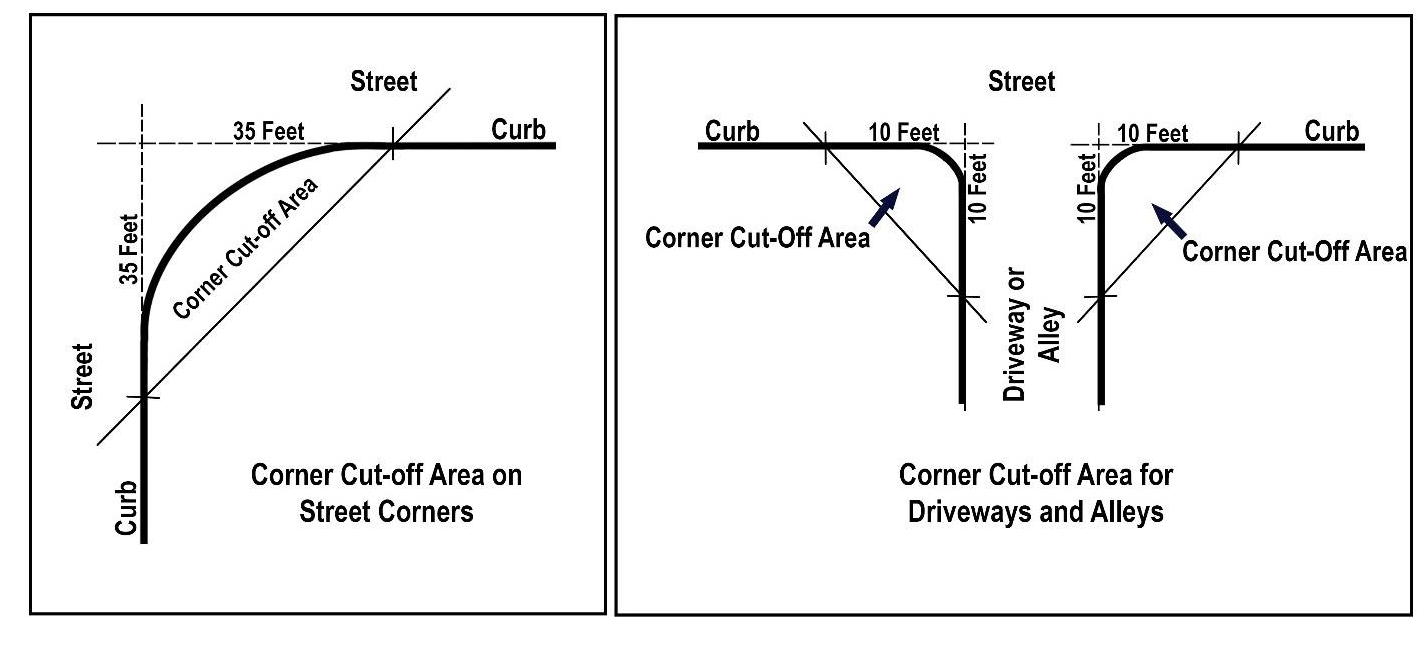
Corner Cutoff Areas. The following regulations shall apply at all intersections of streets, alleys or private driveways in all residential districts in order to provide adequate visibility for vehicular traffic. There shall be no visual obstruction within the cutoff areas established herein.
1.
There shall be a corner cutoff area at all intersecting streets or highways. The cutoff line shall be in a horizontal plane, making an angle of forty-five degrees, with the side, front or rear property line, as the case may be. It shall pass through the points located on both the side and front (or rear) property lines at a distance of thirty feet from the intersection of such lines or their projections at the corner of a street or highway.
2.
There shall be a corner cutoff area on each side of any private driveway intersecting a street or alley. The cutoff lines shall be in a horizontal plane, making an angle of forty-five degrees with the side, front or rear property line, as the case may be. They shall pass through a point not less than ten feet from the edges of the driveway where it intersects the street or alley right-of-way.
3.
There shall be a corner cutoff area on each side of any alley intersecting a street or alley. The cutoff lines shall be in a horizontal plane, making an angle of forty-five degrees with the side, front or rear property line, as the case may be. They shall pass through a point not less than ten feet from the edges of the alley where it intersects the street or alley right-of-way.
4.
Where, due to an irregular lot shape, a line at a forty-five-degree angle does not provide for intersection visibility, said corner cutoff shall be defined by a line drawn from a point on the front (or rear) property line that is not less than thirty feet from the intersection of the side and front (or rear) property lines and through a point on the side property line that is not less than thirty feet from said intersection of the side and front (or rear) property lines.
D.
All fences and walls shall be constructed of new or good used material, and all fences and walls shall be kept in good repair and adequately maintained. Any dilapidated, dangerous, or unsightly fences or walls shall be removed, unless otherwise required, or repaired.
E.
The provisions of this title regarding fences or walls shall not apply to a fence or wall necessary for public safety or as required by any law or regulation of the state, or any agency thereof.
F.
Exceptions may be granted in accordance with Chapter 18.84.
(Ord. No. 491-18, § 2(Exh. A), 10-9-2018)
18.50.120 - Fences, walls, and hedges by zone district
A.
The following standards shall apply in the R-L and R-M zone districts:
1.
Fences, walls and hedges not exceeding seven feet in height shall be permitted, except that in a required front yard or within five feet of a street side property line on a corner or side on cul-de-sac lot, a fence, wall or hedge shall not exceed four feet in height.
2.
Front yard and street side yard fence materials shall consist only of wood, tubular steel, wrought iron, or other decorative metal. Brick, stone, or stucco piers may be used in combination with these materials. New chain link front yard and street side yard fences are prohibited.
3.
Block walls, fences, wrought iron fences for residential developments along arterial or collector roadways shall be designed to provide pedestrian access between the arterial or collector to the residential development where possible.
B.
The following standards shall apply in the R-MH, R-H, O, and PF zone districts:
1.
Fences, walls and hedges not exceeding seven feet in height shall be permitted except that in a required front yard, or a required side yard on a corner or side on cul-de-sac lot, a fence, wall or hedge shall not exceed four feet in height except as allowed by subsections (2) and (4) below.
2.
Wrought Iron Fences. A decorative open metal fence of wrought iron or tubular steel (not chain link) not exceeding seven feet in height shall be permitted along the front and street side property lines or within the front yard and street side yard setback areas of multi-family uses. This subsection does not authorize solid walls or fences composed of woven wire (chain link), wood, or other materials other than open metal wrought iron or tubular steel. A post or pilaster consisting of masonry, brick, or other solid material between twelve and eighteen inches square and seven feet tall may be used to support a wrought iron or tubular steel fence at a distance of at least six feet, but no more than thirty-six feet, between the posts or pilasters.
3.
Block walls, fences, wrought iron fences for multi-family developments along arterial or collector roadways shall be designed to provide pedestrian access between the arterial or collector to the multi-family residential development.
4.
Along a front lot line an open chain link fence up to seven feet in height may be located in conjunction with a public or quasi-public playground or park use.
C.
The following standards shall apply in the MX, MX-D, C-N, C-S, C-H, I-L, and I-H zone districts:
1.
A seven-foot solid masonry wall shall be required along any side or rear property line abutting an R-L, R-M, R-MH, R-H, O, or PF zone district, except in required front and corner side yards where the maximum height shall be three feet.
2.
The director may allow fence and wall heights to be increased in order to mitigate noise problems documented by a noise study.
3.
Razor wire, electrified fencing, and similar security devices are only allowed on a permanent basis in the I-L and I-H zone districts with approval by the director, provided that it is not visible from the public right-of-way and is not located adjacent to a residence or residential district.
(Ord. No. 491-18, § 2(Exh. A), 10-9-2018)
18.50.130 - Temporary fences.
The use of temporary fences is allowed subject to the following requirements:
A.
A temporary fence shall be constructed of chain link or other such material approved by the director and shall not be permanently affixed to the site.
B.
A temporary fence shall be located on the site in such a manner as not to impede pedestrian or vehicle traffic adjacent to the site.
C.
A temporary fence placed to secure a construction, rehabilitation or demolition project on the site shall be removed when the project is completed.
D.
A temporary fence placed for a reason other than to secure a construction, rehabilitation or demolition project on the site shall be removed after ninety days unless a temporary use permit is issued in accordance with Chapter 18.76 that allows a longer period of time.
(Ord. No. 491-18, § 2(Exh. A), 10-9-2018; Ord. No. 503-20, § 2(Atts. 2, 4), 10-27-2020)
18.50.140 - Tents, tarps, and other coverings.
No front or side building setback area in the R-L, R-M, R-MH, R-H, O and PF zone district shall be covered by tents, tarps, cloth, fabric, or a wood or metal covering or structure except for the following:
A.
Standard window and door awnings.
B.
Ornamental covers, such as a sidewalk or entry awning trellis, or other similar improvement intended as an improved passageway or for aesthetic purposes providing architectural integrity with the building to which it is attached.
(Ord. No. 491-18, § 2(Exh. A), 10-9-2018)
18.50.150 - Outdoor lighting standards.
A.
Purpose. The purpose of this section is to establish standards for the types, construction, installation and use of outdoor electrically powered illuminating devices and systems to conserve energy, preserve the natural environment, and provide nighttime safety and security, while not materially interfering with the use and enjoyment of property.
B.
Definitions. For purposes of this section, unless otherwise defined, the following words and phrases when used in this section shall have the following meaning:
1.
"Automatic timing device" means device which automatically turns on and off outdoor light fixtures or circuits.
2.
"Canopy light fixture" means an outdoor lighting fixture attached to or recessed within a canopy ceiling.
4.
"Fully shielded fixture" means an outdoor light fixture shielded in such a manner that all light emitted by the fixture, either directly from the lamp or indirectly from the fixture, is projected below the horizontal plane as determined by photometric test or certified by the manufacturer. A light fixture mounted under a canopy or other structure such that the canopy or surrounding structure effectively shields the light in the same manner is also considered fully shielded for the purposes of this definition.
5.
"Light glare" means the reflections of light sources which reduce the contrast between detail and background within the visual area.
6.
"Light trespass" means any form of artificial illumination emanating from a light fixture or illuminated sign that penetrates other property and creates a nuisance.
7.
"Lumen" means that unit used to measure the actual amount of light which is produced by an outdoor light fixture.
8.
"Luminous tube lighting" means gas-filled tubing which, when subjected to high voltage, becomes luminescent in a color characteristic of the particular gas used, e.g., neon, argon, etc.
9.
"Outdoor light fixture" means an electrically powered illuminating device which is permanently installed outdoors, including, but not limited to, devices used to illuminate any site, structure, or sign.
10.
"Temporary lighting" means lighting which does not conform to the provisions of this section and which will not be used for more than one continuous thirty-day period within one calendar year. Temporary lighting is intended for uses, which by their nature are of limited duration; e.g. holiday decorations, civic events, special events, construction projects, emergencies or similar situations. The thirty-day time limitations may be extended by the city on a case-by-case basis for unusual or special circumstances.
C.
Exemptions. The outdoor lighting fixtures listed below are exempt from the provisions of this section:
1.
Outdoor lighting fixtures which were lawfully installed prior to the enactment of these standards and do not create a nuisance.
2.
Luminous tube lighting. Gas-filled tubing such as neon, argon, etc.
3.
Temporary lighting, as defined in subsection B.
4.
Public outdoor recreational facilities, airport, roadway and navigation lighting installed and maintained by a public agency or public utility.
5.
Outdoor light fixtures producing light by the combustion of fossil fuels, such as liquid fuel lanterns or gas lamps.
6.
Low voltage holiday decorations and landscape/walkway lighting.
7.
Ornamental lighting within the street right-of-way when approved by the city.
8.
Lights emitting infrared radiation used for remote security surveillance systems.
9.
Emergency Lighting by Emergency Services. Searchlights, floodlights, laser source lights, strobe or flashing lights, or any similar high intensity lights are permitted when used in emergencies by police, fire, medical, or utility personnel or at their direction.
10.
Solar-Powered Lighting. Solar-powered lights of five watts or less per fixture used in residential landscaping applications and to illuminate walkways are exempt from applicable lamp type and shielding standards and are excluded from the total lumen calculations for the site.
D.
General Outdoor Lighting Standards. The following requirements and standards shall apply in all zone districts for the installation and use of outdoor lighting fixtures.
1.
All lights and light fixtures, except public street lights, shall be located, aimed or shielded so as to minimize light trespassing across property boundaries or skyward.
2.
No lights or light fixtures shall flash, revolve, blink or otherwise resemble a traffic control signal or operate in such a fashion to create a hazard for passing traffic.
3.
Building mounted lighting fixtures shall be attached only to the walls of the building. The top of a light fixture attached to a building wall shall not be higher than the top of the building parapet or the top of the roof eave, whichever is lower.
4.
Canopy ceiling light fixtures shall be recessed or the sides of the lens area shall be shielded in order to eliminate emission of horizontal light.
5.
The height of freestanding light fixtures including freestanding parking lot fixtures shall be measured from the top of a light fixture to the adjacent grade at the base of the support for that light fixture and shall not exceed the following:
a.
Eighteen feet in height, when located within fifty feet of any residential zone district; and
b.
Twenty-five feet in height when located within fifty-one to one hundred fifty feet of any residential zone district; and
c.
Thirty feet in height when located more than one hundred fifty feet from any residential zone district; and
E.
Residential Outdoor Lighting Standards. In addition to the general outdoor lighting standards stated in subsection D, the following additional requirements shall apply to outdoor lighting fixtures in the R-L, R-M, R-MH, and R-H zone districts:
1.
Mercury vapor lamps shall be a fully shielded fixture with all light directed on-site.
2.
Freestanding light fixtures, including freestanding parking lot light fixtures, shall not exceed eighteen feet in height measured from the top of a light fixture to the adjacent grade at the base of the support for that light fixture.
F.
Non-residential Outdoor Lighting Standards. In addition to the requirements identified in subsection D, the following additional requirements shall apply to outdoor lighting fixtures in the O, PF, and all commercial and mixed-use zone districts:
1.
All outdoor fixture lighting shall be a fully shielded fixture and focused to minimize light trespass and glare.
2.
Outdoor lighting fixtures shall be turned off after close-of-business unless needed for safety or security, in which case the lighting shall be activated by motion sensor devices. Illuminated signs and parking lot lighting are excluded from this requirement.
3.
Lighting for signs, recreational facilities, and decorative effects for building and landscape shall be fully shielded fixtures equipped with automatic timing devices and focused to minimize light glare and light trespass.
G.
Submission of Plans and Evidence. For parking lots and commercial developments, the submission of lighting plans and evidence of compliance with these lighting requirements are required, and shall include the following:
1.
Description of outdoor light fixtures, including component specifications such as lamp reflectors, lens style, angle of light cutoff, supports, poles, and include manufacturers' catalog specifications.
2.
Locations and description of all outdoor light fixtures and hours of their operation.
(Ord. No. 491-18, § 2(Exh. A), 10-9-2018)
18.50.160 - Through lots.
A front building setback area shall be provided on each frontage of a through lot, except where access to one of the frontages has been waived or is otherwise prohibited.
(Ord. No. 491-18, § 2(Exh. A), 10-9-2018)
18.50.170 - Exceptions in building setback area limitations.
A.
Architectural features, including without limitation, sills, chimneys, fireplaces, cornices and eaves, may extend into a required side building setback area, a required rear building setback area, or a space between structures, not more than thirty-six inches, and may extend into a required front building setback area not more than six feet. Where an architectural feature extends more than twenty-four inches into a required side building setback area, such extension shall meet all fire and building code requirements. No building or projection thereof may extend into a public easement or right-of-way.
B.
Open, unenclosed, uncovered metal fire escapes and depressed ramps or stairways may project into any required yard or space between buildings not more than four feet; and planter boxes attached to a building may be extended into a required front building setback area by not more than three feet.
C.
Fences, walls, hedges, garden structures, walks, driveways and retaining walls may occupy any required building setback area or other open space, subject to the limitations prescribed in this title.
D.
When more than sixty percent of the linear frontage of lots improved with residential buildings within any street block is comprised of lots with less than the minimum front building setback requirements, the minimum front building setback for newly constructed residential buildings in such block shall be the average of the actual front building setback of all the lots in such block improved with residential buildings; counting those that have front building setbacks greater than the minimum front building setback requirement of the zone district as having the minimum requirement.
(Ord. No. 491-18, § 2(Exh. A), 10-9-2018)
18.50.180 - Exceptions to height limitations.
Penthouses or roof structures for the housing of elevators, stairways, tanks, ventilating fans, air- conditioning equipment, or similar equipment required to operate and maintain buildings, and fire and parapet walls, skylights, towers, spires, cupolas, road signs (where permitted), flagpoles, chimneys, smokestacks, television and radio masts, or similar structures may be erected above the height limit but shall not be allowed for the purpose of providing additional floor space.
(Ord. No. 491-18, § 2(Exh. A), 10-9-2018)
18.50.190 - Property maintenance.
It is a public nuisance for any person owning, leasing, renting, occupying, or having possession of any real property to maintain said real property in a manner in which any of the following conditions are found to exist:
A.
The real property or any buildings, structures, or improvements located thereon which violate one or more of the following:
1.
The California Building Standards Code, California Code of Regulations, Title 24, any and all amendments, thereto, published by the California Building Standards Commission;
2.
Any provision of the Chowchilla Municipal Code;
3.
Any other law or regulation, such violations including, without limitation, violations that create a fire hazard, endanger human life, or are hazards to the public health, safety and general welfare of the citizens of the city, including without limitation, real property, structures or other improvements that are in disrepair or are not property maintained as determined by the chief building official;
B.
Outdoor storage of personal property of any type or design in any unscreened/unfenced areas fronting on any alley, street, or other public right-of-way;
C.
The parking of vehicles in landscaped areas;
D.
Real property or structures or improvements thereon not properly maintained so as to constitute a fire hazard by reason of weeds, grass, rank overgrowth, or accumulations of debris or which could harbor rats or other vermin, create unsightly appearance, or create conditions which are detrimental to neighboring properties;
E.
Broken windows or other structural defects in the real property or any structures or improvements thereon which create hazardous conditions and invite trespassing and malicious mischief including unsafe structural supports, boarded doorways and windows, dry rot, termites, and similar hazards;
F.
Clothes lines visible from a public street;
G.
Garbage cans and garbage receptacles stored in locations on a lot that are visible from the public street or neighboring properties. Except that, the enforcement officer may determine that circumstances involving the property or its occupants make it difficult or impossible to place the garbage cans and receptacles out of public view. If the enforcement officer makes such a determination, the enforcement officer shall designate a location on the property for the storage of the garbage cans and receptacles even though such location may allow the garbage cans and receptacles to be visible from the public street or neighboring properties;
H.
Failure to maintain any wall, fence, or hedge as to constitute a hazard to persons or property or which create an unsightly appearance;
I.
Failure to maintain required landscaping and trees and/or removal, destruction or severe pruning of required landscaping or trees;
J.
Installation of newspaper/magazine racks, overnight/postal drop boxes or other items of personal property in the public right-of-way without first obtaining an encroachment permit from the city and/or failure to properly maintain said items.
(Ord. No. 491-18, § 2(Exh. A), 10-9-2018)

