
Chowchilla City Zoning Code
CHAPTER 18
56 - SIGNS AND OUTDOOR ADVERTISING STRUCTURES
18.56.010 - Purpose.
A.
The purpose of this chapter is to regulate signs as an information system that preserves and enhances the aesthetic character and environmental values of Chowchilla, its residential neighborhoods, its downtown, and commercial/industrial areas, while also providing an effective means for members of the public to express themselves through the display of signs. These regulations recognize the importance of business activity to the economic vitality of the city as well as the need to protect the visual environment. Specifically, these regulations are intended to implement the general plan and to:
1.
Provide minimum standards to safeguard life, health, property, public welfare, and traffic safety by controlling the design, quality of materials, construction, illumination, size, location and maintenance of signs and sign structures;
2.
Preserve and enhance the visual attractiveness of the city for residents, businesses, and visitors;
3.
Protect and enhance property values and community appearance by encouraging signs that are compatible with the architectural style, character, and scale of the building to which they relate and with adjacent buildings and businesses;
4.
Restrict signs that may create visual clutter or a nuisance to nearby properties, violate privacy, or create hazards or unreasonable distractions for pedestrians and drivers;
5.
Provide adequate opportunity for the exercise of the free speech by display of a message or image on a sign, while balancing that opportunity with other community and public interests;
6.
Ensure that commercial signs are accessory or auxiliary to a principal business or establishment on the same premises, rather than functioning as general advertising for hire; and
7.
Prohibit signs that may cause traffic or pedestrian safety hazards or interfere with ingress and egress.
B.
It is the city's policy to regulate signs in a constitutional manner that is content neutral as to noncommercial messages which are within the protections of the First Amendment to the U.S. Constitution and the corollary provisions of the California Constitution.
(Ord. No. 491-18, § 2(Exh. A), 10-9-2018)
18.56.020 - Applicability and severability.
This chapter regulates signs that are located or mounted on private property within the jurisdictional boundaries of Chowchilla. The provisions in this chapter apply in all zoning districts within the city. No sign within the regulatory scope of this chapter shall be erected or maintained anywhere in the city except in conformance with this chapter. If any part, section, subsection, paragraph, subparagraph, sentence, phrase, clause, term, or word in this chapter is declared invalid, such invalidity shall not affect the validity or enforceability of the remaining portions of the chapter.
(Ord. No. 491-18, § 2(Exh. A), 10-9-2018)
18.56.030 - No discrimination against noncommercial speech.
Subject to the property owner's consent, a noncommercial message of any type may be substituted, in whole or in part, for any commercial message or any other noncommercial message provided that the sign structure or mounting device is legal without consideration of message content. Such substitution of message may be made without any additional approval or permitting. This provision prevails over any more specific provision to the contrary within this title. The purpose of this provision is to prevent any inadvertent favoring of commercial speech over noncommercial speech or favoring of any particular noncommercial message over any other noncommercial message. This provision does not create a right to increase the total amount of signage on a parcel, nor does it affect the requirement that a sign structure or mounting device be properly permitted.
(Ord. No. 491-18, § 2(Exh. A), 10-9-2018)
18.56.040 - Exempt signs.
A.
The following signs are exempt from the permit requirements of this chapter and do not count toward the total sign area limit for a site, provided that they conform to applicable standards:
1.
One nameplate per residence or business premises, mounted on a wall and not exceeding two square feet in area, identifying the owner and/or address of the property.
2.
Barber poles, not exceeding eighteen inches in height, located in a non-residential zone district and containing no lettering.
3.
Signs on vehicles, provided that the message pertains to the establishment of which the vehicle is an instrument or tool, and the sign does not utilize changeable copy or special illumination.
4.
Holiday and cultural observance decorations on private property that do not include commercial advertising. This exemption includes strings of lights associated with a holiday decoration.
5.
Official notices issued by a court or public agency and posted in the performance of a public duty; notices posted by a utility or other quasi-public agency; signs erected by a governmental agency to direct or regulate pedestrian or vehicular traffic; noncommercial bus stop signs erected by a public transit agency, or other signs required or authorized by law. This exemption also covers signs and banners for special civic events erected by the city, which may be displayed in public rights-of-way.
6.
Signs that are located entirely within a building or enclosed structure and are not visible from the public right-of-way.
7.
Signs located on a private area of a lot that is not accessible by the general public, such as a backyard, and are not visible from the public right-of-way.
8.
Signs and menu display boards fixed to mobile vending carts, up to a maximum of eight square feet of sign area, plus a menu display board.
9.
Signs that are part of a vending machine.
10.
Temporary signs that conform to the standards of Chapter 18.56.
11.
Signs mounted on carrier vehicles such as buses, taxicabs, and limousines that legally pass through the city.
12.
Window signs that conform to the standards of Chapter 18.56.
B.
Exempt signs that have electrical connections or engineered supports shall obtain the appropriate building permit, as required by the California Building Code.
(Ord. No. 491-18, § 2(Exh. A), 10-9-2018)
18.56.050 - Prohibited signs.
A.
The following signs shall be prohibited in all zones:
1.
Signs illuminated with red, green, or amber light placed in such a position that it could reasonably be perceived to interfere with, or be confused with any official traffic control device, traffic signal, or official directional guide sign.
2.
Signs placed within thirty feet of the intersecting curb lines of a street, except for signs erected by a governmental agency to direct or regulate pedestrian or vehicular traffic.
3.
Signs so located as to prevent free ingress and egress from any door, window, or fire escape;
4.
Outdoor advertising structures located on a site other than the site on which the advertised commercial use is located or on which the advertised commercial product is produced.
5.
Signs extending above or beyond the face of the building, the fascia of the roof, the peak of a pitched roof, or the parapet line of a flat roof.
6.
Glaring, flashing, sparkling, glittering, twinkling, or shimmering signs.
7.
Signs with open letters that can be viewed from the reverse side.
8.
Streamers, balloons, blimps, or other floating, inflatable, or hanging devices secured with a rope or string, unless specifically permitted with a temporary use permit.
9.
Signs located, placed, or erected in or upon any public right-of-way, except as specifically allowed by this chapter.
10.
Signs located, placed or attached upon any tree, utility pole, or fence, except as specifically allowed by this chapter.
11.
Signs placed on private property without permission of the property owner.
12.
Nonconforming signs and sign structures associated with an activity, business, product or service that has not been sold, produced, provided or conducted on the premises for a period of ninety days.
13.
Signs that revolve or are animated, except public service signs, such as time and temperature units and barber pole.
14.
Signs containing statements, words, symbols, or characters of an obscene nature.
15.
Signs emitting sound.
16.
Murals that contain commercial speech or logos.
17.
Signs located within five feet of a fire hydrant, street sign, or traffic signal.
18.
Can or cabinet signs.
(Ord. No. 491-18, § 2(Exh. A), 10-9-2018)
18.56.060 - Permits required.
A.
No sign shall be erected, altered, reconstructed, or relocated without a sign permit. A permit is not required for ordinary maintenance and repairs to signs and for temporary signs on private property that conform to the standards of this chapter. The director will review all applications for sign permits for consistency with this chapter.
B.
Signs that project over or extend into a public street or sidewalk shall also require approval of an encroachment permit by the city engineer pursuant to the provisions of Title 12 of the municipal code.
C.
Consent of the property owner and business owner is required before any sign permit may be approved.
D.
Where permitted per Table 18.56.090, a permanent freestanding sign may extend higher than twenty feet after first securing approval of a conditional use permit in accordance with Chapter 18.80. The height of all proposed freestanding signs shall comply with the Madera County Airport Land Use Compatibility Plan and shall conform with all applicable Federal Aviation Administration requirements.
(Ord. No. 491-18, § 2(Exh. A), 10-9-2018; Ord. No. 503-20, § 2(Atts. 2, 4), 10-27-2020)
18.56.070 - Sign design principles.
A.
The following sign design principles should be used as criteria for review and approval of sign permits and master sign programs.
1.
Architectural Compatibility. A sign, including its supporting structure, if any, should be designed as an integral design element of a building's architecture and be architecturally compatible, including color and scale, with any building to which the sign is to be attached and with surrounding structures. A sign that covers a window or that spills over "natural" boundaries or architectural features and obliterates parts of upper floors of buildings is detrimental to visual order and will not be permitted. Common indicators of compatibility include quality sign design and construction, proportional size and scale; and use of materials, shapes and colors that complement the building's architectural style and the surrounding environment.
2.
Legibility. The size and proportion of the elements of the sign's message, including logos, letters, icons, and other graphic images, should be selected based on the average distance and average travel speed of the viewer. Sign messages oriented towards pedestrians may be smaller than those oriented towards vehicle drivers. Colors chosen for the sign text and/or graphics should have sufficient contrast with the sign background in order to be easily read during both day and night. Symbols and logos can be used in place of words. Substantial contrast should be provided between the color and materials of the background and the letters or symbols to make the sign easier to read.
3.
Readability. A sign message should be easily recognized and designed in a clear, unambiguous and concise manner, so that a viewer can understand or make sense of what appears on the sign.
4.
Visibility. A sign should be conspicuous and readily distinguishable from its surroundings, so a viewer can easily see the information it communicates.
5.
Placement. Often, a building's architectural details create logical places for signage. Signs should not cover or interrupt architectural details or ornaments of a building's façade. On buildings with a monolithic or plain façade, signs can establish or continue appropriate design rhythm, scale, and proportion. Well-designed and well-located retail signs create visual interest and continuity with other storefronts on the same or adjacent buildings.
6.
Materials. Signs shall be made of sturdy, durable materials. Paper, cardboard, or other material subject to rapid deterioration can only be used for signs that comply with applicable requirements for temporary signs. Fabric signs are restricted to awnings, canopies, flags, and temporary signs.
B.
Sign permits or master sign programs that are determined by the director to be substantially inconsistent with these sign design principles may be denied.
(Ord. No. 491-18, § 2(Exh. A), 10-9-2018; Ord. No. 503-20, § 2(Atts. 2, 4), 10-27-2020)
18.56.080 - Rules for sign measurement.
A.
For the purposes of this chapter, lot frontage shall be calculated as follows:
1.
If a lot fronts on two streets, both frontages may be used to determine the allowable sign area.
2.
If a lot fronts on three or more streets, the length of only two contiguous sides shall be added together to determine allowable sign area.
B.
The building frontage shall be the building facade in which main customer access is provided to the establishment. A building's frontage is considered continuous if projections or recesses in the building facade do not exceed fifteen feet in any direction. For buildings with two or more frontages, the length of the wall and allowable sign area shall be calculated separately for each building frontage.
C.
The area of an individual sign shall be calculated as follows.
1.
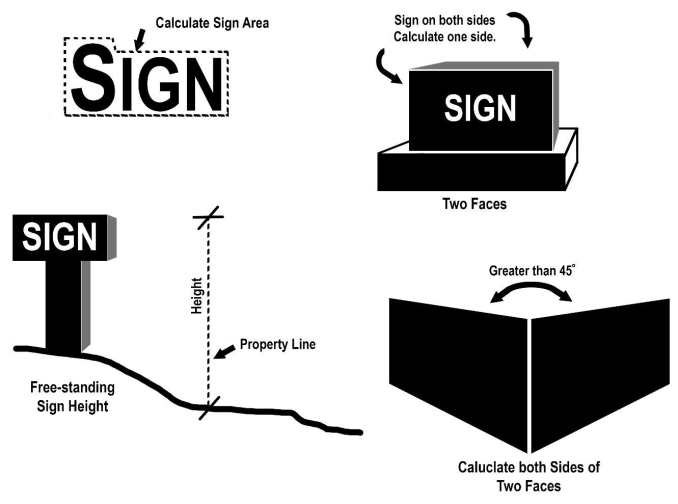
Sign area shall include the entire area within a single continuous perimeter composed of squares or rectangles that enclose the extreme limits of all sign elements, including, but not limited to, sign structures or borders, written copy, logos, symbols, illustrations, and color. Supporting structures such as sign bases and columns are not included in sign area provided that they contain no lettering or graphics.
2.
Where two faces of a double-faced sign are located two feet or less from one another at all points or located at an interior angle of forty-five degrees or less from one another, the sign area shall be calculated as the area of one face. Where the two faces are not equal in size, the larger sign face shall be used. Where two faces of a double-faced sign are located more than two feet or forty-five degrees from one another, both sign faces shall be counted toward sign area.
3.
On a three-faced sign, where at least one interior angle is forty-five degrees or less, the sign area shall be calculated as the sum of the largest and the smallest face. In all other situations involving a sign with three or more sides, sign area shall be calculated as the sum of all faces.
4.
Three-Dimensional Signs. The size of signs that consist of, or have attached to them, one or more three-dimensional objects (i.e., balls, cubes, clusters of objects, sculpture, or statue-like trademarks), shall be calculated as the sum of the square footage of the two adjacent sides of the smallest theoretical cube that would encompass the sign.
D.
The height of a sign shall be calculated as follows.
1.
The height of a sign that is not a freestanding sign shall be the vertical distance measured from the ground level directly beneath the sign to the highest point at the top of the sign, including any structural or architectural components of the sign.
2.
The height of a freestanding sign shall be measured as the vertical distance from grade at the edge of the right-of-way along which a freestanding sign is placed to the highest point of the freestanding sign, including any structural or architectural components of the sign. When the grade at the edge of the right-of-way is higher than the site on which the sign is placed, that portion of the sign below the grade at the edge of the right-of-way shall not be included in determining the freestanding sign's overall height. Freestanding signs oriented towards a freeway shall be measured from the site's finished grade or pad, whichever is lower.
E.
Sign clearance shall be measured as the smallest vertical distance between finished grade and the lowest point of the sign, including any framework or other embellishments.
F.
For the purpose of determining the allowed number and size of signs, an integrated shopping center shall be considered as one site.
(Ord. No. 491-18, § 2(Exh. A), 10-9-2018)
18.56.090 - Sign regulations on developed sites by zone district.
For the purpose of this section, signs are grouped into four types: building signs, freestanding signs, temporary building signs, and temporary freestanding signs.
This section establishes standards for the number of signs, size of signs, placement of signs, and illumination of signs for developed sites based on the zone district in which the signs are located. Table 18.56.090(A) establishes specific regulations by zone district for building signs, and freestanding signs. Table 18.56.090(B) establishes specific regulations by zone district for temporary building signs and temporary freestanding signs. Signs shall not be placed on private property except in conformance with Table 18.56.090(A) and Table 18.56.090(B).
Table 18.56.090(A)
Notes:
1
The height of all proposed freestanding signs shall comply with the Madera County Airport Land Use Compatibility Plan and shall conform with all applicable Federal Aviation Administration requirements.
Table 18.56.090(B)
(Ord. No. 491-18, § 2(Exh. A), 10-9-2018; Ord. No. 503-20, § 2(Atts. 2, 4), 10-27-2020; Ord. No. 525-25, § 1, 1-14-2025)
18.56.094 - Additional highway-oriented signs.
A.
The sign standards in Section 18.56.090 are modified in accordance with this section to allow for highway-oriented signs in specified locations along State Highway 99.
B.
This section is only applicable to parcels located in the C-N, C-S, C-H, or MX zones and located adjacent to State Highway 99 east of the Union Pacific Railroad tracks, west of South Fig Tree Blvd, south of Ash Slough, and north of Berenda Slough. Only parcels meeting this zoning and location criteria are allowed an additional highway-oriented sign.
C.
In addition to the signs allowed in Section 18.56.090, parcels allowed to have a highway-oriented sign may, upon issuance of a sign permit, establish a pole sign or a pylon sign consistent with the following standards:
1.
There shall be a maximum of one such sign per parcel.
2.
The sign shall have a maximum of two sides.
3.
Signs shall be consistent with a two to one foot ratio of sign size to sign height.
4.
The maximum size shall be two hundred square feet per side.
5.
The maximum height shall be one hundred feet.
6.
The sign shall be set back a minimum of ten feet from all property lines and rights-of-way.
7.
The sign shall be set back a minimum of forty feet from any residential zone district.
8.
The sign shall be located in a landscaped planter at least three feet wider than the base of the sign on all sides. The planter may encroach into the required minimum setback areas.
D.
In lieu of the single sign allowed in subsection C above, up to six multiple commercial uses that are located on the same parcel or on adjacent parcels may, upon issuance of a sign permit, establish a pylon sign consistent with the following standards:
1.
There shall be a maximum of one such sign per parcel with more than one pole or upright for support.
2.
The sign shall have a maximum of two sides.
3.
The maximum size shall be one hundred forty square feet per commercial use, not to exceed six commercial uses.
4.
The maximum height shall be one hundred feet.
5.
The sign shall be set back a minimum of ten feet from all property lines and rights-of-way.
6.
The sign shall be set back a minimum of eighty feet from any residential zone district.
7.
The sign shall be located in a landscaped planter at least three feet wider than the base of the sign on all sides. The planter may encroach into the required minimum setback areas.
E.
Highway-oriented signs may be internally lit but shall not be externally lit. Signs must be compliant with Chapter 2 of the California Manual on Uniform Traffic Control Devices (MUTCD) which contains guidance for signs on highways and private roads.
(Ord. No. 525-25, § 1, 1-14-2025)
18.56.096 - Additional shopping center signs.
A.
Shopping centers or office complexes with a mix of retail and/or professional office tenants having three to six business establishments and located within the C-N, C-S, C-H, or MX zones may be allowed one additional permanent freestanding or permanent building sign beyond what is allowed in Section 18.56.090 if the sign conforms to the following provisions:
1.
The sign may advertise the name of the center, the tenants in the center, or both the center and tenant names. Tenant advertising on a shopping center sign is not counted as part of the overall sign area permitted by Table 18.56.090(A). Only advertising for businesses located on the shopping center site is allowed.
2.
The sign shall have a maximum of two sides.
3.
The maximum size shall be one hundred square feet per side.
4.
The maximum height shall be twenty-five feet.
5.
The sign shall be set back a minimum of five feet from all property lines and rights-of-way.
6.
The sign shall be set back a minimum of forty feet from any residential zone district.
7.
The sign may be illuminated unless adjacent to residential uses, in which case the community development director may require conditions on the type of illumination to protect against negative effects on the adjacent residential uses. Individual letters and logos may be internally illuminated.
8.
Materials, color, and arrangement of the sign shall be compatible and consistent with the shopping center buildings.
B.
With the adoption of a comprehensive master sign program in accordance with Section 18.56.210, an additional sign that is allowed by subsection A may be eligible for "bonus" sign area greater than allowed in subsection A.
1.
The maximum size of the sign area may be up to two hundred fifty square feet if a permanent copy is included on the shopping center sign that states "City of Chowchilla," "Welcome to Chowchilla," or equivalent language.
2.
The maximum size of the sign area may be up to three hundred square feet, upon approval by the planning commission, if enhanced design features (such as additional landscaping, water features, decorative artwork, seating areas, etc.) are incorporated into the shopping center.
3.
The maximum size of the sign area may be up to three hundred square feet, upon approval of the planning commission if the criteria of both "1" or "2" above are met.
4.
The maximum allowable height of the additional sign may be up to forty feet, upon approval by the planning commission, if the criteria for either "1" or "2" above are met and/or if the shopping center is located on the corner of two arterial streets, as defined in the Chowchilla General Plan.
(Ord. No. 525-25, § 1, 1-14-2025)
18.56.100 - Sign regulations on undeveloped or developing sites.
A.
Undeveloped sites shall be allowed a maximum one temporary freestanding sign of a maximum size of thirty-two square feet. Illumination of the sign is prohibited.
B.
Developing sites, i.e. construction sites, shall be allowed a maximum two temporary freestanding signs of a maximum size of thirty-two square feet each. Illumination is prohibited. Temporary signs that are not visible from any public right-of-way shall not be counted in the maximum number or size of signs.
C.
Residential subdivision sites where ten or more new residences are offered for sale shall be allowed one temporary sign of a maximum size of thirty-two square feet. Illumination of the sign is prohibited. The sign shall not be made or constructed from cloth, bunting, plastic, paper or similar material. The sign may be mounted on a building or may be a freestanding temporary sign of a maximum height of twelve feet. Additional temporary signs, temporary freestanding signs, and flags may be maintained within the boundaries of a residential subdivision provided that they are not visible from outside the residential subdivision and do not create a safety hazard by obstructing the clear view of pedestrian and vehicular traffic.
(Ord. No. 491-18, § 2(Exh. A), 10-9-2018)
18.56.110 - Offsite temporary signs for residential subdivisions.
A.
Residential subdivision sites where ten or more new residences are offered for sale shall be allowed up to four offsite temporary freestanding signs with a size not to exceed thirty-two square feet and a height not to exceed eight feet per residential subdivision. Signs shall be located on private, non-residential zoned parcels, or on private, residential zoned parcels that are part of an undeveloped residential subdivision (as defined in Section 1[18.56.100] hereof) and that are unoccupied, vacant and otherwise free from any structures or buildings. Signs shall not be made or constructed from cloth, bunting, plastic, paper or similar material. Banners and flags with or without an advertising message shall not be permitted offsite.
B.
In addition to any sign permitted pursuant to subsection A. above, up to four nonilluminated offsite temporary freestanding signs in an A-frame configuration, with a size not to exceed twelve square feet per face or four feet in height, may be permitted per residential subdivision. A-frame signs shall be located on private, non-residential property or on public property behind any existing sidewalks, and in such a manner so as to not to create a safety hazard by obstructing the clear view of, or otherwise hinder or impede, pedestrian and vehicular traffic. A-frame signs may only be displayed during the operating hours for the residential subdivision sales office and shall be located no further than one thousand five hundred feet from the subject residential subdivision entry.
C.
No more than one offsite temporary subdivision sign per parcel shall be allowed.
(Ord. No. 491-18, § 2(Exh. A), 10-9-2018)
18.56.120 - Flags and flagpoles.
A.
Flags on flagpoles shall not count toward the maximum sign area.
B.
Flagpoles shall not be located within any required side or rear building setback areas. Flagpoles may be mounted on the ground or on the roof or wall of a building.
C.
The maximum height of a flagpole shall be as follows:
1.
Flagpoles located in a C-N, C-S, C-H, MX, I-L, or I-H zones shall have a maximum height of fifty feet or a maximum height equal to twice the distance from the base of the pole to the closest lot line, to a maximum of one hundred feet, whichever is greater.
2.
Flagpoles located in the R-L, R-M, R-MH, or R-H zones shall have a maximum height of thirty feet, mounted on the ground.
3.
Flagpoles located in the C-N, MX, O, and PF zones shall have a maximum height of fifty feet.
4.
Flagpoles located in the MX-D zone shall have a maximum height of fifty feet or a maximum height of thirty feet plus the height of a building upon which it is mounted, whichever is greater.
D.
The maximum width (hoist) of an individual flag on a ground-mounted or roof-mounted flagpole shall be equal to twenty percent of the height of the flagpole upon which it is located. The maximum length (fly) of an individual shall be twice the allowed width (hoist.)
E.
The maximum width (hoist) of an individual flag on a wall-mounted flagpole shall be a maximum six feet by twelve feet.
(Ord. No. 491-18, § 2(Exh. A), 10-9-2018)
18.56.130 - Search lights and klieg lights.
Search lights and klieg lights are prohibited, except when used for public safety purposes or when specifically approved with a temporary use permit for a special event.
(Ord. No. 491-18, § 2(Exh. A), 10-9-2018)
18.56.140 - Signs in public rights-of-way.
The following signs are allowed in the public right-of-way:
A.
Building signs in the MX-D zone that project into the public right-of-way, provided that the width of the projecting sign is a maximum of three feet, and that the bottom of the sign is seven feet above the sidewalk or finished grade below it.
B.
Building signs located on or under awnings in the MX-D zone that meet the provisions of this chapter.
C.
Temporary freestanding signs placed on the sidewalk in the MX-D zone that meet the provisions of this chapter and when a minimum four-foot wide clear path of travel is provided.
(Ord. No. 491-18, § 2(Exh. A), 10-9-2018)
18.56.150 - Temporary sign standards.
A.
Temporary signs shall require a temporary sign permit.
B.
Temporary freestanding signs in non-residential zones shall not be located:
1.
In any public right-of-way;
2.
In parking lot driving lanes, aisles or spaces;
3.
On multi-use trails or sidewalks if they would block a four-foot wide pedestrian path of travel;
4.
At any location where they would block pedestrian access;
5.
Within one hundred feet on either side, or in front of a permanent freestanding sign;
6.
Within twenty feet from any other temporary freestanding sign; or
7.
Within thirty feet from a drive approach (driveway entrance) or intersection of two streets.
C.
Temporary building signs shall be removed after a period of thirty days. After removal, no temporary building sign may be placed on the site for a period of thirty days.
D.
Temporary freestanding signs placed on a sidewalk in accordance with this chapter shall be only be allowed between one hour before and one hour after the site's establishment is open to the public.
E.
Banners shall not be used as permanent signs.
F.
Banners and feather banners shall be constructed of durable, weather-resistant materials not subject to rapid deterioration or fading and shall be professional in appearance. Acceptable materials include but are not limited to vinyl, nylon reinforced vinyl, polyethylene or polyester- like materials, or durable fabric.
G.
Temporary freestanding signs shall be affixed to supporting structures made of a durable, rigid material such as, without limitation, wood, plastic or metal. Freestanding signs placed on hard surfaces in conformance with this chapter are exempt from this subsection if they have a weight and mass that makes them not inadvertently movable and they do not block a four-foot wide pedestrian path of travel.
(Ord. No. 491-18, § 2(Exh. A), 10-9-2018)
18.56.160 - Size of signs on windows.
Signs affixed to windows shall not cover more than forty percent of each window. They shall not be counted toward the maximum allowable sign size.
(Ord. No. 491-18, § 2(Exh. A), 10-9-2018)
18.56.170 - Signs with non-electronic changeable copy.
Non-electronic changeable copy shall represent no more than twenty percent of the total allowable sign area. Changeable copy shall not be changed more than once every twenty-four hours.
(Ord. No. 491-18, § 2(Exh. A), 10-9-2018)
18.56.180 - Signs with electronic changeable copy.
A.
Electronic copy is allowed as a display medium on freestanding signs in the commercial or mixed use zone districts upon issuance of a conditional use permit, issued pursuant to Chapter 18.80.
B.
Signs with electronic changeable copy shall meet the following standards:
1.
The electronic sign face shall be directed in a manner that is not visible from the front or side of residential properties located in a residential zone district.
2.
The electronic sign face shall be an integral part of the remainder of the sign area.
3.
Electronic copy shall be limited to no more than thirty lumens output, measured at ten feet from the sign face.
4.
No portion of the electronic sign face shall change more frequently than once every six seconds.
5.
The electronic sign shall not emit any audible sound, buzz, or noise.
6.
The electronic sign shall be operative only during the hours of operation of the associated business establishment.
7.
Sign copy or electronic picture displays shall be limited to advertising related to the use(s) on the premises on which the freestanding sign is located, except for message substitution, as allowed in Section 18.56.030.
8.
No change of lighting intensity may occur during a display or between displays except to respond to a change in ambient lighting conditions.
9.
No display shall create a potential distraction to drivers by virtue of the frequency of changes of images (i.e. the time between images expressed in seconds). The planning commission may impose limitations on the number of images that can be displayed over a specified time period for reasons of traffic safety.
(Ord. No. 491-18, § 2(Exh. A), 10-9-2018)
18.56.190 - Illumination of signs.
The illumination of signs, from either an internal or external source, must be designed to avoid negative impacts on surrounding rights-of-way and properties. The following standards apply to all illuminated signs:
A.
Sign lighting shall not be of an intensity or brightness that will create a nuisance for residential uses in a direct line of sight to the sign. Illuminated signs located adjacent to any residential area shall be controlled by a rheostat or other acceptable method to reduce glare.
B.
Internally illuminated signs shall be designed with an opaque, semi-opaque, or matte finish background on the sign face.
C.
Light sources for externally illuminated signs shall meet the following standards:
1.
Light sources shall be so arranged and maintained so that the light source is not directly visible from a public right-of-way or adjacent property.
2.
Low pressure sodium lighting is the preferred light source to minimize undesirable light into the night sky.
3.
High pressure sodium, metal halide, fluorescent, quartz, LED, and incandescent light sources shall be fully shielded.
4.
Metal halide and fluorescent light sources shall be filtered. Most glass, acrylic, or translucent enclosures satisfy these filter requirements.
5.
Mercury vapor light sources shall be prohibited.
(Ord. No. 491-18, § 2(Exh. A), 10-9-2018)
18.56.200 - Concealed electrical systems.
External conduits, boxes, and other connections related to the function of a sign and associated lighting shall not be exposed.
(Ord. No. 491-18, § 2(Exh. A), 10-9-2018)
18.56.210 - Master sign program.
A.
The purpose of the master sign program provisions is to provide a coordinated and flexible design approach to signage for Chowchilla's commercial shopping districts, industrial districts, and office parks. A master sign program is required for any site that contains more than three commercial establishments
B.
A master sign program shall be reviewed by the director as an administrative use permit. The planning commission shall approve a master sign program when it is proposed with a development project that requires a conditional use permit.
C.
A master sign program shall not be used to grant a special privilege nor provide more visibility or exposure than is available to similarly situated properties.
D.
Master sign programs shall feature a unified and coordinated approach to the materials, color, size, type, placement, and general design of signs proposed for a project or property.
E.
Reasonable conditions of approval may be imposed to achieve the purposes of this section and ensure internal sign design consistency on the site.
F.
After approval of a master sign program, no sign shall be erected, placed, painted, or maintained, except in conformance with such program, and such program shall be enforced in the same way as any provision in this section.
G.
The master sign program and all conditions of approval shall be attached to the lease agreements for all leasable space subject to the master sign program.
H.
Approval of a master sign program does not waive the permit requirements for individual signs that are subject to the program.
I.
The director may approve minor amendments to a master sign program that are in substantial conformance with the original approval. All other amendments, including amendments to conditions of approval, shall be processed as a new application. Proposed amendments shall include written concurrence by the property owner.
(Ord. No. 491-18, § 2(Exh. A), 10-9-2018)
18.56.220 - Variances and minor deviations.
A variance or a minor deviation to the standards in this chapter may be granted in accordance with Chapter 18.70 and Chapter 18.84.
(Ord. No. 491-18, § 2(Exh. A), 10-9-2018)
18.56.230 - Wall mural placement and design criteria.
A.
"Wall mural" or "mural" means an art form consisting of paint applied to a wall surface depicting a scene, personal experience, or observation. A wall mural is to be public art, not for the purpose of identifying, advertising, or drawing attention to a particular business, service, or economic activity.
B.
Words and/or images may not be incorporated within the mural which specifically identifies or reflects the business, products, and/or services provided by any business service or economic activity.
C.
Wall murals must be painted directly onto an exterior wall surface. Wall murals may not be prefabricated and thereafter mounted onto a building. Wall murals may occupy an entire single wall on which the mural is applied. The wall mural must be architecturally incorporated into the building so that it does not appear to be a sign attached to the building or have the appearance that the structure is ancillary to the mural. The wall mural may not be mounted on the building roof or extend above the cornice of a flat roof or above the roof eave of a gable or mansard roof.
D.
A wall mural must be completed within ninety days after the date painting commences. The final anti-graffiti protective clear-coat must be applied within this ninety-day period. Time extensions may be granted by the director in thirty-day increments up to a maximum of sixty days upon a showing of good cause.
E.
Wall murals shall not be illuminated unless such lighting is incidentally and indirectly illuminated from surrounding street and building lighting.
F.
Maintenance of the wall mural is the responsibility of the property owner. It shall be the property owner's responsibility to remove the wall mural if it is not maintained as required. Proper maintenance shall include periodic painting so that the wall mural does not exhibit chipping, pealing, or fading and other required maintenance as identified in conditions of approval issued by the director. Wall murals not maintained as required shall be deemed a nuisance. In addition to its other remedies, the city shall have the right to require removal of the wall mural and if the wall mural is not removed within the time period designated by the city, the city shall have the right to remove the wall mural at the property owner's expense.
G.
No person shall paint a wall mural on the exterior of any structure or change any existing mural on the exterior of any structure prior to the issuance of a wall mural permit issued by the city council. An application for a wall mural permit shall be submitted on the form prescribed by the director and shall include a colored detailed drawing or sketch of the mural plus any other information as prescribed on the application form. The application must be made by the owner of the structure or include the written consent of the owner of the structure consenting to the painting of the wall mural on the structure consistent with the mural identified in the application.
H.
Design Criteria. An application for a wall mural permit must satisfy the following criteria:
1.
The paint and/or materials to be used and applied on the structure shall be appropriate for use in an outdoor locale for an artistic rendition and shall be of a permanent or long-lasting variety.
2.
The proposed wall mural shall exhibit exceptional design quality and incorporate high quality materials that enhance the overall development and appearance of the site.
3.
The proposed wall mural shall be well integrated with the buildings and other elements of the property and be harmonious with surrounding character.
4.
The proposed wall mural, by its design, construction, and location, shall not have a substantial adverse effect on abutting property or the permitted use thereof, and will contribute to the city's unique character and quality of life.
5.
The wall mural shall be designed and painted by, or supervised by, someone with sufficient knowledge in the design of such projects and the application of paints for such projects.
6.
To the extent feasible, the mural shall be vandal and graffiti resistant.
I.
The city council shall identify conditions of approval to the issuance of a wall mural permit.
J.
As a condition of approval of any wall mural permit, the applicant, the owner of the structure, and the artist shall agree pursuant to language prepared by the city to indemnify, defend, and hold the city of Chowchilla its officials, officers, employees, and agents harmless from and against any and all damages or liabilities of whatever nature arising out of or in connection with the wall mural.
(Ord. No. 491-18, § 2(Exh. A), 10-9-2018)
18.56.240 - Nonconforming signs.
A sign or outdoor advertising display of any character lawfully occupying a site prior to the adoption of this zoning code or on the effective date of applicable amendments to the zoning code that, as a result of the adoption or amendment to the zoning code, does not conform with the standards for subject matter, location, size, lighting, or movement prescribed for the district in which it is located, shall be deemed to be a nonconforming sign or outdoor advertising structure and may be displayed and maintained in said district, except as otherwise provided in this section.
(Ord. No. 491-18, § 2(Exh. A), 10-9-2018)
18.56.250 - Maintenance of signs.
A.
All signs and associated supporting structures shall be maintained in like-new condition, without rips, tears, fading, and similar damage that inevitably occurs as a result of normal wear and aging.
B.
All signs shall be reasonably free from deterioration, rot, rust, and loosening so that they do not create a hazard to persons or property or constitute a nuisance.
C.
Any sign or sign structure that is sagging, leaning, fallen, decayed, broken, deteriorated, ripped, torn, faded, or other deteriorating or dilapidated condition shall be promptly repaired to the satisfaction of the city or removed.
D.
Graffiti on a sign shall be removed within two days of notice of its placement on such sign.
(Ord. No. 491-18, § 2(Exh. A), 10-9-2018)
18.56.260 - Hazardous signs.
Whenever any sign, by virtue of its physical nature and condition, poses an immediate and serious threat to the public safety, the same may be removed by city personnel, or its physical deficiency cured, to the extent necessary to protect the public safety. The cost of such removal or repair shall be assessed against the sign owner.
(Ord. No. 491-18, § 2(Exh. A), 10-9-2018)
18.56.270 - Abandoned or obsolete signs.
An on-premises sign advertising an activity, business, service, or product must be removed within sixty days following the actual discontinuance of the activity, business, service, or product. If the sign is not so removed, the director may have the sign removed in accordance with the public nuisance abatement provisions of this title. A sign structure is not required to be removed, however, the sign face shall be removed or replaced with a blank face or other sign face consistent with this chapter.
(Ord. No. 491-18, § 2(Exh. A), 10-9-2018)
18.56.280 - Illegal signs.
Any sign, banner, or sign structure not erected, constructed, or located in conformance with this chapter and not classified as a legal nonconforming sign is an illegal sign and is subject to abatement in accordance with the public nuisance abatement procedures of Chapter 18.94.
(Ord. No. 491-18, § 2(Exh. A), 10-9-2018)
18.56.290 - Enforcement.
Signs which do not conform to the provisions of this chapter and are erected after its effective date and signs erected after the effective date of this chapter without obtaining a permit that is required are declared to be unlawful and a public nuisance. All signs declared to be unlawful by this chapter and all persons erecting or maintaining them shall be subject to the provisions of Chapter 18.94. The director shall take necessary actions or proceedings for the abatement, removal and enjoinment pursuant to Chapter 18.94. The remedies provided for in this section are cumulative and nonexclusive.
(Ord. No. 491-18, § 2(Exh. A), 10-9-2018)
18.56.300 - Definitions.
As used in this chapter, the following terms are defined in this section. The images are intended to illustrate some of the sign types that are defined in this section.
"A-Frame sign" means a sign made of wood, plastic or other lightweight and rigid material having the capability to stand on its own support(s) and being portable and movable.
"Animated sign" means a sign with action or motion, whether by flashing lights, color changes, wind, rotation, movement of any parts of the sign or letters or parts of the sign structure, or other motion.
"Awning" means a shelter supported entirely from the exterior wall of a building and composed of a collapsible frame covered completely with nonrigid material.
"Banner" means any flexible material, such as cloth, plastic, vinyl, paper, cardboard or thin metal, with or without a "message", attached outdoors to a building, structure or mounting device, or attached indoors to a building, structure or mounting device so as to be visible from the exterior of a building, or structure. This definition includes a pennant, flag, or bunting.
"Billboard" means a sign which directs attention to a business, community service or entertainment not exclusively related to the premises where such sign is located.
"Business premises" means a specific business occupancy within a building or upon a parcel of land, typically having a specific address and discrete entrance(s) and exit(s) so as to maintain a specific business identity and location.
"Can or cabinet sign" means a sign that contains all the text and/or logo symbols within a single enclosed box-shaped cabinet where the translucent face of the sign can be interchanged to change the sign message without having to remodel the cabinet. It is mounted to a wall or other surface and illuminated from within the cabinet.
"Changeable copy" refers to the display of a message that can change by means of moveable letters, slats, lights, light emitting diodes, or moveable background material.
"Erect" means and includes erect, construct, place, relocate, enlarge, substantially alter, attach, suspend, paint, post, maintain and display.
"Externally illuminated sign" means a sign which has light cast on its surface from an artificial exterior source installed for the purpose of illuminating the sign.
"Flag" is a form of "banner" that is mounted and displayed outdoors on a pole.
"Freestanding sign" means a sign which is permanently supported on the ground by one or more uprights, braces, poles, or other similar structural components that are not attached to any building. This category includes both monument and pole signs.
"Frontage, building" means the distance between the two most distant corners of a building measured in a straight line along the building face.
"Frontage, street" means the distance between the two most distant corners of a site along a single street measured in a line along the street curb, including drive approaches, but excluding curb returns at street intersections.
"Height" means the distance measured vertically from grade to the highest point or portion of the object to be measured.
"Install" or "installation" means the act by which a sign is constructed or placed on land or a structure, or the act of attaching, painting, printing, producing, or reproducing, or using any other method or process by which a visual message is presented or placed upon a surface.
"Internally illuminated sign" means any sign whose illumination originates from within the structure of the sign and the source of which is not visible from the exterior of the sign.
"Message" means any form of visual communication presented on any type of media. It is not material whether the communication has any logical, practical, literary, or artistic significance or not. It includes any form or combination of letters, graphics, symbols or designs. The term is not intended to include mono-color paint applied to the exterior, trim, fascia, or other architectural elements of a building for protection against the elements.
"Monument sign" means a low-profile freestanding sign supported by a structural base or other solid structural features other than support poles and may contain signage on more than one side.
"Mural" means a sign painted on the exterior wall of a building consisting of graphics or images, either alone or in combination with letters.
"Off-site" or "off-site sign" refers to a sign or banner that promotes or advertises goods, services or activities located or offered on a business premises or parcel that is separate from the parcel where the sign is located, even if the two sites or parcels are contiguous to each other.
"On-site" or "on-site sign" refers to a sign or banner that promotes or advertises goods, services, or activity located or offered on the business premises or parcel of property where the sign is located.
"Outdoor advertising" refers to the placement of a message on signs or banners located outdoors or located indoors in a manner such that the message is visible from the exterior of a building or structure.
"Outdoor advertising structure" means a structure erected or maintained for the main purpose displaying commercial outdoor advertising and located on a site other than the site on which the advertised commercial use is located or on which the advertised commercial product is produced.
"Outdoors" means a location on undeveloped property or to the exterior of a building or structure.
"Painted sign" refers to a sign that comprises only paint applied on a building or structure.
"Parapet wall" means an exterior wall which extends vertically above the roof line.
"Parcels" or "property" or similar references or descriptions shall refer to parcels defined or delineated by assessor parcel numbers maintained by the county tax assessor or as defined in the glossary of this code.
"Pedestrian access" means a doorway which has been designed for the primary use of the patrons or customers of that particular use.
"Permanent sign" means a sign that is solidly attached to a building, structure, or the ground by means of mounting brackets, bolts, welds, or other combination of attachment methods, thereby rendering the sign non-moveable or difficult to reposition without the use of machinery, cutting devices, or mechanical devices. See also "temporary sign."
"Placed" includes constructing, erecting, posting, painting, printing, tacking, nailing, gluing, sticking, carving or otherwise fastening, affixing, or making visible in any manner whatsoever.
"Pole sign" means a permanently mounted, freestanding sign which is supported above the ground by one or more uprights, braces, poles, or other similar structural components.
"Roof line" means the highest point of a parapet wall or the main roof structure or a highest point of a parapet wall other than such architectural features as cupolas, pylons, projections or raised portions of the roof.
"Rooftop or roof-mounted sign" means a sign that extends above the ridgeline of the roof of a building or a sign attached to any portion of the roof of a building. Rooftop or roof-mounted signs are not allowed.
"Sign" means any letter or symbol made of cloth, metal, paint, paper, wood or other material of any kind whatsoever placed for advertising, identification or other similar purposes on the ground or on any wall, post, fence, building, structure, vehicle or on any place whatsoever.
"Sign area" means the geometric area of a sign including all elements such as board or frames, perforated or a solid background, ornamental embellishments, arrows or other sign media. For the purposes of a freestanding sign the structural elements necessary to support the sign are included in the sign area.
"Sign copy" means any words, letters, numbers, figures, designs, or other symbolic representations incorporated into a sign face and/or its structure with the purpose of attracting attention to the subject matter.
"Sign face" means the panel surface of a sign which carries the advertising, information, or identification message.
"Sign structure" means any structure which supports or is capable of supporting any sign. A sign structure may or may not be an integral part of a building. For the purpose of a freestanding sign, the sign structure shall include the aggregate area of the sign including the sign copy and all structural elements of the sign.
"Structural alteration" means any change to the sign structure.
"Temporary sign" means a sign that is easily moveable, and which is not attached to a building, structure, or the ground in such a manner as to be rendered a permanent sign.
(Ord. No. 491-18, § 2(Exh. A), 10-9-2018)

