
Clayton City Zoning Code
ARTICLE II
- DISTRICTS
Sec. 46-70.- Purpose and intent.
The R-1 single-family residential district is intended to establish and preserve quiet, stable single-family residential neighborhoods at low densities (not to exceed three units per acre) free from other uses except those which are compatible with and convenient to the residents of such district.
(Ord. of 1993, § 901; Ord. of 1-17-2023(1))
Sec. 46-71. - Permitted uses.
In R-1 single-family residential district, the following uses are permitted:
(1)
Single-family detached dwellings not including mobile or manufactured homes.
(2)
Accessory buildings and uses customarily incidental to the principal residential use of the property, including guest houses (not accessory apartments) home gardens, non-commercial greenhouses, and shelters or enclosures for household pets. Livestock and poultry raising activities are specifically prohibited.
(3)
Churches, temples, synagogues and places of worship, and their solely owned and operated customary accessory facilities, including cemeteries, provided such uses are located on a lot with a minimum area of one acre, principal buildings are setback a minimum of 50 feet from any property line, and parking areas are located outside of the required front yard and separated from any side or rear property line by a minimum six-foot high, opaque fence or wall, or a densely planted landscape strip of at least ten feet in width.
(4)
Home occupations as limited in section 46-43.
(5)
Parks, playgrounds, community centers, tennis courts, swimming pools, golf courses and other recreational facilities, operated on a nonprofit basis.
(6)
Public and semi-public buildings and uses.
(7)
Schools, public elementary, middle and secondary.
(8)
Schools, parochial and private offering courses in general education substantially similar to that of a public school, not offered for profit.
(Ord. of 1993, § 902)
Sec. 46-72. - Area, height, density and placement requirements.
Area, height, density and placement requirements shall be as specified in sections 46-30 and 46-31.
(Ord. of 1993, § 903)
Sec. 46-103.- Purpose and intent.
The R-2 moderate density residential district is intended to establish and preserve quiet, stable residential neighborhoods with possible mixtures of single-family residences, duplexes and other dwelling types at medium densities (not to exceed six units per acre) free from other uses except those which are compatible with and convenient to the residents of such district.
(Ord. of 1993, § 1001; Ord. of 11-15-2022(1))
Sec. 46-104. - Permitted uses.
In the R-2 moderate density residential districts, the following uses are permitted:
(1)
Single-family detached dwellings including mobile and manufactured homes, all dwellings being subject to the following design standards:
a.
The structure shall meet all applicable codes;
b.
The structure shall be placed on a permanent foundation;
c.
Residences must be constructed with a minimum roof slope of two inches vertical rise for every 12 inches of horizontal run, commonly referred to as a 2:12 slope;
d.
All towing devices, wheels, axles and hitches must be removed; and
e.
Each home shall be completely skirted with an appropriate barrier, properly ventilated, to enclose the area between the bottom of the structure and the ground. Such skirting shall not be required for those homes with a complete masonry or concrete perimeter foundation.
(2)
Accessory apartments.
(3)
Accessory buildings and uses customarily incidental to the principal residential use of the property, including guest houses (not accessory apartments) home gardens, non-commercial greenhouses, land shelters or enclosures for household pets. Livestock and poultry raising activities are specifically prohibited.
(4)
Single-family attached dwellings (townhouses), subject to the requirement of section 46-107.
(5)
Churches, temples, synagogues and places of worship, and their solely owned and operated customary accessory facilities, including cemeteries, provided such uses are located on a lot with a minimum area of one acre, principal buildings are set back a minimum of 50 feet from any property line, and parking areas are located outside of the required front yard and separated from any side or rear property line by a minimum six foot high, opaque fence or wall, or a densely planted landscape strip of at least ten feet in width.
(6)
Two-family dwellings (duplexes), three-family dwellings (triplexes) and four-family dwelling (quadraplexes).
(7)
Home occupations as limited in section 46-43.
(8)
Parks, playgrounds, community centers, tennis courts, swimming pools, golf courses and other recreational facilities, operated on a nonprofit basis.
(9)
Public and semi-public buildings and uses.
(10)
Schools, public elementary, middle and secondary.
(11)
Schools, parochial and private offering courses in general education substantially similar to that of a public school, not offered for profit.
(Ord. of 1993, § 1002)
Sec. 46-105. - Conditional uses.
In the R-2 moderate density residential districts, professional offices, not to exceed a density of 5,000 square feet of area per acre nor a total of 10,000 square feet, are permitted as conditional uses.
(Ord. of 1993, § 1003)
Sec. 46-106. - Area, height, density and placement requirements.
Area, height, density and placement requirements for R-2 moderate density residential districts are as specified in sections 46-30 and 46-31.
(Ord. of 1993, § 1004)
Sec. 46-107. - Townhouse developments.
All developments in R-2 moderate density residential districts containing fee-simple townhouses shall conform to the following requirements:
(1)
Lots. Each townhouse shall be located on its own lot of record, and subdivision plat approval shall be required in accordance with the city subdivision regulations.
(2)
Minimum lot size, frontage, width. Each townhouse lot shall contain a minimum lot area of 2,000 square feet. The minimum lot width and frontage for each lot shall be 18 feet. The minimum lot area for a townhouse development shall be one acre.
(3)
Setbacks. Townhouses shall conform to the setbacks established for the zoning district in which it is located; provided, however, that zero lot line (no side building setback) is permitted between individual townhouse units forming the same building. Between buildings, there shall be a side yard of not less than 25 feet. The rear setback shall be a minimum of 25 feet. Dwelling units which form a part of a single building shall have the front setbacks and rooflines varied/staggered by a minimum of two feet.
(4)
Maximum unit per building. No more than six townhouses shall be permitted to form any building.
(5)
Streets. All streets within a townhouse development shall be built to city specifications as provided in the city subdivision regulations and dedicated to the city.
(6)
Maximum density. Townhouse developments shall not exceed the maximum density permitted within the particular zoning district.
(7)
Parking. Off-street parking facilities shall be grouped in bays, either adjacent to streets or in the interior of blocks. No off-street parking space shall be more than 100 feet by the most direct pedestrian route from a door of the dwelling unit it is intended to serve.
(Ord. of 1993, § 1005)
Sec. 46-128.- Purpose and intent.
The R-3 multiple-family residential district is intended to provide suitable land for a variety of dwelling types at medium to high densities (up to ten units per acre but not exceeding six detached units) in areas served by public water and sanitary sewer.
(Ord. of 1993, § 1101; Ord. of 11-14-2023(2); Ord. of 11-15-2022(2))
Sec. 46-129. - Permitted uses.
In R-3 multiple-family residential districts, the following uses are permitted:
(1)
Any use permitted in the R-2 moderate-density residential district.
(2)
Apartments subject to the requirements of section 46-132.
(3)
Churches, synagogues, temples and places of worship.
(4)
Condominiums, with a minimum lot size of two acres for any condominium development, and subject to the provisions of section 46-210.
(5)
Institutional buildings for private clubs and social organizations, nonprofit.
(Ord. of 1993, § 1102)
Sec. 46-130. - Conditional uses.
In R-3 multiple-family residential district, the following conditional uses are permitted:
(1)
Roominghouses or boardinghouses.
(2)
Personal care homes, nursing homes and convalescent homes.
(3)
Mobile home parks, subject to the requirements of section 46-165.
(Ord. of 1993, § 1103)
Sec. 46-131. - Area, height, density and placement requirements.
Area, height, density and placement requirements for R-3 multiple-family residential districts are as specified in sections 46-30 and 46-31.
(Ord. of 1993, § 1104)
Sec. 46-132. - Apartment developments.
The following additional requirements apply to apartment developments in R-3 multiple-family residential districts:
(1)
Site plan approval by the planning commission shall be required.
(2)
Apartment buildings shall be constructed with a separation of at least 20 feet if one or more buildings contain two stories, and a separation of at least 30 feet if one or more buildings contain three or more stories.
(3)
No principal building shall be constructed less than 40 feet from any property line.
(4)
Each apartment development shall have a minimum of 20 percent of the development's total land area as landscaped open space.
(Ord. of 1993, § 1105)
Sec. 46-133. - Residential condominium developments.
All developments in R-3 multiple-family residential districts containing residential condominiums shall conform to the following requirements:
(1)
Site plan approval. Site plan approval by the planning commission shall be required.
(2)
Compliance with state law. Condominium developments shall meet all applicable state laws, including the state condominium act.
(3)
Bylaws. Proposed condominium bylaws shall be submitted with the application for site plan approval.
(4)
Setbacks. Residential condominiums shall conform to the setbacks established for the zoning district in which it is located; provided, however, that the rear setback for all residential condominium buildings shall be 25 feet.
(5)
Maximum density. Residential condominium developments shall not exceed the maximum density permitted within the particular zoning district.
(6)
Parking. Off-street parking facilities shall be grouped in bays, either adjacent to streets or in the interior of blocks. No off-street parking space shall be more than 100 feet by the most direct pedestrian route from a door of the dwelling unit it is intended to serve.
(Ord. of 1993, § 1106)
Sec. 46-165.- Applicability.
Development of mobile home parks in the MHP district shall conform to the regulations of this division.
(Ord. of 1993, § 1107(intro.))
Sec. 46-166. - Site plan approval required.
All mobile home park developments shall require site plan approval by the planning commission.
(Ord. of 1993, § 1107(1))
Sec. 46-167. - Location and frontage.
A mobile home park district development shall be located on property with a minimum frontage of 200 feet on a public street.
SAMPLE MOBILE HOME PARK SITE PLANS
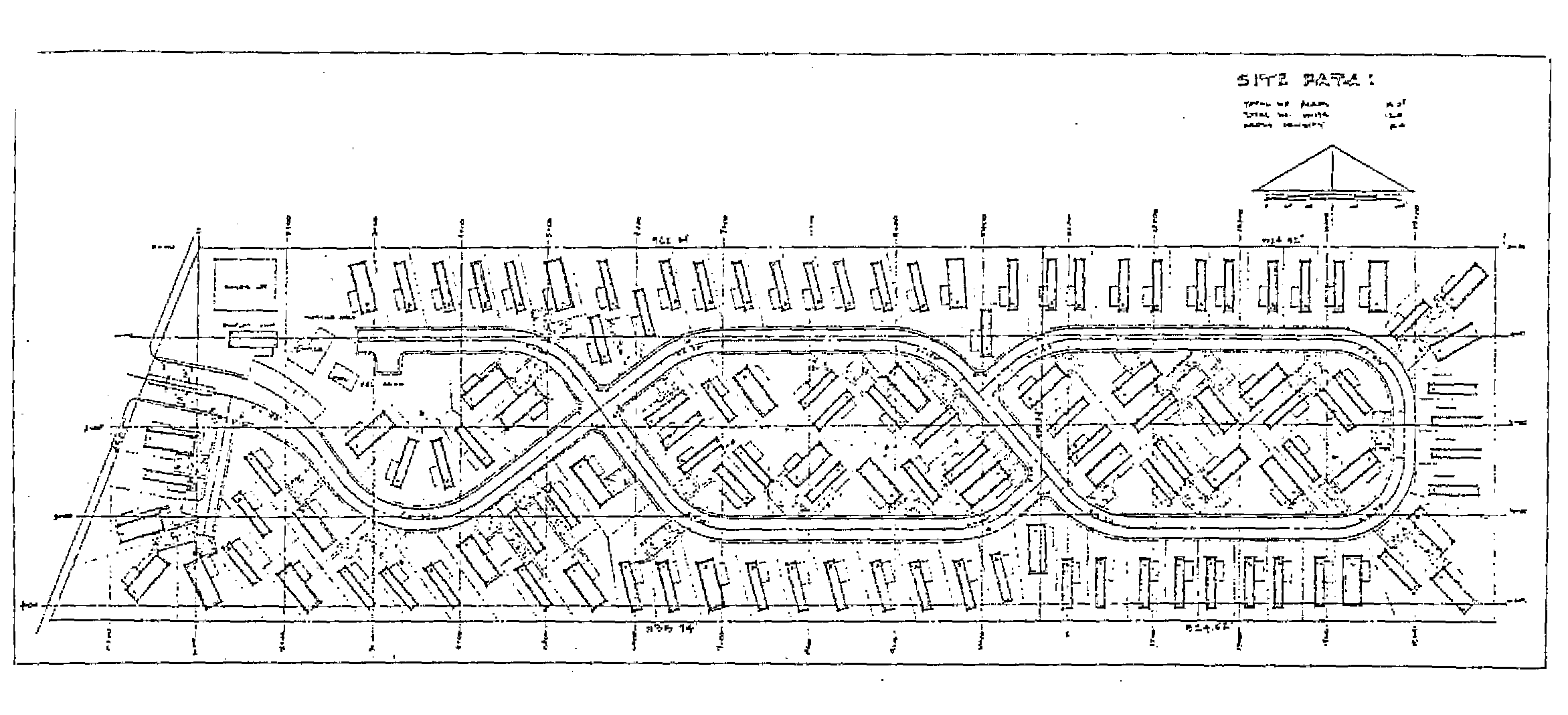
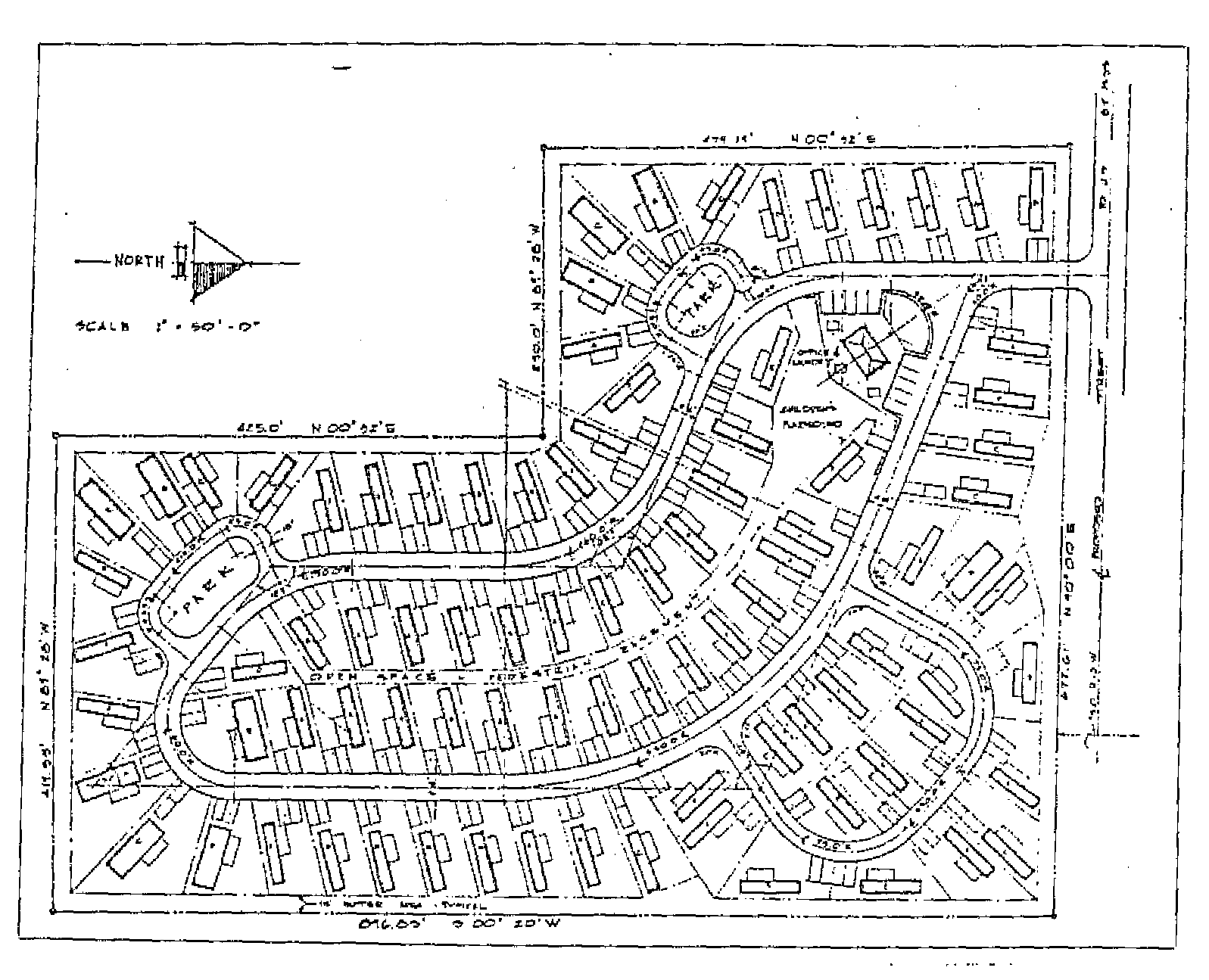
(Ord. of 1993, § 1107(2))
Sec. 46-168. - Street requirements.
Interior roads serving the development shall be constructed to city standards as specified in the city subdivision regulations, and in addition shall have a minimum pavement width of 20 feet. If dedicated to the public, the roads within the development shall have a minimum right-of-way width of 40 feet.
(Ord. of 1993, § 1107(3))
Sec. 46-169. - Lot area and width.
A mobile park home district development shall have a minimum area of ten contiguous acres and a lot width of at least 200 feet.
(Ord. of 1993, § 1107(4))
Sec. 46-170. - Density.
The maximum density of a mobile home park district development shall be six units per acre.
(Ord. of 1993, § 1107(5); Ord. of 11-14-2023(3))
Sec. 46-171. - Recreation and other community facilities.
Not less than ten percent of the total area of the development shall be devoted to recreation and other community use facilities for those mobile home parks designed for or containing ten or more mobile homes.
(Ord. of 1993, § 1107(6))
Sec. 46-172. - Perimeter setback required.
No mobile home or other building or structure shall be located closer than 40 feet to any mobile home park perimeter property boundary.
(Ord. of 1993, § 1107(7))
Sec. 46-173. - Perimeter screening required.
A landscaped screen consisting of dense evergreen trees or shrubs and having a minimum width of 25 feet adjacent to all public rights-of-way and 15 feet along all other property lines shall be required. A minimum six-foot-high, opaque fence or wall may be erected along property lines not abutting a public right-of-way in lieu of such landscaped screen. All perimeter screening must be maintained.
(Ord. of 1993, § 1107(8))
Sec. 46-174. - Utilities.
All mobile home parks shall be served by approved public water and public sanitary sewer systems.
(Ord. of 1993, § 1107(9))
Sec. 46-175. - Refuse collection.
Each mobile home park shall provide refuse collection pads at locations convenient to each mobile home space, but in no case more than 50 feet from the street serving each mobile home.
(Ord. of 1993, § 1107(10))
Sec. 46-176. - Space numbering.
Each mobile home space shall be provided with a sign, not less than one square foot in area, which indicates the appropriate space number or address.
(Ord. of 1993, § 1107(11))
Sec. 46-206.- Purpose and intent.
The planned unit development district is intended to provide flexibility in the application of area, height, bulk, placement, and other zoning controls; provide for mixing a wide variety of residential housing types and arrangements; provide for the mixing of compatible residential, office, commercial and industrial land uses; encourage imaginative and innovative design for the unified development of tracts of land; provide an alternative for more efficient use of land, resulting in smaller networks of utilities and streets, thereby resulting in lower construction and maintenance costs to the public; preserve the natural amenities of the land by encouraging scenic and functional open areas within the development; and to promote land development in proper relation to the surrounding neighborhood.
(Ord. of 1993, § 1201)
Sec. 46-207. - Permitted uses.
In planned unit development districts, any land uses and combinations thereof, including signs and accessory buildings and uses, that have been specifically proposed by the applicant and approved by the city council as a part of a planned unit development site plan, report, or other supporting information are permitted uses.
(Ord. of 1993, § 1202)
Sec. 46-208. - Development summary report required.
Applications for rezoning to, or development within, a planned unit development district shall require a written report which explains the type, nature, size, intent and characteristics of the proposed development. As a minimum, the report shall include the following:
(1)
A complete listing of every land use proposed within the development, including total acreage and the amount of acreage devoted to each use. All uses not specifically included in the report or site plan and approved by the city council are prohibited unless subsequently the application is amended in accordance with applicable procedures.
(2)
Proposed development standards including minimum lot sizes, minimum lot widths, minimum lot frontages, minimum floor areas or residential dwelling unit sizes, maximum number of dwelling units, maximum square footage figures for nonresidential developments, minimum yards/building setbacks, landscape strips and buffers, height limitations, restrictive covenants, and any other such applicable standard or requirement. The report should also indicate any proposed exceptions or variations from the size, setback, frontage, density or other standards which are required in other conventional zoning districts, along with justification for such proposed exceptions or variations.
(3)
Time frame of development and provisions for ownership and management of the development.
(4)
Intended plans for the provision of utilities, including water, sewer and drainage facilities.
(5)
All streets and common open spaces not proposed for dedication to the public shall have the proposed maintenance and ownership agreements explained in detail.
(Ord. of 1993, § 1203)
Sec. 46-209. - Site plan approval required.
Applications for rezoning to, or development within, a planned unit development district shall require a site plan approved by the planning commission. Site plans shall be prepared by a professional engineer, architect, land surveyor, land planner or landscape architect, and his seal of registration or professional initials shall be indicated on such plans.
(Ord. of 1993, § 1204)
Sec. 46-210. - Report and site plan are minimum requirements.
The approved development summary report, site plan, and all other information, studies, plats, plans or architectural elevations submitted in the application, or required to be submitted by the city council, shall establish the standards and minimum requirements for the subject property and shall become the zoning regulations that apply to the subject property, regardless of changes in property ownership.
(Ord. of 1993, § 1205)
Sec. 46-211. - Revisions to approved PUD application.
Any additions in the types of land uses, increases in square footage or density, decreases in lot sizes, changes in the location or dimensions of streets, decreases in dwelling unit floor areas, major alterations in the land use patterns, or other substantial changes that, in the opinion of the zoning administrator, result in a development of such intent and character which has not been conceptually approved by the city council shall require additional approval in accordance with procedures established in accordance with the city's zoning regulations. Otherwise, minor changes may be approved by the zoning administrator prior to issuance of building permits.
(Ord. of 1993, § 1206)
Sec. 46-212. - Minimum site area and frontage required.
The minimum site area for a planned unit development district shall be ten contiguous acres, a minimum lot width of 100 feet and the site must have a minimum of 100 feet of frontage on a public street, which shall provide access to such public street.
(Ord. of 1993, § 1207)
Sec. 46-213. - Suggested site planning guidelines.
The following specifications are not regulations, but recommended guidelines to be utilized in preparation of site plans for planned unit developments:
(1)
Land uses which have traditionally been viewed as incompatible (e.g., single-family subdivision and a manufacturing plant) should not be proposed in the same planned unit development unless considerable screening and physical separation is provided.
(2)
Office, commercial or industrial uses should be located adjacent to major thoroughfares or in other areas with suitable access that will not result in traffic through residential areas.
(3)
Lot sizes, lot widths, unit sizes and other characteristics of residential development within the planned unit development should be similar to those characteristics of adjacent or nearby residential subdivisions or provide a suitable transition from such adjacent uses.
(4)
Location of land uses should conform substantially to land use plan goals, policies and suggested types of uses.
(5)
Street lengths, alignments, patterns and other characteristics should conform to city subdivision regulations or standard planning principles.
(6)
Proposed developments should make maximum use of natural features of the land.
(7)
For developments that are predominantly residential, only limited commercial uses (up to 10,000 square feet, or ten percent of the total development site area) of a convenience retail nature, internally oriented and intended to serve the needs of the residents of the development, should be proposed.
(Ord. of 1993, § 1208)
Sec. 46-235.- Purpose and intent.
The NS neighborhood shopping district is intended to provide areas for limited small-scale commercial uses of a convenience nature serving nearby residential neighborhoods as opposed to a regional market. The district is not intended to accommodate automotive or other types of more intensive commercial activities that are of such magnitude or type that would result in the generation of excessive traffic, noise, odors, pollution, safety hazards, or other adverse impacts which would detract from the desirability of adjacent properties for residential use. In general, the neighborhood shopping district includes offices and retail and service establishments but excludes those highway-oriented uses which involve use of chemicals and outside sales, storage or display.
(Ord. of 1993, § 1301)
Sec. 46-236. - Permitted uses.
In NS neighborhood shopping districts, the following uses are permitted:
(1)
Accessory uses and structures normally incidental to principal permitted uses and structures.
(2)
Churches, temples, synagogues and places of worship, and their customary accessory uses and structures, including cemeteries.
(3)
Clubs, lodges, fraternal institutions and other places of public assembly for membership groups, nonprofit or for-profit, not to exceed 10,000 square feet of gross floor area.
(4)
Day care centers.
(5)
Finance, insurance and real estate establishments.
(6)
Public and semi-public buildings and uses.
(7)
Residences of all types. Home occupations are permitted as accessory uses, without being subject to the limitations of section 46-43.
(8)
Restaurants, but not including drive-in or drive-through facilities. Unenclosed seating area is permitted.
(9)
Retail trade establishments, enclosed.
(10)
Schools, public elementary, middle and secondary, and public and private colleges and universities.
(11)
Schools, parochial, private vocational, technical and others, nonprofit or operated for profit.
(12)
Services, business.
(13)
Services, miscellaneous.
(14)
Services, personal.
(Ord. of 1993, § 1302)
Sec. 46-237. - Area, height, density and placement requirements.
Area, height, density and placement requirements are as specified in sections 46-30 and 46-31.
(Ord. of 1993, § 1303)
Sec. 46-268.- Purpose and intent.
The HB highway business district is intended to provide adequate space for various types of general business uses that serve residents on a community level rather than neighborhood level, including the retailing of major goods and services of large scale, automotive and other types of more intensive commercial activities and establishments that rely on highway-oriented, passer-by traffic. This district is most appropriately located along state or federal highways.
(Ord. of 1993, § 1401)
Sec. 46-269. - Permitted uses.
In HB highway business districts, the following uses are permitted:
(1)
Any use permitted in the NS neighborhood shopping district but not subject to any specified square footage limitations.
(2)
Accessory uses and structures normally incidental to permitted principal uses.
(3)
Commercial recreation facilities, except firearm shooting ranges, race tracks for animals or motor-driven vehicles.
(4)
Contractor's establishments, building, electrical and plumbing.
(5)
Convalescent homes, nursing homes, group homes, rehabilitation centers, sanitariums and similar institutionalized residential facilities involving professional care and treatment.
(6)
Mini-warehouses and mini-storage facilities, where no individual storage stall or compartment exceeds 500 square feet of total floor area.
(7)
Restaurants, including drive-in and drive-through facilities.
(8)
Retail trade establishments, unenclosed.
(9)
Services, automotive.
(10)
Services, lodging.
(11)
Transportation, communication and utility facilities.
(12)
Warehousing and storage uses which occupy no more than 20,000 square feet of floor area.
(13)
Wholesale establishments which occupy no more than 20,000 square feet of floor area.
(Ord. of 1993, § 1402)
Sec. 46-270. - Conditional uses.
In HB highway business districts, firearm shooting ranges, race tracks for animals or motor-driven vehicles, and other commercial recreation facilities not encompassed within the definition in section 46-1, are authorized as conditional uses.
(Ord. of 1993, § 1403)
Sec. 46-271. - Area, height, density and placement requirements.
Area, height, density and placement requirements are as specified in sections 46-30 and 46-31.
(Ord. of 1993, § 1404)
Sec. 46-291.- Purpose and intent.
(a)
The intent of the CBD central business district is to establish and maintain a compact area containing a mixture of retail, service, government and other uses where, due to the close proximity of buildings and uses, pedestrian shopping is encouraged in favor of vehicle trips being made from one destination to another. While some commercial uses targeted at the highway traveler may be permitted to exist in the central business district, the intent is that automotive service establishments and other highway business-oriented uses be excluded, due to their encouragement of automobile rather than pedestrian travel.
(b)
The CBD district is unique in that the existing development pattern consists of buildings covering very large percentages of the lot, little if any building setbacks on front, side and rear property lines, and a lack of off-street parking sufficient to meet the requirements of this chapter. This district therefore provides for less restrictive bulk, height, dimensional and parking requirements than do other commercial districts.
(c)
The CBD district is appropriate only in the existing or adjacent downtown area with the above mentioned development characteristics.
(Ord. of 1993, § 1501)
Sec. 46-292. - Permitted uses.
In CBD central business districts, the following uses are permitted:
(1)
Any use permitted in the NS neighborhood shopping district but not subject to any specified square footage limitations.
(2)
Accessory uses and structures normally incidental to permitted principal uses.
(3)
Bus stations and taxicab stands.
(4)
Convalescent homes, nursing homes, group homes, rehabilitation centers, sanitariums and similar institutionalized residential facilities involving professional care and treatment.
(5)
Commercial recreation facilities, enclosed.
(6)
Hospitals and clinics.
(7)
Manufacturing and fabrication establishments, enclosed, which occupy no more than 1,000 square feet of gross floor area.
(8)
Services, lodging, including bed and breakfast inns and hotels, but specifically excluding motels, motor hotels, and tourist courts.
(9)
Temporary or seasonal uses approved by the zoning administrator.
(Ord. of 1993, § 1502)
Sec. 46-293. - Conditional uses.
In CBD central business districts, unenclosed commercial recreational facilities and open air business uses are authorized as conditional uses.
(Ord. of 1993, § 1503)
Sec. 46-294. - Area, height, density and placement requirements.
Area, height, density and placement requirements shall be in accordance with sections 46-30 and 46-31.
(Ord. of 1993, § 1504)
Sec. 46-322.- Purpose and intent.
The M-1 light industrial district is established with the purpose of reserving certain areas with relatively level topography, adequate water and sewerage facilities, and access to arterial streets for industrial operations, but where such areas' proximity to residential and other districts makes it desirable to limit industrial operations to those that are not objectionable by reason of the emission of noise, vibration, smoke, dust, gas, fumes, odors or radiation and that do not create fire or explosion hazards or other objectionable conditions. Uses within this district do not require substantial quantities of water for manufacturing operations and do not necessarily require rail, air and water transportation. Certain commercial uses having an open storage characteristic, or which are most appropriately located as neighbors of industrial uses, are also included within this district.
(Ord. of 1993, § 1601)
Sec. 46-323. - Permitted uses.
In M-1 light industrial districts, the following uses are permitted:
(1)
Accessory uses and structures normally incidental to permitted principal uses, including offices, showrooms and administrative facilities.
(2)
Agricultural implement rental, repair, sales and service, and farm supply stores and storage yards.
(3)
Airports and accessory facilities.
(4)
Blueprinting and printing establishments.
(5)
Building material and other outside storage yards.
(6)
Bus passenger stations, terminals.
(7)
Cabinet shops.
(8)
Contractor's establishments.
(9)
Distribution of products and merchandise.
(10)
Dry-cleaning plants.
(11)
Exterminators and pest control businesses.
(12)
Junkyards and used auto parts yards, subject to screening requirements on all four sides of the lot on which the use is located.
(13)
Kennels.
(14)
Lumber yards, planing and sawmills.
(15)
Machine shops.
(16)
Mini-warehouse and mini-storage facilities.
(17)
Parking garages and parking lots.
(18)
Public and semi-public buildings and uses.
(19)
Race tracks for animals or motor-driven vehicles, provided the site contains a minimum of 15 acres.
(20)
Radio and television broadcasting towers.
(21)
Repair of household appliances.
(22)
Recycling plants, including any processing activities.
(23)
Research and scientific laboratories.
(24)
Residence for caretaker or night watchmen.
(25)
Sign fabrication and painting shops.
(26)
Storage buildings and storage yards.
(27)
Soft drink bottling and distributing plants.
(28)
Transportation, communication and utility facilities.
(29)
Truckstops and truck terminals.
(30)
Welding shops.
(31)
Wholesaling and warehousing facilities.
(32)
Wrecked motor vehicle compounds and wrecker services, subject to screening requirements on all four sides of the lot on which the use is located.
(33)
Any use permitted in the R-2 moderate-density residential district.
(34)
Apartments subject to the requirements of section 46-132.
(35)
Condominiums, with a minimum lot size of two acres for any condominium development, and subject to the provision of section 46-210.
(Ord. of 1993, § 1602; Ord. No. 2025-04, § 1)
Sec. 46-324. - Conditional uses.
In M-1 light industrial districts, the following conditional uses are authorized:
(1)
Asphalt plants.
(2)
Canning establishments.
(3)
Ceramic production facilities.
(4)
Cold storage, frozen food lockers and ice manufacture.
(5)
Concrete, cement, clay, mortar and plaster production.
(6)
Extraction or removal of sand, gravel, top soil, clay, dirt, precious metals, gems, or other natural resources.
(7)
Feed, grain, or fertilizer manufacture or storage.
(8)
Food processing plants, including fish and poultry facilities.
(9)
Manufacturing, processing and assembling of the following products: chemicals, floor coverings, glass, machinery, metals, rubber, textiles, tobacco, and wood, unless more specifically listed under conditional uses.
(10)
Residences for a caretaker or night watchman.
(11)
Rooming houses or boardinghouses.
(12)
Personal care homes, nursing homes and convalescent homes.
(13)
Mobile home parks, subject to the requirements of section 46-165.
(Ord. of 1993, § 1603; Ord. No. 2025-04, § 1)
Sec. 46-325. - Area, height, density and placement requirements.
Area, height, density and placement requirements are as specified in sections 46-30 and 46-31.
(Ord. of 1993, § 1604)
Sec. 46-354.- Purpose and intent.
The A-1 agricultural district is established to maintain those areas with land characteristics such as soil moisture, temperature and content suitable for farming, dairying, forestry operations and other agricultural activities; to protect land used or needed for food production and other agricultural uses from encroachment by untimely and unplanned residential, commercial or industrial development; to permit the continuation of agricultural uses in areas where development is anticipated, but where the present application of zoning controls for future, more intensive uses would be unreasonable and premature; prevent the subdivision of land for residential development that requires public services such as paved roads, water and sanitary sewer. In certain instances the A-1 district may be appropriate for preserving the very low density character and rural characteristics of areas in the city.
(Ord. of 1993, § 1701)
Sec. 46-355. - Permitted uses.
In A-1 agricultural districts, the following uses are permitted:
(1)
Agricultural uses, including and production of field crops, fruits, nuts and vegetables; the raising of livestock and poultry; dairying; horticulture; forestry and fisheries; and other uses involving agricultural operations.
(2)
Animal hospitals.
(3)
Antique shops.
(4)
Cemeteries.
(5)
Churches, temples, synagogues and places of worship.
(6)
Dwellings, single-family, provided each dwelling is located on a lot that is a minimum of one acre and a minimum lot width of 150 feet.
(7)
Farm buildings, including barns, chicken houses, grain storage facilities, implement sheds, and structures accessory to agricultural use.
(8)
Home occupations.
(9)
Horse stables.
(10)
Kennels.
(11)
Marinas and boat storage yards.
(12)
Mobile and manufactured modular homes, provided each home is located on a lot that is a minimum of three acres and a minimum lot width of 200 feet.
(13)
Nurseries and greenhouses; plants, trees and shrubs.
(14)
Produce stands, provided products sold are those grown or produced on the premises.
(15)
Public and semi-public buildings and uses.
(16)
Schools, public elementary and secondary, and public and private colleges and universities.
(17)
Schools, parochial, private and others offering courses in general education not operated for profit.
(Ord. of 1993, § 1702)
Sec. 46-356. - Conditional uses.
In A-1 agricultural districts, the following conditional uses are authorized:
(1)
Farm supply stores and agricultural-related businesses, such as agricultural implement sales and service, auction facilities, feed and grain stores and other businesses not involving sales or services to the general public, provided such business is located on property a minimum of two acres that fronts on a state or federal highway, and provided such buildings or uses are not located within 200 feet of abutting property zoned or utilized for single-family or mobile home use.
(2)
Boarding homes, dormitories and lodginghouses for agricultural workers, provided that such dwellings are located on a farm with a minimum size of 20 acres, provision is made to meet all applicable public health requirements, land provided such lodging is intended only for the temporary or seasonal housing of farm workers.
(3)
Clubs, lodges, fraternal institutions and other places of assembly for nonprofit membership groups, provided such use is located on property a minimum of two acres that fronts on a state or federal highway.
(4)
Radio and television broadcasting towers, including studios or offices, provided such use is not located within 500 feet of abutting property zoned or utilized for a residence, and provided the height of such tower does not exceed 150 feet without specific authorization from the Federal Aviation Administration and Federal Communications Commission.
(Ord. of 1993, § 1703)
Sec. 46-357. - Area, height, density and placement requirements.
Area, height, density and placement requirements are as specified in sections 46-30 and 46-31.
(Ord. of 1993, § 1704)
Sec. 46-25. - Use districts enumerated.
For the purpose of this chapter, the city is hereby divided into use districts as set out below:
(Ord. of 1993, § 401)
Sec. 46-26. - Interpretation of district boundaries.
(a)
Where boundaries are indicated as approximately following the centerline of streets or highways, street right-of-way lines or railroad right-of-way lines or such lines extended, such centerline, street right-of-way lines, or railroad right-of-way lines shall be construed to be such boundaries.
(b)
Where boundaries are indicated as approximately following the corporate limit line of the city, such corporate limit line shall be construed to be such boundaries.
(c)
Where boundaries are indicated as approximately following property lines or such lines extended, such property lines or such lines extended, as indicated by boundary survey, deed or legal description maintained in the official file of the zoning adoption or amendment, if available, shall be construed to be such boundaries.
(d)
Where boundaries are indicated as approximately following the centerline of streambeds or river beds, such centerline shall be construed to be such boundaries.
(e)
In the case where the exact location of a boundary cannot be determined by the foregoing methods, the city council shall, upon application, determine the location of the boundary.
(Ord. of 1993, § 404)
Sec. 46-27. - District boundary line divides a lot of single ownership.
Where a boundary line as appearing on the official zoning map divides a lot in single ownership at the time of the enactment of the ordinance from which this chapter is derived, the requirements for the district in which the greater portion of the lot lies may be extended to the balance of the lot without recourse or amendment procedure, provided that this provision shall not apply to a double frontage lot. In the case of a double frontage lot, the restrictions of the district applying to the adjoining lots which front on the same street as the lot frontage in question shall apply.
(Ord. of 1993, § 405)
Sec. 46-28. - Minimum requirements.
Within each district, the regulations set forth in this chapter shall be minimum requirements and shall apply uniformly to each class or kind of building, structure or land.
(Ord. of 1993, § 702)
Sec. 46-29. - Use prohibited when not specified.
Unless otherwise stated, any use not specifically permitted in a use district as provided in these regulations shall be prohibited in that district.
(Ord. of 1993, § 710)
Sec. 46-30. - Minimum setback and buffer requirements by zoning district.
Principal building setbacks (in feet) shall be as follows:
Additional setbacks may be required for specific uses as provided in permitted uses sections of particular zoning districts.
*See section 46-237.
a When development in this district abuts an A-1, R-1, R-2 or R-3 zoning district boundary, a buffer with a minimum width of 15 feet shall be provided along the entire property line abutting the zoning district.
b When development in this district abuts an A-1, R-1, R-2 or R-3 zoning district boundary, a buffer with a minimum width of 30 feet shall be provided along the entire property line abutting the district.
c No new building shall be constructed with a setback greater than five feet from any front property line or public right-of-way, if adjacent lots are occupied with buildings erected within five feet of the front property line or public right-of-way. No new building shall be constructed with more than one side yard if adjacent lots are occupied with buildings erected within two feet of the side property line.
(Ord. of 1993, § 1801)
Sec. 46-31. - Minimum lot width, lot size, floor area and density requirements.
Minimum lot width, lot size, floor area, and density shall be as follows:
(Ord. of 1993, § 1802; Ord. of 11-14-2023(1))
Sec. 46-32. - Lot size on land containing slopes of ten percent or more.
(a)
Lot size for lots positioned on land containing a slope of ten percent or more shall be as follows:
(b)
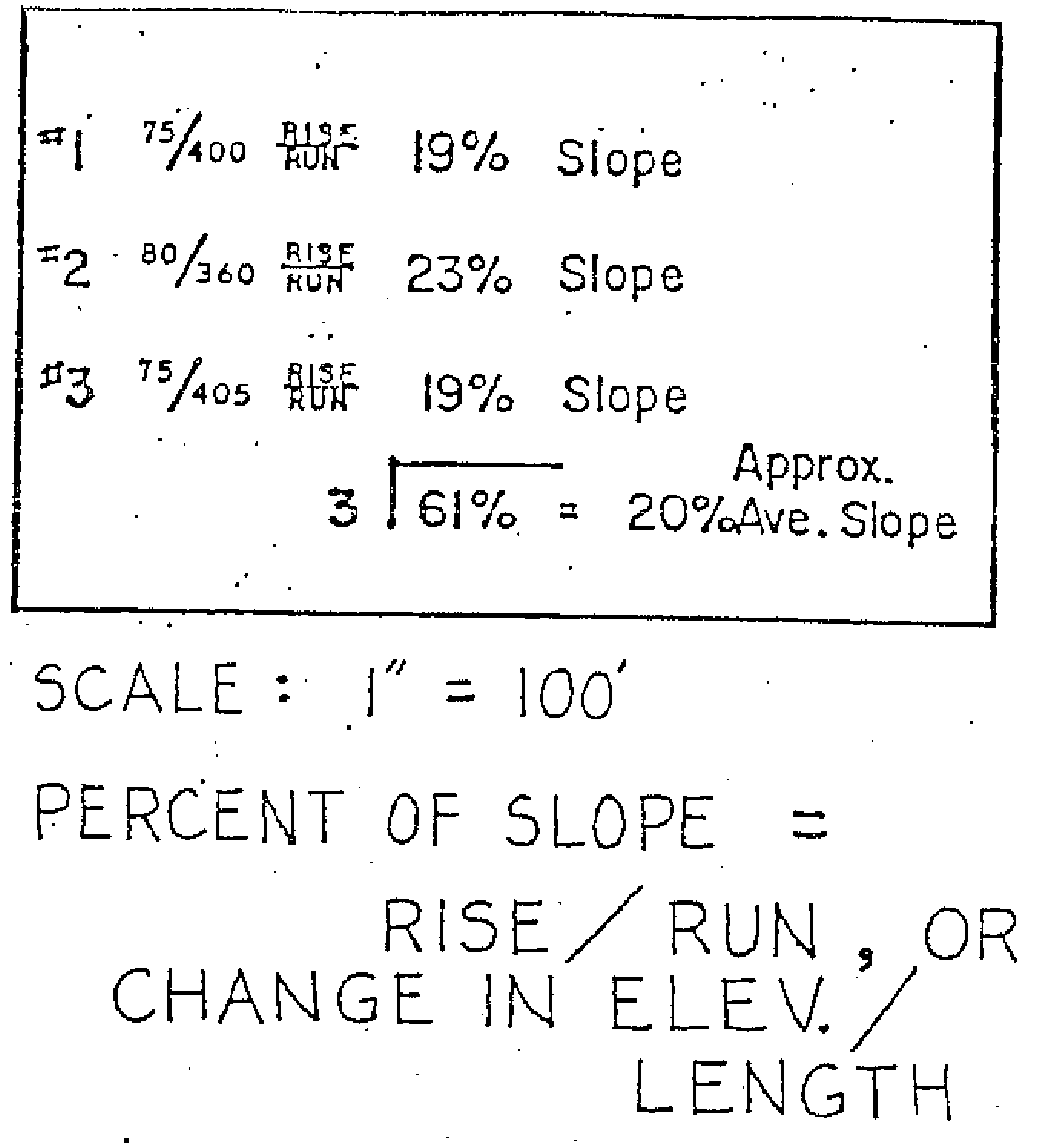
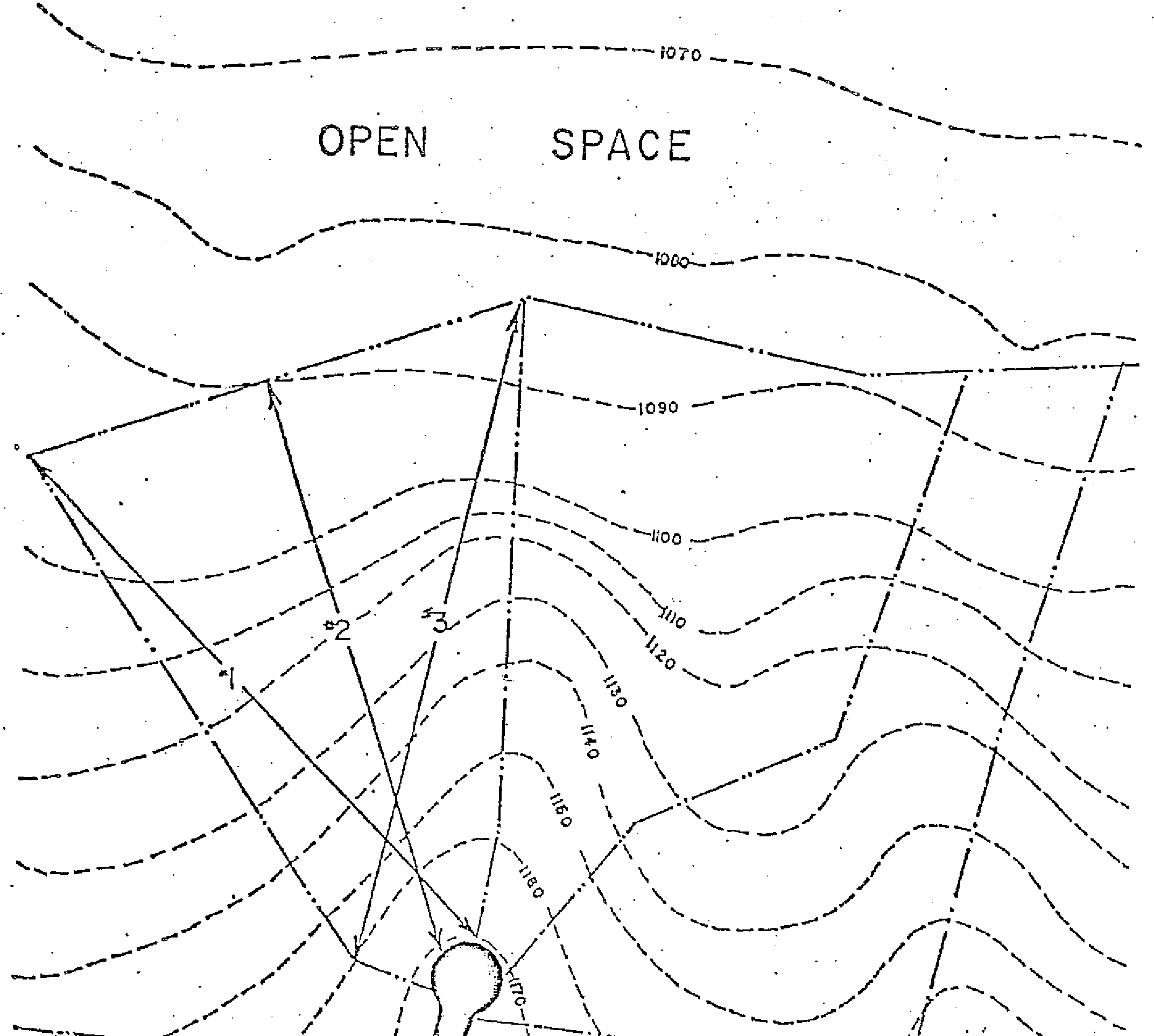
Interpolation shall be permitted. See figures 1 and 2 for determination of slope and relationship between buildings and the natural resource base.
Figure 1
RELATIONSHIP BETWEEN BUILDING AND THE NATURAL RESOURCE BASE
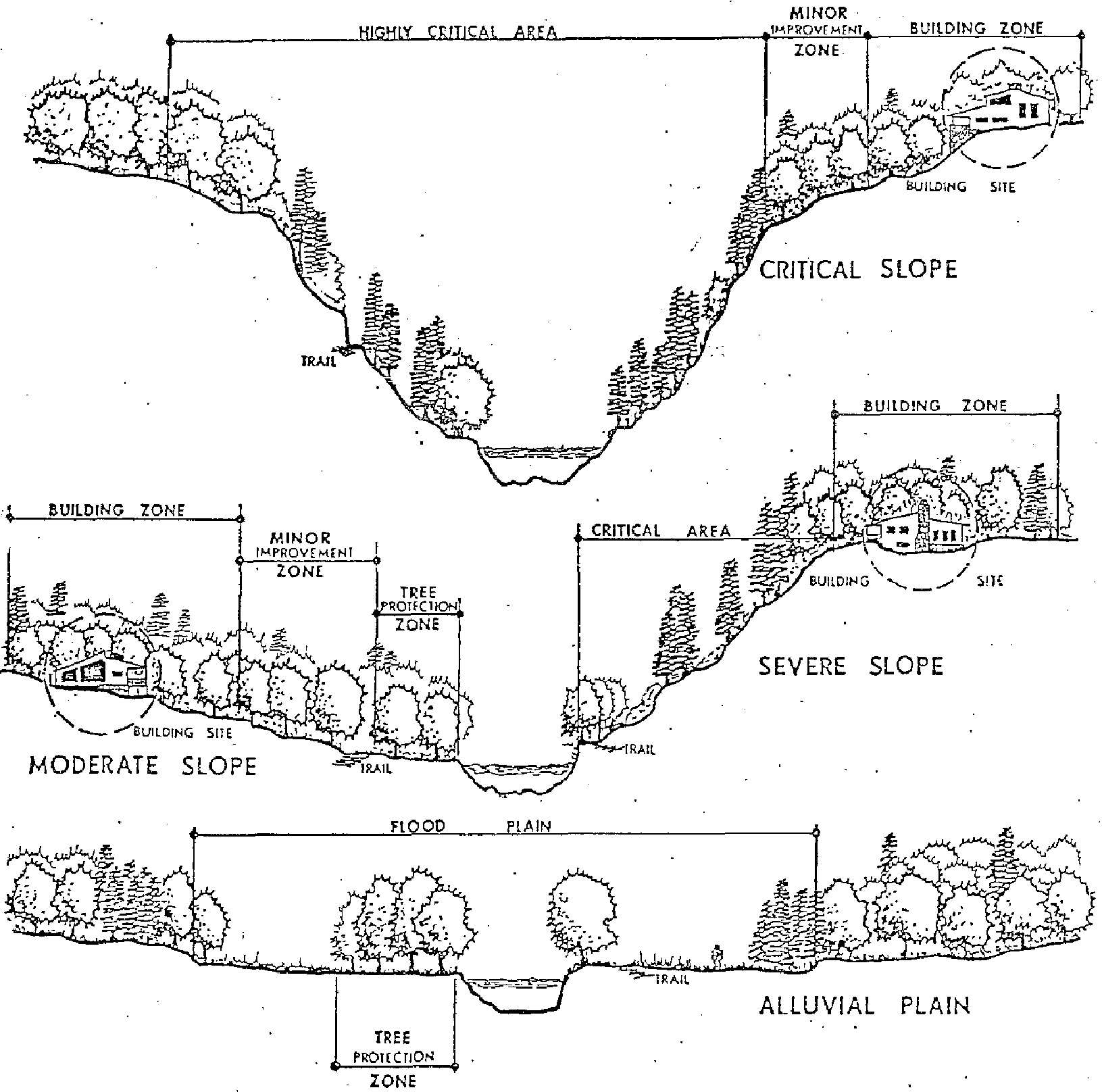
Typical site areas illustrating the varying degrees of slope and their relation to the actual building site. Floodplains, tree protection zones, zones of minor improvements and locations for scenic trails are also shown.
Figure 2
DETERMINATION OF AVERAGE SLOPE FOR LOTS
(Ord. of 1993, § 1803)
Sec. 46-33. - Use, occupancy and erection.
No building, structure, land, open space or water shall hereafter be used or occupied and no building or structure or part thereof shall hereafter be erected, constructed, reconstructed, moved, structurally altered or maintained, and no new use or change shall be made or maintained of any building, structure, land, open space or water, unless in conformity with all the regulations herein specified for the district in which it is located.
(Ord. of 1993, § 701)
Sec. 46-34. - Height limitations.
(a)
No building or structure shall hereafter be erected, constructed, reconstructed, or altered, except as otherwise specifically exempted in this article, to exceed the maximum height for the district in which the building or structure is located; provided, however, that the city council may permit buildings and structures to exceed height limitations upon approval of a conditional use as specified in these regulations.
(b)
The height limitations established herein shall not apply to chimneys, smokestacks, church spires and steeples, domes, flagpoles, public monuments, observation towers, water towers, non-commercial radio and television towers, electricity transmission towers, utility poles and similar structures.
(Ord. of 1993, § 703)
Sec. 46-35. - Every use must be upon a lot.
No building or structure shall be erected or use established unless upon a lot of record as defined by these regulations except as otherwise provided herein.
(Ord. of 1993, § 704)
Sec. 46-36. - One principal building on a lot.
Only one principal building and its accessory buildings may hereafter be erected on any one lot intended for such use; provided, however, that more than one multiple dwelling, office, institutional, commercial or industrial building may be located upon a lot, subject to setbacks and separation as provided in these regulations.
(Ord. of 1993, § 705)
Sec. 46-37. - Separation between principal buildings.
No principal building shall be located closer than 20 feet to another principal building.
(Ord. of 1993, § 706)
Sec. 46-38. - Reduction in lot size prohibited.
No lot shall be reduced, divided or changed in size so that lot width, size of yards, lot area per dwelling unit or any other requirement of these regulations is not maintained, unless the reduction or division is necessary to provide land which is acquired for a public purpose.
(Ord. of 1993, § 707)
Sec. 46-39. - Annexation.
Any land area subsequently added to the incorporated area of the city shall automatically be classified R-1 (single-family residential district) until or unless otherwise classified by amendment to the official zoning map. Within 60 days after the date of annexation approval, the planning commission shall, after public hearing, recommend to the city council a zoning classification for each newly annexed area which will carry out the objectives of the comprehensive plan. Upon such recommendation by the planning commission for an amendment to the official zoning map as related to the subject property the city council may act in accordance with normal procedures specified in these regulations to assign a different zoning district to the property.
(Ord. of 1993, § 708)
Sec. 46-40. - Street frontage requirement.
No building or structure shall hereafter be erected on a lot, and no lot shall be subdivided, that does not abut for at least 30 feet on a public street.
(Ord. of 1993, § 709)
Sec. 46-41. - Accessory buildings and uses.
With the exception of water well houses and other utilities, accessory buildings and uses shall be permitted only in side or rear yards, unless otherwise provided by these regulations. Accessory buildings and uses shall be permitted only if they meet the following:
(1)
Accessory buildings and uses shall be set back a minimum of five feet from any lot line.
(2)
Where a building housing an accessory use is structurally attached to the principal building, it shall be subject to and must conform to all regulations applicable to the principal building and shall not be considered an accessory building.
(3)
In the case of double frontage lots, accessory buildings shall observe front yard requirements on both streets.
(4)
Detached accessory buildings shall be located a minimum of ten feet from the principal building on a lot.
(Ord. of 1993, § 711)
Sec. 46-42. - Regulations for specific accessory structures.
The following specified structures shall conform to the following regulations:
(1)
Fences and walls. Installation of fences and barrier walls shall require a permit issued by the zoning administrator. No fence or wall shall be erected closer than two feet from a public right-of-way or in such a manner as to obstruct vision on a public right-of-way. Barbed wire top strands six feet above the ground may be permitted in agricultural, commercial and industrial zoning districts.
(2)
Gasoline pumps. Gasoline pumps and pump islands shall be set back a minimum of 25 feet from any public right-of-way or property line.
(3)
Canopies and carports. Canopies and other attached or detached structures intended for cover shall be set back a minimum of ten feet from any public right-of-way or property line.
(4)
Nonresidential occupancy of mobile homes. Mobile homes, manufactured homes or other temporary portable structures shall not be used as a permanent or temporary office, classroom, store, or for-hire work space in any district; provided, however, that such mobile homes or structures may be used for a temporary construction office for a licensed contractor in any district, upon issuance of a permit by the zoning administrator. The permit shall be temporary but renewable once after a period of six months.
(5)
Swimming pools. Swimming pools accessory to residences shall be enclosed by a security fence a minimum of six feet in height. The fence shall provide security against unauthorized use of the swimming pool, and all pools shall meet any applicable code requirements on swimming pools. A permit shall be obtained from the zoning administrator for the siting and construction of a swimming pool. Swimming pools which are operated as an accessory use to hotels, motels or other uses shall be restricted to use by the patrons or guests of the principal use on the subject property and shall not be opened to the general public for a fee.
(Ord. of 1993, § 712)
Sec. 46-43. - Home occupations.
(a)
A home occupation shall conform to the following requirements:
(1)
Only residents of the dwelling may be engaged in the home occupation, with the exception that employment of one person not residing in the dwelling may be permitted.
(2)
The home occupation shall be clearly incidental and secondary to the residential use of the dwelling and shall not change the residential character of the building or lot.
(3)
Only vehicles used primarily as passenger vehicles shall be permitted in connection with the conduct of a home occupation.
(4)
No internal or external alterations of the dwelling solely for the accommodation of a home occupation are permitted, with the exception of one additional outside entrance for business use.
(5)
One non-illuminated, non-animated business identification sign or name plate not exceeding four square feet in area indicating the name or occupation of occupant shall be permitted.
(6)
Use of a building for a home occupation shall not exceed 25 percent of one floor of the principal building. Home occupations are not permitted, in whole or part, within accessory buildings.
(7)
A business license shall be obtained from the city prior to the operation of any home occupation. The business license shall require approval by the zoning administrator.
(8)
The following uses are allowable as home occupations (not all inclusive): tutoring, consultation and instruction in music, dance, arts, crafts and similar subjects, limited to six students at one time; day care centers serving six or less persons; professional services (e.g., attorneys, architects, accountants, realtors, insurance and travel agents; secretarial services and answering services); mail order and general offices not involving the storage of equipment, materials or vehicles; phone solicitations; beauty salons and barbershops limited to two patrons at a time; food catering and home products sales agents.
(9)
The following uses are specifically prohibited as home occupations (not all inclusive): cabinet shops and/or metal cutting; doctors, dentists or other medical professions; automobile repair or related work, small engine repair shops, and landscaping, nursery or greenhouse operations.
(b)
The failure of a home occupation licensee to comply with any of the above conditions shall be reasonable grounds for revocation of a home occupation business license.
(Ord. of 1993, § 713)
Sec. 46-44. - Visibility at intersections.
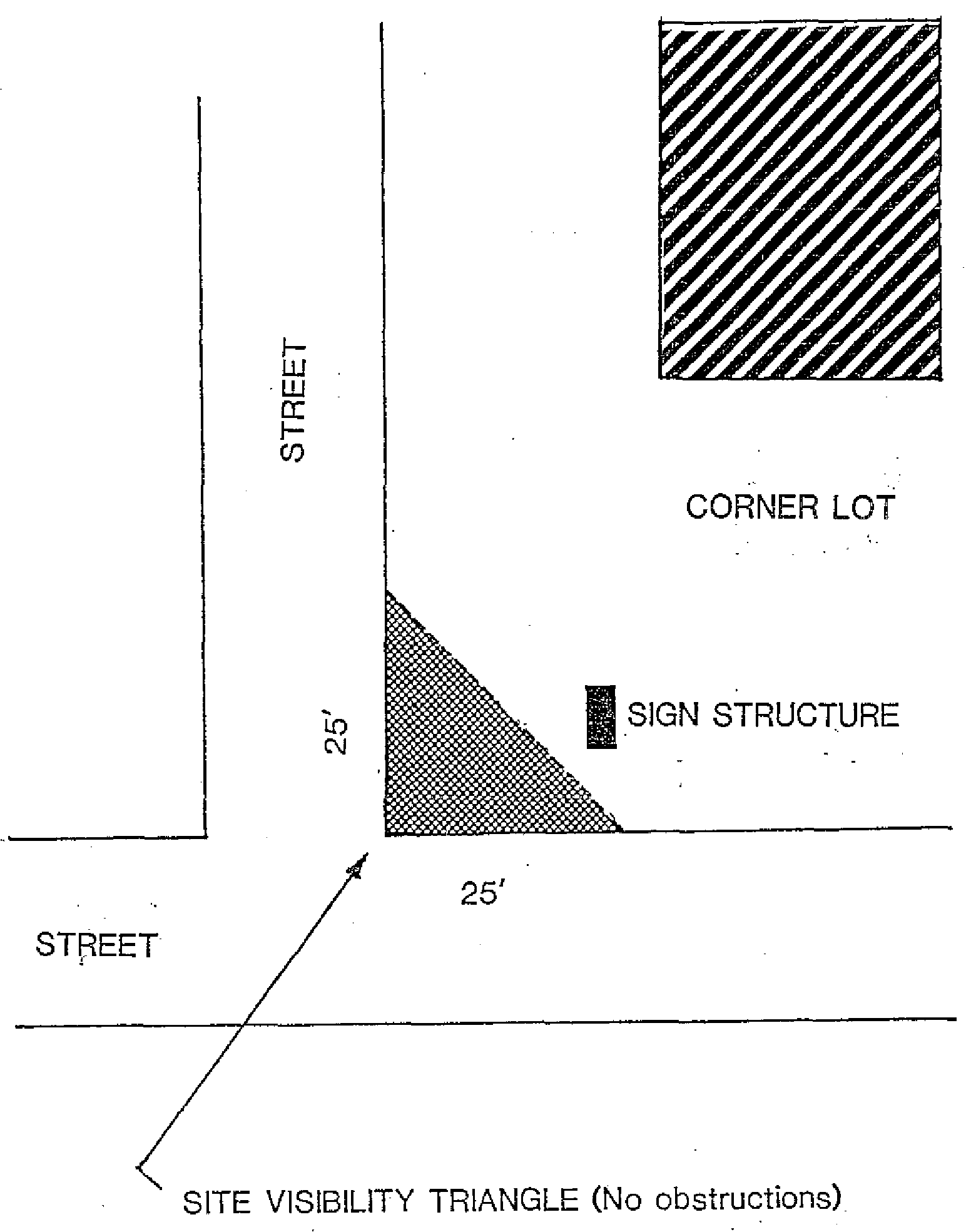
No fence, wall, sign, hedge or planting which obstructs the sight lines at elevations between 2.5 and 12 feet above any roadway shall be placed or permitted to remain on any corner lot within the triangular area formed by the street right-of-way lines, or such lines extended, and a line connecting such right-of-way lines at points 25 feet from the intersection of the right-of-way lines.
(Ord. of 1993, § 714)
Sec. 46-45. - Abandoned, wrecked or junked vehicles and materials.
Except as otherwise expressly permitted, it shall be prohibited in all districts to park or continuously store abandoned, wrecked, junked or inoperable vehicles, and power-driven construction equipment. Used lumber or metal, or any other miscellaneous scrap material in quantity that is visible from a public street or adjacent or abutting property is prohibited. These prohibitions shall not be construed as to prohibit the temporary repair or maintenance of automobiles owned by the property owner or the storage of such vehicles, equipment or other materials within an enclosed building, provided that such vehicles, equipment or materials are not for commercial sale.
(Ord. of 1993, § 715)
Sec. 46-46. - Subdivision plats must meet zoning requirements.
No proposed plat of a subdivision, nor any plat of re-subdivision, shall hereafter be approved by the city council or by the planning commission unless the lots within such plat equal or exceed the minimum size and width requirements set forth in the various zoning districts in these regulations and unless such plat fully conforms with the statutes of the state and regulations of the city council.
(Ord. of 1993, § 716)
Sec. 46-47. - Yard sales.
Yard sales will be allowed in all residential zoning districts as frequently as once every six months. The duration of any yard sale shall not exceed 72 hours. Sales must be operated in such a manner so as not to be a nuisance to the neighbors or obstruct sidewalks, driveways or other public ways. A permit shall be required.
(Ord. of 1993, § 717)
Sec. 46-48. - Designation after street abandonment.
Where a public street, alley or other right-of-way is officially vacated or abandoned, the regulations applicable to the property to which it reverted shall apply to such vacated or abandoned public street, alley, or right-of-way.
(Ord. of 1993, § 406)
Sec. 46-49. - Definitions.
The following words, terms and phrases, when used in this subdivision, shall have the meanings ascribed to them in this section, except where the context clearly indicates a different meaning:
Bedroom occupancy standard means the reasonable occupant limit for a bedroom and shall be based on 50 square feet allowed for each occupant, the number of permanently erected bed(s) or sleeping device(s), emergency egress capacity and the configuration of the entire unit and structure.
Code compliance verification form means a document executed by the zoning administrator that certifies that the short-term rental complies with the safety provisions of this subdivision and applicable codes at such short-term rental location. No person shall allow occupancy or possession of any short-term rental unit if the premises are in violation of any applicable zoning, building, residential, health, water or sewer, or life safety code(s) or provisions thereof.
Curtilage means an area of land attached to a house, building or structure and forming one enclosure along the boundary.
Designated responsible person means an individual designated to care for and responsible for a short-term rental unit that is a minimum age of 18 years of age, and is an individual that is knowledgeable and perceptive of the responsibilities and availability needed for that designation to ensure compliance with the laws, codes and rules and regulations of the city and state.
Emergency evacuation diagram means a diagram that is conspicuously and permanently affixed to the walls of a structure that reflects the actual floor arrangement of the structure and defines the exit locations, such diagram shall be posted in multiple locations within the structure and upon each floor. The diagram shall be large enough to be clearly visible to occupants and shall define the present location of the posting, show orientation to the North by arrow, mark egress paths that are available from that present location and throughout the structure, show location of extinguishers and define exterior paths that will take occupants a safe distance from the structure to a gathering location.
Health department means the department of the government of the State of Georgia or Rabun County which focuses on issues related to the general health and disease protection for the community.
License or licensure means permission issued by the City of Clayton to allow an activity or business.
Managing agency or agent means a person, firm or agency representing an owner(s) of a short-term rental(s), or a person, firm or agency that owns a short-term rental.
Owner means a person or entity that holds legal and/or equitable title to private property.
Reasonable period means a period not to exceed 14 calendar days.
Responsibly prudent business practices shall mean an individual who uses good judgement or common sense in handling practical business matters.
Short-term rental means a rental period of 30 days or less. It may also refer to a property that is rented for such time periods.
(Ord. of 6-16-2010)
Sec. 46-50. - Purpose and intent.
(a)
The purpose of this subdivision is to establish regulations for the use of rental dwelling units as short-term rentals and to ensure collection and payment of required excise and occupational tax fees.
(b)
The owner shall be required to designate an agent for any short-term rental unit, whose responsibility it shall be to comply with the requirements of this subdivision on behalf of the owner. The owner may be the agent.
(c)
The owner or agent shall be required to display at least one legible copy of the "notice to be posted" as defined in section 46-58 and to be conspicuously mounted in an area that shall be easily observed by all occupants.
(d)
An emergency evacuation plan shall be posted that shall be legible and conspicuously mounted as defined in section 46-49.
(e)
The owner or agent shall not be relieved of any personal responsibility or personal liability for the violation of any applicable code contained in the Code of Ordinances, or any rule or regulation pertaining to the use and occupancy of the unit as a short-term rental.
(f)
This subdivision is not intended to regulate hotels or inns. This subdivision is not limited to boarding, lodging or rooming houses, or units located within structures that are commercial in nature.
(Ord. of 12-11-2018)
Sec. 46-51. - Applicability.
(a)
It shall be unlawful for any owner of any property within the incorporated limits of the City of Clayton to rent or operate a short-term rental of property contrary to the procedures and regulations established in this subdivision, other provisions of Code, health department requirement(s), requirement(s) of the City of Clayton for water, sewage or sanitation, or any other applicable state law or rule.
(b)
The restrictions and obligations contained in this subdivision shall apply to short-term rentals at all times during which real properties are marketed or used as short-term rentals.
(c)
The allowance of short-term rentals pursuant to this subdivision shall not prevent enforcement of additional restrictions that may be contained in restrictive covenants or other private contractual agreements or arrangements.
(Ord. of 12-11-2018)
Sec. 46-52. - Property owner(s), local contact person, and responsible person.
(a)
Property owner(s). The owner(s) and/or local contact person shall use reasonably prudent business practices to ensure the short-term rental is used in a manner that complies with all applicable codes, laws and rules and regulations pertaining to the use and occupancy of the short-term rental unit, and shall further use reasonably prudent business practices to ensure occupants and/or guests of the rental do not create disturbances, engage in disorderly conduct or violate any City Code, law or rule or regulation pertaining to the use and occupancy of the subject short-term rental unit.
(b)
Local contact person.
(1)
Each owner of a short-term rental shall designate a local contact person who has access and authority to assume management of the short-term rental and take remedial measures while the short-term rental is being rented or occupied by an occupant and/or guest. An owner of a short-term rental may designate himself or herself as the local contact person;
(2)
The local contact person shall be at least 18 years of age;
(3)
There shall be only one designated contact person for a short-term rental at any given time;
(4)
The local contact person shall be required to respond to the location of the short-term rental 24 hours a day, seven days a week, regardless of holidays and within one hour after being notified by the City of Clayton Police or other law enforcement agency of the existence of a violation of this subdivision or any other provision of this code, the Code of Ordinances or state law; or any disturbance or complaint requiring immediate remedy or abatement regarding the condition, operation, or conduct of occupants of the short-term rental;
(5)
An owner may retain a managing agent, managing agency, operator, or representative to serve as a local contact person to comply with the requirements of this subdivision if such individual or agency representative lives a maximum of 25 miles from the subject rental unit. This shall include without limitation, the permitting of the short-term rental, the management of the short-term rental and compliance with the conditions of the short-term rental ordinance. The owner of the short-term rental is responsible for compliance with this subdivision and all other codes and rules and regulations, to include the failure of an agent, representative, operator, or local contact person to comply with this subdivision that shall be deemed as a violation, either by fault or failure, by the owner;
(6)
The owner shall immediately notify the City of Clayton Zoning Administrator in writing upon a change of the local contact person or the local contact person's contact number. The short-term rental license will be revoked, and a new revised business short-term rental license shall be required that shall not extend beyond the expiration date of the original short-term rental license. Such revised license will be issued for a fee of $25.00 and must be posted in the short-term rental within three days of any change of local contact person information and before any occupants shall rent or occupy the short-term rental unit.
The local contact person's information shall be posted in a legible manner and in a conspicuous location within three days of reissuance, and before the short-term rental unit is rented or occupied unless such time limit is extended for extenuating circumstances by the city.
If extenuating circumstances occur the owner shall ensure the contact information is provided to the police department who shall be responsible for responding to incidents and complaints at the short-term rental location. Failure or refusal to comply with this requirement may be reason for suspension of the license granted pursuant to this subdivision for a period not to exceed 30 days for the first offense.
(c)
Responsible person. Every short-term rental shall be rented to a designated responsible person. The owner of the short-term rental is responsible for compliance with the provisions of this subdivision, and the failure to designate a responsible person prior to the occupancy of the short-term rental shall be deemed refusal to comply by the owner.
(Ord. of 12-11-2018)
Sec. 46-53. - Occupational license for short-term rental and transferability.
(a)
Required occupational licensure and short-term rental.
(1)
It shall be unlawful for any owner, individual, business organization or partnership within the incorporated limits of the City of Clayton to rent or operate a short-term rental unit, building or structure without proper licensure or contrary the procedures and regulations established in this subdivision, other provisions of Code, or any applicable state law.
(2)
The owner shall pay the required occupation tax as defined in section 12-175 and shall comply with all applicable provisions of article II of chapter 12 of the Code of Ordinances for occupation licenses and regulations.
(3)
The owner shall be required to report and pay all excise fees monthly by the 20th day of the following month on each location, unit, area, space, room, building or structure at the fee percentage approved by the city council as defined in article V of chapter 12 of the Code of Ordinances and O.C.G.A § 48-13-51.
(4)
No person, individual, agency, or local contact person of a short-term rental shall rent, lease, or otherwise allow the occupation of or otherwise exchange for compensation all or any portion of a short-term rental without first obtaining an occupational license for short-term rental and providing for payment of excise fees with the city clerk.
(5)
An occupational license shall be required for each short-term rental location used for the purpose of short-term rental.
(6)
An occupational license for short-term rental application may be denied if the applicant has had a prior short-term rental for the same location revoked within the previous 12-month period;
(7)
An owner, or their designated representative, of a short-term rental unit shall submit an application for an occupational license for short-term rental with the required information updated to the city on an annual basis. The application shall be furnished on a form specified by the city, accompanied by a non-refundable permit fee as established by the city council.
(8)
Such application shall include:
a.
The complete street address and parcel code of the short-term rental;
b.
Ownership information including the name, address, email, and phone number of each person or entity with an ownership interest in the rental location;
c.
The name, address, 24-hour contact number, and email of the local contact person for the rental;
d.
The number of bedrooms and square footage of the short-term rental. This information shall be used to determine the maximum occupancy of the rental;
e.
A completed code compliance verification form (executed by the zoning administrator), certifying that the rental satisfies the fire and safety requirements to include extinguisher requirements, detectors, egress, and all fire and safety requirement(s) as adopted by the city;
f.
A completed health department approval form as may be required for large or multiple rental units;
g.
Acknowledgement that the owner and local contact person have read all requirements of this subdivision and other applicable codes pertaining to the operation of the short-term rental;
h.
Acknowledgement that the owner or local contact person understands that the "Notice to be Posted" located in section 46-58, an emergency escape route diagram permanently affixed as defined in section 46-49, and the local contact 24/7 contact number shall be posted before licensure and shall be maintained in compliance with this subdivision;
i.
A copy of the insurance policy for the short-term rental property (that contains a rider specifically for short-term or rental property), and such policy shall not contain an expiration that shall occur during the period of the short-term licensure. If the carrier for such insurance is changed during the period of licensure, the owner or designated representative shall within five days provide the updated information to the city. If the owner or representative fails, regardless of the reason, to provide the updated insurance information to the city, the short-term rental licensure may be revoked.
(9)
Any false or inaccurate information provide in the application may be grounds for denial or revocation of the license, including denial of future applications.
(b)
License fee(s)/renewal.
(1)
The short-term rental license application shall be accompanied by an initial license application fee of $150.00 and be subject to an annual renewal fee of $100.00 every year or the required fee as amended by the city council, thereafter;
(2)
All licensure granted by this subdivision shall expire on December 31 of each year. Renewal applicants shall file a renewal application accompanied by the required fee with the city clerk on or before the second Tuesday in December of each year without penalty. If an application is received after the second Tuesday in December, a new application and new application fee shall be required, as renewal eligibility will not be considered past this date.
(3)
The short-term rental license is non-transferrable, and should ownership of the rental property change, a new license shall be required.
(Ord. of 12-11-2018)
Sec. 46-54. - License conditions.
All short-term rental licenses issued pursuant to this subdivision are subject to the following standard conditions:
(1)
The owner or local contact person shall, by written agreement with the responsible person, limit overnight occupancy of the short-term rental to the maximum allowable occupancy authorized by the zoning administrator.
(2)
Any advertising of the short-term rental shall conform to information included in the short-term rental license and the requirements of this subdivision, and shall include notification of the maximum allowable occupancy and the maximum number of vehicles that shall be parked on the short-term rental property.
(3)
The number of overnight occupants shall not exceed the occupancy allowed under the "bedroom occupancy standard" as defined in section 46-49 plus two additional persons per rental unit complying with building code, life and safety code, and environmental health requirements. Exceeding the maximum occupancy authorized by the zoning administration shall be a serious violation of the life and safety requirements of this subdivision and shall require that the police department, law enforcement, fire department, or the zoning administrator remove and banish all individuals that exceed the maximum allowable occupants for the structure or unit. The public safety officer or employee that observes this violation shall report it to the zoning administrator who shall document such occurrence and provide for possible action as defined in sections 46-62 through 46-65. Violation of this Section can result in the revocation of short-term rental license.
(4)
A bedroom or sleeping quarters shall be a room that is designed to be and complies with the building code requirements to be used as a bedroom or sleeping quarters and no other primary purpose. Every sleeping quarters shall have the required alarms(s) for the structure (fire, CO) and an emergency escape or exit complying with the requirements of the life and safety code. Each bedroom or sleeping quarters shall have at least one operable window or door for emergency escape that opens directly to the exterior of the structure and provides a path or means of escape to a safe distance as defined in section 46-61. Each bedroom or sleeping quarter shall comply with all current requirements of the Code or Ordinances or adopted codes.
(5)
Each short-term rental unit shall have a minimum ceiling height of eight feet at center and may be graduated from a shorter ceiling height.
(6)
The owner or local contact person shall, by written agreement with the responsible person, limit daytime occupancy of the short-term rental to the authorized occupants designated upon the short-term rental permit, with the number of additional visitors not to exceed 20 guests. In no case shall the daytime occupancy of a short-term rental exceed 30 persons total. Daytime guests shall not be allowed on the premises of a short-term rental between the hours of 10:00 p.m. and 7:00 a.m.;
(7)
The owner or local contact person shall, by written agreement with the designated responsible person, ensure that no motor homes, campers, tents, or temporary sleeping structures or devices be occupied or erected on the short-term rental property. Vehicles such as motor homes, travel trailers, or campers are permitted to be parked upon the rental property;
(8)
Prior to permitting occupancy of a short-term rental by a transient occupant(s), the owner or local contact person shall:
a.
Obtain the name, address and a copy of a valid government issued identification of the designated responsible person;
b.
Provide information about the short-term rental regulations to the designated responsible person; and
c.
Provide and require that such designated responsible person execute a formal acknowledgement that he or she is legally responsible for compliance by all occupants and/or guests at the rental property with all applicable codes and this subdivision.
This information shall be maintained by the owner or local contact person for a period of one year and be made readily available upon request of a police officer, law enforcement officer, or zoning administrator for the enforcement of any provision of this subdivision, Code, or any other applicable law or regulation.
(Ord. of 12-11-2018)
Sec. 46-55. - Vehicles.
(a)
Vehicles shall be limited by written agreement between the owner or local contact person, and the designated responsible person to the number that shall be specified in the short-term rental code compliance verification form containing the maximum allowable vehicles not exceeding two vehicles per bedroom at any given period of time and additional vehicles as permitted for daytime guests if an adequate parking area exists.
(b)
The agreement shall be maintained by the owner or local contact person and include the name and address of each occupant and the corresponding vehicle to include the vehicle make, model, year, state of registration, and tag number. This information shall be readily available upon request of any law officer or the zoning administrator. Occupant's vehicles shall not be parked upon the road right-of-way along any road or street in the city or upon private property not associated with the short-term rental.
(c)
Large vehicles such as motor homes or towable campers are permitted to be parked upon such property but at no time shall be occupied or erected for use as a temporary structure or additional sleeping areas.
(Ord. of 12-11-2018)
Sec. 46-56. - Transferability of occupational license for short-term rental.
No short-term rental license issued under this subdivision shall be transferred, assigned, or used by any other individual other than the owner or local contact person for which it was assigned or upon any other location than the one for which it was issued.
(Ord. of 12-11-2018)
Sec. 46-57. - Abandonment.
The abandonment or failure to use a property as a short-term rental for a period of seven consecutive months during any period shall be deemed an abandonment of the short-term rental use and the owner shall be required to obtain a new short-term rental license for the property.
(Ord. of 12-11-2018)
Sec. 46-58. - Notice to be posted.
A posted information notice shall be legible and posted in at least one conspicuous location within the short-term rental unit adjacent to the front door or the kitchen area that shall contain the following language and information:
(1)
The name of the owner and the local contact person of the short-term rental and contact number at which the owner or local contact person can be reached on a 24-hour, seven days a week basis;
(2)
The name and address of the nearest hospital;
(3)
The maximum number of overnight occupants authorized to be at the short-term rental;
(4)
The maximum number of vehicles authorized to be parked on the property, including a sketch of the location(s) of the on-site parking location;
(5)
The following stipulations for good neighborhood relations:
a.
Please respect the neighborhood and your neighbors' right to quiet enjoyment of their home. Sounds, animals, or things that interfere with the peace and disturb the quiet of the neighborhood are a violation of Law. Loud music or noise are prohibited anytime. Quiet time: 10:00 p.m. to 7:00 a.m.;
b.
Animals may run at large within the curtilage of the short-term rental property but are required to be on a leash if they leave the property. Animals running at large are subject to seizure;
c.
No motor homes, campers, tents or temporary sleeping structures shall be occupied or erected on this property;
(6)
Notification that the failure to comply with the occupancy or parking requirements of the short-term rental is a violation of this subdivision and Law.
(Ord. of 12-11-2018)
Sec. 46-59. - Occupancy.
The number of overnight occupants at the short-term rental shall comply with section 46-54(c), city Code and NFPA 101 the Life Safety Code.
Exceeding the maximum occupancy authorized by the zoning administrator shall be a serious violation of the life and safety requirements of this subdivision and shall require and authorize any police officer, law enforcement officer, zoning administrator, or member of the fire department to remove and banish all individuals that exceed the maximum allowable occupants for the structure or unit. The public safety officer or employee that observes this violation shall report it to the zoning administrator in a reasonable period of time, who shall document such occurrence and provide for possible action as defined in sections 46-62 through 46-65. Violation of this section can result in revocation of a short-term rental license.
(Ord. of 12-11-2018)
Sec. 46-60. - Life and safety inspection.
All short-term rental units or locations shall be required to obtain a fire and life safety inspection yearly for licensure.
Short-term rental units or locations may be inspected as required or upon complaint for fire and safety requirements as a term of licensure. Failure of the licensee or the local contact person to permit inspection or to mitigate all deficiencies of inspection shall result in suspension of short-rental licensure until such point as the inspection is permitted or those deficiencies observed are mitigated. Violations of fire and life safety requirements shall require that the owner or local contact person suspend rental or occupation of the unit until such time as the unit or structure shall comply with those requirements.
(Ord. of 12-11-2018)
Sec. 46-61. - Life and safety minimum requirements.
The licensee shall comply with all fire and safety requirements as defined in city ordinance, NFPA 101 the Life Safety Code and the requirements of the Georgia Safety Fire Commissioner as defined in Chapter 120 and O.C.G.A § tit. 25 ch. 12.
The following shall be provided:
(1)
Every sleeping quarters or bedroom shall be provided an operating fire detector that complies with the aforementioned code(s);
(2)
Every unit or structure that utilizes fossil fuels or other substances that may cause carbon monoxide to collect within the short-term rental shall provide operational CO detectors as recommended by manufacturer;
(3)
Each sleeping quarters or bedroom shall be equipped with at least one operable window or door that opens directly to the exterior of the structure and shall comply with the requirements of applicable code. The window shall have a clear opening of not less than 5.7 square feet. The width shall not be less than 20 inches, and the height shall not be less than 24 inches and shall comply with applicable code. The bottom of the window opening shall not be more than 44 inches above the floor;
(4)
The door shall be the size and type that complies with applicable code;
(5)
The door or window shall be operable from the interior and shall not require the use of tools, keys, special effort or strength and shall provide a full, clear opening;
(6)
The window or door shall discharge to the exterior of the structure and shall provide a clear, level path to the public way or a place of safety that is distant to the structure;
(7)
All floors above or below main level shall provide means of egress or escape that complies with code(s);
(8)
Each short-term rental unit shall provide an approved fire extinguisher that complies with code as to the type and weight and be located no more than eight feet from a cooking area, fireplace, gas stove/fireplace or logs or any other device or area that provides the use of flame or extreme heat. Additionally, an extinguisher shall be located upon each floor of the rental property such are to be fully charged, satisfy expiration requirements, and meet all NFPA standards including those as set forth in NFPA 10: Standard for Portable Fire Extinguishers;
(9)
Private swimming pools shall comply with the current International Swimming Pool and Spa Code and Georgia State Law;
(10)
The owner and/or local contact person shall maintain 9-1-1 numbering upon the structure and at the roadway entrance to the property that has a minimum four-inch lettering, reflective and two-sided signage that is visible from both directions of travel upon the city street, to assist emergency responders to locate the rental.
(Ord. of 12-11-2018)
Sec. 46-62. - Suspension or revocation of short-term rental license.
(a)
Any short-term rental license issued under this subdivision for the operation of a short-term rental shall be immediately revoked in the case of bankruptcy, receivership or levy of legal process upon the owner or subject short-term rental property.
(b)
A short-term rental license shall be immediately suspended or revoked upon learning that an applicant furnished fraudulent or untruthful information in the application for permit or omitted information required in the application for permit or fails to pay all fees, taxes, utilities (water-sewer), or other charges imposed under the provisions of this subdivision or city codes.
(c)
A short-term rental license shall be suspended by the zoning administrator for a violation of the fire or the life safety requirements of this subdivision. Such violation shall be such that an unsafe condition exists where a fundamental safety precaution or device defined in this subdivision or adopted codes is rendered inoperable or does not exist.
(d)
Other than for those reasons set forth in parts (a), (b), and (c) of this section; suspension, revocation or forfeiture of a short-term license issued by the City of Clayton shall occur only after notice and opportunity for a hearing before the city council pursuant to sections 46-65 and 46-66.
(Ord. of 12-11-2018)
Sec. 46-63. - Violation of this subdivision.
Except when defined in this subdivision requiring an appearance before city council, penalty(s) for violation of this subdivision shall be at the discretion of the municipal judge who possess the authority to fix punishment in accordance with the city charter, the city Charter, ordinances and state law or by a court of competent jurisdiction.
(Ord. of 12-11-2018)
Sec. 46-64. - Civil penalty.
The city council shall possess the authority to impose a civil penalty against any entity that is licensed for short-term rentals which may include suspension or revocation of licensure, fine, and forfeiture as determined for violations of this subdivision. Civil penalties shall not relieve the owner, individual, business organization, or partnership from mitigating specified violations and may include fines and penalties as may be prescribed by the municipal court or a court of competent jurisdiction.
(Ord. of 12-11-2018)
Sec. 46-65. - Enforcement.
(a)
Penalties, including notice of code violation or citation may be imposed and the short-term rental licensure may be suspended or revoked in the manner provided in this subsection.
(b)
Any complaints or response by the City agency or other agencies regarding a short-term rental shall result in a notice of the complaint and shall be directed to the local contact person or owner if the local contact person cannot be determined or located. Such notice may be made electronically or in writing. The local contact person or owner is required to visit the short-rental location and shall ensure that compliance is obtained within seven days after verbal or written notice. The short-term rental shall not be occupied by renters if the violation is safety related placing occupants in an elevated risk hazard. Additionally, notice may be delivered by emergency dispatch verbally to the owner or local contact person, requiring the appropriate individual to respond to the short-term rental location as may be required by police officer, law enforcement, fire department, or the zoning administrator.
(c)
The zoning administrator or designee shall conduct an investigation whenever there is a reason to believe that the owner or local contact person is unsuccessful either by failure or refusal to comply with the provisions of this subdivision. The investigation may include an inspection without limitation of the premises, review of response and incident report(s), online searches, review of citations or notice(s), and interview and documentation of community members affected by the event; all of which may constitute evidence of a violation of this subdivision, Code, or state law. Should the investigation support a finding that a violation occurred, the zoning administrator shall issue written notice of the violation and advance the accusation to the city council or municipal court as may be deemed appropriate. The notice shall be served by certified mail or personally and shall specify all pertinent facts (as deemed necessary by the zoning administrator) to set forth grounds for the imposition of penalties or for suspension or revocation of the license.
(Ord. of 12-11-2018)
Sec. 46-66. - Hearing on denial, suspension or revocation.
Upon receipt of notice pursuant to section 46-65 and setting forth a specific date, time, and place of hearing; the owner or local contact person may appear in person to present evidence either to deny, confirm, or mitigate the accusation. A decision of the city council or municipal court may be appealed to the Superior Court of Rabun County.
(Ord. of 12-11-2018)
Sec. 46-67. - Severability clause.
Should any word, phrase, sentence, paragraph, or section of this subdivision or the application thereof to any person, individual, business organization, partnership, circumstance be held invalid by a court of competent jurisdiction; such invalidity shall not affect the other provisions of this subdivision. This subdivision is hereby declared severable.
Any modification of federal or state law or regulation which would effect a change in the provisions of this subdivision are hereby incorporated herein by reference and made a part hereof.
(Ord. of 12-11-2018)

