
Clayton City Zoning Code
ARTICLE VII
ADMINISTRATION AND ENFORCEMENT
Sec. 46-534. - Administration and interpretation.
The provisions of this chapter shall be administered and enforced by the zoning administrator who shall be appointed by the city council and serve at its pleasure. The zoning administrator shall be responsible for interpretation of the provisions of these regulations and for maintenance of the official zoning map.
(Ord. of 1993, § 1906)
Sec. 46-535. - Penalties.
Any person, firm or corporation violating, neglecting or refusing to comply with any of the provisions of these regulations shall be guilty of a misdemeanor and, upon conviction, shall be subject to penalties as provided in section 1-13.
(Ord. of 1993, § 1906)
Sec. 46-536. - Other remedies.
(a)
In case any building or structure is or is proposed to be erected, constructed, reconstructed, altered, converted or maintained, or any building structure or land is or is proposed to be used in violation of any provision of these regulations, the zoning administrator or any other appropriate authority may, in addition to other remedies, and after due notice to the owner of the violation, issue a citation for violation of these regulations requiring the presence of the violator in the court of proper jurisdiction; institute injunction, or other appropriate action or proceeding to prevent such unlawful erection, construction, reconstruction, alteration, conversion, maintenance or use to correct or abate such violation or to prevent the occupancy of such building, structure or land.
(b)
Where a violation of these regulations exists with respect to a structure or land, the zoning administrator may, in addition to other remedies, require that utility service be withheld therefrom until such time as the structure or premises is no longer in violation of these regulations.
(Ord. of 1993, § 1907)
Sec. 46-537. - Authority of city council and board of zoning appeals; appeal procedure.
(a)
Zoning amendments. The city council may from time to time amend the number, shape, boundary or area of any zoning district, or may amend any regulation pertaining to any district; or may amend any article or section of this chapter. The procedure for adopting and amending this chapter shall be as provided in this chapter.
(b)
Variances. The city council is hereby empowered to authorize upon application in specific cases such variance from the dimensional requirements of zoning regulations (any provisions requiring a number to be achieved, such as height in feet, setback, lot area, lot width, parking and loading requirements, etc.) as will not be contrary to the public interest where, owing to special conditions, a literal enforcement of the provisions of these regulations will in an individual case result in unnecessary hardship, so that the spirit of these regulations shall be observed, public safety and welfare secured, and substantial justice done. The existence of a nonconforming use of neighboring land, buildings or structures in the same zoning district or of permitted or nonconforming uses in other districts shall not constitute a reason for the requested variance.
(c)
Appeals.
(1)
The city council is empowered to hear and decide appeals where it is alleged there is an error in any order, requirement, decision or determination made by the zoning administrator in the interpretation or enforcement of these zoning regulations. The board of zoning appeals is empowered to hear an appeal made by any person, firm, or corporation, or by any officer, department, board, or bureau affected by any decisions of the zoning administrator based on this chapter.
(2)
This section shall not be construed as permitting an appeal of the city council's denial of a rezoning request or conditional use, the appropriate remedy of which would be suit in county superior court.
(3)
An appeal under this section shall be taken within 60 days, or as provided by the rules of the board, by filing with the zoning administrator notice of appeal specifying the grounds thereof. All papers constituting the record upon which the action appealed from was taken shall forthwith be transmitted to the city council.
(Ord. of 2-14-1995, §§ 1, 7, 8)
Sec. 46-568. - Development permit.
(a)
A development permit shall be required for any proposed use of lands or buildings to indicate and ensure compliance with all provisions of these regulations before any building permit is issued or any improvement, grading, land disturbing activity or alteration of lands or buildings commences; provided, however, that development permits for individual structures within approved single-family residential subdivisions or for single-family dwelling units on individual lots shall not be required.
(b)
If a land disturbance permit is required pursuant to the city's soil erosion and sediment control ordinance, the development permit and land disturbance permit shall be considered one and the same.
(c)
Approval of a preliminary plat in accordance with all applicable provisions of the subdivision regulations shall constitute approval of the development permit for each subdivision, and plan approval of a planned unit development, mobile home park, or condominium development as specified in these regulations shall constitute approval of a development permit.
(d)
All development permits shall be issued by the zoning administrator, who shall in no case approve a development permit for the use, construction, or alteration of any land or building if the land or building as proposed to be used, constructed or altered would be in violation of any of the provisions of these regulations or any other codes and laws. A development permit shall be valid for two years from its issuance.
(e)
If work described in any development permit has not begun within 120 days from the date of issuance thereof, the permit shall expire, and further work shall not proceed until a new development permit has been obtained.
(Ord. of 1993, § 1903)
Sec. 46-569. - Building permit.
(a)
No building, structure or sign, except as specifically exempted by these regulations, shall be erected, moved, extended, enlarged or structurally altered, nor shall any excavation or filling of any lot for the construction of any building be commenced until the zoning administrator has issued a building permit for such work in conformity with the provisions of these regulations.
(b)
All building permits shall be issued by the zoning administrator. In cases of uncertainty regarding whether a proposed building or structure conforms to any provisions within these regulations, the planning director shall make the determination.
(c)
Building permits shall become invalid unless the work authorized by it shall have been commenced within 90 days of its date of issue, or if the work authorized by it is suspended or abandoned for a period of six months or more.
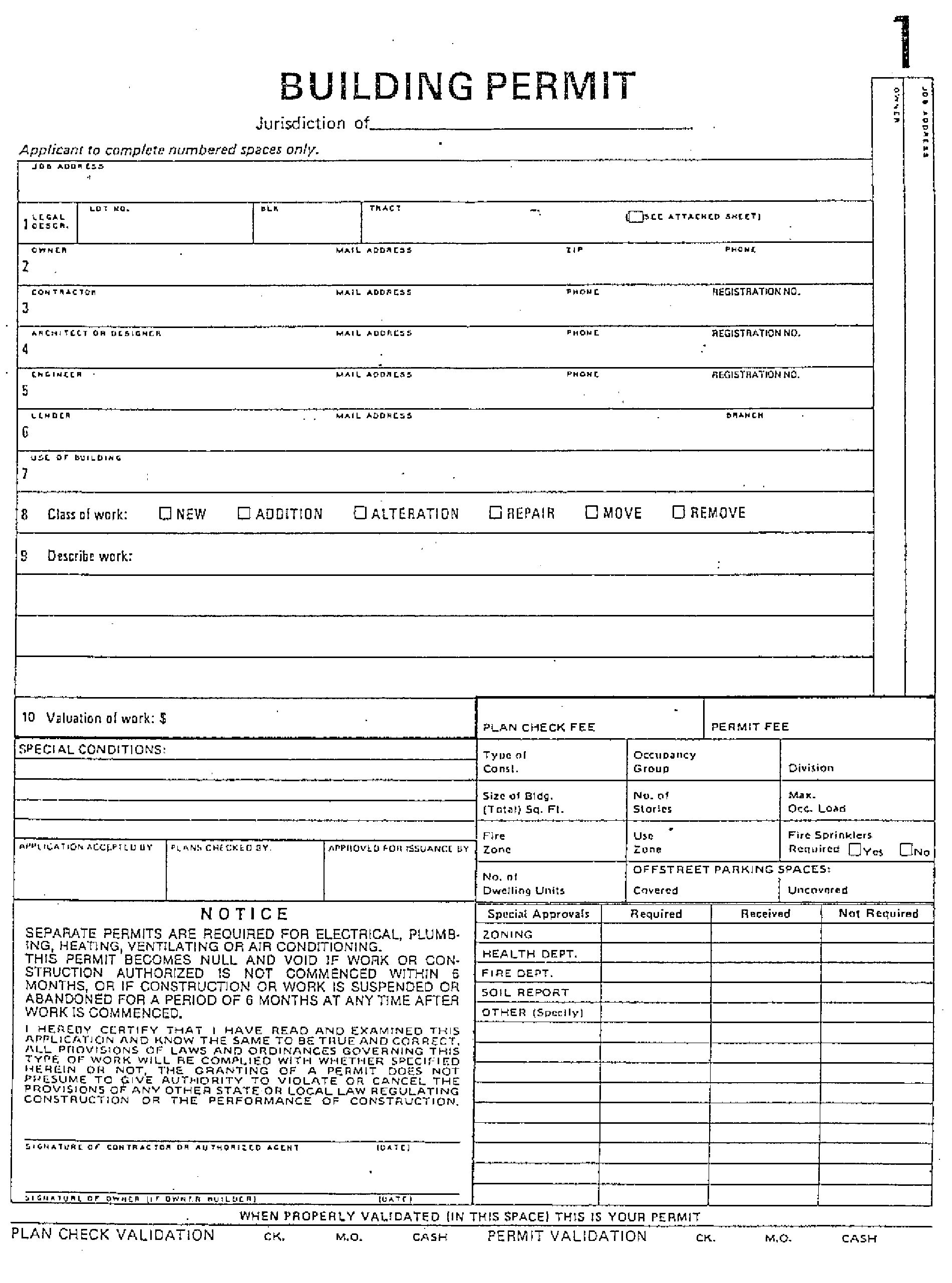
BUILDING PERMIT (ILLUSTRATIVE ONLY)
(Ord. of 1993, § 1904)
Sec. 46-570. - Certificates of occupancy.
(a)
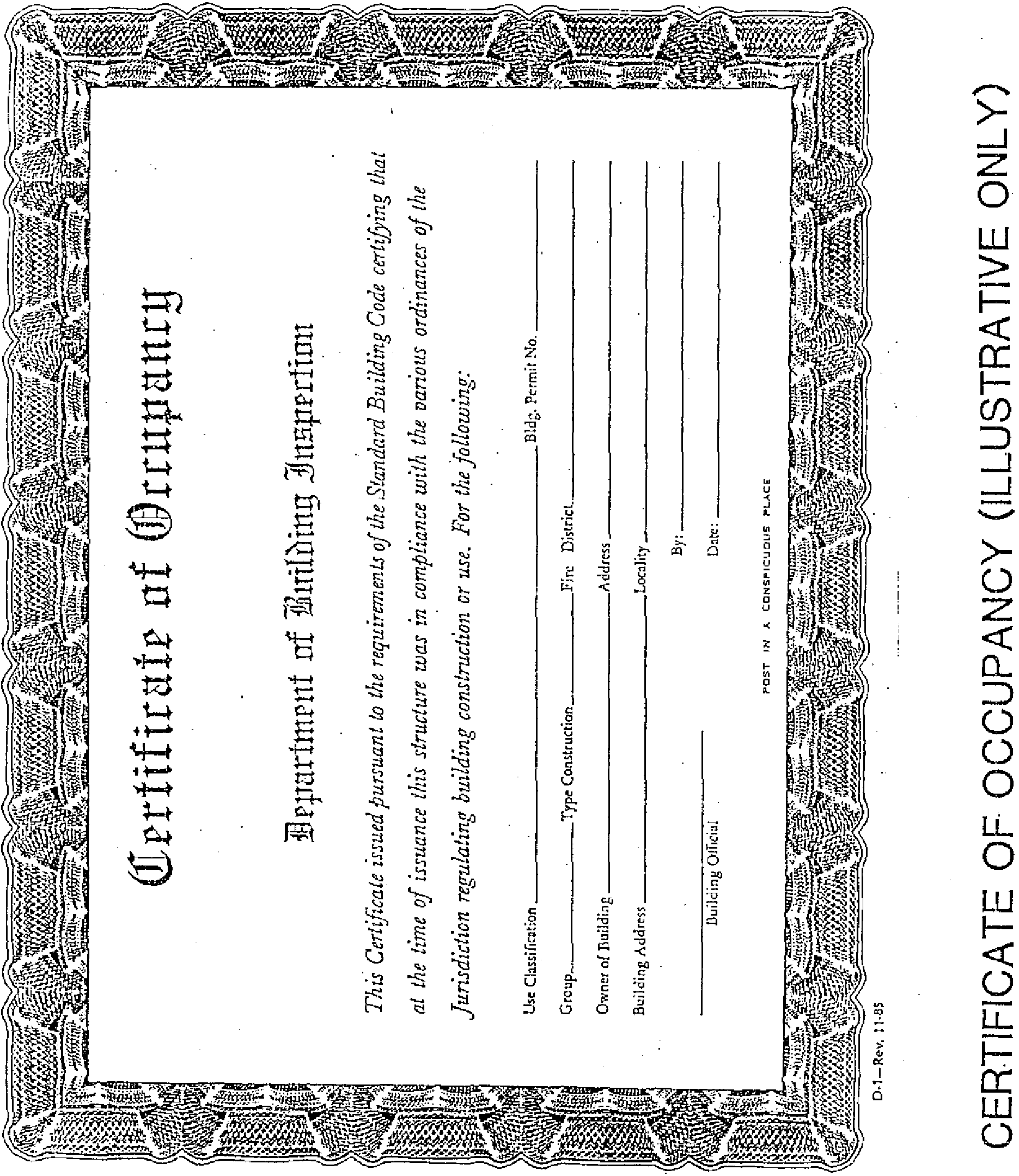
A certificate of occupancy issued by the zoning administrator is required in advance of occupancy or use of any lot or change or extension in the use of any lot; any building or structure hereafter erected; or any change in the use of an existing building or structure. All certificates of occupancy shall be issued by the zoning administrator, and no such certificate shall be issued unless the proposed use of a building or land conforms to the applicable provisions of these regulations.
(b)
Business licenses shall not be issued until the business conforms to the regulations of the district in which it is located and a valid certificate of occupancy is issued.
(Ord. of 1993, § 1905)
Sec. 46-589. - Application requirements.
Application materials specified in this section shall be required for petitions for amendments to the official zoning map, conditional use permits, and variances:
(1)
An application form furnished by the zoning administrator;
(2)
A legal description of the property to be considered in the application which shall be by metes and bounds unless an alternative legal description (such as a tax plat map) is accepted by the zoning administrator;
(3)
Boundary surveys of the property whenever available;
(4)
For applications regarding property in commercial or industrial zoning districts, a site plan with all information specified (which plan, unless otherwise noted in the approval, shall be considered a part of the approval and must be followed);
(5)
A fee for the application as established by the city council from time to time; and
(6)
If the application requires action by the city council or zoning board, disclosure of any potential or actual conflicts of interest as required by state law.
(Ord. of 2-14-1995, § 3; Amend. of 10-20-2020)
Sec. 46-590. - Site plan requirements.
All site plans required by this article shall, at a minimum, contain the following information:
(1)
Title of the proposed development and the name, address and telephone number of the property owner;
(2)
The name, address and telephone number of the architect, engineer or other designer of the proposed development;
(3)
Scale, date, north arrow, and general location map showing relationship of the site to streets or natural landmarks; and
(4)
Boundaries of the subject property, all existing and proposed streets, including right-of-way and street pavement widths; buildings; watercourses; parking and loading areas; and other physical characteristics of the property and proposed development.
(Ord. of 2-14-1995, § 4)
Sec. 46-591. - Criteria to consider for map amendments.
(a)
The zoning administrator, zoning board, and city council should review an application for zoning map amendment with regard to the following criteria:
(1)
The existing uses and zoning of nearby property and whether the proposed zoning will adversely affect the existing use or usability of nearby property.
(2)
The extent to which property values are diminished by the particular zoning restrictions.
(3)
The extent to which the destruction of property values promotes the health, safety, morals or general welfare of the public.
(4)
The relative gain to the public, as compared to the hardship imposed upon the individual property owner.
(5)
The physical suitability of the subject property for development as presently zoned and under the proposed zoning district.
(6)
The length of time the property has been vacant, considered in the context of land development in the area in the vicinity of the property, and whether there are existing or changed conditions affecting the use and development of the property which give supporting grounds for either approval or disapproval of the rezoning request.
(7)
The zoning history of the subject property.
(8)
The extent to which the proposed zoning will result in a use which will or could cause excessive or burdensome use of existing streets, transportation facilities, utilities, schools, parks, or other public facilities.
(9)
Whether the zoning proposal is in conformity with the policy and intent of the comprehensive plan, land use plan, or other adopted plans.
(b)
The city council and zoning board may consider other factors deemed relevant before taking action on a particular request.
(Ord. of 2-14-1995, § 5; Amend. of 10-20-2020)
Sec. 46-592. - Criteria to consider for conditional uses.
(a)
The zoning administrator, zoning board, and city council should review an application for conditional uses with regard to the following criteria:
(1)
Off-street parking and loading facilities are adequate in terms of location, amount and design to serve the use.
(2)
The number, size and type of signs proposed are compatible with the surrounding area.
(3)
The amount and location of open space and the provision of screening is such that buffering of incompatible uses is achieved.
(4)
Ingress and egress to the property is suitable and safe, and the effect of the proposed activity on traffic flow along adjoining streets is not adverse.
(5)
The location and intensity of outdoor lighting is such that it does not cast light on adjacent, adjoining or neighboring properties.
(6)
Hours and manner of operation of the proposed use are not inconsistent with adjacent and nearby uses.
(7)
Public facilities and utilities are capable of adequately serving the proposed use.
(8)
The proposed use will not have a significant adverse effect on the level of property values or the general character of adjacent land uses or the general area.
(9)
The physical conditions of the site, including size, shape, topography and drainage, are suitable for the proposed development.
(10)
The proposed use is consistent with the goals and objectives of the city's comprehensive plan.
(b)
The city council and zoning board may consider other factors deemed relevant before formulating recommendations and taking action on a particular conditional use application.
(Ord. of 2-14-1995, § 6; Amend. of 10-20-2020)
Sec. 46-593. - Criteria to consider for variances.
(a)
A variance may be granted in an individual case of unnecessary hardship, after appropriate application, upon specific findings that the following conditions exist:
(1)
There are extraordinary and exceptional conditions pertaining to the particular piece of property in question because of its size, shape or topography that are not applicable to other land or structures in the same district;
(2)
A literal interpretation of the provisions of these zoning regulations would create an unnecessary hardship and would deprive the applicant of rights commonly enjoyed by other property owners within the district in which the property is located;
(3)
Granting the variance requested will not confer upon the property of the applicant any special privileges that are denied to other properties of the district in which the applicant's property is located;
(4)
Relief, if granted, will be in harmony with the purpose and intent of these regulations and will not be injurious to the neighborhood or general welfare in such a manner as will interfere with or discourage the appropriate development and use of adjacent land and buildings or unreasonably affect their value;
(5)
The special circumstances are not the result of the actions of the applicant;
(6)
The variance requested is the minimum variance that will make possible the legal use of the land, building, or structure; and
(7)
The variance is not a request to permit a use of land, building or structures which is not permitted by right in the district involved.
(b)
A variance shall not be granted in cases where the requested relief to the property owner can be remedied by a change to a zoning district which otherwise would not require a variance.
(Ord. of 2-14-1995, § 7)
Sec. 46-594. - Withdrawal of applications.
Any petition for amendment to this chapter text, official zoning map, conditional use approval, or variants may be withdrawn, at the discretion of the person or agency initiating such a request, at any time prior to closing the required public hearing upon written notice to the zoning administrator. If the public hearing has been completed, withdrawal by the applicant is not permitted. Any required application fees shall be refunded to the applicant only if such application has not been prepared and submitted for advertisement as determined by the zoning administrator.
(Ord. of 2-14-1995, § 2; Amend. of 10-20-2020)
Sec. 46-595. - Simultaneous consideration of multiple applications.
A petitioner may simultaneously submit multiple applications involving the same property, such as a rezoning request, conditional use, and variance. The zoning board or city council may simultaneously hear and consider multiple applications, provided any applicable public notice and other specified requirements are met. The proper order of consideration of multiple applications shall be rezoning requests first, conditional use second, and variances third. The zoning board or city council may consider and act upon a variance request at the same meeting as a rezoning request or conditional use is approved.
(Ord. of 2-14-1995, § 9; Amend. of 10-20-2020)
Sec. 46-596. - Conditional approval permitted.
In exercising their powers, the zoning board or city council may attach any conditions to their approval or recommendation for approval which they find necessary to accomplish the reasonable application of the requirements of these regulations and are specifically authorized to attach rezoning conditions when necessary to render the proposed zoning district or use compatible with adjacent and nearby properties and land uses.
(Ord. of 2-14-1995, § 10; Amend. of 10-20-2020)
Sec. 46-597. - Public notice and public hearing required.
(a)
Applicability. This section shall apply only to adoption of a new zoning ordinance, applications for amendments to the text of the zoning regulations, and amendments to the official zoning map.
(b)
Publication of notice of application. Upon receipt of a completed application, fees, and other information required by this article; the zoning administrator shall cause notice of such application to be published at least one time in a newspaper of general circulation in the community at least 15 days, but not more than 45 days prior to the date of public hearing on the application.
(c)
Content of published notice. The publish notice shall include, as a minimum, the purpose, location, date, and time of the public hearing, the location of the property being considered, and the present and proposed zoning classification of the property.
(d)
Posting of notice of application. The zoning administrator shall also cause to have posted in a conspicuous place on the property one or more signs, each of which shall contain the information specified for publish notices. The public hearing shall not take place until the signs have been posted for at least 15 days, but not more than 45 days prior to the date of the public hearing. Posting of signs shall not be required when the city council is considering adopting or readopting a zoning ordinance and official zoning map.
(e)
Rescheduling and continuing hearings. Public hearings may be delayed, rescheduled or continued at another time and date, provided announcement is given at the time and place of the initially scheduled and advertised public hearing, and provided such date, time and location of the public hearing to be delayed, rescheduled or continued is announced.
(Ord. of 2-14-1995, § 11; Amend. of 10-20-2020)
Sec. 46-598. - Conduct of public hearings.
(a)
Hearing body. All public hearings required by this article shall be conducted and heard in accordance with the requirements of Georgia law. Within its discretion, the city council may delegate the conducting of public hearings to its duly appointed zoning board and does so designate the zoning board as the proper body to hold and conduct public hearings in association with this article; so long as such board is properly impaneled and operating. The city council may, as necessary and in its sole discretion, conduct any such required public hearings on its own.
(b)
All public hearings required by this article shall be governed by the following procedures:
(1)
The presiding officer shall open the hearing by stating the specific application being considered at the public hearing.
(2)
The zoning administrator or other staff may present a description of the proposed application, any applicable background material, and any recommendation regarding action on the application as appropriate.
(3)
Persons who support the application will be asked to comment first. The petitioner may, upon recognition and upon statement of name and address, present and explain his application. The petitioner, or his designated agent, is expected to attend the public hearing unless written notice of hardship is received prior to such meeting. A time limitation may be imposed at the discretion of the presiding officer.
(4)
Persons who oppose the application or who have questions about the subject application will be asked to comment next. All interested parties after being recognized shall be afforded an opportunity to address the proposed application by standing before the appropriate body and identifying their name, address, and interest along with any comments on the proposed application. A time limitation may be imposed at the discretion of the presiding officer.
(5)
The petitioner shall have an opportunity to answer any questions raised by the public, for summary remarks, and for rebuttal concerning the proposed application.
(6)
Upon the completion of any comments from interested parties and the petitioner, the public hearing shall be completed and adjourned.
(7)
All public comments having been heard, the members of the body considering the application may discuss the request among themselves. During this discussion period, the members of the body may call on the petitioner or other interested parties to clarify points made previously or to answer questions. The petitioner or interested parties may respond upon recognition. Additional questions from the general public may not be asked once the public hearing has been closed.
(8)
Once the public hearing is closed and a vote or other action is being considered, unrecognized responses from the petitioner shall be ruled out of order by the presiding officer.
(c)
Upon conclusion of the public hearing, any and all votes or recommendations made by the zoning board shall be submitted in writing to the city council, which shall take up the issue for consideration and vote at its next regularly scheduled city council meeting.
(Ord. of 2-14-1995, § 12; Amend. of 10-20-2020)
Sec. 46-610. - Purpose.
In support and furtherance of its finding that a public need exists for the establishment of a planning, code and zoning board to promote health, prosperity and general welfare; the city council establishes a planning and zoning board, which shall serve the City of Clayton in accordance with this article, the Code of Ordinances, and the city's Charter.
(Ord. of 4-15-2019, § I)
Sec. 46-611. - Board members; number, appointment, terms.
The board shall consist of not less than three nor more than seven members. The members of the board shall be appointed by the mayor and approved by the city council and shall serve a four-year term upon appointment. All members shall be persons who have demonstrated a special interest in the preservation, management and care of the community through proper planning, codes and zoning.
In order to achieve staggered terms initial appointments shall be: Two members appointed for two years, two members appointed for three years and two members receiving appointment for four years.
(Ord. of 4-15-2019, § II)
Sec. 46-612. - Meeting; rules.
The board shall observe the rules of procedure as adopted by the City of Clayton, as required by by-laws and Roberts' Rules of Order.
(Ord. of 4-15-2019, § II)
Sec. 46-613. - Expenses.
All appointed and designated members of the board shall be reimbursed for actual approved expenses incurred by them in the connection with their official duties of said board.
(Ord. of 4-15-2019, § II)
Sec. 46-614. - Statement of the boards authority.
The planning and zoning board shall be authorized to:
(1)
Prepare and maintain an inventory of all property within the City of Clayton to include an inventory of all real property, buildings and structures;
(2)
Conduct educational programs on planning, codes and zoning with the city and for the community;
(3)
Recommend to the city council revisions, amendments and deletions of the City of Clayton Code of Ordinances, rules and regulations;
(4)
Review applications for variance, rezoning, subdivisions, developments or commercial construction and recommend to the city council to approve or deny such applications;
(5)
Participate in planning for the future of the city and recommend to the city council appropriate actions to sustain growth and vitality;
(6)
Seek out local, state federal and private funds and make recommendations concerning the most appropriate uses of any funds acquired;
(7)
Promote the acquisition by the City of Clayton of façade easements and conservation easements and land grants, as appropriate, in accordance with the provisions of the Georgia Uniform Conservation Easement Act of 1992 (O.C.G.A §§ 44-10.1—44-10.8).
(Ord. of 4-15-2019, § II)
Sec. 46-615. - Boards authority to receive funding from various sources.
The board may facilitate, with council approval, donations, funds and grants and shall ensure that the same do not displace appropriated governmental funds.
(Ord. of 4-15-2019, § II)
Sec. 46-616. - Code of ethics.
Each member of the board shall adhere to the following code of ethics:
(1)
Board members shall act with integrity and in an ethical and professional manner in their interactions with each other and the public.
(2)
Board members shall maintain high ethical and moral character, both professionally and personally, so that their behavior will reflect positively upon the board and the City of Clayton.
(3)
Board members shall use proper care and exercise independent professional judgement in the performance of their duties.
(4)
Board members will recuse themselves and not participate in the consideration of any matter or attempt to affect the outcome of any issue before the board when to do so might result in even the appearance of a conflict of interest.
(5)
Board members recognize that all board decisions and actions are based solely on integrity, competence and independent judgement on the merits and benefits to the City of Clayton and its citizens.
(6)
Additionally, the board shall comply with chapter 2 article VIII Ethics, of the Code of Ordinances.
(Ord. of 4-15-2019, § II)
Sec. 46-617. - Standards of conduct.
(a)
Board members shall not belittle, debase or abuse other board members on issues or actions in the presence of the public. A board member may question another board member while in the presence of the public in regard to a decision, but never belittle, debase or abuse in their presence.
(b)
Board members shall not engage in conduct that would comprise, discredit or diminish the integrity of the board.
(c)
The board shall respect the authority of the chairman and vice-chairman.
(d)
Board members will function with the understanding that they represent the citizens and the City of Clayton government, but the board does not posses the sole authority in matters before the board. The final authority for all matters shall be the city council of the City of Clayton.
(e)
A board member shall not participate in a breach, contribute to such action, or to the concealment of such breach of the standards of conduct, code of ethics, City of Clayton Policy or Georgia State Law.
(Ord. of 4-15-2019, § II)
Sec. 46-618. - Removal of a member of the board.
The mayor and council shall have the authority to remove any member of the board for cause, upon written charges, after a public hearing.
(Ord. of 4-15-2019, § II)
Sec. 46-619. - Vacancy.
Any vacancy in the membership of the board shall be filled for the unexpired term by the mayor and city council.
(Ord. of 4-15-2019, § II)
Sec. 46-620. - Conflict of interest.
The board shall be subject to all conflict of interest laws set forth in Georgia Statutes and within the City of Clayton Charter and ordinances.
(Ord. of 4-15-2019, § II)
Sec. 46-621. - Technical advice.
The board shall have the authority to seek technical advice from outside its members upon any application, motion, request, issue or action.
(Ord. of 4-15-2019, § II)
Sec. 46-622. - Records of board meetings.
A public record shall be kept of the board resolutions, motions, requests, proceedings and actions showing the vote of each member upon each question and shall keep records of its examinations and other official actions, all of which shall be filed in the office of the city clerk and shall be public record.
(Ord. of 4-15-2019, § II)
Sec. 46-623. - Authority to subpoena witnesses.
The chairman, or in his/her absence the vice-chairman, may administer oaths and compel the attendance of witnesses by subpoena.
(Ord. of 4-15-2019, § II)
Sec. 46-624. - Meeting, hearings, and actions of the board.
All meetings, hearings and actions taken by the board shall be governed by the by-laws as established by the city council, the city Code of Ordinances, city Charter and the laws of the State of Georgia.
(Ord. of 4-15-2019, § II)

