
Clayton City Zoning Code
ARTICLE III
OFF-STREET PARKING, LOADING AND ACCESS
Sec. 46-387.- Parking requirements.
(a)
All submissions of permit application for new development, remodel, or addition shall be accompanied by a parking plan detailing all off-street parking provided for the subject property. Such plan must be approved in conjunction with the issuance any such permit.
(b)
No property with existing off-street parking shall eliminate any of such parking without prior approval from the city.
(Ord. No. 2025-01, § 1)
Sec. 46-388. - Off-street parking and loading spaces required.
(a)
Off-street automobile parking and loading spaces shall be provided, as specified in this article, for uses and structures hereafter established in all districts at the time of initial construction of any principal building, unless otherwise exempted from this article. For developments phased in timing, parking and loading requirements may also be phased in accordance with the requirements applying for each particular time phase of development.
(b)
Any building or use that is subsequently enlarged or converted to another use shall meet the off-street parking and loading space requirements of this article, for the enlarged or new use.
(c)
Required parking and loading spaces shall be maintained and shall not be encroached upon by refuse containers, signs or other structures, unless an equal number of spaces are provided elsewhere in conformance with these regulations.
(d)
Required parking and loading spaces shall be provided with vehicular access to a public street or alley.
(e)
Off-street parking and loading facilities required shall be located contiguous to the principal building or use. However, as much as 25 percent of the required number of parking spaces may be located within 200 feet of the principal building or use, provided proof of ownership of such premises is provided to the zoning administrator. Such distance shall be measured between the nearest point of the parking facility and the nearest point of the principal building or use. If this option of utilizing nearby parking is utilized, then the parking area may not be discontinued or otherwise converted to another use during the time that it is utilized to meet the minimum required number of off-street parking spaces.
(Ord. of 1993, § 601)
Sec. 46-389. - Minimum number of off-street parking spaces required.
The minimum number of required off-street parking spaces for each type of permitted use shall be as indicated below. For uses not specifically listed, the off-street parking requirements shall be those of the most similar use as determined by the zoning administrator. When the application of these parking requirements results in a fractional space requirement, the fractional space requirement shall be construed to mean one additional space.
(Ord. of 1993, § 602)
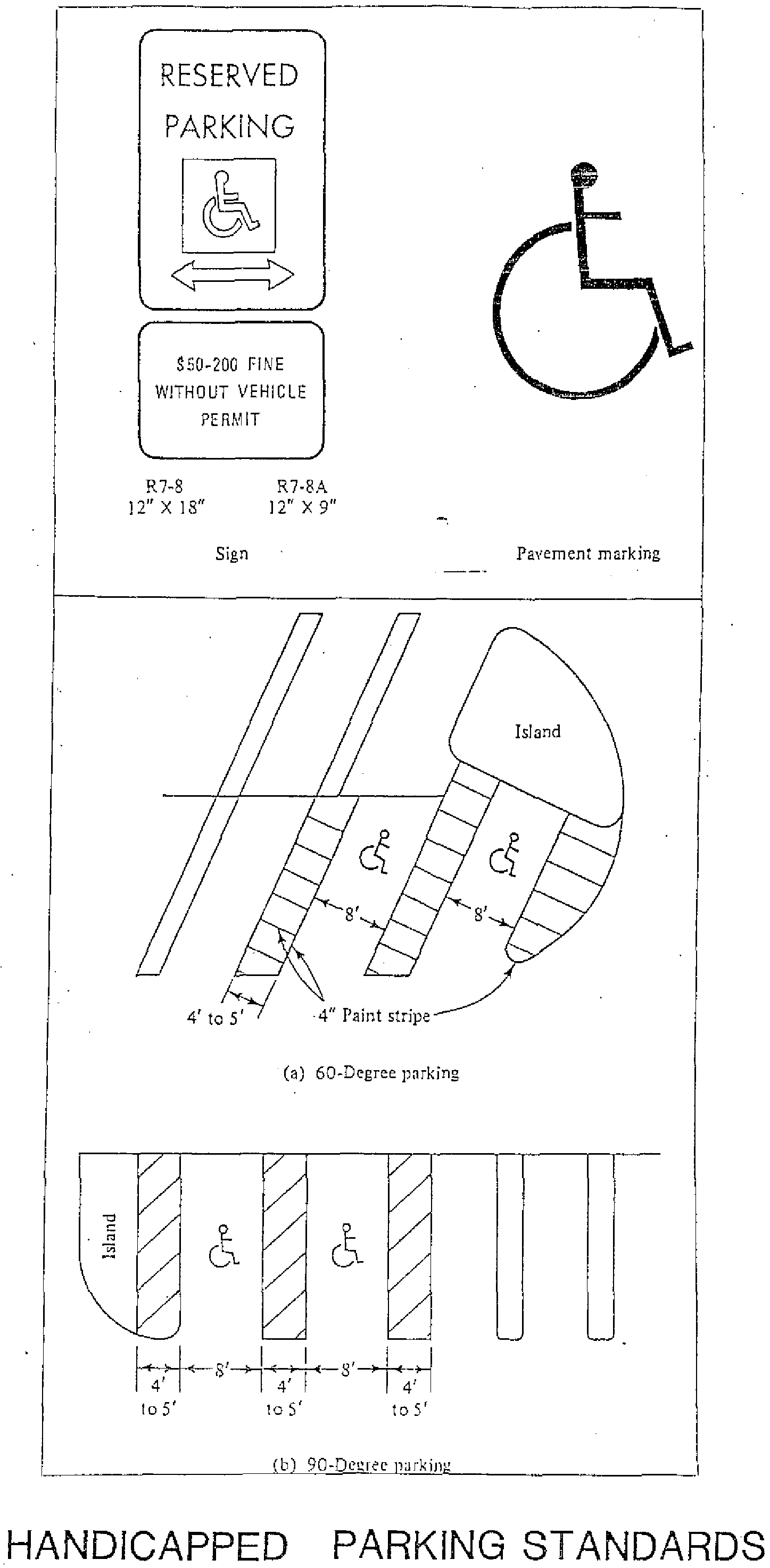
Sec. 46-390. - Handicapped parking requirements.
Each parking area of six or more spaces devoted to uses other than residential shall provide handicapped parking spaces (a minimum of twelve feet in width) counted as a part of the total parking required, in accordance with the following scale:
(Ord. of 1993, § 603)
Sec. 46-391. - Parking space and lot design flexibility.
Individual parking spaces shall be a minimum of 160 square feet. The angle of design for parking spaces and parking lots may be 30, 45, 60, 90 degrees or parallel to the curb, provided that sufficient maneuvering isle width is provided subject to the approval of the zoning administrator.
(Ord. of 1993, § 604)
Sec. 46-392. - Minimum number of off-street loading spaces required.
(a)
On the same lot with every building, structure or part thereof, erected or occupied for manufacturing, storage, warehouse, truck freight terminal, goods display, department store, wholesale store, market, hotel, hospital, mortuary, laundry, dry cleaning, retail business or other uses similarly involving the receipt or distribution of vehicles, materials or merchandise, there shall be provided and maintained on the lot adequate space for the standing, loading and unloading services to avoid undue interference with public use of streets and alleys.
(b)
Such loading and unloading space, unless otherwise adequately provided for, shall be an area 12 feet by 60 feet, with 14-foot height clearance, and shall be provided according to the schedule in subsection (c) of this section.
(c)
For the uses described in subsection (a) of this section, one loading space shall be provided for the first 25,000 square feet of gross floor area or fractional part thereof. Uses in excess of 25,000 square feet shall provide loading spaces according to the following schedule:
(d)
All plans for off-street loading areas shall be subject to the approval of the zoning administrator.
(Ord. of 1993, § 605)
Sec. 46-393. - Parking and loading area design requirements.
(a)
Improvement of parking lots. All parking areas containing more than five spaces shall meet the following requirements:
(1)
They shall be graded to ensure proper drainage, surfaced with concrete or asphalt, and maintained in good condition free of obstructions.
(2)
Parking areas shall not be used for the sale, repair, dismantling or servicing of any vehicle, equipment, materials or supplies.
(3)
Each parking space shall be clearly marked, and directional arrows or signs shall be provided wherever necessary. Markers, directional arrows and signs shall be properly maintained at all times.
(4)
A parking lot pavement setback of ten feet from any public street right-of-way and five feet from any exterior property line shall be provided, except where access points and interconnections to other parcels have been approved.
(5)
The parking lot pavement setback shall be increased to 25 feet where such lot abuts a residential district. Concrete or other suitable curb stops shall be installed so as to prevent vehicle encroachment onto setback areas.
(6)
Not less than ten percent of the total area devoted to parking shall be landscaped open space.
(7)
Any lighting facilities installed shall be so arranged to prevent the direct illumination of adjacent residential properties or public streets.
(8)
A site plan indicating property lines, parking areas, location of parking spaces, pavement setbacks, drainage facilities, paving materials, access and other features required to ensure compliance with this article shall be submitted to the zoning administrator. A permit shall be required prior to the construction of new parking areas, or for the expansion or alteration of existing parking areas.
(b)
Curb cut and access specifications. Access from public streets to all parking areas, regardless of the number of parking spaces provided, shall meet the following requirements:
(1)
Curb cuts or access breaks for service drives, entrances and exits on public streets shall not be located within 50 feet of the intersections of two curblines, street pavement lines or such lines extended or any street intersection nor within 40 feet of another curb cut or access break on the same side of the street.
(2)
Curb cuts shall be no greater than 40 feet in width and no closer than 25 feet to any property line, unless common use of driveways for an abutting lot is required or approved by the city Engineer.
(3)
No more than two curb cuts or access breaks shall be permitted for any lot or parcel with a frontage of 200 feet or less on any one street.
(4)
All curb cuts or access breaks onto public streets, except for those serving single-family detached residences, shall require a permit from the zoning administrator.
(5)
Curb cuts for driveways that serve commercial, office or industrial zoning districts shall not be permitted to pass through residential zoning districts or to access alleys that abut a residential zoning district.
(6)
Where the side of an accessed public street or alley does not contain curbing, such curbing or other method of approved access control shall be provided.
(Ord. of 1993, § 606)
Sec. 46-394. - Parking areas must be appropriately zoned.
Parking areas, parking lots or parking garages which constitute the principal use of a lot shall only be permitted in NS, HB, CBD and M-1 zoning districts. In cases where parking areas, parking lots or parking garages exist or are proposed to serve as accessory parking for a particular building or use, regardless of whether such parking is required by this article, such land, area or lot, including all access drives, shall require the same or less restrictive zoning district as that within which such building or use it serves is located. Similarly, in cases where accessory parking serves a building or use which requires, or was approved as, a conditional use, such parking area and access drives shall require the same conditional use approval as that for which such conditional use or building it serves.
(Ord. of 1993, § 607)

