
Clearwater City Zoning Code
ARTICLE XII
SIGNS
Sec. 117-1247.- Findings.
The city council hereby finds as follows:
(1)
Exterior signs have a substantial impact on the character and quality of the environment.
(2)
Signs provide an important medium through which individuals may convey a variety of messages.
(3)
Signs can create traffic hazards, aesthetic concerns and detriments to property values, thereby threatening the public health, safety and welfare.
(4)
The city's zoning regulations include the regulation of signs in an effort to provide adequate means of expression and to promote the economic viability of the business community, while protecting the city and its citizens from a proliferation of signs of a type, size, location and character that would adversely impact upon the aesthetics of the community and threaten the health, safety and welfare of the community. The regulation of the physical characteristics of signs within the city has had a positive impact on traffic safety and the appearance of the community.
(5)
Signs shall be defined as any letter, word or symbol, poster, picture, reading matter or representation in the nature of advertisement, announcement, message or visual communication, whether painted, posted, printed, affixed or constructed, including all associated brackets, braces, supports, wires and structures, which is displayed for informational or communicative purposes. The term "structure" is defined as anything which is built, constructed or erected; an edifice or building of any kind; or any piece of work artificially built up and/or composed of parts joined together in some definite manner whether temporary or permanent in character. Among other things, structures include but are not limited to buildings, gazebos, decks, retaining walls, walls, fences over six feet in height, and swimming pools, but excluding patios and similar at-grade improvements.
(Ord. No. 04-2006, exh. 1(23.01), 9-5-2006)
Sec. 117-1248. - Purpose.
It is not the purpose or intent of this article to regulate the message displayed on any sign; nor is it the purpose or intent of this article to regulate any building design or any display not defined as a sign, or any sign which cannot be viewed from outside a building. The purpose and intent of this article is to:
(1)
Regulate the number, location, size, type, illumination and other physical characteristics of signs within the city in order to promote the public health, safety and welfare.
(2)
Maintain, enhance and improve the aesthetic environment of the city by preventing visual clutter that is harmful to the appearance of the community.
(3)
Improve the visual appearance of the city while providing for effective means of communication, consistent with constitutional guarantees and the city's goals of public safety and aesthetics.
(4)
Provide for fair and consistent enforcement of the sign regulations set forth herein under the zoning authority of the city.
(5)
Establish standards which permit property owners the opportunity to identify and advertise themselves, goods, or services.
(Ord. No. 04-2006, exh. 1(23.02), 9-5-2006)
Sec. 117-1249. - General provisions.
The following provisions apply to signs located in all zoning districts within the city:
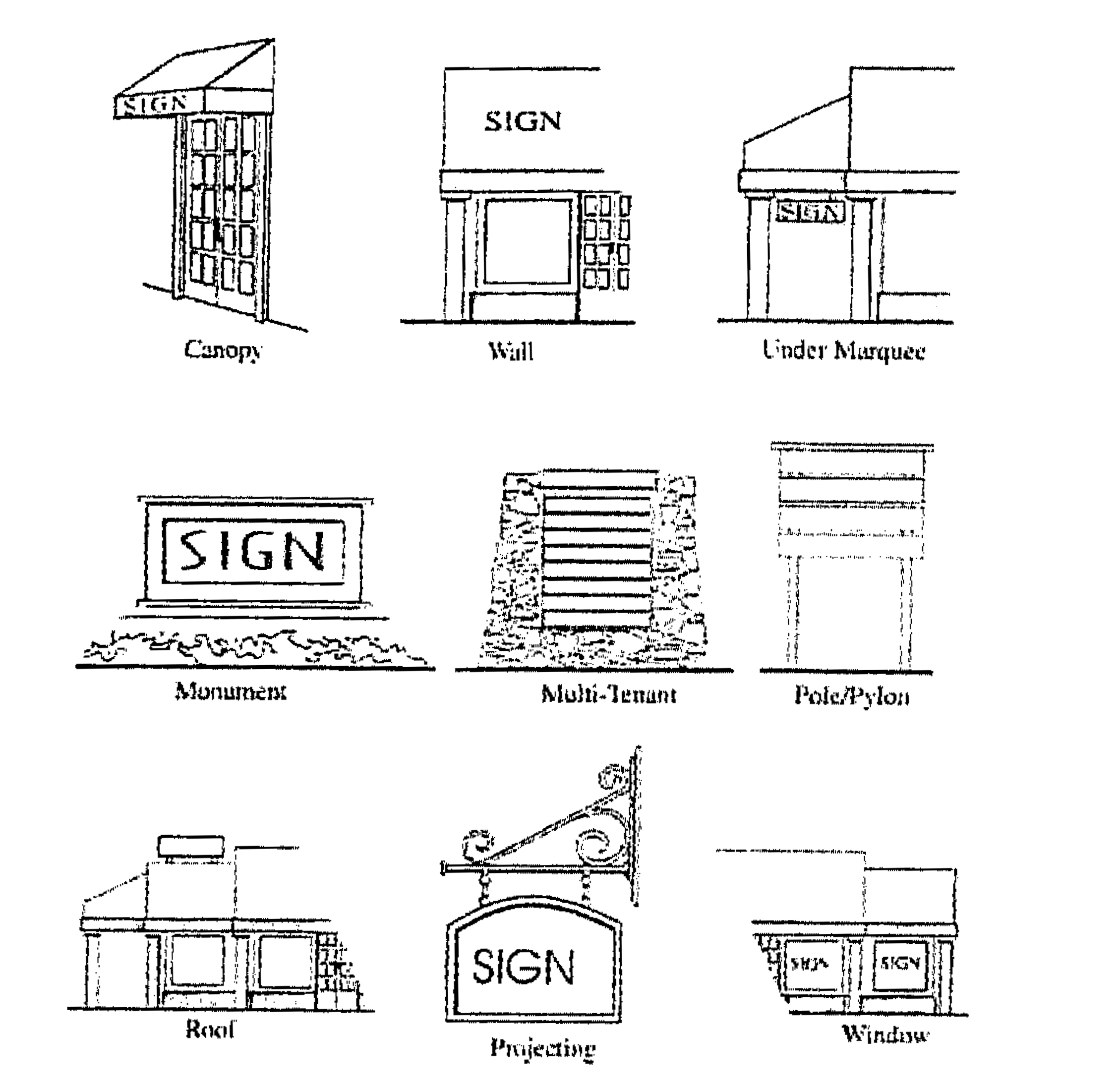
(1)
Sign types.
(2)
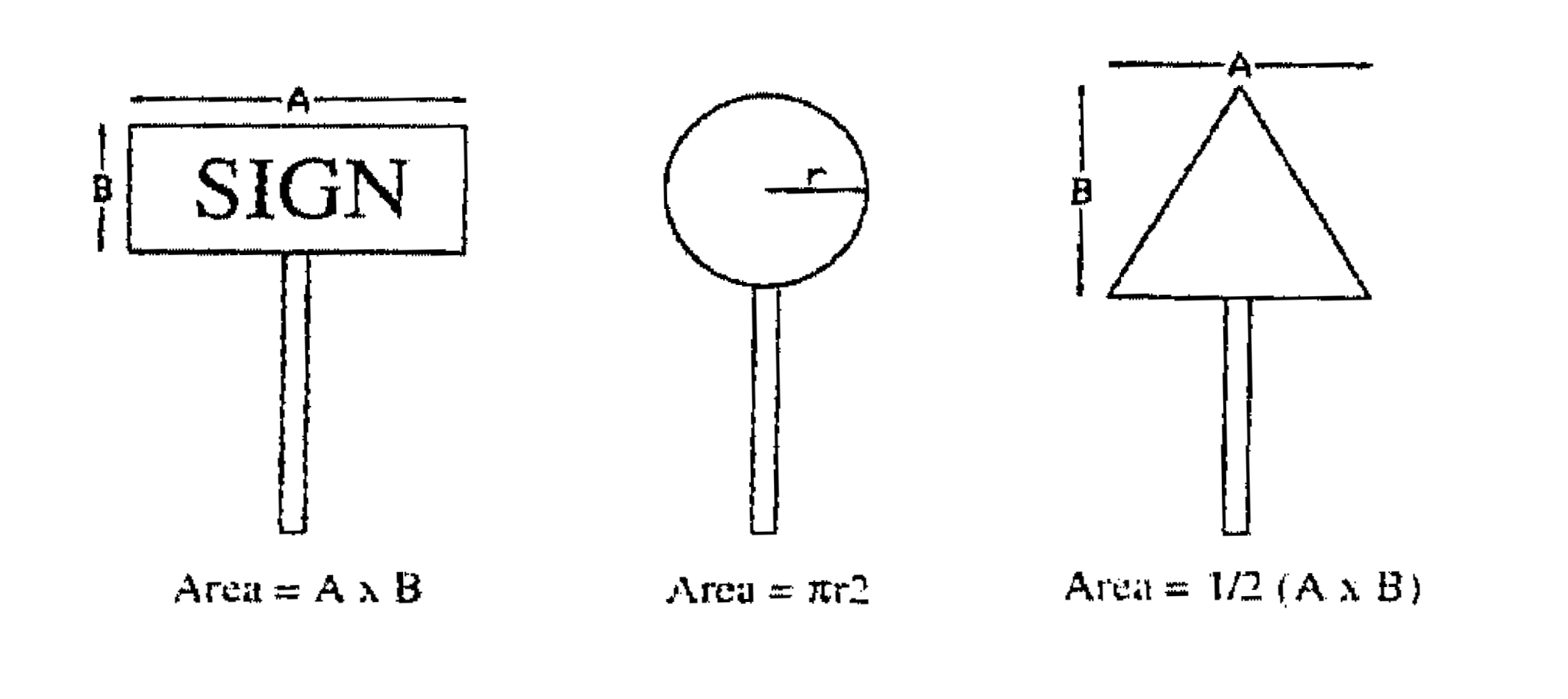
Sign area measurement. The outer dimensions of the frame/cabinet surrounding the sign face. Double-faced (back-to-back, abutting) freestanding signs shall be considered as a single sign face if the copy is identical on both faces.
Measurement of Sign Area—Examples
(3)
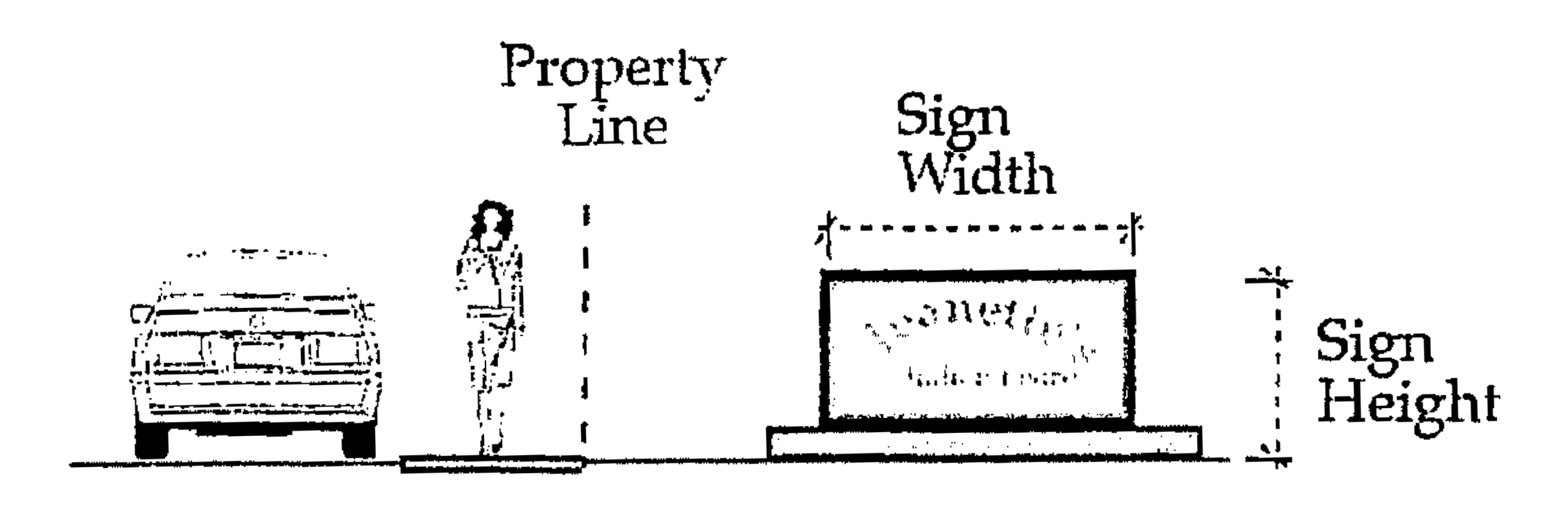
Sign height. The height of a freestanding sign will be measured from the average grade within the perimeter of the sign to the uppermost point of the sign.
(4)
Sign illumination. If a sign is illuminated, the illumination must be directed toward and limited to the sign's surface and not trespass onto adjacent property or in any way distract traffic.
(Ord. No. 04-2006, exh. 1(23.04), 9-5-2006)
Sec. 117-1250. - Signs exempt from permit.
(a)
Exemptions specified by type. The following signs shall not require a permit. These exemptions, however, shall not be construed as relieving the owner of the sign from the responsibility of its erection and maintenance and its compliance with the provisions of this article or any other law or ordinance regulating the same.
(1)
The changing of the display surface on a previously approved painted or printed sign.
(2)
One sign six square feet or less in size per lot.
(3)
Governmental signs, including but not limited to, traffic control, other regulatory purpose or street signs, informational signs, danger signs, and railroad crossing signs.
(4)
Any public sign (directional, safety, danger, trespassing, traffic, warning or public information) whose primary purpose is to communicate community events erected by, or on the order of, a duly constituted public office of city, county, state or federal governments in pursuance of their public duties, and provided signs are erected by or on order of a public officer or employee in the performance of official duty.
(5)
Political campaign signs are permitted on private property in any zoning district subject to the express consent of the owner or occupant of such property and in accordance with Minn. Stats. § 211B.045, provided that:
a.
No such sign is located within 100 feet of any polling site;
b.
No such sign is placed within the public right-of-way;
c.
No such sign is posted prior to August 1; and
d.
The political campaign sign is removed within ten days following the election.
(6)
Memorial signs or tablets, names of buildings and date of erection, when cut into any masonry surface or when constructed of bronze or other incombustible material.
(7)
Window signs, provided that no more than half of an individual window is covered with signs or painting.
(8)
Flags.
(b)
Prohibited places. Unless otherwise noted, no such sign shall be placed on fences, trees or other vegetation, public street/traffic signs, utility poles or city/public property. Signs in violation of this section may be removed by city personnel at their discretion, without advance notice to the sign owner.
(Ord. No. 04-2006, exh. 1(23.05), 9-5-2006; Ord. No. 2021-06, 6-14-2021)
Sec. 117-1251. - Unauthorized signs.
The following signs are unauthorized signs and are prohibited by this article:
(1)
Any sign, signal, marking or device proposed which is not authorized by a governmental unit which claims to be or is an imitation of or resembles any official traffic control device or railroad sign or signal, or emergency vehicle signal.
(2)
Signs within any public right-of-way or upon public lands or easements or other public rights-of-way (except for governmental signs).
(3)
Signs obstructing ingress or egress from any door, window, fire escape, stairway or other opening.
(4)
A sign or sign structure attached to a fire escape.
(5)
Abandoned signs.
(6)
Any sign that obstructs the vision of drivers or pedestrians or detracts from the visibility of any official traffic control device.
(7)
Any sign which becomes structurally unsafe or endangers the safety of a building or premises or endangers the public safety. Such unsafe signs shall be taken down and removed by the owner, agent, or person having the beneficial use of the building, structure or land upon which the sign is located.
(Ord. No. 04-2006, exh. 1(23.06), 9-5-2006)
Sec. 117-1252. - Construction and maintenance standards.
All signs shall be designed, constructed and maintained in accordance with the following standards:
(1)
The size and style of graphics, its scale, proportion, design, material and texture as well as the size and style of the letter shall relate to the building to which it refers and/or is attached and to the property and to the district that surrounds it.
(2)
The design and alignment of signs on multiple-use buildings shall be coordinated so as to achieve a unified appearance.
(3)
Unless otherwise noted, all signs shall be constructed of permanent materials and shall be permanently attached. Signs constructed with high-quality, natural materials such as stone, glass, wood, brick and similar materials are preferred.
(4)
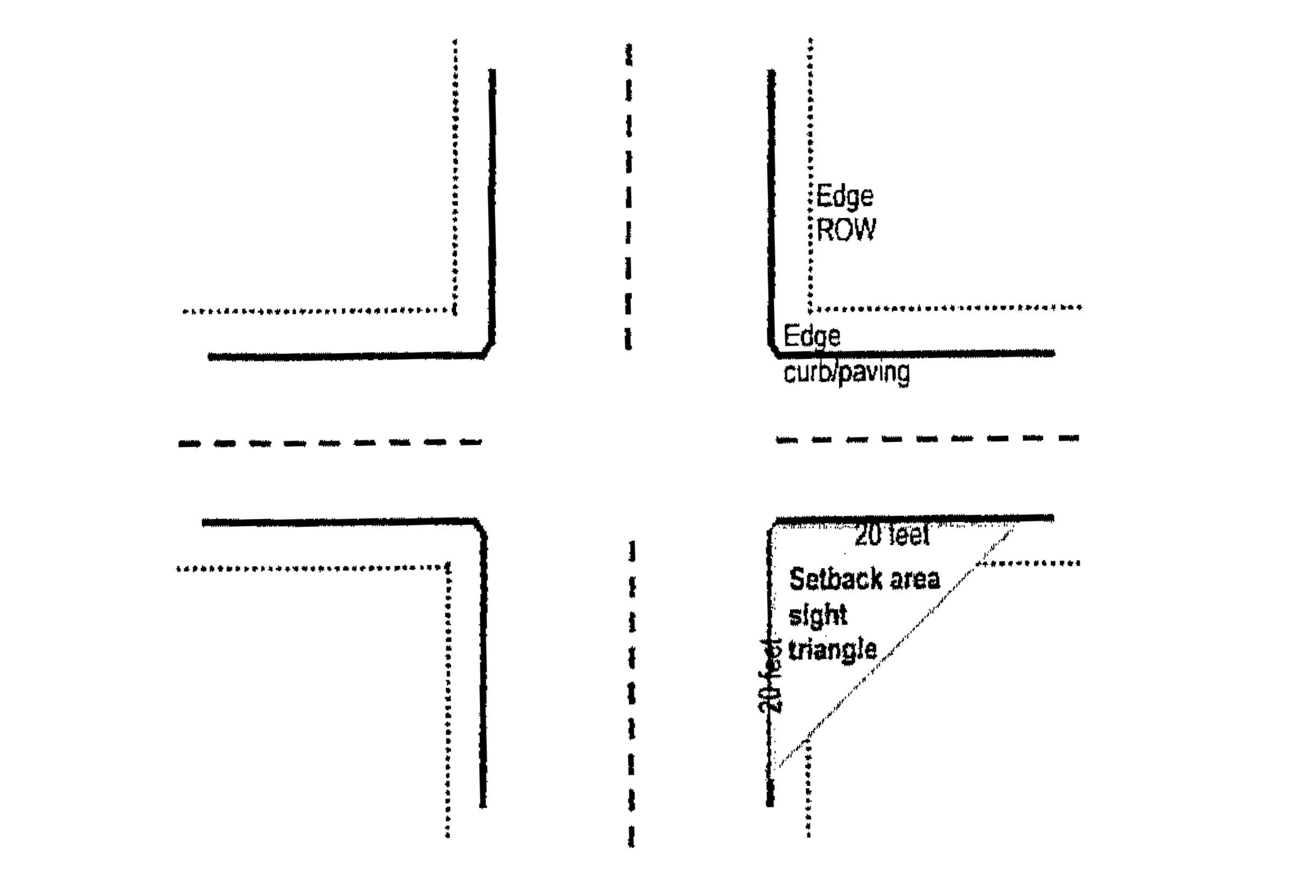
Unless stated otherwise in this article, permanent signs shall be set back at least ten feet from all property lines. Signs on corner lots shall be set back 20 feet from the edge of the rights-of-way of intersecting streets so as to preserve the a sight triangle. The sight triangle is the area of visibility required on a corner to allow for the safe operation of vehicles, pedestrians and cyclists in the proximity of intersecting streets, sidewalks and bicycle paths. The city may require a greater setback because of public safety reasons that may include, but not be limited to, the following concerns: vehicle sight-distances, distance from an intersection, or function of the adjoining right-of-way.
(5)
All signs shall contain current information. Outdated signs or signs with outdated information shall be removed by the property owner. This requirement shall not apply to changing the display surface on a painted or printed sign (i.e., poster replacement and/or on-site changes involving sign painting).
(6)
Painting, repainting, cleaning, and normal maintenance and repair of a sign or sign structure is required to protect the sign and prevent its deterioration and maintain its neat appearance. Such maintenance is allowed without permit unless a structural change is made.
(Ord. No. 04-2006, exh. 1(23.07), 9-5-2006)
Sec. 117-1253. - Sign permit required.
(a)
Application for permit required. Except as provided in section 117-1250, no person, company, organization or club shall hereinafter install, erect, alter, remodel or move any sign in the corporate limits without first obtaining from the city a sign permit as provided in this Code. A sign permit may be issued to the owner or occupant of the premises/property on which a sign is to be installed or displayed, or to the owner or installer, or to a licensed contractor upon completion of an application form and payment of fees.
(b)
Fees. Permit fees shall be as established by the city and shall be in such amounts as the council determines in its reasonable discretion to be necessary to finance the administration and enforcement of this article.
(c)
Information required. Application for a sign permit shall be made to the city, containing the following information:
(1)
Name, address, and telephone number of the applicant and sign contractor, and location of building structure or lot to which or upon which the sign or other advertising structure is to be attached or erected.
(2)
A drawing showing the method of attachment, construction, design, and other information such as may be necessary so that the city/zoning administrator and/or building official may determine the compliance of the sign with this article. If requested by the building official, engineering data showing the structure is designed to accommodate dead load and wind pressure in any direction.
(3)
A drawing of the proposed sign showing dimensions and describing materials, lettering, colors, illumination and support systems and the sign's height above grade, dimensions and square footage of sign area.
(4)
If a wall sign, a drawing of the building face to which it is proposed to be attached.
(5)
A site plan showing the location of the proposed sign and the location of all existing signage on the premises.
(6)
Such other information as may be required by the zoning/city administrator and/or building official.
The application shall be signed by the owner of the property at which the subject sign is to be erected and also contain the signature of the owner of the proposed sign.
(d)
Granting of permit. It shall be the duty of the zoning/city administrator and/or the building official upon the filing of an application for a sign permit, to examine such plans and specifications and other data; and if it appears that the proposed structure is in compliance with all requirements of this article and all other laws and ordinances of the city, then he shall grant the sign permit. In addition, all illuminated signs shall be subject to the provisions of the state electrical code and shall comply with the Underwriter's standard as defined in the current Underwriter Laboratories Standard for safety, electric sign.
(e)
Fee doubled for premature work. When work for which a permit is required by this article is started or proceeded with prior to obtaining a permit, the fee shall be doubled. Payment of such doubled fee shall neither relieve any persons from fully complying with the requirements of this article in the execution of the work nor from any other penalties prescribed herein.
(f)
Expiration of permit. If the work authorized under a sign permit has not been completed within six months after the date of issuance, said permit shall expire automatically and renewal of the permit shall be required.
(Ord. No. 04-2006, exh. 1(23.08), 9-5-2006)
Sec. 117-1254. - Master signage plan.
(a)
Required in nonresidential plan. A master signage plan shall be included in any nonresidential development plan, site or plot plan and/or nonresidential planned unit development with more than one individual business or tenant. No permit shall be issued for an individual sign requiring a permit in a commercial and/or industrial zoning district where more than one business or industry will be located until a master signage plan has been approved by the city. The master signage plan is intended to control total sign area and sign placement so as to help eliminate incongruities as tenants/occupants change.
(b)
Information to be included. The owner/agent proposing a nonresidential development plan, site or plot plan and/or nonresidential planned unit development with more than one individual business or tenant shall submit a master signage plan containing the following information:
(1)
A scaled site plan showing location of buildings, parking lots, driveways and landscaped areas and an accurate indication on the site plan of the proposed location of present and future signs of any type, whether requiring a permit or not.
(2)
Scaled color drawings clearly showing location of signage on building elevation.
(3)
Computation of the maximum total sign area, the maximum area for individual signs and the height of signs.
(c)
Plan to control numbers of signs. The maximum number of signs affixed to a building by each business within the building shall be controlled by the master signage plan.
(d)
Other restrictions. Other provisions of the plan may contain such other restrictions as the owner of the development or building may reasonably determine.
(e)
Signed agreement or covenants required. The plan shall be signed by all owners or their authorized agents in such form as required by the city or as a part of applicable and active restrictive covenants.
(f)
Amendment to plan. A master signage plan may be amended by filing administratively a new master signage plan that conforms to all requirements of this article.
(g)
Enforcement. After approval of a master signage plan, no sign shall be erected, placed, painted or maintained, except in conformance with approved master signage plan and such plan may be enforced in the same way as provisions of this article. In case of any conflict between the provisions of such a plan and this Code, the Code shall govern.
(Ord. No. 04-2006, exh. 1(23.09), 9-5-2006)
Sec. 117-1255. - Temporary signs.
(a)
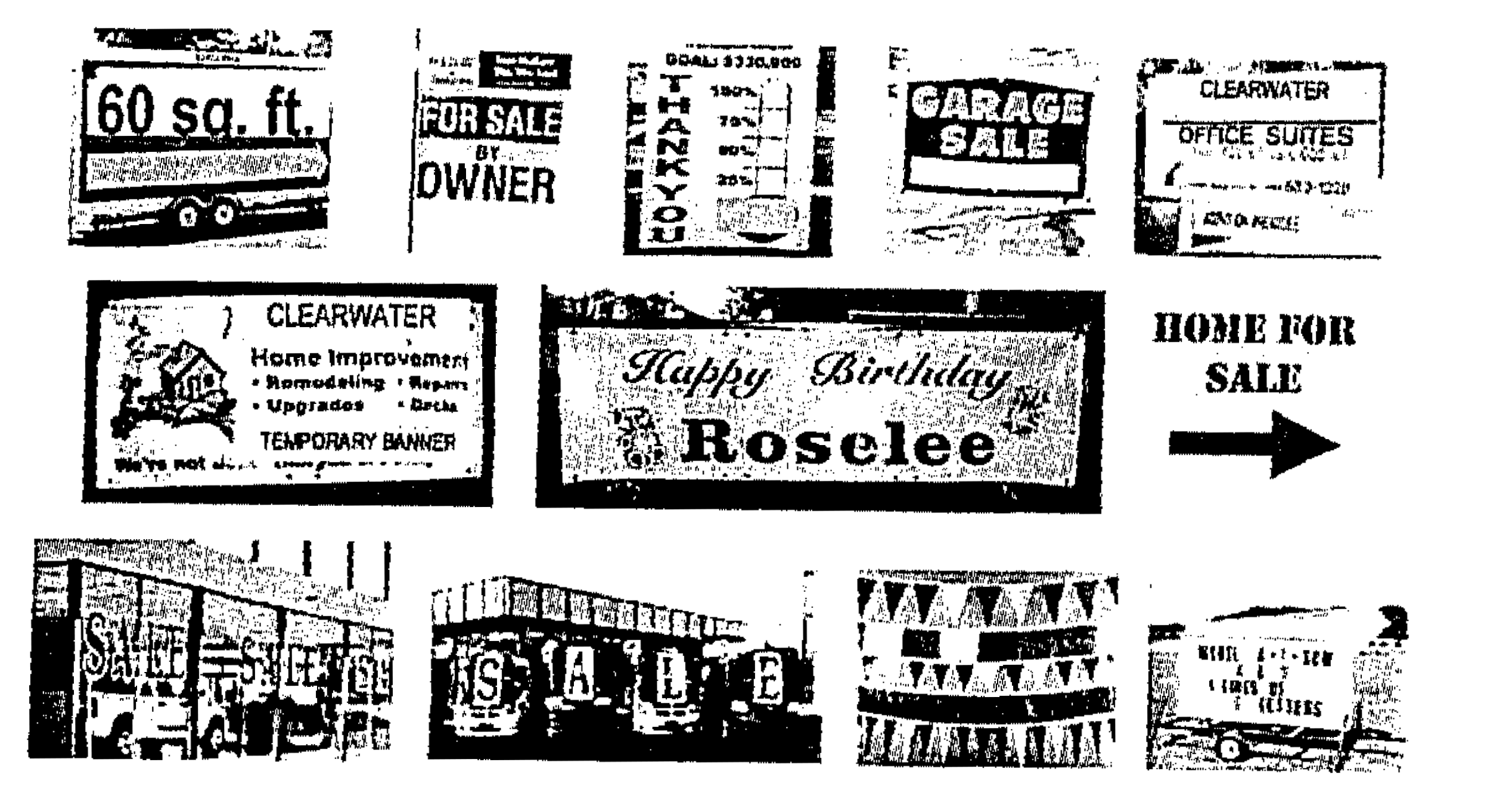
Definition. A temporary sign is defined as any sign, flag, banner, pennant, inflatable device, mobile sign or advertising related to an event occurring on a specific date, or between a specific set of proximate dates; any sign of a type normally displayed for a short period of time only that is not intended to be permanently installed.
(b)
Permit required. A temporary sign permit shall be obtained from the zoning administrator prior to erection of said temporary sign.
(c)
Maximum size. The sum of the square footage of all temporary signage (aggregate square foot area) shall not exceed a total of 80 square feet per lot including the framework to which it is attached.The maximum square footage of a single temporary sign shall not exceed 60 square feet in area.
(d)
Maximum number. There shall be no more than two temporary signs per business or lot at any one time.
(e)
Setback. Temporary signs shall maintain a ten-foot setback from all property lines and be located on private property.
(f)
Expiration. A temporary sign permit shall expire 40 days after the initial display date contained in the permit.
(g)
Means of attachment. Temporary signs shall be affixed to a permanent structure in a weather-resistant (wind, rain, snow) manner and not attached to outdoor displays/storage, rooftops or windows. The term "permanent structure" is defined as anything which is built, constructed or erected; an edifice or building of any kind; or any piece of work artificially built up and/or composed of parts joined together in some definite manner which is permanent in character. Among other things, structures include, but are not limited to buildings, gazebos, decks, retaining walls, walls, fences over six feet in height, and swimming pools, but exclude patios and similar at-grade improvements. Portable temporary signs similar to those pictured above are excepted from this standard provided compliance with all other applicable standards is maintained.
(h)
Removal required if detached. Temporary signs which do not remain affixed shall be immediately removed/re-secured.
(i)
Fee if removed by city. If any temporary sign is not removed by the expiration date of the permit, the zoning/city administrator or his designee may remove it and charge the costs of removal to the individual or enterprise responsible or property owner per the city's fee schedule.
(Ord. No. 04-2006, exh. 1(23.10), 9-5-2006)
Sec. 117-1256. - Standards by zoning district: permanent signs.
(a)
Permanent signs erected/placed on/within each lot or parcel of property shall comply with the standards applicable to the designated zoning classification described in the table below, all other requirements of this article and all other applicable local, state and/or federal laws.
(b)
A sign permit as described in section 117-1253 is required.
(c)
The table on the following pages describes the requirements for permanent signage per zoning classification:
(Ord. No. 04-2006, exh. 1(23.11), 9-5-2006)
Sec. 117-1257. - Billboards.
(a)
The term "billboard" is defined as a permanent sign with a total sign face exceeding 175 square feet or an overall height which exceeds 24 vertical feet in height.
(b)
Billboards must be located a minimum distance of 100 feet of any highway right-of-way.
(c)
Billboards are limited to those facing or intended to be viewed by motorists on Interstate 94 and those facing or intended to be viewed by motorists on T.H. 24 south of I-94.
(d)
Billboards facing or intended to be viewed from T.H. 24 north of I-94, CSAH 75 or other street with a functional classification of minor arterial, collector or local are prohibited.
(e)
Billboards are prohibited in all residential zoning classifications.
(f)
No part of a billboard may be constructed upon or over any public right-of-way.
(g)
Maximum area of billboard signs facing or intended to be viewed from I-94 is 672 square feet per side. Maximum area of billboard signs facing or intended to be viewed from I-94 is 300 square feet per side.
(h)
Minimum ground clearance is eight feet.
(i)
Maximum height is 30 feet. Height shall be vertical distance as measured from the highest component of the sign to the average grade within a five-foot radius of the sign.
(j)
Minimum distance from R-1 and R-2 zoning districts, parks, historical sites, churches, schools, public picnic or rest areas is 500 feet.
(k)
Minimum distance from other billboard signs on the same side of either Interstate 94 or T.H. 24 facing the same direction is 500 lineal feet.
(l)
Minimum distance from street intersections is 100 feet as measured from the right-of-way.
(m)
Billboards facing or intended to be viewed from Interstate 94 may contain no more than two individual signs per facing. Billboards facing or intended to be viewed from T.H. 24 where allowed shall be restricted to a single sign per face.
(Ord. No. 04-2006, exh. 1(23.12), 9-5-2006)
Sec. 117-1258. - Sandwich boards.
Where allowed, the following limitations shall apply:
(1)
No more than one sandwich board sign per business shall be allowed.
(2)
Sandwich board signs shall not exceed 36 inches in height or 30 inches in width.
(3)
Sandwich board signs shall be displayed only during store hours.
(4)
Sandwich board signs shall not require any form of electricity or display lights or moving parts.
(5)
Sandwich board signs shall not block driveways, entryways or pedestrian accesses, shall not significantly occlude the sidewalk and shall not impact sightlines/view at street intersections.
(6)
Sandwich board signs shall be made of superior quality, weather-resistant and wind- resistant materials such as MDO board (high-density exterior-grade compressed wood), high-quality fiberglass and similar material (e.g., Centrex), aluminum/plywood (e.g., Alumiply), high density foam board, plastic (with weights), etc., but shall not include (due to temporary exterior quality) cardboard, OSB, plywood and the like.
(7)
Sandwich board signs shall not be affixed to the sidewalk, other signage or temporary or permanent structure.
(8)
The sign owner and property owner shall provide proof of liability insurance listing the city as an additional insured and holding the city harmless.
(Ord. No. 04-2006, exh. 1(23.13), 9-5-2006)
Sec. 117-1259. - Nonconforming signs.
It is recognized that signs exist within the zoning districts which were lawful before the sign ordinance from which this article is derived was enacted, but will be prohibited under the terms of this article. It is the intent of this article that nonconforming signs shall not be enlarged upon or expanded, nor be used as grounds for adding other signs or uses prohibited elsewhere in the same district. It is further the intent of this article to permit legal nonconforming signs existing on July 1, 2000, to continue as legal nonconforming signs provided such signs are safe, are maintained so as not to be unsightly, and have not been abandoned or removed, subject to the following provisions:
(1)
No sign shall be enlarged or altered in a way which increases its nonconformity.
(2)
If the use of the nonconforming sign or sign structure is discontinued for a period of one year, the sign or sign structure shall not be reconstructed or used except in conformity with the provisions of this article.
(3)
Should such nonconforming sign or sign structure be damaged or structure be destroyed by any means to an extent greater than 50 percent of its market value and all required permits for its reconstruction have not been applied for within 180 days of when the sign or sign structure was damaged, it shall not be reconstructed or used except in conformity with the provisions of this article.
(4)
Should such sign or sign structure be moved for any reason for any distance whatsoever, it shall thereafter conform to the regulations for the zoning district in which it is located after it is moved.
(Ord. No. 04-2006, exh. 1(23.14), 9-5-2006)
Sec. 117-1260. - Substitutions regarding commercial and noncommercial speech.
The owner of any sign which is otherwise allowed by this article may substitute noncommercial speech in lieu of any other commercial speech or noncommercial speech. This substitution of copy may be made without any additional approval or permitting. The purpose of this provision is to prevent any inadvertent favoring of commercial speech over noncommercial speech, or favoring of any particular noncommercial speech over any other noncommercial speech. This provision prevails over any more specific provision to the contrary.
(Ord. No. 04-2006, exh. 1(23.15), 9-5-2006)
Sec. 117-1261. - Fees.
(a)
Sign permit fees are set by the city's fee schedule. Where work for which a permit is required by this article is started or proceeded with prior to obtaining a permit, the fee as provided by the city council shall be doubled. Payment of such doubled fee shall neither relieve any persons from fully complying with the requirements of this article in the execution of the work nor from any other penalties prescribed herein.
(b)
The city may assign a fee per sign for persons wishing to retrieve signs removed by city personnel as identified in the fee schedule. The city may also charge the costs of removal to the individual or enterprise responsible or to the property owner.
(Ord. No. 04-2006, exh. 1(23.16), 9-5-2006)
Sec. 117-1262. - Enforcement.
The zoning administrator is hereby authorized and directed to enforce all the provisions of this chapter and shall perform, or cause to be performed, the following duties:
(1)
Review and issue all applications pertaining to use of signs.
(2)
As needed, inspect, or cause to be inspected signs to determine compliance with the terms of this article.
(3)
When required notify, in writing, any person responsible for violating a provision of this article, indicating the nature of the violation and order the action necessary to correct it.
(4)
Order discontinuance of illegal use of signs.
(5)
Maintain a current file of all applications and all copies of notices of violation, discontinuance, or removal, for such time as necessary to ensure a continuance, compliance with the provisions of this article and, on request, provide information to any person having a proprietary or tenancy interest in any specific property.
(Ord. No. 04-2006, exh. 1(23.17), 9-5-2006)

