
Clearwater City Zoning Code
ARTICLE IX
OFF-STREET PARKING AND LOADING
Sec. 117-1158.- Purpose.
The regulation of off-street parking spaces in these zoning regulations is intended to alleviate or prevent congestion of the public right-of-way and to promote the safety and general welfare of the public by establishing minimum requirements for off-street parking of motor vehicles in accordance with the intensity of utilization of the various parcels of land or structures.
(Zoning Ord., § 20.01; Ord. No. 03-2007, § 1, 8-20-2007)
Sec. 117-1159. - Scope of regulations.
The off-street parking requirements of this chapter shall apply within all zoning districts for uses and structures, except as hereinafter provided.
(Zoning Ord., § 20.02; Ord. No. 03-2007, § 1, 8-20-2007)
Sec. 117-1160. - General provisions.
(a)
Application.
(1)
For the purposes of this chapter, the off-street parking provisions of this article shall apply to all motorized vehicles including, but not limited to, passenger automobiles, trucks, vans, and motorcycles, unless otherwise specified herein.
(2)
All business uses located within the C-3 zoning district may be exempt from the following off-street parking requirements of this chapter, upon approval of the city council.
(b)
Site plans. All site plans submitted for a structure requiring parking spaces and/or loading facilities shall show or designate the parking and/or loading areas, number of parking spaces, and type of surfacing, screening, drainage, curbing, sidewalks, and other improvements which may be required to be installed. Said plan shall be a part of the building permit for any such structure, and except for one-family and two-family dwellings, no final certificate of occupancy shall be issued until all items shown on the plan for parking and loading facilities have been completed, unless an agreement supported by a financial security is provided for the completion of said plan. For lots of record established after July 1, 2000, all site plans for single-family homes must provide for location of a three-stall attached garage, whether or not construction is intended.
(c)
Change in land use. When the site intensity or use of a building and/or property is increased with consequential effect upon the parking requirements as prescribed in this article, the parking requirements as prescribed herein shall be used to provide for such increase in the site intensity and/or use.
(d)
Reduction of existing off-street parking space or lot area. Off-street parking spaces and loading spaces or lot area devoted to parking or loading space existing July 1, 2000, shall not be reduced in number or size unless said number or size exceeds the requirements set forth herein for a similar new use.
(e)
Handicap parking. Handicapped parking spaces shall be provided as applicable pursuant to Minn. Stats. § 168.021.
(Zoning Ord., § 20.03; Ord. No. 03-2007, § 1, 8-20-2007)
Sec. 117-1161. - Off-site parking.
Except as otherwise allowed in the C-3, Old Town zoning district, when parking is provided on a site other than the lot or tract upon which a principal use is located, said parking area shall be in the ownership of and remain in the possession of the owner of the principal use for which it is designated. No authorization for separate parking facilities shall be given until such time as the city council is reasonably certain that the ownership and use of the parking area will continue and that the site will be well maintained. Off-site parking facilities may be allowed only by conditional use permit and shall be subject to the following conditions:
(1)
Ordinance compliance. Off-site parking shall be developed and maintained in compliance with all requirements and standards of this chapter.
(2)
Access. Reasonable access from off-street parking facilities to the use being serviced shall be provided as determined by the zoning administrator.
(3)
Proximity to multiple-family dwellings. The furthest space of an off-site parking lot for multiple-family dwellings shall not be located more than 300 feet (excluding public rights-of-way) from any normally used entrance of the principal use being served.
(4)
Proximity for nonresidential uses. The furthest space of an off-site parking lot for nonresidential uses shall not be located more than 300 feet (excluding public rights-of-way) from the main entrance of the principal use being served.
(Zoning Ord., § 20.04; Ord. No. 03-2007, § 1, 8-20-2007)
Sec. 117-1162. - Screening and landscaping.
(a)
Off-street parking areas. All exposed parking areas of four or more required spaces shall be landscaped on all sides in compliance with article VIII of this chapter. No landscaping or screening shall interfere with driver or pedestrian visibility for vehicles entering or exiting the premises. Parking lots with over 75 parking spaces shall provide internal landscaping within the parking lot in the amount of 350 square feet for every 50 parking stalls over 75 stalls. Such islands shall be bounded by concrete curbing.
(b)
Off-street loading areas. Loading areas established after July 1, 2000, shall be prohibited within 300 feet of residentially zoned or guided property unless completely screened by an intervening building. Loading areas not requiring screening by an intervening building shall be screened from adjacent residentially zoned or guided property by the use of berms, fences, or walls to provide 100 percent opacity to a height of at least ten feet.
(Zoning Ord., § 20.05; Ord. No. 03-2007, § 1, 8-20-2007)
Sec. 117-1163. - Off-street parking restrictions.
(a)
Prohibited uses. Required accessory off-street parking spaces in any district shall not be utilized for open storage, sale or rental of goods, storage of inoperable vehicles, and/or storage of snow. All site plans required by this chapter shall illustrate the size and location of snow storage space on the property in question.
(b)
Permitted uses. Except as may be otherwise allowed by this chapter, on-street and off-street parking facilities accessory to a residential use shall be utilized solely for the parking of licensed and operable motor vehicles not to exceed 30 feet in length and eight feet in height; and recreational vehicles and equipment. Exceptions, for cause and in compliance with the intent and purpose of this chapter, may be approved by the zoning administrator as an administrative permit.
(c)
Storage of commercial vehicles and equipment prohibited. Under no circumstances shall required parking facilities accessory to residential structures be used for the storage of commercial vehicles or equipment or for the parking of automobiles belonging to the employees, owners, tenants, or customers of business or manufacturing establishments.
(d)
Storage of construction vehicles and equipment prohibited. Except where specifically allowed, contracting, excavating equipment, or other construction vehicles and equipment may not be parked or stored on any property in the city unless it is being used in conjunction with a temporary service benefiting the premises.
(e)
Vehicle repair and parts storage prohibited. No motor vehicle repair work of any kind shall be permitted in conjunction with exposed off-street parking facilities, except for temporary (not exceeding 96 hours) minor repairs of vehicles owned by the occupant or resident of the principal use for which the parking space is intended. No exterior storage of car parts is allowed at any time.
(Zoning Ord., § 20.06; Ord. No. 03-2007, § 1, 8-20-2007)
Sec. 117-1164. - Parking area design.
(a)
Construction. Except in the U-R districts, all exposed parking areas and driveways shall be surfaced with material such as asphalt or concrete. Equivalent surfacing materials and porous pavement options may be allowed upon approval by the zoning administrator.
(b)
Striping and curbing. All parking areas where four or more spaces are required shall be marked by durable painted stripes designating the parking spaces. A continuous curb and gutter shall be provided around the periphery of the paved parking area of the lot, including drives. Exceptions to the above requirement may be approved by the zoning administrator.
(c)
Setbacks.
(1)
Front, side and rear setback requirements for off-street parking areas shall be consistent with the applicable provisions of subsection (e)(5) of this section.
(2)
In the case of properties which abut street easements, applicable setbacks shall be determined by the zoning administrator and relate to roadway classification as identified in the comprehensive plan.
(d)
Calculating Space.
(1)
Floor Area. The term "floor area" for the purpose of calculating the number of off-street parking spaces required shall be determined on the basis of the exterior floor area dimensions of the buildings, structure or use times the number of floors, minus ten percent, except as may be hereinafter modified and where a gross floor area calculation is specified.
(2)
Computation. When determining the number of off-street parking spaces, any fraction of a number shall constitute an additional space.
(3)
Places of public assembly. In stadiums, sports arenas, churches and other places of public assembly in which patrons or spectators occupy benches, pews or other similar seating facilities, each 18 inches of such seating facilities shall be counted as one seat for the purpose of determining parking requirements.
(4)
Snow storage in parking stalls. Provision shall be made in the parking area for adequate snow storage or removal in order to ensure that the required number of spaces are available at all times during the year.
(e)
Design.
(1)
Circulation. Traffic circulation systems shall be designed to accommodate anticipated traffic demands. Vehicular traffic generated by a use shall be channeled and controlled in a manner which will avoid congestion or interference with other vehicular transportation systems and pedestrians and which will avoid creating traffic hazards or excessive traffic. The adequacy of any proposed traffic circulation system to accomplish these objectives shall be determined by the city, which may require such additional measures for traffic control as it may deem necessary, including, but not limited, to the following: directional signage, channelization, standby turn lanes, sidewalks, illumination and other facilities within the site to prevent a backup of vehicles on public streets.
(2)
Parking space size. All required off-street parking spaces shall comply with the minimum dimension requirements of subsection (e)(5) of this section.
(3)
Pedestrian provision. All off-street parking areas shall be designed with due regard to pedestrian circulation. Off-street parking areas shall be designed such that vehicle and pedestrian circulation is accommodated in a safe, complementary, and orderly fashion.
(4)
Compact car spaces. Up to 20 percent of the parking spaces in a parking lot may be permanently marked for compact cars only, provided that:
a.
The parking lot contains 40 or more off-street parking spaces.
b.
All compact car spaces are a minimum of eight feet in width and 16 feet in length.
c.
Signs and markings, as approved by the city, are placed and maintained for compact car spaces.
d.
All required off-street parking aisle widths are maintained.
e.
The compact car stalls shall not displace preferred handicap parking stall locations.
f.
The design, layout, and location of designated compact car spaces shall not encourage utilization by oversized vehicles and shall be subject to approval by the zoning administrator.
(5)
Dimensional requirements. Unless otherwise specified in this chapter, stall, aisle and driveway design for required off-street parking shall comply with the following standards:
PARKING LOT DIAGRAM
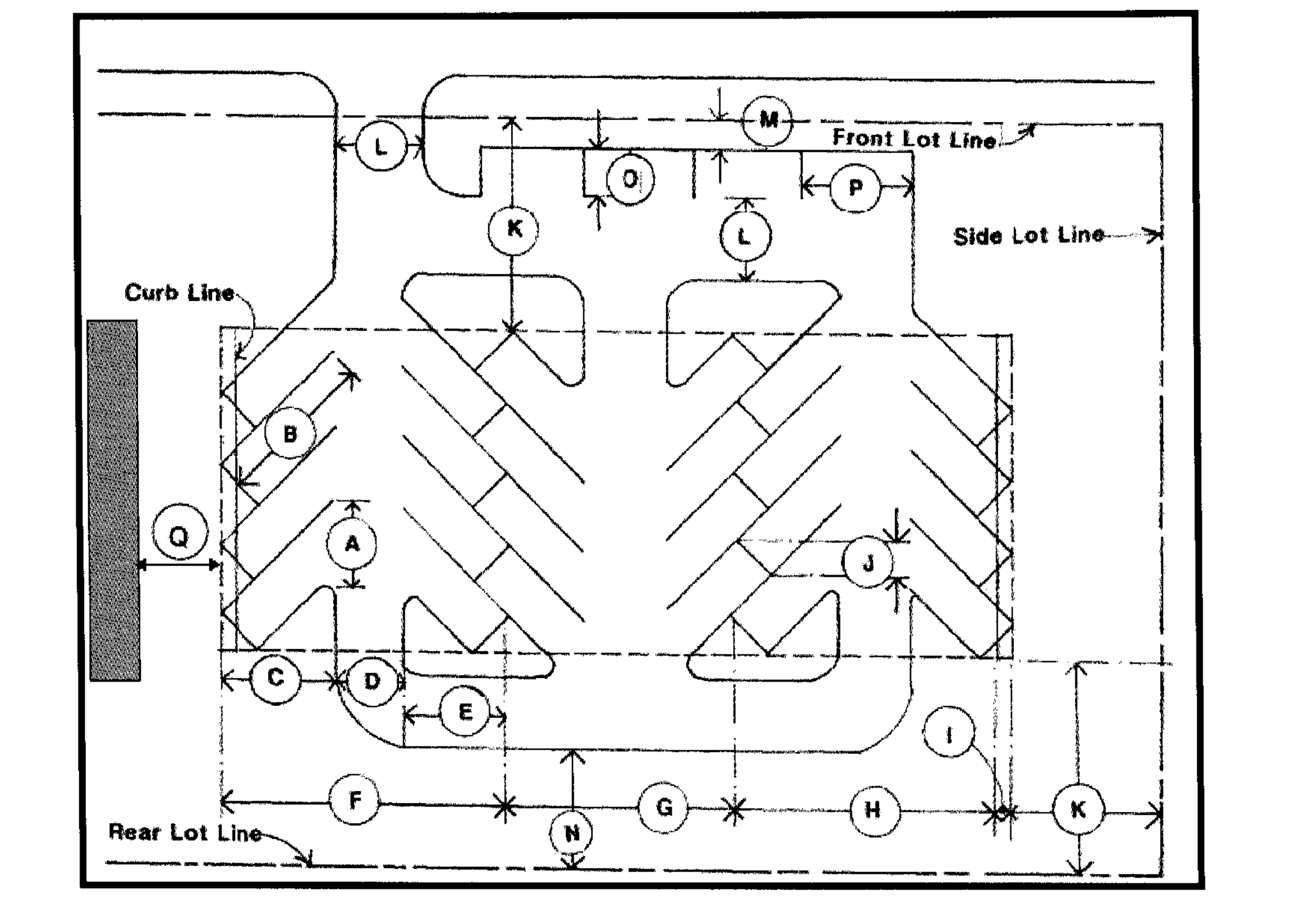
PARKING LOT STANDARDS
*Required handicap stalls and ramps shall be per state code.
**Joint or combined parking facilities on separate lots as authorized and when constructed adjacent to a common lot line separating two or more parking areas are not required to observe the parking area setback from such common lot line.
***Except lots with frontage on cul-de-sac turnarounds.
(6)
Parking garages/parking within structures. The off-street parking requirement may be furnished by providing fee-free space so designed within the principal building or structures attached thereto; however, unless provisions are made, no building permit shall be issued to convert said parking structure into a dwelling unit or living area or other activity until other adequate provisions are made to comply with the required off-street parking provisions of this chapter. In no case shall on-street parking be utilized to satisfy the required off-street parking supply.
(7)
Street encroachments. Except in the case of single-family, two-family and townhouse and manor home dwellings, parking areas shall be designed so that circulation between parking bays or aisles occurs within the designated parking lot upon the property being serviced and does not depend upon a public street or alley. Except in the case of single, two-family, townhouse, and manor home dwellings, parking area design which requires backing into the public street is prohibited. Parking spaces in a public right-of-way shall not be utilized in meeting required off-street parking standards, except as may be provided in this chapter.
(8)
Curb cut proximity to intersection. No curb cut access shall be located less than the following distances from street intersections. This distance shall be measured from the intersection of lot lines.
a.
Twenty feet from the intersection of two or more local streets in residential areas;
b.
Thirty feet from an intersection with one or more collector streets in residential areas;
c.
Forty feet from an intersection with one or more arterial streets in residential areas;
d.
Thirty feet from an intersection with one or more local or collector streets in commercial and industrial areas; or
e.
Forty feet from an intersection with one or more arterial streets and in commercial industrial areas.
(9)
Curb cut maximum. No curb cut access shall exceed 24 feet in width for a driveway except upon approval by the zoning administrator. In no case shall a curb cut access exceed 32 feet, except onto a state or county roadway with approval of a permit of the respective jurisdiction.
(10)
Curb cut spacing minimum. Curb cut openings shall be located at a minimum of five feet from the side yard lot line in residential districts and a minimum of ten feet from the side lot line in all other districts.
(11)
Curb cut separation. Driveway access curb openings on a public street except for single-family, two-family, townhouse, and manor home dwellings shall not be located less than 40 feet from one another except on approval by the zoning administrator.
(12)
Parking area grades. The grade elevation of the required parking area or portion thereof shall not exceed five percent.
(13)
Driveway access minimum. Each property other than single-family uses shall be allowed one driveway access for each 125 feet of street frontage. All property shall be entitled to at least one driveway access. Single-family uses shall be limited to one driveway access per lot, except when the property exceeds the required street frontage per zoning district requirements, a second driveway access may be allowed by approval of the zoning administrator. Except as otherwise approved by the zoning administrator, single-family uses shall not access arterial and collector streets. In such cases, if a lot does not have frontage upon a local street and where driveway access to arterial and collector streets is determined necessary by the zoning administrator, joint access through the use of shared curb cuts and access easements shall be utilized to the extent possible.
(14)
Street access. Except as allowed by a conditional use permit or property subdivision, each lot shall have frontage and access directly onto an abutting, improved and city- accepted public street.
(15)
Lighting. Any lighting used to illuminate an off-street parking area shall be so arranged as to reflect glare away from adjoining property, adjacent residential uses and public rights-of-way and be in compliance with section 117-1036.
(16)
Signs. No sign shall be so located as to restrict the sight lines and orderly operation and traffic movement within any parking lot. All signs shall be in conformance with article XII of this chapter.
(17)
Cart storage. Retail commercial uses exceeding 55,000 square feet in gross floor area, including multiple-tenant buildings, may be required to provide ample space for the storage of customer service carts within off-street parking areas. The need and specific amount of required cart storage space shall be determined as part of site plan review. When required, cart storage areas shall not occupy required off-street parking space, shall be clearly delineated, and include facilities for cart confinement.
(Zoning Ord., § 20.07; Ord. No. 03-2007, § 1, 8-20-2007; Ord. No. 05-2007, § 1, 10-1-2007)
Sec. 117-1165. - Location.
(a)
Required accessory off-street parking shall be on the same lot under the same ownership as the principal use being served, except as provided for under the provisions of sections 117-1161 and 117-1170.
(b)
Except for single-family, two-family, townhouse, and manor home dwellings, head-in parking, directly off of and adjacent to a public street, with each stall having its own direct access to the public street, shall be prohibited.
(c)
Except for single-family, two-family, townhouse, and manor home dwellings, there shall be no off-street parking within 15 feet of any street surface.
(d)
The boulevard portion of the street right-of-way shall not be used for parking or parking lot circulation.
(e)
In the case of single-family, two-family, townhouse, and manor home dwellings, parking shall be prohibited:
(1)
Within three feet of any side or rear lot line.
(2)
Within any established drainage or utility easement.
(3)
In any portion of the front yard except designated driveways leading directly into a garage or one open, surfaced space located on the side of a driveway, away from the principal use. Said extra space shall be surfaced with concrete or bituminous material.
(f)
In the case of single-family, two-family, townhouse and manor home buildings, driveways providing access to garages may qualify as required off-street parking spaces if all of the following conditions are met:
(1)
The driveway shall serve a dwelling unit which has use of a two-stall garage.
(2)
The driveway shall be under the direct control of the dwelling unit served by the garage.
(3)
The driveway shall measure at least 22 feet in length between the front of the garage and the street or roadway; and
(4)
Parking on the driveway shall not impede pedestrian or traffic circulation or access to any other dwelling unit, nor shall it adversely effect the ability to provide public utilities or public safety.
(5)
The parking space is located beyond the minimum front yard setback requirement.
(Zoning Ord., § 20.08; Ord. No. 03-2007, § 1, 8-20-2007)
Sec. 117-1166. - Pedestrian circulation.
All off-street parking areas shall be designed with due regard to pedestrian circulation. Off-street parking areas shall be designed such that vehicle and pedestrian circulation is accommodated in a safe, complementary and orderly fashion. When curb-separated sidewalks are provided at the head of parking stalls, the minimum width shall be seven feet to provide space for vehicle overhang.
(Zoning Ord., § 20.09; Ord. No. 03-2007, § 1, 8-20-2007)
Sec. 117-1167. - Maintenance; snow removal.
It shall be the joint and several responsibility of the owner of the principal use (or lessee) to use and to maintain in a neat and adequate manner the parking space, accessway, striping, landscaping, and required fences and to undertake snow removal.
(Zoning Ord., § 20.10; Ord. No. 03-2007, § 1, 8-20-2007)
Sec. 117-1168. - Number of off-street parking spaces required.
The following minimum number of off-street parking spaces shall be provided and maintained by ownership, easement, and/or lease for and during the life of the respective uses hereinafter set forth.
(Zoning Ord., § 20.11; Ord. No. 03-2007, § 1, 8-20-2007)
Sec. 117-1169. - Parking deferment.
The city may allow a reduction in the number of required parking stalls for commercial, industrial, and institutional uses by administrative permit, provided:
(1)
The proposed use will have a peak parking demand less than the required parking under section 117-1168. Factors to be considered when reviewing the proposed parking demand shall include, but not be limited to:
a.
Size of building.
b.
Type and use.
c.
Number of employees.
d.
Projected volume and turnover of customer traffic.
e.
Projected frequency and volume of delivery or service vehicles.
f.
Number of company owned vehicles.
g.
Storage of vehicles on site.
(2)
In no case shall the amount of parking provided be less than one-half of the amount of parking required by ordinance.
(3)
The site has sufficient property under the same ownership to accommodate the expansion of the parking facilities to meet the minimum requirements of this chapter if the parking demand exceeds on-site supply.
(4)
On-site parking shall only occur in areas designed and constructed for parking in accordance with this article.
(5)
The applicant and city enter into a development agreement, to be recorded against the subject property, which includes a clause requiring the owner to install the additional parking stalls, upon a finding of the zoning administrator that such additional parking stalls are necessary to accommodate the use.
(6)
A change of use will necessitate compliance with the applicable zoning chapter standard for parking.
(Zoning Ord., § 20.12; Ord. No. 03-2007, § 1, 8-20-2007)
Sec. 117-1170. - Off-site joint use of parking.
The city council may, after receiving a report and recommendation from the planning commission, approve an interim use permit for one or more businesses to provide the required off-street parking facilities by joint use of one or more sites where the total number of spaces provided are less than the sum of the total required for each business should they provide them separately. Such a permit shall not be granted except when the following conditions are found to exist:
(1)
Entertainment uses. Up to 50 percent of the parking facilities required for a theater, bowling alley, or other commercial recreational facilities may be supplied by the off-street parking facilities provided by type of uses specified as primarily daytime uses in subsection (4) of this section.
(2)
Nighttime or Sunday uses. Up to 50 percent of the off-street parking facilities required for any use specified under subsection (4) of this section, as primarily daytime uses may be supplied by the parking facilities provided by the following uses which typically have their major parking demand occurring during nighttime or weekends; auditoriums incidental to a public or parochial school, churches, bowling alleys, theaters, or apartments.
(3)
School auditorium and church uses. Up to 80 percent of the parking facilities required by this article for a church, or an auditorium incidental to a public or parochial school may be supplied by the off-street parking facilities provided by uses specified under subsection (4) of this section as primarily daytime use.
(4)
Daytime uses. For the purpose of this article, the following uses are considered as primary daytime uses: banks, business offices, retail stores, personal service shops, household equipment or furniture shops, clothing or shoe repair, service shops, manufacturing, wholesale and similar uses.
(5)
Additional criteria for joint parking. In addition to the preceding requirements, the following conditions are required for joint parking usage:
a.
Proximity. The building or use for which application is being made to utilize the off-street parking facilities provided by another building or use shall be located within 300 feet of such parking facilities, excluding public rights-of-way.
b.
Conflict in hours. The applicant shall demonstrate in documented fashion that there is no substantial conflict in the principal operating hours of the two buildings or uses for which joint use of off-street parking facilities is proposed.
c.
Written consent and agreement. A legally binding instrument, executed by the parties concerned, for joint use of off-street parking facilities, duly approved as to title of grantors or lessors, and in a form and manner of execution approved by the city attorney, shall be filed with the city clerk-treasurer and recorded with the county recorder or registrar of titles, and a certified copy of the recorded document shall be filed with the city within 60 days after approval of the joint parking use by the city, or the interim use permit shall be considered null and void.
(Zoning Ord., § 20.13; Ord. No. 03-2007, § 1, 8-20-2007)
Sec. 117-1171. - Off-street loading space, design and maintenance.
(a)
Design.
(1)
Dimensional requirements.
a.
Nonresidential uses. Except in the C-3 district, required off-street truck loading or unloading spaces for nonresidential uses shall be at least 12 feet in width, 14 feet in height, and 60 feet in length, in accordance with the requirements of subsection (b) of this section. Where a loading space parallel to a building is to be utilized, such area shall not be less than 12 feet in width nor less than 65 feet in length. In no instance shall any designated side loading space encroach upon a fire lane or driving aisle or parking spaces.
b.
Reductions. Reductions to loading space size may be granted by the zoning administrator upon demonstration of facility need.
(2)
Allowed on private property only. All off-street loading and all maneuvering for off-street loading shall be accomplished on private property. At no time shall a public right-of-way or easement be used for off-street loading or maneuvering.
(3)
Maneuvering area required. In addition to the required loading space, all loading spaces shall include a maneuvering area. The maneuvering area shall not use any of that portion of the site containing parking stalls or customer service areas. Maneuvering areas shall be of such size as to permit the backing of truck tractors and coupled trailers into the loading space without blocking the use of other loading spaces, drives, parking spaces, or maneuvering areas on public right-of-way.
(4)
Construction and setback standards. The construction and setback standards listed in subsections 117-1164(a) and (c) shall apply to all loading spaces.
(5)
Customer drop-off spaces. Customer drop-off spaces shall not constitute off-street loading spaces as may be required subsection 1164(e)(5).
(b)
Number of loading spaces required. The number of required off-street loading spaces shall be as follows:
*Reductions to loading space quantity requirements may be granted by the zoning administrator upon determination of facility need.
(c)
Landscaping and screening of loading spaces. Loading spaces shall be screened from all property lines. Said screening shall be accomplished by a solid wall or fence and shall be so designed as to be architecturally harmonious with the principal structure and in conformance with article VIII of this chapter. Screening plantings may be substituted, provided such plantings are in conformance with article VIII of this chapter.
(d)
Location requirements.
(1)
Off-street. All required loading spaces for a nonresidential use shall be off-street and located on the same lot as the building or use to be served.
(2)
Distance from intersection. All loading space curb cuts shall be located at minimum 50 feet from the intersection of two or more street rights-of-way. This distance shall be measured from the property line.
(3)
Distance from residential use. Loading areas established January 1, 2000, shall be prohibited within 300 feet of residentially zoned or guided property excluding public rights-of-way, unless completely screened by an intervening building. Loading areas not requiring screening by an intervening building shall be screened from adjacent residentially zoned or guided property by the use of berms, fences, or walls to provide 100 percent opacity to a height of at least ten feet.
(4)
Pedestrians. Loading spaces shall not conflict with pedestrian movement.
(5)
Visibility. Loading spaces shall not obstruct the view of the public right-of-way from off-street parking access.
(6)
General compliance. Loading spaces shall comply with all other requirements of this article.
(7)
Traffic interference. Each loading space shall be located with appropriate means of vehicular access to a street or public alley in a manner which will cause the least interference with traffic.
(8)
Accessory use; parking and storage. Required loading spaces shall not be used for the storage of goods, inoperable vehicles or snow and shall not be included as part of the space requirements to meet off-street parking requirements.
(Zoning Ord., § 20.14; Ord. No. 03-2007, § 1, 8-20-2007)
Sec. 117-1172. - Off-street bicycle and motorcycle parking.
Provisions shall be made for the off-street parking of bicycles and motorcycles in all multiple-family and nonresidential developments and uses. Plans for such facilities shall be reviewed and evaluated on an individual project or use basis as part of site plan review provisions of division 5 of article II of this chapter.
(Zoning Ord., § 20.15; Ord. No. 03-2007, § 1, 8-20-2007)

