
Clifton Forge City Zoning Code
ARTICLE 2
- GENERAL PROVISIONS
Sec. 2-1.- Purpose.
The purpose of this article is to establish general rules of applicability, interpretation, and construction critical to the equitable and consistent administration and enforcement of the provisions of this appendix and to provide the general rules for the regulation of each zoning district.
Sec. 2-2. - Compliance.
(a)
Compliance with provisions.
(1)
Except as otherwise expressly provided in this appendix, no building, structure, or land, or part thereof, shall hereafter be used or occupied, or constructed, altered, moved, expanded, or converted to another use or structurally altered except in conformity with the regulations specified within this appendix.
(2)
Lots created after the effective date of this appendix shall not be platted and recorded unless the minimum requirements established by the provisions of this appendix are met.
(b)
Change affecting compliance with minimum requirement.
(1)
No lot area, open space, parking space, or other feature required by this appendix shall be reduced in dimension or area or eliminated, except in conformance with the provisions of this appendix.
(2)
The reduction of yards below the minimum established by the provisions of this appendix shall not be permitted.
(c)
Permits and certificates. No construction may commence, no use may be established or changed, and no structure shall be constructed, erected, altered, moved, or demolished unless and until all permits required by article 9 of this appendix have been issued.
Sec. 2-3. - Coordination with other regulations.
The use of land and buildings within the town is subject to all other regulations as well as this appendix, whether or not such other provisions are specifically referenced in this appendix. References to other regulations or provisions of this appendix or other chapters of this Code are for the convenience of the reader. Lack of a cross reference shall not be construed as an indication that other regulations do not apply.
Sec. 2-4. - Fees.
Pursuant to Code of Virginia, § 15.2-2286.A.6, as amended, the town council may establish an annual fee schedule to provide for the collection of fees to cover the cost of making inspections, issuing permits, advertising of notices, and other expenses incident to the administration of a zoning ordinance or to the filing or processing of any appeal or amendment. All applications for rezonings, conditional use permits, variances, reviews, approvals or other actions for which fees are specified by such annual fee schedule shall be accompanied by the required application fee. Such schedule of fees shall be made available in the office of the zoning administrator.
Sec. 2-5. - Rules of applicability and interpretation.
(a)
Uniform applicability of regulations. All regulations established by this appendix shall be uniform for each class or kind of buildings and uses throughout each district, but the regulations in one district may differ from those in other districts.
(b)
Minimum requirements. Unless specifically indicated herein to the contrary, the provisions of this appendix shall be considered to be the minimum requirements to protect public health, safety, comfort, prosperity, and general welfare, and to provide a remedy for existing conditions which are detrimental thereto.
(c)
Requirements pertain to each building, structure, or use. No part of any lot, yard, open space, parking space, or other feature required by this appendix for a building, structure, or use shall constitute a lot, yard, open space, parking space, or other feature for any other building, structure, or use, except as may be specifically provided in this appendix.
(d)
Conflicting ordinances. Whenever any regulation in this appendix imposes higher or more restrictive standards than are required in any other statute, ordinance, or regulation, the provisions of the regulations of this appendix shall govern. Whenever the provision of any other statute, ordinance, or regulation imposes higher or more restrictive standards than are required by this appendix, the provisions of such other statute, ordinance, or regulation shall govern.
(e)
Rules of construction. For the purposes of the provisions of this appendix, the following rules of construction shall apply:
(1)
Headlines. The headlines of the articles, divisions, and sections of this appendix are intended as catchwords to indicate the contents thereof and shall not be deemed or taken to be titles of such sections, or any part thereof.
(2)
Interpretations guided by purpose statements. The regulations of this appendix shall be construed to achieve the purposes for which they are adopted. Interpretations shall be guided by the purpose statements in this appendix.
(f)
Terms not defined in ordinance.
(1)
Where terms are not defined in this appendix, they shall have their ordinarily accepted meanings, within such context as they are used.
(2)
The zoning administrator may determine the meaning of a disputed word, phrase, or sentence of the appendix, guided by the purposes and intent of the ordinance. Such determination of the zoning administrator shall be recorded in writing.
(g)
Measurement of distance.
(1)
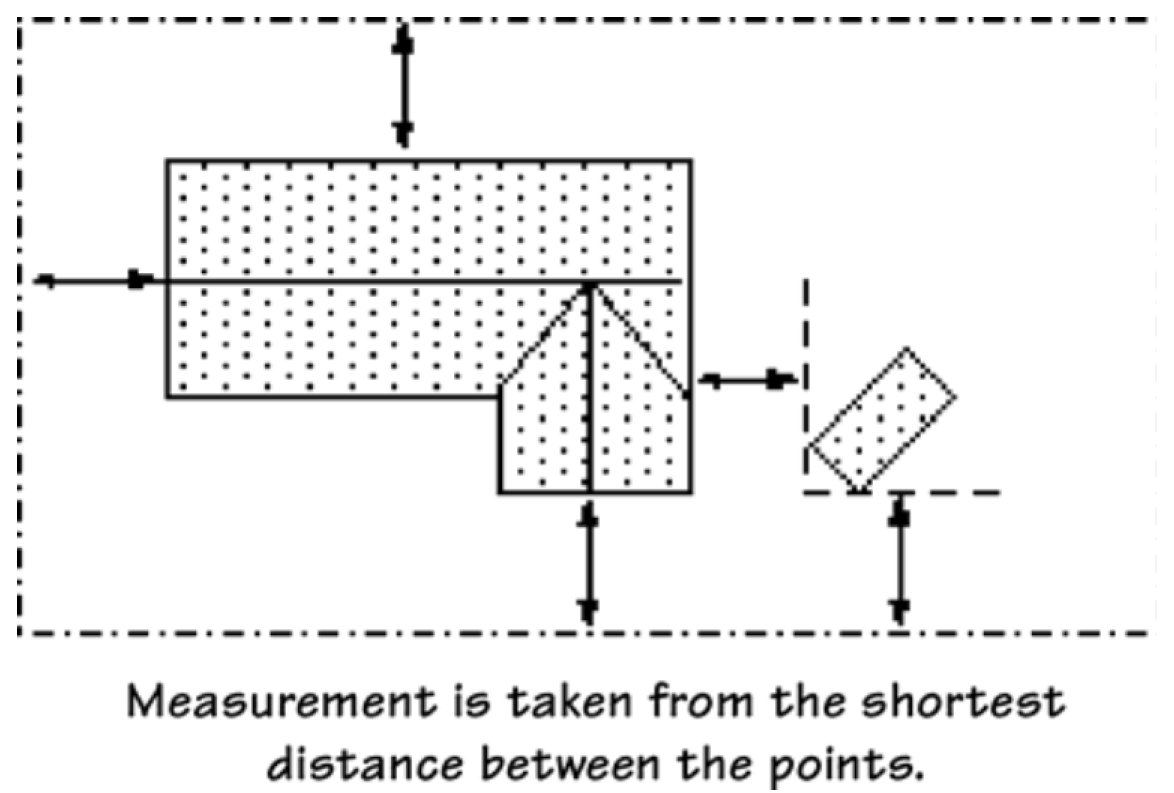
All distances specified in this appendix shall be measured in a horizontal plane (see Figure 2-5-1). When measuring a required distance, such as the minimum distance between a structure and a lot line, the measurement is made at the shortest distance between the two objects (see Figure 2-5-2).
Figure 2-5-1. Distances Measured Horizontally
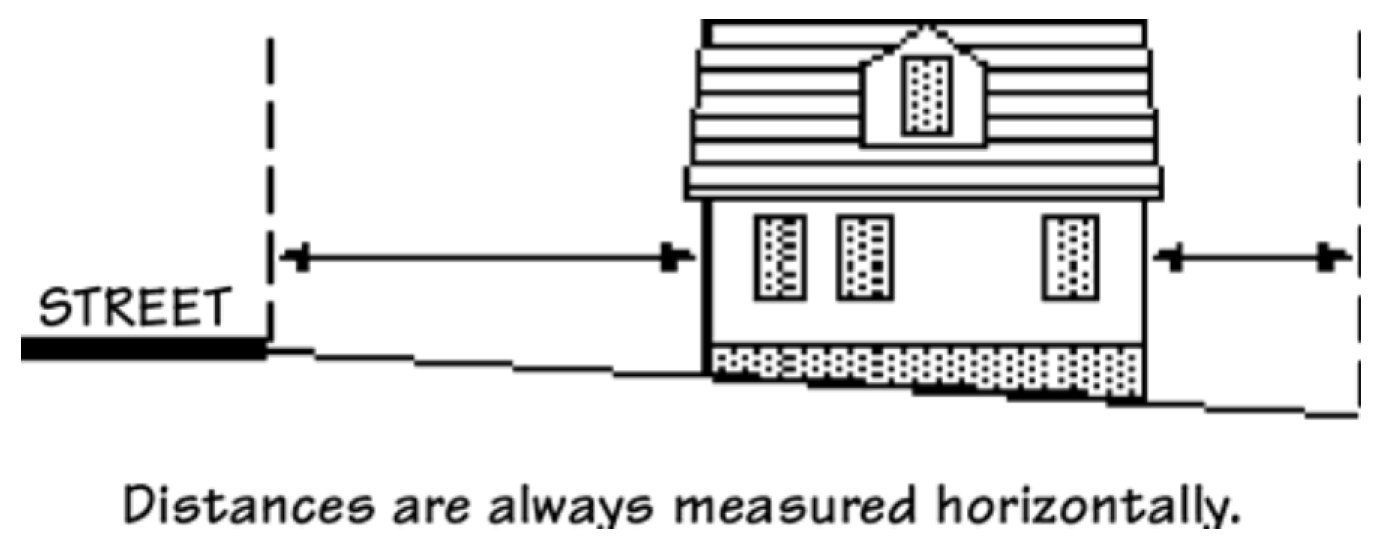
Figure 2-5-2. Measurement Made at Shortest Distance Between Points
(2)
All distances specified in this appendix for the purpose of separating uses shall be measured in a horizontal plane from the closest property line of one use to the closest property line of the other use.
(3)
All distances specified in this appendix for the purpose of separating structures shall be measured in a horizontal plane from the closest point of one structure to the closest point of the other structure.
(4)
All distances specified in this appendix for the purpose of separating a use from a residentially zoned district shall be measured in a horizontal plane from the property line of the use to the nearest point of the boundary line of the residentially zoned district.
Sec. 2-6. - Development standards and supplemental regulations.
In addition to the regulations for specific zoning districts set forth in article 4 of this appendix, development standards applicable to all zoning districts, unless otherwise provided, are set forth in article 7 [of this appendix], and supplemental regulations applicable to particular uses or building types, within one or more districts, are set forth in article 6 [of this appendix].
Sec. 2-7. - Use regulations.
(a)
Applicability. Pursuant to Code of Virginia, § 15.2-2280, as amended, article 4 of this appendix regulates the use of all land and structures for commercial, industrial, residential, and other categories of land uses.
(b)
Permitted uses. The uses permitted as of right or by conditional use permit for each base zoning district are set forth in table format in article 4 [of this appendix] and are referred to in this appendix as use tables. Uses permitted as of right or by conditional use permit shall be subject to all provisions of this appendix.
(c)
Interpretation of use tables.
(1)
The purpose of the use types as delineated in the use tables in article 4 [of this appendix], and as defined in article 11 [of this appendix], is to establish a use classification system and a consistent set of terms defining uses permitted within the various zoning districts. The examples listed in the definitions of use types are intended to be illustrative, as opposed to exclusive, unless a use or activity is specifically excluded within the use type definition.
(2)
Uses and activities not provided for or addressed by the terms of this appendix shall be deemed prohibited uses and activities unless the zoning administrator determines that the use is substantially the same as a permitted use type pursuant to subsection (c)(5) of this section.
(3)
If a use is specifically identified in the use tables, while a more general use category is also listed, the regulations and applicability of the specifically identified use shall govern.
(4)
In the case of mixed uses, the regulation for each use, as provided in article 4 [of this appendix], shall apply to that portion of the building or land so used unless otherwise provided.
(5)
For a use not identified in the use tables, the zoning administrator may determine that such proposed use is substantially the same as a use type otherwise permitted in the use tables.
(A)
Such determination of the zoning administrator shall be recorded in writing and shall include an explanation of the reasons for the determination.
(B)
In making such determination, the zoning administrator shall consider the definitions of the use types, along with examples of uses provided in the respective definitions, and shall make such finding that the proposed use is substantially the same as a permitted use type. Such consideration shall include functional, product, and physical characteristics of the proposed use that are in common with a permitted use type, pursuant to the definition, including the type and amount of activity, type of customers or residents, how goods or services are sold or delivered, and certain site factors.
Sec. 2-8. - Dimensional regulations.
(a)
Applicability.
(1)
Each section of article 4 [of this appendix] establishes minimum and maximum standards for the size, height, areas, and bulk of structures, the areas and dimensions of land and air space to be occupied by structures and uses, and yards and other open spaces to be left unoccupied by uses and structures, pursuant to Code of Virginia, § 15.2-2280, as amended.
(2)
Supplemental regulations (article 6 [of this appendix]) that contain certain dimensional requirements shall supersede the dimensional requirement of the applicable zoning district as set forth in article 4 [of this appendix] or this section.
(3)
In addition to the dimensional regulations set forth in article 4 [of this appendix] for each zoning district, dimensional regulations shall be further defined as set forth in subsections (b) through (k) of this section.
(b)
Density calculation.
(1)
In calculating the maximum allowable density for any lot, any fractional dwelling count shall be equal to zero dwelling units.
(2)
Any lands normally submerged under water shall not be included in calculating the allowable number of dwelling units for any lot.
(3)
For single-family detached dwellings, the total number of dwelling units shall be governed by the minimum lot area.
(c)
Lot area. Any lot, legally in existence at the time this appendix was adopted, which does not meet the minimum lot area, minimum lot frontage, or minimum lot width requirements of the district in which it is located, as set forth in article 4 of this appendix, may be developed, subject to the use and other dimensional requirements of the applicable district.
(d)
Lot frontage.
(1)
Every building erected or moved shall be located on a lot that has frontage on an improved street.
(2)
Lot frontage requirements for townhouses shall be governed by section 6-15 of this appendix.
(3)
In addition to the lot frontage and lot width required by the applicable zoning district, all structures shall be located on lots so as to comply with any adopted ordinances of the town relating to public service and fire protection.
(e)
Yards; generally.
(1)
Applicability. Whenever more than one principal building is located on a lot, the yards required by the applicable zoning district shall be established and maintained on the lot around the group of buildings. Buildings shall be separated by any distance prescribed by the fire prevention and protection regulations of chapter 50 of this Code.
(2)
Permitted encroachments. Yards shall be unoccupied and unobstructed as defined in article 11 [of this appendix], except that encroachments 30 inches or greater in height into yards shall be permitted as set forth in Table 2-8-1, provided the structure with which the encroachment is associated is conforming, or if the structure is nonconforming, provided the encroachment does not increase any nonconforming characteristic of the structure.
(f)
Front yards.
(1)
The depth of a front yard shall be measured at a right angle to the applicable street line. In the case of a curved street line, the depth shall be measured on the radial line.
(2)
The required depth of the minimum front yard shall be established by the minimum building setback line of the applicable zoning district regulations as set forth in article 4 [of this appendix].
(g)
Side yards and side street yards. The required width of a side yard or side street yard shall be measured at a right angle to the adjacent side lot line or adjacent street line, respectively. In the case of a side street yard on a street with a curved street line, the depth shall be measured on the radial line.
(h)
Rear yards. The depth of a rear yard shall be measured at a right angle to the rear lot line.
(i)
Yards; corner lots.
(1)
On a corner lot having two street frontages, one front yard shall be provided along the shorter of the two lot lines abutting a street and shall be subject to the minimum front yard depth of the applicable zoning district, as determined by the minimum building setback line. A side street yard shall be provided along the longer of the two lot lines abutting a street, subject to the minimum side street yard depth of the applicable zoning district. The yards remaining after the provision of the front yard and side street yard shall be deemed a side yard and rear yard as defined in this appendix.
(2)
On a corner lot having more than two street frontages, one front yard shall be provided along the shortest of the lot lines abutting a street and shall be subject to the minimum front yard depth of the applicable zoning district, as determined by the minimum building setback line. Side street yards shall be provided along the other lot lines abutting a street, subject to the minimum side street yard depth of the applicable zoning district. The yard or yards remaining after the provision of the front yard and side street yards shall be deemed side or rear yards as defined in this appendix.
(j)
Yards; through lots.
(1)
Through lots shall provide one front yard along the frontage to which the principal structure is oriented, subject to the minimum front yard depth of the applicable zoning district, as determined by the minimum building setback line.
(2)
Yards remaining after the front yard has been provided shall be deemed side yards and a rear yard as defined in this appendix.
(k)
Height.
(1)
Applicability. The maximum height regulations set forth in article 4 [of this appendix] for each zoning district shall apply to principal and accessory buildings. This appendix contains other applicable height standards for signs (article 7 [of this appendix]) and fences, walls, and certain other structures (supplemental regulations of article 6 [of this appendix]).
(2)
Exemptions from maximum height regulations.
(A)
In all zoning districts, the maximum height regulations set forth in article 4 [of this appendix] shall not apply to any of the following parts or appurtenances of a building not intended for human occupancy:
(i)
Church spires, belfries, cupolas, chimneys, flues, smokestacks, cooling towers, flagpoles, attached whip antennas less than eight feet in length and similar structures;
(ii)
Water towers, active solar collectors, and radio and television antennas and their supporting structures;
(iii)
Elevator penthouses, towers, and mechanical or electrical equipment except satellite dishes, located on a roof, provided that such features shall be erected only to the height necessary to accomplish the purpose they are intended to serve and the total area covered by such features shall not exceed 20 percent of the horizontal area of the roof on which they are located; and
(iv)
Parapet walls or cornices, without windows, which do not exceed the maximum height requirement of the applicable district by more than six feet.
(B)
In all zoning districts, the maximum height regulations set forth in each base zoning district shall not apply to any amateur radio tower or antenna or satellite dish, such structures being subject to the height limitation provisions of sections 6-3(d) and 6-13 of this appendix respectively.
Sec. 2-9. - Sight distance triangles.
A sight distance triangle shall be required at the intersecting rights-of-way of any two public streets and at the intersection of any driveway with a public street right-of-way, as described and set forth in subsection (a) of this section. Such sight distance triangles shall be maintained to be clear of obstructions to driver visibility as set forth in subsection (b) of this section.
(a)
A sight distance triangle shall be a triangular area as set forth in subsections (b)(1) and (2) of this section:
(1)
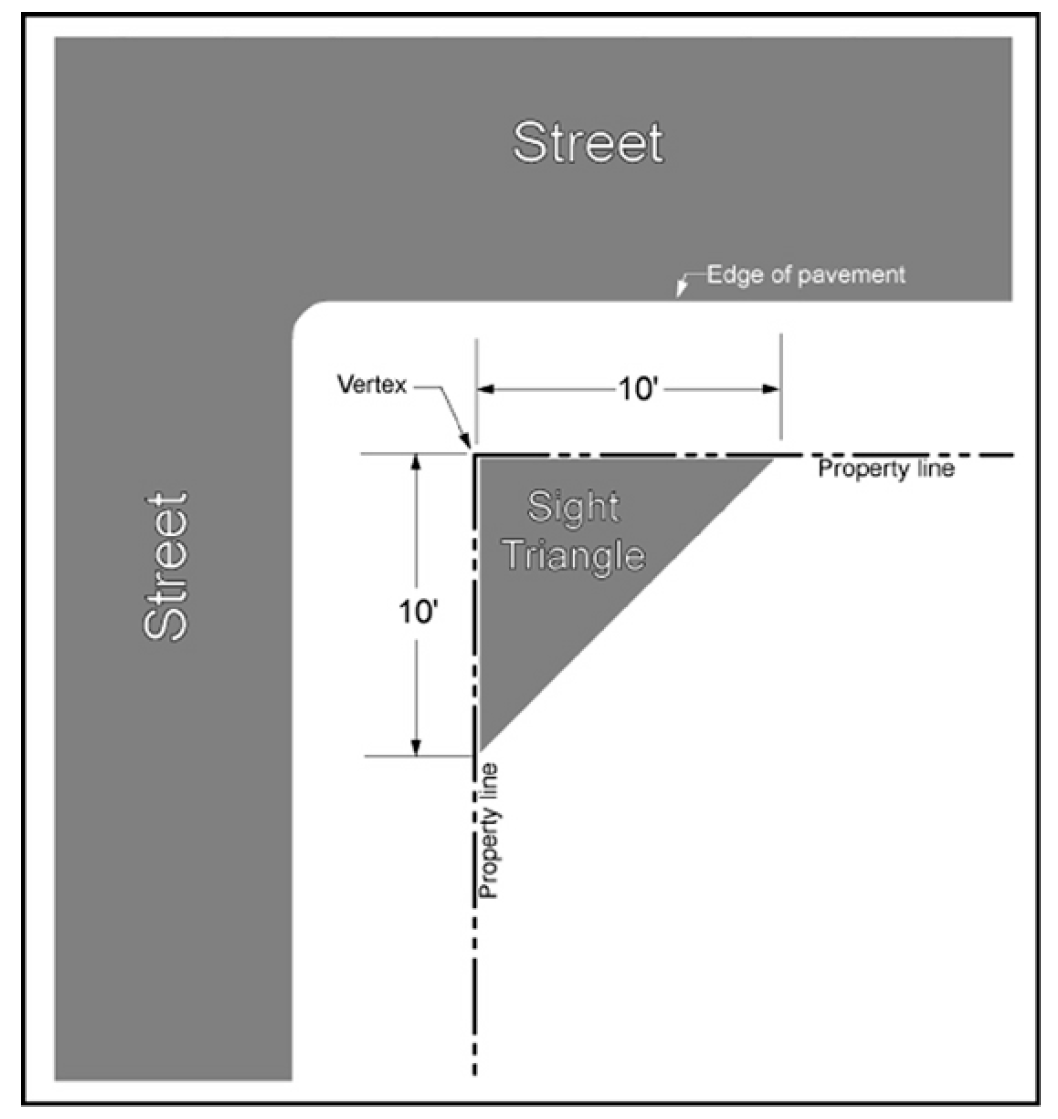
That portion of a corner lot, in any zoning district, lying within a triangle area formed by measuring from the vertex of that portion of the property line adjacent to the intersecting streets, to a point on each property line running from the vertex equal to ten feet, and then connecting the two points thus established with a third line (see Figure 2-9-1);
Figure 2-9-1. Sight Distance Triangle—Corner
(2)
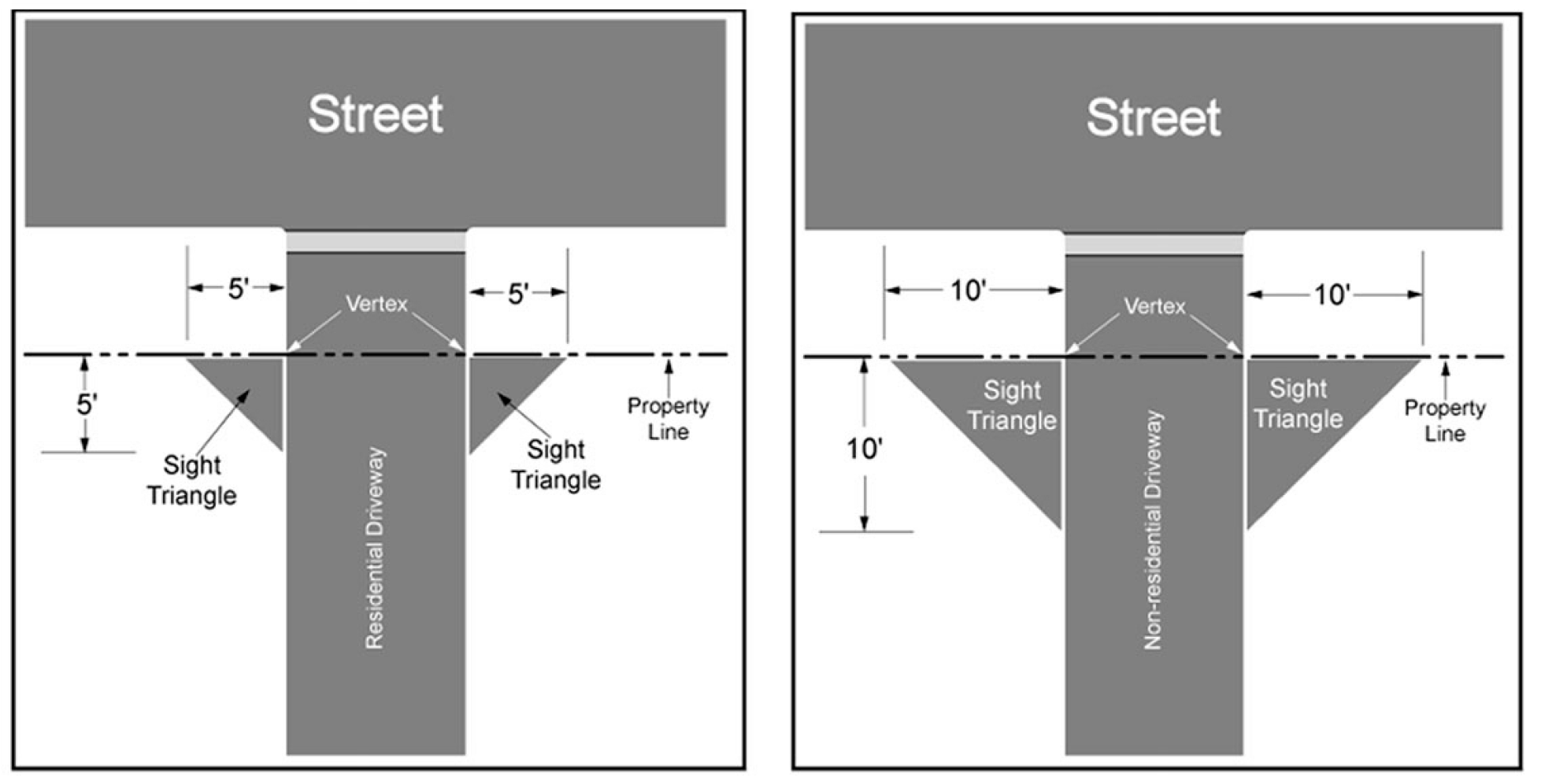
A triangular area formed by a diagonal line connecting two points located on a right-of-way line and the edge of a driveway, with such points to be equal to five feet from the intersecting lines for residential driveways, and ten feet from the intersecting lines for non-residential driveways (see Figure 2-9-2).
Figure 2-9-2. Sight Distance Triangle—Street
(b)
In order not to obstruct cross-visibility, the following standards shall apply within any required sight distance triangle:
(1)
No fence, wall, or hedge that exceeds a height of 30 inches from graded ground level shall be permitted;
(2)
No shrub or ground cover shall exceed 30 inches in height above the graded ground level;
(3)
No tree shall form a material impediment to visibility between a height of 30 inches and ten feet from graded ground level;
(4)
No freestanding sign, nor any part of such sign other than a supporting pole or brace no greater than 18 inches in width or diameter, shall be located lower than nine feet from grade;
(5)
No structure, except for a freestanding sign as described in subsection (b)(4) of this section, exceeding a height of 30 inches from graded ground level shall be permitted; and
(6)
No vehicle impeding visibility shall be parked.

