Clifton Forge City Zoning Code
ARTICLE 9
- PROCEDURES
Sec. 9-1.- Purpose.
In order to meet development needs while protecting the public welfare and safety, the purpose of this article is to set forth the procedures for obtaining permits pursuant to this appendix.
Sec. 9-10. - General procedural requirements.
(a)
Application process, generally. The specific procedures required for reviewing various applications differ. Generally, the procedures for all applications have three common elements: submittal of a complete application, including applicable information and payment of the required fee; review of the submittal by designated officials, commissions, and boards; and action to approve, approve with conditions, or deny the application. Submittal dates or filing deadlines are established by the requirements of the specific application.
(b)
Application materials. Current application materials shall be the responsibility of, and made available in, the department of community development. Applications shall be accompanied by payment of all required fees and charges. Applications that require a public hearing or public meeting pursuant to this appendix or the Code of Virginia, as amended, shall be filed by a deadline as established by the applicable commission or board.
(c)
Completeness review. The zoning administrator shall review for completeness any application filed pursuant to this appendix. Nonpayment of required fees shall deem an application to be incomplete.
(d)
Fees. Fees shall be collected to cover the cost of making inspections, issuing permits, advertising of notices and other expenses incident to the administration of a zoning ordinance or to the filing or processing of any appeal or amendment thereto, pursuant to Code of Virginia, § 15.2-2286.A.6, as amended. All such fees and charges shall be set forth in an annual fee schedule established by the town council, and such schedule of fees shall be made available in the office of the zoning administrator. All applications for rezonings, conditional use permits, variances, reviews, approvals or other actions for which fees are specified by such annual fee schedule shall be accompanied by the required application fee.
(e)
Decision-making bodies. The bodies, officials, agents, and employees of the town, as set forth in Column (C) of Table 9-10-1, shall be designated as the body or official with authority to render a determination as to the approval, approval with conditions, or denial of the applications for development approval set forth in Column (A). The bodies, officials, agents, and employees of the town, as set forth in Column (B) of Table 9-10-1, are designated as the body or official with authority to submit a recommendation relating to the application for development approval to the body with final decision-making authority (the "Decision-Maker").
(f)
Notice provisions.
(1)
Notice requirements generally per state code. Notice requirements shall be as prescribed in the Code of Virginia, as amended, and as may be further prescribed in the individual subsections of this article.
(2)
Action consistent with notice given. The reviewing body may take any action on the application that is consistent with the notice given, including approval of the application, approval of the application as amended, or denial of the application. The reviewing body may allow amendments to the application if the effect of the amendments is to allow a lesser change than that requested on the original application or to reduce the impact of the development or to reduce the amount of land involved from that indicated in the notices of the hearing. The reviewing body shall not, in any case, permit a greater intensity of development, or a use falling in a different general use category, or a larger land area than indicated in the original application, or a greater variance than was indicated in the notice.
(g)
Public hearings.
(1)
Purpose. The purpose of a public hearing is to allow the applicant and all other interested parties a meaningful and fair opportunity to be heard, to present evidence relevant to the application, and to rebut evidence presented by others.
(2)
Conduct and rules of procedure. All hearings under this article shall be open to the public and shall be conducted in an impartial manner. The conduct of a public hearing before the planning commission, the board of zoning appeals, or the town council shall be as set forth in the Code of Virginia, as amended, and other applicable sections of this article. Where appropriate, additional rules governing the public hearing may apply, including the provisions of other chapters of this Code applicable to the body conducting the hearing and any of the body's adopted rules or procedures. The body conducting the hearing may adopt rules of procedure to limit the time for each presentation or each speaker.
(3)
Recording of minutes. The body conducting the hearing shall record the minutes of the proceedings by any appropriate means as prescribed by rule and consistent with Virginia law.
Sec. 9-11. - Post-decision proceedings.
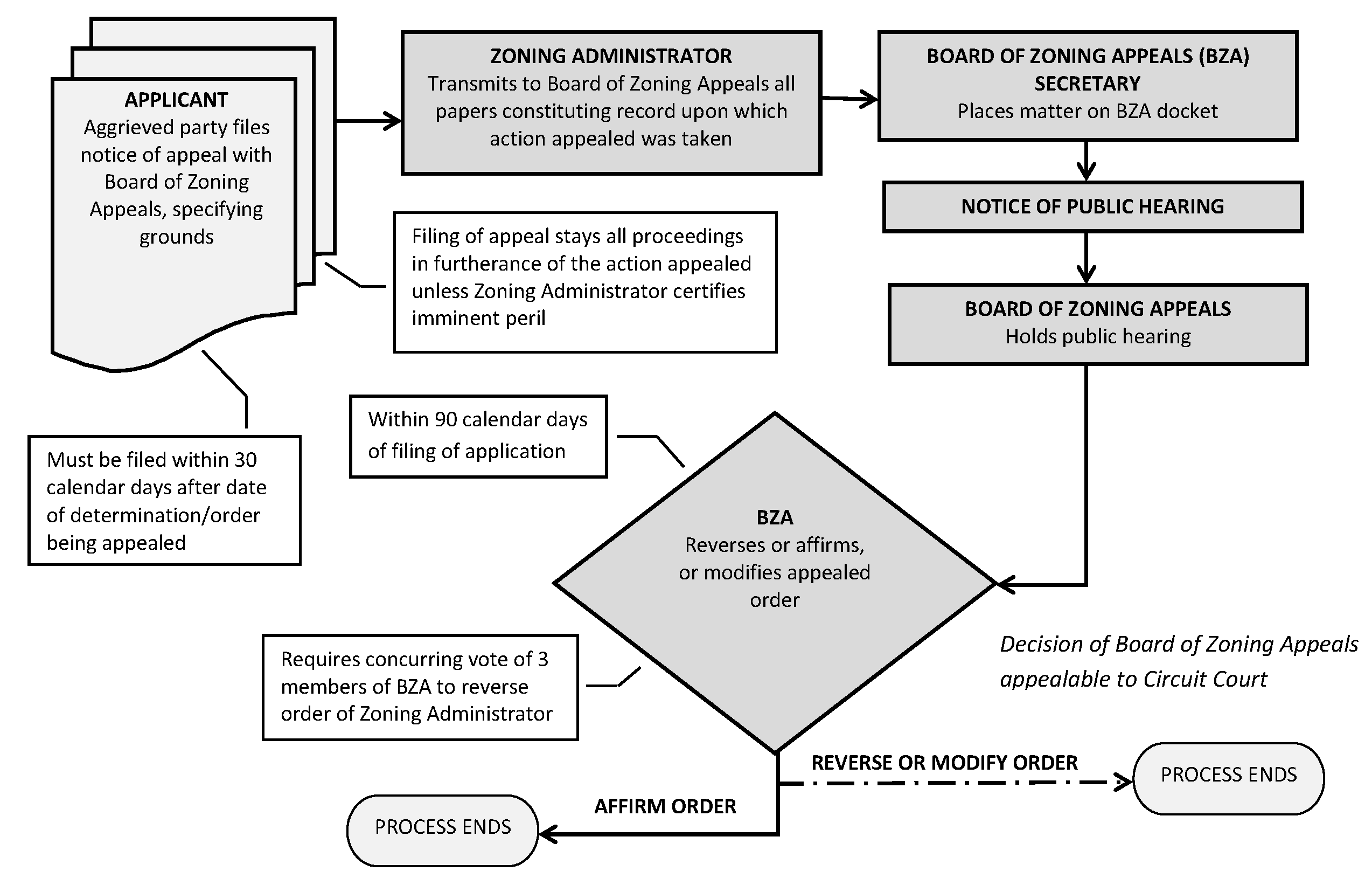
Any person, including any officer or body of the town, aggrieved by a final administrative determination on a development permit or administrative development approval by the zoning administrator or final decision-maker may appeal such final determination to the appellate body designated by this article, if any, in the manner provided in this article. The applicable appellate bodies are designated in Column (C) of Table 9-11-1.
Sec. 9-20. - Purpose.
The purpose of this division is to establish procedures for permits which do not require administrative or legislative notice of a public hearing. A public hearing is not required for permits set forth in this division for one or more of the following reasons:
(a)
Public hearings have already been conducted relating to the permit application, and the permit application procedure for a zoning permit or certificate of occupancy is designed to ensure that the proposed use complies with a previously approved subdivision plat, site plan, or conditional zoning; or
(b)
The proposed use is permitted as of right in the applicable zoning district.
Sec. 9-21. - General applicability.
No development may be undertaken unless all applicable permits are issued in accordance with this appendix. At a minimum, no development may occur until a zoning permit has been obtained from the zoning administrator and a building permit, where applicable, is obtained from the department of community development.
Sec. 9-22. - Zoning permit.
(a)
Applicability.
(1)
No structure shall be erected, constructed, reconstructed, moved, demolished, added to, or structurally altered until a zoning permit has been issued by the zoning administrator.
(2)
The use of a property shall not be changed, and clearing, grading, or excavating shall not be commenced, without a zoning permit issued by the zoning administrator.
(3)
A zoning permit shall not be issued by the zoning administrator except in strict compliance with this appendix. Where site plan review is required, no zoning permit shall be issued until such site plan has been approved.
(4)
Property owners whose use of property becomes nonconforming as a result of the enforcement of the provisions of this appendix shall obtain a zoning permit within 60 days upon written notification of such nonconformity from the zoning administrator.
(b)
Filing procedure.
(1)
Application. An application for a zoning permit shall be submitted to the zoning administrator prior to the issuance or consideration of issuance of any permit.
(2)
Accompanying plans. All applications for a zoning permit required pursuant to subsection (a) of this section shall be accompanied by a scale drawing or site plan as set forth in subsections [(b)](3) and (4) of this section.
(3)
Scale drawing.
(A)
In those circumstances where one of the following activities is proposed, three copies of a scale drawing shall be submitted with any zoning permit application:
(i)
Construction, reconstruction, moving, or addition to a single-family detached dwelling or permitted accessory structure and including associated grading and clearing, when development is not in conjunction with the construction, reconstruction, moving, or addition to another single-family detached dwelling or permitted accessory structures on the same lot or on an adjacent lot under the same ownership at the time of application; or
(ii)
Construction, reconstruction, moving, or addition to a two-family dwelling and including associated grading and clearing, when development is not in conjunction with the construction, reconstruction, moving, or addition to other two-family dwellings on the same lot or on an adjacent lot under the same ownership at the time of application; or
(iii)
Additions to buildings or intensification of uses not exceeding ten percent of the floor area of a building and where the number of required parking spaces is increased by no more than three; or
(iv)
Additions of up to, but not more than, four parking spaces; or
(v)
Additions of less than 2,000 square feet of impervious surfaces other than rooftops or parking areas.
(B)
The scale drawing shall show the following:
(i)
The size and shape of the parcel of land on which the proposed structure is to be constructed;
(ii)
The nature of the proposed use of the structure or land;
(iii)
The location of such structure or use with respect to the property lines of said parcel of land to the right-of-way of any street or highway adjoining said parcel of land; and
(iv)
Any other information which the zoning administrator deems pertinent for determining compliance with the provisions of this appendix.
(4)
Site plan. Except where a scale drawing is required pursuant to subsection (b)(3) of this section, a site plan shall be submitted with any zoning permit application. Any required site plan shall be submitted, reviewed, and considered pursuant to the procedures and requirements set forth in article 9, division 3 [of this appendix], Site Plan Review.
(c)
Zoning administrator action.
(1)
The zoning administrator, pursuant to the powers and duties set forth in sections 10-40, 10-41, and 10-42 [of this appendix], shall be responsible for determining compliance with this appendix of an application and accompanying plans for a zoning permit.
(2)
The zoning administrator shall act on any application for a zoning permit within 20 business days of receiving the complete application; provided, if written notice is given to the applicant, the time for action may be extended for an additional 20 business days. Failure of the zoning administrator to act on the application within the established timeframe shall be deemed to constitute approval of the application, except that where a site plan is required pursuant to subsection (b)(4) of this section, the timeframe for action on the site plan and issuance of the zoning permit shall be as set forth in sections 9-33(d) and 9-34 [of this appendix].
(3)
The zoning administrator shall return one copy of the application and accompanying plans to the applicant, after marking such copy as either approved, approved subject to conditions, or disapproved, and attested to the same by signature. If a zoning permit is denied, the zoning administrator shall state in writing to the applicant the reasons for the denial.
(d)
Scope of approval.
(1)
Zoning permits issued under the provisions of this appendix, on the basis of applications and plans approved by the zoning administrator, and other officials and bodies where additional approval is required, are deemed to authorize only the use, arrangement, location, and construction indicated in such approved plans and application, and no other. Any use, arrangement, location, or construction not in compliance with such authorization shall be deemed a violation of this appendix.
(2)
If the work described in any zoning permit has not begun within six months from the date it was issued, or within the time limits established by a conditional use permit or variance, the permit shall expire.
(A)
Upon written application submitted by the original applicant, or his successors in title or under law, within 90 calendar days after the expiration of the original zoning permit, the zoning administrator may issue a new zoning permit for work other than that involving a variance or conditional use permit, using the original application and plans, if in the opinion of the zoning administrator such original application and plans are still adequate. The zoning administrator may not issue a zoning permit extending time limits set by the board of zoning appeals or town council, except on specific order of the board or council as applicable.
(B)
Failure of a person to apply for a new zoning permit within 90 calendar days after expiration of the original zoning permit shall cause the zoning administrator to order such work on the premises involved as may be necessary to remedy conditions which would, in the opinion of the zoning administrator, cause imminent peril to life or property. The failure of any person who was the original applicant for a zoning permit, or who is the successor in title or under law to the original applicant, to do work ordered in such case shall be considered a violation of this appendix. In addition to other remedies and penalties, the zoning administrator may, in such cases, order such work done, with charges to be assessed, under procedures provided by law, against the property.
(e)
Building permit; relation to zoning permit. The zoning administrator shall be responsible for determining whether applications for building permits required by the Building Code are in accordance with the provisions of this appendix. No building permit shall be issued by the building official without certification from the zoning administrator that such plans are in strict compliance with the provisions of this appendix.
(f)
Land disturbing permit; relation to zoning. No land disturbing permit required by the erosion and sediment control ordinance applicable to the town shall be issued until the zoning administrator has reviewed the application and certified that the proposed land disturbing activity, including the plans, specifications, and intended use of the property, conforms to the provisions of this appendix.
(g)
Appeal of decision of zoning administrator. Any person, including any officer or body of the town, aggrieved by a final determination of the zoning administrator on the issuance of a zoning permit may appeal such final determination to the board of zoning appeals, pursuant to section 9-71 [of this appendix].
Sec. 9-23. - Certificate of occupancy.
(a)
Applicability.
(1)
New or altered uses. It shall be unlawful to use or occupy any structure or land, individually or in combination, in whole or in part, in which or on which a new use is created or an existing use is changed, converted, enlarged, or moved, until a certificate of occupancy is issued.
(2)
Nonconforming uses.
(A)
No person shall renew or resume after discontinuance or abandonment, or change, move, enlarge upon, expand, or extend, any nonconforming use of any land or structure, individually or in combination, in whole or in part, unless and until a certificate of occupancy for such use shall have been issued by the zoning administrator.
(B)
Property owners whose use of property becomes nonconforming as a result of the enforcement of the provisions of this appendix shall obtain a certificate of occupancy within 60 days upon written notification of such nonconformity from the zoning administrator.
(b)
Filing procedure. A certificate of occupancy, for the whole or portion of a building, shall be applied for simultaneously with the application for a zoning permit.
(c)
Zoning administrator action.
(1)
The zoning administrator, pursuant to the powers and duties as set forth in sections 10-40, 10-41, and 10-42 [of this appendix], shall be responsible for determining compliance with this appendix of an application for a certificate of occupancy.
(2)
A certificate of occupancy shall be issued only upon completion of the work in conformity with the provisions of this appendix, after inspection by the zoning administrator indicates that the use and occupancy are in compliance with the application and the provisions of this appendix. Such application for new uses or altered uses shall require the approval by signature of the zoning administrator.
(3)
A certificate of occupancy shall be issued within ten days after the erection or structural alteration of a building has conformed to the provisions of this appendix. In the circumstance of application by a property owner whose use of property becomes nonconforming as a result of enforcement of the provisions of this appendix as set forth in subsection (a)(2)(B) of this section, a certificate of occupancy shall be issued within 15 days after the written request of the owner or operator of the nonconforming use.
(d)
Scope of approval. Certificates of occupancy issued under the provisions of this appendix, on the basis of applications and plans approved by the zoning administrator, and other officials and bodies where additional approval is required, are deemed to authorize only the use, arrangement, location, and construction indicated in such approved plans and application, and no other. Any use, arrangement, location, or construction not in compliance with such authorization shall be deemed a violation of this appendix.
(e)
Records. The zoning administrator shall maintain a record of all certificates of occupancy, and a copy shall be furnished to any person upon request.
(f)
Temporary certificate of occupancy. A temporary certificate of occupancy may be issued by the zoning administrator for a period not exceeding six months during alterations or partial occupancy of a structure pending completion, provided such temporary certificate may require such conditions and safeguards as will protect the safety of the occupants and the public.
(g)
Appeal of decision of zoning administrator. Any person, including any officer or body of the town, aggrieved by a final determination of the zoning administrator on the issuance of a certificate of occupancy may appeal such final determination to the board of zoning appeals, pursuant to section 9-71 [of this appendix].
Sec. 9-30. - Purpose.
The purpose of the site plan regulations is to provide for the submission of sufficient plans and information for review and approval to assure compliance with the provisions of this appendix and the town's comprehensive plan and to ensure that the purpose and intent of this appendix are met. These site plan regulations are intended to promote the orderly development of activities in the town, to maintain or enhance the character and integrity of residential neighborhoods and commercial areas by promoting orderly development, preventing traffic hazards or congestion, preventing undue land or site hazards, and encouraging the most appropriate development and use of land in harmony with surrounding properties and in the interest and welfare of the general public.
Sec. 9-31. - Applicability.
A site plan shall be required to be submitted with a zoning permit application pursuant to section 9-22(b) [of this appendix].
Sec. 9-32. - Site plan requirements.
A site plan is intended to represent graphically all components of a proposed development required for review to determine compliance with this appendix. Site plans may include, where necessary, written data or computations and additional plans or drawings necessary to explain clearly the proposed development.
(a)
Preparation. A site plan may be submitted in either single or multiple sheet form, as appropriate to the needs of the specific development project, and shall be drawn to the following specifications:
(1)
Preparer. Site plans, or any portion thereof, shall be prepared by a professional engineer, architect, landscape architect, or land surveyor, licensed by the Commonwealth of Virginia.
(2)
Sheet size. The sheet size of plans shall be a minimum of 18 inches by 24 inches and shall be no larger than 30 inches by 42 inches. Sheet size of 11 inches by 17 inches may be permitted, when applicable and upon approval by the zoning administrator.
(3)
Single sheet or multiple sheets. When the plan entails construction, features, and data too numerous to be clearly and legibly shown on one sheet, the site plan shall be prepared on separate component sheets and shall be prefaced by a cover sheet with an index listing of the type and title of the various plan sheets included in the plan.
(4)
Identification on plan sheets. Each plan sheet, whether submitted in single sheet or multiple sheet form, shall identify the type of plan, such as site dimension, layout plan, utility plan, erosion and sediment control plan, storm water management plan, or landscape plan, the name of the property owner, business, firm, or company, and the property location.
(5)
Fixed scale. A site plan shall be prepared in a clear and legible manner and shall be submitted at a scale no smaller than one inch equals 50 feet.
(6)
Horizontal lines. All horizontal lines shown on the site plan shall be in feet and decimal fractions of a foot to the closest one hundredth of a foot (0.00), and all bearings shall be in degrees, minutes, and seconds.
(b)
Required information. The site plan shall provide, at a minimum, the following:
(1)
Name, address, and telephone number of the property owner or developer;
(2)
Name, address, and telephone number of the submitting engineer, architect, surveyor, or landscape architect;
(3)
Date;
(4)
Number of sheets of the plan;
(5)
Arrow indicating true north;
(6)
Scale denoted both graphically and numerically;
(7)
Reserved blank space three inches wide by five inches long for the use of the approving authority;
(8)
Vicinity map showing the location of the site in relation to surrounding features such as streets, drawn to a scale no smaller than one inch equals 1,200 feet, and including the scale of the vicinity map, north arrow, and information sufficient to clearly identify the location of the property;
(9)
Boundary, as determined by survey, of the property to be developed with all bearings and distances shown, as certified by a licensed land surveyor or engineer;
(10)
Existing features including:
(A)
Property lines;
(B)
Streets and easements, including names, numbers, and widths;
(C)
Location and size of existing sanitary storm sewers, gas lines, water mains, culverts, and other utilities and their easements;
(D)
Buildings;
(E)
Watercourses; and
(F)
Any other prominent physical features on or adjoining the tract.
(11)
Zoning classification and zoning district boundaries on the property to be developed and on adjoining properties, and any proposed changes in zoning if applicable;
(12)
Present use of all adjoining properties;
(13)
Existing topography with contours drawn at two-foot intervals, except where the existing slope is less than two percent either one-foot contours or spot elevations where necessary but not more than 50 feet horizontally apart in any direction;
(14)
Delineation of any floodplains;
(15)
Proposed location, general use, number of floors, height, and floor area for each building and, where applicable, the number, size, and type of dwelling units;
(16)
Off-street loading spaces, parking areas and spaces, and walkways indicating the type of surfacing, size, angle of stalls, width of aisles, and a schedule of parking spaces provided;
(17)
Location and dimensions of any required sidewalks and curbs and gutters along public street frontages;
(18)
Proposed water and sanitary facilities, indicating pipe sizes, types, and grades and where connection is to made to the public utility systems;
(19)
Proposed gas lines and other utilities and their easements;
(20)
Location, dimensions, and character of construction of proposed streets, alleys, and driveways, and the location, type, and size of vehicular entrances to the site;
(21)
Proposed finished grading at two-foot intervals or by spot elevations;
(22)
Provisions for the adequate disposition of natural water and storm water indicating location, sizes, types, and grades of ditches, catch basins, pipes, and connections to existing drainage systems or suitable outlet;
(23)
Provisions for the adequate control of erosion and sedimentation indicating the proposed temporary and permanent control practices and measures that will be implemented during all phases of clearing, grading, and construction;
(24)
Location, type, size, and height of fencing, retaining walls, and screen planting where required under the provisions of this appendix or other town ordinance;
(25)
Location of wooded areas on the property and the location of trees and wooded areas that will be retained;
(26)
Location and dimensions of proposed recreation areas, open space, and required amenities and improvements; and
(27)
Location, character, size, height, and orientation of proposed signs and outdoor lighting.
Sec. 9-33. - Site plan review and approval.
(a)
Filing procedure. Six copies of the site plan, accompanied by application and payment of required fees, shall be submitted to the zoning administrator, pursuant to the submittal requirements of section 9-32 [of this appendix], for review and approval in accordance with subsections (b), (c), and (d) of this section.
(b)
General review guidelines. Review of a site plan shall consider all aspects of the proposed development necessary to carry out the intent of this division and shall include a review of:
(1)
The compatibility of the development with its environment and provision for such things as grading, screening, buffering, lighting, and landscaping;
(2)
The ability of the development to provide for parking areas and the convenient and safe internal and external movement of vehicles and pedestrians; and
(3)
The location and adequacy of necessary drainage, storm water management, sewage, utilities, and erosion and sediment control measures.
(c)
Approval criteria.
(1)
The site plan shall comply with all applicable requirements of this appendix.
(2)
Where erosion and sediment controls for the development are required by the provisions of chapter 46, Environment, article IV, of this Code, an erosion and sediment control plan shall be implemented.
(3)
All features and elements of the site plan shall conform in all respects to all applicable provisions and standards of the Code of Virginia, as amended, town ordinances, and the standards and requirements of the Virginia Department of Transportation and the Virginia Department of Health.
(4)
In order to enforce compliance with permit conditions, a development plan may be approved in phases, subject to a condition that building permits and certificates of occupancy in a phase of the development may be withheld subject to compliance with permit conditions in a prior phase.
(d)
Decision.
(1)
The zoning administrator, pursuant to the powers and duties as set forth in sections 10-40, 10-41, and 10-42 [of this appendix], shall be responsible for determining compliance with this appendix of an application for site plan approval. The zoning administrator shall approve or disapprove all site plans, except as set forth in subsection (d)(2) of this section.
(A)
The zoning administrator shall process and coordinate the review of site plans by circulating site plans to the relevant town, county, and state agencies and officials for comments as to the proposed development's conformance to all applicable standards and requirements. The reviewing agencies and officials may include, but are not limited to, the department of community development, the town attorney, the town engineer, the Virginia Department of Transportation, and the Virginia Department of Health.
(B)
The zoning administrator shall act on any initially submitted or resubmitted site plan within 45 business days after it has been submitted or resubmitted for approval, by either approving or disapproving the site plan in writing, and providing with any disapproval the specific reasons therefor. The reasons for disapproval shall identify deficiencies in the site plan that caused the disapproval by reference to specific duly adopted ordinances, regulations, or policies and shall identify, to the greatest extent practicable, modifications or corrections that will permit approval of the site plan. Subject to the provisions of this subsection, including the designated timeline, the zoning administrator shall notify the applicant or his representative in writing that:
(i)
The information on the site plan is incomplete, in error, or lacking in detail, and delineate the additional information required and the corrections or modifications required to make the plan approvable; or
(ii)
The site plan is sufficient in required information and accuracy and has been reviewed and approved.
(C)
In the review of a resubmitted site plan that has been previously disapproved, the zoning administrator shall consider only deficiencies identified in the review of the initial submission that have not been corrected in such resubmission and any deficiencies that arise as a result of the corrections made to address deficiencies identified in the initial submission. Upon the second resubmission of such disapproved site plan, the zoning administrator's review shall be limited solely to the previously identified deficiencies that caused its disapproval.
(2)
The zoning administrator, the applicant, or the planning commission may request that a site plan be reviewed and approved by the planning commission.
(A)
If such request is made by the zoning administrator or the planning commission, the zoning administrator shall notify the applicant, in writing, within 15 calendar days of submission or resubmission of a site plan that the site plan must be reviewed by the planning commission at its next regularly scheduled meeting.
(B)
All required plans and information to be submitted to the planning commission shall be submitted at least ten business days prior to the scheduled meeting of the commission. The zoning administrator shall prepare a report outlining the various and particular aspects of the plan, with recommendations for the planning commission's consideration.
(C)
The zoning administrator shall inform the applicant, in writing, of the planning commission's decision. If the commission's decision necessitates revision of the site plan, the applicant shall submit six copies of the revised site plan to the zoning administrator for final approval.
(3)
All approved site plans shall be signed by the zoning administrator.
(4)
The failure of the zoning administrator or planning commission to approve or disapprove a site plan within the time periods required by this section shall cause such site plan to be deemed approved.
Sec. 9-34. - Scope of approval.
(a)
Issuance of zoning permit. Upon receipt of an approved and signed copy of the site plan, and provided that all other requirements of this appendix have been met, the zoning administrator shall issue a zoning permit to the applicant.
(b)
Validity of five years. An approved site plan shall expire and be null and void unless a building permit has been issued or use of the land has commenced within five years from the date of approval, except as provided in subsection (d) of this section. A site plan shall be deemed final once it has been reviewed and approved by the town if the only requirements remaining to be satisfied in order to obtain a building permit are the posting of any bonds and escrows or the submission of any other administrative documents, agreements, deposits, or fees required by the town in order to obtain the permit. However, any fees that are customarily due and owing at the time of the town review of the site plan shall be paid in a timely manner.
(c)
Extension of validity. Upon written request of the developer filed prior to the expiration of an approved site plan, the zoning administrator may grant an extension of one year, provided that all factors of the original site plan review are the same and taking into consideration the size and phasing of the proposed development, and the laws, ordinances, and regulations in effect at the time of the request for an extension.
(d)
Extension of validity of certain site plans. Notwithstanding the time limits for validity set out in subsection (b) of this section, any approved site plan valid under subsection (b) of this section and outstanding as of January 1, 2011, shall remain valid until July 1, 2017, pursuant to Code of Virginia, § 15.2-2209.1.A, as amended, or such later date provided for by the terms of the town's approval, or for a longer period as agreed to by the town per subsection (c) of this section.
(1)
Any other plan or permit associated with such site plan extended by this subsection shall likewise be extended for the same time period.
(2)
The extension of validity provided in this subsection shall not be effective unless any unreleased bonds and agreements or other financial guarantees of completion of public improvements in or associated with the proposed development are continued in force; however, if the town has enacted a bonding moratorium or deferral option, the performance bonds and agreements or other financial guarantees of completion may be waived or modified by the town, in which case the extension of validity provided in this subsection shall apply. The landowner or development must comply with the terms of any bonding moratorium or deferral agreement with the town in order for the extensions referred to in this subsection to be effective.
(e)
Vested right. For so long as the site plan remains valid in accordance with the provisions of this section, no change or amendment to any local ordinance, map, resolution, rules, regulation, policy or plan adopted subsequent to the date of approval of the site plan shall adversely affect the right of the developer or his successor in interest to commence and complete an approved development in accordance with the lawful terms of the approved site plan unless the change or amendment is required to comply with state law or there has been a mistake, fraud, or a change in circumstance substantially affecting the public health, safety or welfare.
Sec. 9-35. - Amendment of site plan.
If it becomes necessary for an approved site plan to be changed, such changes shall be filed with the zoning administrator for review and approval. If a proposed change will, in the opinion of the zoning administrator, substantially affect the terms of the original approval, a new plan shall be required to be drawn and submitted for review and action in accordance with the provisions of this appendix.
Sec. 9-36. - Compliance with approved site plan.
(a)
Prerequisite to permits. Where a site plan is required by the provisions of this appendix, an approved site plan is a prerequisite to the issuance of permits to construct, erect, or alter any building or structure or to improve or develop land subject to the provisions of this appendix.
(b)
Building permits and certificates of occupancy. All building permits and certificates of occupancy shall comply with the provisions of the approved site plan.
(c)
Inspections. The zoning administrator shall make inspections during the installation of off-site and on-site improvements to ensure compliance with the approved site plan. The owner or developer shall make one set of approved site plans available at the site at all times that work is being performed.
Sec. 9-40. - Purpose.
The purpose of this division is to encourage the preservation and enhancement of the town's historic commercial areas and encourage rehabilitation and new construction in conformance with the existing scale and character of the district.
Sec. 9-41. - Applicability.
(a)
Within the Historic Commercial Area Overlay District (H-1), no building or structure, including signs, shall be erected, reconstructed, altered, demolished, moved, or restored without the issuance of a certificate of appropriateness by the board of architectural review or, on appeal, by the town council.
(b)
No certificate of appropriateness shall be issued unless the board of architectural review, or the town council on appeal, finds that the proposed erection, reconstruction, alteration, or restoration is architecturally compatible with the buildings, structures, or historic landmarks in the Historic Commercial Area Overlay District (H-1).
(c)
Where a certificate of appropriateness is required by this division, the zoning administrator shall not issue a permit for the erection, reconstruction, alteration, restoration, demolition, or moving of any structure or historic landmark until such certificate has been issued. Once the permit has been issued, the work shall be routinely inspected by the zoning administrator to ensure compliance with the terms of the certificate of appropriateness. Any work not in accordance with such certificate shall be reported to the board of architectural review by the zoning administrator.
(d)
Nothing in this division shall be construed to prevent the ordinary maintenance of any structure or historic landmark in the H-1 Overlay District. For the purposes of this division, "ordinary maintenance" means any activity relating to a structure or landmark which constitutes a minor repair of any element of a structure or landmark which is, or should be, performed on a regular and relatively frequent basis to maintain architectural and structural integrity. The determination of whether an activity constitutes ordinary maintenance, or whether an installation or modification otherwise requires a certificate of appropriateness under this division, shall be made by the zoning administrator in consultation with the board of architectural review.
(1)
In the H-1 Overlay District, painting shall be deemed ordinary maintenance, provided that the color of a structure is not changed; however, changing the color of paint or the painting of previously unpainted masonry surfaces shall require a certificate of appropriateness.
(2)
In the H-1 Overlay District, the replacement of porches, stairs, awnings, roofing materials, or windows, or other similar modifications to an element of a structure or landmark, shall be deemed ordinary maintenance, provided that such replacement is performed using materials that are of the same design as those on the structure or landmark, and provided that such replacement maintains the architectural defining features of the structure or landmark.
(e)
Nothing in this division shall be construed to prevent the demolition of a structure or historic landmark which the building maintenance code official certifies in writing is required for public safety because of an unsafe or dangerous condition.
Sec. 9-42. - Filing procedure.
(a)
In order to be heard by the board of architectural review at its next regular meeting, a complete application for a certificate of appropriateness shall be made to the secretary to the board, on forms provided, in accordance with the rules adopted by the board of architectural review.
(b)
All plans, elevations, and other information necessary to determine the appropriateness of the features to be passed upon, together with a copy of the application for a building or zoning permit or certificate of occupancy, shall be made available to the board of architectural review by the zoning administrator.
Sec. 9-43. - Board action.
(a)
The board of architectural review, pursuant to the powers and duties as set forth in section 10-27 [of this appendix], shall review, evaluate, and act upon applications for certificates of appropriateness within the Historic Commercial Area Overlay District (H-1).
(b)
The board of architectural review shall vote and announce its decision on any matter within 15 calendar days after the conclusion of the hearing on the matter, unless the time is extended with the written consent of the applicant. Failure of the board to take final action upon any case within 45 calendar days after the application for the permit shall be deemed approval, except when mutual agreement has been made for an extension of the time limit.
(c)
In the case of disapproval of an application before the board of architectural review, the board shall state its reasons in writing to the applicant and may make recommendations to the applicant in regard to the appropriateness of design, arrangement, texture, materials, color, and the like of the subject property. Notice of such disapproval and a copy of the written statement of reasons therefor also shall be transmitted to the zoning administrator. In the case of disapproval accompanied by recommendations, the applicant may again be heard before the board if an amended application that addresses the recommendations of the board is filed by the applicant within 90 calendar days.
(d)
Upon approval by the board of architectural review, or the town council upon appeal, of any erection, reconstruction, alteration, restoration, or demolition, a report shall be transmitted to the zoning administrator, stating the basis upon which the approval is granted and causing a certificate of appropriateness to be issued to the applicant. Such certificate of appropriateness shall be a statement signed by the chair of the board of architectural review, stating that the exterior architectural features of the proposed construction, reconstruction, alteration, or restoration for which application has been made are approved by the board.
Sec. 9-44. - Appeal of decision of board of architectural review.
Any property owner aggrieved by any decision of the board of architectural review may present to the town council a petition appealing such decision, provided such petition is filed within 30 calendar days after the decision is rendered by the board. The town council shall schedule the matter for a public meeting and render a decision on the matter within 60 calendar days of the receipt of the petition, unless the property owner and the zoning administrator agree to an extension. The town council may affirm the decision of the board, reverse or modify the board's decision, in whole or in part, or refer the matter back to the board.
Sec. 9-45. - Appeal of town council decision.
Any property owner aggrieved by any final decision of the town council pursuant to section 9-44 [of this appendix] may present to the circuit court a petition setting forth the alleged illegality of the action of the town council, provided such petition is filed within 30 calendar days after the final decision is rendered by the town council. The filing of such petition shall stay any action pursuant to the decision of the town council pending the outcome of the appeal to the court, except that the filing of the petition shall not stay any action pursuant to the decision of the town council if such decision denies the right to raze or demolish a historic landmark, building, or structure. The court may reverse or modify the decision of town council, in whole or in part, if it finds upon review that the decision of the town council is contrary to law or that its decision is arbitrary and constitutes an abuse of discretion, or the court may affirm the decision of the town council.
Sec. 9-46. - Scope of approval.
A certificate of appropriateness is valid for a period of one year from the date of the action of the board of architectural review or the town council on appeal.
Sec. 9-47. - Consideration of substantially same application.
Having once considered an application, the board of architectural review shall not hear substantially the same application for one year.
Sec. 9-48. - Demolition; offer to sell.
(a)
Pursuant to Code of Virginia, § 15.2-2306, as amended, in addition to the right of appeal of the town council's decision as set forth in section 9-45 [of this appendix], the owner of a historic landmark, building, or structure within the H-1 Overlay District, the demolition of which is subject to the provisions of section 9-41 [of this appendix], shall have the right to demolish such landmark, building, or structure provided that:
(1)
The property owner has applied to the town council for such right; and
(2)
The owner has for the period of time set forth in the time schedule established in subsection (b) of this section, and at a price not more than its fair market value, made a bona fide offer to sell such landmark, building, or structure, and the land pertaining thereto, to the town or to any person, firm, corporation, or government or agency thereof, or political subdivision or agency thereof, which gives reasonable assurance that it is willing to preserve and restore the landmark, building, or structure and the land pertaining thereto; and
(3)
No bona fide contract, binding upon all parties thereto, shall have been executed for the sale of any such landmark, building, or structure, and the land pertaining thereto, prior to the expiration of the applicable time period set forth in the time schedule in subsection (b) of this section.
(b)
The time schedule for offers to sell shall be as follows:
(1)
Three months when the offering price is less than $25,000.00;
(2)
Four months when the offering price is $25,000.00 or more but less than $40,000.00;
(3)
Five months when the offering price is $40,000.00 or more but less than $55,000.00;
(4)
Six months when the offering price is $55,000.00 or more but less than $75,000.00;
(5)
Seven months when the offering price is $75,000.00 or more but less than $90,000.00; and
(6)
12 months when the offering price is $90,000.00 or more.
(c)
Before making a bona fide offer to sell, as provided above, an owner shall first file a statement with the secretary to the board of architectural review identifying the property and stating the offering price, the date the offer of sale is to begin, and the name of the real estate agent. No time period as set forth in the schedule in subsection (b) of this section shall begin to run until such statement has been filed. Within 14 business days of receipt of such statement, the secretary to the board shall distribute copies to the town council, the board of architectural review, and the town manager.
(d)
Such bona fide offer to sell, in accordance with the provisions of this section, must be made within one year after a final decision by the town council. If not, an owner must renew his request to the town council to approve such demolition in order to demolish a structure or historic landmark.
(e)
Any appeal taken pursuant to section 9-45 [of this appendix] shall not affect the right of the owner of a structure or historic landmark to make the bona fide offer to sell referred to above.
Sec. 9-50. - Zoning amendment.
(a)
Purpose. The purpose of this section is to establish procedures for initiating and processing applications to amend the provisions of this appendix and to amend the official zoning map.
(b)
Applicability. Whenever the public necessity, convenience, general welfare, or good zoning practice requires, the town council may by ordinance amend, supplement, or change this appendix, including the text and the official zoning map.
(1)
Any such amendment may be initiated by resolution of the town council or by motion of the planning commission. Any such resolution or motion shall state the public purposes therefor.
(2)
An amendment to the official zoning map may be initiated by application by the owner, contract purchaser with the owner's written consent, or the owner's agent of the property which is the subject of the proposed zoning map amendment.
(c)
Filing procedure.
(1)
An application to rezone property shall be in writing on forms provided by the town and filed with the zoning administrator, accompanied by payment of all required fees and charges. See sections 9-10(c) and (d) [of this appendix] for completeness review and fees.
(2)
Prior to the initiation of an application for a rezoning by the owner of the subject property, the owner's agent, or any entity in which the owner holds an ownership interest greater than 50 percent, the applicant shall produce satisfactory evidence that any delinquent real estate taxes that are owed to the town and have been properly assessed against the subject property have been paid.
(3)
An application for the rezoning of property shall include, at a minimum, the following:
(A)
Purpose of the requested zoning district classification and the proposed use of the property;
(B)
Concept plan, drawn to scale, outlining features of the proposed use of the property including existing buildings or proposed building envelopes, existing streets, parking and driveways, utilities and infrastructure, open space, significant environmental or historical features, and similar existing or proposed amenities or features;
(C)
General description of the existing and adjacent land uses;
(D)
Map or maps of the area requested for rezoning;
(E)
Names, signatures, and addresses of the owner or owners of the lots or property included in the proposed change; and
(F)
Names, addresses, and official tax numbers of owners of the lots or property immediately adjacent to and those directly opposite thereto; provided, however, that inaccuracy or inadequacy of any such list of adjacent owners shall not in any manner affect the validity of any proceedings had or taken by the town council with respect to the matters contained in such application.
(4)
An application to rezone property brought by property owners, contract purchasers, or the agents thereof shall be sworn to under oath before a notary public, or other official before whom oaths may be taken, stating whether or not any member of the planning commission or town council has any interest in such property, either individually, by ownership of stock in a corporation owning such land, partnership, as the beneficiary of a trust, or the settler of a revocable trust, or whether a member of the immediate household of any member of the planning commission or town council has any such interest.
(5)
Upon the filing of an application to rezone property, and the payment of all applicable fees and charges, the zoning administrator shall transmit the application, with a report and recommendation, to the planning commission for study, report, and recommendation to the town council, with a copy of such application mailed or delivered to the town manager and members of the town council.
(d)
Notice of hearing. Prior to conducting any public hearing required by this appendix before the town council or the planning commission, notice, including newspaper legal advertisements and notices sent by first-class mail, shall be given as required by Code of Virginia, § 15.2-2204, as amended. The expense of legal advertisement shall be borne by the applicant. Any affidavits required by Code of Virginia, § 15.2-2204, as amended, shall be filed with the town clerk. In the case of a proposed amendment to the official zoning map, public notice shall be provided pursuant to Code of Virginia, § 15.2-2285, as amended.
(e)
Standards for consideration. In consideration of all proposed zoning amendments, including text or the official zoning map, the planning commission and town council shall study the proposal to determine the following:
(1)
The need and justification for the change;
(2)
When pertaining to a change in the district classification of property, the effect of the change, if any, on the property and on the surrounding neighborhood;
(3)
When pertaining to a change in the district classification of property, the amount of undeveloped land in the general area and in the town having the same district classification as requested; and
(4)
The relationship of the proposed amendment to the purposes of the general planning program, with appropriate consideration as to whether the proposed change will further the purposes of this appendix and the town's comprehensive plan.
(f)
Planning commission action.
(1)
The planning commission, pursuant to the powers and duties as set forth in section 10-17(c) [of this appendix], shall review, evaluate, report, and make recommendations to the town council regarding any proposed amendment of any regulation or district boundary provided by this appendix.
(2)
Pursuant to subsection (c)(5) of this section, all proposed amendments to this appendix shall be referred to the planning commission for consideration and recommendation to the town council.
(3)
In consideration of all proposed zoning amendments, the planning commission shall study proposals subject to the standards for consideration set forth in subsection (e) of this section.
(4)
Prior to making recommendations on any proposed amendment to the provisions of this appendix or to the official zoning map, the planning commission shall conduct a public hearing on such proposal, after notice of such hearing is given pursuant to subsection (d) of this section.
(5)
Within 60 calendar days from the date that any proposed amendment is referred to it (unless a longer period shall have been established by mutual agreement between the applicant and the planning commission in the particular case), the planning commission shall submit its report and recommendation to the town council. The recommendation of the planning commission shall be advisory only and shall not be binding on town council. If the planning commission does not submit its report to the town council within the prescribed time, the town council may proceed to act on the amendment, without further awaiting the recommendation of the planning commission, unless the proposed amendment has been withdrawn by the applicant prior to the expiration of the time period. In the event of and upon such withdrawal, processing of the proposed amendment shall cease without further action as otherwise would be required by this section.
(g)
Town council action.
(1)
Before approving and adopting any amendment to the provisions of this appendix or to the official zoning map, the town council shall conduct at least one public hearing on such proposal, after notice of such hearing is given pursuant to subsection (d) of this section.
(2)
In consideration of all proposed zoning amendments, the town council shall study proposals subject to the standards for consideration set forth in subsection (e) of this section.
(3)
After the town council has held a public hearing, it may make appropriate changes or corrections in the proposed amendment and proceed to act without holding a hearing on the proposed amendment in its new form, provided that no land shall be zoned to a more intensive use classification than was contained in the public notice without additional public hearing and notice.
(4)
The town council shall decide whether to approve or to deny an application to amend the provisions of this appendix or the official zoning map.
(h)
Consideration of substantially same application. Once the town council has considered and rendered a decision on an application for a zoning amendment, the town council shall not consider substantially the same request within one year, except when such decision is the subject of a motion to rehear. Any such motion to rehear shall be in accordance with rules adopted by the town council.
Sec. 9-51. - Conditional zoning.
(a)
Purpose. The purpose of this section is to implement conditional zoning authority pursuant to Code of Virginia, § 15.2-2296, as amended, in order to provide for the orderly development of land in a manner that provides for a flexible and adaptable zoning method to cope with situations whereby a zoning reclassification may be allowed subject to certain conditions proffered by the applicant for the protection of the community that are not generally applicable to land similarly zoned.
(b)
Applicability. Conditional zoning may be granted pursuant to the provisions of Code of Virginia, §§ 15.2-2296 through 15.2-2302, as amended. A conditional rezoning may be initiated only by application of the owner, contract purchaser with the owner's written consent, or the owner's agent of the property which is the subject of the proposed zoning map amendment. The owner shall sign such application if conditions are proffered.
(c)
Procedures.
(1)
The procedures for the filing and approval of a conditional rezoning shall be the same as the procedures to amend the official zoning map as set forth in section 9-50(c) through (h) [of this appendix], except as otherwise provided in this section.
(2)
The acceptance of proffers or other conditions, enforcement, recordation, amendments, and variations of conditions, shall be as set forth in the provisions of Code of Virginia, §§ 15.2-2296 through 15.2-2303, as amended.
(3)
Conditions may be proffered prior to the public hearing before the planning commission. Alternatively, or in addition, in consideration of comments expressed during the commission deliberations on an application, the property owner may, prior to the final public hearing conducted by the town council, choose to proffer original conditions or revised conditions.
(d)
Proffered conditions; requirements.
(1)
The owners of property for which an application is being made for an amendment to the official zoning map may, as part of the application, voluntarily proffer, in writing, reasonable conditions which shall be in addition to the regulations of the zoning district classification requested by the application. Any conditions proffered by application of a property owner shall be drafted in such a way that they are clearly understood and enforceable and shall adhere to the following standards:
(A)
The rezoning itself shall give rise for the need for the conditions;
(B)
The conditions shall have a reasonable relation to the rezoning;
(C)
The conditions shall not include a cash contribution to the town;
(D)
The conditions shall not include mandatory dedication of real or personal property for open space, parks, schools, fire departments, or other public facilities not otherwise provided for in Code of Virginia, § 15.2-2241, as amended;
(E)
The conditions shall not include a requirement that the applicant create a property owners' association under Chapter 26 (Section 55-508 et seq.) of Title 55, Code of Virginia, as amended, which includes an express further condition that members of a property owners' association pay an assessment for the maintenance of public facilities owned in fee by a public entity, including open space, parks, schools, fire departments and other public facilities not otherwise provided for in Code of Virginia, § 15.2-2241, as amended; however, such facilities shall not include sidewalks, special street signs or markers, or special street lighting in public rights-of-way not maintained by the Virginia Department of Transportation;
(F)
The conditions shall not include payment for or construction of off-site improvements except those provided for in Code of Virginia, § 15.2-2241, as amended;
(G)
No condition shall be proffered that is not related to the physical development or physical operation of the property; and
(H)
All such conditions shall be in conformity with the town's comprehensive plan.
(2)
Proffered conditions may provide for the timing or phasing of dedications or improvements.
(e)
Approval criteria. The decision as to whether to accept a condition or a proffer shall be considered a legislative decision, and shall be committed to the sole discretion of the town council subject to any criteria set forth in the applicable provisions of Code of Virginia, §§ 15.2-2296 through 15.2-2302, as amended, or any other applicable provision of state or federal law.
(f)
Amendment of proffered conditions at the public hearing.
(1)
The town council may accept amended proffers once the public hearing has begun if the amended proffers do not materially affect the overall proposal.
(2)
Without new public notice and hearing, proffered conditions may be amended to correct an error in the submitted proffered conditions or to impose additional conditions on the property. The amended proffered conditions cannot allow a more intensive use classification than was contained in the public notice without an additional public hearing after notice as required by section 9-50(d) [of this appendix].
(3)
Amended proffered conditions which would remove an advertised condition or amend a condition to make it less restrictive shall be re-advertised pursuant to section 9-50(d) [of this appendix].
(g)
Scope of approval.
(1)
Proffered conditions shall be considered supplemental to and in addition to the provisions contained elsewhere in this appendix or other town ordinances and shall not authorize less than full compliance with all other applicable provisions of this appendix.
(2)
Once proffered and accepted by the town council as part of an amendment to the official zoning map, proffered conditions shall continue in full force and effect until a subsequent amendment changes such conditions or the zoning on the property covered by the conditions; however, the conditions shall continue if the subsequent amendment is part of a comprehensive implementation of a new or substantially revised zoning ordinance.
(3)
Conditions once proffered and accepted by the town council shall immediately become effective with approval of the application to amend the official zoning map. Upon approval, any site plan or subdivision plat submitted for the development of the property in question shall be in conformance with all proffered conditions, and no development shall be approved by any town official in the absence of such conformance.
(4)
Notwithstanding any other provision of this appendix, for any conditional rezoning action approved pursuant to this section, valid and outstanding as of January 1, 2011, and related to new residential or commercial development, any proffered condition that requires the landowner or developer to incur significant expenses upon an event related to a stage or level of development shall be extended until July 1, 2017, pursuant to Code of Virginia, § 15.2-2209.1.C, as amended, or longer as agreed to by the town. However, the extensions in this subsection shall not apply as follows:
(A)
To land or right-of-way dedications pursuant to the provisions for conditional rezoning;
(B)
When completion of the event related to the stage or level of development has occurred; or
(C)
To events required to occur on a specified date certain or within a specified time period.
(h)
Amendment of conditions. Amendment of conditions created pursuant to this section shall be made only as an original application for amendment to the zoning ordinance, pursuant to the procedures set forth in this division including public notice and hearing, except as provided in subsections [(h)](1) and (2) of this section.
(1)
Any landowner subject to conditions proffered pursuant to this section may apply to the town council for amendments to or variations of such proffered conditions provided only that written notice of such application be provided in the manner prescribed in Code of Virginia, § 15.2-2204.H, as amended, to any landowner subject to such existing proffered conditions; and
(2)
When an amendment to such proffered conditions is requested pursuant to subsection (h)(1) of this section, and where such amendment does not affect conditions of use or density, the town council may waive the requirement for a public hearing prior to amendment of such proffered conditions.
(i)
Record of conditions. The existence of conditions attached to a zoning district designation shall be shown on the official zoning map by an appropriate symbol on the map. The zoning administrator shall keep and make available for public inspection in the department of community development a conditional zoning index. Such index shall provide ready access to each ordinance creating such conditions. The zoning administrator shall update the index annually, no later than November of each year.
(j)
Enforcement of conditions. Failure to meet all conditions of a conditional rezoning shall constitute cause to deny the issuance of any required permit or certificate, as may be appropriate, and to seek such remedy as provided under the terms of this appendix. The zoning administrator shall be vested with all necessary authority on behalf of the town council to administer and enforce such conditions as may be attached to an amendment of the official zoning map, including:
(1)
The ordering in writing of the remedy of any noncompliance with such conditions;
(2)
The bringing of legal action to ensure compliance with such conditions, including injunction, abatement, or other appropriate action or proceeding; and
(3)
The requiring of a guarantee, satisfactory to the town council, in an amount sufficient for and conditioned upon the construction of any physical improvements required by the conditions, or a contract for the construction of such improvements and the contractor's guarantee, in like amount and so conditioned, which guarantee shall be reduced or released by the zoning administrator upon the submission of satisfactory evidence that construction of such improvements has been completed in whole or in part.
(k)
Review of decision in enforcement of proffered conditions. Any zoning applicant or any other person who is aggrieved by a decision of the zoning administrator made in the enforcement of conditions pursuant to the provisions of subsection (j) of this section may petition the town council for review of the decision of the zoning administrator. All petitions for review shall be filed with the zoning administrator and the town clerk within 30 calendar days from the date of the decision for which review is sought and shall specify the grounds upon which the petitioner is aggrieved.
Sec. 9-60. - Purpose.
The purpose of this division is to provide for the approval of certain uses which by the nature of their operations potentially have an adverse impact on surrounding properties or the general public than uses otherwise permitted as of right in the same zoning district. It is the intent of this division to provide suitable safeguards in addition to the regulations of the applicable zoning district, in the form of imposed conditions, to address these potential negative impacts generated by the conditional use of the property.
Sec. 9-61. - Applicability.
The town council shall have the power to hear and decide on applications for conditional use permits as authorized by this appendix.
Sec. 9-62. - Filing procedures.
(a)
An application for a conditional use permit shall be in writing on forms provided by the town and filed with the zoning administrator, accompanied by payment of all required fees and charges. See sections 9-10(c) and (d) [of this appendix] for completeness review and fees.
(b)
Applications for conditional use permits may be made by any property owner, tenant, government official, department, board, or bureau.
(c)
Prior to the initiation of an application for a conditional use permit by the owner of the subject property, the owner's agent, or any entity in which the owner holds an ownership interest greater than 50 percent, the applicant shall produce satisfactory evidence that any delinquent real estate taxes that are owed to the town and have been properly assessed against the subject property have been paid.
(d)
Upon the filing of an application for a conditional use permit, including the payment of all applicable fees and charges, the zoning administrator shall transmit the application, with a report and recommendation, to the planning commission for study, report, and recommendation to the town council, with a copy of such application mailed or delivered to the town manager and members of the town council.
Sec. 9-63. - Notice and public hearing requirements.
Upon application for a conditional use permit, prior to conducting any public hearing required by this appendix before the town council or the planning commission, notice shall be given as required by Code of Virginia, § 15.2-2204, as amended. However, when giving any required notice to the owners, their agents, or the occupants of abutting property and property immediately across the street or road from the property affected, notice may be given by first-class mail rather than by registered or certified mail. Any affidavits required by Code of Virginia, § 15.2-2204, as amended, shall be filed with the town clerk. No conditional use permit shall be authorized except after such application, notice, and public hearing. The expense of legal advertisement shall be borne by the applicant.
Sec. 9-64. - Approval criteria; imposing of conditions.
(a)
Standards. In considering any application for a conditional use permit, the planning commission and town council shall determine the appropriateness and reasonableness of the application based on the general welfare of the public, impact on the welfare of the properties within the district, the suitability of the property for various uses, the existing use and character of the property, how the conditional use satisfies one or more of the purposes of this appendix as set forth in section 1-4 [of this appendix], and the following standards of consideration:
(1)
The use is compatible with the character and appearance of the surrounding neighborhood by virtue of its height, bulk, location on the lot, and the design and location of parking, signage, landscaping, and other outside activities or structures;
(2)
The use does not create a demand on public water or sanitary sewer services that exceeds the design capacity of these systems or that would in any way decrease the quality of service to the surrounding neighborhood;
(3)
The use does not generate traffic on public streets that exceeds the design capacity of such streets and does not create a dangerous traffic problem by virtue of driveway location, site clearance, driveway slope, or other factor;
(4)
The use does not increase the flood potential in the surrounding neighborhood;
(5)
The use is in conformance with the setback, yard, frontage, lot area, parking, signage, screening, and other applicable requirements of this appendix as they pertain to the district in which the use is located or to the specific use, whichever the case may be; and
(6)
The use furthers the intent of the town's comprehensive plan.
(b)
Criteria. In consideration of the standards set forth in subsection (a) of this section, the planning commission and town council shall utilize the following criteria to determine whether or not the proposed conditional use meets the standards for approval:
(1)
The nature, character, and types of land uses and zoning districts established in the area;
(2)
Ingress and egress to and from the subject property and proposed structures with particular reference to motor vehicle and pedestrian safety and convenience, traffic flow and control, and emergency access;
(3)
Off-street parking and loading areas where required with particular attention to the criteria in subsection (b)(2) of this section;
(4)
The economic, noise, dust, glare, or odor effects of the conditional use on adjoining properties and properties generally in the district;
(5)
Refuse and service areas, with particular reference to the criteria in subsections (b)(2) and (3) of this section;
(6)
Utilities, with reference to location, availability, and compatibility;
(7)
Screening and buffering with reference to type, dimensions and character of the proposed conditional use;
(8)
Required yards and other open spaces; and
(9)
General compatibility with adjacent properties and other properties in the district.
(c)
Conditions. In authorizing a conditional use permit, the town council may impose such conditions relating to the use for which a permit is granted as it may deem necessary in the public interest, including limiting the duration of a permit. Any imposed condition shall be reasonably related to land use concerns and problems directly generated by the conditional use of the property, both by connection to the development's impact and the extent of the impact.
Sec. 9-65. - Planning commission action.
(a)
The planning commission, pursuant to the powers and duties as set forth in section 10-17(d) [of this appendix], shall review, evaluate, report, and make recommendations to the town council regarding any application for a conditional use permit.
(b)
Pursuant to section 9-62(d) [of this appendix], all applications for conditional use permits shall be referred to the planning commission for study, report, and recommendation to the town council.
(c)
In consideration of all applications for conditional use permits, the planning commission shall study proposals subject to the standards for consideration and approval set forth in section 9-64(a) and (b) [of this appendix].
(d)
Prior to making recommendations on any application for a conditional use permit, the planning commission shall conduct a public hearing on such proposal, after notice of such hearing is given pursuant to section 9-63 [of this appendix].
(e)
Within 60 calendar days from the date that any application for a conditional use permit is referred to it (unless a longer period shall have been established by mutual agreement between the applicant and the planning commission in the particular case), the planning commission shall submit its report and recommendation to the town council. The recommendation of the planning commission shall be advisory only and shall not be binding on town council. If the planning commission does not submit its report to the town council within the prescribed time, the town council may proceed to act on the application, without further awaiting the recommendation of the planning commission, unless the application has been withdrawn by the applicant prior to the expiration of the time period. In the event of and upon such withdrawal, processing of the application for a conditional use permit shall cease without further action as otherwise would be required by this section.
(f)
The planning commission may recommend conditions pursuant to section 9-64(c) [of this appendix].
Sec. 9-66. - Town council action.
(a)
Before approving any conditional use permit, the town council shall conduct at least one public hearing on such proposal, after notice of such hearing is given pursuant to section 9-63 [of this appendix].
(b)
After the town council has held a public hearing on the matter, the town council shall decide whether to approve or to deny an application for a conditional use permit. In authorizing a conditional use permit, the town council may impose conditions pursuant to section 9-64(c) [of this appendix], and may require a guarantee to ensure compliance with the conditions imposed.
Sec. 9-67. - Scope of approval.
(a)
Construction shall begin or the use of land for which a conditional use permit has been obtained shall commence within 12 months from the effective date of such permit; otherwise, such permit shall become void.
(b)
In the event that the use allowed by a conditional use permit is discontinued for a period of two consecutive years, the conditional use permit shall become void.
(c)
Notwithstanding any other provision of this appendix, for any valid conditional use permit outstanding as of January 1, 2011, and related to new residential or commercial development, any deadline in the conditional use permit, or any requirement to commence the project or to incur significant expenses related to improvements for the project within a certain time, shall be extended until July 1, 2017, pursuant to Code of Virginia, § 15.2-2209.1.B, as amended, or longer as agreed to by the town. The provisions of this subsection shall not apply to any requirement that a use authorized pursuant to a conditional use permit be terminated or ended by a certain date or within a set number of years.
(1)
Pursuant to Code of Virginia, § 15.2-2209.1.D, as amended, the extension of certain deadlines as provided in subsection (c) of this section shall not be effective unless any unreleased performance bonds and agreements or other financial guarantees of completion of public improvements in or associated with the proposed development are continued in force; however, if the town has enacted a bonding moratorium or deferral option, the performance bonds and agreements or other financial guarantees of completions may be waived or modified by the town.
(2)
Pursuant to Code of Virginia, § 15.2-2209.1.D, as amended, and in reference to subsection [(c)](1) of this section the landowner or developer must comply with the terms of any bonding moratorium or deferral agreement with the town in order for the extensions referred to in this subsection to be effective.
Sec. 9-68. - Consideration of substantially same application.
Once the town council considers and renders a decision on an application for a conditional use permit, the town council shall not consider substantially the same request within one year, except when such decision is the subject of a motion to rehear. Any such motion to rehear shall be in accordance with rules adopted by the town council.
Sec. 9-69. - Revocation.
(a)
The town council may revoke a conditional use permit previously granted if the town council determines that there has not been compliance with the terms or conditions of the permit. No conditional use permit may be revoked except after notice and hearing as provided by Code of Virginia, § 15.2-2204, as amended.
(b)
A decision to revoke a conditional use permit shall become final 30 calendar days after the date the decision is rendered, unless appealed. After such effective date of revocation, any activities continuing pursuant to such permit shall be deemed to be in violation of this appendix.
(c)
The right to revoke a conditional use permit, as provided in this section, shall be cumulative to any other remedy allowed by law.
Sec. 9-70. - Variance.
(a)
Applicability. The board of zoning appeals shall have the power to authorize, upon appeal or original application in specific cases, variances from the terms of this appendix, pursuant to the procedures and standards set forth in this section.
(b)
Filing procedures.
(1)
An application for a variance from the terms of this appendix shall be in writing on forms provided by the town and filed with the zoning administrator, accompanied by payment of all required fees and charges. See sections 9-10(c) and (d) [of this appendix] for completeness review and fees.
(2)
Applications for variances may be made by any property owner, tenant, government official, department, board, or bureau.
(3)
Prior to the initiation of an application for a variance by the owner of the subject property, the owner's agent, or any entity in which the owner holds an ownership interest greater than 50 percent, the applicant shall produce satisfactory evidence that any delinquent real estate taxes that are owed to the town and have been properly assessed against the subject property have been paid.
(4)
Upon the filing of an application for a variance, including the payment of all applicable fees and charges, the zoning administrator shall transmit the application and accompanying materials to the secretary of the board of zoning appeals who shall place the matter on the docket to be acted upon by the board. The application and materials shall also be transmitted to the planning commission which may send a recommendation to the board of zoning appeals.
(c)
Notice and public hearing. Upon receipt of a complete application for a variance, the board of zoning appeals shall hold a public hearing after giving notice as provided in Code of Virginia, § 15.2-2204, as amended. However, when giving any required notice to the owners, their agents, or the occupants of abutting property and property immediately across the street or road from the property affected, the board may give such notice by first-class mail rather than by registered or certified mail. No variance shall be authorized except after such appeal, notice, and public hearing. The expense of legal advertisement shall be borne by the applicant.
(d)
Standards for consideration. Subject to the standards and procedures set forth in this section, the board of zoning appeals may grant a variance from the terms of this appendix as will not be contrary to the public interest when, owing to special conditions, a literal enforcement of the provisions of this appendix will result in unnecessary hardship, provided that the spirit of the appendix shall be observed and substantial justice done. No variance shall be authorized pursuant to this appendix unless the applicant can show that the property was acquired in good faith and that the literal application of the provisions of this appendix would create an unnecessary hardship that would effectively prohibit or unreasonably restrict the utilization of the property. The applicant shall provide evidence that the variance being sought satisfies this general standard and those standards set forth as follows:
(1)
The subject property is exceptional as compared to other lots subject to the same provision by reason of a unique physical condition, including exceptional narrowness, shallowness, size, or shape; exceptional topographic conditions; or other extraordinary situation or condition peculiar to and inherent in the subject property, or to the condition, use, or development of property immediately adjacent thereto.
(2)
The unique physical condition set forth in subsection [(d)](1) of this section is not the result of any action or inaction of the owner or his predecessors in title and existed at the time of the effective date of the provisions of this appendix from which a variance is sought.
(3)
The alleged hardship is a clearly demonstrable hardship, as distinguished from a special privilege or convenience sought by the applicant.
(4)
The requested variance would not result in a use or development of the subject property that would not be in harmony with the intended spirit and purpose of this appendix.
(e)
Conditions and guarantees. In authorizing a variance, the board of zoning appeals may impose such conditions regarding the location, character, and other features of the proposed structure or use as it may deem necessary in the public interest, and may require a guarantee to ensure compliance with the conditions imposed.
(f)
Board action.
(1)
The board of zoning appeals, pursuant to the powers and duties as set forth in section 10-37(b) [of this appendix], shall hear and decide upon requests for variances from the terms of this appendix.
(2)
Before approving any variance to the provisions of this appendix, the board of zoning appeals shall conduct a public hearing on such proposal, after notice of such hearing is given pursuant to subsection (c) of this section.
(3)
During such public hearing, the chair of the board of zoning appeals, or the acting chair in the absence of the chair, may administer oaths and compel the attendance of witnesses. The board of zoning appeals shall keep recordings, transcripts, minutes, or other records of its proceedings on variances sufficient to make possible court determinations on appeal as to the validity of its findings and its reasons therefor. Such minutes and records of official actions shall be filed in the office of the zoning administrator and shall be public records.
(4)
Following the close of the public hearing, the board of zoning appeals shall render a decision, denying or granting with or without conditions the variance, pursuant to the standards and procedures set forth in subsections (d) and (e) of this section and subsection (f)(5) of this section. The concurring vote of three members of the board of zoning appeals shall be necessary to effect any variance from this appendix. The board of zoning appeals shall not grant a variance to permit a use in a district not authorized by that district's regulations.
(5)
Upon the evidence heard by the board of zoning appeals, the board shall authorize a variance only if it makes all five of the following findings:
(A)
That the strict application of this appendix would produce undue hardship relating to the property;
(B)
That such hardship is not shared generally by other properties in the same zoning district and the same vicinity;
(C)
That the authorization of such variance will not be of substantial detriment to adjacent property and that the character of the district will not be changed by the granting of the variance;
(D)
That the condition or situation of the property concerned is not of so general or recurring a nature as to make reasonably practicable the formulation of a general regulation to be adopted as an amendment to this appendix; and
(E)
That the variance is no greater than the minimum variation necessary to relieve the unnecessary hardship demonstrated by the applicant.
(g)
Scope of approval. Notwithstanding any other provision of law, the property upon which a property owner has been granted a variance shall be treated as conforming for all purposes under state law and local ordinance; however, the use or the structure permitted by the variance may not be expanded unless the expansion is within an area of the site or part of the structure for which no variance is required under this appendix. Where the expansion is proposed within an area of the site or part of the structure for which a variance is required, the approval of an additional variance shall be required.
(h)
Consideration of substantially same application. Once the board considers and renders a decision on a variance, the board shall not consider substantially the same request for one year, except when such decision is the subject of a motion to rehear. Any such motion to rehear shall be in accordance with rules adopted by the board of zoning appeals.
Sec. 9-71. - Appeals to board of zoning appeals.
(a)
Applicability. The board of zoning appeals, pursuant to the powers and duties set forth in section 10-37(a) [of this appendix], shall have the power to hear and decide appeals from any order, requirement, decision, or determination made by the zoning administrator or any administrative officer in the administration or enforcement of this appendix, except as provided in section 9-51(k) [of this appendix].
(b)
Filing procedures.
(1)
An appeal to the board of zoning appeals may be taken by any person aggrieved or by any officer, department, board, or bureau of the town affected by any decision of the zoning administrator or any other administrative officer in the administration or enforcement of this appendix.
(2)
Such notice of appeal shall be filed with the zoning administrator, and with the board, within 30 calendar days from the date of the decision for which review is sought and shall specify the grounds upon which the petitioner is aggrieved. If not appealed within 30 calendar days, the decision shall be final and unappealable. The 30 calendar days timeframe for appeal shall not commence until a statement of right to appeal is given, pursuant to the provisions of section 9-82(d)(2) [of this appendix].
(3)
Upon notice of appeal, the zoning administrator shall forthwith transmit to the board of zoning appeals all the papers constituting the record upon which the action appealed from was taken.
(4)
The filing of the appeal shall be accompanied by all required fees and charges as established by the town council; provided that, pursuant to Code of Virginia, § 15.2-2311.A, as amended, the fee for filing an appeal shall not exceed the costs of advertising the appeal for public hearing and reasonable costs.
(5)
When any applicant requesting a written order, requirement, decision, or determination of the board of zoning appeals is not the owner or the agent of the owner of the real property subject to the written order, decision or determination, written notice shall be given to the owner of the property within ten days of the receipt of such request. Such notice shall be given by the zoning administrator or other administrative officer. Written notice mailed to the owner at the last known address of the owner as shown on the current real estate tax assessment books or current real estate tax assessment records shall satisfy the notice requirements of this subsection. This subsection shall not apply to inquiries from the town council, planning commission, or employees of the town made in the normal course of business.
(6)
An appeal shall stay all proceedings in furtherance of the action appealed from unless the zoning administrator certifies to the board, after the notice of appeal shall have been filed, that by reason of facts stated in writing to the board, a stay would, in the zoning administrator's opinion, cause imminent peril to life or property. In such case, proceedings shall not be stayed other than by a restraining order granted by the circuit court upon notice to the board and to the zoning administrator, and for due cause shown.
(c)
Notice and public hearing. Upon receipt of a notice of appeal, the board of zoning appeals shall fix a reasonable time for the hearing of the appeal and give notice of the hearing as provided in Code of Virginia, § 15.2-2204, as amended. However, when giving any required notice to the owners, their agents, or the occupants of abutting property and property immediately across the street or road from the property affected, the board may give such notice by first-class mail rather than by registered or certified mail.
(d)
Basis of a decision on appeal. The decision on an appeal from any order, requirement, decision, or determination made by the zoning administrator or any other administrative officer in the administration and enforcement of this appendix shall be based on the board's judgment of whether the zoning administrator or other administrative officer was correct. The board shall consider the purpose and intent of any applicable ordinances, laws, and regulations in making its decision.
(e)
Board action.
(1)
The board of zoning appeals shall make its decision on an appeal within 90 calendar days of the filing of the appeal.
(2)
Prior to making a decision on any appeal, the board of zoning appeals shall conduct a public hearing on such appeal, after notice of such hearing is given pursuant to subsection (c) of this section.
(3)
During such public hearing, the chair of the board of zoning appeals, or the acting chair in the absence of the chair, may administer oaths and compel the attendance of witnesses.
(4)
The board of zoning appeals shall keep recordings, transcripts, minutes, or other records of its proceedings on appeals sufficient to make possible court determinations on appeal as to the validity of its findings and its reasons therefor. Such minutes and records of official actions shall be filed in the office of the zoning administrator and shall be public records.
(5)
Following the hearing, the board of zoning appeals shall render a decision on the appeal, pursuant to subsection (d) of this section. Such decision may reverse or affirm, wholly or partly, or may modify the appealed order, requirement, decision or determination of the zoning administrator or administrative officer. The concurring vote of three members of the board of zoning appeals shall be necessary to reverse any order, requirement, decision or determination of the zoning administrator or other administrative officer.
(6)
In any appeal taken pursuant to this section, if the board's attempt to reach a decision results in a tie vote, the matter may be carried over until the next scheduled meeting at the request of the person filing the appeal.
(7)
A decision by the board on an appeal taken pursuant to this section shall be binding upon the owner of the property which is the subject of such appeal only if the owner of such property has been provided written notice of the zoning violation, written determination, or other appealable decision of the zoning administrator in accordance with this section and with the provisions of section 9-82 [of this appendix].
(f)
Consideration of substantially same application. Once the board considers and renders a decision on an appeal, the board shall not consider substantially the same request for one year, except when such decision is the subject of a motion to rehear. Any such motion to rehear shall be in accordance with rules adopted by the board of zoning appeals.
Sec. 9-72. - Appeals of board of zoning appeals.
(a)
Applicability. Any person or persons jointly or severally aggrieved by any decision of the board of zoning appeals, or any aggrieved taxpayer of any officer, department, board, or bureau of the town, may file with the clerk of the circuit court a petition that shall be styled "In Re: [date] Decision of the Board of Zoning Appeals of the Town of Clifton Forge" specifying the grounds on which aggrieved within 30 calendar days after the final decision of the board.
(b)
Procedures.
(1)
Upon the presentation of a petition as set forth in subsection (a) of this section, the court shall allow a writ of certiorari to review the decision of the board of zoning appeals and shall prescribe therein the time within which a return thereto must be made and served upon the secretary of the board of zoning appeals or, if no secretary exists, the chair of the board of zoning appeals, which shall not be less than ten calendar days and may be extended by the court. The allowance of the writ shall not stay proceedings upon the decision appealed from, but the court may, on application, on notice to the board and on due cause shown, grant a restraining order.
(2)
Any review of a decision of the board of zoning appeals shall not be considered an action against the board, and the board shall not be a party to the proceedings; however, the board shall participate in the proceedings to the extent required by this section. The town council, the landowner, and the applicant before the board of zoning appeals shall be necessary parties to the proceedings. The court may permit intervention by any other person or persons jointly or severally aggrieved by any decision of the board of zoning appeals.
(3)
The board of zoning appeals shall not be required to return the original papers acted upon by it but it shall be sufficient to return certified or sworn copies thereof or of the portions thereof as may be called for by the writ. The return shall concisely set forth such other facts as may be pertinent and material to show the grounds of the decision appealed from and shall be verified.
(4)
If, upon the hearing, it shall appear to the court that testimony is necessary for the proper disposition of the matter, it may take evidence or appoint a commissioner to take evidence as it may direct and report the evidence to the court with his findings of fact and conclusions of law, which shall constitute a part of the proceedings upon which the determination of the court shall be made.
(5)
The court may reverse or affirm, wholly or partly, or may modify the decision brought up for review.
(c)
Standards in appeal from board of an order or determination of administrator officer. In the case of an appeal from the board of zoning appeals to the circuit court of an order, requirement, decision or determination of the zoning administrator or other administrative officer in the administration or enforcement of this appendix, the findings and conclusions of the board of zoning appeals on questions of fact shall be presumed to be correct. The appealing party may rebut that presumption by proving by a preponderance of the evidence, including the record before the board of zoning appeals, that the board erred in its decision. Any party may introduce evidence in the court. The court shall hear any arguments on questions of law de novo.
(d)
Standards in appeal from board of decision that denied or granted a variance. In the case of an appeal by a person of any decision of the board of zoning appeals that denied or granted an application for a variance, the decision of the board shall be presumed to be correct. The petitioner may rebut that presumption by showing to the satisfaction of the court that the board of zoning appeals applied erroneous principles of law, or where the discretion of the board is involved, the decision of the board of zoning appeals was plainly wrong and in violation of the purpose and intent of the zoning ordinance.
(e)
Costs. Costs shall not be allowed against the town, unless it shall appear to the court that it acted in bad faith or with malice. In the event the decision of the board is affirmed and the court finds that the appeal was frivolous, the court may order the person or persons who requested the issuance of the writ of certiorari to pay the costs incurred in making the return of the record pursuant to the writ of certiorari. If the petition is withdrawn subsequent to the filing of the return, the town may request that the court hear the matter on the question of whether the appeal was frivolous.
Sec. 9-80. - Purpose.
The purpose of this division is to ensure that this appendix is observed when development occurs. This division provides procedures for written determinations of the zoning administrator and remedies for the town when violations occur.
Sec. 9-81. - Applicability.
The zoning administrator, pursuant to the powers and duties set forth in section 10-41 [of this appendix], shall administer and enforce the requirements of this appendix. The remedies provided in this division for violations of any provision of this appendix, or regulation adopted pursuant to this appendix, shall be cumulative and shall be in addition to any other remedy provided by law. Except as otherwise provided in this appendix, any development or use initiated after adoption of this appendix, or maintained in violation of this appendix, which is not in compliance with this appendix is prohibited and is referred to as an unlawful development or use.
Sec. 9-82. - Procedures.
(a)
Written orders, decisions, or determinations. Any written decision or determination of the zoning administrator regarding the permissibility of a specific use or density of a property, dated on or after July 1, 1993, shall include a statement informing the recipient that he may have a right to appeal the written order within 30 calendar days in accordance with section 9-71 [of this appendix], and that the decision or determination shall be final and unappealable if not appealed within 30 calendar days. The written determination shall include the applicable appeal fee and a reference to where additional information may be obtained regarding the filing of an appeal. The appeal period shall not commence until the statement is given.
(1)
A written determination of the zoning administrator that includes statements as set forth in subsection (a) of this section sent by registered or certified mail to, or posted at, the last known address of the property owner as shown on the current real estate tax assessment books or current real estate tax assessment records shall be deemed sufficient notice to the property owner and shall satisfy the notice requirements of this section.
(2)
When any applicant requesting a written order, decision, or determination from the zoning administrator, that is subject to the appeal provisions contained in section 9-71 [of this appendix], is not the owner or the agent of the owner of the real property subject to the written order, decision, or determination, written notice shall be given to the owner of the property within ten days of the receipt of such request. Such notice shall be given by the zoning administrator or other administrative officer. Written notice mailed to the owner at the last known address of the owner as shown on the current real estate tax assessment books or current real estate tax assessment records shall satisfy the notice requirements of this subsection. This subsection shall not apply to inquiries from the town council, planning commission, or employees of the town made in the normal course of business.
(3)
In no event shall a written decision or determination made by the zoning administrator be subject to change, modification or reversal by any zoning administrator or other administrative officer after 60 days have elapsed from the date of the written decision or determination where the person aggrieved has materially changed his position in good faith reliance on the action of the zoning administrator unless it is proven that such written decision or determination was obtained through malfeasance of the zoning administrator or through fraud. The 60-day limitation period shall not apply in any case where, with the concurrence of the attorney for the town, modification is required to correct clerical errors.
(b)
Investigation and enforcement. The zoning administrator shall be responsible for the enforcement of this appendix and for investigating complaints alleging a violation of the provisions of this appendix. Whenever the zoning administrator receives a complaint alleging a violation of this appendix, the zoning administrator shall investigate the complaint and take such action as is warranted in accordance with the provisions set forth in this section. The provisions for enforcement of this appendix, pursuant to the authority of the zoning administrator, are set forth in section 10-41(b) [of this appendix].
(c)
Inspection warrant. The zoning administrator may present sworn testimony to a magistrate or court of competent jurisdiction, and if such sworn testimony establishes probable cause that a zoning violation has occurred, the zoning administrator may request that the magistrate or court grant the zoning administrator or agent an inspection warrant to enable the zoning administrator or agent to enter the subject dwelling for the purpose of determining whether violations of the zoning ordinance exist. The zoning administrator shall make a reasonable effort to obtain consent from the owner or tenant of the subject dwelling prior to seeking the issuance of an inspection warrant under this section.
(d)
Discovery of violation.
(1)
If the zoning administrator finds that any provision of this appendix is being violated, the zoning administrator shall provide a written notice to the person responsible for such violation, indicating the nature of the violation and ordering the action necessary to correct it.
(2)
Any written notice of a zoning violation or a written order of the zoning administrator dated on or after July 1, 1993, shall include a statement informing the recipient that he may have a right to appeal the notice of a zoning violation or a written order within 30 calendar days in accordance with section 9-71 [of this appendix], and that the decision shall be final and unappealable if not appealed within 30 calendar days. The zoning violation or written order shall include the applicable appeal fee and a reference to where additional information may be obtained regarding the filing of an appeal. The appeal period shall not commence until the statement is given. A written notice of a zoning violation or a written order of the zoning administrator that includes such statement sent by registered or certified mail to, or posted at, the last known address of the property owner as shown on the current real estate tax assessment books or current real estate tax assessment records shall be deemed sufficient notice to the property owner and shall satisfy the notice requirements of this section.
Sec. 9-83. - Penalties.
(a)
Violating, causing, or permitting the violation of, or failure to comply with any of the requirements of, this appendix, including violations of any conditions established in connection with grants of variances, conditional rezonings, conditional use permits, or the issuance of zoning permits or site plan approval, by any person, firm, or corporation, whether as principal, agent, owner, lessee, employee, or other similar position, shall be unlawful and is subject to the following:
(1)
Criminal sanctions. Any violation shall be a misdemeanor punishable, upon conviction, as provided in Code of Virginia, § 15.2-2286.A.5, as amended.
(2)
Injunctive relief. Any violation or attempted violation of this appendix may be restrained, corrected, or abated, as the case may be, by injunction or other appropriate proceeding for relief, alone or in conjunction with any criminal action.
(b)
Each day that any violation continues after notification by the zoning administrator shall be considered a separate offense for purposes of the penalties and remedies specified in this section.
Sec. 9-84. - Revocation of permit or approval.
(a)
This section shall apply to any situation where the applicant has supplied materially misleading information relating to the approval of a permit issued by the zoning administrator.
(b)
If the zoning administrator determines that there are reasonable grounds for revocation of a development permit or approval, the zoning administrator shall notify the permit holder in writing. Such notice shall inform the permit holder of the alleged grounds for the revocation and shall include specific reasons or findings of fact that support the revocation. Revocation of a permit by the zoning administrator may be appealed to the board of zoning appeals as set forth in section 9-71 [of this appendix].
(c)
A decision to revoke a development permit shall become final 30 calendar days after the date the decision is rendered, unless appealed. After such effective date of revocation, any activities continuing pursuant to such permit shall be deemed to be in violation of this appendix.
(d)
The right to revoke a development permit, as provided in this section, shall be cumulative to any other remedy allowed by law.
Sec. 9-90. - Permit process flowcharts.
The following flowcharts outline procedures for obtaining permits pursuant to this article. These flowcharts are for illustrative purposes only as they are simplified depictions of what are complex processes. They are intended to illustrate the major steps in the submission and review process. In the case of any discrepancy between the flowcharts and the specific regulations of this article, or the lack of depiction of requirements, within the flowcharts, the specific regulations of this article shall govern.
Process Flowchart 9-90-1. Zoning Permit (with Scale Drawing)
See section 9-22 for specific requirements.
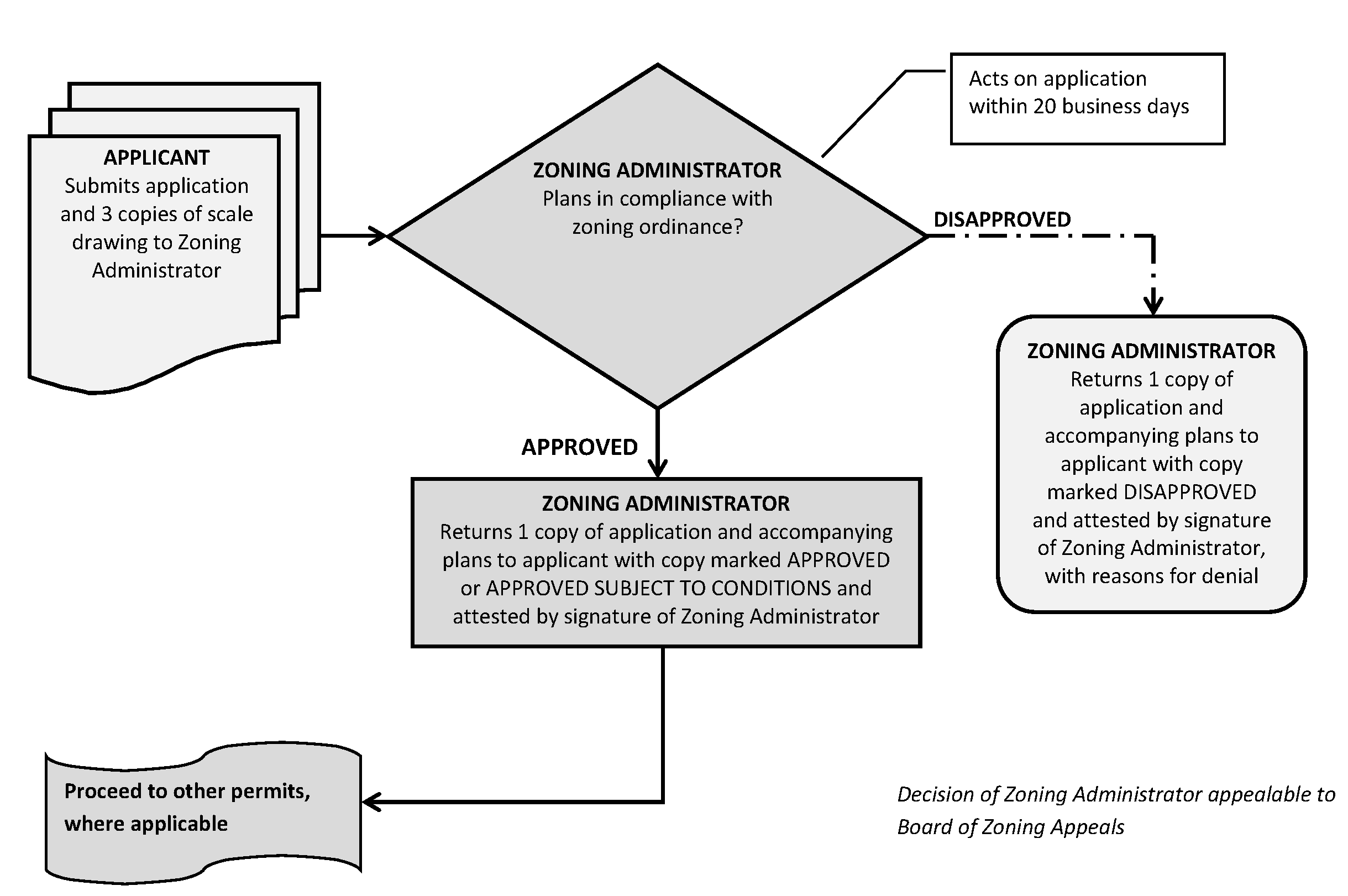
Process Flowchart 9-90-2. Site Plan
See sections 9-30 through 9-36 for specific requirements.
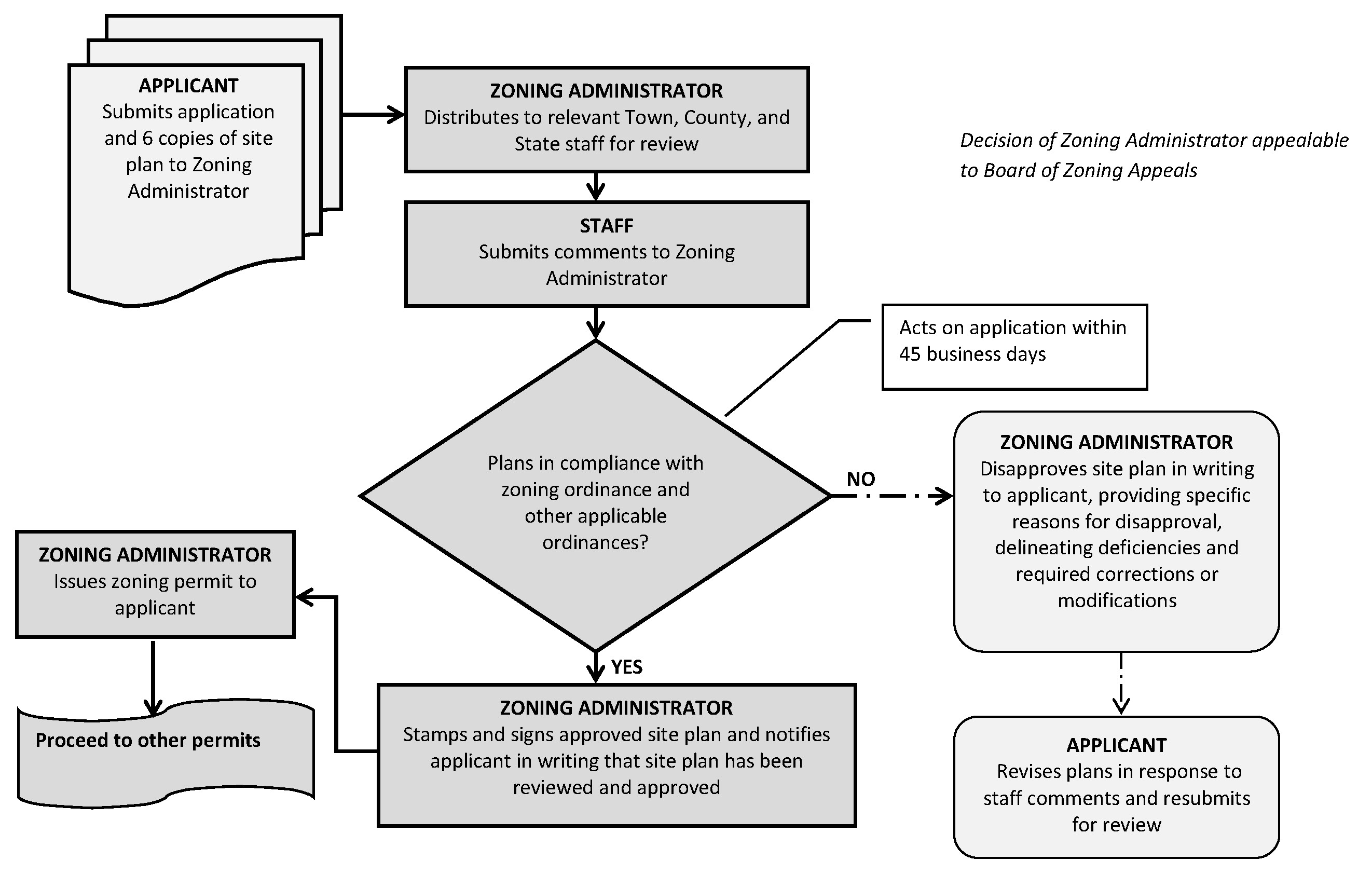
Process Flowchart 9-90-3. Certificate of Appropriateness
See sections 9-40 through 9-48 for specific requirements.
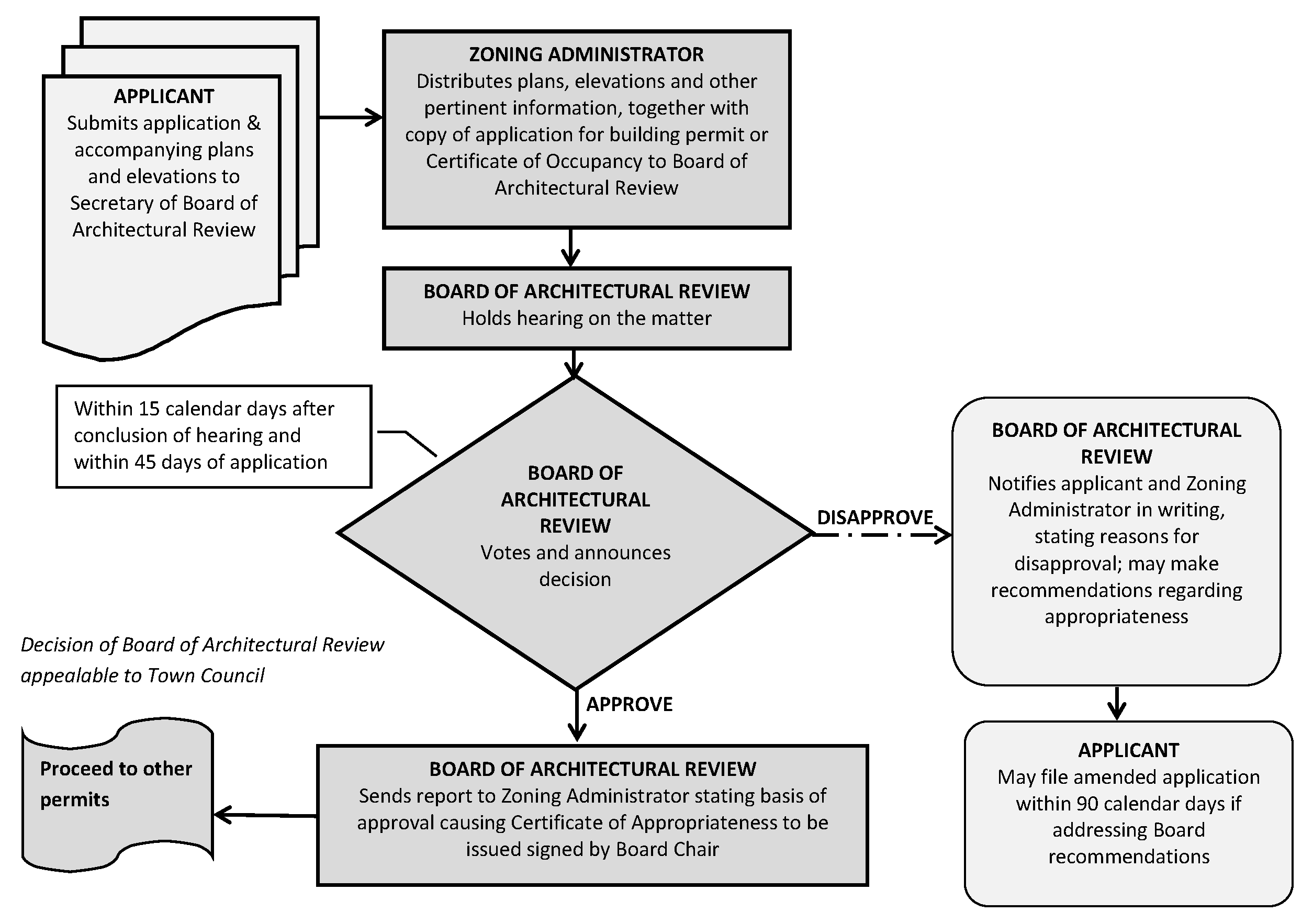
Process Flowchart 9-90-4. Zoning Amendment
See section 9-50 for specific requirements.
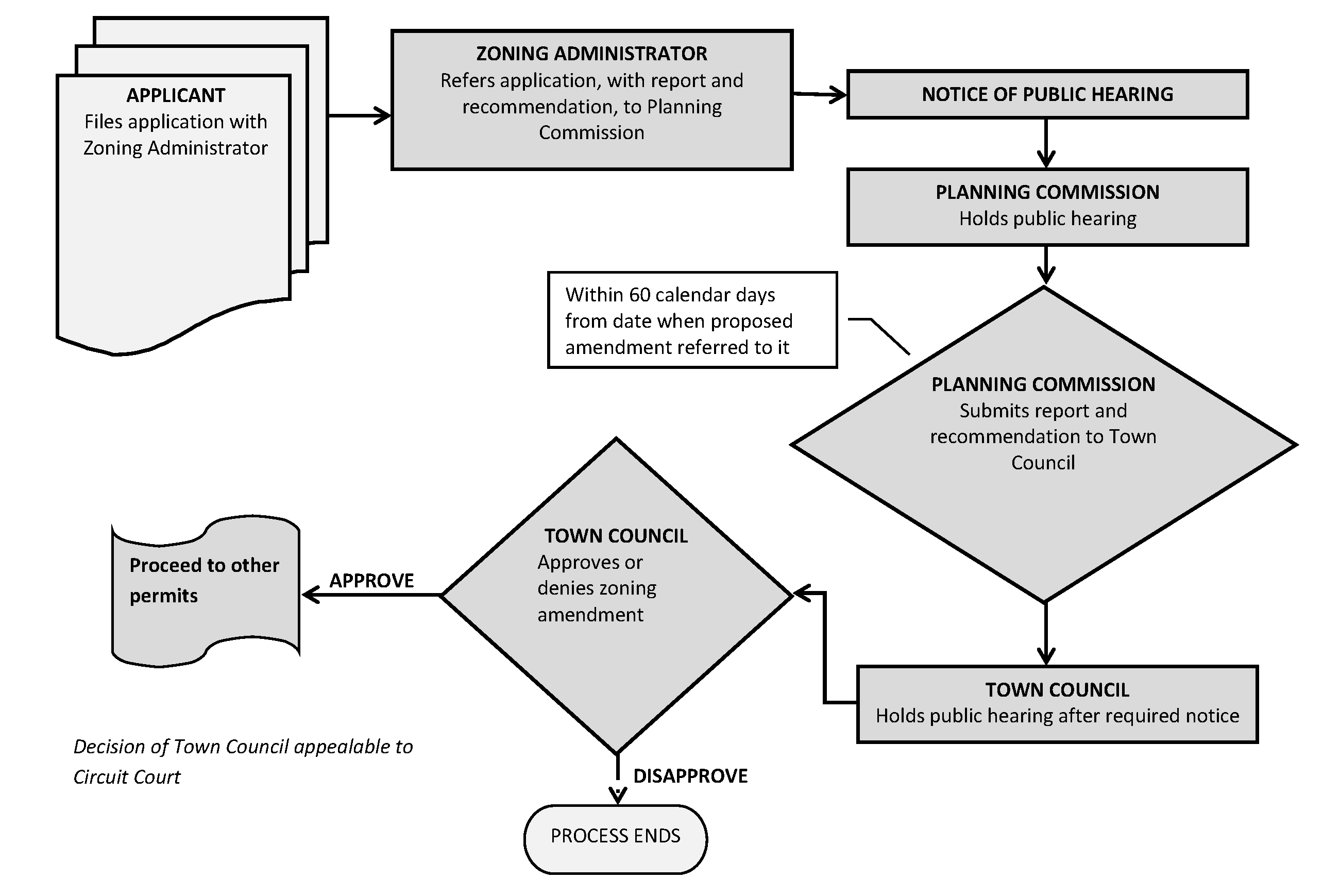
Process Flowchart 9-90-5. Variance
See section 9-70 for specific requirements.
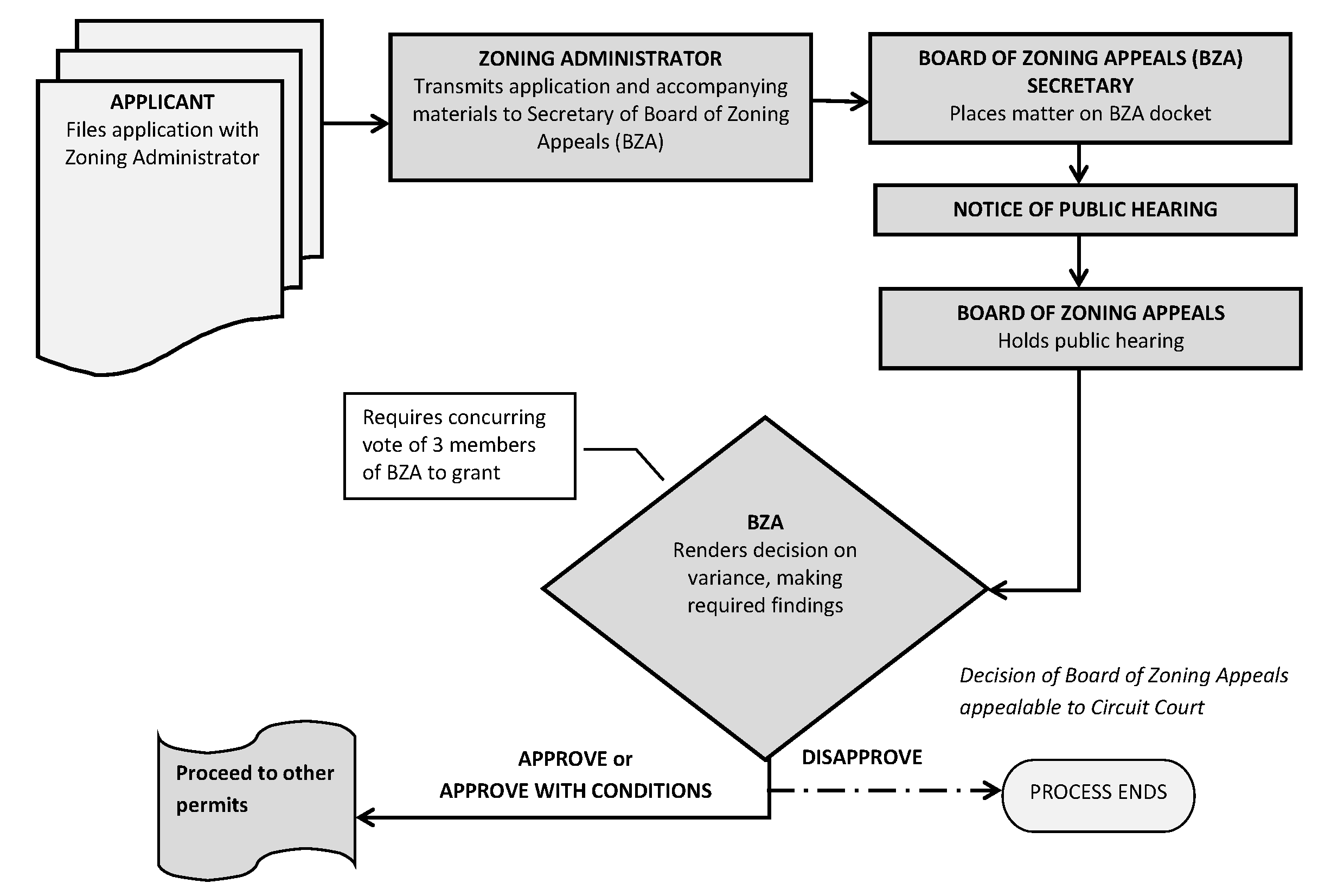
Process Flowchart 9-90-6. Appeal of Determination/Order of Zoning Administrator
See section 9-71 for specific requirements.