
Collinsville City Zoning Code
SECTION 17
910 - EXTERIOR ILLUMINATION
Sec. 17.910.100.- Purpose and intent.
The purpose of this title is to regulate the placement, orientation, distribution patterns, and fixture types of outdoor lighting and shall be applied only to exterior illumination. The intent of this title is to encourage lighting that provides safety, utility, and security also to prevent glare on public roadways, protect the privacy of residents, and reduce atmospheric light pollution.
(Zoning Ord. 2009, § 17.910.100)
Sec. 17.910.110. - Definitions.
The following words, terms and phrases, when used in this Section 17.910, shall have the meanings ascribed to them in this section, except where the context clearly indicates a different meaning:
Disability glare means the eye's line-of-sight contact with a direct light source, which causes a partial blindness.
Footcandle means a unit of measure for illuminance. A unit of illuminance on a surface that is everywhere one foot from a uniform point source of light of one (1) candle and equal to one (1) lumen per square foot.
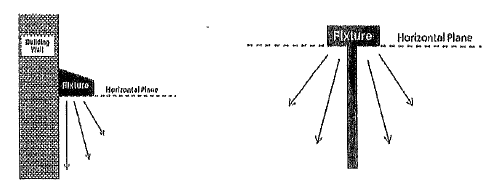
Full cut-off type fixture means a luminaire or light fixture that by design of the housing, does not allow any light dispersion or direct glare to shine above a ninety (90) degree, horizontal plane from the base of the fixture. Full cut-off fixtures must be installed in a horizontal position as designed, or the purpose of the design is defeated, and disability glare will result.
Horizontal illuminance means the measurement of brightness from a light source, usually measured in footcandles or lumens, which is taken through a light meter's sensor at a horizontal position.
Installed means the attachment, or assembly fixed in place, whether or not connected to a power source, of any outdoor light fixture.
Light trespass means light from an artificial light source that is intruding into an area where it is not wanted or does not belong.
Outdoor light fixture means outdoor electronically powered illuminating devices, outdoor lighting or reflective surfaces, lamps and similar devices, permanently installed or portable, used for illumination or advertisement. Such devices shall include, but are not limited to, search, spot and flood lights for:
1.
Buildings and structures;
2.
Recreational area;
3.
Parking lot lighting;
4.
Landscape lighting;
5.
Billboards and other signs (advertising or other);
6.
Street lighting;
7.
Product display area lighting;
8.
Building overhangs and open canopies.
Person means any individual, tenant, lessee, owner, or any commercial entity including but not limited to a firm, business, partnership, joint venture or corporation.
Up lighting means any light source that distributes illumination above a ninety (90) degree horizontal plane.
Ratio means uniformity ratio, describing the average level of illumination in relation to the lowest level of illumination for a given area. Example: U. ratio = 4:1 for the given area, the lowest level of illumination (1) should be no less than % or "4 times less" than the average (4) level of illumination.
(Zoning Ord. 2009, § 17.910.110)
Sec. 17.910.120. - Approved materials and methods of construction, installation or operation.
The provisions of this title are not intended to prevent the use of any design, material, or methods of installation or operation not specifically prescribed by this title, provided any such alternate has been approved. The Zoning Administrator may approve any such proposed alternative provided it:
(1)
Provides at least approximately equivalent to the applicable specific requirement of this title; and
(2)
Is otherwise satisfactory and complies with the purpose and intent of this title.
(Zoning Ord. 2009, § 17.910.120)
Sec. 17.910.130. - Standards.
A.
All exterior lights and illuminated signs shall be designed, located, installed and directed in such a manner as to prevent objectionable light at, and glare across, the property lines and disability glare at any location on or off the property.
B.
The "maintained horizontal illuminance recommendations" set by the Illuminating Engineering Society of North America (IES) shall be observed.
C.
Up lighting is prohibited except for the American flag or unless otherwise regulated. Externally lit signs, display, building and aesthetic lighting must be lit from the top and shine downward. The lighting must be shielded to prevent direct glare and/or light trespass. The lighting must also be, as much as physically possible, contained to the target area. Internally lighted signs are acceptable.
D.
All new and replacement exterior lighting fixtures installed within the city shall be full cut-off or a shielded type, not allowing any upward distribution of light above a horizontal plane as depicted in the images below.
E.
Adjacent to residential property, no direct light source will be visible at the property line at ground level or above.
F.
All nonessential lighting will be required to be turned off after business hours, leaving only the necessary lighting for site security. "Nonessential" lighting shall include all lighting that does not serve to display merchandise or advertise a business name or purpose.
G.
Exterior lighting fixtures used for illumination of any business, parking lot, private drive or residential structure shall not be mounted or installed on any public utility pole or light standard located in any public right-of-way. All such lighting shall be restricted to the private residential, commercial, instructional or industrial parcel on which lighting is sought.
H.
Exterior lighting fixtures used for illumination of any business, parking lot, private drive or residential structure shall not be mounted or installed on any public utility pole or light standard located on any utility easement on the same property that is primarily used for utility transmission lines (electric, phone, cable).
(Zoning Ord. 2009, § 17.910.130; Ord. No. 25-13, § 1, 1-28-2025)
Sec. 17.910.140. - Regulations.
A.
The illumination from any light fixture shall be shaded, shielded, or directed to prevent direct light from being cast upon any adjacent property and/or public thoroughfare. The lighting fixture shall be designed so as not to create more than one (1) footcandle of illumination at any adjacent residentially zoned property or more than five (5) foot-candles at any adjacent commercially zoned property.
B.
No light fixture shall have any blinking, flashing, rotating or fluttering lights or other illuminating device which has a changing light intensity, brightness, or color.
C.
Neither the direct or reflective illumination from any light fixture shall create a traffic hazard to operators of motor vehicles on public thoroughfares.
D.
All off street parking lots or loading areas that are used after dark shall, for safety purposes, contain a system of illumination to provide at least one (1) footcandle of illumination over the area of the parking area to be used.
E.
Display lot lighting not provided for by Section 17.91.140 shall be turned off within thirty (30) minutes after closing of the business on which the display lot lighting is situated. Only security lighting shall be used after 11:00 p.m. unless special arrangements are made or if the business remains open.
F.
Light fixtures used to illuminate objects mounted on a pole, platform, or pedestal shall not use a spotlight, floodlight, or beacon that will extend beyond the intended illuminated object. Lighting of these structures shall cease by 11:00 p.m.
G.
All other outdoor light fixtures lawfully installed prior to and operable on the effective date of the ordinance from which this title is derived are exempt from all requirements unless:
1.
Existing outdoor lighting fixtures are replaced, removed, or reinstalled after the effective date of the ordinance from which this title is derived; or
2.
Existing outdoor lighting systems are determined to be a nuisance to adjoining owner-occupants or that creates a traffic hazard to operators of motor vehicles on public thoroughfares. If deemed a nuisance by the Zoning Administrator, he shall so notify the responsible party and shall order appropriate corrective action as otherwise provided for in this title.
H.
Interior lighting may not be used for, or result in, exterior illumination in a manner that exceeds the provisions of this title.
(Zoning Ord. 2009, § 17.910.140)
Sec. 17.910.150. - Special uses.
A.
Recreational facilities. Any light source permitted by this title may be used for illuminating outdoor recreational facilities (public or private), such as, but not limited to, football fields, soccer fields, baseball fields, softball fields, tennis courts, auto race tracks, horse race tracks or show areas, provided all of the following conditions are met:
1.
Illumination of parking lots and other areas surrounding the playing field, court, or track shall comply with Section 17.910.130.
2.
All fixtures used for event lighting shall be fully shielded as defined in Section 17.910.110 or be designed or provided with sharp cut-off capability, so as to minimize up-light, spill-light, and glare.
3.
All events shall be scheduled so as to complete all activity before or as near to 11:00 p.m. as practical, but under no circumstances shall any illumination of the playing field, court, or track be permitted after 11:59 p.m. except to conclude a scheduled event that was in progress before 11:00 p.m. and circumstances prevented concluding before 11:59 p.m.
B.
Outdoor display lots. Any light source permitted by this title may be used for lighting of outdoor display lots such as, but not limited to, automobile sales or rental, recreational vehicle sales, or building material sales, provided all of the following conditions are met:
1.
Illumination of parking lots and other areas surrounding the display lot shall comply with lighting regulations in the specific area as defined in Section 17.910.130.
2.
All fixtures used for display lighting shall be fully shielded as defined in Section 17.910.110, or be designed or provided with sharp cut-off capability, so as to minimize up-light, spill-light, or glare.
3.
Display lot lighting shall be turned off within thirty (30) minutes after closing of the business. Under no circumstances shall the full illumination of the lot be permitted after 11:00 p.m. Any lighting used after 11:00 p.m. shall be used as security lighting.
(Zoning Ord. 2009, § 17.910.150)
Sec. 17.910.160. - Exemptions.
The following uses shall be exempt from the provisions of this title:
(1)
Roadway and airport lighting and lighting activated by motion sensor devices.
(2)
Temporary circus, fair, carnival, festival, holiday or civic uses.
(3)
Construction or emergency lighting, provided such lighting is temporary and is discontinued immediately upon completion of the construction work or abatement of the emergency necessitating said lighting.
(4)
Temporary lighting or as allowed for in Section 17.910.170.
(5)
Lighting associated with agricultural pursuits.
(Zoning Ord. 2009, § 17.910.160)
Sec. 17.910.170. - Temporary exemption.
A.
Request; renewal; information required. Any person may submit a written request, on a form prepared by the City, to the Zoning Administrator for a temporary exemption request. A temporary exemption shall, at a minimum, contain the following information:
1.
Specific exemption or exemptions requested;
2.
Type and use of outdoor light fixture involved;
3.
Duration of time requested for exemption;
4.
Type of lamp and calculated lumens;
5.
Total wattage of lamp or lamps;
6.
Proposed location on premises of the outdoor light fixture;
7.
Previous temporary exemptions, if any, and address of premises thereunder;
8.
Physical size of outdoor light fixture and type of shielding provided;
9.
Such other data and information as may be required by the Zoning Administrator.
B.
Approval; duration. The Zoning Administrator shall have fifteen (15) business days from the date of submission of the request for temporary exemption to act, in writing, on the request. If approved, the exemption shall be valid for not more than thirty (30) days from the date of issuance of the approval. The approval shall be renewable at the discretion of the Zoning Administrator upon a consideration of all the circumstances. Each such renewed exemption shall be valid for not more than thirty (30) days.
C.
Disapproval; appeal. If the request for temporary exemption is disapproved, the person making the request will have the appeal rights as otherwise provided for in this Title 17.
(Zoning Ord. 2009, § 17.910.170)

