
Collinsville City Zoning Code
SECTION 17
040 - ZONING DISTRICT REGULATIONS
Sec. 17.040.010.- Establishment of districts.
For the purpose of regulating and restricting the use of land, or the use of structures in the City, all land within the City is hereby divided into one of the following districts:
*No additional property shall be rezoned to these districts. District regulations have been provided for existing uses within these districts legally in effect on the date of adoption of this Code.
**Planned Districts shall be used in conjunction with one of the City's existing Zoning Districts. For example, a planned single-family residential development may be zoned "P-R1."
(Zoning Ord. 2009, § 17.040.010)
Sec. 17.040.020. - Historic Preservation Overlay (HPO) District.
Structures or sites that have historic or architectural significance are encouraged to utilize the Historic Overlay District or landmark designation procedures. All proposed Historic Preservation Overlay District requests shall be in accordance with the City's Historic Preservation Ordinance. (See Ordinance 2852 Historic Preservation.)
(Zoning Ord. 2009, § 17.040.020)
Sec. 17.040.030. - Eastport Development Park District.
A.
Definition. The Eastport Development Park shall be defined as that part of the City of Collinsville which lies west of Illinois Route 157 (Bluff Road), and north of Interstate 55/70, and consists of predominately large, flat tracts of land with excellent highway accessibility.
B.
Zoning permitted. The Eastport Development Park was created for the purpose of preserving commercially desirable land for the development of high quality office, commercial, hospitality and industrial users. Only the following zoning districts are permitted within the Eastport Development Park:
_____
C.
Yard regulations. No building or structure shall be constructed or enlarged within the Eastport Development Park unless the following front setback is provided and maintained in connection with such building:
All other minimum yard setbacks shall comply with the requirements of the underlying zoning district, or as designated on the approved site plan.
(Zoning Ord. 2009, § 17.040.030)
_____
Sec. 17.040.040. - Changes to the official zoning district map.
A.
Annexed land. All land which may hereinafter be annexed to the City of Collinsville shall be classified "R1" Single-Family Residential District, and shall be re-classified only after a public hearing by the Planning Commission and recommendation to the Governing Body as provided in these regulations for zoning district amendments. The public hearing by the Planning Commission to adopt a recommendation shall be held prior to annexation of the subject parcel of land to the City.
B.
Right-of-way vacation. Whenever any street, alley or public way is vacated by an official action of the Governing Body, the zoning district adjoining each side of such vacated land shall be automatically extended to the center of the land vacated and all land included in the vacation shall then be subject to the regulations and restrictions of that particular district.
(Zoning Ord. 2009, § 17.040.040)
Sec. 17.040.050. - "R-1" Single-Family Residential District.
A.
Intent. The intent of this district is to provide for low-density residential development, including those uses which reinforce residential neighborhoods, and to allow certain public facilities.
B.
Permitted uses. Single-family dwellings, parks, and related accessory uses are permitted. For a general listing of permitted and conditionally permitted uses, see Table 5.
C.
Accessory uses. For a listing of permitted accessory uses see Section 17.050, Table 5. Section 17.050 also contains specific conditions associated with the permitted Accessory Uses.
D.
Special uses. For a general listing of special uses see Table 5. Special use permits shall be authorized in accordance with Section 17.100.
E.
Planned uses. The Governing Body may increase the intensity of use for any permitted use within the "R1" District in accordance with the Planned District Procedures or the cluster subdivision provisions contained in Section 17.060.
F.
Intensity of use regulations. There shall be no more than one (1) principal dwelling and two (2) accessory structures, including private garages, on each lot.
1.
Minimum district area: five (5) acres.
2.
Minimum lot area: eight thousand (8,000) square feet for single-family dwellings.
3.
Minimum lot width: eighty (80) feet in width at the established building line.
4.
Minimum lot depth: one hundred (100) feet.
5.
Lot coverage: all structures combined shall not cover over twenty-five (25) percent of the total area of the lot.
6.
Exemptions: any lot of record with less area, width or length established at the time of passage of the ordinance from which this title is derived may be used or may continue to be used as permitted and herein regulated.
G.
Maximum structure height. Thirty (30) feet.
H.
Yard regulations. The following yard areas shall be maintained for every principal structure within the "R-1" Single-Family Residential District:
1.
Front yard: twenty-five (25) feet.
2.
Side yard: ten (10) feet.
3.
Rear yard: twenty-five (25) feet.
I.
Parking regulations. See Section 17.070 "Off-Street Parking and Loading Regulations."
J.
Unified control. All open space around or adjacent to building lots shall be landscaped by the developer and shall include such provisions for the ownership and maintenance of the common open spaces as are reasonably necessary to insure its continuity, care, conservation and maintenance, and to insure that remedial measures will be available to the Governing Body if the common open space is permitted to deteriorate, or is not maintained in a condition consistent with the best interests of the development or of the entire community. See also Section 17.030.060.
K.
In-fill design regulations. Prior to issuance of a building permit, any new single-family dwelling proposed on a vacant lot within a developed area (infill) or redevelopment or restoration of more than fifty (50) percent of a structure within a developed area shall be subject the following guidelines:
1.
Parking/garage location. When front entry garages are used special consideration shall be given to the design continuity between the garage and residential structure and to ensure that all building entries (pedestrian oriented) are prominent and visible.
2.
Heating, ventilation, and air conditioning (HVAC) equipment. HVAC equipment shall be located at the rear of buildings, and screened from adjacent properties.
3.
Scale and proportion. New and redeveloped dwellings shall use appropriately scaled building mass, height and entry size, and incorporate architectural features such as gables, porches and windows to complement the surrounding buildings while breaking up the structure's street facade.
4.
Landscaping. Front facades (both yards in the case of corner lots) shall be landscaped in a manner consistent with surrounding buildings. In addition, new and redeveloped dwellings shall maintain the established streetscape by preserving existing or establishing new street trees and providing landscaping that is consistent with the pattern established by surrounding buildings.
5.
Rooflines and pitch. Rooflines and pitch similar to surrounding structures are encouraged, as the similarity establishes a pleasing pattern and rhythm for the streetscape, allowing new construction to blend with the established neighborhood.
6.
Appeals and grievances. In the case an applicant should disagree or have other grievances with staff in the application of the above standards, the applicant shall be directed to formally appear before the Planning Commission for review of such disagreement or other grievance.
7.
Setbacks. All setbacks for the R-l zoning district shall be met, except where over fifty (50) percent of the residential lots on the block are developed with primary structures that do not meet the minimum front yard setback area. In said case, the minimum front yard setback may be averaged. For the purposes of this section, the block shall be identified as all homes on one side of a street, between the two (2) nearest intersecting streets, that clearly define a boundary or establish a crossroad. The average front yard setback of existing homes on the block shall be the established minimum front yard setback for new principal structures, redevelopments, or restorations of more than fifty (50) percent and additions to existing, legally nonconforming structures. In no case shall the setback of the primary structure be less than ten (10) feet from the front property line. Infill development shall not be exempt from Section 17.070—Off-Street Parking/Loading Regulations.
L.
Plain concrete finish shall not be exposed by more than twelve (12) inches in any area of public view on all new construction within this district. Special concrete textures or other treatments may be permitted as approved by the Community Development Director on a case-by-case basis.
(Zoning Ord. 2009, § 17.040.050; Ord. No. 20-101, § 1, 12-1-2020; Ord. No. 24-180, § 1, 12-10-2024)
Sec. 17.040.060. - "R-1A" Single-Family Residential District.
A.
Intent. The R-1A District is intended only for property previously zoned R-1A. All preexisting R-1A property shall be permitted for all lawful uses as of the effective date of these Regulations. After the effective date of these Regulations, no additional land shall be designated or thereby rezoned to the R-1A District. The Planned District options may be used as an alternative to the conventional "R" zoning districts. Use of property maintaining the R-1A preexisting zoning shall be subject to all other regulations of this Code.
B.
Permitted uses. The "R-1A" Single-Family Residential District shall be open to single-family dwellings, parks, and related accessory uses on lots of record established prior to the date of adoption of these Regulations. For a general listing of permitted and conditionally permitted uses, see Table 5.
C.
Accessory uses. For a listing of permitted accessory uses see Section 17.050, Table 5. Section 17.050 also contains specific conditions associated with the permitted Accessory Uses.
D.
Special uses. For a general listing of special uses see Table 5. Special use permits shall be authorized in accordance with Section 17.100.
E.
Planned uses. The Governing Body may increase the intensity of use for any permitted use within the "R-1A" District in accordance with the Planned District Procedures.
F.
Intensity of use regulations. There shall be no more than one (1) principal dwelling and two (2) accessory structures, including a private garage, on each lot.
1.
Minimum district area: five (5) acres.
2.
Minimum lot area: six thousand (6,000) square feet.
3.
Minimum lot width: fifty (50) feet in width at the established building line.
4.
Minimum lot depth: one hundred (100) feet.
5.
Lot coverage: all structures combined shall not cover over thirty (30) percent of the total area of the lot.
6.
Exemptions: any lot of record with less area, width or length established at the time of passage of the ordinance from which this title is derived may be used or may continue to be used as permitted and herein regulated.
G.
Maximum structure height. Thirty (30) feet
H.
Yard regulations. The following yard areas shall be required for every principal structure in the "R-1A" Single-Family Residential District.
1.
Front yard: twenty-five (25) feet.
2.
Rear yard: twenty-five (25) feet.
3.
Side yard: the combined width for both side yards shall be not less than fifteen (15) feet with a minimum of five (5) feet for one side yard and a minimum of ten (10) feet for the other side yard.
I.
Parking regulations. See Section 17.070 Off-Street Parking and Loading Regulations.
J.
In-fill design regulations. Prior to issuance of a building permit, any new single-family dwellings proposed on a vacant lot within a developed area (infill) or redevelopment or restoration of more than fifty (50) percent of a structure within a developed area shall be subject to the following guidelines:
1.
Parking/garage location. When front entry garages are used special consideration shall be given to the design continuity between the garage and residential structure and to ensure that all building entries (pedestrian oriented) are prominent and visible.
2.
Heating, ventilation, and air conditioning (HVAC) equipment. HVAC equipment shall be located at the rear of buildings and screened from adjacent properties.
3.
Scale and proportion. New and redeveloped dwellings shall use appropriately scaled building mass, height, and entry size, and incorporate architectural features such as gables, porches, and windows to complement the surrounding buildings while breaking up the structure's street facade.
4.
Landscaping. Front facades (both yards in the case of corner lots) shall be landscaped in a manner consistent with surrounding buildings. In addition, new and redeveloped dwellings shall maintain the established streetscape by preserving existing or establishing new street trees and providing landscaping that is consistent with the pattern established by surrounding buildings.
5.
Rooflines and pitch. Rooflines and pitch similar to surrounding structures are encouraged, as the similarity establishes a pleasing pattern and rhythm for the streetscape, allowing new construction to blend with the established neighborhood.
6.
Appeals and grievances. In the case an applicant should disagree or have other grievances with staff in the application of the above standards, the applicant shall be directed to formally appear before the planning commission for review of such disagreement or other grievance.
7.
Setbacks. All setbacks for the R-1A zoning district shall be met, except where over fifty (50) percent of the residential lots on the block are developed with primary structures that do not meet the minimum front yard setback area. In said case, the minimum front yard setback may be averaged. For the purposes of this section, the block shall be identified as all homes on one side of a street, between the two (2) nearest intersecting streets, that clearly define a boundary or establish a crossroad. The average front yard setback of existing homes on the block shall be the established minimum front yard setback for new principal structures, redevelopments, or restorations of more than fifty (50) percent and additions to existing, legally nonconforming structures. In no case shall the setback of the primary structure be less than ten (10) feet from the front property line. Infill development shall not be exempt from Section 17.070—Off-Street Parking/Loading Regulations.
(Zoning Ord. 2009, § 17.040.060; Ord. No. 4575, § 1, 1-28-2013; Ord. No. 20-101, § 2, 12-1-2020)
Sec. 17.040.070. - "R-2" One- and Two-Family Residential District.
A.
Intent. Other than single-family dwellings, all other uses within the "R-2" District shall comply with the Planned Use procedures and requirements contained in this section and in accordance with the land use regulations of Section 17.050 Use Regulations. The "R-2" District is established herein to provide opportunities for planned residential development and planned mixed-use developments consisting of a variety of housing types, densities and styles.
B.
Permitted uses. For a general listing of permitted uses, see Table 5.
C.
Accessory uses. For a listing of permitted accessory uses see Section 17.050, Table 5. Section 17.050 also contains specific conditions associated with the permitted Accessory Uses.
D.
Special uses. For a general listing of special uses see Table 5. Special use permits shall be authorized in accordance with Section 17.100.
E.
Planned uses. Attached single-family dwellings (Villas, town homes and duplexes) are permitted as planned uses in accordance with the Planned District procedures. The Governing Body may increase the intensity of use for any permitted use within the "R-2" District in accordance with the Planned District Procedures.
F.
Intensity of use regulations. There shall be no more than one (1) principal dwelling and two (2) accessory structures, including private garages, on each lot.
1.
Minimum district area: five (5) acres.
2.
Minimum lot area single-family home: ten thousand (10,000) square feet.
3.
Minimum lot area two (2) family attached duplex: twelve thousand (12,000) square feet.
4.
Minimum lot width: eighty (80) feet in width at the established building line.
5.
Minimum lot depth: one hundred (100) feet.
6.
Lot coverage: all structures combined shall not cover over thirty (30) percent of the total area of the lot.
G.
Maximum structure height. Thirty (30) feet.
H.
Yard regulations. The following yard areas shall be maintained for every principal structure within the "R-2" One- and Two-Family Residential District.
1.
Front yard: twenty-five (25) feet.
2.
Rear yard: twenty-five (25) feet.
3.
Side yard: where a side yard abuts another lot, a minimum depth of ten (10) feet must be maintained, as measured from the side lot line, except in cases where the dwelling units are originally separate ownership or the dwelling units are subsequently converted to separate ownership, in which cases, no side yard is required between the separately owned dwelling units. In such cases, commonly referred to as zero side lot lines, the separately owned dwelling units shall meet the following requirements:
a.
Each dwelling unit shall contain separate utility connections and separate utility meters.
b.
The common wall separating the dwelling unit shall comply with the BOCA code with respect to fire resistant construction, except that no openings will be permitted.
c.
Where a side yard abuts a street, a minimum of not less than twenty-five (25) feet, as measured from the side lot line.
I.
Parking regulations. See Section 17.070 Off-Street Parking and Loading Regulations.
J.
Unified control. All open space around or adjacent to building lots shall be landscaped by the developer and shall include such provisions for the ownership and maintenance of the common open spaces as are reasonably necessary to insure its continuity, care, conservation and maintenance, and to insure that remedial measures will be avail-able to the Governing Body if the common open space is permitted to deteriorate, or is not maintained in a condition consistent with the best interests of the development or of the entire community. See also Section 17.030.160.
K.
Design guidelines. Prior to issuance of a building permit, all single-family dwellings converted to a two-family or multifamily dwelling, all new or redeveloped single-family attached structures, all new single-family dwellings proposed on a vacant lot within a developed area (infill) and any redevelopment or restoration of more than fifty (50) percent of a structure within a developed area shall be subject to the following guidelines:
1.
Parking/garage location: When front entry garages are used special consideration shall be given to the design continuity between the garage and residential structure and to ensure that all building entries (pedestrian oriented) are prominent and visible.
2.
Heating, ventilation, and air conditioning (HVAC) equipment: HVAC equipment shall be located at the rear of buildings, and screened from adjacent properties.
3.
Scale and proportion: New and redeveloped dwellings shall use appropriately scaled building mass, height and entry size, and incorporate architectural features such as gables, porches and windows to complement the surrounding buildings while breaking up the structure's street facade.
4.
Landscaping: Front facades (both yards in the case of corner lots) shall be landscaped in a manner consistent with surrounding buildings. In addition, new and redeveloped dwellings shall maintain the established streetscape by preserving existing or establishing new street trees and providing landscaping that is consistent with the pattern established by surrounding buildings.
5.
Rooflines and pitch: Rooflines and pitch similar to surrounding structures are encouraged, as the similarity establishes a pleasing pattern and rhythm for the streetscape, allowing new construction to blend with the established neighborhood.
6.
Appeals and grievances: In the case an applicant should disagree or have other grievances with staff in the application of the above standards, the applicant shall be directed to formally appear before the Planning Commission for review of such disagreement or other grievance.
L.
Plain concrete finish shall not be exposed by more than twelve (12) inches in any area of public view on all new construction within this district. Special concrete textures or other treatments may be permitted as approved by the Community Development Director on a case-by-case basis.
(Zoning Ord. 2009, § 17.040.070)
Sec. 17.040.080. - "R-3" Multifamily Residential District.
A.
Intent.
1.
Other than single-family dwellings, all other uses within the "R-3" District shall comply with the Planned Use procedures and requirements contained in this section and in accordance with the land use regulations of Section 17.050 Use Regulations. The "R-3" District is established herein to provide opportunities for planned high-density residential development and planned mixed-use developments consisting of a variety of housing types, densities and styles. A wide range of multifamily densities and dwelling types may also be appropriate in large-scale mixed use developments or as a residential re-use options in obsolete commercial or office centers, except within the Eastport Development Park. However, multifamily development within the City's residential districts shall not permit temporary housing or facilitate, arrange, offer or provide the services and amenities that are typically associated with a traditional hotel or other related businesses. This district is designed for areas served by publicly-provided sanitary sewer.
2.
The regulations contained in this section are the district regulations in the "R-3" Multiple-Family Residential District. These regulations are supplemented and qualified by additional general regulations contained elsewhere in this title, and are incorporated as part of this section by reference.
B.
Permitted uses. For a general listing of permitted and special uses see Table 5. Special use permits shall be authorized in accordance with Section 17.100.
C.
Accessory uses. For a listing of permitted accessory uses see Section 17.050, Table 5. Section 17.050 also contains specific conditions associated with the permitted Accessory Uses.
D.
Planned uses. Cluster subdivisions, attached single-family dwellings over two (2) units (multifamily dwellings), apartments and nursing or convalescent homes are permitted as planned uses in accordance with the Planned District procedures. The Governing Body may increase the intensity of use for any permitted use within the "R-3" District in accordance with the Planned District Procedures or the cluster subdivision provisions contained in Section 17.060.
E.
Intensity of use regulations. There shall be no more than one (1) principal dwelling and two (2) accessory structures, including private garages, on each lot.
1.
Minimum district area: two (2) acres.
2.
Minimum lot width: one hundred (100) feet in width at the established building line.
3.
Minimum lot depth: one hundred (100) feet.
4.
Minimum lot area single-family home: ten thousand (10,000) square feet.
5.
Minimum lot area two-family attached duplex: twelve thousand (12,000) square feet.
6.
Minimum lot area multifamily apartment or townhouse: not less than 14,000 square feet for four (4) or less units and an additional three thousand five hundred (3,500) square feet for each additional unit over four (4). Maximum overall density ten (10) units per acre.
7.
Minimum lot area single-family attached villa: six thousand (6,000) square feet per unit. Maximum overall density six (6) units per acre.
F.
Lot coverage. All structures combined shall not cover over thirty-five (35) percent of the total area of the lot.
G.
Open space. Any development with a density equal to or greater than eight (8) units per acre shall comply with the open space standards contained in Section 17.060 "Supplemental District Regulations."
H.
Unified control. All open space around or adjacent to building lots shall be landscaped by the developer and shall include such provisions for the ownership and maintenance of the common open spaces as are reasonably necessary to insure its continuity, care, conservation and maintenance, and to insure that remedial measures will be available to the Governing Body if the common open space is permitted to deteriorate, or is not maintained in a condition consistent with the best interests of the development or of the entire community. See also Section 17.030, Subsection 160.
I.
Height regulations. Maximum structure height: thirty-five (35) feet.
J.
Yard regulations. The following yard areas shall be maintained for every principal structure in the "R-3" Multiple-Family Residential District:
1.
Front yard: twenty-five (25) feet.
2.
Rear yard: twenty-five (25) feet.
3.
Side yard: Where a side yard abuts another lot, a minimum depth of ten (10) feet must be maintained, as measured from the side lot line, except in cases where the dwelling units are originally separate ownership, in which cases no side yard is required between the separately owned dwelling units. In such cases, commonly referred to as zero side lot lines, the separately owned dwelling units shall meet the following requirements:
a.
Each dwelling unit shall contain separate utility connections and separate utility meters.
b.
The common walls separating the dwelling units shall comply with the BOCA code with respect to fire resistant construction, except that no openings will be permitted.
c.
The zero side lot lines will be permitted in this district only if the principal dwelling consists of twelve (12) units or less.
K.
Parking regulations. See Section 17.070 Off-Street Parking and Loading Regulations.
L.
Landscape regulations. See Section 17.080 Landscaping, Screening and Buffering.
M.
Site plan review. Development in the "R-3" District shall be subject to the requirements and procedures in Section 17.120 Site Plan Review, except for the development of single-family and two-family attached villas.
N.
Design guidelines.
1.
Prior to site plan approval, all new or redeveloped multifamily developments and apartments shall be subject to the review of the multifamily design guidelines contained in Section 17.050 and approval by the Governing Body.
2.
Prior to issuance of a building permit, all new or redeveloped single-family attached structures, all new single-family dwellings proposed on a vacant lot within a developed area (infill) and any redevelopment or restoration of more than fifty (50) percent of a structure within a developed area shall be subject to the following guidelines:
a.
Parking/garage location: When front entry garages are used, special consideration shall be given to the design continuity between the garage and residential structure and to ensure that all building entries (pedestrian oriented) are prominent and visible.
b.
Heating, ventilation, and air conditioning (HVAC) equipment: HVAC equipment shall be located at the rear of buildings, and screened from adjacent properties.
c.
Scale and proportion: New and redeveloped dwellings shall use appropriately scaled building mass, height and entry size, and incorporate architectural features such as gables, porches and windows to complement the surrounding buildings while breaking up the structure's street facade.
d.
Landscaping: Front facades (both yards in the case of corner lots) shall be landscaped in a manner consistent with surrounding buildings. In addition, new and redeveloped dwellings shall maintain the established streetscape by preserving existing or establishing new street trees and providing landscaping that is consistent with the pattern established by surrounding buildings.
e.
Rooflines and pitch: Rooflines and pitch similar to surrounding structures are required, as the similarity establishes a pleasing pattern and rhythm for the streetscape, allowing new construction to blend with the established neighborhood.
f.
Appeals and grievances: In the case an applicant should disagree or have other grievances with staff in the application of the above standards, the applicant shall be directed to formally appear before the planning commission for review of such disagreement or other grievance.
(Zoning Ord. 2009, § 17.040.080)
Sec. 17.040.090. - "R-4" Manufactured Home District.
A.
Intent. The intent of the "R-4" District is to provide for the uniform development of any proposed manufactured home subdivision. All uses within the "R-4" District shall comply with the Planned Use procedures and requirements contained in the Planned District procedures of this section and in accordance with the land use regulations of Section 17.050.
B.
Permitted and special uses. For a general listing of permitted and special uses see Table 5. Special use permits shall be authorized in accordance with Section 17.100.
C.
Accessory uses. For a listing of permitted accessory uses see Section 17.050, Table 5. Section 17.050 also contains specific conditions associated with the permitted Accessory Uses.
D.
Intensity of use regulations. There shall be no more than one (1) principal dwelling and two (2) accessory structures, including private garages, on each lot.
1.
Minimum district area: three (3) acres.
2.
Minimum lot size: six thousand (6,000) square feet.
3.
Maximum density: five (5) units per acre.
4.
Minimum lot width: fifty (50) feet at the established building line.
5.
Minimum lot depth: one hundred (100) feet.
6.
Minimum street frontage: fifty (50) feet.
7.
Maximum lot coverage: thirty-five (35) percent.
E.
Yard requirements. The following yard areas shall be maintained for every principal structure in the "R-4" Manufactured Home District:
1.
Front yard: twenty-five (25) feet.
2.
Rear yard: twenty-five (25) feet.
3.
Side yard: the combined width for both side yards shall be not less than fifteen (15) feet with a minimum of five (5) feet for one side yard and a minimum of ten (10) feet for the other side yard.
F.
Maximum structure height. Fifteen (15) feet.
G.
Site plan review. Development in the "R-4" District shall be subject to the requirements and procedures in Section 17.120 Site Plan Review.
H.
Minimum design standards. Each manufactured home park shall be designed in accordance with all City codes and to the following minimum design standards:
1.
All roadways, sidewalks, and lighting shall be private and shall be in accordance with the requirements of the City of Collinsville's Infrastructure Design Manual.
2.
The perimeter of all manufactured homes shall be fully skirted.
3.
Sidewalks shall be required on both sides of all streets.
4.
All manufactured home lots shall front upon a private hard-surfaced/dust-free roadway of not less than twenty-five (25) feet in width. If parallel parking is permitted on one side of the street, the width shall be increased to thirty (30) feet, and if parallel parking is permitted on both sides of the street, the width shall be increased to thirty-six (36) feet. All roadways shall have unobstructed access to a public street.
5.
Off-street parking areas shall be provided in all manufactured home parks. Such off-street parking areas shall provide sufficient parking spaces for a minimum of two (2) cars per manufactured home within the manufactured home park. Off-street parking areas may be provided on individual manufactured home spaces provided that the off-street parking area is improved as required in Section 17.070, and the off-street parking area surface is not less than ten (10) feet from the nearest adjacent manufactured home space.
6.
A community structure may be provided which may include recreation facilities, laundry facilities, and other similar uses.
7.
A storm shelter shall be provided in accordance with state and federal law.
8.
Final approval for the park shall be obtained before any grading, clearing, installation of streets or moving a manufactured home into any "R-4" district.
I.
Water supply.
1.
Water shall be supplied to the park by a public water system.
2.
The size, location and installation of the water lines shall be in accordance with the requirements of the City of Collinsville's Infrastructure Design Manual.
3.
Individual water service connections shall be provided at each manufactured home space.
J.
Required recreation areas.
1.
In all manufactured home parks accommodating or designed to accommodate twenty-five (25) or more manufactured homes, there shall be one (1) or more recreation areas which shall be easily accessible to all park residents.
2.
The size of such recreation areas shall be based upon a minimum of one hundred (100) square feet for each lot within the manufactured home park. No outdoor recreation area shall contain less than two thousand five hundred (2,500) square feet.
3.
Recreation areas shall be so located as to be free of traffic hazards and should, where the topography permits, be centrally located.
4.
The required recreational area within the manufactured home park shall contain playground equipment or other recreational facilities as approved by the Planning Commission. The cost of purchasing and installing said recreational equipment shall be paid for by the developer of the manufactured home park.
5.
The maintenance of recreation areas and equipment within each manufactured home park shall be paid for by the owner of the manufactured home park.
K.
Sewage disposal. Each manufactured home park shall be connected to the City sanitary sewer system or to a private sewage system as approved by Madison County. Each manufactured home space within a manufactured home park shall be connected to and served by the central sanitary sewer system serving the manufactured home park.
L.
Tie-downs and ground anchors. All manufactured homes shall be secured to the ground by tie-downs and ground anchors in accordance with the Manufactured Home and Recreational Vehicle Code.
M.
Electrical. Each manufactured home space shall be provided with an individual electrical outlet supply which shall be installed in accordance with the building codes of the City and requirements of the electric supplier.
N.
Gas. Natural gas hookups, when provided, shall be installed in accordance with the Building Codes of the City and the regulations of the gas supplier.
O.
Refuse and garbage handling. Storage, collection and disposal of refuse in a park shall be in accordance with City code.
P.
Blocking. All manufactured homes shall be blocked at a maximum of ten (10) foot centers around the perimeter of each manufactured home in accordance with the Manufactured Home and Recreational Vehicle Code and in accordance with the manufacturer's guidelines.
Q.
Pad requirements. Shall be a flexible surface with a minimum of five (5) inch thick gravel, stone or compacted surface, treated to discourage plant growth, constructed to discharge water and edged to prohibit fraying or spreading of surfacing materials; or shall be of a hard surface of a minimum of two (2) eighteen (18) inch wide concrete ribbons or slabs capable of carrying the weight and of sufficient length to support all blocking points of the manufactured home.
(Zoning Ord. 2009, § 17.040.090; Ord. No. 24-196, § 1, 12-10-2024)
Sec. 17.040.100. - "B-1" Office District.
A.
Intent. The "B-1" District is intended only for preexisting B-1 zoning and shall permit as a lawful use only the specific use of the property in effect on the effective date of this Code. After the effective date of this Code, no additional property shall be added to the City's "B-1" zoning district. Any proposed subdivisions, including lot splits, and all redevelopment, change of use, or new construction in an existing "B-1" District, other than as may be authorized as a lawful minor alteration to a nonconforming use, shall require rezoning to the applicable district and application of the requirements therein. Use of property maintaining the preexisting "B-1" zoning classification shall be subject to all other regulations of this Code.
B.
Permitted uses. Generally offices and similar uses are permitted. For a specific listing of permitted uses, see Table 5.
C.
Special uses. For a general listing of permitted and special uses see Table 5. Special use permits shall be authorized in accordance with Section 17.100.
D.
Accessory uses. For a listing of permitted accessory uses see Section 17.050, Table 5. Section 17.050 also contains specific conditions associated with the permitted accessory uses.
E.
Intensity of use regulations.
1.
Minimum district area: no new districts permitted.
2.
Minimum lot area: twelve thousand (12,000) square feet.
3.
Lot coverage: all structures combined shall not cover over forty (40) percent of the lot area.
F.
Maximum structure height. Thirty-five (35) feet.
G.
Yard regulations.
1.
Minimum front yard: twenty-five (25) feet.
2.
Minimum side yard: ten (10) feet.
3.
Minimum rear yard: twenty-five (25) feet, except where a side lot line abuts a street, a minimum depth of fifteen (15) feet must be maintained, as measured from the side lot line.
H.
Parking regulations. See Section 17.070 Off-Street Parking and Loading Regulations.
I.
Landscape regulations. See Section 17.080 Landscaping, Screening and Buffering.
J.
Use limitations.
1.
Outdoor storage: see Section 17.050 for minimum requirements for outdoor storage and display of merchandise.
2.
Exterior lighting: all lighting shall be in compliance with the provisions of Section 17.060, Subsection 120 and 140 and the City's Exterior Illumination Ordinance.
K.
Site plan review. Development in the "B-1" District shall be in accordance with Section 17.120, Site Plan Review.
(Zoning Ord. 2009, § 17.040.100)
Sec. 17.040.110. - "B-2" Limited Commercial District.
A.
Intent.
1.
The "B-2" Commercial District is intended to be a high density, compact pedestrian oriented-comparative shopping facilities, restaurants, entertainment and arts establishments and limited hospitality services would be encouraged and inappropriate or incompatible uses would be prohibited. This district is most suitable for in-fill type commercial development in the older or redeveloping portions of the City where lots sizes are limited.
2.
The regulations contained in this section are the district regulations for the "B-2" Commercial District. These regulations are supplemented and qualified by additional general regulations contained elsewhere in this title and are incorporated as part of this section by reference.
B.
Permitted uses. Generally, commercial, retail, service industries, offices, and similar uses are permitted. For a listing of permitted uses, see Table 5.
C.
Special uses. For a general listing of permitted and special uses see Table 5. Special use permits shall be authorized in accordance with Section 17.100.
D.
Accessory uses. For a listing of permitted accessory uses see Section 17.050, Table 5. Section 17.050 also contains specific conditions associated with the permitted accessory uses.
E.
Planned uses. All Planned Development proposals shall comply with the Planned District procedures contained in this section and the site plan review requirements contained in Section 17.120.
F.
Conditions of use.
1.
There shall be no manufacturing, processing, or treatment of products other than those which are clearly incidental and essential to the retail business conducted on the same premises and not employing more than five (5) persons exclusive of manager, clerks and drivers on any shift.
2.
Loft style dwellings located in upper stories of commercial buildings in downtown Collinsville shall be considered as a special use in accordance with Section 17.100. Street levels should be reserved for retail, hospitality and other commercial services.
3.
Outdoor material and equipment storage. Outdoor storage of equipment or materials is not allowed and any refuse or dumpsters must be screened and totally enclosed prohibiting visibility from the street or neighboring property.
4.
Exterior lighting: All lighting shall be in compliance with the provisions of Section 17.060, Subsection 120 and 140 and the City's Exterior Illumination Ordinance.
5.
The maximum height of accessory structures shall not exceed twenty-five (25) feet or the maximum height of the principal structure, whichever is less.
G.
Intensity of use regulations.
1.
Minimum district size: subject to plan review.
2.
Minimum lot area: six thousand (6,000) square feet.
3.
Lot coverage: all structures combined shall not cover over forty (40) percent of the lot area.
H.
Yard regulations.
1.
Minimum front yard: subject to plan review.
2.
Minimum rear yard: subject to plan review.
3.
Minimum side yard: subject to plan review.
I.
Maximum structure height. Twenty-five (25) feet.
J.
Parking regulations. See Section 17.070 Off-Street Parking and Loading Regulations.
K.
Landscape regulations. See Section 17.080 Landscaping, Screening and Buffering.
L.
Site plan review. Development in the "B-2" District shall be in accordance with Section 17.120, Site Plan Review.
M.
Historic preservation. Structures of historic or architectural significance in the "B-2" district shall be encouraged to utilize the Historic Overlay District or landmark designation procedures.
(Zoning Ord. 2009, § 17.040.110)
Sec. 17.040.120. - "B-3" Expressway Service Commercial District.
A.
Intent. The B-3 District is intended only for preexisting B-3 zoned properties and shall permit and encourage limited retail, service, hospitality, office and other uses which have a regional market area or which require accessibility to the regional transportation system. After the effective date of this Code, no additional property shall be added to the City's B-3 zoning district.
B.
The regulations contained in this section are the district regulations for existing areas zoned "B-3" Expressway Service Commercial District. These regulations are supplemented and qualified by additional general regulations contained elsewhere in this title, and are incorporated as part of this section by reference.
C.
Permitted uses. For a specific listing of permitted uses see Table 5.
D.
Special uses. For a general listing of permitted and special uses see Table 5. Special use permits shall be authorized in accordance with Section 17.100.
E.
Accessory uses. For a listing of permitted accessory uses, see Section 17.050, Table 5. Section 17.050 also contains specific conditions associated with the permitted accessory uses.
F.
Intensity of use regulations:
1.
Minimum district area: No new districts permitted.
2.
Minimum lot size: Ten thousand (10,000) square feet.
3.
Minimum lot width: Seventy (70) feet at the building line.
4.
Maximum lot coverage: Fifty (50) percent.
G.
Yard regulations. No building shall be erected or enlarged unless the following setbacks are provided and maintained in connection with such buildings.
1.
Minimum front yard: There shall be provided on every lot(s) a front setback of not less than forty (40) feet in depth, except that when existing buildings located in this district have already established a building line at a depth less than required above, then all new buildings may conform to the same building line.
2.
Minimum rear yard: A rear setback of not less than twenty (20) feet shall be provided.
3.
Minimum side yard: A side setback of not less than fifteen (15) feet shall be provided.
4.
When abutting a residential district, an approved landscape screen shall be required in accordance with Section 17.080.
H.
Outdoor storage. Outdoor storage shall be prohibited.
I.
Exterior lighting. All lighting shall be in compliance with the provisions of Section 17.910, exterior illumination.
J.
Parking regulations. See Section 17.070, off-street parking and loading regulations.
K.
Site plan review. Development in the B-3 District shall be in accordance with Section 17.120, site plan review.
(Zoning Ord. 2009, § 17.040.120; Ord. No. 4566, § 1, 1-14-2013)
Sec. 17.040.130. - "B-4" Commercial District.
A.
Intent. The "B-4" District is intended only for preexisting B-4 zoned properties and shall encourage and permit medium density, neighborhood scale, compact pedestrian oriented-comparative shopping facilities, restaurants, entertainment and arts establishments, limited hospitality services and limited neighborhood scale office uses. Uses deemed inappropriate and/or incompatible with those uses identified shall be prohibited. After the effective date of this Code, no additional property shall be added to the City's "B-4" zoning district. The regulations contained in this section are the district regulations for existing areas zoned as "B-4" Commercial District. These regulations are supplemented and qualified by additional general regulations contained elsewhere in this chapter and are incorporated as part of this section by reference.
B.
Permitted uses. For a specific listing of permitted uses see table 5.
C.
Special uses. For a general listing of permitted and special uses see Table 5. Special Use Permits shall be authorized in accordance with Section 17.100.
D.
Accessory uses. For a listing of permitted accessory uses see Section 17.050, Table 5. Section 17.050 also contains specific conditions associated with the permitted accessory uses.
E.
Uses limitations.
1.
There shall be no manufacturing, processing, or treatment of products other than those which are clearly incidental and essential to the retail business conducted on the same premises.
2.
Outdoor storage and display of merchandise is permitted in accordance with Section 17.050.
3.
All lighting shall be in compliance with the provisions of Section 17.910, Exterior Illumination.
F.
Intensity of use regulations.
1.
Minimum district area: No new districts permitted.
2.
Minimum lot size: Subject to plan review.
3.
Lot Coverage: Seventy (70) percent
G.
Yard regulations.
1.
Minimum front yard. There shall be provided on every lot(s) a front setback of not less than thirty (30) feet in depth, except that when existing buildings located in this district have already established a building line at a depth less than required above, than all new buildings may conform to the same average building line.
2.
Minimum side yard. A side setback of a minimum of ten (10) feet shall be provided.
3.
Minimum rear yard. A rear setback of a minimum of twenty (20) feet shall be provided.
H.
Parking regulations. See Section 17.070, Off-Street Parking and Loading Regulations.
I.
Landscape regulations. See Section 17.080, Landscape, Screening, and Buffering Requirements.
J.
Site plan review. Development in the "B-4" District shall be in accordance with Section 17.120, Site Plan Review.
(Zoning Ord. 2009, § 17.040.130; Ord. No. 4298, § 1, 2-22-2010)
Sec. 17.040.140. - "B-5" Warehouse Commercial District.
A.
Intent.
1.
The "B-5" District is intended only for preexisting "B-5" zoning and shall permit as a lawful use only the specific use of the property in effect on the effective date of this Code. After the effective date of this Code, no additional property shall be added to the City's "B-5" zoning district. Any proposed subdivisions, including lot splits, and all redevelopment, change of use, or new construction in an existing "B-5" District, other than as may be authorized as a lawful minor alteration to a nonconforming use, shall require rezoning to the applicable district and application of the requirements therein. Use of property maintaining the preexisting "B-5" zoning classification shall be subject to all other regulations of this Code.
2.
The regulations contained in this section are the district regulations for existing area zoned "B-5" Warehouse Commercial District. These regulations are supplemented and qualified by additional general regulations contained elsewhere in this title and are incorporated as part of this section by reference.
B.
Permitted uses. Generally, warehousing, wholesaling and storage of stocks, goods or materials other than live animals, explosives, flammable gasses or liquids except containers of liquefied petroleum or gasses of less than five (5) cubic feet capacity are permitted. For a specific listing of permitted uses, see Table 5.
C.
Special uses. For a general listing of permitted and special uses see Table 5. Special use permits shall be authorized in accordance with Section 17.100.
D.
Accessory uses. For a listing of permitted accessory uses see Section 17.050, Table 5. Section 17.050 also contains specific conditions associated with the permitted accessory uses.
E.
Intensity of use regulations:
1.
Minimum district area: no new districts permitted.
2.
Minimum lot size: twelve thousand (12,000) square feet.
3.
Lot coverage: fifty (50) percent.
F.
Yard regulations:
1.
Minimum front yard: subject to plan review.
2.
Minimum rear yard: subject to plan review.
3.
Minimum side yard: subject to plan review.
G.
Height regulations. Maximum structure height is thirty-five (35) feet.
H.
Use limitations:
1.
All storage of materials, products or equipment, shall comply with the outdoor storage regulations contained in Section 17.050.
2.
No structure shall be used for residential purposes except that a watchman may reside on the premises.
3.
All lighting shall be in compliance with the provisions of Section 17.910, Exterior Illumination.
I.
Site plan review. Development in the "B-5" District shall be in accordance with Section 17.120, Site Plan Review.
J.
Parking regulations. See Section 17.070 Off-Street Parking and Loading Regulations.
K.
Landscape regulations. See Section 17.080 Landscaping, Screening and Buffering.
(Zoning Ord. 2009, § 17.040.140)
Sec. 17.040.150. - "M-1" Industrial District.
A.
Intent.
1.
The "M-1" District delineates areas where a satisfactory correlation of factors such as adequate transportation facilities, accessibility for employees, efficient land assembly, adequate topographical conditions, and adequate provisions of public utilities required by industry may be achieved. It is intended that this particular district will generally provide for light industry of an assembly nature from finished goods, warehousing and wholesaling activities. Supportive services for light industry are generally of non-retail or personal service character and should be encouraged to locate in this district.
2.
The regulations contained in this section are the district regulations in the "M-1" Industrial District. These regulations are supplemented and qualified by additional general regulations contained elsewhere in this title and are incorporated as part of this section by reference.
B.
Permitted uses. For a listing of permitted uses, see Table 5.
C.
Special uses. For a general listing of permitted and special uses see Table 5. Special use permits shall be authorized in accordance with Section 17.100.
D.
Accessory uses. For a listing of permitted accessory uses see Section 17.050, Table 5. Section 17.050 also contains specific conditions associated with the permitted accessory uses.
E.
Planned uses. All Planned Development proposals shall comply with the Planned District procedures contained in this section and the site plan review requirements contained in Section 17.120.
F.
Intensity of use regulations:
1.
Minimum district area: three (3) acres.
2.
Minimum lot size: twelve thousand (12,000) square feet.
3.
Lot coverage: fifty (50) percent.
G.
Maximum structure height. Thirty-five (35) feet.
H.
Yard regulations. No building or structure shall hereafter be erected or structurally altered unless the following setbacks are provided and maintained in connection with such buildings:
1.
Front setback: On every zoning lot or tract, a front setback of not less than thirty (30) feet in depth shall be provided.
2.
Side setback: On every industrial site, a side setback shall be provided along each side lot line. Each side setback shall have a minimum width of twenty (20) feet.
3.
Rear setback: A rear setback sufficient for structural maintenance and/or safety equipment of at least twelve (12) feet in depth shall be provided.
I.
Use limitations:
1.
Outdoor storage is permitted in accordance with Section 17.050.
2.
All lighting shall be in compliance with the provisions of Section 17.910, Exterior Illumination.
3.
No structure shall be used for residential purposes except that a watchman may reside on the premises.
J.
Site plan review. Development in the "M-1" District shall be in accordance with Section 17.120, Site Plan Review.
(Zoning Ord. 2009, § 17.040.150)
Sec. 17.040.160. - "HP-1" Hospitality Park District.
A.
Intent. The "HP-1" Hospitality Park District provides for the development of lodging, restaurant, tourism, and entertainment and related businesses in a planned setting. The intent of this district is to accommodate a variety of hospitality related commercial businesses and their related activities at a scale and intensity of use that is compatible with high quality development. The location factors of the formation of this district relate to present and past land use and development trends, proximity to the interstate highway system, and the position and influence of the Collinsville Convention Center.
B.
Permitted uses. For a listing of permitted uses, see Table 5.
C.
Special uses. For a general listing of permitted and special uses see Table 5. Special use permits shall be authorized in accordance with Section 17.100.
D.
Accessory uses. For a listing of permitted accessory uses see Section 17.050, Table 5. Section 17.050 also contains specific conditions associated with the permitted accessory uses.
E.
Planned uses. All Planned Development proposals shall comply with the Planned District procedures contained in this section and the site plan review requirements contained in Section 17.120.
F.
Intensity of use regulations:
1.
Minimum lot size: one and one-half (1.5) acres.
2.
Minimum lot width: one hundred fifty (150) feet in width at the established building line.
3.
Lot coverage: maximum total lot coverage by structures and parking shall be no greater than sixty-five (65) percent of lot area.
4.
The primary floor area of each principal building shall contain at least four thousand (4,000) square feet, exclusive of antennae, HVAC equipment storage, and parking and loading ramps.
G.
Yard regulations. No building or structure shall be constructed or enlarged unless the following yards are provided and maintained in connection with such building.
1.
Minimum front yard: Each lot upon which a building is constructed shall have a front yard of not less than fifty (50) feet in depth, measured from the street right-of-way line.
2.
Minimum side yard: Each lot upon which a building is constructed shall have a side yard of not less than fifty (50) feet from the side street, or adjoining property line.
3.
Minimum rear yard: There shall be a rear yard of not less than fifty (50) feet. A one (1) story accessory building may be located in the rear yard provided the accessory building is not located closer to the rear lot line than either: twenty (20) feet adjacent or parallel to the rear lot line; or the width of a utility easement on or adjacent to the rear lot line, whichever is greater.
H.
Height regulations. Subject to plan review.
I.
Use limitations:
1.
Accessory commercial sales of goods or services that are subordinate to primary use of structure or offices shall not exceed fifteen (15) percent of structure area.
2.
All lighting shall be in compliance with the provisions of Section 17.910, Exterior Illumination.
J.
Site plan review. All development plans in any "HP-1" District shall be in accordance with Section 17.120, Site Plan Review.
K.
Parking regulations. See Section 17.070, Off-Street Parking and Loading Regulations.
L.
Landscape regulations. See Section 17.080, Landscaping, Screening and Buffering.
M.
Street and roadway standards. All streets and roads within the "HP-1" Hospitality Park District shall be in accordance with the requirements of the City's Infrastructure Design Manual.
(Zoning Ord. 2009, § 17.040.160; Ord. No. 24-196, § 1, 12-10-2024)
Sec. 17.040.170. - "CP-1" Commercial Park District.
A.
Intent. The "CP-1" Commercial Park District provides for the development of large retail stores, discount houses, power centers, outlet malls, and related businesses in a planned setting. The intent of this district is to accommodate a variety of regional retail stores and related commercial businesses and their related activities at a scale and intensity of use that is compatible with high quality development. The location factors of the formation of this district relate to present and past land use and development trends and the proximity to the major highway and interstate highway systems.
B.
Permitted uses. For a listing of permitted uses see Table 5.
C.
Special uses. For a general listing of permitted and special uses see Table 5. Special use permits shall be authorized in accordance with Section 17.100.
D.
Accessory uses. For a listing of permitted accessory uses see Section 17.050, Table 5. Section 17.050 also contains specific conditions associated with the permitted accessory uses.
E.
Planned uses. All Planned Development proposals shall comply with the Planned District procedures contained in this section and the site plan review requirements contained in Section 17.120.
F.
Intensity of use regulations:
1.
Minimum lot size: three (3) acres.
2.
Minimum lot width: two hundred fifty (250) feet in width at the established building line.
3.
Lot coverage: maximum total lot coverage by structures and parking shall be no greater than eighty-five (85) percent of lot area.
4.
The primary floor area of each principal building shall contain at least fifteen thousand (15,000) square feet, exclusive of antennae, HVAC equipment storage, and parking and loading ramps.
G.
Yard regulations. No building or structure shall be constructed or enlarged unless the following yards are provided and maintained in connection with such building.
1.
Minimum front yard: Each lot upon which a building is constructed shall have a front yard of not less than fifty (50) feet in depth, measured from the street, front or side street, right-of-way line.
2.
Minimum side yard: Each lot upon which a building is constructed shall have a side yard of not less than fifty (50) feet from the side street, or adjoining property line.
3.
Minimum rear yard: There shall be a rear yard of not less than fifty (50) feet. A one (1) story accessory building may be located in the rear yard provided the accessory building is not located closer to the rear lot line than either: twenty (20) feet adjacent or parallel to the rear lot line; or the width of a utility easement on or adjacent to the rear lot line, whichever is greater.
H.
Height regulations. Subject to plan review.
I.
Use limitations:
1.
Accessory commercial sales of goods or services that are subordinate to primary use of structure or offices shall not exceed fifteen (15) percent of structure area.
2.
All lighting shall be in compliance with the provisions of Section 17.910, Exterior Illumination.
J.
Site plan review. All development plans in any "CP-1" District shall be in accordance with Section 17.120, Site Plan Review.
K.
Parking regulations. See Section 17.070 Off-Street Parking and Loading Regulations.
L.
Landscape regulations. See Section 17.080 Landscaping, Screening and Buffering.
M.
Street and roadway standards. All streets and roads within the "CP-1" Commercial Park District shall be in accordance with the requirements of the City's Infrastructure Design Manual.
(Zoning Ord. 2009, § 17.040.170; Ord. No. 24-196, § 1, 12-10-2024)
Sec. 17.040.180. - "CP-2" Commercial District.
A.
Intent. The "CP-2" Commercial Park District provides for the development of an Auto Mall or other automobile related retail centers, for sale or service of the automobile or related vehicles, and related businesses in a planned setting. The intent of this district is to accommodate a variety of automobile related commercial businesses and their related activities at a scale and intensity of use that is compatible with high quality development. The location factors of the formation of this district relate to present and past land use and development trends, proximity to the major highways and arterial roadways.
B.
Permitted uses. For a listing of permitted uses see Table 5.
C.
Special uses. For a general listing of permitted and special uses see Table 5. Special use permits shall be authorized in accordance with Section 17.100.
D.
Accessory uses. For a listing of permitted accessory uses see Section 17.050, Table 5. Section 17.050 also contains specific conditions associated with the permitted accessory uses.
E.
Planned uses. All Planned Development proposals shall comply with the Planned District procedures contained in this section and the site plan review requirements contained in Section 17.120.
F.
Intensity of use regulations:
1.
Minimum lot size: two (2) acres.
2.
Minimum lot width: two hundred fifty (250) feet in width at the established building line.
3.
Lot coverage: maximum total lot coverage by structures and parking shall be no greater than eighty-five (85) percent of lot area.
4.
The primary floor area of each principal building shall contain at least four thousand (4,000) square feet, exclusive of antennae, HVAC equipment storage, and parking and loading ramps.
G.
Yard regulations. No building or structure shall be constructed or enlarged unless the following yards are provided and maintained in connection with such building.
1.
Minimum front yard: Each lot upon which a building is constructed shall have a front yard of not less than seventy-five (75) feet in depth, measured from the street, front or side street, right-of-way line.
2.
Minimum side yard: Each lot upon which a building is constructed shall have a side yard of not less than fifty (50) feet from the side street, or adjoining property line.
3.
Minimum rear yard: There shall be a rear yard of not less than fifty (50) feet. A one (1) story accessory building may be located in the rear yard provided the accessory building is not located closer to the rear lot line than either: twenty (20) feet adjacent or parallel to the rear lot line; or the width of a utility easement on or adjacent to the rear lot line, whichever is greater.
H.
Height regulations. Subject to plan review.
I.
Use limitations:
1.
Accessory commercial sales of goods or services that are subordinate to primary use of structure or offices shall not exceed fifteen (15) percent of structure area.
2.
Outdoor storage is permitted in accordance with Section 17.050.
3.
All lighting shall be in compliance with the provisions of Section 17.910, Exterior Illumination.
J.
Site plan review. All development plans in any "CP-2" District shall be in accordance with Section 17.120, Site Plan Review.
K.
Parking regulations. See Section 17.070, Off-Street Parking and Loading Regulations.
L.
Landscape regulations. See Section 17.080, Landscaping, Screening and Buffering.
M.
Street and roadway standards. All streets and roads within the "CP-2" Commercial Park District shall be in accordance with the requirements of the City's Infrastructure Design Manual.
(Zoning Ord. 2009, § 17.040.180; Ord. No. 24-196, § 1, 12-10-2024)
Sec. 17.040.190. - "BP-1" Business Park District.
A.
Intent. The "BP-1" Business Park District provides for the development of corporate office centers, large regional offices, and data centers in a planned setting. The intent of this district is to accommodate a variety of corporate business related businesses and their related activities at a scale and intensity of use that is compatible with high quality development. The location factors of the formation of this district relate to present and past land use and development trends, proximity to the interstate highway system, and the position and influence of the Eastport Development Park and other regional offices.
B.
Permitted uses. For a listing of permitted uses see Table 5.
C.
Special uses. For a general listing of permitted and special uses see Table 5. Special use permits shall be authorized in accordance with Section 17.100.
D.
Accessory uses. For a listing of permitted accessory uses see Section 17.050, Table 5. Section 17.050 also contains specific conditions associated with the permitted accessory uses.
E.
Planned uses. All Planned Development proposals shall comply with the Planned District procedures contained in this section and the site plan review requirements contained in Section 17.120.
F.
Intensity of use regulations:
1.
Minimum lot size: two (2) acres.
2.
Minimum lot width: two hundred fifty (250) feet in width at the established building line.
3.
Lot coverage: maximum total lot coverage by structures and parking shall be no greater than sixty-five (65) percent of lot area.
4.
The primary floor area of each principal building shall contain at least fifteen thousand (15,000) square feet, exclusive of antennae, HVAC equipment storage, and parking and loading ramps.
G.
Yard regulations. No building or structure shall be constructed or enlarged unless the following yards are provided and maintained in connection with such building.
1.
Minimum front yard: Each lot upon which a building is constructed shall have a front yard of not less than seventy-five (75) feet in depth, measured from the street, front or side street, right-of-way line.
2.
Minimum side yard: Each lot upon which a building is constructed shall have a side yard of not less than fifty (50) feet from the side street, or adjoining property line.
3.
Minimum rear yard: There shall be a rear yard of not less than fifty (50) feet. A one (1) story accessory building may be located in the rear yard provided the accessory building is not located closer to the rear lot line than either: twenty (20) feet adjacent or parallel to the rear lot line; or the width of a utility easement on or adjacent to the rear lot line, whichever is greater.
H.
Height regulations. Subject to plan review.
I.
Use limitations:
1.
Warehouse usage allowing for one loading dock and accessory commercial sales of goods or services including (without limitation) financial services (e.g., banks and brokerage firms), professional offices (e.g., lawyers, engineers, and physicians), and restaurants that are subordinate to primary use of structure or offices shall not exceed twenty-five (25) percent of structure area.
2.
All lighting shall be in compliance with the provisions of Section 17.910, Exterior Illumination.
J.
Site plan review. All development plans in any "BP-1" District shall be in accordance with Section 17.120, Site Plan Review.
K.
Parking regulations. See Section 17.070, Off-Street Parking and Loading Regulations.
L.
Landscape regulations. See Section 17.080, Landscaping, Screening and Buffering.
M.
Street and roadway standards. All streets and roads within the "BP-I" Business Park District shall be in accordance with the requirements of the City's Infrastructure Design Manual.
(Zoning Ord. 2009, § 17.040.190; Ord. No. 24-196, § 1, 12-10-2024)
Sec. 17.040.200. - "BP-2" Business Park District (general/ professional office).
A.
Intent. The "BP-2" Business Park District provides for the development of professional office space and general office space and related businesses in a planned setting. The intent of this district is to accommodate a variety of office related businesses and their related activities at a scale and intensity of use that is compatible with high quality development. The location factors of the formation of this district relate to present and past land use and development trends, proximity to the interstate highway system, and the position and influence of the Eastport Development Park and other office development.
B.
Permitted uses. For a listing of permitted uses see Table 5.
C.
Special uses. For a general listing of permitted and special uses see Table 5. Special use permits shall be authorized in accordance with Section 17.100.
D.
Accessory uses. For a listing of permitted accessory uses see Section 17.050, Table 5. Section 17.050 also contains specific conditions associated with the permitted accessory uses.
E.
Planned uses. All Planned Development proposals shall comply with the Planned District procedures contained in this section and the site plan review requirements contained in Section 17.120.
F.
Intensity of use regulations:
1.
Minimum lot size: one (1) acre.
2.
Minimum lot width: one hundred fifty (150) feet in width at the established building line.
3.
Lot coverage: maximum total lot coverage by structures and parking shall be no greater than sixty-five (65) percent of lot area.
4.
The primary floor area of each principle building shall contain at least four thousand (4,000) square feet, exclusive of antennae, HVAC equipment storage, and parking and loading ramps.
G.
Yard regulations. No building or structure shall be constructed or enlarged unless the following yards are provided and maintained in connection with such building.
1.
Minimum front yard: Each lot upon which a building is constructed shall have a front yard of not less than fifty (50) feet in depth, measured from the street, front or side street, right-of-way line.
2.
Minimum side yard: Each lot upon which a building is constructed shall have a side yard of not less than fifty (50) feet from the side street, or adjoining property line.
3.
Minimum rear yard: There shall be a rear yard of not less than fifty (50) feet. A one (1) story accessory building may be located in the rear yard provided the accessory building is not located closer to the rear lot line than either: twenty (20) feet adjacent or parallel to the rear lot line; or the width of a utility easement on or adjacent to the rear lot line, whichever is greater.
H.
Height regulations. Subject to plan review.
I.
Site plan review. All development plans in any "BP-2" District shall be in accordance with Section 17.120, Site Plan Review.
J.
Parking regulations. See Section 17.070 Off-Street Parking and Loading Regulations.
K.
Landscape regulations. See Section 17.080 Landscaping, Screening and Buffering.
L.
Street and roadway standards. All streets and roads within the "BP-2" Business Park District shall be in accordance with the requirements of the City's Infrastructure Design Manual.
(Zoning Ord. 2009, § 17.040.200; Ord. No. 24-196, § 1, 12-10-2024)
Sec. 17.040.210. - "BP-3" Business Park District (general office/ small warehousing).
A.
Intent. The "BP-3" Business Park District provides for the development of professional offices, general office space, and small size warehousing and distribution. The uses are for a hybrid development of businesses in a planned setting. The intent of this district is to accommodate a variety of office and warehousing uses on a smaller scale and their related activities at a scale and intensity of use that is compatible with high quality development. The location factors of the formation of this district relate to present and past land use and development trends and the proximity to major transportation routes.
B.
Permitted uses. For a listing of permitted uses see Table 5.
C.
Special uses. For a general listing of permitted and special uses see Table 5. Special use permits shall be authorized in accordance with Section 17.100.
D.
Accessory uses. For a listing of permitted accessory uses see Section 17.050, Table 5. Section 17.050 also contains specific conditions associated with the permitted accessory uses.
E.
Planned uses. All Planned Development proposals shall comply with the Planned District procedures contained in this section and the site plan review requirements contained in Section 17.120.
F.
Intensity of use regulations:
1.
Minimum lot size: one and one-half (1.5) acres.
2.
Minimum lot width: one hundred fifty (150) feet in width at the established building line.
3.
Lot coverage: maximum total lot coverage by structures and parking shall be no greater than sixty-five (65) percent of lot area.
4.
The primary floor area of each principal building shall contain at least four thousand (4,000) square feet and no more than fifty thousand (50,000) square feet.
G.
Yard regulations. No building or structure shall be constructed or enlarged unless the following yards are provided and maintained in connection with such building.
1.
Minimum front yard: Each lot upon which a building is constructed shall have a front yard of not less than seventy-five (75) feet in depth, measured from the street, front or side street, right-of-way line.
2.
Minimum side yard: Each lot upon which a building is constructed shall have a side yard of not less than fifty (50) feet from the side street, or adjoining property line.
3.
Minimum rear yard: There shall be a rear yard of not less than fifty (50) feet. A one (1) story accessory building may be located in the rear yard provided the accessory building is not located closer to the rear lot line than either: twenty (20) feet adjacent or parallel to the rear lot line; or the width of a utility easement on or adjacent to the rear lot line, whichever is greater.
H.
Height regulations. Subject to plan review.
I.
Use Limitations. Accessory commercial sales of goods or services that are subordinate to primary use of structure or offices shall not exceed fifteen (15) percent of structure area.
J.
Site plan review. Development in the "BP-3" District shall be in accordance with Section 17.120, Site Plan Review.
K.
Parking regulations. See Section 17.070 Off-Street Parking and Loading Regulations.
L.
Landscape regulations. See Section 17.080 Landscaping, Screening and Buffering.
M.
Street and roadway standards. All streets and roads within the "BP-3" Business Park District shall be in accordance with the requirements of the City's Infrastructure Design Manual.
(Zoning Ord. 2009, § 17.040.210; Ord. No. 24-196, § 1, 12-10-2024)
Sec. 17.040.220. - "BP-4" Business Park District (distribution/ assembly/warehousing).
A.
Intent. The "BP-4" Business Park District provides for the development of warehousing, assembly, distribution industries and related businesses in a planned setting. The intent of this district is to accommodate a variety of industrial highway related businesses and their related activities at a scale and intensity of use that is compatible with high quality development. The location factors of the formation of this district relate to present and past land use and development trends, the proximity to the interstate highway system, and the position and influence of the Eastport Development Park.
B.
Permitted uses. For a listing of permitted uses see Table 5.
C.
Special uses. For a general listing of permitted and special uses see Table 5. Special use permits shall be authorized in accordance with Section 17.100.
D.
Accessory uses. For a listing of permitted accessory uses see Section 17.050, Table 5. Section 17.050 also contains specific conditions associated with the permitted accessory uses.
E.
Planned uses. All Planned Development proposals shall comply with the Planned District procedures contained in this section and the site plan review requirements contained in Section 17.120.
F.
Intensity of use regulations:
1.
Minimum lot size: five (5) acres.
2.
Minimum lot width: five hundred (500) feet in width at the established building line.
3.
Lot coverage: maximum total lot coverage by structures and parking shall be no greater than seventy-five (75) percent of lot area.
4.
The primary floor area of each principal building shall contain at least twenty thousand (20,000) square feet, exclusive of antennae, HVAC equipment storage, and parking and loading ramps.
G.
Yard regulations. No building or structure shall be constructed or enlarged unless the following yards are provided and maintained in connection with such building.
1.
Minimum front yard: Each lot upon which a building is constructed shall have a front yard of not less than one hundred (100) feet in depth, measured from the street, front or side street, right-of-way line.
2.
Minimum side yard: Each lot upon which a building is constructed shall have a side yard of not less than one hundred (100) feet from the side street, or adjoining property line.
3.
Minimum rear yard: There shall be a rear yard of not less than one hundred (100) feet. A one (1) story accessory building may be located in the rear yard provided the accessory building is not located closer to the rear lot line than either: twenty (20) feet adjacent or parallel to the rear lot line; or the width of a utility easement on or adjacent to the rear lot line, whichever is greater.
H.
Height regulations. Subject to plan review.
I.
Use limitations. Accessory commercial sales of goods or services that are subordinate to primary use of structure or offices shall not exceed fifteen (15) percent of structure area.
J.
Site plan review. Development in the "BP-4" District shall be in accordance with Section 17.120, Site Plan Review.
K.
Parking regulations. See Section 17.070, Off-Street Parking and Loading Regulations.
L.
Landscape regulations. See Section 17.080, Landscaping, Screening and Buffering.
M.
Street and roadway standards. All streets and roads within the "BP-4" Business Park District shall be in accordance with the requirements of the City's Infrastructure Design Manual.
(Zoning Ord. 2009, § 17.040.220; Ord. No. 24-196, § 1, 12-10-2024)
Sec. 17.040.230. - Planned development districts.
A.
Intent.
1.
One of the principal objectives of the Zoning Ordinance is to provide for a compatible arrangement of uses of land and buildings that is consistent with the requirements and welfare of the City. To accomplish this objective, most uses are classified as permitted or special uses in one (1) or more of the districts established by the Zoning Ordinance. However, it is recognized that there are certain uses that, because of their scope, location or specific characteristics, give raise to a need for a more comprehensive consideration of their impact, both with regard to the neighboring land and the City in general. Such uses fall within the provisions of this section and shall only be permitted if authorized as a planned development.
2.
Applications for Planned Development shall specify the intended land use, complete with a description of said use and the intended underlying zoning district or districts. The nearest similar conventional zoning district, use regulations or other regulatory provisions shall apply except as specifically adjusted for the particular development, such as, but not limited to, reduced lot sizes or setbacks. Planned zoning districts and their equivalent districts are as follows:
_____
_____
B.
Objective. The objective of the Planned District Procedure is to enable the granting of certain allowances or modifications from the basic provisions of the Zoning Ordinance to achieve attractive and timely development in furtherance of the City of Collinsville's objectives and proposed land uses as stated in the Comprehensive Plan. Through the flexibility of the planned development process, the City seeks to achieve one (1) or more of the following specific objectives:
1.
Creation of a more desirable environment than may be possible through the strict application of other City land use regulations.
2.
Promotion of a creative approach to the use of and related physical facilities resulting in better design and development implementation, including aesthetic amenities.
3.
Combination and coordination of the character, the form and the relationship of structures to one another.
4.
Preservation and enhancement of desirable site characteristics such as natural topography, vegetation and geologic features.
5.
The beneficial use of open space.
6.
Encouragement of land use or combination of uses that maintain the existing character and property values of the City and promote the public health, safety, comfort, and general welfare of its residents.
7.
Promotion of long-term planning pursuant to a site plan that will allow harmonious and compatible land uses or combination of uses with surrounding areas.
8.
Promotion of economic development within the City.
C.
Procedures. The reclassification of any property to a Planned District shall constitute a "rezoning" and therefore must comply with the regulations contained in Section 17.150 "Amendments." Site plans and all other associated exhibits shall be required in accordance with the procedures and requirements as set out in Section 17.110 "Planned District Procedures" and Section 17.120 "Site Plan Review."
D.
Minimum area. There shall be no minimum area.
E.
Permitted uses. Planned developments will generally be limited to those uses or combinations of uses currently permitted in the underlying zoning district or those designated as "Planned Uses" in Table 5. An applicant shall petition for consideration of a use or combination of uses not specifically allowed in the underlying zoning district. If the Governing Body finds that the conditions, procedures and standards of this section are met and that such use or combination of uses is shown to be beneficial to the City, the uses shall be depicted on a site plan in accordance with this section and Section 17.120. The Governing Ordinance authorizing a Planned District shall depict the specific uses permitted within that district. A description of any use not defined in Section 17.020, or uses that may deviate from the definitions provided in this title, shall be required and approved prior to the authorization of any use in any Planned District.
F.
Permitted accessory structures and uses. Accessory uses clearly associated with and supplementary to the principal use of the lot or tract of land may be permitted as approved by the Planning Commission and in accordance with Section 17.050. Requested accessory uses must be specified on the site plan.
G.
Performance/bulk standards. A Planned District Development shall be consistent with the general standards for use of land, and the use, type, bulk, design, and location of buildings, the density or intensity of use, open space and public facilities as set out in the underlying District Regulations, and other applicable Sections of these regulations.
H.
Conditions of use. Approval of the final development plan may be conditioned by the Planning Commission to minimize any negative impact on the community. Planned developments shall adhere to the following:
1.
Open space: A minimum of thirty (30) percent of the net area of that part of a Planned Development reserved for residential development shall be provided for open space as defined by these regulations. At least one-half of this open space or twenty (20) percent of the net area devoted to residential development shall be provided for common open space for the leisure and recreational use of the residents and owned and maintained in common by them, generally through a homeowner's association. The common open space shall be developed for appropriate recreational facilities, and a minimum of fifty (50) percent of the proposed recreational facilities shall be constructed prior to the development of one-half of the project, and all recreational facilities shall be constructed by the time the project is seventy-five (75) percent developed.
2.
Unified ownership: All planned developments shall include such provisions for the ownership and maintenance of the common open spaces as are reasonably necessary to insure its continuity, care, conservation and maintenance, and to insure that remedial measures will be available to the Governing Body if the common open space is permitted to deteriorate, or is not maintained in a condition consistent with the best interests of the Planned Development or of the entire community. The Community Development Director may require assurance of the financial and administrative ability of any agency created by a developer for the purpose of maintaining common open space and facilities of a nonpublic nature. See also Section 17.030.160.
3.
Utilities: All Planned District Developments shall be connected to the City water and sewer system.
4.
Parking: Parking shall be provided in a manner that reduces to a minimum its adverse physical impact in the area. Screening parking areas with landscaping or walls, breaking parking areas into smaller units by introducing landscaped areas or other physical separators shall be required in accordance with Section 17.070 Off-Street Parking and Section 17.080 Landscaping, Buffering and Screening. The parking areas should be appropriately spaced to serve those units they represent.
5.
Traffic: Each planned district request shall provide a technical assessment letter from a licensed professional engineer describing the level of impact the development may have on the local transportation system and a circulation plan meeting the requirements of the City's Infrastructure Design Manual. The Community Development Director may waive this requirement or may require a complete transportation impact analysis depending on the nature of the development.
6.
Sidewalks: Sidewalks shall be required in accordance with the City's Infrastructure Design Manual.
7.
Any modifications of the underlying zoning or other regulations that would otherwise be applicable to the site may be permitted, providing the design of the Planned Development and the amenities incorporated in it is consistent with the City's Comprehensive Plan and the interest of the public generally.
I.
Design criteria. Planned developments shall observe the following design criteria:
1.
The overall plan shall be comprehensive, embracing land, buildings, landscaping and their inter-relationships and shall conform in all respects to all adopted plans of all governmental agencies for the area in which the proposed development is located.
2.
The plan shall provide for adequate open space, circulation, off-street parking, and pertinent amenities. Buildings, structures and facilities in the parcel shall be well integrated, oriented and related to the topographic and natural landscape features of the site.
3.
The proposed development shall be compatible with existing and planned land use, and with circulation patterns on adjoining properties. It shall not constitute a disruptive element to the neighborhood and community.
4.
The internal street system shall not be a dominant feature in the overall design, rather it shall be designed for the efficient and safe flow of vehicles without creating a disruptive influence on the activity and function of any common areas and facilities.
5.
Common areas and recreational facilities shall be so located so as to be readily accessible to the occupants of the dwelling units and shall be well related to any common open spaces provided.
6.
Architectural design within the development and within the neighborhood and community shall respect the scale and character of the adjacent development. Attention to views, building scale and orientation, proximity to adjacent uses, location of driveways, noise, lighting and landscape should be respected.
J.
Escrow or surety bond. Before starting construction of any Planned Development, the applicant must post a surety bond with the Department of Community Development in an amount equal to the estimated construction cost, as determined by the developer and approved by the City authorities after consultation with the City engineers or consultants, of all improvements intended to be dedicated.
K.
Subdivision requirements. Applicants for a Planned District shall meet all applicable requirements contained in the City of Collinsville Subdivision Control Ordinance.
(Zoning Ord. 2009, § 17.040.230; Ord. No. 24-196, § 1, 12-10-2024)
Sec. 17.040.240. - "PUD" Planned Unit Development.
A.
Intent.
1.
The Planned Unit Development District is intended only for property previously zoned PUD. All preexisting PUD developments shall be permitted as lawful uses as of the effective date of this Code. After the effective date of this Code, no additional land shall be designated or thereby rezoned utilizing the Planned Unit Development process, unless otherwise authorized by the Governing Body. Planned development petitions shall utilize the Planned District Procedure in lieu of the Planned Unit Development procedure. The preexisting PUD requirements are listed here for Planned Unit Developments established prior to the adoption of this Code.
2.
The purpose of this district is to provide areas suitable for planned unit developments. The Planned Unit Development District is designed to provide for site design and utilization in areas favorable for growth but experiencing a variety of developmental problems, or for areas having access to urban services, utilities, and public improvements containing potentially significant site planning advantages for planned unit developments. Problems may relate to existing or future traffic, land acquisitions, topographical, utility and related problem areas. It is the intent of this district to maximize the public welfare and to provide the flexibility needed by developers to potentially enhance the aesthetic quality, consumer benefits and marketability of multiple- and single-use developments, and to reduce the capital investment necessary for development, utilities and public improvements.
3.
The regulations contained in this section are the district regulations in the "PUD" Planned Unit Development District. These regulations are supplemented and qualified by additional general regulations contained elsewhere in this title and are incorporated as part of this section by reference.
B.
Minimum area. The minimum Planned Unit Development District size is two (2) acres.
C.
Permitted uses. Any residential, commercial or industrial uses or combinations thereof as approved by the Planning Commission and amendment to the Zone Map by ordinance are permitted.
D.
Intensity of use.
1.
The density of residential developments or the residential portion of multiple use developments shall not exceed the maximum dwelling unit density for the same uses in the appropriate residential districts of this title, unless the Planning Commission, in its discretion, specifically approves the project with a higher dwelling unit density. The acreage used in computing the dwelling units per acre shall be the net acreage as defined under "Area, Buildable," in the definitions.
2.
Example: A multiple family "PUD" development shall not exceed a density of one (1) dwelling unit per three thousand (3,000) square feet of net area, unless the Planning Commission approves the project with a more dense dwelling unit use.
E.
Conditions of use:
1.
General. The Planned Unit Development can be planned and developed to result in an environment of superior quality than can be achieved under traditional zoning requirements and practices.
2.
Natural features. Provisions shall be made to accommodate and assure the maintenance of unique natural and manmade amenities such as streams, stream banks, wooded areas, rough terrain, historic sites and similar areas.
3.
Unified control. The land is or will be under continuing unified control during and after construction, subject to the restrictions of this section.
4.
Open space. Common or public open space shall be provided in sufficient quantity for amenity and recreational purposes. The quantity of open and recreation space in residential developments shall be a minimum of twenty-five (25) percent of total land area and additionally, shall be appropriate to the scale and character of the Planned Unit Development, considering its size, density, expected population, topography, and the number, type, and density of land uses to be provided.
5.
Utilities. All Planned Unit Developments shall be connected to the City's water and sewer system.
6.
Information required. Applicants for a "PUD" District shall furnish the information requested in Section 17.56.080. Additionally, refer to Chapter 17.108 for amendment procedures.
7.
Subdivision requirements. Applicants for a "PUD" District shall meet all applicable requirements contained in the City of Collinsville Subdivision Control Ordinance.
8.
Changes after "PUD" completion. After the final plan or plat has been approved and construction has been completed, changes in use or land area shall only be by a zoning amendment consistent with the intent and purpose of the "PUD" except for changes which may increase the bulk of any building or a rearrangement of land use by not more than ten (10) percent.
F.
Permitted accessory structures and uses. Accessory uses clearly associated with and supplementary to the principal use of the lot or tract of land may be permitted as approved by the Planning Commission.
G.
Off-street parking and loading requirements. The off-street parking and loading requirements and regulations in the "PUD" District are to be the same requirements and regulations as specified for the same uses in the other districts of this title.
H.
Applications and permits. The applicant shall submit to the Community Development Director four (4) copies of zoning applications, four (4) copies of building applications, and the applications shall contain both a graphic and written description of the proposal. All applications shall be one (1) inch equals one hundred (100) feet, if possible, or a scale necessary for clarity, and if more than one map is submitted, a map index is required.
1.
Photographs of the site (aerial photos are acceptable).
2.
The existing natural topographic features of the project area and its immediate surroundings. USGS ten (10) foot contour data is acceptable.
3.
Number of dwelling units by type and gross density per acre.
4.
The approximate location, size, character and number of all proposed buildings, structures and uses.
5.
The location and size of proposed off-street parking, loading and pedestrian and vehicular traffic circulation, and its relationship to adjacent circulation systems.
6.
Landscaping, erosion and sedimentation control features.
7.
Location of public and/or private utilities and facilities proposed to serve the subject area, including water supply, sewage and drainage facilities.
8.
Proposed finished grade of the site.
9.
Perspective or such other drawings as are necessary to indicate the relative character and compatibility of the different land uses of the proposed development with the immediate area as well as within the project area.
I.
Narrative. The narrative statement to accompany graphics material as part of the application shall contain, at a minimum, the following information:
1.
Development schedule providing guidelines and sequence for the completion of the proposed development.
2.
A description of the economic viability of the development may be required to include a market analysis, cash flow projections and expected types of funding.
3.
The nature and extent of clearing and grading.
4.
A statement of the present ownership of all land within the subject area, and, if identification has not been established, an explanation of the method of securing unified development control throughout the "PUD" area, both during and after construction. Unified control after construction shall include homeowner associations, trust indentures, deed restrictions and other building agreements assuring operating and maintenance of common lands and improvements.
J.
Impact requirements. The applicant shall project expected impacts of the development to include, but not be limited to:
1.
A description of the projected population, in total and by age group categories, and an explanation of the methods by which such projections were derived.
2.
Anticipated kinds of commercial and industrial development and their projected employment.
3.
Volume and nature of projected traffic.
4.
Water consumption and supply.
5.
Sewage generation and treatment.
6.
Drainage facility and system requirements.
K.
Subdivision ordinance requirements. Planned Unit Developments shall meet all development and construction standards as required in the Collinsville Subdivision Ordinance.
L.
Surety bond.
1.
Before starting construction of any Planned Unit Development, the applicant must post a surety bond with the Department of Community Development in an amount equal to the estimated construction cost, as determined by the developer and approved by the City authorities after consultation with the City engineers or consultants, of all improvements intended to be dedicated.
2.
Some "PUD" Developments may consist of dwelling units which after construction are individually sold to others. A common term for this type of development is "Condominium." The individual units may be houses, villas, apartments or suites.
3.
These developments shall include recreational areas and/or buildings, open spaces, tennis courts, swimming pools, and so forth, which are dedicated to an approved private legal entity usually consisting of the individual dwelling unit owners.
4.
Before starting construction of this type of development, the applicant must post a surety bond with the Department of Community Development, in an amount equal to the estimated construction cost, as determined by the developer and approved by the City authorities after consultation with the City engineers or consultants, of all improvements intended to be dedicated.
(Zoning Ord. 2009, § 17.040.240)
Sec. 17.040.250. - "UCD" Uptown Collinsville District.
A.
Intent.
1.
The Uptown District promotes the redevelopment of buildings and land located within the Uptown Planning Area in a manner that is consistent with the City Comprehensive Plan. The intent of this district is to facilitate the development of a traditional, pedestrian-oriented main street area. Forms and patterns of the built environment shall reflect the recommendations outlined in the City Comprehensive Plan and meet the requirements of this section.
2.
Buildings containing retail and service uses on the first floor, and offices, services or residences on upper floors, shall be located, and have frontage on, Main Street and Clay Street. Such mixed-use buildings shall meet the urban design standards as noted in this section and shall be linked to and complemented by integrated residential development within the district and nearby neighborhoods.
3.
Residential development shall consist of single-family or multi-family residential units constructed using traditional neighborhood design principles; shall feature pedestrian-oriented streetscapes; and shall feature a system of neighborhood open spaces, all as defined in this section.
B.
General applicability. All properties located within the limits of the Uptown Planning Area, as identified within the City Comprehensive Plan, shall be required to follow the requirements of this section when meeting any of the following criteria:
1.
Upon change of use or use expansion greater than twenty (20) percent of the area of building or lot dedicated to that use, said property shall be required to adhere to the regulations and process identified within this section.
2.
All new buildings, exterior alterations and expansions to existing buildings greater than twenty (20) percent, are subject to the regulations and process identified within this section.
3.
An existing building or use shall be permitted to continue as long as no physical changes or expansions of the use or building that require site plan approval are proposed. If changes, expansions or alterations requiring site plan approval are proposed, then the building, site and use shall be brought into compliance with the requirements of this district.
4.
Any structural changes to buildings (e.g., additions, changes to windows and entries) shall meet the architectural standards of this district.
C.
Proposals requiring site plan review and approval. Use and development of land within the district shall be regulated as follows:
1.
All new buildings, and exterior alterations and expansions to existing buildings, are subject to the site plan requirements as identified in Section 17.120, Site Plan Review. Additional conditions of approval may be imposed on a site plan.
2.
When a substantial change in use is proposed that does not require an addition or modification to an existing building or site, the building and site both shall be brought into compliance with the requirements of this district to the maximum extent practical, as determined by the Planning Commission.
3.
Use permissibility shall correspond with the guidance for use contained within the City Comprehensive Plan for the Uptown Planning Area. The following land uses shall be expressly prohibited within the district; manufactured and modular homes, adult entertainment businesses, agricultural sales and service, assembly industries, automotive parts and supply stores, automotive sales and lease, automotive rental agency, automotive service station, automotive repair shop, automotive washing (car wash), composting facility, construction sales and service, freight terminal, industrial use (light and heavy), machine shops for tool and die and pattern making, manufacturing and assembly, materials recovery facility, paper and paper products warehousing and storage, rental equipment servicing and repair, service station (automotive and truck stop), tattoo parlors, vehicle/equipment sales, vehicle/equipment storage yard, warehouse (residential self storage), warehouse and distribution, wholesale establishment and welding and machine shop.
D.
Intensity of use regulations. Sites in the Uptown District shall meet the following dimensional requirements:
1.
Residential uses.
a.
Minimum lot area.
1)
Single-family home: Six thousand two hundred fifty (6,250) square feet.
2)
Single-family attached villa: Four thousand three hundred fifty (4,350) square feet per unit.
3)
Multi-family apartment: Two thousand nine hundred (2,900) square feet per unit.
b.
Density.
1)
Single-family home: Seven (7) units per acre.
2)
Single-family attached villa: Ten (10) units per acre.
3)
Multi-family apartment: Fifteen (15) units per acre.
4)
The overall density shall not exceed fifteen (15) units per acre even through the utilization of the planned district process.
c.
Minimum lot width: Single-family homes: forty (40) feet; multi-family: eighteen (18) feet.
d.
Minimum lot depth: Seventy-five (75) feet.
e.
Lot coverage: Maximum lot coverage shall not exceed sixty-five (65) percent.
f.
Building height: Minimum one and one-half (1½) stories; Maximum three and one-half (3½) stories. Maximum forty-two (42) foot building height. The first floor elevation for townhouses shall be at least three (3) feet above the sidewalk elevation in front of the building.
2.
Nonresidential uses.
a.
Minimum lot area: Five thousand (5,000) square feet.
b.
Minimum lot width: Fifty (50) feet.
c.
Minimum lot depth: Seventy-five (75) feet.
d.
Lot coverage: Maximum lot coverage shall not exceed ninety (90) percent.
e.
Building height: Minimum two (2) stories. Maximum five (5) stories - not including half (½) stories. Maximum sixty-six (66) foot building height. The minimum floor-to-ceiling height of the first story shall be twelve (12) feet.
E.
Yard requirements.
1.
Residential uses.
a.
Front yard: Minimum ten (10) foot front yard setback; maximum twenty (20) foot front yard setback. Front setbacks shall be measured from the back of the of the adjacent curb line in place on the date of code adoption.
b.
Side yard: A zero side yard setback may be allowed where a firewall is provided along the side yard, subject to a determination by the City of Collinsville Building Director. The Planning Commission may require pedestrian or vehicular access to the rear of the lot. If a side yard setback is provided it shall be a minimum of six (6) feet.
c.
Rear yard: A five (5) foot minimum rear yard setback shall be required as measured to the lot line. If an alley is present at the rear of the property, a minimum fifteen (15) foot rear yard setback shall be required.
d.
Frontage requirement: The building facade shall occupy no less than sixty (60) percent of the lot frontage at the front yard setback.
e.
Accessory structures:
1.)
Accessory structures shall only be located in the rear yard and shall be setback a minimum of three (3) feet from the rear and side lot lines.
2.)
Two-story secondary structures should be set back a minimum of ten (10) feet from the alley edge, or rear property line.
3.)
Attached garages are permitted provided they meet the following:
A.)
The front of the garage is set back at least five (5) feet behind the front facade of the building;
B.)
The garage wall facing the street is less than fifty (50) percent of the total facade length of the street-facing dwelling unit; and
C.)
If accessed from either an alley or the rear of the lot, the access drive shall not exceed twenty (20) feet in length as measured from the improved edge or curb in place at the time the ordinance from which this section is derived was adopted.
2.
Nonresidential uses - primary and accessory structures.
a.
Front yard: Minimum six (6) foot front yard setback; maximum twelve (12) foot front yard setback. Front setbacks shall be measured from the back of the adjacent curb line in place on the date of Code adoption and shall accommodate the sidewalk.
b.
Side yard: Minimum zero (0) foot side yard setback, maximum twelve (12) foot side yard setback.
c.
Rear yard: Minimum zero (0) foot rear yard setback, maximum twenty (20) foot rear yard setback.
d.
Frontage requirement: Ninety (90) percent of lot frontage shall be occupied by the building facade at the front yard setback. Exceptions to the maximum front yard setback and building frontage requirements may be granted by the Planning Commission when the front yard is used for the following purposes:
1.)
A gathering area or plaza that offers seating, landscape enhancements, public information and displays, fountains, outdoor seating or other pedestrian amenities;
2.)
Intersection clear vision zone;
3.)
The building is used for public or quasi-public/institutional purposes with a plaza or open space area provided in the front yard; or
4.)
Parking is permitted on the side yard.
F.
Parking lot location. The location of parking lots shall meet the following standards:
1.
On-street parking shall be permitted and may be credited towards meeting off-street parking requirements. Otherwise, the Planning Commission shall determine the appropriate location and number of parking spaces, based on the type of use that is proposed, as referenced in Section 17.070, Off-Street Parking/Loading Regulations.
2.
On-street parking spaces located along the front of the lot shall count toward meeting parking requirements. At least fifty-one (51) percent of the length of the space must be in front of the lot to be counted.
3.
Parking shall be permitted in the rear yard on an improved dust free surface. Parking on lawn and landscaped areas is prohibited.
4.
Parking in the side yard shall not be located in front of a line extending across the front facade of the principal building. A three (3) foot high brick screenwall or wrought iron fence with piers shall be provided between the parking and the public sidewalk. Openings may be provided to accommodate vehicular or pedestrian access but shall not be wider than twenty-four (24) feet for vehicles and six (6) feet for pedestrians.
5.
Parking areas shall not occupy more than fifty (50) percent of the lot area.
G.
Residential design requirements. Stand-alone townhouses, multi-family, and single-family residential dwellings shall meet the following architectural design requirements:
1.
Building design.
a.
Residential buildings shall reflect traditional architectural character, such as, but not limited to: Arts & Crafts, Colonial, Gothic Revival Italianate, Tudor, Victorian and other traditional regional styles.
b.
Identical or similar buildings or elevations may not be repeated more frequently than every sixth (6th) house along the same side of any street.
2.
Front facade.
a.
All residential buildings shall have a main entrance that faces the front lot line.
b.
All single-family homes and townhomes shall have a front porch or front stoop with steps. A front stoop or porch (plus steps) shall not extend closer than five (5) feet to the sidewalk.
c.
The front facade of all residential units shall be at least fifteen (15) percent windows or doors.
d.
The finished floor elevation shall be no less than three (3) feet and no more than seven (7) feet above the exterior sidewalk elevation in front of the building or from the ground elevation.
3.
Building materials.
a.
All buildings shall use high-quality exterior building materials that are in keeping with traditional architectural styles. All exterior materials shall be maintained free of stains, mold, algae, and any signs of deterioration or damage.
b.
Permitted materials include:
1.)
Brick.
2.)
Stone.
3.)
Wood.
4.)
Fiber cement siding.
5.)
.044 inch gauge vinyl siding.
c.
EIFS, glass, metal, and synthetics may be considered as a secondary and trim materials when it is detailed, such as wood trim around windows and doors, and shall not cover more than thirty (30) percent of the façade (exclusive of windows and doors.
d.
Aluminum siding, metal panels, and concrete (except for basements and floors) for primary materials are prohibited.
e.
Innovative or "green" materials, such as solar shingles, concrete sills and passive solar glass panels, are encouraged provided that they contribute to the visual continuity of the neighborhood.
4.
Roof forms.
a.
Buildings shall have sloping roofs such as gabled and hipped as the required roof form.
b.
Mansard roof treatments are prohibited.
c.
Roof materials shall appear similar in scale and texture to those found traditionally.
d.
Asphalt and fiberglass shingles are appropriate roofing materials.
e.
"Green" materials that are innovative yet design and character congruent, are encouraged.
5.
Door and window design.
a.
Doors and windows shall be designed and located to respect the privacy of neighboring properties.
b.
Windows and doors shall not be located on elevations that are directly adjacent to a neighboring property's windows and doors locations, when possible.
c.
Where windows may overlook a neighboring property additional design requirements to preserve privacy shall be utilized such as locating windows above typical eye level, or utilizing an opaque or glazed type of coating (glass).
d.
The location of an exterior landing and entry door shall not significantly impact the privacy of neighboring properties.
6.
Driveways and parking.
a.
Parking patterns in the rear of lots shall be maintained.
b.
Parking shall be accessed from an alley where available to maintain the traditional parking patterns.
c.
For a lot on an alley, parking shall be located in a detached garage or carport near the alley edge and accessed from the alley, or for lots not accessible from an alley, parking shall be located to the rear of the lot with a driveway accessed from the street.
d.
Parking in the front yard is prohibited.
e.
New curb cuts shall be avoided to the maximum extent possible.
f.
Shared driveways and curb cuts are encouraged, both with adjacent properties and for multi-unit housing.
g.
Circular driveways are prohibited.
h.
The visual impacts of non-alley accessed driveways shall be minimized by limiting curb cuts to accommodate only single-car access. Single-car width (ten (10) feet maximum) shall be maintained until the driveway extends beyond the rear of the primary structure.
i.
Turf blocks or parking strips are encouraged to minimize the amount of paved surface.
j.
Pervious pavement and decorative pavement is encouraged in parking and drives occur at the primary street entrance.
7.
Lighting.
a.
Lighting shall be residential in both type and nature with accent lighting on structures and landscaped areas.
b.
The average maintained lighting levels for multi-family units shall not exceed one-half (0.5) footcandle at property line boundaries, and ten (10) footcandles at buildings/parking lots/other areas. The maximum to average ratio shall not exceed 2.5:1.
8.
Landscaping.
a.
The design and positioning of buildings, impervious surfacing, and related construction activities shall accommodate and preserve, to the maximum extent practical, existing trees and mature vegetation.
b.
Any tree removal or substantial tree trimming shall require review and approval by the Community Development Director or his designee.
c.
One (1) three (3) inch caliper canopy tree shall be planted within the front yard, between the sidewalk and the front building plane of the primary structure, for every forty (40) feet of lot frontage.
d.
Landscaping maintenance shall be required consistent with the most recently adopted version of the International Property Maintenance Code.
9.
Public to private space.
a.
Front yards shall be complimentary to the character of adjoining residential properties.
b.
Walkways shall be incorporated in a manner that leads from the sidewalk to the primary building entrance and shall be designed to be both perpendicular and winding.
c.
Soft landscaping (including but not limited to well-maintained turf, mulched planting beds and asymmetrically placed trees) in the front yard shall be predominant over hard surface paving for patios, terrace or drives.
d.
Ornamental fences or well-maintained hedges may be used to define the yard.
e.
Permitted fencing materials include wrought iron, aluminum, vinyl or wood; chain link, wire, or barbed wire fencing is prohibited
f.
Fences shall not exceed a maximum height of forty-two (42) inches when located in the front yard.
g.
Masonry and solid fences shall not exceed a maximum height of thirty-six (36) inches and should be used as a complement to the primary structure.
h.
Contemporary interpretations of traditional fences are encouraged and shall be compatible with the neighborhood character.
10.
Specialty equipment.
a.
Satellite dishes, antennas, and other equipment shall be located deep enough into the back of the structure and screened so as to not be visible from the street level and public right-of-way.
b.
Screening treatments shall be compatible with architecture and design of the primary structure.
c.
Window air-conditioning units are prohibited.
d.
Utilities (including, but not limited to, pipes, conduit and cables) shall be located on the rear of the primary structure and screened so as to not be visible from the street level.
e.
Exterior stairs shall be located on the rear or sides of structures.
11.
Alleys.
a.
Alleys shall be permitted, encouraged and maintained in all areas of the Uptown Collinsville District and shall be required, where deemed necessary, to provide access to parking lots, loading areas and garages at the rear of dwelling units.
b.
Alleys that access residential garages shall have a minimum pavement width of twenty (20) feet and be located within a right-of-way that is a minimum of thirty (30) feet wide.
12.
Additions.
a.
An addition shall be designed in a complimentary and unobtrusive manner, and shall accommodate and be complimentary of respect the design character of the primary and/or original structure.
b.
Building materials, windows and doors shall be utilized that are compatible with, and present no impact to, those of the principal and/or original building.
c.
Additions to an existing structure that is listed as a historically significant property, shall be required to adhere to the U.S. General Services Administration Historic Preservation Technical Procedures, and if located within the Collinsville East Central Historic District, shall be required to comply with the requirements of said district prior to the issuance of any City approvals or permits.
d.
Additions shall respect the mass and scale of the primary building by keeping the addition as a lesser mass as viewed from the street or public right-of-way.
e.
Additions shall be located to the rear of the primary structure while limiting the size and scale in relationship to the primary structure so as to not obscure the character of the building.
f.
Rooftop additions shall be located near the back of the building and on non-character defining elevations.
13.
Accessory structures.
a.
Accessory structures shall be compatible with, and complimentary to, the architectural approach and character of the primary structure.
H.
Nonresidential design requirements. Commercial, office and mixed-use buildings in the Uptown Collinsville District shall meet the following architectural design requirements (refer to Figure 1):
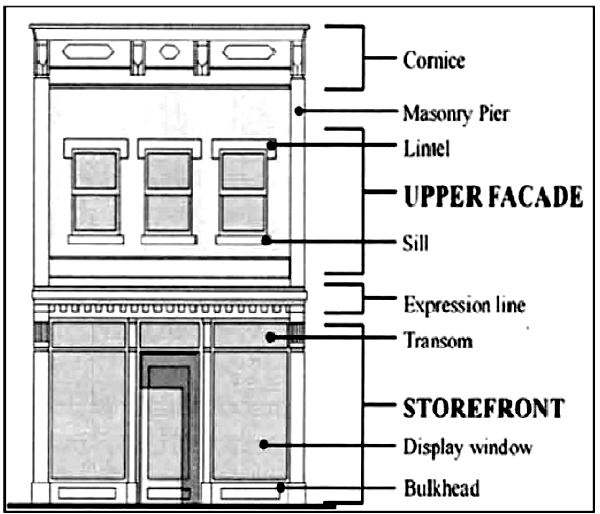
1.
Building design.
a.
Commercial, office and mixed-use buildings shall be designed to reflect traditional architectural elements and character.
b.
All buildings shall front onto a public sidewalk, shall exhibit windows, doors, and architectural details that are customary to traditional storefronts, and shall be characterized by varying materials and appearances.
2.
Front facade. First floor facades of commercial, office and mixed-use buildings shall have architectural variety in the form of offsets, lintels, expression lines or cornices; clearly defined and recessed entryways that orient to the street; display windows that orient street-level customers to merchandise; change in texture, color or masonry pattern; pilasters, piers or columns; awnings, arcades, awnings or covered porches that protect users from the weather.
3.
Secondary building facades.
a.
All exposed sides of a building shall use similar or complementary materials as used on the front facade.
b.
Any secondary facade facing a public street (corner buildings) shall utilize the same design features as the primary front facade, including expression lines and cornice details.
c.
Any rear facade that incorporates a public entrance should be treated with similar design attention as the front facade.
d.
In existing secondary facades, a monotone color selection should be considered to limit attention to the secondary facade and focus attention to the primary facade.
4.
Building entrances.
a.
All commercial, office and mixed-use buildings shall have a main entrance that is located at street level, facing a street frontage.
b.
Main entrances shall be designed so that architectural details enhance their appearance and prominence and so that they are recognizable from the street and parking areas.
c.
For buildings longer than one hundred (100) feet, a minimum of one functional entrance shall be located for every fifty (50) feet of street frontage.
5.
Corner buildings.
a.
The architectural character of a building situated at a corner shall incorporate accents and details that accentuate its prominent location. This can be accomplished by vertical projections or changes in height that are incorporated into the design. Included are features such as changes in roof design, a building peak, tower, or similar accent with the highest point located at the intersecting corner. Alternatively, a pedestrian plaza may be provided at the corner of the intersecting streets.
b.
A main entrance shall be on a street-facing wall and either at the corner or within twenty-five (25) feet of the corner.
6.
Building materials. The following requirements shall apply to facades facing a street or parking area (these requirements do not include areas devoted to windows and doors):
a.
All walls exposed to the public view from the street, or from parking areas, shall be constructed of not less than seventy-five (75) percent modular brick or stone.
b.
Panel brick and tilt-up brick textured paneling shall be prohibited.
c.
The remaining facade may include concrete block, wood siding or fiber cement siding.
d.
Exterior insulation finish systems (EIFS) may be used for architectural detailing above the first floor.
e.
Multi-story buildings shall be designed so that there is distinct architectural differentiation between the ground floor and the floors above. This can be achieved by differences in floor-to-ceiling heights, use of an expression line, a change in material or textures, or by an awning or canopy between the first and upper stories.
7.
Roof forms.
a.
Unless otherwise approved by the Planning Commission, buildings shall have flat roofs, as viewed from the street.
b.
The top of a building shall be clearly defined from the lower floors by a change in materials, such as a cornice line that is proportionate to the size of the building and length of the wall.
c.
The Planning Commission may permit a pitched roof; however, pitched and mansard roofs shall not be permitted if the eaves are less than twenty (20) feet above grade.
d.
All roof edges shall be accentuated in a manner proportionate to the size of the building and length of the wall.
e.
Flat roofs shall be enclosed by parapets.
f.
All rooftop-mounted equipment shall be enclosed or screened from view on all sides of the building.
g.
Parapets and other screen treatments shall use high quality building materials and shall blend with the design of the building in terms of color, materials, scale and height.
8.
Door and window design.
a.
At least sixty (60) percent of the storefront/ground floor facade shall be clear glass windows and a doorway.
b.
Required window areas shall be either windows that allow views into retail space, working areas or lobbies, pedestrian entrances, or display windows set into the wall.
c.
Reflective or tinted glass that impedes views into a building is prohibited.
d.
Windows shall not be covered with opaque materials or blocked by shelving units.
e.
The bottom of a window must be no more than three (3) feet above the adjacent exterior grade.
f.
The front entranceway shall be inset a minimum of three (3) feet from the front facade.
g.
Window openings above the first story shall be a minimum of twenty-five (25) percent and a maximum of sixty (60) percent of the total facade area.
h.
Windows shall be taller than wide in proportion.
9.
Awnings.
a.
Awnings may project over a public sidewalk if a minimum eight (8) foot vertical clearance is maintained (refer to Figure 2).
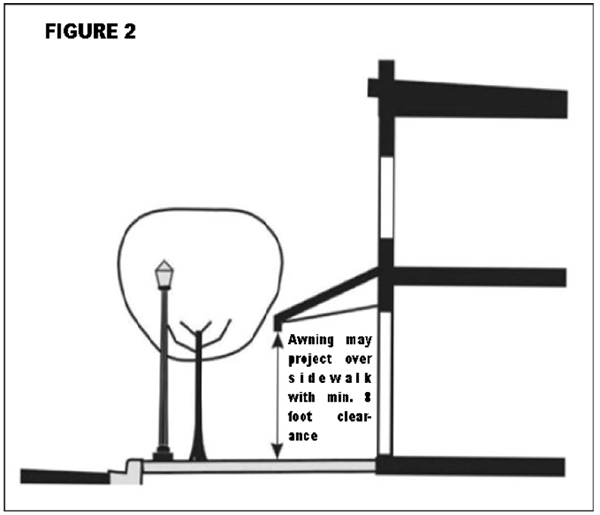
b.
Awnings shall be traditional angled awnings with open sides and shall only be positioned directly above ground floor windows and doors.
c.
Awnings shall be constructed of durable materials such as canvas or steel.
d.
High-gloss or plasticized awnings are prohibited.
e.
Awnings shall not be internally illuminated and any awning signs shall be illuminated by fixtures located above the awning and directed downward.
10.
Driveways and parking.
a.
On-street parking spaces located along the front of the lot shall count toward meeting parking requirements. At least fifty-one (51) percent of the length of the space must be in front of the lot to be counted.
b.
Parking shall be permitted in the rear yard.
c.
Parking in the side yard shall not be located in front of a line extending across the front facade of the principal building. A three (3) foot high brick screenwall or wrought iron fence with piers shall be provided between the parking and the public sidewalk. Openings may be provided to accommodate vehicular or pedestrian access but shall not be wider than twenty-four (24) feet for vehicles and six (6) feet for pedestrians.
d.
Parking areas shall not occupy more than fifty (50) percent of the lot area.
11.
Lighting.
a.
Exterior building lighting shall be designed in a manner that accentuates the building design through highlighting architectural details and features with lighting integrated into the building design.
b.
Facade lighting shall provide for a sense of vibrancy and safety without resulting in excessive light and glare.
c.
Energy conservation and efficiency shall be integrated into lighting design.
d.
Full cut-off lighting shall be utilized to minimize light pollution.
12.
Specialty equipment.
a.
Satellite dishes, antennas, and other equipment shall be screened so as to not be visible from the public rights-of-way.
b.
Mechanical equipment and service areas shall be located out of the public view.
c.
Loading/service areas including refuse/recycling enclosures should be located out of public view to the maximum extent practical and shall not front onto a street.
d.
Electrical and communication transformers/cabinets located in the city right-of-way must be installed below grade in the right-of-way or located on-site and screened from public view.
e.
Backflow prevention/anti-siphon valves must be integrated into the building design and concealed from public view. Such devices may not be located within the public right-of-way.
f.
All other mechanical equipment shall be located behind or on top of the building and screened from public view with parapet walls, landscaping, etc.
g.
Screening shall be compatible with building architecture and other site features.
h.
Window air-conditioning units are prohibited.
13.
Alleys.
a.
Alleys shall be permitted and maintained in all areas of the district and shall be required where necessary to provide access to parking lots, loading areas and garages.
b.
Alleys accessing commercial parking lots and loading areas shall have a minimum pavement width of eighteen (18) feet and be located within a Right-Of-Way (ROW) that is a minimum of twenty-five (25) feet wide or wider.
14.
Additions.
a.
An addition shall be designed in a complimentary and unobtrusive manner, and shall accommodate and be complimentary of respect the design character of the primary and/or original structure.
b.
Building materials, windows and doors shall be utilized that are compatible with and do not impact those of the principal and/or original building.
c.
Additions to an existing structure identified and listed as a historically significant property, shall be required to adhere to the U.S. General Services Administration Historic Preservation Technical Procedures, and if located within the Collinsville East Central Historic District, shall be required to comply with the requirements of said district prior to the issuance of any City approvals or permits.
d.
Additions shall respect the mass and scale of the primary building by keeping the addition as a lesser mass as viewed from the public viewshed.
e.
Rooftop additions shall be located near the back of the building and on non-character defining elevations.
I.
Supplemental standards. The following supplementary standards shall apply to all developments when qualifications are met:
1.
Drive-up windows.
a.
Accessory drive-up windows may only be permitted as an accessory use for pharmacies and banks. All other drive-up window uses are prohibited.
b.
There shall be no more than two (2) drive-up window stalls per use.
c.
The drive-up window area shall be located on the side or rear of the main building.
2.
Live/work units. Live/work units are dwelling units that are attached by common side walls and where the main floor is designed to accommodate a small business with upper floors utilized as living space. Live/work units shall be subject to the following:
a.
The first floor of each unit shall be designed to accommodate office or retail use within a commercial storefront that is at grade with the sidewalk.
b.
The upper floors shall be designed to accommodate a dwelling unit that functions as a single occupancy unit.
c.
Live/work Units shall meet the design standards applicable to mixed-use buildings.
3.
Sidewalk dining/cafes.
a.
A minimum width of fifteen (15) feet of sidewalk from the curb to the building entrance shall be maintained for uses with outdoor seating or temporary display areas.
b.
Pedestrian circulation and access to the building entrance shall not be impaired by tables, chairs, and other encumbrances.
4.
Street connections.
a.
The Uptown Collinsville District will provide an interconnected street network and street connections shall be provided to all parcels within the District.
b.
Cul-de-sacs and dead-end streets are prohibited; however, where it is not possible to provide a through-street, the Planning Commission may allow dead-end, or cul-de-sac streets based on findings of necessity due to physical, natural or engineering restraints.
5.
Street furniture. Benches and trash receptacles shall be provided in park and plaza areas, at public transit stops and along sidewalks.
6.
Bicycle facilities.
a.
Bicycle facilities shall be permitted within the district and shall count toward any open and public space requirements.
b.
Bicycle facilities shall be designed to accommodate and promote bicycle travel by providing bike paths, bike lanes, and bike racks at destination points.
7.
Street trees.
a.
Street trees, when required, shall be planted in a manner appropriate to their size and shape at full maturity.
b.
Trees planted along Main and Clay Streets shall compliment building facades, shade the sidewalk and frame the streetscape.
c.
Trees planted along all other streets within the district shall provide a canopy that shades both the street and sidewalk and serves as a visual buffer between the street and homes or structures.
8.
Parking. The parking standards of Section 17.070, Off-Street Parking/Loading Regulations, shall apply; however, the Planning Commission may modify these standards based on the following:
a.
The location of and number of spaces in nearby public shared parking lots;
b.
A phased development plan that reserves areas for deferred parking spaces. Deferred parking may be granted by the Planning Commission if the following conditions are met:
1.)
Areas proposed for deferred parking shall be shown on the site plan and shall be sufficiently large to construct the required number of parking spaces in accordance with parking area design and other site development standards of this section.
2.)
Alterations to the deferred parking area may be initiated by the owner or required by the City.
3.)
Based on findings that additional parking is needed, all or part of deferred parking shall be constructed if required by the City.
c.
Parking limitations.
1.)
The proposed number of parking spaces shall not exceed the minimum parking space requirements established in Section 17.070, Off-Street Parking/Loading Regulations, by more than ten (10) percent.
2.)
The Planning Commission may grant additional spaces beyond those permitted in this title when the following is demonstrated:
A.)
The parking area otherwise permitted will be inadequate to accommodate the minimum parking needs of the particular use; and
B.)
The additional parking will be required to avoid overcrowding. The actual number of permitted spaces shall be based on professionally documented evidence of the parking demand for the specific land use.
d.
Shared parking areas.
1.)
The Planning Commission may approve a shared parking arrangement for two (2) or more uses to utilize the same off-street parking facility where the operating hours of the uses do not significantly overlap.
2.)
Required parking shall be calculated based on the use that requires the greatest number of spaces.
e.
On-street parking. On-street parking shall be permitted in the district, and shall be credited towards meeting the off-street parking requirements of Section 17.070, Off-Street Parking/Loading Regulations, provided that at least fifty-one (51) percent of the length of the space is located in front of the lot.
f.
Loading areas.
1.)
Loading areas shall be provided as appropriate and necessary.
2.)
The Planning Commission may allow shared loading areas and waste receptacles between adjacent uses where shared use and maintenance easements are provided.
3.)
All loading areas shall be screened from any adjacent residential areas and from view of any street by a six (6) foot tall brick or masonry wall.
9.
Open space requirements.
a.
Uptown Collinsville District developments shall be designed to create cohesive community neighborhoods through a network of open spaces such as parks, plazas and common areas for passive or active recreation and resident interaction.
b.
Site plan submissions for residential developments containing three (3) or more lots and all nonresidential developments shall include an open space and landscaping plan that provides the following:
1.)
Residential developments shall set aside a minimum of fifteen (15) percent of the projects land area for open space, which shall contain some form of active recreational facility, such as a park, garden or play area. Recreational improvements such as playground equipment, benches, picnic tables, gazebos and pathways shall also be provided.
2.)
Areas dedicated to nonresidential or mixed-use shall set aside a minimum of ten (10) percent of the land area for open spaces such as sidewalks, plazas, common areas or parks.
10.
Gateways. To ensure place-making and design continuity throughout the district, primary and secondary gateways are identified for improvement as public spaces. These gateways include:
a.
Primary gateways:
1.)
Route 159 (South Morrison Ave.) and West Main Street (three (3) corners);
2.)
Route 159 and East Clay Street (four (4) corners); and
3.)
West Main Street and N. Combs Avenue (three (3) corners).
b.
Secondary gateways:
1.)
West Clay Street and North Combs;
2.)
West Main Street and at the Collinsville Municipal Public Library.
c.
Developments located at any of these primary and secondary gateways are required to incorporate gateway/landmark type public open spaces into their site design.
d.
Gateway designs shall be subject to the review and approval of the Planning Commission within the site plan process.
11.
Public art. Art may be incorporated in the form of sculptures, fountains or murals as part of the open space system, within sidewalk plazas and along sidewalks, at highly visible locations.
12.
Reserved.
13.
Mixed use required for large sites. Consistent with the regulating plan, any project site that is larger than one (1) acre shall provide a mixture of uses, such that no less than thirty (30) percent of the total land area is residential. For the purpose of this district, a site shall constitute a single parcel or multiple adjacent parcels under single ownership and shall include sites that are developed in phases or subdivided for separate development.
14.
Civic uses.
a.
Sites developed with civic uses (e.g., schools, post office, libraries, government offices, parks) shall exhibit architectural treatments and design qualities that are unique and exceptional in order to serve as cornerstones of the Uptown Collinsville District.
b.
The Planning Commission may permit modifications to the dimensional and building height requirements of this district as part of the site plan review.
c.
In considering the modifications, the Planning Commission shall consider the design of civic buildings, the location of parking areas and the relationship of the site to the streetscape and adjacent buildings and uses.
15.
Buffer zones. Low-level brick walls and wrought iron fences with intermittent brick piers and low-level landscaping shall be required adjacent to sidewalks and parking areas where appropriate to provide internal buffers and to define pedestrian movement areas.
16.
Outdoor display and storage.
a.
Permanent and long-term outdoor displays or storage of inventory or product shall not be permitted in this district.
b.
Temporary outdoor displays of merchandise on the City sidewalk shall receive a permit from the Community Development Department as per Section 17.060.076, sidewalk displays and sales.
17.
Energy and environmental design.
a.
All development in the Uptown Collinsville District shall utilize, to the maximum extent practical, sustainable design and construction practices and principles.
b.
Development in this district is required to attain certification in a minimum of one nationally recognized program relating to energy efficiency and environmental design (including, but not limited to, LEED (Leadership in Energy and Environmental Design), Energy Star, National Home Builders Association, etc.).
c.
The incorporation of "green" elements and procedures in new construction and renovation projects are required to the maximum extent practical. Where projects do not incorporate these design approaches they shall demonstrate to the Planning Commission why said project should be granted a waiver from this requirement (economical considerations shall not be considered in the evaluation of granting a waiver by the Planning Commission).
18.
Modifications. The Planning Commission may approve deviations to the architectural requirements of this section in order to achieve the objectives of this district through the use of creativity and flexibility in development and design in the following manner:
a.
Each modification shall require a finding that the design standard deviation sought would, if no deviation were permitted, prohibit an enhancement that would be in the public interest.
b.
An applicant seeking a design standard deviation shall submit elevation drawings of the proposed building that is superimposed on a color drawing or photograph of the entire block showing the relation of the proposed building design to other buildings along the block. This submittal shall be utilized by the Planning Commission to evaluate the proposed building design deviation. Approvals shall be based upon the following findings of fact:
1.)
The building design standard deviation is consistent with the desired character of the Uptown Collinsville District, as articulated in the City Comprehensive Plan.
2.)
The proposed building fits within the context of adjacent buildings along the block.
3.)
The building remains oriented towards the front sidewalk and maintains or enhances the continuity of the pedestrian environment.
4.)
The roof design remains in character with other buildings along the block and is within the minimum and maximum height requirements of the district.
5.)
The exterior finish materials remain of equal or better quality and durability as those otherwise required in this district.
6.)
Ground floor windows remain along the front sidewalk to maintain the pedestrian orientation of the streetscape.
7.)
Upper story windows are compatible with the rhythm and proportions of windows on other buildings along the block.
19.
Other regulations. All proposed developments shall be in accordance with all other applicable regulations of this title. Where there is a conflict between the requirements of the Uptown Collinsville District and the requirements of another part of this title, then the requirements of the Uptown Collinsville District shall govern.
(Ord. No. 4230, 6-22-2009; Ord. No. 4349, § 2, 7-26-2010; Ord. No. 20-28, § 2, 3-23-2020; Ord. No. 23-111, § 1, 10-10-2023; Ord. No. 24-196, § 1, 12-10-2024; Ord. No. 25-60, § 2, 4-22-2025)

