
Columbia City Zoning Code
ARTICLE 6
- PROCEDURES AND ENFORCEMENT
Sec. 29-6.1. - Reviewers and decision-making bodies.
This article 6 of chapter 29 identifies officers and bodies authorized to review, recommend, or make decisions regarding required applications, permits, and approvals under this chapter. Any reference to an officer or body includes any agents, employees, subordinates, or others to which the named individual or body has lawfully delegated power to take the action.
(a)
City council. The city council is the governing body of the city. In connection with this Unified Development Code, the council's responsibilities include approving amendments to the city's adopted comprehensive plan, approving amendments to the text of this chapter, and approving amendments to the official zoning map, appointing the members of the commission and board, and performing any additional duties set forth in this chapter.
(b)
Planning and zoning commission (P&Z).
(1)
Continued existence, membership, and qualifications, attendance.
(i)
The city planning and zoning commission ("commission") established prior to the effective date of this chapter shall continue in existence.
(ii)
The commission shall consist of nine (9) members appointed by the council for staggered terms of four (4) years. All members shall be appointed as provided for in this article for terms beginning on the first day of June. Six (6) members of the commission shall constitute a quorum for the transaction of business.
(iii)
The members of the commission shall be qualified voters, residents of the city at least one year immediately prior to the date of their appointment, and shall hold no other office or position in the city administration. Appointments to fill vacancies shall be for unexpired terms only. All members shall serve without pay.
(iv)
The chair of the commission is authorized to excuse any member from attendance at a commission meeting; provided, that the member requested to be excused before the meeting. Any member who is absent, without being excused, from three (3) regular meetings in any twelve-month period shall automatically forfeit their office. Furthermore, any member who has a combination of five (5) or more excused or unexcused absences from regular meetings within any twelve-month period shall automatically forfeit their office. It shall be the duty of the chair to promptly notify the council of the vacancy.
(2)
Powers and duties. The commission shall:
(i)
Prepare and submit to the council for its adoption a comprehensive plan for the physical development of the city and uses of land in the city. The plan may include the general location and character of residential, commercial, mixed use, industrial and other areas, the general location, character and extent of streets, bridges, parks, waterways and other public ways, grounds, and spaces, together with the general location of public buildings and other public property, public utilities, and redevelopment projects. The plan shall contain the commission's recommendations for the land and may include those contents outlined in RSMo § 89.340.
(ii)
Make recommendations in connection with the execution and detailed interpretation of the comprehensive plan.
(iii)
Act as a zoning commission, in accordance with the provisions of present or future state zoning enabling acts.
(iv)
Prepare and recommend to the council rules controlling the subdivision of land.
(v)
Make recommendations regarding the approval or disapproval of plats for land subdivision. All such plats shall be referred to the commission before the council takes any action. Failure of the commission to act within sixty (60) days shall be deemed a recommendation for approval.
(vi)
Recommend to the council such amendments or revisions to this chapter as the commission shall deem necessary or desirable for the promotion of the health, safety, morals and general welfare of the inhabitants of the city. Such provisions may include regulations as to the location, width, height, and bulk of buildings; the size of yards, courts, and other open spaces surrounding buildings; and the use of buildings and land. The commission shall hear applications for amendments, modifications or revisions of this chapter and shall forward such applications to the council with its recommendations on the application. The recommendations of the commission shall not be binding upon the council, which may approve or disapprove the commission's findings; however, no plan or ordinance related to zoning, nor any modification, amendment or revision of such a plan or ordinance, shall be finally considered by the council unless it has been first submitted to the commission for its examination and recommendation.
(vii)
Recommend from time to time any other legislation which may be desirable to further the purposes of city planning.
(viii)
Make such reports to the council as it may deem proper or as required by the council.
(ix)
Assume any other powers and perform any other duties as are provided for by the Charter of the city or by council action.
(x)
Adopt rules for the conduct of its business that are consistent with the purposes of the commission and the requirements of this chapter, which shall be approved by council ordinance.
(c)
Board of adjustment (BOA).
(1)
Continued existence, membership, and qualifications.
(i)
The city board of adjustment ("board") established prior to the effective date of this chapter shall continue in existence.
(ii)
The board shall consist of five (5) members who shall be residents of the city. The terms of office of the members of the board shall be for five (5) years, except that the five (5) members first appointed shall serve respectively for terms of one, two (2), three (3), four (4), and five (5) years. Thereafter all members shall be appointed by the council for terms of five (5) years each. No member shall serve more than two (2) consecutive full terms. The presence of four (4) members shall be necessary to constitute a quorum.
(iii)
Three (3) alternate members, who shall be residents of the city, shall be appointed by the council to serve in the absence of, or disqualification of, the regular members. The first three (3) alternates appointed shall serve for terms of three (3), four (4), and five (5) years, respectively. Thereafter, all alternates shall be appointed for five-year terms.
(iv)
The vacancy of any member or alternate member shall be filled by appointment of the council for the unexpired term only.
(v)
All members and alternates may be removed for cause by the council, upon written charges after public hearing.
(2)
Powers and duties. The board shall have the following authority and duties:
(i)
Appeals. To hear and decide appeals where it is alleged there is error in an order, requirement, decision or determination made by an administrative official in the administration or enforcement of this chapter, as described in section 29-6.3(f).
(ii)
Variances. To hear and decide applications for variances from the terms or conditions of this chapter under section 29-6.4(d) (variances).
(iii)
Other powers.
(A)
Assume any other powers and perform any other duties as are provided for by the Charter, City Code, council action, or state law.
(B)
The board may adopt rules for the conduct of its business that are consistent with the purposes of the board and the requirements of this chapter, which shall be approved by council ordinance.
(3)
Meetings and voting.
(i)
Meetings of the board shall be held at the call of the chairman and at such other times as the board may determine. Such chairman, or in his absence, the acting chairman, may administer oaths and compel the attendance of witnesses.
(ii)
All meetings of the board shall be open to the public.
(iii)
The board shall keep minutes of the proceedings, showing the vote of each member upon each question, or, if absent or failing to vote, indicating such fact, and shall keep records of its examinations and other official actions, all of which shall be immediately filed in the office of the board and shall be a public record.
(iv)
All testimony, objections thereto, and rulings thereon shall be taken down by a reporter employed by the board for that purpose and who shall receive reasonable compensation for such from the city. The reporter shall furnish to any person or persons a transcript of all or part of such proceedings upon payment to him of a fee equal to that set forth in RSMo 492.590(2).
(v)
The concurring vote of four (4) members of the board shall be necessary to reverse any order, requirement, decision or determination of any such administrative official, or to decide in favor of the applicant on any matter before the board.
(d)
Historic preservation commission. The membership, terms, powers, and duties of the historic preservation commission are listed in section 29-2.3(c)(2) as part of the historic preservation overlay district.
(e)
Community development department.
(1)
Continued existence and purpose.
(i)
The community development department ("department") established prior to the effective date of this chapter shall continue in existence.
(ii)
The purpose of the department is to plan for the present and future development and improvement of the city in all phases of its activities in coordination with other departments of the city which may have either primary or secondary roles in such planning and development. Such activities shall include, but not be limited to, traffic, transportation, playgrounds, parks, public buildings, housing, public monuments, works of art, public streets, public utilities, parking, and parking facilities.
(2)
Powers and duties of department. The department shall have the following authority and duties:
(i)
Advise the city manager and the council with respect to the planning affairs of the city, and shall furnish to the city manager and council at any time upon request, such information and particulars concerning planning as may be desired.
(ii)
Act upon all matters referred to it by the city manager or the council and shall, if required or deemed necessary, report on those matters to the city manager or the council.
(iii)
Be the advisor and consultant to the commission, and shall prepare and furnish to the commission such reports, studies, plans, surveys or other data as may be necessary in aiding and assisting the commission in the discharge of its duties.
(iv)
Be the advisor and consultant to the board, and shall prepare and furnish to the board such reports, studies, plans, surveys or other data as may be necessary in aiding and assisting the board in the discharge of its duties.
(v)
Assume any other powers and perform any other duties as are provided for by the Charter, City Code or by council action.
(Ord. No. 24565, § 1, 3-1-21)
Sec. 29-6.2. - Regulatory procedures table.
(Ord. No. 25587, § 4, 2-19-24)
Sec. 29-6.3. - Standard regulatory procedures.
All applications under this chapter are subject to the procedural requirements in this section 29-6.3 unless exempted by the terms of this chapter.
(a)
Application: Materials and fees required.
(1)
Unless otherwise indicated by a specific provision of this chapter, the applicant for a permit or approval under this chapter must be the owner of the property that is the subject of the application or a duly authorized agent of the owner. An applicant who is the purchaser of the subject property under a contract must provide proof that the applicant is an authorized agent of the owner of the subject property for purposes of the application.
(2)
Unless otherwise indicated by a specific provision of this chapter or another city ordinance or regulation, applications for permits and approvals under this chapter shall be submitted to the community development department.
(3)
An applicant for a permit or approval under this chapter shall be required to file an application containing all information required for that type of application by the department, as those requirements may be revised from time.
(4)
Each applicant for a permit, approval, or appeal under this chapter shall be required to file an application fee as established by the council from time to time.
(5)
Schedule of fees. The following processing fees are established:
(i)
Preliminary plat .....$600.00 + $10.00 per lot
(ii)
Final plat (in addition to recording fee) .....$400.00 + $10.00 per lot
(iii)
Replat (in addition to recording fee) .....$300.00 + $10.00 per lot
(iv)
Rezoning (in addition to advertising): .....
0 to 2 acres .....$300.00
Greater than 2 acres to 5 acres .....$450.00
Greater than 5 acres to 10 acres .....$600.00
Greater than 10 acres to 15 acres .....$900.00
Greater than 15 acres to 20 acres .....$1,200.00
Greater than 20 acres .....$1,500.00
(v)
Planned district development plan or major revision to a development plan (in addition to advertising): .....
0 to 2 acres .....$300.00
Greater than 2 acres to 5 acres .....$450.00
Greater than 5 acres to 10 acres .....$600.00
Greater than 10 acres to 15 acres .....$900.00
Greater than 15 acres to 20 acres .....$1,200.00
Greater than 20 acres .....$1,500.00
(vi)
Minor revisions to planned district development plan .....$200.00
(vii)
Vacation of public easement, street or alley (in addition to recording fee) .....$350.00
(viii)
Variance from subdivision regulations .....$350.00
(ix)
Rezoning from any district to district R-1, (advertising fee shall apply) .....No application fee
Rezoning from district R-3 or R-4 to district R-2, (advertising fee shall apply) .....No application fee
Rezoning to district H-P .....No application or advertising fee
Waiver of the advertising costs for any rezoning application for which there is no application fee may be authorized by the city council upon written request of the applicant. Any such waiver shall be requested and granted or denied prior to the filing of the rezoning application.
(x)
Annexation petitions (voluntary or agreement) .....$250.00 (in addition to advertising)
(xi)
Rezoning to equivalent or lesser intensity Boone County zoning concurrent with annexation petition .....No fee
(xii)
Hearing Continuance (applicant request after advertising) .....$100.00
(xiii)
Administrative Plat .....$200.00 + $10.00 per lot
(xiv)
Plat Vacation (abrogation) .....$300.00
(xv)
Cell Tower (new) .....$1,500.00
(xvi)
Cell Tower (co-locate) .....$250.00
(xvii)
Zoning review letter, per requested address .....$75.00
(xviii)
Board of Adjustment: .....
Appeal, variance and conditional use application fees, per request .....$250.00
Public notice fee (refundable), per request .....$200.00
(xix)
Advertising and public notice fee (rezoning, subdivision, planned development, design adjustments), per request .....$175.00
(xx)
Advertising (two (2) times) and public notice fee (annexation - voluntary), per request .....$300.00
(b)
Complete application required. No application for a permit, approval, or appeal under this chapter shall be reviewed by city staff, or scheduled for a public hearing before the applicable board or commission, and no permit or approval under this chapter shall be issued, until the department has confirmed that required application materials are complete and required fees have been paid. The burden of providing complete and accurate information required by the department for that type of application shall be on the applicant.
(c)
Notice of public hearing.
(1)
General.
(i)
When this chapter requires that a board or commission hold a public hearing prior to making a recommendation or decision, the types of public notice set forth herein shall be provided.
(ii)
The provisions of this subsection (c) shall be considered met if the city or the applicant has attempted to comply with the standards and has achieved substantial compliance and the requirements of due process have been satisfied, as determined in the sole discretion of the city. Unintentional mistakes in notice due to inaccurate records or failures of notification systems shall not require the delay or cancellation of a public hearing if substantial compliance and due process have been achieved.
(iii)
The city may decide to provide additional notice beyond that required by this chapter, and no mistake or omission in providing any additional notice will require the delay or cancellation of a public hearing.
(iv)
When the application that is the subject of the public hearing involves one or more specific lots, tracts, parcels, or areas of land (as opposed to an ordinance text amendment that affects all land in the city or in specific base or overlay zone districts, or affects all development of a certain type), the required notice shall contain an address or description of the general location of the real property to be affected, and a map of the real property to be affected and the surrounding area.
(v)
Where the required notice will require publication or mailing expenses, those expenses (or a deposit sufficient to cover the expenses) shall be paid by the applicant before the public hearing may be held.
(vi)
Unless otherwise indicated by a specific provision of this chapter or another city ordinance or regulation, all required notices under this chapter shall be the responsibility of the community development department.
(2)
Published notice.
(i)
If the application is for an text or zoning map amendment, a conditional use permit, variance, an appeal, or other request for relief or action from the board or commission, or for any action authorized in this chapter for which public notice is required under applicable law, the director shall cause a notice of the date, time, and location of the public hearing to be published in a newspaper of general circulation within the city at least fifteen (15) days before the public hearing. The public notice shall include the action requested, including the current and proposed zoning district for each rezoning request, the telephone number of the department, and all other information required under City Code or applicable law.
(3)
Posted notice.
(i)
If the application is for a zoning map amendment, a conditional use permit, or a variance, from the board or commission, the director may, as a courtesy, place conspicuous notification signs facing each street abutting the property that is the subject of the application. The failure of the director to place notification signs shall not affect the validity of any action taken on the aforementioned items.
(ii)
When the application is for a certificate of appropriateness or a certificate of economic hardship under section 29-2.3(c) (historic preservation overlay) the director shall place a conspicuous notification sign facing a public street abutting the property that is the subject of the application. The sign face of notification signs shall be at least five (5) square feet. Notification signs shall contain, or have attached to them, information on the proposed change to the property, the date and time of the historic preservation commission meeting, and the telephone number of the department.
(4)
Mailed notice. If the application is for a zoning map amendment, a conditional use permit, or an appeal, variance, or other request for relief or action from the board or commission, the department shall send first class mail notice of the public hearing to the addresses of the residences of the land proposed to be rezoned and to the owners of all land within lines drawn parallel to and one hundred eighty-five (185) feet from the boundaries of the land which is the subject of the requested action.
(5)
Electronic notice. The director may, as a courtesy, send electronic notice to any persons or organizations in the city, or to any governmental, public, or quasi-public organization regarding any matter related to this chapter that may affect the interests of that person or organization, or on any matter on which any such person or organization has requested notice. The failure of the director to send such notice or the failure of any resident or property owner to receive such notice shall not affect the validity of any ordinance affecting such land.
(d)
Decisions under this chapter.
(1)
Unless otherwise indicated in a specific provision of this chapter, the director, department, board, commission, or council authorized to make a decision under this chapter may approve the application, deny the application, or approve the application subject to conditions as stated in subsection (e) below.
(2)
When this chapter authorizes a director, department, board, commission, or council to make a decision under this chapter, that decision shall be made pursuant to the specific criteria applicable to the application in section 29-6.4 (specific regulatory procedures). If section 29-6.4 does not include specific criteria for that type of decision, the director, department, board, commission, or council shall make the decision based on whether the application complies with this chapter and any regulations authorized by this chapter, and will protect the public health, safety, and welfare.
(3)
Unless otherwise stated in this chapter, or unless a different condition is attached to a permit or approval, permits and approvals granted under this chapter are not affected by changes in ownership or tenancy of the property.
(e)
Conditions on approvals.
(1)
The department, board, commission, or council may attach conditions to any permit or approval under this chapter, provided that the condition is required to bring the development proposed in the application into compliance with the requirements of this chapter.
(2)
In addition, the board, commission or council may attach conditions to any permit or approval under this chapter, provided that the condition is required to bring the development proposed in the application into compliance with the adopted comprehensive plan of the city or to protect the public health, safety, or welfare.
(f)
Appeals. Decisions of the director or the department in the application of the subdivision standards of section 29-5.1 may not be appealed to the board, but requests for design adjustments to the subdivision standards may be made to the commission and/or the council during the subdivision of land process in section 29-5.2.
(1)
Appeals to the board may be taken by any person aggrieved, or by any officer, department, board or bureau of the city affected by any decision of an administrative official in the administration or enforcement of this chapter. The appeal shall be taken within a reasonable time, as provided by the rules of the board, by filing with the officer from whom the appeal is taken and with the board a notice of appeal specifying the grounds of the appeal, including the section of this chapter that is inconsistent with the decision being appealed. The officer from whom the appeal is taken shall forthwith transmit to the board all the papers constituting the record upon which the action appealed from was taken. An applicant shall deposit a sum sufficient to pay the costs of advertising as required by statute and ordinance. The director shall inform an applicant of the estimated cost of advertising and require a deposit sufficient to meet the costs upon filing. All unexpended portions of the deposit shall be returned to the applicant after the actual costs of advertising have been met.
(2)
An appeal stays all proceedings related to the action appealed from, unless the officer from whom the appeal is taken certifies to the board, after the notice of appeal shall have been filed with such officer, that by reason of facts stated in the certificate, a stay would, in the opinion of the officer, cause imminent peril to life or property. In such case proceedings shall not be stayed otherwise than by a restraining order granted by the board or by a court of record, on application or notice to the officer from whom the appeal is taken and on due cause shown.
(3)
The board shall fix a reasonable time for the hearing of the appeal, give public notice of the hearing, as well as due notice to the parties in interest, and decide the appeal within a reasonable time. At the hearing any party may appear in person, by agent, or by attorney.
(4)
In exercising the above-mentioned powers, the board may reverse or affirm, wholly or partly or may modify the order, requirement, decision or determination appealed from and may make such order, requirement, decision or determination as ought to be made, and to that end, shall have all powers of the administrative official from whom the appeal is taken.
(Ord. No. 23277, § 1, 8-21-17; Ord. No. 24011, § 1, 9-16-19; Ord. No. 26076, § 1, 9-2-25)
Sec. 29-6.4. - Specific regulatory procedures.
(a)
Zoning compliance. Each application under this chapter that does not require one or more of the specific regulatory procedures in subsections (b) through (q) below shall be reviewed for zoning compliance. Zoning compliance checks shall be conducted by the department, and applications shall be approved if they comply with this chapter. The department's decision may be appealed to the board pursuant to section 29-6.3(f).
(b)
Building permit.
(1)
No erection, alteration, or enlargement of a building may begin until the owner of the property on which the building is or will be located, or the owner's authorized agent, has applied to the director for a building permit and the director has issued a building permit authorizing the proposed erection, alteration, or enlargement. The director shall issue a building permit if the application is consistent with the requirements of this chapter, all adopted and applicable building codes of the city, and all other regulations of the city. Failure to comply with the provisions of this chapter shall be good cause for the revocation of any building permit by the director. A record of such applications and plans shall be kept in the office of the department.
(2)
Building permits may not be issued for a tract or parcel of land consisting of two (2) or more adjacent lots or one lot and a portion of another lot.
(3)
A building permit shall only be issued on a lot as defined in section 29-1.11.
(4)
No building permit shall be issued for construction of a new building on a lot that does not have access allowing vehicles, pedestrians, and bicycles to pass from a public street directly onto the lot, provided non-residential lots within a unified development may obtain access to a public street to the lot over an irrevocable access easement approved by the city counselor, or designee.
(5)
No building permit shall be issued for construction of a new building on a lot until the director determines sufficient infrastructure exists, or will exist at the time the building is completed and occupied, to support the proposed use, including, but not limited to adequate utilities, storm drainage, water, sanitary sewer, electricity, streets and sidewalks.
(c)
Certificate of occupancy.
(1)
Requirement. No vacant land shall be occupied or used except for agricultural uses, and no building erected or structurally altered shall be occupied or used until a certificate of occupancy has been issued by the director. A certificate of occupancy shall state that the building or proposed use of a building or land complies with this chapter and with all the building and health laws and ordinances of the city.
(2)
Vacant land. A certificate of occupancy for the use of vacant land, or the change in the character of the use of land, shall be applied for before any such land shall be occupied or used, and a certificate of occupancy shall be issued within ten (10) days after the application has been made, provided such use is in conformity with the provisions of this chapter.
(3)
Buildings. A certificate of occupancy for a new building or the alteration of an existing building shall be applied for in writing coincident with the application for a building permit, and shall be issued within ten (10) days after the erection or alteration of such building or part of the building has been completed in conformity with this chapter. Pending the issuance of a regular certificate, a temporary certificate of occupancy may be issued by the director for a period not exceeding six (6) months, during the completion of alterations or during partial occupancy of a building pending its completion. The temporary certificate shall not be construed as altering the respective rights, duties or obligations of the property owners or of the city relating to the use or occupancy of the premises, or any other matter covered by this chapter, and the temporary certificate shall not be issued except under such restrictions and provisions as will ensure the safety of the occupants.
(d)
Variance.
(1)
Procedure.
(i)
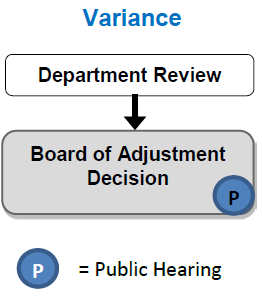
An applicant may apply for a variance from the zoning regulations of this chapter, but no variance may change the review and approval procedure for any type of application set forth in this chapter.
(ii)
An application for a variance shall be decided by the board pursuant to the criteria shown in subsection (2) below, with the following exceptions:
(A)
No variances from the subdivision standards in section 29-5.1 are permitted. Requests for deviations from the subdivision standards shall be considered by the commission and decided by council during the subdivision of land procedures in section 29-5.2.
(B)
Variances in the historic preservation overlay district shall be approved as described in section 29-2.3(c)(14) (variances).
(C)
Variances in the floodplain overlay district shall be approved as described in section 29-2.3(d)(15) (variance procedures) and section 29-2.3(d)(16) (conditions for variances).
(D)
Variances from sign regulations shall be approved as described in section 29-6.4(d)(2)(ii) (sign variances).
(iii)
Any person or persons, jointly or severally aggrieved by any decision of the board, any taxpayer, or any officer or director of the city, may appeal a decision of the board to a court of competent jurisdiction.
(2)
Criteria for approval. The board may approve an application for a variance from the terms and provisions of this chapter if it determines that all of the following are true.
(i)
General criteria.
(A)
The variance is required to address practical difficulties or unnecessary hardships related to the shape, size, terrain, location or other factors of the applicant's site, those difficulties or hardships are not generally applicable to property in the area, and the difficulties or hardships were not created by the actions of the applicant;
(B)
The variance will not have the effect of permitting a use of land that is not indicated as a permitted or conditional use in section 29-3.1 (permitted use table) in the zone district where the property is located, nor shall a variance be granted to modify a standard that operates as part of the definition of any use;
(C)
The variance will not permit a development that is inconsistent with the adopted comprehensive plan;
(D)
The variance is the least change from the requirements of this chapter necessary to relieve the difficulty or hardship; and
(E)
The variance will not harm the public health, safety, or welfare or be injurious to other property or improvements in the area where the property is located.
(ii)
Sign variance. The board may only grant a variance to the sign regulations in section 29-4.8 if it also determines (in addition to the criteria in subsection (i) above) that variance will not change both the maximum size and the maximum height of freestanding signs.
(iii)
Floodplain regulations. In addition to the findings in subsection (i) above, no variance to the floodplain overlay district regulations in section 29-2.3(d) shall have any effect unless the record of the proceeding before the board contains a written opinion of a registered professional engineer that the granting of the variance would not result in any increase in quantity or velocity of flow, degradation of water quality, or negative impacts upon adjoining or downstream properties, nor upon the stormwater system, which shall be accompanied with supporting documentation used by the engineer in rendering the opinion required by this section.
(e)
Adjustment of form-based controls.
(1)
Minor. An applicant for a permit or approval in the M-DT district may apply for an adjustment to the form-based controls in section 29-4.2 and the director may approve the adjustment if the director determines that all of the following criteria have been met:
(i)
The proposed adjustment will not result in development that is inconsistent with the intended character of the M-DT district or the regulating plan for the block face including the applicant's property or the block face(s) immediately across the street(s) from the applicant's property;
(ii)
The proposed adjustment will result in a building and site design of equal or superior quality and visual interest to that required by the application of the form-based controls in section 29-4.2; and
(iii)
The proposed adjustment will not result in any of the following:
(A)
Change a minimum or maximum height requirement by more than five (5) percent;
(B)
Change a finished floor elevation requirement by more than five (5) percent;
(C)
Change a street wall height, length, or access gate requirement by more than ten (10) percent;
(D)
Move a required building line further from the street;
(E)
Move a required building line more than six (6) inches closer to the street;
(F)
Reduce a minimum percentage of a building frontage that must be built to the required building line by more than five (5) percent of the required length;
(G)
Move a parking setback line more than five (5) feet closer to any street;
(H)
Increase the maximum average spacing of building entrances by more than ten (10) percent;
(I)
Change a minimum or maximum fenestration requirement by more than five (5) percent; or
(J)
Change the minimum or maximum depth of a building projection by more than five (5) percent.
(2)
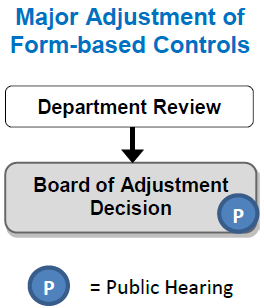
Major. All other variances from the form-based controls in section 29-4.2 shall require an approval by the board, after a public hearing, following the procedure in section 29-6.4(d) but based on the criteria in section 29-6.4(e)(1)(i) and (ii) above instead of the criteria in section 29-6.4(d).
(f)
Sign permit.
(1)
Applicability.
(i)
A permit is required prior to the erection, construction, reconstruction, alteration, moving, conversion or maintenance of any sign, except those signs listed in subsection (ii) below or signs otherwise exempted in this chapter or other ordinances or regulations of the city.
(ii)
The following types of signs may be erected without the issuance of a permit or payment of a permit fee, but each such sign shall meet all the standards and requirements for that type of sign in section 29-4.8 (signs):
(A)
Signs indicating a home or apartment or non-residential building or structure, or part of a home, apartment, building or structure, for sale, rent, or lease;
(B)
Construction signs;
(C)
Memorial signs or tablets when cut into masonry surface or when constructed of bronze or other incombustible material;
(D)
Government building signs erected on a municipal, state or federal building that announce the name, nature of the occupancy and information as to use of or admission to the premises.;
(E)
Official signs furnished by the superintendent of the Missouri State Highway Patrol designating an official vehicle inspection station in accordance with RSMo 307.365. One such sign shall be allowed for each street frontage at all such official vehicle inspection stations, in addition to the signs allowed by the following provisions;
(F)
Noncommercial signs;
(G)
Commercial flags allowed under section 29-4.8(c)(11);
(H)
Signs prohibiting peddlers, solicitors, hawkers, itinerant merchants or transient vendors of merchandise, when placed upon private residential property;
(I)
"No Parking" signs that comply with section 29-4.8(e)(8) or section 14-561 of the City Code; provided the sign does not exceed eighteen (18) inches by twenty-four (24) inches in dimension; and
(J)
Garage sale signs.
(2)
Procedure.
(i)
The director shall approve the application if the director determines that it complies with this chapter and all other ordinances and regulations of the city.
(ii)
No permit shall be issued for erection of a sign on property on which a sign plan has been approved under section 29-6.4(g) (sign plan approval), where the sign does not conform with the requirements of that plan, without the removal at the applicant's expense of all signs permitted by the plan and not otherwise permitted.
(iii)
A permit issued under this section 29-6.4(f) shall become null and void six (6) months after the date of issuance if the work authorized by the permit has not been completed.
(iv)
The director may revoke any permit issued pursuant to this section 29-6.4(f) if the permit holder does not comply with any of the provisions of this chapter.
(g)
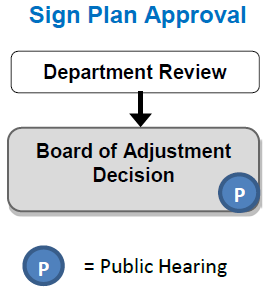
Sign plan approval. The owner or lessee of the premises upon which a sign is to be erected may file an application with the board for approval of a sign plan upon forms provided by the city and the board may approve a sign plan allowing different numbers and types of signs permitted on a property if it determines that the following criteria are met. Sign plans are not allowed in a PD district. An adjustment to a permitted sign in a PD district requires an amendment to the PD district approval.
(1)
No unlawful signs shall be permitted;
(2)
Each sign meets the size, setback and other limitations and requirements for that type or class of sign in section 29-4.8;
(3)
The sign plan reduces the number of signs that would otherwise be permitted on the property;
(4)
The sign plan reduces the total square footage of signs that would otherwise be permitted on the property;
(5)
The sign plan does not violate the spirit or intent of section 29-4.8; and
(6)
All nonconforming signs on the property or premises shall be brought into compliance with the requirements of this chapter.
(h)
Temporary parking permit.
(1)
Procedure. The director may issue temporary permits to allow parking of motor vehicles in a yard area as prohibited in section 29-4.3(f)(3) (parking-use of yards), for a period of up to forty-eight (48) hours on Saturdays, Sundays, and holidays, if the director determines that the criteria in subsection (2) have been met.
(2)
Criteria for approval.
(i)
The parking is necessary for an event of city-wide or area-wide concern that will attract traffic that cannot be effectively served by existing accessible parking facilities; and
(ii)
The permit will not permit parking in the yard area of a one-family, one-family attached or two-family dwelling.
(i)
Floodplain development permit. Floodplain development permits shall be approved as described in section 29-2.3(d) (floodplain overlay district).
(j)
Optional development standards approval.
(1)
Applicability.
(i)
The provisions of this section apply to:
(A)
Property owners in the R-2 district that apply to have the development of their property subject to the "cottage" development standards rather than the "current" development standards as shown in Table 29-2-3 and Table 4.1-1.
(B)
Property owners in the M-N district that apply to have the development of their property subject to the "pedestrian" development standards rather than the "current" development standards as shown in Table 29-2-7 and Table 4.1-2.
(C)
Property owners in the M-C district that apply to have the development of their property subject to the "transit" development standards rather than the "current" development standards as shown in Table 29-2-8 and Table 4.1-2.
(ii)
Any such application shall request that the city approve the application of all of the optional development standards available for the zone district in which the property is located, as listed in Tables 29-2-3, 29-2-7, 29-2-8, 4.1-1, and 4.1-2 respectively. The board may not approve an application requesting application of some but not all of the optional development standards listed in the applicable tables for the zone district where the property is located.
(2)
Procedure.
(i)
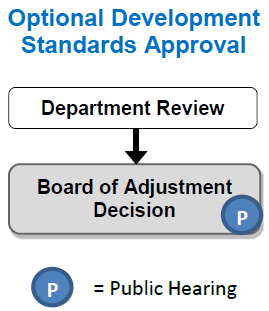
The department shall review the application and make a recommendation to the board, which shall hold a public hearing on the application.
(ii)
If approved by the board, the applicability of the optional development standards shall be indicated by recording a notice with the recorder of deeds.
(iii)
The owner of property for which optional development standards have been approved subject to this section 29-6.4(j) may apply to have the "current" development standards reapplied to the property, and the board may approve that application, through the same process and using the same criteria used to approve the optional development standards.
(3)
Criteria for approval. The board may approve an application for optional development standards if it determines that the following criteria have been met:
(i)
The use of optional development standards is consistent with the intended character of the area as shown and described in the city's adopted comprehensive plan;
(ii)
The use of the optional development standards will provide adequate off-street parking for the permitted uses available in the zone district where the property is located, and will not result in significant increases in off-site parking on sections of local neighborhood streets other than those immediately fronting the applicant's property; and
(iii)
The use of the optional development standards will not create additional traffic congestion or risks to public health and safety in the surrounding area.
(k)
Certificate of appropriateness. A certificate of appropriateness in the HP-O district shall be approved as described in section 29-2.3(c)(8).
(l)
Landmark and historic district designation. Designation of landmark and historic districts shall be approved as described in sections 29-2.3(c)(5) and (6). If designated, the district shall be added to the list of approved districts in section 29-2.3(c)(7).
(m)
Conditional use permit.
(1)
Procedure.
(i)
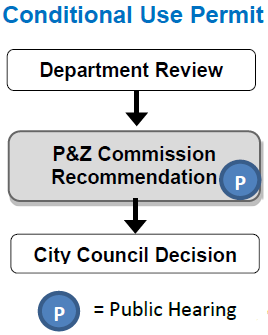
Except as otherwise specifically provided elsewhere in this chapter, the department shall review the application and shall forward a recommendation to the commission based on the criteria listed in subsection (2) below.
(ii)
The commission shall hold a public hearing on the application and shall make a recommendation to the council. The commission's recommendation shall be based on the criteria in subsection (2) below and shall be in writing.
(iii)
After the public hearing in front of the commission, the commission may make a tentative recommendation and direct the department to draft a proposed written recommendation to be presented to commission at its next meeting. The applicant may also submit a proposed recommendation to the commission. The commission may accept, reject, amend or modify any proposed recommendation and shall submit a proposed recommendation to the council.
(iv)
The council shall take final action on the application after considering the criteria in subsection (2) below. The council's decision shall be in writing. The council may accept, reject, amend or modify any written recommendation of the commission and adopt such recommendation as its final written decision.
(v)
An application for a conditional use permit may be combined with an application for a variance, but the board shall decide the application for a variance based on the criteria for approval in section 29-6.4(d) (variance) before the commission holds its public hearing on the conditional use permit.
(vi)
A conditional use permit is to allow that use on a specific site and may not be transferred to any other site.
(2)
Criteria for approval. After giving due consideration to the following criteria, the commission may recommend and the council may grant a conditional use permit which may include any conditions deemed necessary to carry out the provisions and intent of this chapter.
(i)
General criteria.
(A)
The proposed conditional use complies with all standards and provisions in this chapter applicable to the base and overlay zone district where the property is located;
(B)
The proposed conditional use is consistent with the city's adopted comprehensive plan;
(C)
The proposed conditional use will be in conformance with the character of the adjacent area, within the same zoning district, in which it is located. In making such a determination, consideration may be given to the location, type and height of buildings or structures and the type and extent of landscaping and screening on the site;
(D)
Adequate access is provided and is designed to prevent traffic hazards and minimize traffic congestion;
(E)
Sufficient infrastructure and services exist to support the proposed use, including, but not limited to, adequate utilities, storm drainage, water, sanitary sewer, electricity, and other infrastructure facilities are provided; and
(F)
The proposed conditional use will not cause significant adverse impacts to surrounding properties.
(ii)
Criteria for communication antennas and towers. When considering a conditional use permit application for a communications antenna or tower, the application shall be submitted to the board and the board shall consider the following criteria in addition to those listed in subsection (i) above, and its decision shall be based on substantial evidence in the written record:
(A)
Whether or not existing towers are located within the geographic area necessary to meet the applicant's engineering requirements;
(B)
Whether or not existing towers, structures or buildings within the applicant's required geographic area are of sufficient height to meet system engineering requirements;
(C)
Whether or not existing towers or structures have sufficient structural strength to support the applicant's proposed antenna;
(D)
Whether or not the fees, costs, or other contractual terms required by the owner(s) of existing tower(s), structure(s) or building(s) within the required geographic area of the applicant or to retrofit the existing tower(s) or structure(s) are reasonable;
(E)
Whether or not there are other limiting conditions that render existing towers, structures or buildings within the applicant's required geographic area unsuitable;
(F)
Whether or not the proposal minimizes the number and size of towers or structures that will be required in the area;
(G)
Whether or not the applicant has previously failed to take advantage of available shared use opportunities provided by this section or otherwise; and
(H)
Whether or not the applicant has provided sufficient evidence indicating that the tower will be made available for use by others, subject to reasonable technical limitations and reasonable financial terms.
(iii)
Criteria for short-term rentals. When considering a conditional use permit application for a short-term rental (STR), the commission and council shall consider the following criteria in addition to those listed in subsection (i) above:
(A)
Whether the proposed STR is used for any part of the year by the registrant as a residence. If so, for how long?
(B)
Whether or not there are established STRs within three hundred (300) feet of the proposed STR measured in all directions from property lines "as the crow flies."
(C)
Whether the proposed registrant has previously operated an STR and if such operation has resulted in a history of complaints, a denied STR certificate of compliance, or revocation of an issued STR certificate of compliance.
(D)
Whether the proposed STR will increase the intensity of the use of the property and cause increased traffic or noise coming from the property.
(E)
Whether there is support for the establishment of the proposed STR from neighboring property owners.
(n)
Text and zoning map amendments.
(1)
General zoning map and text amendments.
(i)
Applicability.
(A)
Any person, firm, or corporation owning real property within the city, the commission, or the council may file an application to change the text of this chapter.
(B)
Any person, firm, or corporation owning real property within the city, or the commission, or the council, may file an application to change the boundaries of any base or overlay district on the zoning map, including, but not limited to, proposed changes in the regulating plan for the M-DT district; provided that no person, firm, or corporation may file an application to change the boundaries of a base or overlay zone district or any portion of the regulating plan for property not owned by that person, firm, or corporation.
(C)
No application for a general zoning map or text amendment shall request changes in the alternative; the requested text and/or boundary change shall be stated as a single proposal to the city. An applicant may include separate requests for changes to more than one section of the chapter, or to the zoning map as applied to more than one lot, tract or parcel in common ownership, so long as no changes are presented in the alternative.
(D)
No application to amend the zoning map may be filed if it is the same or substantially the same as an application submitted within the previous twelve (12) months that was denied by the council or withdrawn by the applicant after a negative recommendation from the commission. The council may, in its sole discretion, authorize a resubmittal within the twelve-month period after reviewing a written request from the applicant that provides justification for the early resubmittal.
(ii)
Procedure.
(A)
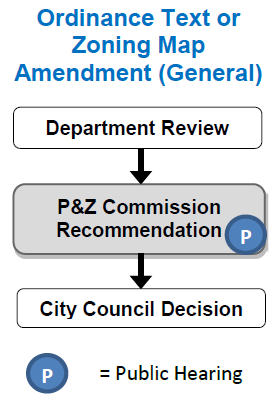
The department shall review the application and shall forward copies of the application and supporting documents to other city departments and public or quasi-public agencies affected by the requested change. The departments or agencies to which the application is sent shall, within ten (10) days of receipt of the application and supporting materials, forward their recommendations to the department. The failure of a department or agency to respond within ten (10) days shall be construed as that department or agency having no objections to the proposed change.
(B)
The department shall make a written recommendation to the commission as to whether the proposed change conforms to the city's adopted comprehensive plan, whether adequate utilities, storm drainage, water, sanitary sewer, electricity, and other infrastructure facilities are available to support development that would be enabled by a proposed zoning map change, and the expected results of the proposed change.
(C)
The commission shall hold a public hearing on the application and shall make a recommendation to the council.
(D)
The council shall take final action on the application. The council shall not approve a change to the chapter text or zoning map that allows less restrictive development, or that enlarges the area to be rezoned beyond the area that was the subject of the public notice and commission public hearing.
(E)
If a protest against a change to the zoning map duly signed and acknowledged by the owners of thirty (30) percent or more, either of the area of land (exclusive of streets and alleys) included in such proposed change, or within an area determined by lines drawn parallel to and one hundred eighty-five (185) feet distant from the boundaries of the area proposed to be changed, the zoning map change amendment shall only be adopted if it receives the affirmative vote of two-thirds (⅔) of the members of the council then in office and not disqualified from voting under section 2-53.1 of the City Code. An abstention shall not be counted either for or against the amendment. In order to be valid, protest petitions must be filed with the city clerk no later than noon on the Wednesday before the council meeting at which the proposed amendment is scheduled to be considered for passage.
(F)
The city manager may place a council bill that changes the zoning map, including but not limited to a proposed change in the regulating plan for the M-DT district, or approves a development plan, or amends this chapter, on the council consent agenda if the city manager determines that the following criteria have been met:
1)
The commission has recommended approval of the application and less than twenty-five (25) percent of the commissioners present voted against the motion to recommend approval;
2)
The applicant agrees with the commission recommendation, including but not limited to any conditions, limitations, or restrictions to the application as originally filed;
3)
No protest petition has been timely filed with the city clerk; and
4)
The commission has not recommended that the proposal be considered under old business.
(G)
Any council bill to change the zoning map including but not limited to proposed changes in the regulating plan for the M-DT district; placed on the consent agenda shall be removed and placed under old business at the request of any council member. The council may remove any such bill from the consent agenda and place it under old business at the council meeting at which the council bill is scheduled to be considered for passage.
(2)
Zoning map amendments to PD district.
(i)
Applicability.
(A)
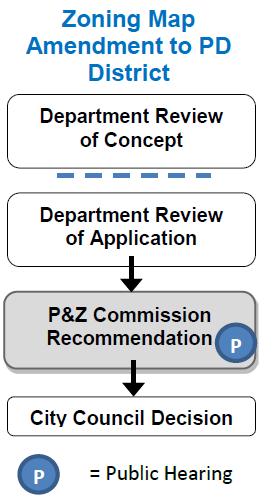
Applications to change the zoning map to designate land into a PD district, or to modify a PD district, shall be made, reviewed, and decisions made as described in section 29-6.4(n)(1) above, except to the extent those requirements are modified in this subsection.
(B)
Rezoning to a PD district requires council approval of a zoning map amendment, a statement of intent for the proposed development, and a development plan for the property. The statement of intent and development plan shall be binding on the owner and its successors and assigns. Later development applications must be consistent with the approved statement of intent and development plan, or the development plan will need to be modified by council action.
(ii)
Approval procedure.
(A)
Before filing an application, the applicant must first meet with the director for a concept review of the proposal. The concept review is an informal discussion to discuss land use and development concepts, consistency with the city's adopted comprehensive plan, applicable sections of this chapter and other city ordinances and regulations, and other concerns about the impacts of the proposed change that may be raised.
The application shall be accompanied by a statement of intent including, at a minimum, those items listed below and a development plan meeting the city's requirements as defined within the UDC Administrative Manual. The application and development plan shall be reviewed by the department and commission, and shall be the subject of final action by council, simultaneously. No application for a zoning map change to a PD district shall be approved without approval of an accompanying statement of intent or development plan. The required statement of intent shall, at a minimum, include the following items:
1)
The uses proposed in the PD district using the same names for uses, or combinations of those names, shown in Table 29-3.1. Such list may not contain any use that is not shown in Table 29-3.1 as that table appears at the time of the application;
2)
The type(s) of dwelling units proposed and any accessory buildings proposed;
3)
The maximum number of dwelling units and bedroom mix (multi-family only) proposed and the development density (net and gross);
4)
Minimum lot sizes, if applicable, maximum building height, minimum building setbacks from perimeter and interior streets, other property lines and minimum setbacks between buildings;
5)
The total number of parking spaces proposed (on-site or off-site) and the parking ratio per dwelling unit. Where off-site parking is proposed documentation shall be provided showing compliance with the provisions of this chapter;
6)
The minimum percentage of the entire site to be maintained in open space, shown by the percent in landscaping and the percent left in existing vegetation; and
7)
Any amenities proposed, such as swimming pools, golf courses, tennis courts, hiking trails or club houses.
(B)
The application materials shall document whether adequate utilities, storm drainage, water, sanitary sewer, electricity, and other infrastructure facilities are available to support the proposed development.
(C)
If the proposed PD development will require subdivision or resubdivision of land, the requirements of section 29-5 regarding subdivision of land shall apply, but the application for a PD district and subdivision of land may be completed simultaneously as described in section 29-5.2(c)(2). Any design modifications to the subdivision regulations proposed as part of the PD application shall be clearly stated on the PD development plan. Such design modifications shall be considered along with commission and council review of the plan.
(D)
No building permit shall be issued for any construction in a PD district until the development plan has been approved by the council.
(E)
No building permit shall be issued for any construction in a PD district that requires subdivision or resubdivision of land until a final subdivision plat for the property on which permits are requested has been approved by council.
(F)
If the PD includes buildings other than single-family detached dwellings or two-family dwellings, with each such dwelling located on an individual platted lot, no building or footing and foundation permit shall be issued until the site plan filed with the application for a building permit has been reviewed by the director for compliance with the approved development plan.
(G)
If construction consistent with the approved development plan has not begun within three (3) years after council approval of the development plan or a major modification of the development plan, the development plan shall expire and be of no force or effect, and no permit for development within the PD district shall be approved until a new development plan is approved pursuant to the same procedures used to approve the initial PD district. Prior to expiration of the PD development plan, the council may extend the time for a one-year period, on a one-time-only basis. A request for a time extension must be made in the form of a letter signed by the property owner or his agent.
(iii)
Modification procedure.
(A)
Minor changes to an approved development plan may be approved by the director. If the PD district contains any single-family detached dwellings or two-family dwellings, minor changes are those that:
1)
Comply with the original statement of intent;
2)
Do not increase the project density in total or in areas of the PD;
3)
Do not change the dwelling unit type (attached, detached, multi-family) being altered;
4)
Do not increase the height or size of any building;
5)
Do not change the size or nature of public or private infrastructure;
6)
Do not change the project amenities such as landscaping, open space, common area or recreational facilities;
7)
Do not rearrange the locations of buildings;
8)
Do not increase any parking area;
9)
Do not change the permitted use of any structure; and
10)
Do not create a potential increase in traffic.
(B)
If the PD district contains does not contain any single-family detached dwellings or two-family dwellings, minor changes are those that:
1)
Do not increase the height or size of any building;
2)
Do not increase any parking area;
3)
Do not rearrange the locations of buildings;
4)
Do not change the size or nature of public or private infrastructure; and
5)
Do not change the project amenities such as landscaping, open space, common area or recreational facilities.
(C)
Changes that do not meet the criteria for a minor change under subsection (a) or (b) above, as applicable, shall follow the same procedure as if it were a new development plan for the PD district.
(3)
Zoning map amendment to UC-O district. Applications to change the zoning map to designate land into a UC-O district, or to modify a UC-O district, shall be made, reviewed, and decisions made as described in section 29-6.4(n)(1) above, except to the extent those requirements are modified in section 29-2.3(a) (UC-O district).
(4)
Zoning map amendment to SR-O district. Applications to change the zoning map to designate land into a SR-O district, or to modify a SR-O district, shall be made, reviewed, and decisions made as described in section 29-6.4(n)(1) above, except to the extent those requirements are modified in section 29-2.3(b) (SR-O district).
(5)
Zoning map amendment to R-MH district.
(i)
Applicability.
(A)
Applications to change the zoning map to designate land into an R-MH district, or to modify an R-MH district, shall be made, reviewed, and decisions made as described in section 29-6.4(n)(1) above, except to the extent those requirements are modified in this subsection.
(B)
Applications to change the zoning map to designate land into an R-MH district require council approval of both a zoning map amendment and a development plan for the property that shall be binding on the owner and its successors and assigns. Later development applications must be consistent with the approved development plan, or the development plan will need to be modified by council action.
(ii)
Procedure.
(A)
Before filing an application, the applicant must first meet with the director for a concept review of the proposal. The concept review is an informal discussion to discuss land use and development concepts, consistency with the city's adopted comprehensive plan, applicable sections of this chapter and other city ordinances and regulations, and other concerns about the impacts of the proposed change that may be raised.
(B)
The application shall be accompanied by a preliminary development plan meeting the city's requirements, and the application and development plan shall be reviewed by the department and commission, and shall be the subject of final action by council, simultaneously. No application for a zoning map change to an R-MH district shall be approved without approval of an accompanying preliminary development plan.
(C)
If council approves the zoning map change ordinance and the preliminary development plan, with or without conditions, the applicant shall submit a final R-MH development plan to the director. The director shall approve the application if it complies with this chapter, all other city ordinances and regulations, and is consistent with the preliminary development plan as approved by council.
(D)
If the proposed R-MH development will require subdivision or resubdivision of land, the requirements of section 29-5 regarding subdivision of land shall apply, but the application for a R-MH district and subdivision of land may be completed simultaneously as described in section 29-5.2(c)(2). Any design modification to the subdivision regulations proposed as part of the R-MH application shall be clearly stated on the development plan. Such design modification shall be considered along with commission and council review of the plan.
(E)
No building permit shall be issued for any construction in an R-MH district until the final development plan has been approved by the director.
(F)
No electrical permit shall be granted for a manufactured home located in an R-MH district with an approved final development plan unless the placement of the manufactured home is in compliance with the approved final development plan.
(G)
No building permit shall be issued for any construction in an R-MH district that requires subdivision or resubdivision of land until a final subdivision plat for the property on which permits are requested has been approved by council.
(iii)
Enlarging existing manufactured home parks. An application to enlarge manufactured home parks existing on the effective date shall be subject to all provisions of this section relating to requirements for adoption of a new R-MH district. When a final development plan is approved for an extension of a manufactured home park existing on the effective date the screening requirements of section 29-4.4 shall apply to the entire manufactured home park.
(o)
Comprehensive plan amendment.
(i)
Applicability. This procedure may be used to amend the city's adopted comprehensive plan or to adopt a new comprehensive plan. An application to amend the comprehensive plan may be filed by the commission, the council, or any resident of the city. An application to adopt a new comprehensive plan may be filed by the commission or the council.
(ii)
Procedure.
(A)
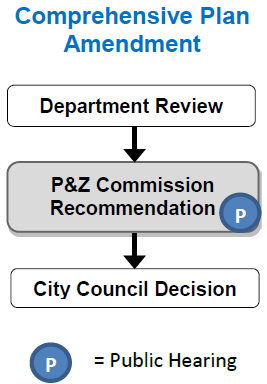
The director shall review the application and make a report to the commission regarding the areas of change from the adopted comprehensive plan and the anticipated long-term impacts of those changes on the growth, development, and sustainability, and affordability of the city, the investment climate in the city, and the efficiency of city administration.
(B)
The commission shall review the application, hold a public hearing on the proposed amendment, and make a recommendation to council.
(C)
The council shall take final action on the application.
(p)
Tall structures in the M-DT district.
(i)
Applicability. This procedure shall apply to proposed construction of buildings located upon frontages designated as urban general/urban general storefront on the M-DT regulating plan that seek to exceed the permitted maximum building height as defined within section 29-4.2 of this chapter.
(ii)
Procedure. All proposed buildings that exceed the maximum building height shall require council approval. Requests for tall structure approval in district M-DT shall require a petition on a form provided by the director and shall be referred to the commission for a recommendation and council consideration of an ordinance approving the tall structure in the same manner and following the same procedural steps as described in section 29-6.4(n) of this chapter.
Petitioners shall provide the planning and zoning commission with preliminary building plans (elevations and representative floor plans), site plan including adjacent streets and alleys, and a shade study. A "shade study" represents, in graphic form, the shade cast by the tall structure on adjacent properties and streets, by time of day and by season. An example of adverse impacts revealed by a shade study would be complete shading of rooftop solar panels mounted on an adjacent, lower building.
A tall building may be approved by the council if it satisfies the following criteria:
(A)
The height is consistent with adopted city plan recommendations for maximum building height in the specific location;
(B)
The additional height will not have an adverse impact on the availability of air and light to adjacent buildings and public streets; adequate spacing exists between the proposed building and openings in the walls of an adjacent building or between the proposed building and rooftop spaces used as amenities to allow the penetration of sunlight to those openings or rooftop spaces;
(C)
The additional height will not create demand on any public utility or public infrastructure in excess of available capacity, as concluded by an engineering analysis of the projected utility loads and the existing and planned capacities of infrastructure to accommodate it; and
(D)
Public sidewalks, crosswalks, and streets adjacent to the site are of sufficient capacity to handle the anticipated pedestrian and vehicular traffic generated by the tall structure, as concluded by a traffic impact analysis.
(Ord. No. 24566, § 1, 3-1-21; Ord. No. 24567, § 1, 3-1-21; Ord. No. 25562, § 1, 2-5-24)
Sec. 29-6.5. - Nonconformities.
(a)
Nonconforming uses.
(1)
Continuation, changes, and discontinuance.
(i)
Any use of land or buildings that was legally created, or that was legal in Boone County on the date that land was annexed into the city, may be continued, and may be transferred or sold to other owners or tenants, whether or not that use complies with the provisions of this chapter for the zoning district in which it is located, subject to the following conditions:
(A)
A nonconforming use of land outside of a building shall not be extended or enlarged beyond the area of land on which it occurred on the date it became nonconforming or the annexation date.
(B)
A nonconforming use of land inside a conforming building may be extended throughout the building that existed on the date the use became nonconforming or the annexation. The board may grant permission for an extension of a conforming building to allow expansion of a nonconforming use in that building by up to twenty-five (25) percent upon a showing that relocation of the use to a district in which it would be a permitted or conditional use would be impossible or impracticable.
(C)
If a nonconforming use of land or buildings is discontinued for any reason for a period of more than twelve (12) months, any future use of such premises shall comply with the provisions of this chapter. Such time period may be extended upon application to the board.
(D)
A nonconforming use of a building may be changed to another nonconforming use that the director determines will have fewer negative impacts on the surrounding area than the use it replaces, provided, that the original nonconforming use shall not be restarted.
(ii)
A nonconforming use of land or buildings, if changed to a conforming use, may not be thereafter changed to a nonconforming use. A nonconforming use of buildings that is changed to a nonconforming use that the director determines will have fewer negative impacts on the surrounding area may not thereafter be changed to any nonconforming use that the director determines will have more negative impacts on the surrounding area.
(b)
Nonconforming structures.
(1)
Continuation and change. Any structure that was legally constructed, or that was legal in Boone County on the date that land was annexed into the city, may continue in use, and may be transferred or sold to other owners or tenants, whether or not that structure complies with the provisions of this chapter for the zoning district in which it is located, subject to the following conditions:
(i)
Any expansion of a nonconforming structure shall conform to the building setbacks and all other dimensional standards applicable to new construction on the site.
(ii)
In the M-DT district, where a legal nonconforming building is located off the required building line, additions shall conform as nearly as practicable. Additions are not required to extend to the required building line. Existing building facades are not required to be retrofit to conform to M-DT fenestration or other M-DT façade requirements.
(iii)
If the structure is occupied by a nonconforming use, any expansion of the nonconforming use into the building expansion area will require approval of the board pursuant to section 29-6.5(a) above.
(2)
Damage and destruction.
(i)
If a nonconforming structure is damaged or destroyed by fire, explosion, an act of God, nature, or a public enemy, and the damage to the structure does not exceed seventy-five (75) percent of its reasonable value, excluding foundations, the structure may be reconstructed in substantially the same configuration as before the damage or destruction. If the damage to the structure exceeds seventy-five (75) percent of its reasonable value, excluding foundations, the structure may only be reconstructed in compliance with this chapter, as applied to the zone district where the structure is located.
(ii)
The provisions of subsection (i) shall not apply to structures containing only residential dwelling units (and permitted home occupations in those dwelling units), which may be reconstructed in substantially the same configuration as before the damage or destruction, regardless of the amount of damage or destruction.
(c)
Nonconforming lots.
(1)
A lot that does not conform to the standards in this chapter for the zoning district in which it is located may nevertheless be used for any use for which a conforming lot may be used, but must comply with all dimensional standards in section 29-4.1, all form-based controls in section 29-4.2, and all other provisions of this chapter applicable to property in that zoning district.
(2)
If the State of Missouri or the city acquires a portion of a tract or parcel of land for right-of-way and the remaining property thereby becomes nonconforming for the zoning district in which it is located, the property shall be treated as a conforming property.
(d)
Nonconforming site features. Conforming land uses and structures on parcels or tracts of land that do not comply with one or more of the standards in section 29-4.3 (parking and loading), 29-4.4 (landscaping and screening), or 29-4.5 (exterior lighting), may be expanded, revised, or redeveloped subject to the following conditions:
(1)
The expansion, revision, or redevelopment must be to land uses and structures permitted in the zoning district where the property is located;
(2)
The expansion, revision, or redevelopment must not increase any nonconformity with the standards in section 29-4.3, 29-4.4 or 29-4.5;
(3)
Any expansion or change in land uses that increases the amount of parking required on the property shall require that the net increase in required parking be provided on-site; and
(4)
Any redevelopment of the property that results in the demolition of an existing principal structure, as defined by the adopted building code or is more than seventy-five (75) percent of the building, and/or construction of new principal structures shall require that the property be brought into compliance with all applicable requirements of this chapter.
(e)
Nonconforming signs.
(1)
All signs which have been lawfully erected shall be deemed to be legal and lawful signs and may be maintained subject to the provisions of this section 29-6.5(e).
(2)
Nonconforming signs that become deteriorated or dilapidated to the extent of over sixty (60) percent of the physical value they would have if they had been maintained in good repair must be removed within sixty (60) days. Nonconforming signs that are damaged to the extent of sixty (60) per cent or less of their physical value must be repaired within sixty (60) days from date of notification, or must be removed. Nonconforming signs that are damaged, other than by vandalism, to the extent of over sixty (60) per cent of their physical value must be removed within sixty (60) days of receiving such damage or brought into compliance with the provisions of this chapter. Nonconforming signs that are damaged by vandalism to the extent of over sixty (60) percent of their physical value must be restored within sixty (60) days or removed or brought into compliance with the provisions of this section 29-6.5(e).
(3)
Nonconforming signs may not be enlarged or increased in height. Nonconforming signs that are enlarged or increased in height in violation of this section must be removed.
(4)
Nonconforming signs may not be relocated except when such relocation brings the sign into compliance with this section 29-6.5(e). Nonconforming signs that are relocated in violation of this section must be removed.
(5)
The sign face of a nonconforming sign may be altered if the sign face is not enlarged beyond the maximum area allowed by this section 29-6.5(e).
Sec. 29-6.6. - Violations, enforcement, and penalties.
The provisions of this chapter shall be administered and enforced by the director.
(a)
Violations. It shall be a violation of this chapter to:
(1)
Use any land or structure for a purpose or in a manner not permitted by this chapter, or without any permits or approvals required from the city before commencing that use of land or structure;
(2)
Subdivide any land whether through deed, survey, or other means, without compliance with the requirements of this chapter;
(3)
Expand, redevelop, or renovate any area of land or structure for which a permit or approval is required by this chapter without first obtaining those permits and approvals;
(4)
Operate any business or land use for which the city or the state or federal government requires a license, permit, or approval, without first obtaining those permits and approvals;
(5)
Park a motor vehicle in the residential yard in violation of section 29-4.3(f)(3) and fail to remove it within two (2) business days after notice from the city to do so, unless the property owner has first obtained a temporary permit for such parking under section 29-6.4(h);
(6)
Improve land or construct or modify structures in a manner that does not comply with any permits, approvals, or development plans, or that does not comply with any conditions on such permits, approvals, or development plans approved pursuant to this chapter;
(7)
Use land or construct or modify structures in any PD district in a manner that is inconsistent with the statement of intent for that zoning district;
(8)
Obtain any permit or approval required under this chapter based on false statements or misrepresentation of facts in any application, documents, correspondence, testimony, or verbal communications with the city;
(9)
Continue a land use or construction, modification, use, or occupancy of a land or structures after the city has suspended a permit or approval or issued a stop work order, until the city reinstates the permit or approval or withdraws the stop work order;
(10)
Fail to install improvements required by this chapter or by an agreement between the city and the property owner or subdivider by the times required by this chapter or the agreement; and
(11)
Take any other act that is prohibited by this chapter, or fail to act when that act is required by this chapter.
(b)
Enforcement.
(1)
In order to enforce compliance with this chapter, the director, the director of housing and neighborhood services, and the director of public works, as applicable, are empowered to take the following actions:
(i)
Cause a building or premises to be inspected for violations of this chapter, with such inspection occurring during normal business hours unless there is an imminent threat to public health or safety;
(ii)
Order in writing that the owner or occupant of the property on which a violation of this chapter is found correct that violation within a reasonable time;
(iii)
Take action to prevent or to stop any use of land or structures, construction or repair of structures, or any division of land that constitutes a violation of this chapter, and/or to prevent the occupancy of the land or structure on which or in which the violation has occurred;
(iv)
Revoke or suspend any permit or approval obtained through a false statement or misrepresentation of fact, or if the permit holder fails to comply with the terms or conditions of the permit or approval, with reinstatement of the permit or approval to occur only after the violation of this chapter has been remedied;
(v)
Refuse to issue any permit or approval, including but not limited to a building permit or certificate of occupancy, for any land use or structure that would violate this chapter, or that contains an existing violation of this chapter that has not been remedied after notice from the city;
(vi)
Remove any unlawful signs on street rights-of-way and property owned by the city;
(vii)
Authorize the city's legal officers to file a lawsuit or court proceeding to require compliance with this chapter and/or correction of any violation of this chapter or to require performance of claim damages for any failure to perform duties required by an agreement between the city and a property owner or subdivider related to a permit or approval under this chapter;
(viii)
Bring an action to require the owner of any property designated as a landmark or located in a landmark district who performs work in violation of this chapter or the requirements of section 29-2.3(c) to return the landmark or property to its appearance and setting prior to the violation, to the greatest extent practicable, and to impose a "demolition without a permit fee" under chapter 6 of the City Code; and
(ix)
Take any action permitted by state law or the city's charter to abate a violation of this chapter that constitutes a nuisance, including without limitation taking those actions listed in sections 12A-201 through 12A-207 (nuisances).
(2)
The enforcement actions set forth in subsection (1) above are cumulative and not exclusive. The city may pursue any available civil remedies, in any order, and may pursue more than one remedy at a time, and the city's choice to pursue one type of enforcement does not limit its ability to pursue different or additional enforcement actions until the violation has been corrected.
(3)
Any decision by the director or the director of public works to pursue any of the enforcement actions listed in subsection (1) (except orders for inspection, removal of signs on public rights-of-way and city owned property, and decisions to file an action in court) may be appealed by the board pursuant to section 29-6.3(f) if filed within ten (10) days after notice of that decision. A timely appeal suspends the enforcement action pending the outcome of the appeal.
(c)
Penalties.
(1)
Generally. The following provisions apply to all violations of this chapter unless an alternative penalty for a specific type of violation is listed in subsection (c)(2) below:
(i)
The owner or general agent of a building or premises where a violation of this chapter has occurred, or the lessees or tenant of an entire building or entire premises where such violation has occurred, or the owner, general agent, lessee or tenant of any part of the building or premises in which such violation occurred, or the general agent, architect, builder, contractor, or any other person who commits, takes part or assists in any such violation or who maintains any building or premises in which any such violation exists, shall be guilty of a misdemeanor.
(ii)
A first misdemeanor under subsection (c)(1)(i) above shall be punishable by a fine of not less than ten dollars ($10.00) and not more than two hundred fifty dollars ($250.00) for each and every day that such violation continues or by imprisonment for ten (10) days for each and every day such violation shall continue or by both such fine and imprisonment in the discretion of the court.
(iii)
For the second and subsequent offenses involving the same violation at the same building or premises, the punishment shall be a fine of not less than one hundred dollars ($100.00) or more than five hundred dollars ($500.00) for each and every day that such violation shall continue, by imprisonment for ten (10) days for each and every day such violation shall continue, or by both such fine and imprisonment, in the discretion of the court.
(iv)
Any such person who, having been served with an order to remove any such violation, shall fail to comply with such order within ten (10) days after such service, or shall continue to violate any provision of the regulations made under authority of this chapter in the respect named in such order, shall also be subject to a civil penalty of two hundred fifty dollars ($250.00).
(2)
Special penalties.
(i)
Violations of section 29-5 (subdivision standards).
(A)
Any person violating the provisions of section 29-5 shall pay to the city a penalty not to exceed three hundred dollars ($300.00) for each lot transferred or sold; the description by metes and bounds in the instrument of transfer or other document used in the process of selling or transferring shall not exempt the transaction from the penalty.
(B)
Any transfer or sale of land in violation of section 29-5 shall be deemed to be null and void and the city may enjoin or vacate the transfer or sale by legal action, and may recover the penalty in such action.
(C)
Any person violating the provisions of section 29-5, in a manner that does not involve the transfer of lots or parcels of land shall pay to the city a penalty not exceeding five hundred dollars ($500.00) for each and every day that such violation shall continue, or by imprisonment not exceeding one year, or by both such fine and imprisonment.
(ii)
Violations of climax forest requirements. Every one thousand (1,000) square feet of climax forest removed, destroyed or damaged in violation of section 29-4.4 shall constitute a separate offense.
(iii)
Violations of section 29-4.8 (sign standards).
(A)
The owner or general agent of a building or premises where a violation of section 29-4.8 exists, or the lessees or tenant of an entire building or entire premises where a violation of section 29-4.8 exists, or the general agent, architect, builder, contractor or any other person commits, takes part or assists in any such violation or who maintains any sign or premises in which a violation of section 29-4.9 exists, shall be guilty of a misdemeanor and shall pay to the city a fine of not less than ten dollars ($10.00) and not more than one hundred dollars ($100.00) for each and every day that such violation continues, unless subsection (b) below applies.
(B)
If the violation of section 29-4.8 is or was willful, the penalty for violation shall be a fine of not less than one hundred dollars ($100.00) or more than two hundred fifty dollars ($250.00) for each and every day that such violation shall continue or imprisonment for ten (10) days for each and every day such violation shall continue, or both such fine and imprisonment in the discretion of the court.
(C)
Any such person who, having been served with an order, within ten (10) days after such service shall continue to violate any provision of section 29-4.8 in the manner named in such order, shall also be subject to a civil penalty of two hundred fifty dollars ($250.00).
(iv)
Violation of section 29-4.3(f)(3) (parking - use of yards). Any person found in violation of section 29-4.3(f)(3) shall be deemed guilty of a misdemeanor and shall be punished by a fine of not more than one hundred dollars ($100.00) or by imprisonment of not more than thirty (30) days, or by both such fine and imprisonment.
(Ord. No. 25587, § 4, 2-19-24)

